Rosa Luxemburg, revolutionary fighter for workers and oppressed

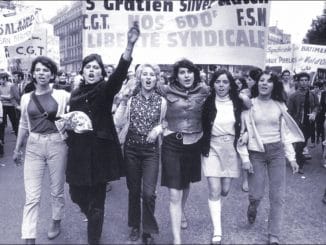
At least 15,000 people marched in Berlin on Jan. 13 to mark 100 years since the murders of Rosa Luxemburg and Karl Liebknecht. Photo: Junge Welt

One hundred years ago, on January 15, 1919, counterrevolutionaries murdered Rosa Luxemburg and Karl Liebknecht, founders of the German Communist Party.

Rosa Luxemburg is often overlooked as one of history’s most important Marxist thinkers. She must also be remembered for her tremendous contributions to the international workers’ movement leading up to and following Russia’s Great October Socialist Revolution of 1917.

Luxemburg was born in 1871 to a Jewish family in Russian-occupied Poland. An accurate history of her life cannot overlook her Jewish identity. At the time, czarist Russia’s rulers often incited pogroms — mass murders — against Jewish communities.

Luxemburg’s childhood was rife with these violent acts of anti-Semitism, along with everyday experiences of anti-Jewish oppression. She also experienced ableism throughout her life because of a visible limp, the result of childhood illness.

At age 16, Luxemburg became involved with the revolutionary socialist movement in Poland, headed by the Proletariat Party. Under pressure from the police, she left Poland for Zurich, Switzerland, where she attended university and participated in the local labor movement.

She quickly became a main contributor to the Proletariat Party’s paper and one of its leading Marxist theoreticians. In 1898, Luxemburg obtained German citizenship and settled in Berlin, the heart of the international socialist movement at the time.

Rosa immediately took up work for the Social Democratic Party of Germany. She found the party dividing due to a growing reformist trend. Luxemburg quickly jumped to defend the principles of Marxism and revolutionary thought, and to call out reformism and revisionism in the movement.

In 1905, Luxemburg went to Czarist-controlled Warsaw to participate in the unsuccessful Russian revolution of that year, where she continued to secretly write for her party’s paper. After being imprisoned, she was expelled from the Russian Empire and returned to Germany with one of her most important theoretical ideas: that mass strikes constituted a most important aspect and necessity of the workers’ struggle for a socialist revolution.

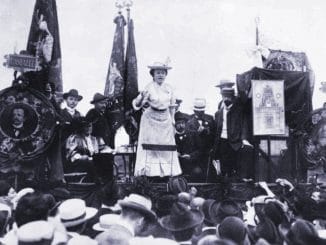
Rosa Luxemburg speaks at a rally during the International Socialist Conference in Stuttgart, Germany, 1907.

Revolutionary opposition to imperialist war

Many political writers emphasize Luxemburg’s theoretical disagreements with Vladimir Lenin, founder of the Bolshevik Party and leader of the Russian Revolution. Some do so in order to argue that Luxemburg was opposed to the Bolsheviks and to discredit the socialist nature of the October Revolution. In particular, they point out that Luxemburg challenged Lenin’s position on the right to self-determination for all oppressed peoples.

Nevertheless, Luxemburg and Lenin had far fewer differences than they had commonalities; in fact, they agreed on almost all fronts, and Lenin held Luxemburg in very high regard. From the start of World War I, both Karl Liebknecht and Luxemburg took the correct position against war and imperialism, in opposition with most of the social democratic movement at the time.

Between 1906 and the beginning of World War I in 1914, Luxemburg spread a revolutionary anti-war, anti-imperialist message among the masses. In 1910, a growing divide in the Social Democratic Party — between reformists who supported the prospect of German imperialist war and true anti-imperialist revolutionaries — reached its peak, and the party divided along those lines, with Rosa at the helm of the revolutionary grouping.

In 1914, the parliamentary representatives of the German Social Democratic Party voted unanimously — excluding one member, Karl Liebknecht — to back the German government in favor of the war. In response, Luxemburg, Liebknecht, Clara Zetkin and a small number of other revolutionary socialists formed the Spartacus League, dedicating themselves to continuing the anti-war struggle in Germany, despite harsh repression.

From prison, Rosa highly praised Russia’s 1917 socialist revolution, issuing calls for German workers to join the international movement. In November 1918, German revolutionaries freed Luxemburg from prison and she hastily resumed agitating and organizing the masses. Her efforts helped reinvigorate the revolutionary socialist struggle in Germany, and in December 1918 she founded the German Communist Party alongside Karl Liebknecht.

In January 1919, workers in Berlin rose up, but their movement, lacking adequate preparation, was crushed. Just two months after her release from prison, German proto-fascists assassinated Luxemburg and Liebknecht with help from the right-wing Social Democrats, who betrayed their whereabouts and enabled the fascists’ agenda.

Luxemburg gave her life to the international socialist struggle, and must be remembered as a disabled, Jewish and revolutionary woman who made brilliant theoretical contributions to Marxist theory, strategy and tactics.

Strugglelalucha256


Lesson of France 1968: Workers must declare themselves in power

The year 2018 marked the 50th anniversary of the May 1968 uprising of workers and students in France. In light of the Yellow Vests protest movement shaking France today and the continued relevance of the lessons of 1968 for anti-capitalist struggles, Struggle★ La Lucha is publishing a series of articles written at that time by Sam Marcy, one of the leading Marxist thinkers of the second half of the 20th century. This piece originally appeared in the June 20, 1968, issue of Workers World newspaper.

Up until the present time, there has been no successful proletarian revolution in the Western capitalist countries. The apologists for Western imperialism seem never to forget to remind us of this fact.

The revolutions in Eastern Europe that came during World War II were to one degree or another aided by the strong intervention of the Red Army, even where the Communist Party was very strong and had large popular support among the workers and peasants. There were, of course, attempts at proletarian revolution immediately after World War I in Germany and in Italy. There were also favorable opportunities for proletarian revolution in Germany during the period immediately preceding the Nazi takeover by Hitler and in France and Spain in the years immediately following Hitler’s seizure of power.

In the view of many, there also existed favorable opportunities in Italy and France after World War II, when large sections of the popular masses were armed and the capitalist state in both countries seemed on the verge of utter collapse.

At this writing, all of the imperialist publicists and commentators are busily writing obituaries to the French Revolution 1968. But as Mark Twain noted, in a different context, “Reports of my death are highly exaggerated.” And, of course, the broad implication of their propaganda is that the Western proletariat is congenitally incapable and uninterested in carrying out the proletarian revolution. As Sanche de Gramont in the Sunday, June 16, New York Times Magazine summed up their (wishful) thinking: “The French workers don’t want to wreck the affluent (affluent for whom? – S.M.) society. They just want to participate in it.”

Of course there is no question that the revolutionary situation in France as it has developed in the last four weeks has experienced a certain ebb tide. No revolutionary situation can continue consistently and steadily on the upgrade unless there is a seizure of power by the working class and its allies. Failing that, a recession is bound to set in. And that is what has happened.

Workers must declare themselves in power

A general strike such as the one which engulfed France these last few stormy weeks cannot endure indefinitely. The leadership of the working class in general and the trade union leadership in particular must make a conscious bid for state power. They must try to orient the working class toward a general seizure and maintenance of the plants, industry and economy with the revolutionary aim of declaring itself — we repeat, declaring itself — to be the legal, that is, the political authority in the country as against the police, the military and the pro-fascist dictatorship of [President Charles] de Gaulle, which has been repudiated by the popular, decisive masses in the streets and factories.

Unless this is done, the revolutionary tide cannot but begin to recede. In fact, it has begun to recede. But it is only a recession. There has been no definitive, no decisive defeat for the working class and its allies among the city and rural poor. Conversely, there has not been a decisive victory for the bourgeoisie.

De Gaulle calls on hated fascists

The de Gaulle regime is as shaky as it ever has been. Its condition both economically and politically is as desperate as it has ever been. And as we have indicated in previous articles, it is torn by a thousand inner class contradictions which it cannot resolve.

Imagine the plight of de Gaulle. He has had to call upon his worst personal enemies for help. He has had to lean on none other than Bidault, Salan & Co., the outright fascist elements so bitterly hated by the overwhelming majority of the French people. These elements only yesterday were plotting his assassination. Can he really have a stable united front with them?

De Gaulle’s so-called reconciliation with the army generals is only of a pro-forma character. The various cliques in the military camarilla make it highly questionable whether they can act in unison in a showdown. The reliability of the army rank and file and of sections of the police once the revolution begins in earnest can only be tested in the crucible of the actual struggle itself.

Decisive battles yet to come

As of now, neither of the major social classes on the opposite sides of the class barricades has been vanquished. Whatever has been lost or won, whatever may have been won by the bourgeoisie and lost by the proletariat and its allies, has been strictly in the field of political maneuver. This has not resulted in major casualties.

True, there have been some killings and brutal, savage beatings of students and workers. Measured by the scale of revolution, however, these can only be regarded as initial skirmishes. No major battle has yet been fought. All that the bourgeoisie has won is a psychological victory.

The lull before the storm

The workers have gone back to work, certainly. But their spirit has not been broken. Their class consciousness has not evaporated. On the contrary, it has been enhanced and enriched. This is the key factor in this great historical situation. This is precisely what the bourgeois press here and everywhere wants to hide. At any rate, most of the workers have gone back only because the French Communist Party-General Confederation of Labor (CGT) leadership has urged them to. The CP-CGT leadership has accepted de Gaulle’s edict to engage in a parliamentary contest with the ruling class for electoral seats rather than wage a revolutionary contest for proletarian state power.

This is where the situation rests at the present time. It is a lull before the next storm. It also affords the opportunity for the revolutionary elements which side with the proletariat against the bourgeoisie to take stock of the situation, reassess their tactics and prepare for the next stage of the struggle.

Objective conditions, class relations still favorable for revolution

The mass mood of the workers, students and rural poor may have changed. Some of the enthusiasm may have evaporated. Anger and disillusionment with the official leadership of the working class and the trade unions may have led to temporary pessimism. But this again is only a mood. The objective relationship of the classes and the relationship of the political forces in the country remains the same.

The actual living conditions of the overwhelming majority of the workers and peasants and a large section of the middle class have not materially changed except perhaps for the worse. The bankers, industrialists and financiers in whose behalf de Gaulle is mounting his counterrevolutionary offensive are not about to grant such major economic and political concessions as would materially influence the conditions of the mass of poor and exploited. Even if the rulers would, the question is still whether they could.  

Therein lay the tremendous material advantages in favor of the further prosecution of the proletarian revolution.

But how? The problem revolves almost entirely around the question of bourgeois parliamentarism — a centuries-old deception carefully cultivated by the bourgeoisie to ensnare, dupe and frighten the masses in the same way in which priests during the feudal period used to frighten the peasants with dire consequences if they refused to purchase indulgences.

‘From revolutionary action to a majority!’

Joseph Barry, former Paris correspondent for the New York Post, reporting in the June 13 Village Voice, writes:

“Two days ago a man handed me a leaflet saying de Gaulle’s requested Civic Action Committee would have its first organizational meeting for my 6th arrondissement in the local government mairie [town hall]. I already had a leaflet from the left-wing Action Committee for the 6th arrondissement ending with the slogan: ‘Not from an electoral majority to revolutionary action, but from revolutionary action to a majority!’ (De Gaulle’s dissolved parliament has a Gaullist majority, yet the action leading to its dissolution was in the street not in parliament.)”

Whatever was the political position of the writers of the slogan: “Not from an electoral majority to revolutionary action, but from revolutionary action to a majority!” even though somewhat vague, they were correct in principle and it reflects the objective tasks of the proletariat.

The idea that the working-class party must win a majority of the masses in a bourgeois parliamentary election supervised by a bourgeois government under a bourgeois system is one that is not easy to overcome. All the political parties of the left in France, as everywhere else in the West, have continually and uninterruptedly in one way or another sustained and strengthened this deception. Now the apologists say, “We are not a majority, we are one-fourth, maybe one-third of the electorate, we need to win an electoral majority.”

De Gaulle conspires with general: the revolution cannot wait

But what if the proletarian revolution is on the doorstep before a majority in an election can be won? What if a neofascist type of police dictatorship threatens the very political existence of the working class, its rights and liberties? What then? What if the revolution can’t wait for a parliamentary majority? What if fascist dictatorship is on the doorstep of every worker’s home? What then?

It took the bourgeoisie centuries to develop its parliamentary system and to “educate” the masses to accept it. The ruling class permitted universal suffrage only after it was absolutely sure that its parliamentary system worked in its favor.

For centuries, the vote was only permitted to property owners. Only after the bourgeoisie felt that it had pacified the masses and “educated” them to its ways did it permit universal suffrage. To the bourgeoisie, universal suffrage and the parliamentary system in general have always been an ideological weapon for the domination and political subjugation of the proletariat, of the exploited, the poor and the oppressed.

The proletariat in power will win all humanity

Marx and Engels took pains to explain that universal suffrage under a bourgeois system can at most, at best, be merely “an index of the maturity” of the working class for power. It can never be more. The truth of this generalization has been proven by the entire history of bourgeois parliamentarism throughout the West.

However, the working class can and will win a majority of the people, and a great deal more than a majority, not under the system of bourgeois parliamentarism, but under a working-class system where the proletariat has the power and the means to educate the population under its and not under the bourgeoisie’s ideological tutelage.

Yes, working-class leaders, students and their allies can say proudly, let us exercise power, real power, by taking the reins of society in our own hands. We will run society on a socialist basis, free from the parasitic, mercenary landlords, bankers, industrialists and other exploiters. We will win more popular support through our state, through our system (because it is a socialist system) than the bourgeoisie could ever win, because we can rectify all the basic ills of society and the bourgeoisie cannot and will not. They can only aggravate them.

It is not too late even if de Gaulle and his pro-fascist coalition should win a majority in his rigged parliament, the parliament of the bourgeoisie. It will not end the acute class struggle which has been brought to the surface in recent weeks. It has only temporarily subsided. It will re-emerge with greater force, with greater vitality than ever.

As against the rigged bourgeois parliament, the working-class organizations, the students, the rural poor and the exploited and oppressed of the cities must strive to build a unified, parallel center, a center of proletarian power — the next phase of the struggle.

Part 1 – Revolutionary situation in France 1968: Which road for the mass struggle?

Part 2 – Decisive question in France 1968: Revolutionary or reformist leadership?

Strugglelalucha256


Decisive question in France 1968: Revolutionary or reformist leadership?

The year 2018 marked the 50th anniversary of the May 1968 uprising of workers and students in France. In light of the Yellow Vests protest movement shaking France today, and the continued relevance of the lessons of 1968 for anti-capitalist struggles, Struggle–La Lucha is publishing a series of articles written at that time by Sam Marcy, one of the leading Marxist thinkers of the second half of the 20th century. This piece originally appeared in the June 6, 1968, issue of Workers World newspaper.

June 4, 1968: The key question in the French Revolution of 1968 is the role of the leadership of the working class in the unfolding events. All other questions really merge into this one.

As these lines are written, press reports indicate a back-to-work movement of the French workers following President Charles de Gaulle’s ultimatum and his threat to use force.

Nevertheless, all the basic conditions for the success of the revolution still exist. In fact, a more favorable political situation for a proletarian revolution during peacetime could scarcely be hoped for.

It is fully two weeks since the workers began to take over the large plants — which is a long time in a revolutionary situation. Almost all of the economic arteries of French national life are still in the hands of the working class.

De facto power of workers

Despite the admonition to the workers by the General Confederation of Labor (CGT) trade union leaders to accept the government’s wage offer; despite Gaullist threats of force and violence, military conspiracy, parliamentary trickery; despite all these factors, the de facto power, as of today, rests squarely in the hands of the working class.

Even at this late date, the much touted back-to-work movement which the capitalist press throughout the world has hailed with so much advance publicity appears to be a trickle against the vast number of strikers.

The fundamental political problem in France concerns the relationship between the general strike and proletarian revolution.

By all accounts, the general strike is the strongest, most widespread and best organized of any in the history of the modern working-class movement. Indeed, it has few parallels.

The great French strikes of 1936 encompassed at most about three million. As of yesterday, it was 10 million and probably more. It exceeds in numbers, depth and revolutionary intensity the only other general strike in Western Europe which brought a country to an almost complete standstill. And that was the British General Strike of 1926.

Although no one doubts the power of the present French General Strike, until just a few days ago it was questioned as to whether it had any revolutionary significance. By now, however, it is almost universally admitted that the strike has posed a revolutionary threat to the regime.

In fact, it has put on the order of the day the proletarian revolution. What is a proletarian revolution? It is a transfer of power from the bourgeoisie to the proletariat. Is this what is happening in France?

Capitalist state helpless

The New York Worker of June 2 [publication of the Communist Party USA] stated flatly that there were “ten million strikers who held in their hands the actual power of the French Republic, having paralyzed economic life and rendered the state helpless.” The account in the Worker is based on reports from Paris. We quote the Worker because it is a close friend and political ally of the French Communist Party.

If, as the Worker states, “the strikers hold in their hands the actual power of the French Republic and render the present capitalist state helpless,” is this not a proletarian revolution in the making? But even if we were to disregard the conclusions of the Worker, there are literally scores of reports in the capitalist press which substantiate the same conclusions.

For instance, [journalist] Max Lerner, who was in Paris at approximately the same time, states that “the rebellion which was sparked by the students became a revolt when the unions seized the factories, and it became a full-fledged revolution when they decided to turn down the general strike settlement which their own union leaders had reached with the government and other employers.” (New York Post, June 3)

But aside from any and all assertions and analyses, the objective facts speak for themselves — the workers, the farmers, the students are in a state of utter rebellion. The sea of red flags that hang over the factories is clear and unambiguous evidence of a desire not merely for economic change but for proletarian revolution.

The key question relates to the role of the leaders of the working-class organizations. From the very beginning, they were taken completely by surprise when the workers seized the plants.

It is entirely possible that even the most revolutionary leadership could be taken by surprise by a spontaneous revolutionary outburst of the working class such as in France.

Revolutionary or reformist leadership?

But a revolutionary leadership is distinguished from a reformist, bourgeois type in that it would welcome the revolutionary situation and seek to turn it into a full-scale assumption of proletarian power.

Indeed, if the capitalist “state is rendered helpless,” does it not follow as night follows day that the workers should set up their own state, since they already have de facto power in their hands?

Instead, however, the leaders are desperately trying to reduce the struggle to a narrow economic one, and, while seeking some concessions from the government and the employers, they are in reality desperately trying to abandon the revolutionary struggle of the workers for state power.

Parallel with British General Strike

The general strike is often regarded as a mere economic weapon launched for economic objectives and not as a revolutionary struggle aimed at the regime and social system itself. The apologists for the Communist Party-CGT leadership in France are trying hard to draw on the tragic experience of the British General Strike of 1926 to bolster their reformist thesis.

The parallel with the British General Strike is indeed instructive, but it thoroughly refutes their thesis.

In 1926, the British working class tied up the country when three million workers walked off their jobs in protest against a government recommendation which would have cut the wages of the coal miners. As in France today, all dock workers, steel workers, building workers were out. Everything was down — all transportation by rail or bus, all shipping and all newspapers with the exception of those published by the British workers for the workers.

Prime Minister Baldwin and General de Gaulle

Like the de Gaulle-Pompidou government, Prime Minister Stanley Baldwin and Winston Churchill launched a monstrous red-baiting campaign. It did not measurably influence the workers. On the contrary, it strengthened their resistance. Like de Gaulle, Prime Minister Baldwin launched a series of maneuvers, including the calling up of the army reserves, demonstrations of the armed forces in London, followed by a series of arrests.

Nevertheless, the strike continued strong. It was the leadership, fearing for the existence of the capitalist system, that suddenly caved in and surrendered. Thus was ended the most revolutionary initiative of the British workers since the Chartist Movement of 1848.

This is the true lesson of the British General Strike. There has been nothing like it since. But there are important differences between the 1926 strikes and the great French sit-downs in 1936, and the present strike, which clearly shows how much more favorably situated is the present leadership in France than were the British leaders in 1926 or the French in 1936. In Britain there was no revolutionary movement of the students that generally reflected the discontent of vast middle-class elements. Equally important was the absence of a parallel protest movement in the rural areas and towns of Britain, unlike present-day France.

Nevertheless, all historical accounts of the Great General Strike of 1926 by working-class observers put the failure of the strike on the shoulders of the leadership.

The British General Strike came in the midst of a general political awakening of the British working class. There were evident signs that the empire was beginning to crack. According to the ruling class, the way to salvage the empire and save Britain’s position in the world as a great imperialist power was to take it out of the hides of the workers, just the way de Gaulle and his cohorts want to do. Prime Minister Baldwin was, like General de Gaulle, trying to preserve the grandeur of British imperialism’s world position.

One of the lessons of the general strike was that while its origins and objectives were economic and while it didn’t necessarily aim to go beyond the confines of the capitalist system, its very scope and momentum posed a revolutionary threat to the power of the ruling class.  Because it successfully tied up the economic life of the country, it also showed the workers that their economic strength could, under the circumstances of a general strike, turn into political power for the working class. This was an objective to which the leadership of Cooke and Purcel of the General Council of the British Trade Union were wholly opposed — just like the present CP-CGT leadership.

French peasant rebellion

How different is the situation today in France! It is scarcely possible to find a more favorable political situation. For the first time in many decades the working-class struggle coincides with the profoundest and deepest discontent of the rural population. Take the demonstration in Auch, France, on May 24, just to give one of many examples. Thousands demonstrated in the farming area of southwestern France. Riot police used tear gas grenades to stop the demonstrators from breaking into the capitol building. Their slogan was “down with de Gaulle.” “We are the serfs, the slaves of the modern era,” shouted a young farm leader from the lowland hamlet of Carbonne. Many of the marchers sang the Internationale.

Under these circumstances it is easy to see that the objective conditions for an alliance between poor peasants and workers is all but guaranteed, if the leadership of the working-class organizations has the courage and determination to take advantage of it while the opportunity lasts.

One of the fundamental objective conditions for the failure of the Paris Commune of 1871 was the lack of support from the countryside. Now, the countryside is seething with rebellion. De Gaulle’s common market scheme has meant misery for the rural poor no less than de Gaulle’s anti-labor policy has meant increasing deprivation for the broad masses of the working class.

After the Paris Commune, Marx said that what would be needed for the victory of the French proletariat was “another edition of the Peasant War” of the preceding century. As one reads about how the peasants are now waving pitchforks and chanting “Pompidou resign,” the situation seems to be ready made for a true revolutionary alliance between peasants and workers.

Action Committee

L’Humanite of May 24, organ of the French CP, reports the existence “in many Departments of Action Committees for setting up a government that would rely on the alliance of all Left forces and be guided in its activity by a program meeting the interests of the mass of the people.”

This is incontrovertible evidence of the embryonic existence of proletarian power. These Action Committees in alliance with other elements of the rebellious population can function as organs of workers’ power, especially if they can ally themselves with the students and rural poor.

To effectuate the transition to proletarian power by the Action Committees and other revolutionary forces, it is necessary to make a complete break with bourgeois parliamentary trickery. It is a foregone conclusion that the type of election scheduled by the Gaullist dictatorship to take place late in June is merely a maneuver calculated to divert the attention of the masses and make them oblivious to the fact that they already have power in their hands and oblige them to transfer it back to the bourgeoisie.

The masses already have spoken by their deeds. The CP and CGT and whatever other allies they have should boycott the elections as a fraudulent device, calculated to deprive the masses of the fruit of their victory. By admonishing the masses to accept the wage agreement in the first place, the leadership showed that they were entirely out of touch with the masses. Fortunately the negotiations were broken off with the government and the employers.

Resort to naked military threats

When de Gaulle announced that he would schedule a referendum, the hostile reception he got from the general population further enhanced the revolutionary mood of the popular masses. From this a section of the ruling class drew the conclusion that perhaps de Gaulle ought to resign. So great was the clamor that a virtual split took place in de Gaulle’s own cabinet.

Under the revolutionary pressure of the masses, the bourgeoisie became more isolated and sought to overcome the crisis by resort to naked military threats and conspiracy with the reactionary military camarilla.

All of this was designed to intimidate the CP-CGT leadership and get them to drive the masses back to work and return the plants to the exploiters.

While, on the one hand, rumors of de Gaulle’s resignation were carefully planted, on the other hand, military maneuvers were widely publicized to intimidate the leaders in the hope of paralyzing the masses.

Then came de Gaulle’s carefully planned counteroffensive. This was an open appeal to the anti-communist, anti-working-class and pro-fascist elements, with a strong threat of open civil war, which was meant to serve as an ultimatum to the revolutionary masses to accept still another parliamentary fraud in the form of general elections.

As of now, June 4, the apparent agreement of the Communist Party leaders to participate in the election and the reported agreement of the CGT leaders to recommend negotiations with the de Gaulle government, especially after both organizations made the resignation of the government a demand of the workers, indicates a capitulation to the threat of the use of force and a surrender of the revolutionary struggle of the workers in favor of the same old fraudulent bourgeois parliamentary hoax.

As the New York Times of May 31 pointed out, “de Gaulle’s present tactics are designed to cover his defeat at the hands of the workers.” What a revealing admission! De Gaulle’s aim, this Times editorial affirms, “is to get the strikes ended and the French middle class activated to vote the Gaullist ticket.” Then the Times significantly adds, “the electoral system will help.”

Role of middle class

Indeed! So far as the middle class is concerned, it is well to remember Marx’s classic analysis of it which remains true to this very day. It is a socially heterogeneous and politically divided social formation. It is torn by a thousand inner contradictions, but it has no independent standing in bourgeois society. It stands in the middle, between the two great classes in contemporary society, the proletariat and the bourgeoisie.

In time of acute class struggle between the bourgeoisie and the proletariat such as is taking place now in France, the middle class continually vacillates between the two great class camps. Invariably as throughout all its history, its decisions will be made on the basis of which class shows the greater determination and the greater power in the struggle. If matters are left to be decided by bourgeois parliamentary methods and not by a decisive bid to reconstruct society on the basis of the power the workers hold now, unquestionably a large section of the middle class will line up with Gaullism.

Every strike an embryo revolution

The occupation of the plants and all industries by a phenomenally successful general strike is only a transitional step to the next phase of the struggle. Every strike is an embryo revolution. The occupation of the plants is a threat to private property. The occupation of the plants on a nationwide scale is a threat to the entire bourgeois social order and is a precursor to collective ownership by the proletariat.

The bourgeoisie cannot help but recognize this. The occupation of the plants is a symptom of dual power between the proletariat and the bourgeoisie. Such a state of affairs cannot endure indefinitely.

Either the proletariat takes over the plants completely, expropriates the bourgeoisie and sets up an alliance with the students, the rural poor and the white-collar workers in the urban centers for the purpose of transforming society, or the bourgeoisie may well crush the working class. The rock-bottom issue in France is proletarian power or ultimately an anti-labor, reactionary bourgeois dictatorship with a military clique to rule over all of France.

Bourgeois vs. proletarian democracy

According to L’Humanite as quoted in the Worker of May 28: “Conditions are rapidly ripening to end the Gaullist power and create a real democracy conforming to the interests of the French people.”

But democracy does not exist in the abstract. There is bourgeois democracy based on a bourgeois parliamentary system as it exists in France today — or a proletarian democracy based upon the popular masses, the working class, the rural poor, the students and the white-collar workers. Nothing could do more to deceive the French working masses than to put up such a fraudulent formulation of democracy.

Alongside this formulation L’Humanite adds: “This democracy will open the road to socialism.” A proletarian democracy based on the proletarian ownership of production and the expropriation of the bourgeoisie will indeed open the road to socialism, but a bourgeois democracy based upon a bourgeois parliament where the bourgeoisie is sure to predominate as it always has is nothing but a new name for an old fraud.

That this nonsense about democracy in general opening the road to socialism, which is being spouted by L’Humanite, should emanate from the land of the Paris Commune, is the worst of all ironies. For it was the Paris Commune which showed that a democracy under Thiers (i.e., de Gaulle) was really a bourgeois dictatorship, while the class rule of the Paris Communards was a proletarian democracy.

Popular Front coalition – on what class structure?

L’Humanite’s solution to the present crisis is a Popular Front. This is a coalition with the leftist section of the bourgeoisie such as with François Mitterand and others of his stripe. A coalition with capitalist politicians, on the basis of the present parliamentary system, which is based on the bourgeoisie as the possessing class, is a class betrayal of proletarian interests. It will simply be a modern version of the coalition between the liberals and the Labour Party of Britain and will mean that leaders of the working-class parties will hold office (even high office) in the cabinet. But they will only be office holders.

This is the most important of all the important distinctions between bourgeois democracy and proletarian democracy. In a bourgeois coalition based on a bourgeois parliamentary system the cabinet ministers are mere office holders. Power — real power — rests with the class that owns and controls the means of production — in this case, the bourgeoisie which runs the social system and determines the destiny of society as a whole.

But it would be altogether different if the CP and CGT proposed that the Mitterands and colleagues first help the workers expropriate the bourgeoisie and let the workers not merely possess but own the means of production, the peasants the land, the students and teachers the schools and universities and so on and so forth. If the Mitterands and Pierre Mendes-Frances accept this kind of coalition on the basis of proletarian rule, that might serve a progressive purpose. It might in fact be a step in the direction of socialism and a transitional stage to the abolition of all social classes and exploitation of man by man.

It would be wrong to say that we are against a coalition with the Mitterands under any and all circumstances. A coalition with them on the basis of the class rule of the proletariat and its allies may serve a useful purpose, especially if they join in disarming the bourgeoisie and dismantling its military and police apparatus.

Arming the workers

All of this is well and good, we are told, but there is one element that we have consistently left out of the situation and that is the role of the military and the fact that the French proletariat is not armed. It is basic to Marxist-Leninist strategy that no proletarian revolution can succeed without having arms in its possession.

It is true that the French working class is not armed in the sense that it does not now have a formal armed workers’ militia. But the workers are armed in the sense that they control the means of transit, the means of communication and the plants that produce arms and ammunition. Furthermore it is not really true to say that the French working class is totally disarmed.

Thoughtful revolutionary young leaders have undoubtedly given much consideration to just such a revolutionary situation as exists today. The army, that is to say, the army and police as presently constituted, is a small percentage of the population and can exercise great power only if the working class and its allies are apathetic and politically indifferent, confused and without perspective.

But an aroused proletariat having vast popular support among nonproletarian masses, as does the French proletariat, will succeed in arming itself and will disarm the bourgeoisie and its mercenary forces. Those leaders that seek to scare the people with frantic shouts that the workers aren’t armed should be asked why the leaders didn’t arm them. Some of these very same leaders acquiesced in the disarming of the French Partisans at the request of this very same de Gaulle they are now fighting. They should be made to answer rather than to ask questions about arming of the masses.

At any rate, the true answer to the arming of the workers and the prosecution of the proletarian revolution lies in the old maxim, “Whoever wills the objective must will the means thereto.” For a revolutionist that is the best answer.


Part 1 – Revolutionary situation in France 1968: Which road for the mass struggle?

Strugglelalucha256


Stock market decline worst since 1930s. Where is this going?

The Wall Street stock market closed December 21 with its worst weekly drop in more than seven years. The fall continued on December 24, losing more than 650 points.

The S&P 500 ended a brutal week down 7 percent. The Dow Jones Industrial Average fell 414 points. The Nasdaq fell 3 percent.

Major U.S. stock markets are now 16 percent to 26 percent below the peaks they reached in the summer and early fall, according to the AP. The Bloomberg Billionaires Index dropped $511 billion this year.

This will be the worst December for stocks since the 1930s.

The economic landscape looks much like 1937, when an apparent economic recovery from the Great Depression came to a sharp stop ― after the Federal Reserve hiked interest rates, triggering a new downturn. And throughout this year, the Fed has been hiking interest rates ― with the latest rise this week ― while the stock market is falling and economic growth is slowing, says Marxist economist Michael Roberts.

Looking behind the curtain

What happens in the stock market reflects the conditions of capitalist production. The mysterious gyrations up and down may appear to be like a disappearing act in a Las Vegas magic show, but they represent the anticipated direction of the economy. And a fall in the stock market can have wide repercussions.

The losses in a stock market downturn directly hit millions of workers and middle-class people through the loss of their savings, pensions and other retirement funds, insurance funds and other institutions, all of which are invested in the stock market.

Engels on the stock exchange

What is the role of the stock market? As long ago as 1895, Frederick Engels, in supplementary notes updating Volume 3 of Capital, said:

“[The stock exchange] tends to concentrate all production, industrial as well as agricultural, and all commerce, the means of communication as well as the functions of exchange, in the hands of stock exchange operators, so that the stock exchange becomes the most prominent representative of capitalist production itself.”

Engels also noted the relation of foreign investment to the stock exchange:

“Now all foreign investments [are] in the form of shares. … [Colonization] is purely a subsidiary of the stock exchange, in whose interests the European powers divided Africa a few years ago, and the French conquered Tunis and Tonkin. Africa [was] leased directly to companies (Niger, South Africa, German South-West and German East Africa), and Mashonaland and Natal [were] seized by [Cecil] Rhodes for the stock exchange.”

The stock exchange is the concentration of all industry, agriculture, commerce and the means of production into the hands of stock exchange operators, that is, the financial industry. That includes not just the Wall Street brokerages and hedge funds, but also the heads of the biggest banks — particularly the central banks such as the Federal Reserve. Of course, not every stock market plunge results in a capitalist economic crisis.

Crisis of overproduction

Left out of most reports on the stock market is the so-called trade war against China and the tariffs imposed by President Donald Trump — as though they were unrelated.

On the steel and aluminum import tariffs, the root cause of the problem is being ignored. That problem, according to an article in Forbes, is global metal overproduction.

The tariffs have meant higher car prices and the auto industry predicts the result will be two million fewer cars sold annually. That’s around 10 percent of the market. That’s overproduction.

China’s soybean imports from the United States dropped to zero in November, a result of the U.S. trade war, leaving U.S. agribusiness with a massive “oversupply.”

Overproduction is the outgrowth of capitalist production, notwithstanding all the research, the sophisticated data, computerization and digital communications at the disposal of the capitalists ― important potential tools for planning.

Anarchy reigns in capitalist production, as Engels explained in “Socialism: Utopian and Scientific,” because:

“No one knows how much of his particular article is coming on the market, nor how much of it will be wanted. No one knows whether his individual product will meet an actual demand, whether he will be able to make good his cost of production or even to sell his commodity at all.”

In Volume III of “Capital,” Karl Marx described the nature of capitalist crises this way:

“The contradiction of the capitalist mode of production … lies precisely in its tendency towards an absolute development of the productive forces, which continually come into conflict with the specific conditions of production in which capital moves, and alone can move. There are not too many necessities of life produced, in proportion to the existing population. Quite the reverse. Too little is produced to decently and humanely satisfy the wants of the great mass.”

This “crisis of overproduction” is the defining feature of a capitalist crisis, according to Marx. Unemployment rises as workplaces are shut down. People go hungry while food sits unsold in warehouses or rots in the fields. Homes stand empty although millions lack an affordable place to live.

The deep-going causes of crises arise from the contradictory nature of the capitalist system, which idolizes private ownership of the means of production and yet has developed the productive forces to the point where they have outgrown private ownership and are really social in character. That is, private property cannot be separated from competition and the ups and downs of capitalist anarchy, while jobs, food and housing are necessities for human beings that should not be disrupted by the drive for capitalist profits.

Profit is the motor-force of capitalist production. The capitalists must always expand production and dominate their market. Expand or die is the law of the marketplace. It is the competition for the market that continually drives expansion to the point of overproduction.

Falling rate of profit

Because capitalists are under constant pressure to invest in ever-greater amounts of machinery and equipment, computers and robots, there is a long-term tendency for the rate of profit to fall. The reason for this is that labor is the source of the surplus value that capitalists keep as profit. The rising proportion of machinery, including computerization, replacing workers creates a downward pressure on the rate of profit over the long run.

That doesn’t mean that capitalism will collapse on its own as profit rates fall. Marx pointed out that capitalist crises actually clear the way for a revival of growth by bankrupting unproductive capitalists and devaluing capital in general.

Strugglelalucha256


Kurdistan: The struggle in historical perspective

On Dec. 19, 2018, President Donald Trump announced plans to withdraw U.S. ground troops from Syria by mid-January 2019. This long overdue acknowledgement of the defeat of imperialism’s strategy to dismember the Syrian Arab Republic set off a firestorm in Washington, from liberal Democrats to Defense Secretary James “Mad Dog” Mattis, who announced his resignation.

A longstanding U.S. tactic has been to ally itself with Kurdish forces in northern Syria and others grouped under the umbrella of the Syrian Democratic Forces (SDF). Trump’s announcement leaves Washington’s Kurdish “allies” to the mercies of their historic enemy, the government of NATO member Turkey, which also seeks the destruction of the Syrian government.

This has led to much confusion on the left, with some groups even calling for continuing the illegal U.S. occupation to “protect” Kurdish Rojava. Some joined Democrats in bemoaning Trump’s “surrender” to Syria and its allies, including Russia, Iran and Lebanon’s Hezbollah movement.

It remains to be seen whether Trump will follow through on the promised Pentagon withdrawal or if this is another in a long line of imperialist ploys.

Struggle-La Lucha will write more about this situation. For now, we present this article by Sam Marcy, a leading Marxist thinker and fighter of the second half of the 20th century, written shortly after the 1991 U.S. war against Iraq. At that time, some Kurdish forces had similarly aligned themselves with U.S. imperialism against the Saddam Hussein government. Marcy’s article, originally published in the April 18, 1991, issue of Workers World, gives a historic perspective on the Kurdish struggle for self-determination and the imperialist role in the Middle East.

Several years ago, when I was in the Mid-Manhattan branch of the New York Public Library looking up something in the Encyclopedia Britannica, a Third World student passed by, glanced at the book and said to me rather pointedly, “This book ought to be burned.” He walked on. It astonished me. Then suddenly he turned around, smiled, and said, “Well, not really.”

The other day, when I was attempting to find the exact date of the founding of the People’s Republic of Kurdistan, I looked in the Encyclopedia Britannica, 1980 edition. To my surprise, there’s no listing for Kurdistan, or even the word Kurds.

It could have easily been sandwiched in between the Kunlun Mountains and Akiro Kurosawa, the Japanese film director. But it wasn’t there.

The New York Times Encyclopedic Almanac of 1972, which claims on its jacket to be “the most complete and authoritative reference annual ever published for home, school and office,” likewise has no listing for the Kurds or Kurdistan.

Nothing so much offends the sensibilities of oppressed people as ignoring their very existence in art, literature and above all, history.

Imperialist distortion of history

This is one of the many, many examples of how historic issues of great significance are either mangled, distorted or completely omitted by imperialist historiography. This is carried to an extreme in the daily capitalist press, not to speak of the electronic media.

Moreover, the U.S. public can be ambushed by a sudden avalanche of lies and deceit whose influence the ordinary person can scarcely avoid, as for instance with the U.S. aggression in the Persian Gulf.

At the moment, it seems that all stops have been pulled out to demonstrate the humanitarianism and generosity of the Bush administration in its airlift of food to hundreds of thousands of Kurdish people in the stricken areas. Soon, a whole group of charitable organizations will be setting up events, probably with many distinguished entertainers, etc., to raise funds for the suffering Kurds. All of it is calculated to show the despotism and cruelty of the Iraqis as against the poor, friendless, stateless Kurdish people, who have been abandoned by all the world except for a handful of imperialist powers.

What is the truth? Would the Kurdish people of Iraq have opened up military operations against the Iraqi government, provoking an onslaught against them, had it not been for the U.S. government and the CIA — as is publicly admitted today?

Is the U.S. government really concerned about the Kurdish people? Are Britain, France, Germany or Turkey?

It is impossible to consider the plight of the Kurdish people without taking into account some of the salient facts of the modern era, beginning with World War I. In the midst of the war, France, Britain and czarist Russia made a secret agreement, the Sykes-Picot treaty, which among other things included Kurdistan in its framework.

“The British envisaged a series of autonomous Kurdish states to be advised by British political officers, which the French were to be asked to concede in the Wilsonian spirit of self-determination for the Kurdish people.” (From “A Peace to End All Peace” by David Fromkin, Avon Books, New York, 1990.)

The war of 1914-1918 was an imperialist war to redivide the world to correspond to the new relationships among the great capitalist powers. It ended not only in the defeat of Germany but in the liquidation of the Ottoman Empire. That gave U.S. President Woodrow Wilson an opportunity, according to U.S. historians, to plead for self-determination, especially for non-Turkish nationalities in the empire. That’s how the Kurdish question was brought to the Paris Peace Conference of 1919, on the initiative of the Kurds.

Wilson is often depicted as an idealist who sought to bring about a new progressive world order, in which the oppressed nationalities would be able to gain their independence. But this is pure bourgeois bunk. The basic idea was to break up the Turkish state in such a way as to make it unviable as a leading power, either in Europe or in the Middle East.

The terms imposed upon Germany, which were harsh enough, nevertheless enabled German imperialism to revive industrially and technologically. Turkey, however, remains to this day mired as a compradore bourgeois state and vassal of the Western imperialist powers.

The Paris Peace Conference was followed by the Sevres Treaty of 1921, which actually liquidated the Ottoman Empire and did in words call for the creation of an autonomous Kurdish state. The Treaty of Lausanne in 1923, however, made no mention of Kurdistan. Bourgeois historians dwell at length on these diplomatic developments, their viewpoint corresponding to the interests of the particular imperialist power they speak for.

None of this would alter the plight of the masses of Kurdistan in any real measure. However, there was one truly great and momentous event which changed the face of all Asia and gave the Kurds, like other peoples, an impetus to rise from abject poverty and semi-slavery and seek real freedom. That was the Bolshevik Revolution.

Bolshevik Revolution and Asia

The Bolshevik Revolution stirred the Western proletariat to the point of insurrection in Germany and Hungary. It also aroused the latent energy of millions and millions of oppressed people living under the yoke of imperialism and feudal despotism.

After the war, all the predatory imperialist powers, adopting Wilsonian rhetoric, were given to endless platitudes about self-determination and protection of national minorities. But in fact none were really for self-determination of oppressed peoples anywhere in the world. The First World War in and of itself did not change the conditions of exploitation and national oppression by the imperialist powers or eliminate enslavement by feudal despotism.

Had the Russian Revolution remained at the level of February 1917, had it become even the best of bourgeois democratic states, it would not have had any real historic significance in Asia. But the February Revolution was superseded by another kind of revolution in October, a revolution of the working class in alliance with the peasantry, a proletarian revolution. It was the sparks of that revolution that began to burn in Asia.

Self-determination was not a platitude of the Leninist government. It was for real. Notwithstanding all the lies and slanders of the imperialist bourgeoisie, it reached down to the masses and inspired them by the millions.

By that alone, the Bolshevik Revolution would have been a momentous development in history. But the Bolsheviks did not just promote self-determination. They were the carriers of irreconcilable class warfare. This is the sine qua non that fundamentally changed class relations in Asia, contributing to the great Chinese Revolution and the heroic revolutions in Vietnam, Korea and elsewhere.

It is in this connection that we should consider the situation of the people of Kurdistan. The Bolshevik Revolution sparked the ultimate rise of the Tudeh Party in Iran. And while the most immediate and fundamental concern of the oppressed peoples in the Middle East was self-determination, the Bolshevik Revolution opened the war of the oppressed against their age-old native oppressors.

Communism and a Kurdish state

It would have been a monumental development had the Kurdish communists been able to carry out a determined revolutionary struggle of the oppressed people, of the peasants against the landlords, in the same way that it was carried out in China and later in Vietnam.

One difficulty was that the Kurdish people were spread out in parts of east Turkey, northeast Iraq and northwest Iran, with smaller groupings in Syria and what is now Soviet Armenia. But more important was the retreat in the Soviet Union from its revolutionary internationalist position in the global class struggle.

However, even in the most difficult days of the Soviet Union’s struggle for existence during World War II, the communist movement as such in the Middle East, and particularly in Iran, was not disintegrated. This explains the existence of what is scornfully referred to by bourgeois, pro-imperialist historians as the “Soviet-backed Kurdish `Republic.’” (New Columbia Encyclopedia, 1975 edition.)

The Kurdish Republic of Mahabad existed from December 1945 to December 1946 in the northern part of Iran. Its proclaimed program included, among other demands: “The Kurdish people in Iran should have freedom and self-government in the administration of their local affairs and obtain autonomy within the limits of the Iranian state. The Kurdish language should be used in education and be the official language in administrative affairs” (Manifesto by Qazi Mohammad and 105 leading Kurds).

The program was modest enough. It didn’t go beyond autonomy within the limits of the Iranian state.

Its real significance lies in the fact that the republic was established and constituted the nucleus of a future state of Kurdistan. It was the first and only state that the Kurdish people have ever had. Its establishment opened a new era for the Kurds. It opened the possibility of obtaining real independence.

It showed great promise of uniting the Kurds, or at least becoming a cultural center for Kurdish people in other parts of the Middle East and Asia. One can scorn it, revile it, lie about it, diminish its significance, but in all the centuries since the Kurds as a people have existed, it was the first time that they established a state of their own.

Overthrow of Kurdish republic

What happened to it? Was there an internal counterrevolution? Or did the Iranian government on its own under the Shah, then a puppet of British imperialism, overthrow it? No, neither of these things.

What happened was that the Truman administration, in collaboration with the British, gave notice to the Soviet Union that its troops had to evacuate Iran. It was one of the first salvos of the Cold War. After their withdrawal, the Shah, armed by U.S. imperialism, opened a military struggle to destroy the Kurdish republic.

There are very few English-language accounts of what happened. The most detailed one is by Archie Roosevelt, Jr., who served the U.S. government as assistant military attache in Teheran from March 1946 to February 1947. In the Middle East Journal of July 1947 (vol. 1, no. 3) he wrote, “The dream of Kurdish nationalists, an independent Kurdistan, was realized on a miniature scale in Iran from December 1945 to December 1946. The origin of the little Kurdish republic, its brief and stormy history and its sudden collapse is one of the more illuminating stories of the contemporary Middle East.”

Unfortunately, he does little to throw light on the driving forces behind the establishment of the Kurdish Republic of Mahabad. He dwells on intertribal struggles and paints the role of the communists in the most lurid colors as nothing but Soviet secret agents.

Whatever one may think of the Kurdish republic of Mahabad as a form of self-determination, it cannot be denied that it became the center of gravity, the pole of attraction for the people of Kurdistan.

No one could have predicted the future of this republic in the light of the international situation. It was wartime. British soldiers were at one end and Soviet forces at the other. Had the Allied powers agreed to a policy whereby both their forces and those of the USSR would withdraw from the area, there would have been a historic opportunity to test whether the Kurdish Republic of Mahabad was the appropriate form of self-determination for the Kurdish people. There may conceivably have been other variants. But no opportunity was afforded.

It is impossible to assess the current political position of the Kurdish people in Iraq and its relation to Iran, Syria and Turkey without understanding the background of the struggle, particularly as it began to emerge immediately after the Bolshevik revolution.

Ba’athism and the socialist perspective

It is the socialist perspective, the perspective of the overthrow of imperialism and capitalism, that has to be borne in mind as the aggression and plundering of the Middle East by the imperialists continues.

Not a day goes by without some new maneuver, some new stance by this or that imperialist power or group. But while the U.S. military machine, in alliance with its imperialist partners, was able to crush Iraq militarily by inflicting vast and incalculable destruction, it has by no means vanquished the people, nor has the regime itself been overthrown.

Whether it was for propagandistic or strategic ends, this was one of the main stated objectives of the Bush administration. It was Bush himself who in early February publicly called for the Iraqi military and Iraqi people to “take matters into their own hands and force Saddam Hussein to step aside.” That hasn’t happened.

The problem in the Middle East from the viewpoint of socialism is that in all the political overturns, all the struggles to rid the region of imperialism, none went beyond the level of the February Revolution in Russia. The most profound revolution, that in Egypt led by Nasser, shows the limits of what can be achieved if the revolution stops at the bourgeois-democratic level. The Iraqi Revolution of 1958 is another example.

These progressive, anti-imperialist revolutions were unable to achieve a transition to a socialist revolution, one that overturns the basic relations of property between the working class and peasants on the one side, and the bourgeoisie on the other, between oppressors and oppressed. What emerged instead was the phenomenon of Ba’athism, which is an eclectic form combining some progressive, or, if you will, socialist measures with the retention of the bourgeoisie as a class.

Mere nationalization of industry, even of oil, does not in and of itself lay the basis for socialism. The nationalization retains within itself the growth of the bourgeoisie. While the level of economic well being can be on a much higher level than in a non-oil-producing country, the retention of the bourgeoisie leads to gross social inequality. In the light of the bourgeoisie’s international connections with imperialism, the country ultimately succumbs to its domination.

Bonapartism in Syria and Iraq

Ba’athism has produced Bonapartist regimes in Syria and, more pertinently, in Iraq. The present ruling group in Iraq is avowedly Ba’athist in its social program. A characteristic feature of such a regime is that it straddles the fence between the working class and peasants on the one hand, and the bourgeoisie. The severe pressure of imperialism has produced the phenomenon of military rule and a number of coups d’etat.

In the struggle against imperialism, it leans heavily on the workers and peasants as its fundamental social support. At the same time, the pressure of bourgeois social forces continually pushes it in an adverse direction.

The oppression of national minorities is a product of this pressure. Oppression of national minorities is consistent with bourgeois interests; it is alien to the socialist objectives of the working class. Therein lies the contradiction of Ba’athism.

On the other hand, oppressed people such as the Kurds, in the conditions of imperialist attack upon Iraq, have the absolute duty to support the Iraqi regime against imperialism or see their standing in the community of oppressed nations completely nullified and themselves reduced to the status of a tool of imperialism. Here again, the adage which applies to Iraq applies also to the Kurds: No nation can itself be free if it helps imperialism oppress another nation.

Wherever Ba’athism has prevailed, it has of course been of a progressive character in relation to outright bourgeois or feudal political domination. But it is a barrier to socialist revolution. It retains the fundamentals of bourgeois rule. The mere existence of a proletariat and a bourgeoisie proves this.

Politically, it makes it enormously difficult for a communist party to function, even where it is legally possible for it to exist and organize in its own name. But more often than not, the party has succumbed to the wiles of Ba’athism. This has meant either being a cooperating element within the political structure, often retaining a program that does not in effect differ from that of the governing Ba’athist party, or, should it seek an independent revolutionary road, being suppressed by force and violence.

The pressure of imperialism on a continuing and more intensive level has created all sorts of phenomena that hinder the development of the class struggle. No nation can be free if it oppresses others. Turkey can never be free as long as it oppresses the Kurds or other peoples. The same applies to Iran and also to Iraq.

This generalization is not limited to the Kurds. It’s a worldwide phenomenon. Sri Lanka was oppressed by India, which itself was long oppressed and continues to be dependent to some extent on Anglo-U.S. imperialism. But Sri Lanka has been unable to grant self-determination and freedom to the Tamils, for instance. All this is a product of the irreconcilable class contradictions which prevail in contemporary imperialist global relations.

No substitute for proletarian solidarity

Only a worldwide socialist federation, based on the abolition of class rule and exploitation, can put an end to national oppression. Self-determination alone, independence alone, without touching the foundations of class rule, is absolutely inadequate to deal with the monstrous growth of the imperialist economic colossus.

Only the reconstruction of society into a socialist commonwealth, free of the violent paroxysms of competition which lead to armed warfare and imperil all humanity, will put an end to racial, national and class oppression.

There is no substitute for proletarian, socialist solidarity in the struggle against capitalism and imperialism. It is the only hope for humanity as a whole.

Strugglelalucha256


Revolutionary situation in France 1968: Which road for the mass struggle?

This year marks the 50th anniversary of the May 1968 uprising of workers and students in France. In light of the Yellow Vests protest movement shaking France today, and the continued relevance of the lessons of 1968 for anticapitalist struggles, Struggle—La Lucha is publishing a series of articles written at that time by Sam Marcy, one of the leading Marxist thinkers of the second half of the 20th century. This piece originally appeared in the May 23, 1968, issue of Workers World newspaper.

May 22, 1968 — There can be absolutely no doubt that as of this writing, France is in the throes of one of the deepest and most profound of revolutionary crises. And France, it must be remembered, has had more of them than any other Western nation to date.

What gives this truly great revolutionary upheaval exceptional and extraordinary significance is that it has the very real potential — more than previous crises — not only of ousting the de Gaulle government, but of overturning the entire rotten edifice on which the French capitalist system is built.

Such an event, of course, would not only change the character of the international situation, but would also light the flames of a new revolutionary conflagration that inevitably would sweep all of Western Europe. This in turn would surely mean a reforging of the bonds of class solidarity between the Western proletariat and the revolutionary struggles waged by the peoples of Asia, Africa and Latin America.

Those bonds, first forged by the victorious October socialist revolution in Russia and the Western proletarian uprisings that followed, were brutally severed by the triumph of opportunism and liquidationism which now hold sway in the USSR, Eastern Europe and most of the Communist parties.

When one considers the rising tide of rebellion in the U.S. today, along with the momentous resurgence in Europe, it is inconceivable that the revolutionary contagion would not also greatly affect the mood as well as the direction of the rank-and-file white American worker and cement a genuine alliance with the Black liberation movement against the U.S. imperialist establishment.

The above prognosis, our cynics will tell you — and they are an international breed — is a revolutionary pipe dream that won’t come true. Perhaps. It is instructive to remember, however, that these very same cynics were telling us only yesterday how stable, prosperous and safe from any revolutionary disorders capitalist France was, under de Gaulle, and that the French workers had become so thoroughly bourgeois that they were beyond revolutionary redemption.

Now, it is plain to see that the French working class, in alliance with the revolutionary students and other social groupings, have what amounts to de facto power in their hands. They have not only paralyzed the economic life of the country — they virtually have it in their hands.

The real issue is whether what they have in their hands will be returned to the absentee owners. This class of ruthless exploiters, a tiny minority of the French people, is now literally at the mercy of an aroused and revolutionary people.

Danger of Popular Frontism

And yet, the ruling classes of Europe and America, while greatly alarmed at the magnitude of the social and political upheaval, seem confident that even if the de Gaulle government is eventually forced out, a new set of leftist politicians will take over, grant a minimum of concessions, a maximum of false promises, and through the medium of the French Communist Party leadership, return the plants back to their “rightful” owners and the workers to exploitation.

A long and protracted parliamentary crisis will then ensue with the cabinet being shuffled and reshuffled and bourgeois, radical, socialist and communist ministers going in and out of the cabinet as through a revolving door. In the end it will be just another case for the French bourgeoisie “doing business as usual during alterations” of their government.

Such a prognosis would have much to recommend it if viewed strictly in the narrow framework of the historical precedent of the 1936-1939 Popular Front period, and also the period immediately following the end of World War II. The French proletariat was armed and might have taken destiny into their own hands were it not for the Socialist Party and Communist Party leadership which disarmed them and returned them back to capitalist slavery.

The present confidence of the French bourgeoisie is based on its conviction that substantially the same type of leadership of the French working-class movement will do a repeat performance and thereby save the bourgeois social order (of which the Communist Party and, to a less influential extent, the Socialist Party are considered to be firm pillars). So much are these working-class parties considered part of the capitalist establishment that the world press, including some of the French, openly and unashamedly speak of them in such terms.

This certainly is a possible variant of development, especially in the light of the two terrible historical precedents referred to.

However, if we look at the revolutionary situation in France today in the light of the entire historical development of the class struggle of the proletariat in France against the bourgeoisie, through all the preceding significant stages, and not merely the last two, one can project an entirely different prognosis.

Such a different prognosis is reinforced when the struggle in France is viewed in the concrete historical context of world relationships as they exist today and not as they existed in 1936-1939 or 1945. Aside from anything else, while the French workers in those two phases of the previous struggle seemed or actually were more revolutionary or more class conscious, they certainly were less well organized than they are today. This is absolutely incontestable.

And as a class — not merely as an economic category in the bourgeois system of economics — the working class has a lot more popular support and sympathy from other class strata and groupings than it had in previous times. Enjoying such support in a revolutionary period is extremely valuable. Hence, the sense of isolation with which the leaders tried to frighten the masses in the earlier periods is certainly not a factor today.

Finally, the sense of dependence on the leadership is no longer an overriding factor as it was then. The unstinted and unquestioning devotion of the very best sons and daughters of the French working class to the Communist Party leadership has given way to healthy skepticism, if not yet to open resistance on a mass scale.

Moreover, a proletarian revolution which seemed so much like a utopian dream in the previous period, must now, after the great Chinese Revolution, the Cuban Revolution and the heroic example of the Vietnamese people, seem not merely a possibility, but an attainable objective entirely within its grasp.

Every French worker knows that there are at least 13 nominally Socialist states even if the political leadership of some of them is as questionable as their own party and union heads. The sense of isolation felt during the Popular Front period when the Soviet Union was an isolated fortress and all of Europe lived under the shadow of Hitler, Mussolini and Franco is not at all a factor today.

Role of the working class

Whereas the confidence of the French bourgeoisie in maintaining their system of exploitation rests almost exclusively on naked terror and on the ability of the Communist Party and Socialist Party leadership to return the masses to the domination of the capitalist establishment, the confidence of the working class, on the other hand, is instinctively based on larger and more significant historical factors.

The role of the working class as a producer, as the key factor in the system of social production, is what in the final analysis has given the French workers, as it will ultimately give all workers, the boldness and audacity to storm the citadels of the bourgeoisie. Even if the class consciousness and revolutionary élan has been watered down by the systematic corruption of the leadership, the working class has gained so much numerically and in other ways that it cannot help but sooner or later emerge as the decisive force in society, become its organizer and its master.

In this connection, it is very important to note that the French proletariat is a unique detachment of the Western working class. The French working class historically has fought its wars against the class enemy always to a finish. True, the battles were lost in the end, but they were fought valiantly with courage and determination.

This is even true of the Great French (bourgeois) Revolution of 1789-1793 to the extent that the French working class was involved at the early period. It was also true in the proletarian insurrections of 1848 and, needless to say, in the Paris Commune of 1871.

The long period of so-called peaceful capitalist development that followed in France after 1871 has as its political foundation the decisive defeat of the heroic Paris Communards who literally fought to the last worker.

But the great struggle of the late 1930s in France and the revolutionary situation that it ushered in were never fought out to the finish with the bourgeoisie. This is a fact of pre-eminent importance. The Popular Front, which was nothing but a new name for an old bourgeois coalition, merely paralyzed the workers but did not end in a decisive defeat of the working class by the bourgeoisie.

In this very important respect, the situation of the French proletariat differs markedly from the decisive defeats which occurred in Spain, Austria and Germany. In these latter countries, fascism triumphed completely by destroying the working-class organizations and ushering in an epoch of historic reaction from which they have not yet significantly recovered.

The French working class maintained its confidence in itself and retained its political organizations and trade unions. The struggle which began with the great strikes of 1936 have only been interrupted and muffled but not really finished. They have now re-emerged apparently stronger than ever.

Bourgeois scholars may not see anything at all in the unique character of the French working class as compared to that of the German, the Spanish, the Austrian and even the Italians. But those French working-class leaders whose objectives are proletarian revolution cannot fail to appreciate its deep significance.

Prosperity and stability based on fraud

During the Popular Front period, the extreme right seemed far, far stronger than the rightist elements of today, whose man incidentally is de Gaulle. In 1936-1939 it was the Popular Front politicians who discredited the cause of the workers by their failure to accomplish anything worthwhile. The right capitalized on the political bankruptcy of the Popular Front. Today, however, it is the right that is discredited because it has, in the person of de Gaulle, held power for ten long years and brought nothing but misery to the broad masses of the people.

The so-called prosperity and stability that the de Gaulle regime brought to France has proven to be a gigantic fraud. De Gaulle has only been able to paper over the crying class contractions inherent in French capitalist society. Not only has he been unable to resolve them, but on the contrary, he has brought these acute class contradictions to the bursting point.

Certainly there has been prosperity for the capitalist class, but, as all of the capitalist newspapers now virtually admit, it has been a prosperity based upon more intensive exploitation of the working class, the city lower middle class and the rural poor. The domination of a handful of monopolists has served as the base from which de Gaulle has sought to mount “greatness” in imperialist French foreign policy.

What it has meant all along, as far as the French working class and the poor and deprived are concerned, is more armaments taken out of their hides. Because the working-class leaders kept quiet about it and refused to heed the grievances of the masses, the bourgeois lie that the workers are “satisfied and happy with their lot” was taken for good coin.

It wasn’t so long ago that Southern senators in the U.S. would get up on the floor of Congress and roundly denounce anybody who so much as hinted at the oppression of the Black people by repeating the lie that “the Negro people are happy with their lot.” Just as the great mass rebellions in the Black communities gave the lie to the talk about the “happy lot” of the Black people in this country, so the revolutionary upheaval in France today has given the lie to all the propaganda of the bourgeoisie, the social democrats and their lackeys.

It is said that all the French workers want is the rectification of some grievances and that their demands are only economic and do not go beyond the limits of the present bourgeois order of society. True enough. But this is the least of all the significant factors in the situation. The demands of the Russian workers and peasants of 1917 were even more modest. Their slogan was bread, land and peace.

Any important strike is an embryo revolution. That is a basic teaching of Leninism.

Relationships of classes in French society

The scope and breadth of the current strike in France, encompassing as of today eight to ten million workers, poses a truly revolutionary threat to the existing social order. It is not the modest character of the demands that is decisive but the manner in which the workers seek to get them achieved. And the manner in which they have gone about it thus far, with speed and with such utter spontaneity, makes it truly characteristic of a revolutionary situation.

However, no revolutionary situation can be considered fully as such unless one also takes into account the situation of the capitalist class and of the reciprocal relationships between all the classes of contemporary French society. The French ruling class is confronted by a series of economic demands just at a moment in its history when the political representatives of the ruling class were seeking to further encroach on the living standards of the people.

It is as though the workers in a certain factory came to the conclusion that their situation was so intolerable that they demanded an immediate raise in pay just at a time when the boss had decided that what was needed was a further cut in pay instead. Economically speaking, this is the situation that prevails on a nationwide scale in France.

Gaullist economists, radical and bourgeois politicians, and the misleaders of labor have all done their share in hiding the true anatomy of class relations in present-day France. That is what is so incredibly wonderful about the manner in which the French working class has put an end to this gross deception. In no other way could it have been brought to the attention of world public opinion, or to the French public generally.

As has happened so many times in history, it took the students to spark the movement, but the students alone, no matter how heroic and self-sacrificing, cannot accomplish the fundamental social change that the workers can, because it is only the workers who operate the basic machinery of society. The student struggle is a symptom of the developing general struggle.

In a true sense, the students acted as a vanguard and initiated the splendid class action of the whole French working class.

But now the question is: How can the struggle be resolved? By parliamentary trickery? By a new bourgeois coalition of left-wing politicians in alliance with the Communist Party and the Socialist Party a la Popular Front days?

This is to tread the old beaten path, the path of treason to the French working class. A call for a so-called referendum embodying some token concessions while maintaining the old system would be a fraudulent device no less vicious than the corrupt political maneuvering of the National Assembly.

Real alternative to capitalist power

Even as these words are being written, the news comes over the radio that the cynical and unrepresentative Assembly refused to censure de Gaulle (May 22).

The failure to pass even a censure vote in the Assembly will reinforce the conviction of the workers that the Assembly is nothing but an instrument of the ruling class and should be completely ignored — that they, the workers, should move on toward resolute, determined mass action to insure their victory.

And some already sense that if the general strike ends without an attempt to politicize and validate the power they have won, if the general strike remains only a general strike, it will end in mere disruption for French capitalist society and frustration for the French masses.

“The entire people is aroused,” says Waldeck-Rochet, the French Communist Party leader. True! What then should be done since “the entire people,” as Waldeck-Rochet puts it, “is aroused”?

Galvanize them to keep the power they have already seized and declare themselves to be the political power of the country — or bring them back to the fraudulent politics of the National Assembly, which is a dead-end street for the working class?

If “the entire people is aroused,” the Communist Party-Socialist Party leaders should ignore the National Assembly and declare the aroused people to be the power in the country through a New National Assembly, composed of workers, students, the rural poor and the lower middle class of the cities.

The students (if the newspapers in this country report it correctly) put forward a call for a “New Estates General.” This may not be exactly what is necessary for the French working people, but it seems to be an attempt to call for a new political power to replace the old one.

Everybody in France knows that it was the Estates General that acted as a rallying point against the established royal power and ultimately resulted in the establishment of the Convention as the revolutionary power — the real power — in the country. But the very idea of posing an alternative to the reactionary bourgeois parliamentary power today has not even been mentioned by the leaders of the Communist Party or Socialist Party.

The alternative that is needed is a national organization of workers’ councils, peasant councils, poor people’s councils, and student councils. That is the real alternative to the discredited National Assembly.

That would be a true Popular Front of the masses, a true coalition of the various strata of the oppressed and exploited peoples — and not a coalition with the bourgeoisie, as Waldeck-Rochet proposes. That would be dual power, and only “dual” as long as the old regime of the exploiters could survive it.

The masses have to establish independent organs of power to validate the possession of the means of production that are presently in their hands and take over the political destiny of the country. Only in this way will they put an end to the reign of the monopolies which breed poverty, reaction and imperialist war.


Part 2 – Decisive question in France 1968: Revolutionary or reformist leadership?

Strugglelalucha256


Bloodsucking capitalists: a U.S. specialty

Besides steel, another vital industry for developed societies is machine tools. These include lathes, drill presses, gear cutters and milling machines ― the machines that make or form machine parts. U.S. industry helped pioneer external grinding because of the auto industry’s need for crankshafts and other items.

But in 2016, little Switzerland exported $2.3 billion worth of machine tools while the U.S. exported just $1.5 billion.

The U.S. did export $25.3 billion worth of human and animal blood the same year. This ninth-largest U.S. export is a red, white and blue specialty.

Malcolm X called capitalists bloodsuckers. From coast to coast, poor people are forced to sell their plasma in order to eat.

Blood actually accounted for slightly more U.S. exports than computers ($15.2 billion) and corn ($10 billion) combined. That’s how decayed U.S. capitalism is. The People’s Republic of China can’t be blamed for it.

Strugglelalucha256


What’s the matter with GE?

General Electric had $122 billion in revenues last year. But in June it was kicked off the Dow Jones Industrial Average.

GE’s replacement was Walgreens Boots Alliance. A few decades ago, Walgreens was just a Chicago drugstore chain.

GE lost over $6 billion in 2017. Since the year 2000, the firm’s “market cap” — the price of all its stock — has fallen by a half-trillion dollars.

The jobs of 300,000 GE workers are in danger. Their pensions are underfunded by $31 billion. (Bloomberg, Feb. 1)

GE was a founding member of the Dow in 1896 and its oldest member. More importantly, GE’s founding father in 1892 was Wall Street’s biggest banker, J.P. Morgan.

This was the first time that U.S. finance capital ventured into manufacturing. Up to that time, Morgan and his fellow loan sharks speculated on railroads and utilities.

Now they got their claws into industrial production. In 1900, Morgan bought up Andrew Carnegie’s steel mills and started the world’s first billion-dollar corporation, U.S. Steel.

These new manufacturing monopolies went hand-in-hand with the bloody U.S. occupations of Cuba, Puerto Rico and the Philippines. In the U.S., hundreds of Black people were lynched every year while the U.S. Supreme Court endorsed segregation in its Plessy v. Ferguson decision.

Almost every major strike was broken by police and private detective agencies shooting workers.

Lenin, the leader of the Bolshevik Revolution, called banking’s control of industry the basis of imperialism, the final stage of capitalism.

GE’s deepening decline

General Electric was a blue chip stock. Back in 2001, it had the highest market cap of any corporation, even greater than that of Exxon Mobil.

GE is also a major player in the military-industrial complex. Last year it sold nearly $4 billion worth of stuff, largely jet engines, to the Pentagon.

Workers at GE made 30,000 types of light bulbs, as well as power plants, home appliances, diesel locomotives, x-rays and cat scans.

General Electric’s management tried to destroy the United Electrical Workers union by red-baiting it to death. As a result, most GE workers in southern states don’t have union contracts and union protection.

Hosting “GE Theater” on television helped propel Ronald Reagan’s political career. Reagan later started his 1980 presidential campaign in Philadelphia, Miss., over the bodies of civil rights workers James Chaney, Andrew Goodman and Michael Schwerner.

And it was then GE-owned NBC that made the racist clown Donald Trump a nationally known figure by having him host “The Apprentice.”

Wall Street loved Jack Welch, GE’s CEO until 2001, for firing 100,000 workers. Schenectady, N.Y., alone lost 20,000 jobs.

It wasn’t immigrants, Muslims or transgender people that stole these jobs. It was corporate greed, propelled by dog-eat-dog capitalist competition, that committed the crime.

GE workers called their boss Neutron Jack. That’s because like a neutron bomb, Welch usually kept the factories intact while destroying the people who worked in them.

This viciousness didn’t stop GE’s stock from plunging from $60 per share in 2000 to $9.28 on Nov. 6. In 2008, GE was bailed out by the Federal Reserve with a $139 billion cheap loan.

Meanwhile, the Fed did nothing to help over five million families who lost their homes because of foreclosure.

Uncle Sam’s lavish corporate handout couldn’t prevent GE from recently cutting its dividend to a penny per share. Now it’s selling off subsidiaries in fire sales.

Longer lives endanger capitalism

Wall Street analysts consider General Electric to be toast. Bloomberg called GE an “astonishing mess” (Feb. 1).

Bankers started GE and during the Great Depression GE created a credit department to help sell its appliances. Usury became so profitable that by 2007, 55 percent of GE’s profit came from its financial institution, GE Capital. (Fortune, May 24)

Turning itself into a bank almost sunk GE during the Great Recession, along with many other banksters.

Now, GE’s high command revealed that the corporation will have to shell out $15 billion by 2024 to cover losses in its remaining insurance business. (marketwatch.com)

GE was forced to divest much of its financial business a decade ago. But it kept long-term insurance contracts bought by seniors to cover nursing home costs.

That seemed to be a sure way to rip off elderly people and help GE’s bottom line. The problem is that people are living longer because of advances in medicine. Longer lives are incompatible with capitalist profit.

GE’s troubles may be a first sign of the next capitalist economic crisis that will come sooner or later. The jobs of hundreds of thousands of GE workers including those super exploited in GE’s plants in Africa, Asia and Latin America — are in danger.

Capitalism is driving GE into the ground. We need a people’s takeover of GE.


Strugglelalucha256


It wasn’t mistakes, it’s capitalism

GE’s mess isn’t really the result of faulty boardroom decisions. Capitalism’s inner workings — whose laws were discovered by Karl Marx — guaranteed it.

Why did Jack Welch and his successor Jeffrey Immelt bet the farm on banking and insurance when it had a commanding presence in so many areas of industry? GE virtually drove General Motors out of the diesel locomotive market in North America.

Even monopolization doesn’t stop the functioning of what Karl Marx called the most important law in political economy: the tendency of the rate of profit to decline.

The real source of profit is the surplus value created by workers. The difference between the value made by workers and what they receive in wages is the surplus stolen by capitalists.

Many workers never even received wages. It was the surplus value created by enslaved Africans that jump-started the capitalist world market.

Karl Marx wrote that capital was born in blood and dirt. Reparations are due for the African Holocaust and the genocide of Indigenous peoples in the Americas.

The dead labor represented in machinery or raw materials doesn’t produce any surplus value. An individual capitalist may be able to buy low and sell high. But for capitalist production overall, surplus value can only be extracted from the living labor power of workers.

Technological progress guarantees the proportion of dead or constant capital will increase as compared to the shrinking amount of variable capital, the amount paid in wages.

The Industrial Revolution started with cotton textile spinning machines made out of wood. Today’s Intel chip plants may have a million dollars of constant capital per every employee.

Capitalists know that cutting wages means higher profits. But as much as they want to exploit workers, the moneybags are also interested in how much money can be made on their investments.

The high-tech machines that Jack Welch used to fire workers cut the wage bill but they also added billions to GE’s invested capital. There wasn’t a proportionate increase in profit.

Even the thousands of workers that GE terribly exploits in Mexico and other countries couldn’t prevent a sliding profit rate. The interest extorted from the loans made by GE Capital simply masked this dilemma.

Marx also wrote that “counteracting influences,” like cheaper raw materials, can partially alleviate the fall in the profit rate. Shipping containers cut transport costs from an average of 10 percent of commodities to one or two percent.

Massive tax cuts for the super rich are another method used to increase the profit rate.

The falling rate of profit will not by itself get rid of capitalism. We have to organize millions of people to overthrow it.

Lenin pointed out there is no impossible situation for capitalism. Wars, cutting wages and eliminating social services are all used by capitalists to prolong their rule.

Under socialism, automation will be used to shorten the working day and to perform dangerous tasks. Under capitalism, high-tech can eventually sink even the biggest corporations.

Strugglelalucha256
https://www.struggle-la-lucha.org/capitalism/page/6/