The coming economic crisis

Dear friends,

You don’t need me to tell you that times are tough. Not only is the cliché about living one paycheck away from disaster absolutely true; for many who have jobs, the crisis is already here, and it never ends.

You’ve probably heard about at least one of the many studies in the last few years showing how precariously workers are living. A recent example says that almost half of U.S. residents can’t afford even a $400 emergency, such as an unexpected medical bill or car repair.

Millions are working more hours for fewer wages than before the Great Recession a decade ago. Others are desperate for more work. Many of us are supplementing low-wage, no-benefit jobs with gig work (Uber, Lyft, etc.). Others are working in inhuman conditions at Amazon.com fulfillment centers, where every step and bathroom break is timed to the second.

Families are doubling up, tripling up, living in garages and cars as rents climb through the roof. Nowhere in the U.S. can a person earning the minimum wage afford to rent a two-bedroom apartment. In May, the median cost for a month’s rent on a one-bedroom apartment in New York City was $2,980.

Profits have soared since the government bailed out big banks and companies with workers’ tax dollars during the Great Recession. But wages have not. Even as the official unemployment rate fell in September — while leaving millions of underemployed and permanently unemployed workers uncounted — average wages actually fell.

The gap between the rich and the rest of us continues to grow, aggravated by President Donald Trump’s tax cuts for the wealthy (who barely paid taxes to begin with). A Federal Reserve report showed that the top 1 percent gained $21 trillion in wealth since 1989, while the bottom 50 percent lost $900 billion. New data from the U.S. Census Bureau show income inequality is at the highest level in more than 50 years.

But these general trends, stark as they are, don’t tell the whole story. For Black, Latinx, Indigenous, Arab and Asian workers, for women and lesbian, gay, bisexual, transgender, queer and two-spirit workers, for migrants and refugees, young and disabled workers, there is discrimination in hiring, wages are lower, jobs more precarious, and there is the constant danger of repression, sexual assault or deportation.

As if all this wasn’t bad enough, now we’re bombarded with warnings that a new recession is starting.

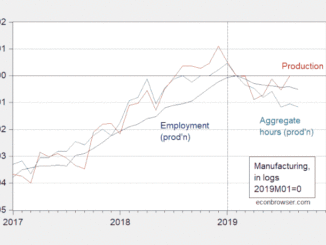
Manufacturing employment hours declined in September.

Signs of crisis

The evidence of a downturn has been building all year, but it really hit at the beginning of October. The manufacturing sector of the economy is now officially in a recession, not only here but globally. In September, the U.S. manufacturing index declined to its lowest level since the 2009 recession.

While some defenders of the status quo hold out hope that the recession won’t affect other sectors of the U.S. economy, it’s just wishful thinking. “That argument does not recognize that many service sectors depend on manufacturing for their own expansion,” explains economist Michael Roberts. “The spillover from a manufacturing slump has usually been significant in previous recessions. If global employment growth should weaken or stop, workers’ purchasing power will wane and the services sector will start to suffer as well.”

Roberts cites a new JPMorgan analysis which shows that “global profits in [the second quarter of] 2019 have stalled. Each of the 10 sectors comprising the total market shows a sharp slowing in profit growth, with half experiencing outright contractions in profits over the past year. … As Marxist theory would predict, slowing or falling profits will eventually mean slowing or falling business investment, and JPMorgan agrees.”

Already, industries related to manufacturing are showing signs of crisis. Some 4,200 truck drivers lost their jobs in September – on top of 5,100 in August. And 640 trucking companies went bankrupt in the first half of 2019.

Many workers rely on low-wage retail jobs to survive. Retail stores sell the finished products created by workers in factories here and worldwide.

Everyone knows the toll online sellers like Amazon.com have taken on retail stores. But this year the collapse has spread beyond those bounds and is getting worse – threatening what CNN called a “retail apocalypse and massive layoffs in the coming year.

Forever 21 and Bed Bath & Beyond are two retail chains that recently announced big store closings and layoffs. In September, the Wall Street Journal reported that the number of store closings and bankruptcies in the first half of 2019 had already exceeded the total for 2018. An in-depth report by industry website Retail Dive lists 28 major chains in danger of going bankrupt next year, including JCPenney, Rite Aid, Pier 1 and J. Crew.

This may all seem overwhelming. But the truth is, we can fight back. 

Next: Together we can build enough strength to challenge the capitalist system itself and replace it with one organized on the basis of planning for people’s needs and protecting the planet, instead of profits. We call that socialism.

The coming economic crisis, Part 2: Socialism is the solution!

Strugglelalucha256


U.S. strategy against socialism: Czechoslovakia 1968, Hong Kong 2019

Since the start of the Hong Kong demonstrations, the corporate media have been united in their narrative that the demonstrators are fighting for democracy and are for independence from an oppressive Chinese regime. Upon closer examination, there are many reasons to question this narrative and the class interests behind it.

The survival and economic growth of the Chinese Revolution is a big problem for the global capitalist class. It threatens their dominance over global finance and trade. 

China is a powerhouse economically and has successfully forged relationships with many oppressed countries by offering trade terms more favorable than those offered by the imperialist countries. The Communist Party of China has weathered several attempts to undermine its leading role, while the state-run socialist sector of the economy provides an important cushion when the global capitalist economy is wracked by crisis.

Since the Russian Revolution in 1917 and the consequent founding of the Soviet Union, the United States and its allies have consistently sought to undermine workers’ states and place governments friendly to the wealthy and the corporate bosses in their place.

Decades of imperialist military threats, economic sabotage and internal subversion played a decisive part in the destruction of the Soviet Union and the Eastern European socialist camp in the late 1980s and early 1990s. China, Vietnam, Cuba and the Democratic People’s Republic of Korea survived — something the U.S. ruling class has never reconciled itself to.

Media’s anti-communist spin 

The current discourse in the corporate media, including the New York Times, the Washington Post, CNN, etc., seems eerily similar to the strategies historically used against various socialist countries, particularly in Eastern Europe. 

There are several historical examples that can potentially shed light on the situation in Hong Kong and the general strategy of the imperialists to undermine socialist countries. 

For example, in 1968, there was an attempt to restore capitalism in Czechoslovakia, a country that had been a state controlled by the workers since 1948. Marxist writer and organizer Sam Marcy wrote an important pamphlet about these events: Czechoslovakia 1968: The Class Character of the Events.”

The U.S. and its Western imperialist allies saw an opportunity in Czechoslovakia to upend the workers’ state and reinstall a capitalist state, which would return the workers of that country to exploitation by the bosses. 

Further, Czechoslovakia had close geographic proximity to the Soviet Union. Having a forward operating center so close to the Soviet Union would have been greatly beneficial to the U.S. at the time, when the Cold War was in full swing.

The people and organizations leading this attempted counterrevolution named it a “democratic socialist revolution.” The movement had started when moderate forces came into power within the socialist government. This opened the door to an attempt at full counterrevolution and dissolution of the government of the workers.

Always ask: democracy for who?

Around this time, the Western media began to publish article after article pushing for U.S. economic and military intervention to ensure “democracy” in Czechoslovakia. 

At first glance, the call for democracy is one that is easy to get behind. Democracy is not inherently a bad thing. Many institutions and organizations strive for a more democratic framework — a framework that allows fair and equal representation in decision-making for all involved.

But it’s important to look beyond abstract calls for democracy to determine what class the “democratic” movement serves and would represent once its government is established. In terms of Czechoslovakia in 1968, demands for democracy in what was then a socialist state were not coming primarily from the working class. These demands were coming from the capitalists, the landlords and the international captains of industry.

So what would democracy have looked like when led by these groups? Would it be to advance the causes of social justice, liberation for the oppressed and equality for all workers? Or would it be to install a government that would silence the workers and elevate the wealthy classes? 

The policy demands of the democracy movement in socialist Czechoslovakia in 1968 may help shed some light on this. One of the central demands being made by this movement was for more open diplomatic relations with not only the U.S. but also West Germany.

This demand is an important clue to discovering the motives of the forces pushing the slogan of democracy. West Germany was an imperialist outpost and right-wing state that functioned as one of the front lines in the Cold War against the Soviet Union. 

While the socialist German Democratic Republic, commonly referred to as East Germany, had sought to build an explicitly anti-fascist country where the working class was no longer exploited and oppressed people attained social justice, West Germany, with the help of the U.S., had rebuilt on a capitalist basis after World War II. There, many fascists were rehabilitated and even elevated to high positions. West Germany’s foreign and economic policies were largely dictated by the U.S.

Role of Masaryk

The movement to bring so-called democratic reforms to Czechoslovakia put forward Thomas Masaryk as its face. Masaryk had been one of the core leaders of the original effort to liberate the country from the Austro-Hungarian empire in 1918. Once the initial independence effort was complete, Masaryk led the building of a bourgeois democratic republic whose purpose was to act on behalf of the U.S. against the USSR. 

Masaryk was not a champion of the workers, but of the bankers and politicians in the U.S. The founding conference of the republic was held in Pittsburgh and attended by many U.S. industrialists and corporate bosses.

Not only was Masaryk’s Czechoslovakia hostile to all workers, it was particularly hostile to those of oppressed nationalities. One of Masaryk’s first moves in power was to betray the Slovak people who had originally supported the new republic. 

At the founding conference, Masaryk, who was an ethnic Czech, promised the Slovaks some level of autonomy under the new republic. Once the republic was established, however, Masaryk denied Slovaks the right to build their own institutions or exercise any autonomy. The new government was run entirely by Czechs. 

In 1948, the workers tore down Masaryk’s government in favor of socialism. Regardless of this checkered history, the democratic reform movement in Czechoslovakia embraced Masaryk as the father of Czechoslovakian independence and democracy.

As 1968 progressed, the calls for “reform” and “economic freedom” increased. The global socialist community became convinced that this movement to bring liberal democracy to Czechoslovakia was actually an attempt at counterrevolution, with the hope of dissolving the socialist government. 

The Soviet Union and its allies ultimately decided, that to give the U.S. and West Germany a stronger economic and military foothold in Czechoslovakia would be a blow to the global struggle of the working class. For these reasons, the socialist military alliance, the Warsaw Pact, intervened to stop the advances of capitalism.

‘One country, two systems’

What does this history have to do with the events playing out in Hong Kong today? The situations do not compare exactly. There are distinctions and similarities and both should be analyzed. Through some examination of these, a clearer view of the U.S. strategies towards socialist countries may appear.

One distinction in particular looms large. Hong Kong is still operating under a capitalist economy, even though it is politically part of China. This arrangement, implemented when Britain was forced to return Hong Kong to China in 1997, is known as “One Country, Two Systems.” The idea is that by 2047, Hong Kong will be fully transitioned into China’s socialist system. 

In 1968, Czechoslovakia was a workers’ state. Economically, the country was fully integrated into the socialist bloc. Consequently, the goal of the imperialist countries and the capitalists in Czechoslovakia was to restore capitalism and destroy socialism. 

But whether the goal is to destroy an already existing socialist government, as in Czechoslovakia, or to prevent the integration of a territory formerly stolen by a colonial power–like Hong Kong–both benefit the global ruling class.

In 1968, the restoration of capitalism in Czechoslovakia would have given the U.S. and its allies a crucial military, political and economic foothold against the Soviet Union. And this is certainly true in the case of Hong Kong today as the U.S. seeks to escalate its economic, political and military power against China.

(Read more about the advances and problems of China’s socialist development in relation to Hong Kong in Fred Goldstein’s article, Hong Kong: Make colonialism great again.”)

Imperialist strategies

Now that we have examined the material differences, we can better understand the imperialist rationale behind certain strategies used against the global socialist movement. There are some striking similarities between the strategies implemented in the attempted capitalist restoration in 1968 Czechoslovakia and those currently being implemented to prevent the continued transition of Hong Kong toward full integration with China.

First, at the center of the movements in 1968 Czechoslovakia and present day Hong Kong were/are calls for democracy and independence. Earlier we asked: What sort of democracy? For which class? Who would it benefit? This is where the Czechoslovakian example can be illustrative. 

In 1968, the calls for democracy and independence were of a bourgeois (capitalist) class character. A capitalist Czechoslovakia would have only served to benefit the global ruling class — the same way a capitalist Hong Kong torn away from China would serve imperialism and be a blow to the global working class. Furthermore, both Czechoslovakia and Hong Kong have close geographic proximity to large industrial socialist powers: the Soviet Union and China. 

Consequently, the U.S. and the other imperialist countries turned to an old strategy: hide their real agenda behind vague but appealing language. 

Who can argue with democracy and independence? Well, in reality, the working class can — when the class character of such demands is to continue or heighten the exploitation of the workers and oppressed by the capitalist class.

Masaryk and Martin Lee

In the struggle to fully halt the process of China’s integration with Hong Kong, certain leaders have come to the forefront. Among the main leaders is Martin Lee, commonly called Hong Kong’s “Father of Democracy.” 

Lee fits the bill of a ruling-class pawn who is propped up as a hero of democracy by the imperial powers — much like Masaryk. 

He is a well-educated lawyer from a middle-class background. Lee has heavy connections to the National Endowment for Democracy, a CIA and State Department front organization. He has relationships with the American Bar Association and prominent U.S. politicians like Nancy Pelosi and Joe Biden, both of whom have consistently supported U.S. military and economic warfare abroad.

Based on this background, it would appear that Lee is not truly a hero for the workers of Hong Kong, but a tool of Washington and the big banks.

There seem to be parallels between not only the backgrounds of Lee and Masaryk, but also the rhetoric used to promote their leadership in the corporate media. Both are spoken of as independence heroes, and the fathers of their respective “liberation” movements. Both have significant ties to U.S. capitalists and politicians. Both have long histories of fighting against socialism.

The corporate media and capitalist politicians have engaged in the same game plan for over 50 years. When a socialist country like Czechoslovakia, or a previously colonized territory like Hong Kong, is deeply embedded with another larger and stronger socialist state, the imperialists may not opt for military intervention. They may opt for a campaign of disinformation and dishonesty, framing their bourgeois and petty bourgeois agents as the real progressive force.

To separate Hong Kong fully from China and stop the transition away from capitalism would be devastating for not only the workers in Hong Kong, but also for the Chinese Revolution. This is exactly why all progressives must call this strategy what it is: a farce meant to establish Hong Kong as a capitalist bulwark against socialist China, just as Czechoslovakia was meant to be against the USSR in 1968.  

Strugglelalucha256


Capitalist pigs and capitalist decay

Donald Trump is an extremely dangerous, racist, sexist, billionaire pig. But is the former New York City mayor, Michael Bloomberg, that much different?

All billionaires are not created equal. Bloomberg’s $55.2 billion fortune makes him the ninth richest person on earth. Trump’s stash is a mere $3.1 billion

Trump is a Republican while Bloomberg has become a registered Democrat again. (He was originally a Democrat, then a Republican and finally an “independent” before his latest shift.)

The Donald J. Trump Foundation was forced to shut down because it was nothing more than a slush fund. Bloomberg gets oodles of publicity as a philanthropist. (And plenty of tax deductions.)

Yet both Trump and Bloomberg are capitalist pigs.

Trump got to the White House even though he lost the popular vote. Bloomberg bought the popular vote by spending at least $268 million in his three mayoral races.

Bloomberg spent $102 million in the 2009 mayoral election or $174 for every vote he got. Yet the moneybags mayor got fewer votes than Mayor Hylan did in 1921, when the Big Apple had 2.5 million fewer people.

This is the democracy for the rich that the billionaire class wants to bring to Cuba and Venezuela.

Never forget Kalief Browder

Trump started his presidential campaign by calling Mexicans rapists. The day after Trump’s racist tirade, nine Black people were murdered by a white gunman in Denmark Vesey’s church in Charleston, S.C.

At least 179 people were killed by New York City police from 1999 to 2014. Eighty-six percent were Black or Latinx. 

Bloomberg was New York City mayor for 12 of those 16 years. In 2006, Bloomberg’s cops fired 50 shots at an unarmed Black man, Sean Bell, killing him on what was supposed to be his wedding day.

Trump keeps migrant children in cages and refuses to give them flu shots. New York City keeps 10,000 poor people locked up on Rikers Island. Eighty-five percent of the inmates haven’t been convicted of anything and are just too poor to post bail. 

Among these inmates was the African-American youth Kalief Browder. He spent three years at Rikers while Bloomberg was in City Hall. Two of those years were spent in solitary confinement,  

Browder was beaten regularly before his case was dismissed. Two years afterwards, the 22-year-old hanged himself on June 6, 2015.  

Civil liberties mean nothing to either Trump or Bloomberg. Fourth Amendment protection against illegal searches and seizures didn’t exist for Black and Latinx people in New York City. In 2011, Gotham’s cops stopped and frisked almost 700,000 people, 84 percent of whom were African American or Latinx.

Yet Bloomberg actually claimed in 2013 that police “disproportionately stop whites too much and minorities too little.”

Both Trump and Bloomberg are union busters. In 2005, Bloomberg called the striking members of Transit Workers Union Local 100 “thugs.”

This is the same Michael Bloomberg that wants to be our saviour by spending $500 million to defeat Donald Trump. 

Only the people can stop the Trumps and the Bloombergs.

Big time capitalist decay

Both Trump and Bloomberg are prime examples of what Lenin—the leader of the Bolshevik Revolution—called The Parasitism and Decay of Capitalism.” Lenin did so in his 1916 pamphlet, Imperialism, the Highest Stage of Capitalism.”

Fred Trump was just as much a bigot and a crook as his son Donald. Daddy Trump got himself arrested when he joined a Klan rally in Queens in the 1920s. 

Trump senior refused to rent to African Americans until he was sued in the 1970s. The U.S. Senate investigated him for excessive profiteering from federal housing programs.

Construction workers employed by Fred Trump still built 27,000 apartments that were affordable to a section of the working class, although Asian, Black, Indigenous and Latinx families had to fight to rent or purchase them.

Donald Trump doesn’t do affordable housing. His developments are exclusively luxury housing for the super rich. Many of the sales for Trump’s condos are to “flight capital.” Capitalists from other lands buy them as a safe haven in case a revolution breaks out in their country.

Today, there’s virtually no affordable housing being constructed in New York City. Current Mayor Bill de Blasio wants to tear down part of the Fulton public housing complex to build private, high-rent apartments. This is at a time when, every night in June, some 21,295 homeless children slept in municipal shelters

Meanwhile, Venezuela has built three million homes for poor people.

Bloomberg’s fortune comes from renting 325,000 computer terminals to stock speculators. Capitalists rent from Bloomberg because they think it will give them an edge over other capitalists.

Employees in Andrew Carnegie’s steel mills had to work 12-hour days. When they went on strike in 1892 at Homestead, Pa., Carnegie hired Pinkerton gunmen to shoot them down.

Yet steel is absolutely necessary for a modern society. Gambling on the stock exchange isn’t. 

Capitalism is so decayed that it can’t even replace the lead water mains that damage children’s health across the country. That’s another reason we need a socialist revolution.

Strugglelalucha256


Trump tariffs clash with globalized capitalist production

The Trump administration is caught between its “America First” super-imperialist, great power chauvinist politics on the one hand, and the capitalist world division of labor on the other hand. 

At every turn the contradiction between capitalist private property and world-wide socialized production becomes an obstacle to capitalism itself. In particular, the global interests of U.S. imperialism and the global economic structure of world capitalism today sharply contradict the Trump administration’s political goals.

Trump and his minions want to overturn the political and economic structure built up by the U.S. capitalist class in the past century. They want to realign the relationship of forces in a way that further subordinates the imperialist rivals and economic satellites of Washington and Wall Street. 

Trump has taken aim at Germany, France, Britain, and the entire European Union, Japan and China, as well as Canada (a minor imperialist country), Mexico, India, Turkey, Indonesia, and Thailand, among others. China is a special case which will have to be dealt with in a separate article.

Globalization and the socialization of production

The term “globalization” is a useful geographical designation of how workers produce goods and services, that is, commodities, today. It is highly descriptive since production of a single commodity takes place in sequence in different parts of the globe. However, from a Marxist point of view, the more scientific economic designation is the socialization of the productive forces on a global basis.

The capitalist class has forced the world working class into a vast, involuntary division of labor in which workers must cooperate, on pain of losing their means of survival, to produce the world’s commodities. But the economic surplus, the surplus value that arises from these global production chains of exploitation is reaped by the bosses. Even the workers who have jobs are left with barely enough to live on. 

Global chains of exploitation are a modern form of the socialization of production carried on within the framework of private property!

Thus, as Trump proceeds with his economic wrecking ball, he is up against the fundamental contradiction of capitalism — the contradiction between socialized production and private property. Friedrich Engels, a co-founder of Marxism, along with Karl Marx, explained this at the dawn of modern capitalism in his classical work “Socialism: Utopian and Scientific” (published in 1880, excerpted from his more extensive book, “Anti-Duhring,” published in 1878):

“This contradiction, which gives to the new mode of production its capitalistic character, contains the germ of the whole of the social antagonisms of today. The greater the mastery obtained by the new mode of production over all important fields of production and in all manufacturing countries, the more it reduced individual production to an insignificant residuum, the more clearly was brought out the incompatibility of socialized production with capitalistic appropriation.”

Tariffs: Trump’s blunt instrument

Today Trump is using tariffs as a blunt instrument to bully countries around the world to hand over their profits to U.S. capitalism. 

What are tariffs? In the imperialist era they are a tax levied on imports by a capitalist class in one country in the struggle against its rivals. The country upon which the taxes are levied suffers a decline in exports and the government of the country levying the tariffs collects the tariffs/taxes in its treasury. 

From a working class point of view, tariffs must be seen in the same light as automation. Like automation, tariffs are part of the world competition between capitalists. Tariffs, like automation, is a tool by which the capitalists fight each other in the world market. 

But this fight is carried on at the expense not just of capitalist rivals, but also at the expense of the working class. Workers in the country that has tariffs levied on it loses jobs because this country’s exports decline. Workers in the country that levies tariffs pay higher prices because the importing capitalists pass on their extra costs to the workers. 

Usually tariffs are met by counter-tariffs. So in a tariff war between the bosses, as in any war, the workers are the real casualties. 

‘Globalization’ and the complexity of socialized production

In his tariff campaign Trump is running afoul of imperialist globalization at every turn; his actions have provoked retaliation from capitalists.The threat, later withdrawn, to levy tariffs on Mexico to get political leverage in his racist struggle against immigrants is a case in point. 

Trump threatened to put a 5 percent tariff on Mexican goods and to raise the tariff another 5 percent every month up to 25 percent if the Mexican government failed to prevent immigrants from crossing the border into the United States.

According to Burgess Everett and James Arkin of Politico, at a closed-door lunch with Senate Republicans earlier this week, “White House deputy counsel Pat Philbin and Assistant Attorney General Steve Engel faced brutal push-back from the GOP, according to multiple senators, with some threatening that Trump could actually face a veto-proof majority to overturn the tariffs.” (Politico June 5, 2019)

If the Republican Trump loyalists in the Senate rebelled against their leader, it’s because the capitalist donors dug in against this. Mexico exports $345 billion to the U.S., much of it automobiles, automobile parts, agricultural products, clothing, etc. 

Other examples of the intricate and interwoven nature of global supply chains apply to Japan and Canada as well.

The Japan Automobile Manufacturers Association (JAMA) says about 8 percent of its members’ total annual sales are built in and imported from Mexico by way of U.S. railways, making them susceptible to the tariffs. JAMA represents Japanese exporters, manufacturers and importers in Canada. It represents Toyota, Honda, Nissan, Mazda, Mitsubishi and Subaru. 

Canada’s largest auto supplier, Magna International, has 32 manufacturing and assembly plants in Mexico, where it employs 29,175 people — more than in either Canada or the United States. (Automotive News, Canada, June 5, 2019)

A number of Japanese firms have their production bases in Mexico. Honda Motor Co., for instance, exported around 120,000 vehicles made in Mexico to the United States in 2018, accounting for around 80 percent of the cars it produces in Mexico, which is also home to large assembly plants owned by Toyota Motor Corp., Nissan Motor Co. and Mazda Motor Corp. (Japan Times, May 31, 2019) 

There are over 700 Japanese companies employing thousands of workers in Mexico. So Trump could also trigger a trade war with Japan because of his threatened Mexican tariffs.

The bosses experienced Trump’s threat against Mexico a threat against them. The Chamber of Commerce threatened the administration with a lawsuit. And the monopoly donors to the Republican Party told the U.S. Senate that they did not want a tariff war with Mexico and Canada.

The tariffs campaign was part of Trump’s reelection bid. Trump is desperate to get reelected and avoid prosecution by the various court jurisdictions that may bring charges against him. In his desperation, Trump ignored the complexity of the U.S. ruling class’s broader economic problem. 

Trade fight with EU and Asia

The United States is also intensifying its trade fight with the European Union over aircraft subsidies. Washington has proposed additional tariffs on EU goods worth $4 billion along with another $21 billion in tariffs it is demanding for European Airbus planes.

The tariffs, announced on July 1 by the United States Trade Representative, cover 89 products including meat, cheese, pasta, fruits, coffee and whiskey. They could be added to a list of EU Airbus exports that the U.S. Trade Representative (USTR) said in April would be subject to tariffs.

General System of Preferences (GPS) status exempts 3,500 items from U.S. tariffs. GPS status is meant for formerly oppressed and colonial countries, designated as “underdeveloped.”

In its struggle against Asia, the Trump administration has threatened to remove the (GPS) status from India, Thailand and Indonesia. Turkey has already lost its GPS status. 

U.S. dairy producers took aim at India and Indonesia, while pork producers targeted Thailand. Medical device manufacturers also filed a petition to exclude India from receiving preferential treatment from the U.S. 

All elements of the U.S. ruling class know that they have a compliant friend in the White House who will do their bidding for the most part, even if at times they have to buck him in the Senate or in the courts. They have reaped the benefits of his corporate tax cuts, deregulation campaign, and land giveaway policies for the energy, mining and timber industries.

With the trade war, the Trump administration is striking out in all directions to put economic pressure on the entire capitalist class world-wide. Its goal is to increase the domination of the U.S. imperialist monopolies.

The contradiction of socialized production vs. private appropriation

The contradiction between the socialized character of production and the private appropriation of the products of labor was emphasized by Vladimir Lenin in “Imperialism, the Highest Stage of Capitalism.” 

Lenin explained that imperialism was the stage of capitalism that would lead to socialism. Bourgeois economists at the time were evading the nature of imperialism by reducing it to the “interlocking” of corporations. Lenin answered:

“Skilled labor is monopolised, the best engineers are engaged; the means of transport are captured—railways in America, shipping companies in Europe and America. Capitalism in its imperialist stage leads directly to the most comprehensive socialisation of production; it, so to speak, drags the capitalists, against their will and consciousness, into some sort of a new social order, a transitional one from complete free competition to complete socialisation.

“Production becomes social, but appropriation remains private. The social means of production remain the private property of a few. The general framework of formally recognised free competition remains, and the yoke of a few monopolists on the rest of the population becomes a hundred times heavier, more burdensome and intolerable.” 

Fast forward to the 21st century. In 2005 New York Times columnist Thomas Friedman wrote about how his Dell computer was made, describing in great detail how workers spread across numerous countries in Asia contributed to its production. He summed up his findings:

“‘The total ‘supply chain’ for this computer, including suppliers of suppliers, came to about 400 companies in North America, Europe, and Asia, mostly the latter, with about thirty prime suppliers.” (“The World Is Flat,” Freidman, 2005, cited in “Low-Wage Capitalism,” Goldstein, 2008)

This author described these supply chains in Marxist terms in “Low-Wage Capitalism” (2008) as follows: “These so-called supply chains, which are really chains of exploitation spread throughout the globe by the giant monopolies, in partnership with finance capital are the business model for all the global capitalists. And the lesser capitalists fit themselves into this framework.” 

Capitalism is becoming an obstacle to the survival of the masses

The increasing inequality of wealth in the U.S. is something that the capitalists and financiers are deliriously happy about. That is why Donald Trump and the Republican National Committee raised  $105 million in the last quarter for his reelection bid.

That is why the capitalist media gave Trump a billion dollars worth of free media publicity in 2016 and why they continue to give the widest possible coverage to his every tweet. They care nothing about Trump’s cruelty to immigrants and their children;  his enabling and accelerating environmental and planetary destruction; his work, every day in every way, to transform the political structure of capitalism in a right-wing, authoritarian direction.   

The U.S. working class is an integral part of the world-wide socialized labor force. Through its hands pass much of the world’s wealth. However, almost none of that wealth stays in the hands of the working class; the lion’s share goes to the exploiting class. 

Sooner or later this fact is going to reach the consciousness of the masses. Sooner or later they will not be able to go on in the old way, suffering the deceptions of the bosses, their politicians in both parties, and the capitalist media. Capitalism is becoming an obstacle to the survival of the workers and oppressed. That obstacle must be removed.

In the long run, no trade war or imposition of tariffs can change the fundamental contradictions of capitalism or stave off its inevitable collapse.

Published on lowwagecapitalism.com website, July 7, 2019.

Strugglelalucha256


Lessons of the 1977 New York rebellion

On the evening of July 13, 2019, parts of Manhattan’s Midtown and Upper West Side were plunged into darkness for several hours by an electricity outage. The outage, whose cause is still being investigated, disrupted subway service throughout the city and shut down much of the Times Square tourist district on a busy Saturday night. 

Corporate media drew comparisons to the much more serious power outage that happened exactly 42 years earlier, on July 13-14, 1977. That shutdown affected nearly all of New York City and sparked a rebellion by oppressed workers that has been slandered and demonized ever since. There is every reason to believe that a prolonged power outage could lead to a similar outbreak in today’s conditions of growing poverty and austerity, homelessness and gentrification, and racist terror by police agencies like the New York Police Department and U.S. Immigration and Customs Enforcement. 

The following article drawing the lessons of that rebellion, written by Marxist leader Sam Marcy, originally appeared in the July 22, 1977, edition of Workers World.

By Sam Marcy

The electricity blackout should not be permitted to obscure or diminish the very real importance and profound lesson of the mass rebellion which took place in New York. It should be kept in mind that it took place in widely separated areas of oppressed communities — Harlem, Bedford-Stuyvesant, East Harlem, the South Bronx, etc.

By no stretch of the imagination could it in any way be implied that there was coordination, planning or premeditation involved in the huge popular participation by the masses.

The police, the city officialdom, the bourgeois media and press would have been delighted to find some “small group of terrorists,” “arsonists” or “left adventurers” who “misled” the people. However, there simply was not the shadow of a possibility or time to concoct such convenient evidence in the present situation.

Wholly spontaneous uprising of oppressed

The uprising, and that is its right name, was of a wholly spontaneous, elemental and instinctive character. It was precisely this which invested the rebellion with a special significance. It is also what has caused the entire bourgeois establishment to become fanatically enraged and terrified.

Had the rebellion been initiated by a handful of people or had it been under the direction of some small grouping, it would surely have amounted to no more than scattered, sporadic activity and would have been doomed to sterility or died aborning. Under such circumstances it would have been justifiably condemned by the broad mass of the oppressed people.

As it developed, however, the mass character of the rebellion, and particularly its spontaneity, came out as plain as daylight and as clear as crystal. It was a popular rising — a collective coming out of the people.

The blackout merely masked the deep significance of this extraordinary event. The bourgeoisie speaks of it as an evil that happened as a result of the darkness. It was done, they say, and repeat ad nauseum, “in the dead of night.” Were it not for that, they continue, “it would not have happened.” So say all the learned bourgeois commentators with a unanimity worthy of their class interests.

But the fable that the darkness was the cause of it is a huge, unmitigated lie. It was not at all the darkness that occasioned the rising. The masses all over the world have lived in darkness over many, many centuries, and darkness has never been the cause of the hundreds and thousands of rebellions in the long struggle against the possessing classes by the oppressed masses. There was no rebellion during the blackout of 1965, when a false war prosperity meant less unemployment.

It was not the absence of light that occasioned the rising. It was the absence of the repressive state forces during the critical period of midnight to 4 a.m., when the rebellion took on full momentum and when the largest amount of participants gathered and controlled the streets. The failure of the combined forces of the state and the city to mobilize the repressive forces in time is what made the rebellion possible.

What a great lesson in the relationship between the oppressive capitalist state and the oppressed masses! Between 12 midnight and 4 a.m. more than one-third of the police force in this city did not show up at all, according to the New York Times of July 15, notwithstanding frantic calls from police headquarters and the officialdom of the city, including the mayor.

Authorities feared broadening rebellion

The failure to show up was not due to vacation time, illness or assignment to different areas for duty. Those who were mobilized moved slowly by order of the city and state authorities. This order was by no means actuated by humanitarian sentiments for the rebellious masses. It was motivated by fear of the rebellion being converted into a general conflagration.

The heavy state apparatus and all its city subsidiaries were in constant turmoil. Happily, the city and state capitalist officialdom were temporarily divided by acute contradictory, immediate, conflicting clique interests. The internal wrangling between the mayor, facing an election in a few months, and a governor mindful of his larger interests on the statewide arena made them cautious in answering calls to mobilize the National Guard. The vulnerability of the Guard was clear from the outset, as it is almost 90 percent white and from suburban areas.

Valuable time lost because of acute contradictions at the summits of the ruling capitalist establishment in the city and the state encouraged the masses to broaden the assault into the wee hours of the morning. Only when the state and city officialdom had arrived at an agreeable formula for assault on the masses did the repressive forces make their presence felt in the communities. Only then did the rebellion begin to subside.

What does this show?

That it is only by virtue of the unrestrained use of force and violence and terror that the masses in the oppressed communities are held in subjection.

This is the central element in understanding the uprising. The deeper causes, the hunger, unemployment and general poverty, are too well known to be dwelt upon here. But the uprising cannot be explained without reference to the absence, at a specific juncture in time, of the terrorist apparatus of the bourgeoisie.

All the previous rebellions, beginning with Watts, Detroit, New York and Newark, were all provoked, according to the police mind, by some “isolated incident with no racial overtones,” the usual description of a police provocation. Here, for the first time, no such development took place. It was a clear-cut massive assault against the whole oppressive system.

Small shops were only available target

The fact that small shopkeepers, the pawnbrokers and jewelers, the mini-markets and retail shops, the mainly white “settlers” in the Black and Latin ghettos, were the immediate object of the wrath of the masses is in the long view of history incidental. It was merely because these were in the immediate vicinity, were the only means for alleviating the hunger of the masses, providing small objects for human consumption and the necessities of life that the attack was directed against them. The masses could find no other outlet for their pent-up anger and frustration.

When a historic opportunity presents itself, the masses instinctively follow that line of struggle which at the moment is of least resistance. It’s a way of feeling out the situation, at first cautiously. Then, as it appears safer, the momentum accelerates. The mass grows in larger and larger numbers, gains strength and confidence by the sheer weight of numbers. Moving cautiously at first, incurring the least casualties, enabled the momentum to grow at an accelerated pace.

All movements of the oppressed, as distinguished from individual groupings, begin slowly by following that which is easiest, safest, that will incur the least casualties. Of course, the monopolist press and media are crying “anarchy,” “destruction of property.” That’s not really true. It was not the destruction of property which motivated the masses. It was mass expropriation of property that urged the masses on. That is a qualitatively different matter.

Individual appropriation of objects of consumption by starving, hungry masses is understandable. But proletarian revolutionaries do not, as a rule, encourage or promote it. This is not at all in obedience to bourgeois legality or, even worse, bourgeois morality.

Individual appropriation must be distinguished from mass expropriation. The latter is in the nature of a class action, a movement of the class, in this case as representative of the oppressed nation or at least a viable part of it.

All who are progressive, all who are in real sympathy with the struggle for liberation, for an end to national oppression and class exploitation, must side with the class in this situation.

Which side are you on?

By the time this is written, all the bourgeois politicians will be saying that the anger and frustration of the masses because of unemployment and poverty is “entirely understandable.” But then they inevitably will add, “Lawlessness must not be condoned.” “That is not the way.” “It is a wrong tactic.” In one form or another, from extreme right to left, while the argument may vary in form, in essence they are all condemnatory of the rebellion.

What matters in a rebellion of the class or oppressed nation is not which argument is presented, however persuasive it may sound. The question really is: Which side are you on? Which class are you defending?

Those who, either because of ignorance or fraud or hypocrisy or downright fear, stand on the position of “not condoning” the tactics in the rebellion in reality stand on the exploiters’ side of the class barricades. All who are progressive, all who are class-conscious and truly devoted to the liberation struggle must stand on the other side.

There can never be a genuine, successful revolutionary upheaval of the masses without there being one of those elusive historic opportunities, without there being that rare combination of circumstances which is almost universally unforeseen, but which inevitably comes about in the course of historical development and which so frequently goes unrecognized even by authentic leaders. The opportunity then slips by and it takes time and not mere effort alone for it to occur again. Thus, the opportunity came on the evening of the 13th day of July. The opportunity was there because the guardians of bourgeois property could not make their presence felt in time. This alone puts in bold relief that which really holds down the masses.

It is true that a labyrinthine complex of social and political institutions of the bourgeoisie enslaves the masses and holds them in a vice. But in the final analysis, it is the gargantuan, swollen repressive apparatus of the state which keeps the masses at bay. This is the truly significant lesson that emerges from the extraordinary development of the July 13 rebellion.

Of course, it was also an opportunity for leadership in a broader, less restricted orientation.

The rebellion came at a specific time. It must be viewed as a particular stage in the political evolution of the struggle. It must not be viewed from the standpoint of bourgeois legality or morality, which the ruling class does not abide by in any case.

But (it will be asked) was there no better way to go about the struggle? Here one must distinguish between what is possible and that which is inevitable. What inevitably happens as a result of the mass action of the class, of the oppressed nation, must be defended against the onslaught of the class enemies and the appropriate lessons must be learned. Failure to defend the class under attack because it could not follow conventional norms of revolutionary conduct under the circumstances is a renunciation of allegiance and loyalty in the struggle against national oppression and class exploitation.

The unrestrained orgy of racist vilification and denunciation of the rebellion which has saturated the mass media can best be understood by the fact that the rebellion infringed upon the holy of holies of bourgeois rule of conduct for the masses.

The rebellion was a massive invasion of bourgeois property rights. Marx brilliantly explained that a hundred years ago. He said the church hierarchy would be willing to forgive the masses for their violation of 38 out of the 39 articles of the ecclesiastical canons of conduct. But should the masses infringe upon 1/64th of the church’s vast property, then it’s a holy war for the suppression of the masses to the end.

Imperialism relies on control over white workers

The rebellion of the oppressed took place in the citadel of imperialism, the source of strength of world imperialism. But this strength, this power of finance capital which seemingly is omnipotent over so many large areas of the world, is relative and in many respects superficial. Wherein lies its omnipotence? Wherein lies its real source of strength? It is not in the technological and scientific prowess of its military-industrial complex, although that, of course, is of formidable proportions. It does not lie wholly in the vast and intricate terrorist and repressive apparatus which at times seems omnipresent.

Its source of strength doesn’t lie in the cruise missile or the neutron bomb or the MX missile. The true measure of its power lies in the social stranglehold it has over the white workers, which is vast, powerful, significant and numerous. It is this social stranglehold which enables monopoly capitalism to maintain such a vast portion of the globe in bondage. It is this stranglehold which must be broken.

The privileged position of the white workers, built over a century of capitalist expansion and monopolist domination, is rapidly coming to an end. The epoch of sharp decline in the fortunes of U.S. finance capital is not merely leveling the privileges of the white workers; it is ravaging, pillaging, and plundering its standard of living, and bringing about an inevitable insurgency.

It is this capitalist crisis that is creating objectively and stimulating subjectively a firmer, more genuine basis of class solidarity between Black and white, between the white workers and all the oppressed nationalities. At the same time, Black and Latin workers are bringing heightened militancy to all the most important industries.

Only this class solidarity, which differs like heaven from earth from the solidarity of the imperialist pirates, their allies and puppets, holds out the true promise of emancipation for all humanity from the ravages of moribund monopoly capital.

Strugglelalucha256


Tariffs: capitalist competition & class warfare

As the June 28 economic summit of the G20 in Osaka, Japan, approaches, President Donald Trump is stepping up threats of tariffs and technological sanctions against China that could trigger a sharp global downturn. The G20, or Group of Twenty, includes the world’s major capitalist economies, the European Union and China.

Morgan Stanley, a U.S. investment bank, sees global recession “if the U.S. imposes 25% tariffs on the remaining circa $300 billion of imports from China.” The International Monetary Fund warned that tariffs against China would reduce global gross domestic product drastically. While the Federal Reserve Bank in New York City estimates that at their current levels the tariffs could raise prices and cost typical households in the U.S. $831 over the course of a year.

Imposing military hegemony

One aspect of the U.S. trade war against China is its attack on the high-tech company Huawei and its 5G wireless network. The globally organized campaign against Huawei by the U.S. represents an effort to stifle Chinese technological development. It is also an attempt to impose strategic military hegemony. Wen Lu, a rates strategist at TD Securities, told the New York Times that “Trump is willing to weaponize tariffs … to reinforce his stance against China.”

The current U.S. administration is using protectionism and belligerent threats of tariffs against many countries, in a fight to maintain dominance in the exploitation of world markets.

On June 11, the New York Times published reports that the trade war is already doing harm slowing global growth and that could ultimately trigger a recession. Fed officials are signaling that they are prepared to prop up the U.S. economy by cutting interest rates. This action from the Fed, a government body that is touted to be nonpolitical, is seen as encouragement allowing more leeway to carry out an aggressive trade policy.

Trump’s war on im/migrants

The belligerence of Trump’s tariff threats took a new, nontrade form against Mexico. These threats were used to try to force the Mexican government to extend Trump’s vicious war against Central American im/migrants. While the threats should not be underestimated, they were quickly dropped. According to the New York Times on June 10, the secret deal that Trump announced with great fanfare consists largely of actions that Mexico had already promised to take.  

It may be that the real reason the tariff threat was dropped was widespread opposition to them because of the fear of the potential devastation that the tariffs would cause within the U.S.

Laura Carlsen, director of the Mexico City-based Americas Program of the Center for International Policy, said on DemocracyNow!, June 5, “The industrial and trade associations, from the Chamber of Commerce to the National Association of Manufacturers, and the others that you mentioned are immediately rushing to Washington to begin lobbying and saying, ‘You’ve got to be kidding. You know, this is — these are our livelihoods that you’re talking about.’ Vertically integrated supply chains, especially in the automotive industry, that rely on Mexican parts, and their costs will automatically increase.”

GM imports 29 percent of its components from Mexico. The U.S. auto industry can’t sell cars at higher prices as wages continue to slide.  

Tariffs killing union jobs

The leadership of the autoworkers’ union, the United Auto Workers, has backed Trump’s trade policy: “The UAW believes that tariffs are a tool. … We hope the administration will ultimately take a measured and targeted approach to bolster domestic manufacturing,” said UAW Legislative Director Josh Nassar.

The UAW leadership continues to support the trade war, even as GM announces that it is shutting down four U.S. factories.

The industry has announced 19,802 workforce reductions this year through April. That’s more than triple — up 207 percent — the 6,451 jobs cuts announced during the same time last year, and the most for the first four months of a year since 101,036 cuts were announced through April of 2009, according to data provided by Challenger, Gray & Christmas.  

The impact of the U.S. tariffs on China is having “a trickle down effect.” “Jobs cuts are likely to continue, especially with the implementation of additional tariffs on Chinese goods,” Challenger added.

The UAW should be organizing union members to defend their jobs. It should not be supporting Trumps’s tariff policies. Autoworkers built the industry, including the machinery they use to assemble the cars. They have a right to the jobs they created.

Vannice Boyles, 57, of Ypsilanti, Mich., who works at Faurecia, referred to as the old Ford Saline plant, told the Detroit Free Press: “When you look at the job closures, there were no real answers towards how they will assist us,” he said after a closed meeting in March with Robert Lighthizer, U.S. trade representative, and the UAW officials.

Role of tariffs

When writing about the mercurial rise of Northern manufacturing after the Civil War, W.E.B. DuBois in his book “Black Reconstruction,” writes about the issue of tariffs and protectionism that were helping to enthrone industrial capitalism in the U.S.  Dubois suggests that a union between the abolitionists, the freed African Americans, together with labor, and poor white farmers could have empowered a real democracy, enabling those workers and oppressed to challenge the industrial oligarchy.

“The current struggle in the United States over free trade can perhaps be better understood when seen in the perspective of the Civil War,” Marxist analyst Sam Marcy wrote.

“In the very early days of the United States, tariffs and duties were imposed primarily to raise revenue to finance the government’s expenditures, which aided the infant industries of the U.S. Later, prior to the Civil War, these same practices were directed at holding back a flood of cheap manufactured goods from abroad that otherwise would have undermined the progressive growth of U.S. industry.

“In the epoch of monopoly capitalism, all of these devices are calculated to bolster monopoly superprofits and envenom national strife. They play a regressive role,” Marcy concludes.

Today, the global capitalist system is based on imperialism and war. The corporate giants with their vile reactionary politicians are using protectionist measures which constrict the great productive forces of humanity. Tariffs are an attempt to save the wealth of the 1% at the expense of everyone else.

Strugglelalucha256


All signs point to deepening capitalist crisis

Economic indicators reported in the business pages are grim, the outcome of a long global depression. In March, this news was characterized by Larry Summers, former U.S. Treasury secretary and professor at Harvard University, as stagnation of the world’s capitalist system.

On June 4, Reuters reported that one U.S. manufacturing index hit the lowest level since October 2016. In May, an index of factory employment was shown to have fallen 11 percent since October 2017.

Aside from a small bump in after-tax profits, induced by Trump’s tax cuts for the rich and the big corporations, the economy has not recovered since the Great Recession of 2007-2009.  According to economist  Alan Freeman, “economic growth of the industrialized North has fallen continuously, with only brief and limited interruptions, since at least the early 1960s.”  

Most alarming is the data reported by the World Bank. In areas dominated by the capitalist economy, the poverty level among people has worsened drastically since 1981, increasing from 3.2 billion to 4.2 billion. Inequality of wealth and income in these economies is widening; the gap between rich and poor countries is widening as well.

An outstanding statistical feature of capitalism in the current period is that it is failing to develop the technology and labor necessary to expand the output of goods and services that human society needs or wants.  As measured by gross national product (GNP), the system based on competition and expansion for profit is finding it more and more difficult to expand.

Try to disguise class struggle

Economic policies propounded by capitalist politicians, their academic advisers and the media are based on models like Keynesianism, and more recently, Modern Monetary Theory (MMT). These models seek to disguise the antagonistic, profit-driven relationship between corporate bosses and workers.

Because these economic models are not founded in reality, their policies entail constant adjustments to try to “correct” an unstable capitalist system wracked by inherent crises.

In “Value, Price and Profit, Karl Marx laid bare the real relationship of exploiter and exploited in a scientific analysis of economic relations:

“We find on the market a set of buyers, possessed of land, machinery, raw materials and the means of subsistence, all of them save land in its crude state, the products of labor; and on the other hand, a set of sellers who have nothing to sell except their laboring power, their working arms and brains. … One set buys continually in order to make a profit and enrich themselves, while the other set continually sells in order to earn their livelihood.” Marx comments that this ought to be called the “original expropriation.”

And again, in Volume One of Capital: “Accumulation of wealth at one pole is, therefore, at the same time accumulation of misery, agony of toil, slavery, ignorance, brutality, mental degradation, at the opposite pole.”

Government stimulus fails to revive capitalism

The U.S. economy was revived after the Great Depression of the 1930s, first by military spending on World War II, and then as it gained domination over the rebuilding of post-war world markets.

The 21st century “Endless War” proclaimed by the George W. Bush administration no longer has the same ability to stimulate the economy. The enormous productive resources absorbed by the military-industrial complex are used solely for destruction and as such can’t return real value to the economy.

Sanctions, like a medieval siege meant to starve the population into submission, are another cruel weapon in the current U.S. arsenal of war. The government hopes that sanctions against countries like Venezuela will destroy all resistance to the plunder of their resources. Actually, it has been found that sanctions solidify resistance and hatred of the U.S. rulers.

Donald Trump’s campaign promises to revive the economy by providing jobs ring hollow. The high employment rate he touts is based entirely on contingent, low-paying, temporary and part-time jobs. In the U.S., 17 percent of workers are only employed part time — one-third more than in the 1960s.

Many workers have been forced to join the “self-employed” gig economy. Others have fallen out of the job market because they’ve given up looking for work.

Threat of tariffs

Many pundits see Trump’s trade war on China and Mexico as a catastrophic threat to a U.S. economy already tottering on the edge.  

Manufacturers, like those producing cars, depend on importing parts from Mexico and China. Tariffs could sound a death knell on high-tech companies like car maker Tesla. China is its second-largest market, the New York Times reported June 3.

The Federal Reserve has tried to offset the potential damage caused by tariffs with a promise to cut interest rates. Some see this incentive as support for Trump’s tariffs. The Fed already dropped a plan to raise interest rates in January as the economy weakened. Interest rates are so low now that a new cut would be practically giving away money to corporations.

This economic stimulus by the government is not improving conditions for the working class because corporations are not investing in providing jobs with a decent rate of pay, job training or new equipment. Rather, they are hoarding funds or investing in superexploitative, low-paying jobs.

Corporations are finding that they can’t improve profits simply by replacing workers with robots and automation. As Marx showed, only human labor time can determine the value of what is produced. Profits are created by the exploitation of human labor.

In the eyes of the financial markets, the current lack of inflation is another dangerous indicator. Traditionally, a high employment rate coincides with inflation. The current job market of low-paying, part-time and temporary jobs appears to be causing deflation.

Proponents of Modern Monetary Theory, many of them supporting the “Green New Deal,” call for the government to print more money as a way of stimulating the economy. In feudal times this was referred to as “clipping the coin” — a practice of shaving coins to mint more of them. It doesn’t actually create more value.

The decaying capitalist system can’t be reformed or revived. It’s an outmoded system that is depending on harsher exploitation and war to sustain itself — and conditions for the working class are steadily declining.


Strugglelalucha256


Lessons of the First Congress of the Communist International

Since the collapse of the Soviet Union and much of the socialist camp, social democrats and revisionists in the international workers’ movement contend that the ideas of working-class power and the dictatorship of the proletariat have been discredited. They say world developments have shown that social change can only take place within the confines of bourgeois-democratic politics. According to this view, progressives’ only goal should be to win influence in their national parliament or congress and other “democratic” institutions.

It is one thing to use these institutions as part of an overall strategy. Communists use every possible means to advance the class struggle. But it’s something else to rely on bourgeois institutions as the primary means of social change.

Revolutionary communists must expose this accommodation to imperialism.

Many groups and trends in the international communist movement are today seeking a regroupment of revolutionary forces on a world scale. Adherence to the principle of working-class power is one of the most important bases for real unity of action. It must be clearly understood by all Marxist-Leninists.

This isn’t the first time in history that the question has been sharply posed. In fact, it has emerged in every political crisis since Marx’s time as a focal point of struggle between the revolutionary proletarian forces and those who advocate reform of the system through class collaboration with the bosses.

Following the Russian Revolution it was the number one issue in the world workers’ movement. In 1919, revolutionary developments were sweeping the European continent. The choice — power to the workers or to the capitalists — was not just a question of orientation but of concrete action.

That year, delegates from the revolutionary movements of 22 countries met in Moscow, the capital of Soviet Russia, to found the Communist International. At the top of the congress’s agenda was concrete action to make workers’ power a reality.

Impact of the Bolshevik Revolution

Capitalism seemed to be in its death throes in Europe after the destruction caused by the first world imperialist war of 1914-1918. The leaders of most big European workers’ parties of the Second International sided with their imperialist governments in the war, betraying the masses of workers and peasants who died on the battlefields.

In the former Russian empire, the Bolshevik Party had seized the opportunity presented by a disintegrating peasant army and massive worker rebellions. In November 1917, it led the workers of Petrograd, Moscow and other key cities in the capture of state power. For the first time, a full-fledged workers’ state — though underdeveloped and impoverished — was born.

Sam Marcy wrote of Soviet Russia, “The new, infant workers’ state had thrust upon it three Herculean tasks utterly unprecedented in the entire history of the class struggle.” One was to defend the new workers’ state. Another was to lay down socialist economic foundations and raise the living standards of the workers.

In addition, said Marcy: “It had the duty and obligation to reorganize, on a revolutionary basis, the left wing of the social-democratic movement, put it on a communist basis, and lay the foundation for a new and revolutionary International. Lenin and the Bolsheviks were thus obligated from the start not only to give revolutionary leadership at home, but, in a way, to become the general staff of the world revolution which seemed visible on the horizon, especially in Western Europe and later in the East, in China.” (1)

This was no small task — especially for a communist party that also had to govern a war-torn, backward and impoverished land in the midst of imperialist aggression and civil war. Yet the Bolsheviks rose to the task.

The vast expanse of the former Russian empire was a virtual International in itself. Within its boundaries were well over 100 distinct nationalities and ethnic groups in many different stages of social development.

The multinational Bolshevik party reflected this. Its ranks included not only Russians but Ukrainians, Poles, Romanians, Belorussians, Georgians, Uzbeks, Kazakhs, Azeris, Armenians, Turks, Chinese, Koreans, Jews, Germans and many more. Soon, revolutionary exiles and prisoners of war from the U.S., France and other European countries joined its ranks.

In 1922, the nations of the former Russian empire united to form the Union of Soviet Socialist Republics.

Revolutionary upsurge

“In the years immediately following the Great October Socialist Revolution, Europe was a veritable revolutionary cauldron,” wrote Marcy. “Proletarian insurrections broke out in Germany, Hungary, Italy, Bulgaria, to some extent France, and later in Great Britain with its great general strike.” (2)

Soviets and workers’ councils sprang up spontaneously in many European countries, including Germany, Austria and Britain. Workers elected political representatives from factories and offices to represent them in the councils. Often, soldiers and even peasants set up similar bodies to represent their interests against the bosses and landlords.

The growth of workers’ councils reflected a pre-revolutionary situation. Their spread in the advanced countries also refuted the widespread belief that soviets were a uniquely Russian phenomenon.

In the United States, “shop committees, hailed as ‘militant tribunes of the union members and nonmembers within the firm,’ spread through American industry,” according to historian Philip Foner. (3)

The first Russian Revolution, in 1905, had sparked national liberation struggles in China and Turkey. The post-war crisis greatly strengthened this trend. As the Communist International was being founded, rebellions against British imperialism arose in Egypt and India. Haitian freedom fighters led by Charlemagne Peralte were fighting to drive U.S. occupation forces out of their Caribbean homeland.

In most countries, though, disciplined, revolutionary Marxist parties of the Bolshevik type did not exist. There were only left-wing trends in the social-democratic and syndicalist movements. Among the handful of communist parties, most were formed only in late 1918.

The leaders of the Second International had become so thoroughly corrupt that their efforts were mostly directed toward saving the capitalist system. There was no hope they could lead the proletariat to victory.

Lenin and the other revolution-minded leaders knew there was only one solution: Communist parties must be built. In the critical circumstances of the moment, it would take a world revolutionary organization — a new International — to unite the various left-wing trends and forge fighting parties.

Blockade of Soviet Russia

During 1918 and early 1919, Soviet Russia and the Bolshevik Party were virtually cut off from the rest of the world. The U.S., Britain, Japan and all the belligerent powers — fearing socialist revolution far more than they feared one another — imposed an imperialist blockade.

The “quarantine” meant that Bolshevik propaganda reached the world working class only sporadically. The capitalist ruling classes and their mouthpieces spread the most incredible and vicious fabrications about the Soviet government — not only of an anti-worker, but of a racist and anti-Semitic character.

Nevertheless, the influence of the Russian Revolution and its leaders grew. Soviet Russia was a bright light of hope that shone on the workers and oppressed of the world.

Soviet Russia looked to a revolutionary development in the imperialist countries to ensure its survival and maximum ability to develop.

Lenin often made this point. At the Eighth Congress of the Russian Communist Party (Bolsheviks) he said: “We are living not merely in a state, but in a system of states; and it is inconceivable that the Soviet republic should continue to exist for a long period side by side with imperialist states. Ultimately one or the other must conquer. Until this end occurs a number of terrible clashes between the Soviet republic and bourgeois states is inevitable.” (4)

With this reality constantly in mind, the Bolsheviks watched international developments with keen interest.

A wide variety of revolutionary trends and groups were invited to join in founding the Communist International. Besides the Communist parties and left-socialist groups allied with the Bolsheviks, the list included such groups as the Socialists in Japan; forces in the French syndicalist movement; the Industrial Workers of the World in the U.S., Britain and Australia; and the left forces in the Socialist Party of America, led by Eugene Debs. (5)

The call also went out to groups of oppressed workers living in the Russian Soviet Republic. Lenin was determined that the Communist International would build strong ties of solidarity and cooperation with the oppressed peoples.

It was not easy to reach Moscow. Anti-communist repression in Europe and the U.S. prevented many groups from even getting the invitation. A German delegate was arrested before he could reach Soviet Russia. Two Hungarian delegates were delayed by heavy fighting in the Ukraine. Others who succeeded faced innumerable dangers along the way, not the least of which was the imperialist military blockade.

Fifty-one delegates attended, representing 35 organizations in 22 countries. Nine delegates came from outside Russia’s borders. Fortunately, some groups had representatives living in Soviet Russia at the time.

Voting and consulting delegates from the following countries attended: Austria, Britain, Bulgaria, China, Finland, France, Czechoslovakia, Germany, Hungary, Iran, Korea, the Netherlands, Norway, Poland, Romania, Soviet Russia, the Serb-Croat-Slovene Kingdom, Sweden, Switzerland, Turkey, and the United States. Communist organizations of Armenia, Azerbaijan, Estonia, Georgia, Latvia, Lithuania, Byelorussia, Turkestan, the Ukraine and the Volga Germans were also present. (6)

The Russian Communist Party (Bolsheviks) was represented by its foremost leaders: V.I. Lenin, Leon Trotsky, Nikolai Bukharin, Grigory Zinoviev and G.V. Chicherin. Soviet Commissar of Nationalities Joseph Stalin was also a delegate, but took no role in the congress. Other prominent Bolsheviks like Alexandra Kollontai and Lev Kamenev attended some sessions. (7)

The critical question

There were many political, ideological, strategic and tactical questions in need of clarification in the revolutionary movement. These ranged from the need for a highly disciplined revolutionary party to a correct Marxist view of the right of nations to self-determination.

Lenin knew this. But he also knew the acuteness of the revolutionary crisis — which does not come often and must be seized in the right way at the right moment. Therefore, his focus, and the theme of the congress, was to clarify and sharpen the understanding of the character and means of the working-class seizure of power.

In fact, “the idea of the working class winning political power” was central in the debates and resolutions of the Congress.

“The delegates came to a very important conclusion, that a new epoch had opened with the triumph of the Russian Revolution and the revolutionary wave that had risen in other countries, ‘the epoch of the disintegration of capitalism, the epoch of the communist revolution of the proletariat.’ In accordance with that a central task was posed: the proletariat’s winning of political power and breaking up of the bourgeois state machinery; the counterposing of the Soviet system to bourgeois democracy. The road to victory lay through mass struggle, a preliminary condition of which was to break with the direct opponents of the revolution” in the working-class movement. (8)

The congress began the evening of March 2, 1919. Lenin opened the first session by asking delegates to rise in tribute to “the finest representatives of the Third International”: Rosa Luxemburg and Karl Liebknecht. (9) These two leaders of the Communist Party of Germany (Spartakusbund) had been murdered by police during an abortive uprising in Berlin.

In his opening remarks, Lenin struck the main theme of the deliberations. “The bourgeoisie is terror-stricken at the growing workers’ revolutionary movement,” he said.

“Dictatorship of the proletariat — until now these words were Latin to the masses. Thanks to the spread of soviets throughout the world this Latin has been translated into all modern languages; a practical form of dictatorship has been found by the working people. The mass of workers now understands it thanks to soviet power in Russia, thanks to the Spartakusbund in Germany, and to similar organizations in other countries, such as, for example, the shop stewards’ committees in Britain. All this shows that a revolutionary form of the dictatorship of the proletariat has been found, that the proletariat is now able to exercise its rule.

“Even though the bourgeoisie is still raging, even though it may kill thousands more workers, victory will be ours, the victory of the worldwide communist revolution is assured.” (10)

Lenin was convinced, after listening to the speeches and talking with delegates, that the significance of the system of soviets was still not clear to the broad masses of the politically educated German workers, “because they have been trained in the spirit of the parliamentary system and amid bourgeois prejudices.” (11)

Bourgeois democracy vs. soviet power

The debate in the workers’ movement over whether to support a government of parliamentary democracy or of workers’ councils took its sharpest turn in defeated Germany.

German workers overthrew the monarchy in November 1918. In its place, a coalition of right-wing social democrats and bourgeois parties ruled, which later became known as the Weimar Republic. But the existence of strong workers’ councils put into question who would govern.

The new government denounced the workers’ and soldiers’ councils as undemocratic and instead advocated a constitutional assembly. Social-democratic leaders said that by simply winning a majority in the assembly, workers could secure the victory of the revolution and even “socialism.” To them, democracy was an abstract thing, with no basis in class rule.

The revolutionary forces, led by Luxemburg and Liebknecht, refuted that. They pointed to both the teachings of Marx and Engels and the lessons of the Russian Revolution to show that the working class must rise up against the bourgeois state machine, crush it, and build instead a republic of workers’, soldiers’ and peasants‘ councils. That’s how a true democracy for the oppressed could be built.

Centrists, like Karl Kautsky’s Independent Socialists, wavered between the two positions. Kautsky advocated sharing power between the workers’ councils and the bourgeois parliament. Such a merger could only destroy the councils’ class independence; Lenin pointed out that this view reflected “the mood of the backward sections of the German proletariat.” (12)

Lenin answered the social democrats’ view in his theses and report to the congress “On Bourgeois Democracy and the Dictatorship of the Proletariat.” (13) It was a concrete, practical and theoretical answer to those who counterposed “democracy in general” to working-class rule.

The communist answer

Lenin’s theses, based on the lessons of the Russian Revolution and the post-war crisis in Europe, generalized the revolutionary concepts laid down in his classic work, “The State and Revolution.”

“1. Faced with the growth of the revolutionary workers’ movement in every country, the bourgeoisie and their agents in the workers’ organizations are making desperate attempts to find ideological and political arguments in defense of the rule of the exploiters. Condemnation of dictatorship and defense of democracy are particularly prominent among these arguments.

“2. This nonclass or above-class presentation, which supposedly is popular, is an outright travesty of the basic tenet of socialism, namely, its theory of class struggle, which Socialists who have sided with the bourgeoisie recognize in words but disregard in practice. For in no capitalist country does ‘democracy in general’ exist. All that exists is bourgeois democracy, and it is not a question of ‘dictatorship in general,’ but of the dictatorship of the oppressed class, i.e., of the proletariat, over its oppressors and exploiters, i.e., the bourgeoisie, in order to overcome the resistance offered by the exploiters in their fight to maintain their domination.

“3. History teaches us that no oppressed class ever did, or could, achieve power without going through a period of dictatorship, i.e., the conquest of political power and forcible suppression of the resistance always offered by the exploiters — a resistance that is most desperate, most furious and that stops at nothing.

“4. In explaining the class nature of bourgeois civilization, bourgeois democracy and the bourgeois parliamentary system, all socialists have expressed the idea formulated with the greatest scientific precision by Marx and Engels, namely, that the most democratic bourgeois republic is no more than a machine for the suppression of the working class by the bourgeoisie, for the suppression of the working-people by a handful of capitalists. There is not a single revolutionary, not a single Marxist among those now shouting against dictatorship and for democracy who has not sworn and vowed to the workers that he accepts this basic truth of socialism. But now, when the revolutionary proletariat is in a fighting mood and taking action to destroy this machine of oppression and to establish proletarian dictatorship, these traitors to socialism claim that the bourgeoisie have granted the working people ‘pure democracy,’ have abandoned resistance, and are prepared to yield to the majority of the working people. …

“10. The imperialist war of 1914-1918 conclusively revealed even to backward workers the true nature of bourgeois democracy, even in the freest republics, as being a dictatorship of the bourgeoisie. Tens of millions were killed for the sake of enriching the German or the British group of millionaires and multimillionaires, and bourgeois military dictatorships were established in the freest republics. …

‘Proletarian dictatorship is absolutely necessary’

“12. In these circumstances, proletarian dictatorship is not only an absolutely legitimate means of overthrowing the exploiters and suppressing their resistance, but also absolutely necessary to the entire mass of working people, being their only defense against the bourgeois dictatorship which led to the war and is preparing new wars. Whenever there is any serious aggravation of the class struggle intrinsic to [capitalist] society, there can be no alternative but the dictatorship of the bourgeoisie or the dictatorship of the proletariat. Dreams of some third way are reactionary, petty-bourgeois lamentations.

“14. The fundamental distinction between the dictatorship of the proletariat and the dictatorship of other classes — landlord dictatorship in the Middle Ages and bourgeois dictatorship in all the civilized capitalist countries — consists in the fact that the dictatorship of the landowners and bourgeoisie was the forcible suppression of the resistance offered by the vast majority of the population, namely, the working people. In contrast, proletarian dictatorship is the forcible suppression of the resistance of the exploiters, i.e., an insignificant minority of the population, the landowners and capitalists.

“It follows that proletarian dictatorship must inevitably entail not only a change in democratic forms and institutions, generally speaking, but precisely such a change as provides an unparalleled extension of the actual enjoyment of democracy by those oppressed by capitalism — the toiling classes. …

“16. The old, i.e., bourgeois, democracy and the parliamentary system were so organized that it was the mass of working people who were kept furthest away from the machinery of government. Soviet power, i.e., the dictatorship of the proletariat, on the other hand, is so organized as to bring the working people close to the machinery of government.”

Only Soviet power, the class power of the armed working people, can dismantle the repressive forces of the capitalist state and break up the bourgeois system. “Destruction of state power is the aim of all socialists, including Marx above all. Genuine democracy, i.e., liberty and equality, is unrealizable unless this aim is achieved. But its practical achievement is possible only through the soviet, or proletarian democracy, for by enlisting the mass organizations of the working people in constant and unfailing participation in the administration of the state, it immediately begins to prepare the complete withering away of any state.” (14)

Lenin laid out the main tasks of communist parties in all countries where soviet governments had not yet been established. These were adopted by the congress in a resolution:

“1. to explain to the broad mass of the workers the historic significance and the political and historical necessity of the new, proletarian democracy which must replace bourgeois democracy and the parliamentary system;

“2. to extend the organization of soviets among the workers in all branches of industry, among the soldiers in the army and sailors in the navy, and also among farm laborers and poor peasants;

“3. to build a stable Communist majority inside the soviets.” (15)

The communist congress officially voted to found the new International on its third day of sessions. Resolutions were also adopted on the international situation and policy of the imperialist powers; the conference of right and center social democrats in Bern, Switzerland; the need to bring women workers into the struggle for socialism; and the White Terror of the bourgeoisie against workers and peasants.

Delegates reported on the development of the workers’ movement in their countries. For the first time, an international Marxist gathering heard a report in the Chinese language. (16)

The second Communist Manifesto

The Manifesto of the Communist International, dubbed “the second Communist Manifesto,” was signed by leading delegates, including Lenin. Red Army commander Leon Trotsky, who authored the document, read it to the delegates on March 5:

“Seventy-two years ago the Communist Party proclaimed its program to the world in the form of a Manifesto written by the greatest heralds of the proletarian revolution, Karl Marx and Friedrich Engels. Even at that time communism no sooner entered the arena of struggle than it was beset by baiting, lies, hatred and persecution of the possessing classes who rightfully sensed their mortal enemy in communism.

“The development of communism during this three-quarters of a century proceeded along complex paths: side by side with periods of stormy upsurge it knew periods of decline; side by side with successes — cruel defeats. But essentially the movement proceeded along the path indicated in advance by the Communist Manifesto. The epoch of final, decisive struggle has come later than the apostles of the socialist revolution had expected and hoped. But it has come.” (17)

The Platform of the Communist International complemented the manifesto’s theoretical overview. It outlined the development of capitalism in the monopoly stage and how it had opened the epoch of imperialist wars and socialist revolutions. And it offered a guide to the tasks of the revolutionary proletariat.

At the close of the congress, Lenin remarked: “That we have been able to gather despite all the persecution and all the difficulties created by the police, that we have been able without any serious differences and in a brief space of time to reach important decisions on all the vitally urgent questions of the contemporary revolutionary epoch, we owe to the fact that the proletarian masses of the whole world, by their action, have brought up these questions in practice and begun to tackle them.

“All we have had to do here has been to record the gains already won by the people in the process of their revolutionary struggle.” (18)

After the founding congress

It did not take long for life to confirm the need for the revolutionary International.

Sixteen days after the congress ended, a Soviet government was proclaimed in Hungary. The Proclamation of the Revolutionary Governing Council of Hungary, issued March 22, 1919, declared: “Today the proletariat of Hungary takes all authority into its hands. The collapse of the bourgeois world and the bankruptcy of the coalition [previous government] compel the workers and peasants to take this step. Capitalistic production has collapsed. Communism alone can preserve the country from anarchy.” (19)

In Vienna, Austria, workers greeted the news with a thousands-strong march through the streets. They chanted, “Down with the capitalists!” and carried banners that said, “Long live the Hungarian Council Republic.” (20)

Soviet republics were soon proclaimed in Bavaria and Slovakia.

Though these heroic revolutions were crushed, they again confirmed the revolutionary character of the post-war epoch — and especially the need for clarity on such fundamental questions as the class character of the state and the need for soviets to be independent of bourgeois institutions.

Never before had the exploiters known such fear. Their overthrow seemed imminent. The capitalist class stepped up its repression against working-class organizations and oppressed peoples.

The founding congress gave a strong impulse to revolutionary forces in every country. It provided a theoretical and practical basis for different trends to unite in unified communist parties. At the Second World Congress of the Communist International in the summer of 1920, over 75 revolutionary organizations were represented, many from the oppressed nations. (21)

These forces also built strong “Hands off Soviet Russia” movements in many countries. “Its main demand, constantly advanced at workers’ meetings and demonstrations, congresses, and conferences, and in the progressive press, was immediate cessation of military support for the Russian counterrevolution, and of the economic blockade and armed intervention.” (22) Bolshevik leaders credited this movement with helping the young Soviet republic survive one of its most difficult years.

Eventually, the revolutionary period ebbed. Capitalism was temporarily stabilized on the backs of the colonial peoples. But the rich revolutionary lessons of that era live on today.

The first issue of Workers World newspaper, dated March 1959, stated: “The founding of the Communist International was probably the most significant event in the postwar revolutionary epoch that followed in the wave of the great socialist October Revolution. It existed as a thoroughgoing revolutionary international only for the first four congresses — roughly to the time of Lenin’s death. But its impact on the labor movement has been unequaled in history.” (23)

History proves need for workers’ power

The whole history of class struggles since 1919 proves the necessity of soviet power and the dictatorship of the proletariat.

In the Soviet Union, China, Cuba and other countries where workers’ power has existed, the working class and oppressed peoples have won tremendous gains, like the right to a job, free quality health care and education. The workers’ states gave aid and support to national liberation movements in the Third World. All this was possible only through the transfer of ownership from the capitalist class to the working class and the political rule of the oppressed. And it was achieved under constant threat from the imperialist powers, especially the U.S.

In contrast, there are many countries, including in the West, where intense class struggles arose but were not carried through under revolutionary leadership. Social-democratic parties have governed the capitalist system in some of these countries. Yet nowhere have they eliminated the scourges of unemployment, racism and poverty that are built into the crisis-ridden capitalist system. Today, the ruling class is wiping out all the concessions won by workers and oppressed peoples.

In other countries, such as Indonesia and Chile, pro-socialist leaders tried to exercise power over the bourgeois state. They did not support the development of workers’ councils as independent organs of proletarian power. Nor did they arm the masses in preparation for revolutionary action. In both cases, the bourgeoisie crushed the government and the labor movement and instituted fascist terror.

“World history is leading unswervingly toward the dictatorship of the proletariat, but is doing so by paths that are anything but smooth, simple and straight,” wrote Lenin in his famous article “The Third International and Its Place in History.” (24)

Today, we live in a period of reaction and setbacks. But it will not last forever. The capitalist system itself plants the seeds that cause class struggle to grow.

Only a thorough socialist revolution that expropriates the bourgeoisie and puts state power into the hands of the workers and oppressed can smash capitalist oppression and build a socialist future. This must be the unequivocal answer of communists to those who urge reconciliation with the dictatorship of capital.

Sources:

  1. Marcy, Sam, “Eurocommunism: A new form of reformism,” pp. l-2.
  2. Ibid, p. 46.
  3. Foner, Philip, “History of the Labor Movement in the United States,” Vol. 8, p. l3.
  4. Quoted in Carr, E.H. “The Bolshevik Revolution l9l7-I923,” Vol. 3, p. 115.
  5. Trotsky, Leon, “Letter of Invitation to the First Congress of the Communist International,” in “The German Revolution and the Debate on Soviet Power,” pp. 450-1.
  6. USSR Academy of Sciences and Institute of the International Working-Class Movement, “International Working-Class Movement: Problems of history and theory,” Vol.4, p. 266.
  7. Riddell, John, ed., “Founding the Communist International,” p. 41.
  8. USSR Academy, p. 267.
  9. Lenin, V.I., “Collected Works,” Vol. 28, p. 455.
  10. Ibid. pp. 455-6.
  11. USSR Academy, p. 273.
  12. Lenin, p. 469.
  13. Ibid. pp. 457-74.
  14. Ibid.
  15. Ibid, p. 475.
  16. Riddell, p. 204.
  17. Trotsky, Leon, “The First Five Years of the Communist International,” Vol. I, p. 19.
  18. Lenin, p. 476.
  19. Daniels, Robert V., ed., “A Documentary History of Communism,” pp. 91-2.
  20. Klingaman, William K., “1919: The year our world began,” pp. 191-2.
  21. Riddell, John, ed., “Workers of the World and Oppressed Peoples Unite!,” Vol. 2, pp. 839-43.
  22. USSR Academy, p. 343.
  23. Workers World, Vol. I, No. l, March 1959.
  24. Lenin, “Collected Works,” Vol. 29, p. 309.

Originally published in Liberation & Marxism magazine, Winter 1994

Strugglelalucha256


After the May 1968 uprising: The political character of capitalist rule in France

The year 2018 marked the 50th anniversary of the May 1968 uprising of workers and students in France. In light of the Yellow Vests protest movement shaking France today and the continued relevance of the lessons of 1968 for anti-capitalist struggles, Struggle-La Lucha is publishing a series of articles written at that time by Sam Marcy, one of the leading Marxist thinkers of the second half of the 20th century. This piece (Part 5 in the series) originally appeared in the July 18, 1968, issue of Workers World newspaper.

July 15 — Now that the revolutionary tide in France has receded for the moment, it is possible to take a closer look at the political character of the de Gaulle regime. This can be fruitful and instructive in preparing for the next phase of the struggle.

Much has been written about the de Gaulle regime. However, most of it is extremely superficial and positively tendentious. It is calculated to blur its true class character and distort its basic political feature. The de Gaulle regime is a special type of Bonapartism, that is, Bonapartism as Marxists have understood that term since Engels first analyzed the phenomenon in his “Origins of the Family, Private Property and the State” — and as Lenin further developed it in his “State and Revolution.”

“The contemporary representative state,” said Engels, “is an instrument of exploitation of wage-labor by capital. By way of exception, however, periods occur when the warring classes are so nearly balanced that the state power, ostensibly appearing as a mediator, acquires, for the moment, a certain independence in relation to both.”

Examples of this, says Lenin in commenting on this passage, “were the absolute monarchies of the 17th and 18th centuries, the Bonapartism of the First and Second Empires in France, and the Bismark regime in Germany.” There have been numerous examples since then, including the period immediately before Hitler took power in Germany, during the Von Papen and Schleicher regimes.

“Above classes” — for the bourgeoisie

De Gaulle is a Bonapartist because in his entire tenure as head of the French state, he has tried to assume the role of mediator between the basic classes in French society. As such, he has deemed it to be his duty to muffle the irreconcilable class antagonisms between the proletariat and the bourgeoisie by putting himself in the pretended position of one who is allegedly acting independently of both classes and is seemingly aloof from the so-called partisan politics of the various groups and parties in France.

De Gaulle, unquestionably a man of the right from the very outset of his career, has tried to lean first on the bourgeoisie, when faced with a challenge from the workers, and then again, also lean on the workers for political support, when he was challenged by the ultraright section of the bourgeoisie.

During the Algerian crisis, when he was faced with an imminent attempt at a coup d’état by the ultraright, he openly called on the working class for support, and were it not for that spontaneous and elemental surge of the masses during those momentous days, he surely would have been overthrown. But once the ultras were defeated, he veered back again to his usual politics of straddling the fence between the classes, leaning this time heavily on the bourgeoisie.

But whether he was veering towards right or left, he was acting in the interests of bourgeois society — in the interest of the bankers, industrialists and landlords. He was always trying to save the social foundation of the bourgeoisie from the excesses of the extreme right, which could endanger the social system, or from the proletariat, which could overthrow the bourgeoisie and put an end to the system of capitalist exploitation altogether.

De Gaulle’s wartime role was unquestionably that of a Bonapartist. Without the Resistance Army (Maquis), which was mainly composed of revolutionary young workers, students and peasants, de Gaulle would have been left with nothing but the shadow of a bourgeois ruling clique, since the larger section of the bourgeoisie had actually capitulated to Hitler and were for the most part either open or covert collaborators of the Vichy Regime. Couve de Murville, the present premier and the financier who married into the Schweisguth family, another wealthy banking group, was an official in the Vichy government.

Bonapartism obscured by stability

The decadelong period from 1958 to 1968 after the defeat of the ultraright obscured the Bonapartist role of de Gaulle. This was because he leaned more and more openly on the bourgeoisie for support, while the working class, led by the French Communist Party and General Confederation of Labor (CGT), abandoned any type of meaningful political struggle against the de Gaulle regime.

A principal characteristic of Bonapartist rule, especially as manifested by de Gaulle in recent years, is the almost total reliance on rule through the police, army and occasionally the parliament. In fact, in order to be able to maneuver between the basic classes of society, a Bonapartist ruler must necessarily turn more and more to rely ultimately on the police and the army and whatever coalition he is able to obtain by parliamentary maneuvering.

It is by this combination in one form or another that de Gaulle by dexterous juggling has been able to maintain himself in power. But whenever a truly momentous sharpening of the class struggle develops, a Bonapartist regime invariably exposes its fundamental weakness, its isolation from both class camps.

A truly revolutionary situation existed in France in May-June 1968. And it was a splendid example of how a Bonapartist regime, which hitherto apparently enjoyed such wide popular support because it was presumed to have had one of its two legs in each of the class camps, suddenly seemed not to have a shred of support in either camp.

Rulers looked for new savior during crisis

During the critical days, the struggle of the French working class reached its peak and was pulling along with it untold hundreds of thousands if not millions of people. The bourgeoisie itself seemed to be pulling away from support of de Gaulle and was looking elsewhere for a new savior or a political combination of leftist politicians which could draw the support of the workers and students and return them to order. But now, the crisis of Gaullism seems to have been temporarily overcome, the acute internal convulsions which had wracked it have been publicly disclosed, and they can be examined more carefully.

An analysis shows that de Gaulle had become isolated not only from the broad masses of people but that the bourgeoisie was on the verge of abandoning him and that his own political family was so much torn by inner strife that its members were at each other’s throats. For the moment, the Bonapartist regime of de Gaulle had become paralyzed as a result of the unprecedented revolutionary mass pressure exerted upon the regime by the workers and the students, as well as by the urban and rural poor.

Whenever a Bonapartist regime is faced by a genuine revolutionary struggle and both class camps seem to be in an irreconcilable conflict, the isolation of the regime becomes fully apparent and its tendency to resort to naked military-police pressure becomes enormously accelerated. That is precisely what happened with de Gaulle.

The military maneuvers which de Gaulle embarked upon, and which we covered in preceding articles, unfortunately proved successful, only because the working-class leaders became cowed and surrendered before de Gaulle’s threats of the use of force.

Whether he could have marshalled the necessary force to quell the revolutionary uprising is another story. For, as a true Bonapartist regime during times of social crisis, its isolation from both class camps became much too apparent and its only supports were in the military and the police, and even these seemed of a dubious character.

Abandoned by his own deputies

In addition, the facts now show that his regime was hopelessly split. It is now admitted that the inner strife in de Gaulle’s official clique was so sharp that his own “parliamentary group came close to demanding the resignation of President de Gaulle.” (New York Times, July 12, 1968)

That is a fact of enormous significance. If de Gaulle couldn’t rely on his own parliamentary faction, it must be that his parliamentary deputies had become terror-stricken by the dimensions of the struggle that the workers and students were putting up and that even the right-wing bourgeois elements that these deputies represented were for abandoning de Gaulle.

Even more significant was the deep cleavage which had developed between de Gaulle and Pompidou. It had gotten to the point where, as we pointed out earlier, de Gaulle had accused Pompidou of treason.

Now, the relationship between President de Gaulle and Premier Pompidou can be likened to the relationship that exists between the chairman of the board of a corporation and its chief executive officer. In this case, Pompidou is the chief executive officer, and has all the operating ends of the bourgeois corporation in his hands.

Furthermore, Pompidou at the moment was urging the resignation of de Gaulle. This moment indeed was the very apex of the crisis in the camp of the bourgeoisie. Pompidou was not merely an official or just another parliamentary figure in de Gaulle’s political entourage. He also is a banker and representative of huge industrial and financial interests of the bourgeoisie. His vacillations and fears pointed out the acuteness of the crisis which was rending the Gaullist clique.

It was Pompidou who was negotiating with the trade union leaders. It was in the negotiations with them that he was able to gauge much better than others the mood of the workers which in one way or another had filtered through the leaders of the CGT and was passed on to him.

But with the recession of the crisis, the relationship reversed. De Gaulle has temporarily strengthened his personal rule and reorganized his clique, and Pompidou has been ousted.

From the point of view of the class interest of the proletariat, there is no fundamental difference between de Gaulle and Pompidou. Each in his own way was seeking a means of subduing the workers and students and getting them to submit peacefully to the same old oppressive system of exploitation. But these two bourgeois leaders had become hopelessly entangled on the method of solving the crisis which the massive character of the strike had brought on.

When the leadership of the bourgeoisie becomes entangled as a result of its own contradictions, shows signs of vacillation, hesitation, coupled with concessions, it not only shows weakness but also shows that it is incapable of acting in unison. What a splendid opportunity for the leadership of the workers to take advantage of the disorder and chaos in the ruling class and press the advantage to the hilt. This was their bounden duty to the workers and to the people of France in general. But they didn’t do it.

Once de Gaulle gave up the idea of the referendum, it was an indubitable sign of a split in his ruling group. Together with the fact that the Gaullist parliamentary faction showed signs of favoring the exit of de Gaulle, the Bonapartist character of de Gaulle’s rule had completely exposed itself as lacking any major support even in the camp of the bourgeoisie.

Only option — the army and police

De Gaulle, therefore, was left only with the possible support of the army and police. And although de Gaulle had visited Baden-Baden in Germany and Mulhouse in Alsace, as well as Taverny, and conspired with the fascist generals, it is an open question whether in a showdown he could have counted on his ultraright-wing conspirators and rivals to go through a military assault on the French workers and students, in view of the unprecedented popular support they had, and in view of the inner divisions within the military establishment of France, which is wracked by as many clique struggles as is the civilian part of the government, if not more.

All this is important to recall, because the so-called massive electoral victory obtained by de Gaulle seems to give the appearance of a solid phalanx of support for his rule.

This electoral support, which suffices in normal times to stabilize the regime, restore the equilibrium between the antagonistic classes and insure the continued exploitation of the working people by finance capital, does not hold in times of revolutionary crisis.

And France is still in the throes of a revolutionary crisis. The working class has not been vanquished. They have gone back to work, but as Time magazine aptly describes the mood of the workers: “They went back with rage in their hearts.” That is not a defeatist mood, not by any means.

And scarcely has a fortnight passed since the elections and the students are once again on the move.

All that the electoral victory for de Gaulle means is that he has papered over the social crisis, but has not solved it.

True to his role as a Bonapartist, de Gaulle has once more shifted to a leftist posture. He has passed down the word that his “new” scheme for social reform will mean vast changes for the betterment of the workers, the students and the farmers, and so on. His plan for reform, which goes under the label of Participation, is nothing but a new catchword for an old hoax whereby the workers are supposed to be given a say in the management of the economy.

But de Gaulle’s new political stance will not fool the workers. Once the scare of civil war by which he managed to mobilize the bourgeoisie and all its duped followers wears off, all the grievances which the workers, the unemployed and the poor peasants had faced before the revolutionary struggle began will once again stare them in the face. The class struggle will be resumed.

What we are witnessing now is a pause between one phase of the revolutionary class struggle in France and the transition to another.

Part 1 – Revolutionary situation in France 1968: Which road for the mass struggle?

Part 2 – Decisive question in France 1968: Revolutionary or reformist leadership?

Part 3 – Lesson of France 1968: Workers must declare themselves in power

Part 4 – Tactics after 1968 uprising in France

Strugglelalucha256


Tactics after 1968 uprising in France

When is it correct to boycott rigged elections?

The year 2018 marked the 50th anniversary of the May 1968 uprising of workers and students in France. In light of the Yellow Vests protest movement shaking France today and the continued relevance of the lessons of 1968 for anti-capitalist struggles, Struggle ★ La Lucha is publishing a series of articles written at that time by Sam Marcy, one of the leading Marxist thinkers of the second half of the 20th century. This piece originally appeared in the July 5, 1968, issue of Workers World newspaper.

It seems only yesterday that the entire structure of capitalist France was tottering and on the verge of utter collapse. The ruling class was reeling under the blows of the student rebellion as well as the most massive and most widespread general strike in Western European history.

Has the so-called landslide election which gave the Gaullists a sweeping majority changed all this? Indeed not! Only those who are victims of parliamentary cretinism, only those who view the truly great revolutionary significance of the May-June class struggle of the French workers as some sort of psychological aberration can take the election figures for good coin or as a true reflection of the living reality of France today.

None of the deep-seated economic issues have in any way been resolved, nor is there any reason to believe that they will be in the future. The so-called “massive” wage increases, which everyone is talking about, are of purely nominal character and are at the mercy of a galloping rise in the cost of living (which, of course, [Prime Minister Georges] Pompidou promises to “control”). The acute class antagonisms which are at the bottom of the struggle and which broke violently through the surface in May can at best be muffled for a short period of time but can never be eradicated or resolved.

Of course, the massive majority whipped up by the Gaullists has significance, but only if it is properly understood in the light of the living struggle of class forces. Gaining a parliamentary majority became the issue in France only because the Communist Party of France—General Confederation of Labor (CGT) leadership permitted de Gaulle to take the initiative of calling for elections without a struggle. Naturally, the bourgeoisie would triumph in an election rigged by the Gaullists.

However, the issue should not have been whether the police dictatorship of de Gaulle could muster a majority of the electorate to vote for his regime, but whether it was proper for the leadership of the CP and CGT to urge the masses to participate in a farce whose outcome was a foregone conclusion.

But was there an alternative choice left open to them? Yes, indeed. A boycott of the elections, even if it went badly, could scarcely have caused as much damage as did the participation in the electoral fraud in which the masses were dragooned to cast their votes for de Gaulle. To begin with, the CP-CGT leadership and its allies among the masses had every legal right to boycott the election and disrupt the election machinery.

Election held under military threat

Why? First of all, this was not a general election in accordance with the constitutional provisions. It was a special election decided upon by de Gaulle himself. Moreover, and this is far more important, the election was called and arranged by de Gaulle under duress and the threat of the use of force. Nothing could fly in the face of bourgeois legality more than the threat of the use of force on the eve of an election. Such an election is considered rigged. Participating in such an election is validating a fraud.

It is instructive to recall the manner in which de Gaulle prepared for the election while the events are still fresh in the minds of the millions. At a time when the revolutionary strike wave was at its height with the economy virtually in the hands of the workers, de Gaulle suddenly disappeared. Where did he go? He went to confer with one of his principal co-conspirators in the military, Gen. Jacques Massu. He is the general who commands the French forces in Germany and who worked with de Gaulle during the Algiers period as a captain. De Gaulle’s departure to meet Massu and other fascist generals was deliberately leaked to the press to threaten and intimidate the leadership as well as the masses with military force.

The holding of an election under these circumstances is constitutionally illegal. The CP-CGT leadership and its bourgeois allies among the politicians pride themselves on standing for “law and order.”

Well, the conspiracy of de Gaulle and his military chiefs in Taverny was a most flagrant breach of bourgeois legality. Why didn’t the CP-CGT leadership take advantage of that? This breach became open and most impudent when he began to move tanks toward the capital. If this is not conducting an election under duress, then nothing is. From then on the CP-CGT leadership had every right, on the basis of elementary bourgeois law, not to submit to military threats by a conspiracy of the fascist generals with de Gaulle at its head.

The case for denouncing de Gaulle’s election maneuver will be more easily understood by U.S. readers who know contemporary American labor history and the struggle of workers to win collective bargaining rights. It has now become well settled law governing U.S. labor relations that a collective bargaining election which takes place during a period when the employer uses threats, coercion, intimidation and duress is invalid and the union has every right not merely to boycott the election but to call a strike to avoid casualties and demoralization in the plant.

Employers do not want collective bargaining elections when the spirit of the workers is high. Rather they seek to dampen that spirit by the use of all foul methods including bribery and intimidation of the leaders to demoralize the workers and then have a rigged election. How many times has this been repeated in contemporary labor history in the U.S.?

Lenin and 1905

Marxist tactics and strategy governing boycotts of parliamentary elections were discussed by Lenin almost fifty years ago in his famous book “Left-Wing Communism” and are considered ABC today. Lenin gives two pertinent examples from Russian history relating to parliamentary elections: when to boycott and when not to boycott.

The boycott of the parliament in 1906, said Lenin, was a mistake because no extraparliamentary struggle of great dimensions was taking place at the time. On the contrary, there was a definite recession of the struggle. However, says Lenin, the boycott in 1905 was correct.

“When, in August 1905,” says Lenin, “the Czar announced the convocation of an advisory ‘parliament,’ the Bolsheviks — unlike all the opposition parties and the Mensheviks — proclaimed a boycott of it.” What was the objective situation in 1905 according to Lenin? It was “one that was leading to the rapid transformation of mass strikes into a political strike, then into a revolutionary strike and then into insurrection.”

Commenting on this later, Lenin says: “We see that we succeeded in preventing the convocation of a reactionary parliament by a reactionary government in a situation in which extraparliamentary, revolutionary mass action (strikes in particular) was growing with exceptional rapidity.”

Of course, the situation in Russia in 1905 and the situation in France in May-June 1968 are different in many respects. However, the essential characteristics of an objective situation making a boycott not only desirable but obligatory prevailed in France in May-June 1968 just as in Russia in 1905.

In other words, the Czar, like de Gaulle, decided to convene the parliament in the midst of a revolutionary situation. The Bolsheviks, even though they felt that the revolution might not be successful, decided to boycott the elections because the main struggle was in the street and around the factories. All the other parties, including the Mensheviks, participated, thereby showing their preference for bourgeois parliamentarism over revolutionary struggle.

Had the CP-CGT leadership tried “to prevent the convocation of a reactionary parliament” by the reactionary de Gaulle government in a situation in which there was so much absolutely unprecedented revolutionary mass action, de Gaulle would not be where he is today.

Part 1 – Revolutionary situation in France 1968: Which road for the mass struggle?

Part 2 – Decisive question in France 1968: Revolutionary or reformist leadership?

Part 3 – Lesson of France 1968: Workers must declare themselves in power

Strugglelalucha256
https://www.struggle-la-lucha.org/capitalism/page/5/