‘State and Revolution’ by V.I. Lenin, a guide for today’s movement against police terror

The State and Revolution was written by V.I. Lenin in 1917 during the Russian Revolution on ”the most urgent problem of the day … the problem of explaining to the masses what they will have to do to free themselves from capitalist tyranny.” Still relevant.

Lenin describes what Karl Marx and Frederick Engels said about the bourgeois state during the early period of capitalist development in Europe. The state was literally choking society, referring to how large and quickly the instruments of repression and bureaucracy had grown. 

In today’s global capitalist system, the capitalist state is even more monstrous, with its gargantuan growth and its repressive forces. 

No surprise there. 

Today’s “armed bodies” include not only police departments in every city, county and state, but also Homeland Security, Border Patrol police, Immigration and Customs Enforcement agents, sheriff’s departments, the FBI and the National Guard. This does not even account for the vast prison system, both private and public, the juvenile jails, immigration detention camps, the vast court system that protects and upholds capitalist law or all ot the imperialist apparatus used to control and colonize oppressed people around the world — some 15 different major spy agencies including the CIA and National Security Agency to all sorts of operatives, both public and private, legal and illegal, as well as assorted special forces. Plus the Army, Navy, Marines, Air Force and the entire Pentagon apparatus on more than 5,000 known military bases and installations around the world. 

As class antagonisms develop, as the divisions in society between exploiter and exploited, of oppressor to oppressed grow larger, so does the repressive force of the state grow. 

Class character of the state

Lenin writes that Marx and Engels viewed history and the development of the state from the lens of material conditions and class struggle. They understood that the state is not a divine power that fell from heaven (or more aptly hell) but from the development of classes and economic conditions, that its purpose is to maintain, preserve and protect whichever class holds power. 

Lenin discussed the historical development of the state in a short lecture delivered in July 1919, to students at the Sverdlov University, an excellent introduction to “The State and Revolution.” You can read a transcript of Lenin’s lecture on the Marxist Internet Archive. (The State: A Lecture Delivered at the Sverdlov University, July 11, 1919)

Today’s class of millionaires and billionaires and potentially even trillionaires is a tiny group in comparison to the vast global working class. They could not preside over and perpetuate a system of exploitation that has led to extreme levels of impoverishment and misery without both a complex and sophisticated political machine, “a body separate and above” on the one hand; and on the other hand without the machinery of repression: police, prisons and the military.

Lenin thoroughly debunked the myth that the state is an independent entity remaining neutral and playing the role of reconciling differences between classes. 

Take the modern-day U.S. police apparatus: Part of its DNA is historically rooted in the early slave patrols used by the Southern landowners to hunt down runaway slaves. While policing has deeply expanded and evolved, its purpose as an occupying army in the most oppressed communities has not changed.  

The Constitution, a document that’s revered and worshiped in almost every kid’s history book, is dripping with blood and hypocrisy. While the “founding fathers” spoke of “freedom and inalienable rights,” they were simultaneously butchering Indigenous people and stealing their land. The Constitution was written by and for wealthy white landowners and mercantile capitalists and as such did not even pretend to be for universal suffrage. It did not include Black people, women, Indigenous people or anyone who was not white and wealthy. 

Back to the present millionaires and billionaires: today’s capitalist economic crisis, pushed over the cliff by the coronavirus pandemic, will undoubtedly reveal even more what the true predatory role of the capitalist state is to millions of workers.

It won’t be the owners of Bank of America who will throw workers and their families out of their homes and apartments, but rather sheriffs and police departments. 

When people are hungry, supermarket CEO’s and agribusiness executives won’t stand in front of the warehouses storing food — instead they will order their capitalist policy makers to call out the National Guard and cops to defend “their private property.”

Read and study “State and Revolution” 

Most of the accounts of Lenin’s personality depict him as a person lacking in vanity.  So it’s doubtful that today he would be on a soapbox yelling “I told you so.” Lenin was fervently and single-mindedly committed to serving the working class and oppressed and making revolution. 

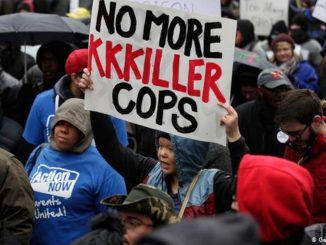
It’s more likely that if Lenin were alive, he would be at the barricades in the George Floyd uprising. On the streets in the daytime and at night writing on the necessity of finishing the revolution for Black liberation, connecting the fight to capitalism and calling for socialism.

Lenin might have even been picked up and kidnapped by Homeland Security in some city like Portland or Chicago. He was arrested several times for his political activity.

But Lenin isn’t here today, so the next best thing we can do is to review, read and study “The State and Revolution.”

If you are new to reading Lenin, don’t give up if the style seems old fashioned and alien to today’s political period. Instead, read to understand the concepts.

The pamphlet “The State and Revolution” is not only a clarion call to revolution and the abolishment of all the hated repressive apparatus of class oppression; it was also Lenin’s own meticulous and detailed study of Marx and Engels writings on the state. 

Struggle-La Lucha and the Socialist Unity Party invite you to attend our classes and study Lenin’s “The State and Revolution.”

We will not only be reviewing how Lenin’s theories apply to the current struggle against racist police terror but also to the capitalist elections. Can the police be reformed? What is capitalist “democracy” versus workers’ democracy? What did Marx and Lenin learn from the heroic Paris Commune and the communards who “stormed the heavens”?

If you would like to attend, please sign up for Struggle-La Lucha and SUP updates as we will send out notices and invites through email. Stay tuned to our web page.

Check out our YouTube channel at tinyurl.com/SUP-YouTube and see our archive of classes.

Strugglelalucha256


Marxism and insurrection: When the people rebel against racism

On Memorial Day 2020, four Minneapolis police brutally murdered George Floyd. Video of the killing quickly spread around the world. On May 26, some 20,000 people marched in Minneapolis, where they were confronted with a violent police response, including rubber bullets and tear gas. The following day, the city erupted into a full-scale rebellion against the racist police. As of this writing, Minnesota’s governor has called in the National Guard to help repress the ongoing uprising.

This article by Sam Marcy, a leading Marxist thinker and fighter of the second half of the 20th century, was written during the Los Angeles rebellion against racism in May 1992, following the acquittal of the cops who beat Black motorist Rodney King. It explains the revolutionary significance and class character of these popular rebellions against racist state violence that the corporate media and politicians seek to cover up.

The brutal suppression of the Los Angeles insurrection offers a classic example of the relationship of bourgeois democracy to the capitalist state. The statistics most eloquently demonstrate the relationship.

The number of arrests in Los Angeles County alone as of May 5 is 12,111 and still rising. The number of injuries has reached a staggering 2,383. Several hundred are critically wounded. Thus, the number of dead at present will undoubtedly continue to rise.

All this has to be seen in light of the repressive forces amassed by the city, state and federal government: 8,000 police, 9,800 National Guard troops, 1,400 Marines, 1,800 Army soldiers and 1,000 federal marshals. (Associated Press, May 5, 1992)

At the bottom of it all, Marxism differs from all forms of bourgeois sociology in this most fundamental way: all bourgeois social sciences are directed at covering up and concealing — sometimes in the most shameful way — the predatory class character of present-day capitalist society. Marxism, on the other hand, reveals in the clearest and sharpest manner not only the antagonisms that continually rend asunder present-day bourgeois society but also their basis — the ownership of the means of production by a handful of millionaires and billionaires.

Bourgeois sociology must leave out of consideration the fact that society is divided into exploiter and exploited, oppressors of nationalities and oppressed. The basis for both the exploitation and oppression is the ownership of the means of production by an ever-diminishing group of the population that controls the vital arteries of contemporary society. They are the bourgeoisie, the ruling class. At the other end of the axis is the proletariat of all nationalities, the producer of all the fabulous wealth. 

Material wealth has been vastly increasing along with the masses’ productivity of labor. But only 1 percent of the population amasses the lion’s share of what the workers produce while a greater and greater mass is impoverished.

Flattering ‘the people’

Especially during periods of parliamentary elections as in the U.S. today, bourgeois sociologists are full of effusive praise for “the people.” Each and every capitalist politician embraces “the people” with what often becomes disgusting flattery. The people are everything during periods when the bourgeoisie needs them most of all, as during its many predatory wars. Indeed, at no time is the bourgeoisie so attached to the people as when it is in its deepest crisis.

But the people — the unarmed masses — become nothing, not even human beings, when they are in the full throes of rebellion against the bourgeoisie’s monstrous police and military machine. Does not the Los Angeles insurrection prove all this?

No amount of praise, no amount of flattery, can substitute for a clear-cut delineation of the class divisions that perpetually rend society apart.

To the bourgeois social scientists, the masses are the object of history. Marxist theory, on the other hand, demonstrates that the masses are the subject of history. Where they are the objects of history they are manipulated as raw material to suit the aims of ruling-class exploitation. They become the subject of history only when they rise to the surface in mass revolutionary action.

Their rising, as in Los Angeles, is what Karl Marx called the locomotive of history. Their revolutionary struggle accelerates history, bringing to the fore the real character of the mass movement.

To speak of the people in general terms, without cutting through the propaganda to reveal the relations of exploiter to exploited, of oppressor to oppressed, is to participate in covering up the reality. 

Oppression of a whole people

Most indispensable for an understanding of contemporary society is the relation between oppressor and oppressed nationalities. One cannot apply Marxism to any meaningful extent without first recognizing the existence of national oppression — the oppression of a whole people by capitalist imperialism. This is one of the most characteristic features of the present world reality.

This concept above all others must be kept foremost if we hope to understand what has happened in Los Angeles and in other major cities of this country.

The insurrection and the way it is being suppressed closely follow the exposition by Frederick Engels in his book The Origin of the Family, Private Property and the State,” and later brought up to date by Lenin in The State and Revolution.”

What is the state? What is democracy?

Bourgeois sociologists and scholars and above all capitalist politicians always confound the relationship between the two. They often treat them as a single phenomenon. In reality, the relation between democracy and the state is based on an inner struggle — between form and essence.

The state can take on many different forms. A state can have the form of a bourgeois democracy; it can be a monarchy; it may be ruled by a military junta. And in modern society, on the very edge of the 21st century, it may have a totalitarian or fascist form.

Whatever its form, its essence is determined by which class is dominant economically and consequently also dominant politically. In contemporary society, this means the rule of the imperialist bourgeoisie over the proletariat and the oppressed nationalities.

Bourgeoisie needs different forms of rule

The bourgeoisie cannot maintain its class rule by relying solely on one particular form of the state. It can’t rely only on the governing officialdom — even those at the very summit of the state, even when they are solely millionaires and billionaires. Under such circumstances, should there be an imperialist war or a deep capitalist crisis that leads to ferment among the masses, the bourgeois state would be vulnerable to revolutionary overthrow.

But the state is not just the officialdom — who presume to govern in the interest of all the people. The state in its essential characteristics is the organization, to quote Engels, of a “special public force” that consists not merely of armed men and women but of material appendages, prisons and repressive institutions of all kinds.

The decisive basic ingredient of the state is the armed forces with all their material appendages and all who service them. Most noteworthy are the prisons — more and more of them — calculated to break the spirit of millions of the most oppressed while pretending to some mock forms of rehabilitation. All the most modern means — mental and physical — are used to demoralize and deprave the character of those incarcerated. 

These repressive institutions, this public force, appears so omnipotent against the unarmed mass of the oppressed and exploited. But it stands out as the very epitome of gentility and humaneness when it comes to incarcerating favored individuals, especially the very rich, who have transgressed the norms of capitalist law.

In general then, the Los Angeles insurrection shows that democracy is a veil that hides the repressive character of the capitalist state. The state at all times is the state of the dominant class. And the objective of the special bodies of armed men and women is to secure, safeguard and uphold the domination of the bourgeoisie.

Growth of the state

Engels explained that in the course of development of capitalist society, as the class antagonisms grow sharper, the state — that is, the public force — grows stronger.

Said Engels, “We have only to look at our present-day Europe where class struggle, rivalry and conquest has screwed up the public power to such a pitch that it threatens to devour the whole of society and even the state itself.”

Written more than 100 years ago, this refers to the growth of militarism. The sharpening of class and national antagonisms had even then resulted in larger and larger appropriations for civilian and military personnel employed for the sole purpose of suppressing the civil population at home and waging adventurist imperialist wars abroad. 

The state grows in proportion as class and national antagonisms develop. Democracy is merely a form which hides the predatory class character of the bourgeois state. Nothing so much proves this as the steady and consistent growth of militarism and the police forces in times of peace as well as war.

The ruling class continually cultivates racism to keep the working class divided, in order to maintain its domination. This is as true at home as it is abroad. The forces of racism and national oppression have been deliberately stimulated by Pentagon and State Department policies all across the globe.

Marxism on violence

After every stage in the struggle of the workers and oppressed people, there follows an ideological struggle over what methods the masses should embrace to achieve their liberation from imperialist monopoly capital. There are always those who abjure violence while minimizing the initial use of violence by the ruling class. They denounce it in words, while in deeds they really cover it up. That’s precisely what’s happening now.

Yes indeed, they readily admit the verdict in the Rodney King beating was erroneous and unfair. But — and here their voices grow louder — “The masses should not have taken to the streets and taken matters into their own hands.” Their denunciation of the violence of the ruling class is subdued and muffled — above all it is hypocritical, a sheer formality. It’s an indecent way of seeming to take both sides of the argument when what follows is in reality a condemnation of the masses.

In times when the bourgeoisie is up against the wall, when the masses have risen suddenly and unexpectedly, the bourgeoisie gets most lyrical in abjuring violence. It conjures up all sorts of lies and deceits about the unruliness of a few among the masses as against the orderly law-abiding many.

Marxism here again cuts through it all. The Marxist view of violence flows from an altogether different concept. It first of all distinguishes between the violence of the oppressors as against the responsive violence of the masses. Just to be able to formulate it that way is a giant step forward, away from disgusting bourgeois praise for nonviolence. It never occurs to any of them to show that the masses have never made any real leap forward with the theory of nonviolence. Timidity never made it in history.

Indeed, Marxists do prefer nonviolent methods if the objectives the masses seek — freedom from oppression and exploitation — can be obtained that way. But Marxism explains the historical evolution of the class struggle as well as the struggle of oppressed nations as against oppressors.

Revolutions, force and violence

As Marx put it, “force is the midwife to every great revolution.” This is what Marx derived from his study of the class struggle in general and of capitalist society in particular.

None of the great revolutions has ever occurred without being accompanied by force and violence. And it is always the oppressor — the ruling class and the oppressing nationality — that is most congenitally prone to use force as soon as the masses raise their heads. 

In all the bourgeois revolutions in Europe, this new would-be ruling class used the masses to fight its battles against the feudal lords. Then, when the masses raised their heads to fight for their own liberation against the bourgeoisie, they were met with the most fearful and unmitigated violence. All European history is filled with such examples, from the revolutions of 1789 and 1848 to the Paris Commune of 1871. Does not the bourgeoisie, once it has tamed the proletariat at home, use force and violence through its vast military armada to more efficiently exploit and suppress the many underdeveloped nations throughout the world?

It is so illuminating that Iraq, the nation subjected to the most violent, truly genocidal military attack in recent times, has taken upon itself to press a formal complaint in the United Nations Security Council on behalf of the embattled masses in Los Angeles and other cities. Iraq called on that body to condemn and investigate the nature of the developments here and the irony is that the head of the Security Council felt obligated to accept the complaint. Not even the U.S. delegate, obviously taken by surprise, objected.

How much real difference is there between the suppression of the Paris Commune in 1871 and that of the revolutionary rising of the masses in Los Angeles in 1992? The brutal suppression differs only in magnitude and not in essence. While it might seem that in Los Angeles national oppression alone is involved, in reality it derives from the class exploitation of the African American masses dating back to the days of slavery.

Watts and social legislation

Following the Watts insurrection, the bourgeoisie made lofty promises to improve the situation. The Watts, Detroit, Newark and other rebellions did win significant concessions that eventually were enacted into law. They became the basis for a temporary improvement in the economic and social situation of the oppressed people.

None of the progressive legislation, up to and including affirmative action, would have been enacted had it not been for the rebellions during the 1960s and the 1970s. Yet now, almost three decades after the Watts rebellion, the masses are in greater poverty and the repression is heavier than before. The fruits of what was won have withered on the vine as racism and the deterioration of economic conditions took hold once again. 

Once more the bourgeois politicians attempted to mollify the masses with endless promises of improvements never destined to see the light of day. This evoked a profound revulsion among the masses. It took only an incident like the incredible verdict of the rigged jury that freed the four police officers in the Rodney King beating to ignite a storm of revolutionary protest.

If revolutionary measures are ever to have any validity, doesn’t a case like this justify the people taking destiny into their own hands?

Less workers, more cops

How interesting that technology everywhere displaces labor, reducing the number of personnel. 

There was a time when it was hoped that the mere development of technical and industrial progress, the increase in mechanization and automation, would contribute to the well-being of the masses. This has once again shown itself to be a hollow mockery. The truth is that the development of higher and more sophisticated technology under capitalism doesn’t contribute to the welfare of the masses but on the contrary, throws them into greater misery.

What has been the general trend? The growth of technology, particularly sophisticated high technology, has reduced the number of workers employed in industry as well as in the services. The introduction of labor-saving devices and methods has dramatically reduced the number of workers in all fields.

But the opposite trend prevails in the police forces. This is an absolutely incontestable fact. At one time the police patrolled the streets on foot. Maybe they used a public telephone for communications with headquarters. Today they are equipped with sophisticated gear. They ride either on motorcycles or in police cars or helicopters. They communicate by radio.

All this should reduce the number of police. But the trend is quite the contrary: to increase the forces of repression. This is not geared to productivity as in industry. Their growth is geared to the growth of national antagonisms, the growth of racism and the bourgeoisie’s general anti-labor offensive.

In Los Angeles, the bourgeoisie is forced to bring in federal troops to assist city and state authorities. The social composition of the U.S. Army is not just a cross-section of capitalist society. The Army and Marines, especially the infantry, have a preponderance of Black and Latinx soldiers. What does this signify?

The U.S. imperialists had to wage a technological war against Iraq out of fear that the preponderance of Black and Latinx soldiers could end up in a disastrous rebellion; they might refuse to engage in a war against their sisters and brothers in the interests of the class enemy. That’s why the armed forces never really got into the ground war that seemed at first to be in the offing.

In Los Angeles, the local police and state forces were inadequate. Only because the masses were unarmed was the bourgeoisie able to suppress what was in truth an insurrection — a revolutionary uprising. 

Spontaneity and consciousness 

As Marx would put it, such a rising is a festival of the masses. The incidental harm is far outweighed by the fact that it raises the level of the struggle to a higher plateau. The wounds inflicted by the gendarmerie will be healed. The lessons will be learned: that a spontaneous uprising has to be supported with whatever means are available; that a great divide exists between the leaders and the masses.

No viable class or nation in modern capitalist society can hope to take destiny in its own hands by spontaneous struggles alone. Spontaneity as an element of social struggle must beget its own opposite: leadership and organization. Consciousness of this will inevitably grow.

Strugglelalucha256


Webinar celebrates Lenin’s contributions to socialist struggle

As part of a series of Marxism classes sponsored by the Socialist Unity Party/Partido de Socialismo Unido and Struggle-La Lucha newspaper, a special webinar was held April 26 to mark the 150th birthday of V.I. Lenin, founder of the Bolshevik (communist) party and leader of the 1917 Russian Revolution. 

Presentations and discussion focused on Lenin’s contributions to revolutionary Marxism as a tool for the emancipation of workers and oppressed peoples, including what we can learn from his example at this moment of global political, social and economic crisis.

The webinar kicked off with a diverse group of activists reading passages from Vince Copeland’s pamphlet, Lenin: Thinker, Fighter.” Copeland described Lenin as “The ‘beginner’ … part of the inevitable and unconscious force of history, [who began] a whole chain of revolutions and a new phase in the world socialist revolution first conceived by Karl Marx.”

Lenin recognized that the cause of world socialism “requires a relentless struggle against the ruling-class enemy, which resists the coming into being of the socialist age with all its might,” wrote Copeland. “This struggle, in turn, requires a different kind of person to engage in it. It also requires a plan, a strategy, a theory and a leadership.

“Lenin provided all those, but in order to do that effectively he had to conduct himself and even shape himself in a certain way,” Copeland explained.

How to build unity?

John Parker, a leader of the Harriet Tubman Center for Social Justice in Los Angeles and national spokesperson for the Socialist Unity Party, talked about the importance of Lenin’s historic contribution to understanding the struggle of oppressed nationalities and people with special oppressions. 

“The question for the leaders of the Bolshevik Revolution was, how were they going to build unity? How could they unify the fighting army that was needed to take state power? How could they convince oppressed non-Russian workers and peasants, who historically didn’t trust the majority Russian population, to even desire a socialist state? 

“The solution came through trying to build trust through political and economic solidarity, using the right of self-determination.”

Miranda Etel, an activist with Youth Against War and Racism and the Peoples Power Assembly in Baltimore, recalled Lenin’s Marxist analysis of imperialism, the highest stage of capitalism, and urged participants to review Lenin’s five-point definition of imperialism. 

“Why does the U.S. spend billions on the Pentagon and almost nothing on public health, education and jobs? Why is the U.S. government intent on inflicting pain and suffering around the world through sanctions? Why can’t we get life-saving medicine from Cuba during this pandemic? 

“To understand these questions, it’s important to understand what imperialism is. Lenin, building on Marx, developed the theory that explained imperialism,” she said.

From New York, Struggle-La Lucha co-editor Greg Butterfield spoke of what Lenin’s example can teach communists about responding to moments of sharp change in capitalist society to further the fight for revolutionary socialism. 

After the Russian Revolution, Lenin wrote the book “Left-Wing Communism” to explain the history of the Bolshevik party and how it altered its tactics to meet the challenges of a variety of situations, from times of reaction and repression to workers’ upsurge. These experiences, Butterfield said, made it possible for Lenin and the Bolsheviks to take the right course of action when a revolutionary situation arose during World War I. 

“Lenin couldn’t predict the exact date of the revolution even shortly before it happened, just like we can’t predict what will happen in two months or two years. But like Lenin, we can strive to be prepared, to be flexible and take advantage of those opportunities when they do come.” 

The webinar was recorded and is available to view on the Struggle-La Lucha YouTube channel. You can also read more at Struggle-La Lucha’s page devoted to #Lenin150.

Online Marxism classes are held on the second and fourth Sundays of every month. Visit and “like” the Struggle-La Lucha Facebook page for updates and to register for upcoming classes.

Strugglelalucha256


The $2 trillion stimulus: Slush fund for Wall Street, trinkets for unemployed

March 27 — The $2 trillion stimulus plan passed by Congress and signed by President Donald Trump on March 27 is a massive giveaway to Big Business and the Wall Street banks with a small, short-term plan for workers who’ve lost their jobs and possibly their homes.

The only part of the stimulus plan that gets much media coverage is the provisions for the working class. There’s a small increase in unemployment insurance, and a one-time direct payment of $1,200 per adult (not the $2,000 a month proposed by Bernie Sanders, which is what is being done in Canada). 

These relief provisions will take about $250 billion, a fraction of the $2 trillion package. There is no support for full paid sick leave, no halt to evictions and foreclosures, no freeze on layoffs — economic measures that are required to counter the crisis.

Some $454 billion of the stimulus plan is a slush fund for the Federal Reserve Bank, report Pam Martens and Russ Martens. “The text of the final bill was breathtaking in the breadth of new powers it bestowed on the Federal Reserve, including the Fed’s ability to conduct secret meetings.”

The result, Pam Martens and Russ Martens say, is that the Federal Reserve will leverage the bill’s bailout fund into $4.5 trillion, which will be handed out through the New York Fed. And, to ensure that the Fed doesn’t have to reveal where that $4.5 trillion goes, the bill suspends the Freedom of Information Act for the Fed.

The Boeing bailout

The rest of the $2 trillion plan? Some $367 billion is for small business loans. And then there are other industry-specific loans, including to airlines and hotels. None of those go to the workers in those industries or include any kind of job protection.

A hidden bonus payment is going to Boeing. The Wall Street Journal reports that “Boeing is set to emerge as a big winner of the coronavirus stimulus package.”  

The Washington Post reported on March 25, “Lawmakers have inserted in the Senate’s $2 trillion stimulus package a little-noticed provision aimed at providing billions of dollars in emergency assistance to Boeing, the aerospace giant. … The carve-out is separate from the $58 billion the Senate package is providing in loans for cargo and passenger airlines.”

“Call it the ‘Boeing bailout,’” says R.J. Eskow, a senior adviser for health and economic justice, in a report produced by Economy for All at the Independent Media Institute. “As the world struggles with the pandemic, Boeing should be seen as the vector for a parallel epidemic. It’s Patient Zero in an epidemic of corporate failure.”  

The corporate failure epidemic is the capitalist economic crash that was looming even before the coronavirus pandemic.

Boeing is among the largest global aerospace manufacturers. It is the second-largest defense contractor in the world, based on 2018 revenue, and is the largest exporter in the United States by dollar value, says USA Today. 

In January 2020, Boeing had gone into negative numbers in sales of its commercial airplanes, that is, it was losing orders for the first time in more than 30 years.

In other words, the Boeing crisis and the bailout by Congress and the president has nothing to do with the coronavirus pandemic and its reductions in travel.

In commercial aircraft, Boeing was being outsold by Airbus, which had a more desirable, fuel-efficient jet, the New York Times reported on March 23, 2019.  

American Airlines, an exclusive buyer of Boeing 737s for more than a decade, said in 2011 that their next order of hundreds of jets would be the Airbus. Boeing responded that they could produce a jet that matched the Airbus’ capabilities. In three months, Boeing was promising American Airlines a rejiggered 737 and called it the 737 Max. Development was rushed, safety steps were skipped.

All of Boeing was being rejiggered, not just the 737. Cost cutting and cutbacks were the rule in order to maximize profits. Airlines flying the Boeing jets began to complain about the quality of the jets they were receiving.

The specific issues described by numerous airlines were consistent. “KLM Royal Dutch Airlines described the factory’s quality control as ‘way below acceptable standards’ when talking about a new 787-10 delivered in spring. Among several issues noted were loose seats, missing and incorrectly installed pins, nuts and bolts not fully tightened, and a fuel-line clamp left unsecured,” Business Insider reported. 

On Dec. 20, 2019, a test run of the Starliner capsule that Boeing built for NASA failed to reach the Space Station. “The NASA source said eight or more thrusters on the service module failed at one point and that one thruster never fired at all,” according to an Ars Technica report. 

Another report concluded: “Not one of Boeing’s large projects seem to be without significant problems. The company has disgruntled its suppliers, its workforce, its customers and its regulators. This is the outcome of a 20 year process that changed the company culture into one where cost cutting and shareholder value were the highest priority. It will take years to change that back into one where good engineering and safety are the most valued attributes.”  

“With the 737 Max, Boeing put profits first and hundreds died,” ProPublica reported on Nov. 11, 2019.  

400 unsaleable 737 Max jets

In January 2020, Boeing finally shut down its 737 production line. It had more than 400 unsaleable 737 Max jets sitting in its parking lot, at an estimated cost of at least $1.5 billion a month. The total loss due to the 737 Max failure is now estimated to be $30 billion.

At that time, Congress had already given Boeing untold billions in the Pentagon budget that was signed by Donald Trump on Dec. 20, 2019. Rep. Rashida Tlaib, one of just seven Democrats to vote against the trillion-dollar spending plan, said, “These are huge checks being written to Boeing and Lockheed Martin, when we should be cutting checks to everyday people struggling to make ends meet.” 

Boeing and Lockheed Martin are the two top arms manufacturers in the world. They are the top two of the five corporations that get 90 percent of the Pentagon contracts. The other three are Raytheon, Northrop Grumman and General Dynamics. The five together are the infamous military-industrial complex.

Until the second 737 Max crash on March 10, 2019, in Ethiopia, which killed all passengers and revealed the jet’s instability, Trump had Patrick Shanahan, a Boeing senior vice president, sitting at the head of the Pentagon: Secretary of Defense (Department of War). The Department of War was established by George Washington in 1789 but was renamed “Department of Defense” in 1947 at the beginning of the Cold War in an attempt to obscure its purpose.

The late Senate Armed Services Chair John McCain (R-Ariz.) was among those expressing qualms about Shanahan’s ties to Boeing during the confirmation hearing, Politico reported. “I am concerned that 90 percent of defense spending is in the hands of five corporations, of which you represent one,” McCain told Shanahan. “I have to have confidence that the fox is not gonna be put back into the hen house.”

A crisis of capitalism

Boeing was already in trouble.

The aircraft industry was in a crisis of oversupply, as the business press put it, which was relieved somewhat when the Boeing 737 Max was grounded. And reports said that the possible return of the 737 Max jet to the market would trigger a crisis. “There could potentially be as many as 1,000 surplus aircraft next year,” Reuters reported.  

The business press has been speculating about possible bankruptcy for months. This bailout might be comparable to the one the government did for General Motors in 2009, except this bailout isn’t being done as an investment. It’s a giveaway! Trump has said over the last few weeks that the federal government is going to step in and “help Boeing.”

The $2 trillion bailout passed by Congress and signed by Trump is not about fighting the coronavirus or helping the working class. The capitalist system was already on the edge of a bust.

Boeing was virtually bankrupt.

Homelessness has reached record levels. The Coalition for the Homeless reported last year that the number of homeless in New York City had reached an all-time record high of 133,284.

The auto industry is also in a crisis. As CNBC reported last November, “Global car sales expected to slide by 3.1 million this year in steepest drop since the Great Recession.”

With an overproduction crisis that has plagued Big Oil since at least 2018, a price war pushing oil down toward $20 a barrel from $60 a barrel three months ago triggered the March 9 stock market nosedive.

Workers’ pay is at record lows, income inequality at record highs. Forty-four percent of all U.S. workers are in poverty, not even a living wage.

The $2 trillion bailout is a giveaway to the rich, who’re in a panic over the crashing capitalist system. It won’t stop the crash, the layoffs, the loss of homes, or the general instability and suffering for the working class and oppressed peoples in the U.S.

Strugglelalucha256


Why the profit system is spinning into crisis

Wall Street has been on an unprecedented roller coaster ride, with big swings in both directions every day for more than a week, a volatility not seen since November 1929. The stock market had the largest one-day point drop in history on March 16, 2020, nearly a 13 percent drop.

The fall hits not just the big investors — big banks, corporations and hedge funds — it also hits 401(k) retirement plans and savings tied to the market.

Businesses have started laying off workers or cutting work hours. “Some 18 percent of adults reported that they had been laid off or that their work hours had been cut,” the Los Angeles Times reported on March 17.

Oil prices plummeted to nearly $20 per barrel on March 18, down from about $60 only three months ago.

The Covid-19 pandemic is being blamed. Thousands of people have lost their lives and hundreds of thousands have been infected. 

But the pandemic is an event that revealed the crisis in the capitalist system — it didn’t cause the crisis. From the point of view of the economy, the virus exposed the underlying economic instability.

The stimulus packages being offered up almost daily by President Donald Trump and Congress as well as the Federal Reserve Bank are meant to keep the economy afloat. But the effects of these measures will be limited without a public health response that could contain the virus.

Large parts of the service sector — restaurants, bars, movie theaters — as well as hotels and airlines — are all severely hit as people stay away from places of public gatherings and stop travel. Normal life is grinding to a halt, with schools and places of worship closing, concerts and conferences being canceled and sports leagues suspending their seasons.

The so-called casual workforce, service workers and the gig workforce have been hit especially hard, with no paid time off, no health care coverage, no guarantee of a job, food or housing.

The coronavirus pandemic’s economic devastation will continue until the coronavirus is contained. But containment has been slow to nonexistent in the U.S. after decades of cuts to the health care systems. In May 2018, then-National Security Adviser John Bolton fired the entire U.S. Pandemic Response Team and at the same time President Trump cut funding for the Centers for Disease Control’s global disease outbreak prevention efforts. 

In fact, the coronavirus crisis in Europe and the U.S. is now worse than at the worst period in China. Indeed, the failure of the capitalist countries to contain the virus has produced a disaster. In proportion to the population, the speed of spread of the virus in Europe is now faster than at any period in China. The number of new daily cases in Germany was three times as high as the peak in China, in France five times as high, in Spain 12 times as high and in Italy 21 times as high. 

The true rate in the U.S. is unknown as testing is still mostly unavailable or limited. Yet testing is the only way to start the measures needed to control the spread of the virus.

Trump reportedly had testing limited as much as possible “because more testing might have led to more cases being discovered of coronavirus outbreak, and the president had made clear — the lower the numbers on coronavirus, the better for the president, the better for his potential re-election this fall.” 

No economic crisis in China

In terms of the global situation, sharp declines in the number of new coronavirus cases in China confirm that the coronavirus outbreak there, while not over, has been brought under control. Therefore, production and supply chains both in China, and from China to the global economy, will begin to improve.

The virus first hit China very hard in December. China responded with a social mobilization of the people, as in a war, to fight the virus. Now Covid-19 has largely been contained in China itself, thanks to the mobilization that was made possible by China’s socialist base.

It’s instructive to look at a timeline of China’s response (drawn up by journalist Godfree Roberts):

November 2002: After its experience with the SARS outbreak in Guangdong Province in 2002, China implemented a rapid response protocol for infectious diseases. The protocol empowered the Health Ministry to assemble professional and managerial help from across the country; established an emergency response coordinating team; prepared funding and authorization for supplies, equipment and emergency health care facilities, anticipating that existing hospitals would be overwhelmed.

July-December 2019: Chinese researchers informed China’s Health Ministry of a novel Coronavirus outbreak, triggering a readiness alert nationwide. The World Health Organization (WHO) describes what happened next: “In the face of a previously unknown virus, China has rolled out perhaps the most ambitious, agile and aggressive disease containment effort in history. … China’s bold approach to contain the rapid spread of this new respiratory pathogen has changed the course of a rapidly escalating and deadly epidemic.”

Dec. 26, 2019: Jixian Zhang detects four anomalous pneumonia infections in Wuhan and reports them to the provincial CDC the next day. The provincial authorities immediately inform the national CDC, which prepares to implement the pandemic response protocols.

Dec. 30, 2019: China’s national CDC notifies the WHO, which reports Zhang’s discovery to the world.

Dec. 31, 2019: WHO reports Zhang’s discovery to the world.

Jan. 7, 2020: China identifies the virus as 2019-nCov and confirms it five days later. President Xi tells officials that the country is on “a war footing.”

Jan. 13, 2020: China makes the first 2019-nCov test kits available.

Jan. 25, 2020: Construction begins on a 1,000 bed intensive care hospital in Wuhan.

Jan. 26, 2020: China extends the New Year holiday to contain the outbreak.

Feb. 5, 2020: First patients moved into a new 1,000 bed intensive care hospital.

March 4, 2020: February rail freight loadings resume, rising 4.5 percent.

March 5, 2020: Shipments to foreign customers upgraded; government subsidizes upgrades from sea to rail delivery and from rail to air delivery.

March 10, 2020: Government organizes and subsidizes bus, rail and air transport for 200 million migrant workers to return to urban jobs.

March 16, 2020: Ninety percent of businesses expected to resume full operations. All Apple stores open.

No layoffs. No evictions. Yes, the economy slowed down, as it must when production is shut down, but there was no crisis involving loss of jobs, of homes, of food.

Yet in the U.S., already 1 in 5 have been laid off. Many, many workers may lose their jobs — perhaps millions — all supposedly because of the coronavirus. But if that didn’t happen in China, then we have to look at other factors that are pulling down the economy.

Capitalist crises of overproduction

In the period before the present Wall Street crash, the U.S. economy was stagnating, economic growth had come to a virtual halt, and the appearance of global overproduction of vital commodities stood out. In particular, were the reports since 2018 of an oversupply of oil, with barrel prices sliding downward.

After World War II, the U.S. was the world center of industrial production and the top economy based on that. Today, industrial production has moved to China, India, Bangladesh and Vietnam. Imperialist capitalism continues to extract profits from the rapidly expanding industrial working class of the Asian countries, the lion’s share of which goes into the pockets of the capitalists of the U.S.

Meanwhile the U.S. has become an economy based on services and “information,” that is, computer software and operations. The U.S. economy has gone through a steady de-industrialization over the last few decades.

The response has been an attempt to make the U.S. the world’s leading carbon-based energy producer through the development of North America’s vast reserves of fossil fuel. In effect, the old U.S. industrial monopoly would be replaced by a new energy monopoly based on carbon-based fuel extracted through shale-rock fracking. 

The U.S. and its Canadian satellite have become the chief suppliers of fossil fuel — oil, coal and natural gas — in the world. That has been the basis for the economic rise since the 2008 Great Recession.

An article titled “U.S. Is Overtaking Russia as Largest Oil-and-Gas Producer” in the Oct. 3, 2013, Wall Street Journal reported: “U.S. energy output has been surging in recent years, a comeback fueled by shale-rock formations of oil and natural gas that was unimaginable a decade ago. A Wall Street Journal analysis of global data shows that the U.S. is on track to pass Russia as the world’s largest producer of oil and gas combined this year — if it hasn’t already.”

The U.S. produced 18 percent of the world’s oil last year, compared with Saudi Arabia’s 12 percent, Russia’s 11 percent and Canada’s 5 percent. 

As far as natural gas alone is concerned, the U.S. and Russia are the dominant producers, with Russia’s flow of natural gas to Europe going through Ukraine. A cutoff in Ukraine would force Europe to depend on oil or U.S.-produced natural gas transported in liquid form by ship. Is there any wonder Trump and Biden are contending in Ukraine?

As the U.S. and Canada developed their profitable fossil fuel industry, whether natural gas or shale oil, the U.S. economy has become increasingly dependent on selling carbon-based energy products. Is that not the reason the president of the U.S. is a climate change denier or that near-military force has been brought down on opponents to pipelines across Native lands in the U.S. and Canada?

The U.S. oil and gas production is done by the expensive and environmentally horrendous method of extraction known as fracking. The price of oil has to be kept pretty high to make fracking profitable.

Now oil has been hit by a crisis of overproduction and the oil industry is on the verge of collapsing.  

The overproduction crisis has plagued Big Oil since at least 2018 and is not related to the drop in demand during the coronavirus epidemic. Oil prices have been falling steadily since a high of about $75 a barrel in 2018. Three months ago, it was $60 a barrel. Today, it is near $20 a barrel. This is well below what it costs to produce oil from fracking. Shale oil can’t produce a profit when prices drop this low.

This is capitalist overproduction. More is being produced than can be sold for a profit.

The continuing fall of the stock market reflects the general instability in the capitalist mode of production for profit. The economy was already slowing, contracting in a cyclical capitalist crisis. Capitalists call it a profit crisis as the produced commodities cannot be sold at profit. That’s the crisis that triggers a major economic downturn, a full-on recession or even a depression.

Strugglelalucha256


CYCLICAL CAPITALIST CRISES: Behind the stock market turmoil

March 5 — The Dow index just fell 12 percent in one week, the worst week for stocks since the 2008 financial crisis. Many wonder if this could become a full-on stock market crash.

Among socialists, there is always a temptation to paint a fall on Wall Street in terms of an imminent economic or political collapse. And while that is a possibility, a market crash never causes an economic collapse. It’s more like a symptom of capitalism’s economic instability. 

On the other side, apologists for the capitalist system are saying that the momentous drop is merely a “correction.” The capitalist economists claim that the global stock market fall is unrelated to the fundamentals of the economy, that the market has been gripped by coronavirus jitters. Just give it a couple of weeks and all will be well.

What happens at the stock market isn’t capitalist production; it does not produce value. What happens at the stock market is a reflection of the conditions of capitalist production. 

The stock exchange concentrates all industry, agriculture, commerce and the means of production into the hands of the stock exchange operators, that is, the biggest banks and financial institutions, including central banks such as the Federal Reserve.

But the stock market is an integral part of the financial industry, and its crash is a forerunner of the economic situation, not the aftermath. 

A crisis of overproduction

Overproduction refers to cyclical crises of the capitalist system, caused by the anarchy of capitalist production.

Marxist economists often use the terms overproduction and overproduction crisis. But what exactly is overproduction? 

A common conception of overproduction is based on an incomplete understanding of Marx’s theory of surplus value. Workers get in wages and benefits only a fraction of the value they create during the workday. In effect, they work for themselves for part of the day in return for wages (paid labor) and for the capitalist the rest of the day free of charge (unpaid labor).

According to this view of overproduction, workers cannot purchase all the commodities they produce and that is what causes the crisis. This is called “underconsumption.” 

The underconsumption explanation says that a capitalist crisis can be overcome by raising wages and expanding credit. When workers take on debt, it expands demand for cars and housing and enables other major purchases. Raising wages and expanding credit can temporarily overcome the “underconsumption-ism” inherent in capitalism, allowing the economy to expand. 

Some have suggested that the current crisis is tied to the unprecedented expansion of consumer debt — mortgages, car loans, credit cards, student loans — to over $14 trillion, and the subsequent rise in delinquencies, that is, nonpayment of debt that has now reached a level last seen in the 2008 economic crash. 

Capitalist Keynesian economics is based on an underconsumption theory, that recessions are the result of inadequate consumer demand.

A major flaw in this underconsumptionist explanation of overproduction crises is the idea that it is only, or mainly, workers who are the buyers of all goods and services. 

However, capitalists as well as their unproductive (of surplus value) institutions, including the government, especially the Pentagon, are also buyers. The capitalists are the buyers of the machinery, the raw materials, the robotics, the computer systems, and the labor power that is required for production. And debt is not just consumer debt, but business debt, capital investments.

On underconsumption, Karl Marx said, “It is sheer redundancy to say that crises are produced by the lack of paying consumption or paying consumers. The capitalist system recognizes only paying consumers, with the exception of those in receipt of poor law support. … When commodities are unsalable, it means simply that there are no purchasers, or consumers, for them. 

“When people attempt to give this redundancy an appearance of some deeper meaning by saying that the working class does not receive enough of its own product and that the evil would be dispelled immediately if it received a greater share, i.e., if its wages were increased, all one can say is that crises are invariably preceded by periods in which wages in general rise and the working class receives a relatively greater share of the annual product intended for consumption,” Marx concluded.

A crisis of overproduction comes about because of the anarchy of capitalist production. Individual owners of means of production produce goods and services with no guarantee of a buyer. The inevitable result is a mass of commodities with no buyers (for many reasons, including a competitor’s product being cheaper or better, the product no longer being needed, or … you can come up with a few other reasons a product can’t be sold).

Under capitalism, it is not possible to prevent or avoid crises of overproduction, because they flow from an irresolvable contradiction of the system, the anarchy of production. 

In “Socialism: Utopian and Scientific,” Frederick Engels describes capitalist crises as collisions between two forces — production and the markets. Capitalists expand production seemingly without limit and are in competition among themselves to do that, but the markets expand only slowly if at all.

Since under capitalism, production cannot grow faster than the market, this contradiction is periodically resolved through a massive contraction of production, destruction of existing productive forces and mass unemployment. 

This resolution is only temporary. After the crisis, and after sometimes years of stagnation, production enters a new powerful expansion that leads once again to a new flooding of the market — and a new crisis.

Current crisis no exception

Most if not all capitalist crises since 1825 have tended to begin in the consumer goods sector, especially residential construction. Other durable consumer goods industries such as the auto industry, which became important during the last century, also tend to turn down before the rest of the economy does. 

The current crisis is no exception. The U.S. housing crisis is a construction crisis, a crisis of overproduction. There are more than 53,000 homeless people in Los Angeles, yet there are more than 100,000 vacant apartments and houses there. The housing is needed, but it remains vacant because it can’t be sold for a profit.

The auto industry is similarly in the grip of an overproduction crisis. As CNBC reported last November, “Global car sales expected to slide by 3.1 million this year in steepest drop since Great Recession.” 

Automakers are slashing the workforce at the fastest pace since the Great Recession a decade ago.

The crisis of global overproduction in the car industry, sharpened by the race to dominate in the transition to electric and hybrid vehicles, triggered the latest gigantic merger, that between the France-based PSA (Peugeot) and Fiat Chrysler.

The aircraft industry was in a crisis of oversupply, as the business press put it, which was relieved somewhat when the Boeing 737MAX was grounded. The financial press is now warning that the return of the 737MAX will trigger a crisis. “There could potentially be as many as 1,000 surplus aircraft next year,” Reuters reported. 

Indeed, the U.S. could be headed into recession.

A new recession will only increase the growing interest in socialism in the U.S., as shown in the Bernie Sanders campaign. Socialism, of course, is the only way to put an end to capitalist economic crises. That means replacing capitalism with socialism. Modifying capitalism can relieve some of the pain, but it won’t stop capitalist crises.

Capitalism is a virus that can’t be fixed. The disease is built into the system. Capitalism must be thrown out for the good health of all humanity.

Strugglelalucha256


How do we get socialism?

Why is capitalism so f@*d up?

Well, the short and loosely accurate answer is that it’s like one of those driverless cars that still don’t quite work the way they are supposed to — because no one’s at the wheel! 

No one is monitoring what needs to be produced or by how much. It’s all based on each individual capitalist’s drive for the maximum profit – whether it means producing milk for babies or bombs that kill babies. And since producing bombs has a higher profit return, then bombs it is. Humanity be damned, the climate be damned!

Capitalism has always been a cruel system, but it came into being partly as a result of farm laborers rejecting an even crueler system, feudalism, which lost its ability to expand production. This revolt against the old system was led by the soon-to-be new ruling class of capitalists, leading the exploited farm laborers (or serfs/peasants) as an army against the monarchs. 

Once the capitalists were in control of how things were being produced in society, with their more scientific and more efficient means, bringing those farmers into their factories as workers, it allowed the advance in productive capacity, helping to limit our want for basic necessities.

But remember, the capitalists aren’t in business to employ workers or provide the necessities of life. They’re in business to maximize profits — which means reducing labor costs by lowering wages and using every new technological advance to make their machines and processes capable of producing more while cutting the amount of workers needed, eventually leading to more poverty and unemployment. 

Capitalism blocks progress

But the bigger problem for the capitalist system is the fact that the pace of production always accelerates above the pace of consumption, leading to what we have today – a global crisis of overproduction — too many products that can’t be sold at a profit.

And when greater profits can be made through financial speculation (gambling on the stock exchange), the investment money flows there.

That’s mostly why there aren’t enough full-time jobs that pay a living wage. Of course, we could always just lower the working hours, allowing more people to be employed — but that’s not allowed because (1) it cuts into profits and (2) even if we think human needs should trump profits, we don’t control how things are produced. 

We’re not the ruling class, and we don’t control the police and military — which will undoubtedly be called in when the profits of the bosses are threatened.

That’s why unemployment and low wages can’t be solved by politicians working within the confines of the capitalist mode of production. Just as feudalism became a strain hampering production, so too has capitalism run its course and become an inhibitor of vital production for humanity. 

The world is now ripe, overripe in fact, for a new mode of production — one that puts us, the workers, the producers of wealth, the majority, behind the wheel — and that defines socialism.

The science of Marxism

It’s important to remember, at this point, that the systemic change that occurred from feudalism to capitalism could only have happened after the means of production were taken from the old ruling class of monarchs and landlords and then controlled by the new ruling class — the capitalists. 

Likewise, a socialist revolutionary change can only happen by taking the means of production from the ruling class of capitalists.

How do we know this? The same way we know that gravity exists. Scientific analysis of objective reality can also be applied to social change as it relates to how a society produces, or its modes of production. The capitalists maintain their power precisely by controlling (owning) the means of production, and control the wealth in society resulting from the value created by our human labor.

This science is called Marxism. 

Karl Marx used the scientific method to analyse how human society is organized to produce the necessities of survival, from ancient societies with no classes to the class societies of slavery, feudalism and capitalism. And this analysis pointed clearly to the next step: socialism.

This scientific socialism developed by Marx, explaining the economic workings of capitalist society and the methods to overcome it, has been the single most relied-upon source for implementing revolutionary social change since the early 20th century on every continent.

It’s been utilized by revolutionaries like Fidel Castro, Che Guevara, Clara Zetkin, Amilcar Cabral, Paul Robeson, George Jackson, Rosa Luxemburg, Mao Zedong, W.E.B. Du Bois, Celia Sánchez, Samora Machel, Ho Chi Minh and, of course, V.I. Lenin — whose utilization of Marxism expanded its reach. His leadership was instrumental in bringing about the Bolshevik Revolution of 1917 in Russia.

Socialism and elections

Okay, time to clean up that driverless car analogy. The problem really isn’t that there is no one behind the wheel. The problem is that the driver is more concerned about making profits than bothering to notice or even being able to care that the car is going off a cliff.

Yes, we don’t control the police or military or even the legislative process. In fact, it’s important to understand that the executive and legislative branches of government have been rigged to ensure the status quo since the late 1800s.

That’s when the money of the Rockefellers, Vanderbilts, Mellons and Morgans, to name a few, locked up the system with the enormous profits they gained from cotton production — in other words, slavery — and used that power to expand into other markets.

In addition to using money to keep out candidates that appeal to workers, nowadays the corporate media insure that any “controversial” candidates don’t make it far into the political process. They slander or more often ignore candidates that represent movements that could inspire a shift to the left. 

That’s happening now with the media playing catch-up in their unified attack against Bernie Sanders, since, regardless of his advocacy of remaining within the framework of capitalism, his base of supporters and his progressive platform could threaten the ruling class’s ideological domination that holds back a raising of working-class consciousness.

This is certainly a new development in our current period, and it affords a tremendous opportunity for revolutionaries: not to be spectators from the sidelines, but active participants in an electoral political campaign that has the potential to go significantly beyond the intentions of the liberal candidate and allow access to the many members of our class who are excited about this campaign. 

Lenin promoted this perspective in his pamphlet, “‘Left Wing’ Communism: an Infantile Disorder,” sharing the lessons from the experiences of the Russian Revolution just three years earlier.  

Revolution, not reform

But to answer the question you’re probably asking about how our class can take over the means of production, we should first understand that promoting the idea of the necessity of that takeover is of prime importance. 

Especially when the organs of capitalism — its media, its politicians and the entire ruling class — have an existential fear of, as Marx put it, “the specter of communism.” 

They will promote and help others to unknowingly promote any alternative theories that have been proven ineffective and incorrect time and again — theories that call for everything but the acquisition of the means of production and replacement of the boss’s state and its bought legislature, military and police.

Marx, in fact, exposed the fallacy of the many forms of socialism being peddled by not only liberal forces, but also encouraged by some government institutions, to avoid the revolutionary implications of scientific socialism in his pamphlet “Critique of the Gotha Program.” Lenin did the same in “What is To Be Done?”

Three years ago was the 100th anniversary of the 1917 Bolshevik Revolution. From then up to and including today, socialism as an ideology and the countries that were and are working toward it have been mercilessly attacked by all imperialist powers, starting with the invasion of Soviet Russia by 16 countries when it was just one year old — led by French, British, U.S., Canadian and Japanese imperialists attempting to snuff out communism. 

As powerful as the imperialists were, they were defeated. But devastating economic warfare, embargoes and the continued threat of nuclear annihilation by the U.S. followed. In addition, serious missteps occurred in the leadership of the Soviet Union after Lenin that would not allow the country to endure the external sabotage by imperialist countries. 

As a result, the Soviet Union and its socialist economic system eventually collapsed and broke up into capitalist countries like Russia, Ukraine and others, now acquiring all the problems of homelessness and poverty at breakneck speed.

What socialism can accomplish

Yet, in spite of these ongoing attacks, it was the Soviet Union that was the determining force in the defeat of Nazi Germany, and it was the socialist countries that facilitated the liberation of 17 African countries from colonialism in the 1960s.

None of these achievements could have been made without socialist planning. This allowed an underdeveloped country to become the second-greatest industrial power in the world at unheard-of speed. 

If it were not for the type of economic planning that allowed the expansion of heavy industry for military purposes as rapidly as it did, the Nazi government in Germany would most likely have been the victors of World War II, a war that took 20 million Soviet lives. Remember that when they tell you that the Soviet Union, and therefore socialism, was a failure.

Also remember the contributions of Cuba’s health care and education system exported all over the world, and that the countries putting up the greatest fight against global warming in resources and money are able to make these contributions to the world precisely because of their economic system of scientific socialism and the workers’ ownership of the vital means of production in society.

Imagine what we can accomplish for the people of this country, and the whole world, when we take the advanced productive powers of the U.S. economy into our own hands and apply socialist methods to them. 

Strugglelalucha256


Consumer debt soars to $14 trillion. So, cancel the debt!

Consumer borrowing in the U.S. rose to a new record level at $14.15 trillion, the Federal Reserve Bank of New York said on Feb. 11.

Everything rose: mortgages, student loans, auto loans, credit card debt. 

Student debt is at $1.51 trillion. Auto loans are at $1.33 trillion. 

Credit card debt in the U.S. is at a record $930 billion. Credit card interest rates have soared to a record high. According to the Federal Reserve, the average interest rate on credit card accounts with balances on which interest is assessed — so not counting the theoretical interest rate on credit card accounts that don’t carry balances — was about 17 percent at the end of 2019, a record level going back to 1994. 

Also rising, according to the Fed’s report, are credit card delinquencies, that is, nonpayment of credit card debt. The rate of credit card balances that are 30 days or more delinquent has spiked to 7.05 percent, the highest delinquency rate seen since back in the 1980s.

Similarly, seriously delinquent auto loans jumped to 4.94 percent. This is higher than the delinquency rate in 2010, when unemployment was the highest since the Great Depression of the 1930s. In 2010, delinquencies on credit cards and auto loans were soaring because over 10 million people had lost their jobs and they couldn’t make their payments.

Today, delinquencies aren’t because of high levels of unemployment; the government’s Bureau of Labor Statistics says the unemployment rate is near historic lows. While unemployment isn’t really that low — it’s at least triple what the BLS says — it’s not at 2010 Great Recession levels. 

Sharp divide

So why are these delinquencies spiking now? We haven’t seen millions of people getting laid off. You hear every day in the business media like the Wall Street Journal, Bloomberg News and CNBC that the economy is good. 

The stock market is booming. CNBC headlined Feb. 19: “S&P 500 and Nasdaq jump to record highs, Dow climbs more than 100 points.” The Dow Jones Industrial Average reached an all-time high of 29,569.58 in February 2020. The coronavirus panic on Feb. 24 has brought that down more than 1,000 points, but the effect of that is yet to be seen.

But there’s a sharp divide in the economy. One group is doing well. Their wealth is rising. Profits are up. For the rest, their incomes have not risen, have not even kept up with inflation, with the price increases of cars and homes and other items. Capitalist economists call it slow wage growth. 

Wages today for most workers are lower, in real terms, than they were 40 years ago. What’s increasing is the rate of capitalist exploitation.

The working class is strung out. Workers have jobs but are living from paycheck to paycheck, not because they’re splurging but because wages have not gone up. People are working, but they aren’t even making a living wage.

The Federal minimum wage is $7.25 an hour. The Fight for $15 movement began in 2012. According to FightFor15.org, the movement has won raises for 22 million people across the country. That’s good, but what is needed is much more.

Approximately 23 million workers are paid between $7.25 and $11 an hour. Nearly half (42.4 percent) of all workers in the U.S. make less than $15 per hour. 

The fact is, even $15 an hour is not enough to be considered a living wage; it’s only enough to rise above what capitalist economists call a poverty wage, which is about $8 — that is, more than the Federal minimum wage. 

The Massachusetts Institute of Technology has a Living Wage Calculator. According to the MIT calculator, a single adult with one child in the New York-Newark-Jersey City metropolitan area has to make $32.29 an hour, working full time (40 hours a week), to have a living wage. In the Los Angeles-Long Beach-Anaheim, Calif., metropolitan area, the living wage for a single adult with one child would be $31.85.

So, $32 an hour would be a good starting point for the minimum wage.

Wages under capitalism

Wages under capitalism is a hot topic. Karl Marx wrote a whole book or three on it. 

Capitalist exploitation is hidden by the wage system. Workers are hired for a given amount of time and receive a wage in return. It appears on the surface that an equal exchange has taken place — but this isn’t the case.

Why not? The capitalist, in addition to purchasing computers, machinery, raw materials, etc., for production, also buys what Marx called labor-power, the capability to produce goods or services for sale on the market. 

Working-class people, who don’t own the means to produce and sell commodities, have one commodity they can sell: their labor-power, their ability to work. In this way, workers are forced to sell themselves to some capitalist for a wage in order to acquire money to buy the necessities of life.

Labor is the actual process of work itself. 

According to Marx, unlike computers, machinery, raw materials and other inanimate materials for production that pass on their value to the product but create no new value, labor-power is a “special commodity …  a source of value.” In other words, workers produce new value contained in the final product, which belongs to the capitalist. This is what the capitalist calls profit.

The capitalist owns not only the means of production, and the workers’ labor-power which is bought to use in production, but the product as well. After paying wages as required for the workers to live, the capitalist then becomes the owner of the surplus value, that is, the profit.

The distinction between “labor-power” and “labor” is the key to understanding exploitation under capitalism.

When a capitalist pays a worker a wage, they are not paying for the value of a certain amount of completed labor, but for labor-power. The soaring inequality in the U.S. today illustrates this. The wealth that workers create has increased, but this has not been reflected in wages, which remain stagnant. Instead, an increasing proportion of the wealth produced by workers swelled the pockets of the super rich, who did not compensate the workers for their increased production on the job.

It appears that the capitalist pays the worker for the value produced by their labor because workers only receive a paycheck after they have worked for a given amount of time. In reality, this amounts to an interest-free loan of labor-power by the worker to the capitalist. 

As Marx wrote, “In all cases, therefore, the worker advances the use-value of his labor-power to the capitalist. He lets the buyer consume it before he receives payment of the price. Everywhere, the worker allows credit to the capitalist.”

Why workers are in debt

What is household debt — mortgages, student loans, auto loans, credit cards? This is not the same as the debt of big businesses like General Motors or Walmart, which involves capital investment. 

Workers’ debt is not a capital investment. Rather, consumer debt or household debt occurs  because wages are too low to cover the costs of the means of subsistence — housing, food, transportation, clothing, health care and so on — as well as to smooth the personal booms and busts between paychecks.

What appears to be a lending of money by banks through loans or credit cards to wage earners is actually a borrowing by the capitalists. Only in the case of wage labor is the commodity used up before it is paid for. Every day, we make an interest-free loan of our labor power to our bosses. And, short of cash, we are forced to take out interest-bearing loans to cover the “revolving” costs of eating and dressing and living, as well as the long-term costs of housing, commuting, schooling, etc. 

Actually, what is being loaned by the banks, the credit dealers and such is unpaid wages, loaned to the capitalists. A raise in pay to at least a living wage would relieve some of the debt burden. But the fact is that what has been borrowed is really unpaid wages and the debt should be cancelled altogether, as it is the accumulation of years of unpaid wages. That and a living wage for all would fix the record-breaking debt crisis. 

Strugglelalucha256


The Communist Manifesto: A clarion call full of ideas


The Communist Manifesto was first published on Feb. 21, 1848. This appreciation was written on its 135th anniversary in 1983 by Sam Marcy, a leading Marxist thinker and fighter of the second half of the twentieth century.

Of all the great classics in the treasury of Marxism, The Communist Manifesto unquestionably stands out as the most popular and widely read throughout the world. Bourgeois ideologists, even the most virulent opponents of Marxism, never fail to be astonished by the persistent attraction the Manifesto has for each new generation of revolutionary militants.

The Manifesto, written by Karl Marx and Frederick Engels in 1848, is a creative revolutionary synthesis of propaganda and agitation, as these terms were originally defined by George Plekhanov when he was still a revolutionary Marxist.

“Propaganda” was then understood as the presentation of many complex ideas to a small group of people, while “agitation” was conceived as the presentation of a few ideas or a single idea to a large audience. Of course, there’s no wall between the two.

The Manifesto illuminates a great number of complex ideas.

It presents the materialist conception of history in clear, brilliant language. It traces the history of the class struggle from its earliest days to 1848. It analyzes the rise of the bourgeoisie, explains its revolutionary role — and not only analyzes the intermediate classes in bourgeois society, but also mercilessly exposes the nature of capitalist exploitation and oppression as it had never been done before.

The Manifesto’s diagnosis of capitalist society is at the same time a prognosis of the destruction of capitalism at the hands of what the Manifesto calls the “gravediggers” of capitalism — the revolutionary proletariat.

Not just a critique but a guide to action

Far from being merely a criticism of feudal and bourgeois society, the Manifesto thus unequivocally points the way to the revolutionary overthrow of the bourgeoisie.

Furthermore, the Manifesto subjects to critical analysis the nature of the capitalist state, as well as the role of the family, religion and culture.

Above all, in tracing the development of the proletariat from its earliest days in mere handicraft production to its role in large-scale industry by 1848, the Manifesto points to the “proletariat alone as the really revolutionary class” and the historic agent for constituting a new social order, free of exploitation or oppression.

All of this is propaganda — irreplaceable working-class propaganda. Yet at the same time it is also revolutionary agitation of the highest order. It fans the flames of revolution.

On the one hand, the Manifesto directs itself toward presenting a succinct, coherent and lucid exposition of the basic principles of Marxism. To that extent, it directs itself to “the few” — not necessarily the middle class, but the advanced sections of the working class.

On the other hand, with its ringing call to overthrow the oppressors and exploiters, the Manifesto addresses itself directly to the broadest and widest sections of the working class.

It is this dialectical unity of opposites — propaganda and agitation — so skillfully blended together that makes the Manifesto such a monumental achievement.

Nothing could be a more crystal-clear call to the proletariat than the final paragraph of the Manifesto.

It ends with this ringing call to action:

“Communists disdain to conceal their views and aims. They openly declare that their ends can be attained only by the forcible overthrow of all existing social conditions. Let the ruling classes tremble at a Communistic revolution. The proletarians have nothing to lose but their chains. They have a world to win.

“Workers of all countries, unite!”

Such a mighty clarion call for revolutionary worldwide action by the proletariat has yet to be surpassed.

Marx and Engels were not unaware that the working class was a narrow segment of society at the time the Manifesto was written. As Engels said in the 1890 preface to a Polish edition of the Manifesto, “Few voices responded to Workers of all countries, unite!’ when we proclaimed these words to the world … on the eve of the first Paris revolution in which the proletariat came out with demands of its own.”

However, wrote Engels, “On Sept. 28, 1864, the proletarians of most of the Western European countries joined hands in the International Workingmen’s Association.” And even though that International — the first attempt at a world organization of the proletariat — lasted only a few years, said Engels, it left a glorious heritage.

National chauvinism vs. internationalism

Just prior to the start of World War I, the working-class movement in Europe, under the leadership of the Social Democratic parties, reached the zenith of its authority over the broadest masses on the continent. Immediately after the outbreak of the war, however, the movement was virtually smashed as a result of the betrayal by the Social Democratic leadership.

The adherents of revolutionary Marxism — in reality the adherents of the principles enunciated by the Manifesto — were temporarily reduced to a small minority. The majority had succumbed to chauvinism. They had forgotten one of the principal tenets in the Manifesto: that the workers in a capitalist country have no fatherland. “The workers have no country. We cannot take from them what they have not got.”

The Social Democratic leaders’ surrender to chauvinism cost the proletariat dearly in World War I: millions upon millions of lives lost and untold devastation and destruction.

Nothing so much arouses the prejudices of the bourgeois ideologists, nothing so much enrages them and exposes their deep-seated chauvinism, as the question of “patriotism,” the “defense of the national interest.” Today, more than ever, this invariably means the defense of the capitalist state and giant finance capital.

Any lie, any falsification will do to corrupt, vulgarize and distort the real meaning and significance of the defense of one’s country, as it was understood both in Marx’s time and in the imperialist epoch.

Marx and Engels had written extensively about the autonomy and unity of each nation. It is well known that they had fought for the independence of Poland, Hungary, Ireland and Italy. Engels wrote in 1893 in a preface to the Italian edition of the Manifesto that the defeat of the 1848 revolutions resulted in “the fruits of the revolution being reaped by the capitalist class.”

“Through the impetus given to large-scale industry in all countries,” he wrote, “the bourgeois regime during the last 45 years has everywhere created a numerous, concentrated and powerful proletariat. It has thus raised, to use the language of the Manifesto, its own grave-diggers.”

Engels then added this remarkable thought, as pertinent today as it was then: “Without restoring autonomy and unity to each nation, it will be impossible to achieve the international union of the proletariat, or the peaceful and intelligent cooperation of these nations toward common aims.”

Fighting monopoly capitalism today

The progressive epoch of the bourgeoisie in the struggle against feudalism — especially the period when Marx was writing — demonstrated a trend toward diminishing national differences and antagonisms. It was due to the development of the bourgeoisie, to freedom of commerce, to the world market.

The subsequent evolution into monopoly capitalism diverted this trend. Indeed, capitalism has not been able to carry out a single one of its economic trends to its ultimate conclusion.

The classical example of this is the failure of the various trusts and combinations, through the process of competition, to be converted into total monopoly and become a worldwide trust or “super imperialism,” which Karl Kautsky thought would abolish the anarchy of capitalism.

As industrial and technological development grows by leaps and bounds, monopoly capitalism, rather than narrowing national differences and ameliorating national oppression, exacerbates them. It is no wonder that the bourgeois world is literally divided into oppressing and oppressed nations.

But this does not at all disqualify the class struggle. It merely imparts a greater urgency for the revolutionary cooperation and solidarity of all the workers in both the oppressing and oppressed nations — in a common struggle against imperialism, capitalism and all forms of bourgeois reaction and feudal rubbish left by centuries of oppression.

The revolutionary contribution of the bourgeoisie, as Marx explained, was in developing the world market, which has “given a cosmopolitan character to production.” This has greatly increased the strategic role of the working class in production and in relation to the class struggle.

Marx’s words are even more true today: “In place of the old local and national seclusion and self-sufficiency,” the bourgeoisie has tremendously enhanced “intercourse in every direction, universal interdependence of nations.”

The bourgeoisie cannot create even the semblance of world unity, despite the obvious foundations laid by the gargantuan growth of the productive forces and the ensuing economic interdependence.

Only the proletariat in alliance with the oppressed peoples and the socialist countries can lay the political and social foundations for worldwide solidarity. This is precisely because only socialism, which is based on planning and the common ownership of the means of production, can purge the worldwide market of its imperialist chaos, its unpredictable crises, and the reign of the arbitrary based on superprofits.

Indeed, the world market, as Marx said, “makes national one-sidedness and narrow-mindedness become more and more impossible.” It inevitably generates proletarian class solidarity — the truest basis for bringing about the solidarity of the human race.

Strugglelalucha256


Marxism and the ideological crisis: The socialist perspective and the collapse of the USSR

The following is excerpted from a document written by Fred Goldstein in April 2006. The discussion of the socialist perspective is as relevant today  as when it was written.

Introduction 

The destiny of the working class and all of humanity in the foreseeable future ultimately depends upon the thoroughgoing revival on a world scale of revolutionary Marxism and on the victorious struggle for socialism and communism — the only true application of Marxist revolutionary science. Inasmuch as U.S. imperialism is the primary instigator of war and intervention, the wellspring of reaction and oppression, and the bulwark of world capitalism, in no place is it more important to fight for the revival of the struggle for socialism than in the United States. No ruling class poses such an overarching threat to humanity and to the planet as does U.S. monopoly capital.

We are mindful that this assertion is put forward in a period when the working class is on the defensive and revolutionary horizons seem distant.

Fifteen years ago (1991) a blanket of reaction fell over the planet after the collapse of the USSR and Eastern Europe. This terrible setback had been preceded by the opening up of China to foreign and domestic capital and the abandonment by the Chinese government of revolutionary internationalism. The subsequent 9/11 catastrophe gave U.S. imperialism an opening for a worldwide offensive.

The purpose of this document is to put forward a review and an analysis for discussion. The bulk of the material and arguments presented here pertain to the U.S. However, the trends outlined exist in all the imperialist countries, although in different stages of development.

Today, Washington’s military offensive is stalled in the cities and towns of Iraq and in the hinterlands of Afghanistan. The U.S. government is facing numerous fronts of political and diplomatic confrontation. The fact is that U.S. imperialism is steadily losing its grip on world events in spite of its “superpower” status — a sign of decline. But, with exceptions, the world movement is still on the defensive and political reaction is still a dominant force, particularly in the imperialist heartland.

One can have no illusions as to the formidable obstacles facing the revolutionary movement. Nevertheless, the fact that the task is formidable does not make it any less necessary or any less urgent. It is an indisputable fact that all economic, social, political and environmental evils of contemporary society are a direct outgrowth of the present-day profit system in its decadent stage, the stage of imperialism.

Socialism is the antithesis of capitalism, its only form of negation. There is no other historically possible resolution of capitalism’s fundamental contradictions. The antagonistic social relations created by capitalism weigh oppressively on the vast majority of humanity.

The overriding contradiction governing all of modern society is between, on the one hand, the private ownership of the world’s vast means of production by a tiny minority of fabulously wealthy corporate financiers who operate the entire system for profit and, on the other, the highly developed, interdependent, socialized global production process set in motion 24 hours a day by the labor of the world’s working class under increasingly onerous conditions.

There are no depths of criminality and barbarism to which the ruling class will not go in order to perpetuate this system of exploitation. There is no act of military aggression, no form of torture, no level of grinding exploitation, no environmental threat to life on the planet that capitalism will reject. From the genocide of Indigenous peoples to the slave trade, to the holocaust, to the expulsion of whole populations, to annihilating major cities with nuclear bombs, there is nothing that the capitalist class will shrink from in its insatiable quest for profit, its thirst for surplus value, its irresistible drive to accumulate and multiply its capital.

These acts are not simply a matter of personal greed or human nature. While greed and capitalism are mutually reinforcing, it is capitalism that creates greed, not greed that creates capitalism. The maximization of profit through the exploitation of labor power and the pillage of the world’s resources is the iron law of capitalism. To put an end to the operation of the laws of capitalism, society must put an end to capitalism itself. And the only significant class in modern society that has both the social and economic power and the deeply rooted historical class interest to end capitalist exploitation is the working class.

The recognition of these fundamental propositions is the theoretical and political starting point for the rebirth of the ideological struggle for socialism.

Period of reaction and seeds of revival

Although political reaction prevails in the imperialist world and in the U.S. in particular, nevertheless, the history of capitalism in the last century is filled with both advances and setbacks for the workers and the oppressed. There have been periods of upsurge and periods of deep reaction. While it is undeniable that the collapse of the USSR transcends in its effects all previous setbacks in the history of the working-class movement, the current period of reaction, like all periods of reaction, contains within itself the seeds of its own dissolution.

The collapse of the USSR and Eastern Europe put an end to the first historic phase of the struggle for world socialism. Marxism suffered a great setback in its wake. But Marxism cannot be extinguished and it cannot be suppressed for long because it is the most effective ideological tool with which the exploited and oppressed can conduct their struggle. It expresses openly and in plain language the class truth about the workers’ true condition in society and clearly outlines the road to emancipation. Imperialism in the age of the scientific revolution is expanding and deepening exploitation and oppression on an unprecedented scale.

What is referred to as “globalization” is, in fact, a process that can only be described as the expanded export of capital and the use of cutthroat trade by giant transnational corporations to pile up huge profits at the expense of the people of the world. In short, it is a phase of intensification and widening of the imperialist plunder of the globe. This process of expanded global exploitation, which is proceeding at breakneck speed due to modern high technology, has profound consequences at home and abroad and is rapidly developing the groundwork for the next phase of the world historic struggle for socialism.

Lenin in light of the scientific-technological revolution

Lenin’s analysis of imperialism must be examined anew in light of this latest phase of the scientific-technological revolution and its impact on trends in the working class. The tendency to create relative privilege among some sectors of the working class, as Lenin pointed out in 1916, certainly still applies. But alongside it a new tendency has grown up, the tendency to destroy privilege among the upper stratum of the workers. At present, this latter tendency is outstripping the former.

In other words, the fallout from the export of capital by the industrial-financial oligarchy that rules imperialism has turned into its opposite. It is still the fundamental source of fabulous superprofits, but in the course of accumulating those profits, by the manner in which finance capital has reorganized world capitalist production, it is now leveling downward the wages and standard of living of the proletariat in the imperialist countries. Instead of fortifying social stability and class peace at home, it is reinforcing the tendency toward the breakup of stability and a renewal of class warfare that was inherent in high tech in the first place.

What began as a technologically based restructuring of industry, largely within national or regional boundaries of the imperialist countries in order to destroy high-wage occupations, has now spread internationally. It has expanded the most ruthless forms of capitalist exploitation into every corner of the globe and is also expanding the proletariat worldwide. This will compel the working class to struggle for its own liberation.

The more finance capital develops the productive forces and the more it socializes production, bringing larger groups of workers into connection with one another on an international scale, the more it also lays the basis for international solidarity as the antidote to the vicious competition among workers—and the more the system of production comes into conflict with private ownership.

————–

Collapse of the USSR and abandonment of socialist perspective

Despite the present dominance of capital in all political, social and economic spheres in the imperialist countries, there is no question of the eventual reemergence of the class struggle. The revival of the class struggle and social upheaval is as certain as the future of intensified exploitation and crisis under capitalism. 

All the accumulating economic and demographic data available to the general public through the capitalist media confirm the Marxist prognosis of impending crisis. It is impossible to tell at what stage capitalism is on the road to that crisis. It is impossible to tell whether or not the ruling class will turn to an escalated war crisis before it arrives at an economic crisis. What is clear is that the discernible trends in the capitalist economic system, i.e., the ruthless orientation of the ruling class to decimate previous concessions to the working class and the oppressed as well as the increasing propensity toward military adventure, both lead in the direction of social upheaval and thus give additional confirmation to Marxist theory. We will come back to this later.

Overcoming ideological crisis is key

For the moment, let us concentrate on the ideological problem—i.e., overcoming the ideological crisis—which is the fundamental historic problem to be tackled in anticipation of the future struggles. Nothing could be more crucial for the ultimate destiny of the movement and of the workers’ struggle than the revival of revolutionary Marxism. Without it, bourgeois ideology and bourgeois politics in one form or another—social democracy or reformism of some type, military authoritarianism or fascism—will allow the ruling class to navigate their crisis and survive the storms that must surely come.

Ideological deterioration longstanding

The revision of Marxism in the international communist movement, particularly in the U.S., Europe and Japan, occurred long before the period leading up to the collapse of the USSR. The ability of capitalism in Europe to revive itself after the Bolshevik revolution and the subsequent victory of fascism had a deleterious influence on the Soviet leadership and the communist parties of the world. After the victory of Hitler, the communist parties largely abandoned the struggle for the socialist revolution and confined themselves to the struggle against fascism and the right-wing and for the preservation of capitalist democracy.

Removing socialist revolution from the immediate agenda was a fundamental revision of Marxism. It was a retreat to reformism.

This orientation was predominant in the world communist movement, save for the period when it was challenged by the Chinese Communist Party under Mao Zedong in the late 1950s and the early 1960s.

The complexities and evolution of the struggle between China and the USSR require an extended treatment and we will touch upon it later. For present purposes it is important to emphasize that the Soviet leadership both collaborated with and competed with imperialism (although on a pragmatic rather than a revolutionary basis) in the struggle between socialism and capitalism on the world arena.

But whatever their policy, the Soviet leaders were the guardians and administrators of the most powerful socialist country. As long as they continued to defend socialism and give assistance to the world struggle, they could never escape the implacable class hostility of the imperialists in the global struggle between the two class camps. 

No matter how many times they promoted disarmament and appealed for world peace, no matter how many times they offered to destroy all their nuclear weapons if the West would destroy theirs, they could never make a dent in the aggressive militarism of the Pentagon and the anti-Sovietism of Washington and Wall Street. If there were brief periods of “détente,” they were always in the nature of imperialist maneuvers that would easily be discarded for a return to open hostility.

All the communist parties that followed the policies of the Soviet CP were, like the Soviet CP itself, in a contradictory position with regard to the imperialist bourgeoisie. Just as the Soviet leadership both collaborated with and competed with imperialism, these CPs had a conciliatory reformist attitude toward their own bourgeoisies at home and weak foreign policies in general. But as representatives of the ranks of communist and pro-communist sections of the working class, and as allies of the USSR, they could never escape the hostility of their own ruling classes. 

Furthermore, their fundamental connection to the world socialist camp remained precisely in their commitment to defend the USSR, which was perpetually confronted by imperialism during various crises in the global class war against socialism. The defense of the USSR was their remaining, much-diluted connection to the Bolshevik revolution, even though the revolutionary legacy of Leninism had long ago been abandoned.

They might have carried out this defense in a pacifist or other nonrevolutionary way. As followers of the Soviet leadership, they engaged in apologetics for false policies. But at the same time they had to stand up to vicious, unremitting bourgeois and social democratic red-baiting during anti-Soviet campaigns. The defense of the USSR against imperialism became a world dividing line between those allied with the socialist camp in some way and those who lined up with imperialism in an anti-Soviet crisis.

Eurocommunism

By the 1970s, this tension between right-wing reformist politics and defense of the socialist camp came to a head in the three largest European CPs — in Italy, France and Spain. The leadership of the Spanish CP propounded the concept of Eurocommunism, an alliance of the European CPs that would no longer have to defend the USSR. The Italian CP called for a “historic compromise” between the bourgeoisie and the proletariat and for entering into the bourgeois government. While all three parties moved sharply to the right, the Italian and Spanish CPs openly abandoned their defense of the socialist camp and turned toward anti-Sovietism. This was a final and complete rupture of their last connection to communism and a defection to imperialism.

The evolution of this development and its significance for the working class movement was analyzed and elaborated in the very important compilation of articles by Sam Marcy entitled “Eurocommunism: A New Form of Reformism,” written in 1975-1977 and published in 1978 and available on the Marxist Internet Archive.

The basic significance of this development was “the transformation of the CPs from social reformist parties into social chauvinist parties with an anti-Soviet orientation. This is what is new. This is what is truly alarming.”

Marcy described the immediate events leading up to this historic shift to the right and then put it in its broader context:

“It is the fierce and unrelenting pressure of [U.S.] imperialism in full collaboration with the European ruling class to enlist all sections of the population in an anti-communist crusade against the Soviet Union. This is the most important, the key central fact of the contemporary world struggle.”

Marcy pointed out that Foreign Affairs, a central organ of ruling class strategic thought, “raised the perspective of ‘the exporting of what has come to be known as Eurocommunism from West to East, signifying a historic shift in the direction of world communism.’ [Their emphasis.] By this is meant,” continued Marcy, “the export by the imperialists and their willing tools of counterrevolutionary theories and influence into Eastern Europe and the Soviet Union.”

Gorbachev intensifies the crisis

It was only a decade later, in 1985, that this current did move from “West to East” and surfaced dramatically in the Soviet Union with the coming of the regime of Mikhail Gorbachev. In effect, Gorbachev abandoned the world socialist perspective and began the demolition of socialism in the USSR under the slogans of glasnost (openness) and perestroika (reconstruction). Instead of “openness” for proletarian democracy and “reconstruction” of socialist industry, his domestic policies gave the green light to the nascent bourgeoisie in politics and economics. 

He and the grouping of technocrats and bourgeois-oriented financial experts around him adopted a foreign policy version of the Italian CP’s “historic compromise,” which was really a code word for surrender. Full-scale collaboration with imperialism was their fundamental orientation. Gorbachev agreed to allow the imperialists a free hand in Eastern Europe and offered not only to deepen collaboration with imperialism, but, most importantly, to end the competition between socialism and capitalism — that is, abandon the support for socialist countries and national liberation movements and disavow the world socialist perspective. This, of course, led to the collapse of socialism in Eastern Europe.

Gorbachev, backed by a new bourgeois social layer, turned out to be a transitional figure on the road to capitalist counterrevolution. He began to break down the monopoly on foreign trade, opened up the right to exploit labor, began to undermine the planned economy by putting enterprises on a profit-making basis, denounced “wage leveling” and increased the salary gap between the lower-paid workers and the higher-paid, even further rewarding the already privileged managers and the technical and scientific intelligentsia. In short, he made an open assault on the fundamental institutions of the socialist economy, using a distortion and misapplication of Lenin’s New Economic Policy as a cover.

This threw the world movement into confusion, creating ideological chaos and further splits to the right.

At the same time, the great Chinese socialist revolution had exhausted its revolutionary momentum, both internally and on the world arena. The left had been defeated. The Deng Xiaoping leadership, which was committed to market reforms, had taken over. Thus, there was no revolutionary ideological alternative for the broad communist and socialist movement.

Collapse precipitates broad retreat

The collapse of the USSR and the emergence of triumphal imperialism precipitated the abandonment of the socialist perspective and of Marxism on a broad front.

The USSR was the embodiment of astounding achievements of socialist construction, science and social welfare for the workers. At the same time, the very leaders who presided over socialist construction had an inglorious record that included the abandonment of fundamental socialist norms of proletarian internationalism in foreign policy and proletarian democracy in domestic policy. It was a contradictory phenomenon, but nevertheless most class-conscious workers, revolutionaries and progressives, whether they adhered to the line of the Soviet leaders or were opposed to it, all took the permanence of the USSR for granted and regarded it as the material fortress of socialism, the most durable attempt to build socialism in the world, with all its errors, defects and deficiencies.

Even those in the movement who had vilified the USSR and declared that capitalist counterrevolution had occurred long ago, either as far back as Kronstadt in 1921 or with the advent of Stalin or with the ascendancy of Khrushchev in 1956, were in shock when the real capitalist counterrevolution came.

Marxism and the collapse

Does collapse invalidate Marxism and socialism?

The fundamental question is whether or not this historic setback refutes or invalidates the science of Marxism and all its revolutionary implications and prognostications. Do these setbacks demand a fundamental modification of the revolutionary socialist perspective in its classical Marxist form?

In the struggle to revive the revolutionary socialist perspective, it is necessary to deal with Marxism, with Leninism, and with the question of the meaning of the collapse of the USSR. We intend to show that the collapse of the USSR is in no way a disqualification of socialism, nor was it the result of flaws in socialism. It does not require any revision of or abandonment of Marx — or of Lenin, who developed Marxism for the age of imperialism.

Marxism — the science of society

With respect to Marxist theory in general, Marx put the study of society on a scientific basis. He uncovered the laws of social development and studied in-depth the laws of capitalism. He worked in the middle of the 19th century, yet his works are the basis for understanding all subsequent development of modern society up until today. Indeed, the capitalist world economy, with its anarchy of production, overproduction and race to develop the means of production, all with the exploitation of labor power as its driving force, operates today in much the same manner as that described in the “Communist Manifesto” and subsequently analyzed in “Capital.”

No bourgeois theorist of the 19th century, or the 20th for that matter, has either refuted Marx or given any effective alternative theory. Before the collapse of the USSR, bourgeois economists and political scientists were reduced to vulgarization and vilification of Marx as life confirmed his ideas. They would go silent every time their economy went into a periodic crisis of overproduction, creating havoc for millions of workers. It would be the height of folly to abandon such a powerful, explanatory theory — on purely scientific grounds alone.

Marxism a tool for liberation of a billion people

But more to the point, Marxist theory is a revolutionary science of the working class. Implemented in practice by revolutionary leaders like Lenin, Mao, Kim Il Sung, Ho Chi Minh, Clara Zetkin, Fidel Castro, Che Guevara, Celia Sánchez, Vilma Espín, Agostinho Neto, Amilcar Cabral, Samora Machel, Jiang Qing, and others, along with millions of their followers, Marxism was a guiding light in the liberation of a billion workers and peasants from capitalist wage slavery and imperialism in the 20th century. What is more, the anti-imperialist spirit of Marxism and Leninism inspired many more millions who threw off the yoke of colonialism and achieved national independence.

Before the Bolshevik revolution, almost every square mile of the planet was directly under the domination of one imperialist power or another. Capitalist wage slavery and colonial superexploitation were evils that afflicted most of the world’s population. The socialist revolutions of China, Korea and Vietnam contributed directly to the liberation of what was then one-fourth of the human race.

These great historic accomplishments, whatever setbacks have occurred, should be cause enough to fight tirelessly to hold onto revolutionary Marxism and to fight for its revival.

A historic setback, not defeat of system

What occurred in the USSR and Eastern Europe constituted grave and historic setbacks to the cause of socialism, the workers and the oppressed all over the world. But these setbacks must be understood for what they represent qualitatively — for what they are and what they are not. They were defeats in the class struggle between two hostile and irreconcilable class camps. The defeats resulted in a drastic change in the relationship of forces between the workers and the oppressed peoples on the one hand, and imperialism on the other.

Marxism and the socialist perspective do not anywhere state or even imply that such defeats cannot take place. These defeats are not in any way in contradiction to Marxist theory or historical experience. The “Communist Manifesto” opens by stating that the driving force of history is the class struggle. Nowhere does it posit the victory of socialism and communism worldwide on a utopian conception that there will be no great and even historic setbacks along the road. On the contrary, only Marxism itself can scientifically explain those defeats and draw the necessary lessons from them.

Collapse of the Second International

In 1914, on the eve of the first great inter-imperialist war, almost the entire leadership of the European socialist movement in the Second International supported the war efforts of their own imperialist powers. These socialist leaders thus betrayed their pledge to oppose their own ruling classes and to turn the war into a civil war for proletarian revolution.

It was a stunning collapse of the leadership of a mighty working class socialist movement built up over a period of 50 years of struggle — comparable in impact at the time to the collapse of the USSR. It suddenly left millions of workers without leadership in the midst of a war crisis and at the mercy of their respective ruling classes, who plunged them into fire and blood. Tens of millions were killed and maimed before revolution and rebellion put an end to the war. Polemics by Lenin documented the historic magnitude of this betrayal. He, together with Karl Liebknecht and Rosa Luxemburg of the German Social Democratic Party and the leaders of the Serbian socialist party, not only opposed the war but also called for the defeat of their own ruling classes.

The working-class movement was rescued from this historic setback by the Bolshevik revolution three years later, which turned the entire international situation around, from disaster to revolutionary upsurge. In the wake of the revolution, the collapse seemed to fade because its effects were overcome by subsequent events. But it is a demonstration that setbacks of the greatest magnitude are part and parcel of the long struggle against capitalism and for the socialist revolution.

Imperialism and the collapse of the USSR

Peaceful collapse of USSR and bourgeois distortions

What made the collapse of the USSR such a great ideological setback for Marxism was that it took place without an internal struggle by the workers or any discernible assault by imperialism. If the counterrevolution had triumphed by a civil war, openly fomented and backed by an invasion, and the USSR had perished in battle after resistance by the workers, as happened with the Paris Commune of 1871, the effect on the world struggle would have been entirely different.

But the collapse without a battle by the workers to defend the socialist system against capitalist counterrevolution opened the floodgates to bourgeois ideologists and propagandists to preach the end of socialism in history and to declare it fundamentally flawed and disqualified as a social system. By extension, Marxism was declared obsolete.

It was the absence of open battle by the workers under the leadership of sections of the Communist Party of the Soviet Union in defense of socialist property that must be explained. This factor is supposed to be the ultimate “strong point” in the bourgeois argument that socialism is fatally flawed. But these so-called “strong points” are based upon several great bourgeois lies.

The role of imperialism

The first lie is that the imperialists were innocent bystanders. They simply sat back and watched as socialism “imploded,” as they put it, from a self-generated internal crisis. In their celebration of the so-called failure of socialism, bourgeois pundits omit mention of the fact that imperialism never gave the USSR one moment’s respite from an unrelenting campaign of counterrevolutionary sabotage for the entire 74 years of its existence.

They neglect the traumatic effects of the extraordinary external pressure that the Soviet government faced from imperialism, beginning with the early military intervention of 14 imperialist armies after the revolution to the protracted interwar imperialist encirclement and blockade. They gloss over the fact that Western imperialism encouraged Hitler to march to the East and did little to impede the Nazi invasion of the USSR, in which 20 million people died and 25 million were left homeless, not to speak of the devastation of the entire western section of the country. The effects of 45 years of so-called Cold War are also discounted as a factor in the bourgeois analysis of the collapse.

U.S. imperialism emerged from World War II to galvanize Western and Japanese imperialism for an all-out struggle against the USSR and China. U.S. imperialism engaged in nuclear terror and the continuous development of new and more deadly weapons systems. It imposed an economic and technological blockade, carried on political and diplomatic warfare, employed the CIA and every means of sabotage and dirty trick in order to bring down Soviet socialism. These were the predominant factors in the collapse of the USSR. To declare socialism a failure in the face of an all-out attempt to destroy it before it could even begin to function properly is a contradiction on the face of it.

Technological blockade a crucial factor

The second lie is that socialism was defeated in an equal competition. It is impossible to overestimate the detrimental effect on socialist development of the technological blockade of the socialist camp, organized and enforced by U.S. imperialism during the Cold War. The long-run success of socialist construction depended upon raising the productivity of labor. Under socialism, unlike under capitalism, the increase in the per capita production of society is used to raise the standard of living of the masses. The imperialists compiled obscene wealth based upon the plunder of the entire world and used their advantage to promote the development of science and technology, first and foremost for military advantage, but also for industrial technology in the quest for increased rates of exploitation of the working class.

The U.S. organized an informal but stringent front of all the capitalist countries, with headquarters in Paris, by which thousands of items of technology were declared banned for shipment to the socialist camp. It was called COCOM and operated in secrecy. Violations of its prohibitions were punished by fines and the ban was enforced. In the struggle between the two social systems, imperialism did all in its power to retard the free economic development of the USSR and all the socialist countries.

Imperialism did not dare permit a genuine competition between the planned economy and the capitalist market. It deliberately deprived the socialist camp, the USSR in particular, of access to what should have been universally available human knowledge. Only on that basis would it have been possible to test the power and efficiency of the two social systems. What the capitalists knew was that even with all their advantages and with all the disadvantages faced by the USSR, and in spite of the blockade and immense burden of military spending, the Soviet economic and scientific accomplishments were formidable. The imperialists knew that permitting the Soviet Union to compete economically under anything resembling fair and equal conditions, with free access to world markets and technology, would end up demonstrating the superiority of the planned economy and nationalized property.

USSR and imperialism in relation to workers and oppressed

The capitalist version of the struggle between the USSR and imperialism is that there were two equal “superpowers,” one based on socialism and one based on capitalism. And capitalism won out. But nothing could be further from the truth.

While U.S. imperialism and the other imperialist powers were plundering the oppressed peoples of Africa, Asia, the Middle East and Latin America and getting wealthier and wealthier from their exploits, the USSR and the socialist countries were diverting precious funds from socialist construction to give aid to liberation struggles, socialist countries and nationalist regimes throughout the world. From Vietnam to Angola to Cuba to southern Africa, relations between the USSR and the oppressed peoples were a cost to socialist construction borne for the sake of international solidarity in the struggle against imperialism. Imperialism, on the other hand, operated in the underdeveloped world to garner superprofits.

In addition, each act of assistance to an embattled socialist country or a national liberation movement brought the Soviet government into conflict with U.S. imperialism in the global class struggle. The most dramatic was the Cuban missile crisis, in which the Pentagon was a step away from launching a nuclear attack. Conflict brought new threats of war and greater military spending, also to the detriment of socialist construction. The military-industrial complex in the U.S. thrived on war, which was also an artificial means of stimulating the capitalist economy, while the working class paid the bills. In the USSR, military spending was antithetical to socialist construction. It disrupted economic planning and was a constant diversion from civilian spending in an economy that was struggling to overcome its initial underdevelopment and was, at its height, only one-third the size of the U.S. economy.

Furthermore, under capitalism the entire goal of the system is to keep the working class in a permanent state of subsistence living in order to increase the profits of the capitalists. The ruling class will only give the working class what it has won in struggle — and then will try to take it back. Only the organized workers have any protection at all and they are a minority of the working class. The bourgeoisie has no responsibility to see to the needs of the workers.

The USSR and the socialist countries, on the other hand, were responsible for the workers. They had to contend with imperialist militarism and economic sabotage while trying to build socialism and while carrying the basic responsibility to meet the social and economic needs of the workers. Wall Street and the Pentagon were not burdened with having to provide free health care, free education, vacations, pensions, early retirement, low-cost housing, etc., to the entire working class. But the USSR provided all those benefits.

The competition between the two social systems was completely lopsided in favor of imperialism, from a purely economic point of view, because the systems were based on irreconcilable class differences.

Marxist theory and Soviet contradictions

Marxism and the historical prerequisites for socialism

The other big lie is that the internal crisis that finally led to counterrevolution was the result of characteristics inherent in the socialist system. All serious so-called “sovietologists,” the bourgeois “experts” on the USSR, studied Marx and Marxism as a prerequisite for waging ideological war against socialism.

Every one of them knew full well that its economic and cultural underdevelopment, its numerically weak proletariat in a vast peasant country such as tsarist Russia, was an unfavorable social and historical foundation upon which to build socialism.

Having studied Marx and the Russian Revolution, they were aware that socialism can only develop properly on the basis of a high degree of development of the productive forces and a numerically strong, culturally developed working class. Marxist theory posits these conditions as essential economic prerequisites to the healthy, normal building of socialism.

The first task, of course, is for the working class to seize political power and liberate the means of production from the capitalist possessing class. Only under conditions of highly developed production, already achieved by advanced capitalism, can it then rapidly develop the economy to achieve a level of abundance and begin to distribute the ample social wealth among the masses. Under these conditions the socialist revolution can immediately reduce the atmosphere of social tension created by poverty and material scarcity, eliminate the struggle for survival that plagues and dominates the life of the masses under capitalism, insure a sense of material security for all the workers and the non exploiting population in general, and begin to establish socialist relations on the basis of nationalized property and social and economic planning to meet human need.

It is a fundamental premise of Marxism that capitalism is the transition to a higher social system after thousands of years of class societies. Ancient Greek and Roman slavery and then feudalism were based on land and agriculture. Relatively primitive instruments of production were mainly suited to the individual and the productivity of labor was low. The social surplus above what it took society to survive was limited and was seized by the slave-owning and serf-owning landed ruling classes, who had gained political control over society and created the state. The class struggle under slavery and feudalism was over that limited social surplus.

Once capitalism developed and applied science to nature and production, it created gigantic means of production and the modern working class. It developed the productivity of labor to such heights that the material basis for a vast social surplus undreamt of in all previous epochs was created. Once set free from the restrictions of private property and the profit system, the workers using this developed technology could produce an abundance of goods and services sufficient to allow all humanity to reach a level where all people could be supplied with whatever they needed to live a decent life.

With socialism, the pressuring of workers to spend their whole lives condemned to being cogs in a wheel of one exploiting capitalist enterprise or another would end. Labor would be contributed to society for the benefit of society, not for the sake of enhancing the wealth of the bourgeoisie. Science would be used to ease the burden of labor rather than increase it, as under capitalism. Classes along with class exploitation would be abolished and the basis of oppression and domination would have evaporated. Human history would truly begin.

Thus the objective role of capitalism in history was to raise the level of productivity of labor of society to the point of abundance, which would be the basis for communism, and to create the working class, which would overthrow the bourgeoisie and take possession of the means of production for all of society.

The Bolshevik revolution and the evolution of Soviet society can only be understood within this framework of a scientific Marxist analysis of the role of capitalism in history and the overall conditions for the advancement of socialism.

Marx on transition to communism

Karl Marx laid the basis for a materialist analysis of the problems facing Soviet socialism in his famous work “Critique of the Gotha Program,” written in 1875. In one section of this work he was developing the concept of the transition from capitalism to communism. Without being schematic and without going beyond what could be known at the time, Marx tried to anticipate the broad development of the revolution from its early stages, after the establishment of the dictatorship of the proletariat, to the stage of fully developed communism.

What is most instructive is his analysis of the period after the seizure of power, which we today call socialism and Marx termed the first stage of communism.

“What we have to deal with here is a communist society, not as it has developed on its own foundation but, on the contrary, just as it emerges from capitalist society; which is thus in every respect, economically, morally and intellectually, still stamped with the birthmarks of the old society from whose womb it emerges (emphasis F.G.).”

Marx explained that a socialist revolution would require a considerable effort at the outset to overcome the backwardness and economic limitations imposed by capitalism — even a revolution achieved under the most favorable conditions of taking over a highly developed capitalist economy, which was his assumption at the time of writing.

Internal contradictions and the collapse

Legacy of feudalism and capitalism

At the time of the Russian Revolution, tsarist Russia was the poorest capitalist country in the world, just emerging from feudalism. The Bolsheviks inherited an underdeveloped country. Society was stamped with the “birthmarks” not of highly advanced capitalism but with those of feudalism and recently developed capitalism. The population was largely illiterate and culturally backward. The revolutionary government was immediately besieged by an imperialist encirclement. It had to build the basis for socialism while lifting the country up in a matter of years to an economic and cultural level that the developed capitalist countries had taken centuries to accomplish.

Far from a relatively relaxed economic and social atmosphere in which the struggle for survival is drastically diminished by socialist distribution of abundant goods, the USSR was beset on all sides, attempting to build up a socialist economy under conditions of extreme scarcity and imperialist pressure. None of the Bolshevik leaders anticipated having to build socialism under such primitive conditions. Once the revolution was defeated in Europe and the USSR was isolated, there was a desperate struggle to raise production.

Production could not be developed in a leisurely, experimental manner. Forced development was regarded as a matter of survival, given the economic isolation and the military preparations in the imperialist countries, particularly once the rearmament of German imperialism got underway.

Departure from socialist norms after Lenin

Even during the darkest times in the early years of the revolution, when Lenin was still at the helm, the party carried out open and fierce debates on matters of foreign and domestic policy, what amounted to matters of life and death. Proletarian democracy was practiced as best as it could be under those dire circumstances.

In Marx’s study of the Paris Commune, “The Civil War in France,” he dealt in detail with the workings of the first living dictatorship of the proletariat. Marx declared:

“Its true secret was this: It was essentially a working-class government, the product of the struggle of the producing against the appropriating class, the political form at last discovered under which to work out the economical emancipation of labor. …

“The first decree of the Commune … was the suppression of the standing army, and the substitution for it of the armed people.

“The Commune was formed of the municipal councilors, chosen by universal suffrage in various wards of the town, responsible and revocable at short terms. The majority of its members were naturally working men, or acknowledged representatives of the working class. The Commune was to be a working body, not a parliamentary body, executive and legislative at the same time.”

In other words, the representatives were not only responsible for enacting decrees but for carrying them out.

The police and all other officials in the entire administration were also subject to immediate recall and directly responsible to the Commune. But most importantly, from the point of view of preventing the government from becoming a source of privilege and eroding the class essence of the Commune,

“From the members of the Commune downwards, the public service had to be done at workman’s wage. The vested interests and the representation allowances of the high dignitaries of state disappeared along with the high dignitaries themselves.”

Lenin paid the closest attention to all of Marx’s findings about the Commune, and applied them to carrying through the revolutionary seizure of power. From a proletarian point of view, the Commune was the most democratic form of government in history. Lenin tried to adhere to the revolutionary democratic standards established in 1871 as closely as possible and particularly the law about party members and officials getting paid no higher than the wages of higher-paid workers.

Under the extreme conditions of cultural and economic poverty, even Lenin had to concede that it was necessary to give some privileges to “experts” to hold on to them during the period of consolidation of the revolution, when the most elementary functions of administration, engineering and so on had to be carried out and the working class had yet to be able to take over these functions.

But as regarded the party and the government, the early Bolsheviks adhered to the “law of the maximum,” meaning no one could place their rewards above those of the workers.

None of the Bolshevik leaders at the time thought that they would have to live with such tension between the aspirations to build socialism and dire material deprivation. They all expected that the German revolution and the revolution in Europe would come to their rescue. According to Marxist theory, their task would be next to impossible if the Soviet Union could not obtain material assistance to support the building of socialism.

But the revolution in Europe was defeated by 1923. Lenin died in 1924. After he died, the socialist norms of the Commune were gradually abandoned, including the law of the maximum. What began as material incentives to foster production grew to become institutionalized, excessive privileges for the upper stratum of society. A differentiation among the workers was promoted. Socialist social relations were subordinated to the development of production. Privilege grew side by side with socialist construction and military development.

These bourgeois tendencies were nourished by the ever-present imperialist military threat and economic blockade. They distorted and eroded the normal operations of socialist institutions, especially proletarian democracy and the direct involvement of the workers in the building of socialism. This permanent war of imperialism against Soviet attempts to build socialism on a drastically insufficient material foundation induced the gradual degeneration of the political leadership and socialist institutions and social relations among the population. The long-term exclusion of the workers alefrom politics led to their alienation and ultimately left them unprepared to recognize, let alone resist, the capitalist counterrevolution when it finally came.

Thus the fundamental defects in Soviet society were not attributable to socialism, to socialist property, to socialist planning, or to working class rule. On the contrary, it was the departure from socialism and the insidious progress of the poisonous legacy of capitalism, bourgeois selfishness and opportunism arising on the foundations of a scarcity enforced by world capitalism that undermined the attempt to build socialism. It was the re-emergence of the bourgeois struggle for individual advantage that fostered privilege and undermined the collective, cooperative spirit necessary to build socialist society.

This inheritance from capitalism, nurtured by imperialism, inserted itself gradually into the party, the government and the planning process and eventually eroded the fundamental pillars upon which socialism could be constructed — particularly the most important pillar, the revolutionary enthusiasm and allegiance of a class-conscious working class.

Despite the extraordinary material and scientific accomplishments of the socialist planned economy, the abandonment of the struggle for socialist equality and direct workers’ rule proved fatal. A privileged sector rose above the working class, retained a monopoly on statecraft, acted as surrogates for the workers in building socialism and became, over time, a breeding ground for bourgeois counterrevolution. But even with all its material disadvantages, the USSR could have overcome these reactionary tendencies had it not had to deal with the overwhelming pressure of imperialism — i.e., if it had been free to develop socialism

Sino-Soviet split

It is impossible to fully understand the collapse of the USSR without reference to the split between China and the Soviet Union. This split, fostered and nurtured by U.S. imperialism, ultimately weakened both China and the USSR. It helped lead to the retreat by China from proletarian internationalism and toward unprincipled alliances with imperialism and, eventually, to the introduction of the capitalist market on a massive scale.

This split was one of the greatest strategic achievements of imperialism in its struggle against socialism. To grasp this it is only necessary to use one’s imagination and conceive of how different world history would be had the People’s Republic of China, the most populous socialist country, and the Soviet Union, the most powerful socialist country, been able to form a rock-solid socialist alliance of mutual aid and solidarity and stand shoulder to shoulder against imperialism in the post-war period.

But it was precisely to prevent such a development that imperialism left no stone unturned to forestall and break up what would have been a natural alliance between two class allies, facing the same class enemy.

The complexities in the evolution of this split require extensive treatment beyond the scope of this document. No summary treatment can do justice to those complexities; nevertheless, some basic outlines can be noted.

China shakes the world

The triumph of the Chinese Revolution in 1949 shook the world on both sides of the class barricades. On the one hand it meant the liberation of one-fourth of humanity from colonial slavery, feudalism and comprador capitalism. On the other hand, it constituted a great setback to the historic ambitions and aspirations of Wall Street to dominate China, with its vast potential markets and resources. Washington had to watch as the Chinese Red Army chased the U.S. puppet forces of Chiang Kai-shek off the mainland onto the island province of Taiwan.

The U.S. was engaged in a Cold War confrontation with the USSR in Germany and Eastern Europe. Without letting up one iota on its pressure on the USSR, the Pentagon began to menace China with the Seventh Fleet in the Pacific. It then launched a massive invasion of Korea and marched north toward the Chinese border. With its revolution only two years old, the Chinese Red Army came to the aid of the Democratic People’s Republic of Korea and helped repel the U.S. military back to the 38th parallel.

Ideological debate

The U.S. kept the People’s Republic of China from taking its seat in the United Nations Security Council and pursued a hard line against the PRC while keeping military (including nuclear) pressure on both countries, China and the USSR. As they were being put under this kind of relentless pressure by imperialism, an ideological struggle broke out between the leadership of the Chinese and Soviet parties over what orientation to adopt in the struggle. The Chinese leadership emphasized a Leninist approach of not relying on accommodations to keep the imperialists from going to war. They also emphasized support for national liberation struggles and promoted the classical Marxist conception that socialism could not be achieved by peaceful means.

The Soviet leaders, on the other hand, were promoting the concept of fighting for peaceful coexistence with imperialism. Their position was that the existence of nuclear weapons changed the equation and that world politics, including the support for national liberation struggles, had to be subordinated to what they considered to be a struggle against nuclear confrontation and for world peace. While not excluding revolution, the Soviet leadership left a big ideological loophole for reformism by claiming that the peaceful transition to socialism was one viable option for the proletariat.

State-to-state struggle

In the midst of this debate, the imperialists began to stir troubled waters. While keeping China under the gun, they began to maneuver with the Soviet leadership, whom they correctly perceived as “soft.” The Soviet leaders began to take the ideological struggle with China to a state-to-state level. Khrushchev went to meet with Eisenhower at Camp David in 1959 for talks on a so-called thaw in the Cold War. But the Soviet leadership never consulted with China on the visit. In 1960, the USSR withdrew all its material aid to China and in 1963 the USSR signed the Nuclear Test Ban Treaty with the Kennedy administration, again without any agreement or prior consultation with China.

The Chinese leadership regarded this break of solidarity as an act of betrayal directed against them. This escalation by the Soviet leaders of the ideological split into a rupture in state-to-state relations was soon reciprocated by China. The Chinese leadership went overboard and falsely characterized the Soviet Union as “social-imperialist,” thus laying the ideological basis for an eventual anti-Soviet alliance and the abandonment of proletarian internationalism — which was what the ideological struggle had been about in the first place. China’s support for the U.S.-backed UNITA against the MPLA in Angola, which was allied with the USSR, was just one tragic consequence of the split.

China was a completely underdeveloped country, needing significant material support for the development of a socialist base. Being cut off from the USSR, it eventually turned to capitalist methods and an open door policy to Western capital. Once the alliance was in tatters and both states were in conflict, U.S. imperialism tore up the so-called détente with the USSR and began its anti-Soviet “full court press.”

Bourgeois propagandists/analysts exclude any account of this monumental, long-term Machiavellian campaign by imperialism to bring about this horrific split when they try to indoctrinate people with their version of the so-called failure of socialism. The bourgeois interpretation of the collapse is one of the greatest mutilations of history.

Achievements concealed

In addition to suppressing the real causes for the collapse of the USSR, the bourgeoisie is silent on its achievements. The revolution took a backward, rural country from the status of underdevelopment to become the second-greatest industrial power in the world. The socialist planned economy never had a single year of declining production (save during World War II)—not a single recession or depression. It largely defeated the Nazis. It launched the space age with Sputnik. It carried out the largest construction projects in history. It provided the first universal program of free or low-cost social benefits to the entire working class while maintaining guaranteed employment.

It was the first government to establish a national legislative body based upon representation of the various nationalities. It instituted a vast affirmative action program for formerly oppressed peoples. It granted suffrage to women before that right was won in the United States. In its early years, before the departure from socialist norms, it established the right of women to divorce on demand, to abortion on demand, and in general tried to overcome the patriarchal system it inherited. It declared sexual preference to be a private matter, striking down all the old anti-gay laws.

And it did all this without bosses, without capitalist exploitation. It showed the way to the future.

The Soviet Union after Gorbachev was broken up into a fragmented array of smaller capitalist states taking the place of the federated republics. The descent of these former Soviet republics socially and economically after the triumph of capitalism gives a scientific demonstration of how much the USSR, with all its defects, had represented a social system superior to capitalism, from the point of view of the workers and the oppressed.

Despite the fragmentation, this new array of capitalist societies exists on the same land mass, has the same productive forces, the same geographical features, the same historical and cultural conditions, stretching over one-sixth of the earth’s surface, as did the USSR which preceded it. The capitalist counterrevolution affords a truly rare instance where two societies can be subjected to a scientific comparison.

Unemployment, poverty, homelessness, prostitution, the social and economic degradation of women, destruction of social insurance of all types, capitalist-style inequality with billionaires growing out of the plunder of state resources, rampant crime, national antagonism and racism are among the most prominent social and economic evils that have reappeared since the undoing of three-quarters of a century of Soviet rule. The United Nations has documented the plummeting of life expectancy, the rise in infant mortality and other indices of social decline. These afflictions, so characteristic of capitalism, had been either entirely eliminated or greatly mitigated during the Soviet period.

In Eastern Europe, which has been colonized by the transnational banks and corporations, women and children are sold into sex slavery and prostitution in the West. Millions of workers have had to emigrate just to find jobs.

Lessons on first phase of struggle for socialism

The political movement must extract from the Soviet experience those universal features that were responsible for the enormous progress of the working class and for society as a whole. They began with the establishment of the revolutionary dictatorship of the proletariat, the expropriation of the ruling class, the nationalization of the means of production, the monopoly of foreign trade and central planning based upon human need. These progressive social features, which brought the extraordinary success of the USSR, must be clearly distinguished from the retrogressive legacy of the old society that contributed to the demise of socialism. Whatever distortions, misuse, misapplication, etc., of these socialist measures may have taken place, they will, properly handled, be fundamental to building socialism in the future.

The first seizure of power by the working class took place in Paris in March 1871 with the establishment of the Paris Commune. The Commune broke up the capitalist state, abolished the standing army, put in its place the popular National Guard, legislated on behalf of the workers and the middle class, and created a revolutionary proletarian dictatorship that was the most democratic government of the people in history. It was crushed before it could begin its real work of social transformation. The Commune lasted 68 days before it was overwhelmed by the forces of the French bourgeoisie and drowned in blood.

It was 46 years later, in the midst of an imperialist war, that the working class finally succeeded in not only seizing power, but holding it in Russia in 1917. The Bolshevik revolution, led by the party of Lenin, thus began the first true phase of the struggle to build socialism in the world.

Lenin and the Bolsheviks never expected to be able to hold power in Russia on a long-term basis. They felt they would succeed if they could hold out long enough for the revolution in the big, developed capitalist powers in Europe. But the revolutionary impulse given by the Russian Revolution was pushed back by the counterrevolution in Europe. The revolution then spread east, culminating in the victory of the Chinese Revolution in 1949. It also spread to the Korean peninsula, then to Southeast Asia, Cuba and Africa. But the imperialists after World War II were able to stabilize their rule at home and keep the socialist revolution on the periphery.

The exception was the revolutionary uprising of 1974 in Portugal, which was forced back by the threat of NATO intervention. But Portugal was the poorest of the European powers, drained by a colonial war in Africa, and the Portuguese bourgeoisie was so poor, relative to the rest of Western Europe, that it had been unable to stabilize its rule.

In retrospect, without diminishing the mistakes and betrayals of leaders, the overriding historical fact is that the first phase of the struggle was fought out on the most unfavorable terrain for the sustained success of the socialist revolution, on the terrain of underdevelopment. Marx’s prognosis that developed capitalism was the historical basis for successfully building socialism has been borne out in the global class struggle. The ability of the material strongholds of world capitalism to revive and develop, and the inability of the working class in the imperialist countries to come to the aid of the socialist camp by overthrowing their own bourgeoisie, allowed imperialism to split the socialist camp and to finally overwhelm the material bastion of socialism, the USSR. What the collapse of the USSR showed is that socialism cannot be permanently secure on the globe until it spreads throughout the world and imperialism is destroyed.

The collapse of the USSR ended the first phase of the struggle for socialism in the world. Cuba, the Democratic People’s Republic of Korea, Vietnam and China (with all its contradictions), represent that first historic phase that began in 1917. Whatever concessions they have made, even China with its dangerous opening to capitalism, they have held out so far and have not succumbed to capitalist counterrevolution.

The revolutions led by Fidel Castro, Kim Il Sung, Ho Chi Minh and Mao Zedong accomplished the overthrow of imperialism by the merging of the national liberation struggle and the proletarian revolution. Each revolution was uniquely created and adapted to the national culture, the historic traditions and the class conditions of each country. At the same time, each has its roots in the Bolshevik revolution.

What is needed to permanently secure their revolutions is for the working class in the imperialist countries to rise and take its proper place in history, consummating the next phase of the struggle through the proletarian revolution.

The collapse of the USSR was followed by the longest (but not the strongest) capitalist upturn in the century. The bourgeoisie, the U.S. imperialists in particular, were delirious. They thought they had escaped their fate forever. The capitalist system had triumphed over socialism. The specter of communism that Marx wrote about in the Manifesto had been exorcised once and for all. The world was all theirs for the taking.

Ideologists were writing about “the end of history.” Economists were writing about the “new economy” that had finally overcome the boom-and-bust business cycle.

The Clinton administration stepped up its attacks on the workers and oppressed at home, balancing the budget on the backs of the workers. In the most outrageous violation of international law and all previous norms of international conduct, Clinton rained missiles on Afghanistan and Sudan, exercising the new, post-Soviet superpower arrogance. He carried out a brutal bombing campaign against Serbia, bombing Belgrade and other civilian targets with Nazi-like callousness. Gen. Wesley Clark, the NATO commander of the war, sent a shot across the bow to the Chinese government by bombing its embassy in Belgrade. U.S. forces had a brief but sharp military confrontation with the Russians. All this was carried out to the cheers of the capitalist establishment. U.S. imperialism began to flex its muscles in all directions.

But then came the crash of 2000, with massive layoffs followed by a jobless recovery, and the laws of capitalism began to reassert themselves. Washington went from being an open advocate of empire to prisoner of the quagmire in Iraq. It has to face the fact that the independent countries of the world refuse to bow down and surrender their sovereignty and right to self-determination and self- defense.

The world is too big for the U.S. to conquer. The masses of people in the 21st century, having passed through almost a century of revolution and national liberation struggles, are on a far higher cultural, technical and technological level than were the masses of the 19th and early 20th centuries, when imperialism first triumphed and divided up the world. In the course of globalization, i.e., of expanding its exploitation, capitalism has not only brought into existence a vast new working class but has necessarily supplied it with technological and military knowhow. The very means of exploitation will be turned against the bourgeoisie and become the means of liberation.

The more it attempts to conquer the world, the more its fundamental strategic weakness, its “feet of clay,” will become apparent. To prepare for the crises and opportunities ahead, the movement must go back to Marx and Lenin, must arm itself ideologically, so that it can intervene and help guide the coming struggle of the workers and oppressed to class victory.

The collapse of the USSR did not abolish the fundamental contradictions of capitalism that gave rise to the Bolshevik revolution in the first place. In an irony of history, the collapse of the USSR, by removing many barriers to a new phase in the global development of capitalism and imperialism, has accelerated the globalization of imperialism, which is rapidly laying the material and social basis for the next phase in the struggle for world socialism.

Strugglelalucha256
https://www.struggle-la-lucha.org/capitalism/page/3/