Lenin: ‘Strikes teach the workers to unite’

Russian revolutionary leader V.I. Lenin studied the importance of strikes and shared this knowledge with the working class. Following are excerpts from his early article, “On Strikes”:

Strikes, which arise out of the very nature of capitalist society, signify the beginning of the working-class struggle against that system of society. When the rich capitalists are confronted by individual, propertyless workers, this signifies the utter enslavement of the workers. But when those propertyless workers unite, the situation changes. There is no wealth that can be of benefit to the capitalists if they cannot find workers willing to apply their labor-power to the instruments and materials belonging to the capitalists and produce new wealth. … Strikes, therefore, always instill fear into the capitalists, because they begin to undermine their supremacy. 

“All wheels stand still, if your mighty arm wills it,” a German workers’ song says of the working class. And so it is in reality: the factories, the landlords’ land, the machines, the railways, etc., etc., are all like wheels in a giant machine — the machine that extracts various products, processes them, and delivers them to their destination. The whole of this machine is set in motion by the worker who tills the soil, extracts ores, makes commodities in the factories, builds houses, workshops, and railways. When the workers refuse to work, the entire machine threatens to stop. Every strike reminds the capitalists that it is the workers and not they who are the real masters — the workers who are more and more loudly proclaiming their rights. Every strike reminds the workers that their position is not hopeless, that they are not alone. …

Every strike means many privations for the working people, terrible privations that can be compared only to the calamities of war — hungry families, loss of wages, often arrests, banishment from the towns where they have their homes and their employment. Despite all these sufferings, the workers despise those who desert their fellow workers and make deals with the employers. Despite all these sufferings, brought on by strikes, the workers of neighboring factories gain renewed courage when they see that their comrades have engaged themselves in struggle. “People who endure so much to bend one single bourgeois will be able to break the power of the whole bourgeoisie,” said one great teacher of socialism, Engels, speaking of the strikes of the English workers. 

A strike teaches workers to understand what the strength of the employers and what the strength of the workers consists in; it teaches them not to think of their own employer alone and not of their own immediate workmates alone but of all the employers, the whole class of capitalists and the whole class of workers. When a factory owner who has amassed millions from the toil of several generations of workers refuses to grant a modest increase in wages or even tries to reduce wages to a still lower level and, if the workers offer resistance, throws thousands of hungry families out into the street, it becomes quite clear to the workers that the capitalist class as a whole is the enemy of the whole working class and that the workers can depend only on themselves and their united action. …

A strike, moreover, opens the eyes of the workers to the nature, not only of the capitalists, but of the government and the laws as well. … The government itself knows full well that strikes open the eyes of the workers and for this reason it has such a fear of strikes and does everything to stop them as quickly as possible. One German Minister of the Interior, one who was notorious for the persistent persecution of socialists and class-conscious workers, not without reason, stated before the people’s representatives: “Behind every strike lurks the hydra of revolution.” Every strike strengthens and develops in the workers the understanding that the government is their enemy and that the working class must prepare itself to struggle against the government for the people’s rights.

Strikes, therefore, teach the workers to unite; they show them that they can struggle against the capitalists only when they are united; strikes teach the workers to think of the struggle of the whole working class against the whole class of factory owners and against the arbitrary, police government. This is the reason that socialists call strikes “a school of war,” a school in which the workers learn to make war on their enemies for the liberation of the whole people, of all who labor, from the yoke of government officials and from the yoke of capital. …

Here we must point out that strikes are, as we said above, “a school of war” and not the war itself, that strikes are only one means of struggle, only one aspect of the working-class movement. From individual strikes the workers can and must go over, as indeed they are actually doing in all countries, to a struggle of the entire working class for the emancipation of all who labor. When all class-conscious workers become socialists, i.e., when they strive for this emancipation, when they unite throughout the whole country in order to spread socialism among the workers, in order to teach the workers all the means of struggle against their enemies, when they build up a socialist workers’ party that struggles for the emancipation of the people as a whole from government oppression and for the emancipation of all working people from the yoke of capital — only then will the working class become an integral part of that great movement of the workers of all countries that unites all workers and raises the red banner inscribed with the words: “Workers of all countries, unite!”

Strugglelalucha256


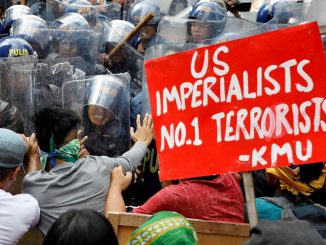
Know your enemy: What is imperialism?

The word “imperialism” is used a lot by people in the progressive and revolutionary movement. What does it mean?

Some people think imperialism is just a cuss word that radicals use to put down rotten government policies. But it’s more than that.

Imperialism is rooted in a particular economic system, capitalism, and benefits a particular class, which Marxists call the bourgeoisie or ruling class. The bourgeoisie is the super-wealthy class of corporate owners, bankers and big landlords.

Progressives know that the United States acts in an imperialist way. The U.S. government, which represents the ruling class, imposes its will on other countries by economic, political and military means.

But imperialism is not a government policy put forth by one administration or political party. It’s the economic system underlying all U.S. government policies, liberal or conservative, Democratic or Republican.

Most people are taught that imperialism simply means a big country bullying a small country. Sometimes that’s true, but it’s not a complete definition. In the wrong hands, this seemingly common-sense definition can be dangerously misleading.

The U.S. government often accuses other governments of “imperialist” behavior. Washington takes advantage of the common, but incomplete, idea of bigger country vs. smaller country to turn public opinion against socialist and progressive nationalist countries trying to maintain their independence.

For example, when Iraq invaded Kuwait in 1990, George Bush the First called the Iraqi government imperialist. Bush neglected to mention that Iraq was responding to provocations from the U.S.-controlled Kuwaiti monarchy, which was stealing Iraqi oil.

He didn’t explain how Kuwait had been arbitrarily carved off from Iraq under British colonial rule, or how the Iraqi people made a revolution in 1958 to be independent of U.S./British domination.

Imperialism = monopoly capitalism

Not every capitalist country is imperialist. In fact, most of the world’s people live in poor, underdeveloped capitalist countries like Iraq that are exploited by the imperialist powers of the United States, Canada, Western Europe, Australia and Japan.

Capitalism developed first and reached its most advanced stage in those countries. Imperialism exists by keeping the rest of the world enslaved and dependent on its institutions, including the World Bank and the International Monetary Fund.

V.I. Lenin, the Russian revolutionary leader of the early 20th century, gave a complete, scientific definition of imperialism in his 1916 booklet, “Imperialism, The Highest Stage of Capitalism.”

He wrote: “If it were necessary to give the briefest definition of imperialism, we should have to say that imperialism is the monopoly stage of capitalism.”

Using economic statistics and historical facts, Lenin showed how capitalism’s early, free-market phase led to the creation of giant industrial and banking monopolies.

Cutthroat competition constantly bankrupted businesses. More successful rivals gobbled these businesses up, until four, three, two or even a single monopoly dominated whole industries.

This process of concentration into monopolies continues today on a much bigger scale. Now giant monopolies absorb other giant monopolies. Some recent examples are AT&T’s absorption of Time Warner, Amazon’s gobbling up of Whole Foods or Facebook and Google’s buyout of multiple big apps and websites. The merger of Walt Disney and Twentieth Century Fox, ExxonMobil, DaimlerChrysler and JP Morgan Chase — the list goes on and on.

Banks dominate

As industrial monopolies grew, so did their hunger for profits. They fought monopolies from the other imperialist powers for the right to dominate poorer countries.

Rather than just exporting goods to these underdeveloped countries, the monopolies started to export capital — that is, they built factories, hired local labor and began to produce goods at much lower cost and higher profit than in their “home” countries.

Bosses tossed extra crumbs to some workers in the imperialist countries to keep class peace at home, while promoting racism and national chauvinism to stop workers from uniting across borders.

The big banks came to dominate the expansion process. Banks control the flow of money to the monopolies. Their representatives sit on the boards of most big industrial corporations and exert decisive influence over business decisions.

Lenin said these five characteristics define imperialism, or monopoly capitalism:

“1) the concentration of production and capital has developed to such a high stage that it has created monopolies which play a decisive role in economic life;

“2) the merging of bank capital with industrial capital, and the creation, on the basis of this ‘finance capital,’ of a financial oligarchy;

“3) the export of capital as distinguished from the export of commodities acquires exceptional importance;

“4) the formation of international monopolist capitalist combines which share the world among themselves;

“5) the territorial division of the whole world among the biggest capitalist powers is completed.”

Epoch of war and revolution

This territorial division of the world among the imperialists inevitably leads to war.

As the fortunes of each imperialist country rise or fall, those with the most power want to expand the proportion of the globe they control. Those whose grip is weakening hold on for dear life.

Rather than eliminating competition, monopoly capitalism raises it to a higher and deadlier level.

Sometimes the imperialists fight each other directly. That was the case during World War I, when Lenin wrote his booklet on imperialism, and World War II.

At other times, they fight for domination through local proxies, like the U.S./German rivalry that tore apart Yugoslavia. But both imperialist powers united to destroy the Milosevic regime when it resisted their plans.

Finally, there are the wars of conquest fought to control strategic countries like Afghanistan, or against governments and popular movements that resist imperialist domination, like Iraq, Libya or Syria. 

Sanctions are another form of war and often a prelude to military intervention, like those imposed by the U.S. today against Iran, Venezuela, Cuba, the Democratic People’s Republic of Korea, Russia and Zimbabwe, to name a few. 

But just as inevitably, the concentration of wealth and political power into fewer hands leads to rebellions and revolutions. Imperialism contains within itself the seeds of its own demise.

Social production vs. private ownership

By expanding capitalist production all over the globe, imperialism has created a huge working class with nothing to lose and everything to gain by fighting for power.

Imperialism has made production profoundly social. That means thousands of workers, often from dozens of countries, are involved in the production, distribution and exchange of a single product or service.

Yet the fruits of this collective labor are robbed from the workers. The bosses, who own the factories, stores, etc., take it for themselves in the form of profit. Wages paid to the workers often don’t cover the basic necessities of life. Others just get by, while millions go jobless.

But as Lenin pointed out, the monopolies are ripe for the workers to take over and run themselves — to create social ownership in harmony with social production.

Ultimately, that’s how imperialism can be defeated: by targeting the diseased economic system, not just its political symptoms.

It’s not enough to change a government policy or the party in power. The whole system must be overturned and replaced by one that puts people’s needs first.

Strugglelalucha256


Lenin: How to oppose an unjust war

The Leninist view of how to fight against imperialist war remains one of the most controversial and defining characteristics of the communist movement, because it means standing up to the capitalist class at the moment its fangs are bared.

Why do we think it’s important to study what Russian revolutionary V.I. Lenin wrote and did during World War I, over 100 years ago?

There are two good reasons. First, Lenin’s Marxist analysis of war shows how capitalism in its highest stage, imperialism, has an insatiable thirst for new markets and bigger profits that drives it to war. That hasn’t changed.

And second, Lenin successfully used this working-class understanding of war to help bring about the socialist revolution in Russia.

In the pamphlet “Socialism and War,” Lenin called the war that had just broken out in Europe “a war between the biggest slaveholders for the maintenance and consolidation of slavery.”

Differentiating the communist position from the pacifists, who condemn all wars equally, Lenin said, “We understand that wars cannot be abolished until classes are abolished and socialism is created.”

He defined as just wars “civil wars, i.e., wars waged by an oppressed class against the oppressor class,” and wars of national liberation by oppressed countries.

“If tomorrow, Morocco were to declare war on France, India on England, Persia or China on [World War I era, pre-revolutionary] Russia, and so forth,” he wrote, “those would be ‘just,’ ‘defensive’ wars, irrespective of who attacked first; and every socialist would sympathize with the victory of the oppressed, dependent, unequal states against the oppressing, slave-owning, predatory ‘Great’ Powers.”

Communists “of the oppressor countries should recognize and champion the oppressed nation’s right to self-determination,” Lenin wrote. “The socialist of a ruling country who does not stand for that right is a chauvinist.”

Revolutionary defeatism

“The defeat of one’s own capitalist government is the lesser evil in the struggle against the war,” he wrote. “A revolutionary class cannot but wish for the defeat of its government in a reactionary war, and cannot fail to see that the latter’s military reverses must facilitate its overthrow.”

Lenin’s thoroughly internationalist perspective is called revolutionary defeatism.

Instead of using the war as an excuse to pull back from the class struggle, Lenin and his co-thinkers argued that it was exactly the time to step up the struggle against capitalism.

It would be a hard road, especially during the first wave of patriotic propaganda. But as the war dragged on and the death and suffering mounted, more workers would turn against the government and capitalism, he argued.

This is the origin of the famous communist slogan, “Turn the imperialist war into civil war.”

Some people misunderstand what Lenin meant by this. They think it means you have to show up at the very first demonstration against the war with signs reading “Turn the imperialist war into civil war.” 

In fact, Lenin argues in his pamphlet that communists should give strong support to all manifestations for peace. This is often the first step by the workers, youths and others toward anti-war consciousness.

All five Bolshevik deputies in the Duma, or parliament, took a strong anti-war stand, and the Czar exiled them to hard labor in Siberia. Factory workers passed anti-war resolutions. Strikes and demonstrations were organized. Agitation was conducted in the army, and fraternization with enemy troops was encouraged.

Because of their correct analysis of the war and their determination to continue and deepen the class struggle, the Bolsheviks were ready when mass anger at the war boiled over. In February 1917, the Russian people rose up and overthrew the Czar. Several months later, after a new pro-capitalist government showed it would continue the war, Lenin and the Bolsheviks led a successful workers’ and peasants’ revolution for socialism under the banner of “Peace, Land, Bread.”

The new Soviet government’s first act was to call on all countries to end the World War and renounce all annexations and occupations. It guaranteed the right of self-determination for all the peoples and nations oppressed by Russian capitalism.

Strugglelalucha256


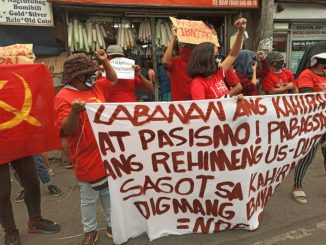
Salute to Communist Party of the Philippines on 51st anniversary

Solidarity and Greetings from Struggle-La Lucha and the Partido de Socialismo Unido / Socialist Unity Party to the Communist Party of the Philippines on its 51st Anniversary

Dear kasamas/comrades,

We send revolutionary greetings and congratulations on the 51st anniversary of the refounding of the Communist Party of the Philippines. We are with you in your struggle for national liberation, a just peace and the People’s Democratic Revolution with a socialist perspective.

The semi-feudal, semi-colonial ruling system in the Philippines is crumbling, much like the ruling system of imperialism in the U.S. We join you in organizing for a revolution that abolishes exploitation and builds socialism. 

The defeat and ouster of the murderous and exploitative U.S.-Duterte regime will constitute a major defeat for U.S. imperialism, the primary threat to the global working class today. This means that the struggle led by the Communist Party of the Philippines is not only a struggle for national liberation, but a struggle against imperialism worldwide. 

Victory for the Communist Party of the Philippines is a victory for the global working class. This is why your struggle is our struggle.

Know that your comrades in the belly of the beast are always with you, especially as you move forward to resume peace talks between the National Democratic Front of the Philippines and the Republic of the Philippines. 

From Palestine to the Philippines, stop the U.S. war machine!
Long live the Communist Party of the Philippines!
Forward to victory! Solidarity forever!

Partido de Socialismo Unido / Socialist Unity Party (U.S.)
and Struggle for Socialism / La Lucha por Socialismo newspaper

Strugglelalucha256


Behind the 1989 reactionary coup in Romania

Struggle-La Lucha is publishing this article by Sam Marcy, one of the leading Marxist thinkers and fighters of the second half of the 20th century, to mark the 30th anniversary of the counterrevolutionary developments in Romania.

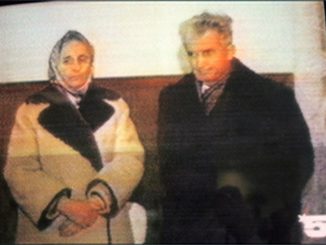
Dec. 26, 1989 — Let there be no mistake about it. Let there be no hypocritical assertions by the imperialist governments that they regret the murder of Nicolae Ceausescu and his wife Elena.

It was an act of undisguised assassination. It was a coup by the most reactionary forces of the army brass in collaboration with the remnants of the old bourgeois ruling class of Romania. It was a wanton act of murder, wholly in accord and characteristic of the period of the 1920s and 1930s, when assassination of political leaders was common, when a reign of terror from ruling-class reactionary groups was on the order of the day.

Clerical reaction, anti-Semitism

What the millions saw on U.S. television, for instance—the burning of public buildings, the shooting up of libraries—is characteristic of the period long ago when the bourgeoisie, in fear of discontented and rebellious peasants, redirected their hatred against the boyars (the landlords) into anti-Semitic channels.

Anti-Semitism has disappeared as an official policy. But we are seeing its recurrence in another form. How else can one take the proclamation that the “anti-Christ” (meaning Ceausescu) was fittingly killed on Christmas Day? The forces of deepest reaction now claim control of the Bucharest government. This is a recrudescence of the vicious, reactionary clericalism that dominated the political scene there for the whole period stretching from the First to the Second World War.

Let us look again at the television scenes of the so-called popular uprising. There is nothing in them to suggest that it was in any way a proletarian uprising. It was altogether uncharacteristic of the traditional struggle of the Romanian workers. There were no working-class, no trade union slogans. It was a rising of all the decayed, leftover bourgeois social strata who have been reawakened to life mostly on the basis of international factors of enormous significance.

Budapest and the national question

It will be proven absolutely correct that these operations were planned not in Bucharest, nor in any other Romanian city, but in Budapest, the haven of the so-called dissidents over a period of years. That is where the conspiracy was hatched, and might have remained dormant or have disintegrated were it not for the intervention of new, powerful influences which made it a certainty that the Budapest reactionaries would become the instrument for the forces of bourgeois counterrevolution and imperialist penetration.

It has been decades now since it became public knowledge that there was a dispute between Hungary and Romania over the treatment of the Hungarian minority in Romania. For years there have been negotiations, but it wasn’t so long ago that both Nicolae Ceaușescu and Hungarian leader Janos Kadar had each affirmed in separate interviews that “We communists will not allow the national question to divide us.”

The question of ethnic minorities has always been the acid test for communists. Fraternal solidarity was always one of the basic teachings of Leninism and was really an extension and development of the Marxist doctrine of the class struggle as it applied to national oppression.

The efforts of the Ceausescu regime, and to some extent that of Gheorghe Gheorghiu-dej earlier, to distance themselves from the Soviet government have deep historical roots in the Balkans, with their fierce small-nation nationalism. They have been able to eke out an existence by maneuvering between the great powers, going from one camp to another in order to retain a modicum of independence, almost always remaining a pawn of one or another of the great powers, whether it be Germany, Austria, Russia, Turkey or France, and lately U.S. imperialism.

The history of the 19th century was filled with the struggles of the smaller nations to free themselves, then again becoming subjected to or being traded away by one great power to another.

It is not the existence of many nations which is a regressive factor in historical development; it is the existence of states which embody the political power of the ruling classes. That is the real source of national fervor, of so-called fanaticism, aside from the mutual antagonism of states and statelets which become the greatest source of antagonism between the workers of different nationalities.

When the Communist Manifesto arrived in 1848, it was a breath of fresh air. It was precisely at a time when the workers were becoming weary of the old nationalism and were looking with open arms for the message of working class solidarity, of workers of the world unite against the common enemy — the bourgeoisie.

Growth of Hungarian bourgeoisie

There were many, many avenues open for the resolution of the national problem between Hungary and Romania on the basis of fraternal socialist solidarity, and indeed it seemed in the early eighties that it was on the road to solution. What changed? What gave it an impetus to become a full-blown struggle between two apparently fraternal socialist countries, tied together in a common organization (CMEA or COMECON, as it is called in the West) and with a common socialist objective?

One can name innumerable retreats away from orthodox revolutionary Marxism-Leninism over the years and decades, but none is more compelling than the series of bourgeois reforms in the USSR under the Gorbachev administration. They have delivered a momentum in the direction of bourgeois restoration which seemed inconceivable only a decade ago.

However, bourgeois reforms were inaugurated as early as 1956 in Hungary. Over a period of years, sometimes faster, sometimes slower, they were remaking the class physiognomy of Hungary to an extent that it only required a push for the Hungarian regime to become a bourgeois state, if not in all its aspects, certainly in some of its most essential ingredients, especially the abandonment of centralized planning and the beginning of the dismantling of state industry.

Hungary had gone over the brink when it canceled its agreement with the German Democratic Republic controlling the borders. It was this flagrant violation of a socialist friendship treaty, passed over by the other socialist countries, which made it possible for the Romanian counterrevolutionary elements to utilize Hungary as a base of operations for what has become open warfare.

This in turn changed the character of the struggle between Romania and Hungary. The Hungarian regime, under the aegis of the new bourgeois leadership, converted the national question, the question of the ethnic minority in Romania, into a state-to-state struggle. In effect, Hungary became a haven not just for incidental reactionary elements but for political counterrevolution.

Soviet pressure in CMEA

However, the Hungarian bourgeois regime would not have dared go beyond certain limits on its own. It must be taken account of that the Soviet reforms were not meant merely as a national policy, given the socialist, centralized economic planning in the USSR. They were also to be imported into its coordinating body for economic relations among the socialist countries, the Council of Mutual Economic Assistance (CMEA). Let this aspect of the struggle not be overlooked.

Thus, at the 42nd Session of the CMEA, held in Bucharest on Nov. 3, 1986, Soviet Premier Nikolai Ryzhkov made it clear in his speech that the Soviet reforms were directly linked to similar reforms in the CMEA countries. According to Ryzhkov, the implementation of the so-called Joint Program for the Development of Science and Technology could only become effective if progress were made on economic reforms. It was at this session back in 1986 that both Romania and Czechoslovakia made it clear they were opposed to establishing reforms of the type then being introduced in the Soviet Union.

The significance of this dispute should not be disregarded. By making the Soviet reforms contingent in one form or another on reforms in Eastern Europe, the Soviet Union was not merely making some abstract recommendation or economic prognosis; it was in effect using a form of economic pressure on its fraternal socialist allies to weaken socialist planning in favor of the bourgeois market.

The USSR’s perspective of a new, more viable coexistence with the imperialist West therefore meant that Eastern Europe would become a free market area for imperialist penetration. It was for this reason that both Czechoslovakia and Romania objected.

Hungary, which was already on the road to the restoration of the bourgeois market and the dismantling of the centralized economy, took the opportunity following this meeting to accelerate its public attacks on Romania. It blew up the issue of the status of the Hungarian minority into a virtual war scare.

The national question became converted into an instrument of bourgeois attack against a socialist country. The national aspect of the Hungarian minority was lost altogether. All this could not but awaken the counterrevolutionary elements in Romania.

U.S.-USSR coordination

Nevertheless, this alone could not have accounted for the fascist-like coup d’etat by Romanian bourgeois reactionaries. Implicit in all of this was the support of the Gorbachev regime and its utter hostility to the Romanian socialist government. To all this has to be added the influence of the imperialist bourgeoisie, which was not standing outside of Romanian politics with its arms folded.

Wasn’t it just this Sunday, Dec. 24, that Secretary of State James Baker on NBC-TV’s Meet the Press gave U.S. approval for a Soviet intervention to support the “revolution” in Romania? Not screams about Soviet intervention, but encouragement for it! What could be plainer?

And on Thursday, Dec. 21, in an editorial entitled “Rumania: Remarkable Common Ground,” the New York Times spoke ecstatically about how Soviet Foreign Minister Shevardnadze had attacked the Ceausescu government. Where? At a NATO meeting in Brussels! This imperialist paper saw this as “a meeting of minds between East and West” that enhanced the possibilities for “drawing the East into any common response” against the Ceausescu government.

How could all of this happen?

The way it is presented in the bourgeois press, the army stood with the “popular uprising” against the security forces, as though they alone were the defenders of the government.

One thing must be clear about the character of the Romanian revolution: it was unlike the Russian, Chinese, Cuban or Vietnamese revolutions. They were all carried out entirely by the masses, by the workers and peasants. That’s where the revolutionary armed forces came from that, in the words of Marx, crushed the old repressive state apparatus. Not so in Romania and other East European socialist countries, with the exception of Yugoslavia.

The intervention of the Soviet Red Army was the most significant and fundamental factor in the overthrow of the old regime. Over 286,000 Soviet soldiers were killed fighting against the Nazi quisling regime alongside Romanian partisans.

Background of Romanian Army

The Romanian bourgeoisie had sided with the Nazis in the war, and Romanian troops fought with the Germans at Stalingrad. But toward the end of the war, when the collapse of Germany was imminent, there was a coup d’etat in Romania; a coalition government under Gen. Constantin Sanatescu signed an armistice with the Allies under which it agreed to supply 12 infantry divisions to the struggle against Germany. This positioned the Romanian Army to play a political role once the war was over.

After the war, there wasn’t a thorough “denazification” of the army as there was in East Germany, for instance. On the contrary, many of these same units were integrated into the reorganized military force.

Notwithstanding that almost 45 years have passed, there is still a vast difference between the Romanian Army and those popular forces wholly drawn from the masses of workers and peasants, as in Russia, China and elsewhere. The old customs, habits and ideology, while kept underground, nevertheless remained.

There is a fundamental difference when the old state apparatus is completely crushed and a new people’s army arises from the ashes of the old one. Even Napoleon’s army, for instance, was almost wholly drawn from the peasantry, as were many of his generals. In Romania, the class struggle was sharp but the counterrevolutionary elements were never destroyed. The army brass were drawn from the older ruling classes and the gentry. They became integrated into the defense establishment. If socialism were to be built, it had to have not merely their acquiescence but their complete loyalty. Thus, what for 40 years appeared not much different from the great revolutions of China, Cuba and the Soviet Union has ultimately proven to be decisively different.

The bourgeois press pours vials of wrath on the security forces of the government. They were the only ones drawn directly from the people. Like in the French Revolution, with its Committees of Public Safety drawn from the masses, they were the eyes and ears of the revolution.

Secret armies? It’s perfectly okay to glorify the FBI and the CIA, because they’re in the service of the bourgeois ruling class. But security police in the service of a government seeking to establish socialism? They become the most reprehensible elements. Yet the bourgeois press in all the imperialist countries can’t help but note that these security forces are fighting to the end in an uneven battle.

Ceausescu tried to maneuver

Of course, such a fascist-type coup could only take place where there has been an accumulation of errors by the government. Not the least was its effort to maneuver between the camp of imperialism and the socialist camp. The outstanding example of this was its effort to ally itself with the West when it sided with Israel during the Arab-Israeli war in 1967.

Earlier, it refused to join the other socialist countries in the 1968 intervention to stop a counterrevolution in Czechoslovakia, which it might have done out of solidarity even while publicly making clear its disagreement. All of these efforts were calculated to free it from dependence on the USSR and the other East European socialist countries, to gain some economic as well as commercial advantages, and to boldly enter the world of capitalist trade and commerce.

But no significant advantages accrued to Romania as a result of its effort to accommodate to imperialism. As in the Arab-Israeli war, the most Romania got out of its pro-Western diplomatic maneuvers was an exemption from the U.S. government’s discriminatory trade practices aimed at the socialist countries. It was granted “most favored nation” (MFN) status and admitted into the General Agreement on Tariffs and Trade (GATT).

But Romania soon learned that political conditions were attached. Finally, early this year, the Romanian government announced it would not seek a renewal of the MFN status, precisely because of the political requirements which inhibited the free development of socialist construction.

Program to urbanize villages

Probably the most significant error of a domestic character was to embark upon a vast urbanization of rural life in certain areas of Romania, the effect of which would be to modernize the social structure of the villages and lead them on the way to communism more rapidly than mere collectivization. In severely underdeveloped rural areas, collectivization often merely changes the legal but not the economic conditions.

On March 3, 1988, the Romanian government announced plans, to be completed by the year 2000, that would involve about half of Romania’s 13,000 villages. They intended to move the peasants into agro-industrial complexes with apartments and modern communal civic centers, like those in the large cities.

It was similar to an idea presented by Khrushchev at one time during the Stalin era. The purpose was to move collectivization further on the road toward communization. But the idea was dropped. Roy Medvedev, the dissident Soviet historian, referred to it as utopian. The idea was nevertheless progressive, even if impractical. But if impractical for the Soviet Union, with its vast resources and industrial-technological apparatus, it would certainly seem like a much more hazardous plan for Romania, particularly in the light of its almost total isolation from other socialist countries.

Nevertheless, we can’t accept the interpretation of the bourgeoisie and the counterrevolutionaries everywhere, that it was repressive, destructive and virtually the annihilation of all civilized life. All this was merely ideological preparation by the bourgeoisie for an assault against the government. A big hullabaloo was raised that it was an attempt at genocide against the Hungarian minority. This is pure hocum. It involved at most 56,000 families. It didn’t endanger the existence of the Hungarian minority, and the whole thing could have been solved amicably within the framework of an economic plan. But it was precisely the fear that the plan might succeed after all that frightened the bourgeois reformers in Hungary and also irritated the Gorbachev grouping, which had firmly set a course in an utterly opposite direction.

Repayment of debt

Another error (which can only be assessed as such in retrospect) was the desperate attempt by the Romanian government to free itself from Western indebtedness to the banks. Not only did they decide to pay the interest on billions in indebtedness (in contrast to Poland and Hungary, which haven’t been able to), but they paid back the principal as well.

During the 1970s, the Romanian government was able to sell its oil and gas on the world market at skyrocketing prices. OPEC was riding high and it seemed like an endlessly upward spiral. But this ended abruptly and a decline in oil revenues became a significant factor in Romania.

Therefore, the decision to pay back the interest and principal, while a bold act to demonstrate political independence, could only be achieved through severe austerity measures of the type proposed by the IMF in other countries. It seems self-defeating.

The majority of the workers seemed to remain loyal to the regime, but the burden of the austerity program became ever more evident. Relenting on some of the Ceausescu experiments became inevitable. Had the regime made it possible for a responsible working-class opposition to function, either within the Party or without, the government might have been able to pull back somewhat on its plans and embark upon some immediate practical solutions.

The Romanian effort to extricate itself from the Central European arena and to strike out into the West, while retaining a socialist economic system entirely antagonistic to Western imperialism, appears to have been visionary and impractical, as well as hazardous. While the imperialists welcomed Ceausescu’s maneuvers, such as his position on the Czech intervention and the Arab-Israeli war, they gave him nothing of substance in return.

Nevertheless, these subjective errors alone could not account for the counterrevolutionary overturn. It is also the virtual economic blockade and political sabotage by the imperialists and fraternal socialist governments like in Hungary that made possible the emergence of the real counterrevolutionary elements.

In the end, what the bourgeoisie really wants is the overturn of the social system and the return of capitalist exploitation and oppression.

Strugglelalucha256


I believe that socialism is the key to a better world

From a talk by Gloria Verdieu at Queen Bee’s Art and Cultural Center in San Diego. Verdieu shared the stage with poets from the San Diego / Tijuana reEvolutionary Poets Brigade at an evening of “Poetry, Education, and Voter Registration.”

Thank you for inviting me to speak at this important event. A lot of thought went into what I wanted to speak on since I am neither a Democrat nor a Republican. I am a socialist. I believe that socialism, which ultimately leads to communism, is the key to a better world for all of us. 

I thought about an essay by political prisoner Mumia Abu-Jamal entitled “Women of the World” which begins with the words:

“Who can think of the world’s women, and not marvel? There is no area of human endeavor upon which the mark of woman has not been made, and made well.”

I thought about Sisters in the Struggle, Black women who fought for a better world for everyone while focusing on justice and freedom for Black people: Sojourner Truth, Harriet Tubman, Ida B. Wells, Mary McLeod Bethune, Septima Clark, Fannie Lou Hamer and Ella Baker, all Black women of the Civil Rights and the Black Liberation movements. 

I thought about Black women who have embraced socialism, as I have, and who committed their lives to creating a better world for all people: 

Lucy Parsons, Mabel Byrd, Capitola Tasker, Lulia Jackson, Louise Thompson, Claudia Jones and Angela Davis.

Lucy Parsons, born in 1853, joined the Socialist Labor Party and fought for the rights of labor, Blacks and women until her death in 1942. 

In 1934, three Black women joined the U.S. delegation that traveled to Paris for the International Women’s Conference. Mabel Byrd was elected to be one of the conference secretaries. Capitola Tasker and Lulia Jackson stunned the conference with their eloquent testimonies about African-American struggles for human dignity.

Louise Thompson studied Karl Marx and V.I. Lenin and emerged as a leader in the Harlem Branch of the CPUSA. In the 1930s, her apartment became a forum where Black intellectuals and activists discussed the Bolshevik Revolution and the party’s position on African Americans in the South.

Claudia Jones was born in Trinidad and became one of the most respected members of the CPUSA. Jones joined after working with the CPUSA in the defense of the Scottsboro Brothers. 

Angela Davis’s commitment to the struggle of Black people intensified on Sept. 15, 1963, when four Black girls were murdered in the racist bombing of a Baptist church in Birmingham, Alabama: Denise McNair, Addie Mae Collins, Cynthia Wesley and Carole Robertson. As part of her militant activism, Angela Davis organized rallies and demonstrations defending the political prisoners known as the Soledad Brothers, and she herself became a political prisoner.

Okay, so what does a socialist country look and feel like? 

To answer this, I would like to read a portion of a speech given by W.E.B. Du Bois in 1959. Du Bois spent several months in Czechoslovakia, East Germany, the Soviet Union and China.  

I have been to socialist Cuba several times. On one visit, I got sick and was admitted into a Cuban hospital, where I stayed for 16 days in 2007.  I was 50 years old at the time, so I was in a room with seniors. I had 2 roommates in their 70s who had witnessed the 1959 Cuban Revolution. 

During that two-and-a-half weeks I was worried about my job, because my vacation time had run out and my boss did not know I was in Cuba.

So, here are some observations from Du Bois in 1959 that I also noticed during my stay in Cuba in 2007.

The people are ordinary folk; they are not in chains; they laugh and cry; they work and rest; there are homes and schools. Life goes on about the same as here. Of course with time and through observation you do see differences. 

One thing they fear which we do not, and that is war. They know what war is, what it costs in death and destruction, in dislocation of life, in disease and hurt.  The world fears war, except the United States. We laugh and joke about it. Our children play at murder. 

In socialist countries, certain fears are absent which never leave the waking hours of Western lands, and are always there in the hours of sleep. They are four in number: unemployment, old age, sickness and opportunity to rest.

Take any person you know, anyone you meet. Take yourself. We fear unemployment, losing our job, being unable to work. 

This, the socialist citizen does not fear. He or she may have to change work, may have to change the place of work, but of work at current pay they are always sure.

We fear old age. What will we do when we’re old? We are desperate to save enough to insure a decent life when we are too old to earn. Thousands of people walk our streets each day sick with fear of age. The citizens of socialist countries do not fear age. Every citizen is certain of support, of food and shelter and clothes, as long as they live. It may not be of the highest quality or what we prefer, but they will not freeze nor starve.

We are frightened of sickness and accident, and attack of some disease, being knocked over by a car. Any day, any time, we may be put to bed by such misadventure. We may be covered by insurance, but many people are not. We can seldom afford the best medical care, and we nearly always lose pay and burden our families when sick. In socialist countries medical care is given great attention. Physicians are being increased rapidly in number and distribution according to the need, even if that need is in a lonesome country district or in a far-off province, or late at night. Medical care is available for all. Of course, everybody cannot get the best, but none are neglected.

All workers need rest, but how many of us dare take it? Some provision or recreation is made, but most workers do not get adequate recreation, and can hardly afford what they take. In socialist lands, the vacation with pay is part of the work contract. The vacation will not be at a fashionable resort, it may not be what the worker would choose, but it will be rest with medical care, with food and recreation.

These systems are not perfect. They break down here and there, now and then, but they are successful. This kind of rest and protection stands in the midst of the supporters of socialism. 

Then there is the problem of children: the loss of time, the pain and discomfort of their birth, the time and money needed for their upbringing, the question of their education and life employment. Many people refuse to procreate children because of these problems so difficult to solve in capitalist lands with individual initiative. But in socialist lands the problem of children comes first. The working mother has rest time with pay during pregnancy. The children are in nurseries and kindergarten when small, and in school as they grow. There is higher education with pay for studying and school attendance and as they become of age, free training for earning a living is open to them according to talent. All of these programs again are not perfect. School facilities lag. School programs go wrong. Monies are wasted. All of this and more, yet the school systems of socialist lands outstrip the systems of Western Europe and of the United States. 

I can see the wealth of human ability the socialist lands are preserving and using for humanity, and see why they have little juvenile delinquency.

All this effort costs: in money, in freedom, in individual training. It means discipline. It means that individuals do what they are told to do, in many cases, rather than what they want to do. But is the situation much different here? Are we free in America to do what we please?                  

Of course not, in a world of natural law, in a world of human legislation, in a world of habit and inherited cultural patterns, the area of human freedom of action must be seriously curtailed. But it is further narrowed when industry, ownership of property, and distribution of income is directed by the owners of capital goods and by the men who own and control the labor of human beings. The question is not whether there will be discipline, but rather, who is to administer it and under what controls will most of the essential freedoms be conserved. The anarchy of individual rule and the rule of chance is inadmissible, just as complete slavery is unthinkable. Discipline involves planning, and planning is absolutely necessary for modern industry. We must not deceive ourselves by assuming that the industry of the United States is not planned. It is planned by the owners of capital and for the individual profit which the enterprises bring.  This may lead to much prosperity, but it also leads to financial crises, to poverty, to exploitation and unemployment, and to crime. Socialism, on the contrary, tries to plan for the general welfare of all citizens. It owns the wealth used for industry. It controls the labor which produces wealth and seeks to distribute property according to need and not by chance, inheritance or force.

One of the principles of socialism is democratic centralism. It takes the full participation of everyone in order for this process of democratic centralism to work. 

I am a registered voter and I believe in the democratic process, but I believe we must look carefully at what we are voting for because in this capitalistic system we continue to vote away our rights because we vote based on our individual needs and wants; not for the needs of everyone.

We must study socialism and capitalism, to figure out what it is going to take to make a better world for all people.

And we must fight for it!

Thank you for listening.


Strugglelalucha256


The Russian Revolution changed the world forever

One-hundred-and-two years ago on Nov. 7, 1917, workers and peasants overthrew the capitalist government in Russia.

Two million soldiers in the Russian army had died in World War I. Russia was ruled by the cruel Czar Nicholas II.

Like the United States, the Russian Empire was a big prison of oppressed nationalities. Uzbeks, Kazakhs, Poles, Ukrainians, Georgians, Finns, Armenians and other peoples were denied self-determination.

Russian peasants and workers were also oppressed. Many had been serfs, a sort of land slavery. Serf families couldn’t be broken up and sold like cattle, as African slaves were in the U.S., but they could be worked to death. Thirty thousand serfs died building St. Petersburg, the former Russian capital.

Serfdom was abolished in 1861, two years after John Brown’s raid at Harper’s Ferry. The outbreak of the U.S. Civil War may have influenced the czar to get rid of serfdom before the serfs got rid of him.

Lenin and the Bolsheviks

By 1914, serfdom was gone, but 30,000 big landlords still ruled the countryside. The vast majority of people were peasants who couldn’t read or write. Women had no rights.

Foreign capital poured into Russia, grabbing huge profits from long workdays in the factories. Striking workers were shot down.

Oppression breeds revolution. V.I. Lenin was the greatest leader of Russia’s revolution. He built a communist party commonly known as the Bolsheviks.

Lenin was 17 when his older brother Alexander was hanged in 1887 for trying to assassinate Czar Alexander III. That’s the same age Black revolutionary Jonathan Jackson was in 1970, when he was killed trying to free his older brother George Jackson and other political prisoners.

Lenin studied the teachings of Karl Marx. Lenin taught that workers had to be imbued with Marx’s revolutionary knowledge and determination to win.

Soviets vs. pogroms

The first Russian Revolution broke out in 1905. Workers went on strike, shutting down factories and railroads. Peasants burned the gentry’s mansions. Czarism was on the ropes.

Workers formed councils called soviets. These councils had no formal legislative power, but they had great authority among the workers, peasants and soldiers.

European banks poured in loans to save czarist tyranny. The 1905 Revolution was defeated. The czar was able to pit peasant soldiers against workers and even other peasants, just as billionaires divide poor and working people in the U.S. today with racism and anti-immigrant bigotry.

Mass lynchings called pogroms killed Jewish people, just as the Ku Klux Klan did to African Americans here.

The Bolsheviks fought pogroms with guns in hand. Lenin waged war on racism. He enriched Marxism by teaching that workers in the big capitalist countries had to support revolts in the colonies.

“What emotion, enthusiasm, clear- sightedness and confidence it instilled into me!” was how Vietnamese leader Ho Chi Minh described Lenin’s “Theses on the National and Colonial Questions.”

Peace, land and bread

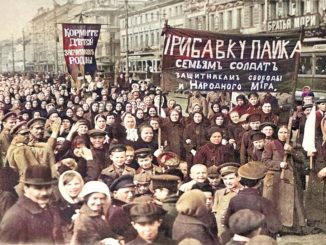
Sick of war and hunger, women textile workers in Petersburg went on strike on March 8, 1917, International Working Women’s Day. The holiday commemorates a 1908 march of women garment workers in New York City.

Five days later, czarism was overthrown. Workers, peasants and soldiers made that revolution, but capitalists controlled the new government.

For the next eight months Lenin’s Bolsheviks won millions of poor people to socialist revolution by demanding bread, peace and land. Despite Lenin and other leaders being forced underground, Bolsheviks won majorities in the soviets that sprung up everywhere.

These soviets overthrew capitalist politician Alexander Kerensky on Nov. 7 (Oct. 25 by the old Russian calendar). Many peoples, not just Russians, rose up to break their chains.

Peasants threw out their landlords. Bolsheviks exposed secret treaties among the imperialists that divided up colonies. This revolutionary energy helped overthrow Germany’s kaiser and end World War I in 1918.

Capitalist governments, including the U.S., then waged war against the Soviets on a dozen fronts. But the Red Army, organized and led by another Bolshevik leader, Leon Trotsky, was victorious.

The 73-year war

Following Lenin’s death the enormous difficulties involved in trying to build socialism in a very underdeveloped country, encircled by imperialism, led to struggles in the party and then to backward steps. Soviet leader Joseph Stalin purged Bolshevik opponents while making concessions to careerists and increasing inequality.

Nevertheless, at the same time the Soviet Union launched the first and biggest affirmative action program in history. Every person had the right to education in their own language. The Soviet five-year plans created the world’s second-biggest economy. Everyone had a job.

But the Soviet Union remained the target of world capitalism. German big capital handed power to Adolph Hitler’s Nazi Party so the Nazis could crush the German working class. German imperialism invaded the Soviet Union in 1941.

With Stalin leading the government, the Soviet Union defeated Hitler, but nearly 26 million Soviet people died in World War II. The Red Army liberated all of Eastern Europe from Nazi rule, including the extermination camp at Auschwitz.

The Pentagon spent $5.5 trillion on nuclear weapons aimed at the Soviet Union. This relentless pressure undermined socialist solidarity and finally led to the downfall of the Soviet Union in 1991.

Despite this tremendous defeat, the lessons of the October Revolution will live forever.

Strugglelalucha256


Lessons of October: The struggle against imperialist war

November 7, 2019, marks the 102nd anniversary of the Great October Socialist Revolution in Russia, led by the Bolshevik Party. Struggle-La Lucha is sharing this article by Sam Marcy, a leading Marxist thinker and fighter of the second half of the twentieth century, which reviews some of the important lessons of that great workers’ and peasants’ revolution and its continued significance for the workers and oppressed. 

October 30, 1982

It is astonishing that 65 years after the October Revolution in Russia so many profound lessons are still relevant today as they were the day after the victory of the revolution.

Take the question, for instance, of the struggle against war. Its urgency proclaims itself every day in the headlines of the world press.

There have been two world wars; two predatory wars in Asia – in Korea and Vietnam; three wars in the Middle East; a whole series of decades-long interventions both overt and covert in Africa and Latin America; a missile crisis in the Caribbean that threatened a world holocaust; and capping all this, the most rece”Peace. Land. Bread.” Women lead the 1917 Russian Revolution. The Bolsheviks said that in the event of an imperialist war, the workers’ party would, in accordance with the International’s resolution, strive to utilize the economic and political crisis of the bourgeoisie and the war it created to overthrow it.nt genocidal war, again in the Middle East, against Lebanon.

Such is the glorious record of the imperialist free enterprise system in this century, a century of the most stupendous technological and scientific discoveries and inventions, the most splendid achievements which would assure peace and happiness for suffering humanity were it not for the incubus of monopoly capitalism.

The Damocles Sword of nuclear war, which has hung over the planet ever since Hiroshima and Nagasaki, is more threatening than ever.

(Legend has it that Dionysius the Elder (430-367 BCE), a cruel and oppressive ruler, had a sword suspended by a single hair from the ceiling of a banquet hall above the head of Damocles. This was meant to punish the courtier for his servility and excessive obsequiousness and to demonstrate the precariousness of his rank.)

One might well say that the war danger in general and nuclear peril in particular is history’s punishment to humanity for the failure of the leadership of working-class parties to assimilate the great anti-war lessons of the October Socialist Revolution.

War and revolution

The war not only contributed heavily to making the revolution possible, it also provoked a revolutionary situation in almost every leading capitalist country in the world.

Most importantly, it brought about revolutionary struggles in Germany, Italy, and Hungary, and caused a tremendous revolutionary upsurge in France. Mutinies in the armed forces followed. It also brought about a rapid leftward swing of the working class in Britain; the great General Strike of 1926 was really a continuation of the consequences of the imperialist war.

Yet despite the unsurpassed suffering of the masses as a result of the havoc wrought by the war, nowhere else in Europe did a proletarian revolution succeed.

The war in and of itself could not have brought the Bolsheviks to power. The war merely accelerated all the social, political, and economic processes which existed during peacetime.

While the imperialist war interrupted the progress of the working-class movement in Russia, as elsewhere in Europe, once the war was on in earnest, once the carnage and suffering took an ever-increasing toll, the very same processes which had been either submerged or driven underground began to surface and accelerate.

The class struggle, even when it appears to be almost dormant, nevertheless exists. It can be muffled, stifled, mutilated. But the objective process of capitalist exploitation is remorseless and relentless. And in time of imperialist war, it accelerates and intensifies.

War, therefore, is not some utterly external factor which suddenly collapses over the heads of the masses. It is an outgrowth of peacetime tendencies inherent in the mode of capitalist production.

Socialist International and World War I

The reason the war was a central factor contributing to the victory of the October Revolution, but failed to have the same effect in France, Italy, or even Germany, must be traced to the position taken toward the approaching conflict by the great socialist parties of Western Europe in the peacetime period immediately before the war.

It is often mistakenly said that the outbreak of the First World War caught the leadership of the socialist parties completely off guard. It is certainly true that the masses as a whole were taken off guard in the light of the official leadership’s default. Large sections of the working class and lower ranking and middle officials of the Social Democratic parties were also taken by surprise.

But certainly the official leadership of the Second International, if it was taken by surprise, should not have been. It had no cause to be.

The years preceding the outbreak of the war were characterized by considerable anti-war agitation on the part of the socialist parties of Germany, France, and other European countries. There were also a variety of bourgeois pacifist organizations such as exist in many parts of the West today.

However, it was socialist and working-class agitation against the war which was predominant. In a general way the anti-war struggle was carried on as an inseparable part of the struggle against capitalism.

It was, of course, limited by the times, which were considered a period of so-called peaceful capitalist development. It was also limited by the large metropolitan cities where it was strong — Berlin, Hamburg, Paris, Marseilles and, in a different way, London – where the socialist movement was developing agitation against militarism.

It is important to know that there was a strong, working-class peace movement and that anti-war agitation was one of the political aspects of the socialist and working-class struggle. Any talk about the leadership of the Second International being surprised or overwhelmed by a totally unexpected outbreak of war is false.

The Socialist International, as it existed at the time, held frequent international congresses where the anti-war struggle was discussed. There were at least two socialist congresses where the approach of war was very seriously discussed and acted upon with firmness and resolution.

These congresses are of singular significance. They mark the apex of the growth of the socialist and working-class movement in Europe. They demonstrate the highest point of class consciousness and working-class internationalism which the working-class movement had known up to that time.

Stuttgart and Basel Congresses

The first of these congresses was held in Stuttgart, Germany, in 1907. Five years later, in 1912, another congress in Basel, Switzerland, discussed and reaffirmed Stuttgart resolution.

It is extremely illuminating to examine this resolution in detail. It has been quoted many times in the polemics of Lenin against Karl Kautsky, the leader and outstanding theoretician of the Second International and the right-wing Social Democrats during the war.

It is to be noted that the Basel meeting was not regarded as just another congress. It was entitled an “Extraordinary International Socialist Congress.” It was held on November 24-25, 1912, and the Basel Manifesto was subsequently published in the Vorwarts, the organ of the Social Democratic Party of Germany.

“If a war threatens to break out,” said the resolution,” it is the duty of the working classes and their parliamentary representatives in the countries involved, supported by the coordinating activity of the International Socialist Bureau to exert every effort in order to prevent the outbreak of the war. …

“In case war should break out anyway,” the resolution continues, “it is their duty to intervene in favor of its speedy termination and with all their powers to utilize the economic and political crisis created by the war to arouse the people and thereby hasten the downfall of capitalist class rule.

“The congress urged the proletariat … to devote the utmost force and energy to planned and concerted action. On the one hand,” the resolution continues, “the universal craze for armaments has aggravated the high cost of living, thereby intensifying class antagonisms and creating in the working class an implacable spirit of revolt; the workers want to put a stop to this system of panic and waste.” (Emphasis in original.)

It warns “the ruling classes of all states not to increase by belligerent actions the misery of the masses brought on by the capitalist method of production.”

It continues, “Let the governments remember that with the present condition of Europe and the mood of the working class, they cannot unleash a war without danger to themselves. Let them remember that the Franco-German War of 1870 was followed by the revolutionary outbreak of the Paris Commune. That the Russo-Japanese War of 1905 set into motion the revolutionary energies of the peoples of the Russian Empire. That competition in military and naval armaments gave the class conflicts in England and on the continent an unheard-of sharpness, and unleashed an enormous wave of strikes.

“Furthermore, it would be insanity for the governments not to realize that the very idea of the monstrosity of a world war would inevitably call forth the indignation and the revolt of the working class.

“The proletarians consider it a crime to fire at each other for the profits of the capitalists, the ambitions of dynasties, or the greater glory of secret diplomatic treaties.”

Finally it calls upon the workers of all countries “to oppose the power of the international solidarity of the proletariat to capitalist imperialism.” It ends with a clarion call to the workers: “To the capitalist world of exploitation and mass murder, oppose in this way the proletarian world of peace and fraternity of all peoples!”

‘Use war crisis to end capitalist rule’

It is to be noted that this resolution, passed at both the Stuttgart and Basel congresses, did not confine itself to mobilizing the masses to end the war only after the war is on. It does not merely confine itself to the peace theme. And it doesn’t suffer from separating the economic struggle from the political struggle.

On the contrary, the resolution directs itself to the working class and warns that if war breaks out, then the working class must utilize the economic and political crisis not merely to end the war but to arouse all the people and thereby hasten the downfall of capitalist rule.

This resolution is remarkable because it brought up to date the strategic approach and tactical orientation of the working class in a new period of capitalist development. In the earlier, so-called progressive period of capitalist development, it had been permissible to side with one’s own capitalist country if it were acting to complete the bourgeois democratic revolution in the struggle against feudalism, if it were carrying out a struggle essential to the development of a unified capitalist state, in order to attain autonomy within its own borders.

That was the epoch of the bourgeois national revolutions. It was the epoch in which the bourgeoisie constituted itself within the framework of a national state, without which it could not fully develop.

It was therefore a period when the criterion for support of and participation in a bourgeois war was whether or not it promoted a progressive and necessary tendency of the bourgeoisie in the struggle against dangerous feudal remnants and in order to constitute the bourgeoisie in a national, that is centralized, state.

The Stuttgart and Basel resolutions recognized, by implication if not by explicitly saying so, that it was now the epoch of imperialist wars, that the previous progressive period of capitalism had ended. The capitalist class could no longer carry on a war on a progressive basis, and the workers therefore ought not to support it.

These resolutions were also the highest theoretical exposition of the Marxist approach to capitalist wars at the time. Indeed, the very idea of formulating the question of war as it was done at these two socialist congresses was in itself an expression of the high degree of class-consciousness and working-class international solidarity that the socialist movement had achieved at the time.

Significance of Basel still in dispute

As we noted earlier, Basel was a specially convened congress to consider the war danger. The resolution gave expression, to the fullest extent possible, to the yearnings of the working class for peace and at the same time to their readiness to struggle.

Efforts to downplay the significance of the resolution as merely a ceremonial act lacking in real significance are post-war lies of right-wing social-democrats and bourgeois historians.

The congress was attended by the most important leaders in the world movement. It met at the time of the Balkan war crisis, which, as the resolution pointed out, had a potential of engulfing all of Europe. And it specifically warned the British, French, and German governments that the Socialist International knew what they were up to.

On no account can it be said that the resolution was just one of those things passed at socialist congresses. It wasn’t.

It was a question, however, whether the leadership of the Socialist International had the will, determination, and readiness to follow up the mandate given by the International and utilize the crisis created by the war to overturn the capitalist system.

There is another school of thought which, decades after the resolution on imperialist war, minimized the significance of the legacy of Stuttgart and Basel. According to this interpretation, the resolutions were framed by “the leftists.”

The insidious thought behind this is that a small group of fanatics positioned themselves in the resolutions committee and put over a line really contrary to the “moderate, reasonable, and pragmatic” positions of the European socialist leaders.

Prestige of the left

It is true, of course, that the resolutions were written by Lenin (on behalf of the Bolsheviks), Julius Martov (who was in the left-wing of the Mensheviks), and Rosa Luxemburg. The truth of the matter, of course, is that Lenin, Martov, and Luxemburg represented the Russian Revolution of 1905 and the great strike struggles that were developing in Russia, especially around the time of the Basel congress.

The Russian revolutionary movement had tremendous prestige on the European continent, very much like the heroic Vietnamese, Cubans, Palestinians, and other oppressed peoples who are carrying on a revolutionary struggle against imperialism. In many ways, Russia at the time was in the category of a somewhat backward country which was oppressing its peoples at home, but was also an oppressor abroad in concert with the other imperialist powers.

The prestige of the left, as represented by the Russian and Polish delegations, was something the opportunists had to reckon with. At the same time, it is to be noted that no one really challenged the validity of the resolutions.

It should be added that in an effort to go even further to the left than the resolution, Jaures from France, in a left opportunist maneuver, tried to amend the key paragraph (relating to the utilization of the economic and political crisis created by the war to overthrow capitalist class rule) by calling the workers to “insurrection.” This was, however, properly defeated.

It was typical of Jaures at the time that he cast himself in the role of being more left than the leadership, and at the same time was a proponent of ministerialism — the practice of accepting posts in a bourgeois cabinet.

The Copenhagen congress of 1904 had condemned the opportunist practice of taking cabinet posts in a bourgeois government. Jaures frowned at this manifestation of adhering to orthodox Marxist principles and impugned the motives of the German Social Democratic leaders, especially Kautsky, who, along with the other socialist leaders of the International, at the time still opposed the practice of accepting cabinet posts in a bourgeois government.

“It is all well and good for you, German comrades,” said Jaures, “to speak against accepting cabinet posts in the bourgeois government. Is it because you are unable to get such posts, since no German government would offer any at all?”

Whatever the motivation, the fact remains that all the German Social Democratic leaders, along with most of the French, Italian, Belgian, Dutch, Swedish, and Japanese, when they were able to attend, took the position of the congress as embodied in the resolutions.

What made the Bolsheviks different?

What distinguished the Bolsheviks from the various socialist parties in the Second International in Europe, and their Russian counterpart, the Mensheviks?

The Bolsheviks, especially Lenin, took most seriously that last, exceptionally significant, sentence quoted above. In the event of an imperialist war, the workers’ party would, in accordance with the International’s resolution, strive to utilize the economic and political crisis of the bourgeoisie and the war it created to overthrow it. Lenin’s conception, in particular, gave the workers the opportunity to intensify the class struggle against the bourgeoisie.

War, according to Lenin, was merely a continuation of the politics of the bourgeoisie by other means. Of course, Kautsky himself knew this very well, as did other leaders. Yet a profound gulf separated the Bolsheviks from the other socialist parties, except for the emerging left wings within the latter. Only the Bolsheviks had pursued a resolute, irreconcilable class struggle against the bourgeoisie and at the same time had fought relentlessly against any softening, watering down, diversion, or distortion of the anti-war thesis in the working-class movement with vigor and perseverance.

Struggle against opportunism

This in essence was what the struggle against opportunism was all about. Opportunism means the sacrifice of the larger issues affecting the working class in the interest of illusory, minor, everyday gains. Opportunism in varying degrees is a common phenomenon in all the labor movements of the world. But it took on an exceptional character in Western Europe in this period when the working-class movement grew in breadth, as Lenin put it, yet at the same time accumulated practices and distortions of socialist tactics in the class struggle that militated against firm adherence to principle.

It was in the struggle against opportunism that the Bolsheviks grew strong.

This was not so in the other European parties. It is true that in 1899 Kautsky and others had taken up the theoretical cudgels to defend Marxism from the revisionism of Bernstein. But by and large that was a long way from a steady, consistent struggle against opportunism and all its manifestations in the trade unions, among the trade union leaders, in the parliamentary fraction of the German Social Democratic Party within the Reichstag, and on the many other fronts.

The trend toward opportunism in practice, as distinguished from revolutionary phraseology, was permitted to grow automatically as though it were an inevitable and necessary accompaniment to socialism and a demonstration of the variety of thought and diversity of tendencies which all contributed progressively to making social democracy a mighty movement of the working class and its allies.

It was in the fight against opportunism and the struggle to pursue a rigidly working-class approach that Leninist doctrine over the years created a qualitatively different party in Russia than that which existed in Western Europe.

National chauvinism vs. revolutionary defeatism

As is well known, the Socialist International broke down as a result of the war and each of the socialist parties took a chauvinist position toward the war. In Russia itself, the Bolsheviks struggled against the Mensheviks, the social-democratic minority who generally leaned in the same direction as their European counterparts.

The sharpness and clarity with which Lenin fought against the war showed that he had a qualitatively different class approach than did the Mensheviks in Russia or the social democrats abroad. The formula which Lenin devised in the struggle against the war is aptly summed up in his sentence, “The defeat of one’s own capitalist government is the lesser evil in the struggle against the war.” (“The Defeat of One’s Own Government in Imperialist War,” Selected Works of Lenin in 12 Volumes, Vol. 5, page 142.)

In this way, Lenin was updating the formula proposed at the Stuttgart and Basel congresses of utilizing the difficulties created by the imperialist war to overthrow the capitalist class.

“A revolutionary class in a reactionary war cannot but desire the defeat of its own government.

“This is an axiom,” says Lenin. “It is disputed only by conscious partisans or by the helpless satellites of the social-chauvinists.”

Lenin continues, “The opponents of the defeat slogan are simply afraid of themselves when they refuse to recognize the very obvious fact that there is an inseparable connection between the revolutionary agitation against the government and facilitating defeat.”

Further on he says, “To repudiate the defeat slogan means reducing one’s revolutionary actions to an empty phrase or mere hypocrisy.”

If the French, German, British, Russian, and Italian workers, as well as the Americans and Japanese, Lenin reckons, had all in the course of this imperialist war devoted their energies to defeating the war effort of their respective capitalist countries, it would have been an act of international proletarian solidarity on the part of each of them.

Those who were promoting the defeatist strategy of Lenin were in reality also promoting international solidarity as against the artificial divisions which the world imperialist bourgeoisie had created in the interest of imperialist super-profits.

Other socialist organizations said they were for stopping the war, were for peace. But, with the exception of the Bolsheviks and the Serbian Social Democratic Party, they all said the continuation of the war was necessary in order to stop the aggression of the other imperialist powers. In this way, French workers were ordered to kill German workers, and German workers were ordered to kill French workers, until aggression was stopped and imperialist peace achieved – after an imperialist war.

A difference in class approach

Thus, one of the fundamental and most significant differences between the Bolsheviks and all other socialist organizations was not merely on how to stop the war. It was a different class approach.

With the other socialists, the class struggle stopped with the outbreak of the war and national unity became the order of the day.

The defense budget took preeminence, just as it does today in all of the capitalist countries. Cuts in the living standard of the workers became necessary to overcome the crisis created by war expenditures. The workers would have to wait for an improvement until after the war – if they were still alive.

With the Bolsheviks, the class struggle did not stop with the outbreak of the war but took on a more intensified and vigorous form and had to be prosecuted to the end.

When the first Russian revolution, which overthrew the czar, broke out in February, there was no thought among the Menshevik leaders of really stopping the war or overthrowing the rule of the bourgeoisie.

But Lenin’s way was to continue the class struggle so as to make sure the government would not participate on behalf of the bourgeoisie in the continuation of the war.

On each and every question, no matter how small, the issue always revolved itself around the attitude to the bourgeoisie. How to win the peasants away from the landlords and enlist them on the side of the proletariat. How to rally them all under the banner of the working class and separate them out from the bourgeoisie while isolating the latter.

All throughout the peaceful period preceding the war, during the war, and during the course of the whole revolution, a red thread runs through all of Leninist strategy and tactics. The struggle against the war in peacetime as in wartime is a struggle against the bourgeoisie. It is inseparable from the struggle against capitalism. To defeat the efforts of the warmakers, it is necessary to defeat the ruling class, making no fundamental distinction between the ruling class at war and the ruling class during peacetime.

Further reading: “The Bolsheviks and War” by Sam Marcy 

Strugglelalucha256


What does Wall Street’s repo crisis mean?

In the week of Sept. 16, the U.S. financial system ran out of cash. It was a modern version of a bank run, and it’s not over yet.

That week, the rate of interest on bank to bank overnight loans — known as repurchase agreements, or repos — suddenly spiked as high as 10 percent.

The Federal Reserve Bank of New York responded with $75 billion in purchases of short-term U.S. government securities, essentially cheap loans to the U.S. commercial banking system.

This is the biggest such operation by the Federal Reserve since the panic days of 2008.

The Fed opened a money spigot, making the overnight loans daily, increasing the amount to $120 billion by Oct. 23, and quietly stating that this operation will continue through at least January 2020.

So what happened? No Wall Street banking crisis has been declared. There have been no hearings held by Congress. Not one elected official in the U.S. has authorized these loans, though they are backed by the U.S. Treasury. 

Does this mean that a new 2008-type financial crisis and associated “Great Recession” — or worse — is imminent for the U.S. economy?

Banks are corporations

Banks are corporations with one goal: giving shareholders a profit. The primary asset of a bank, it’s profit-maker, is loans, mainly to industrial and commercial capitalists, as well as consumer credit cards and the purchase of durable consumer goods such as houses, cars and appliances.

When there is a downturn in the capitalist industrial cycle, creditors start to fall behind on their repayment of loans.

Rather than reporting “nonperforming loans,” banks will often extend new loans or simply lengthen the terms of an existing loan. The banks hope that the nonperforming loans will become performing loans once again as business picks up.

However, if loan repayments continue to be nonperforming or a more severe economic downturn makes more of the banks’ loans nonperforming, a point is reached where the banks’ loan crisis cannot be concealed.

A bank run happens when depositors have lost confidence in the bank and demand payment in cash.

During a general bank run, the banks scramble for cash. To conserve cash, the commercial banks halt new loans and existing loans are called in. The owners of commodity capital—industrial and commercial capitalists—also are forced to scramble for cash as their debts are called in by the banks and other creditors. 

Forced to raise cash quickly, they dump their unsold commodities at great losses, causing prices to fall sharply. Production, trade and, most significantly, employment contract sharply.

To avert this, commercial banks are required to pay into an insurance fund. In the event of a bank failure, the fund is used to promptly repay the depositors. In 1934, the Federal Deposit Insurance Corporation (FDIC) was established, backed by the full credit of the U.S. government. 

Even if the Federal Deposit Insurance Fund were exhausted, the U.S. government is charged with coming up with the money to pay off the depositors of failed banks, at least up to the insured limit.

Student loans

Now, no banking loan crisis has been declared and no one is saying why the Fed is feeding more than $120 billion a day into Wall Street, but there are known financial crises looming.

Student loan debt burdens 44 million people in the U.S. The total national student debt is now over $1.5 trillion. Outstanding student loan debt has outpaced credit card and auto debt. 

Every day, 3,000 student loan borrowers go into default. The Brookings Institution estimates that as many as 40 percent of borrowers could default on their student loans by 2023.

The rate at which student-loan borrowers can’t pay their debt looks a lot like the rate at which people could not pay their mortgages during the 2008 financial crisis.

Banks too big to fail

It is clear now that in 2008 many of the largest banks in the U.S. were in reality insolvent. By law, insolvent banks should be liquidated. But these weren’t small banks. Liquidating an insolvent mega-bank is virtually impossible.

Today, the FDIC holds $107 billion, which is enough to cover only 1.4 percent of insured deposits. The deposits of the five largest U.S. banks, with 40 percent of all U.S. bank deposits, alone exceeds $5.6 trillion. So five banks have about $5.6 trillion more or less in deposit liabilities. 

The U.S. Treasury in 2018 had $507.5 billion in assets — not trillion. In other words, the cash that would be necessary to repay the enormous deposit liabilities of the mega-banks simply does not exist.

Although the Federal Reserve did not explain its actions, the current “repo crisis” does not appear to involve a crisis of bank insolvency, at least in the immediate sense, but rather a shortage of bank reserves. Bank reserves include the cash on hand to pay depositors who wish to withdraw all or a portion of their deposits from the bank and what the economists call “central bank money.” Central bank money consists of the deposits of commercial banks at the central bank — one of the 12 Federal Reserve Banks that make up the Federal Reserve System.

What are repos?

In order to maximize their profits, banks keep their reserves as low as economic caution and legal requirements allow, but they do have to maintain some cash reserves. On any given day, individual banks often find themselves short of cash reserves while other banks have surplus reserves. 

Therefore, banks with surplus cash loan it to banks that are short of cash. Sometimes these are actual loans, and sometimes they are repurchase agreements or repos. 

In a repurchase agreement, a bank that is short of cash reserves sells a short-term government security to another bank for cash. It agrees that it will buy back the treasury note the next day at a slightly higher price than it sold it. The difference between the price the bank with a cash shortage sells the treasury security for and the slightly higher price it buys it back for is the repo rate of interest.

As a general rule, the repo rate is more or less in line with the federal funds rate. But on Sept. 16-17, 2019, some banks were so in need of ready cash they were willing to pay a rate of 10 percent, far above the federal funds rate of around 2.25 percent.

What the banking system needed and the Federal Reserve System is now providing is liquidity in the form of ready cash. A sudden demand for cash like this is a classic symptom of a capitalist economic crisis.

The shortage of cash reserves in the U.S. banking system is the strongest indication yet of a downturn in the industrial cycle. If a U.S. recession has not already begun, the repo crisis says that a recession is not far off. 

But won’t the U.S. Federal Reserve stave off a recession by moving to increase bank reserves by simply increasing the quantity of Federal Reserve-created dollars? Trump has been demanding that the Fed do exactly that, hoping that the next recession will be postponed until sometime after the November 2020 election.

Technically and legally under the current “fiat money” system, the Fed can create any amount of dollars it wants to. So maybe a recession is not imminent after all?

The Fed can maneuver but it cannot prevent a recession once conditions for a recession have fully matured. 

There is only one answer to the bankers when they say they are too big to fail and demand to be bailed out. The answer has to be the expropriation of the capitalists and a turnover to socialism. 

The banks being too big to fail means that capitalism itself has become “too big” to continue.

Strugglelalucha256


The coming economic crisis, Part 2: Socialism is the solution!

Dear friends,

Last time, we talked about the signs of an impending recession — what Marxists call a crisis of capitalist overproduction. What causes it, and what can we do to fight back?

A lot of blame for the impending capitalist crisis is being put on Donald Trump’s trade war with China. The tariffs imposed on China aren’t fair and certainly aren’t helping, but this is not the cause of the crisis

Overproduction is an automatic process built into the capitalist system. It doesn’t mean that workers have produced too many goods or services compared to what people actually need. It just means that more has been produced than the boss can sell at a profit, and that throws the whole system into crisis.

Overproduction is based on the tooth-and-nail competition and unplanned nature of the profit system, with bosses trying to produce more for less to get a leg up on their rivals and secure the most profit, often through the introduction of machinery and computer technology that increases workers’ productive capability. 

It also reflects the contradiction between social production of goods and services by many workers, on the one hand, and the appropriation of those goods and services for the profit of individual bosses, on the other.

Over the last 200 years, the bosses and bankers have come up with many stopgap measures to try to avert the crisis of overproduction. They use financial manipulation, lower credit rates, juggling free trade measures vs. tariffs, and on and on. But at best, these measures can only delay the inevitable, and at worst, they make the crash harsher when it does come. 

Frederick Engels studied capitalism together with his friend Karl Marx to help workers understand the system in order to change it. He described the boom and bust cycle of capitalism in his famous pamphlet, Socialism: Utopian and Scientific.” While much has changed in the last 140 years, the fundamental operation of capitalism is still just as he described it in 1880: 

“Since 1825, when the first general crisis broke out, the whole industrial and commercial world, production and exchange … are thrown out of joint about once every 10 years. Commerce is at a stand-still, the markets are glutted, products accumulate, as multitudinous as they are unsaleable, hard cash disappears, credit vanishes, factories are closed, the mass of the workers are in want of the means of subsistence because they have produced too much of the means of subsistence; bankruptcy follows upon bankruptcy, execution upon execution.

“The stagnation lasts for years; productive forces and products are wasted and destroyed wholesale, until the accumulated mass of commodities finally filters off, more or less depreciated in value, until production and exchange gradually begin to move again. Little by little, the pace quickens. It becomes a trot. The industrial trot breaks into a canter, the canter in turn grows into the headlong gallop of a perfect steeplechase of industry, commercial credit, and speculation, which finally, after breakneck leaps, ends where it began — in the ditch of a crisis. And so on over and over again.”

What is new in the 21st century is how the “boom” periods of capitalism do almost nothing to alleviate the overwork, underemployment, economic instability and misery of the working class. 

All of us together: fight back

The media and politicians, advertisers and pop culture do a great job of making us feel isolated in our problems. In our heads, we know that many other workers face the same awful problems we do. But we are made to feel like we are alone in our struggle, that finding a solution is all up to us as individuals, and if we can’t find one it’s because of our personal failings.

We have to get over that. These are problems of the system, not individuals. And they can be solved — if we work together. 

One reason wages haven’t risen in recent decades like profits and productivity have, is because of the decimation of the labor movement that began with the high-tech restructuring of the economy and Ronald Reagan’s busting of the PATCO air controllers’ strike in the 1980s. 

As individuals, we have little power to demand higher wages and better conditions from our bosses – especially when we feel our jobs and living situations are precarious to start with. 

Our strength as workers comes through unity. If we work together, we can stop production (and the bosses’ profits), as striking auto workers at General Motors recently did. We can mobilize our communities to demand change, as striking teachers have done from West Virginia to Chicago to Los Angeles.

We have to build and rebuild unions, other workers’ and community organizations, and the spirit of solidarity to confront the crisis that we face. We have to reach out beyond our own workplaces and industries to unite with our whole class. To do that, we have to be committed to fighting racism, sexism, anti-LGBTQ2S bigotry and every other attempt to divide workers. 

And we must reach beyond the borders of the U.S. to join hands with workers in other countries who are confronting the same bosses and the same system of exploitation.

Socialism is the solution

If the working class is organized, we can use many tactics to fight back and make the bosses pay for their own crisis — from demanding more and better unemployment insurance and social services paid for by taxing the rich, to sitting in and taking over plants and stores that the bosses want to close.

While we can and should fight for every reform and emergency measure to protect our class from bearing the brunt of the capitalist crisis, it’s important to understand that these reforms can’t solve the problem. Crisis is built into capitalism. Even if the bosses are forced to grant concessions to the workers, they will take them away at the first opportunity, and the cycle will repeat itself at our expense.

The only way to guarantee an end to recessions, layoffs, plant closings, retail bankruptcies and service cuts is for the workers and oppressed to take power for themselves: politically, socially and economically. This is what we call revolutionary socialism.

Real socialism can’t be voted in or won through reforms. It requires a fight. The whole political system that exists in the United States was created and maintained to protect the interests of finance capital–the merger of big business and big banks–and the domination of the repressive military-industrial complex. 

Real socialism requires the workers and oppressed to establish their own form of government and challenge the political institutions of capitalism, like the presidency, the Congress and the Supreme Court. It means workers taking over not only their own workplaces, but the whole economic system, and coming up with an economic plan to meet the needs of all the people and to protect the planet for future generations.

It also requires a commitment to solidarity — to repudiate the divide-and-conquer politics that the bosses and their media use to poison people with racism, xenophobia, sexism and anti-LGBTQ2s bigotry. It means raising up the most oppressed members of our class and redressing the historic injustices of capitalism and imperialism against the descendants of slaves and the Indigneous peoples. 

Sound like a big job? It is! But people all over the world, from Cuba and Venezuela to Korea and Vietnam, have started the process of building socialism. We can learn from their experiences as well as by using our own creativity. 

You are needed! Together, we can fight back against the bosses’ crisis. And we can fight for a socialist future that guarantees the livelihoods and rights of all. 

Let’s get to work!

To connect with people organizing for revolutionary socialism in your area, contact info@struggle-la-lucha.com.

The coming economic crisis, Part 1

Strugglelalucha256
https://www.struggle-la-lucha.org/capitalism/page/4/