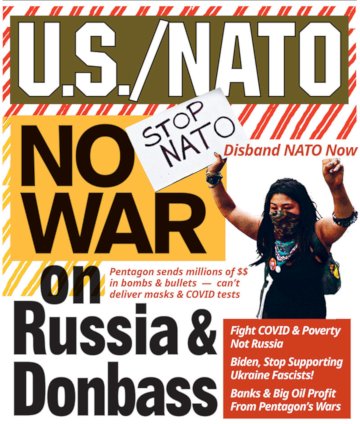
Why do we say: NO U.S./NATO WAR ON RUSSIA & DONBASS – Feb. 27

Students & Youth! & everyone young at heart
Sunday, February 27, 5 pm ET, 2 pm PT

Join us for a film showing and mini-teach-in
Why do we say: NO U.S./NATO WAR ON RUSSIA & DONBASS

Watch Oliver Stone’s: Ukraine on Fire
Dialogue with our guest Greg Butterfield*

Sponsored by: Youth Against War and Racism
Endorsed by Peoples Power Assembly & Struggle-La Lucha

*Struggle-La Lucha co-editor Greg Butterfield is the coordinator of Solidarity with Novorossiya & Antifascists in Ukraine. He has written extensively on developments in Ukraine and Donbass since 2014. In September 2014, he visited Crimea to meet with exiled Ukrainian activists; when he attempted to visit the city of Kharkov in eastern Ukraine, he was deported at gunpoint. In 2016, he went to Donetsk and Lugansk, attending an anti-fascist conference and visiting the people’s militia near the front line. Many of his articles and translations can be found at Red Star Over Donbass.

This is one of the recent articles by Greg Butterfield: Why Russia recognized the Donbass republics

**Our format will be meeting style so please be prepared to turn on your video. Meet and talk with the room.

Feb 27, 2022 05:00 PM in Eastern Time (US and Canada)

Register here:  https://us02web.zoom.us/meeting/register/tZckdequrjojE9wCIk12MX9cH-0Hk6PrsAK1

Strugglelalucha256


March 1 to 7: International week of actions to stop war with Russia

No Wars! No Sanctions! No NATO!

The conflict in Ukraine has escalated to a dangerous level between two nuclear armed states. The United States and its allies continue to portray the current situation as one of Russian aggression without acknowledging that US-backed Ukrainian forces are attacking the Eastern region of the country and killing citizens of Russian ethnicity.

This current escalation is a serious threat to world peace and requires a unified and rapid response by anti-war organizations from around the globe to stop a major war.

To that end, we, the undersigned groups, have agreed to support a week of international action from March 1 to 7 with the following demands on our governments:

— No war with Russia

— Stop the NATO expansion

— No more weapons to Ukraine and the European Union

— Obey international laws and the UN Charter

— Resolve the current conflict within the United Nations Security Council

— Restore the Minsk Agreements

— De-escalate the threat of a nuclear war

Initial Signatories:

Alliance for Global Justice
ANSWER Coalition
CODEPINK
Global Network Against Weapons and Nuclear Power in Space
International Action Center
Popular Resistance
Roots Action
United National Antiwar Coalition
US Peace Council
Women’s International League for Peace and Freedom – US Section (WILPF-US)
World BEYOND War

Additional signers:

Observatorio por los Derechos Humanos de los Pueblos (People’s Human Rights Observatory)
Communist Party of Catalunya
Comité Permanente de Derechos Humanos (Permanent Committee for Human Rights) – Colombia
New York Peace Council
Progressive Center for a Pan American Project
Coop Anti-War Cafe Berlin
Pole for Communist Revival in France
People’s Party of Oregon
Boston May Day Coalition
Women Against Nuclear Power
Peace and Justice Community of Hidalgo County
Seattle Anti-War Coalition
Peace Action WI
Hilton Head for Peace
Workers Voice Socialist Movement
Veterans for Peace Madison – Clarence Kailin Chapter 25
ALL Children ALL Borders
Workers World Party
Women for Peace
Socialist Unity Party


Strugglelalucha256


Lenin: How to oppose an unjust war

The Leninist view of how to fight against imperialist war remains one of the most controversial and defining characteristics of the communist movement, because it means standing up to the capitalist class at the moment its fangs are bared.

Why do we think it’s important to study what Russian revolutionary V.I. Lenin wrote and did during World War I, over 100 years ago?

There are two good reasons. First, Lenin’s Marxist analysis of war shows how capitalism in its highest stage, imperialism, has an insatiable thirst for new markets and bigger profits that drives it to war. That hasn’t changed.

And second, Lenin successfully used this working-class understanding of war to help bring about the socialist revolution in Russia.

In the pamphlet “Socialism and War,” Lenin called the war that had just broken out in Europe “a war between the biggest slaveholders for the maintenance and consolidation of slavery.”

Differentiating the communist position from the pacifists, who condemn all wars equally, Lenin said, “We understand that wars cannot be abolished until classes are abolished and socialism is created.”

He defined as just wars “civil wars, i.e., wars waged by an oppressed class against the oppressor class,” and wars of national liberation by oppressed countries.

“If tomorrow, Morocco were to declare war on France, India on England, Persia or China on [World War I era, pre-revolutionary] Russia, and so forth,” he wrote, “those would be ‘just,’ ‘defensive’ wars, irrespective of who attacked first; and every socialist would sympathize with the victory of the oppressed, dependent, unequal states against the oppressing, slave-owning, predatory ‘Great’ Powers.”

Communists “of the oppressor countries should recognize and champion the oppressed nation’s right to self-determination,” Lenin wrote. “The socialist of a ruling country who does not stand for that right is a chauvinist.”

Revolutionary defeatism

“The defeat of one’s own capitalist government is the lesser evil in the struggle against the war,” he wrote. “A revolutionary class cannot but wish for the defeat of its government in a reactionary war, and cannot fail to see that the latter’s military reverses must facilitate its overthrow.”

Lenin’s thoroughly internationalist perspective is called revolutionary defeatism.

Instead of using the war as an excuse to pull back from the class struggle, Lenin and his co-thinkers argued that it was exactly the time to step up the struggle against capitalism.

It would be a hard road, especially during the first wave of patriotic propaganda. But as the war dragged on and the death and suffering mounted, more workers would turn against the government and capitalism, he argued.

This is the origin of the famous communist slogan, “Turn the imperialist war into civil war.”

Some people misunderstand what Lenin meant by this. They think it means you have to show up at the very first demonstration against the war with signs reading “Turn the imperialist war into civil war.” 

In fact, Lenin argues in his pamphlet that communists should give strong support to all manifestations for peace. This is often the first step by the workers, youths and others toward anti-war consciousness.

All five Bolshevik deputies in the Duma, or parliament, took a strong anti-war stand, and the Czar exiled them to hard labor in Siberia. Factory workers passed anti-war resolutions. Strikes and demonstrations were organized. Agitation was conducted in the army, and fraternization with enemy troops was encouraged.

Because of their correct analysis of the war and their determination to continue and deepen the class struggle, the Bolsheviks were ready when mass anger at the war boiled over. In February 1917, the Russian people rose up and overthrew the Czar. Several months later, after a new pro-capitalist government showed it would continue the war, Lenin and the Bolsheviks led a successful workers’ and peasants’ revolution for socialism under the banner of “Peace, Land, Bread.”

The new Soviet government’s first act was to call on all countries to end the World War and renounce all annexations and occupations. It guaranteed the right of self-determination for all the peoples and nations oppressed by Russian capitalism.

Strugglelalucha256


Victory to the anti-fascist forces of Donbass and their allies! U.S./NATO hands off Russia!

Socialist Unity Party / Partido de Socialismo Unido statement on the military conflict in Ukraine

On Feb. 24, the anti-fascist Donetsk and Lugansk People’s Republics, together with the Russian Federation, launched a military action with the goal of “demilitarization and denazification” of the U.S.-NATO coup regime in Ukraine. It is in the interest of poor and working people, anti-war and anti-imperialist forces, especially in the U.S. and other NATO countries, to take a clear and unambiguous position in solidarity with the anti-fascist forces. The real war danger comes from U.S. and NATO forces surrounding Russia. The government in Kiev is a proxy of these forces of war, with no regard for the people of Ukraine.

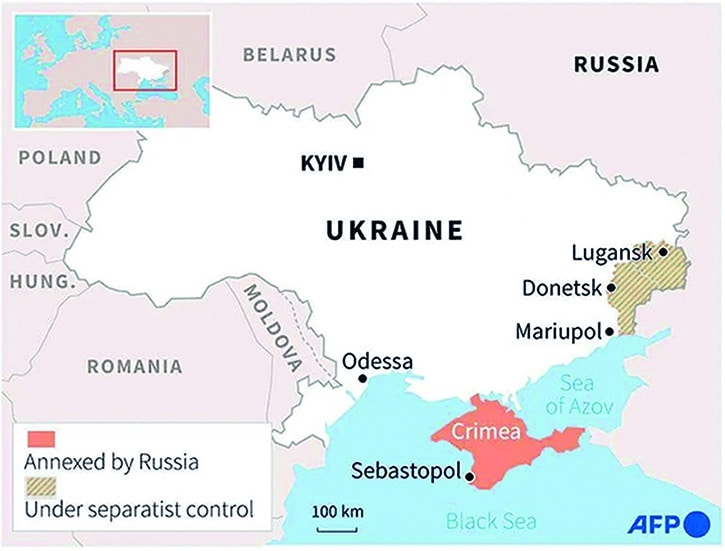
For eight years, the people of Donetsk and Lugansk in the Donbass region have maintained their independence in the face of constant bombing, shooting and terrorist attacks by the Ukrainian government – a regime installed by a fascist coup orchestrated with bipartisan U.S. support. More than 14,000 people have died in Ukraine’s war on Donbass, according to the United Nations. 

Since November 2021, the U.S. has pushed Kiev to launch a new murderous invasion of the Donbass, while claiming that the real threat was from Russia against Ukraine. Meanwhile, the U.S. and its NATO military allies poured weapons and “trainers” into Ukraine, and built up their own imperialist armies on Russia’s Western borders and throughout Eastern Europe. The U.S. rejected Moscow’s just demands to guarantee Ukraine’s neutrality and pull back NATO’s armies. 

Russia officially recognized the independence of Lugansk and Donetsk on Feb. 21 – nearly eight years after the people of Donbass overwhelmingly chose independence in a democratic referendum, rejecting the rule of the pro-Western/neo-fascist coup government in Ukraine. 

The response of the U.S. and its allies was to impose new sanctions on Russia – an act of war – and to send still more troops and weapons to threaten the independent countries of the region. This included blocking the Nord Stream II gas pipeline project between Russia and the European Union, a major goal of Big Oil and Wall Street banks.

Washington and NATO deliberately and methodically pushed the Donbass republics and Russia into a corner, from which there were only two options: submit or fight back. 

On the night of Feb. 23-24, the People’s Militias of Donetsk and Lugansk and their Russian allies launched a military action with the goals of reclaiming Ukrainian-occupied areas of Donbass and demilitarizing and denazifying the Ukrainian-NATO regime. 

The People’s Militias are fighting to drive back the Ukrainian Armed Forces, including neo-Nazi battalions armed and trained by the U.S., Canada and NATO, that constantly threaten the lives of their residents. U.S. white supremacists have trained with the Ukrainian fascist gangs, something even admitted by the FBI, and gained military experience fighting against Donbass which they bring back to attack oppressed communities here. They were key players in the “Unite the Right” rally in Charlottesville, Virginia., and the murder of anti-racist activist Heather Heyer.  

The Russian armed forces have carried out attacks on at least 74 military bases throughout Ukraine, many of them constructed and upgraded by NATO specifically to facilitate war against Russia. Russian, Donbass and the Ukrainian anti-fascist underground are also working to locate, capture or eliminate neo-Nazi forces, including the ringleaders of the 2014 Odessa massacre, when at least 46 people were killed at the House of Trade Unions.

The anti-fascist military action, forced on Donbass and Russia by the Western imperialist powers – principally President Joe Biden and the U.S. government – has exposed confusion and equivocation in the U.S. anti-war movement, even among socialists and communists. 

Let’s be clear: Modern capitalist Russia is not an imperialist country. It had no means to become one after the counterrevolution in the USSR. It is a regional power akin to India or Brazil, primarily an exporter of commodities, not capital. In order to maintain its independence, Russia had to ally itself with other countries in opposition to imperialism.

Ukraine’s coup regime, by contrast, is a pawn of U.S. imperialism that has been waging a brutal war on its neighbors in Donbass for eight years and offered itself as a base for NATO aggression against Russia. 

We want to remind the movement of the principles laid down at the dawn of imperialism by V.I. Lenin, the leader of the Bolshevik Revolution. Differentiating the communist position from the pacifists, who condemn all wars equally, Lenin said, “We understand that wars cannot be abolished until classes are abolished and socialism is created.”

If Iran attacked Saudi Arabia to stop the genocidal U.S. war on Yemen (carried out by Saudi Arabia at Washington’s behest), which also threatens Iran and its regional allies, we hope that anti-imperialists would recognize that this was a just war, despite some of our ideological differences with the government of the Islamic Republic of Iran. Yet this is exactly what is happening in Ukraine today.

Our responsibility is to stop U.S. imperialism and its wars in all forms, and to stand in solidarity with those who fight against U.S. domination.

Victory to the Donetsk and Lugansk People’s Republics and their allies!

Solidarity with the anti-fascist underground and exiles of Ukraine!

U.S./NATO: Hands off Russia! Get out of Ukraine and Eastern Europe!

Dismantle the imperialist NATO war machine – bring all the troops home now!

Strugglelalucha256


¡Victoria a las fuerzas antifascistas del Donbas y sus aliados! ¡EUA / OTAN, saquen sus manos de Rusia!

Comunicado del Partido de Socialismo Unido sobre el conflicto militar en Ucrania

El 24 de febrero, las Repúblicas Populares antifascistas de Donetsk y Lugansk, junto con la Federación Rusa, lanzaron una acción militar con el objetivo de “desmilitarizar y desnazificar” el régimen golpista de Estados Unidos y la OTAN en Ucrania. Es en el interés de las/os pobres y trabajadores, fuerzas contra la guerra y antiimperialistas, especialmente en EUA y otros países de la OTAN, tener una posición clara e inequívoca en solidaridad con las fuerzas antifascistas. El verdadero peligro de guerra proviene de las fuerzas estadounidenses y de la OTAN que rodean a Rusia. El gobierno de Kiev es un representante de estas fuerzas guerreristas, y no tienen en cuenta al pueblo de Ucrania.

Durante ocho años, las/os habitantes de Donetsk y Lugansk en la región del Donbas han mantenido su independencia frente a los constantes bombardeos, disparos y ataques terroristas del gobierno ucraniano, un régimen instalado por un golpe fascista orquestado con el apoyo bipartidista de EUA. Más de 14.000 personas han muerto en la guerra de Ucrania en Donbas, según las Naciones Unidas.

Desde noviembre del 2021, EUA ha presionado a Kiev para que lance una nueva invasión asesina del Donbas, al tiempo que afirma que la verdadera amenaza viene de Rusia contra Ucrania. Mientras tanto, EUA y sus aliados militares de la OTAN vertieron armas y “entrenadores” en Ucrania y construyeron sus propios ejércitos imperialistas en las fronteras occidentales de Rusia y en toda Europa del Este. Estados Unidos rechazó las justas demandas de Moscú de garantizar la neutralidad de Ucrania y retirar los ejércitos de la OTAN.

Rusia reconoció oficialmente la independencia de Lugansk y Donetsk el 21 de febrero, casi ocho años después de que el pueblo de Donbas eligiera abrumadoramente la independencia en un referéndum democrático, rechazando el régimen del gobierno golpista prooccidental y neofascista en Ucrania.

La respuesta de EUA y sus aliados fue imponer nuevas sanciones a Rusia, un acto de guerra, y enviar aún más tropas y armas para amenazar a los países independientes de la región. Esto incluyó el bloqueo del proyecto de gasoducto Nord Stream II entre Rusia y la Unión Europea, un objetivo importante de los bancos de Wall Street y las grandes petroleras.

Washington y la OTAN empujaron deliberada y metódicamente a las repúblicas del Donbas y Rusia a un rincón, del que solo había dos opciones para salir: someterse o contraatacar.

En la noche del 23 al 24 de febrero, las Milicias Populares de Donetsk y Lugansk y sus aliados rusos lanzaron una acción militar con el objetivo de recuperar las áreas ocupadas por Ucrania en el Donbas y desmilitarizar y desnazificar el régimen ucraniano-OTAN.

Las Milicias Populares están luchando para hacer retroceder a las Fuerzas Armadas de Ucrania, incluidos los batallones neonazis armados y entrenados por EUA, Canadá y la OTAN, que amenazan constantemente la vida de sus residentes. Los supremacistas blancos de EUA se han entrenado con las bandas fascistas ucranianas, algo que incluso el FBI admitió, y adquirieron experiencia militar luchando contra Donbas; experiencia que traen para atacar a las comunidades oprimidas aquí. Fueron actores clave en la manifestación “Unir a la derecha” en Charlottesville, Virginia, y en el asesinato de la activista antirracista Heather Heyer.

Las fuerzas armadas rusas han llevado a cabo ataques contra al menos 74 bases militares en toda Ucrania, muchas de ellas construidas y mejoradas por la OTAN específicamente para facilitar la guerra contra Rusia. Antifascistas de Rusia, Donbass y Ucrania clandestinos también están trabajando para localizar, capturar o eliminar a las fuerzas neonazis, incluidos los cabecillas de la masacre de Odessa de 2014, cuando al menos 46 personas fueron asesinadas en la Casa de los Sindicatos.

La acción militar antifascista impuesta en Donbas y Rusia por las potencias imperialistas occidentales, principalmente el presidente Joe Biden y el gobierno de EUA, ha expuesto confusión y equivocaciones en el movimiento contra la guerra de EUA, incluso entre socialistas y comunistas.

Estemos claros: la Rusia capitalista moderna no es un país imperialista. No tenía medios para convertirse en uno después de la contrarrevolución en la URSS. Es una potencia regional similar a la India o Brasil, principalmente un exportador de productos básicos, no de capital. Para mantener su independencia, Rusia tuvo que aliarse con otros países en oposición al imperialismo.

El régimen golpista de Ucrania, por el contrario, es un peón del imperialismo estadounidense que ha estado librando una guerra brutal contra sus vecinos en Donbas durante ocho años y se ofreció como base para la agresión de la OTAN contra Rusia.

Queremos recordar al movimiento los principios establecidos en los albores del imperialismo por V.I. Lenin, el líder de la revolución bolchevique. Al diferenciar la posición comunista de la de los pacifistas, que condenan todas las guerras por igual, Lenin dijo: “Entendemos que las guerras no se pueden abolir hasta que se acaben las clases y se cree el socialismo”.

Si Irán atacó a Arabia Saudita para detener la guerra genocida de Estados Unidos contra Yemen (llevada a cabo por Arabia Saudita a instancias de Washington), que también amenaza a Irán y sus aliados regionales, esperamos que los antiimperialistas reconozcan que esta fue una guerra justa, a pesar de algunas de nuestras diferencias ideológicas con el gobierno de la República Islámica de Irán. Sin embargo, esto es exactamente lo que está sucediendo hoy en Ucrania.

Nuestra responsabilidad es detener el imperialismo estadounidense y sus guerras en todas sus formas, y solidarizarnos con quienes luchan contra la dominación estadounidense.

¡Victoria para las Repúblicas Populares de Donetsk y Lugansk y sus aliados!

¡Solidaridad con la clandestinidad antifascista y los exiliados de Ucrania!

EUA/OTAN: ¡Fuera sus manos de Rusia! ¡Fuera de Ucrania y Europa del Este!

¡Desmantelamiento de la maquinaria de guerra imperialista de la OTAN – que regresen todas las tropas a casa ahora!

Strugglelalucha256


In conversation with Dmitri Kovalevich

Dmitri Kovalevich is a Ukrainian journalist and activist of the banned communist organization ‘Borotba’.

The organization was banned in 2014 for active protests against pro-U.S. coup and against legalization of neo-Nazism. It was banned along with the Communist party. It acts illegally in Ukraine and legally in Donbas republics (Donetsk and Lugansk). His organization supported Donbass rebels in the civil conflict which lasts since pro-U.S. coup in 2014.

The International: How would you explain the events unfurling in Ukraine right now?

Dmitri Kovalevich: The current events are a continuation of the Donbass conflict which has been going on since 2014. For years Kyiv media and West MSM used to tell that Ukraine was confronting the Russian invasion – and now that happened in reality – as soon as Russia recognized the republics. The official stated aim of the operation: ‘denazification of Ukraine’. Donbass republics seceded in 2014 exactly because they were outraged by legalization of WW2 Nazi collaborators of Ukrainian origin.

The International: Was the situation inevitable? Could it have been resolved through a series of negotiations?

Dmitri Kovalevich: The negotiations have been going on since 2014. Ukraine twice signed the Minsk agreement but refused to fulfill them fearing that armed neo-Nazis would overthrow the government like in 2014. The Minsk agreement implied the reintegration of Donbass republics back in Ukraine but providing the special autonomy status with right to have their own cultural and language policy. This was unacceptable for our radical nationalists who would like to see unified and monoethnic pro-Nazi Ukraine. So, it is either communists are banned and here or Nazis. There is no third option.

The International: How are the Ukrainians dealing with this?

Dmitri Kovalevich: There are some 5-6% of Ukrainians sharing pro-nationalist or pro-Nazi ideology. There are some 5-6% of commited communists or sympathizers. The rest support those who are winning at the moment. Last years millions of Ukrainians migrated: some 3.5 million to Russia and they would like to come back in case of change of the government. Some 3.5 – labor migrants in western countries, they tend to share Western media narratives.

The International: What ramifications will this have for the Donbass Republics?

Dmitri Kovalevich: I suppose they will be a sort of independent countries like Abkhazia, South Ossethia, Transnistria. Since Ukraine refused from Minsk agreements, they will not come back, given also much blood spilt within 8 years which divide Kiev and Donetsk.

The International: So far everyone has been playing the blame game and rooting for either of the sides. Is there something that the media has hidden from the public?

Dmitri Kovalevich: The main thing hidden from the public is that there are numbers of outright Nazis integrated into Ukraine’s army, police and National Guard. The Ukrainian education system brainwashes children glorifying WW2 Nazis and blaming Soviets. West media preferred to ignore the daily shelling of Donbass cities and the resistance of Donetsk coal-miners, but are outraged when only when pro-U.S. side is being bombed.

The International: If the NATO pushes back, is there a possibility of a full-scale war?

Dmitri Kovalevich: I can’t predict that. But definitely, it’s a new war between pro-NATO and anti-NATO sides. There are deep changes on the geopolitical level and the First World countries face economic crisis. The only way they see in a conflict is profiting on arms trade and sales. They are also to show for the Third World countries that U.S./UK are still strong to impose their imperialist agenda, especially after fails in Afghanistan). A possible loss of any pro-NATO force or country may enforce further economic conflict within the First World countries providing more opportunities to the Third world countries to improve their economic situation.

Strugglelalucha256


France withdraws from Mali, but continues to devastate Africa’s Sahel

On February 17, 2022, French President Emmanuel Macron held a press conference in Paris just ahead of the sixth European Union-African Union summit in Brussels along with Senegal’s President Macky Sall and Ghana’s President Nana Akufo-Addo as well as European Council President Charles Michel. At the conference, Macron announced that the French forces would be withdrawing from Mali. This means that France and its European allies will start to wind down “Barkhane and Takuba anti-jihadist operations in Mali.” The protests in Mali against the presence of the French troops seem to have finally succeeded.

Macron said that France had to withdraw its troops because it would no longer like to “remain militarily engaged alongside de facto authorities whose strategy or hidden objectives we do not share.” A statement appeared on the French government website signed by the European Union (EU) and by the African Union (AU) that made the same point, namely that “the Malian transitional authorities have not honored their commitments.”

The language used by Macron and included in the AU and EU statement shows a lack of transparency about the real reasons behind the withdrawal of troops from Mali. The government of Mali (“de facto” and “transitional”) came to power through two coups d’état in recent years: Colonel Assimi Goïta, leader of the National Committee for the Salvation of the People of Mali, carried out the first coup in August 2020 against the elected government and installed Bah Ndaw, who was a military officer, as the interim president of Mali. Ndaw was then overthrown in a second coup in May 2021, when Goïta took over the position of interim president himself. By June, the European countries insisted that the new military junta hold elections by February 2022. Goïta said that he would honor this timeline. He did not do so, which gave the EU and the AU the excuse to break links with Goïta’s government.

That’s the excuse being used by these regional powers to wind down operations in Mali. Matters become far less clear, however, when it comes to the statements that were made by France in this regard. Macron spoke about Goïta’s “hidden objectives,” but did not elaborate on that accusation. What could these “hidden objectives” be?

Mali’s Troubles

Mali’s troubles do not start and finish with the unrest in northern Mali nor with the military coup. If you were to ask Alpha Oumar Konaré, the president of Mali from 1992 to 2002, he would tell you a different story. When Konaré took over the presidency in Mali in 1992, the people were exhausted by the debt crisis produced by International Monetary Fund (IMF) policies and by military rule. They wanted something more. One of Konaré’s close advisers said during his time in office, “We service our country’s debt on time every month, never missing a penny, and all the time the people are getting poorer and poorer.”

Konaré’s government asked for relief from the IMF so that it could marshal resources toward ensuring the development of the northern part of the country; the insurgency, Konaré argued, would be better confronted by development than by war. The United States government and the IMF disagreed.

From Konaré’s time in office as president to now, Mali’s governments—whether civilian or military—have been unable to craft a policy framework to tackle endemic social and economic crises. It is true that there has been a long-standing rebellion in the north that has brought together the Ifoghas aristocrats among the Tuaregs and the Al Qaeda factions that came out of the Algerian civil war (1991-2002) and the destruction of Libya (2011-2012); none of the many peace agreements have worked largely because there is simply no money in Bamako, the capital of Mali, to promise the kind of development needed to undercut a million frustrations. Less remarked, but equally true, are the devastatingly poor social indicators in the rest of Mali, where hunger and illiteracy appear normal in Bamako’s bidonvilles.

Western intervention in much of Africa has not resulted in beneficial economic assistance in the region. This assistance has come through IMF austerity policies and military aid.

France’s 2013 military intervention into Mali came alongside its construction of a military project across the Sahel belt called G5 Sahel (including Burkina Faso, Chad, Mali, Mauritania and Niger) in 2014. The military in each of these countries received aid, and its officers received training. It is no surprise that Goïta, for instance, received training from the U.S. armed forces in Burkina Faso alongside Colonel Mamady Doumbouya, who carried out a coup in Guinea in September 2021; it is no surprise either that Lieutenant Colonel Paul-Henri Sandaogo Damiba of Burkina Faso trained alongside these men and carried out his coup in Burkina Faso in January 2022; and no surprise that in Chad, “General Kaka” (Mahamat Idriss Déby Itno), the son of the former president, was installed as the president by the military in what was effectively a coup in April 2021. Three of the G5 Sahel countries—Burkina Faso, Chad and Mali—are now led by a military government (Niger’s authorities thwarted a coup in March 2021).

All the handwringing about why there are so many coup attempts in Africa these days fails to connect the dots: no agenda out of the IMF-austerity model is permitted by the Western states, which prefer to build up the military forces in the region rather than allow a genuine social democratic process to open in these key African countries.

Discomfort With the Western Interventions

In October 2021, Mali’s current Prime Minister Choguel Kokalla Maïga told a Russian news outlet that his government had “proof” that the French are training terrorist groups such as Ansar Dine. According to his interview, France had created an “enclave” in the Kidal region in 2013. “They have militant groups there, which were trained by French officers,” Maïga said. Kidal is in Mali’s north, not far from its borders with Algeria and Niger.

Nothing Maïga said should have raised an eyebrow. France’s former ambassador to Mali, Nicolas Normand, made some similar comments in 2019 when he released his book on the continent, Le grand livre de l’Afrique. Normand told Radio France Internationale that Macron’s government forged ties with the National Movement for the Liberation of Azawad and with the aristocrats of the Ifoghas region to prevent them from making a rapid advance toward Bamako. France wanted to play the “good armed groups” against the “bad armed groups,” but in the end failed to see that both these groups were terrible for Mali. This approach, combined with the civilian casualties of the French military operations (22 civilians died when France bombed a wedding in Bounti in 2021, for example), turned the people of Mali away from France.

French troops have now begun to leave Mali, but they are not returning to France. They will be deployed to next-door Niger, where they will continue their mission to prevent migration to Europe and to fight off the radicalized victims of IMF austerity (which often come in the form of frustrated young people, some of whom turn to terror). Macron’s eyes are on the French presidential elections, which are expected to take place in April this year, and on the rising tensions in response to Russia’s military intervention into Ukraine.

Meanwhile, the people of Mali came to the streets to celebrate the departure of the French. Interestingly, many of the signs thanked the Russians. Perhaps the entry of Russian aid and mercenaries are the “hidden objectives” Macron was referring to?

This article was produced by Globetrotter. Vijay Prashad is an Indian historian, editor and journalist. He is a writing fellow and chief correspondent at Globetrotter. He is the chief editor of LeftWord Books and the director of Tricontinental: Institute for Social Research. He is a senior non-resident fellow at Chongyang Institute for Financial Studies, Renmin University of China. He has written more than 20 books, including The Darker Nations and The Poorer Nations. His latest book is Washington Bullets, with an introduction by Evo Morales Ayma.

Strugglelalucha256


Why Russia recognized the Donbass republics

In order to have a clear anti-war, anti-imperialist position today, class-conscious workers need to understand the significance of the Russian Federation’s Feb. 21 decision to recognize the Donbass republics of Donetsk and Lugansk as independent, sovereign countries, nearly eight years after they first declared independence from Ukraine.

Following an unprecedented live telecast of the meeting of Russia’s National Security Council, President Vladimir Putin announced, “I deem it necessary to make a decision that should have been made a long time ago – to immediately recognise the independence and sovereignty of the Donetsk People’s Republic (DPR) and the Lugansk People’s Republic (LPR).”

Putin signed presidential decrees recognizing the republics; establishing treaties of friendship and mutual cooperation with them; and authorizing Russian peacekeepers to be deployed to the Donbass if requested. Reciprocal decrees were signed by the leaders of the DPR and LPR, Denis Pushilin and Leonid Pasechnik.

The U.S. and its global allies denounced the decision.

Russia’s decision came after several days of heightened Ukrainian military attacks on the two small republics. Two-thirds of Ukraine’s NATO-armed and -trained military forces are poised on the roughly 200-mile “line of contact” with Donetsk and Lugansk, near Russia. Some 175,000 NATO troops, meanwhile, are also stationed on Russia’s western border.

Hundreds of Ukrainian artillery attacks, shootings and terrorist acts have been carried out since Feb. 17, killing and wounding civilians and members of the Donbass People’s Militias, destroying homes and damaging vital infrastructure like water filitration plans, gas pipelines and schools. 

Mass evacuations of civilians from Donetsk and Lugansk began Feb. 18. Everyone understood that a Ukrainian invasion was imminent, even though the Biden administration, standing reality on its head, kept repeating that Russia was planning to invade Ukraine.

Although the shelling of Donetsk, capital city of the DPR, subsided briefly after Russia’s announcement, Ukrainian attacks soon resumed, including a bomb attack on the Donetsk television center and the killing of two Lugansk civilians by a Ukrainian anti-tank missile Feb. 22.

What Washington wants

Since November 2021, Washington has relentlessly pushed Ukraine to launch a major attack on the Donbass in hopes of drawing Russia into a conflict to justify further NATO expansion and shut down Russian fuel exports to Western Europe. 

For three decades, the bipartisan goal of U.S. capitalism has been to break up Russia and bring it firmly under Washington’s control – something Putin acknowledged in his Feb. 21 address to the Russian people.

On Feb. 22, Biden and “Defense” Secretary Lloyd Austin ordered the deployment of thousands more U.S. troops, attack helicopters and fighter planes to Eastern Europe. 

Biden imposed broad new sanctions on Russia, including individual sanctions on parliamentarians who supported the decision to recognize the Donbass republics. Other imperialist countries and U.S. puppet regimes quickly followed suit.

Perhaps most important, Germany announced Feb. 22 that it was stopping authorization of the newly completed Nord Stream 2 gas pipeline that was set to significantly increase the flow of fuel from Russia to the European Union. 

Cutting off this relationship – forcing Europe to buy oil and gas products from U.S.-owned and -controlled sources, directing the profits into U.S. banks – was a major goal of Washingon’s anti-Russia campaign. On cue, oil and gas prices jumped to near-record levels, with oil close to $100 a barrel on Feb. 23.

Of all the NATO imperialists, Germany had most dragged its feet in supporting the U.S. war drive. But it’s important to recall that Germany, though the strongest economic power in Europe, is also militarily occupied by the Pentagon, with a whopping 119 U.S. military bases, second only to another imperialist frenemy, Japan with 120.

Real significance of recognition

Russia’s recognition of the Donetsk and Lugansk republics was greeted with great enthusiasm by Donbass residents, who have lived under eight years of Ukrainian war and sanctions, at the cost of more than 14,000 lives. It was an important, if belated, acknowledgement of their democratic decision in the referendum of May 11, 2014 and the sacrifices they have made to fend off NATO/neo-Nazi encroachment.

They understand, as do the Ukrainian fascists that seek to “cleanse” the Donbass region, that further aggression by Kiev now means a military confrontation with Russia. Ukraine’s President Volodymyr Zelensky fears this, but as a willing tool of Washington has no power to resist.

At the same time, Russia had little choice but to take this step, which was forced upon it by Washington. For eight years, since the 2014 U.S.-backed coup in Kiev, Moscow has parried numerous Western attempts to draw Russian forces into a fight with Ukraine. But it has become apparent that room to maneuver has run out.

Among the Russian people there is massive support for the residents of Donbass. It’s doubtful that the Putin government could have survived the abandonment of Donetsk and Lugansk.

Putin’s televised address combined a clear-eyed assessment of the stakes of the current confrontation for Russia with an analysis of Ukrainian history severely distorted by anti-Sovietism and Russian nationalism. We must honestly acknowledge that this is an impediment to rebuilding solidarity between Russian and Ukrainian workers.

But the true significance of Russia’s decision to recognize the Donetsk and Lugansk People’s Republics goes in another direction. It’s an acknowledgement of the deeply rooted traditions of anti-fascism and internationalism of the multinational Soviet working class, even three decades after the socialist USSR was broken up.

Today as never before, the workers and oppressed of the U.S. and the world must reject the lies of Washington, Wall Street and the corporate media and demand: No war with Russia! Biden, recognize Donetsk and Lugansk! U.S. out of Ukraine!


Strugglelalucha256


Biden gives Big Oil a win, gas prices going up

On Feb. 22, President Joe Biden announced new sanctions on Russia and on the company that built Nord Stream 2 and its German CEO. These sanctions will mean higher gas prices in the U.S. as well as in Europe.

“As I said last week, defending freedom will have costs, for us as well and here at home,” Biden said. “We need to be honest about that.” Biden added that he will take measures to “blunt” gas price increases, “to limit the pain the American people are feeling at the gas pump.” 

Biden said he’s doing this in coordination with the major oil producers, but gave no details, meaning that there’s really no limit planned. It’s a signal of support to Big Oil profits, particularly in the heating gas market in Europe.

An inflation rate in the U.S. at 7.5% — higher prices for gas, food and rent — has been a severe wage cut for all workers here. At the same time, corporate profits have reached a 70-year high. 

“Two dozen of the most profitable oil and gas companies — a group that includes Shell, BP, ExxonMobil and Chevron — recorded $74.9 billion in net income” in the third quarter of 2021, reports Common Dreams. “Big Oil’s soaring profits come as gasoline prices have hit a seven-year high in the U.S. … with Americans now paying about $3.40 for a gallon of fuel compared with around $2.10 a year ago.”

The sanctions on Russia and Nord Stream 2 — the ones that will drive gas prices even higher, with some predicting pump prices going up to $7 a gallon — are driven, in part, by the demands of Big Oil. The sanctions were announced after Russia gave recognition to the Donetsk People’s Republic and the Lugansk People’s Republic in Donbass. 

If the goal of U.S. sanctions was really for peace in Ukraine, why didn’t the Biden administration demand implementation of the 2015 Minsk 2 agreement, which is the policy supported by both France and Germany? Minsk 2 requires Ukraine to negotiate with the two Donbass republics on autonomy, but no serious negotiations have been held.

EU gets gas from Russia

The European Union imports 40% of its gas from Russia. The primary route for gas from Russia is through the Nord Stream 1 pipeline to Germany. Nord Stream 2 was built to provide a more secure and stable pipeline that has at least double the capacity.

Biden really spilled the beans earlier when he indicated that he wanted to block Nord Stream 2, a pipeline built to bring Russian gas under the Baltic Sea directly to Germany.

On Feb. 7, Biden threatened to take control over the German-Russian project that the U.S. has no relation with. From the White House transcript:

[By previous arrangement, the first question went to a Reuters reporter.]

Reuters.  Andra- — Andrea. You’ve got the first question.

Q: Thank you, Mr. President. And thank you, Chancellor Scholz. Mr. President, I have wanted to ask you about this Nord Stream project that you’ve long opposed. You didn’t mention it just now by name, nor did Chancellor Scholz. Did you receive assurances from Chancellor Scholz today that Germany will, in fact, pull the plug on this project if Russia invades Ukraine? And did you discuss what the definition of “invasion” could be?

PRESIDENT BIDEN: The first question first. If Germany — if Russia invades — that means tanks or troops crossing the — the border of Ukraine again — then there will be — we — there will be no longer a Nord Stream 2. We will bring an end to it.

Q: But how will you — how will you do that exactly, since the project and control of the project is within Germany’s control?

PRESIDENT BIDEN: We will — I promise you, we’ll be able to do it.

Blocking Nord Stream 2 has been a goal of Big Oil and therefore of the U.S. government. It was near the top of Donald Trump’s agenda. Despite what reports may say, the record of the Trump administration is a long series of sanctions and hostile actions against Russia, as the Brookings Institution has detailed.

Mostly unknown here, Trump worked overtime to block the Nord Stream 2 pipeline. In 2018, Trump got German Chancellor Angela Merkel to agree to spend $1 billion building a new liquified natural gas (LNG) port to import highly priced U.S. LNG. The plan was canceled after Trump lost the election and Merkel left office.

With the U.S. pushing a NATO expansion to Russia’s borders and supporting a coup government in Ukraine, the Biden administration found another way to block Nord Stream 2. As Under-Secretary of State for Political Affairs Victoria Nuland explained in a State Department press briefing on Jan. 27: “If Russia invades Ukraine one way or another Nord Stream 2 will not move forward.”

On Feb. 22, when Biden announced his sanctions on Russia, Germany announced it was halting the certification process for Nord Stream 2. The Nord Stream 2 project was finished in September, but has stood idle pending certification by Germany and the EU.

Dmitry Medvedev, Russia’s former president and now deputy chairman of its Security Council, tweeted: “Welcome to the new world where Europeans will soon have to pay 2,000 euros per thousand cubic meters!” — suggesting prices were set to double.

Strugglelalucha256


From the U.S. to Honduras – Socialism & Black Liberation

From the U.S. to Honduras – Socialism & Black Liberation

Sunday, February 20, 2022, 5 pm ET, 4 pm CT, 2 pm PT

Exciting guests at this webinar also included Dr. Luther Harry Castillo, featured in the film “Revolutionary Medicine: A Story of the First Garifuna Hospital,” and Dr. Samira Addrey, both graduates of ELAM (Latin American Medical School) in Cuba.

Dr. Castillo is the newly appointed Secretary of Science and Technology of Honduras, and Dr. Addrey is the ELAM coordinator for IFCO Pastors for Peace.

Panelists included: John Parker, Berta Joubert, Hernan Amador.

Webinar participants saw the film “Revolutionary Medicine: A Story of the First Garifuna Hospital.” Award-winning documentary! “A truly moving story of the courage of the Afro-Honduran community and Garifuna Dr. Luther Castillo who graduated from the ELAM medical school in Cuba”

You can see the film viewed at the webinar on YouTube:

It took only eight days for the newly elected administration of Xiomara Castro and the Libre Party to make changes that impact poverty and racism in Honduras. One million people had electricity bills cut, tuition for schools ended, and Afro-Hondurans made gains in hiring by the new government.

Panelists:

John Parker is a founder of the Harriet Tubman Center for Social Justice and the Socialist Unity Party. He was part of an international delegation that attended the inauguration of President Xiomara Castro. Parker will speak on the present, and historic role socialism has played in the liberation of Black/African peoples here in the U.S. and abroad.

Berta Joubert, who lives in Puerto Rico, founded Women in Struggle/Mujeres En Lucha. Joubert is a writer for Struggle-La Lucha. They were also a part of the international delegation at the inauguration of Honduran President Xiomara Castro.

Hernan Amador is a member of the Libre Party of Xiomara Castro, who was part of the delegation. He lives in Costa Rica and will talk about the African ethnicities, including the Garifuna people in Honduras. In addition, Amador will discuss how conditions for Afro-Hondurans have changed since the U.S. supported the 2009 coup that unseated socialist and elected President Manuel Zelaya.

See John Parker’s report at Struggle-La-Lucha.org

Please subscribe to Struggle-La-Lucha.org

Strugglelalucha256
https://www.struggle-la-lucha.org/2022/page/70/