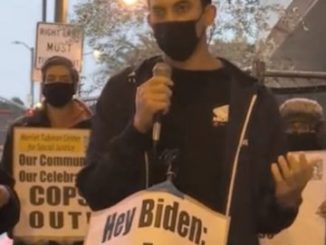
Martin Luther King Day March organizers say ‘no cops in the commemoration’

Sekou Parker of Harvard Boulevard Block Club speaks at Cops Out of MLK DAY press conference, Dec. 30. SLL photo: Maggie Vascassenno

Los Angeles – The Harriet Tubman Center for Social Justice, Martin Luther King Coalition, Unión del Barrio, the Boycott, Divestment and Sanctions (BDS) Movement, Coalition to Free Mumia Abu-Jamal, South Central Tenants Union, Puerto Rican Alliance, BAYAN USA, Harvard Boulevard Block Club and Socialist Unity Party are just a few of the organizations supporting this year’s MLK March for Social Justice.

Many of them were part of the news conference Dec. 30 announcing the MLK March for Social Justice on the Dr. Martin Luther King Jr. holiday, Monday, Jan. 17. The enthusiasm felt from the organizations at the media event comes from this being the first time in over three decades that the MLK events will exclude the police and not disrespect the legacy of Dr. King. 

In addition, Immigration and Customs Enforcement (ICE) and U.S. military organizations are not invited to have contingents or any representatives.

Many in South Central, where the MLK Parade occurs, see the recent killing of 14-year-old Valentina Orellana-Peralta, a recent immigrant from Chile, as yet another horrible reminder of the terror created by the police forces against the predominantly Black and Brown community. Her tragic death was caused by a stray bullet from a Los Angeles Police Department military assault weapon fired in a crowded store.

“We can’t let Dr. King’s message of social justice, against war and poverty, be corrupted by those who have shown no remorse and are dedicated to maintaining their murderous assault and war on the people of South Central. We cannot honor and enable them in a parade that is supposed to fight against injustice,” said Jefferson Azevedo of the Harvard Boulevard Block Club, the community block organization where the King Day Parade has begun year after year.

“We believe that we should have a voice in what goes on in our community,” said Maggie Vascassenno, another member of the block club. “I worry every time my son drives on these streets to school or work – what if he gets stopped and profiled by trigger-happy police all too willing to shoot young Black men? Imagine the insult of seeing those who’ve committed atrocities against us being lauded in a parade that is supposed to be about Dr. King.”

Ron Gochez of Unión del Barrio spoke about the need for Black and Brown people to come together to not allow police at the event, to honor Dr. King, keep the event a family-friendly and welcoming day for the community, and allow the community to shape the activities of the day.

The Harriet Tubman Center and the coalition were the first to file for the permit application last July. This Ad Hoc Coalition for the MLK March for Social Justice is also part of the national initiative by Dr. King’s family. 

Martin Luther King III recently announced that this year is not to be a celebration, but part of the fight for social justice to demand the Biden administration not just condemn the voter suppression avalanche aimed at especially Black voters in words – but take real effective action. King III’s initiative, “Give Us the Ballot,” has endorsed this coalition’s march.

The coalition is now in the process of making sure the LAPD honors the permit application.

https://www.facebook.com/maggie.vascassenno/videos/418258293314532

Strugglelalucha256


Workers organize and strike to fight pandemic and capitalist inflation

The COVID-19 pandemic continues as the new year begins, spreading faster with the Omicron variant. Average daily infections in the U.S. are over 500,000. Total deaths are approaching 1 million. The coronavirus is now the top killer of adults ages 25 to 44 in the U.S., reports the Journal of the American Medical Association.

“For years, the number-one cause of death in my age group [25 to 44] was not cancer or heart disease but accidents, followed closely by drug overdoses and suicide,” says Dr. F. Perry Wilson of the Yale School of Medicine. “COVID-19 changed that.”

The pandemic’s deadly impact is the result of capitalist governments putting profits before people’s lives. It doesn’t have to be this way. Look at China. Since the beginning of the pandemic, only 4,849 COVID deaths have occurred in China.

In the U.S., while the working class was suffering and dying in the pandemic, Wall Street was booming.

“Global stock and bond markets never had it so good,” reports economist Michael Roberts. “Central bank-financed credit flooded into financial assets like there was no tomorrow. 

“The result has been a staggering rise in financial asset prices (stocks and bonds) and in real estate. Central banks have injected $32 trillion into financial markets since the start of the COVID-19 pandemic, lifting global stock market capitalization by $60 trillion. 

“And companies worldwide raised $12.1 trillion by selling stock and taking out loans as a result. The U.S. stock market index rose 17% in 2021, repeating a similar rise in 2020. The S&P 500 index reached a record high. The Nikkei 225 Index had its highest annual gains since 1989.

“But as we go into 2022, the days of ‘easy money’ and cheap loans are coming to an end. The huge stock market boom of the last two years looks likely to peter out,” Roberts explains.

“So this year could be the one for a financial crash or at least a severe correction in stock market and bond prices, as interest rates rise, eventually driving a layer of zombie corporations into bankruptcy. 

“This is what central banks fear. That is why most are being very cautious about ending the era of easy money. And yet they are being driven to do so because of the sharp rise in the inflation rates of prices of goods and services in many major economies,” concludes Roberts.

Inflation is for profits

What about inflation? Workers can’t have prices rising faster than their wages and benefits.

The big business-controlled media reports about inflation, however, are meant to boost corporate profits.

What needs to be looked at economically is the state of wages. Are wages keeping up with rising prices? Over the last two years of the pandemic, inflation has been relatively low but wages have been stagnant. That means that wages have been kept at poverty levels or even have been going down.

Inflation is rising now, but that’s because businesses are raising prices, which has resulted in record profits.

What’s needed is not a focus on inflation but a focus on wages.

Karl Marx led a battle in Britain for raising workers’ wages. Marx pointed out that wage rises do not cause price rises (inflation is price increases, not wage increases). As Marx put it in “Value, Price and Profit,” when he debated with trade unionist John Weston, who argued that wage rises would cause inflation:

“Firstly. A general rise in the rate of wages would result in a fall of the general rate of profit, but, broadly speaking, not affect the prices of commodities.

“Secondly. The general tendency of capitalist production is not to raise, but to sink the average standard of wages.

“Thirdly. Trades unions work well as centers of resistance against the encroachments of capital.”

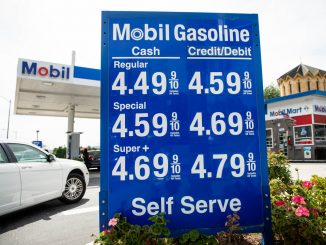
Prices are not driven by wages. Gas prices are soaring, but no one can say that’s because petroleum workers are being paid that much more (they aren’t). In fact, according to Oilman Magazine, some 107,000 jobs “vanished” from the U.S. oil, gas and chemicals industry during the last two years. 

So wages are not driving up gas prices. Profit-gouging is. 

Labor unions fight

Yes, labor unions have been central to the fight for better wages and working conditions. 2021 was a year of strikes, unionization efforts and worker mobilizations. 

Low-wage workers suffered disproportionately during the pandemic and are demanding increased wages, sick pay, meal and rest breaks, better benefits and shorter shifts.

As the new Omicron strain spreads quickly across the United States, threatening to draw the pandemic out even longer, workers organizing and fighting back is the only way forward out of the crisis.

Strugglelalucha256


Right-wing hate speech runs rampant in India’s elections

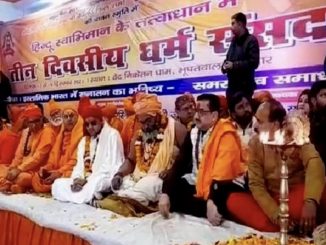
A bizarre event took place in northern India between December 17 and December 19, 2021. It was a “religious parliament” (Dharma Sansad) with the theme, “The Future of the Sanatan Dharma in Islamic India: Problem and Solutions.” The event took place in Haridwar, a city in the Indian state of Uttarakhand. The speakers—each of them dressed in saffron robes, which are usually worn by Hindu monks—took to the stage during the Dharma Sansad and spoke in a startlingly dangerous and provocative fashion. Sadhvi Annapurna, the general secretary of the Hindu Mahasabha, a right-wing Hindu nationalist outfit in India, was the most forthright in spelling out the agenda of hatred against the Muslim community that marked the tone for this event. “Nothing is possible without weapons,” she said. “If you want to eliminate their [the Muslim] population, then we are ready to kill them.”

The reference to “their” and “them” in her speech was clear to everyone in the room and anyone who watched her clip, which circulated widely on social media and on television channels in India. Sadhvi Annapurna was referring to the 204 million Muslims of India. “Even if 100 of us are ready to kill 20 lakh [2 million] of them, then we will be victorious and are ready to go to jail,” she said.

Despite calls by some sections of society, including a group of retired government officials, to investigate and arrest the organizers and speakers of the Dharma Sansad for making these provocative hate speeches, the police in the state of Uttarakhand did not take any “serious action” against those who tried to incite violence through this event, stated government officials in a letter they sent to Uttarakhand’s Chief Minister Pushkar Singh Dhami “condemning his government’s response” to the Dharma Sansad. Uttarakhand is governed by the Bharatiya Janata Party (BJP), whose leader Narendra Modi is the prime minister of India.

Meanwhile, Dhami did not make any statements against the event, although photographs of him bowing before one of the speakers at the conclave appeared to suggest a close association with the people involved in organizing the event. That speaker in the photograph, Swami Prabodhananda Giri, the head of the Hindu Raksha Sena, a right-wing organization based out of Uttarakhand, said at the gathering, “Every Hindu must pick up weapons, and we will have to conduct this cleanliness drive.” It is clear that the association of “weapons” with “cleanliness” refers to the kind of ethnic or religious cleansing witnessed during various periods in history, including the Holocaust during World War II.

Elections and hate

Between February and March 2022, three key north India states are expected to go to the polls; among these states is Uttarakhand. The other two states—Uttar Pradesh and Punjab—are key to the fortunes of the ruling BJP, which will see its popularity tested after Modi had to withdraw three farm bills on November 19, 2021. Farmer unrest in both Punjab and Uttar Pradesh led to a year-long protest campaign that soured the reputation of the BJP in these two states and has created the possibility of new electoral maps being drawn in both these states in India. Uttar Pradesh (which has a population of approximately 200 million) is India’s most populous state, and the fortunes of the BJP there will determine the authority of Modi’s government in Delhi, India’s capital and the central government’s seat of power. A defeat in Uttar Pradesh, or even a reduced majority, would give the opposition greater confidence to challenge Modi’s fiat approach to policymaking and to counter the right-wing ideology propagated by the BJP.

Currently, the BJP dominates the state assembly in Uttar Pradesh (it won 312 out of the 403 seats in the assembly elections of 2017). The atmosphere in Uttar Pradesh remains tense for minorities (around 19 percent of the population in the state are Muslims), largely because various Hindu right-wing organizations—such as those represented at the religious conclave—have stoked the fires of hatred against the Muslim minority for generations. As part of its vote-gathering arsenal, the BJP has developed a strategy to provoke religious violence, polarize the population, and ensure that the majority Hindu vote gathers under its banner. This is what the BJP did to succeed in the 2014 general elections, before which local party officials engineered a pogrom in the town of Muzaffarnagar in August to September 2013 that resulted in the death of more than 60 people and left thousands of others displaced. In the aftermath of that violence, BJP leader—and now home minister of India (responsible for law and order in the country)—Amit Shah in 2014 told a crowd in Shamli in western Uttar Pradesh that the general election, which eventually led to the BJP seizing power in India, was about honor, and was “an election to take revenge for the insult” and “to teach a lesson to those who have committed injustice.”

In November 2021, the Samajwadi Party and the Rashtriya Lok Dal (National People’s Party) formed an alliance for the Uttar Pradesh legislative elections. The Samajwadi Party had governed the state from 2012 to 2017 under the leadership of former Chief Minister Akhilesh Yadav. The Rashtriya Lok Dal, meanwhile, brings heft in the western districts of Uttar Pradesh, where the farmers’ agitation had the greatest impact. This combination threatens the BJP’s divisive agenda. It is likely that more events like the Dharma Sansad focused on spreading and strengthening religious hate in Uttar Pradesh will be on offer to polarize the electorate to the benefit of the BJP.

Sewers of hate

The religious conclave held in December 2021 suggested that there was a threat to Hindus in “Islamic India.” This is a theme that goes back to the 19th century, when leaders of the Hindu right wing began to say that Hinduism was being threatened by, among other things, the rising birth rate of Muslims. Facts apart, this idea festered in the sewers of right-wing thought continues to find favor in the currents within the BJP, such as Shah, who had described the minority Muslim population of Uttar Pradesh as the people “who have committed injustice.” To refer to India as “Islamic” is part of the exaggerated paranoia, a festivity of hatred that results in violence and in the consolidation of political power for the BJP.

Rather than face arrest for their hate speech, the men and women who spoke at the assembly filed a complaint with the police against “maulanas or clerics” and “the Quran, maulvis [Islamic scholars] of Haridwar and other unnamed Muslims.” Sadhvi Annapurna, who had called for the murder of Muslims, is heard in a video posted on Twitter on December 28, 2021, telling a police officer to “show us that you are not biased.” Yati Narsinghanand, who organized the religious conclave, interjects to say that the police officer is “biased and on our side.” Following the religious conclave in Haridwar, 21 “Hindu monks” who participated in the conclave formed a committee to hold more of these meetings and to “convert India into a ‘Hindu Rashtra’ [state].” “You [the Hindus in India] can fight them only with arms,” the monks said, with no need to elaborate on whom they meant during their reference to “them.”

Democracy in India is wounded by the acidic legacy of the Hindu right wing, which thrives on intimidation and false pride as the fuel for its success. The farmers’ agitation offered an alternative path. The two roads will be tested in these legislative elections expected to take place in early 2022.

This article was produced by Globetrotter. Vijay Prashad is an Indian historian, editor and journalist. He is a writing fellow and chief correspondent at Globetrotter. He is the chief editor of LeftWord Books and the director of Tricontinental: Institute for Social Research. He is a senior non-resident fellow at Chongyang Institute for Financial Studies, Renmin University of China. He has written more than 20 books, including The Darker Nations and The Poorer Nations. His latest book is Washington Bullets, with an introduction by Evo Morales Ayma.

Strugglelalucha256


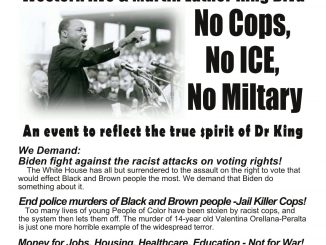
Los Angeles: MLK March for Social Justice, Jan. 17

MONDAY, JANUARY 17, 2022
MLK March for Social Justice
Western Ave and Martin Luther King Boulevard

This year Martin Luther King Jr. Day will begin a new chapter on the themes and participants who reflect the messages of social justice and against war and poverty. This year no police, ICE or military representatives or contingents are invited in the march. The latest killing of the 14-yr-old Valentina Orellana-Peralta is just one more horrible example of the terror brought by entities like the LAPD against Black and Brown communities.

The LAPD and Sheriffs Dept have yet to apologize or give any indication of stopping the racist brutality and killings that continue to rise – they should not be celebrated … instead let’s build on King’s vision.

Strugglelalucha256


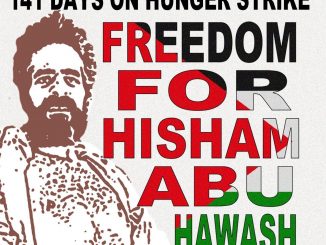
Jan. 4 in NYC: Emergency demo – Freedom for Hisham Abu Hawash!

Tuesday, 4 January
4:30 pm
Zionist consulate
800 2nd Ave, NYC
Info: https://twitter.com/SamidounPP/status/1478124013402525696

Join Samidoun NY/NJ, Palestinian Youth Movement and Within Our Lifetime in New York City for an emergency mobilization to defend Hisham Abu Hawash and all our prisoners!

141 days of hunger strike for freedom from administrative detention without charge or trial. Join us in action to demand freedom for Hisham Abu Hawash!

NYC! Tomorrow! https://t.co/uOWJBObXaN

— Mohammed El-Kurd (@m7mdkurd) January 3, 2022

Strugglelalucha256
https://www.struggle-la-lucha.org/2022/page/82/