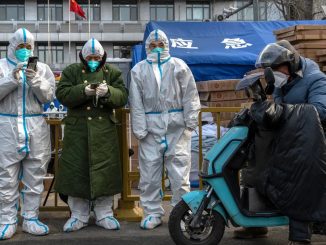
Zero COVID: Don’t be deceived by U.S. reports on the protests in China

Epidemic control workers wear PPE to prevent the spread of COVID-19 as they stand next to equipment for cold weather in an area where some communities are under lockdown on Nov. 29, 2022, in Beijing, China.

The opportunism of the major U.S. media was on full display in late November over the protests against China’s anti-COVID lockdowns. The protests began in the Xinjiang city of Urumqi after a terrible fire took the lives of 10 people on Nov. 24. People in the district responded to the tragedy by protesting the lockdown that had gone into effect after a COVID outbreak in late summer. 

The protests occurred in somewhere between 15 and 20 cities, including Beijing and Shanghai. The numbers reported by the U.S. press were purposely vague. The liberal PBS claimed thousands in a Nov. 29 headline and then “tens of thousands” in the article. Some reports indicated hundreds in Shanghai, and many pieces didn’t estimate crowd size at all. 

For context, there are about 60 cities of a million people or larger in China, and about 20% of the world lives in China. So even if the claim by PBS of “tens of thousands” is true, this brief series of protests was not the mass uprising against the leadership of China that the U.S. capitalist class and their loyal media salivate over. 

Hoping the protests would mark the beginning of their long-desired “color revolution” in China, the U.S. media’s elation got the best of them and led to the overblown coverage. But the hyperventilating reportage wasn’t limited to slander. There are reports of Western journalists using Telegram channels to guide “activists” from Hong Kong and Taiwan to the locations of some of the protests. 

When the “color revolution” failed to materialize, their giddy predictions gave way to another distortion of the facts. They claimed the CCP is being pushed by the momentum of the protests to ease its COVID policy, which they claim is the result of Xi’s authoritarianism and his desire to always be correct regardless of consequences. 

Zero COVID 

Their omission of the fact that President Xi Jinping had already signaled a relaxation of the “Zero COVID” measures a full two weeks before the protests broke out was not an error. It was imperialist media policy.

The decision to announce adjustments to the Zero COVID policy in a major speech by President Xi on Nov. 11 is only one indication that the national leadership of China was cognizant of the fact that people’s patience was exhausted. 

Even before the Nov. 11 speech, it was clear that national authorities were trying to address a gap between the thinking of national health officials and the officials in some provinces using a one-size-fits-all approach to lockdowns. The website of Friends of Socialist China reports that national officials reminded “authorities in Henan’s capital Zhengzhou … of the exceptions that need to be made to stay-home orders” and rebuked “police in Anhui for over-strict enforcement of quarantine.”

Moving toward a relaxation of quarantine times and lockdowns shows that China’s battle against COVID is based on not only physical science but also social science. From the beginning of the outbreak, it was meant to be a dynamic approach that would adjust based on the ever-changing characteristics of the virus and even on differences between locations.  

Even if greatly exaggerated by the U.S. press, the tragedy in Urumqi brought frustrations to the surface after three years of dealing with the pandemic. But that doesn’t mean there is broad dissatisfaction with the leadership of the campaign against COVID. 

Just 5,000 COVID deaths

On the contrary, what was smeared in the Western media as extreme has limited the number of deaths in China to just over 5,000. Moreover, the success of the “People’s War” against COVID, with widespread testing, lockdowns, and quarantines as essential elements, is nothing short of astounding compared to major capitalist countries. With quadruple the population, the Chinese death toll is 200 times less than the more than 1 million deaths in the U.S. 

China’s sustained policy of lockdowns was unique in the world. It was borne out of necessity and likely saved millions or tens of millions of lives. After more than a hundred years of being ravaged by colonizers and then imperialist countries, the physical health of Chinese people was among the priorities of the 1949 revolution. 

China was weak and sick. When Mao Zedong declared that “the Chinese people have stood up!” foremost on his mind must have been bringing the health of a giant, poverty-stricken nation up to par. Britain and France had waged war to force opium on the Asian giant, and opium addiction was widespread. Diseases that were inexpensive to treat and, in many cases, eradicate were rampant at the time of the revolution.

China’s campaign of “barefoot doctors” headed to the countryside. Hospitals were constructed. But bringing a nation of hundreds of millions of people back to health isn’t an overnight process. 

A developing country

While China is now on its way to achieving a higher GDP than the U.S., it is still a developing country, and building a complete healthcare system is an ongoing process. When COVID emerged, China still had only 4 ICU beds per 100,000 people. 

Even though health care has improved dramatically over the seven decades, the availability of ICU beds was, and is, inadequate for dealing with COVID. During February 2020, the severe symptoms quickly overwhelmed hospitals. That hurdle had to be overcome, and China’s leadership and people swung into action. 

Some 10,000 volunteer medical workers from all over the country traveled to the areas hit hardest by the virus. Emergency, makeshift hospitals were constructed at speeds the world had never seen. Given the highly transmissible feature of the virus, and as-of-then unavailable treatment, widespread testing, quarantine, and lockdowns emerged as the best plan to prevent catastrophic death rates. Early on, China’s scientists shared the DNA of the virus with the world and then developed vaccines that protect from severe symptoms and death. The campaign to continue vaccination — especially among the elderly — is ongoing.

COVID-19 has tested the world’s healthcare capabilities more than anything in living memory. Socialist planning and science saved tens of millions of lives in China and will keep China on the right path as the virus ebbs and flows. Socialism must be the future.

Strugglelalucha256


Does the U.S. chip ban on China amount to a declaration of war in the computer age?

The United States has gambled big in its latest across-the-board sanctions on Chinese companies in the semiconductor industry, believing it can kneecap China and retain its global dominance. From the slogans of globalization and “free trade” of the neoliberal 1990s, Washington has reverted to good old technology denial regimes that the U.S. and its allies followed during the Cold War. While it might work in the short run in slowing down the Chinese advances, the cost to the U.S. semiconductor industry of losing China—its biggest market—will have significant consequences in the long run. In the process, the semiconductor industries of Taiwan and South Korea and equipment manufacturers in Japan and the European Union are likely to become collateral damage. It reminds us again of what former U.S. Secretary of State Henry Kissinger once said: “It may be dangerous to be America’s enemy, but to be America’s friend is fatal.”

The purpose of the U.S. sanctions, the second generation of sanctions after the earlier one in August 2021, is to restrict China’s ability to import advanced computing chips, develop and maintain supercomputers, and manufacture advanced semiconductors. Though the U.S. sanctions are cloaked in military terms—denying China access to technology and products that can help China’s military—in reality, these sanctions target almost all leading semiconductor players in China and, therefore, its civilian sector as well. The fiction of ‘barring military use’ is only to provide the fig leaf of a cover under the World Trade Organization (WTO) exceptions on having to provide market access to all WTO members. Most military applications use older-generation chips and not the latest versions.

The specific sanctions imposed by the United States include:

  • Advanced logic chips required for artificial intelligence and high-performance computing
  • Equipment for 16nm logic and other advanced chips such as FinFET and Gate-All-Around
  • The latest generations of memory chips: NAND with 128 layers or more and DRAM with 18nm half-pitch

Specific equipment bans in the rules go even further, including many older technologies as well. For example, one commentator pointed out that the prohibition of tools is so broad that it includes technologies used by IBM in the late 1990s.

The sanctions also encompass any company that uses U.S. technology or products in its supply chain. This is a provision in the U.S. laws: any company that ‘touches’ the United States while manufacturing its products is automatically brought under the U.S. sanctions regime. It is a unilateral extension of the United States’ national legal jurisdiction and can be used to punish and crush any entity—a company or any other institution—that is directly or indirectly linked to the United States. These sanctions are designed to completely decouple the supply chain of the United States and its allies—the European Union and East Asian countries—from China.

In addition to the latest U.S. sanctions against companies that are already on the list of sanctioned Chinese companies, a further 31 new companies have been added to an “unverified list.” These companies must provide complete information to the U.S. authorities within two months, or else they will be barred as well. Furthermore, no U.S. citizen or anyone domiciled in the United States can work for companies on the sanctioned or unverified lists, not even to maintain or repair equipment supplied earlier.

The global semiconductor industry’s size is currently more than $500 billion and is likely to double its size to $1 trillion by 2030. According to a Semiconductor Industry Association and Boston Consulting Group report of 2020—“Turning the Tide for Semiconductor Manufacturing in the U.S.”—China is expected to account for approximately 40 percent of the semiconductor industry growth by 2030, displacing the United States as the global leader. This is the immediate trigger for the U.S. sanctions and its attempt to halt China’s industry from taking over the lead from the United States and its allies.

While the above measures are intended to isolate China and limit its growth, there is a downside for the United States and its allies in sanctioning China.

The problem for the United States—more so for Taiwan and South Korea—is that China is their biggest trading partner. Imposing such sanctions on equipment and chips also means destroying a good part of their market with no prospect of an immediate replacement. This is true not only for China’s East Asian neighbors but also for equipment manufacturers like the Dutch company ASML, the world’s only supplier of extreme ultraviolet (EUV) lithography machines that produces the latest chips. For Taiwan and South Korea, China is not only the biggest export destination for their semiconductor industry as well as other industries, but also one of their biggest suppliers for a range of products. The forcible separation of China’s supply chain in the semiconductor industry is likely to be accompanied by separation in other sectors as well.

The U.S. companies are also likely to see a big hit to their bottom line—including equipment manufacturers such as Lam Research Corporation, Applied Materials, and KLA Corporation; the electronic design automation (EDA) tools such as Synopsys and Cadence; and advanced chip suppliers like Qualcomm, Nvidia, and AMD. China is the largest destination for all these companies. The problem for the United States is that China is not only the fastest-growing part of the world’s semiconductor industry but also the industry’s biggest market. So the latest sanctions will cripple not only the Chinese companies on the list but also the U.S. semiconductor firms, drying up a significant part of their profits and, therefore, their future research and development (R&D) investments in technology. While some of the resources for investments will come from the U.S. government—for example, the $52.7 billion chip manufacturing subsidy—they do not compare to the losses the U.S. semiconductor industry will suffer as a result of the China sanctions. This is why the semiconductor industry had suggested narrowly targeted sanctions on China’s defense and security industry, not the sweeping sanctions that the United States has now introduced; the scalpel and not the hammer.

The process of separating the sanctions regime and the global supply chain is not a new concept. The United States and its allies had a similar policy during and after the Cold War with the Soviet Union via the Coordinating Committee for Multilateral Export Controls (COCOM) (in 1996, it was replaced by the Wassenaar Arrangement), the Nuclear Suppliers Group, the Missile Control Regime, and other such groups. Their purpose is very similar to what the United States has now introduced for the semiconductor industry. In essence, they were technology denial regimes that applied to any country that the United States considered an “enemy,” with its allies following—then as now—what the United States dictated. The targets on the export ban list were not only the specific products but also the tools that could be used to manufacture them. Not only the socialist bloc countries but also countries such as India were barred from accessing advanced technology, including supercomputers, advanced materials, and precision machine tools. Under this policy, critical equipment required for India’s nuclear and space industries was placed under a complete ban. Though the Wassenaar Arrangement still exists, with countries like even Russia and India within the ambit of this arrangement now, it has no real teeth. The real threat comes from falling out with the U.S. sanctions regime and the U.S. interpretation of its laws superseding international laws, including the WTO rules.

The advantage the United States and its military allies—in the North Atlantic Treaty Organization, the Southeast Asia Treaty Organization, and the Central Treaty Organization—had before was that the United States and its European allies were the biggest manufacturers in the world. The United States also controlled West Asia’s hydrocarbon—oil and gas—a vital resource for all economic activities. The current chip war against China is being waged at a time when China has become the biggest manufacturing hub of the world and the largest trade partner for 70 percent of countries in the world. With the Organization of the Petroleum Exporting Countries no longer obeying the U.S. diktats, Washington has lost control of the global energy market.

So why has the United States started a chip war against China at a time that its ability to win such a war is limited? It can, at best, postpone China’s rise as a global peer military power and the world’s biggest economy. An explanation lies in what some military historians call the “Thucydides trap”: when a rising power rivals a dominant military power, most such cases lead to war. According to Athenian historian Thucydides, Athens’ rise led Sparta, the then-dominant military power, to go to war against it, in the process destroying both city-states; therefore, the trap. While such claims have been disputed by other historians, when a dominant military power confronts a rising one, it does increase the chance of either a physical or economic war. If the Thucydides trap between China and the United States restricts itself to only an economic war—the chip war—we should consider ourselves lucky!

With the new series of sanctions by the United States, one issue has been settled: the neoliberal world of free trade is officially over. The sooner other countries understand it, the better it will be for their people. And self-reliance means not simply the fake self-reliance of supporting local manufacturing, but instead means developing the technology and knowledge to sustain and grow it.

This article was produced in partnership by Newsclick and Globetrotter. Prabir Purkayastha is the founding editor of Newsclick.in, a digital media platform. He is an activist for science and the free software movement.

Strugglelalucha256


Why Biden is unleashing a full scale chip war against China

The following article, by Marc Vandepitte and Jan Jonckheere, was originally published in Dutch on De Wereld Morgen. It explains the crucial significance of semiconductor chips to advances in modern technology, and goes on to describe the “chip war” currently being waged by the US government against China. The authors note that this is not the first time the US has attempted to suppress another country’s technological development, but they express significant doubt about the chances of success in this case. “In the past, the US has often succeeded in bringing countries to order and keeping them in line. However, whether it will succeed with China is highly questionable.”

Keith Lamb’s article Blocking China’s semiconductor industry is an attempt to impede the construction of socialism provides useful supplementary reading.

Recently, the US has identified China as its main enemy and is trying to thwart its economic and technological rise. Chips play a key role in this as they are the backbone of economic and military performance in the digital age. Whether the U.S. will succeed in its endeavor is highly questionable.

The key to the future

Technology is the key to the future. It is the basis for military might on the one hand, and economic productivity and a competitive position in the world market on the other.

Until recently, the US had an unassailable, dominant position on both fronts. The White House wants to maintain that hegemony at all costs, but the rise of China threatens to put an end to that.

According to US Presidential Security Adviser Sullivan, “we are facing a competitor that is determined to overtake US technological leadership and willing to devote nearly limitless resources to that goal”.

That is why the US has identified the People’s Republic of China as its main enemy and is trying to thwart the economic and technological ascent of this Asian giant.

Chip War

Semiconductors and chips[1] are particularly targeted. This makes sense because in the future geopolitical supremacy may increasingly depend on computer chips. Chips are integrated circuits that are pretty much the nervous system of electronic devices.

Until last century, military strength was based on firearms, warships, fighter jets, or (nuclear) missiles. In the digital age, chips are the backbone of economic as well as military performance.

According to James Mulvenon, an expert on Chinese cybersecurity, “the Pentagon has decided that semiconductors is the hill that they are willing to die on. The sector of semiconductors is the last industry in which the US is leading, and it is the one on which everything else is built”.

In early October 2022, the White House put its money where its mouth is. The Biden administration introduced sweeping export controls that will severely hamper Chinese companies’ attempts to obtain or manufacture advanced computer chips.

Under Trump, US companies were no longer allowed to sell chips to Huawei. Biden has now extended those trade restrictions to more than 40 Chinese companies, including several chip makers. The new measure effectively prohibits any US or non-US company from supplying those Chinese companies with hardware or software whose supply chain includes US technology.

The export restrictions not only target military applications but seek to block the development of China’s technological power by all means available. The strategy is to cut China off from the rest of the world in chip supply chains in order to deny it the opportunity to indigenize its semiconductor industry.

Paul Triolo, China and technology expert describes the new measure as a “major watershed” in US-China relations. “The US has essentially declared war on China’s ability to advance the country’s use of high-performance computing for economic and security gains.”

Conversely, the US is doing all it can to further increase its technological lead. For example, the White House’s National Science and Technology Council has just published a 47-page ‘National Strategy for Advanced Manufacturing’ that includes 11 strategic goals to increase US competitiveness in chips.

Geopolitics aside, the chip industry is also big business. The market capitalization of the largest listed chip firms now exceeds $4,000 billion. China spends more on computer chip imports than on oil.

Quest for allies

Although Biden claims to be eager to work with allies, this chip war is only initiated by the US. Experts admit that if other countries continue to supply China, the restrictions will have little effect. The only consequence then is that US chip companies will miss out on the large Chinese market.

In the past, the US already pressured other countries and regions to stop supplying high-tech products to China. In the case of chips, this mainly involves South Korea, Japan, the Netherlands, and the de facto autonomous Chinese province of Taiwan. With the new measure, foreign companies working with US technology are now supposed to act following US restrictions. They must seek US permission on a case-by-case basis.

Of course, foreign countries are not eager to comply with that, because China is a very important if not the most important customer. Samsung, for example, is the world’s largest builder of memory chips. Partly as a result of the new measure, this South Korean company expects 32 percent less revenue. It remains to be seen whether and to what extent these countries will seek and find possible loopholes.

Washington especially wants to bring Taiwan along in its isolation strategy. Taiwan accounts for 92 percent of the world’s high-value chips. For China, imports from Taiwan are economically and technologically vital.

It is in the context of this chip war that the provocative visit by Pelosi and other US politicians to the separatist leadership of Taiwan must be viewed. Mid-September, the US Senate approved a bill providing $6.5 billion in direct military aid to the island. Washington is putting pressure on China on several fronts.

Chances of success?

Chips are the main engine of electronics. China itself manufactures about 12 percent of global production. That is by no means enough for its own use. Only one-sixth of what it needs in chips is produced domestically. Moreover, for the time being, it is still unable to produce the most advanced chips.

In other words, in terms of chips, the country is highly dependent on imports. Annually they account for about $400 billion. If that supply were compromised, it would not only mean a very large economic loss, but it would also seriously undermine technological progress. In this sense, chips are considered the Achilles heel of Chinese industry.

To overcome that dependency and catch up with the technological backlog, China is investing more than any other country in this strategic industry. The country has already made serious progress in a number of areas. For example, it has successfully produced a 7-nanometer chip.[2] This puts it only one or two ‘generations’ behind industry leaders in Taiwan and South Korea.

But with these breakthroughs, it will remain dependent on imports of parts from other countries for the time being.[3] It doesn’t have to stay that way. Analysys Mason, a leading consulting firm, says in a recent report that China could be self-sufficient in chips within three to four years.

In any case, the US restrictive strategy will motivate the Chinese government to allocate even more resources and make breakthroughs. Asia Times gives the example of the 2015 blocking of the supply of Intel’s high-end Xeon Phi processors to Chinese supercomputer makers. A year later, Chinese researchers developed those processors themselves.

In the past, the US has often succeeded in bringing countries to order and keeping them in line. However, whether it will succeed with China is highly questionable. By the end of this decade, we will know whether the US attempt to wreck China’s chip industry has succeeded or failed.

Notes:

[1] Semiconductors are electronic components based on semiconductor material. A diode and a transistor are examples of semiconductors. In a sense, you can think of semiconductors as the building blocks of chips. Chips are integrated circuits, small in size. They are part of a computer or other electronic devices. In the mainstream media, there is usually no distinction between semiconductors and chips.

[2] The company in question, SMCI, is reportedly now working on even more advanced 5-nanometer chips.

[3] For example, China cannot make advanced semiconductor devices without EUV lithography equipment from ASML (Netherlands) and electronic design automation (EDA) tools from Synopsis and Cadence (US) or Siemens (Germany).

Source: Friends of Socialist China

Strugglelalucha256


China and Cuba: A relationship of solidarity, friendship and cooperation

We are very pleased to publish below an interview with Carlos Miguel Pereira Hernández, Cuba’s ambassador to China, conducted by People’s Daily and published in Chinese on 13 October. The unabridged English translation has been provided to us by the Cuban Embassy in Beijing.

Timed to coincide with the 62nd anniversary of the establishment of diplomatic relations between the Republic of Cuba and the People’s Republic of China, the interview gives an overview of the history and contemporary reality of relations between the two countries.

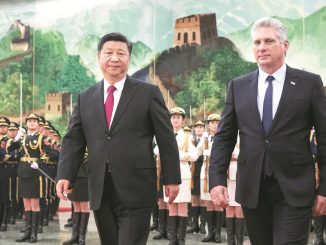
Noting that revolutionary Cuba was the first country in the Western hemisphere to extend diplomatic recognition to the People’s Republic of China – in 1960, just a year after the 26th of July Movement came to power – Pereira references the role played by Chinese immigrants in Cuba’s independence struggle. He points out that Cuba and China consider themselves “mutual referents in the construction of socialism with our own characteristics” and notes that President Miguel Díaz-Canel describes Cuba-China ties as “paradigmatic”, and President Xi Jinping describes them as those of “good friends, good comrades and good brothers”.

Describing the cooperation between China and Cuba fields in a vast array of fields, Comrade Pereira expresses confidence that the relationship will continue to deepen.

– Friends of Socialist China


This year marks the 62nd anniversary of the establishment of diplomatic relations between China and Cuba, how do you assess the fraternal friendship between the two countries? What are your specific plans to further promote economic, trade and people-to-people exchanges between the two countries?     

Relations between Cuba and China were made official on September 28, 1960, a formal step after the announcement by Commander in Chief Fidel Castro a few days earlier in front of more than a million Cubans, in the context of the historic First Declaration of Havana, to recognize the New China and rescind ties with Taiwan. That just decision was born of the political and popular will that have accompanied our relations throughout these 62 years.

The nascent Cuban Revolution definitively broke with the Monroe Doctrine and blind obedience to Washington, allowing Cuba to become the first country in the entire Western Hemisphere to establish ties with New China. We are honored to have made that modest contribution as one of the first manifestations of independence from our foreign policy.

The historical foundations and deep bonds of friendship between our peoples go back to the arrival of those first Chinese immigrants 175 years ago, who also had an outstanding and glorious participation in our struggles for independence.

Throughout these years of uninterrupted relations, Cuba has had the historic privilege of always being in the front row in promoting exchanges with China. Our relations represent a model of cooperation based on equality, respect and mutual benefit. We consider ourselves mutual referents in the construction of socialism with our own characteristics and on that basis, we carry out a broad and systematic exchange of experiences.

Our bilateral relations, as we reach the 62nd anniversary of diplomatic relations, are accurate and broadly in line with the definitions given in this regard by our top leaders. In the words of President Miguel Díaz-Canel, the ties between Cuba and China are paradigmatic, and President Xi Jinping has described our bonds as those of good friends, good comrades and good brothers.

The special character of our bilateral ties is a historic consensus, which reaches today an unprecedented solidity, by virtue of the high level of political mutual trust, the broad coincidence of positions in the international arena and the multidimensional and full development of our ties.

In the last two years, even in the midst of the pandemic, our ties continued to grow, the mechanisms of inter-party dialogue, government, parliamentarians and thus of various sectors, continued to strengthen in pursuit of coordination and cooperation both bilaterally and in international organizations.

It can be said that Cuba and China have been fraternal countries, which have supported each other on core issues and, above all, in difficult times. Since our official ties were established, Cuba has always shown its unequivocal support for the “One China” policy, and the firm rejection of any action that threatens China’s sovereignty and territorial integrity. For our part, we have counted on the sustained support from the Chinese government and people, and in particular, in our fight against U.S. blockade, which continues to intensify even in times of pandemic.

On September 24, in the framework of the 77th Session of the General Debate of the United Nations, State Councilor and Foreign Minister, Wang Yi, in a historic and unprecedented pronouncement, requested for the first time in that important scenario, the lifting and immediate end of the genocidal blockade policy. This transcendental support from China becomes a new milestone in our bilateral relations that ratifies the special and exceptional character of our ties, as well as mutual support on core issues.

Our ties have had a multidimensional growth, including the integral development of economic, commercial and financial ties. Despite the differences in terms of volume and productive capacity, the complementarity of our economies and the excellent political environment in which they develop, confirm the enormous potential to be exploited in this area.

Today, our ties cover almost all sectors of the economy of both countries. China continues to be Cuba’s second largest trading partner, a fundamental source of financing on favorable terms and the main technological supplier for the execution of projects prioritized for the economic and social development of our country.

China has also consolidated as the main market for our exports of goods. Sugar, nickel, rum and tobacco are emblematic products with great acceptance and demand in the Chinese market, for their good quality and recognition in the international market. New items have been added in recent years and others represent very promising prospects such as lobster, white and sea shrimp, coffee, honey and biotechnology products.

Likewise, we are inserted in new business models such as cross-border electronic commerce, through the creation of the Cuban Pavilion “Cuban Excellences” on JD.com Group platform. This has also been part of strategy of deepening our relations with China and a new milestone in bilateral cooperation, allowing the introduction of more Cuban products to this market, as well as a greater promotion of Cuba’s image, through its tourist and cultural resources.

It is worth mentioning as a milestone in our economic ties, the signing of the Memorandum of Understanding in 2018 and subsequently the Action Plan for the joint construction of the “Belt and Road”. Under this initiative, we hope to promote new projects linked to tourism, renewable energies, communications with the Digital Silk Road, health, biotechnology and science and technology.

In this context, an important area for cooperation is foreign investment in which China has much to contribute in the development of Sino-Cuban investments in Cuba, especially in the development of infrastructure such as airports, ports, roads, tourism infrastructure, telecommunications, as well as in projects related to renewable energies, biotechnology and health.

It is also of great interest to promote cooperation in the biotechnology sector between Cuban scientific entities and Chinese companies and to promote cooperation in this area, through the models that we are developing today in China, such as joint ventures.

Similarly, and taking into account that China promotes and encourages domestic consumption of high-quality products, we believe that the export of Cuban products to the Asian giant is also an area of potential for cooperation.

Another sector with promise is the export of Cuban medical services. In this regard, our exchanges with Chinese counterparts have transcended broad interests in cooperating in specialties such as oncology, ophthalmology, primary health care, health and wellness tourism and the possibility of applying the innovative products of Cuban biotechnology, which have great impact and recognition at the international level.

People-to-people exchanges are fluid and close, highlighting the close historical and cultural links. There is an increasing interest in Cuba to know the culture and language of China, while, to cite just two examples, the learning of the Spanish language and Cuban salsa, are gaining more and more followers in China. On the other hand, Cuba is a safe destination and could be the gateway for Chinese tourism to the Caribbean.

The Communist Party of China and the Communist Party of Cuba are the leading nucleus of their countries’ respective socialist causes. How do you see the inter-party exchanges and cooperation between Cuba and China? What do you think is the greatest contribution made by the Communist Party of China to world political civilization in the last decade?

The relations between the Communist Party of Cuba and the Communist Party are forged on the basis of numerous affinities and consensuses, and also by the common challenge of building socialism based on different national realities, in the midst of a complex international situation characterized by growing unilateralism and the hegemonic attempt to impose on us the patterns and models of others.

The fluid inter-party dialogue throughout these 62 years, together with the frequent exchange of experiences in the construction of socialism, according to the conditions of each country, constitute essential pillars of the solid mutual trust that exists.

The recent exchanges between the party structures of both countries have been projected towards the implementation of the consensus reached between First Secretary Miguel Díaz-Canel Bermúdez and Secretary General Xi Jinping, from a face-to-face meeting they had in Beijing in 2018 and the two telephone calls held after the beginning of the pandemic.

This year we celebrate the virtual IV Theoretical Seminar between both Communist Parties that strengthens the practice of the exchange of experiences in socialist construction.  In this context, the messages of both leaders were relevant, ratifying the utmost importance that both countries attach to strengthening the Parties in pursuit of the consolidation of strategic communication and political trust at the highest level.

On the other hand, the Communist Party of China has been central to the achievements of the New China, so it is of great importance in the international arena, for socialist countries such as Cuba and for left-wing and progressive movements.

The CPC was able to innovate Marxist theory by adjusting it to China’s own characteristics, which constitutes a valuable contribution to the study, dissemination and promotion of Marxism in the twenty-first century. The process of “sinicization” of Marxism is an example of the application of materialist dialectics, achieving a socioeconomic model, whose successes are undeniable.  The feat of eradicating extreme poverty in China is a tangible demonstration of the accurate leadership of the party organization.

For Cuba, China constitutes a benchmark of the conquests of socialism in modern times, which, under the leadership of the Communist Party of China, has managed to overcome adversities and meet development goals such as the revitalization of the nation.

In this regard, the holding of the Twentieth Congress of the Communist Party of China will be a historic moment, to which we will pay maximum attention and follow-up. Cuba wishes China success in celebrating this momentous event. We are convinced that as a result of the Twentieth Congress of the Communist Party of China we will find a strengthened China, determined to maintain its conquests, to build socialism, and to fulfill its second centennial goal.

The strengthening of inter-party exchange will continue at the end of the XX Congress, because it will be a favorable moment to promote new spaces for bilateral dialogue, based on the exchange of experiences, consultation and support in regional and international forums.

Strugglelalucha256


Manufacturing consent for the containment and encirclement of China

If you’re not careful, the newspapers will have you hating the people who are being oppressed, and loving the people who are doing the oppressing. (Malcolm X)

The Western media is waging a systematic and ferocious propaganda war against China. In the court of Western public opinion, China stands accused of an array of terrifying crimes: conducting a genocide against Uyghur Muslims in Xinjiang; wiping out democracy in Hong Kong; militarizing the South China Sea; attempting to impose colonial control over Taiwan; carrying out a land grab in Africa; preventing Tibetans and Inner Mongolians from speaking their languages; spying on the good peoples of the democratic world; and more.

Australian scholar Roland Boer has characterized these accusations as “atrocity propaganda – an old anti-communist and indeed anti-anyone-who-does-not-toe-the-Western-line approach that tries to manufacture a certain image for popular consumption.” Boer observes that this propaganda serves to create an impression of China as a brutal authoritarian dystopia which “can only be a fiction for anyone who actually spends some time in China, let alone lives there.”[1]

It’s not difficult to understand why China would be subjected to this sort of elaborate disinformation campaign. This media offensive is part of the imperialist world’s ongoing attempts to reverse the Chinese Revolution, to subvert Chinese socialism, to weaken China, to diminish its role in international affairs and, as a result, to undermine the global trajectory towards multipolarity and a future free from hegemonism. As journalist Chen Weihua has pointed out, “the reasons for the intensifying US propaganda war are obvious: Washington views a fast-rising China as a challenge to its primacy around the world.” Furthermore, “the success of a country with a different political system is unacceptable to politicians in Washington.”[2]

Propaganda wars can also be war propaganda. In this case, the war in question is the escalating US-led New Cold War.[3] The various slanders against China – particularly the most lurid accusations, such as that of genocide in Xinjiang – have much in common with the 2003 allegations regarding Iraq’s weapons of mass destruction, or the 2011 allegation that the Libyan state under Muammar Gaddafi was preparing a massacre in Benghazi. These narratives are constructed specifically in order to mobilize public opinion in favor of imperialist foreign policy: waging a genocidal war against the people of Iraq; bombing Libya into the Stone Age; and, today, conducting a wide-ranging campaign of economic coercion, political subversion and military threats against the People’s Republic of China.

In his book Neo-Colonialism, the Last Stage of Imperialism, Kwame Nkrumah, Pan-Africanist and first President of Ghana, discusses how “ideological and cultural weapons in the form of intrigues, manoeuvres and slander campaigns” were employed by the Western powers during the Cold War in order to undermine the socialist countries and the newly-liberated territories of Africa, Asia and Latin America. “While Hollywood takes care of fiction, the enormous monopoly press, together with the outflow of slick, clever, expensive magazines, attends to what it chooses to call ‘news’… A flood of anti-liberation propaganda emanates from the capital cities of the West, directed against China, Vietnam, Indonesia, Algeria, Ghana and all countries which hack out their own independent path to freedom.”[4]

The mechanisms for such “intrigues, manoeuvres and slander campaigns” have changed little since Nkrumah’s day. British media analysts David Cromwell and David Edwards explore the concept of the propaganda blitz – “fast-moving attacks intended to inflict maximum damage in minimum time.” These media attacks are “communicated with high emotional intensity and moral outrage” and, crucially, give the appearance of enjoying consensus support among experts, academics, journalists and politicians.[5] This consensus “generates the impression that everyone knows that the claim is truthful.”[6] Such a consensus is most powerful when it includes not only right-wing ideologues but also prominent leftist commentators. “If even celebrity progressive journalists – people famous for their principled stands, and colourful socks and ties – join the denunciations, then there must be something to the claims. At this point, it becomes difficult to doubt it.”

When it comes to China, many such commentators are only too happy to oblige: British columnist Owen Jones for example, writing for the Guardian, has asserted that “despite the denials of the Chinese regime, the brutal campaign against the Uighurs in the Xinjiang region is real.”[7] Jones backs his assertion up with links to two other Guardian articles, both of which rely on research provided by the Australian Strategic Policy Institute (ASPI) – a hawkish anti-China think tank funded by the Australian government, the US government and various multinational arms manufacturers (of which more below). That is, this self-described socialist relies on the same sources as the most extreme China hawks in Washington. Yet his public endorsement of anti-China slander, along with that of NATO-aligned commentators such as Paul Mason,[8] serves to create the impression that such slander is entirely credible, as opposed to being what it in fact is, namely yet another unhinged far-right conspiracy theory.

Although the various anti-China slanders clearly lack evidentiary support, they are nonetheless powerful, persuasive and sophisticated. It requires no great skill to persuade hardened reactionaries and anti-communists to take a hard line against China, but the propaganda war is carefully crafted such that it actively taps into progressive ideas and sentiments. The accusation of genocide is particularly potent: by accusing China of perpetrating a genocide against Uyghur Muslims in Xinjiang, imperialist politicians and journalists are able to mobilize legitimate sympathies with Muslims and national minorities, as well as invoking righteous indignation in relation to genocide. An emotional-intellectual environment is created in which to defend China against accusations of genocide is equivalent to being a Holocaust denier. Solidarity with China thus incurs a hefty psychological, and perhaps material and physical, cost.

Manufacturing Consent

Edward Herman and Noam Chomsky’s 1988 work Manufacturing Consent: The Political Economy of the Mass Media remains an authoritative and indispensable analysis of how the so-called free press works in the capitalist world. In particular, the book explores the connection between the economic interests of the ruling class and the ideas that are communicated via mass media. “The media serve, and propagandise on behalf of, the powerful societal interests that control and finance them. The representatives of these interests have important agendas and principles that they want to advance, and they are well positioned to shape and constrain media policy.”[9]

Herman and Chomsky develop a propaganda model, in which a set of informal but entrenched ‘filters’ determine what media consumers read, watch and hear. These filters include:

  • The ownership structure of the dominant mass-media firms. Media owners are members of the capitalist class, and they consistently privilege the interests of that class.
  • Reliance on advertising revenue. Since most media operations can only survive, meet their costs and turn a profit if they carry advertising from large corporations, they must be sensitive to the political views of those corporations.
  • Reliance on information “provided by government, business, and ‘experts’ funded and approved by these primary sources and agents of power.”[10] The authors note that the Pentagon, for example, “has a public-information service that involves many thousands of employees, spending hundreds of millions of dollars every year and dwarfing not only the public-information resources of any dissenting individual or group but the aggregate of such groups.”[11]
  • A system of ‘flak’, or negative feedback, in response to news stories that don’t conform to the values of those in power. This “may take the form of letters, telegrams, phone calls, petitions, lawsuits, speeches and bills before Congress, and other modes of complaint, threat, and punitive action.”[12] With the advent of the internet – and particularly social media – methods of ‘flak’ have multiplied, and provide an important means of conditioning what information is consumed by the public.
  • The pervasive ideological framework of anticommunism, which serves as “a national religion and control mechanism”. Here the authors are referring specifically to the United States, but the point holds elsewhere in the West.

According to Herman and Chomsky’s propaganda model, “the raw material of news must pass through successive filters, leaving only the cleansed residue fit to print.”[13] The resulting news output serves to “inculcate and defend the economic, social, and political agenda of privileged groups that dominate the domestic society and the state.”[14]

Western mainstream media coverage of China fits comfortably within this model. Almost without exception the major media operations – from Fox News to the Guardian, from the BBC to the Washington Post – present a narrative consistently hostile to China. For example, in relation to the 2019 protest movement in Hong Kong, the Western press was universal in its one-sided condemnation of the Hong Kong police and authorities, and in its effusive support for ‘pro-democracy’ protestors. Violence by the protestors – storming the parliament building, attacking buses, throwing petrol bombs, vandalizing buildings and intimidating ordinary citizens – was either totally ignored or written off as the actions of a small minority, whereas the local Hong Kong government was subjected to an extraordinary level of scrutiny and condemnation. A Guardian editorial went so far as to state that “China is crushing any shred of resistance in Hong Kong, in breach of its promises to maintain the region’s freedoms”[15] – unironically citing Chris Patten, the last (unelected like all his predecessors) British governor of Hong Kong, in support of its claim. It apparently didn’t occur to the author to contrast the Hong Kong police’s incredibly restrained response to the protests with the US police’s shockingly violent repression of Black Lives Matter protests during the summer of 2020, which saw several fatalities at the hands of the US police, compared to precisely zero at the hands of their Hong Kong counterparts.[16]

No major Western news outlet seriously explored the violence of the protestors; nor did they mention the protest leaders’ extensive links with some of the most reactionary US politicians;[17] nor did they choose to investigate the role of the National Endowment for Democracy in providing financial support to the movement.[18] Meanwhile they shamelessly ignored the millions of Hong Kong residents who didn’t support the protests, who saw that “rioters and mobs were everywhere destroying public facilities, paralysing railway systems and so on but they were called ‘Freedom Fighters’ by Western countries.”[19]

Conversely, what should be positive stories about China – for example in relation to poverty alleviation,[20] or its progress in the field of renewable energy,[21] or suppressing the Covid-19 pandemic[22] – are either ignored or magically transformed into anti-China stories. The announcement that China had succeeded in its goal of eliminating extreme poverty was “delivered with much bombast but few details”, and the whole program was written off as part of a cunning strategy by Xi Jinping “to cement his position as the country’s most powerful leader since Mao Zedong”.[23] Literally millions of lives have been saved as a result of China’s dynamic Zero Covid strategy, and yet according to the New York Times, the CPC is simply trying to “use China’s success in containing the virus to prove that its top-down governance model is superior to that of liberal democracies”. While acknowledging that a policy of saving millions of lives unsurprisingly “still enjoys strong public support”, this is put down to a familiar trope that Chinese people have “limited access to information and no tools to hold the authority accountable”.[24]

Veteran political scientist Michael Parenti wrote in Blackshirts and Reds about the absurdity of Western propaganda against the socialist world during the Cold War, and how refraction through the lens of anti-communism could “transform any data about existing communist societies into hostile evidence.” He notes:

“If the Soviets refused to negotiate a point, they were intransigent and belligerent; if they appeared willing to make concessions, this was but a skilful ploy to put us off our guard. By opposing arms limitations, they would have demonstrated their aggressive intent; but when in fact they supported most armament treaties, it was because they were mendacious and manipulative. If the churches in the USSR were empty, this demonstrated that religion was suppressed; but if the churches were full, this meant the people were rejecting the regimes atheistic ideology. If the workers went on strike (as happened on infrequent occasions), this was evidence of their alienation from the collectivist system; if they didn’t go on strike, this was because they were intimidated and lacked freedom. A scarcity of consumer goods demonstrated the failure of the economic system; an improvement in consumer supplies meant only that the leaders were attempting to placate a restive population and so maintain a firmer hold over them.”[25]

Parenti’s observation certainly resonates with the contemporary media consensus against China. For such a media consensus to be coincidental would be a statistical impossibility. It represents precisely the current political agenda of the “privileged groups that dominate the domestic society and the state” (that is, the imperialist ruling classes); it aims precisely to manufacture consent for the New Cold War on China.

Xinjiang

Nowhere is the propaganda model more visible than in relation to the mainstream media coverage of Xinjiang. The accusation that China is committing a genocide (or “cultural genocide”) in Xinjiang has been repeated so frequently as to become almost an accepted truth in large parts of the West. Although the accusation is backed up with precious little evidence, the story has become a global media sensation and has led to the introduction of an escalating program of sanctions, plus a “diplomatic boycott” by various imperialist countries of the Beijing Winter Olympics in February 2022.[26] Furthermore, it has filtered into popular consciousness, fuelled by sophisticated social media campaigns. It has become the quintessential example of a propaganda blitz. As noted above, and consistent with Edwards and Cromwell’s description, this propaganda blitz is consistent across the corporate media’s conservative-liberal spectrum, from Fox News[27] to the New York Times,[28] from the Daily Mail[29] to the Guardian.[30]

Herman and Chomsky’s propaganda model explains how such a story picks up steam:

“For stories that are useful, the process will get under way with a series of government leaks, press conferences, white papers, etc… If the other major media like the story, they will follow it up with their own versions, and the matter quickly becomes newsworthy by familiarity. If the articles are written in an assured and convincing style, are subject to no criticisms or alternative interpretations in the mass media, and command support by authority figures, the propaganda themes quickly become established as true even without real evidence. This tends to close out dissenting views even more comprehensively, as they would now conflict with an already established popular belief. This in turn opens up further opportunities for still more inflated claims, as these can be made without fear of serious repercussions.”[31]

The mass media is supplemented by much of the radical left in the imperialist heartlands. Popular progressive news outlet Democracy Now has parroted every lurid accusation against China in relation to Xinjiang.[32] Jacobin in 2021 gave a sympathetic interview to Sean R Roberts, author of The War on the Uyghurs: China’s Campaign Against Xinjiang’s Muslims, in which he claims that “what we see right now in the Uyghur region is a lot like the process of cultural genocide elsewhere in the world from a century ago, but benefitting from high-tech forms of repression that are available now in the twenty-first century”.[33] Meanwhile Britain’s Socialist Worker claims that “up to one million Uyghurs are locked up in internment camps.”[34] Somewhat ironically, Noam Chomsky himself is not immune to the imperialist propaganda model, stating in a 2021 podcast episode that China’s actions in Xinjiang are “terrible” and “highly repressive”, and repeating the assertion (discussed at length below) that “there are a million people who have gone through reeducation camps.”[35]

Meanwhile in the sphere of parliamentary politics, right and left have formed an unholy alliance in pursuit of the New Cold War on China. Besides right-wing fundamentalists such as Mike Pompeo, progressive Democratic Congresswoman Ilhan Omar has been hawkish regarding Xinjiang, calling on US businesses to study an Australian Strategic Policy Initiative (ASPI) report condemning China and ensure that their companies are not connected to Uyghur forced labour. Omar said: “No American company should be profiting from the use of gulag labor, or from Uyghur prisoners who are transferred for work after their time in Xinjiang’s concentration camps.”[36]

What is China accused of in Xinjiang?

Genocide

Of all the claims that are made in relation to China’s treatment of Uyghur people, the most serious is that it is perpetrating a genocide. One of the last acts of Trump’s State Department was, in January 2021, to declare that the Chinese government is “committing genocide and crimes against humanity through its wide-scale repression of Uyghurs and other predominantly Muslim ethnic minorities in its northwestern region of Xinjiang, including in its use of internment camps and forced sterilisation.”[37] The Biden administration doubled down on this slander, claiming in its 2021 annual human rights report that “genocide and crimes against humanity occurred during the year against the predominantly Muslim Uyghurs and other ethnic and religious minority groups in Xinjiang”, and that the components of this genocide included “the arbitrary imprisonment or other severe deprivation of physical liberty of more than one million civilians; forced sterilisation, coerced abortions, and more restrictive application of China’s birth control policies; rape; torture of a large number of those arbitrarily detained; forced labor; and the imposition of draconian restrictions on freedom of religion or belief, freedom of expression, and freedom of movement.”[38]

Canada’s House of Commons quickly followed suit,[39] as did the French National Assembly.[40] The European Parliament adopted a somewhat less adventurist resolution claiming that Muslims in Xinjiang were at “serious risk of genocide.”[41]

Genocide has a detailed definition under international law, which can be summarized as the purposeful destruction in whole or in part of a national, ethnic, racial or religious group.[42] It is rightly considered to be one of the gravest crimes against humanity. As such, it is not the sort of accusation that should be thrown around carelessly and without evidence. And yet imperialist ideologues routinely do exactly that. As Herman and Chomsky pointed out decades ago, “genocide is an invidious word that officials apply readily to cases of victimisation in enemy states, but rarely if ever to similar or worse cases of victimisation by the United States itself or allied regimes.”[43]

Prominent scholar and economist Jeffrey Sachs has written in relation to the Biden administration’s accusations of genocide that “it has offered no proof, and unless it can, the State Department should withdraw the charge.” Continuing, Sachs writes that the charge of genocide should never be made lightly. “Inappropriate use of the term may escalate geopolitical and military tensions and devalue the historical memory of genocides such as the Holocaust, thereby hindering the ability to prevent future genocides. It behoves the US government to make any charge of genocide responsibly, which it has failed to do here.”[44]

What is the nature of the actual genocide charge? A 2021 report by a highly dubious Washington think-tank, the Newlines Institute for Strategy and Policy,[45] claims that the Chinese government has implemented “comprehensive state policy and practice” with “the intent to destroy the Uyghurs as a group.” The report doesn’t claim that Uyghurs are directly being killed, but that coercive birth control measures are being selectively applied such that the Uyghur population slowly dies off.

However, there is no credible data to support these claims. It is the case that the birth rate has been trending downward in Xinjiang, but the same is true for every Chinese province. Meanwhile, the Uyghur population from 2010 to 2018 increased from 10.2 million to 12.7 million, an increase of 25 percent. During the same period, the Han Chinese population in Xinjiang increased by just 2 percent.[46] Reflecting on the reasons for the marginal downturn in Uyghur birthrate, Pakistani-Canadian peace activist Omar Latif noted that the causes are “the same as elsewhere; more women acquiring higher education and participating in the workforce; less necessity for parents to have more children to take care of them in old age; urbanisation; lessening of patriarchal controls over women; increased freedom for women to practice birth control.”[47]

China’s one-child policy was first implemented in 1978, at a time when China was relatively insecure about its ability to feed a large population (China has 18 percent of the global population but only around 12 percent of the world’s arable land, along with chronic water scarcity).[48] The policy was in place until 2015, and largely serves to explain the long-term decline in the birth rate in China. However, national minorities – including Uyghurs – were exempt from the policy. Indeed the Uyghur population doubled during the period the one-child policy was in force. This pattern is replicated throughout China – according to the latest census data, the population of minority groups increased over the last decade by 10.26 percent (to 125 million), while that of Han Chinese grew at by 4.93 percent (to 1.3 billion) – less than half the rate.

Another data point that tends to belie the claims of a genocide in Xinjiang is that average life expectancy in the region has increased from 30 years in 1949 to 75 years today.[49]

One question that the various anti-China think tanks have not addressed is: if there were a genocide taking place in Xinjiang – including the ‘slow genocide’ of discriminatory coercive birth control – would this not lead to a refugee crisis? There is certainly no evidence of such a crisis; no camps along the border with Pakistan or Kazakhstan, and so on. Repression, war, poverty and climate change have combined to produce numerous current refugee crises in Africa, Asia and the Middle East; it is highly implausible that a full-blown genocide in Western China would not lead to any such issue. A Time article in 2021 confirmed that, in spite of both the Trump and Biden administrations’ outspoken criticisms of human rights abuses in Xinjiang, the US had not admitted a single Uyghur refugee in the preceding 12 months.[50] Given that, in the same time period, Biden offered a refuge to people “fleeing Hong Kong crackdown”,[51] it’s unimaginable that the US would not offer refugee status to thousands of Xinjiang Uyghurs fleeing persecution – if they existed.

Lamenting the fact that the Office of the High Commissioner for Human Rights ‘Assessment of human rights concerns in the Xinjiang Uyghur Autonomous Region’, issued in August 2022, fails to even mention the charge of genocide, Yale Law School academic Nicholas Bequelin lets slip that there simply is not a credible evidentiary basis for such a charge. “For the crime of genocide, you need to have several elements. One of the elements is intent. You need to be able to demonstrate, and to demonstrate convincingly, before a court, that the state had the intent of committing genocide. That’s the first thing. The second is that you have a number of elements for the crime of genocide – which is that it has to be a systematic, widespread extermination, or attempted extermination, of a national, racial, religious, or ethnic group. There are elements that are present in the Chinese case, but it’s not clear that the intent is to lead to the extermination of a particular ethnic group.”[52]

The handful of reports on which the genocide charge is based do not provide anything like compelling evidence. What they put forward are some highly selective birth rate statistics, and the testimony of a small number of Uyghur exiles who claim to have been subjected to abuse. Working on the basis of ‘innocent until proven guilty’, China can by no means be considered as guilty of genocide.

An aside: at the time of writing, the total number of deaths caused by Covid-19 in Xinjiang is three.[53] It is very difficult to believe that state forces conducting a genocide against a given ethnic group would fail to take advantage of a pandemic in support of their project; indeed that the regional health authorities would go to significant lengths to prevent the people of this group dying from Covid-19.

Cultural genocide

A somewhat more sophisticated accusation against the Chinese government is that is perpetrating a cultural genocide in Xinjiang – not wiping out the Uyghur population as such but the Uyghur identity, Uyghur traditions, Uyghur beliefs. Although cultural genocide is not defined under international law, it apparently refers to “the elimination of a group’s identity, through measures such as forcibly transferring children away from their families, restricting the use of a national language, banning cultural activities, or destroying schools, religious institutions, or memory sites.”[54]

While the accusation seems less extreme than the accusation of physical genocide, the claims of cultural genocide are nonetheless similarly lacking in evidentiary basis. For example, all schools in Xinjiang teach both Standard Chinese and one minority language, most often Uyghur.[55] Chinese banknotes have five languages on them: Chinese, Tibetan, Uyghur, Mongolian and Zhuang.[56] Thousands of books, newspapers and magazines are printed in the Uyghur language. What’s more, there are over 25,000 mosques in Xinjiang – three times the number there were in 1980, and one of the highest number of mosques per capita in the world (almost ten times as many as in the United States).[57]

Turkish scholar Adnan Akfirat observes that the Quran and numerous other key Islamic texts are readily available and have been translated into the Chinese, Uyghur, Kazakh and Kyrgyz languages. Further, “the Xinjiang Islamic Institute, headquartered in Urumqi, has eight branches in other cities such as Kashgar, Hotan and Ili, and there are ten theological schools in the region, including a Xinjiang Islamic School. These schools enrol 3,000 new students each year.”[58] Akfirat states that Muslims in Xinjiang freely engage in their religious rituals, including prayer, fasting, pilgrimages, and celebrating Eid al-Fitr and Eid al-Adha.

These details have been confirmed by a steady stream of diplomats, officials and journalists that have visited Xinjiang in recent years. A diplomatic delegation in March 2021 included Pakistani Ambassador to China, Moin ul Haque, who explicitly rejected the accusations of religious persecution: “The notable and important thing is that there’s freedom of religion in China and it’s enshrined in the Constitution of China, which is a very important part… People in Xinjiang are enjoying their lives, their culture, their deep traditions, and most importantly, their religion.”[59]

Fariz Mehdawi, Palestinian Ambassador to China, commented that there were a huge number of mosques and one could see there was respect for religious and ethnic traditions, saying: “You know, the number of mosques, if you have to calculate it all, it’s something like 2,000 inhabitants for one mosque. This ratio we don’t have it in our country. It’s not available anywhere.” It was put to Mehdawi that he could simply have been shown a Potemkin village. He replied: “Are we diplomats so naive that we could be manoeuvred to believe anything … Or are we part of a conspiracy, that we would justify something against what we had seen? I think this is not respectful… There is no conspiracy here, there is facts. And the fact of the matter is that China is rising and developing everywhere, including Xinjiang. Since some people are not happy about that, they would like to stop the rise of China by any means.”[60]

Looking at different countries’ voting records at the UN in relation to human rights in China, it’s striking that the only Muslim-majority country that consistently votes in support of US-led slanders is NATO member Albania. During the 50th session of the Human Rights Council in 2022, members of the Organisation of Islamic Cooperation overwhelmingly co-sponsored the statement supporting China’s position (by 37 to 1). This pattern is mirrored in Africa (33 to 2) and Asia (20 to 2).[61] It is very difficult to believe that the vast majority of Muslim-majority countries, and countries of the Global South, would stay silent in the face of a cultural genocide committed against Uyghur Muslims in China.

Given the lack of evidence for a cultural genocide; the data and reports concerning the protection of minority cultures in China; the large number of diplomatic missions to Xinjiang; and the near-consensus voice of Muslim-majority countries defending China against slander; the accusations of cultural genocide appear to be wholly insupportable.

Concentration camps

The specific charge most frequently leveled against the authorities in Xinjiang is that they operate prison camps where Uyghur Muslims are locked up in huge numbers – the most oft-mentioned figure is one million, out of a population of 13 million.[62] The alleged purpose of these prison camps is to eradicate Uyghur Muslim culture and to brainwash people into supporting the government – to “breed vengeful feelings and erase Uyghur identity”.[63]

The “million Uyghurs in concentration camps” story is a quintessential propaganda blitz. Through sheer repetition across the Western media, along with support from the US State Department, this startling headline has acquired the force of a widely-accepted truth. And yet the sources for this “news” are so spurious as to be laughable.

A 2018 China File article attempting to locate the source of this one million figure identifies four key pieces of research, by the German anthropologist Adrian Zenz; Washington DC-based non-profit Chinese Human Rights Defenders (CHRD); the Australian Strategic Policy Institute (ASPI); and US-based media outlet Radio Free Asia (RFA). A new player entered the game in 2021: the Newlines Institute, a think tank based at the Fairfax University of America, which issued the “first independent report” to authoritatively determine that the Chinese government has violated the UN convention on genocide. It is worthwhile considering whether these individuals and organizations most responsible for these high-profile accusations against China have any vested interests or ulterior motives.

Adrian Zenz was the first person to claim that a million Uyghurs were being held in concentration camps.[64] He is also something of a trailblazer in relation to allegations of forced labor and forced sterilization. His relentless work slandering China has received an appreciative audience at CNN,[65] the Guardian,[66] Democracy Now,[67] and elsewhere. It is difficult to find a news report about China’s alleged use of concentration camps that does not reference Zenz’s work.

A hagiographic report in the Wall Street Journal highlights the outsized role of this one individual in the construction of a global anti-China slander machine: “Research by a born-again Christian anthropologist working alone from a cramped desk … thrust China and the West into one of their biggest clashes over human rights in decades. Doggedly hunting down data in obscure corners of the Chinese internet, Adrian Zenz revealed a security buildup in China’s remote Xinjiang region and illuminated the mass detention and policing of Turkic Muslims that followed. His research showed how China spent billions of dollars building internment camps and high-tech surveillance networks in Xinjiang, and recruited police officers to run them.”[68]

Casually hinting at Zenz’s ideological orientation, the article notes that “his faith pushes him forward” and that his previous intellectual activity includes co-authoring “a book re-examining biblical end-times.”[69] He “feels very clearly led by God” to issue anti-China slanders. In other words, Zenz is not simply a politically-neutral data scientist with a passion for human rights. Rather he’s a hardened anti-communist and Christian end-timer; he is employed as the Director in China Studies at the Victims of Communism Memorial Foundation,[70] an arch-conservative organization set up by the United States Congress in 1993 in order to memorialize “the deaths of over 100,000,000 victims in an unprecedented imperial holocaust” such that “so evil a tyranny” as state socialism would ever again be able to “terrorise the world.”[71] His book Worthy to Escape: Why All Believers Will Not Be Raptured Before the Tribulation, he urges the subjection of unruly children to “scriptural spanking” and describes homosexuality as “one of the four empires of the beast.”[72]

Given Zenz’s ideological affiliations and intellectual record, it would not be unreasonable to demand that his research be subjected to serious scrutiny. In reality, however, his evaluations regarding Xinjiang have been uncritically accepted and widely amplified by the Western media and political machine.

Another organization lending its support to the accusation that “more than a million Uyghurs and members of other Turkic Muslim minorities have disappeared into a vast network of ‘re-education camps’” is the Australian Strategic Policy Institute (ASPI).[73] ASPI is a think-tank set up by the Australian government, and has become highly influential in terms of molding the Australian public‘s attitude towards China. Its reports about Xinjiang are among the most-cited sources on the topic.

ASPI describes itself as “an independent, non-partisan think tank”, but its core funding comes from the Australian government, with substantial contributions from the US Department of Defense and State Department (earmarked specifically for “Xinjiang human rights” work), as well as the UK Foreign, Commonwealth and Development Office, Amazon, Google, Facebook, Microsoft, BAE Systems, Lockheed Martin and others.[74] In summary, ASPI is knee-deep in the business of Cold War and the militarization of the Pacific, and there is a clear conflict of interest when it comes to discussing human rights in China.

The most recent “non-partisan think tank” to amplify anti-China propaganda in relation to Xinjiang is the Newlines Institute, described by Jeffrey Sachs as “a project of a tiny Virginia-based university with 153 students, eight full-time faculty, and an apparently conservative policy agenda.”[75] The Newlines report – “the first independent expert application of the 1948 Genocide Convention to the ongoing treatment of the Uyghurs in China”[76] – received extensive coverage in the Western media as the smoking gun proving China’s culpability in relation to concentration camps, forced labor and cultural genocide. The report was put together by the institute’s Uyghur Scholars Working Group, an illustrious group led by none other than Adrian Zenz. Canadian journalist Ajit Singh, in a detailed investigation for The Grayzone, points out that “the leadership of Newlines Institute includes former US State Department officials, US military advisors, intelligence professionals who previously worked for the ‘shadow CIA’ private spying firm, Stratfor, and a collection of interventionist ideologues.” Further, the institute’s founder and president is Ahmed Alwani, otherwise best known for having served on the advisory board for the US military’s Africa Command.[77]

The BBC, the Guardian, the New York Times, the Washington Post and others all treated the Newlines report as if it represented the very pinnacle of academic rigour, without mentioning even in passing its connection with the US military-industrial complex.

It is abundantly clear that the popular narrative about Xinjiang prison camps rests on highly dubious sources. The evidence offered up by Zenz, ASPI and the like is a handful of individual testimonies along with a small selection of photographs and satellite pictures purporting to show prison camps. These pictures do appear to prove that some prisons exist, but this is not a terribly interesting or unusual phenomenon. China has some prisons, although its incarceration rate – 121 per 100,000 people – is less than 20 percent that of the US.[78]

Several commentators have pointed out that it is not easy to hide a million prisoners – approximately the population of Dallas. As Omar Latif comments: “Imagine the number of buildings and the infrastructure required to house and service that number of prisoners! With satellite cameras able to read a vehicle license plate, one would think the US would be able to show those prisons and prisoners in great detail.”[79]

Perhaps the most iconic image purporting to show a Xinjiang prison camp is that of a group of men in a prison yard wearing blue boiler suits. This turns out to be a picture of a talk given at Luopu County Reform and Correction Centre, in April 2017.[80] The Luopu Centre is an ordinary prison, with ordinary criminals, but it has been “fallaciously used to prove, show, or insinuate either concentration camps or slave labor of Xinjiang people”.[81]

Deradicalisation

The Chinese authorities claim that what Western human rights groups are calling concentration camps are in fact vocational education centers designed to address the problem of religious extremism and violent separatism. They combine classes on sociology and ethics – focused on trying to undermine ideas of religious hatred – with classes providing marketable skills such that the attendees can find jobs and improve their standard of living. The basic idea is to improve people’s life prospects so that they are less likely to be radicalized by fundamentalist sectarian groups.

The threat from such groups is real enough. The biggest among them is the East Turkestan Islamic Movement (ETIM), which up until October 2020 was classified by the US State Department as a terrorist group.[82] It has sent thousands of its militia to fight alongside Daesh and assorted al-Qaeda groups in Syria and Afghanistan.[83]

Between the mid-1990s and mid-2010s, there was a sequence of terrorist attacks in China carried out by Uyghur separatist outfits – in shopping centers, train stations and bus stations as well as Tiananmen Square, killing hundreds of civilians. This corresponds with an increase in terrorism across Middle East and Central Asia, in no small measure related to the West’s proxy wars against progressive or nationalist states in the region. Like any population, the Chinese people demand the right to safety and security; as such, terrorism is not a problem China’s government can simply ignore.

The vocational centers were therefore set up as part of a holistic anti-terrorism campaign aimed at increasing educational attainment and economic prosperity, thereby addressing the disaffection that is known to breed radicalization. Educational methods have been combined with a focus on improving living conditions: in the five years from 2014 to 2019, per capita, disposable income increased by an average annual rate of 9.1 percent.[84]

China’s approach to tackling terrorism is based on the measures advocated in United Nations’ Plan of Action to Prevent Violent Extremism, which “calls for a comprehensive approach encompassing not only essential security-based counter-terrorism measures but also systematic preventive steps to address the underlying conditions that drive individuals to radicalise and join violent extremist groups.”[85] Thus China is actively attempting to operate within the framework of international law and best practices. This approach compares rather favorably with, for example, the US’s operation of a torture camp for suspected terrorists, not to mention innocent victims snatched more or less at random, in Guantánamo Bay – itself an illegally-occupied area of Cuba.[86]

Without conducting extensive investigations on the ground, it is obviously not possible to verify the Chinese authorities’ claims about how the vocational education centers run. What we can say with certainty is that the accusations about genocide, cultural genocide, religious oppression and concentration camps are not backed by anything approximating sufficient proof. Meanwhile the most prominent accusers all, without exception, have a known axe to grind against China.

None of the foregoing is meant to deny that there are any problems in Xinjiang; that Uyghur people are never mistreated or ethnically profiled by the police; or that there has never been any coercion involved in the deradicalization program. But these problems – which are well-understood in China and which the government is actively addressing – are in no way unique to China. Certainly any discrimination against Uyghurs pales in comparison with, for example, the treatment of African-Americans and indigenous peoples in the United States, or the treatment of Dalits, Adivasis and numerous other minorities in India.

Why Xinjiang?

The perverse propaganda campaign around Xinjiang serves multiple purposes. It is a component of the US-led New Cold War – a project of hybrid warfare designed to slow down China’s rise, to maintain US hegemony and prevent the emergence of a multipolar world.[87] It also connects to a century-old pattern of vicious anti-communism that aims to disrupt the natural solidarity the working classes in the capitalist countries, and oppressed people generally, might otherwise feel towards the socialist world. Lastly, Xinjiang’s geostrategic importance means that it has a special role in any overall strategy of weakening China. Bordering Russia, Mongolia, Kazakhstan, Kyrgyzstan, Tajikistan, Afghanistan and Pakistan, Xinjiang constitutes a key point along the major east-west land routes of the Belt and Road Initiative. It connects China to Central Asia and therefore also to the Persian Gulf, the Middle East, and Europe. Xinjiang is China’s largest natural gas-producing region, is the centre of China’s solar and wind power generation, and is crucially important for China’s security.

British political scientist Jude Woodward noted that Xinjiang’s location puts it at the heart of China’s blossoming trade relationship with Central Asia – “part of the world where the confrontation between China’s win-win geo-economics and the US’s old style geopolitics are playing themselves out with the starkest contrast… China has proposed that Central Asia should be at the crossroads of a reimagined Eurasia connected by oil and gas pipelines, high speed trains and continuous carriageways, with stability underpinned by growth and fuelled by trade. China offers a vision of a world turned on its axis, placing not the ‘middle kingdom’ but the entire Asian continent at the centre of the next phase of human development.”[88]

In order to disrupt this progress, the US has resorted to destabilization and demonization. The maximum goal is to lay the ground for a pseudo-independent Xinjiang which would in reality be a US client state and a powerful foothold for further aggression against China and other states in the region. The minimum, and far more likely, goal is to disrupt the value chains connecting China to the Eurasian landmass, thereby slowing down the Belt and Road Initiative and damaging China’s trade relationships with Central Asia, the Middle East and Europe.

As an aside, the West’s stoking of instability in Xinjiang and its imposition of sanctions expose the shallowness of its commitment to the fight against climate breakdown. In 2021, Xinjiang generated 2.48 trillion kilowatts of electricity from renewable sources (primarily solar and wind) – nearly 30 percent of China’s total electricity consumption.[89] Around half of the world’s supply of polysilicon, an essential component in solar panels, comes from Xinjiang.[90]

If the US and its allies were serious about pursuing carbon neutrality and preventing an ecological catastrophe, they would be working closely with China to develop supply chains and transmission capacity for renewable energy. China’s investment in solar and wind power technology has already led to a dramatic reduction of prices around the world.[91] Instead, they are imposing blanket sanctions on China and attempting to cut Xinjiang out of clean energy supply chains.[92] This indicates rather clearly that the imperialist ruling classes are prioritizing their anti-China propaganda war over preventing climate breakdown. It seems the slogan “better dead than red” lives on in the 21st century.

Refuse consent

Malcolm X, the African-American civil rights leader and revolutionary, famously said that “if you’re not careful, the newspapers will have you hating the people who are being oppressed, and loving the people who are doing the oppressing.”[93]

China is rising. Its life expectancy has now overtaken that of the US.[94] Extreme poverty is a thing of the past, and people increasingly live well. China has established itself as a leading force in the fight against climate breakdown; in the fight to save humanity from pandemics; and in the movement towards a more democratic, multipolar system of international relations. It is “now the standard-bearer of the global socialist movement,” in the words of Xi Jinping.[95]

The US and its allies are pursuing a New Cold War with the aim of weakening China, limiting its rise, and ultimately overturning the Chinese Revolution and ending the rule of the Communist Party. The barrage of anti-China propaganda provides the marketing for this New Cold War. The Western ruling classes want Chinese socialism to be associated with discrimination, authoritarianism and prison camps; not with ending poverty and saving the planet. Readers in the imperialist countries should consider whether they want to have their consent manufactured in this way; whether they share the foreign policy objectives of their ruling classes.

What would the likely repercussions be if the US and its allies were successful in their aims and the People’s Republic of China suffered the same fate as the Soviet Union?

For one thing, the consequences in terms of the climate crisis would potentially be catastrophic. A capitalist government in China would have neither the will nor the resources to continue the projects of renewable energy, afforestation and conservation at the level they are currently being pursued. A pandemic on the scale of Covid-19 would be utterly devastating, resulting in several million – rather than a few thousand – Chinese deaths. Meanwhile, malaria, cholera and other diseases could all be expected to make a comeback, given the perfect storm of poverty, overcrowding, rising temperatures and sea levels – ‘Goldilocks conditions’ for pathogens.

Poverty alleviation and common prosperity would be relegated to history. Hundreds of millions would be pushed into destitution by a ruling class that had no reason to prioritize their interests. Homelessness, violent crime and drug addiction would once again become commonplace, as they did in Russia following the Soviet collapse. Furthermore a capitalist China, desperate to earn the friendship and protection of the US, would end its international role promoting multipolarity and opposing imperialism.

We must resolutely oppose and expose anti-China slander, which aims to break the bonds of solidarity within the global working class and all those opposed to imperialism; which seeks to malign and undermine socialism; and which serves to perpetuate a moribund capitalist system that everyday generates more poverty, more misery, more oppression, more violence, more environmental destruction, and that increasingly threatens the very survival of humanity.


References

[1]                  Boer, Roland. Socialism with Chinese Characteristics: A Guide for Foreigners. Singapore: Springer, 2021, p11

[2]                 Chen, W 2021, US should correct wrongs by ending propaganda war against China, China Daily, accessed 27 August 2022, <https://www.chinadaily.com.cn/a/202110/15/WS6168b867a310cdd39bc6f0b4.html>.

[3]                 Discussed in detail in Martinez, C 2021, The left must resolutely oppose the US-led New Cold War on China, Invent the Future, accessed 27 August 2022, <https://invent-the-future.org/2021/06/the-left-must-resolutely-oppose-the-us-led-new-cold-war-on-china/>.

[4]                 Nkrumah, Kwame. Neo-Colonialism: The Last Stage of Imperialism. Reprinted. London: Panaf, 2004.

[5]                 Edwards, David, and David Cromwell. Propaganda Blitz: How the Corporate Media Distort Reality. London: Pluto Press, 2018, p1

[6]                 ibid, p8

[7]                 Jones, O 2021, The right condemns China over its Uighur abuses. The left must do so too, The Guardian, accessed 27 August 2022, <https://www.theguardian.com/commentisfree/2021/jan/21/right-condemns-china-over-its-uighur-abuses-left-must-do>.

[8]                 Martinez, C 2020, Socialists should oppose the new cold war against China – a reply to Paul Mason, Morning Star, accessed 27 August 2022, <https://morningstaronline.co.uk/article/socialists-should-oppose-new-cold-war-against-china-%E2%80%93-reply-paul-mason>.

[9]                 Herman, Edward S., and Noam Chomsky. Manufacturing Consent: The Political Economy of the Mass Media. London: Vintage Digital, 2010, p12

[10]               ibid, p78

[11]                ibid, p101

[12]               ibid, p111

[13]               ibid, p78

[14]               ibid, p490

[15]               The Guardian view on Hong Kong’s crackdown: an assault on political opposition (2021), The Guardian, accessed 28 August 2022, <https://www.theguardian.com/commentisfree/2021/jan/06/the-guardian-view-on-hong-kongs-crackdown-an-assault-on-political-opposition>.

[16]               See for example Barker, K; Baker, M; Watkins, A 2021, In City After City, Police Mishandled Black Lives Matter Protests, New York Times, accessed 28 August 2022, <https://www.nytimes.com/2021/03/20/us/protests-policing-george-floyd.html>.

[17]               Coyle, K 2020, In Hong Kong, labour movement loyalties are divided, Morning Star, accessed 19 September 2022, <https://morningstaronline.co.uk/article/kenny-coyle-based-interview-hk-trade-unionist-alice-mak>.

[18]               Cheung, T; Lao, C 2022, Hongkongers with ties to US-backed group slammed by Beijing report could risk censure, analysts warn, South China Morning Post, accessed 15 September 2022, <https://www.scmp.com/news/hong-kong/politics/article/3177383/hongkongers-ties-us-backed-group-slammed-beijing-report>.

[19]               Coyle, K 2022, Hong Kong: truth is out, Morning Star, accessed 28 August 2022, <https://morningstaronline.co.uk/article/f/hong-kong-truth-is-out>.

[20]              Martinez, C 2022, China’s long war on poverty, Invent the Future, accessed 15 September 2022, <https://invent-the-future.org/2022/06/chinas-long-war-on-poverty/>.

[21]               Martinez, C 2019, China leads the way in tackling climate breakdown, Invent the Future, accessed 15 September 2022, <https://invent-the-future.org/2019/10/china-leads-the-way-in-tackling-climate-breakdown/>.

[22]              Martinez, C 2020, Karl Marx in Wuhan: how Chinese socialism is defeating COVID-19, Invent the Future, accessed 15 September 2022, <https://invent-the-future.org/2020/03/karl-marx-in-wuhan-how-chinese-socialism-is-defeating-covid-19/>.

[23]              Kuo, L 2021, China claims to have eliminated poverty, but the figures mask harsh challenges, Washington Post, accessed 15 September 2022, <https://www.washingtonpost.com/world/asia_pacific/china-poverty-economy-growth/2021/02/25/9e92cb18-7722-11eb-9489-8f7dacd51e75_story.html>.

[24]              Li, Y 2022, China’s ‘Zero Covid’ Mess Proves Autocracy Hurts Everyone, New York Times, accessed 15 September 2022, <https://www.nytimes.com/2022/04/13/business/china-covid-zero-shanghai.html>.

[25]              Parenti, Michael. Blackshirts & Reds: Rational Fascism & the Overthrow of Communism. San Francisco, Calif: City Lights Books, 1997, p43

[26]              Young, I 2022, Canada and Britain join diplomatic boycott of Beijing Winter Olympics, amid human rights concerns, South China Morning Post, accessed 20 September 2022, <https://www.scmp.com/news/china/diplomacy/article/3158979/canada-joins-diplomatic-boycott-beijing-winter-olympics-citing>.

[27]              Hagstrom, A 2022, Hacked Xinjiang files reveal China’s Uyghur genocide details: ‘Just kill them’, Fox News, accessed 21 September 2022, <https://www.foxnews.com/world/china-xinjiang-uyghur-genocide-leak>.

[28]              Ramzy, A 2019, ‘Absolutely No Mercy’: Leaked Files Expose How China Organized Mass Detentions of Muslims, New York Times, accessed 21 September 2022, <https://www.nytimes.com/interactive/2019/11/16/world/asia/china-xinjiang-documents.html>.

[29]              Pleasance, C 2022, The truth about China’s Uyghur camps Beijing is trying to hide: Hacked data reveals thousands of prisoners forced to undergo ‘re-education’… with a shoot-to-kill policy for anyone who tries to flee, Daily Mail, accessed 21 September 2022, <https://www.dailymail.co.uk/news/article-10848301/Chinas-Uyghur-detention-camps-exposed-huge-leak-Xinjiang-police-data.html>.

[30]              Johnson, S 2021, China’s Uyghurs living in a ‘dystopian hellscape’, says Amnesty report, The Guardian, accessed 21 September 2022, <https://www.theguardian.com/global-development/2021/jun/10/china-uyghur-xinjiang-dystopian-hellscape-says-amnesty-international-report>.

[31]               Herman and Chomsky, op cit, p122

[32]              Haiphong, D 2021, Democracy Now amplifies State Department propaganda campaign against China behind progressive cover, The Grayzone, accessed 21 September 2022, <https://thegrayzone.com/2021/02/22/democracy-nows-china-state-departments-cold-war/>.

[33]              Roberts, S 2021, Demanding an End to Uyghur Oppression, Jacobin, accessed 21 September 2022, <https://jacobin.com/2021/04/uyghur-oppression-ccp-surveillance-reeducation-war-on-terror>.

[34]              Tengely-Evans, T 2019, Why does China persecute the Uyghur Muslims?, Socialist Worker, accessed 21 September 2022, <https://socialistworker.co.uk/features/why-does-china-persecute-the-uyghur-muslims/>.

[35]              Mounk, Y 2021, Noam Chomsky on Identity Politics, Free Speech, and China, The Good Fight podcast, accessed 24 September 2022, <https://www.persuasion.community/p/chomsky>.

[36]              Omar, I 2020, Rep. Omar Leads Letter to CEOs, including Apple, Amazon, and Google, Condemning the Use of Forced Uyghur Labor in China, Ilhan Omar website, accessed 24 September 2022, <https://omar.house.gov/media/press-releases/rep-omar-leads-letter-ceos-including-apple-amazon-and-google-condemning-use>.

[37]              Wong, E; Buckley, C 2021, U.S. Says China’s Repression of Uighurs Is ‘Genocide’, New York Times, accessed 25 September 2022, <https://www.nytimes.com/2021/01/19/us/politics/trump-china-xinjiang.html>.

[38]              Hudson, J 2021, As tensions with China grow, Biden administration formalizes genocide declaration against Beijing, Washington Post, accessed 25 September 2022, <https://www.washingtonpost.com/national-security/china-genocide-human-rights-report/2021/03/30/b2fa8312-9193-11eb-9af7-fd0822ae4398_story.html>.

[39]              Canada’s parliament declares China’s treatment of Uighurs ‘genocide’, BBC News, accessed 25 September 2022, <https://www.bbc.co.uk/news/world-us-canada-56163220>.

[40]              French lawmakers officially recognise China’s treatment of Uyghurs as ‘genocide’, France24, accessed 25 September 2022, <https://www.france24.com/en/europe/20220120-french-lawmakers-officially-recognise-china-s-treatment-of-uyghurs-as-genocide>.

[41]               Resolution on the human rights situation in Xinjiang, including the Xinjiang police files, European Parliament, accessed 25 September 2022, <https://www.europarl.europa.eu/doceo/document/RC-9-2022-0310_EN.html>.

[42]              Genocide, United Nations Office on Genocide Prevention and the Responsibility to Protect, accessed 25 September 2022, <https://www.un.org/en/genocideprevention/genocide.shtml>.

[43]              Herman and Chomsky, op cit, p25

[44]              Sachs, J; Schabas, W 2021, The Xinjiang Genocide Allegations Are Unjustified, Project Syndicate, accessed 25 September 2022, <https://www.project-syndicate.org/commentary/biden-should-withdraw-unjustified-xinjiang-genocide-allegation-by-jeffrey-d-sachs-and-william-schabas-2021-04>.

[45]              Chi, Z 2021, Unsettling intentions and suspicious origins: D.C.-based Newlines Institute has more skeletons in its anti-China closet, People’s Daily, accessed 25 September 2022, <http://en.people.cn/n3/2021/0326/c90000-9832855.html>.

[46]              Truth and fabrication on Xinjiang’s population change, China Daily, accessed 25 September 2022, <https://global.chinadaily.com.cn/a/202102/05/WS601cba78a31024ad0baa7830.html>.

[47]              Latif, O 2021, China, The West, And The Uighurs: A Special Report, Canadian Peace Congress, accessed 25 September 2022, <https://www.canadianpeacecongress.ca/uncategorized/china-the-west-and-the-uighurs-a-special-report/>.

[48]              Arable land (% of land area), World Bank, accessed 12 October 2022, <https://data.worldbank.org/indicator/AG.LND.ARBL.ZS>.

[49]              Average life expectancy in Xinjiang grows to 74.7 years: white paper (2021), Xinhua, accessed 2 October 2022, <http://www.xinhuanet.com/english/2021-07/14/c_1310060001.htm>.

[50]              Aguilera, J 2021, The U.S. Admitted Zero Uyghur Refugees Last Year. Here’s Why, Time, accessed 2 October 2022, <https://time.com/6111315/uyghur-refugees-china-biden/>.

[51]               Fox, B 2021, People fleeing Hong Kong crackdown get temporary US haven, AP News, accessed 2 October 2022, <https://apnews.com/article/hong-kong-fd6eee4affe1edfbf74f5e635c8e6445>.

[52]              Chotiner, I 2022, Why Hasn’t the U.N. Accused China of Genocide in Xinjiang?, The New Yorker, accessed 25 September 2022, <https://www.newyorker.com/news/q-and-a/why-hasnt-the-un-accused-china-of-genocide-in-xinjiang>.

[53]              Number of novel coronavirus COVID-19 infection, death and recovery cases in Greater China as of June 7, 2022, by region, Statista, accessed 2 October 2022, <https://www.statista.com/statistics/1090007/china-confirmed-and-suspected-wuhan-coronavirus-cases-region/>.

[54]              Cronin-Furman, K 2018, China Has Chosen Cultural Genocide in Xinjiang—For Now, Foreign Policy, accessed 25 September 2022, <https://foreignpolicy.com/2018/09/19/china-has-chosen-cultural-genocide-in-xinjiang-for-now/>.

[55]              Fact Check: Lies on Xinjiang-related issues versus the truth, Global Times, accessed 26 September 2022, <https://www.globaltimes.cn/page/202102/1215149.shtml>.

[56]              A Linguistic Look at China’s Currency, China Briefing, accessed 26 September 2022, <https://www.china-briefing.com/news/a-linguistic-look-at-chinas-currency/>.

[57]              Hassan, M 2020, Allegations of demolition of mosques in Xinjiang groundless, People’s Daily, accessed 26 September 2022, <http://en.people.cn/n3/2020/0821/c98649-9737215.html>.

[58]              Akfirat, A 2021, 10 imperialist lies and Uygur truths (Part 2), CGTN, accessed 26 September 2022, <https://news.cgtn.com/news/2021-02-25/10-imperialist-lies-and-Uygur-truths-Part-2–Y9bVWkDYME/index.html>.

[59]              Pakistan fully supports China’s position on Xinjiang: envoy (2021), Daily Times, accessed 26 September 2022, <https://dailytimes.com.pk/743754/pakistan-fully-supports-chinas-position-on-xinjiang-envoy/>.

[60]              The Point: What do three ambassadors talk about Xinjiang with Liu Xin?, YouTube, accessed 27 September 2022, <https://www.youtube.com/watch?v=ebeGipO6-gU>.

[61]               Wan, C 2022, Bachelet’s “Assessment of Human Rights Concerns in Xinjiang” Risks Discrediting the OHCHR and Politicizing the Human Rights Regime, Friends of Socialist China, accessed 07 October 2022, <https://socialistchina.org/2022/09/09/bachelets-assessment-of-human-rights-concerns-in-xinjiang-risks-discrediting-the-ohchr-and-politicizing-the-human-rights-regime/>.

[62]              Maizland, L 2022, China’s Repression of Uyghurs in Xinjiang, Council on Foreign Relations, accessed 27 September 2022, <https://www.cfr.org/backgrounder/china-xinjiang-uyghurs-muslims-repression-genocide-human-rights>.

[63]              Buckley, C 2018, China Is Detaining Muslims in Vast Numbers. The Goal: ‘Transformation.’, New York Times, accessed 27 September 2022, <https://www.nytimes.com/2018/09/08/world/asia/china-uighur-muslim-detention-camp.html>.

[64]              Seibt, S 2022, Adrian Zenz, the academic behind the ‘Xinjiang Police Files’, on China’s abuse of Uighurs, France 24, accessed 28 September 2022, <https://www.france24.com/en/asia-pacific/20220525-adrian-zenz-the-academic-behind-the-xinjiang-police-files-on-china-s-abuse-of-uighurs>.

[65]              Dr. Adrian Zenz discusses leaked Xinjiang documents on CNN Newsroom (2020), YouTube, accessed 28 September 2022, <https://www.youtube.com/watch?v=25QhBJt3vCw>.

[66]              Wintour, P 2021, Leaked papers link Xinjiang crackdown with China leadership, The Guardian, accessed 28 September 2022, <https://www.theguardian.com/world/2021/nov/29/leaked-papers-link-xinjiang-crackdown-with-china-leadership>.

[67]              Child Separation & Prison Camps: China’s Campaign Against Uyghur Muslims Is ‘Cultural Genocide’ (2019), Democracy Now, accessed 28 September 2022, <https://www.democracynow.org/2019/7/26/china_xinjiang_uyghurs_internment_surveillance>.

[68]              Chin, J 2019, The German Data Diver Who Exposed China’s Muslim Crackdown, Wall Street Journal, accessed 28 September 2022, <https://www.wsj.com/articles/the-german-data-diver-who-exposed-chinas-muslim-crackdown-11558431005>.

[69]              Sias, Marlon L., Zenz, Adrian. Worthy to Escape: Why All Believers Will Not Be Raptured Before the Tribulation. United States: Author Solutions, Incorporated, 2012.

[70]              Adrian Zenz, Ph.D., Victims of Communism Memorial Foundation, accessed 2 October 2022, <https://victimsofcommunism.org/leader/adrian-zenz-phd/>.

[71]               Ata, T 2022, Unveiling True Nature of Victims of Communism, The International, accessed 02 October 2022, <https://www.internationalmagz.com/articles/unveiling-true-nature-of-victims-of-communism>.

[72]              Porter, G; Blumenthal, M 2021, US State Department accusation of China ‘genocide’ relied on data abuse and baseless claims by far-right ideologue, The Grayzone, accessed 12 October 2022, <https://thegrayzone.com/2021/02/18/us-media-reports-chinese-genocide-relied-on-fraudulent-far-right-researcher/>.

[73]              Xu, V; Cave, D; Leibold, J; Munro, K; Ruser, N 2020, Uyghurs for sale, Australian Strategic Policy Institute, accessed 2 October 2022, <https://www.aspi.org.au/report/uyghurs-sale>.

[74]              ASPI Funding, Australian Strategic Policy Institute, accessed 02 October 2022, <https://www.aspi.org.au/about-aspi/funding>.

[75]              Sachs, J; Schabas, W 2021, The Xinjiang Genocide Allegations Are Unjustified, Project Syndicate, accessed 25 September 2022, <https://www.project-syndicate.org/commentary/biden-should-withdraw-unjustified-xinjiang-genocide-allegation-by-jeffrey-d-sachs-and-william-schabas-2021-04>.

[76]              The Uyghur Genocide: An Examination of China’s Breaches of the 1948 Genocide Convention (2021), Newlines Institute for Strategy and Policy, accessed 2 October 2022, <https://newlinesinstitute.org/uyghurs/the-uyghur-genocide-an-examination-of-chinas-breaches-of-the-1948-genocide-convention/>.

[77]              Singh, A 2021, ‘Independent’ report claiming Uyghur genocide brought to you by sham university, neocon ideologues lobbying to ‘punish’ China, The Grayzone, accessed 02 October 2022, <https://thegrayzone.com/2021/03/17/report-uyghur-genocide-sham-university-neocon-punish-china/>.

[78]              Widra, E; Herring, T 2021, States of Incarceration: The Global Context 2021, Prison Policy Initiative, accessed 2 October 2022, <https://www.prisonpolicy.org/global/2021.html>.

[79]              Latif, O 2021, China, The West, And The Uighurs: A Special Report, Canadian Peace Congress, accessed 25 September 2022, <https://www.canadianpeacecongress.ca/uncategorized/china-the-west-and-the-uighurs-a-special-report/>.

[80]              Woolford, K 2021, Xinjiang: staying afloat in a wave of disinformation, Challenge, accessed 2 October 2022, <https://challenge-magazine.org/2021/04/13/xinjiang-staying-afloat-in-a-wave-of-disinformation/>.

[81]               Xinjiang: A Report and Resource Compilation (2020), Qiao Collective, accessed 2 October 2022, <https://www.qiaocollective.com/education/xinjiang>.

[82]              Lipes, J 2020, US Drops ETIM From Terror List, Weakening China’s Pretext For Xinjiang Crackdown, Radio Free Asia, accessed 2 October 2022, <https://www.rfa.org/english/news/uyghur/etim-11052020155816.html>.

[83]              Chew, A 2021, Militant group ETIM, which has been targeted by China, remains active in Afghanistan, UN report says, SCMP, accessed 2 October 2022, <https://www.scmp.com/week-asia/politics/article/3143053/militant-group-etim-which-has-been-targeted-china-remains-active>.

[84]              Xinjiang’s GDP grows 7.2 pct annually from 2014 to 2019 (2021), Xinhua, accessed 2 October 2022, <http://www.xinhuanet.com/english/2021-02/05/c_139724061.htm>.

[85]              Plan of Action to Prevent Violent Extremism, United Nations Office of Counter-Terrorism, accessed 2 October 2022, <https://www.un.org/counterterrorism/plan-of-action-to-prevent-violent-extremism>.

[86]              Weston, D 2004, US occupation of Guantanamo Bay is illegal, says top lawyer, Cuba Solidarity Campaign, accessed 4 October 2022, <https://cuba-solidarity.org.uk/cubasi/article/32/us-occupation-of-guantanamo-bay-is-illegal-says-top-lawyer>.

[87]              Martinez, C 2021, The left must resolutely oppose the US-led New Cold War on China, Ebb Magazine, accessed 4 October 2022, <https://www.ebb-magazine.com/essays/the-left-must-resolutely-oppose-the-us-led-new-cold-war-on-china>.

[88]              Woodward, Jude. The US vs China: Asia’s New Cold War? Geopolitical Economy. Manchester: Manchester University Press, 2017, p281

[89]              Xinjiang power generation from renewable energy integrates AI technologies to grasp real-time capacity (2022), Global Times, accessed 5 October 2022, <https://www.globaltimes.cn/page/202202/1252283.shtml>.

[90]              Murtaugh, D 2021, Why It’s So Hard for the Solar Industry to Quit Xinjiang, Bloomberg, accessed 5 October 2022, <https://www.bloomberg.com/news/articles/2021-02-10/why-it-s-so-hard-for-the-solar-industry-to-quit-xinjiang>.

[91]               Chiu, D 2017, The East Is Green: China’s Global Leadership in Renewable Energy, Center for International and Strategic Studies, accessed 5 October 2022, <https://www.csis.org/east-green-chinas-global-leadership-renewable-energy>.

[92]              Angel, R 2021, US bans target Chinese solar panel industry over Xinjiang forced labor concerns, The Guardian, accessed 5 October 2022, <https://www.theguardian.com/world/2021/jun/25/us-bans-target-chinese-solar-panel-industry-over-xinjiang-forced-labor-concerns>.

[93]              Malcolm X with Dick Gregory At the Audubon Ballroom (Dec. 13, 1964), Malcolm X Files, accessed 6 October 2022, <http://malcolmxfiles.blogspot.com/2013/07/at-audubon-ballroom-dec-13-1964.html>.

[94]              Hui, M 2022, China’s life expectancy is now higher than that of the US, Quartz, accessed 6 October 2022, <https://qz.com/china-life-expectancy-exceeds-us-1849483265>.

[95]              Zheng, W 2022, Xi Jinping article gives insight into China’s direction ahead of Communist Party congress, SCMP, accessed 6 October 2022, <https://www.scmp.com/news/china/politics/article/3192677/xi-article-gives-insight-chinas-direction-ahead-party-congress>.


Source: Friends of Socialist China

Strugglelalucha256


China’s 73 years of moving forward

When the People’s Republic of China was born on Oct. 1, 1949, the country was devastated by years of war. At least 20 million Chinese people were killed. Starvation stalked the land. 

The Chinese Revolution swept that misery away. Seventy-three years after Mao Zedong declared that “China has stood up,” look at what socialism has accomplished:

  • Life expectancy has more than doubled to reach 77.3 years. That’s a longer lifespan than in the U.S.
  • Women moved forward with unbound feet. Chinese scientist Tu Youyou won the Nobel Prize in medicine in 2015. She discovered artemisinin and dihydroartemisinin, which are used to combat malaria.
  • While 80% of China’s people couldn’t read or write in 1949, illiteracy has been virtually abolished. Thirty-seven million people attend universities compared with 117,000 before the revolution. More than 52% of college students were women
  • China has become the workshop of the world. The People’s Republic makes more than a billion tons of steel annually. China has built more miles of high-speed rail than the rest of the world combined.
  • Even greater advances have been made by China’s national minorities, whose languages and cultures flourish. One of the great victories of human rights was the abolition of serfdom in Tibet by the People’s Liberation Army. The Chinese Revolution inspired oppressed people around the world, including Malcolm X.

None of these achievements would have been possible without a socialist revolution led by the Communist Party of China. 

Two centuries of hate

These great advances have made China even more hated by the imperialists whose troops plundered China during a century of humiliation. British colonialists fought the Opium Wars to enslave Chinese people with drug addiction. 

One of the biggest drug pushers was a Yankee merchant named Warren Delano. His family’s dope fortune helped put his grandson, Franklin Delano Roosevelt, in the White House.

Even before 1776, U.S. capitalists in seaports like Marblehead and Salem in Massachusetts dreamed of the riches of China. FDR got the U.S. ruling class into World War II with the prospect of grabbing all of China.

The Chinese Revolution stopped that colonial nightmare. The anti-communist witch hunt led by Senator Joe McCarthy demanded to  know “who lost China?” It was “lost” to the Chinese people, led by their communist party.

Wall Street greeted the People’s Republic of China by instigating the Korean War. As a result, millions of Korean people were killed. Koreans were burned alive by napalm and phosphorus bombs like those dropped later on the Vietnamese and Laotian people.

Thousands of Chinese volunteers died beside their Korean comrades, including Mao Anying, a son of Mao Zedong. U.S. General Douglas MacArthur wanted to drop dozens of atom bombs on both China and Korea

Today, the Pentagon’s “Pivot to Asia” is aimed at the People’s Republic of China along with thousands of U.S. nuclear missiles. President Biden says he will go to war if China recovers Taiwan province.

Taiwan was stolen from China by the Japanese Empire in 1895. The U.S. invaded the Philippines three years later, killing a million Filipino people.

Both colonial conquests will be avenged. Taiwan will be reunited with China.

The big lies

Harry Anslinger, the first commissioner of the U.S. Treasury Department’s Federal Bureau of Narcotics during the presidencies of Hoover, Roosevelt, Truman, Eisenhower, and Kennedy, was a racist pig. He targeted jazz musicians, especially singer Billie Holiday after her 1939 song “Strange Fruit.” Anslinger assigned a special agent to get Holiday; she died while being chained to a hospital bed under Anslinger’s orders. 

In the 1950s, Anslinger claimed that China was shipping tons of heroin to the U.S. This big lie was a cover-up for the CIA’s “French Connection” drug ring. 

It paved the way for the Pentagon to flood the Black and Latinx communities with heroin. (See “The Politics of Heroin in Southeast Asia” by Alfred McCoy.)

Just as China’s socialist revolution fought drug addiction, the socialist revolution has allowed the country to defeat COVID-19. In the United States, over a million people have died of the pandemic. That’s 90 times the number of deaths in China.

This success hasn’t prevented the capitalist media from attacking China for its absolutely necessary public health measures. These have included closing entire cities for a time to stop the spread of COVID-19.

In contrast, big drug outfits like Pfizer and Moderna delayed supplying vaccines to developing countries in Africa, Asia and Latin America. This accelerated the coronavirus mutations.

Another big lie is that China is responsible for destroying millions of jobs in the United States. General Motors shut nine of its ten plants in Flint, Michigan. Not China.

Former Michigan Gov. Rick Snyder poisoned Flint’s children with polluted water, not China. The same goes with Jackson, Mississippi’s polluted water supply.

Our enemy is high rents, police brutality and mass incarceration. We need what China has: a socialist revolution.

Happy birthday to the People’s Republic of China.

Strugglelalucha256


The U.S. gets ready for war in Taiwan

In the following article, first carried in the Morning Star, Kenny Coyle details the “major reversal in U.S.-China relations”, most recently highlighted by Biden’s unequivocal declaration that the U.S. would commit its forces in the event of a military conflict between China and its renegade island province of Taiwan. This, Kenny explains, is “viewed with alarm in Beijing”, as it “increases the possibilities of a U.S.-China war.”

The article outlines the key points of the three Sino-U.S. joint communiques, noting how the second was swiftly undermined by the ‘Taiwan Relations Act,’ and drawing attention to the ‘Taiwan Policy Act’, currently making its way through the U.S. legislature. This would allow for an “enduring rotational U.S. military presence” on Taiwan, something that the U.S. has not maintained since 1979 when it established diplomatic relations with the People’s Republic. As Kenny rightly concludes, this “suggests dark days lie ahead.”

Friends of Socialist China

On Sunday 18 September, U.S. President Joe Biden told the U.S. news program 60 Minutes that the U.S. military would go to war in Taiwan should Chinese forces land on the island chain to enforce its sovereignty.

While China has never ruled out the last-resort use of military force, it has always insisted on its preference for peaceful reunification. Biden’s most recent comments repeat previous statements, including one made in Japan, Taiwan’s former colonial occupying power, in May. They are, however, the first since U.S. House Speaker Nancy Pelosi’s journey to Taipei in August which resulted in China holding major military exercises after her visit.

Pelosi’s meeting with the political leadership of Taiwan certainly enraged China and inflamed tension in the area. This was no diplomatic faux pas; it was the whole point of her trip.

An official visit by the third most senior politician in the U.S. on a U.S. Air Force special air mission Boeing C40 military jet emblazoned with U.S. livery to a territory in which Washington does not have an embassy or a consulate was a deliberate provocation.

China got the message. Once Pelosi’s jet departed Taiwan’s self-declared air space, rejoined by her U.S. Air Force escort, China announced a series of live-fire military drills around the main island of Taiwan and reaffirmed its declaration of sovereignty over the territories administered by the Taipei authorities.

Despite claims by the White House that Biden’s remarks do not challenge the One China policy, they essentially confirm the abandonment of “strategic ambiguity” over U.S. military intentions and the adoption of a policy of “strategic clarity” instead.

The move is viewed with alarm in Beijing, not simply because it is seen as breaking these longstanding commitments but because it increases the possibilities of a U.S.-China war. It is feared that such a shift will encourage separatist forces to escalate moves toward establishing a nominally independent Taiwan, thereby triggering the very conflict the U.S. claims it seeks to avoid.

The Biden administration’s moves represent a major reversal in U.S.-China relations that started with president Richard Nixon’s visit to China 50 years ago. In 1971, one year before Nixon’s trip, representatives of the People’s Republic of China (PRC) took up China’s seat at the United Nations, one formerly held by the Republic of China (ROC). The ROC’s leadership under Chiang Kai-shek had retreated to the island province of Taiwan and some neighbouring island groups after their civil war defeat on the Chinese mainland in 1949.

On the final day of Nixon’s 1972 visit, the U.S. and China issued a joint statement, known as the Shanghai Communique, that began the gradual process of diplomatic normalization between the two countries.

The communique stated in part: “The U.S. acknowledges that all Chinese on either side of the Taiwan Strait maintain there is but one China and that Taiwan is a part of China. The U.S. government does not challenge that position. It reaffirms its interest in a peaceful settlement of the Taiwan question by the Chinese themselves.

“With this prospect in mind, it affirms the ultimate objective of the withdrawal of all U.S. forces and military installations from Taiwan. In the meantime, it will progressively reduce its forces and military installations on Taiwan as the tension in the area diminishes.”

Although the text used “acknowledges” rather than the unambiguous “accepts” or “agrees,” the U.S. side did make it clear that it did not challenge the One China interpretation, which was in any case the position of the ROC authorities, with which the U.S. maintained diplomatic relations at the time.

Crucially it recognized the possibility of peaceful reunification by the Chinese themselves, both those on the mainland and Taiwan, and committed the U.S. to de-militarisation.

Full U.S.-PRC relations were formalized on January 1 1979 and a second joint declaration was issued. This stated: “The U.S. recognises the government of the People’s Republic of China as the sole legal government of China. Within this context, the people of the U.S. will maintain cultural, commercial, and other unofficial relations with the people of Taiwan.”

Naturally, this was interpreted by the Chinese as excluding official diplomatic and military relations between the U.S. and the authorities in Taipei. However, just a few months later, Congress passed the Taiwan Relations Act. This drastically altered the terms that had just been agreed.

The Act stated that the U.S. was “to provide Taiwan with arms of a defensive character; and to maintain the capacity of the U.S. to resist any resort to force or other forms of coercion that would jeopardise the security, or the social or economic system, of the people on Taiwan.”

The U.S. had unilaterally appointed itself the guardian of Taiwan and its social and economic system. This was hardly non-interference.

The third communique, by contrast, adopted during the Reagan presidency, August 17, 1982, set out much clearer parameters. These included:

“Respect for each other’s sovereignty and territorial integrity and non-interference in each other’s internal affairs constitute the fundamental principles guiding China-U.S. relations.

“The U.S. government attaches great importance to its relations with China, and reiterates that it has no intention of infringing on Chinese sovereignty and territorial integrity, or interfering in China’s internal affairs, or pursuing a policy of ‘two Chinas’ or ‘one China, one Taiwan.’

“The U.S. government states that it does not seek to carry out a long-term policy of arms sales to Taiwan, that its arms sales to Taiwan will not exceed, either in qualitative or in quantitative terms, the level of those supplied in recent years since the establishment of diplomatic relations between China and the U.S., and that it intends gradually to reduce its sale of arms to Taiwan, leading, over a period of time, to a final resolution.”

Anxious to enlist China in an anti-Soviet alliance, the U.S. clearly made serious concessions to Chinese positions that went beyond the first two declarations. However, these principles have never been implemented by the U.S. side in practice.

Challenges to China’s sovereignty and territorial integrity are openly canvassed by Washington, while U.S. arms sales to Taiwan have ballooned. According to defensenews.com Taiwan has a $14 billion backlog of U.S. arms, delayed due to the pandemic and the diversion of U.S. supplies to the proxy war in Ukraine.

In Washington today, the anti-China hawks are in full flight. A new piece of legislation, the Taiwan Policy Act, is currently being drafted by the Senate’s foreign relations committee.

This goes beyond previous policy in that it would commit the U.S. to a wider range of programs, an extended definition of “Chinese aggression,” including cyber attacks, social media disinformation, and economic coercion.

It provides for $6.5bn in military supplies and training programs over the next few years to pay for “war games, full-scale military exercises, and an enduring rotational U.S. military presence that assists Taiwan in maintaining force readiness and utilising U.S. defence articles and services transferred from the U.S. to Taiwan.”

The U.S. has not had an “enduring” military force in Taiwan since 1979, just after it recognized the PRC. That such a proposal is even being discussed in the corridors of power in Washington suggests dark days lie ahead.

Strugglelalucha256


Statement condemning the OHCHR’s ‘Assessment of human rights concerns in the Xinjiang Uyghur Autonomous Region, People’s Republic of China’

The following statement has been initiated by Friends of Socialist China. Organizations wishing to add their signatures to this statement should contact us at info@socialistchina.org

We strongly condemn the publication by the Office of the High Commissioner for Human Rights (OHCHR) of its Assessment of human rights concerns in the Xinjiang Uyghur Autonomous Region, People’s Republic of China. In the words of former OHCHR lawyer and human rights expert Alfred de Zayas, this document “should be discarded as propagandistic, biased, and methodologically flawed.”

Based on substandard research methods and biased sources, the Assessment is completely lacking in credibility. It treats arms of the military-industrial complex such as the Australian Strategic Policy Institute (ASPI), along with professional anti-communists such as Adrian Zenz, as legitimate sources. Meanwhile the voices of Chinese NGOs, academics and individuals are suppressed, as are the numerous reports of diplomatic trips to Xinjiang – including by representatives of Muslim-majority countries – that have taken place in recent years.

The Assessment pointedly ignores China’s extraordinary progress in promoting the human rights of all ethnic groups in Xinjiang: in relation to poverty alleviation, social welfare, economic development, safety from terrorist attacks, and more. Instead, the document uses deliberately ambiguous language – that China’s actions “may” constitute crimes against humanity – in order to slander the People’s Republic of China whilst maintaining some plausible deniability.

It is highly suspicious that the Assessment makes no mention of then-UN Human Rights Commissioner Michelle Bachelet’s visit to Xinjiang in May 2022. Having visited a prison and spoken to former trainees at a vocational education and training center; having interacted with civil society organizations, academics, and community and religious leaders; Bachelet found no evidence of crimes against humanity. The numerous conversations she had do not form part of the data set for the Assessment.

What is the reason for the disparity between the OHCHR report and Bachelet’s end-of-mission statement? It is painfully obvious that the OHCHR has come under intense pressure from the US to bolster the credibility of the lurid slanders that have been thrown at China by Western politicians and journalists. Such propaganda forms part of the West’s imperial agenda of undermining China.

The OHCHR Assessment does a profound disservice to the cause of strengthening global human rights cooperation. The report does not enjoy a mandate from the General Assembly or the Human Rights Council, and it runs counter to the wishes and interests of the mainstream of the international community. A joint statement delivered by Cuba at the 50th session of the Human Rights Council in June this year stated its firm opposition to the “politicization of human rights and double standards, or interference in China’s internal affairs under the pretext of human rights”. This statement was signed by 69 countries, the overwhelming majority from the Global South.

Given the OHCHR’s relative silence in relation to persistent human rights abuses by the imperialist powers, it is impossible to avoid the conclusion that the Assessment is politically-motived, produced under pressure from the US, and designed to contribute to a dangerous, escalating New Cold War.

We call on the OHCHR to withdraw its Assessment, and we stand in solidarity with the people of China, subjected to abhorrent and baseless accusations.

Initial signatories (organizations)

Initial signatories (individuals)

  • Kojo Amoo Gottfried (former Ambassador of Ghana to the People’s Republic of China)
  • Roland Boer (Professor, Dalian University of Technology)
  • Ben Chacko (Editor, Morning Star)
  • Michael Dunford (Emeritus Professor, University of Sussex)
  • John Foster (Emeritus Professor, University of the West of Scotland)
  • Robert Griffiths (General Secretary, Communist Party of Britain)
  • Kenneth Hammond (Professor, New Mexico State University)
  • Dee Knight (DSA International Committee member)
  • Doug Nicholls (General Secretary, General Federation of Trade Unions)
  • Dirk Nimmegeers (Editor, ChinaSquare.be)
  • Ben Norton (Editor, Multipolarista)
Strugglelalucha256


Why China isn’t capitalist

Wall Street and the Pentagon view the People’s Republic of China as their number one enemy. China is the target of U.S. imperialism’s “Pivot to Asia.” 

China’s economy may already be larger than the United States. The American Enterprise Institute―one of the best-known capitalist think tanks ― admits China surpassed the U.S. as the world’s biggest manufacturer back in 2010. 

That’s historically significant. Factories in the United States exceeded Britain’s production in the 1890s.

China is now the “workshop of the world.” In 2021, China built nearly 17 million more motor vehicles than the U.S.

This tremendous economic growth is the result of China’s socialist revolution. It’s not just a matter of China making more than a billion tons of steel a year or having more miles of high-speed rail than the rest of the world.

When Mao Zedong declared “China has stood up” in 1949 and the People’s Republic of China was born, Chinese people lived to be, on average, just 36 years old. 

By 2022 life expectancy had more than doubled to reach 77.3 years. That’s a longer lifespan than in the United States.

Despite these tremendous gains, some communists and revolutionaries contend that capitalism has been restored in the People’s Republic of China. They point to the 606 billionaires in China, including 67 in Hong Kong. 

The capitalist world market

The People’s Republic of China is entangled in the capitalist world market. Almost $2.5 trillion in foreign direct investment has poured into China since 1992. 

This represents millions of Chinese workers being exploited by foreign capitalists. For example, in 2021, General Motors made 2.9 million cars in China. 

That’s almost 700,000 more vehicles than it sold in the U.S. Tesla is investing $7.5 billion in its Shanghai “gigafactory.”

Unlike China before liberation, none of this investment is colonial in character. Foreign corporations have to share technology and know-how. Elon Musk ignored California’s safety regulations during the height of the COVID-19 pandemic, but he has to follow Chinese laws.

Mistakes shouldn’t be repeated

Decades ago, many revolutionaries had already considered the Soviet Union to be capitalist.

Mikhail Gorbachev ― who opened the door to capitalist restoration ― didn’t come out of nowhere. He rose in the bureaucracy under both Khrushchev and Brezhnev.

There were hundreds of thousands of Gorbachevs in the Soviet government and Communist Party. They were supporters of Gorbachev’s anti-Marxist “new thinking” that sneered at the class struggle. These elements shared Gorbachev’s illusions about U.S. imperialism and capitalist society in general. 

Most of the “oligarchs” came from their ranks. They stole trillions of dollars worth of socialist property that workers and peasant farmers had built over a dozen five-year plans.

Aided the liberation of Angola, Namibia

Yet as late as 1988, Soviet-built MiG-25 jet fighters gave the People’s Armed Forces of Liberation of Angola air superiority in the crucial battle of Cuito Cuanavale. A coalition of liberation forces decisively defeated the apartheid army from South Africa, backed by the Pentagon.

These included the People’s Liberation Army of Namibia (PLAN), the armed wing of the South West Africa People’s Organization (SWAPO); uMkhonto we Sizwe (MK), the armed section of the African National Congress (ANC), and the Revolutionary Armed Forces of Cuba. Also present were military advisers from the Socialist Republic of Vietnam and the Soviet Union.

Less than two years after this battle, Nelson Mandela walked out of prison on Feb. 11, 1990.

Apartheid South Africa first invaded the newly independent People’s Republic of Angola in 1975. Africa called, and Cuba answered. Cuban volunteers shed their blood beside their African comrades.

Critics of the Soviet leadership could see for themselves which side of the world the Soviet Union and its allies were on.

It’s been over 30 years since socialism was tragically overthrown in the Soviet Union. This was a greater defeat for workers and oppressed people everywhere than Hitler crushing the German working class.

To have written off Soviet socialism in the decades before Gorbachev rose to power confused revolutionaries. It disarmed communists when the real counter-revolutionary threat appeared.

Socialism vs. COVID

Those that claimed that the Soviet Union was already capitalist 50 or 60 years ago apparently didn’t understand that capitalism can’t function without a huge body of unemployed workers. Frederick Engels, the co-thinker of Karl Marx, called jobless workers the industrial reserve army.

Capitalists know this well. Sam Insull ― whose crooked Midwestern utility empire collapsed in the Great Depression ― declared that “the greatest aid to the efficiency of labor is a long line of men waiting at the gate.” Meaning women and men desperately seeking a job.

But there was no industrial reserve army in the Soviet Union. Instead, the country suffered from a labor shortage.

This was one of the features of Soviet society that made it incompatible with capitalism. The Soviet economy was planned. A state monopoly of foreign trade kept the International Monetary Fund and the World Bank at bay. 

In contrast to the Soviet Union, millions of workers in the People’s Republic of China are without a job. The unemployment rate for youth between 16 and 24 years old reached 19.9% in July. 

Particularly affected are the record number of 10.75 million college graduates. Before liberation in 1949, there were only 117,000 college students in China. 

A big reason for the lack of hiring has been the anti-COVID actions that socialist China took. The capitalist media attacked these absolutely necessary health measures. 

Huge cities like Beijing and Shanghai were temporarily closed. Unarmed socialist police in Wuhan delivered meals to people in their homes.

This was a clear contest between capitalism and socialism. In the U.S., 1,046,243 people have died from COVID-19 as of Sept. 1. 

Meanwhile, 14,922 people died in the People’s Republic of China, which has over a billion more people than the United States. (China’s total includes 9,701 people who died in the capitalist Special Administrative Region of Hong Kong.) 

No capitalist government on earth could have done what socialist China did in fighting the pandemic. Banksters and billionaires wouldn’t have allowed it. Profits are more precious than life to billionaires and their media stooges.

John Tyson (chicken billionaire) and other dead-animal capitalists got Trump to issue an executive order keeping the meatpacking plants open and shielding themselves from lawsuits. As a result, over 59,000 meatpacking workers caught the virus, and 269 died.

Kept on a leash

China has a sizeable capitalist class, with 606 billionaires forming its crest. These capitalists are kept on a leash.

Liu Han’s $6 billion stash didn’t prevent him from being executed in 2015. A millionaire (much less a billionaire) has never been executed in the United States.

A handful of banks play a dominant role over the U.S. government. The Communist Party of China runs China’s banks.

The commanding heights of China’s economy are controlled by the Communist Party. While production has stagnated in the imperialist countries, China’s steel production leaped from 400 million tons in 2007 to over a billion tons today.

You can’t explain China’s fantastic economic growth except by admitting there’s some other social system than capitalism in charge.

If socialism had been overthrown in China, there would be no need for a separate regime for capitalist Hong Kong, which has its own currency. China liberated Hong Kong from British colonialism in 1997. 

After the Soviet Union was destroyed, Wall Street’s next target was China. But, to many in the military-industrial complex, NATO’s 78 days of bombing Yugoslavia was a poor substitute.

Their frustration was behind the deliberate bombing of the Chinese embassy in Belgrade.

NATO’s war against Yugoslavia was a class war. Despite all the concessions that Tito had made to imperialism, what remained of Yugoslavia in 1999 was socialist in class character.

Sometimes retreats are absolutely necessary. For example, the Long March was a glorious retreat that saved the Communist Party of China from being destroyed.

Mao Zedong argued for the Red Army to take the Long March to escape encirclement. Lenin and the Bolsheviks had to make a sharp economic retreat in the early 1920s by launching NEP, the New Economic Policy.

Karl Marx contemplated that following a socialist revolution, the working class might have to “buy off the band” of well-to-do elements.

Confronted by world imperialism, the People’s Republic of China has allowed both foreign and domestic capital to flourish. It was a case of bending instead of being broken.

Growth of China’s working class

While the capitalist class has grown in China, much more spectacular has been the growth of the working class.

The Chinese Revolution’s biggest problem was the small number of workers in the country. In 1949, workers were perhaps 1% of the population.

Today the working class in the People’s Republic of China is hundreds of millions strong. Thousands of strikes occur against private capitalists.

Chinese workers credit communism for China’s tremendous advances in health and economic growth. The social weight of the working class has been responsible for China’s extensive reforms in health care and education over the last 20 years.

Those who claim that a counter-revolution has taken place in China should show when this overthrow occurred. Comrade Mao Zedong famously wrote that a revolution is not a dinner party.

A counter-revolution is far bloodier. The events following Mao’s death couldn’t have changed China’s class character.

Just as a rising class needs to smash the state machine of the old ruling class ― as was done in the French and Bolshevik revolutions ― so would a counter-revolution need to smash the apparatus built by the Chinese Revolution. That hasn’t happened.

To claim that the concessions made to capitalists over the last 45 years amount to overthrowing the Chinese Revolution is reformism in reverse.

There are many more chapters to be written in the Chinese Revolution. The working class in the People’s Republic of China ― which includes millions of workers from minority nationalities like the Uyghurs and Tibetans ― will have the last word.

Long live the Chinese Revolution!

Strugglelalucha256


Biden escalates with $1.1 billion arms sale to Taiwan

The Biden administration is set to ramp up its arms sales to Taiwan with numbers that suggest Ukraine levels of escalation.

“The Biden administration plans to formally ask Congress to approve an estimated $1.1 billion arms sale to Taiwan that includes 60 anti-ship missiles and 100 air-to-air missiles, according to three sources with direct knowledge of the package,” Politico reports.

According to Politico, the over $1 billion arms package includes “60 AGM-84L Harpoon Block II missiles for $355 million, 100 AIM-9X Block II Sidewinder tactical air-to-air missiles for $85.6 million, and $655.4 million for a surveillance radar contract extension, the people said. The Sidewinder missiles will arm Taipei’s U.S.-made F-16 fighter jets.”

“When it comes to the Taiwan question, the U.S. president is very much like the general sales manager of a big arms dealer,” Global Times writer Hu Xijin commented on Twitter.

The new escalation to send more advanced arms to Taiwan follows a month of four separate U.S. Congressional delegation visits. It started with House Speaker Nancy Pelosi’s grandstanding arrival Aug. 2 in a U.S. Air Force Boeing C-40 militarized aircraft.

On Aug. 28, the U.S. Navy sent a pair of warships through the Taiwan Strait for the first time since Pelosi’s trip.

U.S. warships in Chinese waters

CNN reported: “The guided-missile cruisers USS Antietam and USS Chancellorsville were on Sunday making the voyage ‘through waters where high seas freedoms of navigation and overflight apply in accordance with international law,’ the U.S. 7th Fleet in Japan said in a statement.”

A spokesperson for the People’s Liberation Army’s Eastern Theater Command said in response: “Troops of the (Eastern) Theater Command are on high alert and ready to foil any provocation at any time.”

“There is no legal basis for ‘international waters’ in the international law of the sea. It is false to call the Taiwan Strait international waters, Chinese Foreign Ministry spokesman Wang Wenbin said at a regular news conference on June 13 when asked by a reporter from Bloomberg,” says Li Huan of the China Institutes of Contemporary International Relations.

Huan adds: “The term ‘international waters’ used by the Bloomberg reporter is not a formal legal term in the international law of the sea, but it is used informally by some countries to refer to ‘high seas.’… Situated between the mainland and the islands of a country, the Taiwan Strait connects the East China Sea and the South China Sea. …

“The Taiwan Strait is approximately 70 nautical miles at its narrowest and about 220 nautical miles at its widest. Under the [1982 United Nations Convention on the Law of the Sea] and Chinese law, the Taiwan Strait’s waters comprise China’s internal waters, territorial sea, contiguous zone, and exclusive economic zone. States have different rights and obligations over different waters, and different modes of navigation apply to different waters. …

“U.S. warships this year have been sailing in the Taiwan Strait about once a month on average. … Such [U.S. military] navigation borders on provocation by supporting Taiwan separatists and continually hollowing out and deflating the ‘One China’ policy.

“In accordance with the convention and Chinese law, China’s government enjoys sovereignty and jurisdiction over the waters of the Taiwan Strait, while respecting the legitimate rights of other countries in these waters. If this question is deliberately manipulated using the false claim that China is in violation of the rules of the international law of the sea, China certainly needs” to respond.

The U.S. military already encircles China with a chain of air bases and military ports. It wants to add bases in Taiwan.

Control of computer chip production

“Beyond being a military asset, Taiwan is the global center of production of computer chips, making it crucial for global supply chains and the production of electronics by U.S. companies,” Brendan Devlin reports in Passage, an independent media outlet in Canada.

“While in Taiwan, Pelosi had a meeting with the chairman of the Taiwan Semiconductor Manufacturing Corporation. The visit coincides with U.S. efforts to convince the company to set up a manufacturing base in the U.S. and to stop making advanced chips for Chinese companies.”

Under the One China policy, the U.S. — like the rest of the world — recognizes Taiwan as a part of China.

The unification of China has always been seen as an essential part of building socialist China. 

The Chinese constitution states: “Taiwan is part of the sacred territory of the People’s Republic of China. It is the lofty duty of the entire Chinese people, including our compatriots in Taiwan, to accomplish the great task of reunifying the motherland.” The Communist Party of China has always stressed its desire to achieve a peaceful reunification with Taiwan.

The escalation of arms from the U.S. to Taiwan, the expanded U.S. naval operations in the South China Sea and Strait of Taiwan, and the increasing frequency of the exercises by aircraft carrier strike groups threaten peace. These are war provocations and must be stopped.

Strugglelalucha256
https://www.struggle-la-lucha.org/china/page/8/