No U.S. war on China!

China is no threat to the people in the United States or to the world;  Wall Street and the Pentagon are. 

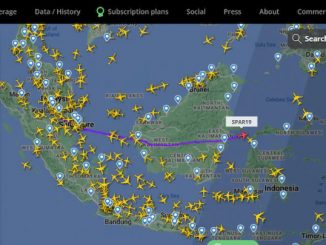
SPAR19 — a U.S. Air Force plane carrying House Speaker Nancy Pelosi from Malaysia to Taiwan as seen on a Flightradar24 map.

House Speaker Nancy Pelosi, the third highest ranking U.S. government official, landed in Taiwan on August 2. This reckless and aggressive move that infringes on the sovereign rights of over 1.4 billion Chinese people pushes the needle ever closer to a larger, more destructive global war. 

The capitalist press portrays Pelosi as a lone individual, a political leader who single-handedly is defying the Chinese government. Nothing can be further from the truth.

Pelosi flew on a U.S. military plane flanked by Air Force F-35 fighters. Instead of flying directly over the South China Sea, her aircraft flew west around the Philippines. All the while, the massive nuclear-powered USS Ronald Reagan carrier strike group lay nearby. This battle group, armed to the teeth, includes a guided missile cruiser and nuclear submarines. 

U.S. violates “One China” policy

Taiwan is part of China, a fact that even the U.S. officially recognizes through the “One China” policy. The U.S. has signed three separate agreements with China confirming the One China policy. “One China” is also recognized by the United Nations

In response to Pelosi’s hawkish actions, the Chinese government issued a statement on August 2 that reads, in part:

Since the founding of the People’s Republic of China in 1949, 181 countries have established diplomatic relations with China on the basis of the one-China principle. The one-China principle is a universal consensus of the international community and a basic norm in international relations.

“In 1979, the United States made a clear commitment in the China-U.S. Joint Communiqué on the Establishment of Diplomatic Relations – ‘The United States of America recognizes the Government of the People’s Republic of China as the sole legal Government of China. Within this context, the people of the United States will maintain cultural, commercial, and other unofficial relations with the people of Taiwan.’”

(Link to full Chinese Foreign Ministry statement)

Words and treaties are one thing with U.S. imperialism, but deeds are another. The Indigenous Nations could attest to this.

The Pentagon seeks to turn Taiwan into a military outpost

House Speaker Pelosi’s visit, while publicly lighting the match, has not been the only action by U.S. imperialism egging on and propping up Taiwan separatism. 

In November 2021, Struggle-La Lucha, reported

“On Oct. 7, (2021) the Wall Street Journal reported that about two dozen U.S. special operations and support troops were ‘secretly operating in Taiwan to train military forces there for at least a year.’” 

The Global Times points out that:

 “Since the U.S. has exposed the news through anonymous officials, it has taken a step forward to undermine, from covertly to semi-overtly, the key conditions for the establishment of diplomatic relations between the Chinese mainland and the U.S.” 

From the same Struggle-La Lucha report: 

“The U.S. government officially recognizes that Taiwan is a province of China, not a separate nation. Therefore, what the Biden administration is now doing — secretly sending special forces into the Chinese province — is in violation of both U.S. and international law.”

Additionally, in March 2021, Nikkei Asia reported that the United States was discussing stationing offensive missiles on Taiwan that would have violated the INF treaty.

Taiwan is manufacturing center for semiconductor chips

Taiwan is a major manufacturing center for semiconductor computer chips that power cars, laptops, phones and appliances. It produces 92% of the world’s advanced semiconductors. 

China is Taiwan’s largest trading partner. While China is building semiconductor plants on the mainland, breaking this supply chain is obviously intended to disrupt Chinese global production. The U.S. produces a mere 12%. It faces a shortage because it was more profitable for U.S. businesses to import from Asia.

That’s what’s behind the Chips and Science Act just passed by Congress on July 28. The act includes more than $52 billion for U.S. companies to take over computer chip production. Reports indicate that the goal is to turn Taiwan production away from China and toward the U.S.

China defends itself 

The Chinese People’s Liberation Army (PLA) is presently continuing exercises blockading the island. The Global Times reported the details of China’s response.

The headline reads: “PLA drills around Taiwan continue to ‘rehearse reunification operation’ amid Pelosi’s visit, ‘exercises blockading island to become routine’

“Joint military exercises around the island of Taiwan by the Chinese People’s Liberation Army (PLA) continued Wednesday with a joint blockade, sea assault, and land and air combat trainings, involving the use of advanced weapons including J-20 stealth fighter jets and DF-17 hypersonic missiles after the drills started on Tuesday evening when US House Speaker Nancy Pelosi landed on the island which seriously violates China’s sovereignty.

“The exercises are unprecedented as the PLA conventional missiles are expected to fly over the island of Taiwan for the first time, the PLA forces will enter the area within 12 nautical miles of the island and the so-called median line will cease to exist, experts said, noting that by surrounding Taiwan entirely, the PLA is completely blockading the island demonstrating the Chinese mainland’s absolute control over the Taiwan question.”

The U.S./NATO proxy war — the 2014 U.S.-assisted coup and the consequent puppet regime in Ukraine — cannot be ignored by the Communist Party of China. Taiwan as a U.S. colony would be a clear existential threat to Chinese sovereignty. 

China cannot allow this, and the Pentagon knows it.

U.S. imperialism wants war — we must organize to stop it!

As the global capitalist crisis deepens, the U.S. imperialist system is propelled toward war. The drive toward war is independent of political administrations or individual intentions, regardless of how venal or corrupt. 

The people of the United States have nothing in common with the multi-trillion dollar war industry that profits off of dumping its weapons on Taiwan and all around the globe. The capitalist system and its bankers seek global domination while workers’ livelihoods are threatened by inflation and recession.

War brings nothing but more repression, misery, death and climate destruction. 

Prepare now: This is not just Pelosi but the whole damn system.


Strugglelalucha256


U.S. condemns Chinese military buildup the U.S. itself provoked

U.S. Indo-Pacific commander Admiral John Aquilino has recently complained about China’s militarization of the South China Sea. He has accused China of placing anti-aircraft and anti-ship systems along with other military facilities on islands scattered throughout the South China Sea.

 The Guardian in an article titled, “China has fully militarized three islands in South China Sea, U.S. admiral says,” would claim:

 “Over the past 20 years we’ve witnessed the largest military buildup since world war two by the PRC,” Aquilino told the Associated Press in an interview, using the initials of China’s formal name. “They have advanced all their capabilities and that buildup of weaponization is destabilizing to the region.” 

The article would go on to explain how the U.S. has positioned its own military in the region, challenging Chinese territorial claims despite having no claims over the South China Sea itself. The Guardian would note that nations like the Philippines, Vietnam, Malaysia, and Brunei have overlapping claims with China, along with the current break-away administration of Taiwan.

The Guardian notes that approximately $5 trillion in trade passes through the South China Sea but fails to note which nation above all others would benefit least from disrupting trade in the region – and which nation would benefit most.

The U.S., not China, threatens trade in the South China Sea

 The Center for Strategic and International Studies (CSIS) – a policy think-tank funded by the U.S. government, its allies, as well as large corporations including weapons manufacturers – maintains the China Power project. In an article published on the project’s website titled, “How Much Trade Transits the South China Sea?,” it would be revealed that China above all other nations depends on the safety and stability of the South China Sea regarding trade, noting that $874 billion in Chinese exports transit the region accounting for over a quarter of all trade through it.

Nations including South Korea, Singapore, Thailand, and Vietnam also account for significant trade through these waters and it must also be kept in mind that each of these nations count China as their main trade partner.

China’s military build-up in the South China Sea isn’t just in reaction to America’s unwarranted and significant military presence in the region, thousands of kilometers from American shores, but also in reaction to the specific threat America’s military presence poses to maritime trade for China and the rest of Asia (who primarily trades with China).

The threat the U.S. poses to Chinese maritime trade is not a figment of Beijing’s imagination but a threat articulated explicitly in U.S. policy papers regarding potential war with China within a closing window of opportunity the U.S. has to use its remaining advantage in military might to fight and win a conventional war with China and thus prevent it from surpassing the U.S. economically, militarily, and diplomatically.

The 2016 RAND Corporation paper, “War with China,” specifically mentions deliberately transforming waters through which China’s trade flows into a war zone. The paper notes that amid a U.S.-Chinese conflict:

…much of the Western Pacific, from the Yellow Sea to the South China Sea, could become hazardous for commercial sea and air transport. Sharply reduced trade, including energy supplies, could harm China’s economy disproportionately and badly. 

The disruption of China’s economy, in fact, is seen as the only realistic way for the U.S. to “win” in a conflict with China. The RAND Corporation paper would note:

The prospect of a military standoff means that war could eventually be decided by nonmilitary factors. These should favor the United States now and in the future. Although war would harm both economies, damage to China’s could be catastrophic and lasting: on the order of a 25–35 percent reduction in Chinese gross domestic product (GDP) in a yearlong war, compared with a reduction in U.S. GDP on the order of 5–10 percent. Even a mild conflict, unless ended promptly, could weaken China’s economy. A long and severe war could ravage China’s economy, stall its hard-earned development, and cause widespread hardship and dislocation. 

The paper also notes that the U.S. need not even specifically blockade various straits Chinese shipping depends on. The paper points out:

This suggests very hazardous airspace and sea space, perhaps ranging from the Yellow Sea to the South China Sea. Assuming that non-Chinese commercial enterprises would rather lose revenue than ships or planes, the United States would not need to use force to stop trade to and from China. China would lose a substantial amount of trade that would be required to transit the war zone. 

Since this paper was written in 2016, the U.S. has incrementally implemented policies to prepare for the conflict described by the RAND Corporation.

By 2021, U.S. State Department-funded media Radio Free Asia in an article titled, “U.S. Indo-Pacific Command Proposes New Missile Capabilities to Deter China,” would note (emphasis added):

The assessment calls for “the fielding of an Integrated Joint Force with precision-strike networks” along the so-called first island chain — referring to missile strike capabilities — and integrated air missile defense in the second island chain, U.S.NI News reported. The document also calls for “a distributed force posture that provides the ability to preserve stability, and if needed, dispense and sustain combat operations for extended periods. 

Extended military operations is precisely what the RAND Corporation called for in its 2016 paper. Additionally, the U.S. has transformed its Marine Corps into a “ship-killing” force equipped to deny China naval access to various territories across the Indo-Pacific region including straits vital for trade.

Defense News in its 2020 article, “Here’s the U.S. Marine Corps’ plan for sinking Chinese ships with drone missile launchers,” would report:

The U.S. Marine Corps is getting into the ship-killing business, and a new project in development is aimed at making their dreams of harrying the People’s Liberation Army Navy a reality.

The article also cited Lieutenant General Eric Smith, chief of the U.S. Marine Corps’ requirements and development, noting:

“They are mobile and small, they are not looking to grab a piece of ground and sit on it,” Smith said of his Marine units. “I’m not looking to block a strait permanently. I’m looking to maneuver. The German concept is ‘Schwerpunkt,’ which is applying the appropriate amount of pressure and force at the time and place of your choosing to get maximum effect.” 

What the U.S. has prepared to do across the Indo-Pacific is implement the RAND Corporation’s “War with China” policy recommendations, implementations aimed at crippling Chinese maritime shipping, strangle its economy, and eventually collapse its government. In other words, the U.S. is creating in the Indo-Pacific region, an existential threat to China’s continued existence as a nation-state.

U.S. Marines are also currently present on Taiwan, according to Voice of America – Taiwan being territory considered by Beijing to be part of China – a fact even the U.S. itself recognizes through the “One China Policy.” Thus, the positioning of U.S. missiles across the region, the navigating of U.S. naval vessels near territory claimed by China, and the placing U.S. military personnel on Taiwan, are all meant to incrementally encircle and encroach upon China – pushing ever closer to, or even crossing over red lines established by China in the interest of basic self-preservation.

Just as the U.S. has done to Russia through Ukraine it is now doing to China through the South China Sea and Taiwan. When conflict eventually breaks out between China and either the U.S. itself or one of its proxies in the region – most likely the administration of Taiwan – it will be a conflict provoked entirely by the United States on the other side of yet another ocean, yet again thousands of kilometers away from American shores, and again endangering the lives of hundreds of millions of people toward the preservation of American hegemony and at the expense of another region’s sovereignty and perhaps even self-preservation.

U.S. Indo-Pacific commander Admiral John Aquilino left all of this very important context out of his observations that China is overseeing a major military build-up –  ignoring entirely the major military threat the U.S. has placed at China’s doorstep.

Source: NEO

Strugglelalucha256


NATO, not China, is to blame for the Ukraine crisis

The Ukraine crisis was largely triggered by NATO’s aggressive eastward expansion. The bloc is the culprit. Instead of reflecting on itself, NATO piles pressure on other countries to stand with it against Russia. This is unreasonable and quite sinister.

“China should join the rest of the world in condemning strongly the brutal invasion of Ukraine by Russia,” NATO Secretary General Jens Stoltenberg said on Tuesday, “The Russian invasion of Ukraine is a blatant violation of international law so we call on [China] to clearly condemn the invasion and of course not support Russia. And we are closely monitoring any signs of support from China to Russia.”

NATO is a puppet of the US, a Cold War military bloc manipulated by the US. The obsolete military organization has launched many ruthless military aggressions and triggered corresponding disasters in which local people underwent great suffering. NATO’s aerial bombing campaign against the Federal Republic of Yugoslavia in 1999 during the Kosovo War is one example.

NATO’s hands are stained with blood and the bloc itself has been a major threat to global and local security. Is NATO qualified to criticize other countries? This organization should have been dismantled long ago.

“NATO is the most serious war machine that violates international law and endangers the sovereignty and territorial integrity of other countries since the end of the Cold War. Since when has the group become a defender of international law? If it is a defender of international law, could you please first apologize for their bombing of Yugoslavia? Could you first compensate for bombing the Chinese Embassy in Yugoslavia in 1999, which left three journalists dead, and more than 20 people injured? Stoltenberg is not qualified and has no right or moral basis to make such remarks,” Shen Yi, a professor at the School of International Relations and Public Affairs of Fudan University, told the Global Times.

The West has fallen into extreme insanity, and this is quite sick. This is also a symptom of the growing abnormality of the international community under the coercion of the US and its allies. Stoltenberg’s rhetoric sounds like he attempted to label China as Russia’s “accomplice.” In terms of tensions between Russia and Ukraine, there is no absolute right and wrong, as the geopolitics, history and culture between them are too complicated. Their tensions are a difficult problem to solve. In this context, portraying their military conflict as good versus evil is not rational and detrimental to address it.

The Chinese ambassador to US Qin Gang said in an opinion piece in The Washington Post that rumors like “Russia was seeking military assistance from China” are “purely disinformation.” All this is information war initiated by the US. NATO is trying to use this kind of information war to intimidate China, and to coordinate Washington, in an attempt to occupy the moral high ground over the Ukraine crisis.

“By making such statements, NATO is trying to distort the focus of the international community from criticizing its eastward expansion to China’s so-called coordination with Russia,” Zhang Tengjun, Deputy Director of the Department for Asia-Pacific Studies at the China Institute of International Studies, said. “NATO is deliberately circumventing its role and responsibility. It is trying to shift the blame and confuse the public. This is very sinister.”

Source: Friends of Socialist China

Strugglelalucha256


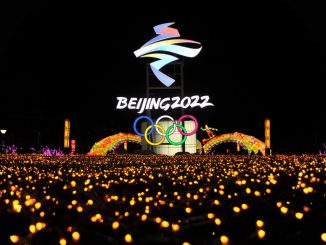
How China became an Olympic boogeyman for the West

In the early 1990s, barely a decade after rejoining the Olympic movement, Beijing launched a bid to host the 2000 Games. Unfortunately by then, U.S. policy had begun to shift perceptibly from the honeymoon years of rapprochement. Gone was the incentive for even arch-reactionaries like U.S. Presidents Nixon and Reagan to embrace the People’s Republic of China (PRC) effusively in the name of hard-nosed anti-Soviet realpolitik. With the end of the first Cold War, anticommunism also receded as a guiding framework for U.S. imperial rhetoric, in favor of a universalized (if richly hypocritical) weaponization of neoliberal “human rights.” This was a discursive terrain tilted heavily toward bourgeois democracies in the imperial core, on which China was hardly more equipped to compete than it had been in the Mao era.

Sure enough, the U.S. mainstream press united in opposition to Beijing’s bid, with the New York Times anticipating the facile and now-omnipresent analogies with Nazi Germany, as University of Hong Kong historian Xu Guoqi quotes in his 2008 book Olympic Dreams: China and Sports, 1895-2008: “The city in question is Beijing in the year 2000, but the answer is Berlin 1936.” Bipartisan majorities in both houses of Congress vehemently urged the International Olympic Committee (IOC) to reject the bid on human rights grounds. In the event, Beijing led in every round of voting until the last, when it narrowly lost to Sydney 45-43. It later emerged that the Sydney organizing committee had not only secured the two-vote margin via outright bribery (par for the course for the IOC), but had secretly commissioned an anti-China smear campaign laundered through a London-based human rights group. The bonds between white Anglo settler colonies prevailed, and the Sydney Olympics became the stage for a truly noxious whitewashing of Australia’s genocide against Aboriginal peoples.

Still smarting from its defeat and the naked hypocrisy of Western powers around the “politicization” of the Games, Beijing nonetheless forged ahead with a bid for the 2008 Olympics. This time it won with ease, aided by widespread sympathy for the circumstances of the 2000 loss, as well as a slick PR campaign designed to neutralize the attack lines that had sunk its previous attempt. Bid committee official Wang Wei assured the IOC that “with the Games coming to China, not only are they going to promote the economy, but also enhance all the social sectors, including education, medical care and human rights.” Despite strenuous efforts to weaponize large-scale unrest in Tibet in the months leading up to the Games, even limited boycott appeals from Western campaign groups went nowhere. The 2008 Beijing Olympics went down in history as China’s “coming-out party” and a seminal moment in its growing self-confidence as a rising world power.

It is telling that Jules Boykoff, the outspoken critic of the Olympics whose book Power Games I have relied on heavily in my research for this and other articles on this topic, makes no mention at all of this widespread popular perception of the 2008 Games or their significance in the broader arc of Chinese history. Instead he treats them as an exclusively elite project and focuses entirely on critical narratives, a tendency he has doubled down on in his most recent commentary on the 2022 Beijing Games. Possibly the most revealing line is his response to Beijing’s assurances from the 2008 bid: “This human-rights dreamscape never arrived. It’s telling that today, neither China nor the IOC are vowing that the Olympics will spur democracy.” It does not seem to occur to Boykoff to see this as a positive development: that China’s growing confidence in its own model frees it from the need to address Western imperialists in their favored (and deeply hypocritical) discursive terms. As the New York Times put it succinctly, “Where the government once sought to mollify its critics to make the Games a success, today it defies them… China then sought to meet the world’s terms. Now the world must accept China’s.”

This reflects a broader analytical lacuna in campaigns that take the Olympics themselves as an undifferentiated political target: they fail to account for the positions of different host countries vis-à-vis the imperialist world system. To flatten “the Olympics” or “human rights” as universal categories is effectively to privilege normative Western understandings of both. In practice this leads to the grossly uneven and asymmetrical treatment of Olympics hosted by self-styled democracies in the imperial core—historically the overwhelming majority—versus the few that are not. To be sure, local anti-Olympics campaign groups are undoubtedly justified in fighting the social dislocations they bring to host cities everywhere. (Full disclosure: I have previously worked with one such group, NOlympics LA, which does valuable work connecting the 2028 Los Angeles Olympics to gentrification and racialized policing.)

But where was the outrage over the illegal U.S. invasion of Afghanistan, when Salt Lake City hosted in 2002? Over Britain’s war crimes there and in Iraq, when London hosted in 2012? Over Japan’s continued refusal to acknowledge its colonial crimes against humanity, when Tokyo hosted in 2021? The indictment of entire host countries as “human-rights nightmares” (Boykoff’s crude label for China and Kazakhstan, when Beijing and Almaty wound up as the only finalists for 2022) seems to be reserved for nations outside the imperial core. The nascent transnational anti-Olympics movement needs to overcome these ideological blinders if it is ever to match the coherence of the great anti-racist mobilizations that shook the IOC in the 1960s and ’70s. Presently there seems little cause for hope, with leading figures like Boykoff and his fellow “left” sportswriter Dave Zirin uncritically propagating U.S. State Department lines on both Xinjiang and Peng Shuai in their coverage leading up to the 2022 Games.

New Emerging Forces

What, you might ask, was the People’s Republic of China up to in the world of international sport during its more than two decades in the Olympic wilderness (​​from 1952 to 1980)? The story of “ping-pong diplomacy” with the United States and other Western powers is already well-documented, reflecting an obvious Northern historiographical bias. But in an age of growing calls for “decoupling” between China and the West, and for South-South cooperation via the Belt and Road Initiative among other projects, the buried history worth uncovering is that of the Games of the New Emerging Forces (GANEFO).

GANEFO emerged from a bold act of anti-imperialist and anti-Zionist solidarity by the Indonesian government of Sukarno, the visionary anticolonial leader and co-founder of the Non-Aligned Movement. In 1962, Indonesia as host pointedly refused to invite Israel and Chiang Kai-shek’s Kuomintang (KMT) regime to the fourth Asian Games and was summarily suspended from the IOC. In response, Sukarno proclaimed that:

“The International Olympic Games have proved to be openly an imperialistic tool… Now let’s frankly say, sports have something to do with politics. Indonesia proposes now to mix sports with politics, and let us now establish the Games of the New Emerging Forces, the GANEFO… against the Old Established Order.”

His bracing rhetoric is reminiscent of the Chinese IOC delegate Dong Shouyi’s 1958 broadside against then IOC President Avery Brundage, but shorn of any residual attachment to a mystical “Olympic spirit.” China enthusiastically jumped in to help organize and promote GANEFO in 1963, covering travel costs to Jakarta for 2,200 athletes from 48 countries, overwhelmingly based in the Global South. It left with a bumper crop of athletic victories—topping the overall medal table, followed by the Soviet second-string squad and the Indonesian hosts—and effusive goodwill from athletes across the emerging Third World.

There would never be another GANEFO, owing to the horrific U.S.-backed coup that ousted Sukarno and installed Suharto’s military dictatorship in 1965. But this piece of history remains more vital than ever to recover. Because the lesson of Beijing 2022 and the moves toward a diplomatic boycott, however farcical, is that the United States and its allies in the Global North will never fully accept China as a legitimate member of their elite club. In their current position as hosts, PRC officials may feel understandably constrained in denouncing the “politicization” of the Games. But it would be wise for them, for the Chinese people, and for the rest of the world to keep in mind the fact that politicizing the Olympics is a long, hallowed tradition for the workers and oppressed nations of the world. The People’s Republic of China has a storied place in that tradition, of which it can be justly proud.

This article was first published on Qiao Collective and was adapted in partnership with Globetrotter.

Charles Xu is a member of the Qiao Collective and of the No Cold War collective.

Strugglelalucha256


China’s Olympic battle for legitimacy: The prehistory of the 2022 Beijing Games

Much has been made of the “diplomatic boycott” by the United States and its allies of the 2022 Beijing Olympics. But what much of the major Western media coverage misses is the historical and geopolitical significance of these games to China—as one of only three Asian host nations for the Olympics (along with Japan and South Korea), and the first Global South country to host the Winter Games. The countries boycotting the 2022 Olympic Games, it seems, see this moment and the history that underpins it as threatening to their global hegemony in both sport and geopolitics.

In 1949, the Communist Party of China decisively prevailed over Chiang Kai-shek’s Kuomintang (KMT) after 22 years of civil war, forcing the latter to flee to Taiwan. The founding of the People’s Republic of China (PRC) brought a definitive end to a “century of humiliation” inaugurated by the First Opium War, which had seen colonial powers reduce China to the “sick man of Asia.” This sickness had been a byword for the weakness, internal rupture, and forced narcotic dependency of the Chinese body politic—transposed inevitably onto the racialized Chinese body.

Overcoming these scars, in all their physical and psychological manifestations, was the guiding principle for sports policy in the PRC. Only through this lens can we understand why it fought in such an obstinate, pugnacious, and unabashedly political way for a place in the Olympic movement on its own sovereign terms. China turned the Olympics into a battleground in its contest for legitimacy with the KMT regime on Taiwan and its imperialist backers, elevating the dispute to “the main burden of Olympism,” in the words of Otto Mayer, chancellor of the International Olympic Committee (IOC) from 1946 to 1964. And as with the parallel struggle for recognition by the United Nations, this one ended after three eventful decades in unqualified triumph. University of Hong Kong historian Xu Guoqi relates this fascinating saga in his 2008 book Olympic Dreams: China and Sports, 1895-2008.

The KMT-led Republic of China had sent a solitary athlete to the 1932 Los Angeles Games, followed by larger delegations in 1936 and 1948—the latter, incredibly, as the KMT was losing the most decisive campaigns of the civil war to the Communists. After the regime’s flight to Taiwan, its National Olympic Committee (NOC) gave the IOC pro forma notice that it had relocated to Taipei with no further explanation. Throughout this period, the Soviet Union had pointedly snubbed the “bourgeois” IOC in favor of organizing its own proletarian Red Sport International, complete with “Spartakiad” games to rival the Olympics. But by the 1952 Helsinki Games, the Soviets were ready to join the existing Olympic movement in force (ultimately finishing a close second to the United States in the medal count) and duly urged the fledgling PRC to do so as well.

From its very first approach, the PRC boldly insisted on what would become known as the one-China policy: that it was the sole legitimate representative of the Chinese nation including KMT-occupied Taiwan. The IOC ultimately fudged on the question and extended a last-minute invitation to Beijing as well as Taipei. Nonetheless, Mao Zedong, Liu Shaoqi, and Zhou Enlai personally approved the decision to send a team, which arrived in Helsinki the day before the closing ceremony and could not take part in any competition. But merely being there was an unalloyed boon to the PRC’s legitimacy, especially as the rival Taipei-based NOC had withdrawn in protest. Avery Brundage, the notoriously racist American who took over as IOC president that year, complained bitterly that “I did everything in my power to prevent them from taking part. Unfortunately, I had only one vote and because many others present did not feel the same way I was outvoted,” as vocal Olympic critic Jules Boykoff recounts in his 2016 book Power Games: A Political History of the Olympics.

This initial success for the PRC’s efforts to participate in the Olympic movement was not to be repeated. In 1956, it was the PRC’s turn to withdraw in protest as Taipei’s delegation insisted on competing in the Melbourne Summer Games under the name “Republic of China.” Two years later, Chinese IOC delegate Dong Shouyi entered into a bracing war of words with Brundage, calling him “a faithful menial of the U.S. imperialists bent on serving their plot of creating ‘two Chinas’” in a resignation letter that concluded:

“A man like you, who stains the Olympic spirit and violates the Olympic Charter, has no qualification whatsoever to be IOC president. … I feel pained that the IOC is today controlled by an imperialist like you and consequently the Olympic spirit has been grossly trampled upon. To uphold the Olympic spirit and tradition, I hereby declare that I will no longer cooperate with you or have any connection with the IOC while it is under your domination.”

Dong would not be the last Chinese representative to evoke an idealized “Olympic spirit”—in opposition to the Americans, who arguably embodied the real one in all its racist ugliness. He would, however, be the last one on the IOC until 1979.

Interestingly, this two-decade hiatus (which actually amounted to a 28-year absence from the Olympic Games, from 1952 to 1980) saw the two most severe diplomatic incidents surrounding the China question at the IOC. Both centered on the KMT regime’s untenable claim to represent the entire Chinese nation as the “Republic of China,” and both ended in bitter defeats for it, even as Beijing was de facto boycotting the entire Olympic movement. In effect, the PRC substituted state-to-state diplomacy—first with the Soviet bloc and then with Western powers after the Sino-Soviet split—for a formal presence within the institutions, closely mirroring its geopolitical strategy.

The first episode occurred in 1959, not long after Dong Shouyi’s acrimonious resignation, when Soviet delegates to the IOC insisted that Taipei’s NOC change its name on the self-evident grounds that it “[could not] possibly supervise sports in mainland China.” The IOC as a whole readily agreed, with even the arch-anticommunist Avery Brundage reluctantly assenting. The U.S. mainstream press exploded in outrage; absurdly, Brundage himself was deluged with hate mail alleging he had succumbed to “communist blackmail.” The U.S. State Department called the decision “a clear act of political discrimination” and even President Dwight D. Eisenhower condemned it. The whole affair ended in another embarrassing fudge, with Taipei competing under the name “Taiwan” at Rome 1960 and quietly reverting to “Republic of China” thereafter.

The second, even more damaging incident took place in the lead-up to the 1976 Montreal Games. After establishing diplomatic relations in 1970, the PRC informed Canada in no uncertain terms that the Taipei NOC should not be allowed to compete as the “Republic of China.” After lobbying earnestly but unsuccessfully for the IOC to recognize Beijing instead of Taipei, Canadian Prime Minister Pierre Trudeau’s government proposed that athletes from Taiwan compete under the neutral Olympic flag. The IOC grudgingly assented at the last minute, but not before debating whether to move the Games to the United States or cancel them entirely; the Taipei NOC ultimately withdrew.

Official reactions from Canada’s domineering southern neighbor were again apoplectic. U.S. President Gerald Ford and the head of the U.S. Olympic Committee seriously discussed the possibility of boycotting or trying to take over the Games at the last minute. This of course did not come to pass, but Canada took a significant reputational hit in the United States—a testament to China’s growing ability to exploit contradictions within the imperialist bloc. Canada’s independent China policy under Pierre Trudeau stood in stark contrast with that of his son Justin, who marched in shameful lockstep first with Trump’s judicial kidnapping of Huawei CFO Meng Wanzhou, and now with Biden’s “diplomatic boycott” of Beijing 2022 over exaggerated allegations of human rights abuses in Xinjiang.

Ironically, just a few years after savaging the Canadians, the United States would follow in their footsteps by establishing diplomatic relations with the PRC and (formally) cutting ties with Taipei under the one-China policy. This paved the way for the IOC to resolve the two-China question later in 1979 in its own unique way: by readmitting Beijing and allowing athletes from Taiwan to compete under the name “Chinese Taipei.” Deng Xiaoping personally approved this compromise in an early foretaste of the future “one country, two systems” settlements that would return Hong Kong and Macao to Chinese sovereignty.

The PRC’s delayed return to the Olympic movement, contingent in many ways on bilateral ties with the United States, contrasted sharply from its triumphant entry into the UN in 1971. On that occasion, an impressive coalition of African and other Third World countries—many fresh from their own national liberation struggles—had secured recognition for Beijing and expulsion of the KMT regime over the strident objections of the United States and most of its allies. By 1979, the basis for unity within the socialist and nonaligned camps had so thoroughly collapsed that China and many other Global South countries readily joined the U.S.-led boycott of the 1980 Moscow Olympics over the Soviet military intervention in Afghanistan.

Instead, mainland China made its long-delayed and triumphant return to Olympic competition at the 1984 Los Angeles Games—remembered locally as an orgy of Reaganite neoliberalism, American jingoism (amplified by the Soviet-led boycott), and militarized police terror that helped create the conditions for the 1992 Rodney King uprising. They nonetheless marked a high point in U.S.-China relations, with PRC athletes being warmly feted by the hosts. This goodwill was not dampened in the slightest when the women’s volleyball team sensationally defeated the hosts to win gold, in one of the most iconic moments of Chinese sports history.

There was ample reason to believe, even after the trauma of the 1989 Tiananmen incident and subsequent U.S. sanctions, that enough of it remained to propel Beijing to victory in its first bid to host the Games. As it turned out, the United States and its allies had no intention of ceding such recognition to a rising China without a fight.

This article was first published on Qiao Collective and was adapted in partnership with Globetrotter. Charles Xu is a member of the Qiao Collective and of the No Cold War collective.

Strugglelalucha256


While China successfully battles COVID, the U.S. targets China and loses the battle against COVID

The U.S. media is spreading a message that the omicron variant of COVID-19 may be the final wave in the pandemic that has taken 5.63 million lives globally, and 875,000 in the U.S. – the U.S. has the highest death toll in the world. 

Even as the death count in areas of the U.S. is rising as predicted by epidemiologists and virologists, a pro-business push to herd people back to work and students back to in-person classes is underway. The push has been embraced by the Centers for Disease Control, and by Biden’s Chief Medical Adviser, Anthony Fauci.

While omicron’s symptoms may be less severe than the delta variant, it is still a killer and is currently averaging 2,200 deaths per day throughout the country. Because it infects people so much more efficiently than previous variants, according to a Jan. 24 Reuters article, “The omicron death toll has now surpassed the height of deaths caused by the more severe delta variant when the seven-day average peaked at 2,078 on Sept. 23 last year.”

In the year 2021, there were 476,863 deaths from the disease in the U.S. During the same year, in China there were only two coronavirus deaths.

Comparing population figures of the United States and China to the respective numbers of COVID-19 deaths, one arrives at a jaw-dropping conclusion. In China, 0.00041% of the population died, while in the U.S. 0.26596% of the population died. You would have to multiply China’s percentage by 653 for it to have been as bad as the death toll in the U.S.

This yawning gap of a difference has had the U.S. propaganda machine – from intelligence agencies, to the White House and State Department and the multi-millionaire spokesmodels that serve as newscasters – spinning a defensive web of lies and all manner of slander against every aspect of China’s “People’s War” against the virus. The bogus “lab leak” theory has lost steam, but the latest tirade is to rally around the case of Zhang Zhan, a right-wing, anti-communist crusader, championed by the Western media and by Amnesty International.

At the beginning of the pandemic

Zhang, who calls herself a “citizen journalist,” was arrested by Chinese authorities in May of 2020. She had traveled to Wuhan in February 2020, at the beginning of the pandemic. She didn’t go there to help in the way that tens of thousands of Chinese volunteers did at the risk of their own health. Instead, she went to record and publish video to opportunistically show the suffering and bolster the U.S. cold-war propaganda that was already underway before the pandemic. 

Zhang recorded video at crematoria in Wuhan and at overcrowded hospitals that were in crisis mode. She posted videos on YouTube accusing the government of “intimidation and threats” and claiming that people were going hungry and being neglected. She did all of this as scientists and government leaders were scrambling to understand and gain control of the virus. If she had arrived several weeks later she would have witnessed the beginning of the end for the initial short-lived torrent of death. For nearly two years now, only 3 people have died of COVID in China.

Zhang is a longtime participant of the U.S. system that churns out lies and foments counterrevolutions. The National Endowment for Democracy and other neo-CIA organizations have nurtured “protest” groups in Hong Kong and Taiwan and have supported the “Weiquan movement” in mainland China, which Zhang is a participant in. They spout the usual laundry list of “issues” against the Communist Party leadership. Sometimes their message is not subtle criticism. While the U.S. pushed the anti-communist “protest” movement in Hong Kong in 2019, Zhang held up an umbrella in Shanghai emblazoned with the words “End socialism, Communist Party down.”

Her case has garnered sympathy from organizations that are based on anti-communism as they stand as opponents of human rights abuses. Her history of engaging in “hunger strikes” gives her a façade that appeals to “liberal” media outlets like the Guardian and the New York Times, and nongovernmental organizations like Amnesty International, as well as the United Nations human rights office. 

Zhang’s mother told the press that she’s very concerned because her daughter is only eating fruit and cookies. Admittedly, that is not the healthiest diet and that would concern any mother, but it is not a hunger strike. Zhang is not anything like Bobby Sands or the other Irish republican hunger strikers in the struggle against British imperialism or any of the Palestinian hunger strikers protesting their imprisonment without trial by the Zionist occupation regime of Israel.

China has literally saved millions of lives through their “People’s War” and their continuing zero-COVID campaign. China’s international medical solidarity, and their call for global cooperation to aid Africa, Asia and Latin America points the way forward to end the pandemic. Regardless of whatever media campaign they are using, the U.S. will never be able to drive a wedge between the Chinese people and the Chinese Communist leadership.

Strugglelalucha256


China expands international medical solidarity to fight COVID

The U.S. Centers for Disease Control (CDC) has overseen a failed effort to combat COVID-19, and in fact, appears to have thrown up its hands in surrender. As of this writing, 843,000 people in the U.S. have died, and the omicron variant is now overloading hospitals with COVID patients, including thousands of children. 

The symptoms may or may not be less severe – assessments in the media are contradictory. But in Chicago, Boston and New York City, where the earliest surges of omicron took place, patients are dying on only a slightly smaller scale than during previous waves of infections – because of the sheer number of cases. 

In spite of all this, capitalist government institutions are pulling back control efforts. Millions of parents are worrying that the premature return to in-school studying will send their children to the hospital. 

Two weeks ago, just days after a Dec. 21 letter from the CEO of Delta Airlines requesting that the isolation period be lessened, the CDC did exactly that. The isolation guidelines were lowered from 10 days to five days.

Had there been a higher level of global cooperation early in the pandemic, it’s questionable whether omicron would have even come into existence. 

U.S. capitalists block cooperation

The means to vaccinate the world through a cooperative international plan existed, and as the U.S. spewed hateful propaganda and anti-communist conspiracy theories, the Chinese government repeatedly called for a cooperative effort. But the chance to move forward was squandered by capitalist greed and vaccine nationalism promoted by U.S. big money.

Giant corporations that own health insurance companies, hospital chains and drug manufacturers, as well as the banks that invest in them, are so dominant in the U.S. economy that the availability of health care has historically compared miserably even to other major capitalist countries. 

That U.S. capitalism produced one of the most resourceful scientific and medical communities in history didn’t help, because it also has commodified all of science to an extent never seen before. Life-saving medical care and even preventive medicine is a privilege that communities of color and poor people in general are often denied. 

Further, instead of going all-out to produce and distribute vaccines globally, the U.S. ruling class’ nationalist and genocidal hoarding of life-saving science is what gave SARS-CoV-2 all the time it needed to mutate and for the omicron variant to emerge in Africa, where the vaccination rate is in the single digits. 

Even the design of the mRNA vaccines – whose development and production was funded by the U.S. government – points to the nationalist orientation of giant capitalists. Regardless of how effective they are, the required cold storage and transportation makes them impractical for a global vaccination campaign. 

That didn’t have to be the case. For instance, once the science, research, development and manufacture of the vaccines was accomplished, redirecting the resources normally devoted to the U.S. imperialist war machine might have made short work of COVID-19.

Many other countries with far fewer advantages than the United States have done a much better job protecting lives and controlling the spread of the disease.

Socialist countries’ achievements 

Cuba and China have stood out as models of how a pandemic should be dealt with. 

Every revolution of the 20th century that set out to build socialism, at its onset, exhibited an all-out effort to improve health care. This history of prioritizing health instead of profit is the foundation of the remarkable achievements by both countries during the COVID-19 pandemic.  

China and Cuba used every resource possible to produce vaccines and treatments to protect their own populations. At the same time – because a pandemic cannot be ended by vaccinating within the borders of one country – they both have shared medical teams, vaccines, treatments and supplies internationally, even while combating the disease at home.

When the 1949 Chinese Revolution ended what they called the “century of humiliation,” the early days in the process of rebuilding saw an unprecedented determination to eradicate diseases that were associated with deep poverty. 

Beginning in 1949 and growing during the Cultural Revolution, Mao Zedong’s army of “barefoot doctors” received basic medical training and set out for the countryside to promote preventive care and treat common illnesses. 

Over the decades, China has beaten back or eliminated numerous communicable diseases that had run rampant throughout the country, such as plague, smallpox, cholera and typhus. In addition, cases of malaria and schistosomiasis have been reduced dramatically. 

Schistosomiasis – a parasitic disease from freshwater snails – infected 10 million Chinese people in the mid-1950s. Mao was so elated as the eradication campaign began showing signs of success that he wrote poetry about it and spoke about it frequently.

China’s Health Silk Road

While it is true that the Communist Party of China has prevailed on many capitalist corporations operating there to contribute to health care and the general welfare of the population, the Chinese health care system itself is almost wholly state-owned, and the “Health Silk Road,” as China’s international medical solidarity has come to be called, is a longtime CPC initiative.

Notably, and to great praise by international health agencies, China has been working hard to replicate this success against diseases of poverty as part of the Health Silk Road, particularly against schistosomiasis in Africa, where 90% of cases exist today.

This drive to help spread health care internationally has ramped up during the pandemic. When COVID began killing people in droves during March 2020, Chinese medical teams went to hard-hit Iran and Italy. By June 2021, the foreign ministry announced that China had delivered more than 350 million vaccine doses to more than 80 countries. 

Last August, President Xi Jinping pledged a $100-million donation to Covax, an international agency coordinating global vaccine distribution, but added a pledge of 2 billion vaccine doses to be provided internationally outside of Covax. 

By October 2021 the China International Development Cooperation Agency reported that over 1.5 billion doses have already been delivered to 106 countries, focusing on Africa, Asia, Latin America and the South Pacific.

While there is still much to be done to safeguard the Global South from this deadly disease and possible new variants, China continues its own medical internationalism and its call for global cooperation instead of Cold War slander and capitalist greed.

Strugglelalucha256


Want to know how to beat COVID? Look at China

The world is now nearing the end of the second year of the COVID-19 pandemic. The United States has the highest death toll in the world – 823,390 as of Dec. 16. 

With all the scientific resources available, and billions of dollars in the vaults of the richest capitalist class in history, the U.S. should have been able to succeed in a vaccination campaign and treat everyone before they were infected. Vaccines should have made their way throughout the world, including the global south where the challenges of poverty magnify the horrors of the pandemic. 

Instead, the White House and U.S. intelligence agencies have taken their cue from the Trump administration and continued apace with a manufactured narrative that slanders and blames China for the pandemic. Their goal is to cover up the global calamity created by the giant multinational corporations they serve and turn people’s attention away from the incredible success of the Chinese socialist public health system in fighting the pandemic. 

An internet search for death statistics or other COVID related metrics outside China is heartbreaking. India lost 476,000 people, in Brazil 617,000 people died, and Mexico suffered 297,000 COVID fatalities. The list of countries that have suffered staggering loss and grief is a long one. Those countries that have been brutalized by imperialism for more than a century have been ravaged, as have oppressed and impoverished communities within the U.S. The pandemic has revealed the entrenched racism and neglect of people of color within U.S. borders, while vaccine nationalism has exposed the genocidal treatment of the global south. 

To date since the beginning of the pandemic, only 4,849 COVID deaths have occurred in China. Since April 24, only three people have died. That is astounding. As of this writing there have been 265,713,467 cases and 5,260,888 deaths from COVID-19 worldwide. 

China’s success was due in part to the great deal of research and experience that followed the outbreaks of the SARS and MERS epidemics. But even more, it is the reality of the Communist Party of China being in the leadership instead of a government run exclusively by and for a tiny handful of billionaires.

At the beginning of the outbreak in February and March of 2020, before COVID-19 became a pandemic, the CPC moved decisively and locked down the city of Wuhan, which has a population of 11 million people. The scale of the quarantine was unprecedented and set the tone for how the CPC and the Chinese people have carried out their incredible “People’s War” ever since.

The Western press often describes it as “authoritarian” and “ruthless.” Human Rights Watch attacked it as a violation of freedom. The campaign was and is, in fact, extraordinarily humanitarian, incredibly efficient and a technological marvel. 

Drones for health, not war

The world’s first major deployment of drones — other than their use by the imperialist U.S. military to murder thousands of people in Yemen, Syria, Afghanistan and elsewhere — was launched in Wuhan. Drones and robots were deployed that could detect people with fevers while hovering, remotely disinfect hospitals, and make announcements to ensure quarantine restrictions were followed. 

Robots delivered food and supplies to people’s doorsteps. No one lost pay or lost their job. 

Two hospitals were literally constructed in a matter of days and other pre-existing buildings were modified and put to use for treatment of COVID patients. Here again, drones hovered over the construction sites to provide light so that construction crews could work 24-hours-a-day. 

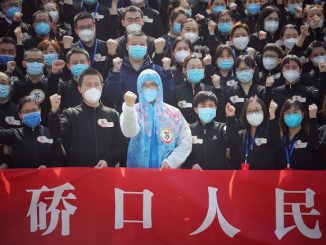
Thousands of medical volunteers traveled from faraway areas of China to help in Wuhan and other places as the disease spread. Videos were produced and spread on social media to update the population about safety measures and how to get help. Scientists mapped the genome of the virus and shared it with the world within 11 days.

After more than two months of sharply increased cases and more than 3,000 deaths, the casualty numbers diminished. But no one in China dropped their guard in the interest of reopening the economy as happened with successive waves of the outbreak in the U.S. Sporadic outbreaks saw more lockdowns – none at the same scale as that in Wuhan, but always announced quickly when there was an uptick in cases. 

The lockdowns were a great economic sacrifice. But there were no demonstrations demanding the lockdowns end as there were in major capitalist countries. The Chinese leadership made sure everyone would receive income, there were absolutely no evictions, and there were no job losses.

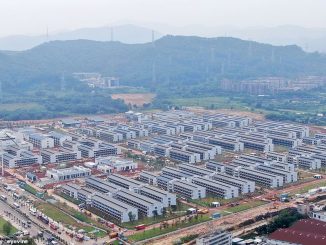
The 5,000-room Guangzhou International Health Station

The CPC still maintains a goal of zero COVID infections as the Omicron variant is surging in many parts of the world. A 5,000-room quarantine facility in Guangzhou, equipped with 5G communication technology and a robot delivery system for food and other essentials, was finished last month. 

The housing is spread over an area as big as 46 soccer fields and is the first in the plans for a chain of similar facilities to house people traveling from abroad. The entire complex was built in less than three months, a feat that would be astonishing anywhere else. Considering the construction of the hospitals in just days at the beginning of the pandemic, it is not surprising.

China’s determined campaign to beat the pandemic is international in scope. In spite of the astonishing success of this People’s War, Chinese leaders, researchers, virologists and epidemiologists know that defeating a pandemic requires complete global cooperation.


Strugglelalucha256


Biden’s ‘democracy summit’ – how Marx showed the fake character of capitalism’s concept of ‘human rights’

The absurdly misnamed “Democracy Summit”, hosted by U.S. President Joe Biden on 9-10 December, the real “non-democratic” character of which is analyzed below, is widely and rightly understood in China as part of the fact that the U.S. simultaneously launched not only an international geopolitical attack on China but also an ideological one.

China has nothing whatever to fear, and on the contrary a great deal to gain, from such an international discussion – due to the overwhelming achievements of China in improving the lives of its own people. The more the people of the world understand China’s extraordinary achievements in this the more they will want the same scale of improvement in the conditions of their people to be enjoyed by their own countries and therefore the more favorable they will be to China.

But in some sections of the media mistakes are made in replying to U.S. attacks on “democracy” and “human rights.” These mistakes consist of falsely accepting the U.S. framework of discussion on these issues. Therefore, it is important to clearly understand the entirely wrong basis of the U.S. claims on “human rights” and “democracy”. This, in turn, leads to analysis of the core of the most fundamental issues of the difference between socialism and “liberal” capitalism. Marx precisely became a socialist (founding Marxism!) through his criticism of the errors of liberal capitalism and his analysis of the real practical situation of life of human beings. This analysis provides the comprehensive framework for critique of all the errors of liberal capitalism and demonstration of the superiority for humanity of socialism – including China’s. Therefore, understanding of these issues is of very great practical importance, as well as theoretical clarity, in replying to false U.S. attacks on China.

The following article therefore deals both with key practical examples of the real bases of human rights and democracy and relates them to Marx’s epoch-making analysis – which provides the foundation for all real examination of the issues of human rights and democracy. It is an expanded version of a speech made on these issues to a conference on 2 December.

This article therefore deals with:

  • What are the real differences regarding human rights and democracy between the U.S. and China?
  • Why China’s position on human rights and democracy, in the real life of real human beings, is far superior to the U.S.?
  • How Marx analysed the fundamental issues on these questions – and why his framework could be expanded from his own first analysis to all the most important issues of humanity’s life?
  • What is the real character of the U.S. pseudo “summit on democracy”?
“Democracy” means the people rule – what are the practical implications of this?

The word democracy in European languages, derives from two Greek words “demos (people)” and “kratos (rule)”. So, “democracy” means literally “rule by the people”.

Democracy is presented as integrally linked to human rights, that is “people’s rights”. This is correct and will be used here. This reality shows that China’s framework and delivery on human rights is far superior to the “West’s”. But, contrary to this fundamental concept of “rule by the people” an attempt is made in the West, more accurately by capitalist countries, to claim that democracy is instead defined purely in terms of certain formal and official structures which they possess – for example Parliament, so called “division of powers” etc. This is false. The issue is about how much in reality “human rights” exist.

The position of women in China and India shows the fake U.S. definition of human rights

To illustrate the real issues involved in the issue of human rights and democracy let us start with an enormous practical example affecting almost one fifth of humanity – women’s position in China and India.

An Indian woman’s life expectancy is 71, in China it is 79.2 – a Chinese woman lives 8 years longer than an Indian woman.

In China female literacy is 95%, in India it is 65%.

The risk of a woman dying in childbirth is 8 times higher in India than in China.

In the real world, for the thinking of any normal human being, the real human rights of a Chinese woman are therefore far superior to those of an Indian woman (I say this with no pleasure at all, I would like the human rights of an Indian woman to improve to become the  equal of those of a Chinese woman).

Yet according to the U.S. concept of “democracy” and “human rights” the ridiculous claim is made that the rights of an Indian woman are superior to those of a Chinese woman – because an Indian woman lives in a “Parliamentary Republic.” What concept leads to such an obviously ridiculous conclusion regarding the life of real human beings?

Or take COVID. Less than 5,000 people in Mainland China have died from COVID. In the U.S. 778,000 people have died from COVID. But China’s population is more than four times that of the U.S.. If the same number of people per capita had died in China as in the U.S. there would be 3,390,000 Chinese people dead instead of less than 5,000. But the U.S. claims human rights and democracy are better in the U.S. than China! What type of absurd reasoning can try to justify such a conclusion which in violation of all the facts on the most fundamental issues of life and death?

Marx became a socialist through analysis of the errors of liberalism

The issues involved in this, go right back to the origins of socialism – which was developed precisely as a critique of the theory and limits of liberal/parliamentary democracy.

The work in which Marx became a socialist, making his transition from a liberal democrat, is his Critique of Hegel’s Philosophy of Right of 1843. Marx showed that the real role of the state was to defend the existing property relations – at that time in Germany these were approaching capitalist relations. This analysis has been fully factually confirmed by innumerable practical examples since that time. Every time that an attempt has been made on a peaceful basis to make the transition from capitalism to socialism, or even to come close to this, the capitalist state has intervened not in order to allow this transition to take place on democratic principles but, on the contrary, to overthrow democracy in order to preserve capitalism. The most infamous example of this internationally was the coup d’etat against Salvador Allende in Chile in 1973 but numerous other examples could be given – for example the Guatemala (1954), Brazil (1964), Honduras (2009), Bolivia (2019).

Having analysed the material role of the capitalist state then, the next year, Marx in his work On the Jewish Question, gave his classic analysis of the false ideology of the “liberal democratic” capitalist state. Marx demonstrated, via analysis of the position of Jews in Germany, the difference between the “official” and “formal” claims of liberal/parliamentary democracy and reality. He demonstrated that removal of formal and legal restrictions on Jews in Germany did not lead to their real equality. It is this analysis which directly relates to the difference between the real human rights of Chinese women and Indian women already considered – although Marx, dealing with an urgent political issue of his period, analysed it regarding the position of Jews in Germany.

Marx designated the difference between what he termed “political emancipation” and “human emancipation” – between purely formal equality and rights in politics and the fundamental inequality and lack of rights in the real world. This so classically sets out the reality of Western parliamentary democracy that it is worth quoting in detail – any other words would simply summarise an analysis that could not be put more clearly.

Marx put it regarding the difference between formal and real human freedom that in parliamentary/liberal democracy: “man liberates himself from a restriction… in an abstract and restricted manner”. This is while liberal/parliamentary democracy proclaimed “equality” this was a fiction in the real world in which human beings lived.

Marx put it regarding the purely formal statements of capitalist/parliamentary democracy: “The state abolishes, in its own way, distinctions of birth, social rank, education, occupation, when it declares that birth, social rank, education, occupation, are non-political distinctions, when it proclaims, without regard to these distinction, that every member of the nation is an equal participant in national sovereignty.” But in reality, none of these real distinctions was removed: “Nevertheless, the state allows private property, education, occupation, to act in their way – i.e., as private property, as education, as occupation, and to exert the influence of their special nature. Far from abolishing these real distinctions, the state only exists on the presupposition of their existence.”

Marx’s analysis of the difference between the real position of Jews in Germany and the false claims of liberal democracy

Therefore, Marx showed there was a complete distinction between the myths of liberal democracy and the reality of human beings life: In a classic passage, going to the core of the myths of liberal democracy: “Where the political state has attained its true development, man – not only in thought, in consciousness, but in reality, in life – leads a twofold life, a heavenly and an earthly life: life in the political community, in which he considers himself a communal being, and life in civil society”.

He went on: “The relation of the political state to civil society is just as spiritual as the relations of heaven to earth. The political state stands in the same opposition to civil society… in the same way as religion prevails over… the secular world… In his most immediate reality, in civil society, man is a secular being…. In the state, on the other hand… he is the imaginary member of an illusory sovereignty, is deprived of his real individual life and endowed with an unreal universality.”

Marx showed that there was a move towards a purely formal equality of Jews in German society, but this concealed the real existing inequality. Liberal/parliamentary democracy obscured this reality by defining “equality” and “democracy” in only a narrow artificial and formal way while ignoring the real inequalities, and the discriminations, that existed.

This situation, and Marx’s analysis of it, later, of course, culminated in one of the greatest crimes in human history – the development of German antisemitism into the Nazi holocaust.

This analysis of the position of the Jews in Germany provided a model for the analysis of the real situation in capitalism. It is exactly this which is shown by the difference of the position of women in China and India, or the difference in deaths from COVID.

The claim by Western capitalist theory is that women in India enjoy better human rights than women in China because of the existence of Parliamentary democracy. This precisely shows the difference between what Marx termed the “heavenly” rights, that is non-existent ones, and “earthly life” – the real one.

Obviously, the real human rights of a Chinese woman are far superior to those of an Indian woman – that is her real “earthly life”. But the theory of liberal democracy ridiculously claims that the human rights of an Indian woman are superior to those of a Chinese woman because of her “heavenly life” in a purely formal equality in Parliamentary Democracy – an equality which in reality does not exist.

In the theory of liberal democracy the world is “standing on its head”

In summary, in the theory of liberal democracy everything is “standing on it head”. The least important, a formal and in reality non-existent equality, is declared to be the most important while the “earthly life” is declared to be less important – precisely as the difference in real life conditions between a Chinese woman and an Indian woman. Or, in Marx’s analysis, the difference between the formal equality of Jews in Germany and their real life.

Socialism, and China, puts everything the right way up. It says that it is the most fundamental that a Chinese women should live 8 years longer, that she should be literate, that she should have a hugely lower risk of dying in childbirth. And then China and socialism starts from what system actually delivers this improvement in the real life of human beings. That is its conception of “rule by the people” and “human rights” is strictly practical.

China extends the same principle as applies to Chinese women to all aspects of society.

China has lifted 850 million people out of internationally defined poverty – that is more than 70% of all those who have been lifted out of poverty in the world.

China has raised itself from almost the world’s poorest country in 1949 to “moderate prosperity” by its national standards and to within two to three years of being a “high income” economy by World Bank standards.

China has produced in the “earthly life” of real human beings, the greatest improvement in the conditions of life of the greatest number of people in human history.

That is, China has a political system which is determined by real results, that is improvement in the real lives of people, not by formal processes.

Because it is a socialist country, China’s economy can be brought under “rule by the people” – which is excluded by the capitalist system of rule of the economy by private property.

Naturally the specific political form, which is secondary in the framework above, is determined by China’s history. As Xi Jinping put it, the person wearing the shoe knows whether it fits or not. China’s present political system based on the leading role of the CPC, with other political parties in alliance with the overall lead of the CPC, is specific to China. It does not propose it for any other country.

But what China has defined is the real improvement of the real conditions of humanity. That is what has been demonstrated by China’s history and real social and political development.

The farce of the so called “democracy summit”

Finally, so far, the analysis has been made of the false analysis of liberal democracy within the framework of the nation state. But, of course, the same analysis applies to international issues – showing even more clearly the farce of the claim that Biden has called on 9-10 December a ludicrously misnamed ‘Summit for Democracy’. On the contrary this is a meeting led by the most anti-democratic countries in the world in the international sphere.

Numerous facts show that U.S. administrations have a record of systematic violations of democracy in the international sphere. No other country approaches the U.S. in a record of invasion of other states, support of anti-democratic coups, and other forms of aggression against countries etc. It is sufficient to mention only the invasion of Iraq, the bombing of Libya, the coup against Allende, the decades long economic embargo against Cuba in defiance of almost unanimous votes in the UN, to see that the claim by the U.S. that its policies are motivated by “democracy” is quite false.

In reality these facts show that the only basis on which U.S. administrations act is support for countries which subordinate themselves to the U.S., including those that have no form of democracy whatever such as Saudi Arabia. U.S. aggression is carried out against countries which stand up for their national interests against the U.S. whatever their form of government. Thus, even countries which fully confirm to the (false) Western liberal concepts of democracy are excluded from the summit – such as Bolivia and Nicaragua.

The facts show that key countries joining this meeting have long histories of colonialism and were participants in anti-democratic actions outside international law and the framework of the United Nations such as the invasion of Iraq. As with the analysis of the real situation of women in China and India, or Marx’s analysis of the position of Jews in Germany, the ideological claims of the U.S. on “human rights” and “democracy” are to conceal the reality that the U.S., and its key allies, are the greatest practical international violators of the real rights of countries and peoples.

In short, no credibility can be given the claim that the purpose of this meeting is about “democracy”.  It is instead about attempts by the U.S. administration to draw false lines of divide to attempt to conceal its real policies.

Conclusion

China’s gigantic achievements since 1949 in improving the real lives of its people, the greatest in human history in such a time frame, exactly correspond to the improvement in the “earthly life”, that is the real life, of human beings, as opposed to their non-existent “heavenly life” – that is the false ideological claims of liberal capitalist democracy.  That is why China will win in a real international discussion on human rights and democracy. But to do so its media, both international and domestic, must not allow itself to be confused by and make concessions to fake Western liberal democratic concepts. It can be guided by one of the greatest examples of genius in human history – Marx’s demolition of the myths of liberal democracy and why, therefore, he became a socialist. This is not merely an historical tribute, it is the best way to deal with the current ideological offensives of the U.S. against the Chinese people and against the real interests of humanity.

Source: Learning from China

The Chinese version of this article was originally published at Guancha.cn.

Strugglelalucha256


There’s a nonsensical propaganda campaign to make China look bad in Uganda

On November 25, 2021, an article appeared in Uganda’s national newspaper the Daily Monitor with the headline: “Uganda surrenders airport for China cash.” The article pointed to “toxic clauses” in the loan agreement signed by the Ugandan government with the Export-Import (Exim) Bank of China on March 31, 2015. The loan—worth $207 million at 2 percent interest—was for the expansion of the Entebbe International Airport—a project under the Chinese Belt and Road Initiative (BRI). Work on the expansion of the airport began in May 2016.

The article in the Daily Monitor, which was written by Yasiin Mugerwa, said that the Chinese authorities were going to take control of the airport because of the failure of Uganda to pay off the loan. A few days after the Daily Monitor article, U.S. media company Bloomberg also ran a similar article on November 28 without providing any further details on this news development, as did other U.S. and international outlets. The story by the Daily Monitor, meanwhile, went viral on Twitter, WhatsApp, and beyond.

The story is not new. On October 28, the Ugandan Parliament Committee on Commissions, Statutory Authority and State Enterprises (COSASE) held a hearing on the loan with the Minister of Finance Matia Kasaija (member of parliament [MP] for Buyanja County) in attendance, according to NTV Uganda. Several members of parliament grilled Kasaija about the loan, with Nathan Itungo (MP from Kashari South) asking him if he and his department had been “doing due diligence” within the negotiating framework. Answering this question, Kasaija said, “I think we did, by looking at other agreements that have been signed along the same lines.” While explaining why the government went ahead with the loan agreement for the Entebbe International Airport, the finance minister said of the agreement that Uganda was looking at the “cheapest alternative, and we jumped on it.”

Joel Ssenyonyi, the chair of COSASE, said that many of the clauses in the loan agreement between Uganda and China’s Exim Bank would cause problems, since the termination of the contract based on the clauses would come “at a huge cost.” Kasaija apologized to the parliamentarians and said, “We should not have accepted some of the clauses.” On the fundamental point of the ownership of the airport, Dan Kimosho (MP, Kazo County) asked, “What happens to the Uganda Civil Aviation Authority [UCAA] and the Ugandan Airport if we fail to pay this money?” “I don’t think it’s at risk,” Kasaija said, adding that if there is a problem and the UCAA was unable to generate the revenue required to pay for the loan, “then the central government will step in.”

At no point did Kasaija or any of the other parliamentarians say that China would take over the Entebbe International Airport. The UCAA managers had pointed to 13 clauses that they said were onerous. These included the clauses that give the right to China’s Exim Bank to inspect the accounts of the UCAA and provide for any dispute resolution to go through the China International Economic and Trade Arbitration Commission (CIETAC).

Neither of these two examples, nor the other clauses, are outside the bounds of normal trade practices. In terms of the clause allowing for CIETAC to be the main arbitration panel for the loan agreement, this would not have happened if the World Trade Organization’s Dispute Settlement Body (DSB) was allowed to operate.

Countries of the Global South have long complained about the effectiveness of using the dispute resolution mechanisms of the World Trade Organization—whose function has been compromised by the U.S. blocking of appointments to its appellate body. Meanwhile, U.S. firms continue to take refuge in the U.S. Trade Representative and the powers that stem from Section 301 of the U.S. Trade Act of 1974, “which allowed the United States to take retaliatory action against nations whose trade practices it deemed unfair or discriminatory.”

Denials

On November 27, two days after the story was reported by the Daily Monitor, Vianney Luggya, spokesperson for the UCAA, wrote on his official Twitter account, “I wish to make it categorically clear that the allegation that Entebbe Airport has been given away for cash is false.” The government of Uganda, he wrote, “can’t give away such a national asset,” the country’s only international airport. “There isn’t an ounce of truth” in the story, he wrote, dismissing rumors regarding China taking over control of the airport. Luggya further tweeted that the UCAA controls the funds it deposited in the Stanbic Bank Uganda as part of the agreement and that the UCAA remains within the loan grace period of seven years. On his own personal Twitter account, Luggya further clarified that the seven-year “grace period ends in December 2022.”

Flooded with accusations, the Chinese Embassy in Kampala, Uganda, posted a statement on its Twitter account on November 28. The embassy said that the story in the Daily Monitor “has no factual basis and is ill-intended only to distort the good relations that China enjoys with developing countries including Uganda. Not a single project in Africa has ever been ‘confiscated’ by China because of failing to pay Chinese loans. On the contrary, China firmly supports and is willing to continue our efforts to improve Africa’s capacity for home driven development.” The next day, on November 29, China’s Foreign Ministry spokesperson Wang Wenbin repeated the word “confiscated,” refuting allegations of China’s takeover of Entebbe International Airport and underlining the fact that China has not “taken over” any “China-Africa cooperation project” on the African continent due to nonpayment of loans.

A study by the Center for Global Development in Washington, D.C., shows that none of the Chinese Belt and Road Initiative projects have been the author of debt distress; of the 68 BRI projects, only eight are in countries struggling with debt, but this struggle predates Chinese investment. Close studies of Chinese investment in the Sri Lankan port of Hambantota (published in the Atlantic) and in the African country of Djibouti (published in the Globe and Mail) show that there is no evidence of asset seizure in either of these cases.

Billion doses

In 2020, Uganda’s deputy head of mission to the embassy in China, Ambassador Henry Mayega, said, “China has been a very good development partner to many African countries especially Uganda and that’s why it gives us loans every time we are in need.” Mayega’s comment came at a time of great tension on and around the African continent regarding Chinese investments and relations with African countries. In 2000, the Chinese government, in partnership with several African states, set up the Forum on China-Africa Cooperation (FOCAC). A few days after the Daily Monitor ran its story, FOCAC gathered in Dakar, Senegal, for its Eighth Ministerial Conference from November 29 to November 30. The news from Uganda threatened to overshadow the events across the African continent.

Nonetheless, China’s President Xi Jinping made two announcements that caught the eye: China will provide 1 billion doses of the COVID-19 vaccine to the continent (600 million as donations and 400 million produced in joint ventures with certain African countries), and China will invest $40 billion in the African continent. The announcement of the vaccines comes just as Europe, the U.S. and several other nations shut their doors to Africa after fears and rumors that the COVID-19 variant Omicron—which was declared a variant of concern by WHO—originated from Botswana. This decision to initiate travel curbs against certain southern African countries was harshly criticized for its racism by Dr. Ayoade Olatunbosun-Alakija of the African Union’s African Vaccine Delivery Alliance.

The false story from Uganda did not derail the FOCAC meeting, but it has inflamed public opinion—particularly on Twitter—about Chinese investments.

This article was produced by Globetrotter.

Vijay Prashad is an Indian historian, editor and journalist. He is a writing fellow and chief correspondent at Globetrotter. He is the chief editor of LeftWord Books and the director of Tricontinental: Institute for Social Research. He is a senior non-resident fellow at Chongyang Institute for Financial Studies, Renmin University of China. He has written more than 20 books, including The Darker Nations and The Poorer Nations. His latest book is Washington Bullets, with an introduction by Evo Morales Ayma.

Strugglelalucha256
https://www.struggle-la-lucha.org/china/page/9/