Washington bets $11 billion on Taiwan war

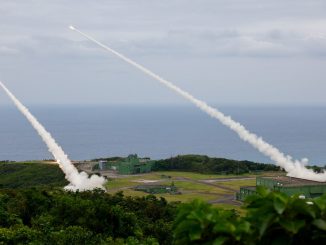
U.S.-supplied HIMARS rocket systems are test-fired by Taiwanese military forces at the Jiupeng base in Pingtung, Taiwan. The ongoing militarization of Chinese territory has accelerated with Washington's record $11.1 billion weapons package.
U.S.-supplied HIMARS rocket systems are test-fired by Taiwanese military forces at the Jiupeng base in Pingtung, Taiwan. The ongoing militarization of Chinese territory has accelerated with Washington’s record $11.1 billion weapons package.

Washington has taken another step toward war with China. By approving the largest weapons package ever sent to Taiwan—$11.1 billion in advanced arms—the United States has intensified a long-standing campaign to militarize Chinese territory.

There is no unresolved sovereignty question in the Taiwan Strait. That question was settled in 1949 with the victory of the Chinese Revolution. What remains is the refusal of U.S. imperialism to accept that outcome.

When the People’s Republic of China was proclaimed, the Kuomintang regime fled to Taiwan under the protection of U.S. military power. That retreat did not create a second China. It created a temporary imperialist foothold on Chinese territory. Every development since then has flowed from that fact.

Restraint, not provocation

For more than seven decades, Beijing has acted with restraint. It asserted sovereignty while avoiding a direct military confrontation that would have given Washington a pretext for open intervention. That restraint was not weakness. It was a conscious political choice shaped by China’s assessment of the global balance of forces. It preserved peace in the Taiwan Strait even as Washington continued to arm, finance, and politically shelter the remnants of a defeated counterrevolution.

The so-called one-China policy did not rest on goodwill or compromise. It rested on the reality that the Chinese Revolution could not be reversed without war on a scale Washington was unwilling to fight. That restraint is now being stripped away.

From ambiguity to open militarization

The recent U.S. decision to approve more than $11 billion in weapons for Taiwan marks a qualitative change. The package centers on long-range strike systems designed for offensive operations, not local defense. 

It includes dozens of HIMARS launchers and hundreds of precision-guided missiles capable of striking targets far beyond Taiwan’s coastline. ATACMS missiles supplied under the deal have ranges of roughly 185 miles, with newer variants reaching more than 300 miles. At the narrowest point, Taiwan lies just about 80 miles from the Chinese mainland. 

Weapons stationed on the island would therefore be able to reach deep into China from the moment they are deployed. Their function is not to shield civilian life, but to fold Taiwan into U.S. war planning as a launch platform for sustained strikes against the mainland—a calculated provocation, not a defensive measure.

This shift did not emerge from misunderstanding or diplomatic drift. It reflects the deeper crisis of imperialism itself. As U.S. economic dominance erodes, military pressure becomes a substitute for lost leverage. Imperialism, unable to coexist with an independent socialist state that has developed its productive forces, turns to encirclement and militarization.

Taiwan is central to this strategy not because of concern for its people, but because of its location and its role in global production. The island is being treated as a fixed platform, a stationary arsenal placed directly on China’s doorstep. The danger to the population arises from this transformation, not from China’s insistence on sovereignty.

A striking feature of the current escalation is its recklessness. Many of the weapons announced will not arrive for years. Yet the provocation is immediate. Imperialism is willing to heighten confrontation today over capabilities that may not materialize until the next decade. This is not strategic foresight. It is the impatience of a system confronting its own limits as economic dominance gives way to military pressure.

Inside Taiwan, this external pressure has distorted political life. Alignment with Washington is presented as security, while the social costs are shifted onto working people. Increased military spending means fewer resources for housing, wages, and social services. The island’s legislature has repeatedly blocked funding for the arms package, revealing resistance within Taiwan’s legislature to increased military spending.

Who is creating the danger

China’s response has been firm but measured. Military exercises conducted by the People’s Liberation Army are not acts of adventurism. They are signals aimed at preventing the permanent militarization of Chinese territory. They are responses to interference, not its source.

This distinction is crucial. Imperialist commentary seeks to portray escalation as a symmetrical process, as if both sides were equally responsible for rising tensions. That framing serves to obscure the real line of motion. The initiative lies with Washington. Beijing’s actions are shaped by the need to block a threat, not to manufacture one.

The question before the world is not whether China will abandon restraint, but whether imperialism will continue to dismantle the conditions that made restraint possible. Peace in the Taiwan Strait was preserved for decades not by arms races, but by the recognition — however grudging — that China’s revolution could not be undone.

There is no progressive outcome in turning Taiwan into a battlefield. Working people gain nothing from being put at risk to preserve U.S. military dominance in East Asia. The drive toward confrontation serves only those whose power depends on dominance, not production; coercion, not cooperation.

Imperialism presents its actions as defense. In reality, it is attempting to reopen a historical question that has already been settled. The danger lies not in China’s unity, but in the effort to prevent it.

Ending the crisis requires ending the interference that created it. Until that happens, imperialism will continue to gamble with the lives of millions in an effort to preserve a world order that no longer corresponds to material reality.


Strugglelalucha256


U.S. expands military encirclement of China across the Pacific

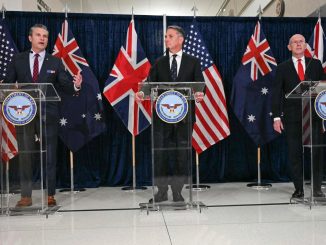
At a Pentagon meeting on Dec. 10, U.S. Secretary of War Pete Hegseth and his counterparts from Australia and Britain pledged to move “full steam ahead” with AUKUS, a trilateral military pact through which the United States is turning Australia into a forward operating base and nuclear-submarine hub for a potential war on China.

In a joint statement, the three governments made clear the pact is about accelerating war preparations — building bases faster, expanding military staffing and pushing weapons development at full speed. 

The announcement came as the United States deployed a pair of nuclear-capable bombers to patrol the Sea of Japan, escorted by Japanese fighter jets. 

One day earlier, on Dec. 9, China and Russia carried out their 10th joint air patrol. The operation involved Russian and Chinese bombers, escorted by fighter jets and early-warning aircraft, flying over the Sea of Japan and the East China Sea. The formation passed through the Miyako Strait, a narrow gap between Okinawa and Miyako Island that serves as one of the main exits from China’s coastal waters into the Pacific.

The Miyako Strait matters because China’s long coastline does not actually open directly onto the Pacific Ocean. Instead, China’s coast borders a series of shallow, semi-enclosed seas — the Yellow Sea, the East China Sea and the South China Sea — that are hemmed in by a chain of islands controlled by U.S. allies. Japan, Okinawa, Taiwan and the Philippines form what U.S. military planners call the “first island chain,” a barrier separating China’s coastal waters from the deep ocean beyond.

To reach the open Pacific, Chinese ships and aircraft cannot simply head east. They must pass through a small number of narrow gaps in this island chain. The Miyako Strait — a wide passage between Okinawa and Miyako Island — is one of the few routes large military formations can use without entering another country’s territorial waters. The corridor is international waters, even though the surrounding islands are controlled by Japan.

That makes the strait a choke point. When Chinese forces pass through it, they are not violating any law. They are moving from shallow coastal waters into deep ocean — the same waters U.S. submarines and carrier groups routinely operate in. U.S. and Japanese forces monitor these passages closely because control of them allows Washington and its allies to contain China’s navy close to its coast and limit its ability to operate beyond the region.

This is why flights and patrols through the Miyako Strait draw such attention. They are treated as extraordinary not because they are illegal, but because they challenge a military setup designed to keep China boxed in while U.S. forces move freely across the Pacific.

For Washington, this is also why AUKUS matters: Nuclear-powered submarines based in Australia are meant to operate on the far side of this island barrier, reinforcing U.S. control of the deep Pacific while keeping China’s navy confined close to its coast.

Japanese officials denounced the joint China-Russia air patrol as a “demonstration of force,” even though it was a routine operation — the 10th such patrol the two countries have conducted together. The flight remained in international airspace, along routes regularly used by U.S. bombers near China’s coastline. U.S. bombers fly these routes routinely without controversy. When China and Russia do the same, it is treated as a threat and used to justify more U.S. military deployments.

Washington’s answer came the following day. Two nuclear-capable B-52 bombers were deployed to the Sea of Japan, escorted by Japanese fighters, in an operation Japan’s Defense Ministry described as a warning against challenges to the “status quo” — meaning continued U.S. military dominance in the region.

Earlier this month, Japanese Prime Minister Sanae Takaichi declared in parliament that a conflict over Taiwan — which is part of China under international law and the One China policy — would constitute an “existential threat” to Japan, effectively aligning Japan’s government with U.S. preparations for military confrontation with China. Beijing condemned the statement as interference.

The danger does not come from any single patrol, but from the political shift by the U.S. Earlier this year, the U.S. State Department removed the phrase “we do not support Taiwan independence” from official policy statements, signaling a shift away from even rhetorical adherence to the One China framework. Combined with Japan’s declaration that Taiwan constitutes an “existential threat,” Washington and Tokyo are moving toward military intervention over Taiwan — steps that sharply raise the risk of war.

These developments in Northeast Asia are tied directly to events further south. AUKUS is part of the same buildup. Announced in 2021 as a security partnership, it has become a channel for pouring government money into militarization. Australia alone has committed an estimated $368 billion to the pact over its lifetime — far more than it spends on housing, health care or climate protection — with Washington now demanding even higher military spending.

Chinese leaders have described this strategy as “containment, encirclement and suppression” — a description borne out by the expanding bases, bomber patrols and alliance commitments now taking shape across the Pacific.

Strugglelalucha256


How the U.S. lost its chip war on China

When the White House quietly approved renewed exports of Nvidia’s H200 AI accelerators to China — with a 25% fee attached — it marked more than a policy adjustment. It marked the effective collapse of Washington’s semiconductor containment strategy. 

After years of escalating export controls, sanctions, and alliance pressure, the United States is now conceding what the chip war made clear: China cannot be technologically frozen, and U.S. monopoly control over advanced technology is no longer enforceable.

According to Bloomberg, the decision was driven by internal concern over Huawei’s accelerating progress in AI hardware and systems. The administration framed the move as a way to preserve U.S. “tech stack dominance,” but the reality is more revealing. 

Washington is retreating from an unwinnable attempt to enforce technological monopoly control, while trying to slow China’s exit from U.S.-controlled software ecosystems, especially Nvidia’s CUDA platform.

This was never about national security. It was always about preserving imperialist monopoly power.

From “Pivot to Asia” to technology war

The semiconductor war did not emerge overnight. It is the culmination of a decade-long imperialist containment strategy aimed at China’s rise. The Obama administration’s 2011 “Pivot to Asia” laid the groundwork, repositioning U.S. military forces around China while signaling the end of unconditional economic engagement. What began as military encirclement soon expanded into economic and technological warfare.

Under Trump, that shift became explicit. Tariffs were imposed. Chinese technology firms like Huawei and ZTE were sanctioned. Access to critical components was cut off. Under Biden, the same strategy was deepened and systematized. Export controls widened. Military alliances such as AUKUS and the U.S.–Japan–South Korea pact fused technological restrictions with strategic encirclement. The semiconductor industry became the central front.

Publicly, these measures were justified as defensive. In practice, they were aimed at preserving the monopoly foundations of the imperialist system. For decades, U.S. power rested on its ability to dominate new technologies long enough to extract enormous super-profits before competitors could catch up. China’s rapid movement into advanced manufacturing, telecommunications, renewable energy, and AI threatened to close that monopoly window.

The chip war was launched to keep it open.

Weaponizing the global supply chain

Washington’s strategy relied on turning the global semiconductor supply chain into a weapon. Because the U.S. historically dominated chip design, software, and key intellectual property, it believed it could enforce obedience far beyond its borders.

Export controls targeted advanced AI processors such as Nvidia’s H100 and H200. The Foreign Direct Product Rule asserted U.S. control over foreign-made products that rely on U.S. technology, forcing companies like TSMC and ASML to comply or lose access to critical tools and markets. Allies were pressured to abandon profitable Chinese markets. Scientific collaboration was restricted. Investment flows were blocked.

The globalized system of production — once celebrated as efficient — was transformed into a gated hierarchy with Washington as rule-maker and enforcer. But this strategy carried an internal contradiction. The same interdependence that gave the U.S. leverage also made it vulnerable to blowback.

That blowback came quickly.

China’s response: planning, scale, and technological sovereignty

China did not respond to the chip war with panic or retreat. It responded with long-term planning tied to production. The confrontation exposed a fundamental clash between two systems: monopoly-finance capitalism and state-led socialist development.

In the United States, AI became a speculative asset. Investment was driven by hype, stock prices, and Pentagon contracts. In China, AI was treated as infrastructure — something to be integrated into manufacturing, logistics, energy systems, and national planning.

Huawei’s progress illustrates this difference. Its Ascend 910C chips are not replicas of Nvidia’s best products, but they are increasingly competitive. The CloudMatrix 384 system compensates for efficiency gaps through scale and coordination, deploying 384 chips in tightly integrated clusters. Huawei has successfully substituted quality (Nvidia’s superior individual chips) with quantity (CloudMatrix’s massive chip clusters), resulting in a system performance that approaches Nvidia’s best in key workloads.

This is not engineering shaped by quarterly profit targets. It is capacity built through long-term state planning and coordination.

U.S. officials reportedly concluded that Huawei could produce millions of Ascend accelerators within a few years. That realization stripped export controls of their force. Instead of stopping China’s advance, containment sped the drive toward domestic production.

The second China shock

The consequences extend far beyond semiconductors. China’s advance represents a second China shock. The first, beginning in the 1990s, followed China’s integration into global supply chains, when U.S. and multinational capital reorganized production internationally — entire industries relocated, millions of jobs disappeared, and working-class communities in the United States were devastated. This second phase marks a break from that pattern. It is centered on China’s own advanced industrial and technological development, not on serving as a manufacturing platform for Western capital.

Chinese firms now lead or dominate in key sectors once assumed to be permanent strongholds of imperialist capital. Huawei in telecommunications. BYD in electric vehicles. CATL in batteries. DJI in commercial drones. Tongwei in solar manufacturing. They strike directly at the monopoly profits that sustained Western dominance.

According to data released on Dec. 1 by the Australian Strategic Policy Institute, Chinese institutions now lead research output in 66 of the 74 critical technologies it tracks — nearly 90% of the fields assessed. The United States leads in only eight. China’s research dominance spans areas central to modern industrial power, including nuclear energy, synthetic biology, small satellite systems, and cloud and edge computing.

This represents a reversal from the early 2000s. At that point, U.S. institutions led the overwhelming majority of advanced research fields, while China accounted for only a small fraction. Over the past two decades, that balance has flipped. China’s lead in cloud and edge computing, in particular, reflects the priority placed on deploying AI at scale — integrating research directly into production, logistics, and infrastructure rather than treating it as a standalone laboratory exercise.

This is why the chip war mattered. It was never just about semiconductors. It was about whether the United States and other imperialist powers could still decide who builds the most advanced technology, who gets access to it, and who does not.

The answer is no. The ability to plan, scale up production, and put technology to work now lies outside their control.

Blowback at home and abroad

The attempt to weaponize global production inflicted serious damage on the United States itself. Reshoring initiatives faltered. TSMC’s Arizona fab — marketed as a symbol of “tech sovereignty” — became a case study in dysfunction, plagued by delays, disputes with U.S. unions over staffing, training, and work practices, and soaring costs. Engineers ultimately had to be flown in from Taiwan to retrain U.S. workers on basic fabrication protocols, exposing the lack of a trained industrial workforce after decades of deindustrialization.

Allied governments and corporations were forced into impossible positions. Companies in South Korea, Japan, and Europe were compelled to sacrifice profits and market access in China for a strategy that primarily served U.S. geopolitical aims. Rather than consolidating control, Washington imposed real economic costs on allied states and corporations, forcing them to absorb losses in markets, supply chains, and investment.

Globally, countries began diversifying away from U.S.-controlled supply chains. The open weaponization of technology made clear that dependence on U.S. systems carried political risk. Claims of a “rules-based order” rang hollow when rules were rewritten at will.

Inside the U.S., the policy fueled a growing military-digital complex. Government money flowed to tech monopolies and defense contractors while social needs went unmet. Even Biden warned of the emergence of a new military-tech complex, in which Big Tech is fused with the armed and intelligence apparatus, concentrating technological and coercive power.

The chip war did not revive U.S. industry. It exposed its fragility.

Nvidia, CUDA, and a strategic retreat

This is the context in which the Nvidia decision must be understood. Allowing H200 exports to China is not a clever compromise. It is a retreat shaped by failure.

Washington is trying to keep Chinese AI firms tied to Nvidia’s CUDA software, slowing the shift toward domestic and open-source alternatives such as Huawei’s CANN. By blocking access to Nvidia’s newest Blackwell chips while allowing sales of the H200, the U.S. is holding back the most advanced hardware while maintaining dependence on U.S.-controlled systems.

Yet even this goal is tenuous. Chinese firms have already demonstrated the ability to train highly capable AI models with fewer resources. Systems such as DeepSeek matched the performance of leading U.S. models by emphasizing training efficiency and better use of available hardware rather than sheer computing scale, undercutting the assumption that restricting access to top-tier chips would halt progress. As domestic hardware continues to improve, software dependence will erode as well.

U.S. export controls were meant to slow China’s access to large-scale AI computing power long enough to give U.S. firms a decisive head start. But China continued advancing anyway — through domestic chip development, scale, and more efficient use of computing resources. As that gap narrowed, the value of strict controls became increasingly uncertain. Faced with the prospect that the restrictions might not stop China but would certainly cut off U.S. corporate profits, Washington chose to reopen exports. In doing so, it accepted a weaker, less durable form of influence in exchange for continued market access.

The end of monopoly enforcement

The chip war’s outcome is now clear. The United States did not fail because of a single mistake. It failed because the strategy itself was flawed. Imperialist monopoly capitalism cannot outplan a system organized for long-term development. Coercion cannot substitute for production. Sanctions cannot replace planning.

By attempting to freeze China’s development, Washington accelerated it. By weaponizing interdependence, it undermined its own position. By prioritizing monopoly profits, it weakened its industrial base.

The reopening of Nvidia exports is not a reset. It is an acknowledgment that the old model of technological domination no longer works. The era when the United States could dictate the terms of global technological development through choke points and monopolies is ending.

What comes next will not be decided by chips alone. It will be decided by which social system can organize production, labor, and technology to meet real needs over time. On that terrain, the chip war has already delivered its verdict.


Strugglelalucha256


China: Building socialism in an imperialist world

China blds Socialism

By Gary Wilson

FREE PDF

China: Building Socialism in an Imperialist World is a report on how over a billion people are building a socialist society inside a world dominated by imperialism. It follows the Chinese Revolution as a long struggle to create new social relations: from the land reform and collectivization that broke feudal power, to the mass campaigns that built industry from scratch, to the Cultural Revolution’s effort to curb rising privilege and keep the revolution on a socialist path.

The report shows how socialist construction created the foundations of modern China: state ownership of key sectors of industry, technology and banking, planning, broad participation, universal education and healthcare, and an industrial base able to withstand pressure from the capitalist powers. It also examines how these foundations were strained after 1978, when market policies widened inequality and allowed new layers of privilege to grow — and how today’s leadership is working to limit these pressures and strengthen the role of state ownership and planning.

Instead of treating China as a puzzle or a template, the report approaches it as a workers’ state developing inside a global capitalist order. China’s advances and its difficulties both arise from the ongoing work of socialist construction — work shaped by struggle, challenged by capitalist forces, and still rooted in the revolution of 1949.

China: Building Socialism in an Imperialist World offers a clear, direct account of how socialism is built in real conditions — and why that process continues to shake the world system shaped by imperialism.

Strugglelalucha256


China: Building socialism in an imperialist world

Part 1: How China fought to build a new society

China’s rise as the world’s major industrial center is reshaping the global economy. What was once concentrated in the United States, Western Europe, and Japan has shifted toward China, where hundreds of millions of workers now produce the machinery, electronics, and manufactured goods that underpin everyday life around the world.

This shift disrupts the underlying economic structure of imperialism that has governed the world capitalist system for more than a century — where dominance in the most advanced sectors of production has provided the capitalist powers with a decisive material advantage.

China’s lifting of more than 800 million people out of extreme poverty since the late 1970s has been the largest global reduction in economic inequality in modern history. It’s a victory of socialism.

The contrast with the United States and other imperialist powers is stark. As China eliminated extreme poverty, the U.S. saw homelessness rise, hunger worsen, wages stagnate for almost two decades, and millions pushed into unstable, insecure living conditions despite enormous national wealth. 

Deep poverty is a significant and persistent issue in the U.S. Approximately 5.0% of the population lives in deep poverty, and 40% are poor or low-income. The difference is structural: one system mobilizes around human need, the other around corporate profit. 

China’s role in the world today cannot be separated from the long course of its revolution: the victory over foreign domination in 1949; the first decades of socialist construction; the Cultural Revolution to block the rise of a new privileged stratum; and the post-1978 turn that opened space for private capital and created the mixed system whose contradictions still shape China’s development.

Socialism means social ownership of the means of production and an economy organized to meet people’s needs rather than maximize profit. That is the core of the struggle.

Development under capitalism and socialism follows two very different paths. Capitalism expands through its own internal motion, driven by competition and profit. It can operate under almost any political form — parliamentary democracy, military rule, even open fascism. Its crises are periodic and unavoidable: when the system breaks down, production collapses, jobs vanish, and living conditions for the most exploited layers take the hardest hit. Yet capitalism rebuilds itself on the same foundations, preparing the ground for the next crisis.

Socialist development is different. It does not arise spontaneously. It has to be built — through planning, public ownership, and a workers’ state led by a revolutionary party. Without the leadership of a party firmly anchored in socialized property and committed to advancing socialist construction, the system does not simply stall. It begins to break down and open the door to capitalist restoration, often in conditions marked by intense struggle.

China is a workers’ state (that’s what Lenin called the Soviet Union) that retains the core instruments of proletarian power: state ownership of key sectors of industry, technology and banking; central planning capacity; Communist Party control over the military and political system. But the market policies introduced from the late 1970s onward left their mark. They created a large private sector, pushed profit-driven practices deep into the economy, widened income gaps, and fostered a privileged layer whose outlook leans toward capitalism. Under Xi, the state has moved to check these tendencies and curb corruption, but the pressures built up over those earlier decades have not simply disappeared. They continue to shape the ground on which socialist construction has to advance.

To understand China today means looking at how a workers’ state was built, how it developed under pressure, and how it faced the threats of imperialism — in China and in the Soviet Union.

The revolution begins: 1949 and after

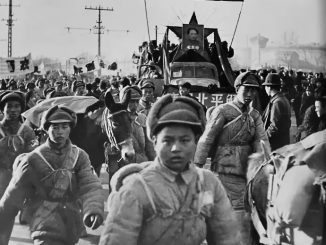
Every revolution inherits the contradictions of the society it destroys. When the People’s Liberation Army entered Beijing in 1949, China did not become socialist overnight. It became a workers’ and peasants’ government leading a country devastated by foreign occupation, warlordism, and deep underdevelopment. The new state united workers, peasants, sections of the national bourgeoisie, and petty-bourgeois layers in a common front against imperialism and feudal remnants. Socialist transformation had begun, but it was far from complete.

Mao and the Communist Party accurately described the new state as a “people’s democratic dictatorship” — a workers’ and peasants’ republic with allied classes — not yet socialism. This was not a semantic distinction. It reflected the real class composition of the new state. Many private owners — from larger national capitalists to small shopkeepers and richer peasants — remained in place. Commodity production continued, and many capitalists were compensated rather than expropriated.

Foreign observers grasped the ambiguity. Owen Lattimore, Washington’s China expert, argued that the new regime was not a “second Soviet Union,” while some liberals insisted that China’s transformation resembled earlier peasant rebellions — another Li Zicheng moment in which a dynasty collapses but the underlying order persists. They misunderstood the character of the Chinese Revolution but recognized something real: the danger that, without a deeper socialist transformation, the old relations could reassert themselves.

The Chinese Communists understood this danger better than anyone. They knew that overthrowing the landlords and the bourgeois strata that served foreign capital was only the first step. The revolution had to keep advancing — through technological modernization, national planning, and the broadest mass participation. That meant a party capable of educating, organizing, and unifying the people, and fighting for their active, conscious involvement in the work of socialist construction. Without this second step, China could sink back into dependency, deepening economic divisions, and imperialist subordination.

The unresolved class contradictions of the early People’s Republic of China gradually reappeared inside the Party itself. The survival of commodity relations, the persistence of privileged strata, and the pressures of uneven development created fertile ground for new bourgeois tendencies to emerge within the administrative apparatus.

By the early 1960s, the Communist Party had become the battleground. The administrative layers of the state were solidifying into entrenched privilege. Officials with specialized knowledge and control over resources formed a stratum increasingly separated from the working class. Inside the Party, rightist forces led by Liu Shaoqi and Deng Xiaoping pushed for policies that increased economic inequality and reopened channels to capitalist relations. Khrushchev’s post-1956 course in the Soviet Union emboldened these elements, offering a model for retreat under the banner of “modernization.”

Mao recognized that the danger of restoration did not come only from outside pressures — from imperialist powers like the United States and Japan — but from within the socialist state itself. Bureaucratic privilege, widening economic inequalities, and the growing distance between officials and the masses prepared the soil for new exploitative tendencies to take root.

It was this danger — more than any economic difficulties — that set the stage for the Great Proletarian Cultural Revolution and framed how China faced the already deepening crisis in its alliance with the Soviet Union.

These internal tensions met an external crisis that helped bring them to a breaking point.

The Sino-Soviet split and the imperialist wedge

To understand how relations between the USSR and the People’s Republic of China unraveled so sharply, it helps to look back at Lenin’s last political writings. Long before Mao and Khrushchev exchanged polemics, Lenin warned that the young Soviet state carried within it the dangers of “Great-Russian chauvinism”—a legacy of the old empire that could distort relations between socialist nations if not fought relentlessly. Those warnings became one of the buried fault lines that later widened into the Sino-Soviet split.

Lenin insisted that a socialist union could not be held together by administrative command or by the habits of an old ruling nationality. The new union had to be built on equal footing among formerly oppressed peoples. In the struggle over how to form the USSR in 1922, Lenin criticized Stalin’s plan to fold the non-Russian republics into the existing Russian federation. He argued instead for a voluntary union of equal republics, with full recognition of the right of oppressed nations to shape their own development. Anything less, he warned, would reproduce the arrogance of the old empire inside the workers’ state itself.

These were not abstract concerns. Lenin spoke openly about “imperialist attitudes” surviving in the mindset of officials who, though members of a revolutionary party, still carried the habits of the old bureaucracy. He cautioned that if the Soviet leadership treated smaller nations dismissively, it would undermine the credibility of socialist internationalism—especially in Asia, where national liberation movements were awakening.

These insights help explain the later difficulties between the USSR and China. The Chinese revolution arose in a country battered by foreign occupation and internal stagnation. Sensitivity to national dignity came from lived experience with imperialist domination, not from rhetoric. When Soviet leaders, especially under Stalin, dealt with the Chinese Party in a paternalistic or heavy-handed way, it struck at precisely the danger Lenin had warned about.

During the battle between China’s Communists and the Kuomintang after World War II — Stalin’s approach reflected a mixture of caution and diplomatic maneuvering. He doubted the Chinese Communist Party could win and pressured it to compromise with Chiang Kai-shek. Even after victory, Stalin initially hesitated to treat the Chinese revolution as a full partner. The Chinese understood these actions as great-power behavior. 

As Chinese leaders later said, “Stalin displayed certain great-nation chauvinist tendencies in relations.”  Yet despite these frictions, the 1949 revolution produced real unity. Soviet aid during China’s early socialist construction was enormous. Chinese leaders publicly praised Stalin, stressing the “unbreakable friendship” between the two socialist states.

The relationship began to fray only after Stalin’s death. Khrushchev’s policies combined partial criticism of Stalin’s excesses with a turn toward “peaceful coexistence” and diplomatic conciliation with the imperialist powers. For a country that had faced U.S. forces in Korea and U.S. pressure over Taiwan, Khrushchev’s shift appeared to play down the threat of imperialism. Still, the Chinese did not question the socialist character of the USSR; they saw the issue as a wrong line within a sister party in the socialist camp.

The deeper break came when Moscow acted unilaterally in ways that touched national dignity—just as Lenin had warned. The abrupt withdrawal of Soviet aid in 1960, the nuclear test ban negotiated behind China’s back, and Soviet maneuvering with India during border tensions all confirmed for the Chinese that they were not being treated as equals. What began as ideological disagreement came to feel more and more like China being talked down to.

Inside China, these tensions developed in parallel with the Cultural Revolution, which intensified criticism of bureaucratic privilege — in China and in the Soviet Union alike. Out of this heated atmosphere came new labels: “restored capitalism,” “social imperialism.” These terms expressed genuine anger at chauvinist behavior by Soviet leaders but did not reflect the material reality of the USSR, which remained a workers’ state with socialist property relations born of the October Revolution. Lenin’s distinction between leadership errors and the class character of the state was lost in the storm.

By the late 1960s, the conflict spiraled into border clashes, giving imperialism an opening it had long sought. The tragedy is that the split was not a clash between two social systems, but the triumph of the dangers Lenin warned about: bureaucratic narrowness, the great-nation chauvinist habits the Chinese had long criticized, and the ongoing pull of old privileged hierarchies.

The Cultural Revolution: A mass struggle to defend the socialist gains

The Great Proletarian Cultural Revolution (1966–76) was launched to confront the same danger that had already overtaken the Soviet Union under Khrushchev — the rise of a privileged layer inside the socialist system that could steer the state back toward capitalism. This danger did not come from old landlords or foreign invaders alone. It came from the social pressures of the world capitalist system itself, which continued to assert influence through the uneven economic conditions, habits, and bureaucratic tendencies left over from class society. Mao believed that unless these pressures were confronted directly, China would face the same retreat.

The response was to turn to the masses — the only force capable of answering a struggle that had shifted onto political ground inside the state. Workers, peasants, and especially students were called on to challenge officials whose authority was separating them from the people and bending the revolution toward a new hierarchy. This was not a matter of discipline or administrative reform. It was class struggle, unfolding within the institutions that had been created to abolish class rule.

The confrontation with Liu Shaoqi made this clear. Liu did not stand for a single mistaken viewpoint; he expressed a political tendency that grows whenever a privileged stratum develops inside a socialist state. This tendency does not have to call itself capitalist. It shows itself through the defense of special advantages, a reliance on bureaucratic authority over mass initiative, and a pull toward the methods and values of the old society. The struggle against Liu’s faction was, in reality, a struggle over whether this privileged stratum would consolidate enough influence to steer the revolution toward capitalist restoration.

The Cultural Revolution’s greatest accomplishment was that it shifted the balance of power back toward the masses. Their participation reasserted that only the people can determine the direction of socialist development. It cut into the growing influence of a privileged layer that was distancing itself from the people and stopped those pushing for a turn away from socialism from gaining ground.

This follows what Engels observed about earlier revolutions: the first victory overturns the old ruling class. The next struggle arises inside the new society itself, against conservative forces that try to revive elements of the old order in new forms. China’s 1949 Revolution established a workers’ and peasants’ state, but its gains were not guaranteed. The Cultural Revolution acted as this second wave — the effort required to prevent an emerging stratum of officials from gaining the authority to reverse the accomplishments of the first wave.

The achievements of the Maoist period — the expansion of collective industry, the rise of social equality, the mass mobilization of working people in public life — were defended because millions intervened at a decisive moment. Their actions prevented privileged forces within the state from consolidating enough power to turn China back toward capitalism. For a crucial period, the Cultural Revolution stopped the gains of 1949 from being rolled back.

Because the gains of 1949 were defended at a decisive moment, China could move forward with the long-term work of socialist development. What came next was not a pause in the revolution but its extension into the fields, factories, and social institutions that shaped daily life.

Mao’s economic record revisited

China’s economic record from 1949 to 1976 is often portrayed in Western accounts as stagnation and failure. The story has been repeated so widely in corporate media and academic writing that it’s taken as fact. The actual record shows something different: a period of extraordinary change under conditions of imperialist pressure and deep poverty.

In the first decades after 1949, China’s industrial growth often approached the pace of the early Soviet Union — one of the only countries to industrialize so rapidly in the 20th century. For a nation emerging from colonial underdevelopment, this was an exceptional achievement.

Entire branches of heavy industry were created from nothing. Life expectancy nearly doubled. Illiteracy fell at a rate unmatched in much of the developing world. Rural healthcare, education, electrification, irrigation, and basic infrastructure expanded at a speed that capitalist governments had never achieved over centuries of rule. By the mid-1970s, China had full employment even as many countries in the global South faced recession, structural adjustment, and deepening dependency.

These advances did not arise from “catch-up capitalism.” They were the product of a socialist state mobilizing millions through collective planning, mass campaigns, and the political energy released by a revolution that had overturned feudal landlords and foreign domination.

The Mao-era period of socialist construction built the industrial, scientific, and social base for China’s later development. Without the foundations created through collectivization, cooperative agriculture, public ownership, and mass participation, there would have been no platform for the policies that came in the late 20th century.

None of this suggests the era was without contradictions or setbacks. The Great Leap Forward faced severe difficulties and produced major crises. The Cultural Revolution was a turbulent attempt to confront rising privilege. The revolution was unfolding in one of the poorest countries on earth, ringed by hostile imperialist powers, cut off from global markets, and lacking a developed administrative and technical layer. Under those conditions, sharp turns and mistakes were unavoidable.

The dominant Western storyline — chaos, irrationality, and collapse — says more about political agendas than about history.

The struggle over development

Since Mao’s death, critics have charged that the Cultural Revolution blocked modernization, targeted the Four Modernizations, or pushed “reactionary egalitarianism.” These charges fall apart the moment they’re examined.

The Cultural Revolution leadership never rejected technological development or improvements in people’s material lives. They rejected only the claim that modernization required reproducing capitalist hierarchies and sharpening economic divisions. They insisted that developing productive forces and narrowing class differences were not incompatible but essential to socialism.

Remember Marx’s “Critique of the Gotha Program.” Marx explained that socialism doesn’t start on a clean slate. It begins with “birthmarks” of the old society still attached. In the early stages, people receive according to the work they perform, not according to their needs. That system carries over some economic divisions from the past. Only through long-term development can a society reach the higher principle of “from each according to ability, to each according to need.”

The Cultural Revolution didn’t reject development — it rejected locking early, unequal arrangements in place. For Marx, “distribution according to work” was never a timeless rule; it was a stopgap shaped by the economic divisions inherited from capitalism.

Lenin later put it plainly: a workers’ state has to uphold certain inherited forms — wage norms, administrative routines, even legal coercion — even as it struggles to move beyond them. These contradictions don’t disappear; they create space for new privileged layers to form inside the socialist system.

The Cultural Revolution raised the question: how can a socialist society reduce economic divisions without undermining its own material base? Its answer was to mobilize the masses against privilege — not against productive labor. The struggle was aimed at those who defended hierarchy and special privileges, not at skilled workers or necessary specialists. When Soviet workers later protested managerial privilege, they faced similar accusations of “leveling.” In both China and the USSR, attacks on “levelers” were often veiled attacks on workers resisting bureaucratic domination.

The upheavals of the Cultural Revolution reflected how hard it is to wage class struggle inside a socialist state. Bureaucratic power had deep historical roots. The working class was still young, dispersed, and unevenly developed. China was under military and political siege — from its western borderlands to the Taiwan Strait. A revolution in these conditions won’t advance through polite argument. It has to fight — often fiercely — to hold its course and prevent new privileged layers from consolidating.

The defeat of the left after Mao

Mao’s death on September 9, 1976, opened a sudden struggle over where the revolution would go next. The arrest of Chiang Ching, Chang Chun-chiao, Wang Hung-wen, and Yao Wen-yuan weeks later signaled the defeat of the forces that had tried to keep class struggle at the center of socialist development.

The Shanghai working class — the backbone of the Cultural Revolution — did not mobilize in their defense. Whether workers were exhausted, confused, or simply outmaneuvered, the absence of resistance allowed the new leadership to move quickly and consolidate control.

What followed was a classic Thermidor — a term drawn from the French Revolution meaning a retreat from the revolutionary high point. It wasn’t a counterrevolution, but a sharp shift in power away from the revolutionary left and toward forces more willing to revive bourgeois norms and market pressures.

Recognizing this defeat is essential. The so-called “Gang of Four” were not a fringe group; they represented the current inside the Party that sought to defend — and deepen — the gains of the Cultural Revolution: workers’ oversight of officials, political struggle against bureaucratic privilege, and efforts to keep socialist planning under popular control. Their removal cleared the way for a right-center bloc that viewed these mechanisms of working-class supervision as obstacles rather than safeguards.

This setback had international repercussions. It strengthened conservative trends in the world movement and reinforced revisionist currents in the USSR and beyond.

Those who call the Cultural Revolution an “error” or “tragedy” misunderstand its purpose. It was a political and ideological battle waged under the most difficult conditions to defend the proletarian character of the revolution. It confronted the central contradiction of the socialist transition: socialist property relations can coexist with bourgeois social relations for an extended period, and unless the masses intervene, the latter can grow strong enough to turn the entire society backward.

The contradiction persists. Every socialist state is threatened not only by imperialist attack but by internal forces shaped by hierarchy, uneven economic conditions, and the persistence of commodity relations.

Imperialism has never let up. The same powers that once invaded and partitioned China, backed reactionary forces against the revolution, threatened nuclear attack in the 1950s, kept China out of the United Nations for a quarter-century, and ringed the country with military bases now work to weaken and contain its development. Whoever leads the Chinese state, Washington’s goal remains the same: to reduce China to a neocolonial subordinate.

Part 2: What a socialist state Is — and how it can be lost

A state marked by the old society

Lenin had a striking way of describing the first steps of socialism. He called the workers’ state, in a certain sense, “a bourgeois state without the bourgeoisie.”

What Lenin meant was straightforward. When workers take power, they don’t start from scratch. They inherit the machinery of the old society — wage systems, office routines, legal rules, managers and specialists shaped by capitalism. You can’t sweep all of this away overnight without stopping the economy. Some of these old forms have to remain for a time, even though they come from a society the revolution is trying to move beyond.

Lenin wasn’t saying socialism remained capitalism. He was pointing out that some structures carried over from capitalism had to be used for a time while new socialist relations were built through planning and the active involvement of the masses.

The early Soviet Republic made this contradiction plain. The Bolsheviks overthrew the old ruling class, expropriated the capitalists, and nationalized the banks and major industries. But they inherited a country shattered by war, with little industry and a largely illiterate population. To keep the railroads moving and the factories and hospitals running, they brought in thousands of former Tsarist specialists. These experts carried hierarchy and privilege with them into the new society. Lenin despised these traits, but he knew they couldn’t be swept away overnight. He called them the “birthmarks” of the old order — problems to handle while a new society was being built.

Lenin pointed out in “The Impending Catastrophe and How to Combat It” that monopoly capitalism had already built some of the structures socialism could use. The big capitalist trusts had centralized production on a huge scale. Under a workers’ state, that machinery could be turned toward planning. The form looked capitalist, but its purpose changed once it came under proletarian control.

The same was true of surplus value. Workers still perform surplus labor under socialism — but it’s no longer taken as private profit. The issue is who controls that surplus and what it’s used for. In the early USSR, it went into the state budget and was used to expand production, build schools and hospitals, and defend the new society.

But the Soviet experience also showed the dangers. A privileged bureaucratic layer can grow even without a capitalist class. Some officials began to claim better conditions and use their positions to steer resources toward themselves. Lenin warned again and again that if this wasn’t checked, it could bring back the very inequalities socialism set out to end — and even open a path back toward capitalism.

The crisis that led to the New Economic Policy brought these contradictions into the open. Civil war had wrecked the economy, hunger was spreading, and peasant uprisings threatened the workers’ state. War Communism — an emergency system of tight central control — had hit its limit. Lenin introduced the NEP as a tactical retreat: a temporary use of markets, small private trade, and limited foreign concessions so the revolution could survive.

Even then, the core of the economy stayed under workers’ control. Heavy industry, banking, and foreign trade remained in state hands. The “NEPmen” ran small shops and petty businesses, but they had no political power. The whole setup was understood as temporary — a breathing space. By the late 1920s, the NEP gave way to socialist industrialization. Its contradictions were real, but they didn’t produce a capitalist class.

Lenin’s approach helps in understanding China today. A workers’ state in a capitalist world can’t build socialism with brand-new tools; it has to work with what it inherits — markets, private firms, even foreign investment — while holding political power in working-class hands. These compromises don’t mean capital runs China. They show the contradiction China is working through: capitalist pressures on one side, and a Party and state that still direct planning, mobilization, and national development on the other.

What matters is not whether capitalist methods appear, but whether capitalist relations take command.The party and the state: two different tasks

Lenin made a distinction that matters for any socialist transition, including China’s. The workers’ state and the revolutionary party don’t play the same role. When those roles blur, the risks of bureaucracy, privilege, and even pressures toward reversal grow quickly.

The state takes on the practical work of running a modern society. It has to keep production going, defend the country, manage distribution, and keep daily life functioning. That can’t be done by willpower alone. It depends on inherited forms — wage systems, managerial layers, legal structures, accounting methods, and specialists shaped by the old society.

The party, though, has a different role. Its task isn’t to operate the old machinery the revolution inherited, but to move society beyond it.

Under socialist construction, the party’s role is to help the working class make sense of the society it is building. By drawing on people’s own struggles and experiences and working through them collectively, the party strengthens the political understanding needed to guide production, defend the revolution, and solve problems together. This helps millions take part in running the country and shaping its direction — not as spectators, but as active participants.

The party has to push back against the pull of old habits — privilege, hierarchy, and the notion that some people deserve more because of their position or skill. These are remnants of “bourgeois right,” the old idea that unequal rewards are normal. The party’s work is to keep the masses at the center of socialist construction and hold to the aim of a society without exploitation or deep-rooted economic divides. It is the conscious force that moves beyond the limits the state still has to manage.

Lenin warned that without this distinction, the party could be pulled into the state apparatus. When party cadres start to see themselves mainly as administrators — managers, supervisors, technical overseers — the inherited forms of capitalism can stop being temporary tools and start rebuilding capitalist relations. Specialists, managers, and bureaucrats, necessary in the early period, can consolidate privileges that widen the distance between the apparatus and the working class. The result isn’t just inefficiency or corruption, but social forces whose interests point back toward bourgeois norms.

A socialist state operating in a hostile capitalist world may allow private enterprise, rely on market signals, use wage differentials, or enter joint ventures with foreign companies. These measures don’t by themselves determine the system’s class character. What matters is who directs them and for what purpose. Under a capitalist state, “state capitalism” strengthens bourgeois rule. Under a socialist state, similar measures can be used to develop socialist property, defend national sovereignty, and build the foundations of a new society.

But this is possible only if the party holds on to its revolutionary character — if it continues to act as an organizer of class struggle rather than slipping into the role of an administrative appendage. When the party sinks into the state and lets its transformative work fade, the advantages held by officials and specialists can harden into a new hierarchy that threatens the gains of the revolution.

This danger is not abstract. It shaped the internal crises of the Soviet Union and later China. In both cases, when the party slipped into bureaucratic administration or adopted a pragmatism cut off from class analysis, privilege grew, inequalities widened, and the pull of the capitalist world market strengthened. The contradictions of socialist transition — the birthmarks of the old world — became openings for pressures toward restoration.

For China, the point is straightforward. A socialist state may use markets, allow private capital, or take part in global trade as part of its development. But the party cannot turn these practical steps into permanent principles. Its task is to push back against capitalist pressures, keep concessions from hardening into new class interests, and hold the transition on a socialist path.

This distinction between party and state — between administration and transformation — shaped the crises of both the Soviet Union and China. In the USSR, the Communist Party’s slow absorption into the state weakened its ability to push back against the bureaucratic forces that later lined up with restoration. In China, the Cultural Revolution grew out of the sense that too many officials were becoming administrators cut off from revolutionary aims. And when Deng Xiaoping expanded market mechanisms, the danger was not only economic but political: the Party could stop trying to change capitalist relations and instead end up managing them. To see how these tensions played out — in the Soviet experience, in Mao’s time, and in the decades since — we have to look closely at their actual history.

The consequences of misidentifying class forces

The Sino-Soviet rift grew out of U.S. imperialist maneuvering and the shift in the Soviet leadership after Stalin. But inside that conflict, some of the Chinese leadership’s own formulations carried their own contradictions. In the heat of the struggle, Mao called the Soviet bureaucracy a “new bourgeoisie,” a phrase that blurred the difference between bureaucratic privilege inside a workers’ state and an actual capitalist class.

The Soviet Union had real bureaucratic distortions — Lenin once wrote, “What we actually have is a workers’ state … with bureaucratic distortions” — but it remained a workers’ state until its final years. The bureaucracy was a corrosive layer, not a new owning class with its own property system.

When the USSR was described as “social imperialist,” the distinction between a workers’ state weighed down by bureaucracy and a capitalist-imperialist power was lost. Once that line was blurred, the basis for proletarian internationalism weakened. If the Soviet Union was treated as a capitalist empire — no different from or even worse than the U.S. — then the whole map of friends and enemies shifted.

Once the USSR was cast as the main danger, tactical cooperation with the United States became thinkable. The irony is clear. The Cultural Revolution, launched to challenge what Mao saw as a drift toward capitalist practices, also created openings that U.S. imperialism later used. The approach to Washington begun under Mao to counter the USSR became, under Deng, one of the routes through which market mechanisms and deeper integration into global capitalism advanced.

The weakening of planning’s ideological foundation

A similar pattern appeared in the attacks on planning. The Cultural Revolution aimed to confront bureaucratic privilege — the layer of officials drifting away from the working class. But as the struggle sharpened, the planning apparatus itself was sometimes cast as the problem, as if the tools needed for socialist development were simply another expression of entrenched bureaucratic power.

This blurred the distinction between bureaucracy and planning. Planning, with all its flaws and risks of abuse, stopped being viewed as a means for working-class control and started to look like a source of domination. In criticizing the “Soviet model,” the fight against bureaucracy ended up weakening institutions that socialist development depended on.

By the late 1970s, supporting planning could be branded as “pro-Soviet” or “revisionist.” Left forces inside the Party found themselves on the defensive, unable to offer a clear alternative to market policies without being tied to a model that had fallen out of favor during the Cultural Revolution’s last years. This opened space for the new leadership to argue that expanding market mechanisms was not a turn toward capitalism but a necessary correction to bureaucracy.

The theoretical vacuum and its exploitation

These shifts left an ideological gap. If the Soviet Union was no longer seen as socialist, and if planning itself was treated with suspicion, the meaning of socialism drifted toward something abstract — a moral stance rather than a concrete system of property, planning, and working-class power.

This gap also dulled the Party’s sense of how class forces develop. Without a clear understanding of how capitalist relations reappear inside a socialist state, the rise of private capital, wage gaps, and market competition could be treated as neutral measures instead of signs of class pressures. A new privileged layer could grow without being named, because the tools for identifying it had been blunted.

The Three Worlds Theory pushed this further. It cast the U.S. and the USSR as competing “superpowers” and grouped China with the “Third World,” a framing that stripped the global struggle of its class content and turned it into a rivalry among states. By treating the Soviet Union as the main danger, national strategy rose above proletarian internationalism, and cooperation with Western capital began to appear normal.

Deng kept this strategic outlook while putting aside the older language. Special Economic Zones, joint ventures, and foreign investment became the economic expression of a geopolitical direction already taking shape.

This doesn’t mean the Cultural Revolution paved the way for Deng — the two tracks were opposed. But some of the conclusions reached in its final years — calling a privileged layer a “new bourgeoisie,” weakening support for planning, and treating the USSR as a “superpower” rather than a workers’ state — created openings that later leaders could use.

These unresolved tensions set the stage for the battles that followed Mao’s death.

The exhaustion that opened the door

By 1976, the Party had endured ten years of fierce struggle. The Cultural Revolution energized the masses but also left institutions strained and divided. Many provincial and local cadres wanted stability and clear administration, not a retreat from socialism. Deng tapped into this desire. His message of “emancipating the mind,” restoring order, and focusing on development appealed to those who associated mass mobilization with disruption instead of strength.

Mainstream narratives portray Deng Xiaoping’s ascent as “pragmatism” triumphing over ideology, with “seeking truth from facts” held up as proof that socialism needed the market to move forward. But this framing masks the substance of the turn: a rebalancing away from socialist planning and toward market mechanisms that widened the space for capitalist relations and a new layer of privilege.

In practice, Deng’s “pragmatism” meant loosening central controls, shifting authority to local governments, inviting foreign capital, and restoring profit incentives in agriculture and industry. None of this was presented as a break with socialism. Deng argued it was necessary to “develop the productive forces,” even if it meant “letting some people get rich first.” “Socialism with Chinese characteristics” became the ideological cover for a strategy whose real content was the broad expansion of market relations inside a socialist state.

Lenin warned that philosophical “pragmatism” — judging policies only by what seems to work in the moment — is a bourgeois outlook. Capitalism encourages people to prize whatever “works” inside the system rather than question the system itself. When this becomes the guiding method, it can end up restoring what socialism seeks to move beyond. In China, policy debates increasingly turned not on socialist principle but on which measures brought in investment, raised output, or filled local budgets.

A large private sector was developed. State enterprises were restructured, corporatized, or privatized. Stock markets were created. Foreign capital flowed into Special Economic Zones. Profit became the central regulator of vast sectors of the economy. A domestic bourgeois layer took shape — not dominant, but increasingly visible and even represented in official bodies like the National People’s Congress.

As market policies advanced, administrative authority became a key site of private enrichment. Officials who controlled land approvals, credit access, and restructuring decisions held practical gatekeeping power in a partially marketized economy. Property remained publicly owned, but access flowed through discretionary decisions and personal networks. This allowed a new layer of well-connected officials and intermediaries to turn political position into material advantage, even if they were not private owners of capital.

By the 1990s and 2000s, corruption was woven into the development model itself. Local governments relied on land leasing and real-estate projects to finance budgets, creating strong incentives for rent-seeking. Guanxi networks — webs of personal ties functioning much like U.S.-style political patronage or insider connections — adapted to the new environment, serving as channels for favoritism, insider access, and protected deals, while princeling families moved easily through banking, real estate, and emerging private industries. Periodic crackdowns hit prominent cases but left the structural incentives of market policies intact. Corruption was not a deviation from the system — it became one of its regular operating methods.

The spread of corruption reshaped everyday life as well. As land deals, real-estate projects, and insider networks became central to local growth, uneven economic conditions widened and regions diverged sharply. Speculation bled into housing, finance, and enterprise, creating bubbles and new avenues for abuse. For working people, the transition meant plant closures, layoffs, and growing insecurity. Poverty increased dramatically and income inequality is roughly in the same high range as the U.S. 

At the same time, a narrow layer — those with special access to state authority and emerging market opportunities — was able to secure personal fortunes and privileges that had been impossible in the Maoist years. The social fabric tightened and frayed under these pressures, exposing divisions that earlier decades of socialist construction had struggled to contain.

Gramsci and China: War of position?

In some academic and left circles, a claim has taken hold that China’s post-1978 turn reflects Antonio Gramsci’s idea of a “war of position.” In this view, China’s entry into the world market was a strategic move — using the existing system to build national strength while keeping state power firmly in Party hands. Market policies are reinterpreted as a long, patient road toward socialism.

It’s an appealing argument: the notion that Deng’s direction was not a retreat but a slow advance.

And it’s true that the Party kept political control through these years. But that alone doesn’t make it a “war of position,” nor does it match what Gramsci was talking about.

Gramsci used “war of maneuver” and “war of position” to describe two ways revolutionary struggle can unfold: a direct fight for state power, or a slower effort to build working-class strength inside society itself.

His idea of a “war of position” grew from studying advanced capitalist countries, where the bourgeoisie ruled not only through force but through dense cultural, political, and ideological institutions. In that setting, it meant building up proletarian strength in civil society — creating workers’ institutions, cultural influence, and political authority capable of challenging bourgeois rule. The aim was to develop the working class as an independent force, preparing it for a future confrontation over state power.

A real “war of position,” then, is not defined by holding political power at the top. It depends on strengthening the organization, confidence, and institutions of the working class — expanding its role in economic life and deepening its place in society. Without that, the concept doesn’t hold.

What Deng’s policies actually did

Nothing in Deng’s approach resembled a “war of position.” The policies did not build independent working-class institutions — many that existed were weakened or dismantled. They did not broaden the role of the proletariat — they expanded market relations, profit incentives, wage gaps, and competition. They did not strengthen collective participation — they elevated managers and empowered local officials who increasingly acted like corporate executives. Whatever “positions” were gained belonged to administrative and market actors, not the working class.

Deng never presented it differently. He did not speak of building working-class leadership or preparing the ground for a higher stage of socialism. His focus was straightforward: growth, investment, productivity — even if this widened inequality and fostered private wealth. The language of class struggle faded, replaced by talk of efficiency, modernization, and national revival.

The use of Gramsci to explain this turn repeats an old pattern. After Gramsci’s death, Palmiro Togliatti and the Italian Communist Party recast the “war of position” as a rationale for settling into permanent parliamentary accommodation and postponing any break with the capitalist state.

What began as an analysis tied to specific conditions in Gramsci’s notebooks became, under Togliatti, a cover for class collaboration. (A sharp contemporary critique came from the Communist Party of China in the December 31, 1962 People’s Daily editorial “The Differences Between Comrade Togliatti and Us,” which challenged Togliatti’s parliamentary line and linked it to the wider revisionist drift of the Soviet leadership.)

In both cases, Gramsci’s categories — pulled out of their original context — end up serving as alibis for retreat.

This Gramsci-inspired reading also obscures the real contradiction. China is not carrying out a quiet, long-term socialist siege through capitalist methods. It is moving through a contested terrain where socialist forms coexist with expanding capitalist relations — and the struggle over which direction will prevail is still unresolved.

Lenin’s NEP and Deng’s turn: two different roads

Comparisons between China’s post-1978 policies and Lenin’s New Economic Policy are often made, but the situations were fundamentally different. Both used markets, but for different reasons and with different results.

Lenin introduced the NEP in 1921 to pull a workers’ state back from the edge of collapse. It was conceived as a temporary step. Heavy industry, banking, transport, and foreign trade stayed under workers’ control. Private traders operated at the margins and held no political power. After seven years, the NEP was replaced by socialist industrialization.

Deng’s course pointed in a new direction entirely. China in 1978 was not facing a breakdown of the state. Household contracts, rural markets, joint ventures, and other early measures were framed as a long-term approach. Over time, they created a mixed economy: a sizable private sector, corporatized state firms, stock markets, and expanding foreign capital. Profit became a central regulator, and a domestic capitalist stratum took shape.

The contrast is straightforward. Lenin allowed narrow private trade while keeping full command of the decisive sectors. Deng’s changes brought capitalist relations into a socialist framework. And while the NEP lasted seven years, China’s market era has continued for more than 45 years — long enough to alter class relations and form new social forces.

Even so, China did not undergo full capitalist restoration. The state still commands the strategic sectors, the financial system, the military, and the overall direction of national development. Planning capacity remains. These pillars keep China in a contradictory position: a workers’ state in structure that coexists with expanding capitalist pressures.

This is why the NEP comparison doesn’t hold. Lenin made a tactical retreat; Deng embarked on a structural shift.

And the end of the NEP did not settle the question of direction in the Soviet Union. As the USSR moved forward, new contradictions emerged inside the workers’ state itself — contradictions that shaped its whole trajectory.

The contradictions that developed

From its earliest years, the Soviet Union faced pressures that ran through the whole system. These didn’t come from “central planning” or “state ownership,” as Western accounts often claim, but from building socialism while surrounded by hostile imperialist powers, pushed into rapid industrialization, and dependent on specialists trained under Tsarism.

Over time, these layers developed into a privileged stratum. They were not a bourgeois class in the Marxist sense — the major industries, banks, and land were no longer privately owned, and state power rested with the working class. But this stratum increasingly tried to secure its position by narrowing mass participation and weakening mechanisms of workers’ oversight. Imperialist pressure only sharpened these tendencies.

As the USSR poured resources into defense and scientific competition, the administrative layers grew more cautious. Their distance from the working class widened as the country shifted from revolutionary mobilization to defensive consolidation.

By the 1970s, these pressures had produced an atmosphere in which parts of the administrative and managerial layers began looking to the West not simply as an opponent, but as a model for economic change and personal advancement. The contradictions of a socialist state under siege had produced a layer whose outlook aligned with the push toward capitalist restoration.

Why the Soviet Union collapsed

The fall of the Soviet Union is often cited as proof that socialism can’t work or that planning is bound to fail. But the collapse was political. The socialist state broke apart when part of its own administrative elite abandoned socialist property relations and embraced capitalist restoration. The decisive break wasn’t economic stagnation alone; it was the transfer of state power to forces committed to dismantling the socialist foundations of the system.

The turning point came in the 1980s, when Gorbachev’s policies — framed as “modernization” — opened space for this stratum to assert itself. Central planning was weakened, Party authority loosened, and bourgeois ideology reentered political life. Anti-socialist intellectuals, Great Russian chauvinists, and pro-market factions gained ground. The Party split, and the state began to come apart.

Under the banner of Perestroika, the USSR moved from full state ownership and centralized planning toward a mixed setup: private cooperatives, semi-autonomous state enterprises, and market pricing for key goods. These changes undercut the socialist core of the economy and opened the way for profit-driven practices.

At the same time, Great Russian chauvinism — which Lenin had warned against from the outset — resurfaced as an organizing force under Gorbachev. Moscow’s dealings with the non-Russian republics, especially in Central Asia and the Caucasus, took on a tone of condescension and control. Accusations of “corruption” or “backwardness” ran downward from a Russian-dominated leadership toward formerly oppressed peoples, turning what should have been comradely relations into something else entirely.

Institutional changes reinforced this shift. In 1989 Gorbachev reduced the authority of the Soviet of Nationalities, and in 1991 he abolished it outright — just months before the dissolution of the USSR. That chamber had given every republic its own delegates and an equal voice in decisions affecting the whole union. Dismantling it marked a break with proletarian internationalism and reasserted Russian dominance, deepening the fractures that tore the union apart.

Not long after, the pro-capitalist wing inside the state moved decisively. They dissolved the USSR, privatized state assets, and turned themselves into a new capitalist class. The 1991 collapse was not an inevitability or an act of nature. It was the outcome of a political fight in which the pro-capitalist forces within the bureaucracy won. Restoration was not an accident. It was a bourgeois class victory.

Why Deng was not China’s Khrushchev

This raises an obvious question: Is China following the same path? Some on the left draw an analogy between Deng Xiaoping and Nikita Khrushchev. Both emerged after periods of upheaval; both criticized parts of the previous leadership; both promised “modernization.” But under Marxist analysis, the comparison falls apart. The political content of their courses diverged sharply, and equating them obscures the class dynamics of both experiences.

Khrushchev represented a real degeneration at the top of a socialist state. His “secret speech” undercut the ideological foundations of Soviet socialism, weakened Party authority, and opened space for anti-socialist forces at home and abroad. His policies encouraged conciliation with imperialism, weakened planning, and strengthened administrative layers whose interests drifted away from the working class. The USSR remained a socialist state, but Khrushchev accelerated the contradictions that helped bring about its eventual collapse.

Deng Xiaoping’s course was different in character. He did not repudiate the revolution or revive bourgeois politics. He did not dismantle the Communist Party or the state sector. He did not abandon the dictatorship of the proletariat, even though the term slipped out of use. The Party retained its political monopoly, control of the military, and command over the strategic core of the economy. Deng did not build a bourgeois state; he reorganized a socialist state.

The danger in Deng’s policies came not from political liberalization but from the expansion of capitalist relations inside a socialist framework. Market mechanisms expanded, private capital grew, and a new privileged stratum took shape around foreign investment, export industries, and domestic accumulation. These forces pushed toward capitalist restoration, but they did not achieve it. The state remains the dominant economic actor, planning continues in key sectors, and the Party’s supremacy is not in question.

The forms differed; the dangers differed; and so did the outcomes. Deng did not frame restoration as his political goal; he aimed at rapid development, but the methods he relied on strengthened forces capable of pushing in that direction. Yet unlike the Soviet bureaucracy — which by the late 1980s acted increasingly as a force aligned with capitalist restoration — the Chinese Communist Party maintained firm control over the state apparatus, the military, the banking system, and the commanding sectors of the economy. Party leadership did not erode; it consolidated.

This is the decisive distinction. Restoration is not the presence of capitalist relations — it is the victory of a capitalist class over the political framework of a socialist state. That occurred in the USSR, shaped in part by Khrushchev’s course and completed under Gorbachev and Yeltsin. It has not occurred in China because the Communist Party retained control over the state and continued to direct national development. How to avoid the Soviet outcome has become a central preoccupation of China’s leadership.

Xi Jinping and the reassertion of political control

By the time Xi Jinping took the helm, China had already experienced more than thirty years of expanding market relations. The growth of that period rested not on the market itself, but on the socialist foundations built in the Mao era — the public ownership, planning capacity, and industrial base that made large-scale development possible.

Those decades of market expansion also produced forces that pressed against the socialist character of the state. A patchwork of local power blocs had formed. Officials built personal networks through land deals, credit channels, and business ties. Private capital gained significant weight, especially in finance, real estate, technology, and export production.

In many areas, Party committees acted less as organs of proletarian rule and more as brokers among competing capital-centered interests. The Party center’s ability to set and carry out national priorities was weakened.

This still wasn’t capitalist restoration; the main sectors of the economy remained publicly owned and under Party direction. But it did create a political climate where private wealth and bureaucratic privilege became increasingly intertwined.

A privileged layer becomes a political danger

The blending of political authority with private wealth produced a privileged layer whose interests leaned toward expanding the market. They were not capitalists in the classical sense — they did not own China’s major industries or banks — but they occupied positions where access to resources, licenses, land, and investment could be turned into personal gain. Their privileges grew out of the coexistence of socialist ownership and an expanding market.

This layer did not yet have the cohesion or independence of a capitalist class, but it was becoming a force that could weaken the socialist state. Local governments relied heavily on land and real-estate deals to fund their budgets, and officials tied to developers pushed projects that enriched a few while raising costs for millions. In the military, some officers oversaw sprawling business operations; in state firms, executives acted as if they were private owners. Taken together, these trends pointed toward a long-term risk: the gradual formation of a political bloc capable of challenging Party leadership.

The Communist Party’s own assessments repeatedly cited the Soviet collapse as a warning. In their view, the USSR fell because its Party no longer functioned as a unified political force. Factionalism, ideological drift, and an entrenched layer of privilege opened the way for restoration. China’s leadership concluded that similar dangers existed within their own system — and that they had to be addressed before they hardened into a decisive break.

The anti-corruption campaign as political struggle

The anti-corruption campaign launched in 2013 was the clearest sign of a counteroffensive by the Party. Western commentary framed it as a purge or a power grab, but its focus was the entrenched interests that had grown under decentralization: military officers running business empires, provincial leaders with patronage machines, SOE (state owned enterprise) executives acting like private owners, and cadres maintaining parallel structures outside central oversight. Within a few years, millions of officials had been disciplined, senior military figures removed, and major state enterprises shaken. The aim was not moral reform; it was to break apart a political order in which capital, privilege, and local networks were cutting into the authority of the socialist state.

The Party often pointed to the Soviet collapse in explaining its approach. In its reading, the USSR fell when the Communist Party stopped functioning as a unified political force. Factionalism, ideological drift, and a privileged layer aligned with restoration opened the way for anti-socialist forces to seize the state. China’s leadership concluded that if the Party lost discipline, coherence, or control over the military and key institutions, a similar outcome was possible.

This shaped the anti-corruption drive: a defensive struggle inside the socialist state. Its purpose was to stop fragmented authority from hardening into a political force that could challenge central leadership. In effect, it was class struggle carried out through Party discipline rather than mass mobilization — an effort to restore unity in a system pulled toward localism and private power.

Xi’s turn went beyond discipline. It aimed to redirect the course of development. For years, local governments had chased GDP growth through real-estate bubbles, debt-driven construction, and speculative projects that sidelined social needs. Xi’s “new development concept,” the poverty-alleviation push, and moves against tech monopolies and shadow finance were attempts to shift development away from speculation and toward steadier, strategically guided growth.

The poverty-alleviation campaign underscored this shift. It redirected state priorities and required officials to deliver tangible improvements in people’s lives rather than relying on inflated growth numbers. It marked a reassertion of planning capacity in a system where market forces had steadily crowded out planning.

There was also an ideological turn. Renewed emphasis on Marxist education, Party discipline, and the subordination of private capital to national priorities signaled an effort to rebuild an ideological grounding that had thinned through years of pragmatism. The aim was to block the rise of a bourgeois political force inside the Party.

None of this reversed the expansion of capitalist relations. The private sector remains large, market pressures shape much of daily life, and the incentives behind corruption still exist. Local governments continue to rely on land-use leases and development deals to finance their budgets, and profit continues to act as a major regulator in wide areas of the economy. The “power–money nexus” has been shaken, but not dismantled.

What Xi’s leadership has done is contain — not resolve — the contradictions created by four decades of market policies. It shows that the Party can restrain capital and reassert collective priorities, but it also reveals how deeply capitalist pressures run through the system. The struggle between socialist foundations and expanding capitalist forces remains open.

The poverty-alleviation campaign as a socialist mobilization

China entered the period when Deng’s market policies were introduced with one of the lowest extreme-poverty rates in the developing world. The socialist institutions built in the Mao era had already raised living standards and secured basic needs for most people. From 1981 to 1990 — the last decade shaped by those institutions — extreme poverty averaged about 5.6%, far below India, Indonesia, or Brazil.

During the market turn of the 1990s, however, extreme poverty surged. Price deregulation drove up the cost of food and housing, wages lagged, and the purchasing power of low-income households collapsed. At the height of this transition, roughly 68% of the population fell below the extreme-poverty line — a sharp reversal of the gains made in the Maoist period.

When China announced the eradication of extreme poverty in 2020, Western commentary treated it as an administrative accomplishment. But the campaign had a different character. It marked the reassertion of collective priorities by a socialist state in a system long steered by market forces. It showed that broad mobilization for social needs was still possible within a contradictory, marketized structure.

Xi Jinping’s targeted campaign went directly at the problem rather than waiting for market growth to lift incomes. The state used its administrative and financial power to ensure that every household met basic material standards — food, clothing, compulsory education, essential healthcare, and stable housing. This minimum social floor was something the market had never provided.

The approach drew on China’s revolutionary traditions. Millions of cadres were sent to rural areas to assess each household’s needs. Families received income support, new housing, relocation when required, and access to schools and clinics. Roads, power grids, water systems, and communications were built or upgraded — projects the market had ignored as unprofitable.

The central government redirected large resources to the poorest areas and changed the incentive system that had long rewarded GDP-driven development. Cadres were evaluated by concrete improvements in people’s lives rather than investment numbers or real-estate output. Collective needs were placed above market priorities.

Market institutions were also pulled into the effort. State banks offered subsidized credit. Large private firms were pressed through Party channels to take part in support programs. Universities, state enterprises, and provincial governments were paired with poor regions in a nationwide assistance system. The campaign did not undo marketization, but it showed that the socialist state could direct the market rather than simply adjust to it.

International institutions recognized the scale of the achievement but often missed its core meaning: this was not a triumph of markets, but of planning capacity and Party leadership. In a system marked by uneven development and expanding private capital, the campaign showed that collective authority still had weight.

Part 3: Why China shakes the imperialist order

China is not imperialist

The claim that China has become an imperialist power is now routine in Washington, the corporate press, and parts of the left influenced by liberal geopolitics. It is repeated so often that it passes for truth. But it collapses under Marxist analysis. Imperialism, as Lenin defined it, is not simply “big-power behavior.” It is a stage of capitalism in which monopoly finance capital dominates, exports capital to oppressed nations, and extracts super-profits through the ownership and control of entire regions and economies.

Judged by this standard, China is not an imperialist power. Its economy is large and its global presence growing, but its actual role bears no resemblance to the historic imperialist centers that built the modern world capitalist system.

Imperialism rests on finance. Its core instruments are global banks, reserve currencies, structural adjustment programs, debt peonage, and the power to reorganize entire economies. This system — built by the U.S., Britain, Germany, France, and Japan — is anchored in the IMF, the World Bank, dollar dominance, and multinational corporations backed by military blocs.

China does not command such a system. Its currency is not a world money. Its banks do not dictate policy to other nations. It does not enforce austerity packages, impose privatization, or conduct economic warfare through sanctions.

When China lends to developing countries, the terms often reflect hard bargaining, uneven benefits, and occasionally dependency — but they do not replicate the debt-peonage system through which Western finance capital governs the periphery. Chinese loans are routinely renegotiated, extended, or forgiven; they do not function as levers to impose privatization, deregulation, and austerity programs on borrowing countries.

China does not extract monopoly super-profits through control of global finance or intellectual property. In reality, it was Western corporations that extracted vast value from China for decades. China’s industrial ascent has altered its role in production, but the commanding heights of global finance remain centered in New York, London, Frankfurt, Paris, and Tokyo.

Military position makes the difference even clearer. Imperialism rests on armed coercion: bases, alliances, interventions, and the global command structure that enforces the capitalist order. The United States maintains roughly 750-800 foreign bases; China has one. The U.S. operates worldwide combatant commands; China does not.

China’s foreign policy emphasizes sovereignty largely because it spent a century as a target of colonial domination, not a beneficiary of it.

China is not a new imperialist center — it is a still-developing country rising in a world order built by others. Its income levels remain far below those of the U.S. and Europe, and many areas still depend on state-led development. The jobs China must do — raising living standards, lifting up poorer regions, and building its own industries — were handled in the rise of the imperialist powers through centuries of colonial plunder. China is doing it without that stolen wealth.

This does not mean China operates abroad as a socialist alternative. Its external activity is shaped by national priorities and the mixed character of its economy. Chinese companies invest overseas to make a profit, sometimes with state backing, and some projects have uneven effects. But this still does not place China in the category of an imperialist power. It is better understood as a post-colonial industrializing country working within a global order long dominated by the imperialist capitalist powers.

China’s foreign policy shift

China’s foreign policy has shifted over time. For decades after 1949, its approach reflected the conditions of a nation emerging from colonial subjugation and civil war. China did not possess overseas corporations or global banks. What it had were political commitments shaped by its own experience of imperialist domination.

In its early decades, China’s foreign policy was explicitly revolutionary. The Communist Party viewed national liberation movements as part of a shared world struggle against colonialism and capitalism. Beijing actively supported communist and anti-imperialist movements across Asia, Africa, and Latin America, providing material aid, training, and political backing to liberation struggles and insurgencies. 

This was not symbolic solidarity. China supplied Korea and Vietnam in their wars against U.S. intervention; sent medical teams, engineers, and military advisers to movements in Algeria, Guinea-Bissau, Angola, Mozambique, and Zimbabwe; and completed the Tanzania–Zambia Railway in 1975 to help newly independent states break free from apartheid-controlled trade routes. 

China viewed these efforts as extensions of its own struggle against foreign domination and as support for newly independent states up against the same imperialist system.

This outlook also shaped China’s participation in the Bandung Conference in 1955, which brought together 29 newly independent Asian and African nations, a significant show of anti-imperialist unity among formerly colonized peoples.

China’s foreign policy aligned with the wave of anti-colonial revolutions then sweeping Asia, Africa, and Latin America as nations fought to end imperialist domination.

The Sino-Soviet split disrupted this unity. Differences over strategy, ideology, and how to confront U.S. power hardened into a rupture that divided the socialist camp. During the Cultural Revolution, the Soviet Union was portrayed inside China as a warning of what happens when a workers’ state retreats from revolutionary struggle. But despite its bureaucratic contradictions, the USSR was not an imperialist power, and the deepening antagonism between Beijing and Moscow weakened the combined strength of states and movements resisting U.S. imperialism.

The consequences were visible by the 1970s. As the Sino-Soviet conflict intensified, China moved toward a tactical accommodation with Washington. Nixon’s 1972 trip to Beijing represented a real political shift. In southern Africa and Southeast Asia, liberation movements found themselves navigating conflicting positions from Beijing and Moscow. The coherence of the anti-imperialist front eroded at a moment when U.S. power remained formidable and on the offensive.

After Mao’s death, China’s leadership undertook a major reorientation. Deng Xiaoping argued that the country’s survival required concentrating resources on economic development. 

Revolutionary assistance abroad was ended. China sought technology, loans, and investment from the advanced capitalist countries, normalized relations with the West, and entered the world market. 

Its foreign policy language shifted accordingly, stressing stability, sovereignty, and the need to operate within a world system still dominated by the imperialist powers led by the United States, alongside Britain, Germany, France, and Japan.

These adjustments reflected the pressures facing any society attempting independent development within a global capitalist order. They did not transform China into an imperialist power, nor did they produce a socialist alternative for other nations. They marked a shift in priorities under difficult conditions — a retreat from earlier international commitments in order to secure national development in an environment shaped by Western finance capital and the military might of the United States.

China’s path — from supporting liberation movements to navigating a hostile world economy — shows the enormous pressures placed on any post-colonial society seeking to develop without plunder or overseas domination. These changes did not turn China into an imperialist power, but they did narrow the space for the kind of revolutionary commitments it once pursued. What followed was shaped by this contradiction: a country that is not imperialist, yet operating inside a world system made by the imperialist powers.

The Global South and the Belt and Road Initiative

China’s expanding role in the Global South is often held up as proof that it has become a new imperialist power. But the reality on the ground tells a different story. Belt and Road — the centerpiece of China’s overseas development activity — does not operate like the IMF, the World Bank, or the great colonial powers whose investments were designed to extract wealth and enforce dependency.

For decades, countries in Asia, Africa, and Latin America faced only one model: loans tied to austerity, privatization, and foreign control. China’s approach breaks from that pattern. It finances ports, rail lines, power plants, and industrial zones without demanding that governments sell off public assets or dismantle social programs. When debts become difficult, Beijing typically restructures them, extends maturities, or forgives portions outright. China pursues its own interests, but it does not use debt the way imperialist powers do — as a weapon to force austerity, privatization, or political control.

None of this means China is charitable. Chinese firms seek profit, and China gains strategic influence. But the relationship is not one of domination. Belt and Road projects usually involve infrastructure-for-trade or infrastructure-for-resources arrangements — not the debt-for-privatization model used by Western finance capital. In many countries, these projects are the first major public works built in generations, expanding local capacity rather than hollowing it out.

China’s position as a nation once carved up by foreign powers also shapes its outlook. Its foreign policy stresses sovereignty and non-interference because it still carries the memory of colonial subjugation. Whatever contradictions exist within its system, China does not behave like the imperialist states that rule the world through force, finance, and unequal treaties.

This alternative — a major industrial country offering development without political control — has opened space for the Global South to maneuver in ways that were impossible under U.S. and European domination. It is one of the key reasons “multipolarity” has become such a common theme in international politics today.

Multipolarity: a description, not a destination

“Multipolarity” has become a dominant theme in international discourse. Governments in Asia, Africa, and Latin America speak of a world with several major power centers, and China and Russia present it as an alternative to U.S. dominance. Some voices on the left cast it as a step forward, and for people challenging U.S. imperialism, can seem like a hopeful counterweight.

But multipolarity describes relations among states, not social systems. It says nothing about exploitation, ownership, or class power. A multipolar world is still a capitalist world — still an imperialist world. It only indicates that U.S. supremacy is being contested, not that it has been overturned or that the global order has changed in any fundamental way.

For the Global South, the idea that multipolarity creates broad new room to maneuver is often overstated. A more contested world system can offer alternative partners and limited leverage, but the core structures of imperialist power remain in place. Whatever space appears is narrow, unstable, and easily closed. It is not a path to development, nor a substitute for anti-imperialist or socialist struggle.

Marxists begin from class, not geopolitics. Knowing that the world is “multipolar” tells us nothing about who owns the banks, who controls production, or who appropriates the surplus. A world with multiple power centers can still be a world ruled by capital; multipolarity does not resolve the basic contradiction between socialized labor and private appropriation.

China’s position in this landscape is shaped by its own internal contradictions and by the pressures of the existing imperialist system. Whether a more contested world order alters those pressures in any meaningful way is uncertain and uneven, and there is little historical basis to assume it will. What is clear is this: China does not promote multipolarity as a socialist project, but as a national strategy within a capitalist world system. This reflects its dual character — a socialist state with significant capitalist sectors navigating an international order still dominated by the old imperialist powers.

Multipolarity is not an alternative to socialist internationalism. It is not a program for liberation. Treating it as such repeats earlier errors, when alliances with “progressive” capitalist states were mistaken for class struggle. Multipolarity offers a description of shifting state relations, not a path beyond capitalism. The central struggle remains the same: the fight of workers and oppressed peoples against the global imperialist system of exploitation.

When the super-profits run out

What alarms Washington is not the talk of “multipolarity” or the emergence of other powerful centers on the world stage. The real threat is material: as China builds up advanced industry, it closes off the sectors where imperialist monopolies make their biggest profits. That strikes at the economic base of U.S. dominance far more than any shift in alliances or changes in official rhetoric.

Marx explained that capitalism is driven by a relentless pressure to innovate. Each capitalist must cut costs and outcompete rivals, which means adopting new machines, reorganizing labor, and transforming whole industries. This constant upheaval — “revolutionizing the means of production” — is one of the forces that gives capitalism its dynamism and also its instability, pushing the system into continual change and periodic crisis.

The imperialist powers turned this pressure into a global system: they seized the new industries first, monopolized them, and drained value from the rest of the world. The super-profits that flowed back home funded selective concessions for certain workers, helping create a labor aristocracy that stabilized political life in the imperialist core.

Today’s situation is not a smooth shift toward a “multipolar” balance. It is the breakdown of the economic pillars that propped up the imperialist order. U.S. dominance rested not only on its military reach but on its grip over the decisive sectors of world production — high technology, advanced manufacturing, finance, and intellectual-property monopolies. These monopolies generated the super-profits that stabilized imperialism both abroad and at home.

Imperialist corporations depend on capturing new industries early, cornering the market, and using that lead to extract super-profits. That brief opening is the “monopoly window.” When China enters these industries early and at scale, it shuts that window. Without monopoly control, the super-profits that sustain imperialist power never fully materialize.

This dynamic is already visible. Policy intellectuals of U.S. imperialism at the Council on Foreign Relations describe it as a “second China shock.” By this, they mean China’s shift from serving as a low-cost export platform for Western capital to becoming a leading producer of advanced, technology-intensive goods — electric vehicles, solar panels, batteries, telecom equipment, robotics, high-speed rail.

What alarms them is not just lower prices or lost market share, but the possibility that Western capital will no longer be able to control these sectors on monopoly terms. China’s massive solar build-out has driven prices down to levels where Western corporations can no longer dominate the industry as before.

In electric vehicles, batteries, energy storage, shipbuilding, and high-speed rail, China is ahead by years, and its telecom companies can build full networks without relying on Western patents. In each of these strategic sectors, imperialist capital now risks more than losing customers — it risks losing the ability to monopolize the industry in the first place.

China isn’t threatening the world with a new empire. It is threatening the old empires by cutting into the monopoly profits they depend on. Enter an industry early, and Western firms can no longer lock it up. Offer loans without IMF conditions, and Western banks lose leverage. Reduce dependence on U.S. technology, and Washington’s global hierarchy begins to crack.

U.S. planners understand this clearly. Their response — sanctions, export controls, chip bans, technology blockades, and a militarized buildup across the Pacific — is aimed at slowing China’s advance long enough for Western capital to regain the initiative. This is not a clash between rival capitals. It is a fight to preserve the monopoly foundations of the imperialist system in the face of an unprecedented challenge.

This is not the end of imperialism. It is the crisis of the monopoly-capitalist system that kept it stable. China disrupts that system not by becoming a new empire, but by undermining the monopolies the old empires rely on to survive. Its socialist foundations give it a different potential from earlier rising imperialist powers — a potential which, if deepened by the struggles of the working class and oppressed peoples, could push beyond capitalist relations and reorganize production and social life on a socialist basis.


Strugglelalucha256


World leaders unite in China to build alternative to U.S.-led financial system

The Shanghai Cooperation Organization (SCO) summit in Tianjin, China, from Aug. 31 to Sept. 1, was attended by 25 heads of state representing nearly half of humanity. 

There were 10 SCO members — Belarus, China, India, Iran, Kazakhstan, Kyrgyzstan, Pakistan, Russia, Tajikistan, and Uzbekistan — at the summit. The members were joined by numerous others from South Asia, Southeast Asia, and the Middle East, as well as the UN secretary-general.

Slovakian Prime Minister Robert Fico and Serbia’s Aleksandar Vucic, both critical of U.S. / NATO sanctions on Russia, were the only Western leaders attending.

The meeting was intended to provide a forum for countries to explore ways to collaborate in freeing their economies from U.S. trade and dollar dominance, which has been intensified in more than a dozen countries by U.S. sanctions. Currently, Donald Trump’s belligerent program, including tariffs and the threat of direct U.S. military intervention, is exacerbating a crisis of survival for many of the world’s people.

The  SCO was formed more than two decades ago as a regional security bloc by China, Russia and four Central Asian states. In June 2017, it expanded to eight states, with India and Pakistan. Iran joined the group in July 2023, and Belarus in July 2024.

In his speech at the Summit, Chinese President Xi Jinping called on the SCO to “step up and play a leading role. … become a catalyst for the development and reform of the global governance system.”  

He outlined China’s new collaborative platforms within the SCO framework, designed to advance cooperation across energy, green industry, digital economy, technological innovation, and both technological and vocational education. These initiatives aim to foster greater equality among the world’s peoples while strengthening global cooperation.

According to Beijing’s data, China’s trade with other SCO member states reached USD 512.4 billion in 2024, and the grouping now represents roughly a quarter of global GDP. 

A proposed SCO Development Bank would provide financing for infrastructure projects without the strict conditions typically imposed by Western finance capital-led institutions, such as the IMF and the Asian Development Bank. Working alongside the BRICS New Development Bank, these alternative financial institutions aim to offer Global South countries more viable funding options.

The principles announced by Chinese President Xi, Russian President Putin, and other SCO members outline a detailed framework for a new international economic order that echoes the promises made 80 years ago at the end of World War II.

End of WW2 commemoration

The summit culminated on Sept. 1 with an extraordinary celebration of the 80th anniversary of victory in the Chinese People’s War of Resistance Against Japanese Aggression and the World Anti-Fascist War, the end of World War II.

The military parade in Beijing was a reminder to the world that the international agreements at the end of World War II were supposed to end fascism and introduce a fair and equitable world order. It was the U.S. and NATO military alliance that abandoned and reversed those promises. 

Chinese Foreign Minister Wang Yi summarized the “major outcomes” of the SCO summit by reflecting on the SCO’s role as “a just voice for defending the achievements of the victory in World War II.” SCO leaders issued a joint statement declaring that “the SCO will stand firmly on the right side of history.” 

Xi has portrayed the war as a pivotal moment in China’s “great rejuvenation,” marking the nation’s triumph over Japanese invasion and its subsequent rise as an economic and geopolitical powerhouse.

On Sept. 2, the day after the SCO summit, Chinese President Xi hosted his country’s largest-ever military parade alongside Russian President Vladimir Putin, Iranian President Masoud Pezeshkian, and Korea’s President Kim Jong Un. It is the first time a North Korean leader has attended a Chinese military parade in 66 years.

During the summits, Xi met with several leaders, including a notably significant discussion with Indian Prime Minister Narendra Modi, where he publicly characterized the China-India relationship as one of “partners, not rivals.” 

Their statements stressed dialogue on differences and cooperation on development – language that marks the clearest thaw since the 2020 Ladakh border crisis. China and India say the rapprochement has opened new opportunities for cooperation. The SCO platform makes it easier for New Delhi and Beijing to co-fund “small and beautiful” cross-border projects that de-risk supply chains.

The U.S. has promoted divisions between India and China by supporting development initiatives in India that are directly aimed at constraining China’s economy.

China and India are the biggest buyers of crude oil from Russia, the world’s second-largest exporter. Now, Trump has imposed devastating 50% tariffs on India to try to force it to buy U.S. fuel.

This type of aggressive economic war was epitomized by the destruction of the Russian North Sea pipeline, intended to supply fuel to Europe. Now, Siberian gas will go to Mongolia and China. It powered European industry in the past; now it will do the same for China and Mongolia, leaving Europe to depend on U.S. LNG exports and declining North Sea supplies at much higher prices.

The SCO/BRICS initiatives, including a potential SCO development bank, offer developing countries cheaper credit, faster logistics, and predictable rules, including the revival of border trade and flight connections, while allowing each nation to pursue its own national priorities.

Strugglelalucha256


Taiwan’s residents reject being Washington’s proxy in its war against Socialist China

The Pentagon’s war plans against the People’s Republic of China (PRC) have hit a snag. On July 27, Taiwan’s residents voted to reject the ruling secessionist Democratic Peoples Party’s (DPP) bid to recall 24 opposition Kuomintang (KMT) legislators. The KMT, just as pro-capitalist as the DPP, nevertheless favors continuing dialogue and improved relations with the PRC.

And it agrees with the “one China policy” accepted by the vast majority of nations around the world. Its leaders have traveled to mainland China to hold trade and cultural talks with the PRC leadership, defying the U.S-supported DPP leadership.

Another recall election of seven more KMT legislators is scheduled for August, but as an NPR article points out: “if Saturday’s results provide an indication, analysts suggest it is unlikely the second round of votes will allow the government to reclaim control of the parliament.”

This development is not going to halt U.S. imperialism’s arming Taiwan with the latest missile and other military technology ready to launch a full-scale war against Socialist China without the consent of Taiwan’s residents.

DPP’s wave of repression meets mass resistance

The Taiwan recall attempt is only one part of the DPP campaign to serve their U.S. masters by coercing Taiwan’s residents to accept becoming proxies in Washington’s war against Socialist China, now on the Pentagon’s drawing board.

A July Wall Street Journal article titled “Taiwan Tries to Purge Its Ranks of China Sympathizers” reports that:

“Taiwan has embarked on a mission to purge any allies of Beijing from its civil service in an escalating battle against China’s influence.

“In the past few weeks, Taiwan expanded the ID-vetting process to local governments, schools and universities, telling administrators to punish employees who hold or have applied for Chinese identity cards but failed to report doing so.

“A spokeswoman for Beijing’s Taiwan Affairs Office said… that Taipei was attempting to ‘undermine efforts to bring people on both sides of the strait closer together.’”

Even mainland-born spouses of Taiwan residents are being threatened, as a July 8 Taiwan News article reported: “1,668 spouses in Taiwan miss deadline to renounce Chinese household registration.”

Many of these are being told that they will lose their permanent residence status.

The news agency AFP reported in a July article titled:

“Taiwan pursues homegrown Chinese spies as Beijing’s influence grows” that even top officials in the DPP executive branch are being targeted:  “Prosecutors last week charged four recently expelled members of the ruling Democratic Progressive Party — including a former staffer in President Lai Ching-te’s office — for sharing state secrets with Beijing.”

All of this is bitterly ironic, since the DPP gained it popularity by being an alternative to the KMT, which imposed the “White Terror” 40 years of martial law on Taiwan’s residents, jailing tens of thousands and murdering between three and four thousand residents,

Now it’s the DPP itself sparking this wave of repression to force the people of Taiwan to fight a war that only serves the interests of U.S. imperialism.

The DPP repressive campaign has sparked mass resistance, as the Hong Kong news site Dimsum reported on April 27:

“In a rainy Taipei on Saturday, more than 250,000 people gathered to protest what they described as the ‘dictatorship’ of Taiwan’s Democratic Progressive Party (DPP) authorities.

“The demonstration occurred amidst growing discontent over the DPP’s ‘mass recall’ campaign, launched earlier this year, which targeted legislative representatives affiliated with the KMT. Protesters also denounced recent searches conducted against KMT offices across Taiwan, viewing these actions as part of a broader effort to suppress opposition voices.”

Trump is not happy with the DPP.

Trump is a fickle master, unhappy with the DPP failure to mobilize the residents behind the U.S. war drive against China. He is threatening a massive 20 percent tariff on Taiwan’s goods sold in the U.S. Trump’s tariffs are vital for Silicon Valley’s accumulation of capital for its Artificial Intelligence and Cryptocurrency schemes.

Trump even told Taiwan’s DPP “President” Lai not to bother stopping in New York City to drum up support for Taiwan’s “independence.” This was supposed to be a main part of Lai’s tour of the few remaining small countries left in the world that still recognize Taiwan rather than the People’s Republic of China (PRC).

The White House announced that this “blocking” of Lai was “to enable trade talks with the PRC.” Certainly, China’s suspension of the sale of rare earth minerals needed for computer hardware has created enormous difficulties for U.S. imperialism.

Now Trump is demanding that India stop purchasing oil from the Russian Federation, which is locked in a war with the U.S. and NATO proxy Ukraine. India has refused to halt those purchases. So, Trump has imposed a 50 per cent tariff on India’s exports to the U.S.

China, which is in the midst of trade negotiations with the U.S., has already refused Trump’s demand to stop buying Russian oil. Obviously, Trump is trying to drive a wedge between India, Russia and China.

But observers note that instead this strategy is actually driving the three countries – Russia, India and China – together:

“Donald Trump’s second-term foreign policy has triggered a geopolitical earthquake that may be reshaping the global order in ways Washington never intended. His aggressive trade tactics, including a 25% [now 50 per cent-cf] tariff on Indian goods and threats of 100% tariffs on China, are inadvertently pushing three historical rivals closer together in what could mark the beginning of a new Eurasian power axis.”

Prime Minister Modi of India, who has recently worked out an important settlement of the ongoing border dispute with the PRC, announced that he will be making his first visit to China in seven years to attend the multilateral Shanghai Cooperation Organization on August 31. India made this announcement the day after Trump escalated tariffs against India.

Washington escalates war preparations on Taiwan’s soil.

But Trump’s continuing failure to force China into submission to imperialism has only emboldened him to escalate military war preparation in Taiwan, with the full assent of the DPP government, but without support of Taiwan’s residents.

On May 12, CNN reported:

“Taiwan on Monday test-fired for the first time a new US-supplied rocket system that has been widely used by Ukraine against Russia and could be deployed to hit targets in China if there is a war with Taiwan.

“Taiwan has bought 29 of Lockheed Martin’s precision weapon High Mobility Artillery Rocket Systems, or HIMARS, with the first batch of 11 received last year and the rest set to arrive by next year.

“With a range of about 300 kilometers (186 miles), they could hit coastal targets in China’s southern province of Fujian, on the other side of the Taiwan Strait, in the event of conflict.

“The US-trained Taiwan military team fired the rockets from the Jiupeng test center on a remote part of the Pacific coast.”

The U.S. is doing more than just training. With all the U.S. missile shipments going to the corrupt Ukraine proxy, it has fallen behind with such shipments to Taiwan.

So, the U.S. “persuaded“ Taiwan to build its own long range offensive missiles. As the Taiwan News reported on June 7:

“Taiwan has reportedly produced 100 Hsiung Sheng surface-to-surface missiles with a range of up to 1,200 kilometers.

“An unnamed senior military official told Liberty Times on Saturday that the Hsiung Sheng missile system has already completed its initial mass production phase.

“The official was quoted as saying the production model of the Hsiung Sheng missile has a range of 1,200 km, and National Chung-Shan Institute of Science & Technology researchers are working to push this further. ‘Naturally, the goal is the range of the latest US and Japanese missiles.’”

The military web site SOFREP reported in June that there are now more than 500 US military personnel in Taiwan. Since the Pentagon lists only 41 soldiers there, it can be assumed that most are expert contractors to make sure all the missiles and other “high tech” weapons are “up to snuff,” and that they will be fired if Trump, not Taiwan, gives the order.

It should be noted that Taiwan’s government is using bribery of the populace to go along with this arms buildup. The news outlet Taiwan Plus reported on August 2:

“Taiwan’s government is set to make cash payments of over US$300 per person by the end of October, after President Lai Ching-te enacted an economic relief bill passed by the legislature in July.”

Of course, the 800,000 heavily exploited migrant workers in Taiwan from Indonesia, Vietnam and the Philippines won’t see a penny of that money.

Source: Fighting Words

Strugglelalucha256


Tu Youyou, Ho Chi Minh, Mao Zedong and the struggle against malaria

Caused by a parasite which is spread by infected mosquitoes, malaria has killed billions during thousands of years of human history. Just in the last century, an estimated 150 to 300 million people died from the disease.

While smallpox, cholera, polio and the plague have been beaten back, malaria and tuberculosis continue to kill hundreds of thousands of people annually. In 2023, an estimated 597,000 people died from malaria. Ninety-five percent were Africans.

This disease also endangered Vietnam’s liberation struggle against the U.S. capitalist empire. In addition to the napalm and Agent Orange dropped by U.S. planes, Vietnamese people were also dying from malaria.

Mosquitoes were infecting Vietnamese soldiers marching down what the corporate media called the Ho Chi Minh Trail. Older remedies like chloroquine were not as effective as they once were. 

The Vietnamese communist leader Ho Chi Minh asked the People’s Republic of China for help. Ho’s comrade, Mao Zedong, responded by setting up Project 523 to find a new and better cure.

It was named for its starting date of May 23, 1967. Its leader was the woman medical researcher Tu Youyou.

Project 523 included more than 500 researchers, including Yu Yagang and Zhong Yurong. (Science, Sept. 29, 2011) Tu and her colleagues searched through thousands of old recipes from Chinese traditional medicine.

A plant called sweet wormwood, mentioned in a 1,600-year-old Chinese medical text, became the focus of attention. Tu Youyou helped develop an extraction method that led to the discovery of the anti-malaria drug Artemisinin in 1972.

Socialist solidarity vs. capitalist greed

Artemisinin and a later medication also developed in China, called dihydroartemisinin, have saved millions of lives around the world. Tu Youyou was finally awarded a Nobel Prize in 2015.

The struggle against malaria continues. It’s outrageous that over half a million Africans die from it every year.

Project 523 followed other massive public health efforts in socialist China, including the struggle against schistosomiasis, which was carried by snails. An army of volunteers waded into waterways to destroy the snails, as recounted in “Away with all pests,” by Dr. Joshua S. Horn.

The number of schistosomiasis cases in China fell from 11.6 million in the 1950s to 38,000 in 2017.

Compare that with capitalist Big Pharma’s record against COVID-19 in Africa. While by the fall of 2021, 6.4 billion vaccine doses had been administered worldwide, only 2.5% of them had been given in Africa

Back in 2001, the U.S. Agency for International Development head, Andrew Natsios, declared it was useless to provide treatment for HIV/AIDS in Africa. He claimed that the medications — which had to be taken at certain intervals — were worthless because Africans allegedly “don’t know what Western time is.”

This year is the 50th anniversary of Vietnam’s victory against the U.S. empire. On April 30, 1975, a Vietnamese tank smashed through the gates of Wall Street’s former embassy in what was to become Ho Chi Minh City. Poor and working people rejoiced everywhere. 

Helping Vietnam was the solidarity given by the other socialist countries, including the then-existing Soviet Union, China, Cuba, and the Democratic People’s Republic of Korea. Part of that solidarity was the work of Tu Youyou and her fellow scientists in finding new cures for malaria.

The Pentagon killed millions of Vietnamese, Laotians and Cambodians, yet the U.S. war machine was defeated. Despite the genocide in Gaza, Palestine will also win.

Strugglelalucha256


Lab leak: The official conspiracy theory that still gets credit

Fauci virus wsj

For a while it seemed like the dubious hypothesis that the virus that causes Covid did not jump from animals to humans, but was released from a Chinese lab, might be fading away. But the U.S. government and the media are breathing new life into this zombie idea, contributing to the vilification of China and undermining actual scientific research.

In a Wall Street Journal op-ed (4/15/25), former Republican Rep. Mike Gallagher, who previously headed the House Select Committee on the Chinese Communist Party, asserted that “Wuhan lab’s risky gain-of-function research was a giant mistake that cost millions of lives.” He offered as evidence that “Western intelligence agencies” who “initially bowed to political pressure and rejected the theory that Covid emerged from the Wuhan lab…now favor that view, and most Americans agree.”

The op-ed called not for a massive overhaul of scientific research into stopping the next pandemic, but for a domestic and international hunt for those responsible for such treachery, because the “Chinese Communist Party was permitted to bleach the crime scene.” Gallagher said:

Mr. Trump should establish a multination tribunal, akin to the International Criminal Court but with actual teeth, to investigate the origins of the virus, examining evidence of negligence or intentional misconduct, and determining the culpability of key people and institutions.

‘Finally comes clean’

Gallagher isn’t alone when it comes to media outlets reheating the lab leak furor. New York Times contributing writer Zeynep Tufekci (3/16/25) stressed that “there is no strong scientific evidence ruling out a lab leak or proving that the virus arose from human-animal contact in that seafood market.” Her main evidence that the virus might have originated in a lab leak was the assessment of various intelligence agencies (mostly U.S., one German).

Tufekci (New York Times11/27/24) had previously praised President Donald Trump’s appointment of Stanford health economist Jay Bhattacharya to lead the National Institutes of Health, despite “making catastrophically wrong predictions” about the deadliness of Covid, because he “has criticized those who would silence critics of the public health establishment on a variety of topics, like the plausibility of a coronavirus lab leak.”

Tufekci’s recent column was gleefully received by right-wing media. The New York Post (3/17/25) ​​said the Times “finally ran a column by a scientist who said the public was ‘badly misled’ about the origins of Covid-19—triggering backlash from readers who say the admission comes five years too late.” It said that Tufekci—who is a sociology professor at Princeton University, and not a medical researcher, as the Post implies—“argued that officials and scientists hid facts, misled a Times journalist and colluded on campaigns to bury the possibility of a research lab leak in Wuhan, China.”

The British conservative magazine Spectator (3/18/25) reported on Tufekci’s piece with the headline “The New York Times Finally Comes Clean About Covid.” The subhead: “It only took the newspaper five years to acknowledge what people had said since the beginning.” Another right-wing British outlet, UnHerd (3/17/25), also used Tufekci’s column as fodder for a “we told you so” piece.

It’s not true that Tufekci is the first at the Times to advance the lab leak hypothesis. The Times‘ David Leonhardt promoted the concept in his widely read Morning Newsletter (5/27/21) only about a year after the U.S. went into shutdown mode. “Both animal-to-human transmission and the lab leak appear plausible,” Leonhardt wrote. “And the obfuscation by Chinese officials means we may never know the truth.”

Molecular biologist Alina Chan was more definitive in a New York Times op-ed (6/3/24) published last year, headlined “Why the Pandemic Probably Started in a Lab, in Five Key Points.” Chan wrote that “a growing volume of evidence…suggests that the pandemic most likely occurred because a virus escaped from a research lab in Wuhan, China.” The essay “recapitulates the misrepresentation, selective quotation and faulty logic that has characterized so much of the pro—lab leak side of the Covid origin discourse,” FAIR’s Phillip Hosang (7/3/24) wrote in response.

Government talking points

In another FAIR piece (4/7/23) about corporate media pushing lab leak speculation, Joshua Cho and I noted that news and opinion pieces often cited intelligence agencies to bolster the credibility of their lab leak claims. “Readers should be asking why so many in media find government talking points on a scientific question so newsworthy,” we wrote, noting that “there is a vast amount of scientific research that points to Covid spreading to humans from other animal hosts.”

Less than two years later, as Trump prepared for his second inauguration, the federal government reintroduced the specter of “lab leak” when the Republican-led House Select Subcommittee on the Coronavirus Pandemic released a report that offered “no new direct evidence of a lab leak,” but instead, according to Science (12/3/24), offered

a circumstantial case, including that the Wuhan Institute of Virology (WIV) used NIAID money to conduct “gain-of-function” studies that modified distantly related coronaviruses.

The magazine also reported that “Democrats on the panel released their own report challenging many of their colleagues’ conclusions about Covid-19 origins.” The minority report noted “that the viruses studied at WIV with EcoHealth funding were too distantly related to SARS-CoV-2 to cause the pandemic.”

The following month, the CIA “offered a new assessment on the origin of the Covid outbreak, saying the coronavirus is ‘more likely’ to have leaked from a Chinese lab than to have come from animals” (BBC1/25/25). As AP (1/26/25) noted, however, the “spy agency has ‘low confidence’ in its own conclusion.” Reuters (3/12/25) subsequently  reported, citing “a joint report” by two German outlets, Die Zeit and Sueddeutscher Zeitung, that

Germany’s foreign intelligence service in 2020 put at 80%–90% the likelihood that the coronavirus behind the Covid-19 pandemic was accidentally released from China’s Wuhan Institute of Virology.

‘Unfounded assertions are dangerous’

Once again, the claims about the pandemics origin being a Chinese lab leak seem to come from Western spooks and anti-Communist zealots, not actual scientists. Yet Gallagher and Tufekci present these governmental declarations, sometimes from the same agencies that brought us the Iraqi WMD hoax, as compelling evidence, seemingly more authoritative than the researchers in relevant fields who point to a zoonotic jump as Covid’s most likely source.

The Journal of Virology (8/1/24) noted that the “preponderance of scientific evidence indicates a natural origin for SARS-CoV-2.” Nevertheless, the journal reported, “the theory that SARS-CoV-2 was engineered in and escaped from a lab dominates media attention, even in the absence of strong evidence.” The immunobiologists and other scientists who wrote the essay spelled out the danger of “lab leak” myth:

Despite the absence of evidence for the escape of the virus from a lab, the lab leak hypothesis receives persistent attention in the media, often without acknowledgment of the more solid evidence supporting zoonotic emergence. This discourse has inappropriately led a large portion of the general public to believe that a pandemic virus arose from a Chinese lab. These unfounded assertions are dangerous…[as] they place unfounded blame and responsibility on individual scientists, which drives threats and attacks on virologists. It also stokes the flames of an anti-science, conspiracy-driven agenda, which targets science and scientists even beyond those investigating the origins of SARS-CoV-2. The inevitable outcome is an undermining of the broader missions of science and public health and the misdirecting of resources and effort. The consequence is to leave the world more vulnerable to future pandemics, as well as current infectious disease threats.

It is hard to believe that the world’s scientists have conspired to create research suggesting zoonotic jump (Globe and Mail7/28/22Science10/10/22PNAS11/10/22Scientific American3/17/23Nature12/6/24) for the sole purpose of covering up a lab leak. The Times and Journal’s unquestioning acceptance of the lab leak hypothesis endorses it as the expense of scientific research that says otherwise, and assumes that China’s government is guilty until proven innocent.

More importantly, the goal of reviving the lab leak idea seems completely divorced from preparing for the next pandemic or protecting public health. If anything, the Trump administration is making it more difficult for scientists to guard against future viral dangers, given its many cuts to scientific and medical research (All Things Considered2/10/25; STAT4/1/25Scientific American4/11/25).

Recent articles giving credence to the lab leak hypothesis serve the Trump administration’s mission of reducing medical research and protections for public health, and have the side benefit for MAGA of stirring up nationalist rage against China. It’s harder to understand what people genuinely interested in protecting humanity from the next pandemic get from listening to intelligence agencies rather than scientists.

Source: Fairness and Accuracy in Reporting

Strugglelalucha256


China’s response to Trump’s escalating trade war

Since U.S. President Donald Trump signed an executive order in February to impose a 10% tariff on all imports, the world has witnessed a confounding series of unilateral tariffs placed on both friends and foes of the U.S.. On self-declared ‘Liberation Day’, on 2 April 2025, Trump unleashed a series of ‘reciprocal’ tariffs on 57 countries, with China being amongst the hardest hit with an additional 34% tariff. A week later, Trump abruptly announced in a Truth Social post a 90-day reprieve of tariffs on countries that ‘have not, at my strong suggestion, retaliated in any way’, while those on Chinese goods soared to 125%. The tariff on China was then raised to 145% on 10 April 2025.

These developments represent the most sweeping escalation of the U.S. trade war against China to date and have injected significant instability into the global economic and political scenario. The justifications behind the tariff hikes are on multiple grounds, including China’s alleged unfair trade practices and failure to meet commitments under an agreement to purchase U.S. goods, as well as an effort to ‘level the playing field’. These thinly veil the United States’ broader strategy aimed at containing China’s rise as a geopolitical and economic actor. The trade measures also come amid broader Trump’s stated aims of reducing trade deficits, revitalising domestic manufacturing, addressing perceived unfair trade practices, enhancing national security, and generating revenue. How the broad waves of tariffs will achieve those aims remains to be seen.

China ‘will by no means sit by’

China responded swiftly and determinedly to the wave of tariffs by announcing a symmetrical 34% tariff on nearly all U.S. goods. These retaliatory measures represent a significant escalation from China to Trump’s initiation of the trade war in 2018 and 2019, when China had gradually increased duties on about $110 billion worth of U.S. goods. Now, virtually every category of U.S. goods – agriculture, energy, manufactured products, and consumer goods – faces extra import taxes at the Chinese border. China has focused its response on some of the sensitive sectors of the bilateral trade, with hefty tariffs on soybeans, grains, and meat to reduce China’s reliance on U.S. agricultural goods. Beijing also raised duties on U.S.-made automobiles and auto parts. Likewise, machinery, chemicals, aircraft, and other high-value manufactured goods are on China’s tariff lists. In addition to tariffs, China also introduced a series of other measures, from renewing intellectual property investigations into U.S. firms operating in the Chinese market, new restrictions on Hollywood film releases, and a suspension of cooperation on the regulation of fentanyl.

In its official discourse, Beijing has stood firmly in indicating it has ‘abundant means’ to retaliate and ‘will by no means sit by’ if its interests are harmed. It has consistently emphasised the need to oppose economic coercion and protect national sovereignty. China has been increasingly put in a position to defend the very international norms and multilateral frameworks that the U.S. has built in its own favour. This is highlighted by China’s complaint filed to the World Trade Organisation, arguing that the U.S.’s ‘reciprocal tariffs’ violate the international trading system.

Patriotism is not just a feeling – it is an action

Domestically, the trade war has generated widespread public attention, including on China’s social media platforms. From 4 to 11 April, the hashtag ‘China’s countermeasures are here’ accumulated over 180 million posts on the Weibo platform in less than a week. Chinese social media platforms such as Weibo, Xiaohongshu, and Zhihu have been filled with patriotic expressions of support for the government’s strong stance, represented by posts such as, ‘Patriotism is not just a feeling – it is an action’. Meanwhile, the increased price of imported goods has also motivated Chinese consumers to move to domestic alternatives, with one user writing, ‘Who needs Starbucks when we have Luckin Coffee? Why buy an iPhone when you can get a Huawei? Forget Tesla, go with BYD’. Others expressed scepticism of the effectiveness of the U.S. tariffs in protecting its economy and its people’s interests, and confidence that China can withstand these escalations. Echoing this view, one user wrote, ‘Congratulations to the U.S.A for receiving a 34% tariff on all its products! Fortunately, very few of the things that ordinary Chinese people eat or use come from the U.S.A’. With every escalation from the U.S., the voices that may have initially called for negotiation have also given way to the overwhelming unity among the Chinese people that the tariffs have provoked.

While the U.S. is a major trading partner, it’s not China’s only trading partner. Learning from the trade war launched during Trump 1.0, China has been steadily strengthening its domestic production and consumption while diversifying its trade in recent years, strategies which are beginning to bear results. Chinese exports to the U.S. in 2023 constituted about 2.9% of its Gross Domestic Product (GDP), falling from 3.5% just five years ago. The combined value of exports and imports between China and the U.S. is about $688.3 billion in 2024, representing about 3.7% of China’s GDP, which, although significant, is not decisive to the Chinese economy. Meanwhile, Belt and Road Initiative countries accounted for 50% of China’s total foreign trade in 2024, up from 44% in 2021. Trade within the Regional Comprehensive Economic Partnership (RCEP), which includes ASEAN members Japan and South Korea, as well as others, represents 30% of China’s total trade, growing 6.3% from 2021 to 2023.

Despite these gains, structural challenges remain. High-tech industries are still dependent on U.S.-aligned supply chains for critical components, including advanced semiconductors and specialised software. Meanwhile, foreign direct investment inflows have shown signs of slowing amid geopolitical tensions and concerns over regulatory risk.

The Global South in an uncertain landscape

Trump’s trade measures have not been limited to China. Countries across Asia and Latin America, including Vietnam, Cambodia, Mexico, and Brazil, have also seen higher tariffs on goods ranging from textiles to steel and agricultural products. Smaller economies may have less means and political willingness to retaliate against these punitive unilateral measures, especially in the face of Trump administration strongarm tactics, which U.S. Treasury Secretary Scott Bessent summarised, ‘Do not retaliate and you will be rewarded’. Within this context, South-South cooperation frameworks are receiving increased attention, together with renewed calls to strengthen trade within the BRICS, RCEP, and other multilateral platforms.

The trajectory of the trade war remains uncertain. On the one hand, Trump’s administration appears committed to an aggressive strategy of economic decoupling, regardless of the costs to global supply chains. On the other hand, China is likely to double down on domestic economic strengthening and continue building ties with trade partners outside the U.S. orbit, especially prioritising Global South countries. What is increasingly evident is that the old assumptions of global economic integration are eroding; meanwhile, U.S. imperialist aggression is on full display.

On April 8, recalling the words of President Xi Jinping from 2018, Chinese Foreign Ministry spokesperson Mao Ning posted the following quote on her social media: A storm may churn a pond, but it cannot rattle the ocean. The ocean has weathered countless tempests – this time is no different.

That China has stood firmly against this storm, characterised by U.S. belligerence and bullying, is something of political significance, not only for the Chinese people but for countries of the Global South.

Tings Chak is a Beijing-based researcher at Tricontinental: Institute for Social Research and co-editor of Wenhua Zongheng: A Journal of Contemporary Chinese Thought.

This article was produced by Globetrotter.

Strugglelalucha256
https://www.struggle-la-lucha.org/china/