‘Washington is pushing Ukraine to attack Donbass’

Residents of Donbass have resisted Ukrainian military attacks since 2014.

Remarks by Struggle-La Lucha co-editor Greg Butterfield during a special online briefing on the U.S./NATO war threats against Russia and Donbass, Jan. 29. Watch the video here.

For more than two months, there’s been a steady drumbeat from the Biden administration and the U.S. corporate media: Russia is threatening to invade Ukraine. The threat is imminent. It’s not a question of if, much less of why, only when.

It’s presented as a bare statement of fact. No dissenting voices are allowed. The only question up for debate is how strong the response should be. Should it be a direct military response? Is it enough to send weapons, money and advisers to Ukraine? What role should negotiations and sanctions play?

Right now 8,500 U.S.-based troops are on alert for deployment to Europe, in addition to the 64,000 already stationed there.

For those old enough to remember, it’s eerily similar to the buildup to the Iraq War in 2002-2003. 

And like the “Weapons of Mass Destruction” story used to justify the U.S. invasion of Iraq, it’s a complete lie.

The real threat of invasion is not by Russia against Ukraine. It is by Ukraine against the small, independent Donbass republics of Donetsk and Lugansk on Russia’s western border.

Let me repeat that: The threat of invasion is not coming from Russia. The threat is from U.S.-armed and -funded Ukraine. Right now, 125,000 Ukrainian troops, half of the country’s military, are concentrated along the borders of the Donbass republics. Washington is pushing, pushing, pushing for Ukraine to attack Donetsk and Lugansk. 

Why? Because the U.S. political establishment, the big banks, Big Oil and the military-industrial complex hope this will force a defensive response from Russia that can be used to justify war, harsher sanctions, more military expenditures and further expansion of the NATO military alliance on Russia’s borders.

Only U.S. rulers want war

The United States is the motor force of this crisis. Russia says it will not invade or start a war. The Donbass republics, which have suffered an eight-year economic blockade and a long conflict with Ukraine that has cost 14,000 lives, don’t want more war. 

Ukraine’s President Zelensky and the oligarchs of Ukraine hate Russia and want to conquer Donbass. But they are terrified of what will happen if the U.S. succeeds in pushing them into a war now. Ukraine’s 2015 invasion of Donbass was roundly defeated by the local People’s Militias and internationalist volunteers. The Ukrainian Army is better trained and armed now, thanks to NATO, but Zelensky knows they are no match for the combined forces of Donbass and Russia.

Germany, the European Union’s biggest economic power, doesn’t want war. Germany needs Russian gas and heating oil to keep flowing to fuel its economy. The German capitalists know that if there is a war, they will have no choice but to buy from U.S. oil companies at greatly inflated prices. The same is true for the rest of Western Europe.

All of these countries are pawns in a deadly game that only benefits U.S. imperialism. The U.S. rulers created this crisis and continue to pour fuel on the fire day by day.

Why now? The global capitalist system is in crisis. It was spiraling toward recession even before the pandemic struck. While some billionaires and sectors have profited handsomely from the COVID crisis, U.S. imperialism’s overall profits and strategic dominance are threatened at every turn. 

In particular, the oil industry – thoroughly entwined with the biggest U.S. banks and the military-industrial complex – has been in crisis for over a decade. Oil and gas prices never rebounded to the heights reached before the Great Recession of 2008 and 2009. That’s why Obama, Trump and Biden have targeted oil producers like Venezuela, Iran, Syria and Iraq, and of course Russia, with blockades, sanctions and war to stem the flow of oil and gas. 

U.S. capitalists are desperate to stop the nearly completed Nord Stream 2 pipeline project slated to bring Russian gas to Europe.

NATO arms Ukraine’s fascists 

There is one other group that is eager for war. It’s neo-Nazi groups like Right Sector, the Azov Battalion, Patriots of Ukraine and C14, that have run rampant since the U.S.-engineered coup overthrew the democratically elected government in 2014. These groups have been fully integrated into Ukraine’s military and security apparatus. 

According to officials and activists in Donbass, neo-Nazi battalions have been deployed to towns and villages on the ceasefire line separating Ukraine from Donetsk and Lugansk. These fascists speak of the residents of the region as “cattle” and “insects” and routinely call for genocide to recapture the region. In the event of a Ukrainian invasion, they will form the spearhead.

The U.S. is truly playing with fire. Even if, despite all the buildup of weapons and mobilization of troops, calmer heads prevail in the Pentagon and Biden gives the order to pull back or slow down, there is no guarantee that the neo-Nazis, now armed with NATO weapons and training, will obey. Likely they will feel that Biden has betrayed them, as they are now saying about Zelensky. 

Why is the Biden administration collaborating with neo-Nazis? 

You won’t see it in any of the current media war propaganda. But over the past few years, several articles have documented how U.S. and European white supremacists have gone to Ukraine to train with these groups. Some have participated in the war on Donbass. The FBI even admitted that a group involved in the Charlottesville fascist riot where Heather Heyer was murdered had trained with Ukrainian nazis. 

Ukraine was occupied by Nazi Germany during the Second World War. The inspiration of the modern day fascists there is a creep named Stepan Bandera, who collaborated with the Nazis. Today’s Ukrainian government recognizes Bandera as a national hero. 

After the war, the United States nurtured Ukrainian Nazis as a weapon against the Soviet Union, just as Nazis were recruited for NATO and the U.S. war machine. It’s a relationship that goes back decades. We should encourage people who voted for Biden as a rejection of Trump’s white supremacist program to demand answers from him.

What we must do

I want to say a little about what we must do to oppose the U.S. war drive. 

At this moment, the most important thing we can do is show visible opposition to a U.S. war with Russia. We need people to go out in the streets with signs, banners and leaflets, organize car caravans, social media blasts, the more the better, while wearing masks and taking all necessary health precautions for the pandemic. Not just in Washington, D.C., or New York City, but all over the country, in cities and towns large and small.

That’s why Struggle-La Lucha and the Socialist Unity Party are joining with other anti-war groups to call for National Days of Action from February 4 through 12 to say “No War on Russia and Donbass! U.S.-NATO Out of Ukraine!” Baltimore, San Diego, New York, Detroit, Los Angeles, New Orleans and Minneapolis are among the places planning activities. 

Wherever possible, we should encourage existing anti-war groups to endorse and we should join any actions they may announce. Those of us with experience in the U.S. movement are aware of the rivalries and sectarianism that exist among these groups, many of which have existed since the Iraq War era. These are long-term issues that we need to work on as a movement. But right now, the most important thing is to make opposition to war with Russia visible.

The George Floyd uprising was just one-and-a-half years ago. The capitalist rulers have certainly not forgotten it. Taking to the streets is the best way to raise the specter of that uprising in their minds and give them pause on their drive toward war.

War danger and the working class

Finally, let’s address the problem of how we can reach out to poor and working people. How do we talk to our family members, co-workers and neighbors about this issue?

One big hurdle we have to overcome is that there is very little understanding among people in the U.S. about Eastern Europe and the former Soviet countries. Through no fault of their own, many people in the U.S. cannot identify Ukraine on a map, and most have probably not even heard of Donetsk and Lugansk. 

If people have any impression of Russia, it’s most often old Cold War anti-communist stereotypes. U.S. war propaganda plays off these stereotypes, despite the fact that socialism was overthrown and the Soviet Union broken up three decades ago. 

Explaining what’s actually happening with Ukraine, Russia and Donbass, and educating people about the role of the U.S. and NATO in Europe, is very necessary. But it may not immediately grab people’s attention out on the street or get them to take a leaflet or consider joining a protest.

However, we can get people’s attention by connecting the war danger to the urgent concerns of their daily lives and struggles. Right now, hundreds of thousands of families are facing eviction around the country as pandemic eviction moratoriums end. But the Biden administration’s priority is a war with another nuclear armed power on the other side of the world. 

Congress can’t manage to pass Build Back Better’s modest social and infrastructure measures. But there was overwhelming bipartisan support for the Pentagon’s $768 billion annual budget passed last month. 

Biden and Harris have not met any of their campaign promises to curb racist police brutality – in fact, they have been promising more money for cops. But they are collaborating with white supremacist movements abroad.

On social media, many people have made the point that huge shipments of U.S. weapons arrived in Ukraine before people even received their four meager home COVID tests by mail. This example really shines a spotlight on the skewed priorities of the U.S. government at a time when everyone can see the utter collapse of public health in this country.

We’re working to develop attractive, easy-to-read flyers that talk about these issues and can be used for leafleting at actions in the coming weeks. We will make them available for download in the next few days. The articles on Struggle-La-Lucha.org also have a ton of helpful facts and information you can use.

Hold a picket line. Have a banner drop. Give out leaflets at your subway stop or school. Notify the local media. Participate in social media blasts. Take photos and videos and share them online and with us. Every action we take right now makes a difference.


Strugglelalucha256


Behind Georgia’s epidemic of police killings

Atlanta – “More than a third of all Georgians fatally shot by law enforcement since 2010 were killed at home,” according to an Atlanta Journal-Constitution/Channel 2 Action News investigation.

When police respond to a call for help or to intervene in a domestic violence case, it often ends with cops killing the residents, especially when they are Black or Brown. White residents who call the police for similar incidents tend to stay alive and get the help they need.

Tenisha Felio is still tormented after she called 911 in December 2010. Her husband James, the father of their three young boys, physically abused her. He was lying asleep in bed, naked and unarmed, and within ten minutes after police arrived, he had been shot dead.

A wrongful death lawsuit against the Lawrenceville Police Department has been filed by Felio’s family.

Friends and family of mentally ill Air Force veteran Anthony Hill demonstrated in DeKalb County because Hill, completely naked and unarmed, was shot in his apartment by police on March 9, 2015. The cops’ excuse was that he made a threatening move.

Former DeKalb County Police Officer Robert Olsen was sentenced to 20 years, with 12 years in prison and 8 years probation, for the killing of Hill. This means he will only serve 12 years for his criminal, murderous act.

A no-warrant murder

Holli Gooch was at her home on Dec. 16, 2010, when six officers in Bartow County came to her door looking for a friend of hers who didn’t live there. She told them they could not enter without a warrant. The officers then kicked in her door and rushed into the home with guns drawn.

Gooch, who had a history of mental illness, panicked and ran into her kitchen. Officers said she grabbed a hammer and wielded it as a weapon, according to a lawsuit filed by her family. The police shot her four times and the mother of two died on her kitchen floor. 

Others killed by police include:

Lori Knowles, who called Henry County 911 after she took too much medication and needed help, according to the audiotape.

Her husband begged the police, “Please don’t hurt her,” but it was too late. Police had entered the home and shot Knowles when she refused to drop her handgun.

Struggle-La Lucha covered the police murder of Rayshard Brooks extensively.

On the night of June 12, 2020, Brooks, a 27-year-old African American man, was fatally shot by Atlanta Police Department (APD) Officer Garrett Rolfe.

Disgustingly, the killer cop was reinstated by the Atlanta Civil Service Board last May. Rolfe is still facing charges of felony murder, aggravated assault (5 counts), violation of oath (4 counts) and damage to property.

His accomplice Devin Brosnan faces charges of aggravated assault and violation of oath (2 counts).

While Ahmaud Arbery was not killed by active members of the police department, his killers were former police officers, and were protected by law enforcement in Brunswick. 

On Feb. 23, 2020, Ahmaud Marquez Arbery, a 25-year-old Black man, was murdered in Satilla Shores, a neighborhood near Brunswick.

His murderers were interviewed, their narrative accepted and they were sent home without question. It wasn’t until a people’s struggle demanding justice exploded in South Georgia that these white supremacists were brought to trial and found guilty!

An investigation into “prosecutorial misconduct” in the Ahmaud Arbery murder case is currently underway as of this writing.

White supremacy serves ruling class

No matter what the talking heads may say, white supremacy does not serve the needs of the poor and working class. The so-called “free market” was constructed and functions within a white supremacist society, period.

The exploitation and domination of nonwhite people will continue to be an integral part of the capitalist market system, because it is built into the structures of the market. Therefore, when we challenge white supremacy, we are also attempting to dismantle capitalism.

Pitting white workers against immigrant workers or other workers of color serves capitalism and its ruling class. We only need to look at recent events to prove this fact. 

The white supremacists who invaded the Capitol on Jan. 6, 2021, are tools of the ruling class because they serve to send fear into the hearts of others wishing to dismantle capitalism. “Bourgeois democracy isn’t so bad compared to fascism,” is the message we are supposed to hear.

For white workers, the tactics of stirring up racial, economic fear and anger helps to keep them fighting against their own class interests.

We can’t depend on the courts, the voting booth, etc., whose whole purpose is to keep us divided. They will never end police brutality, white supremacy, misogyny, homophobia, transphobia and sexism. 

Only a united working class fighting to own the means of production under a socialist economic system will achieve this goal and liberate the whole world. Black, Brown, Indigenous, Asian, Arab and white, gay, straight, trans, women and men – together we can dismantle this oppressive capitalist system. 

Strugglelalucha256


‘Ukraine refuses peaceful solution to Donbass conflict’

Struggle-La Lucha received this message from a collective of communists in Donetsk, capital of the Donetsk People’s Republic, about the danger of U.S, NATO and Ukrainian military intervention against Russia and Donbass.

Despite the fact that the conflict is presented as a Ukrainian-Russian conflict, one should look at the situation more globally. 

The current situation can be assessed as an information war against Russia. Information attacks are a way of pressuring Russia and forcing it to make concessions. There is intimidation with sanctions and military presence: If Ukraine provokes Russia, and Russia responds, the West threatens its participation in the conflict.

If you look at the broader background, there is a redistribution of the energy market. The U.S. has seen that exporting energy resources is profitable. And this information war is provoking a rise in energy prices. 

Spreading disinformation about Russia is a tool to strengthen the right wing, both in Europe and in Ukraine itself. It increases the possibility of an escalation of the war in Donbass. And it gives capital the opportunity to exploit right-wing sentiment around the world. 

Ukraine methodically refuses a peaceful solution to the Donbass conflict. In addition, this propaganda distracts attention from socio-economic problems. 

Against the backdrop of the pressure, arms sales to Ukraine are increasing.

Moreover, the war does not stop in Donbass, although the media, which are engaged in the escalation, ignore this fact. And for us there is a prospect that such aggravation can lead to an escalation of the war. 

Information warfare and media pressure are affecting the psychological state of people in Donbass, exacerbating anxiety, which is already provoked by economic problems and the situation with COVID. It is in the interest of the residents of Donbass to begin the peace process.

Strugglelalucha256


No to U.S./NATO war: Here are the facts!

The corporate media and politicians claim that Russia is about to invade Ukraine. It’s a big lie, just like the lie about Iraq’s “Weapons of Mass Destruction.” Actually, Washington is pushing U.S.-armed Ukraine to invade two small independent republics, Donetsk and Lugansk, on Russia’s border. They want to provoke a response from Russia to justify NATO intervention. 

Fight COVID, evictions and poverty, not Russia

Workers are facing crises right here at home. Why is Biden preparing to send 8,500 additional U.S. troops to Europe on top of 64,000 already stationed there? Why did Congress raise Pentagon war funding when they can’t even pass Build Back Better legislation or protect people’s basic democratic rights, like the right to vote and reproductive rights?

Millions of $$ in bombs and bullets, can’t deliver masks and tests

Between Jan. 21 and Feb. 1, the U.S. delivered 500 tons of weapons and military supplies to Ukraine. Yet many people have still not received their four free home COVID tests in the mail. Pharmacies have signs saying, “Free gov’t masks not yet available.” Imagine if Washington put the same effort into fighting the COVID pandemic and providing healthcare. How many of the nearly 1 million U.S. lives lost could have been saved?

Biden: Stop supporting Ukrainian fascists

Ukraine has sent white supremacists and neo-Nazis to the front line to threaten Russia and the residents of Donetsk and Lugansk. Biden went back on his promise to curb racist police violence against Black and Brown communities. Meanwhile the Pentagon is training and arming Ukraine’s hate groups, who are no different than those who attacked the Capitol last Jan. 6.

Banks and Big Oil profit from Pentagon wars

U.S. Big Oil companies and banks want to stop the flow of Russian oil and gas to Western Europe. They want to force their European allies to pay extortionate prices for U.S. fuel instead. We don’t need another bloody war for oil profits! 

PDF


Strugglelalucha256


Año del tigre, año de luchas en Puerto Rico

El año del tigre ha comenzado en Puerto Rico con la gente en las calles, y promete ser una lucha larga y multitudinaria.

Parte de la lucha por la liberación de esta colonia, están esas otras batallas del diario vivir que no se pueden separar del movimiento por la descolonización y la soberanía; y que eventualmente al fusionarse, lograrán romper las cadenas impuestas por el imperio yanqui.

En cuestión de días, y como respuesta al recién aprobado Plan de Ajuste de la Deuda impuesto por la criminal Junta de Control Fiscal del Congreso de los Estados Unidos, que plantea un escenario de tanta austeridad que llevaría al pueblo a la más absoluta  miseria, se han levantado en paro amplios sectores del servicio público desde jubilados, bomberos, maestras y maestros, y hasta la policía. Ante los cuales, el gobierno local responde con la insensible postura de decir “cada cual escoge su trabajo”, como si un sueldo de miseria fuera el destino de los servidores públicos.

A este ambiente de lucha, se han sumado las ambientales reclamando la no imposición de las llamadas mini plantas nucleares y el cese definitivo de la generadora AES con su carbonera tóxica, ambas para la generación de energía. 

También se suman a esta ola de reclamos en la calle, las exigencias de derogación de la Ley 22 que hace de Puerto Rico un paraíso fiscal para millonarios extranjeros que nos roban el terreno.

Como ejemplo de una acción espontánea del pueblo, se convocó por las redes, a una concentración en una de nuestras playas públicas que millonarios extranjeros pretendían usar como su playa privada porque construyeron una casa de $1 millón de dólares en el lugar. A la acción acudieron familias enteras para disfrutar de nuestro bien común con comidas, música y deportes de playa dando el mensaje de que las playas – por ley – son un bien público y no dejaremos que invasores extranjeros se apoderen de lo nuestro. Una de las consignas más usadas estos días es la de ¡”Gringo go home”!

Desde Puerto Rico, para Radio Clarín de Colombia, les habló Berta Joubert-Ceci

Strugglelalucha256


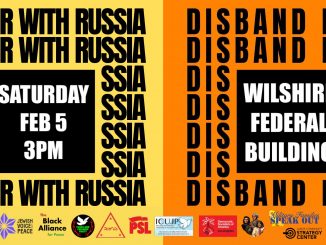
Los Angeles: No War On Russia! Disband NATO! Feb. 5

In Los Angeles – Saturday, February 5, 3:00 pm at Westwood Federal Bldg, 11000 Wilshire Blvd. Join the Harriet Tubman Center, Socialist Unity Party and many more organizations to say NO US/NATO War on Russia & Donbass!

Strugglelalucha256


Blackwater is in the Donbass with the Azov Battalion

The phone call between President Biden and Ukrainian President Zelensky “did not go well“, CNN headlines: while “Biden warned that the Russian invasion in February is practically certain when the frozen ground makes it possible for tanks to pass through,” Zelensky “asked Biden to tone down, arguing that the Russian threat is still ambiguous”. While the Ukrainian president himself takes a more cautious stance, the Ukrainian armed forces are massing in Donbass close to the Donetsk and Lugansk area inhabited by Russian populations. According to reports from the OSCE Special Monitoring Mission in Ukraine, units of the Ukrainian Army and National Guard amounting to about 150,000 men are positioned there, the news is overshadowed by our mainstream which speaks only of the Russian deployment. They are armed and trained, and so effectively commanded by U.S.-NATO military advisers and instructors.

From 1991 to 2014, according to the U.S. Congress Research Service, the United States provided Ukraine with $4 billion in military assistance, plus over $2.5 billion after 2014. The NATO Trust Fund provided over a billion dollars in which Italy also participated. This is only a part of the military investments made by the major NATO powers in Ukraine. Great Britain, for example, has concluded various military agreements with Kyiv investing, among other things, 1.7 billion pounds in upgrading Ukraine’s naval capabilities: this program provides for the arming of Ukrainian ships with British missiles, the production of joint 8 fast missile units, the construction of naval bases on the Black Sea and also on the Azov Sea between Ukraine, Crimea, and Russia. In this context, Ukrainian military spending, which was equivalent to 3% of GDP ( Gross Domestic Product) in 2014, rose to 6% in 2022 corresponding to over 11 billion dollars.

In addition to the U.S.-NATO military investments in Ukraine, there is the $10 billion investment foreseen by the plan that is being carried out by Erik Prince, founder of the U.S. private military company Blackwater – now it is renamed  Academy – which has supplied mercenaries to the CIA, the Pentagon, and the State Department for covert operations (including torture and murder), gaining billions of dollars. Erik Prince’s plan, revealed by an investigation of Time magazine, consists in creating a private army in Ukraine through a partnership between the Lancaster 6 Company, and the main CIA-controlled Ukrainian intelligence office. Through them, Prince has supplied mercenaries in the Middle East and Africa. It is not known, of course, what would be the task of the private army created in Ukraine by the founder of Blackwater certainly with CIA funding. However, it can be expected that it would conduct covert operations in Europe, Russia, and other regions from its Ukraine base.

Against this background, the exposure made by the Russian Defense Minister Shoigu that in the Donetsk region there are “U.S. private military companies that are preparing a provocation with the use of unknown chemicals” is particularly alarming. It could be the spark causing the detonation of war in the heart of Europe: a chemical attack on Ukrainian civilians in Donbass would immediately be attributed to the Donetsk and Lugansk Russians, who would be attacked by the preponderant Ukrainian forces already deployed in the region to force Russia to militarily intervene in their defense. At the forefront, ready to massacre the Russians of Donbass there is the Azov battalion, which trained and armed by the U.S. and NATO has been promoted to a special forces regiment. It distinguished by its ferocity in its attacks on the Russian populations of Ukraine. The Azov battalion recruits neo-Nazis from all over Europe under its flag similar to that of the SS Das Reich, it is commanded by its founder Andrey Biletsky who was promoted to colonel. It is not just a military unit but an ideological and political movement, and Biletsky is the charismatic leader in particular for the youth organization that is educated to hate Russians by his book “The words of the white Führer.

Source: worldbeyondwar.org

Strugglelalucha256


El bloqueo a Cuba cumple 60 años

Se dice fácil, pero han sido seis décadas durísimas que comenzaron con una ligereza desconcertante y la creencia de que el bloqueo del Gobierno de Estados Unidos a Cuba no duraría demasiado. Un par de años, quizás.

El 2 de febrero de 1962 John F. Kennedy llamó a su secretario de Prensa, Pierre Salinger y le dio una tarea urgente: “Necesito muchos puros cubanos, Pierre”. “¿Cuántos, presidente?”. “Unos mil”. El funcionario visitó las tiendas mejor surtidas de Washington y consiguió 1.200 cigarros H. Upmann Petit Corona enrollados a mano en las vegas de Pinar del Río, en el extremo occidental de la Isla.

“A la mañana siguiente, cuando llegué a mi despacho, el teléfono directo al Presidente ya estaba sonando. ‘¿Qué tal te fue?’, dijo, mientras yo cruzaba el umbral. ‘Muy bien’, respondí. Kennedy sonrió y abrió un cajón de su escritorio. Tomó un gran papel y lo firmó inmediatamente. Era el decreto que prohibía todos los productos cubanos en nuestro país. Los puros cubanos eran a partir de ese momento ilegales en Estados Unidos”, contó años después Salinger a la revista Cigars Aficionado.

Los periódicos de la época relataron con bastante exactitud lo que significaba aquella decisión. The Nation escribió: “La economía de Cuba dependía de los Estados Unidos para artículos esenciales como camiones, autobuses, excavadoras, equipos telefónicos y eléctricos, productos químicos industriales, medicinas, algodón crudo, detergentes, manteca de cerdo, papas, aves, mantequilla, una gran variedad de productos enlatados y la mitad de los alimentos básicos en la dieta cubana como el arroz y los frijoles negros. … Una nación que había sido un apéndice económico de los Estados Unidos quedó repentinamente a la deriva; era como si Florida hubiera quedado aislada del resto del país, incapaz de vender naranjas y ganado o de traer turistas, gasolina, repuestos de automóviles o cohetes de Cabo Cañaveral”.

Entre el 3 de febrero de 1962 y el 22 de noviembre de 1963 mediaron 657 días. Kennedy fue asesinado antes de que pudiera quemar uno a uno su arsenal de tabacos cubanos y antes de que se concretara la agenda de la negociación para tal vez revertir o suavizar el bloqueo, un proceso que estaba en curso cuando el magnicidio de Dallas.

Las consecuencias del fracaso de la invasión de Cuba por Playa Girón, en abril de 1961 – los invasores habían sido cambiados por compotas y tractores – y la llamada crisis de Octubre que involucró a EE.UU., la URSS y Cuba, en 1962, fueron dos de los factores que habían determinado el arranque del intento negociador. Un memorando remitido por Gordon Chase, especialista del Consejo de Seguridad Nacional para asuntos de América Latina, a McGeorge Bundy, Consejero de Seguridad Nacional del presidente Kennedy, el 11 de abril de 1963, recomendó con cinismo: “Si una suave aproximación negociadora a Castro es factible y exitosa, los beneficios podrían ser sustanciales”.

De nada valieron los intentos de rectificación de Kennedy ni los llamados no ya a la elemental justicia, sino al pragmatismo. Decenas de analistas, funcionarios y hasta ex presidentes estadounidenses han reclamado cordura para evitar que el castigo impuesto al pueblo cubano siga basado en la pulsión sádica, la inercia o simplemente en la arrogancia de un cogollo de politiqueros. Pero Washington ha seguido moviéndose en unas constantes vitales perversas. Wayne Smith, quien fuera jefe de la Sección de Intereses de Estados Unidos en La Habana y una de las voces más firmes contra el bloqueo impuesto unilateralmente por su país, llegó a la conclusión de que Cuba parece tener “el mismo efecto en las administraciones estadounidenses que la luna llena tiene en los hombres lobo”.

Tienen nietos y hasta bisnietos los que nacieron cuando Kennedy, con sus razones oscuras y su trastienda de tabacos, firmó la Orden Ejecutiva 3447 que decretó un bloqueo total sobre Cuba, incluyendo las medicinas y los productos alimenticios, y la amenaza a cualquier país que decidiera aliviar las sanciones. Algunos de esos cubanos han muerto y muchos morirán sin saber cómo funciona un país en condiciones de normalidad, la vieja o la nueva con Covid, da igual. Sin entender cómo se ha podido actuar contra millones de personas por tanto tiempo y con tanto odio, un odio sin límite ni explicación racional.

Este artículo fue producido para Globetrotter y publicado primero en La Jornada.

Rosa Miriam Elizalde es una periodista cubana y fundadora de Cubadebate. Es vicepresidenta de la Unión de Periodistas de Cuba (UPEC) y de la Federación Latinoamericana de Periodistas (FELAP). Es autora y coautora de varios libros, incluyendo Jineteros en La Habana y Chávez Nuestro. Por su destacada labor, ha sido merecedora en varias ocasiones del Premio Nacional de Periodismo Juan Gualberto Gómez. Es columnista semanal de La Jornada, México.

Strugglelalucha256


The blockade against Cuba turns 60

It’s easy to say, but it’s been six very hard decades that began with disconcerting lightness and the belief that the United States government’s blockade of Cuba would not last long—a couple of years, maybe.

On February 2, 1962, U.S. President John F. Kennedy called his press secretary, Pierre Salinger, and gave him an urgent task: “I need a lot of [Cuban] cigars.” “How many, Mr. President?” “About a thousand,” Kennedy replied. Salinger visited the best-stocked stores in Washington and got 1,200 H. Upmann Petit Corona cigars rolled by hand in the fertile plains of Pinar del Río, at the western end of the island.

“The next morning, I walked into my White House office at about 8 a.m., and the direct line from the President’s office was already ringing,” Salinger told Cigar Aficionado magazine years later. “‘How did you do, Pierre?’ he asked, as I walked through the door. ‘Very well,’ I answered. … Kennedy smiled, and opened up his desk. He took out a long paper which he immediately signed. It was the decree banning all Cuban products from the United States. Cuban cigars were now illegal in our country.”

The media outlets of the time reported quite accurately what that decision meant. The Nation wrote: “Cuba’s economy… depended on the United States for such essential items as trucks, buses, bulldozers, telephone and electrical equipment, industrial chemicals, medicine, raw cotton, detergents, lard, potatoes, poultry, butter, a large assortment of canned goods, and half of such staple items in the Cuban diet as rice and black beans. … A nation which had been an economic appendage of the United States was suddenly cut adrift; it was as if Florida had been isolated from the rest of the country, unable to sell oranges and cattle or to bring in tourists, gasoline, automobile parts, or Cape Canaveral rockets.”

There were 657 days between February 3, 1962—when Kennedy issued a blockade on trade between the U.S. and Cuba—and November 22, 1963, when he was assassinated.

Kennedy was killed before he could burn his arsenal of Cuban cigars one by one and before the negotiation agenda was finalized to perhaps reverse or ease the blockade, a process that was underway at the time of the Dallas assassination.

Two key factors that determined the start of negotiations were the failure of the Bay of Pigs invasion of Cuba in April 1961—the invaders had to be exchanged for food and tractors—and the 1962 October missile crisis that involved the U.S., the USSR and Cuba. A memorandum sent by Gordon Chase, National Security Council specialist for Latin American affairs, to McGeorge Bundy, national security adviser to President Kennedy, on April 11, 1963, cynically recommended: “If the sweet approach [to Castro] turned out to be feasible and, in turn, successful, the benefits would be substantial.”

Kennedy’s attempts at rectification were of no use, nor were the calls, not just for elementary justice, but for pragmatism. Dozens of analysts, officials and even former U.S. presidents have since demanded sanity to prevail in order to prevent the punishment imposed on the Cuban people from these continuing embargoes, which are based on the sadistic drive, inertia or simply on the arrogance of a bunch of politicians. But Washington has continued to show vital signs of not backing down. Wayne Smith, who was head of the U.S. Interests Section in Havana and one of the strongest voices against the blockade imposed unilaterally by his country, concluded that Cuba seems to have “the same effect on American administrations that the full moon has on werewolves.”

Those who were born when Kennedy, with his hidden reasons and a secret stash of cigars, signed Executive Order 3447, which decreed a total blockade on Cuba, now have grandchildren and even great-grandchildren. Some of those Cubans have died and many will die without knowing how a country works under normal conditions—the old one or the new one with COVID-19, it no longer matters. They will never understand how it has been possible for the U.S. to act against millions of people for so long and with so much hatred, a hatred without limits or rational explanation.

This article was produced by Globetrotter. Rosa Miriam Elizalde is a Cuban journalist and founder of the site Cubadebate. She is vice president of both the Union of Cuban Journalists (UPEC) and the Latin American Federation of Journalists (FELAP). She has written and co-written several books including Jineteros en la Habana and Our Chavez. She has received the Juan Gualberto Gómez National Prize for Journalism on multiple occasions for her outstanding work. She is currently a weekly columnist for La Jornada of Mexico City.
Strugglelalucha256


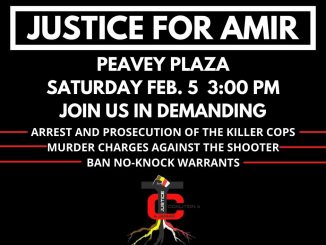
Minneapolis: Justice for Amir Locke, Feb. 5

SATURDAY, FEBRUARY 5, 2022 AT 4 PM – 6 PM EST
Protest – Justice for Amir Locke. Rally @ Peavey Plaza
1101 Nicollet Mall, Minneapolis

MPD shot and killed Amir Locke on Feb. 2nd. Within 9 seconds of executing a search warrant, they executed a human being.
Join us in demanding:
— Fire, arrest and prosecute the killer cops and those who planned the raid.
— Immediate moratorium on no-knock warrants

Strugglelalucha256
https://www.struggle-la-lucha.org/2022/page/75/