May 1: Cuba’s determination and resistance are on full display

A 8500 scaled
For Cuba Together We Create. Photo: Bill Hackwell

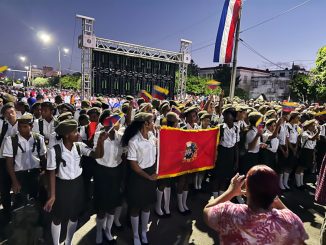
Havana, May 1 — The massive outpouring filled the emblematic Plaza of the Revolution in Havana this morning to show their resolve that they will not go back or give in to the maximum pressure that U.S. policy imposes on the Cuban people.

For the first time since 2022, when the scaled-back May Day celebrations gathered in other venues for economic reasons, today the march returned to the Plaza in an unmistakable response to the unrelenting extra-territorial starvation measures imposed by Cuba’s rapacious neighbor to its north.

At exactly seven o’clock, as the sun broke into the plaza, the first notes of the National Anthem were heard. And the 25th anniversary, the speech given by Cuba’s historic leader Fidel Castro Ruz, echoed across the people and the hundreds of international union and solidarity delegations attentively gathered there, defined what Revolution Is, “Revolution is a sense of the historical moment; it is to change everything that must be changed; it is full equality and freedom; it is to be treated and to treat others as human beings; it is to emancipate ourselves by ourselves and with our own efforts; it is to challenge powerful dominant forces within and outside the social and national sphere; is to defend values in which we believe at the price of any sacrifice; is modesty, selflessness, altruism, solidarity and heroism; is to fight with audacity, intelligence and realism; is to never lie or violate ethical principles; is a deep conviction that there is no force in the world capable of crushing the force of truth and ideas. Revolution is unity, it is independence, it is fighting for our dreams of justice for Cuba and for the world, which is the basis of our patriotism, our socialism and our internationalism.”

5 1 25 capote
Cubans wait for hours to begin May 1, march. Photo: Raul Capote

The celebrations were led by army general Raul Castro Ruz, and President of the Republic, Diaz-Canel Bermudez. In the major address by the Secretary-General of the Central de Trabajadores de Cuba (CTC), Ulises Guilarte said, “Cubans do not fear threats or blackmail.”

Guilarte went on to say, “We are celebrating the feast of the world proletariat in the midst of a complicated international scenario, the world suffers a renewed and dangerous imperialist offensive, with neo-fascist expressions that seeks to redesign the international system, ignore the principles of peaceful coexistence and sovereign equality between states as well as to overturn the conquests of justice and human dignity achieved by the peoples. … Without hesitation, we will continue the battle we wage for the consolidation of our freedom, independence and social justice; this is strongly being confirmed by the sea of people that are flooding the squares of the whole country today, with the slogan ‘For Cuba together We Create.’ The Secretary-General went on to add, “We reaffirm our most absolute rejection of the genocidal war waged by the Israeli government against the children of Palestinian land.”

A 6836
May 1, Havana. Photo: Bill Hackwell

Officially, 5.3 million Cubans turned out across the island, according to the CTC publication Trabajadores, including an estimated 700,000 in Havana alone., according to the Cuban Institute for Friendship with the Peoples (ICAP), which is celebrating its 65th anniversary this year. A thousand friends from more than 30 countries, including members of the May Day brigade, shared the revolutionary energy, dreams and commitment of struggle of the Cuban people.

The first contingent in Havana this morning was the doctors, health professionals, hospitals, research and pharmaceutical facilities providing improved outcomes by prioritizing human health needs instead of piling up profits for Big Pharma, corporate hospitals, and insurance companies.

Recently, Secretary of State Marco Rubio has upped the attacks on Cuba’s medical missions by threatening to sanction individual leaders of countries for engaging in legal bilateral agreements with Cuba for medical support, which was widely rejected by Caribbean leaders.

A 8524 scaled
Photo: Bill Hackwell

The U.S. has targeted the tens of thousands of Cuban doctors providing the health needs of under-served communities primarily in the Global South. The extraordinary example of Cuban doctors coming from this blockaded country is an embarrassment to the U.S., which is the richest country in the world that only identifies healthcare with profit. It is important to remember that we are approaching the twentieth anniversary of Hurricanes Katrina and Rita, when President Bush ignored Cuba’s offer to send 1,500 fully equipped disaster-trained medical professionals to save lives in New Orleans, as the majority Black population died in flood waters and on rooftops. That contingent was named the Henry Reeve Brigade for a U.S.-born hero who fought and died struggling for Cuba’s independence from Spanish colonialism.

For those visiting Cuba for the first time, today’s event provided a tremendous inspiration to fight along the lines of Fidel’s words.

Source: Resumen Latinoamericano – English

Strugglelalucha256


May Day message from Cuba’s CENESEX

By CENESEX (Cuban National Center for Sex Education)

This May Day occurs at a difficult time for just causes around the world.

We see how rights are being rolled back in several countries, and revolutionary forces have had to mobilize to express their resistance to a retrograde, neoliberal, and far-right offensive advancing under the guise of modernity and media manipulation, fueled by the erosion of traditional politics and the exploitation of the exploited working class, which sees the satisfaction of its needs increasingly at a disadvantage.

New powers, allied with the established powers, are consolidating and building consensus against leftist ideas. There are attempts to dilute the class struggle, camouflage exploitation, exclusion, and inequality with “technological” capitalism. Revolutionary ideas are stigmatized, and the identity of those who defend socialist and communist ideas is attacked. In this context, no just cause should be seen as an isolated struggle.

In the face of the advance of neo-fascism and capitalism, of genocide and the economic blockade, as a method of imposition of imperialist power, as has occurred against the Palestinian and Cuban people, and above all, for the class consciousness we must have in our struggle for all rights for all people, the workers and activists of CENESEX will once again be in the Plaza marching in support of the ideal of the Cuban Revolution and socialism, alongside our people on this International Workers’ Day, aware that one cannot fight for a just cause if one is not capable of fighting for all just causes.

Translated by Melinda Butterfield

Strugglelalucha256


Naval blockade of Cuba

An African country with coastlines on the eastern Atlantic decided to donate 3,000 tons of horse mackerel to Cuba, the delicious oily fish that swims in shoals from the Canary Islands and Senegal to the Gulf of Guinea and Baía dos Tigres, in Angola. As 2024 began, and since the island has no merchant ships, the nation that made the donation asked a local company to take charge of processing and transporting the cargo.

No shipping company was willing to make the direct voyage to the port of Mariel in Cuba for fear of US sanctions, according to a report published by the daily Granma which addressed specific examples of the US blockade of the island. A test container was sent to evaluate the costs, via a much longer itinerary, which included several stops at ports in China. The voyage began on February 18, 2024, and ended on May 3, 75 days later. According to estimates, transporting the full cargo along this route would cost $9.7 million.

The African country, in solidarity, could not afford such a sum and decided to sell the 3,000 tons of horse mackerel and use the money to buy frozen fish in a port near Cuba. “The money raised was only enough to buy 386 tons in nearby waters,” says Granma.

The sophistication of the blockade has reached indescribable levels, with measures to frighten shipping companies and make it increasingly difficult for cargo to arrive by sea in Cuba, which, after all, has no other means of regular trade for large containers of food and fuel. What was previously prevented by warships patrolling territorial waters is now made impossible by sanctions, regulations and legal threats that turn every Cuban port into a risk zone for any shipping company.

In 2024, an amendment to the US National Defense Authorization Act established that any port under the jurisdiction of a government considered to be a state sponsor of terrorism, as is the case of Cuba according to Washington’s unfounded accusations, will be evaluated as a port with insufficient security measures. Therefore, US customs controls, which were already very strict (any ship arriving on the island had to wait six months to travel to the US), were tightened. The 2024 regulations apply to all commercial vessels arriving in US territory after having visited Cuban ports, with the exception of those that have docked at the Guantanamo Naval Base.

Last week another bombshell went under the media radar, a common practice of the US administration, which has the world turned upside down with the tariff war, while the State Department’s little wars are carried out with equal perfidy but greater stealth. Thus they established special conditions for all commercial ships that have visited Cuban ports on their last five stopovers before reaching US territory. Even those that comply with this requirement will be subject to special surveillance, they will be guarded by coastguards and the guards must have total visibility of the exterior of the ship, both on the land and sea sides.

Apart from the new blow aimed at shipping companies that dared to trade with the island and carry a test container with horse mackerel, the new measure nips in the bud the transportation from the US of food, electrical appliances and cars that were allowed during the Biden administration, under one-sided conditions and operated by the private sector in Cuba. The measures are aimed at further deteriorating cooperative ties on security issues and increasing the extraterritoriality of the blockade.

The difference between the direct naval blockade and this one is purely formal: if before a military vessel was enough to prevent trade, today the threat induced through a sanctions system that suffocates as much or more is enough, without the need for a single gunboat.

This week the White House special envoy for Latin America, Mauricio Claver-Carone, acknowledged in Miami that the Trump administration is taking a “more surgical” approach against the government of Miguel Díaz-Canel, with the aim of strangling the Cuban economy. What he does not say is that this cruelty has a direct impact on the civilian population and leaves unbearable images linked to an increasingly precarious daily life in Cuba, where not even the horse mackerel escapes.

Source: La Jornada,  Resumen Latinoamericano -English

Strugglelalucha256


Cuba’s message: ‘Learn the truth about our struggle and end imperialist punishment’

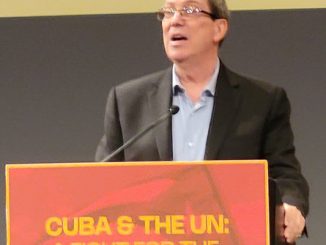
On February 28, Cuban Deputy Foreign Minister Carlos Fernandez de Cossio delivered a speech at the Institute for Policy Studies in Washington, D.C., to provide an update on the current state of U.S.-Cuba relations from Cuba’s perspective. C-Span’s video of the broadcast event is available at: Cuban Official Discusses U.S.-Cuba Relations | C-SPAN.org The event was co-sponsored by the Latin American Working Group and Black Alliance for Peace.

In a concise but clear presentation, de Cossio explained the root issue in U.S.-Cuba relations is “the consistent failure by the government of the United States of understanding and accepting that Cuba is and has the right to be a sovereign nation with the right to self-determination. That the U.S. has no right to govern Cuba and we do have the right to govern ourselves and defend ourselves and to provide for our people in the way that as Cubans we feel is appropriate.”

After eight years of “maximum pressure” initiated during the first Trump administration and continued under Biden, “the current government has come in – at least from the State Department point of view and for the people that are in State Department – with a declared commitment to make life for Cubans, all Cubans, even more difficult than it is today. The commitment to mobilize the full power of the United States which is very overwhelming and has an impact all over the world to make sure that this punishment is presented upon the people of Cuba with the aim of cutting all the remaining sources of income, to be able to cut our access to technology, to markets, to financial institutions,” de Cossio said, likening it to a medieval siege.

The U.S. will fail at its aim to defeat Cuba’s revolutionary independence as it has over the 65 years since Lester Mallory wrote the infamous State Department April 6, 1960, secret memo. The memo outlines the continued U.S. strategy to alienate support “through disenchantment and disaffection based on economic dissatisfaction and hardship.” It specifies that “as adroit and inconspicuous as possible, make the greatest inroads in denying money and supplies to Cuba, to decrease monetary and real wages, to bring about hunger desperation and overthrow of government.” (https://history.state.gov/historicaldocuments/frus1958-60v06/ch10)

At this meeting, the Deputy Foreign Minister discussed Cuba’s role on the international stage. The government of Cuba views the current world order, that of U.S. hegemony, as unsustainable and damaging to world peace. They also believe in a world order based on multilateralism, which is differentiated from a multipolar world order that can seem reminiscent of old colonialism. 

The Cuban people have not shied away from their mission to help those of oppressed communities all around the world. Even with U.S. agreements frozen, and the country put back on the “State Sponsor of Terrorism” list, there will still be Cuban doctors working to give life-saving medical care all around the world. 

This good faith by the Cuban people is returned on the international stage where since 1992 the majority of countries vote with Cuba in the United Nations General Assembly calling for the U.S. to end its illegal siege and occupation of the island. In 2023 and 2024, 187 out of 193 UN member countries urged that Cuba be removed from the U.S. State Department unilateral list of “State Sponsors of Terrorism” and called on the U.S. to end the blockade.

The audience left the gathering with a clear objective. The objective is to counteract media disinformation by sharing the truth about Cuba with the larger population within the United States. It is the Cuban government’s stance that if the people of the United States knew the true horrors of U.S. imperialism on Cuba, they would work by any means necessary to end the U.S. campaign to intentionally impose hunger and hardships on the Cuban people. 

Whether it is fighting the information war or the economic siege, the victories can only be won through continued international solidarity and channeling the Cuban people’s revolutionary fighting spirit and resistance into everything we do. 

Strugglelalucha256


Cuba will win in the face of the imperialist onslaught!

Statement by the Revolutionary Government

U.S. President Donald Trump has attacked Cuba from day one and without any pretext. The decision to reestablish the ironclad economic war measures against Cuba, which his predecessor eliminated only days before, is a demonstration of the aggressiveness of U.S. imperialism against the sovereignty, peace and well-being of the Cuban population.  Among them is the inclusion of our country, once again, in the arbitrary list of States that supposedly sponsor terrorism, a designation that shows an absolute disregard for the truth.

This is not surprising.  The statement by the Ministry of Foreign Affairs on January 14 already warned: “The government of that country could reverse in the future the measures adopted today, as has happened on other occasions and as a sign of the lack of legitimacy, ethics, consistency and reason of its conduct against Cuba.”  He also said that “American politicians do not usually stop to find justification…”.  This is how the country is governed.

Trump has interpreted his coming to power as the coronation of an emperor. His ambition includes, just to start, the conquest of Canada, the usurpation of Greenland, the renaming of the Gulf of Mexico and the deprivation of the Panamanians of their canal.  The hegemonic Monroe Doctrine and Manifest Destiny, which were imposed by blood and fire in Latin America and the Caribbean, are the guide of the new government team.

He is associated with the groups and politicians who have made aggression against Cuba a way of life, have profited for decades from the anti-Cuban business and today share the intoxication of the new president.  They all have a high responsibility in the difficult economic situation of the country and in the increase of the migratory flow from Cuba to the United States.

This new act of aggression by the United States government against the Cuban people shows, once again, the true, cruel, merciless objective of these and so many other measures of siege and suffocation, which are applied against Cuba for the purpose of domination.  It constitutes a reaction of impotence in the face of the inability to bend our will and in the face of the respect, sympathy and support that the Revolution arouses among the peoples of the world.

The economic blockade, its reinforcement and the new aggressive measures will continue to weigh, with a very damaging effect, on our economy, the standard of living, the potential for development and the legitimate dreams of justice and well-being of the Cuban people, as has been the case in recent years.

They will not divert us from the socialist path, from the effort to recover the economy, from promoting the greatest solidarity, creativity, talent, spirit of work, and from defending as an impregnable bastion the freedom, independence, sovereignty and privilege of building a future without foreign interference.

The Cuban people are grateful for the many expressions of support and solidarity received from all over the world, from governments, Cubans living abroad, parliaments, political, religious and social organizations, and from political figures in the United States and other countries.

No one should be fooled.  The Cuban people expressed themselves with clear determination and strength in the march on December 20th.  Here the conviction prevails that CUBA WILL WIN!

HOMELAND OR DEATH, WE WILL WIN!

Havana, January 21, 2025

(Cubaminrex)

Strugglelalucha256


Declaration of the International Committee for Peace, Justice and Dignity for Cuba

From the International Committee for Peace, Justice and Dignity we salute the victory of the Revolutionary Government, the Cuban people and the international solidarity that fought tirelessly for four consecutive years for Cuba to be removed from the List of Supposedly Sponsoring Countries of Terrorism (SSOT List) where it should never have been.

The decision of the Biden administration, six days before the end of his term, with the official and express recognition in the White House presidential memorandum, acknowledges that Cuba does not sponsor terrorism.

The arbitrary inclusion in the unilateral and spurious List was political, within the framework of the multidimensional war imposed by the U.S. blockade, plus the 243 economic and financial sanctions, to strangle the Cuban economy and provoke an internal outbreak that would put an end to the achievements of the Revolution and impose a government subservient to Washington.

We reaffirm what Cuban President Miguel Díaz-Canel expressed on the social network X: “It is a decision in the right direction, although belatedly and with limited scope,” since “the blockade and most of the extreme measures that were put in place in 2017 to suffocate the Cuban economy and cause shortages to our people remain in place.”

The inclusion in the list of sponsors of terrorism “has had a high cost for the country and Cuban families.”

A very high cost that will never be forgotten by the Cuban people deprived of medicines and food by the criminal policy of the U.S., which on November 20 reaffirmed in a massive demonstration in Havana its rejection of the longest genocidal blockade in history, the demand to be taken off the List and its support for the Cuban Revolution.

As for International Solidarity we will continue working together with the Cuban people and government until we achieve the end of the blockade and the extraterritorial laws, we will continue advocating for peace and friendship between the peoples of the United States and Cuba, beyond the four years of the current government in power in the White House.

Sixty-six years of heroic and peaceful resistance is the clearest message to the outgoing and incoming administration.

Here is Cuba standing with its sovereign flag, before which the noble men and women of the world, the peoples who resist and struggle, bow down.

Long live Cuba, its Revolutionary Government and its heroic people.

Source: Cuba en Resumen

Strugglelalucha256


Cuba’s Fernando González: “With Trump we can expect even more aggression”

As the island goes through one of its worst economic crises, the president of the Cuban Institute of Friendship with the Peoples, Fernando Gonzalez, believes that international solidarity is now “more essential than ever.”

Hurricanes, earthquakes, economic crisis and soon the return of the extreme right-wing Republican to the White House… The situation seems very worrying for Cuba and its revolution. For the president of the Cuban Institute of Friendship with the Peoples (ICAP), Fernando Gonzalez, who foresees four years of even harsher policies against his country, “international solidarity is now more essential than ever.”

However, there is no room for despair for the island, which has always been able to reinvent itself and defy all obstacles. Interview with the former Cuban intelligence agent, one of the “Cuban Five” awarded the title of “Hero of the Republic of Cuba” after serving sixteen years in prison in the United States for infiltrating paramilitary circles planning attacks against his country.

What is the situation in Cuba after the last hurricanes that hit the island?

The situation in Cuba is very complex. We have had two hurricanes and an earthquake, which have caused considerable damage. But the government, at all levels, is trying to implement all the necessary structural measures to correct the situation. Some issues, such as power, water and telephone outages, have already advanced at a good pace in their recovery, while others, such as damage to buildings or homes, will take longer, not for lack of will, but because of the limited resources we have.

It is worth remembering that these calamities occur at a time when the Cuban economy is in an extremely complex situation. It has not had the capacity to grow in recent years, which is due in part to the very limited availability of resources. In spite of this, the government’s desire continues to be to provide solutions and not to leave anyone in difficulties.

What are the factors that explain the failures of the electrical system, apart from the impact of natural disasters?

The issue of the electrical system is very complex. Even before the cyclones, we had already experienced an episode in which the entire electrical system was down due to technical problems. Today, we can say that a big part of it has been restored, but there is still a fundamental problem: the production capacity at the national level still does not cover the total demand of the population.

In Cuba, the demand is about 3,000 megawatts per day, so if we only produce 1,700 megawatts, we will have a deficit that we will not be able to cover. For now, the only way to solve this problem is to schedule power outages. Clearly, the situation means that at certain times of the day, the population has to suffer power cuts. And that translates into discomfort for people, irritation.

To what extent does the U.S. blockade affect the Cuban electrical system?

Our thermoelectric power plants are more than 30 years old. It is not always possible to carry out the necessary repairs, for various reasons, among which is precisely the high and constant demand for electricity. And, of course, there are all the issues related to the blockade which, for example, prevents us from accessing the spare parts or materials needed to carry out the required repairs in the power plants.

There is also the question of dependence on oil to fuel these power plants….

In fact, this is in addition to the problems I just mentioned. Our country does not always have all the fuel needed to produce this electricity. Once again, at the root of this fundamental problem is the ruthless economic war waged against us by the United States.

Because it is very difficult for Cuba to buy oil abroad, not only because of our financial limitations, but also because of the barriers that the U.S. government has erected to prevent our supply from arriving.

Often, even if you have the funds, it is very difficult to bring oil tankers to Cuba, because the companies that trade with us (from shipping companies to insurance companies) are persecuted and can be subject to sanctions by U.S. authorities simply for carrying out a common business transaction afforded most countries in the world. Very few people are willing to send fuel to Cuba. This is a direct consequence of the blockade.

What role can international solidarity with Cuba play, if not to remedy, at least to mitigate the effects of the U.S. blockade?

It is essential. Cuba is a small country, which does not have many resources, but which proposes an alternative form of society, organized in a different way that is not only around the profits of certain interest groups.

It is a society organized around the human being, and I think it offers an alternative to individualism, while everywhere else the benefits are reserved only for certain sectors in the hands of the private sector, leaving aside the vast majority of the population. And I believe that this is the origin of the war that is being waged against Cuba: the objective is to try to erase this example of another model of society that we offer.

Far be it for me to pretend that everything in Cuba is perfect, there are many things we could have done better, and also things we have done that in the long run we have realized were mistakes.

Sometimes things do not go as we intended, however, everything that is done here is aimed at serving the majority of the population. No measure is adopted in pursuit of a particular interest, or because a sector of the economy has been able to buy the vote of deputies or members of the government. Everything that is done in Cuba is done with the human being and the improvement of the living conditions of the majority of Cubans in mind.

We think above all of the collective, we try to build a society that seeks the common good and, through this common good, the individual good of the citizens.

Being in solidarity with Cuba is not only a humanitarian question, there is a political and ideological question….

It is important to defend the right to life of Cubans and through this the right to exist as an alternative society that we propose, especially in the current circumstances when the United States is waging a war against Cuba in an attempt to suffocate its economy, in the hope that the people will withdraw their support for the revolutionary government.

Solidarity with our country, with our revolution, has always existed, but today it is even more important, and even essential in these difficult times we are going through.

Broad diplomatic support is not enough?

The moral victory obtained at the United Nations shows, once again, that Cuba is far from being alone at the international level, quite the contrary. But we know very well that this support does not mean the end of the blockade. Today’s slogan is to demand with all our might that Cuba be removed from the infamous State Sponsors of Terrorism (SSOT) created by our northern neighbor. Together, Cuba and its supporters must find the formula that will allow us to reach out to the U.S. government and reverse this absurd measure.

We are in an extremely complex scenario, and we say it clearly: today more than ever we need international solidarity. We need new voices to denounce the injustice committed against Cuba and to find new ways to defend international law.

What can we expect from the United States now that Republican Donald Trump is about to return to power?

Some of their administrations have been more aggressive, others not so much, but at the end of the day, we know that there is a consensus within the political class in this country, whether they are Democrats or Republicans, on how to deal with Cuba. They have always sought, in one way or another, to stifle our economy in an attempt to get our people to withdraw their support for their government.

We do not expect much from the new U.S. presidency. Our flag is and will always be to defend our independence and sovereignty, tooth and nail, whatever it takes.

If we look at the results of Donald Trump’s four years in the White House, we can imagine what awaits us: four years of even harsher policies against Cuba. He will surely try by all means to continue limiting as much as possible the little room for maneuver we have to stay afloat economically.

The appointment of Marco Rubio to the Foreign Affairs post does not bode well.

Indeed, Donald Trump’s arrival will be aggravated by the fact that his likely Secretary of State is a person who has a personal vendetta to take against Cuba. For any other secretary of state, Cuba might be, for example, a footnote. But not for this person.

Therefore, we can expect the aggressiveness and efforts of the U.S. government, which have been going on for 60 years to try to suffocate the Cuban economy, to intensify in the next four years. They will pursue their unattainable dream: that the Cuban people will blame their government for the calamities and needs they suffer. We will face this new scenario with the support and help of international solidarity.

We know that we have many friends around the world, millions of people know the reality of our country and support us, which gives us strength to continue fighting. There is no room for despair. Cuba reinvents itself every day, with its own effort and with the precious company of activists from all over the world. The Trump administration is about to arrive, and then it will move on. The Cuban revolution will always be there.

Source: Resumen Latinoamericano – Buenos Aires

Strugglelalucha256


Solidarity network in the U.S. ratifies the struggle against the blockade on Cuba

Representatives of more than 70 organizations of the National Network on Cuba in the United States (NNOC) concluded last night the annual meeting of this broad coalition with a call for the lifting of the blockade of the Caribbean country.

For two days, activists from Michigan and others from South Carolina, Florida, Illinois, Massachusetts, New York, Minnesota California, Tennessee, Virginia, Washington DC and others who participated on line, met in the city of Detroit to discuss strategies for solidarity work towards 2025. The weekend event was highlighted by an atmosphere of positive energy as this solidarity network continues to push the demand that calls for Biden to take Cuba off of the fictitious list of State Sponsors of Terrorism before he leaves office, while preparing for the next years of Trump in the White House.

On Saturday three other organizations joined the NNOC in the first day of discussions of the event: Arise for Cuba (Chicago); Community Movement Builders (Detroit) and Diaspora Pa’lante (New Jersey).

In its final statement, the NNOC celebrated achievements in “strengthening solidarity with Cuba and advancing the broader struggle to support the removal of Cuba from the list of countries sponsoring terrorism and ending the genocidal U.S. economic embargo against Cuba.”

For the coming year, the “objective is to continue our collaborative efforts with like-minded organizations,” the text stressed, emphasizing that its members will broaden and diversify networks to make the issue of the need to lift the blockade relevant at the local level.

The communiqué emphasized that to raise awareness they will link “the impacts of the blockade with tangible costs, both material and physical, here in the United States; our goal is to make our message resonate with ordinary people, galvanizing broader support,” it stressed.

At the meeting, it was announced that the International Conference on Normalization of U.S.-Cuba Relations will be held in March next year and that the next annual meeting of the NNOC will be held in November 2025 in South Carolina.

On Friday night at the Swords to Plow Shares gallery in downtown Detroit, as a lead up to the conference, there was an inauguration of the exhibition of photographs of the Latin American news agency Prensa Latina commemorating“65 Years in the Service of Truth”, which includes moments in the history of this Cuban media, founded on June 16, 1959 at the initiative of Fidel Castro.

In her account in the social network X, the Chargé d’Affaires of the Cuban Embassy in the United States, Lianys Torres, thanked the numerous expressions of solidarity of the American people, whose voices have been strongly raised against the blockade and the inclusion of the island in the unilateral list of sponsors of terrorism.

Photos: Bill Hackwell

Source: Radio Havana Cuba from Prensa Latina / Resumen

Strugglelalucha256


The secret weapons were Trump’s

Lying is not Complicated, but Enduring a Lie over Time is.

Seven years have passed since the great hoax known as the “Havana syndrome”, according to which U.S. diplomats suffered alleged acoustic attacks in Cuba that compromised their health. One of the speculations in vogue was that the “painful sounds” selectively perceived by the officials were due to attacks with microwave weapons. Over time, the hoax faded for lack of scientific evidence – there was no way to explain how a sound attacks some individuals and not others in the same room – but now we learn that the U.S. government has been experimenting with high-power microwave (HPM) systems to stop vehicles or ships by jamming their electronic systems.

According to an investigation published in the U.S. magazine Wired

(https://acortar.link/s0CXpG), the U.S. Central Intelligence Agency has at least one mysterious system capable of “covertly (and nonviolently)” disabling ships, including large ones. The device was considered for use against oil-laden ships sailing between Venezuela and Cuba during Donald Trump’s presidency.

“The Trump administration thought that if the US intercepted or otherwise sabotaged oil tankers sailing from Venezuela to Cuba, it could strike a blow to both regimes,” a CIA source told Wired, which published this revelation on October 31 as part of a broader investigation into Washington’s failed efforts to overthrow Venezuelan President Nicolás Maduro between 2018 and 2020.

The system in question not only has the capability to employ techniques to stop or slow a vessel without causing damage to the ship’s structure, but is complemented by electronic attacks that jam key communications on the vessel. According to Wired, the CIA assessed the use of microwaves that require discreetly approaching the target, that involved the use of unmanned or disguised platforms to reduce the risk of detection.

“At least one option involved the CIA, which has a mobile system that can covertly (and nonviolently) disable ships. Trump administration officials wanted the agency to move the system near Venezuela, to target some of its fuel ships,” Wired continues. “The agency refused. CIA officials explained that they only had one such system, which at the time was in another hemisphere, and that they didn’t want to move it to the northern tip of South America.”

The detail that the CIA only had one of these systems in another hemisphere is very significant, according to The War Zone (TWZ), a military analysis platform: “This would seem to indicate that the system in question is already being deployed outside the Western Hemisphere, and possibly with a very specific target in mind. This could also indicate a reluctance to potentially expose what this system can do, unless there is a particularly serious crisis or very high priority clandestine operations.”

TWZ claims that U.S. defense contractors have been working for years on specially developed microwave emitter systems to shoot down swarms of drones quickly and at very low cost. There are at least two programs for the use of these weapons, such as the High Power Joint Electromagnetic Non-Kinetic Strike (Hijenks) and the Counter-electronics High Power Microwave Missile Project (Champ), apparently used against Iranian ships in the Red Sea and under the protection of the alliance between Washington and Tel Aviv.

Having eliminated the esoteric clue of the “Havana Syndrome” that fooled even respectable US academics, what remains is what the US government and some of its satellites can do. We now know that the uproar of the first Trump administration over the alleged attacks on its diplomats was nothing more than the projection of what was cooking in Washington and what the U.S. government refused to see of itself: its violence, its injustice, its disregard for the truth, its indifference to the fate of others, its fierce individualism.

Let us not forget that under the pretext of the “Havana syndrome” more than 240 additional blockade sanctions were imposed on Cuba, which has led the Caribbean country to the current crisis. And if this was the first season of Trump and his hawks, what other secret weapons are awaiting us? With what lies will they try to politicize their new outrages?

Source: La Jornada, translation Resumen Latinoamericano – English

Strugglelalucha256


Putin approves supply of 80,000 tons of fuel to Cuba

Russia has announced a $60 million diesel shipment to Cuba during bilateral meeting in Havana.The Russian assistance, authorized directly by President Vladimir Putin, represents an international effort to help stabilize Cuba’s energy sector.

The announcement of the supply of Russian fuel was made during the Meeting of the Co-Chairs of the Intergovernmental Commission for Economic-Commercial and Scientific-Technical Collaboration, which began sessions in Havana. The bilateral meeting is headed by Russian Deputy Prime Minister Dmitry Chernyshenko and Cuban Deputy Prime Minister Ricardo Cabrisas.

“Following instructions from our president, Vladimir Putin, Russia is ready to provide emergency assistance to sister Cuba in connection with the current situation in the energy sector,” Chernyshenko said during the bilateral meeting. The Russian assistance follows a significant collapse of Cuba’s electric power system on October 18, which left much of the country without electricity for approximately 72 hours. Electricity service was not restored until the early hours of October 21.

According to the latest report from Cuban energy authorities, issued on November 1, the island continues to experience a deficit in electricity generation, although they have ruled out the possibility of a new disconnection from the national grid.

The Russian assistance, authorized directly by President Vladimir Putin, represents an international effort to stabilize Cuba’s energy sector, which has faced serious challenges due to the lack of fuel and the deterioration of its electricity generating facilities as a result of the economic blockade imposed by the U.S. government. The effort also comes at a time when Cuba is recovering from two major hurricanes that have recently hit the island.

Source: Resumen Latinoamericano – Buenos Aires

Strugglelalucha256
https://www.struggle-la-lucha.org/cuba/page/5/