Cuba responds to Trump’s latest fascistic statement

In a new delirious escalation of his anti-Cuban rhetoric and measures, the US president said on social media that there will be no more oil or money from Venezuela for Cuba, disregarding the sovereign nature of both Latin American nations.

@realDonaldTrump

Cuba lived, for many years, on large amounts of OIL and MONEY from Venezuela. In return, Cuba provided “Security Services” for the last two Venezuelan dictators. BUT NOT ANYMORE! Most of those Cubans are DEAD from last weeks U.S.A. attack, and Venezuela doesn’t need protection anymore from the thugs and extortionists who held them hostage for so many years. Venezuela now has the United States of America, the most powerful military in the world (by far!), to protect them, and protect them we will. THERE WILL BE NO MORE OIL OR MONEY GOING TO CUBA – ZERO! I strongly suggest they make a deal, BEFORE IT IS TOO LATE. Thank you for your attention to this matter. President DJT.

\1 11 diaz canel

Díaz-Canel rejects Trump’s statements and reaffirms Cuba’s sovereignty

January 11, 2026

In response to today’s statements by US President Donald Trump, the President of the Republic of Cuba, Miguel Díaz-Canel Bermúdez, categorically rejected any accusations against the island and questioned Washington’s moral authority to pass judgment on the Cuban reality.

“Those who turn everything into business, even human lives, have no moral authority to point fingers at Cuba in any way, absolutely none,” said the head of state, referring to what he described as a campaign of hostility and discredit against the Caribbean nation.

Díaz-Canel maintained that those who today “hysterically rail” against Cuba do so, in his opinion, motivated by anger at the sovereign decision of the Cuban people to choose their own political model. In this regard, he rejected attempts to blame the Revolution for the severe economic shortages facing the country.

“Those who blame the Revolution for the economic difficulties we are suffering should be ashamed to speak, because they know—and acknowledge—that they are the result of the draconian measures of extreme suffocation that the United States has been applying to us for six decades and now threatens to intensify,” he stressed.

The president reiterated that Cuba is a free, independent, and sovereign nation that does not accept external impositions. “No one dictates what we do. Cuba does not attack; it has been attacked by the United States for 66 years,” he emphasized, while reaffirming the country’s willingness to defend its sovereignty against any threat.

1 11Bruno Rodriguez

Minister Bruno Rodríguez Parrilla said on his twitter account “Unlike the US, we do not have a government that lends itself to mercenary activities, blackmail, or military coercion against other states,”

Rodríguez explained that his country “has every right” to import fuel from markets “willing to export it,” in addition to exercising its right to develop its commercial relations “without interference or subordination to unilateral coercive measures by the US.” “Right and justice are on Cuba’s side,” he recalled.

At the same time, the foreign minister accused Washington of behaving like a “criminal and uncontrolled hegemon that threatens peace and security, not only in Cuba and this hemisphere, but throughout the world.”

Rodríguez also responded to Trump’s accusations that Havana was receiving “large quantities” of oil from Venezuela in exchange for providing security services. “Cuba does not receive and has never received monetary or material compensation for the security services it has provided to any country,” he emphasized.

Source: Cubadebate translation Resumen Latinoamericano – English


Strugglelalucha256


‘Cuba must be loved’

Jan. 7, 2026
From Arroyo Naranjo, Cuba

Gerardo Hernández Nordelo, the national coordinator of Cuba’s Committees for the Defense of the Revolution (CDR), has a large office on the top floor of the organization’s headquarters on the busy Línea Avenue in Havana. The problem is you will never find him there. Hernández, one of the Cuban Five heroes who spent 16 years in U.S. federal prisons for monitoring the activities of anti-Cuban terrorists operating with impunity in South Florida, is making up for lost time circulating around Cuba, listening to the needs and problems of the people at the community level while engaging in homegrown methods of solving them.

The CDRs were created in 1960 after the Revolution, when a wave of sabotage and bombings followed Fidel’s victory. Fidel said, “We’re going to set up a system of collective vigilance; neighborhood by neighborhood, block by block.” Today, the CDR structure continues as a viable, grassroots problem-solving mechanism, including direct representation in Cuba’s National Assembly, with each having access to a medical clinic.

U.S. blockade of Cuba: the longest and most severe in modern history

The battle that Cuba and the CDRs face is the U.S. blockade, which has created scarcity and restricted access to everyday necessities that most developed countries take for granted. This has been going on since the Eisenhower administration followed the Mallory memo in April 1960, which recognized the overwhelming popularity of the Revolution while offering this solution to overthrow it: “…every possible means should be undertaken promptly to weaken the economic life of Cuba. If such a policy is adopted, it should be the result of a positive decision which would call forth a line of action which, while as adroit and inconspicuous as possible, makes the greatest inroads in denying money and supplies to Cuba, to decrease monetary and real wages, to bring about hunger, desperation and overthrow of government.”

The Mallory directive has been and remains the basis of U.S. policy toward the island nation through every Democratic and Republican administration, with a couple of brief periods of opening up. The bottom line is that the United States perceives Cuba as a runaway colony that represents a dangerous example to other countries because it reveals that a better world is possible by establishing relations based on respect for sovereignty and mutual benefit for all, instead of for the corporate rich.

“A Cuba hay que quererla”

Acute shortages are a way of life in Cuba, and the CDR response has to be creative, collaborative and immediate; quite literally, lives depend on it. Today, Gerardo is traveling to Arroyo Naranjo, a community on the outskirts of Havana, to bring emergency medical supplies to Julio Trigo Hospital so that a number of medical procedures — some of them lifesaving — can proceed.

This is part of a network he helped set up called A Cuba hay que quererla (“Cuba must be loved”), named after a song by popular Cuban musician Raúl Torres. In this project, he is working with Amado Riol, a facilitator who connects medical supplies with need. Riol is on the phone constantly, working with a sense of urgency, talking with doctors and hospital staff, connecting the dots. He explains that the hospital is completely out of medical stents and that he has found some to deliver.

Visit to the Arroyo Naranjo CDR

While he was in the area, Gerardo took the opportunity to attend a meeting with the Arroyo Naranjo CDR to get an update on the well-being of the community and its ongoing projects. He makes himself accessible and listens to everyone’s comments and suggestions. This is grassroots Cuba, forced to struggle against all odds. What is apparent here — and what the empire cannot fathom — is the sense of cooperation, respect and determination to make things happen, something the Revolution has instilled in Cuban society at all levels.

Source: Resumen Latinoamericano – U.S.

Strugglelalucha256


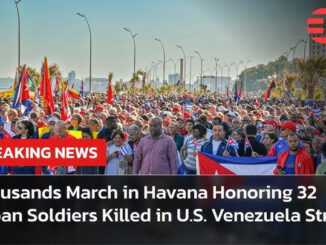
Cuba reports 32 fighters killed in U.S. attack on Venezuela

Combatienetes cubanos caidos en venezuela

The Cuban government announced Jan. 4 that 32 Cuban citizens were killed during the U.S. military strike on Venezuela in the early morning hours of Jan. 3.

The fighters were serving missions on behalf of Cuba’s Revolutionary Armed Forces and Ministry of the Interior at the request of Venezuelan counterpart agencies when U.S. forces bombed military installations and civilian areas across Caracas and northern Venezuela.

According to the Cuban government, the combatants “fell in direct combat against the attackers or as a result of the bombing of the facilities” after offering “fierce resistance.”

Once their identities were confirmed, their families were notified and received condolences from Army General Raúl Castro, President Miguel Díaz-Canel, and the heads of the institutions to which they belonged.

Cuba characterized the attack as “a new criminal act of aggression and state terrorism” and stated that the fallen combatants “knew how to uphold, with their heroic actions, the solidarity of millions of compatriots.”

President Díaz-Canel declared two days of national mourning, effective from 6 a.m. on Monday, Jan. 5, through midnight on Tuesday, Jan. 6. During this period, the Cuban flag will fly at half-staff on all public buildings and military installations, and public shows and festive activities are suspended.

The Jan. 3 strike, codenamed “Absolute Resolve,” involved more than 150 U.S. military aircraft that bombed infrastructure across northern Venezuela. U.S. forces captured Venezuelan President Nicolás Maduro and his wife Cilia Flores and flew them to New York City to face narcoterrorism charges.

Venezuelan officials report that more than 80 people were killed in the attack, including the 32 Cuban fighters and numerous Venezuelan military personnel and civilians. Strikes hit residential areas, including a civilian apartment complex in Catia La Mar.

Trump told reporters that “a lot of Cubans were killed” and said they “were protecting Maduro.” He added that two U.S. soldiers were injured but that no U.S. personnel were killed.

The Trump administration has said it plans to “run” Venezuela temporarily and exploit the country’s oil reserves and mineral deposits.

Presidential Decree declares national mourning

The following is the text of Presidential Decree 1147:

MIGUEL DÍAZ-CANEL BERMÚDEZ, President of the Republic.

I HEREBY ANNOUNCE: That by virtue of the provisions of Article 125 of the Constitution of the Republic of Cuba and Article 24, paragraph x), of Law 136 “Of the President and Vice President of the Republic of Cuba,” of October 28, 2020, I have considered the following:

WHEREAS: With deep sorrow our people have learned that during the criminal attack perpetrated by the United States government against the sister Bolivarian Republic of Venezuela, carried out in the early morning of January 3, 2026, 32 Cubans lost their lives in combat actions, who were fulfilling missions representing the Revolutionary Armed Forces and the Ministry of the Interior, at the request of counterpart bodies of that country.

Our compatriots honorably fulfilled their duty and fell, after fierce resistance, in direct combat against the attackers or as a result of the bombing of the facilities and knew how to uphold, with their heroic action, the solidarity of millions of compatriots.

THEREFORE: In the exercise of the powers conferred by Article 128, paragraph ñ), of the Constitution of the Republic of Cuba, I have decided to issue the following:

PRESIDENTIAL DECREE 1147

FIRST: Declare two days of National Mourning, from 6:00 a.m. on January 5 until midnight on January 6, 2026.

SECOND: To order that while the National Mourning is in effect, the Lone Star Flag be flown at half-mast on public buildings and military institutions.

THIRD: During the period of National Mourning, public shows and festive activities are suspended.

FOURTH: The Ministers of the Revolutionary Armed Forces, the Interior, and Foreign Affairs are responsible for complying with the provisions of this Decree.

PUBLISH in the Official Gazette of the Republic of Cuba.

GIVEN, at the Palace of the Revolution, on the 4th day of January 2026. “Year of the Centenary of Commander-in-Chief Fidel Castro Ruz.”

Miguel Díaz-Canel Bermúdez President of the Republic

Source: Prensa Latina

Strugglelalucha256


Speech by Cuban President Miguel Díaz-Canel at Saturday’s Havana rally condemning U.S. aggression against Venezuela

0301 viva venezuela7

Miguel Díaz-Canel, President of Cuba, has condemned the military aggression perpetrated on Saturday, January 3rd, by the U.S. government against Venezuela and the kidnapping of his counterpart in that South American country, Nicolás Maduro Moros, as an act of state terrorism.

Díaz-Canel asserted that the armed action constitutes a criminal assault against Our America, as a Zone of Peace; a violation of the sovereignty of a nation that is a symbol of independence, dignity, and solidarity; and an unacceptable attack on International Law.

The threat is not only to Venezuela, but to all of humanity, and is based on the fallacious doctrine of peace through force, the Cuban president warned during his address at the event condemning the aggression and expressing support for the Venezuelan president.

Due to its importance, Radio Havana Cuba brings you, in its entirety, the text of the speech delivered by the First Secretary of the Central Committee of the Communist Party of Cuba at the event held at the José Martí Anti-Imperialist Tribune in Havana.


Speech delivered by Miguel Mario Díaz-Canel Bermúdez, First Secretary of the Central Committee of the Communist Party of Cuba and President of the Republic, at the event condemning the military aggression against the Bolivarian Republic of Venezuela and expressing support for its legitimate president, Nicolás Maduro Moros, and the Popular, Military, and Police Unity, held at the José Martí Anti-Imperialist Tribune, on January 3, 2026, “Year of the Centenary of Commander-in-Chief Fidel Castro Ruz”

(Stenographic Versions – Presidency of the Republic)


Down with imperialism! (Exclamations of: “Down!”)

Down with imperialism! (Exclamations of: “Down with it!”)

Down with genocidal, immoral, and fascist imperialism! (Exclamations of: “Down with it!”)

Brothers and sisters of Venezuela and all of our America;

Citizens of the world;

Brother Maneiro, Ambassador of the Bolivarian Republic of Venezuela to Cuba;

Compatriots:

Our Commander-in-Chief Fidel Castro Ruz, analyzing the dangerous behavior of imperialism in its predatory advance on independent nations of the Middle East, said more than twenty years ago:

“Never before have all the nations of the world been subjected to the power and whims of those who govern a superpower with seemingly limitless power, whose philosophy, political ideas, and notions of ethics no one has the slightest idea about. Their decisions are practically unpredictable and unappealable. The force and capacity to destroy and kill seem to be present in each of their pronouncements.”

These words seem perfectly suited to describe today’s brutal and treacherous attack by U.S. military forces against Venezuela and the unacceptable, vulgar, and barbaric kidnapping of our brother, President Nicolás Maduro, and his partner, Cilia Flores (Applause).

Cuba condemns and denounces these actions as an act of state terrorism; a criminal assault against our America, a Zone of Peace; a violation of the sovereignty of a nation that is a symbol of independence, dignity, and solidarity; and an unacceptable attack on International Law.

No, imperialist gentlemen, this is not your backyard, nor is it disputed territory! We neither accept nor recognize the Monroe Doctrine, nor outdated kings or emperors! The land of Bolívar is sacred, and an attack on its children is an attack on all the worthy children of our America! (Applause.)

And as Abel mentioned, for Venezuela, and of course also for Cuba, we are prepared to give even our own blood, even our own lives, but at a very high price! (Applause.)

The attack in the early morning hours on a peaceful and noble people can only be described as cowardly, criminal, and treacherous.

And it is an act of state terrorism, insofar as it is carried out arbitrarily and abusing military supremacy, on the orders of a foreign leader, as an unequivocal expression of fascism or, better said, of the neo-fascism that they seek to impose and establish on all of humanity in these turbulent times.

Therefore, the threat is not only to Venezuela; the threat is against all of humanity. And it is based on the fallacious doctrine of “peace through strength.”

This act of state terrorism that has just occurred in Venezuela is a scandalous violation of the norms of International Law: military aggression against a peaceful nation, which poses no threat whatsoever to the United States, and the kidnapping of a legitimate President sovereignly elected by his people. This is outrageous, and that is why we, the outraged, are here!

There can be no silence or acceptance of this act of state terrorism, comparable only to the crimes against humanity committed by Israeli Zionism in the Gaza Strip (Applause).

This morning we witnessed a chilling confirmation: the most fervent contender for the Nobel Peace Prize is, in reality, the greatest threat to peace on the continent (Applause). His treacherous attack on Venezuela shatters the stability that has characterized our Latin American and Caribbean region for years.

Those who celebrate the terrorist and fascist act, as Gerardo explained, that the United States has just committed against a sovereign nation on the continent can only do so from a place of hatred that clouds their judgment. No one even remotely informed can ignore or underestimate the grave implications of such criminal acts for regional and global peace.

That is why it is urgent that the international community mobilize, organize, and coordinate in denouncing this flagrant act of state terrorism and the illegal, immoral, and criminal kidnapping of a legitimate president to bring about regime change, as if someone foreign to the Venezuelan people had that right.

The target is not our brother Maduro, nor the Venezuelan military, nor even the fallacious narrative of drug trafficking that was cynically perpetuated for weeks and months by the worst kind of bandits like Marco Rubio. The very dark object of imperialist desire is Venezuelan oil, Venezuela’s land, and its natural resources.

Only cynics and cowards can close their eyes and ears to the declarations of Trump and his cronies, who just days ago admitted, without the slightest shame, that what they seek are Venezuela’s riches—riches openly and without limits promised to them by the empire’s candidate. And now, news is circulating that they will support her to become president of Venezuela.

The objective is also to extinguish that bastion of resistance to imperialism and defense of regional integration that is the Bolivarian Revolution since Commander Chávez’s rise to the presidency of this heroic nation.

The Bolivarian Revolution has proven to be a mass movement, with deep popular roots, and we have no doubt that the people will come out to defend their sovereignty, their democracy, and their President, as they did in April 2002 against the coup d’état also instigated by the US empire, which has never abandoned its attempt to seize Venezuela’s oil. (Applause)

The United States has no moral or legal authority whatsoever to forcibly remove the Venezuelan President from his country! But the United States is indeed responsible to the world for Maduro’s physical safety! (Applause.)

We join the call of the Venezuelan authorities demanding proof that Maduro and Cilia are alive.

For months, they have been fabricating the false accusation of narco-terrorism against the Venezuelan government and have been unable to present a single shred of evidence to support it. They haven’t done so because such evidence doesn’t exist, because such practices don’t exist, because it all stems from a narrative designed to justify this outrageous act of state terrorism they have just committed.

From within their own federal agencies, US analysts and researchers have been offering opinions and information that refute the false narrative of narco-terrorism and debunk these accusations against Venezuela and its President.

It is outrageous that Trump, Rubio, and their cronies don’t care about the truth. They are the ones who should be condemned by an international anti-fascist tribunal! (Applause.)

The fascists who are in power in the United States today learned very well from their Nazi role models the Goebbelsian principle that a lie repeated a thousand times can become the truth. But the truth will prevail, and the people will defend it as they triumphed and defeated Hitlerian fascism in the past.

Neither the Venezuelan people, nor the American people, nor the international community believe the string of lies they have been constructing.

These are not times for half measures; these are times for defining our positions and taking a stand against fascism and imperial barbarism! (Applause.)

Let us close ranks, peoples of the Americas, let us not allow the seven-league giant to pass us by!

Let us not forget what Che Guevara warned six decades ago: “…imperialism cannot be trusted, not even a little bit” (Applause).

Nicolás and Cilia are from Venezuela, and they must be returned to the Venezuelan people who elected and demand their legitimate President (Applause).

Down with imperialism! (Exclamations of: “Down!”)

Down with imperialism! (Exclamations of: “Down!”)

Down with imperialism! (Exclamations of: “Down!”)

The people united will never be defeated! (Exclamations of: “The people united will never be defeated!”)

Cuba and Venezuela, united they will win! (Exclamations of: “Cuba and Venezuela, one flag!”)

Patria o Muerte!
Homeland or Death!

Socialism or Death!
Socialism or Death!

Venceremos!
We will win!

IMAGE CREDIT: ACN | Photo: Omara García Mederos

[ SOURCE: AGENCIA CUBANA DE NOTICIAS ]

Source: Radio Havana Cuba/Ed Newman

Strugglelalucha256


Cuba’s strong condemnation of the cowardly U.S. aggression against Venezuela and its absolute support for that sister nation

1 3 aUntitled

Statement of the Revolutionary Government of Cuba on January 3, 2026

The Revolutionary Government strongly condemns, in the strongest possible terms, the military aggression carried out by the United States against Venezuela, while categorically reaffirming Cuba’s absolute support and solidarity with the sister Bolivarian Republic of Venezuela and its government. Cuba supports the address delivered by the Executive Vice President, Comrade Delcy Rodríguez, and endorses her demand that the Government of the United States provide proof of life of the constitutional President, Nicolás Maduro Moros, and Comrade Cilia Flores, as well as its support for the determination of the Bolivarian and Chavista government and its people to reject the aggression and defend their independence and sovereignty.

This cowardly U.S. aggression constitutes a criminal act and a violation of international law and the Charter of the United Nations. It represents a dangerous escalation of the sustained campaign of war waged for years by the United States against that sister nation, which intensified beginning in September 2025 with the aggressive naval deployment in the Caribbean Sea, under false pretexts and unfounded accusations lacking any evidence.

Cuba emphatically demands the immediate release by U.S. authorities of President Nicolás Maduro Moros and Comrade Cilia Flores.

This is a blatant imperialist and fascist aggression with objectives of domination, aimed at reviving U.S. hegemonic ambitions over Our America, rooted in the Monroe Doctrine, and at achieving unrestricted access to and control over the natural wealth of Venezuela and the region. It also seeks to intimidate and subjugate the governments of Latin America and the Caribbean.

The consequences of this irresponsible act remain to be seen. The Government of the United States, President Donald Trump, and his Secretary of State, together with the aggressive elements hostile to Latin America and the Caribbean that have gained significant political influence in that country, bear absolute responsibility for the deaths, as well as the human and material damage already caused and any that may result from this aggression.

In January 2014, in Havana, the governments of the region, representing their peoples, unanimously signed the Proclamation of Latin America and the Caribbean as a Zone of Peace—an aspiration that is now under attack by the United States.

The international community cannot allow an aggression of this nature and gravity against a UN Member State to go unpunished, nor permit the military abduction of the legitimate and sitting president of a sovereign country without consequences. Venezuela is a peaceful nation that has not attacked the United States or any other country.

For that sister nation and its people, we are prepared to give, as we would for Cuba, even our own blood.

The Revolutionary Government calls upon all governments, parliaments, social movements, and peoples of the world to condemn the military aggression of the United States against Venezuela, and to confront this act of State terrorism that threatens international peace and security and seeks to impose a new doctrine of domination by U.S. imperialism worldwide, and particularly in Latin America and the Caribbean.

All nations of the region must remain alert, as the threat hangs over all. In Cuba, our determination to struggle is firm and unwavering. The decision is one and only one: Homeland or Death.

We Shall Overcome!

Havana, January 3, 2026

Source: Granma

Strugglelalucha256


Cuba condemns U.S. attack on Venezuela as ‘state terrorism’

Nnoc

Statement from the National Network on Cuba

The recent U.S. military assault on Venezuela is not a legitimate action against “narco-terrorism”—it is naked imperialism, a blatant violation of international law and Venezuelan sovereignty. The United States’ bombardment of Caracas and other regions, along with the announcement of the capture of President Nicolás Maduro, has drawn immediate condemnation from leaders across Latin America and the world, including Cuba’s government, which called it “state terrorism” and demanded an urgent global response.

This escalation comes after months of naval blockade, strikes on vessels, and sanctions on Venezuelan oil firms—moves critics say are less about public safety and more about controlling the region’s vast natural resources and strategic influence.

But the consequences are already clear: this aggression is destabilizing the Southern Hemisphere. It risks triggering broader conflict, disrupting regional peace, and creating waves of migration, economic hardship, and humanitarian crisis across Latin America and the Caribbean. Experts warn that such intervention could spiral into a conflict reminiscent of past major wars, with international involvement and profound human cost.

We reject this war of conquest. The right to self-determination, sovereignty, and peace is enshrined in the UN Charter and international law—principles that these actions have ignored. Instead of building cooperation and mutual respect, the U.S. government is choosing domination and extraction. We stand in solidarity with the Venezuelan people, with all nations resisting imperialist war, and with those around the world who know that peace cannot be secured through bombs and blockades but through justice and respect for sovereign peoples.

Demanding Proof of Life

Following President Trump’s reckless declaration that the United States had “captured” Venezuelan President Nicolás Maduro, the situation escalated into a grave international crisis. Venezuela’s Vice President Delcy Rodríguez, speaking on state-run television, stated that the whereabouts of President Maduro and his wife are unknown, and directly challenged the U.S. government—demanding proof of life.

This moment marks an unprecedented and dangerous threshold in U.S. foreign aggression. The forced disappearance of a sitting head of state—whether through direct seizure, covert detention, or proxy action—constitutes a blatant violation of international law, including the UN Charter, the Vienna Convention, and the fundamental principles of national sovereignty. It is not diplomacy; it is state kidnapping.

The immediate regional fallout is already visible. Colombia’s President Gustavo Petro announced the deployment of Colombian forces to the Venezuelan border, preparing for the possibility of a massive refugee influx. This response exposes the cascading consequences of imperial intervention: destabilization, displacement, and the spreading of crisis far beyond Venezuela’s borders.

Latin America has lived through this script before—coups masked as “liberation,” invasions framed as “security,” and sanctions justified as “democracy promotion.” Each time, the result has been devastation for working people and long-term instability for the region. What is unfolding now is not an isolated incident, but part of a broader imperial strategy aimed at crushing sovereignty and reasserting U.S. dominance over the Global South.

The Venezuelan people did not choose war. They did not choose blockade, sabotage, or the terror of political disappearance. This crisis has been manufactured by an empire willing to shatter international norms to maintain control over resources and geopolitical influence.

We stand in unwavering solidarity with the people of Venezuela and with all nations resisting imperial domination. The demand is clear and urgent: produce proof of life, respect international law, and end U.S. aggression immediately.

Cuba’s Firm Stand

The escalation of U.S. aggression has drawn firm and unequivocal condemnation from across the Global South. Cuba’s Minister of Foreign Affairs, Bruno Rodríguez Parrilla, denounced the ongoing military assault in the strongest terms:

“We strongly condemn the ongoing military aggression by the USA against Venezuela. The bombings and acts of war against Caracas and other locations in the country are cowardly acts against a nation that has not attacked the United States or any other country.”

The Cuban government characterized the airstrikes as acts of state terrorism and a flagrant violation of Venezuelan sovereignty, warning that such attacks threaten not only Venezuela but the stability of the entire region. Havana called on the international community to respond urgently to what it described as a criminal assault that shatters the principles of international law and undermines the Zone of Peace declared by Latin America and the Caribbean.

“Our Zone of Peace is being brutally attacked,” the Cuban statement affirmed. “This is an act of aggression against the brave Venezuelan people and against Our America.”

Cuba reaffirmed its unconditional solidarity with Venezuela and its enduring commitment to the self-determination of peoples, standing firmly against imperial domination, military coercion, and the normalization of war as policy. In a moment when international law is being openly trampled and sovereignty treated as expendable, Cuba’s position reflects a moral clarity rooted in decades of resistance and internationalism.

The message concludes not as rhetoric, but as resolve—echoing the historical consciousness of a people who have faced blockade, invasion, and terror yet refused to surrender their dignity:

“Patria o Muerte. ¡Venceremos!”

This is not merely Venezuela’s struggle. It is a defining moment for the future of global peace, sovereignty, and justice.

National Network on Cuba
Co-chairs: Cheryl LaBash, Shaquille Fontenot, Onyesonwu Chatoyer, César Omar Sánchez, Tim Rupprecht

Strugglelalucha256


History is still absolving Fidel Castro

Fidel Castro was born on Aug. 13, 1926. If he were alive today, he’d be turning 100 next year. In Cuba, preparations are already underway to celebrate his centennial. But even without the anniversary, current events – the dangerous world situation right now – warrant a reappraisal of Fidel’s life and the Cuban revolution. They have a lot to teach us.

Right now, the U.S. government is intensifying its attacks on Venezuela and other countries of Latin America. This imperialist government, run for the billionaires, has already been illegally assassinating people in the Caribbean who are just trying to make a living, offering zero proof that they are smuggling drugs. 

War is a real danger. This would not only be a disaster for Latin America, but also for working-class and oppressed people here in the U.S. itself. (We always seem to get poorer as the war profiteers get richer.)

But Washington’s attempts to subjugate Latin America to Wall Street are nothing new. Fidel Castro spent his life fighting against the murder machine that is U.S. imperialism. And with his leadership, the Cuban revolution first threw off the U.S.-backed Batista dictatorship and then spent decades fighting off U.S. attempts to resubjugate Cuba. Sixty-six years later and they haven’t beaten the Cuban revolution.

Fidel understood that there really was no making peace with imperialism. The leaders of the global capitalist system might soften their tone from time to time, pretend that they will start playing fair. Trump exemplifies this pattern. But the unrelenting profit motive that drives the whole system can never allow peace, and the imperialists can never accept it when people of formerly colonized countries of the Global South, like Cuba, start to run their own affairs.

The problem, from the oligarchs’ point of view, is that if Global South countries are independent, the working-class and oppressed majority there could get hold of the reins of power and actually help the people. When that happens, it threatens corporate profits (the same corporations keeping us down here). 

That’s why the U.S. and Britain backed a coup in Iran in 1953, inaugurating decades of bloody dictatorship. The Iranian government had nationalized the oil industry and wanted to use the country’s resources to raise living standards. That meant stopping U.S. and British capitalists from stealing everything.

Venezuela’s crime 

There are similarities between Iran and Venezuela, which happens to have the largest proven oil reserves in the world. Venezuela nationalized its oil in 1976, and when Hugo Chávez was elected in 1998, bringing the Bolivarian revolution to power in 1999, the government used the country’s wealth to undertake massive efforts to uplift the people, expanding access to housing, education, health care, etc. Washington has been trying to destroy Venezuela’s Bolivarian government, essentially from day one, long before the bogus narco-state accusations. 

Venezuela’s crime is threatening foreign capitalist profits. That was the crime of Iran, and it’s the crime of Cuba. The imperialists can’t accept anything that looks like self-determination. That’s why the Palestinian people’s resolve makes them crazy. That’s why Trump vilifies the Black majority government of South Africa.

There are many things we can learn from Fidel Castro’s life as we contemplate his centennial. But one is that the imperialist system will never accommodate itself to us – to oppressed people, to workers. So, we should not accommodate ourselves to it. Instead, we have to fight it.


Strugglelalucha256


Eyewitness accounts bring Cuban socialism to life in Los Angeles

Los Angeles — Delegates who recently traveled to Cuba shared their experiences at a public meeting on Nov. 14 at the Harriet Tubman Center for Social Justice. The “Eyewitness: ¡Cuba Socialista!” presentation brought the reality of Cuban socialism to life through firsthand accounts.

The delegates from the U.S., representing Struggle-La Lucha and the Struggle for Socialism Party, traveled to Cuba on two occasions. The first was for the launch of the book “Love is the law: Cuba’s queer rights revolution,” and the second was to attend the Third International Meeting on Theoretical Publications of Left-Wing Parties and Movements and the First Granma-Rebelde Festival.

The presentation began with a basic history of Cuba, beginning with Spanish colonial rule — a crucial part of understanding Cuba on its own terms and in its own historical context. Cuba’s socialist revolution and its accomplishments are a product of, and counter to, its exploitation and domination by Spain and the United States.

One presenter told of their participation in the book launch of “Love is the law.” There was a lovely coincidence in which an LGBTQ delegation of the Venceremos Brigade happened upon the book launch and stayed to hear the presentations.

Another presenter detailed their first time in Cuba as a participant of the Third International Meeting on Theoretical Publications of Left-Wing Parties and Movements and the First Granma-Rebelde Festival. In addition to the conference lessons already published in Struggle-La Lucha, this presenter put emphasis on seeing a better world, a socialist system, in practice.

They reflected on visiting a neighborhood block party put on by its Committee for the Defense of the Revolution (CDR) and meeting its president. “The president and the CDR are responsible for identifying its people’s needs and making sure they are connected to whatever resources they need. It is truly a people-oriented system.”

Both presenters and participants committed to building a mass movement to end the U.S. blockade of Cuba and to remove Cuba from the list of “state sponsors of terror.”


Strugglelalucha256


National Network on Cuba reaffirms actions in solidarity

Charleston, S.C., Nov. 11 — More than 100 National Network on Cuba delegates and friends rededicated their solidarity with socialist Cuba during its annual fall meeting held in Charleston, South Carolina, November 7 to 9. The meeting, themed “Unity in Action,” was hosted by the Lowcountry Action Committee, one of more than 50 engaged member organizations of the NNOC.

ICAP president highlights challenges and priorities

In a video message, the president of the NNOC’s Cuban partner, the Cuban Institute for Friendship with the Peoples (ICAP), Fernando González Llort, outlined the challenges faced by the peoples of both the U.S. and Cuba as they confront the global crisis. He described the extensive damage caused by the recent hurricane and the effectiveness of Cuba’s civil defense system, designed under Fidel Castro to preserve life.

González Llort emphasized that the greatest obstacle to recovery is the criminal economic, commercial, and financial blockade imposed by the U.S. government. While the U.S. media machine conceals the political and legal framework of the blockade, he noted that people in the United States continue to demonstrate consistency and solidarity.

“The work you do from the United States is essential. Every local resolution passed, every caravan, every brigade, every piece of communication that dismantles the lies, is a decisive blow against the policy of suffocation,” he said.

He outlined Cuba’s key priorities:

  • Intensify the campaign to denounce the blockade and Cuba’s inclusion on the List of State Sponsors of Terrorism.
  • Develop an effective solidarity response that channels medical supplies, construction materials, and essential equipment to Cuba.
  • Promote travel to Cuba as a political act that reveals the truth about the island.
  • Strengthen national and inter-regional alliances to confront and overcome the blockade.

IMG 9687 scaled

NNOC leadership calls for strategic action

During opening remarks, NNOC Co-Chair Onyesonwu Chatoyer emphasized the urgent importance of the Network’s work. “We are not here to merely resist. We are here to build a unified, strategic, and disciplined force that can win,” she said. From delivering medicine to forming brigades to passing resolutions, the NNOC’s efforts contribute directly to building a world beyond imperialism.

New campaign: Let Cuban athletes compete

To actively engage in the perspective outlined by Chatoyer, one of the NNOC key leaders, the gathering unanimously endorsed a new international effort: Let Cuban Athletes Compete in the 2028 Olympics! Grant visas now for qualifying games of the 2028 Olympics and Paralympics. The campaign will launch later this month.

See Belly of the Beast Instagram video

The campaign responds to a report from the Cuban Sports Institute documenting 81 incidents this year affecting Cuban athletes, coaches, and officials due to U.S. visa denials. Prensa Latina has reported: “Visa issues have affected Cuban athletes in table tennis, basketball, track and field, soccer, triathlon, fencing, volleyball, and softball, as well as officials from the Cuban Olympic Committee, who are unable to attend meetings of Panam Sports, the governing body for sports on the continent.”

Workshops build national and international solidarity

The experiences learned in the 9th Continental meeting in solidarity with Cuba held in Mexico City was carried through the weekend where four workshops aimed at expanding solidarity work.

Growing NNOC Action for Cuba Committees

A national growth strategy through NNOC Action for Cuba Committees to organize and mobilize returning Cuba brigadistas; a material aid strategy to expand the resource contacts and communication across the country. In addition to supporting hurricane relief donations through the Peoples Forum, continuing the Saving Lives Campaign born during the COVID-19 crisis and the Hatuey Project bringing critical pediatric medicines to Cuban children, a workshop discussed building a national ongoing coordination of material aid beginning with filling containers for Cuba as initiated by the LA Hands Off Cuba in partnership with the Pan American Medical Medical Association and Not-Just-Tourists.

C 9428 scaled

Building support for ending the blockade

Another workshop, We Are Resolute: Building and Documenting Support for Ending the Blockade, focused on resolution campaigns. Participants proposed adding a “what to do after a resolution is passed” resource to NNOC.org.

More than 120 resolutions have already been adopted by elected bodies and labor organizations, representing more than 60 million U.S. residents. Ypsilanti, Michigan, and Chicago, Illinois, are among the most recent jurisdictions calling for Cuba’s removal from the State Sponsors of Terrorism list. The Coalition of Black Trade Unionists reaffirmed its support with a resolution at its 2025 International Convention.

Coordinating media work

The fourth workshop focused on expanding media coordination. This was a major focus of the recent Mexico conference where coordination was urged over duplication.

New members and renewed leadership

Two new organizations — Philly4Cuba and Colorado Cuba Sí — were voted in as NNOC members. Two of the Network’s five co-chair positions were renewed. Representatives of the Cuban Embassy brought greetings and took part in a panel discussion.

IMG 9714 scaled

Honoring Palestine and the history of Charleston

The weekend’s agenda incorporated solidarity with Palestine and deep recognition of the historic setting of the place the delegates gathered. The last session of the conference was held on the Atlantic shore in a stirring and fitting conclusion. While drummers set the tone in tribute to Assata Shakur, who died recently, a free woman in Cuba, the memory of the ancestors who arrived on slave ships was also present.

For a local perspective, see: Charleston, SC: National Network on Cuba Fall Meeting.

Source: National Network on Cuba (NNOC)


Strugglelalucha256


Operación Carlota: 50 Years of Cuba and African liberation

“The Cuban people hold a special place in the hearts of the people of Africa. The Cuban internationalists have made a contribution to African independence, freedom and justice unparalleled for its principled and selfless character.” Nelson Mandela, July 26, 1991

November 5 2025 marks the 50th anniversary of Operación Carlota, Cuba’s internationalist mission in southern Africa, which was pivotal in securing Angola and Namibia’s independence and hastening the fall of apartheid South Africa. The 50th anniversary of Operación Carlota marks a milestone in the global struggle against colonialism, apartheid, and imperialism. The successful military defense of Angola by Cuban and Angolan forces hastened the independence of Namibia in 1990 and dealt a severe blow to the apartheid regime in South Africa, hastening its demise.

On 5 November 1975, in response to a direct and urgent appeal from the newly independent government of Angola, Cuba launched Operación Carlota. This bold act of internationalist solidarity was in direct response to a military invasion by apartheid South Africa, which, backed by the United States and other Western powers, sought to crush Angola’s fledgling Black-led government and halt the broader tide of African liberation. Angola had only just emerged from a protracted and brutal anti-colonial war against Portuguese colonialism. Its independence, won through great sacrifice, was immediately threatened by a foreign-backed effort to impose a client regime and derail genuine sovereignty.

In this context, Operación Carlota—named after Carlota Lucumí, an enslaved African woman who led a revolt in Cuba on 5 November 1843—was a decisive intervention. Cuban forces, in coordination with Angolan troops, halted the South African advance toward Luanda and drove the invading forces out of Angola. This victory marked a turning point in the African anti-colonial and anti-apartheid struggles. The defeat of the apartheid army on the battlefield shattered the myth of white invincibility and emboldened liberation movements across the continent. The significance of Cuba’s action was not lost on the African continent. The World, a Black South African newspaper, captured the moment: “Black Africa is riding the crest of a wave generated by the Cuban success in Angola. Black Africa is tasting the heady wine of the possibility of realizing the dream of ‘total liberation.”

Operación Carlota would last more than fifteen years. More than 400,000 Cuban soldiers, teachers, doctors, engineers, and workers served in Angola in various capacities during the mission. More than 2,000 Cubans lost their lives defending Angola’s sovereignty and supporting the right of the peoples of southern Africa to self-determination and freedom. This long struggle culminated in 1987–88 at Cuito Cuanavale, where combined Cuban and Angolan forces dealt a decisive defeat to the apartheid South African military. The 1987-88 military reversal in Angola constituted a mortal blow to the apartheid regime. The battle of Cuito Cuanavale ended its dream (nightmare for the region’s peoples) of establishing hegemony over all of southern Africa as a means by which to extend the life of the racist regime. This defeat on the ground forced South Africa to the negotiating table, resulting in Namibian independence and dramatically hastening the end of apartheid. Yet Cuba’s extensive and crucial role in the struggle against apartheid, and the broader regional war of terror waged by the apartheid regime that set the context for Cuba’s intervention, remain virtually unknown in the West. This extraordinary example of anti-imperialist solidarity remains largely erased from mainstream historical memory.

Apartheid South Africa’s War of Terror

Equally forgotten is the apartheid state’s regional war of terror—waged in Namibia, Angola, Mozambique, and beyond—which made Cuba’s intervention not only necessary, but historic. The struggle for and against apartheid unfolded both inside and beyond South Africa’s borders. Determined to secure and entrench its regional dominance, the apartheid regime waged war across southern Africa. Indeed, far more people—tens, if not hundreds, of thousands—lost their lives outside South Africa than within it. As the Truth and Reconciliation Commission observed, “the number of people killed inside the borders of the country in the course of the liberation struggle was considerably lower than those who died outside.” The human toll was staggering, between 1981 and 1988 alone an estimated 1.5 million people were killed directly or indirectly, among them 825,000 children.

Cuban involvement in Southern Africa has been repeatedly dismissed as surrogate activity for the Soviet Union. This insidious myth has been unequivocally refuted. John Stockwell, the director of CIA operations in Angola during and in the immediate aftermath the 1975 South African invasion, in his memoir, In Search of Enemies: A CIA Story, stated “we learned that Cuba had not been ordered into action by the Soviet Union. To the contrary, the Cuban leaders felt compelled to intervene for their own ideological reasons.” In his acclaimed book, Conflicting Missions: Havana, Washington and Africa, 1959-76, Piero Gliejeses demonstrated that the Cuban government – as it had repeatedly asserted – decided to dispatch combat troops to Angola only after the Angolan government had requested Cuba’s military assistance to repel the South Africans, refuting Washington’s assertion that South African forces intervened in Angola only after the arrival of the Cuban forces and; the Soviet Union had no role in Cuba’s decision and were not even informed prior to deployment. In short, Cuba was not the puppet of the USSR. Even The Economist magazine (no friend of Cuba) in a 2002 article, acknowledged that the Cuban government acted on its “own initiative.”

That Cuba could act on its own initiative, independent of the great powers, was not only an anathema to Washington but also inconceivable. In 1969 Henry Kissinger, then National Security Advisor and later US Secretary of State, expressed characteristic chauvinism: “Nothing important can come from the South. History has never been produced in the South. The axis of history starts in Moscow, goes to Bonn, crosses to Washington, and then to Tokyo. What happens in the South is of no importance.” That Cuba—a poor “Third World” Latin-African nation—could act independently and shape history enraged Kissinger. At his behest, the Pentagon drew up extensive military plans in 1975–1976 to punish the island for defying the imperial order and its racist hierarchy. These plans, ranging from naval blockade to invasion, were seriously debated at the highest US levels, illustrating the dangers Cuba faced and accepted in defending Angola.

Paying Humanity’s Debt to Africa

The Cuban leadership justified the military missions in southern Africa as both defending an independent country from foreign invasion and repaying a historical debt owed by Cuba to Africa. Fidel Castro frequently invoked Cuba’s historical links to Africa. On the fifteenth anniversary of the Cuban victory at Playa Girón (Bay of Pigs), he declared that Cubans “are a Latin-African people.” The late Jorge Risquet, Havana’s principal diplomat in Africa from the 1970s to 1990s), was also unambiguous in explaining Cuba’s military intervention in terms of Cuba’s obligations to Africa, and this linkage resonated especially with black Cubans, who were able to make a symbolic connection with their African roots. As scholar Terrence Cannon for many blacks fighting in Angola was akin to defending Cuba except that the fight was “this time in Africa. And they were aware that Africa was, in some sense, their homeland.” Reverend Abbuno Gonzalez underscored this connection: “My grandfather came from Angola. So, it is my duty to go and help Angola. I owe it to my ancestors”. General Rafael Moracen echoed this sentiment and the words of Amilcar Cabral: “When we arrived in Angola, I heard an Angolan say that our grandparents, whose children were taken away from Africa to be slaves, would be happy to see their grandchildren return to Africa to help free it. I will always remember those words

Today, thousands of Cuban medical personnel provide essential services across dozens of African countries. In 2014, Cuba made a decisive contribution to the fight against the Ebola epidemic in Guinea, Liberia, and Sierra Leone, sending the largest medical mission of any country.” More than 450 Cuban doctors and nurses—selected from over 15,000 volunteers—travelled to West Africa to stand alongside its peoples in the struggle against Ebola. As Cuba’s ambassador to Liberia, Jorge Lefebre Nicolas, affirmed: “We cannot see our brothers from Africa in difficult times and remain there with our arms folded.” At the 16 September 2014 United Nations Security Council meeting, Cuban representative Abelardo Moreno underscored: “Humanity has a debt to African people. We cannot let them down.” Even the Wall Street Journal acknowledged: “Few have heeded the call, but one country has responded in strength: Cuba.” Nevertheless, as Cuba specialist John Kirk notes, Cuba’s medical internationalism remains one of “the world’s best-kept secrets.”

Commemorating the anniversary of Operación Carlota is not simply an act of historical recovery. Fifty years on, Operación Carlota reminds us that the fight for African independence remains as urgent as ever. In a time when the struggle for authentic African independence and sovereignty is again under threat—from neocolonial economic domination, foreign military interventions, and resource plunder—it serves as a reminder of the possibilities of principled internationalism, solidarity, and collective liberation.

Professor Isaac Saney is a Black Studies and Cuba specialist at Dalhousie University and coordinator of the Black and African Diaspora Studies program. He is the author of several books including Cuba, Africa and Apartheid’s End: Africa’s Children Return

Source: Cuba Solidarity Campaign – UK / Resumen

Strugglelalucha256
https://www.struggle-la-lucha.org/cuba/