China’s unfair ‘overcapacity’

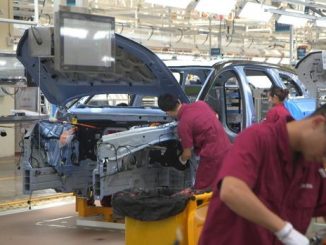
Assembly line at Chinese all-electric car company Nio.

The recent nonsense issued by U.S. Treasury Secretary Janet Yellen on China’s ‘overcapacity’ and ‘unfair subsidies’ to its industries is particularly pathetic.  As Renaud Bertrand put it: The so-called threat of China’s ‘industrial overcapacity’ is a buzzword that actually means that China is simply too competitive, and by asking it to address this, what Yellen is truly asking of China is akin to a fellow sprinter asking Usain Bolt to run less fast because he can’t keep up.”

Indeed, let me quote Bertrand’s rebuttal of Yellen’s claims of ‘overcapacity’: “Let’s start with capacity utilization rates. It’s crystal clear they’ve been pretty much constant in China for the past 10 years, standing at roughly 76% right now, which is in the same ballpark as America’s own utilization rates, at about 78%. So, there’s no issue there.”

Bertrand goes on: “Despite the very low prices for its EVs or solar panels, Chinese companies involved still make a profit (industrial profits are rising at double-digit growth), and they DO charge higher prices abroad than at home. The competitiveness of Chinese companies is overwhelming: today, in scores of industries – like solar or EVs – there is simply no way for American or European companies to compete with Chinese ones. This is the real issue: Yellen and Western leaders are afraid that if things keep going, China will simply eat everyone’s lunch.”

China is the only country in the world that produces all categories of goods classified by the World Customs Organization (WCO). This gives it a key advantage when it comes to end prices: when you want to build something in China, you can literally find the entire supply chain for it at home. Bertrand: “China has become an innovation powerhouse. In 2023, it filed roughly as many patents as the rest of the world combined, and it’s now estimated to lead 37 out of the 44 critical technologies for the future. All this, too, has implications when it comes to the final prices of its products.”

Europe’s leaders have been echoing Yellen’s claims.  After meeting Xi in Beijing last December, European Commission president Ursula von der Leyen noted the EU’s trade deficit with China had ballooned to €400bn from €40bn 20 years ago, as she highlighted a series of complaints, including China’s industrial ‘overcapacity,’ she said: “European leaders will not be able to tolerate that our industrial base is undermined by unfair competition.”

But let’s get this right: the EU trade deficit with China has risen from $40bn to $400bn in 20 years!  Not two years, not five years, not ten years, but throughout this century.  First, that makes the rise in the deficit not so large per year, say about $10-15bn, and throughout that period, we heard little complaint from the EU that China was adopting unfair trade practices.  Suddenly, after the debacle of rising energy costs after cutting off Russian energy imports and a virtual two-year recession in the major EU countries, von der Leyen now blames China. Indeed, most of the increase in the ‘China deficit’ has come in the post-pandemic period.

As for the U.S., currently, the bilateral trade deficit between the U.S. and China relative to the size of the U.S. economy, is the lowest it’s been since 2002.  As Bertrand says, “So it’s an odd time to complain so vociferously about trade imbalance with China since, from America’s standpoint, the trade imbalance is the lowest it’s been in over 20 years.

Nevertheless, the Keynesian/China experts promote and parrot Yellen’s message. Here is a quote from a Western media source: “Against the backdrop of rising international concern, experts believe the manufacturing strategy will not deliver on Beijing’s growth targets. Exports already account for a fifth of GDP, and China’s share of global manufacturing stands at 31 percent. Absent an explosion of demand, they say it is unlikely the rest of the world could soak up China’s exports without shrinking its own manufacturing.”

Who are these great experts?  The usual suspects.

Michael Pettis tells us that if China goes on expanding its manufacturing exports, it will have to be “accommodated by the rest of the world.” And the rest of the world is unlikely to do that.  Really?  It seems that China has no problem selling its exports to the rest of the world’s consumers and manufacturers, who are eager to buy.

Another expert is Brad Setser.  Setser tells us that “China’s domestic EV market was created via industrial policy; it didn’t appear out of thin air. A critical point, and one that is often now forgotten. Same is true of HSR and wind, and China is trying in other sectors as well.”  Shock, horror; it was not achieved through market forces but through state-led investment.  He goes on, “The reality that many of China’s export success stories now didn’t originate with the magic of the market no doubt complicates global trade, as adjusting to accommodate China’s successes doesn’t “feel” like a true market adjustment.“  In other words, the U.S. and Europe and Japan cannot compete.  So what to do?  Setser says, “I think the U.S. should make a real effort to offset China’s economic coercion here. It will take a bit of sacrifice but I at least am willing to step up.”   So competition is now called ‘coercion,’ and the U.S. must respond with coercion itself, with Setser ready to help Yellen on that.

The rationality of this nonsense is found in the Western mainstream view that China is stuck in an old model of investment-led export manufacturing and needs to ‘rebalance’ towards a consumer-led domestic economy where the private sector has free rein. China’s weak consumer sector is forcing it to try to export manufacturing ‘over capacity’.

But the evidence for this is not there. According to a recent study by Richard Baldwin, he finds that the export-led model did operate up to 2006, but since then, domestic sales have boomed so that the exports to GDP ratio has actually fallen. “Chinese consumption of Chinese manufactured goods has grown faster than Chinese production for almost two decades. Far from being unable to absorb the production, Chinese domestic consumption of made-in-China goods has grown MUCH faster than the output of China’s manufacturing sector.”

Chinese manufacturers remain highly competitive in world markets, despite all the efforts of the West to impose tariffs and other protectionist measures.  China is doing particularly well in electric vehicle production, solar energy and other green technologies. But as Baldwin points out, this export success does not mean that China depends on exports for growth.  China is growing mainly because of production for the home economy, like the U.S.

But there is a more worrying feature of this ‘overcapacity’ nonsense.  It has been swallowed hook, line, and sinker by economists in the Chinese banking sector, who were mainly trained in Western universities.  Take the recent speech by the chief economist at the China Bank, Zu Gao.  His speech was highly praised by the likes of Pettis and Setser.  Xu argued that “the significantly lower consumption-to-GDP ratio in China, compared to the global average, is the fundamental cause of the country’s lackluster domestic demand and economic slowdown.”

Xu explains that “weak domestic demand, compounded by lackluster external demand or export volumes, results in insufficient total demand, thereby stifling economic growth. In that sense, the long-term growth constraints on the Chinese economy lie not in the supply but in demand.”  Really?  China’s relative growth slowdown in the past decade has been due to the slowing expansion of its labor force with economic growth then depending primarily on raising the productivity of labor.  And that depends on investment in productivity-boosting technology, not consumption, which is a deduction from resources for investment.  Moreover, which countries have achieved faster growth in the last few years: the consumer-led West or low-consumption China?

Xu follows up his classic crude Keynesian theory by saying that “the objective of economic growth is to fulfill the people’s expectation for a better life, which is primarily manifested through their expectation for enhanced consumption—better quality food, clothing, and leisure activities. When a country’s consumption constitutes a small fraction of its GDP, it indicates a misalignment between the aggregate economic growth (as depicted by GDP) and the lived experiences of its people.”

But this is just not true.  A low consumption-to-GDP ratio does not necessarily mean low consumption growth.  And China’s consumption growth has been way faster than the consumer-led economies of the West.

Then we get to the real purpose of Xu’s speech: “The extensive presence of state-owned enterprises (SOEs) in China, whose profits and dividends primarily flow to the state rather than households, diminishes the wealth effect that might otherwise stimulate household consumption.” You see, it’s China’s state-led economy that’s the problem: it is stopping “an efficient market mechanismfrom working.

So what to do? “Of course, SOEs in China are technically owned by the people, yet their equity is predominantly held by the state. Consequently, the dividends from SOEs primarily flow to the state rather than the households; the profits retained post-dividend distribution from SOEs are not directly connected to the balance sheets of households, making it difficult to contribute to household wealth. So says Xu, “We need to distribute all SOE stocks to citizens,” i.e., privatise the state-owned companies.

The chief economist of China Bank seems to reckon that the only answer to the perceived ‘lack of demand’ and ‘overcapacity’ in China is to restore the dominance of the ‘efficient market mechanism”.

Strugglelalucha256


Washington’s New Cold War: U.S. Special Forces train Taiwan troops in drone warfare

On March 14, Taiwan Defense Minister Chiu Kuo-cheng confirmed that U.S. Army Special Forces, specifically the “Green Berets,” are permanently stationed in amphibious command centers in the Kinmen and Penghu islands. 

The Green Berets are training Taiwanese forces on the use of military drones including the Black Hornet Nano, like those being used by U.S.-advised forces in Ukraine.

Previously, U.S. troops stationed in Taiwan were only temporary, not permanent. The permanent deployment of any U.S. troops to Taiwan breaches the “One China” policy.

China’s sovereignty over Taiwan is internationally recognized. In 1972, in a joint  communiqué, the U.S. acknowledged that “there is but one China and that Taiwan is a part of China.” 

While the U.S. officially recognizes that Taiwan is part of China, it has maintained a military presence on the island since the People’s Liberation Army’s victory in 1949, when the Chiang Kai-shek government fled to Taiwan. That presence was reduced in the 1970s after the adoption of the One China policy.

Now, as the BBC reported, “the U.S. is quietly arming Taiwan to the teeth.”

“U.S. President Joe Biden recently signed off on a $80m grant to Taiwan for the purchase of American military equipment. … The $80m is not a loan,” the BBC says. This is a departure from the earlier policy of only selling weapons to Taiwan.

The U.S. “is using its own money to send weapons to a place it officially doesn’t recognize. This is happening under a program called Foreign Military Financing (FMF). …”

The FMF, under the State Department and separately funded through the Foreign Operations Appropriations Act, has been used to give some of the billions in military aid sent to Ukraine.

The BBC continues: “It has been used to send billions more to Afghanistan, Iraq, Israel and Egypt, and so on. But until now it has only ever been given to countries or organizations recognised by the United Nations. Taiwan is not. …

“After the U.S. switched diplomatic recognition from Taiwan to China in 1979, it continued to sell weapons to the island under the terms of the Taiwan Relations Act. … The U.S. State Department has been quick to deny [the FMF grant] implies any recognition of Taiwan.”

The BBC quotes a top Taiwan politician who “says the $80m is the tip of what could be a very large iceberg and notes that in July, President Biden used discretionary powers to approve the sale of military services and equipment worth $500m to Taiwan.” The report adds that Taiwan expects more than $10 billion in military aid from the U.S.

The deployment of U.S. Army special forces near China’s mainland, where they are establishing and conducting exercises with reconnaissance drones used for offensive military attacks, is an escalation in Washington’s New Cold War against China.

Gary Wilson is the author of War and Lenin in the 21st Century.

Strugglelalucha256


Taiwan elections: U.S. beats the war drums despite the vote

When the election results for Taiwan’s president and legislature were announced on January 13, the U.S. corporate media seemed jubilant. Three parties competed for president: The ruling pro-Taiwan-independence Democratic Progressive Party (DPP), the nationalist opponent of independence Kuomintang Party (KMT), and another opponent of Taiwan independence, the Taiwan People’s Party (TPP).

All three are bourgeois parties reflecting a split in Taiwan’s business class. Although there were several domestic issues raised in the campaign, the main issue was and is relations with mainland China. The People’s Republic of China has always maintained that Taiwan is, in fact, a province of China and that the goal of the PRC is “peaceful unification.”

However, just as Abraham Lincoln waged war against the enslavers’ Confederacy to prevent its “separation” from the Union, China asserted the right to use force if necessary to prevent Taiwan’s “Independence.”

Taiwan belongs to all the people of China, including all of its provinces, not just residents of that island. Recognition of that fact forced the U.N. to expel Taiwan as a separate nation and even forced the U.S. to recognize China as “one country” in 1979. But U.S. imperialism has continued to bully dependent countries to continue to recognize Taiwan as China and continues to supply Taiwan with massive shipments of weapons and military “trainers.”

A January 20 Wall Street Journal article proclaimed: “China’s Strongest Ally in Taiwan Is Weaker Than Ever.” The article states that the KMT was losing its hold on the island “as more Taiwanese embrace a local identity separate from China and reject the KMT’s perceived coziness with Beijing.”

Yet further down that same article, the WSJ had to provide the actual election results in Taiwan that give a far different picture. In 2020, the DPP presidential candidate won 57 percent of the vote. In 2024, he won only 40 percent of the vote. The two other parties, both of whom oppose the call for independence, combined for 60 percent of the vote, with 33.5 going to the KMT candidate and 26.5 percent to the TPP.

The DPP also fared badly in the legislative elections. Before, they held the majority with 61 seats in the 113-seat legislature. They lost 10 seats in the vote, while the KMT now has 52 seats to the DPP’s 51, with two independents lining up with the KMT. And the TPP won eight seats, giving the two opposition parties effective control.

On the international scene, two days after the election, the small Pacific Island nation of Nauru switched recognition from Taiwan to the PRC. And another island nation, Tuvalu, just elected a prime minister who campaigned on the promise of switching recognition from Taiwan to the People’s Republic of China.

In Central America, the recently elected president of Guatemala, Bernardo Arevalo, faces a cruel choice. On the one hand, he campaigned with the promise of switching recognition to the PRC from Taiwan in order to develop his desperately poor country, devastated by global warming, causing a cycle of droughts and floods.

On the other hand, that same devastation has forced thousands of Guatemalans to migrate to the U.S., 220,000 in 2022 alone. Arevalo is trying to get work permits for these people from the Biden administration, which has now taken an openly hostile view, just like the Trumpist Republicans, towards migrants.

So far, Arevalo has been unable to carry out the switch to the PRC because of this.

Despite enormous U.S. pressure, only 11 countries now recognize Taiwan as a nation, including the Vatican, a “nation” consisting of the residence of the Roman Catholic pope.

All in all, during the eight years of the pro-independence rule of the DPP in Taiwan, ten countries switched recognition from that island to the People’s Republic.

China-Taiwan relations in flux

All three Taiwan parties are hostile to the PRC and are enemies of socialism. But before the DPP took power in 2016, the KMT government, while maintaining the absurd fiction that it was the legitimate government of all of China, agreed with the People’s Republic on the “one China” principle, so they were able reach a series of important economic agreements with the PRC.

China and its city, Hong Kong, became Taiwan’s top trading partners, and many social and cultural agreements were reached as well.

But in 2014, the U.S. engineered a “recolonization” campaign in Hong Kong, aiming to tear that former British colony (a war prize from the first Western Opium War) away from China. China’s successful effort to prevent that frightened Taiwan’s ruling class. So, it switched its support to the pro-independence DPP and called on the U.S. for increased military backing.

The U.S. obliged by sending its fleet into waters just offshore of China and Taiwan and began a steady series of provocations. Taiwan became the “linchpin” of U.S. imperialism’s effort to effect “regime change” in China itself, which has made a steady turn to the left since President Xi Jinping took office in 2012.

The U.S. beats the drums of war, but no echo in Taiwan or the PRC.

Despite the weakening position of the DPP from these elections, the U.S. corporate media has stepped up its campaign to mobilize the population here for war against China. Here is just a sample:

  • February 1, The Guardian, “A race against time’: Taiwan strives to root out China’s spies.”
  • January 25, Benzinga, “Amid Tensions With China, US Navy Sends First Warship Through Taiwan    Strait Post-Election.”
  • January 27, NY Times, “What Worries Me About War With China After My Visit to Taiwan.”
  • February 7, NBC, “Chinese hackers spent 5 years waiting in US infrastructure, ready to attack, agencies say.”
  • February 8, Newsweek, “‘China’s Spies Hacked NATO Ally’s Defenses’, Official Says.”
  •  February 9, Newsweek, “US and Japan Fight China in Allied War Game.”
  • February 9, GB News, “China opens Antarctic base right next to US site as Americans fear it could be used for espionage.” (Some of those penguins could be Chinese spies.)

But, the response by the Chinese government and military to the elections in Taiwan has been far more restrained. For example, during her 2022 visit, House Speaker Nancy Pelosi openly tried to incite the DPP government to declare Taiwan’s “independence,” which would have the island become a “Ukraine-style proxy” in a conflict with China. China’s navy and air force responded with a show of strength.

Many polls, along with these election results, show that most of Taiwan’s residents see any calls by the DPP for “independence” as a threat to peace and their livelihood. Efforts by the U.S. to stop the reunification process between Taiwan and the PRC, just like the U.S. efforts to force regime change on the Chinese people, are bound to fail.

Source: Fighting Words

Strugglelalucha256


Trilateral missile defense system a step toward Asian NATO

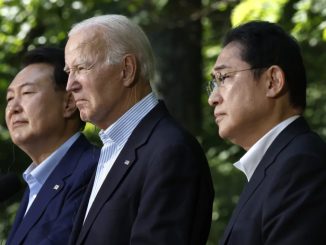
The United States, Japan, and South Korea will fully operationalize a missile warning system “by the end of December.” While justified as a means to counter North Korea’s missile launches, more worrisome, it escalates tensions in the region with China through the “NATOification” of all three countries, agreed upon in the “Spirit of Camp David” agreement.

The agreement was hailed as a “new era of trilateral partnership” during the August 18 press conference following a meeting between the heads of state of all three countries. Western media echoed the sentiment, calling it “historic” and “unprecedented.” China, listed in the agreement as a regional concern, accused the United States of creating a “mini NATO in Asia.” In response, United States National Security Advisor Jake Sullivan emphatically stated that the trilateral alliance is “nothing new” and certainly “not a new NATO for the Pacific.” Yet despite such dismissals, this meeting between the U.S. and its strongest allies in the region lays the foundations for NATO-level military cooperation—a common threat, interoperability, and security coordination—that threatens China and escalates tensions in the region.

‘Collective interests and security’

While the United States has had bilateral agreements under the San Francisco System with South Korea and Japan for decades, the August 18 Camp David meeting institutionalized trilateral cooperation among the three nations, changing the scope and nature of their relations from the hub-and-spoke bilateral alliances to trilateral annual summits (covering finance, commerce, industry, foreign policy, and defense) and joint military exercises. As Victor Cha of the Center for Strategic and International Studies (CSIS) states: “This [unprecedented] institutionalization of the trilateral relationship… transforms these alliances into something quite new.” This was a historical breakthrough for the United States, which first pursued a NATO-level alliance built around Japan in the 1950s. Yet, unresolved grievances around Japan’s colonialism (enabled by the U.S. decision to prioritize its security interests over rectifying Japan’s war crimes and colonialism), and the different security interests between South Korea and Japan forced it to settle for bilateral agreements with governments it installed and propped up. Nonetheless, as noted in Foreign Policy magazine, this U.S. “military preeminence in the Pacific gave Washington the luxury of not needing a collective security agreement.” Today, as the U.S. “has lost its preponderance of military power in the maritime domain… [the U.S. and its allies face a] threat comparable to what NATO confronted in Europe during the Cold War.”

The conservative, pro-U.S. Yoon Suk Yeol administration’s 2023 decision to normalize relations with Japan (casting aside a South Korean Supreme Court ruling against Japanese companies for the wartime conscription of Koreans) paved the way towards establishing the trilateral alliance that the U.S. had sought for the past 70 years. While the Spirit of Camp David Agreement is not yet a full-fledged mini Asian-NATO, combining two of the United States’ closest allies in the region into military cooperation with each other is a step towards it. The agreement contains the seeds of a NATO-level trilateral alliance based on mutual self-defense. More specifically, it calls for consultation and coordinated responses “to regional challenges, provocations, and threats that affect our collective interests and security.” As Kurt M. Campbell, Biden’s Asia strategy architect, has stated: a “fundamental, foundational understanding” of the Spirit of Camp David statement is that “a challenge to the security of any one of the countries affects the security of all of them.”

‘Integrated deterrence’

One of NATO’s strengths, which enhances and expands U.S. power projection in the region, is the synergy achieved by greater interoperability (i.e., the ability to effectively “achieve tactical, operational and strategic objectives”) between member countries. All of these are being built up and pursued through the trilateral security cooperation agreement.

This agreement lays the groundwork for trilateral interoperability to achieve “integrated deterrence” against China. This integrated deterrence is key in the U.S. containment of China. It allows the United States to carry out provocations (e.g., former U.S. House Speaker’s Nancy Pelosi August 2022 visit with Taiwan’s president) while limiting China’s response options.

A key component of integrated deterrence is joint military cooperation and coordination through a common operational picture. In other words, all parties need to be looking at the same operational picture, informing their operational decisions. The recent normalization of the General Security of Military Information Agreement (GSOMIA) by the Yoon Administration lays the foundation for this. Previously, under the 2014 trilateral information sharing agreement, South Korean and Japanese intelligence would be shared between each other through the United States and would be limited to threats from North Korea. GSOMIA, first signed in 2016 and reinstated by Yoon (after former President Moon allowed it to expire in 2019), allows comprehensive intelligence sharing between South Korea and Japan directly, including “threats from China and Russia.” On August 29, the United States, South Korea, and Japan held joint ballistic missile defense drills to “detect and track a computer-simulated ballistic missile target, and share related information.” The system is expected to be fully operationalized by the end of December 2023. While ostensibly against North Korean intercontinental ballistic missiles, given the scope of GSOMIA, this missile defense system can just as well be applied to China.

At a time when regional power is maintained through an “extended deterrence” to determine the outcome without a bullet even fired against an adversary, the United States’ missile defense system allows it to project its power in the region by neutralizing China’s anti-access and area-denial capabilities. Furthermore, it threatens to neutralize China’s ability to respond to a first strike by the United States. The United States’ “extended deterrence” containing China and China’s “extended deterrence” safeguarding its economic rise leaves both jostling for military advantage. In effect, U.S. actions are triggering a set of actions and counteractions that are escalating tensions in the region.

Members of the Biden Administration extol the Camp David Agreement as historic and unprecedented and as a qualitative leap forward in the United States, Japan, and South Korea military cooperation and coordination. At the same time, they oppose its characterization as a mini-Asian NATO. And while the agreement has not yet reached NATO status, it is clearly laying the groundwork toward that objective. It has also driven China, North Korea, and Russia to strengthen their own coordination, effectively consolidating an opposing bloc. Ultimately, the fight to establish competing “extended deterrence” is the beginning of war. To stop war, we must shift from military posturing and escalation to diplomatic solutions and respect for the security concerns of all countries.

This article was produced by Globetrotter.

Jeffrey Wagner is an educator in South Korea and a member of the International Strategy Center.

Dae-Han Song is in charge of the networking team at the International Strategy Center and is a part of the No Cold War collective.


Strugglelalucha256


China in crosshairs as U.S. deploys land-based medium-range missiles in Asia-Pacific

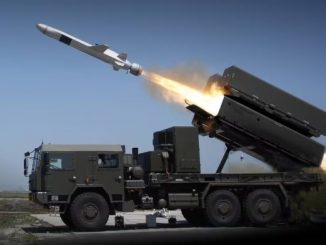
As the mainstream propaganda machine was trying to present the supposed “new era of detente” between the United States and China (at least until President Joe Biden shot down their efforts with a single remark), the Pentagon was preparing for something completely different. Namely, the U.S. military is in the process of deploying new medium-range missile systems to the increasingly contested Asia-Pacific region. According to General Charles A. Flynn, a four-star commanding officer of the U.S. Army Pacific (USARPAC), the deployment is officially slated for next year, and its purpose is to “deter China from invading Taiwan.” More importantly, Flynn revealed that the U.S. Army will deploy a missile launcher that will be able to fire the land-based version of the medium-range “Tomahawk” missile.

“We have tested them and we have a battery or two of them today,” General Flynn said, adding: “In 2024 we intend to deploy that system in your region. I’m not going to say where and when. But I will just say that we will deploy them.”

Although this isn’t exactly a new capability, as the U.S. Army had ground-based medium-range cruise missiles back in the early 1980s, the weapon in question was banned under the now-defunct Intermediate-Range Nuclear Forces (INF) Treaty signed by Washington, D.C., and Moscow in 1987 (came into effect on June 1, 1988). This arms control agreement banned land-based missiles and weapons (bar coastal defense ones) with ranges of 500-5500 km. This included ballistic and cruise missiles, both conventional and nuclear-tipped, but excluded air and sea-based weapons.

Among the most prominent types eliminated by the INF Treaty were the American MGM-31A “Pershing” and “Pershing II” solid-fueled ballistic missiles (ranges of 740 and 1770 km, and single warheads with yields of up to 400 and 80 kt, respectively) and the Russian RSD-10 “Pioneer” solid-fueled ballistic missiles (range of up to 5500 km) capable of using three MIRV (multiple independently targetable reentry vehicles) warheads with a yield of 550 kt each roughly 37 (111 altogether) times more powerful than the Hiroshima bomb). However, among the affected weapons was one that the U.S. effectively never stopped using.

The missile in question was the GLCM (Ground Launched Cruise Missile), officially designated as the BGM-109G “Gryphon,” a subsonic cruise missile with a range of 2780 km and a single W84 thermonuclear warhead (yield of up to 150 kt, or approximately ten times more powerful than the Hiroshima bomb). The “Gryphon” was a land-based version of the infamous “Tomahawk” cruise missile that the U.S. Navy continues to use and upgrades regularly (the latest variant being the Block 5). As the U.S. unilaterally withdrew from the INF in 2019, it’s currently in the process of reinducting these types of missiles.

Back then, several colleagues of mine and I argued that Washington DC did so because of their rivalry with China, despite the official stance of the U.S. government that the alleged Russian violations of the INF Treaty were the reason for their withdrawal. The belligerent thalassocracy never provided any solid evidence for these allegations, but it did expose its own hypocrisy by testing a land-based version of the “Tomahawk” cruise missile just three weeks after it announced the termination of its compliance with the INF Treaty. The conclusion that this was prepared months or even years in advance is the only logical one.

Namely, it takes years to develop such weapons or months (at best) to convert them from sea to land-based missiles. Even then, it took nearly half a decade of testing for the U.S. Army to officially induct the weapon and its “Typhon” launch platform. The newly deployed U.S. Army units that use the land-based “Tomahawk” missiles can hit targets at ranges of approximately 1600 km. Their ability to carry the W80 thermonuclear warheads means that the old “Gryphon” is effectively resurrected, with the only difference being that its target is not European Russia but China and, very likely, North Korea as well.

The very usage of the name “Typhon” indicates that the missile is a successor to the “Gryphon,” while the wordplay itself (similarity with the word typhoon) reveals its purpose as the weapon that’s supposed to devastate targets along China’s Asia-Pacific shore. The future location of the U.S. Army units and their missile batteries is yet to be revealed, as General Flynn refused to give any comments in that regard, but various sources indicate that it could be Japan, further reinforcing the aforementioned hypothesis and “Typhon/typhoon” etymological connection.

The U.S. is also expanding its military presence in the Philippines, Guam, and elsewhere in the region. This includes the deployment of similar “Tomahawk” launchers by the U.S. Marine Corps (U.S.MC), while the U.S. Navy already has numerous sea-based “Tomahawk” launch platforms. All this clearly indicates a concerted effort to surround China with hostile military bases and infrastructure that would force it to respond accordingly. And while Beijing might prioritize peace talks and detente, it will not do so at all costs. The Asia-Pacific and its busy sea lanes are vital to the Asian giant’s heavily export-oriented economy, and any dangerous deployments that could jeopardize them will not be tolerated or left unanswered, particularly as Chinese hypersonic capabilities far eclipse that of the U.S.

Drago Bosnic is an independent geopolitical and military analyst.

Source: InfoBrics
Strugglelalucha256


Xi meets Biden

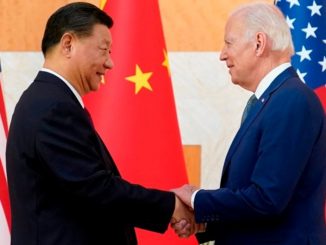
This was the only second face-to-face meeting during the Biden presidency. It seems the aim was to clarify just how close the U.S. and China are to conflict over Taiwan and other security issues, as well as trying to establish some semblance of trade progress after years of U.S. moves to reduce China’s rise in hi-tech and other products (EVs) that threaten U.S. hegemony.  Indeed, Xi was also meeting U.S. business leaders to try and reassure them that they can invest in China, despite recent moves by the Chinese CP leaders to tighten controls on the capitalist sector.

It does not appear much came out of the meeting apart from agreeing not to attack each other ‘by mistake.’  But while the leaders ‘talked turkey,’ the economic reality is that U.S. efforts to strangle the Chinese economy are not working.  Western ‘experts’ continue their never-ending message that China is close to a debt collapse; China’s property market is imploding; and above all, China’s previous phenomenal growth is now over, and the economy since COVID is grinding to a halt and will end up like Japan, stagnating in a sea of debt.

If this were really so, then Biden and American capital would have nothing to worry about – but they do worry, and rightly so.  Yes, China’s property bubble has burst, and some very large private-sector property developers are going bust.  In previous posts, I have argued that it was a big mistake by the Chinese CP leaders to adopt the Western capitalist model for urban development.  Instead of putting housing construction into the public sector to build homes at reasonable rents for the hundreds of millions of Chinese who have moved into the cities to work, the government allowed private developers (with billionaire owners) to do the job, and now the result is a classic debt-driven bubble that has burst.

And yes, overall debt in the capitalist sector has rocketed.  Now, the government will be forced to liquidate many of these developers and/or ‘restructure’ their operations with state money.  But this does not mean China is about to have a deflationary crash.  China’s net debt to GDP ratio (debt burden) is only 12% of the average in the G7 economies.  The state holds huge financial assets, so it can easily manage this property slump.

The government has just announced that its new Central Financial Commission will take over from the People’s Bank and the existing financial regulator, the control of China’s financial private sector.  The ‘Western experts’ decry this move because they think the market can better allocate investment than the state.  “The temptation to intervene in capital and credit allocation, whether arising from risk or management failure, or from political directive, is likely to be elevated,” said perennial China skeptic George Magnus.  He added. “These features do not augur well for China’s financial stability or economic prospects.”

The point is that the Xi leadership no longer trusts the Western-educated economists in the People’s Bank to regulate the private sector – the bank is a fortress of neo-classical pro-market economics.  The bank’s economists would support Magnus’ approach to free up the finance sector – something so successful in Western economies! But the CP leaders still stop short of bringing these speculative financial and real estate speculators into public ownership (no doubt some leaders have personal links).  Until they do, financial speculation will continue to distort the economy much more than any arbitrary policies of the party leaders.

The Chinese economy is not diving into a recession.  The IMF has just forecast that China’s real GDP will rise by 5.4% this year – and that’s an upgrade from its previous forecast.  The housing market may be struggling, but productive industrial construction is booming.  China has already built enough solar panel factories to meet all demand in the world.  It has built enough auto factories to make every car sold in China, Europe, and the U.S.. By the end of next year, it will have built in just five years as many petrochemical factories that Europe and the rest of Asia have now.

And take hi-speed rail and infrastructure projects.  Back in the U.S., Biden makes much of his infrastructure program after decades of decline and neglect in U.S. transportation facilities.  But that’s nothing to the rapid expansion of high-speed rail and other transport projects that now have linked up the vast expanse of China’s regions.  Compare this to the state of infrastructure in the San Francisco area as Xi visits.

Ah, but you see, China’s economy is seriously ‘imbalanced’.  There is ‘too much’ investment in such projects and not enough handouts to the people to spend on consumer goods like iPhones or services like tourism and restaurants. China cannot grow anymore unless it switches households from saving to spending and investment to consumption.  The old state-led investment and export model is dying.  China will now end up like Japan, stagnating with near-zero growth and a falling population.

I have pointed out the nonsense of this view on several occasions.  China’s growth has been based on a high rate of productive investment – at least until the unproductive capitalist property development sector came overloaded with debt.

But high investment does not mean low consumption growth – on the contrary, investment leads to more production, more jobs, and then more income and consumption.  China’s supposedly low consumption ratio to GDP compared to the highly successful Western capitalist economies is accompanied by a much faster growth in household spending.  Indeed, retail sales rose 7.6% yoy in October – not suggesting an entirely weak consumer.  China’s workers may not have any say in what their government does, but nevertheless, their wages are still rising faster than anywhere else in Asia.

.

And those wage rises are not being eaten away by inflation as has happened in the last few years in the rest of the G20 economies.  China’s inflation rate is near zero, while inflation, despite recent falls, in the U.S. and Europe is several times higher – indeed, U.S. workers have seen prices rise by 17% since COVID.

The Western mainstream economists proclaim China’s ‘disappointing’ economic slowdown (real GDP growth of 5.4% and forecast 4.5% next year), but they say little about Japan. Japan is dropping into stagnation and even slump.  In Q3 2203, real GDP fell 2.1% at an annualized rate (the measure U.S. economists use to bolster the U.S. rate); consumer spending is stagnating, and business investment’s decline is accelerating.

Japan: real GDP growth (annualized rate) %

Japan is joining much of the Eurozone, the UK, Canada, Sweden, New Zealand, etc, in contraction this coming year.

And if Biden is hoping that the upcoming presidential election in Taiwan will lead to a victory for the pro-independence candidate from the Democrat party, then he could be in for a surprise.  It seems that the two anti-independence, pro-China parties, the Kuomintang and People’s Party, are planning to run a single candidate for the presidency and current polls show that such a candidate would win.  So that could mean a pro-China president in Taiwan next year.

Source: Michael Roberts Blog

Strugglelalucha256


Chinese military bases in the Middle East – threat to whom?

United States President Joe Biden recently stated that his country is not only “the most powerful in the world” but also supposedly “in the history of mankind.” And while that assertion is highly debatable to anyone remotely familiar with the actual history of our planet, it’s true that very few countries (if any) can (or could’ve) match the U.S. in terms of military (over)deployment. Namely, while the exact number is not easy to pinpoint, Washington, D.C., currently operates at least a thousand military bases, logistics hubs, centers, etc., around the globe. The belligerent thalassocracy insists that this is “necessary” to supposedly “maintain global security.” However, the vast majority of the people on our planet are perfectly aware that this is anything but true and that the U.S. and its vassals and satellite states are by far the greatest security threat to anyone in the world.

And yet, in its endless hypocrisy and double standards, Washington DC keeps “expressing concern” when other countries establish a military presence on foreign soil, no matter how minuscule it is in comparison to the U.S. According to various reports, for the first time in its history, China is planning to establish a permanent military base in the Middle East.  Washington, D.C., is virtually bound to see this “as a significant challenge,” particularly as the planned permanent base will be in the highly strategic (and volatile) Persian Gulf region. The U.S. itself also has a major military presence, such as the Navy Central Command military infrastructure in Qatar and Bahrain. On November 7, citing “people familiar with the matter,” Bloomberg reported that “President Joe Biden has been briefed on what his advisers see as a Chinese plan to build a military facility in Oman.”

“This comes amid a broader effort by Beijing to deepen defense and diplomatic ties with the Middle East,” the report continues, further adding: “Biden was told that Chinese military officials discussed the matter last month with Omani counterparts, who were said to be amenable to such a deal, said the people, who asked not to be identified discussing private deliberations. They said the two sides agreed to more talks in the coming weeks.”

The exact location of the future Chinese military infrastructure in Oman is still unknown. Back in August, Beijing and Muscat celebrated the 45th anniversary of the establishment of their formal diplomatic relations. In recent decades, the two countries have significantly improved their economic and military relationship, including joint exercises and other activities related to security and national interests. In addition, the port of Muscat is known for regularly hosting the ships of the People’s Liberation Army Navy (PLAN). Back in mid-October, the Royal Navy of Oman (RNO) and PLAN held joint naval drills and also promised “to expand their naval defense and military cooperation.” It should also be noted that China maintains very close relations with other countries in the region, including the United Arab Emirates (UAE), which could also be a possible candidate for future Chinese military presence.

At present, the only significant military base that Beijing operates anywhere near the region is its military base in Djibouti, a small country in East Africa. It should be noted that China is prone to establishing a military presence only in areas that its leadership thinks are important for the security of its massive infrastructure projects, such as the unprecedented One Belt One Road. This Chinese-led multinational effort spans almost the entirety of Asia and large parts of Europe. It includes both land and naval facilities and infrastructure, with a particular focus on trade and transportation. An important part of the project also includes Beijing’s plans to deepen ties with various major energy producers, a mutually beneficial effort that will further stabilize the otherwise volatile region. Bloomberg also suggested this is a major reason behind strengthened military ties between China and Oman.

And while the U.S. doesn’t have a direct and permanent military presence in Oman (besides naval visits to its ports), it does have an official agreement with Muscat to use the country’s military bases whenever it needs them for operations in the region. This includes the Thumrait airbase of the RAFO (Royal Air Force of Oman), located near the homonymous city in the south of the country. The airbase is often used by the USAF. In addition, the U.S. Navy also has a strong presence in waters off the coast of Oman. Its primary mission in the area is essentially “legalized piracy” that includes hunting for Iranian ships supposedly loaded with oil, weapons, or anything else the U.S. considers “illegal”. Needless to say, such activities by the U.S. forces in the region only contribute to unnecessary tensions and destabilization. This stands in stark contrast to China’s plans, as Beijing maintains a strong partnership with everyone in the region.

In the last several years, the U.S. Africa Command (AFRICOM) began warning that China is supposedly “not content with its Djibouti base on the continent’s east coast, but is looking to establish a military presence on the Atlantic.” Washington, D.C., sees this as a major threat to its much-touted “rules-based world order.” However, it’s obvious that Beijing’s military ambitions are nowhere near those of Washington, D.C., and that the Eurasian giant simply wants to ensure the safety of its global infrastructure projects. It’s highly unlikely that the U.S. will be able to force China’s partners in any of the areas where these projects are being conducted to stop them, let alone break growing ties with Beijing. For these countries, the choice is rather simple – it’s crucial to maintain close ties with the world’s most powerful production economy and a country that actually makes long-term investments in socioeconomic development.

Drago Bosnic is an independent geopolitical and military analyst.

Source: InfoBrics
Strugglelalucha256


The U.S. steps up its ‘chip war’ against socialist China

On October 17, Commerce Secretary Gina Raimondo announced new bans on the giant tech company Nvidia from sales of its advanced computer chips, particularly its advanced H800 and A800 products.

Raimondo claimed that this move was directed solely against the Chinese military. According to an October 18 CNN report, she said in August on her visit to China: “the administration was “laser-focused” on slowing the advancement of China’s military. She emphasized that Washington had opted not to go further in restricting chips for other applications.”

But on October 17, Raimondo made clear that the target of these sanctions against socialist China is much wider:

“The goal was to limit China’s ‘access to advanced semiconductors that could fuel breakthroughs in artificial intelligence and sophisticated computers’.”

China’s Foreign Ministry quickly responded:

“The US needs to stop politicizing and weaponizing trade and tech issues and stop destabilizing global industrial and supply chains,” spokesperson Mao Ning told a press briefing. “We will closely follow the developments and firmly safeguard our rights and interests.”

China has decided to cut off the U.S. from supplies of germanium and gallium, essential for manufacturing semiconductors.

Commerce secretary calls Huawei’s computer chip breakthrough ‘incredibly disturbing’

At a Senate hearing on October 5, Commerce Secretary Raimondo called the Chinese firm Huawei’s new cellphone and its 7nm computer chip “incredibly disturbing.” Why? It’s because that chip was produced by the Chinese state-owned Semiconductor Manufacturing International Corporation (SMIC).

Both companies, Huawei and SMIC, have been “blacklisted” by both the Trump and Biden administrations to prevent them from developing advanced semiconductors and other computer technologies.

In 2018, Trump had gone so far as to have a top Huawei executive placed under house arrest in Canada for three years for supposedly violating U.S. sanctions against Iran.

The Biden administration has escalated its economic war with China, prohibiting not only U.S. companies from selling advanced computer technologies to Chinese companies but also other countries from doing so, such as South Korea, the Netherlands, and the computer companies based in Taiwan. U.S. “experts” had predicted that this move would take decades for China to overcome if it ever did.

An October 4 opinion piece in the New York Times details how the U.S. establishment uses international digital financial tools to bend their “junior partners” to their will over the sentiments of the populace in their own countries. The article discusses a recently published book: “Underground Empire: How America Weaponized the Global Economy,” by Henry Farrell of Johns Hopkins and Abraham Newman of Georgetown:

“These institutions include the dollar and the bank-messaging system known as Swift (the Society for Worldwide Interbank Financial Telecommunication), which is based in Belgium and run by an international board but vulnerable to American pressure. It helps that the rise of the internet has made the United States home to much of the wired world’s circuitry and infrastructure, including, in our time, some of the major cloud computing centers of Amazon Web Services, Microsoft, and Google.

”The United States now has the ability to survey and influence the world’s communications and supply chains, should it choose to. After the Sept. 11 [2001] attacks, it chose to. It bent the institutions to which it had access into a defensive (as it then saw things) weapon in the war on terror. ‘To protect America,’ Mr. Farrell and Mr. Newman write, ‘Washington has slowly but surely turned thriving economic networks into tools of domination.’

“A study this past summer by the European Council on Foreign Relations found large majorities, 62 percent continent wide, would wish for Europe to remain neutral should the United States and China ever enter into conflict over Taiwan. Yet last April, when President Emmanuel Macron of France urged his fellow Europeans to preserve their ‘strategic autonomy’ in Sino-American matters and avoid getting swept up in ‘a logic of bloc against bloc,’ he was rebuffed, not just by American politicians but also by certain of his European allies.“

Up until these imperialist sanctions, socialist China had obtained its semiconductor and other tech designs from a complex global network. Facing this U.S. blockade, the Chinese government began a robust campaign to develop its own semiconductor design capabilities. With this new Huawei success, it appears that socialist China has made a massive breakthrough.

Of course, in an example of extraordinary arrogance, the U.S. accused China’s SMIC, a company that it had already sanctioned, of violating those sanctions by not asking the U.S. Commerce Department for “permission” to develop its own new computer chip and sell it to another Chinese company, Huawei.

Not only is the U.S. placing stricter requirements on computer chip sales by its own companies and its Western subordinates, but it has demanded that Taiwan rulers stop its companies from engaging with tech companies on the mainland.

An October 5 Benzinga article stated that a probe by the Bloomberg business website revealed that four companies based in Taiwan were helping to build semiconductor plants in the mainland. The linchpin of the entire U.S. strategy to counter China is Taiwan and the Trump/Biden threat to wage war to defend the island’s “independence,” breaking with the “One China” policy that the U.S. had agreed to in 1979.

Biden’s much-touted anti-China “Chips and Science Act” program has hit a snag with the most important of Taiwan’s tech companies – the Taiwan Semiconductor Manufacturing Company (TSMC). An August 28 article from the Guardian indicates that the company is eager to get the U.S. government money but is in no hurry to actually build the plant in Arizona or hire union workers:

Eight months on, the Phoenix microchip plant – the centerpiece of Biden’s $52.7bn US hi-tech manufacturing agenda – is struggling to get online.

The plant’s owner Taiwan Semiconductor Manufacturing Company (TSMC), the largest chip maker in the world, has pushed back plans to start manufacturing to 2025, blaming a lack of skilled labor. It is trying to fast-track visas for 500 Taiwanese workers. Unions, meanwhile, are accusing TSMC of inventing the skills shortage as an excuse to hire cheaper, foreign labor. Others point to safety issues at the plant.

A “presidential” election is slated in Taiwan in January 2024. Polls indicate that the pro-independence ruling party’s candidate has only 33 percent popular support, while the three opposition candidates who oppose independence garner more than 50 percent support. They have yet to come up with a way to unify their opposition, but it still indicates that Taiwan’s residents reject the Ukraine-style proxy war scenario that the Pentagon and the Biden White House are pushing.

Artificial Intelligence – the next front

Now, the U.S. is scrambling to prevent China from developing even more powerful semiconductors and other advanced technologies that would power Artificial Intelligence (AI) systems.

Of course, AI presents opportunities for greater profits in a capitalist society. Each worker becomes more “productive”; that is, she or he can produce more goods or services in less time. But since the value of each commodity or service is measured by the amount of “average” labor time to produce it, this same technical development drives down that value, forcing companies to “overproduce” to try to maintain their level of profits. This leads to the “bust” part of the capitalist cycle – recessions and depressions.

But this is not a problem in a socialist system, where production is socially owned and is driven by scientific planning, not profit. China has virtually eliminated poverty. President Johnson declared his “War on Poverty” in 1964, but just like his war against socialist Vietnam, poverty won and is still widespread here among the workers and oppressed communities.

And the capitalist class fears that artificial intelligence could be used under socialism to greatly enhance the coordination and accuracy of that scientific planning. The workers, through their Communist Party, could use it to far more capably direct their economy to meet the people’s needs rather than fill the coffers of the banks and corporations.

The imperialist ruling class is keenly aware of the danger of this, not only in its economic competition with socialist China but also with the example of a powerful and prosperous socialist China lighting a revolutionary beacon to the global working class as to the possibilities with a new social system.

Source: Fighting Words

Strugglelalucha256


Washington’s expanding military footprint on China’s doorsteps


A series of announcements by the U.S. reflects its large and still growing military presence across Asia-Pacific, particularly in East and Southeast Asia. Together, they reflect a continued and increasingly desperate desire by Washington to encircle and contain China.

These announcements include plans for expanding the number of U.S. air bases across the region as part of the U.S. Air Force’s (USAF) new “Agile Combat Employment” (ACE) doctrine. It also includes plans for a “civilian port” in the Batanes islands, less than 200 km from the Chinese island province of Taiwan. Then there were recently announced plans by the U.S. Department of Defense to create drone swarms for countering China’s growing advantage in materiel and manpower.

Washington’s “ACE” in the Hole? 

A recent article published by Defense One titled “Air Force expanding number of bases in Pacific over next decade,” reported on the Pentagon’s plans to expand the number of air bases across the Pacific over the next decade to fulfill the requirements of the U.S.AF’s “ACE” doctrine.

More than simply increasing the number of air bases in the region, ACE seeks to disperse U.S. aircraft, ammunition, and personnel among a larger number of smaller bases, thus creating more targets for potential adversaries and increasing the overall survivability for U.S.AF assets.

The article notes:

The U.S. Air Force will increase its number of bases across the Pacific over the next decade, in an effort to spread out and become more survivable in conflict.

And that:

In the ACE concept, a few airfields serve as central ports, or hubs, while several smaller airfields serve as spokes. The idea is to be able to distribute weapons and assets over a large area and to increase survivability, versus just having a few large airfields throughout the geographically enormous region. 

Despite U.S.AF assets being distributed, command and control would be able to mass together assets from across multiple smaller bases for each specific mission or “force package.”

The concept is meant to make it more difficult in a potential conflict with China for it to target and destroy U.S. air bases with its large missile arsenals and, by doing so, significantly disrupting U.S. air capabilities in the region.

While ACE doctrine may be a realistic shift away from the relatively centralized nature of U.S. military bases across the Pacific, it will take many years to implement and only if the Pentagon’s budget is adjusted to do so. By then, China’s missile arsenal will only have increased in size and capabilities, possibly neutralizing any advantage the U.S. seeks to achieve by pursuing this doctrinal shift.

And while an eventual dispersal of U.S. air assets may complicate China’s ability to target and destroy U.S. warplanes before even leaving the ground to perform missions, China also possesses a large and very capable integrated air defense system able to intercept both U.S. warplanes and the munitions they would be using against Chinese targets.

U.S. seeks “civilian port” dangerously close to Taiwan 

Reuters, in an article titled “Exclusive: U.S. military in talks to develop port in Philippines facing Taiwan,” would report:

The U.S. military is in talks to develop a civilian port in the remote northernmost islands of the Philippines, the local governor and two other officials told Reuters, a move that would boost American access to strategically located islands facing Taiwan. 

U.S. military involvement in the proposed port in the Batanes islands, less than 200 km (125 miles) from Taiwan, could stoke tensions at a time of growing friction with China and a drive by Washington to intensify its longstanding defence treaty engagement with the Philippines.

The article also notes:

The Bashi Channel between those islands and Taiwan is considered a choke point for vessels moving between the western Pacific and the contested South China Sea and a key waterway in the case of a Chinese invasion of Taiwan. The Chinese military regularly sends ships and aircraft through the channel, Taiwan’s defence ministry has said.

The article fails to mention a much more important fact, that this “choke point” leading into the “contested South China Sea” is already “a key waterway,” one for Chinese maritime shipping.

While the U.S. poses as underwriting peace, stability, and prosperity in the “Indo-Pacific” region and, more specifically, in upholding “freedom of navigation” in areas like the South China Sea, the reality is that most of the “navigation” taking place in these waters is trade moving to and from China between other nations in the region which consider China their largest trade partner.

U.S. government and arms industry-funded think tank, the Center for Strategic and International Studies (CSIS), as part of its “China Power” project, published a post titled, “How Much Trade Transits the South China Sea?” It included an interactive map indicating the percentage of trade that flowed through the South China Sea from each nation.

China, by far, was the largest beneficiary of navigation through the South China Sea, accounting for over a quarter of all trade passing through it. South Korea (7%), Japan (4%), and Southeast Asian nations like Thailand (5%), Vietnam (5%), and Singapore (6%) also accounted for large percentages of trade through the sea, with each of these nations counting China as their largest trade partner.

Very clearly, the U.S., by expanding its military presence in and around the South China Sea, including at choke points like the Batanes islands, is best positioned to threaten, not protect, maritime shipping in the region, which would hurt China first and foremost. But it would also hurt trade among Washington’s supposed “allies” in the region it seeks to recruit in its escalating confrontation with Beijing.

Within the pages of U.S. government-funded think tank documents detailing war games between the U.S. and China, the disruption of Chinese commerce is a key element of Washington’s strategy. By creating a “civilian port” at the northernmost reach of the Philippines, so close to Taiwan and at a critical choke point leading in and out of the South China Sea, the U.S. is placing itself one step closer to a better position from which to launch a war against China.

Drone swarms aimed at China 

Defense One, in another article titled “‘Hellscape’: DOD launches massive drone swarm program to counter China,” would report:

China’s most important asset in potential war with the United States is “mass,” says Deputy Defense Secretary Kathleen Hicks: “More ships. More missiles. More people.” 

To counter that advantage, the Defense Department will launch an initiative called Replicator to create cheap drones across the air, sea, and land in the “multiple thousands” within the next two years. 

Cheap drones, of the type Ukraine has deployed to great effect against Russia, can be produced close to the battlefield at much lower cost than typical Defense Department weapons.

While at first glance, the strategy may seem sound, within the article itself, the primary problem with these plans reveals itself. The proliferation of swarms of cheap drones being used by both sides in Ukraine is made possible by easy-to-purchase Chinese-made components.

The whole reason China has “more ships” and “more missiles” than the United States in the first place is because of its much larger industrial base. Whatever drone swarm the U.S. may be preparing for China, China will have the capacity to create one much larger to strike back with.

A future war with China 

Amid the current conflict in Ukraine, Ukrainian drones have repeatedly targeted Russian air bases deep within Russian territory. Despite the vast majority of these drones being disabled or intercepted, small numbers still occasionally make it through, causing damage. Had Ukraine possessed greater long-range strike capabilities or were Russian air defenses less capable, the damage to these centralized air bases could have been much greater and may have even potentially disrupted Russian combat operations.

The wisdom behind the U.S. Air Force’s “ACE” doctrine is apparent. Should Russia adopt a similar doctrine, distributing its warplanes over a larger number of smaller airfields, the rare instances of success Ukraine currently achieves would be even rarer still.

China is certainly learning from the ongoing conflict in Ukraine and is likely studying the posture of its own air assets in relation to the U.S. military’s build-up and plans to not only disperse their assets over a wider number of smaller facilities but also their plans to utilize drone swarms in addition to other long-range strike capabilities on a scale much larger than Ukraine is currently using.

Finally, as the U.S. moves closer and closer to Chinese territory with its military and “civilian” infrastructure, and specifically near “choke points” that could potentially restrict or cut off Chinese maritime shipping, Beijing must consider contingencies to sustain its economy including its trade even under the worst-case scenario.

In many ways, the “Belt and Road Initiative” (BRI) already partially accomplishes this. Growing trade with Russia across Russia and China’s shared border represents another means of maintaining essential trade, including the flow of energy and raw materials, even if the U.S. implements a naval blockade in the Indo-Pacific.

Taken together, it is clear the U.S. is moving as quickly as possible to position itself best for a coming conflict with China. While U.S. leaders and the Western media suggest China is rushing to war “by 2025,” it is clear that time is on China’s side and that it is the U.S. rushing to war.

The economic and industrial advantages China enjoys over the U.S. today did not exist 2–3 decades ago. A decade from now, however, China’s advantages over the U.S. industrially and thus militarily will only have grown. The U.S. seeks to exploit a closing window of opportunity to fight now before the odds tilt any further in China’s favor. But considering the realities of these recent announcements by the U.S. and how little they actually change the odds in Washington’s favor, some may conclude that the window has already shut.

Brian Berletic is a Bangkok-based geopolitical researcher and writer, especially for the online magazine “New Eastern Outlook.”

Strugglelalucha256


China issues report on U.S. violation of WTO rules

China issued, for the first time, a report comprehensively revealing the United States’ excessive violation of World Trade Organization rules on August 11, urging the world’s largest economy to shoulder responsibilities and safeguard the multilateral trading system with WTO at the core.

Reviewing the U.S.’s performance in following WTO rules via the report, China has expressed concerns over U.S. policy measures that undermine the multilateral trading rules, impose unilateral sanctions, adopt double standards in industrial policies, and disturb global industrial and supply chains.

The U.S. has not only refused to follow the WTO ruling but also rejected a proposal to start the process of selecting new judges for the Appellate Body of the WTO, which became non-functional in December 2019 for lack of judges, the report, which was released on the website of the Ministry of Commerce, pointed out.

The U.S. has long been imposing unilateral sanctions like additional tariffs on other countries under the so-called concerns of national security, human rights, and forced technology transfer, and forces others to take its side and meet its requirements, the report said.

The U.S. also implements exclusive and discriminatory subsidy policies and disrupts other countries’ industrial development through means like export control. It provokes decoupling, breaks global industrial and supply chains, expects to force industrial reshoring through the unilateral levying of tariffs, tries to establish U.S.-centered industrial and supply chains through massive and exclusive industrial subsidies, and promotes friendly-shoring outsourcing based on its so-called sharing similar values.

Source: China Daily

Strugglelalucha256
https://www.struggle-la-lucha.org/china/page/5/