New book reveals Tiananmen square massacre, others fabricated by U.S.

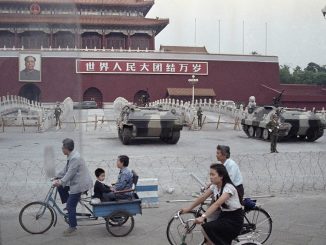
Cyclists pass by armored vehicles parked in front of Tiananmen Gate near the square where the West claimed China had committed a massacre on June 4, 1989.

For decades, Western media have been narrating the same story about China being this brutal “dictatorship” whose people are killed at the hands of the criminal communist regime, giving the Tiananmen Square massacre as a prime example of the brutality of the Chinese government, wherein supposedly scores of students were killed at the hands of the People’s Liberation Army. However, a new book emerged, proving that these claims are false and have no foundation to them except for Washington’s aspirations to tarnish the image of the Chinese Communist Party.

Atrocity Fabrication and Its Consequences: How Fake News Shapes World Order, a new book by A. B. Abrams, highlights that there never were any killings in the infamous Tiananmen Square back in 1989 as had been spread by Western propaganda for decades, and it was revealed that the entire affair was but a mere attempt at showing China as the villain in the geopolitical arena. The book underlines that no killings, let alone a massacre as is proclaimed, took place in Tiananmen Square.

How did the U.S. succeed in manipulating the mainstream narrative and have millions upon millions of people believe that China initiated a mass murder of its own people – young college students – crushing them with tanks and shooting them down with machine guns? The answer is simple: the manipulation of public perception through the press. This could be done using media out of context and providing an incomplete version of the truth.

For example, the most infamous piece of media “documenting” the crime to ever exist is a video showing a tank marching onto a person alleged to have been a student, and right as the tank gets close enough to the young man and stops, the video is cut, with there being some text accompanying the video hinting or proclaiming that the tank went on to run over the protester. However, that could not be further from the truth. In reality, other protesters rushed to the scene and accompanied him from there as the tank was standing in place, waiting for him to comply and get out of its way.

The book argues that all the acts committed by the United States were in a bid to “justify wars of conquest and exploitation” and generate multi-billion-dollar profits for the notorious military-industrial complex, as reported by CovertAction Magazine.

Abrams highlighted that the Tiananmen Square protests initially took place not as a push for Westernization or the downfall of the Chinese government. Instead, their primary focus was on reinforcing the principles of China’s 1949 Communist Revolution and addressing the issue of corrupt officials who had deviated from Maoist principles.

This movement encompassed not only students but also a significant number of workers who exhibited a stronger anti-CCP stance. Their collective objective aimed at the establishment of a socialist democracy within the framework of the movement.

The book cited a cable from the U.S. Embassy in Beijing that WikiLeaks published in 2016. The leak included reports on the eyewitness account of a Chilean diplomat and his wife, who were present when the PLA made it to Tiananmen Square to disperse the protesters. The pair made it in and out of the square, numerous times without any harassment and observed no mass firing of weapons into the crowds. They never saw any use of lethal force, to begin with.

Moreover, the book cited former Washington Post Beijing Bureau chief Jay Mathews who, in 1998, admitted that “all verified eyewitness accounts say that the students who remained in the square when troops arrived were allowed to leave peacefully.”

It also cited Reuters correspondent Graham Earnshaw, who spent the night of June 3-4 at the center of Tiananmen Square and reported that most of the students left the square peacefully, with the remainder of them being persuaded to do the same.

As is customary, the main source the Western media used to claim that a massacre took place was an anonymous student from Qinghua University making claims to the Hong Kong press, who then made it to the British media.

Still, BBC‘s Beijing correspondent James Miles said there was no massacre. “Western reporting had conveyed the wrong impression and protesters who were still in the square when the army reached it were allowed to leave after negotiations.”

The narrative was also completely spun out of proportion, with the perpetrators being painted as the victims of a crime that was never committed in the first place. The book underlined that those who did die in Beijing during the events lost their lives in street battles between the PLA and insurgents far from the square. Reports from the U.S. Department of State underlined that the unarmed PLA officers were attacked with petrol bombs, burning many alive.

Uyghurs, another ‘crime’ China committed

The hoax built around Tiananmen Square was a blueprint for U.S. media campaigns aimed at showing the Chinese government in a bad light, as Washington went on to accuse Beijing of perpetrating a genocide against the Uyghur people in Xinjiang province.

The book stressed that the claims about the so-called Uyghur genocide relied on nothing but hardline extremist U.S.-funded anti-China groups. Namely, they were funded by the CIA-affiliated National Endowment for Democracy, which was tasked with carrying out what the notorious spy agency had done alone under the covers for decades.

Amid the claims of Beijing genociding the Uyghurs, the Uyghur population in Xinjiang saw an increase of 25% between 2010 and 2018 instead of the population experiencing a contraction. Even facilities the West claimed to have been “concentration camps” in which Uyghurs were killed en masse and “brainwashed” or “indoctrinated” appeared to have been a logistics park, a regular detention center, and elementary and middle schools.

Xinjiang looks good, safe, and secure, and all the people I spoke with seemed happy about it, former London Metropolitan Police Officer Jerry Grey, who spent a lot of time traveling in Xinjiang, said.

“Uyghurs in China have been growing faster than the majority Han Chinese in part because they weren’t subject to the one-child policy, they have 20,000 mosques built […] Uyghur children can get into top universities easier than Han Chinese, and have halal foods prepared for them in canteens and they have a prayer area on campus,” Daniel Dumbrill, a Canadian businessman and Chinese political analyst said.

“Portraying an adversary as committing particularly egregious crimes, especially when one intends to initiate military action or other hostile measures against the adversary, has consistently provided an effective means of moving public and international opinion and justifying [U.S. imperial] actions,” Abrams said in his book.

Yugoslavia

The book also shed light on the U.S. propaganda focused in the 1990s on Serb leader Slobodan Milosevic, a socialist who sought to keep Yugoslavia together, accusing him of genocide in Kosovo and elsewhere.

Milosevic, a socialist, aimed to maintain the unity of Yugoslavia and prevent its fragmentation. This effort was driven by his desire to counteract Western nations’ potential expansion of influence and the establishment of U.S. military bases in a strategically vital area.

Interestingly, the most severe instances of ethnic cleansing during the war were actually executed by the Croats through Operation Storm, a plan devised by the CIA.

The Clinton administration additionally provided support to the Kosovo Liberation Army (KLA), which sought to establish an ethnically homogeneous Albanian state. This endeavor involved targeting Serbs and other minority groups.

Financing from the drug trade played a significant role in sustaining the KLA, leading the State Department to label it a “terrorist organization”. The NATO North Atlantic Council identified the KLA as the primary instigator of violence in Kosovo.

The narrative of genocide and the Serbs running concentration camps once again heavily relied on the testimony of an individual who openly admitted to not witnessing any killings – propagandist reporter Roy Gutman. This account was eventually discredited when a British journalist visited an alleged death camp, discovering that the inmates had voluntarily sought refuge from the nearby conflict in surrounding villages.

Yugoslavia was a highly successful state that united numerous contemporary Baltic nations under the banner of communism, and it met its demise when the United States and NATO waged a war against it, killing hundreds of civilians in the notorious bombing campaign it launched on the country in order to “sow democracy” there.

Syria

The same man who was one of the main reasons behind the collapse of Yugoslavia was almost able to do the same with Syria. Gutman played a major role in another similar war launched over a decade later against Syrian President Bashar Al-Assad.

The propaganda effort pushed by Gutman was similar to the one he peddled earlier, with it including the mass murder of people at the hands of the government without any evidence backing up these claims.

Western media and regimes falsely accused Al-Assad of carrying out attacks with chemical weapons against his own people while the attacks were likely carried out by U.S.-backed terrorists.

Back in November, the Grayzone website published a series of leaks that expose how senior officials of the OPCW censored this explosive finding in the Syrian city of Douma.

In its investigation, the website stated that “in the early days of the OPCW’s investigation of an alleged chemical attack in Douma, Syria, expert toxicologists ruled out chlorine gas as the cause of death for more than 40 civilians reported at the scene.”

The Korean War: Another ‘atrocity’

The Korean War, a war peddled by the United States that wound up splitting one people into two, was presented to the public as a “humanitarian intervention” aimed at rescuing the local population from communist forces. To establish this narrative, the Pentagon sponsored a propaganda film, titled The Crime of Korea narrated by Humphrey Bogart. This film falsely attributed atrocities committed by the South Korean government, with U.S. support, to the Democratic People’s Republic of Korea.

This narrative gained traction within the U.S. media and significantly bolstered the perception of the war as “morally justified”. An influential Time magazine column titled “Barbarity” furthered this perspective by describing a communist massacre in Taejon, which subsequent investigations revealed was actually perpetrated by South Korean troops allied with the U.S..

Charles E. Potter, Chairman of the Senate Subcommittee on Korean Atrocities and appointed by Senator Joseph McCarthy, notorious for McCarthyism, which was responsible for the persecution of anyone even thought to be affiliated with any leftist organization or held any left-wing beliefs, emphasized the inhumane acts committed by U.S. adversaries. He recounted gruesome incidents, such as a “Red Chinese” nurse using garden shears to sever a GI’s toes without anesthesia and American POWs being subjected to torture with bamboo spears and confinement in small iron cages until death, with maggots infesting their eye sockets.

However, the accounts presented by Potter contradicted the testimonies of American and British POWs, who indicated that their treatment by captors was generally decent, although they had to attend lectures on communism.

Meanwhile, U.S.-run POW camps subjected DPRK and Chinese prisoners to severe brutality. These inmates were massacred for singing revolutionary songs and subjected to violent coercion to renounce repatriation to their homelands. This strategy aimed to score Cold War propaganda points by portraying defection to the West as a desire born out of the perceived superiority of its political-economic system.

The campaign of propaganda against the DPRK extended well into the 21st century, with increasingly extravagant made-up tales to portray the country in a negative light. Many of these stories were propagated by DPRK defectors, some of whom were influenced or incentivized by South Korea and possibly the CIA.

Shin Dong-hyuk, a defector, collaborated with Washington Post correspondent Blaine Harden to write a highly successful book Escape From Camp 14: One Man’s Remarkable Odyssey from North Korea to Freedom in the West. However, this account was later revealed to be a fabrication.

Yeonmi Park, another defector, who charges a speaking fee of $12,500 on Western media outlets, even made the ludicrous claim that her friend’s mother was executed for watching a Hollywood movie.

Lee Soon-ok, yet another defector, testified before a House committee in 2004 that she had witnessed Christians being tortured and burned to death in DPRK political prisons. However, the head of the North Korean Defectors’ Association, Chang In-suk, contradicted this, asserting that Lee was never a political prisoner.

Abrams noted that fabricated reports about DPRK state executions of prominent figures often coincided with the surprising reappearance of these supposedly deceased individuals on camera.

In a CNN report from May 2015, it was alleged that DPRK leader Kim Jong Un had ordered the poisoning and killing of his aunt, Kim Kyong Hui. However, Mrs. Kim appeared in public in January 2020, highlighting the inaccuracy of the claim.

Abrams suggested that these false defector testimonies and biased media coverage were embraced in the West due to the “self-gratification” they provided, seemingly affirming the notion of Western superiority over the least Westernized state. Additionally, they often served as justifications for hostile policies, including economic sanctions, against the DPRK.

The book talks about the demonization of the Russian and Vietnamese governments, as well as that of Libya and Iraq in a bid to validate the Gulf War, while also revisiting numerous cases of U.S. propaganda aimed at subverting its foes while giving impetus to itself and its beliefs in a bid to uphold the unipolar system that it has been trying so hard to keep propped up – to no avail. The recounting of the countless crimes committed by the United States comes as no surprise to many as the latter has done so for decades and continues to do so, exploiting its hold on the media to give itself the moral high ground over its geopolitical enemies.

Source: Al Mayadeen English

Strugglelalucha256


Biden sends $345 million in weapons to Taiwan: Activists protest U.S.-Australia anti-China war games

The Biden administration announced a $345 million weapons package for Taiwan on July 28. The package includes a variety of weapons systems, including Reaper drones, Harpoon anti-ship missiles, Stinger anti-aircraft missiles, and TOW anti-tank missiles.

This is the first part of a $1 billion weapons transfer directly from Pentagon stockpiles to Taiwan this year. 

The transfer of weapons from the U.S. to Taiwan is a violation of Chinese sovereignty under international law, which recognizes Taiwan as an island province of China.

The United States does not officially recognize Taiwan as an independent country.

The MQ-9A Reaper is a long-endurance, medium-altitude, unmanned aerial vehicle (UAV) that is used for surveillance and strike missions. It is equipped with a variety of sensors, including a radar, a camera, and a laser designator. The Reaper can also carry a variety of weapons, including Hellfire missiles and laser-guided bombs.

The drones will be used to gather intelligence and could be used to strike population centers in mainland China, as Ukraine is doing with drone strikes on civilian apartment buildings in Moscow.

The transfer of the MQ-9A Reapers to Taiwan is a significant development, as it is the first time that the U.S. has sent this type of drone to a country in the Asia-Pacific region. It is clearly a significant increase in the U.S. military threat against China.

Politico reported: “The package marks the first time the U.S. has used new authority from Congress to transfer military equipment directly from Pentagon inventory to Taiwan. The transfer is done under the Presidential Drawdown Authority, the same mechanism Washington uses to send weapons to Ukraine.”

On July 21, the U.S. and Australia began two weeks of “Talisman Sabre war games” involving more than 30,000 troops and participants from 11 other countries, in a show of force against China, Reuters reported.

“This year will see Germany participate for the first time, with 210 paratroopers and marines taking part as the European nation bolsters its presence in the Indo-Pacific,” Reuters adds.

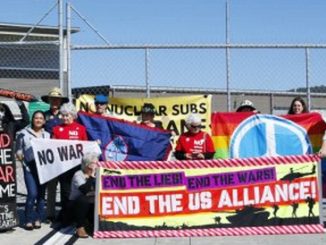
Activists from around Australia joined guests from the Pacific to speak out against the Talisman Sabre war training on July 30 outside the Enoggera Army Base, Green Left reported. The protest heard from guests who addressed the “Calling for Peace in the Pacific” conference, including Indigenous women Naek Flores from Guahan (Guam) and Shinako Oyakama from Ryukyu (Okinawa).


Strugglelalucha256


China and DPRK mark 70th anniversary of historic victory over U.S. imperialism

The Democratic People’s Republic of Korea (DPRK) organized a number of grand celebrations to mark the 70th anniversary of the signing of the armistice agreement on July 27, 1953, that ended just over three years of bitter fighting in the Korean War. Known as the Fatherland Liberation War in the DPRK and as the War to Resist U.S. Aggression and Aid Korea in China, July 27 is considered in both countries as a triumphant day when the two fledgling socialist states scored a historic victory over U.S. imperialism and its satellite forces.

A high-level Chinese party and government delegation, led by Li Hongzhong, a member of the Political Bureau of the Central Committee of the Communist Party of China and Vice-Chairman of the Standing Committee of the National People’s Congress (NPC), attended the celebrations at the invitation of the Korean side, between July 26-30.

The only other foreign delegation to participate was led by Sergei Shoigu, Minister of Defense of the Russian Federation. The former Soviet Union provided crucial assistance to the Korean and Chinese peoples during the war, most notably through the deployment on active service in Korean skies of its air force fighter pilots.

These were the first foreign delegations to visit the DPRK since the country closed its borders as a preventive measure against the spread of the COVID-19 virus at the start of the pandemic.

Top leader of the DPRK, Kim Jong Un gave a reception for the Chinese delegation on July 28.

Repeatedly expressing gratitude to the respected Comrade Xi Jinping for having dispatched a party and government delegation to the significant celebrations of the victory common to the DPRK and China and sending his personal letter with best wishes, he extended heartfelt thanks to the Communist Party of China, the PRC government and all the Chinese people that helped the DPRK’s revolutionary war at the cost of their blood and have invariably supported the just cause of the WPK [Workers’ Party of Korea] and the people of the DPRK.

He said that the Korean people would always remember and praise the militant feats and historic contribution of the service personnel of the Chinese People’s Volunteers who provided the excellent tradition of winning victory in the staunch anti-imperialist revolutionary spirit and with the revolutionary unity while heroically fighting in the same trench with the Korean army in the most difficult period of the DPRK.

Being very rejoiced over the fact that the Chinese party and government have made world-startling achievements in the new course of comprehensively building a modern socialist country with Chinese characteristics and the international position of the PRC is growing higher with each passing day, he expressed conviction that the fraternal Chinese party and people would surely realize the Chinese nation’s dream of great prosperity under the wise leadership of Xi Jinping.

Earlier, Comrade Kim Jong Un had met the Chinese delegation just prior to a concert held in the early hours of July 27.

There, Li Hongzhong handed Kim Jong Un the personal letter from Xi Jinping, in which the Chinese leader pointed out that 70 years ago, the Chinese People’s Volunteers (CPV), together with the people and army of the DPRK, achieved a great victory in resisting U.S. aggression and aiding Korea, and forged a great friendship bound by blood. No matter how the international situation may change, it is always the unswerving policy of the CPC and the Chinese government to maintain, consolidate and develop China-DPRK relations, Xi Jinping wrote.

Expressing his thanks, Kim Jong Un told Li Hongzhong that the significance of July 27, the war victory day common to the Korean and Chinese peoples, was further highlighted as they were present together to celebrate it. Noting that Xi Jinping dispatched a party and government delegation to the DPRK in the current crucial period, he said that it showed the general secretary’s will to attach great importance to the DPRK-China friendship.

Saying the Korean people will never forget the fact that the brave soldiers of the Chinese People’s Volunteers shed blood to bring about the war victory and their noble spirit and soul, though many years have passed and that generation has been replaced with a new one, he affirmed that the WPK and the DPRK government will as ever strive to further strengthen the friendship and solidarity with the fraternal Chinese people and always advance hand in hand with the Chinese people in the struggle for socialism.

Previously, on the day of their arrival, the Central Committee of the WPK and the government of the DPRK had invited the Chinese delegation to a welcome reception at which Kim Song Nam, head of the WPK’s international department, made a speech.

Referring to the fact that the CPV made a historic contribution to bringing about the war victory, an unprecedented event in history, through militant unity and comradely cooperation, he said that the Korean people would never forget the heroic feats and merits of the brave soldiers who recorded a brilliant page in the history of the great victory in the Fatherland Liberation War and the history of DPRK-China friendship.

The Korean people are rejoiced over the achievements made by the Chinese people in building a modern socialist state with Chinese characteristics in the new era, he said, expressing conviction that the Chinese nation’s dream of great prosperity will surely come true, thanks to the steadfast leadership of the Communist Party of China with General Secretary Xi Jinping as its core and the devoted efforts of the Chinese people rallied around the Party.

Replying, Li Hongzhong said that China is very rejoiced over the fact that the socialist cause of the DPRK has steadily gained momentum with each passing day through thorough implementation of the resolutions made at the 8th Congress of the WPK and the plenary meetings of the Party Central Committee. He hoped that the Korean people would continue to achieve fresh successes by promoting the cause of socialism under the leadership of the WPK headed by General Secretary Kim Jong Un.

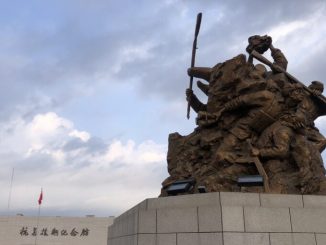
During their stay, the Chinese delegation also attended the huge military parade held in Pyongyang’s Kim Il Sung Square, met with other senior leaders of the DPRK party and state, and visited the birthplace of the DPRK’s founding leader Kim Il Sung, the Victorious Fatherland Liberation War Museum, the Martyrs Cemetery of the Chinese People’s Volunteers, which includes the grave of Comrade Mao Zedong’s son, Mao Anying, and the Friendship Tower, which honors the fallen Chinese internationalist fighters.

In the days leading up to the anniversary, Kim Jong Un also visited the Chinese People’s Volunteers cemetery. The DPRK leader said that the noble soul and spirit of sons and daughters of the Chinese people who supported the Korean people in the sacred anti-imperialist, anti-U.S. struggle with their heroic sacrifice, and made an important contribution to the war victory, are obviously recorded in history as a foundation and model of the DPRK-China friendship to be immortal along with the socialist ideal.

Noting that the hard-fought Fatherland Liberation War was a war of justice to defend their dignity, honor and sovereignty as well as the world peace and security and an acute political and military confrontation with the imperialist dominationist forces which was staged on behalf of the peace-loving forces and progressive humanity, he stressed that the great victory won by the peoples of the DPRK and China at the cost of their blood is invariably displaying its great vitality still now, century after century.

Also, at the end of June a remodeling of the interior of the Friendship Tower was unveiled. Speaking at the ceremony, the DPRK’s Minister of Urban Management, Im Kyong Jae, said that the  militant unity and comradely cooperation between the DPRK and Chinese peoples, displayed in the joint struggle against the U.S.-led imperialist allied forces, set a living example of internationalism, and the historic contributions made by the officers and men of the Chinese People’s Volunteers, who rendered assistance to the just cause of the Korean people at the cost of their lives will always remain in the hearts of the peoples of the two countries. He noted that Kim Jong Un personally initiated the work for remodeling the interior of the Friendship Tower on the occasion of the 70th anniversary of the war victory and gave detailed instructions on its layout, new art pieces and exhibits and guided the work for successfully completing the project.

Chinese Ambassador Wang Yajun expressed sincere thanks on behalf of the Chinese party and government to the Korean party and government and people over the fact that the interior of the Friendship Tower was excellently remodeled under the personal attention and guidance of General Secretary Kim Jong Un.

The Chinese party and government will remain unchanged in their firm stand to successfully defend, consolidate and develop the China-DPRK relations no matter how the international and regional situations may change, the ambassador said, adding that the Chinese side is willing to thoroughly adhere to the common understanding reached by the top leaders of the two parties and the two countries and thus provide the peoples of China and the DPRK with better happiness and make new and bigger contributions to the regional and global peace, stability and prosperity, together with the DPRK side.

In an article carried on China Military, the website of China’s Ministry of Defense, Liu Qiang, a prominent Chinese academic, wrote that fighting aggression and assisting the DPRK had been the right decision. He noted:”Some people have questioned China’s decision to aid the DPRK and resist U.S. aggression, and have questioned whether the cost in lives was worth it. It is not difficult to answer these questions if we consider the situation at that time.

“Although it was at the request of the DPRK that China’s leadership decided to send the Chinese People’s Volunteers force to the peninsula, China also had to safeguard its own national security… As the U.S. bombed border cities and towns on the border between China and the DPRK, it posed a threat to China’s national security, with some in the U.S. calling for the war to be extended into China.

“Since the expansion of the war into China would have had severe consequences for the newly founded People’s Republic, Chairman Mao Zedong announced that China needed to restore peace on the Korean peninsula.”

He added: “Some people think the hostilities ended in a stalemate because after the signing of an armistice, the two sides returned to their respective pre-war positions separated by the 38th Parallel. But the fact that the ill-equipped Chinese People’s Volunteers force, who made huge sacrifice during the war, did not retreat in face of the U.S.-led forces, which had the most advanced weapons and equipment, shows that the Chinese side was the victor in the war.”

Pointing out that, by fighting the war, China minimized the risk of a direct military attack on China at the height of the Cold War, Liu Qiang concluded:

“Some countries led by the U.S. are hyping up the ‘China threat’ theory nowadays as part of their strategy to contain China. China is not a threat to any country, it pursues a defensive defense policy. However, should its sovereignty, national security and development interests be threatened, the spirit of the Chinese People’s Volunteers force will inspire the people to firmly defend the motherland.”

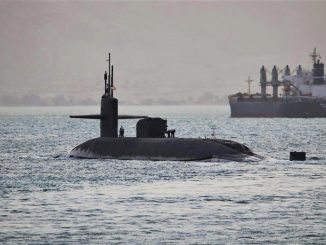
A similar tone was struck in an editorial carried by the Chinese newspaper Global Times, which noted that, prior to the 70th anniversary, “a U.S. nuclear ballistic missile submarine visited Busan, South Korea, the first visit by a U.S. submarine since 1981. Some U.S. congressmen have openly claimed that this move is not only a warning to North Korea but also a deterrent against China.”

The paper observed that: “The Korean War is one of the most profound regional conflicts following World War II, and it is regarded as the ‘biggest defeat in the history of the U.S. Army.’”

However, “some American political elites have drawn completely wrong lessons from the Korean War, using them to misguide the U.S.’ foreign policy today, leading the country to proactively incite and provoke crises, and even wars.”

In this regard, the paper critiqued an article entitled ‘Why America forgets – and China remembers – the Korean War’, written by Mike Gallagher, Chairman of the recently established neo-McCarthyite “House Select Committee on the Strategic Competition Between the United States and the Chinese Communist Party”, and carried in the current issue of Foreign Affairs, the house journal of the U.S. foreign policy establishment.

Global Times writes: “His arrogance and madness are comparable to that of Douglas MacArthur.” (MacArthur was the U.S. commander in Korea, who even the U.S. administration felt constrained to dismiss following his advocacy of the mass use of nuclear weapons not only in Korea, but also against the major cities of both China and the Soviet Union.)

Global Times issued a serious warning to the United States, writing:

“The U.S. should never underestimate China’s determination and ability to defend its homeland. Disregarding these… lessons happens to be the prominent characteristic of current American hegemonism. The Korean War inflicted a painful price on the U.S., but if the U.S. fails to learn from it, it will make even greater mistakes in the future.”

Before China decided to resist the U.S. aggression and aid North Korea during the Korean War, it had repeatedly sent stern warnings that if U.S. forces crossed the 38th parallel China would not sit idle. However, the U.S. did not take it seriously, thinking that China was only making empty threats and would not take action. As a result, they were caught off guard when they encountered the Chinese People’s Volunteers Army on the battlefield. Today, a similar major misjudgment toward China is occurring in Washington. The biggest difference between now and the Korean War era is that China’s strength has greatly increased. The consequences of infringing upon China’s security interests and national sovereignty will undoubtedly be much more severe… it must be clear that if there is another strategic misjudgment this time, the price it will pay will surely be much higher than 70 years ago.”

The following articles were originally carried on the websites of the Xinhua News Agency, the Korean Central News Agency (KCNA), China Daily and Global Times.


China ready to promote sound, steady development of ties with DPRK: official

Xinhua, 29 July 2023

Li Hongzhong, a member of the Political Bureau of the Communist Party of China (CPC) Central Committee and vice chairman of the National People’s Congress (NPC) Standing Committee has paid a visit upon invitation to the Democratic People’s Republic of Korea (DPRK) as head of a delegation of the Party and government representatives, starting from July 26.

During the visit, Kim Jong Un, general secretary of the Workers’ Party of Korea (WPK) and president of the State Affairs of the DPRK, met with Li.

Li handed over a letter signed by Xi Jinping, general secretary of the CPC Central Committee. In the letter, Xi pointed out that 70 years ago, the Chinese People’s Volunteers (CPV), together with the people and army of DPRK, achieved a great victory in resisting U.S. aggression and aiding Korea, and forged a great friendship bond by blood. No matter how the international situation may change, it is always the unswerving policy of the CPC and the Chinese government to maintain, consolidate and develop China-DPRK relations, said Xi in the letter.

Noting that in recent years, Xi and Kim have met five times, ushering in a new era of China-DPRK relations, Li said that China is willing to implement the important consensus reached by the top leaders of the two parties and countries with the DPRK, strengthen communication and exchanges, advance practical cooperation, promote the sound and steady development of China-DPRK relations, and make positive contributions to maintaining peace and stability on the peninsula and of the region.

Kim expressed sincere gratitude to Xi for the signed letter, saying that the party and people of the DPRK will always remember the immortal achievements of the CPV martyrs. He added that the DPRK is willing to consolidate traditional friendship with China, strengthen exchanges and cooperation, push DPRK-China relations to a higher level, and jointly safeguard regional peace and stability and the common interests of both sides.

During his visit, Li also met with Choe Ryong-hae and other DPRK leaders, attended the commemoration of the 70th anniversary of the Korean War armistice, visited the China-DPRK Friendship Tower, and went to the cemetery of the martyrs of the CPV in Hoechang County.


Respected Comrade Kim Jong Un Hosts Reception for Chinese Delegation

KCNA, 29 July 2023

Kim Jong Un, general secretary of the Workers’ Party of Korea and president of the State Affairs of the Democratic People’s Republic of Korea, received the party and government delegation of the People’s Republic of China (PRC) led by Li Hongzhong, member of the Political Bureau of the Central Committee of the Communist Party of China and vice-chairman of the Standing Committee of the Chinese National People’s Congress, on July 28.

The respected Comrade Kim Jong Un gladly greeted the members of the delegation and had a souvenir picture taken with them.

He had a talk with them in a warm atmosphere.

Repeatedly expressing gratitude to the respected Comrade Xi Jinping for having dispatched a party and government delegation to the significant celebrations of the victory common to the DPRK and China and sent his personal letter with best wishes, he extended heartfelt thanks to the Communist Party of China, the PRC government and all the Chinese people that helped the DPRK’s revolutionary war at the cost of their blood and have invariably supported the just cause of the WPK and the people of the DPRK.

He said that the Korean people would always remember and praise the militant feats and historic contribution of the service personnel of the Chinese People’s Volunteers who provided the excellent tradition of winning victory in the staunch anti-imperialist revolutionary spirit and with the revolutionary unity while heroically fighting in the same trench with the Korean army in the most difficult period of the DPRK.

Being very rejoiced over the fact that the Chinese party and government have made world-startling achievements in the new course of comprehensively building a modern socialist country with the Chinese characteristics and the international position of the PRC is growing higher with each passing day, he expressed conviction that the fraternal Chinese party and people would surely realize the Chinese nation’s dream of great prosperity under the wise leadership of Xi Jinping.

Reaffirmed at the talk was the stand of the parties and governments of the two countries to cope with the complicated international situation on their own initiative and steadily develop the friendship and comradely cooperation onto a new high stage through close strategic and tactical collaboration while dynamically accelerating socialist construction.

He invited the members of the delegation to the reception.

Present there were Jo Yong Won and Choe Ryong Hae, members of the Presidium of the Political Bureau of the C.C., WPK, Ri Il Hwan and O Su Yong, secretaries of the C.C., WPK, Choe Son Hui, minister of Foreign Affairs, Kim Song Nam, department director of the C.C., WPK, Kim Yo Jong, vice department director of the C.C., WPK, and officials concerned.

Kim Yo Jong and Li Hongzhong made speeches at the reception.

The reception proceeded in an amicable atmosphere overflowing with warm comradeship and friendship.


Grand Performance Given to Celebrate 70th Anniversary of Great War Victory

KCNA, 27 July 2023

A grand celebration performance was given at 00:00 on July 27, adding to the joy and excitement of celebrating the 70th anniversary of the victory in the Fatherland Liberation War shining as a symbol of heroism and justice along with its great eminence of victory in the course of the development of the dignified Democratic People’s Republic of Korea (DPRK), as a grand festival of glory and succession to be specially recorded in history.

The performance venue was overflowing with the great pride and self-confidence of significantly greeting the war victory day, the holiday of the DPRK and all its people, with the priceless honor and dignity offered by the victory in the three-year war and the 70-year-long indomitable struggle for preserving that victory – 25 568 days since July 27, the historic day when the first people’s country in the East, a new-born republic, won a victory in the war for repulsing the brigandish armed invasion by the U.S. imperialism, the ringleader of the imperialists, in the middle of the 20th century called the “century of war”.

Kim Jong Un, general secretary of the Workers’ Party of Korea (WPK) and president of the State Affairs of the DPRK, enjoyed the performance.

Prior to enjoying the performance, he had a warm and friendly talk with Li Hongzhong, vice-chairman of the Standing Committee of the National People’s Congress of the People’s Republic of China (PRC) who is on a visit to the DPRK on the occasion of the 70th anniversary of the great war victory.

Li Hongzhong, member of the Political Bureau of the Central Committee of the Communist Party of China (CPC) and vice-chairman of the Standing Committee of the National People’s Congress of the PRC who is leading a Chinese party and government delegation on a visit to Pyongyang, courteously handed to the respected Comrade Kim Jong Un a personal letter sent by Xi Jinping, general secretary of the Central Committee of the CPC and president of the PRC, on the occasion of the war victory day.

Expressing thanks for it, Kim Jong Un offered his heartfelt thanks to Xi Jinping.

He told Li Hongzhong that the significance of July 27, the war victory day common to the Korean and Chinese peoples, was further highlighted as they were present together to celebrate it. Noting that Xi Jinping dispatched a party and government delegation to the DPRK in the current crucial period, he said that it showed the general secretary’s will to attach great importance to the DPRK-China friendship.

Saying the Korean people will never forget the fact that the brave soldiers of the Chinese People’s Volunteers shed blood to bring about the war victory and their noble spirit and soul though many years have passed and generation has been replaced with new one, he affirmed that the WPK and the DPRK government will as ever strive to further strengthen the friendship and solidarity with the fraternal Chinese people and always advance hand in hand with the Chinese people in the struggle for socialism.

When Kim Jong Un appeared at the theatre auditorium with the heads of the delegations, stormy cheers of the audience shook the theatre.

Pretty children presented fragrant bouquets to Kim Jong Un.

Children presented bouquets to the heads of the delegations.

Members of the Presidium of the Political Bureau of the WPK Central Committee, cadres of the Party, the government and the military, and the participants in the celebrations including war veterans and persons of wartime merits watched the performance.

Present there on invitation were members of the Chinese party and government delegation and the Russian military delegation.

The performance was given by leading art troupes including the State Merited Chorus, the Ensemble of the State Affairs Commission and the Wangjaesan Art Troupe, and social and military art troupes and artistes and students of art education institutions.

Put on the stage of the performance which started with overtures “Tell, Fireworks of War Victory” and “July 27, Our Victory Day”, were wartime songs, hymns for the war victory, songs of faith popular during the years of succession and other numbers.

Through the immortal hymn “Cantata to Marshal Kim Il Sung”, the performers sang highly of the greatest-ever feats of President Kim Il Sung, who trained the Korean people to be the strongest ones with indomitable spirit and matchless strength punishing the imperialist tyranny and made a history of miraculous war victory admired by mankind in the grim period when the U.S. imperialists, who boasted of being the world’s “strongest”, had gone to extremes in their arrogance and arbitrary practices and thus brought about a fierce storm of independence against imperialism and the revolution for national liberation.

When the venerable image of the President declaring victory at the military parade for celebrating the war victory was shown on the background screen along with his friendly voice resounding throughout the venue, the audience broke into loud applause with boundless reverence for the peerlessly brilliant commander who reliably protected the destiny of the country and peace of humankind by winning a great victory in the fierce anti-imperialist, anti-U.S. sacred war with his Juche-oriented military idea, outstanding strategy and tactics and iron faith and will.

“Song of National Defence”, “To a Decisive Battle” and other wartime songs, which resounded all over Korea fighting against aggressors, touched the audience, bringing back the memory of the legendary years.

Through the numbers representing the endless advance by the defenders of the country under the hail of bullets and shells and their hand-to-hand combats for annihilating the enemies, and through the numbers pulsating with the patriotic passion and emotion lavished by them out of their confidence in victory during the three-year-long war woven with life and death, blood and tears and love and hatred, the performers impressively sang of what a stern death-defying resistance the heroic army and people of the DPRK waged to preserve the dignity and prestige of their country.

When Chinese and Russian serial songs specially selected for goodwill missions visiting Pyongyang were put on the stage, the audience felt their hearts overflowing with conviction and friendship that the history and traditions of friendship and solidarity formed and consolidated in the joint struggle for independence against imperialism would be steadily carried forward and developed century after century.

The performance ended with the finale “The People Offer Glory to the Party” and “July 27, Our Victory Day”.

At the end of the performance, the audience again broke into enthusiastic cheers.

Kim Jong Un warmly acknowledged their cheers, congratulating the performers on their successful performance.


Reception Given for Chinese Party and Government Delegation

KCNA, 27 July 2023

The Central Committee of the Workers’ Party of Korea (WPK) and the government of the Democratic People’s Republic of Korea (DPRK) gave a reception at the Mansudae Assembly Hall on July 26 in honor of the party and government delegation of the People’s Republic of China (PRC) on a visit to the DPRK for participating in the celebrations of the 70th anniversary of the victory in the great Fatherland Liberation War.

Present there on invitation were the party and government delegation of the PRC led by Li Hongzhong, member of the Political Bureau of the C.C., Communist Party of China (CPC) and vice-chairman of the Standing Committee of the Chinese National People’s Congress, and Ambassador Wang Yajun and staff members of the Chinese embassy here.

Attending it were Choe Ryong Hae, member of the Presidium of the Political Bureau of the WPK Central Committee, first vice-president of the State Affairs Commission of the DPRK and chairman of the Standing Committee of the Supreme People’s Assembly, Kim Song Nam, department director of the WPK Central Committee, Kang Yun Sok, vice-chairman of the Standing Committee of the Supreme People’s Assembly, and senior officials of the Party and the government.

Kim Song Nam made a speech at the reception.

The speaker warmly welcomed the Chinese delegation’s visit to the DPRK on behalf of the WPK Central Committee and the DPRK government and paid high tribute to the martyrs and veterans of the Chinese People’s Volunteers (CPV) who helped the Korean people in their revolutionary war at the cost of their blood in the most difficult period.

Referring to the fact that the CPV made a historic contribution to bringing about the war victory, an unprecedented event in history, through militant unity and comradely cooperation, he said that the Korean people would not forget forever the heroic feats and merits of the bravery soldiers who recorded a brilliant page in the history of the great victory in the Fatherland Liberation War and the history of DPRK-China friendship.

The Korean people are rejoiced over the achievements made by the Chinese people in building a modern socialist state with Chinese characteristics in the new era, he said, expressing conviction that the Chinese nation’s dream of great prosperity will surely come true, thanks to the steadfast leadership of the Communist Party of China with General Secretary Xi Jinping as its core and the devoted efforts of the Chinese people rallied around the Party.

Then Li Hongzhong made a speech.

Noting that upon authorization of General Secretary Xi Jinping and the Central Committee of the CPC, he visited the DPRK at the head of the Chinese party and government delegation, he said: General Secretary Kim Jong Un and the WPK Central Committee attach great importance to the visit of the delegation and accord cordial hospitality to it, and this is a manifestation of friendly feelings toward the Chinese party, government and people.

Saying China is very rejoiced over the fact that the socialist cause of the DPRK has steadily gained momentum with each passing day through thorough implementation of the resolutions made at the 8th Congress of the WPK and the plenary meetings of the Party Central Committee, he hoped that the Korean people would continue to achieve fresh successes by promoting the cause of socialism under the leadership of the WPK headed by General Secretary Kim Jong Un.

The Chinese side is ready to, together with the Korean side, resolutely implement the important common understanding reached by the top leaders of the two parties and two countries and thus promote the sound and stable development of the China-DPRK relations, provide the peoples of the two countries with happiness and make a positive contribution to the regional peace, stability, prosperity and development.

The reception proceeded in an amicable atmosphere.


Respected Comrade Kim Jong Un Visits Cemetery of CPV Martyrs

KCNA, 26 July 2023

Kim Jong Un, general secretary of the Workers’ Party of Korea (WPK) and president of the State Affairs of the Democratic People’s Republic of Korea (DPRK), visited the cemetery of martyrs of the Chinese People’s Volunteers (CPV) in Hoechang County of South Phyongan Province to pay a high tribute to them on the occasion of the 70th anniversary of the victory in the great Fatherland Liberation War.

He was accompanied by Jo Yong Won, Presidium member of the Political Bureau and secretary of the WPK Central Committee, Kang Sun Nam, minister of National Defence of the DPRK, Choe Son Hui, minister of Foreign Affairs, Kim Song Nam, department director of the WPK Central Committee, and Kim Yo Jong, vice department director of the WPK Central Committee.

The guard of honor of the Korean People’s Army (KPA) lined up at the cemetery.

The national anthems of the People’s Republic of China and the Democratic People’s Republic of Korea were solemnly played.

Amid the playing of the wreath-laying music, a wreath in the name of the respected Comrade Kim Jong Un was laid at the monument to the CPV martyrs.

Written on the ribbons of the wreath were letters reading “Martyrs of the Chinese People’s Volunteers will Be Immortal”.

Kim Jong Un paid a silent tribute in memory of the CPV martyrs who unsparingly dedicated their precious lives to the righteous war of the Korean people to repel the imperialist aggression.

Then, he placed a flower before the grave of Mao Anying at the cemetery and paid a tribute to him.

He made a round of the cemetery, together with senior officials accompanying him.

He said that the noble soul and spirit of sons and daughters of the Chinese people who supported the Korean people in the sacred anti-imperialist, anti-U.S. struggle with their heroic sacrifice and made an important contribution to the war victory are obviously recorded in history as a foundation and model of the DPRK-China friendship to be immortal along with the socialist ideal.

Noting that the hard-fought Fatherland Liberation War was a war of justice to defend their dignity, honor and sovereignty as well as the world peace and security and an acute political and military confrontation with the imperialist dominationist forces which was staged on behalf of the peace-loving forces and the progressive mankind, he stressed that the great victory won by the peoples of the DPRK and China at the cost of their blood is invariably displaying its great vitality still now, century after century.

He said that the noble life of the CPV martyrs would be immortal in the hearts of the Korean people and that the history and tradition of unity between the peoples of the two countries, who forged the bonds of kinship in the sacred struggle for accomplishing the cause of anti-imperialist independence and socialism and have resolutely smashed the reactionary offensive of the imperialists by dint of justice and truth, would be reliably carried forward through generations.


Interior of Friendship Tower Remodeled in DPRK

KCNA, 29 July 2023

The interior of the Friendship Tower has been remodeled thanks to the noble intention and will of the Central Committee of the Workers’ Party of Korea (WPK) to convey the history and tradition of militant friendship and solidarity between the DPRK and China to posterity.

The interior of the tower, the symbol of the DPRK-China friendship, was remodeled more excellently in terms of ideological theme and formative art on the occasion of the 70th anniversary of the victory in the great Fatherland Liberation War.

An event took place on June 28 to mark the completion of the project for remodeling the interior of the tower.

Present there was Choe Ryong Hae, member of the Presidium of the Political Bureau of the WPK Central Committee, first vice-president of the State Affairs Commission of the DPRK and chairman of the Standing Committee of the Supreme People’s Assembly.

And attending it were Ju Chang Il, department director of the C.C., WPK, Jon Sung Guk, vice-premier of the Cabinet, and other senior officials of the Party and government, officials concerned, members of the relevant units involved in the remodeling project and working people in Pyongyang Municipality.

Also on hand were Ambassador Wang Yajun and staff members of the Chinese embassy here and Chinese guests and residents in the DPRK.

Im Kyong Jae, minister of Urban Management, made a speech.

The militant unity and comradely cooperation between the DPRK and Chinese peoples, displayed in the joint struggle against the U.S.-led imperialist allied forces, set a living example of internationalism, and the historic contributions made by the officers and men of the Chinese People’s Volunteers (CPV) who rendered assistance to the just cause of the Korean people at the cost of their lives will always remain in the hearts of the peoples of the two countries, he said, paying high tribute to the martyrs and veterans of the CPV.

He said that the DPRK-China friendship, provided and cultivated by the preceding leaders of the two countries, is now further developing thanks to the close friendly relations between the respected Comrade Kim Jong Un and Comrade Xi Jinping.

He noted that Kim Jong Un personally initiated the work for remodeling the interior of the Friendship Tower on the occasion of the 70th anniversary of the war victory and gave detailed instructions on its layout, new art pieces and exhibits and guided the work for successfully completing the project.

The great victory, won by the peoples of the two countries sharing weal and woe with each other, invariably demonstrates its undying vitality century after century despite the passage of time, he said, expressing the stand of the WPK and the government of the DPRK to further consolidate the DPRK-China friendly and cooperative relations with socialism as their core, as required by the new era.

Ambassador Wang Yajun made a speech.

He expressed sincere thanks on behalf of the Chinese party and government to the Korean party and government and people over the fact that the interior of the Friendship Tower was excellently remodeled under the personal attention and guidance of General Secretary Kim Jong Un.

He said that the successful remodeling of the interior of the Friendship Tower, the symbol of the traditional China-DPRK friendship and witness to the glorious history of the two countries, this year of special significance demonstrated the will of the peoples of the two countries to steadily develop and promote the friendship between China and the DPRK, sealed in blood, along with the times.

The Chinese party and government will remain unchanged in their firm stand to successfully defend, consolidate and develop the China-DPRK relations no matter how the international and regional situations may change, the ambassador said, adding that the Chinese side is willing to thoroughly adhere to the common understanding reached by the top leaders of the two parties and the two countries and thus provide the peoples of China and the DPRK with better happiness and make new and bigger contributions to the regional and global peace, stability and prosperity, together with the DPRK side.

He wished the Korean people greater success in socialist construction under the leadership of the WPK headed by General Secretary Kim Jong Un.

Laid before the tower were a wreath in the joint name of the Central Committee of the Workers’ Party of Korea, the Standing Committee of the Supreme People’s Assembly of the DPRK and the Cabinet of the DPRK and a wreath in the joint name of the Central Committee of the Communist Party of China, the Standing Committee of the National People’s Congress of the People’s Republic of China, the State Council of the People’s Republic of China and the National Committee of the Chinese People’s Political Consultative Conference.

Also placed were wreaths in the names of the Ministry of National Defence, the Ministry of Foreign Affairs, the Ministry of Urban Management and the Mansudae Art Studio of the DPRK and wreaths in the joint name of the Korean Committee for Cultural Relations with Foreign Countries, the DPRK-China Friendship Association, the Pyongyang Municipal Committee of the Workers’ Party of Korea and the Pyongyang Municipal People’s Committee.

And laid were wreaths in the names of the International Liaison Department of the Central Committee of the Communist Party of China, the Foreign Ministry, the Defence Ministry, the Veteran Office and the embassy of the People’s Republic of China and wreaths in the joint name of the Chinese People’s Association for Friendship with Foreign Countries and the China-Korea Friendship Association.

The participants paid a silent tribute to the memory of the CPV martyrs who unhesitatingly dedicated their youth and lives to the sacred war against the imperialist invasion.

Choe Ryong Hae and Wang Yajun cut off the red tape draped before the interior of the Friendship Tower.


Experts’ take on War to Resist U.S. Aggression and Aid Korea

China Daily, 26 July 2023

July 27 marks the 70th anniversary of the armistice agreement that put the Korean War (1950-53) on hold.

Eight months after the founding of the People’s Republic of China, the Korean War broke out in June 1950. The flames of war soon reached the border river of Yalu, and U.S. planes repeatedly bombed Northeast China’s border regions. On Oct 19, 1950, responding to the Democratic People’s Republic of Korea’s request for assistance the Chinese People’s Volunteers army crossed the Yalu River to aid the DPRK’s fight there until the armistice was signed in 1953.

Some people have questioned China’s decision to aid the DPRK and resist U.S. aggression, and have questioned whether the cost in lives was worth it. It is not difficult to answer these questions if we consider the situation at that time.

Although it was at the request of the DPRK that China’s leadership decided to send the Chinese People’s Volunteers force to the peninsula. China also had to safeguard its own national security. With the intervention of Washington, the fighting did not stop at the 38th Parallel, along which a buffer or demilitarized zone had been established. As the U.S. bombed border cities and towns on the border between China and the DPRK, it posed a threat to China’s national security, with some in the U.S. calling for the war to be extended into China.

Since the expansion of the war into China would have had severe consequences for the newly founded People’s Republic, Chairman Mao Zedong announced that China needed to restore peace on the Korean Peninsula.

Some people think the hostilities ended a stalemate because after the signing of an armistice, the two sides returned to their respective pre-war positions separated by the 38th Parallel. But the fact that the ill-equipped Chinese People’s Volunteers force, who made huge sacrifice during the war, did not retreat in face of the U.S.-led forces, which had the most advanced weapons and equipment shows that the Chinese side was the victor in the war. When the fighting finally ceased around the 38th Parallel, the Chinese volunteers force had advanced about 300 kilometers from the China-DPRK border, at one stage even reaching near the 37th Parallel.

Yes by participating in the war, China succeeded in building a peaceful environment that boosted the morale of the Chinese people and facilitated the country’s economic development. China repeatedly warned the U.S.-led forces preparing to cross the 38th Parallel to continue their offensive that the Chinese people love peace but are not afraid to fight a war against aggression, and it would will take counteraction if the U.S. forces crossed that line.

Washington ignored these warnings as it believed that Beijing had neither the ability nor the courage to confront the powerful, well-equipped U.S.-led forces.

By pushing the U.S.-led forces back to the 38th Parallel from close to the Yalu River and exacting an armistice from the U.S., the Chinese People’s Volunteers force demonstrated its brave spirit and excellent tactics, and created a significant strategic buffer zone for the country. If China had not won the war, it would have faced great military pressure with the U.S. forces crossing the Yalu River.

China paid a great price by being forced to participate in a war to resist U.S. aggression for it won the peace alongside the DPRK, safeguarding its territories, creating opportunities for its economic development and peaceful rise.

By fighting the war, China also minimized the risks of military attack or military interference in its internal affairs at the height of the Cold War. Therefore, China should commemorate the victory of the War to Resist U.S. Aggression and Aid Korea and laud the Chinese leadership at that time for making the hard but wise decision that in the long run was crucial for the country’s development, and to the Chinese People’s Volunteers force and civilians, who made great sacrifices to secure peace on the peninsula. Over 197,000 Chinese people had died in the war.

The War to Resist U.S. Aggression and Aid Korea showed that although China is a peace-loving country, it will not hesitate to fight if forced to safeguard its territories and protect its people.

Some countries led by the U.S. are hyping up the “China threat” theory nowadays as part of their strategy to contain China. China is not a threat to any country, it pursues a defensive defense policy. However, should its sovereignty, national security and development interests be threatened, the spirit of the Chinese People’s Volunteer force will inspire the people to firmly defend the motherland.


If the U.S. fails to learn lessons from Korean War, it will continue to suffer

Global Times, 26 July 2023

July 27 marks the 70th anniversary of the signing of the Korean Armistice Agreement. Prior to this commemorative day, a U.S. nuclear ballistic missile submarine visited Busan, South Korea, the first visit by a U.S. submarine since 1981. Some U.S. congressmen have openly claimed that this move is not only a warning to North Korea but also a deterrent against China.It appears that the U.S. has not seriously reflected on the lessons learned here, but instead seems to be repeating the mistakes made back then. As a result, at the juncture of the 70th anniversary of the Korean War armistice, it is of significant practical importance and utmost urgency to review the lessons brought about by that war.

The Korean War is one of the most profound regional conflicts following World War II, and it is regarded as the “biggest defeat in the history of the U.S. Army.” However, ironically, this “biggest defeat” that was called a “nightmare” has become a “forgotten war” within the U.S., deliberately overlooked by Washington. This negligence and forgetfulness may leave the American people without the consciousness of drawing lessons from the past when facing new crises, making them susceptible to repeating past mistakes.

Yet, what is even more serious, worse, and dangerous is that some American political elites have drawn completely wrong lessons from the Korean War, using them to misguide the U.S.’ foreign policy today, leading the country to proactively incite and provoke crises, and even wars.

On July 26, the U.S. magazine Foreign Affairs published an article written by Mike Gallagher, Chairman of the “House Select Committee on the Strategic Competition Between the United States and the Chinese Communist Party,” titled “Why America Forgets – and China Remembers – the Korean War.” This Washington politician, known for his consistently anti-China stance, summarized three “lessons” that the Korean War taught the U.S..

The first lesson is that “Washington must not neglect deterrence and readiness,” and should always be prepared to fight and enhance military capabilities. He directly mentioned that “the U.S. has failed to make sufficient military investments” in Taiwan. The second lesson is that “politics and combat are deeply intertwined.” The third lesson is that “once fighting has broken out, excessive self-restraint can invite further aggression.”

These three “lessons” are all targeted at China, specifically referring to the Taiwan question. His arrogance and madness are comparable to that of Douglas MacArthur. We can see that when most Americans lack knowledge and discernment about the Korean War 70 years ago and today’s Taiwan question, they can easily be led astray by a few loud and radical voices, resulting in a “herd effect” in American diplomacy. As the U.S. is a superpower, the mistakes it makes often result in strong spillover effects that not only harm itself but also burden the region and even the entire world.

In fact, the U.S. can and should learn valuable lessons from the Korean War. The first is to respect the legitimate security concerns of regional major powers; the second is to restrain the impulse and ambition to interfere in the affairs of other countries. Lastly, the U.S. should never underestimate China’s determination and ability to defend its homeland. Disregarding these three lessons happens to be the prominent characteristics of current American hegemonism. The Korean War inflicted a painful price on the U.S., but if the U.S. fails to learn from it, it will make even greater mistakes in the future.Before China decided to resist the U.S. aggression and aid North Korea during the Korean War, it had repeatedly sent stern warnings that if U.S. forces crossed the 38th parallel China would not sit idle. However, the U.S. did not take it seriously, thinking that China was only making empty threats and would not take action. As a result, they were caught off guard when they encountered the Chinese People’s Volunteers Army on the battlefield. Today, a similar major misjudgment toward China is occurring in Washington. The biggest difference between now and the Korean War era is that China’s strength has greatly increased. The consequences of infringing upon China’s security interests and national sovereignty will undoubtedly be much more severe.

Back then, when General MacArthur threatened to bring the war to the Chinese mainland, then chairman of the Joint Chiefs of Staff Omar Bradley said, a wider conflict would embroil the U.S. “in the wrong war, at the wrong place, at the wrong time, and with the wrong enemy.” The irony of history is that 70 years after the Korean War armistice, the U.S. once again finds itself in a position dangerously close to committing such a terrible mistake. However, it must be clear that if there is another strategic misjudgment this time, the price it will pay will surely be much higher than 70 years ago.

Source: Friends of Socialist China

Strugglelalucha256


The U.S. ‘Act of War’ against China

The July 12 New York Times Magazine headlined: “‘An Act of War’: Inside America’s Silicon Blockade Against China.”

The report is about the October 2022 “export controls” against China:

“Last October, the United States Bureau of Industry and Security issued a document that — underneath its 139 pages of dense bureaucratic jargon and minute technical detail — amounted to a declaration of economic war on China. …

“The Oct. 7 controls essentially seek to eradicate, root and branch, China’s entire ecosystem of advanced technology. ‘The new policy embodied in Oct. 7 is: Not only are we not going to allow China to progress any further technologically, we are going to actively reverse their current state of the art,’ [Gregory] Allen [of the Center for Strategic and International Studies in Washington]  says. C.J. Muse, a senior semiconductor analyst at Evercore ISI, put it this way: ‘If you’d told me about these rules five years ago, I would’ve told you that’s an act of war — we’d have to be at war.’”

The U.S. export controls (the act of war) on computer chips aim to undermine China’s ability to produce or purchase high-end chips, which are crucial for the development of advanced technologies such as supercomputers and artificial intelligence (AI). Some call this a Silicon Curtain in the New Cold War against China.  

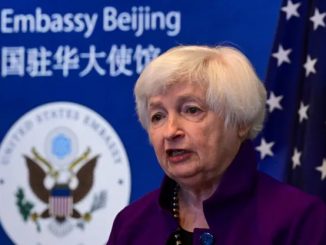
The U.S. controls (again, an act of war) are not narrowly targeted at curbing Chinese military development, as claimed by the Biden administration. On her recent visit to China, Treasury Secretary Janet Yellen seemed openly insincere when she tried to say the controls were not aimed at the broader economy. China’s Premier Li Qiang, who met Yellen, told her that she was “overstretching.”

The export controls are broad. As the New York Times reports, they seek to undermine China’s entire ecosystem of advanced technology, including its AI industry. The semiconductor industry is seen as a means to achieve this goal.

The semiconductor industry is a global industry that the U.S. has dominated and controlled, as U.S. Big Oil has dominated the global energy industry. 

The Pentagon’s semiconductor project

The semiconductor industry began as a project of the Pentagon’s Semiconductor Technology Advanced Research Network (STARnet), part of the Defense Advanced Research Projects Agency (DARPA). The industry in the U.S. was and is, to this day, heavily financed by the Pentagon and the U.S. government

The CHIPS Act, passed by Congress and signed by President Biden in August 2022, pumped an additional $280 billion in new funding for the research and manufacture of semiconductors in the U.S. That was followed by a DARPA announcement in January 2023 that it was putting almost half a billion dollars into a project to help advance the semiconductor industry in the U.S. 

None of this, by the way, was created or developed by any capitalist entrepreneur. Capitalism does not create anything on its own; it just finds a way to exploit new technology to make a profit. And many of the biggest, highest profit-making capitalist industries were created and funded by the government in various ways, including most of the technology industry, the internet, the pharmaceutical industry, the automobile industry, and even Big Oil.

The semiconductor industry is a knowledge-intensive industry. It is built on shared knowledge and resources. Initially, semiconductor companies were built on open innovation. Because of its complexity, development, and production required the collaboration of research centers, universities, scientists, engineers, and many others to develop the techniques and methodologies required.

The pace of innovation in the semiconductor industry has been incredibly rapid. New chip designs are constantly being developed, and the capabilities of chips are constantly increasing. This is due to a number of factors, including:

  • The increasing complexity of chips. Chips are becoming increasingly complex, with billions of transistors packed into a tiny space. This complexity requires the use of advanced manufacturing techniques and the development of new materials.
  • New materials and manufacturing techniques. The semiconductor industry is constantly developing new materials and manufacturing techniques to improve the performance and efficiency of chips. For example, new materials, such as gallium arsenide, silicon carbide, and graphene, have allowed for the development of faster and more powerful chips.
  • The increasing availability of computing power. The increasing availability of computing power has allowed chip designers to develop more complex and sophisticated chip designs.

Global means global

Global means that chips are designed and manufactured in many countries around the world, not just the U.S. This means:

  • A global workforce of scientists, engineers, technicians, and other skilled workers. The semiconductor industry requires a large pool of skilled labor. This labor is not evenly distributed around the world. Most of the semiconductor industry is now concentrated in China, Taiwan, and South Korea.
  • As a global industry, production depends on a complicated matrix of manufacturing, warehousing, shipping, and transportation. This global supply chain is highly interconnected and spans across many countries. Every chip has been produced from parts developed and produced in a dozen or more countries. This necessitates collaboration and sharing to ensure smooth operations and product quality.

The U.S. export restrictions (an act of war) are designed not only to prevent further advances in China’s technology sector but also to actively reverse its technological development. The controls are intended to eradicate China’s advanced technology ecosystem and hinder its progress in economic growth and development.

U.S. export controls, introduced by the Trump administration and now expanded by the Biden administration, have already had devastating consequences for Chinese companies like Huawei, which was heavily impacted by the chip bans imposed by the Trump administration in 2019. Huawei, once the largest smartphone seller in the world, saw its revenues plunge and its market share drastically decline as a result of these measures.

Biden expands what Trump started

The Biden administration has continued the Trump administration’s campaign against Chinese technology companies, but it has taken a more expanded approach. The Trump administration imposed broad sanctions on Chinese companies, including Huawei, ZTE, and Hikvision. The Biden administration has focused on whole industries, such as telecommunications and semiconductors.

In the words of Gregory Allen at CSIS, “The Trump administration went after companies. The Biden administration is going after industries.”

The Biden administration’s actions against China’s technology sector are an attempt to slow down the entire Chinese economy. China is heavily reliant on semiconductors, and the Biden administration’s actions are making it more difficult for China to acquire the technology and components it needs to produce its own chips.

The fact that China spent more on computer chip imports than it did on oil in April is a clear indication of how important semiconductors are to the Chinese economy. Chips are used in a wide range of products, from smartphones to cars to industrial machinery. 

But the New Cold War and its Silicon Curtain cannot reproduce the old Cold War.

In the Cold War, the United States and the European imperialist powers in NATO were the biggest manufacturers in the world. This gave them dominance in terms of economic power and military strength. 

Now, socialist China has emerged as a major manufacturing power. Today, China is the world’s largest manufacturer, including the semiconductor industry. China is the largest trade partner for 70% of the countries in the world. 

This has led to a decline in the United States’ relative power. The United States is no longer the dominant producer in the world.

In addition, the U.S. used to have a significant advantage in the global energy market, due to its control of West Asia’s hydrocarbon resources. However, in recent years, China has become a major player in the global energy market, and OPEC has become less reliant on the United States. The U.S. has greatly reduced oil imports because of domestic shale oil (fracking) and gas production. This means that OPEC is no longer as dependent on the United States as it once was. This has led to a loss of control for the United States in the global energy market.

Strugglelalucha256


Not a spy balloon, but the propaganda sticks

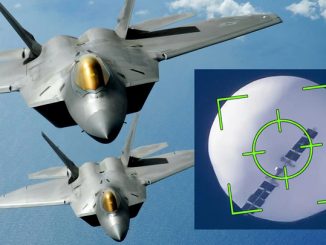
On Feb. 4, the U.S. Air Force carried out an elaborate operation to shoot down a Chinese weather balloon. 

At 2:39 p.m. Eastern time, an F-22 Raptor from the 1st Fighter Wing at Joint Base Langley-Eustis, Virginia, fired an AIM-9X Sidewinder into the approximately 90-foot-wide balloon, causing it to fall towards the Atlantic Ocean, according to U.S. military officials.

At the time, war tensions were rising. The Pentagon managed the daily news reports. The generals were in charge. 

But it was all propaganda. All the news coverage in the U.S. called it a spy craft, never a weather research balloon, as China said.

Nothing the Pentagon and White House said at the time was true, and they knew it. But the purpose wasn’t to speak truth; the purpose was to justify the Pentagon’s war buildup against China.

Now, the Pentagon admits that the balloon was not a spy balloon. Reuters reported on June 29 that the Pentagon now says that the Chinese balloon wasn’t a spy craft and it did not collect any information while in U.S. airspace. This is exactly opposite from what they said back in February, claiming it was a spy balloon that had collected intelligence on U.S. military sites.

The Pentagon says that after a reassessment based on an analysis of the balloon’s components and flight path, the balloon did not have the necessary equipment to collect intelligence and was not flying in a pattern that would have allowed it to do so.

Also, President Biden acknowledged that the balloon had been blown off course. He said the U.S. government knows the balloon was originally intended to fly over the Pacific Ocean but had been caught in a strong wind current that carried it over land. Biden also said that China had no intention of letting the balloon cross Canada and the United States.

Of course, this news hasn’t made it to any front pages or top stories in the big business media. That’s because the war propaganda against China isn’t over.

Strugglelalucha256


Biden drops ‘One China’ policy, uses Philippines for war drive over Taiwan

Pentagon strategists have been beefing up their military presence in Asia and building alliances in preparation for an all-out war against China. In recent months Taiwan has increasingly come into focus as the likely excuse to justify a war as terrible – or worse — than any in modern history.

They want to use Taiwan as a tool to “manufacture consent.” But the island is important for more than just war propaganda. Pentagon planners are readying plans for control of areas of Asia and, in particular, the South China Sea that would be of value in war. 

In early April, CNN reported that U.S. forces would now be allowed to rotate troops to nine military bases in the Philippines, including four new bases. Three of the four are within a few hundred miles of Taiwan and close to military defense locations of China’s People’s Liberation Army. 

The Philippines bases would facilitate a takeover of the channel between northern Luzon and Taiwan – the area called the Bashi Channel. Control of Taiwan would be instrumental in moving into the South China Sea.

Only weeks after securing access to the bases, the U.S. conducted war exercises jointly with the Armed Forces of the Philippines (AFP). Annual Balikatan war exercises between the U.S. and the Philippines have been growing in size and scope in their decades-long history, and this was the largest ever, involving 17,600 troops – nearly double that in 2022. 

More than 12,000 of the troops were from the U.S., a small number from Australia, and the remainder from the AFP. They used live ammunition, F-16 fighter jets, the F-35B stealth bomber, Patriot missile batteries, and Blackhawk and Chinook helicopters. They included amphibious landing practice, and targeted and sunk a decommissioned ship close to the South China Sea. 

Balikatan 2023 was an open threat and practice for war against China.

In another signal of the heightened war danger, Philippines President Ferdinand Marcos Jr. followed up with an announcement that the AFP would join the U.S. in ongoing naval patrols of the South China Sea. Marcos’ father was a brutal U.S.-backed dictator who was driven into exile by an uprising of the Filipino people in 1986.

War budget, arms sales

On March 9, U.S. Secretary of Defense Lloyd Austin announced President Joe Biden’s proposed Fiscal Year 2024 Defense Budget of $842 billion – which is $26 billion more than 2023. 

Describing Biden’s proposal, Austin said: “To sustain our military advantage over China, it makes major investments in integrated air and missile defenses and operational energy efficiency, as well as in our air dominance, our maritime dominance, and in munitions, including hypersonics. 

“This budget includes the largest ever request for the Pacific Deterrence Initiative, which we are using to invest in advanced capabilities, new operational concepts, and more resilient force posture in the Indo-Pacific region. It also enables groundbreaking posture initiatives in Guam, Mariana Islands, the Philippines, Japan, and Australia.”

Separate from the proposed defense budget, the Biden administration has approved $19 billion in arm sales to Taiwan. Weapons makers are energetically pushing for more of that. 

Defense News reported May 3, “A delegation of United States defense contractors and a former senior leader of the U.S. Marine Corps pledged the beginning of deeper cooperation with Taiwan.

“Speaking at a public forum in Taiwan’s capital Taipei, retired Lt. Gen. Steven Rudder said the U.S. wants to be part of the defense capabilities of Taiwan and improve the supply chain resilience of the island. He also emphasized how critical the island’s position is for security.”

Taiwan was already part of China more than a century before George Washington was elected the first president of the U.S. Its unwarranted recognition as a separate country only happened in 1949 when Chiang Kai-Shek, the nationalist leader who slaughtered hundreds of thousands of Mao Zedong’s revolutionary fighters beginning with the 1927 Shanghai Massacre, was finally chased out. 

Chiang fled to Taiwan and was recognized by the imperialist powers of the U.S. and Britain as the legitimate government of China. Under pressure from the U.S., the United Nations didn’t even grant the People’s Republic of China a seat until 1971. 

Since then, officially, the U.S. has adhered to the “One China” policy in recognition of the fact that Taiwan is part of China. The “Three Communiques” were mutually agreed on policies that the U.S. ostensibly accepted in exchange for the right to invest in China. 

Two trends of thought have competed with each other among those billionaires who dominate U.S. policy toward China. There are those who want to maintain a stable profit-taking relationship. 

But the spectacular successes of China in lifting more than 800 million people out of extreme poverty, China’s rise as a world scientific power, its global leadership in surviving the COVID-19 pandemic, and myriad other achievements have emboldened those capitalist rulers who want to destroy China.

The anti-imperialist movement is facing its greatest challenge in many decades. The proxy war against Russia and the growing momentum for war against China have to be seen as one. A powerful people’s movement that takes militant action against U.S. imperialism can and must block another calamitous war.

Strugglelalucha256


Biden nukes Korea, builds anti-China alliances

On April 26, in the “Washington Declaration,” the Biden administration announced that the U.S. would be docking nuclear-armed submarines in South Korea for the first time since the 1980s. The U.S. had withdrawn its open nuclear weapons from South Korea in 1992 with the “Joint Declaration of South and North Korea on the Denuclearization of the Korean Peninsula” treaty.

Although it was widely believed that the U.S. continued to secretly deploy nuclear weapons in Korea, this move by the Biden administration is a blatant violation of the denuclearization treaty.

The deployment of nuclear-armed submarines is an escalation bringing the Korean peninsula to the “brink of a nuclear war,” the Korean Central News Agency reported on May 1.

“So far, the U.S. has staged large-scale combined military exercises and all sorts of war drills against the DPRK [Democratic People’s Republic of Korea],” the Pyongyang daily Rodong Sinmun reported on May 1, referring to the mass flight of U.S. Air Force nuclear-capable B52 bombers over the Korean peninsula on April 5. Now, the U.S. is “deploying strategic nuclear bombers, nuclear carrier task forces and even strategic nuclear submarines near the territorial waters of the DPRK and makes it public.”

The U.S. has not attempted to conceal that the exercises were intended to simulate an attack on the DPRK.

Rodong Sinmun continues, “What is more serious is that U.S. President Biden dared to make frantic and reckless remarks about ‘the end of regime’ [of] the DPRK while becoming vociferous about a ‘swift, overwhelming and decisive response’ at a press conference after the talks.”

North Korean leader Kim Yo Jong said Biden’s threat should not be dismissed as simply a “nonsensical remark from the person in his dotage.”

She said, “When we consider that this expression was personally used by the president of the U.S., our most hostile adversary, it is threatening rhetoric for which he should be prepared for far too great an after-storm.”

The more the U.S. is “dead set on staging nuclear war exercises, and the more nuclear assets they deploy in the vicinity of the Korean peninsula, the stronger the exercise of our right to self-defense will become in direct proportion to them.”

Third-largest U.S. military occupation

According to data from the Pentagon, about 30,000 U.S. troops are stationed in South Korea, the third-largest military presence outside the country after Japan and Germany. In addition, U.S. Forces Korea (USFK) operates about 90 combat planes, 40 attack helicopters, 50 tanks, and some 60 Patriot missile launchers.

The “Washington Declaration” was part of a summit between President Biden and South Korea’s far-right President Yoon Suk Yeol.

“According to the New England Korea Peace Campaign, Boston Candlelight Action Committee, and Massachusetts Peace Action, which are preparing to hold a protest on Friday, April 28, in Cambridge, Massachusetts, during Yoon’s visit to Harvard, ‘Since entering office, Yoon’s right-wing administration has expanded costly and provocative U.S.-ROK military exercises, heightened tensions with North Korea, rolled back workers’ rights, threatened to abolish the ministry of gender equality, and has taken many other actions to undermine struggles for peace and justice in South Korea,’” Simone Chun reports

“Yoon’s state visit comes at a time when South Korea is experiencing unprecedented crises on the political, economic, and national security fronts as a consequence of the Biden administration’s unrelenting pressure on South Korea to join the U.S. anti-China bloc,” Chun adds.

The joint statement issued by Biden and Yoon Suk Yeol did not explicitly mention China, but it did make several references to the “free and open Indo-Pacific,” which is seen by many as a code phrase for “containing” China.

The statement also declared, “The Presidents reiterated the importance of preserving peace and stability in the Taiwan Strait as an indispensable element of security and prosperity in the region.”

Ending ‘One China’ policy

The U.S. is now targeting Taiwan, virtually ending the “One China” policy that recognizes that Taiwan is part of China. In recent years, the U.S. has increased arms sales to Taiwan, sent high-level officials and Congressional delegations, and conducted joint military exercises with Taiwan. In addition, the U.S. has quadrupled the number of U.S. troops on the island.

Washington is building a system of alliances throughout the Indo-Pacific as part of its war buildup against China. These alliances include the Quadrilateral Security Dialogue (Quad) — Australia, India, Japan, and the U.S. — and the AUKUS pact made up of Australia, Britain, and the U.S.

On April 11, Al Jazeera reported that the U.S. and the Philippines began their largest-ever military drills, including a live-fire exercise on a ship in the South China Sea.

The drills, known as Balikatan, have about 12,200 U.S. troops, 5,400 Armed Forces of the Philippines (AFP) members, and representatives from other countries, including Australia. Balikatan means “shoulder to shoulder” in Tagalog.

The Philippines recently agreed to allow the U.S. access to more military bases under the Enhanced Defense Cooperation Agreement (EDCA). Nine EDCA bases are planned, with four directly facing Taiwan. The Philippines is also increasing military ties with Japan.

Biden has persisted in his aggressive rhetoric on Taiwan. He told CBS News last September that he would send U.S. troops to “defend” Taiwan. Then, in a significant break with the longstanding U.S. “One China” policy, he added: “Taiwan makes their own judgments about their independence… That’s their decision.” 

Of course, Taiwan is part of China and not “independent.” Any U.S. military invasion to “defend” Taiwan would be an act of war against China.

China not an imperialist power

As Foreign Policy magazine noted recently, “China is not a superpower.” The report uses the term superpower to avoid the more direct and accurate phrase imperialist power, which the U.S. tries to deny. 

“The United States is undoubtedly a superpower, with a worldwide network of alliance agreements and overseas bases enabling it to deploy and move forces rapidly between various theaters,” FP reports. “China, however, is only a regional power. It wields global economic power and influence, but the geographic reach of its military is largely limited to the Asian and Indo-Pacific theaters.”

The United States has direct and unhindered access to the Atlantic, Pacific, and Arctic oceans. China has limited access to the Pacific and is mostly hemmed in by major island chains it does not control.

Imperialist “gunboat diplomacy” requires boats, and airplanes need airfields to operate in far-flung regions. China has none of them, either.

China has only one overseas base — its naval facility in Djibouti, staffed with 400 Chinese marines.

While the U.S. Navy plows the world’s oceans daily, the Chinese navy conducts missions only in its own Indo-Pacific area.

A superpower means military and economic dominance over other countries, which China has never had. The U.S., in contrast, has hegemonic dominance over countries in every continent because no other state is in a position to challenge its dominance, FP concludes.

Strugglelalucha256


Tucker Carlson and the U.S. war on China

Why was Tucker Carlson fired from Fox News? Not for any of his known offensives, even though that’s a very long list.

Carlson is the millionaire (net worth $420 million) son of the director of the CIA’s Voice of America and Radio Marti directed at Cuba as well as the U.S. Information Agency, whose racist, misogynist, homophobic, anti-immigrant views take 27,407 words to chronicle on Wikipedia. Obviously not a friend of the working class.

Glenn Greenwald, the journalist who started his career as a lawyer for a white supremacist and has been a second banana on Carlson’s Fox News show in recent years, suggests that Carlson was fired because “the removal of Tucker means the elimination of the only real, sustained dissent on U.S. militarism.” Greenwald claims Carlson “opposed the U.S. proxy war in Ukraine.”

If Greenwald was honest, he wouldn’t say that Carlson dissented on U.S. militarism; he dissented only on the U.S. proxy war on Russia.

What Carlson says is: “Russia is not America’s main enemy … Our main enemy is China. The U.S. ought to be in a relationship with Russia, aligned against China”.

In another broadcast, Carlson said: “The biggest threat to this country is not Vladimir Putin; that’s ludicrous. The biggest threat obviously is China.”

When Jack Teixeira, the 21-year-old in the Air National Guard’s 102nd Intelligence Wing at Otis Airbase, released top-secret Pentagon documents, Rep. Marjorie Taylor Greene praised him as “white, male, christian, and antiwar … he told the truth about [U.S.] troops being on the ground in Ukraine and a lot more.” 

Really? This guy, who was known for his racist and anti-Semitic postings, was never antiwar, though he may have opposed the U.S. proxy war on Russia. That’s what Tucker Carlson said, that Teixeira’s leaks “prove U.S. troops are fighting in Ukraine.”

Actually, that part is true. The U.S. and NATO started training Ukrainian forces to fight in Donbass in 2015, and while the training is now done in other countries, NATO provides six-month training courses to all of Ukraine’s forces. 

The leaked Pentagon documents revealed that in addition to military trainers and “consultants” in Ukraine, the U.S. has about a hundred special forces personnel operating there, including 14 who are part of a special forces unit made up mostly of “elite” British SAS soldiers.

The leaked Pentagon documents also show a buildup in Pentagon operations targeting China, including assessments that could be used for a U.S. military intervention in Taiwan

Divisions in U.S. ruling class

The documents also reveal what the Washington Post calls “the U.S.’s gloominess on the war in Ukraine.” 

“The [Washington Post] admits that Western media audiences have been misled about the course of the war, that essentially what mainstream media has been reporting about Ukraine has been a pack of lies: namely that Ukraine is winning the war and is poised to launch an offensive that will lead to a final victory,” reports Joe Lauria in Consortium News.

“Instead, the second paragraph of the piece makes clear the leaked documents show the long-planned Ukrainian offensive will fail miserably — ‘a marked departure from the Biden administration’s public statements about the vitality of Ukraine’s military,’ Lauria continues.  

“In other words, U.S. officials have been lying about the state of the war to the public and to reporters who have faithfully reported their every word without a hint of skepticism,” he concludes.

The documents show there are sections of the U.S. ruling class who are worried about the disastrous proxy war in Ukraine. The death toll has been rising steadily, and the economic costs of the war are mounting. 

The war is also having a destabilizing effect on the global economy, with the price of oil and gas rising sharply and inflation spiraling in the U.S. and Europe. It could disrupt the U.S. war buildup against China.

That’s the fear being voiced by Tucker Carlson, Glenn Greenwald, Representative Greene, the Pentagon leaker, and their kind.

The U.S. war on China is dominant in Washington now. As Financial Times columnist Gideon Rachman noted on April 24: “Visiting Washington last week, it was striking how commonplace talk of war between the U.S. and China has become. That discussion has been fed by loose-lipped statements from American generals musing about potential dates for the opening of hostilities. …

“They are a reflection of the broader discussion on China taking place in Washington — inside and outside government. Many influential people seem to think that a U.S.-China war is not only possible but probable.”

Strugglelalucha256


President Maduro: China is a non-imperialist great power

“China gives strong signals that it can be a great power without being an imperialist power,” said the president of Venezuela, Nicolás Maduro, this Monday. The comments were made in the context of the new multipolar geopolitical reality in which the People’s Republic of China has emerged as a great power.

“Relations between Greater China and the Homeland of Bolívar have reached their highest level of mutual trust, collaboration, and work, and our relations are at the highest level, at the best level, that relations between Venezuela and China have ever been,” President Maduro said.

The head of state said that both nations have shared visions regarding the construction of a new humanity. That goal must be built, the president said, with relations of respect, cooperation, and solidarity.

Regarding U.S. provocations centered around the Chinese province of Taiwan, the Venezuelan president questioned the aggression of the West towards China: “Venezuela has been on the front line of the battle for truth, denouncing all the provocations against China and supporting the People’s Republic of China and its desire for peace and the peaceful exercise of sovereignty.”

Honors to the Chinese ambassador, Li Baorong

These words were issued by President Maduro during a farewell ceremony for the ambassador from the People’s Republic of China to the Bolivarian Republic of Venezuela, Li Baorong.

“Five years after the beginning of his service as ambassador of the People’s Republic of China, in Venezuela—mission accomplished,” Maduro said. “China and Venezuela will continue their path of redemption, development, and common destiny.”

Despite imperialist aggression, the Chinese ambassador was able to witness how the Venezuelan people faced difficult situations. “Still, we have emerged victorious,” President Maduro said.

The Venezuelan president took the opportunity to extend his congratulations to his counterpart, Xi Jinping, for his recent re-election.

Finally, President Maduro pointed out that, in the face of imperial hegemony, civilizational changes are being generated with the emergence of a great military, political, and economic power that promotes the concept of a new humanity under the slogan of a “community of common destiny for mankind.”

(RedRadioVE) by Yucsealis Rincon, with Orinoco Tribune content

Translation: Orinoco Tribune

Strugglelalucha256


Bipartisan slander of China: Lab leak theory dead, U.S. war drive alive and well

Last week, before the capitalist crisis of bank failures crowded it out of the headlines, news of a congressional hearing to further investigate the origins of the virus that caused the COVID-19 pandemic was splashed across the front pages and websites of major U.S. media. 

Trumpists, conspiracy theorists and fascists in the House of Representatives, who now drive the program of the Republican Party, led the charade. It was a means to revive the slanders against China and launch a broadside attack on their Democratic Party rivals, too. 

Meanwhile, the China hawks in the Democratic Party and the Biden Administration are content to let them carry the ball. If the lies finally get exposed, the Republican Party will take the heat for the deception. But more important to the China hawks in both parties, the whole affair serves to villainize China and soften anti-war sentiment in preparation for an unthinkable U.S. war.

Even before the House hearings issued their summary report that calls the lab leak lie “most likely,” a team of scientists found DNA evidence that shows the virus was spread from bats to other animals and then to humans at the market in Wuhan. Swabs taken from the market soon after the virus began to spread contain DNA of raccoon dogs and DNA of the virus. (Racoon dogs are fox-like animals native to eastern Asia.)

If the House “investigation” had been objective and based on science, the summary report would have been delayed, and the hearing would have taken this evidence into account. The report would have acknowledged that the lab leak theory should be dispensed with and the zoonotic route of the virus is as close to proof as any explanation can be. That didn’t happen because the aim of the hearing was simply to damage China’s reputation as a world leader in the fight against Covid 19.

The congressional hearing was prompted by a U.S. Department of Energy (DOE) report reasserting the slanders against the lab in Wuhan and claiming a cover-up by China. In spite of no new evidence being included in the report, major U.S. media ran with it, and the House “investigation” followed.

The role of the DOE as supposed investigators of a global health catastrophe shows the falsity of the claims. The DOE gets huge research funds to develop weapons for the Pentagon. Its staff are not virologists, epidemiologists or scientists even remotely connected to health. They monitor and regulate the supply of energy in the U.S. But a lesser known function is that they help the Pentagon by testing, designing, and upgrading the U.S. nuclear weapons stockpile.

Bipartisan slander

In January 2021, a United Nations delegation of scientists and health experts visited China. Their summary report concluded that a lab leak was unlikely and that there should be continued effort to find the route that the virus took – the search for a second mammal that “piggybacked” the virus from bats to humans. But that didn’t stop Biden administration officials from continuing to push the China-bashing that escalated during the Trump era and led to a spike in violent anti-Asian attacks. 

In May 2021, President Joe Biden sought more anti-China propaganda by ordering spy agencies to investigate. Six agencies did so. Four concluded the virus was likely to have spread from animals. But the FBI and the DOE leaned in the direction of a lab leak. All six reports were issued at a level of “low confidence.“ 

The results must have been somewhat disappointing to Biden, Secretary of State Antony Blinken, and National Security Advisor Jake Sullivan, who were by now the new leaders of the growing anti-China demonization. The lab leak theory was kept alive, though, as China hawks latched onto the missing second mammal that spread COVID-19 from bats to humans. The raccoon dog link was still unknown.

Outside the context of the war drive, where logic and science prevail, the lab leak lie has certainly been dealt a death blow by the discovery of the raccoon dog as the intermediate mammal. In fact, the evidence that COVID-19 was spread naturally from bats to raccoon dogs and then to humans is stronger in a sense than the evidence for zoonotic spread of the virus that caused the SARS outbreak in the early 2000s. 

In a March 16 Atlantic article, Gigi Gronvall, a senior scholar at the Johns Hopkins Center for Health Security, said, “I think the evidence is actually more sturdy for COVID than it is for many others.

“The strength of the data might even, in at least one way, best what’s available for SARS-CoV-1: Although scientists have isolated SARS-CoV-1-like viruses from a wet-market-traded mammal host, the palm civet, those samples were taken months after the outbreak began—and the viral variants found weren’t exactly identical to the ones in human patients. 

“The versions of SARS-CoV-2 tugged out of several Huanan-market samples, meanwhile, are a dead ringer for the ones that sickened humans with COVID early on.”

Yet there was no outcry for multiple investigations at the time of the SARS outbreak, even though they hadn’t confirmed the intermediate mammal that spread it to humans. The Pentagon was then waging its terrible war against the people of Iraq. The new war drive against China and the uptick in Cold War-style fear-mongering had not yet begun. There was no impetus to deny science and spread antagonistic anti-China slanders. 

That has changed. Now the U.S. is patrolling near China’s territorial waters, using the greater portion of the Pentagon’s naval combat forces. That can only spell war. As they try by proxy to destroy Russia, China is also in U.S. imperialism’s crosshairs. 

We need a global anti-imperialist uprising. Anti-war forces in the U.S. have the potential and the obligation to stop what would be a catastrophic war before it starts.

Strugglelalucha256
https://www.struggle-la-lucha.org/china/page/6/