Biden’s tariffs on China: A union worker responds – part 1

Biden has slapped a 100% tariff on Chinese electric vehicles.

When Biden was running for office in 2020, he said that Trump’s tariffs on Chinese products increased inflation on the public and promised to reduce or eliminate them.

He did not.

Instead, on May 4, the Biden Administration announced a massive tariff increase on imported goods from the People’s Republic of China (PRC):

Tariffs on medical supplies must be considered particularly bizarre, as the population is still subject to outbreaks of the deadly Covid virus. And public health officials are increasingly alarmed by a new outbreak from the avian H5N1 flu virus which has infected dairy cows and their milk across the country. Many farmworkers who milk cows have become ill from this virus.

A June 3 Scientific American article reports:

The U.S. Centers for Disease Control and Prevention currently recommends that workers on farms where H5N1 has been detected have access to personal protective equipment, or PPE, such as N95 respirators, face masks, goggles and face shields. But it’s only a recommendation, Lakdawala says.

In order to prevent bird flu from causing more infections in humans, Lakdawala thinks dairy workers on all farms should have access to and use proper PPE—especially face shields to protect their eyes. Getting workers to wear N95 masks while working all day in hot barns is unlikely, she notes, but a face shield would provide at least some protection.

But in terms of the economic effects on workers and the oppressed communities, the most dramatic was the tariff increase was on electric vehicles (EVs), going from Trump’s 25 percent to a whopping 100 percent, doubling the price of the cars, placing them out of reach for most of our class.

And Biden tripled tariffs on Chinese-manufactured lithium batteries, going from Trump’s 8% to 25%.

The big winner from Biden’s tariffs: Global warming

A May 28th article from the Foreign Policy website describes these new tariffs from an environmental perspective:

The winner of the escalating, zero-sum green technology trade war between the United States and China may well be climate change. In the latest surge of election-year techno-nationalism, to protect and advance his green transition—and to out-Trump former U.S. President Donald Trump—President Joe Biden last week imposed a wave of new tariffs on Chinese-made electric vehicles (EVs), batteries, and solar cells as well as other Chinese goods, in addition to retaining all of Trump’s tariffs on China.

Scientists are already predicting that 2024 will surpass 2023 as the warmest year globally:

A May 7 CNN article describes some of the catastrophic effects of this on people around the world:

The impacts have been stark. Swaths of Asia have been grappling with deadly heat: schools were closed for millions of children in Bangladesh, rice fields have shriveled in Vietnam, and people in India battled 110 degree Fahrenheit temperatures to vote in recent elections.

Global ocean heat in April was also record-breaking for the 13th consecutive month. Ocean surface temperatures reached 21.04 degrees, the highest on record for any April, and just a fraction below the overall record set in March, according to Copernicus data.

The impact on marine systems is devastating. A mass coral bleaching event occurred this spring, which scientists said at the time could be the worst on record.

As for the U.S., the National Oceanic and Atmospheric Administration (NOAA) has presented a grim hurricane forecast for 2024:

NOAA National Weather Service forecasters at the Climate Prediction Center predict above-normal hurricane activity in the Atlantic basin this year. NOAA’s outlook for the 2024 Atlantic hurricane season, which spans from June 1 to November 30, predicts an 85% chance of an above-normal season, a 10% chance of a near-normal season and a 5% chance of a below-normal season.

NOAA is forecasting a range of 17 to 25 total named storms (winds of 39 mph or higher). Of those, 8 to 13 are forecast to become hurricanes (winds of 74 mph or higher), including 4 to 7 major hurricanes (category 3, 4 or 5; with winds of 111 mph or higher). Forecasters have a 70% confidence in these ranges.

In 2021, to pass his corporate-friendly Inflation Reduction Act (IRA), Biden promised a 50 percent to 52 percent reduction in greenhouse gas emissions (compared to 2005 levels) by 2030, zero net emissions by 2050, and 50 percent of all new vehicles being zero-emission by 2030.

But in his campaign to “out-Trump” Trump and protect corporate profit margins and the oil and gas industry, these new tariffs mean that Biden’s climate promises go right out the window.

As part of Biden’s IRA, billions were allocated for public EV charging stations across the country. Yet by February 2024, there are only 61,000 public chargers in the U.S.

In China, by the end of 2023, there were 2.7 million such chargers, with a 40 percent increase expected this year.

Chris Fry is a Chrysler retiree and former member of UAW Local 51. He worked on the pre-final line as an assembler at Chrysler Lynch Road Assembly  before  the company shut down the plant.

Part 2 – International solidarity, not corporate protectionism, key to union drives, jobs, and higher wages and benefits

Source: Fighting Words

Strugglelalucha256


Reuters exposes Washington’s global disinformation campaign: The rest of the story

In a recent article, Reuters confirms what many knew for years, that the United States government and its various departments and agencies have been conducting global disinformation campaigns targeting nations it seeks to undermine, and whose governments it seeks to overthrow.

Washington was Deliberately Harming American “Allies” 

The article titled, “Pentagon ran secret anti-vax campaign to undermine China during pandemic,” admits:

At the height of the COVID-19 pandemic, the U.S. military launched a secret campaign to counter what it perceived as China’s growing influence in the Philippines, a nation hit especially hard by the deadly virus.

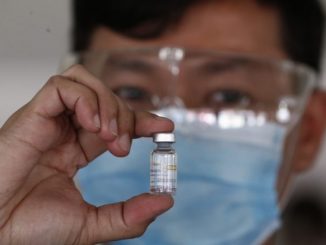
The clandestine operation has not been previously reported. It aimed to sow doubt about the safety and efficacy of vaccines and other life-saving aid that was being supplied by China, a Reuters investigation found. Through phony internet accounts meant to impersonate Filipinos, the military’s propaganda efforts morphed into an anti-vax campaign. Social media posts decried the quality of face masks, test kits and the first vaccine that would become available in the Philippines – China’s Sinovac inoculation.

The article reveals that the campaign was not conducted only in the Philippines, but across the rest of Southeast Asia and far beyond.

The U.S. government campaign, carried out by the U.S. military, was not conducted because it was actually believed that China’s Sinovac vaccine or any of the protective equipment it manufactured was faulty, but purely to undermine China.

Reuters would cite a senior military officer involved in the disinformation campaign who claimed, “we weren’t looking at this from a public health perspective. We were looking at how we could drag China through the mud.”

Reuters also interviewed doctors who admitted, “it put civilians in jeopardy for potential geopolitical gain.”

The U.S. Military Wasn’t the Only Culprit 

As revealing and disturbing as Reuters’ article is, it falls far short of fleshing out the full extent of U.S. disinformation, manipulation, and coercion regarding Chinese vaccines and medical equipment.

In addition to a large-scale campaign across social media conducted by the U.S. military, the U.S. State Department through the National Endowment for Democracy (NED, is banned in Russia) called on various opposition groups and political parties the U.S. government had built up over the course of years in targeted countries, including in Southeast Asia, to amplify these same narratives both across the media, and even into the streets.

In Thailand, the U.S.-backed “Future Forward Party” headed by billionaire-turned-politician Thanathorn Juangroongruangkit and his NED-funded opposition movement helped spread the Pentagon’s admitted lies and disinformation through a series of protests demanding the Thai government end cooperation with China and instead procure vaccines from the United States, and more specifically, U.S. pharmaceutical giants Pfizer and Mondera.

The South China Morning Post in a 2021 article titled, “How China’s Sinovac vaccine got caught in the crossfire of Thailand’s anti-government protests,” would report:

Thailand’s anti-government movement has gone beyond calls for reforming politics and the monarchy and is zooming in on Prayuth’s handling of the pandemic and his reliance on the Sinovac vaccine amid a Delta-fuelled third wave.

The article would avoid mentioning who the opposition was specifically, and what potentially compromising connections they may have had motivating them to “coincidentally” take the Pentagon’s narrative into the streets of Bangkok.

It was clearly no coincidence that a U.S.-back opposition was conducting such protests, especially now that Reuters has revealed the Pentagon as the source of the anti-China claims the U.S.-backed Thai opposition were repeating.

The U.S. used all of its assets, far beyond media operations conducted by its military, but also opposition groups and political parties it had built up and is funding around the globe, to likewise participate in Washington’s global disinformation campaign against China.

Far from a single example, the U.S.-backed opposition in Thailand (and elsewhere) has sided with Washington against China on all conceivable issues, including issues that have nothing to do with Thailand directly, including the South China Sea, of which Thailand is not a claimant.

This Wasn’t the First, Nor the Last U.S. Disinformation Campaign 

While Reuters focuses primarily on this one single aspect of a single disinformation campaign now admittedly and deliberately conducted by the United States knowingly causing harm to allies and enemies alike, the report alludes to the existence of many more campaigns like it.

Reuters would note:

Clandestine psychological operations are among the government’s most highly sensitive programs. Knowledge of their existence is limited to a small group of people within U.S. intelligence and military agencies. Such programs are treated with special caution because their exposure could damage foreign alliances or escalate conflict with rivals.

While Reuters omits any mention of specific campaigns, it admits that the U.S. government has conducted similar disinformation campaigns aimed at undermining public opinion of China.

Reuters admits:

In 2019, Trump authorized the Central Intelligence Agency to launch a clandestine campaign on Chinese social media aimed at turning public opinion in China against its government, Reuters reported in March. As part of that effort, a small group of operatives used bogus online identities to spread disparaging narratives about Xi Jinping’s government.

These campaigns continue today, calling into question the quality and safety of other Chinese products and projects, ranging from telecommunication equipment manufactured by Huawei, to major infrastructure projects, all with the aim of not supplying or selling the developing world with American alternatives, but to simply deny the developing world the opportunity to develop altogether.

Just as was the case with Chinese vaccines and protective medical equipment, the U.S.-back Thai opposition has played a direct role in amplifying these other media campaigns.

For example, Thanathorn Juangroongruangkit was cited by Bloomberg, denouncing the Thai government’s plan to jointly build a high-speed rail line connecting Thailand to China via Laos who already has a functioning Chinese-built high-speed rail line.

The U.S. State Department regularly decries China’s Belt and Road Initiative, condemning it as a means of “entrapping” nations in debt and reliance on China.

The 2018 article titled, “Thailand Needs Hyperloop, Not China-Built High-Speed Rail, Junta Critic Says,” would report:

A tycoon turned politician who opposes Thailand’s military government has criticized its $5.6 billion high-speed rail project with China because hyperloop technology offers a more modern alternative.

Thanathorn Juangroongruangkit would also organize a press event in which he promoted the non-existent “hyperloop” as an alternative to the Chinese-Thai high-speed railway. During this event, he would reveal the true purpose of opposing Chinese-built infrastructure:

I think over the past five years we have been giving too much importance to China. We want to reduce that and rebalance our relationship with Europe, with Japan, [and] with the U.S. more.

In reality, Thailand places importance on China because of its geographic proximity, common cultural and historical ties, and more pragmatically, the fact that China is Thailand’s largest trade partner, investors, source of tourism, infrastructure partner, and even increasingly a partner in the realm of defense.

Reducing a successful and growing relationship to pivot toward the U.S. and its European and Japanese proxies, all of whom are unable to offer alternatives to opportunities provided by China, is an irrational policy. It is only “rational” if those proposing such a policy serve U.S. interests rather than Thailand’s.

Considering the close relationship Thanathorn Juangroongruangkit himself has with Washington, and the fact that his opposition movement is funded by Washington, his proposal of policies that serve U.S. interests at Thailand’s expense comes as no surprise.

This is just a small illustration of just how much larger the scale is of U.S. manipulation and coercion around the globe, far exceeding dishonest and abusive activities across social media platforms, but going as far as building up opposition movements and political parties to not only express opposition to China, but to forcibly pivot nations away from working with China by politically capturing their governments, installing client regimes into power, and having policy irrationally tilted in favor of serving U.S. interests as the expense of the targeted nation, in this case, Thailand.

This is done not only through the U.S. military, but also the U.S. State Department and a vast global network of organizations and political parties built up, funded, and directed by Washington.

For nations around the world, it is important to understand the abuse exercised by the U.S. within their own respective information spaces, and the necessity to protect their public against such abuse by controlling the social media networks serving as a vector for this abuse.

By forcing foreign social media companies to open offices in targeted countries and holding them accountable for violating local laws prohibiting abusive disinformation campaigns conducted by foreign entities like Washington, and by developing local alternatives to U.S.-based social media platforms, targeted nations can decide for themselves who can use their information space and for what purpose – and whether or not to tolerate the sort of manipulation and coercion exercised by Washington as exposed by Reuters in their recent report.

For China and Russia, who have already gone far in securing their own respective information spaces, they could perhaps add the means of defending information space to the portfolio of defense articles both nations already export around the globe.

Brian Berletic is a Bangkok-based geopolitical researcher and writer, especially for the online magazine “New Eastern Outlook”.

Strugglelalucha256


How the Pentagon waged an anti-vax propaganda war against China

During the Trump administration, China’s COVID-19 vaccine, Sinovac, was freely distributed to the Philippines and over 40 other nations across Africa, Asia, Latin America, and the Caribbean, marking a significant global health initiative.

A June 14 Reuters exposé reports that in response, the Pentagon unleashed an anti-vax campaign against China. The campaign, centered in the Philippines, aimed to discredit Chinese vaccines and aid through fake social media accounts impersonating Filipinos, leading the anti-vax propaganda effort.

According to Reuters, the Pentagon’s anti-vax campaign involved the use of fake social media accounts posing as Filipinos. These accounts disseminated anti-vaccine propaganda and cast doubt on the safety of Chinese medical supplies, including masks, test kits, and the Sinovac vaccine. 

At least 300 of these fake accounts were identified on X, formerly Twitter, spreading the slogan #Chinaangvirus, which translates to “China is the virus” in Tagalog. The accounts posted messages such as “COVID came from China and the VACCINE also came from China, don’t trust China!”

The operation expanded beyond Southeast Asia, targeting Central Asia and the Middle East. The Pentagon used fake social media accounts aimed at Muslims to suggest that Chinese vaccines contained pork gelatin and were thus forbidden under Islamic law. This effort was part of a broader U.S. military strategy to undermine China’s influence by exploiting local sensitivities and spreading fear about the vaccines. The anti-vaccine campaign was continued by the Biden administration until mid-2021.

The Pentagon’s anti-China propaganda campaign was driven by concerns that China’s COVID-19 diplomacy, including offers of vaccines and medical supplies, was increasing Beijing’s influence in countries like the Philippines. China’s diplomatic efforts, including providing vaccines as a “global public good,” were seen as a threat to U.S. geopolitical interests. 

The Pentagon was also defending the profit-making of Moderna and Pfizer.

Reuters reports that the campaign’s fallout included heightened vaccine hesitancy in the Philippines, where vaccination rates were among the lowest in Southeast Asia. 


Strugglelalucha256


United States assembles the Squad against China

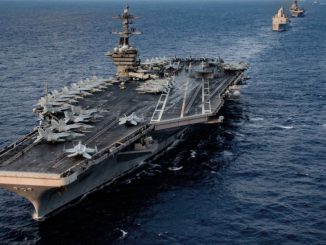
In early April 2024, the navies of four countries—Australia, Japan, the Philippines, and the United States—held a maritime exercise in the South China Sea. Australia’s Warramunga, Japan’s Akebono, the Philippines’ Antonio Luna, and the United States’ Mobile worked together in these waters to strengthen their joint abilities and—as they said in a joint statement—to “uphold the right to freedom of navigation and overflight and respect for maritime rights under international law.” A few weeks later, between April 22 and May 8, ships from the Philippines and the United States operated alongside Australian and French naval troops for Exercise Balikatan 2024.

For this Balikatan (“shoulder-to-shoulder”), over 16,000 troops participated in an area of the South China Sea that is outside the territorial waters of the Philippines. Alongside the navies of these nations, the Coast Guard of the Philippines took part in Exercise Balikatan. This is significant because it is the boats of the Coast Guard that most often encounter Chinese ships in these international waters, part of which are disputed between China and the Philippines. Although the official documents of these exercises do not mention China by name, they are certainly designed as part of the increasing military activity driven by the United States along China’s maritime border.

During the Balikatan exercise, the navy vessels from the Philippines and the United States jointly attacked and sank the decommissioned Philippine Navy BRP Lake Caliraya. The ship—which was made in China—had been donated to the navy by the Philippine National Oil Company in 2014. The fact that it was the only ship in the Philippines’ navy that was made in China did not go unnoticed within China. Colonel Francel Margareth Padilla-Taborlupa, a spokesperson of the armed forces of the Philippines, said that this was “purely coincidental.”

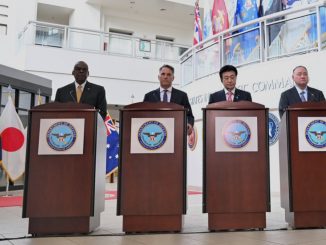
During Balikatan, the defense ministers of the four main nations met in Honolulu, Hawaii to discuss the political implications of these military exercises off the coast of China. Australia’s Richard Marles, Japan’s Kihara Minoru, the Philippines’ Gilberto Teodoro, and the United States’ Lloyd Austin met for their second meeting to discuss their collaboration in the region that they call the Indo-Pacific. It was at the edges of this meeting that the public relations teams of these ministers began to float the term “Squad” to refer to these four countries. While they did not formally announce the creation of a new bloc in East Asia, this new nickname intends to provide a de facto announcement of its existence.

From the Quad to the Squad

In 2007, the leaders of Australia, India, Japan, and the United States met in Manila (Philippines) to establish the Quadrilateral Security Dialogue (or Quad) while their militaries conducted Exercise Malabar in the Philippines Sea. The Quad did not initially include the Philippines, whose President at the time—Gloria Arroyo—was trying to improve relations between her country and China. The Quad did not develop because Australia’s Prime Minister, Kevin Rudd, was unhappy with Washington’s growing belligerence towards Beijing. The Quad revived in 2017, once more in Manila, with a more forthright agenda to work against China’s Belt and Road ambitions in the region (which U.S. Secretary of State Rex Tillerson called “predatory economics”).

Over the course of the past two years, the United States has been frustrated with India’s discomfort with the kind of pressure campaign that the U.S. has been mounting against China and Russia. India refused to stop buying discounted Russian energy, which was a pragmatic decision during an election period (although India’s purchase of Russian energy has declined over time). When asked if India will consider being a NATO+ member, India’s foreign minister, S. Jaishankar, said that India does not share the “NATO mentality.” India’s reluctance to join in the full-throated New Cold War against China annoyed the U.S. government, which therefore decided to set aside the Quad and assemble the Squad with the more pliant and eager government of Philippines president Bongbong Marcos. It is important to note, however, that in April, India delivered a batch of supersonic BrahMos cruise missiles to the Philippines (sold for $375 million and produced by a joint venture between arms manufacturers in India and Russia). That these missiles might be part of the new pressure campaign against China is not something buried in the fine print of the deal.

Provocations

Since its “pivot to Asia,” the United States has sought to provoke China. The U.S. trade war that began in 2018 largely fizzled out due to China’s Belt and Road Initiative and its attempt to build the advanced production lines to circumvent U.S. trade restrictions (for instance, when the U.S. tried to prevent China from importing semiconductor chips, the Chinese developed their own manufacturing capacity). The U.S. attempt to make Taiwan into the frontline of its pressure campaign has not borne fruit either. The inauguration of Taiwan’s new president Lai Ching-te on May 20 brings to the helm a man who is not interested in pushing for Taiwan’s independence; only 6 percent of Taiwan’s population favors unification with China or independence, with the rest of the population satisfied with the status quo. Unable to create the necessary provocation over Taiwan, the United States has moved its gunsights to the Philippines.

While the Philippines and China dispute the status of several islands in the waters between them, these disagreements are not sufficient to drive either country to war. In April 2024, former president of the Philippines Rodrigo Duterte recalled that when he was president (2016-2022), “there was no quarrel. We can return to normalcy. I hope that we can stop the ruckus over there because the Americans are the ones pushing the Philippine government to go out there and find a quarrel and eventually maybe start a war.” In March, President Marcos said that he is “not poking the bear” and does not want to “provoke” China. However, the formation of the Squad two months later does indicate that the Philippines has now replaced Taiwan as the frontline state for U.S. provocations against China.

China’s vice chair of its Central Military Commission, Zhang Youxia, warned against “gunboat muscles.” “Reality has shown,” he said, “that those who make deliberate provocations, stoke tensions, or support one side against another for selfish gains will ultimately only hurt themselves.”


This article was produced by Globetrotter. Vijay Prashad is an Indian historian, editor, and journalist. He is a writing fellow and chief correspondent at Globetrotter. He is an editor of LeftWord Books and the director of Tricontinental: Institute for Social Research. He has written more than 20 books, including The Darker Nations and The Poorer Nations. His latest books are Struggle Makes Us Human: Learning from Movements for Socialism and (with Noam Chomsky) The Withdrawal: Iraq, Libya, Afghanistan, and the Fragility of U.S. Power.


Strugglelalucha256


Socialist Korea exposes U.S. military strategy in the Pacific

The Korean Central News Agency (KCNA), the official news agency of the Democratic People’s Republic of Korea (DPRK), published two important commentaries in April concerning US strategy in the Asia-Pacific region, noting that its principal target is China.

Writing on April 12, Jong Min, an international security analyst, focused on the US attempt to deploy intermediate-range missiles in the region.

He said that not long ago, the US army Pacific commander claimed that the Chinese army is taking an irresponsible way in the use of military means, adding that the US forces are planning to deploy new intermediate-range missiles in the Asia-Pacific region later this year to restrain China.

Jong adds: “Not content with persistently escalating the situation and inciting constant war fever through frequent dispatch of strategic assets to the Asia-Pacific region, the US is scheming to deploy even ground-launched intermediate-range missiles capable of directly aiming at specific countries in the region and promptly striking them at any moment. This clearly shows what phase the US ambition for military supremacy has reached.”

He notes that the US started to develop and modernise intermediate-range missiles, as soon as it unilaterally withdraw from the Treaty on the Elimination of Intermediate-Range and Shorter-Range Missiles between Russia and US in August 2019 and completed the development of an intermediate-range missile system by the end of 2022.

“This fact goes to prove that the US attempt to deploy intermediate-range missiles in the Asia-Pacific region is not a defensive step to cope with ‘threat’ from someone but a product of the offensive and hegemonic military strategy which has been steadily pushed forward in a sequential and planned way for a long time.

“The US attempt to deploy intermediate-range missiles is dangerous enough to explosively aggravate the political and military situation in the Asia-Pacific region, trigger off strong rebuff and counteraction of China and other regional countries and spark off a fierce arms race in the region.

“In view of the range of those missiles, their deployment in Guam, Hawaii and other territories of the US has no military significance. Accordingly, they will have to be deployed in such allies of the US in the Asia-Pacific region as Japan and the puppet Republic of Korea (ROK).

“The US arms buildup to check China’s peaceful development and growth and restrain it militarily will inevitably invoke strong countermeasures. And Japan and the puppet ROK or any third country might be well aware of the fact that they would be the first target of military retaliation if the US intermediate-range missiles were deployed in their territories.

“After all, the US deployment of intermediate-range missiles in the Asia-Pacific region is not for protecting its junior allies. On the contrary, it will lead them to the fate of being victims and sacrifices of the US strategy for hegemony.”

Then, on April 25, international affairs analyst Kang Jin Song commented on the US attempt to expand the AUKUS military alliance, presently consisting of Australia, Britain and the United States, to other countries, starting with Japan.

He notes that since its founding, AUKUS has been called a nuclear mine planted in the waters of the Asia-Pacific as ‘the Anglo-Saxon nuclear submarine alliance’ for seeking nuclear supremacy in the Asia-Pacific region by detouring the international nuclear non-proliferation system.

It is the sinister intention of the US to make Japan a crewmember of a confrontation ship called AUKUS and put it at the outpost line of the anti-China pressure and push the nuclear minefield in the Asia-Pacific region closer to China.

He goes on to outline how the Biden administration recently held a tripartite summit of the US, Japan and the Philippines in the wake of a US-Japan summit to call for strengthened security cooperation between Manila and Tokyo, as well as Canberra and Seoul.

“This is mainly aimed at building double and triple infrastructure for implementing the ‘integrated deterrence strategy’ against China by ultimately putting together tools designed for achieving supremacy existing in the Asia-Pacific region in a ‘latticed’ way.

“The reality goes to prove once again that the ‘competition accompanied by dialogue’ with China and the ‘installation of a guard rail’ in bilateral relations, heard from US public officials, are nothing but deceptive slogans and their thinking and practice are oriented to anti-China confrontation from A to Z.

“Owing to the establishment of a ‘small group’ of the US whose arch enemy is China and its ceaseless attempt to expand the group, the Asia-Pacific region, where opportunities and potentials for development are richer than any other region of the world, is turning into a theatre of muscle-flexing and a touch-and-go nuclear minefield.”

The following articles were originally published by KCNA.


Int’l Security Analyst on U.S. Attempt to Deploy Intermediate-range Missiles in Asia-Pacific Region

Pyongyang, April 12 (KCNA) — Jong Min, an international security analyst of the DPRK, issued the following article “U.S. attempt to deploy intermediate-range missiles causes strategic instability in Asia-Pacific region” on Friday:

The U.S., immersed in realizing the military supremacy over the world, is trying to play a new military gambling in the Asia-Pacific region.

Shortly ago, the U.S. army Pacific commander said that the Chinese army is taking an irresponsible way in the use of military means, adding that the U.S. forces are planning to deploy new intermediate-range missiles in the Asia-Pacific region late this year to restrain China.

Not content with persistently escalating the situation and inciting constant war fever through frequent dispatch of strategic assets to the Asia-Pacific region, the U.S. is scheming to deploy even ground-launched intermediate-range missiles capable of directly aiming at specific countries in the region and promptly striking them at any moment. This clearly shows what phase the U.S. ambition for military supremacy has reached.

The U.S. has possessed and deployed a large number of strategic means capable of dealing a fatal blow to any country on the globe. Nonetheless, it is planning to deploy intermediate-range missiles in the Asia-Pacific region. This is prompted by its strategic intention to improve the efficiency of military pressure on China by additionally reinforcing tactical and operational strike means and deploying them in the forward area.

It is the ulterior calculation of the U.S. that it can check China’s advance into the seas and secure the constant capability of rapidly striking the inland of China if intermediate-range missiles are forward-deployed in the Asia-Pacific region.

The U.S. started to develop and modernize intermediate-range missiles, as soon as it unilaterally withdraw from the Treaty on the Elimination of Intermediate-Range and Shorter-Range Missiles between Russia and U.S. in August 2019, and completed the development of intermediate-range missile system by the end of 2022.

The typical weapon system is Typhon, a ground-launched intermediate-range missile launch system, manufactured and delivered to the U.S. military by Lockheed Martin of the U.S.

According to experts, the Typhon can launch existing Tomahawk long-range cruise missiles and SM-6 multi-purpose guided missiles.

Besides, the U.S. is stepping up the modernization of the intermediate-range missile forces while focusing on the development of various types of hypersonic weapons, including the long-range hypersonic weapon (LRHW) of the Army, air-launched rapid response weapon AGM-183 and hypersonic attack cruise missile (HACM).

This fact goes to prove that the U.S. attempt to deploy intermediate-range missiles in the Asia-Pacific region is not a defensive step to cope with “threat” from someone but a product of the offensive and hegemonic military strategy which has been steadily pushed forward in a sequential and planned way for a long time.

The U.S. attempt to deploy intermediate-range missiles is dangerous enough to explosively aggravate the political and military situation in the Asia-Pacific region, trigger off strong rebuff and counteraction of China and other regional countries and spark off a fierce arms race in the region.

The U.S. dreams about deploying the missiles within this year, but the process will never go smoothly.

In view of the range of those missiles, their deployment in Guam, Hawaii and other territories of the U.S. has no military significance. Accordingly, they will have to be deployed in such allies of the U.S. in the Asia-Pacific region as Japan and the puppet Republic of Korea (ROK).

The U.S. arms buildup to check China’s peaceful development and growth and restrain it militarily will inevitably invoke strong countermeasures. And Japan and the puppet ROK or any third country might be well aware of the fact that they would be the first target of military retaliation if the U.S. intermediate-range missiles were deployed in their territories.

After all, the U.S. deployment of intermediate-range missiles in the Asia-Pacific region is not for protecting its junior allies. On the contrary, it will lead them to the fate of being victims and sacrifices of the U.S. strategy for hegemony.

The U.S. new military gambling in the Asia-Pacific region with “wager” called the deployment of intermediate-range missiles may be led to the nightmare-like result that even the security of its mainland should be mortgaged.


What Is Washington’s Scheme to Extend Sphere of Alliance Aimed at

Pyongyang, April 25 (KCNA) — Kang Jin Song, an international affairs analyst of the Democratic People’s Republic of Korea, issued the following article titled “What is Washington’s scheme to extend the sphere of alliance aimed at”:

The U.S. is now intensifying its scheme to expand and strengthen military blocs in the Asia-Pacific region.

As known, the U.S.-Britain-Australia tripartite defense authority talks on April 8 made public a joint statement on examining a proposal for promoting cooperation between AUKUS and Japan in the field of ultra-modern technology. And Biden confirmed Japan’s participation in AUKUS at the U.S.-Japan summit held in Washington on April 10.

It means that the extension of AUKUS and the preferential participation of Japan have become formal.

The U.S. defends itself saying that cooperation between AUKUS and Japan is limited to the field related to eight core defense technologies, including artificial intelligence and cyber, and it’s not aimed at increasing the number of AUKUS members, but the danger of Japan’s participation in AUKUS is making the whole international community tense, not to mention the regional countries.

In September 2021, AUKUS was forged as a tripartite security cooperation body involving the United States, Britain and Australia. Since its founding, it has been called a nuclear mine planted in the waters of the Asia-Pacific as “the Anglo-Saxon nuclear submarine alliance” for seeking nuclear supremacy in the Asia-Pacific region by detouring the international nuclear non-proliferation system.

Judging from the fact that the extension of AUKUS has become formal and the first candidate for its membership is Japan, a state of aggression and war criminal which tried to develop nuclear weapons during the Second World War and has covertly beefed up its capability for manufacturing nuclear weapons after the war, this poses a serious problem in terms of security environment of the whole world including the Asia-Pacific region.

When the issue of extending AUKUS appeared on the table, Britain and Australia reportedly took a skeptical view, pointing out that Japan failed to fully protect sensitive information.

Although Canada and New Zealand, members of “Five Eyes” – an information-sharing body of Anglo-Saxons – were potential candidates for “AUKUS+”, Japan has been designated as a candidate member of AUKUS, which is attributable to the U.S. pressure and persistent persuasion, according to experts.

Clear is the intention of the U.S. that persists in involving Japan in AUKUS.

It is the sinister intention of the U.S. to make Japan, a vanquished country which revised the “Pacifist Constitution” and is making frantic moves to beef up the forces of aggression under the cloak of “possessing counterattack capability”, obsessed by nationalism, a crewmember of a confrontation ship called AUKUS and put it at the outpost line of the anti-China pressure and push the nuclear minefield in the Asia-Pacific region closer to China.

Most experts comment that the technical cooperation between AUKUS and Japan, promoted under the control of the U.S., will lead sooner or later to its full membership and to the additional admission of other potential candidate countries.

The Biden administration recently held a tripartite summit of the U.S., Japan and the Philippines in the wake of a U.S.-Japan summit to call for the strengthened security cooperation between Manila and Tokyo, and Canberra and Seoul. This is mainly aimed at building double and triple infrastructure for implementing the “integrated deterrence strategy” against China by ultimately putting together tools designed for achieving supremacy existing in the Asia-Pacific region in a “latticed” way.

The reality goes to prove once again that the “competition accompanied by dialogue” with China and the “installation of a guard rail” in bilateral relations, heard from U.S. public officials, are nothing but deceptive slogans and their thinking and practice are oriented to anti-China confrontation from A to Z.

Owing to the establishment of a “small group” of the U.S. whose arch enemy is China and its ceaseless attempt to expand the group, the Asia-Pacific region, where opportunities and potentials for development are richer than any other region of the world, is turning into a theatre of muscle-flexing and a touch-and-go nuclear minefield, and the ensuing immediate and prospective security burden has been heavily placed on the regional and international community.

The peace camp in the region and the rest of the world should heighten vigilance against the reckless moves of Washington to frantically expand its alliance sphere without limits, targeting a certain state.

Source: Friends of Socialist China

Strugglelalucha256


Never forget the U.S.-NATO bombing of China’s embassy!

May 7, 2024, marks the 25th anniversary of NATO’s bombing of the Chinese Embassy in Belgrade. This article was originally published in 2019, when Venezuela’s embassy in Washington, D.C., was being defended against Donald Trump’s illegal takeover.

Twenty years ago — on the night of May 7-8, 1999 — the Embassy of the People’s Republic of China in Belgrade, Yugoslavia, was deliberately bombed by the U.S. Air Force.

This war crime was committed during the 78-day-long bombing of then-socialist Yugoslavia by NATO. Three Chinese journalists were killed. At least twenty were injured.

Ambassador Pan Zhanlin escaped being killed only because the bomb that crashed through the roof of his residence didn’t explode.

The bodies of newlywed journalists Xu Xinghu, 31, and Zhu Ying, 27, were found under a collapsed wall. They wrote for the Communist Party daily newspaper Guangming (Enlightenment).

Forty-eight-year-old Shao Yunhuan of the Xinhua news agency was also killed. Her husband, Cao Rongfei, was blinded.

While it was one or more U.S. Air Force B-2 stealth bombers that attacked the embassy, it was the CIA that picked the target. The CIA director, George Tenet, later testified that the embassy bombing was organized and directed by his agency.

This liar claimed satellite images showed “no flags, no seals, no clear markings,” when in fact all three were present.

Why did the U.S. do it?

The CIA chose to bomb the embassy because the U.S. military-industrial complex wanted to launch a war on China. They viewed President Bill Clinton’s murderous bombing of Yugoslavia as a poor substitute.

After the Soviet Union and the socialist countries of Eastern Europe were overthrown — with the exception of Yugoslavia — the Pentagon wanted to destroy the People’s Republic of China.

In 1996, Clinton had already used aircraft carriers in a military provocation against China, ostensibly over the stolen Taiwan province. But that wasn’t enough for the military. The chairman of the Joint Chiefs of Staff in 1996 was Gen. John Shalikashvili, whose father had been a general in Hitler’s SS.

The attitude of a major section of the ruling class was shown by the Republican Majority Whip of the House of Representatives, Tom DeLay, who bragged how he physically confronted the ambassador of the People’s Republic of China to the U.S. during a filming of Meet The Press:

“So he’s coming off the stage and I’m going onto the stage and I intentionally walked up to him and blocked his way. … I grabbed [his] hand and squeezed it as hard as I could and pulled him a kind of little jerk like this and I said: ‘Don’t take the weakness of this president as the weakness of the American people.’  And he looked at me kind of funny, so I pulled him real close, nose to nose, and I repeated it very slowly, and said, ‘Do-not-take-the-weakness-of-this-president-as-the-weakness-of-the-American-people.’”

Defend Venezuela’s Embassy

The attack on the Chinese Embassy in Belgrade was answered by hundreds of thousands of Chinese students demonstrating against U.S. imperialism. Even Boris Yeltsin — whom the U.S. had re-elected in 1996 — felt compelled to send troops to Yugoslavia at Pristina airport on June 12, 1999, a month after the embassy bombing.

Later that same year was the “Battle of Seattle,” where thousands of union workers and students confronted the International Monetary Fund and the World Bank. People around the world saw the brutality of Seattle’s cops.

But it was world finance capital trying to squeeze blood out of a stone throughout Latin America that provoked the biggest fightback. Hungry people in Buenos Aires stripped supermarkets of food and Argentina was forced to cancel debt payments.

Latin American declared ¡Basta ya! to the neoliberal program of cutbacks and misery.  Hugo Chávez Frías was elected Venezuela’s president on Dec. 6, 1998, and inaugurated on Feb. 2, 1999.

The Bolivarian Revolution had begun.

Twenty years later, U.S. imperialism’s latest attempt to turn back the clock in Venezuela to the time when it was a colony of Big Oil and Nelson Rockefeller is sputtering.

Just like the CIA-directed bombing of China’s Embassy in Belgrade, the current attack on Venezuela’s Embassy in Washington, D.C., by the State Department and Secret Service, is an international crime.

Whenever you hear the State Department or the capitalist media attacking any country for violating “the freedom of the press,” remind them of the three Chinese journalists who were murdered in Belgrade: Xu Xinghu, Zhu Ying and Shao Yunhuan.

The best way to honor their memory is to continue to defend Venezuela’s Embassy. Hands off Venezuela!

Strugglelalucha256


Hamas-Fatah meeting in China included talks for temporary government


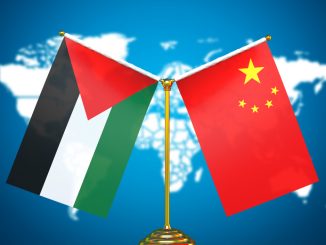
Palestinian sources revealed to Al Mayadeen Tuesday the outcomes of the meeting held between the two Palestinian factions, Hamas and Fatah, in the Chinese capital Beijing.

The sources confirmed that the two factions agreed on the importance of unifying the Palestinian position regarding the Israeli genocidal war on Gaza, emphasizing the importance of a ceasefire and the complete withdrawal of the Israeli occupation forces from the Strip.

In this context, the factions further agreed on “coordinating joint national efforts to deliver urgent aid and relief to the sector and to arrange with the relevant parties in Gaza,” and forming a joint bilateral committee in Cairo for coordination and follow-up.

According to the sources, the meeting emphasized coordinating positions and efforts in the West Bank and al-Quds to confront settler attacks on villages and towns, as well as Israeli occupation assaults on the Al-Aqsa Mosque.

The outcomes of the meeting also stressed the priority of the detainees’ issue and the necessity to preserve their rights and support them during this difficult phase, where they are subjected to the worst forms of abuse and harm inside Israeli occupation prisons.

A unified Palestinian front was on the agenda

On another note, the sources reported from the meeting that Hamas and Fatah affirmed the necessity of unity and ending the division, “within the framework of the Palestine Liberation Organization by joining all Palestinian forces and factions within it and its institutions, based on previous agreements in this regard.”

The parties also highlighted the importance of forming a non-factional national unity government during or after the genocidal war, tasked with its technical and administrative duties in relief efforts, alleviating the effects of aggression, and rebuilding Gaza.

This government will also work on unifying Palestinian institutions and preparing for general elections, “to strip Israel and America of the pretext of division.”

The sources confirmed that the meeting included an agreement to strengthen Palestinian unity with the assistance of China, which “will contribute to ending the occupation and establishing the Palestinian state in the West Bank, Gaza Strip, and al-Quds according to international resolutions.”

The sources informed Al Mayadeen that the outcomes of the meeting constitute the agenda for the next meeting in Beijing on June 14, 2024.

On their part, the Chinese Ministry of Foreign Affairs stated that both sides “expressed political willingness to achieve reconciliation through dialogue,” adding that they reached an agreement on ideas for future dialogue, and “they will continue the dialogue to achieve Palestinian unity as soon as possible.”

The Ministry affirmed that Hamas and Fatah expressed their great appreciation for China’s support for the Palestinian people.

The Chinese Foreign Ministry announced that Beijing hosted talks between Hamas and Fatah at its invitation to conduct “deep and frank dialogue to enhance Palestinian reconciliation.” Furthermore, the Ministry affirmed that Hamas and Fatah expressed deep appreciation for China’s support for the Palestinian people.

It also announced that Beijing hosted talks between Hamas and Fatah at its invitation to conduct a “deep and candid dialogue to enhance Palestinian reconciliation.”

Source: Al Mayadeen 

Strugglelalucha256


Asian ‘NATO’ encircles China

The U.S.-steered Aukus military alliance is cranking up hostilities by inviting Japan into the anti-China pact

MAJOR new announcements this month indicate that the U.S. is intent on escalating its military interference in the Asia-Pacific and the seas around China.

The first announcement by the defence ministers of the U.S., Britain and Australia on the April 8 2024, revealed that the Aukus military alliance is seeking to expand with plans to invite Japan into the anti-China pact.

This was followed by another announcement three days later, at a summit in Washington between U.S. President Joe Biden, Prime Minister of Japan Fumio Kishida, and the President of the Philippines Ferdinand Marcos Jnr, where a new trilateral agreement between the countries was unveiled, including plans to conduct joint naval exercises in the South China Sea this year.

Days before this announcement, on April 7, the first joint naval and air drills between the U.S., Australia, Japan, and the Philippines took place in the South China Sea.

These new initiatives aim to bolster the U.S.’s already substantial military encirclement of China, threatening to destabilize the region and lay the foundations for a U.S.-led hot war against China.

Washington is whipping up conflict in the South China Sea

Under the disingenuous rhetoric of safeguarding “peace and security” in the Asia-Pacific and the South China Sea, the U.S. is cajoling the Philippines and Japan into following its militaristic policy against China.

Since Ferdinand Marcos Jnr became president of the Philippines in June 2022, there has been a significant shift in the country’s foreign policy orientation with a departure from the neutral policy pursued by the previous government led by former president Rodrigo Duterte.

The new anti-China orientation of the current Philippine government has been strongly influenced by the U.S..

This was evident when President Marcos Jnr announced in 2023 that the U.S. would be granted access to four additional military bases, bringing the total number of Philippine bases used by the U.S. to nine.

Two of the new sites are located just across from Taiwan and southern China.

The trilateral summit between the U.S., the Philippines, and Japan on April 11 announced a further advance of the U.S. strategy: joint naval exercises in the South China Sea, which aim to whip up tensions between the Philippines and China.

The shift in the Philippines’ foreign policy has been strongly criticized by the country’s former president, Duterte, who has warned that his country risks being used as a pawn in a potential U.S.-led hot war on China.

Duterte said: “The Americans are the ones pushing the Philippine government to go out there and find a quarrel and eventually maybe start a war … But I do not think that America will die for us … I would tell the Americans, you have so many ships, so you do not need my island as a launching pad or as a launching deck for you.”

It is important to understand these developments take place in the wider context of U.S. aggression against China. The U.S. already surrounds China with around 400 military bases. The U.S.’s main foreign policy goal now, and for a least the next decade, is to preserve U.S. global hegemony by stopping the peaceful rise of China.

The U.S. claims that its actions are “defensive” and designed to preserve the “status quo” in the region. These claims turn reality on its head.

The South China Sea is 12,000 kilometres away from the U.S. Countries in the region would be able to discuss and resolve their disputes peacefully without imperialist meddling from Washington.

The U.S. administration has appointed itself the world’s “policeman” and is attempting to stoke division in the Asia-Pacific and create tensions through militaristic interference.

The U.S.’s claim that confronting China in the South China Sea is necessary to defend its own “national security” is nonsensical. China poses no “threat” to the U.S. — Beijing is not conducting naval exercises off the coast of California and has no military bases surrounding the U.S.

The U.S. push for an ‘Asian Nato’

The U.S. wants its global North allies to join its military build-up against China. The founding of the Aukus military alliance between the U.S., Britain, and Australia in 2021 was a significant advance in that project.

The announcement that Aukus is now seeking new members, chiefly the former colonial power Japan, is an ominous development.

Many analysts are warning that the U.S.’s plans to expand Aukus are an attempt to create an “Asian Nato,” pointing to the risk that Aukus could emulate NATO’s role in Europe, which has intentionally provoked a devastating proxy war in Ukraine with the goal of “weakening Russia.”

The Aukus pact promotes nuclear proliferation. The agreement involves the U.S. and Britain transferring tons of weapons-grade highly enriched uranium to Australia, a non-nuclear state. This breaches The Treaty on the Non-Proliferation of nuclear weapons (NPT).

The plan to invite Japan into Aukus threatens to escalate Japanese militarism and encourage Japan to move even further away from its post-War World II pacifist constitution.

In 2022 there was a significant shift in Japan’s foreign policy when it was announced that the country’s military spending would be increased to 2 percent of GDP by 2027, after decades of being capped at 1 percent.

This increase in military spending is claimed to be necessary to provide the funds for Japan to buy cruise missiles from the U.S. that are capable of hitting North Korea and parts of China.

An imperialist clique targeting China

It is particularly grotesque that the U.S. is proposing that Japan, a country with a shameful colonial history of invading and subjugating China in the 19th and 20th centuries, joins a military alliance aimed at stopping the peaceful development of China.

Japan has committed many brutal atrocities in China. In World War II Japan murdered millions of Chinese people and carried out mass rapes of women and girls.

Britain, already a member of Aukus, has its own appalling colonial history. Britain infamously launched two opium wars against China, forcing it to import and legalize drugs against its government’s will.

Britain invaded and colonized Hong Kong in 1841 and then ruled it with an iron fist for 156 years.

Unlike Japan, Britain, and the U.S., China’s remarkable rise over the past 70 years has not been achieved through invasions, colonialism, slavery, and genocide but through peaceful means.

It is precisely this peaceful development of China that the U.S. is determined to stop.

The stepping up of Washington’s militarised aggression in the Asia-Pacific takes place in the context of the U.S.’s failures to compete with China economically.

The U.S. has not been able to raise its own rate of growth nor slow down China’s through its cold war measures. China’s economy is currently growing at a rate two-and-a-half times faster than that of the U.S..

To compensate for its relative economic decline, the U.S. is doubling down on military aggression, the sphere in which the U.S. remains globally dominant.

The U.S.’s increasing militarization of the Asia-Pacific is a key component of Washington’s global war drive. It should be vigorously opposed by all those who want to stop the U.S. dragging everyone into another world war.

Source: Morning Star

Strugglelalucha256


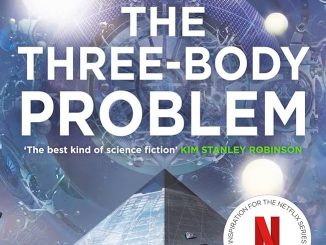
Three-Body Problem: science fiction for China’s ‘New Era’?

This article contains no spoilers for any of Liu Cixin’s works or their adaptations.

The Three-Body Problem (三体), a science fiction novel released in 2006, counts as perhaps the major cultural ‘crossover’ success of China in the last decade. This was true even before the release of the new Netflix television adaptation of the book, released on the 21st of March 2024, and produced and written for the screen by Game of Thrones show creators David Benioff and D. B. Weiss alongside Alexander Woo.

That the creators of arguably the largest television ‘phenomenon’ of recent years saw fit to choose Three-Body as their next project is testament to the cultural impact of this work within China and, increasingly, in the wider world. All the more interesting since the author Liu Cixin, a cultural icon in the PRC, refuses to repudiate his country’s revolutionary history, including its current governing party, the Communist Party of China. As such, he cannot easily be co-opted as a ‘dissident’, and those seeking to market and adapt his works in the West find themselves in the awkward position of having to promote an author who is proud of his country’s achievements and is able to critically engage with the historical path of the Chinese revolution in a productive way, avoiding what Xi Jinping refers to as “historical nihilism.”[1]

This article will look at the original book series, as well as a Chinese-made (Tencent) adaptation from 2023, and compare them with the recently released US-made (Netflix) adaptation. It will assess the relative merits of each version, different audience reactions to these series, as well as some wider considerations of the differences between contemporary Western and Chinese science fiction.

Three-Body Problem was published in China in 2006. The book is the first of a trilogy, with subsequent volumes titled The Dark Forest (黑暗森林) and Death’s End (死神永生), with the trilogy collectively known as Remembrance of Earth’s Past (地球往事). It achieved broad commercial and critical success domestically, with Liu’s works accounting for 2/3rds of the Chinese science fiction market and abroad, with translations into more than 20 languages. In English, the first volume of the trilogy, translated by Ken Liu, received the coveted Hugo Award for ‘Best Novel’ in 2015, the first non-English speaking writer to do so. Liu Cixin’s dominance of modern Chinese science fiction can also be seen in the enormous domestic (and moderate international) success of film adaptations of his Wandering Earth novel, with China selecting the second installment in this film series as its submission for this year’s Oscars.

The plot of the Remembrance of Earth’s Past series is difficult to summarise, especially when trying not to spoil anything. In general, the action initially takes place in a near-contemporary era with the deaths by suicide of various theoretical and applied physicists around the world, many of them leaving cryptic notes suggesting something along the lines of “Physics doesn’t exist.” The first book also jumps back to Mao-era China and follows Ye Wenjie, herself a gifted physicist, during the Cultural Revolution and subsequent work at a radio telescope base in Inner Mongolia. In the broadest possible strokes, the series can be considered an ‘alien contact’ story, but it also touches on themes such as ecology and human development, ‘game theory’, the capacity for ideological groups to form depending on external circumstances, global cooperation to overcome multi-generational problems, and high-level physics concepts.

The books were extremely well-received, with many praising their creative and inventive use of scientific concepts, enormously ambitious ‘high-concept’ action sequences, and philosophical themes. Equally, however, some readers critiqued the series, suggesting that these overwhelmingly abstract ‘ideas’ take center stage, to the detriment of any focus on interpersonal drama and character development. As such, for years it was considered that the novels were ‘unfilmable’.

There had been a few abortive attempts at adapting the book series in China, in animation, or even video game form. Eventually, the Chinese company Tencent succeeded and released a 30-episode series in January 2023. This covers the events of the first novel, Three-Body Problem, in exhaustive detail and is considered a highly faithful adaptation, often with dialogue taken straight from the novel. On release, it was praised by fans of the book, with strong performances, excellent cinematography, and impressive special effects, especially for its budget and the fact it was a Chinese television drama. However, there were also some criticisms from both domestic and international audiences, which criticized the show’s irregular pacing, poor performances by non-Chinese actors, and the ‘old-fashioned’ CGI of the ‘video game’ section of the story.

The recent Netflix adaptation of the series is admirable in many respects. Cixin Liu and his main English-language translator, Ken Liu, were producers on the Netflix version, and it clearly finds great inspiration in the wilder ideas and ‘wow’ moments from the series, with mixed results in carrying them over to the screen. For fans of the original series, an immediate issue is the compression of the first book, along with some elements of the second and even third, into just eight episodes. Even with that in mind, the series wastes time trying to manufacture a series of ‘likeable’ characters (this time with less than mixed results).

In the quest for ‘relatability’ (through petty squabbles and contrived romances), the writers sacrifice the authenticity of these supposedly brilliant theoretical physicists. Such poor scriptwriting and ham-fisted characterization inevitably detract from the impact of the visual spectacle. When the series spends time away from the ‘contemporary’ era, in Mao-era China, or in the ‘video game,’ the series is more engaging, but most of the time is spent with an unconvincing group of presumably committee-decided-upon personalities. This group painfully delivers Marvel Studios-style “witty dialogue,” and the rushed nature of the series never allows for their relationships to develop naturally.

In comparing the two adaptations, pacing is a key difference, with the US-made series’ breakneck speed allowing little time for digestion or contemplation of the weighty, mind-bending concepts. Each episode of the Netflix series reportedly cost $20 million, so having fewer episodes is understandable, but the decision to force more events from future books into this first series was perhaps unwise. And it is notable that while the US adaptation looks more ‘expensive’ on screen, it doesn’t necessarily translate into more impact, or better performances, or direction when compared to the Tencent version.

Politically, a difference arises in the various adaptations with regard to the character of Ye Wenjie. Her ‘pessimism’ and ‘misanthropy’ are present in all versions and drive her fateful actions, but the stress placed upon the cause is different. In each version, Ye is affected by negative experiences she and her family experienced during the time of the Cultural Revolution. The Netflix adaptation (perhaps due to time constraints, but equally, it performs a well-worn ideological function) essentially makes this experience her key motivation and draws her entire desire for ‘revenge’ from one act of violence in a ‘struggle session’—in a shocking scene that opens the series, and indeed the first book.

With more room to breathe, the novel and the Tencent series also bring out other elements, primarily witnessing ecological damage, as key motivators for her eventual ‘nihilistic’ attitude toward the human race as a whole.[2]  Another big difference between the Netflix and other versions is the scope of the action and the participants. Although the Tencent drama suffered from poor acting for its international cast members, it tried to stay loyal to the novels by incorporating a wide variety of international characters and institutions such as the UN—making global-level responses and cooperation a key theme of the work, whereas the Netflix version focussed primarily on London, Oxford, and unnamed British security services.

Reactions to the Netflix adaptation have been mixed: in China, many have praised the strength of the visual effects, and in some cases admired the filmmakers’ clear admiration for the source material. However, some have argued that the series is only a superficial engagement with the books, and have questioned the switching of the primary location from Beijing to London, and of the Chinese characters to Westerners.

Inevitably, orientalist Western reporting of Chinese netizens’ responses has characterized them as reductively “nationalist” and suggested that they are purely driven by animus towards the US (inevitably whipped up by “propaganda”!). For such a cherished series, it will inevitably draw out a wide variety of responses in the enormous and diverse commentariat of online Chinese communities, and it is easy for Western newspapers to cherry-pick comments that suit their narrative. Likewise, they will ignore more nuanced comments, such as those by Zhang Yiwu, a professor at Peking University, who noted, “while there are changes influenced by Western ideology, it does not necessarily mean there’s a deliberate effort to demean China or any specific arrangement of that nature.”[3] Such a one-sided portrayal of negative comments among Chinese audiences also ignores that the Tencent version also received its fair share of critiques alongside positive comments at its time of release.

In the West, likewise, the series has met with both praise and criticism. While admiring the series’ ambition in seeking to transform this ‘difficult’ story and promote it on the widest possible platform, some notable failures are pointed out. Some stunning special and visual effects and memorable set-pieces are let down by weak characterization, clunky scriptwriting, and labored exposition.

It has been noted that recent Western science fiction, particularly in cinema, is based either on simplified superhero narratives or extremely pessimistic dystopian/post-apocalypse scenarios, and this reflects a spiritual and ideological absence in late capitalist culture.[4]

Liu Cixin’s works, including the Remembrance of Earth’s Past trilogy, while not blandly utopian by any stretch of the imagination, focus instead on proactive and creative responses to long-standing and seemingly intractable problems affecting the whole of humanity (while climate crisis is a single topic within the book series, the story as a whole can also be seen as a metaphor for humanity’s contradictory responses to the issue). As such, Liu Cixin’s stories are fitting science fiction for China’s ‘New Era’ period of continuing socialist construction, undertaking (and more importantly achieving) its own enormously complex and profound projects of poverty elimination, green transformation, and high-quality development.[5]

With that in mind, it’s heartening to see this growing appreciation for Liu Cixin’s works, and the range of adaptations of Three-Body Problem will hopefully encourage more people to read the original series (and spur more translations of Chinese science fiction novels). As a tool for people-to-people exchange, adapting popular stories across cultures can foster understanding. Three-Body Problem has the potential to be such a bridge, opening a door to the captivating world of Chinese science fiction for a global audience.


[1] In a 2013 speech, Uphold and Develop Socialism with Chinese Characteristics, Xi Jinping criticised those in the Communist Party of the Soviet Union who had completely repudiated the historical path of the Stalin era: “to repudiate Lenin, to repudiate Stalin was to wreck chaos in Soviet ideology and engage in historical nihilism. It caused Party organisations at all levels to have barely any function whatsoever.”

[2] Ye Wenjie, in both the book and the Netflix series, bluntly justifies her actions by stating: “Our civilisation is no longer capable of solving its own problems”, which seems to repudiate Marx’s claim, from A Contribution to the Critique of Political Economy, that “Mankind thus inevitably sets itself only such tasks as it is able to solve, since closer examination will always show that the problem itself arises only when the material conditions for its solution are already present or at least in the course of formation.” This Marx quote was used by Xi Jinping in a speech from 1989, collected in Up and Out of Poverty, 2016, Foreign Languages Press.

[3] https://www.globaltimes.cn/page/202403/1309480.shtml

[4] With the quip attributed to Jameson, “it is easier to imagine the end of the world than to imagine the end of capitalism.”

[5] Such projects are all the more impressive since they are often achieved ahead of schedule, with for example recent estimates suggesting China will reach peak CO2 emissions this year or next, with “structural decline” from then on, many years ahead of schedule. https://www.carbonbrief.org/analysis-chinas-emissions-set-to-fall-in-2024-after-record-growth-in-clean-energy/

Source: Friends of Socialist China

Strugglelalucha256


Green Berets ‘permanently’ stationed in Taiwan near China’s mainland coast

On May 6, 2016, the New York Times published an obituary for Donald W. Duncan, a former Green Beret master sergeant and later an outspoken critic of the U.S. war against Vietnam. Duncan wrote articles and a memoir and spoke at many anti-war rallies.

The Green Berets, a “special operation” military unit, was first sent into Vietnam in 1957, not long after Ho Chi Minh and the liberation forces drove the French colonial forces out of Indochina. They were tasked with training soldiers for the newly formed U.S.-created “South” Vietnam puppet regime.

Duncan told the radical journal Ramparts about his special forces training, which “…included ‘methods of torture to extract information,’ including ‘the delicate operation of lowering a man’s testicles into a jeweler’s vise.’ He said he later witnessed the use of such techniques in Vietnam.”

Mr. Duncan also testified that year [1967] at an unofficial “war crimes tribunal” organized by the philosopher Bertrand Russell in Denmark, and at a South Carolina court-martial, where he spoke in defense of Capt. Howard R. Levy, a Green Beret who had also turned against the war. Captain Levy was convicted of disobeying orders and attempting to incite disloyalty, and eventually served 26 months in prison.

Duncan’s testimony about the military and the war industry is just as true now as it was then:

 I also know that we have allowed the creation of a military monster that will lie to our elected officials, and that both of them will lie to the American people.

After the U.S. was driven out of Vietnam in 1973, the Green Berets were sent by President Ronald Reagan to guide the secret illegal war to support the “Contras” in Nicaragua and their murderous campaign against the Sandinista government. The contras were responsible for killing thousands of civilians, including many members of the clergy.

In 2001, the Green Berets were the first shock troops sent into Afghanistan when the U.S. began its 20-year occupation of that country, and in 2003, they were then sent into Iraq to overturn the government there, resulting in the deaths of more than 300,000 people, mostly civilians.

Biden sends Green Berets to Taiwan to set up ‘live fire’ exercises.

On March 20, Newsweek reported that:

“Taiwan has confirmed there are U.S. troops stationed on its islands in the Taiwan Strait on a permanent basis, including an island just over a mile off China’s southeast coast.

“The [U.S.] National Defense Authorization Act (NDAA) in 2023 paved the way for their arrival to conduct training programs for troops on Taiwan’s front line.”

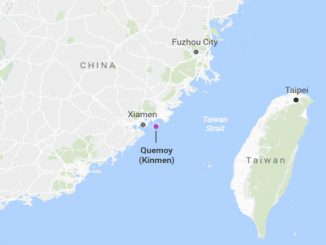
The Green Berets are now permanently stationed on Quemoy, also called Kinmen, within sight of the Chinese mainland coast, as well as Penghu, some 70 miles away.

Of course, “training” is actually down the list of duties for these soldiers. More importantly, they act as a “tripwire” for U.S. imperialism as it attempts to provoke China into open war.

The South China Morning Post reported that Taiwan’s quasi-regime will conduct 20 days of “live fire drills” on Quemoy, which the Pentagon says the Green Berets will participate in:

A military source said various guns and cannons, including M60A3 main battle tanks, 20mm cannons, 120mm mortars, and high-explosive 155mm and 105mm Howitzers, will be used during the exercises that will simulate defending against attacks from the People’s Liberation Army.

On March 7, the Eurasian Times website reported that Taiwan and the U.S. will test the Israeli-made Spyder air defense missile system as it makes its debut during these “fire drills.”

An opinion piece by Alex Lo in the South China Morning Post on March 19 puts this all into perspective:

Now imagine how Washington would react if China had permanently stationed some of its most elite troops a couple of kilometers from Hawaii, Guam or worse, the continental United States. The Pentagon would probably deploy more than a few coastguard vessels as a response.

Taiwan residents are not eager to be Washington’s proxies in war with the PRC.

The Global Affairs website published a March 2022 article about two polls conducted in Taiwan with questions about how willing the residents were to fight off an invasion by mainland China.

The article stated that the results differed sharply depending on who sponsored the poll, whether it was by the ruling pro-independence Democratic Progressive Party (DPP) or a more non-aligned conductor:

One organization’s [DPP] poll had 62 percent of respondents say yes and 27 percent say no, while the other survey, with a slight difference in its wording asking whether “you or your family” would be willing to fight, found only 40 percent said yes and 51 percent said no. 

In January of this year, elections were held in Taiwan. The DPP candidate won the presidency with only 40 percent of the vote, while the combined opposition vote was close to 60 percent. The opposition parties also took control of Taiwan’s “legislature.”

The aptly named Institute for the Study of War, whose board is made up of retired Pentagon generals, former neo-con officials, and Wall Street bankers and hedge fund operators, published a March 22 “China-Taiwan Weekly Update.”

While Washington frequently boasts that Taiwan is “democratic,” this article complains that the DPP war preparations are being hampered by the opposition parties in the legislature:

The Kuomintang (KMT) and Taiwan People’s Party (TPP) are pursuing political reforms that threaten to undermine the Democratic Progressive Party’s (DPP) governance by expanding legislative oversight of the executive branch. 

The opposition’s plan to impose checks and balances on the DPP could significantly hamper the government’s ability to pass policy by miring it in defensive actions against accusations of overstepping authority or corruption.

For these well-heeled gentlemen, imperialist war to crush socialist China is far too important to be stopped by the people that would bear the consequences of it, whether in Taiwan, mainland China, or the U.S..

Meanwhile, on April 1, former Taiwan “president” Ma Ying-jeou traveled from Taiwan to mainland China for an 11-day trip. He is expected to meet with PRC President Xi Jinping.

“This is a trip of peace as well as of friendship,” Ma told reporters in brief remarks at the airport in Taiwan before flying to the southern Chinese city of Shenzhen in Guangdong province.

Ma added that he hoped to convey a message that Taiwan’s people love peace and hope to avoid war.

As U.S. imperialism faces setback after setback in its proxy wars in Ukraine, in Gaza, and in Yemen, as it faces more and more opposition in the streets here and abroad for its devastating drumbeat for war while fundamental people’s rights are under attack, the anti-war movement must be vigilant and ready to mobilize against this threat to People’s China!

There is one China!

Taiwan belongs to all the Chinese people!

U.S., hands off Taiwan! Remove the Green Berets now!

Source: Fighting Words

Strugglelalucha256
https://www.struggle-la-lucha.org/china/page/4/