U.S. war drive against China fuels ‘Mulan’ boycott

Chinese American actor Liu Yifei, who plays the title role in the “Mulan” remake, became a target of anti-China forces in the U.S.

When the Walt Disney Company released its live-action remake of “Mulan,” the bourgeois media establishment responded with indignation and hand-wringing. This spread all the way to the U.S. Congress and the Trump administration.

Members of the Congressional-Executive Commission on China authored a letter to the CEO of Disney, signed by both Democrats and Republicans, demanding that Disney explain the nature of its relationship and collaboration with the Communist Party of China regional bodies in Xinjiang. 

It demands that Disney disclose whether officials were aware of “mass surveillance and detention against Uyghurs and other Muslim minorities,” and whether Disney has a policy on “cooperating with entities that are known human rights abusers.” Marco Rubio, Tom Cotton, Jeff Merkley and Ted Cruz are among the representatives and senators who signed the letter. (For background on the U.S. slander campaign on Xinjiang, read The U.S. road to war on China.”)

Meanwhile, the U.S., at all levels of government, has supported the detention of immigrants and refugees in concentration camps, where they suffer sexual assault, forced sterilization and inhumane conditions that allow for a deadly spread of COVID-19. 

The U.S. has also implemented mass surveillance and encouraged racist violence against Muslim immigrants and Muslim Americans. The U.S. also actively funds and supports countries like Israel, Saudi Arabia and the Philippines, whose government forces commit despicable human-rights atrocities and war crimes on a daily basis. 

Talking heads within the bourgeois media establishment who called for the boycott of the “Mulan” remake are being hailed as activists or protesters, creating massive confusion around the issue. They call for this boycott because this remake is supposedly “pro-China” at a time when China is “committing human-rights atrocities.” In reality, it’s because the U.S. is beating its war drums against China.

One such “activist” is Joshua Wong, considered the face of the “pro-democracy” movement in Hong Kong. What many don’t know is that Wong and an overwhelming swath of the protest movement in Hong Kong are funded and supported by the National Endowment for Democracy, a tax-funded “nonprofit” arm of the U.S. State Department founded and designed for regime change operations. Wong is on public record meeting with some of the same right-wing politicians that signed the letter to Disney.

Many of the other “activists” calling for a boycott of the movie are deeply swayed by the bourgeois media’s Cold War attitude towards China. Even liberal talking heads criticized Trump for freezing funds meant to benefit Hong Kong protesters.  

Struggle-La Lucha interviewed Eliza Romero and Chris Jesu Lee of the “Unverified Accounts” podcast, who released an episode about the hypocrisy and double standards to which the live action remake of “Mulan” is held. 

Struggle-La Lucha: Tell us a little about you — your organization, previous projects, etc. 

Eliza Romero: I’m a coordinator for Malaya Movement’s Baltimore chapter as well as a blogger and podcast host. My blog and podcast both go under the name “Aesthetic Distance.” I’m also one of the co-hosts of the “Unverified Accounts” podcast, which just launched last week. 

Chris Jesu Lee: I’m one of the creators of “Plan A,” an Asian American political/cultural magazine and podcast. Eliza, Filip and I are the creators of “Unverified Accounts”!

Eliza: Filip Guo, our third host, is also one of the creators of “Plan A” and based out of Toronto. 

SLL: Tell us a little about your podcast, your fellow hosts, and why you decided to start it.

Eliza: “Unverified Accounts” is a place for Asian American opinions on arts and culture, with politics naturally coming into play. The idea is for my co-hosts and I to air our own perspectives, which are often at odds with those of the majority of neoliberal Asian American celebrities. Every Monday, Chris Jesu Lee, Filip Guo and I discuss movies, books and TV shows that are connected to cultural and political issues that are trending, generally on social media. We’re an alternative to your typical “NPR/NBC/HuffPost Asian American” fare. 

SLL: Why did you decide to talk about “Mulan” (2020)? What is your take on it?

Eliza: We talked extensively about the new “Mulan” film in episode 3 of “Unverified Accounts,” Mulan Rouge: The New Red Scare.” We are all big fans of the original animated Disney film from 1998 and were skeptical about the remake. After all, Disney live-action remakes haven’t been very successful, save for a very few. Also, Western movies haven’t always been kind to Asian people or culture. We were curious about how the liberal elite crowd, who are very concerned with positive representation of Asians in the media, would react to a story that is very clearly pro-China and is unsubtly attempting to market to Chinese audiences. We also anticipated pushback since the U.S. is now embroiled in a Cold War with China. 

What we found was that regardless of how one feels about China, it’s pretty sickening to watch Asians try so desperately to prove their loyalty to America by creating a moral panic about the movie and/or letting themselves be used as political pawns. Our podcast detailed the hypocrisy in their reasoning — after all, there were no calls to boycott movies that proclaim loyalty to the U.S. or Britain or other imperialist nations, so why single this movie out? The U.S. is the biggest violator of human rights in the world. 

If they praise Marvel movies, which are very pro-capitalist, pro-military-industrial complex, pro-surveillance state, how can they boycott “Mulan” for being pro-China? The same people calling for the boycott praised other nationalist movies like “The Good Shepherd,” “Saving Private Ryan,” “1917” and “Dunkirk” too. Why are they okay with the U.S. and Britain doing it, but it’s “immoral” when China does it? 

While many boycotters of the “Mulan” remake talk extensively about their love for the original, we found a lot of hypocrisy here too, because narratively, the original and the remake are exactly the same. The only difference is the timing of their releases and current political pressures. It was rather hilarious watching some people try to resolve this cognitive dissonance.

On the representation side of things, there were calls to boycott the movie because “there was zero representation of Asian people” in the production of the film. This was also hypocritical because they do not criticize the lack of representation behind the scenes in the original 1998 animated film, which was also written, produced and directed by white people and had fewer Asian voice actors than the new version had on-screen. Some consistency, please!

Chris: I thought the movie was pretty bad, as most of these Disney live-action remakes are. But a lot of the criticism has obvious political or personal agendas. The bigger picture story is how unnecessary this movie is because Asia doesn’t really need America’s approval as much as before. This movie predictably flopped in China. Why would China want to watch a Hollywood knock-off of its own material? It’s this loss of American centrality that has so many people enraged and anxious. 

SLL: What would you hope to happen if more people listened to this episode? Or your podcast in general?

Eliza: Our podcast is an alternative to the typical neoliberal takes on arts and culture in mainstream media, especially among mainstream Asian American media outlets. With every episode we release, we hope to embolden people to think in other ways or speak up about beliefs they’ve always held but are afraid to voice. With our “Mulan” episode, we hope to help our listeners see that there are some dark, anti-communist forces at work with the boycott of the film — it’s a combination of red scare and yellow peril. And many mainstream Asian liberal elites are weaponizing their own identities to push forward a pro-U.S. imperialist, anti-Chinese agenda. 

SLL: Where can people find your podcast or any of your other work?

Eliza: You can find “Unverified Accounts” and “The Aesthetic Distance Podcast” on Apple, Google Play, Spotify and wherever you listen to podcasts. New episodes of “Unverified Accounts” are released every Monday morning. You can find my blog at aestheticdistance.com and I am also very active on social media (Instagram @aestheticdistance/Twitter @aesthdistance1). 

Additionally, Malaya Movement Baltimore is an organization that I am very proud to be a part of. It is the Baltimore chapter of the Malaya Movement, a U.S.-based movement against the killing and dictatorship and for democracy in the Philippines. As our name indicates, Malaya (Filipino for “free”) seeks not only to broaden our opposition against fascism but also to broaden support for the cause of freedom, democracy and human rights in the Philippines. 

Follow us on Instagram (@malaya.baltimore) to stay updated on all of our upcoming national and Baltimore-based campaigns, actions and educational sessions. You can also join our movement by filling out this form. If you’re not in Baltimore, that’s okay. We will connect you with the chapter closest to you.

Strugglelalucha256


Trump, China, TikTok, Tulsa. Free speech?

On Aug. 5, President Donald Trump announced that he’s planning on banning TikTok due to “security risks” and the fact that the app collects data of the users. There are lots of people happy (mostly right-wing Trump supporters) about this decision due to the fact they’re not okay with the idea of their information being collected by someone in China. 

Despite the fact that TikTok, like many other websites and apps, has a terms-of-service in which it explains that “by agreeing you accept our privacy policy.” This privacy policy explicitly explains the information they collect. The irony of all this being that before TikTok was even available on the app store, websites and apps like Google, Facebook, Twitter, Instagram, YouTube, Snapchat, WhatsApp, Amazon and so many more were already collecting users data. It’s evident that this has nothing to do with security and everything to do with the anti-China sentiment that Trump loves to promote.

While many people aren’t self-aware enough to recognize the irony of wanting to ban the app; most TikTok users see the hypocrisy in banning one app for collecting the user’s personal information but not the other apps. It’s obvious that Trump and his supporter’s only issue is that this is someone from China is collecting this information. 

Not once has Trump ever mentioned banning Facebook or Amazon for their collection of data information. An alternative to the ban is for ByteDance, the company that owns TikTok, to give up ownership to companies like Microsoft. Even if Microsoft were to buy TikTok, Trump said a fee would have to be paid to the U.S. Treasury. This isn’t just among Trump and the right. This anti-China propaganda is common among liberals and Democrats. Sen. Chuck Schumer said that he was the one that had first “exposed TikTok’s links to China and is in full support of this ban. 

Another factor that may have played into this was the sabotage of Trump’s Tulsa rally. TikTok users had shared videos on how to get free tickets for Trump’s June 20 rally in Tulsa, Okla. He went on Twitter to say, “Almost One Million people requested tickets for the Saturday Night Rally in Tulsa, Oklahoma!” despite bragging about getting one million RSVPs, fewer than 6 thousand turned out. Trump couldn’t fill his 19,000-person capacity arena. 

I’m not defending any of the companies, but it’s obvious that this is Trump and his supporters being very anti-China. This is also his way of retaliating against the sabotaging of his rally. Many supporters of his are pro-free speech but they don’t realize (or make him accountable) that Trump is against free speech.

Strugglelalucha256


The U.S. tech war on China and the 5G battlefield

The U.S. tech war on China continues, banning Chinese equipment from its network, and asking its 5-Eyes partners and North Atlantic Treaty Organization [NATO] allies to follow suit. It is a market and a technology denial regime that seeks to win back the market that the U.S. and European countries have lost to China.

International trade assumed that goods and equipment could be sourced from any part of the world. The first breach in this scheme was the earlier round of U.S. sanctions on Huawei last year, that any company that used 25% or more of U.S. content had to obey U.S. sanction rules. This meant U.S. software, and chips based on U.S. designs, could not be exported to Huawei. The latest round of U.S. sanctions in May this year, stretched the reach of U.S. sanctions to cover any goods produced with U.S. equipment, extending its sovereignty well beyond its borders.

In the last three decades of trade globalization, the U.S. has increasingly outsourced manufacturing to other countries, but still retained control over the global economy through its control over global finance — banks, payment systems, insurance, investment funds. With the fresh slew of sanctions, another layer of U.S. control over the global economy has been revealed: its control over technology, both in terms of intellectual property and critical manufacturing equipment in chip making.

The new trade sanction that the U.S. has imposed is in violation of the World Trade Organization’s rules. It invokes national security, the nuclear option in WTO, on matters that are clearly trade-related. Why the U.S. has gutted the WTO refusing to agree to any new nominations to the Dispute Settlement Tribunal now becomes clear. China cannot bring the illegal U.S. sanctions to WTO for a dispute settlement, as the dispute settlement body itself has been made virtually defunct by the U.S.

The battle over 5G and Huawei has become the ground on which the U.S. -China tech war is being fought. The 5G network market itself is expected to reach 48 billion dollars by 2027, but it will drive trillions of dollars of economic output over the installed 5G networks. Any company or country that controls the 5G technology will then have an advantage over others in this economic and technology space.

The internet is the foundation on which almost all future digital technologies will be deployed. 5G networks will boost wireless internet speeds by a factor of 10 to 40. For the consumers, slow internet speed is the bottleneck for applications, such as video conferencing, multiplayer online gaming, where both upload and download speeds need to be high. This is unlike consuming videos over the internet, like Netflix, where only download speeds are important. 5G networks will also allow such high-speed internet to be deployed over a much larger area, and on our mobile devices.

The two other areas that would benefit from 5G are driverless cars and the Internet of Things (IoT), in which all our gadgets will talk to each other over the wireless internet. While driverless cars are still some distance away, IoT could be much more important, e.g, in improving efficiency and maintaining the physical infrastructure of electricity, traffic lights, water and sewage systems in future ‘smart cities’.

The G in telecom networks refer to generations, and each generation of technology in wireless communications means increasing the amount of information the radio waves carry. The 5G networks are much faster than the equivalent 4G networks, and support a much higher number of devices in a given area. The price is that unlike the current 3G and 4G, 5G cannot travel long distances, and needs a number of repeater hops, or cells and antennas, to travel the same distance. A 5G network can provide the same speeds that a fiber optic cable network provides, without the large cost of physical cabling. It can, therefore, reach less dense population centers including rural areas with high-speed internet at much lower costs.

Who are the other players in the 5G space? The other major players apart from Huawei are Samsung (South Korea), Nokia (Finland), Ericsson (Sweden), and ZTE (China). While the U.S. has no major player at the network equipment level, it has Qualcomm that manufactures wireless components and chipsets, and Apple that is the market leader in smartphones.

The U.S. sanctions had earlier attacked Huawei using its dominant position on software. Google’s Android powers most of China’s mobile phones, as it does most other non-Apple mobile phones. In semiconductor chips, ARM processors have a leading position in the embedded systems and mobile market, with most companies that require advanced processors switching over from Intel to ARM. ARM, a UK-based company but owned by SoftBank of Japan, does not manufacture chips themselves, but provides designs for cores that go into processors. These are licensed to companies like Huawei, Qualcomm, Samsung and Apple, who design their processors based on 2,4, or 8 ARM cores and get them fabricated in silicon foundries. These processors power mobile network equipment, mobile phones or laptops of different manufacturers.

The silicon foundries that fabricate the actual processors using ARM cores from the designs of Huawei, Samsung or Apple, are companies like Taiwan Silicon Manufacturing Company (TSMC). TSMC is the largest silicon foundry in the world, with 48% of the global market. Samsung also has high capacity silicon foundry with another 20% of the global market. It uses its captive facility for its internal needs, but also for other manufacturers. China has the fifth largest silicon foundry in the world, Semiconductor Manufacturing International Corporation (SMIC), but it is only one-tenth the size of TSMC. TSMC and Samsung have 7 nanometer technology (7 nanometer transistor size in the chips), while SMIC currently has 14 nanometer technology.

The earlier U.S. attack on Huawei and China banning U.S. software from Huawei systems, meant that Huawei had to change over from Google’s Android mobile operating system and various apps that rode on top of the Android system in Google’s app store (Play Store). It had anticipated this attack and created its own operating system, HarmonyOS, and its own app store. It is also using an open source version of Android and its app store—App Gallery—as a replacement for Google Play Store. How its users would cope without the Google app store, remains to be seen. It would depend on whether the app developers would switch to Huawei in large enough numbers, and the quality of Chinese app makers who have already proven themselves in the Chinese market.

It was initially thought that ARM processors would not be available for Huawei in the future. This raised a question mark over Huawei’s equipment, as it is critically dependent on the ARM processors for networking equipment, mobile phones, and laptops. ARM initially suspended all future sales of its processors to Huawei, as the U.S. had claimed that it has more than 25 percent U.S. content and therefore fell within U.S. sanctions regime. Subsequently, ARM has come to the conclusion that its U.S. content is less than 25 percent and therefore not subject to the U.S. sanctions.

This is what precipitated the new sanctions that the U.S. has imposed. In these sanctions, if any equipment of U.S. origin is used to produce components or systems for Huawei, then those components and sanctions also come within its sanctions regime. TSMC uses U.S. origin machines for its manufacture of chips, and has stopped taking Huawei orders. Samsung has a mix of U.S. , and non-U.S. machines for its fabrication lines and could, if it wanted, switch at least some of these lines to use only non-U.S. machines for its fabrication. This leaves a window for Huawei to beat the U.S. sanctions. Huawei has still some cards to play, one of which is ceding the high-end mobile phone market to Samsung for access to its chip fabrication facilities.

If Huawei has to depend on only domestic sources, it is going to take a hit on its future production. It has a stockpile of possibly 12-18 months of fabricated chips, so this is the time window it has for a new supplier, or use a less dense—10 or 14 nanometer—technology using its domestic supplier SMIC.

For the 5G market, the 7 nanometer fabrication may not be the only deciding factor. Huawei has a significant lead in radios and antennas that are the key components in the 5G network. The 5G networks depend on what are called Massive Multi-input Multi-output (MIMO) antennas, where Huawei is streets ahead of others. This, more than processor size, may decide the technical advantage of Huawei’s offerings. Nokia and Ericsson are using Intel chips for their base stations which are no match for ARM processors. And with Huawei’s support, China’s SMIC in Shanghai may be able to switch to a 10 nanometer technology quickly, shortening the gap between its processors and that of others.

Huawei can provide a complete 5G solution—from networks to 5G mobile phones—and install it much faster than others. Its home market is bigger than all other 5G markets in the world, with which it can power its growth.

It is certainly not game over for Huawei, as many tech analysts are concluding. They have already pronounced the game over twice, once over Google’s Android system denial, later on ARM processor ban. With this new set of sanctions, the U.S. has secured some temporary advantage for other Western players, but has also created an incentive for manufacturers outside the U.S. to move away from U.S. equipment. Such bans are always double-edged weapons.

So it is very much game on for Huawei and China in the tech war. It is the larger forces of the political economy that will decide this war. Like any other war, it is not one battle in one arena that will decide the war. The 5G is only one battle theater, there are many other battlefields that will decide the future of this war. And in many of those, China holds the cards.

Source: Peoples Dispatch

Strugglelalucha256


Marines retool for war on China

As the COVID-19 death toll in the U.S. approaches 120,000, the Trump administration is relying heavily on anti-China propaganda — including wild accusations, right-wing conspiracy theories and racist anti-Asian rhetoric that greenlit physical attacks and racist assaults against Asian Americans.  

Trump and his ilk need to distract from their own disastrous response to the deadly pandemic, the deep capitalist recession, the epidemic of violent police racism and murder, and the brutality against protestors demanding justice for George Floyd. Slandering and attacking China became their chosen distraction.

But the animosity toward China isn’t limited to mere rhetoric. There are calls to make China pay reparations, lawsuits against China by several U.S. states, investigations of the origins of the virus by intelligence agencies in Australia, Europe and the U.S., an effort by the Trump administration to forge an international alliance to further sabotage China, and a cutoff of funds to the World Health Organization.

The heightened animosity from the White House has prompted establishment media to reference the Cold War, when imperialist hostility meant the USSR, China, Cuba and other socialist countries were under constant threat of nuclear attack. And, in fact, the Pentagon is preparing for a war against China. The possibility of a military confrontation can’t be ignored by anti-war forces in the U.S.

Pentagon pivot to Asia long planned

The shift in U.S. military strategy toward targeting China precedes the pandemic and the Trump administration. The reorientation began when the Obama administration embraced then-Secretary of State Hillary Clinton’s “pivot to Asia,” which called for a stronger military presence in the South China Sea to challenge China and gain access to Asian markets. But the right-wing coup in Ukraine and Crimea’s refusal to be part of the U.S. orbit, along with the war on Syria, ended up taking precedence. 

Pentagon war planners are now going full-throttle to make up for lost time. As generals and admirals came to Congress in March to demand more money for war in the 2021 budget, it came to light that they were already thoroughly invested in preparations for all-out war against China. On March 5, Gen. David Berger, commandant of the U.S. Marines, outlined for the Senate Armed Services Committee a 10-year transition for the Marines that is already underway. 

The Marine Corps is retooling for war against the People’s Republic of China. For decades, the Marines have provided ground troops in the longest reign of imperialist death and destruction in U.S. history, in Afghanistan and Iraq. Now the plan is to leave that to the U.S. Army, and for the Marines to become a high-tech maritime force to operate more vigorously in the South China Sea and to augment the U.S. Navy.

The Intermediate-Range Nuclear Forces Treaty (INF) ended in August 2019, and the U.S. shunned efforts to replace it. Without that treaty in place, the Pentagon is preparing the first phase of the Marine’s transition — stocking up on previously prohibited, land-based cruise missiles. 

A May 6 Reuters article reports that “having shed the constraints of a Cold War era arms control treaty, the Trump administration is planning to deploy long-range, ground-launched cruise missiles in the Asia-Pacific region. … The Marines will join forces with the U.S. Navy, using small mobile units armed with anti-ship missiles dispersed along the so-called first island chain — the string of islands that runs from Japan, through Taiwan, the Philippines and on to Borneo, enclosing China’s coastal seas.”

The transition means tanks and heavy weaponry are being dispensed with, and fewer F-35 aircraft for the smaller mobile Marine units. V-22 tiltrotor aircraft, helicopter units and shore-assaulting amphibious vehicles will be cut. According to a report by the Center for Strategic and International Studies, the radical reshaping of the Marine Corps will transform it into a naval expeditionary force. 

The Marine Corps will be redesigned to fight “within an adversary’s (read China’s) bubble of air, missile and naval power,” according to Gen. Bergen. It will require small groups of less visible, newly designed warships, armed with drones currently in development — essentially jet-powered unmanned fighter jets — to function in small units with the ability to move independently and deploy in and around the South China Sea.

U.S. rulers threatened by China’s example

Military contractors like General Dynamics and Raytheon have made billions equipping the Marine Corp and drained funds from the U.S. Treasury that should have been used for people’s needs. No doubt there will still be lucrative contracts for them, in addition to the billions that will likely be handed over to AeroVironment for the “lethal unmanned” drones and to Kratos Defense and Security for their jet-powered drones. General Dynamics, Lockheed Martin and Huntington Ingalls will all be vying for the billions it will take to build the new warships.

But this shift by the Pentagon is fueled by more than the usual siphoning off of Treasury funds by giant criminal corporations. 

Regardless of concessions made to capitalism by the People’s Republic of China over the years of its development, the Chinese Communist Party and the people of China set an example in the “People’s War” against COVID-19. Their successful struggle against the disease trumpeted amazing advances in science and medicine, the superiority of centralized planning and how humanity is prioritized over profit. It is a victory in the battle for the consciousness of the worldwide working class. 

A famous quote by the beloved leader of the Cuban Revolution, Fidel Castro, goes: “A revolution is a struggle to the death between the future and the past.” Our people’s movement, strengthened enormously by the working-class explosion against police racist murders, has to be ready to defend socialism in China — the future.

Strugglelalucha256


Marxism and the social character of China

From a June 9, 2013, talk by Fred Goldstein at the Left Forum, a yearly event in New York City. The talk was focused on socialism and China in the wake of the Great Recession of 2008. Although the details of what is happening now are different, the social and economic forces have not changed. The conclusion is also unchanged: there must be a firm defense of China against every scheme by imperialism to undermine the socialist foundation that still exists there.

The issue of China is one of the most important questions of the 21st century for the working class and the oppressed peoples, as well as the hostile imperialist ruling classes of the world.

The progressive and revolutionary movements, especially in the U.S., have a great stake in arriving at a correct policy toward China.

First of all, China is a formerly oppressed country that achieved liberation from British, French, German, U.S. and Japanese imperialism in 1949 by making one of the greatest revolutions in history. At that time, one quarter of the human race was torn from the clutches of imperialism. As a formerly oppressed country struggling for national development, it must be defended against all varieties of imperialist military, economic and political aggression, regardless of what one thinks about its social character.

China today is a new, complex and contradictory phenomenon in history. It has fundamental socialist structures alongside capitalist development and imperialist penetration. The leadership calls it “market socialism” or socialism with Chinese characteristics.

Socialism is inscribed firmly as China’s foundation in its constitution. The international capitalist class is profoundly hostile to China and never ceases to try to undermine its fundamental socialist structures.

Yet workers in Chinese private industry are subjected to capitalist exploitation and the workers in the state industries have lost much of the economic support that once attached to their workplaces. Horrendous industrial accidents take place and environmental problems are severe.

Dual character of China’s economic foundation

Only Marxism enables us to approach an analysis of China.

Marxism has shown that the character of any society is determined by its economic foundation and that the superstructure of society, its politics, ideology, etc., are determined by the economic foundation.

How can such an analysis be applied to China and how can it help to clarify how to view China?

To begin with, the economic foundation of China is not homogeneous. It is partly socialist and partly capitalist. The question for us and for the world working class is: Which is dominant? — the socialist foundation, or the capitalist enterprises seeking private accumulation of profit through the exploitation of the working class?

Similarly, the superstructure is not homogeneous. On the one hand, there are the Communist Party, the People’s Liberation Army and the ideological doctrine that declares socialism to be the foundation of China. On the other hand, there is the relentless promotion of opening up to imperialism and capitalist market reforms. And, above all, there is a struggle over political reform, meaning the right for the bourgeoisie and the petty bourgeoisie to organize politically, either inside the party, outside the party or both. There is a steady drumbeat for “political reform” from the imperialists and their class allies inside China.

Economic crisis of 2008-2009 was a critical test

How can we assess this situation? We should start by empirical examination of China, on the one hand, and the rest of the capitalist world on the other.

A critical test came when the Chinese leadership was forced to deal with the effects of the worst capitalist crisis since World War II.

When the crisis hit in 2008 to 2009, many tens of millions of workers in the U.S., Europe, Japan and across the capitalist world were plunged into unemployment.

China, which had dangerously allowed itself to become heavily dependent on exports to the capitalist West, suddenly was faced with the shutdown of thousands of factories, primarily in the eastern coastal provinces and the special economic zones.

More than 20 million Chinese workers lost their jobs in a very short time.

So what did the Chinese government do?

We described what happened in a pamphlet titled “The Suppression of Bo Xilai and the Capitalist Road — Can Socialism Be Revived in China?” in an article titled “Capitalist crisis versus planning.” The article, published on March 27, 2012, explained that plans drafted as far back as 2003, to go into effect in future years, were pushed forward and implemented.

We then quoted from Nicholas Lardy, a bourgeois China expert from the prestigious Peterson Institute for International Economics, who described how consumption in China actually grew during the crisis of 2008-2009, wages went up, and the government created enough jobs to compensate for the layoffs caused by the global crisis.

Said Lardy: “In a year in which GDP expansion [in China] was the slowest in almost a decade, how could consumption growth in 2009 have been so strong in relative terms? How could this happen at a time when employment in export-oriented industries was collapsing, with a survey conducted by the Ministry of Agriculture reporting the loss of 20 million jobs in export manufacturing centers along the southeast coast, notably in Guangdong Province? The relatively strong growth of consumption in 2009 is explained by several factors. First, the boom in investment, particularly in construction activities, appears to have generated additional employment sufficient to offset a very large portion of the job losses in the export sector. For the year as a whole, the Chinese economy created 11.02 million jobs in urban areas, very nearly matching the 11.13 million urban jobs created in 2008.

“Second, while the growth of employment slowed slightly, wages continued to rise. In nominal terms, wages in the formal sector rose 12 percent, a few percentage points below the average of the previous five years (National Bureau of Statistics of China 2010f, 131). In real terms the increase was almost 13 percent. Third, the government continued its programs of increasing payments to those drawing pensions and raising transfer payments to China’s lowest-income residents. Monthly pension payments for enterprise retirees increased by RMB120, or 10 percent, in January 2009, substantially more than the 5.9 percent increase in consumer prices in 2008. This raised the total payments to retirees by about RMB75 billion. The Ministry of Civil Affairs raised transfer payments to about 70 million of China’s lowest-income citizens by a third, for an increase of RMB20 billion in 2009 (Ministry of Civil Affairs 2010).”

He further explained that the Ministry of Railroads introduced eight specific plans, to be completed in 2020, to be implemented in the crisis. The World Bank called it “perhaps the biggest single planned program of passenger rail investment there has ever been in one country.” In addition, ultrahigh-voltage grid projects were undertaken, among other advances.

The full article by Lardy can be found in “Sustaining China’s Economic Growth after the Global Financial Crisis,” Kindle Locations 664-666, Peterson Institute for International Economics.

Socialist structures reversed collapse

So income went up, consumption went up and unemployment was overcome in China — all while the capitalist world was still mired in mass unemployment, austerity, recession, stagnation, slow growth and increasing poverty.

The reversal of the effects of the crisis in China is the direct result of national planning, state-owned enterprises, state-owned banking and the policy decisions of the Chinese Communist Party.

There was a crisis in China, and it was caused by the world capitalist crisis. The question was which principle would prevail in the face of mass unemployment — the rational, humane principle of planning or the capitalist market. In China the planning principle, the conscious element, took precedence over the anarchy of production brought about by the laws of the market and the law of labor value.

But the institutions based on the remaining structures of Chinese socialism, which saved the masses from economic disaster, are the very institutions that the World Bank, the International Monetary Fund, Wall Street and London want to reduce and eventually destroy. They are the state-owned enterprises, government planning and the control by the Chinese Communist Party.

One might say that the Chinese leadership did this to avoid unrest. Surely the capitalists in Europe and the U.S. also want to avoid unrest. But that did not cause them to put tens of millions of workers back to work, raise pensions, and raise stipends and social welfare payments. It only caused them to institute austerity to secure the profits of the bankers.

Coming back to Marxist analysis, it is clear from the way the Chinese leadership handled this crisis that the socialist side of the economic foundation is still dominant in China. And the same can be said for the political superstructure.

The enemies of socialism claim that capitalism is responsible for the great successes in China.

But that is a falsehood. China has succeeded in its economic development because the socialist sector has broadly contained domestic capitalism and imperialist investment within the framework of the national economic goals of the leadership.

Without that, China would look like India — which also has planning but is a thoroughly capitalist country.

In India, poverty is so deep that people live on garbage dumps, wash their clothes in polluted water, and the urban slums in Kolkata and Mumbai rival rural poverty. The masses of India are desperately poor — living on $1 to $2 a day — even as the glittering high-tech industry develops alongside the abysmal economic conditions faced by hundreds of millions of Indians.

There is no comparison with China. But if the imperialists have their way, if they can destroy the socialist foundation and the Communist Party, they will turn China into another India. That is what is at stake in the struggle to stop the counterrevolution in China.

‘Market socialism’ a false and dangerous concept

This analysis should not be understood in any way as support for the doctrine of “market socialism.” In our view the anarchy of the capitalist market is antagonistic to the planning of a socialist society and socialist construction. Capitalist private property is antagonistic to socialist property and production for private accumulation is antagonistic to production for social use and human need.

There are historical circumstances of extreme underdevelopment which compel a socialist government to employ both private and state capitalist methods to promote development of the productive forces and the creation of the working class from the rural population.

It is one thing, however, to use these methods as a temporary expedient, to make a retreat from socialism in order to make socialism triumphant in the struggle against capitalist methods. That was Lenin’s idea behind the New Economic Policy. It began in 1921 in the USSR, during the direst times after the civil war left the country in ruins and the working class that survived was going back to the country to get food.

But Lenin always regarded this as a retreat and a crucial struggle. The question, as Lenin put it, was “Who will win?”

China long ago developed economically after the capitalist reforms instituted by Deng Xiaoping.  But what should have been a temporary retreat has become an enshrined policy of treating capitalism as a partner with socialism.  Private capital grows automatically and with it the economic strength and political influence of the capitalist class, its petty bourgeois hangers-on, as well as the petty bourgeois intelligentsia. This carries great long-term dangers for China.

The socialist component of the economic foundation is dominant at the present. But capitalism is continuing to erode that foundation and do damage to the workers. Furthermore, the new leadership of Xi Jinping and Li Kequang have sent signals that they want to move to the right in the economy. Expanding the opportunities for imperialist investment and moving more and more in the direction of bourgeois economic reforms is playing with fire.

Revive spirit of Mao, workers’ power

Bo Xilai, the former head of the party for Chongqing Province, is now languishing in detention. He has been held for over a year because he sought to revive the cultural and egalitarian spirit of Mao Zedong and because he had a program to retard the march down the capitalist road. 

Bo represented a left resistance to the current policies at the level of top leadership. His defeat has paved the way for a further turn to the right.

What is really needed is a sharp turn to the left. The workers must reclaim the socialist rights first established by the Chinese revolution and deepened during the period of Mao.  This is the only thing that can revive and secure Chinese socialism in the long run.

But in the meantime, there must be a firm defense of China against every scheme by imperialism and by the domestic capitalist class in China to undermine the socialist foundation that still exists there.


Strugglelalucha256


The U.S. road to war on China

The imperialist media reports all read the same, like they were written on the same computer. The Dec. 4 CNN report began: “The U.S. House of Representatives passed a bill Dec. 3 demanding a tougher response from the Trump administration over reports of mass detention centers run by the Chinese government in Xinjiang.” 

CNN continues: “The Uyghur Human Rights Policy Act, which still needs to gain approval from the U.S. Senate, calls for concrete measures to be taken against Beijing over allegations that up to two million Muslim-majority Uyghurs have been detained in ‘re-education’ camps in the far western region.”

It’s the kind of report and action by Congress that’s done to whip up a war fervor.

There’s a long history of this kind of propaganda going back to the beginnings of imperialist warfare.

Lenin wrote about imperialist war in his popular outline, “Imperialism: The Highest Stage of Capitalism,” which was a polemic against those socialists who supported “their own government’s” war efforts in World War I.

Lenin’s main point was that all the big monopoly capitalist governments were fighting for predatory, expansionist and colonial goals. He showed that capitalism had emerged as a world system that was doomed to be involved in war after war as the imperialists redivide the planet for exploitative purposes.

At the time of World War I, the English and French governments whipped up war propaganda claiming a German “Rape of Belgium” was taking place.

The English and French governments and their media accused German troops of the public mass rape of Belgian girls in Liege. The classic image of the Allied propaganda against Germany was a dead Belgian baby impaled on a bayonet. German troops, eight in number, were accused of bayoneting a 2-year-old Belgian baby. The descriptions of atrocities continued and became ever more gruesome. A Belgian commission of inquiry in 1922, however, failed to find any evidence whatsoever for any of these alleged atrocities.

Such false propaganda has been used for launching almost every war in the imperialist stage of capitalism — not just inter-imperialist wars, but also wars on the oppressed as well as the socialist countries, including the Gulf of Tonkin Incident in 1964, used to launch a massive war on Vietnam. In the 2003 documentary “The Fog of War,” former Defense Secretary Robert McNamara admitted that the so-called Gulf of Tonkin attack never happened.

And for the Iraq War there were the “weapons of mass destruction” that never existed, promoted for the purpose of launching the war by politicians from then-President George W. Bush to then-Sens. Joe Biden and Hillary Clinton. The biggest source for this war propaganda at the time was the New York Times and its top reporter in the region, Judith Miller. 

The New York Times has not stopped being a source for war propaganda and has played a key role in promoting false information about China.

Congressional hypocrisy 

The Uyghur Human Rights Policy Act passed by the House of Representatives is presented in the media as a concern for the plight of Muslims. The reports do not question that narrative, yet it is a Congress that has practically declared war on Muslims. And, of course, President Donald Trump has instituted a Muslim ban, branded Islam as extremism and a vicious cancer that has to be excised, and increased the use of drones by five-fold over the already prolific Obama administration. He also dropped the “mother of all bombs” — the most powerful non-nuclear weapon in the U.S. arsenal — on Afghanistan.

If Congress wanted to act against the repression of Muslim peoples, why have they not said anything about the fascist-like repression and military occupation of Kashmir by the Narendra Modi government of India?

Like the reports that alleged weapons of mass destruction in Iraq, the reports on the Xinjiang Uyghur Autonomous Region of China are based on propaganda with a political agenda.

“Media outlets falsely claimed the U.N. reported China is holding a million Uyghurs in camps. The claim is based on unsourced allegations by an American commission member, U.S.-funded outfits, and a shadowy government-funded opposition group,” Ben Norton and Ajit Singh wrote on The Grayzone in an Aug. 23 report titled “No, the U.N. did not report China has ‘massive internment camps’ for Uighur Muslims.”

A follow-up report by Ajit Singh and Max Blumenthal on Dec. 21 is titled “China detaining millions of Uyghurs? Serious problems with claims by U.S.-backed NGO and far-right researcher ‘led by God’ against Beijing.” The subheading says: “Claims that China has detained millions of Uyghur Muslims are based largely on two studies. A closer look at these papers reveals U.S. government backing, absurdly shoddy methodologies, and a rapture-ready evangelical researcher named Adrian Zenz.”

The report continues: “The claim that China has detained millions of ethnic Uyghurs in its Xinjiang region is repeated with increasing frequency, but little scrutiny is ever applied. Yet a closer look at the figure and how it was obtained reveals a serious deficiency in data.

“While this extraordinary claim is treated as unassailable in the West, it is, in fact, based on two highly dubious ‘studies.’

“The first, by the U.S. government-backed Network of Chinese Human Rights Defenders, formed its estimate by interviewing a grand total of eight people.

“The second study relied on flimsy media reports and speculation. It was authored by Adrian Zenz, a far-right fundamentalist Christian who opposes homosexuality and gender equality, supports ‘scriptural spanking’ of children, and believes he is ‘led by God’ on a ‘mission’ against China.”

“As Washington ratchets up pressure on China, Zenz has been lifted out of obscurity and transformed almost overnight into a go-to pundit on Xinjiang. He has testified before Congress, providing commentary in outlets from the Wall Street Journal to Democracy Now!, and delivering expert quotes in the International Consortium of Investigative Journalists’ recent ‘China Cables’ report.”

Zenz, a German theologist, is a senior fellow for China studies at the Victims of Communism Memorial Foundation think tank, which is backed by the CIA.

All this comes at a time when the U.S. is openly and brazenly building up its military forces aimed at China. A recent Reuters headline declared: “Pentagon to cut troops in Africa as focus shifts to China, Russia.” 

The report, which, of course, is read in China and Russia as well as the U.S., says, “Earlier this year, the U.S. military put countering China and Russia at the center of a new national defense strategy. … A congressionally mandated report by former U.S. officials released earlier this week said that the military did not have sufficient resources to fund the military’s needs and goals.”

An openly military war has not yet begun, but the war preparations have. Make sure you don’t get caught up in the tangle of war propaganda. There is nothing being done in or by China that can in any way justify any type of intervention. It’s just imperialist propaganda that says otherwise.

Strugglelalucha256


Hong Kong riots share tactics, aims of Bolivia coupmakers

Nov. 21 — A standoff between authorities in the Chinese territory of Hong Kong and U.S.-backed rioters who occupied Polytechnic University appears to be winding down. Hong Kong police have the upper hand with a handful of holdouts still inside.

While Nov. 18 saw one of the most violent confrontations to date, after months of right-wing, anti-communist riots, the majority of those who had occupied Polytechnic exited the campus when the police were poised to move in. Much of the university, including libraries and other facilities used by students, has been destroyed.

Destruction of government buildings, blockades of mass transportation, bridges and other public facilities, and violent attacks on police and Hong Kongers loyal to socialist China are the hallmarks of this “democratic movement,” as the Western media characterize it.

This was only the latest episode — and with imperialist maneuvering driving the chaos, a return to normalcy is far from certain. 

The U.S. and Britain have egged on the pro-Western protests in an attempt to separate Hong Kong from China. Hong Kong was returned to China in 1997, after the British stole it in 1847 during the Opium Wars and held it as a colony for 150 years. 

In the 1997 agreement, China allowed that capitalism could continue to function in Hong Kong until 2047. What was essentially a “mini-constitution” for the city, called the Basic Law, was put in place. The agreement granted wide autonomy to the Hong Kong administration and gave final authority regarding any changes to the agreement to the central government of China.

Right-wing rebellion

What is in fact a right-wing rebellion began in early 2019 over an attempt to pass an extradition law to send a man, who had admitted to murdering his girlfriend, to Taiwan. Similar treaties exist between many countries in the world. 

The legislation was later withdrawn as a concession to the protesters, but by that time their demands had morphed into distancing Hong Kong from the People’s Republic of China. Large numbers of protesters faded away at that point. 

Now a smaller, more violent group, coaxed by imperialist functionaries, continue the mayhem. Tactics have shifted from mere property destruction to more use of petrol bombs, hurling bricks, violent attacks and the latest addition: bows and flaming arrows.

Until now, the Hong Kong police have been restrained, compared to what would have happened anywhere in the U.S. under similar circumstances. Imagine the U.S. response if Chinese officials were advising Black Lives Matter or Antifa organizers!

Links to Bolivia coup

The leaders of the Hong Kong protests have carried out actions and have associated with characters that reveal tactical similarities to the so-called color revolutions and other regime-change operations organized by intelligence agencies of the U.S. 

One example that comes to mind is how a Venezuelan “opposition” crowd burned an Afro-Venezuelan man to death in May 2017. Earlier this month, the “peaceful protesters” in Hong Kong doused a man arguing with them with a flammable liquid and lit him on fire as well.

In an episode of a podcast called “China Unscripted,” a ridiculous anti-communist host interviewed a young Bolivian woman named Jhanisse Vaca-Daza, who talked about her “nonviolent activism” in Bolivia. She and a handful of others led a propaganda blitz that blamed Bolivian President Evo Morales for the massive fires in the Amazon rainforest, effectively using Brazilian President Jair Bolsonaro’s profit-driven recklessness as a counterrevolutionary propaganda tool. 

She also praised and candidly admitted that she’s met with Hong Kong protest leaders. 

Vaca-Daza happens to be the “Freedom Fellowship Manager” at the Human Rights Foundation. On her LinkedIn profile, the Freedom Fellowship is described in typical National Endowment for Democracy language as “a one-year program that awards ten human rights advocates, social entrepreneurs and nonprofit leaders from countries ruled by authoritarian regimes around the world with the unique opportunity to dramatically increase the impact of their work.”

Numerous U.S. officials have met directly with leaders of the Hong Kong riots. Late in August, some anti-China Hong Kong officials flew to Montana and met under the radar with a bipartisan group, including a U.S. senator and three representatives, to discuss legislation to punish China for “human rights violations.” 

The fruit of that meeting is a pair of bills championed by House Speaker Nancy Pelosi and passed by both houses of Congress on Nov. 21: the so-called “Hong Kong Human Rights and Democracy Act.” One bill mandates an annual review to determine if Hong Kong’s level of autonomy warrants continuing special trade status and allows sanctions to be imposed. The second bill blocks sending nonlethal ammunition to the Hong Kong police. 

The response from China’s Foreign Ministry spokesperson, Geng Shuan, was swift and angry: “This act neglects facts and truth, applies double standards and blatantly interferes in Hong Kong affairs and China’s other internal affairs.

“The United States must immediately stop interfering in Hong Kong affairs and China’s other internal affairs, or the negative consequences will boomerang on itself,” the official said.

Many view Donald Trump’s ongoing trade war with Beijing as a possible restraint on more direct U.S. attacks on China’s sovereignty. But so far it has not restrained them. 

Hong Kong is part of China. The Chinese government and People’s Liberation Army may have no choice but to reinforce the Hong Kong police and end what is essentially a U.S. intervention in Hong Kong. 

Strugglelalucha256


The NBA and China. It’s not a game

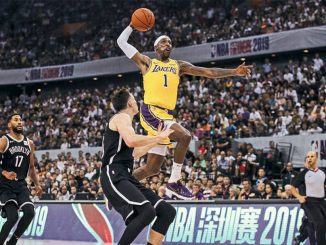
An Oct. 4 tweet from Houston Rockets General Manager Daryl Morey regarding the Hong Kong protests started a series of events that have continued to play out in the mainstream media over the last several weeks. Morey’s tweet expressed his support for U.S. flag-waving, “Trump Please Liberate Hong Kong” demonstrations.

This statement came days before Morey’s Houston Rockets were set to play two exhibition games in China. These games are part of an ongoing exchange between the NBA and Chinese Basketball Association. The exchange between the NBA and China is complex. The NBA is wildly popular in China. Many players have relationships with the Chinese government and various Chinese companies. Some of the biggest NBA stars spend portions of their off-season in China promoting their brands and holding public-relations events for Chinese fans. Previous NBA star Stephon Marbury went as far as to become a permanent resident, after having a successful post-NBA career playing professional ball in China.

The NBA stars who have large followings and strong relationships in China include Rockets’ star James Harden and the Los Angeles Lakers’ LeBron James, widely considered to be the face of the NBA. Both players were in China at the time of Morey’s tweet. Soon after the tweet, Chinese government officials and business people alike denounced the statement and demanded an apology.

Morey’s criticism put the entire series of NBA games in China at risk. It was for this reason that James Harden went in front of the media and publicly apologized to the Chinese people, saying, “We apologize. You know, we love China. We love playing here.” It was soon after this that LeBron commented on the issue, asserting that Morey “wasn’t educated on the situation at hand and he spoke.” 

LeBron went on, “So many people could have been harmed not only financially but physically, emotionally and spiritually.”

Since LeBron’s comments, he has faced criticism from the media and U.S. politicians. These were mostly the same media and politicians who were critical of NFL quarterback Colin Kaepernick when he took a knee during the national anthem to protest racist police brutality.

Strugglelalucha256


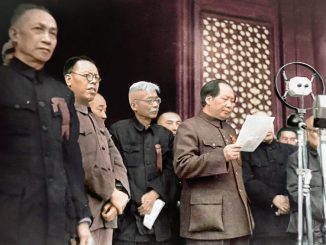
Happy 70th Anniversary People’s Republic of China!

On Oct. 1, some 1.4 billion people in China are celebrating the 70th anniversary of the founding of the People’s Republic. China’s culture spans 5,000 years and, in spite of the 19th and 20th century sabotage and war against its people, especially by British colonialists, followed by economic warfare, covert and overt interference against its sovereignty by U.S. imperialism–repeated today in Hong Kong, utilizing the National Endowment for Democracy and other U.S.-funded, CIA-led entities–its social achievements are some of humanity’s greatest, spanning the disciplines of science, medicine, philosophy and revolution.

Some of the greatest achievements made by the people of China could not have come about if not for a revolution in 1949 that ended imperialist domination over their fate. British colonialism and imperialism since the early 1800s did not bring progress, enlightenment or wealth to China. Instead, it forced the economy to be dependent on opium, drug addiction and imperialist exploitation, with extreme poverty and starvation for the benefit of the British ruling class.

But after the Revolution, things changed. It wasn’t just any revolution, it was a socialist revolution that took control over the vital means of production, the majority of which are still in the hands of the current Chinese government. This meant that decisions would be reflective of the majority, the working class and farmers and their allies living in the country, not monarchs, capitalists or British imperialists, whose only concerns are for profit. This allowed the economy to be planned. And, their plans to wash the filth of imperialism, like hunger, joblessness, illiteracy and drug addiction, off of their backs was one of the greatest achievements in human history.

Eight hundred and fifty million people have been lifted out of poverty in recent decades in what the United Nations acknowledges as a stunning achievement by any standard of social progress.

Like every country in the world suffering from the global capitalist crisis, China’s increased privatization and greater dependence on market reforms create a dangerous situation and contradictions that must be overcome. However, wages of workers in China, who are unionized, increase every year. 

The homelessness, desperation and $4 per hour wages affecting the majority of workers who live in Hong Kong as a result of continued imperialist control, especially over the financial industry, do not exist in mainland China. Many of the demonstrators in Hong Kong, and the U.S.-funded organizations playing their part in the protests against China, are not there to win more rights for workers, but to fight to win back capitalist rule and bring back the good old days of unleashed exploitation. The U.S. is fighting to weaken and eliminate the Communist Party of China for this purpose.

But, the Chinese people today are saying loud and clear that China and its socialist plans for the future are not going anywhere. And, we should all be happy about that because there are two things that are the greatest threats to the existence of life on this planet today – imperialist war and climate change.

The U.S. and its imperialist accomplices have created more poverty and stolen more lives than any other empires in history. In fact, just a few years before China’s Revolution, the U.S. ripped apart children, women, men and anything alive with atomic bombs in two heavily populated cities of civilians: Hiroshima and Nagasaki. This was followed by U.S. wars against Korea, Vietnam, the Philippines and more, and continues to this day in Iraq, Syria, Libya and now threatens Venezuela and Iran.

However, the legacy of China’s Communist Party differs and has kept to its declarations for peace. In 1953, while the U.S. was planning its long-term occupation on the Korean peninsula, China proposed the Five Principles for Peaceful Co-existence as general rules for international relationships. They are mutual respect for sovereignty and territorial integrity; mutual non-aggression; non-interference in each other’s internal affairs; equality and mutual benefit; and peaceful coexistence.

Another reason to celebrate the 70th anniversary and China’s plans for the future is the importance that China is placing on responding to climate change. In spite of the challenges of having to use fossil fuels for its 1.4 billion people, the ongoing reduction in their use is unmatched by any other industrial country. In addition, China continues to meet its commitments and promises made at the Paris Agreements on Climate Change and is due to phase out coal use by 2040. In addition, China allocated another whopping $360 billion on renewable energy sources like solar and wind in 2017, to be spent by 2020. China is already the largest producer of solar panels in the world.

So, for those buying into the latest anti-Communist propaganda manufactured by the U.S. State Department against China, be careful what you wish for. But, don’t worry too much because more than a billion people in China are determined to, that’s right, save the world from the profit driven imperialist powers who remain on the path of war, poverty and environmental suicide.

Happy 70th anniversary People’s Republic of China!

Strugglelalucha256


Washington’s anti-China strategy in Hong Kong

It is impossible to separate the counterrevolutionary colonialist demonstrations in Hong Kong from Washington’s new cold war against the People’s Republic of China (PRC). (See article “The New Cold War Against China,” lowwagecapitalism.com.}

The over two-month-long campaign of demonstrations–which are really for independence from the mainland and aimed at detaching the city from China–are sustained and guided by superpower resources from Washington and London, with an assist from Taiwan’s separatist forces. 

The CIA-run National Endowment for Democracy (NED) and other U.S.-run nongovernmental organizations (NGOs) are in the thick of the demonstrations. U.S. diplomats have met with so-called student leaders as an offer of support. (See the article in Fight Back News, Aug. 19, 2019.)

There are millions of poor workers in Hong Kong. Most of them are in low-paying jobs, including retail, food and drink, estate management, security, cleaning, elder care and courier services, among others.

They live in costly housing because the real estate industry has been dominant under Hong Kong capitalism, as have finance, tourism and other high-paid services. But you don’t see these workers on the streets demanding separation from mainland China. 

Another thing you won’t see is the thousands of demonstrators who came out to defend the Hong Kong police and the Chinese mainland on Aug. 26 and denounce the protesters. “A rally organized by the Great Alliance to Protect Hong Kong, a new umbrella organization, drew tens of thousands of people to a park near the headquarters of China’s military garrison earlier this month.” (New York Times picture caption, Aug. 27, 2019)

In fact, the South China Morning Post reported on Aug. 23, 2019, that several thousand accountants joined the march for “democracy” in Hong Kong recently. The four largest accounting firms in the world, known as the “Big Four” are in Hong Kong. The four firms and their 2018 revenue in U.S. dollars are as follows:

Deloitte, based in New York, made $43.2 billion; PwC (PricewaterhouseCoopers), based in London, earned $41.3 billion; EY (Ernst & Young), based in London, earned $34.8 billion; KPMG (Klynveld Peat Marwick Goerdeler), based in Amstelveen, Netherlands, earned $28.96 billion (Reuters, Aug. 24, 2019).

What you see instead are thousands of middle class anti-China demonstrators who are demanding autonomy for one of the largest financial centers in Asia. Hong Kong became a financial and commercial center under British colonial rule. London ruled Hong Kong for 156 years until it was forced to turn over sovereignty to the mainland in 1997.

According to Wikipedia’s list of banks in Hong Kong, 70 of the100 largest banks in the world are in this tiny city. This includes the largest U.S. and British banks. The largest insurance companies, hotel chains and tourist agencies are there as well.

It is hardly surprising that the imperialist NGOs and think tanks are able to mobilize thousands of professionals to take to the streets to separate from the mainland. And they carry out their protests violently, while the capitalist media complain about the Hong Kong police, who are under siege from the demonstrators. (Struggle-La Lucha, Behind the anti-China Protests in Hong Kong, Aug. 19, 2019

In the meantime, “Australia has emerged as an ideal destination for Hong Kong millionaires who are looking to emigrate from the Chinese semi-autonomous territory reeling from political turmoil.

“A notable rise in applications for the Significant Investor Visa (SIV) program, which grants direct residency to applicants, has been filed with the New South Wales state migration department over the past months, reported Reuters. Interested individuals have to invest at least A$5 million (US$3.4 million) to be eligible for the program.” (Taiwan News, Aug. 23, 2019)

Hong Kong leadership offers dialogue: demonstrators escalate

U.S. imperialism, the CIA, the Pentagon and the State Department want to use the Hong Kong demonstrations to vilify the PRC and socialism. The demonstrators are being as provocative as possible in order to try to draw the People’s Liberation Army (PLA) into the battle. Many demonstrations have gone right up to the PLA garrison in Hong Kong with provocative acts and slogans. 

Washington’s goal is to be able to create a new version of Tiananmen Square and raise a worldwide hue and cry against China, the way they did in 1989. National Security Adviser John Bolton, Secretary of State Mike Pompeo, the CIA and the military want a rerun as they drum up war fever against China. 

Describing a recent demonstration, the Wall Street Journal of Aug. 24 wrote, “Tear gas engulfed the industrial neighborhood of Kwun Tong as protesters were more aggressive, blocking roads, surrounding the local police station and sawing down at least one video-surveillance pole, which protesters said could be used to spy on people. 

“Demonstrators with poles fought face to face with the charging police, knocking some to the ground and sending others scrambling back. Some threw rocks at the police. A small fire bomb exploded amid the melee.“

This attack on the police, who held up signs warning the demonstrators to stop, came shortly after the Hong Kong chief executive, Carrie Lam, offered to enter into dialogue with the protesters. Lam said she “would be open to talking to the community.” In a post on her official Instagram account on Saturday—ahead of the latest violence—she said everyone was tired after months of protests and asked if “we can sit down and talk about it” after a calmer week. (WSJ, Aug. 24, 2019)

In other words, the reactionary forces tried to break up any move by the Hong Kong leadership to calm the situation.

On the day before the attack on the police, there was a demonstration in which the protesters held hands in the streets of Hong Kong. 

“Hong Kong residents on Friday night formed human chains across large parts of the city in … a display that recalled a major anti-Soviet demonstration from 30 years ago. The message was clear today just as it was at the time of the USSR: get free of mainland China.” The demonstration was called the “Hong Kong Way.” (New York TImes, Aug. 23, 2019)

This was a replica of the “Baltic Way” demonstration in 1989 in Latvia, Lithuania and Estonia. It was a demonstration to be free of the Soviet Union. It was undoubtedly engineered by the same imperialist forces that were behind the “Hong Kong Way” demonstrations. 

The Hong Kong Way demonstration, the attack on the police station the following day, the provocations against the PLA garrison in Hong Kong, the ransacking of the legislature, all these are signs of a Washington-London strategy of trying to provoke some type of Chinese intervention which can then be used to vastly escalate political tensions against the PRC. The Chinese Communist Party has reacted with great restraint in the face of these vicious provocations. Instead they have supported the pro-China forces in Hong Kong who don’t want to sell their country to imperialism. 

Posted to lowwagecapitslism.com on Aug. 28, 2019

Strugglelalucha256
https://www.struggle-la-lucha.org/china/page/12/