China pulls itself out of poverty 100 years into its revolution

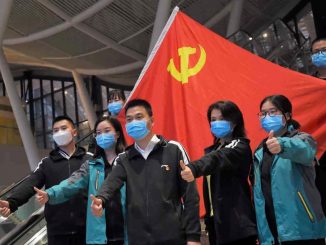
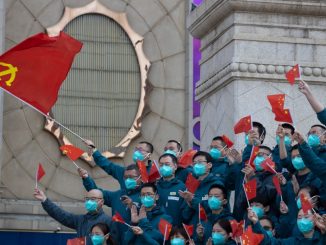
Performers surround a Communist Party flag during a mass gala marking the 100th anniversary of the Communist Party on June 28, 2021, in Beijing.

On February 25, 2021, China’s President Xi Jinping announced that his country of 1.4 billion people had pulled its people out of poverty as it is defined internationally. Since 1981, 853 million Chinese people have lifted themselves out of poverty thanks to large-scale interventions from both the Chinese state and the Communist Party of China (CPC); according to the data of the World Bank, three out of four people worldwide who were lifted out of poverty live in China. “No country has been able to lift hundreds of millions of people out of poverty in such a short time,” Xi said.

When UN Secretary-General António Guterres visited China in September 2019, he gushed over this accomplishment, calling it the “greatest anti-poverty achievement in history.” “You reduced infant and maternal mortality rates, improved nutrition, reduced stunting and halved the proportion of the population without access to safe drinking water and sanitation,” Secretary Guterres said. In 1949, at the time of the Chinese Revolution, the infant mortality rate in China was 200 per 1,000 live births; this declined to fewer than 50 by 1980. A World Bank study from 1988 noted, “Much of China’s success in improving the health of its people can be attributed to the health policies and the national health service delivery system.” This is the historical context for Secretary Guterres’ 2019 comment; in other words, the Chinese state institutions—products of the revolution led by the CPC—improved the social conditions of life.

Before the Revolution

In 1949, China was one of the world’s poorest countries. Only 10 countries had a lower per capita GDP than China. Chairman Mao Zedong’s famous words at the inauguration of the People’s Republic of China—“The Chinese people have stood up”—is a reflection of a century of humiliations that produced terrible poverty in the country.

The degree of this national suffering may be seen in the fact that between 1840 and 1949 almost 100 million Chinese people died in wars, which directly resulted from foreign intervention, or were victims of civil wars and famines related to those interventions. China had suffered the longest Second World War, from 1937 to 1945 (with a civil war following that lasted until 1949); the death toll was at least 14 million (as documented by Rana Mitter in his book Forgotten Ally: China’s World War II, 1937-1945). From the Opium Wars beginning in 1839 to the Japanese invasion in 1931, China struggled to establish its sovereignty and its future.

It was the terrible burden of this past that brought together a range of radicals to establish the CPC in July 1921 in Shanghai. The small group of 13—including Mao—met in Shanghai’s French Concession and then on a tourist boat on Nanhu Lake after the foreign police came for them on the information of a spy. The principal task of the CPC was to organize and guide the working class. By May Day 1924, 100,000 workers marched in Shanghai, while 200,000 workers marched in Canton. “The time is past when workers are only cannon fodder for the bosses,” the workers wrote in a leaflet. The CPC threw itself into these struggles, growing through setbacks—including the Shanghai Massacre of 1927; leadership by the CPC in the protracted, anti-imperialist war against Japan led it to eventual victory in 1949.

Phases of socialist construction

The Chinese Revolution had to confront a broken state, a destroyed economy, and a society in deep turmoil. In 1949, China’s people lived three years less than the world average. They were less well-educated and deeply unhealthy. By 1978, they lived five years longer than the world average. Literacy rates had risen, and health care data showed a marked improvement. As China in 1978 was 22 percent of the world’s population, never in human history had such an immense step forward taken place.

From 1978, with the introduction of “reform and opening up,” China achieved the fastest economic growth ever calculated by a major country in recorded history. From 1978 to 2020, China’s annual average GDP growth was 9.2 percent. Since 1978, China’s household consumption has increased by 1,800 percent, twice that of any major country. This means that everyday life has improved markedly in China. China’s literacy rate is now 97.33 percent, up from 95.92 percent in 2010, far above the literacy rate of 20 percent in 1949.

By 2025, China will become a “high-income” economy by World Bank international standards, according to Justin Lin Yifu (a standing committee member of the Chinese People’s Political Consultative Conference National Committee, and dean and professor at the Institute of New Structural Economics of Peking University). That is, in about 75 years, a single lifetime, China will have gone from almost the world’s poorest country to a high-income economy—with all the enormous improvement in human living standards, life expectancy, education, culture, and numerous other dimensions of human welfare this results in.

With the foundation of the CPC 100 years ago by a handful of people, the Chinese people found a leadership that could deliver them from a struggle that dates back to 1839; now, the CPC will play a decisive role in deciding the fate not only of China but of the world. This historical context is too often lost when Western media and politicians play down China’s socioeconomic victories or imply they came out of nowhere. China’s people have fought for this outcome for centuries.

This article was produced by Globetrotter.

Vijay Prashad is an Indian historian, editor and journalist. He is a writing fellow and chief correspondent at Globetrotter. He is the chief editor of LeftWord Books and the director of Tricontinental: Institute for Social Research. He is a senior non-resident fellow at Chongyang Institute for Financial Studies, Renmin University of China. He has written more than 20 books, including The Darker Nations and The Poorer Nations. His latest book is Washington Bullets, with an introduction by Evo Morales Ayma.

John Ross is a senior fellow at Chongyang Institute for Financial Studies, Renmin University of China. His writing on the Chinese and U.S. economies and geopolitics has been published widely online, and he is the author of two books published in China, Don’t Misunderstand China’s Economy and The Great Chess Game. His most recent book is China’s Great Road: Lessons for Marxist Theory and Socialist Practices (1804 Books, 2021). He was previously director of economic policy for the mayor of London.

Strugglelalucha256


Happy birthday to China’s Communist Party!

The Chinese Communist Party was born a century ago on July 1, 1921. Several dozen courageous revolutionaries came to Shanghai to start building a party that led China out of its misery.

At that time, China was being picked apart by imperialist powers, including the United States. Foreign gunboats prowled along the mighty Yangtze River.

Shanghai itself was divided into foreign “concessions” which were occupation zones. In one of them a whites-only club displayed a Jim Crow sign saying “Chinese and dogs not allowed.”

The Chinese Revolution swept away all that filth. As Mao Zedong declared in founding the People’s Republic  on Oct. 1, 1949,  “China has stood up!”

Lenin led the 1917 Bolshevik Revolution that helped unlock the door for workers and oppressed people everywhere. The socialist revolutions in East Asia — China, Korea, Laos and Vietnam — smashed through it.

The transformation of China since 1949 has been stunning. China’s women stepped forward with unbound feet. Life expectancy has doubled.

Illiteracy has been virtually wiped out, while over 30 million Chinese students are attending college.

China has built more miles of high-speed rail than the rest of the world combined. Over 900 million metric tons of steel are made in China, over half of the world’s production.

It’s taken New York City 90 years to open three stations on the unfinished Second Avenue subway. Just between 2009 and 2019, China opened 21 new subway systems

While capitalism is cooking the earth, socialist China has reforested an area of 123,000 square miles, twice the size of New England. 

None of this progress is to the liking of the billionaires and banksters who run the United States. Even before 1776, Massachusetts shipowners dreamed of China’s “unlimited market.”

John Jacob Astor smuggled opium to China. His profits helped make him the biggest slumlord in the Americas.

Another big drug lord was Warren Delano, whose opium profits established the family fortune and helped put his grandson Franklin Delano Roosevelt in the White House.

The pivot and the lies

Thirty years ago, the overthrow of the Soviet Union and the socialist countries in Eastern Europe was a terrible defeat for every poor person. The next target of the Pentagon and CIA was the People’s Republic of China.

The White House proclaimed a “pivot to Asia,” which meant aiming their bombers and nukes at China. They keep China’s Taiwan province from being restored to the People’s Republic. The U.S. Navy continues to throttle the Pacific Ocean like it’s Lake Michigan. 

U.S. generals have never forgiven China for helping to defeat them in the Korean War. Chinese volunteers died alongside their Korean comrades, including Mao Anying, a son of Mao Zedong.

Lies are another weapon that Wall Street and its media use against China. While the CIA’s “French Connection” was pouring heroin into New York City, Federal Bureau of Narcotics Commissioner Harry Anslinger was claiming China was responsible for the dope trade.

Sixty years later, the capitalist media is peddling another big lie. They claim that China was responsible for the COVID-19 pandemic. With no evidence, their media claims that the coronavirus somehow leaked from a Wuhan lab.

The millions of people in the U.S. who are hungry, jobless or facing eviction or foreclosures, don’t need lies. The $700-billion-plus Pentagon budget is stolen from them.

The 2.2 million people in U.S. prisons — a quarter of the world’s total — need jobs and freedom, not falsehoods about Hong Kong and Xinjiang.

When Malcolm X was in prison, he was thrilled to read about the Chinese Revolution. Mao Zedong met with Mabel and Robert Williams, who led armed self-defense against the Ku Klux Klan in Monroe, N.C.

China today is helping Cuba, Iran, Venezuela and Zimbabwe, whose economies have been strangled by the U.S. and Europe.

Every progressive person should reject the slander against the People’s Republic of China. Hands off China!

Happy Birthday to the Chinese Communist Party!

Strugglelalucha256


Were new attacks on China created in a Trump lab?

May 29 — This week the level of attacks on China regarding its success against COVID-19 has been elevated to a fever pitch. The Biden administration has all the major U.S. media in tow. 

A pack of Cold War-style lies targeting a laboratory in Wuhan, China, has been picked up and made “credible” by the Wall Street Journal, the New York Times, National Public Radio and others. Headlines across the internet refer to a previously discredited theory conjured up by the Trump administration as having “gone mainstream.” 

When viewed in the context of the growing U.S. military presence near China’s territorial waters, the ratcheting up of propaganda is ominous.

Until recently, the anti-China slanders about the Wuhan lab and other lies and attacks have been kept alive by an exclusively right-wing cast of characters led by Trump’s Secretary of State Mike Pompeo and including the likes of Senator Tom Cotton of Arkansas — who had also called for sending in troops to put down and “quarter” [kill] Black Lives Matter protesters — and others.

China, with four times the population of the U.S., held its death toll from the coronavirus to less than 5,000 through a “people’s war” against the virus that showcased the superiority of socialist planning over the anarchy of capitalism. Trump and his team used attacks on China to try to distract from the fact that his administration allowed the pandemic to take hundreds of thousands of lives in the U.S.

The conspiratorial “lab leak” theory that became a central part of Trump’s narrative has now been revived with the support of Joe Biden’s White House. The theory goes that the origin of the virus that causes COVID-19 was not natural but created by researchers in the Wuhan Institute for Virology (WIV) laboratory and then leaked in an accident. In some versions it was unleashed in a purposeful germ warfare attack.

No one in Wuhan lab had COVID

All of the recent hype is anchored on a “fact sheet” penned by Trump’s vile neo-Cold Warrior, former Secretary of State Pompeo. Pompeo referenced U.S. intelligence “information” that claimed WIV staff were sickened and hospitalized in November 2019, a month before the earliest known case of COVID-19. 

The story isn’t substantiated in any way. All of the staff at the Wuhan Institute were tested and there was no presence of COVID antibodies in anyone. This simple fact shows the lab leak hypothesis to be a sham.

There have been two delegations sent to Wuhan by the World Health Organization (WHO) to research the origin of the virus. The first was early in the pandemic and the second was in March of this year. Both concluded that the virus likely jumped from bats to an intermediary animal and then to humans, and that the lab leak theory was “highly unlikely.”

During the Trump administration, major media had to some extent been dismissive of the slanderous attacks and had treated its propagators as peddlers of a precarious conspiracy theory. But the tone began to change as Biden’s new Secretary of State Antony Blinken signaled that the diplomatic assaults on China would continue unchanged from the previous Trump administration. 

This week the floodgates opened, and it was an all-out media assault on China. On May 27, Biden ordered further “investigation” into the origin of the virus — not by scientists but by the same spy agencies that fabricated the infamous “weapons of mass destruction” story used to  justify the horrible U.S. war against Iraq in the George W. Bush era.

Wuhan lab leading virus research globally

The WIV lab has been a global leader in research on coronaviruses. Since the first SARS coronavirus outbreak in 2003, it has collected hundreds of viral samples from bats to further the study of how viruses mutate and what mutations may create a higher possibility of transfer to humans. The hope is that the research could help in the development of vaccines and allow scientists to gain an edge in fighting future pandemics. 

The lead scientist at the WIV is Zhengli Shi, famously known as the Bat Woman for her devotion to this field of study.

The New York Times’ contribution to the slander includes an exceptionally long article written by its disgraced former science reporter Nicholas Wade. Wade was the subject of an anti-racist outcry over his 2014 book that drew on the white-supremacist Bell Curve theory. That hasn’t stopped the Times from trotting him out from time to time, and they tapped him to help push the current attacks on China.

Wade accuses National Institutes of Health (NIH) Director Anthony Fauci of helping China in a supposed coverup of a lab leak. He hangs his hat on the fact that the intermediate animal that is crucial to the natural origin hypothesis hasn’t been found, citing the quick success in doing so only in the SARS and MERS outbreaks, even though it took much longer to trace that pathway and identify the intermediary animal in many other viral outbreaks. In his claim that WIV researchers created the virus, he attributes scientific abilities to the researchers that just don’t exist.

The journal Science published a letter by a group of 18 scientists also trying to give credibility to the lab leak theory. All of the scientists are from imperialist countries or other countries that have already been taking part in the U.S.-led hostility toward China.

The Chinese Embassy in Washington posted a response to Biden’s call for investigation that said: “Some political forces have been fixated on political manipulation and the blame game.” 

Chinese Foreign Ministry spokesperson Zhao Lijian has demanded an investigation into the work conducted at the U.S. biolab in Ft. Detrick, Md., which is surrounded by secrecy. Zhao said that Biden’s order showed that the U.S. “does not care about facts and truth, nor is it interested in serious scientific origin tracing.”

Strugglelalucha256


The U.S.’s New Cold War in China’s Xinjiang region

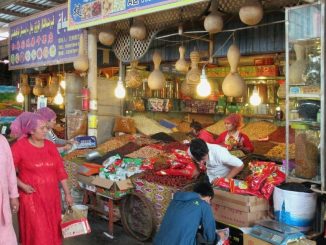
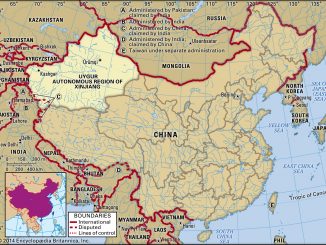
“Kashgar is a key location for the land and sea interface of the Belt and Road, connecting not only westward to West Asia, Europe, the Red Sea, and Africa, but also southward to the Indian Ocean through the port of Gwadar,” said Professor Li Bo of the China Research Institute, Fudan University. It is, he told us, “a core area of the Belt and Road strategy.” Kashgar, one of the westernmost cities in China, is the main urban area of the southern Xinjiang Uyghur Autonomous Region (XUAR). Traders from across Asia have assembled at its Sunday bazaar for 2,000 years.

More than 1,000 kilometers north of Kashgar is the town of Nur-Sultan, previously known as Astana, the capital of Kazakhstan. Here, in 2013, Chinese President Xi Jinping spoke about the need for a “Silk Road Economic Belt.” This Belt would include trade deals and transportation networks, cultural interactions and political connections. The project would become the One Belt, One Road initiative, which is now known as the Belt and Road Initiative (BRI). China’s National Development and Reform Commission released a report in March 2015 that planned for six economic corridors, which would be funded by more than $155 billion from the Asian Infrastructure Investment Bank and the Silk Road Fund. Since then, many of these corridors, which run from China into Central Asia and also down through Pakistan and Afghanistan, have been completed. In December 2020, a goods train traveled from Istanbul, Turkey, to Xi’an, China, covering 8,693 kilometers of this new Silk Road. The train carried Turkish appliances, which were meant for the Chinese market.

Accusations by the United States government and its allies about genocide and forced labor in Xinjiang have brought China’s westernmost province into the gaze of the international media. This approach toward Xinjiang defines the information war prosecuted by Washington. In our conversations with Professor Li Bo and Professor Wang Yiwei, director of the Institute of International Affairs at Renmin University, as well as intellectuals from Kashgar and Ürümqi (Xinjiang’s capital), we developed a storyline that includes the dynamics of Xinjiang’s social development, the threats of extremism, and the enfolding of its problems into the wider hybrid war unleashed against China.

Develop the West

“The economy of Xinjiang is not as good as that of the eastern coast [of China],” Professor Wang Yiwei told us. This reality was understood 20 years ago when the Chinese government launched the Western China Development Program (Xībù Dàkāifā) in 1999. In 2010, Kashgar was designated as a special economic zone with the intention of drawing investment into southern Xinjiang to tackle high poverty rates and to shape the province into a gateway to Central Asia and Europe.

At the 18th National Congress of the Communist Party of China in 2012, the delegates made Xinjiang’s development a priority. Construction of infrastructure, development of energy sources, linkage of Xinjiang’s economy with the BRI, and the development of talent emerged as the main avenues for the province, Professor Li told us. By 2019, Xinjiang’s government announced that between 2014 and 2018, 2.3 million people had been lifted out of poverty and 1.9 million of them lived in southern Xinjiang, where the Uyghur population is concentrated. During the pandemic, the Chinese government made an effort to find a way to improve life for farmers and herdsmen in the Taklamakan Desert of southern Xinjiang. This has helped to continue a pattern of lifting most of the 6.1 percent of the province’s population who were experiencing absolute poverty in 2018 out of that state (the poverty level decreased to 1.2 percent of Xinjiang’s population in 2019 and continues to trend downward).

“When I visited Xinjiang,” Professor Li told us, “I was struck by the fact that the province is involved in a great struggle. This struggle is manifested in several ways: in the development of social and economic life, in the integration of minority ethnic groups into the broad social life of China, and in the difficult task of fighting terrorism.”

Washington’s Jihad

In August 2013, the 74-year-old imam of a mosque in Turpan, 200 kilometers east of Ürümqi, was brutally killed by extremists. These extremists—likely members of the East Turkestan Islamic Movement (ETIM) or the Turkistan Islamic Party (TIP)—killed Abdurehim Damaolla because he was part of the Islamic Association, which worked with China’s government to combat extremism. Within Uyghur society, a gulf opened up between the vast majority of the people who opposed radicalization along religious lines and those who joined the ETIM and the TIP.

The roots of the ETIM and the TIP go back to the 1960s and 1970s when Saudi Arabia’s World Muslim League began to proselytize a harsh version of Islam to counter communism. Those drawn to these views left Saudi schools—many in Pakistan—to join Washington’s jihad in Afghanistan in the 1980s. There, the Uyghur extremists joined other disaffected Central Asian extremists to form various outfits that pledged jihad against communism.

When the USSR collapsed, these groups sought to use violence to advance their agenda against the post-communist states in Central Asia, the first among them all was the Islamic Movement of Uzbekistan (IMU), which was affiliated with Al Qaeda. Uyghur militants joined the Islamic Renaissance Party of Tajikistan, the IMU, and the global platform known as Hizb-ut Tahrir (Party of Liberation). Extremists from Xinjiang cut their teeth while fighting for jihad in Afghanistan, Syria, Libya, and in the Central Asian states.

Xinjiang first saw a major violent attack by these militants in the 1990s in Ürümqi and in southern Xinjiang’s smaller towns. A major riot on July 5, 2009, in Ürümqi led to the death of almost 200 people. Since then, there have been many smaller attacks. “Uneven economic development,” said Professor Wang, “is the basis for terrorism and extremist religious ideology.”

Shohrat Zakir, who is the chairman of the government of XUAR, concurs, and notes that his government has put forward an agenda to “root out terrorism.” There is no point in merely treating this like a war—such as the U.S. did in Afghanistan. This is not a war that can be won by violence, said Zakir, but it must be won by education and by economic development. Asked about vocational education, Zakir explained, “Some residents there [in Xinjiang] have a limited command of the country’s common language and a limited sense and knowledge of the law. They often have difficulties in finding employment due to limited vocational skills. This has led to a low material-basis for residents to live and work there, making them vulnerable to the instigation and coercion of terrorism and extremism. There is still a long way to go for southern Xinjiang to eradicate the environment and soil of terrorism and religious extremism.”

New Cold War

In 2011, then U.S. Secretary of State Hillary Clinton proposed a New Silk Road Initiative. The idea was for the U.S. to use Afghanistan as the core of a North-South axis that would break the Central Asian states away from their links to Russia and China; this axis would orient these countries to South Asia and then to the United States. Failure to settle the problems of Afghanistan led the U.S. to abandon that project. Instead, it has turned its focus to undermining China’s BRI.

The information war now conducted against China centers on Xinjiang. Once again, the U.S. uses longstanding problems — such as the rise of extremism in Central Asia (fueled to some extent by the U.S. since the 1980s) — to create problems for its adversaries. Officials in China tell us that the government has long ignored the economic development of Xinjiang and has not been able to fully handle the various grievances of the minority ethnic groups. But the answer to these problems is not to deliver Xinjiang to disaffected affiliates of Washington’s jihads. As with Syria and Libya, Washington once more plays a reckless game with Islamic extremism.

This article was produced by Globetrotter.

Vijay Prashad is an Indian historian, editor and journalist. He is a writing fellow and chief correspondent at Globetrotter. He is the chief editor of LeftWord Books and the director of Tricontinental: Institute for Social Research. He is a senior non-resident fellow at Chongyang Institute for Financial Studies, Renmin University of China. He has written more than 20 books, including The Darker Nations and The Poorer Nations. His latest book is Washington Bullets, with an introduction by Evo Morales Ayma.

Jie Xiong is a Chinese technologist, translator and editor. He has participated in the digitization process of multiple leading enterprises in China. He is a founder of Shanghai Maku Cultural Communications Ltd., a company that introduces China to Global South readers. He is a senior researcher at the Sichuan Institute for High Quality Development. He has written and translated more than 10 books. His latest translation is Cybernetic Revolutionaries.

Strugglelalucha256


China-Iran agreement to bust U.S. economic sanctions


The People’s Republic of China and Iran have announced an agreement that is a direct challenge to the punishing U.S. sanctions against Iran and strikes back against the economic war on China. 

China will invest $400 billion in Iran over 25 years for infrastructure and other purposes. Iran will supply China with oil for its growing economy. Both countries have been targeted by U.S. economic sanctions, and this is an agreement to forcefully bust the sanctions.

The Biden White House has carried forward a reactionary and punishing “foreign policy” from previous administrations. Sanctions that cause starvation and deprivation in targeted countries have become a favored weapon for U.S. imperialism, and were responsible for more than 1 million deaths in Iraq after the 1991 Gulf War. 

Slander campaigns and gunboat diplomacy have become stock in trade for the White House and the Pentagon. Now Iran and China are drawing their own line in the sand.

The sanctions against Iran were increased when the Trump administration pulled out of a deal struck between the U.S. and Iran during the Obama administration. Iran had been developing a nuclear energy program to alleviate the domestic burden on petroleum reserves and free up petroleum for export. As part of its ongoing aggression and slander, the U.S. government accused Iran of building a nuclear weapons program. 

The Obama administration negotiated a deal with Iran that it said was to limit the processing of uranium to levels that couldn’t be used for nuclear weapons. In reality, the agreement also limited low-level processing of uranium. What the U.S. was targeting was in fact Iran’s attempt to ease the economic suffering caused by the sanctions by selling petroleum on the world market. 

Sanctions mean hunger, shortages

In return for these nuclear limitations, Washington was supposed to ease the sanctions. The additional sanctions imposed when Trump broke the agreement are far worse than anything in the 40 years of U.S. animosity toward the Iranian Revolution, and are actually causing hunger and shortages of medicine and other vital supplies. 

The Biden administration says that it wants to reinstate the nuclear agreement, but is insisting that Iran comply with all the restrictions first. In the meantime, none of the 240 sanctions imposed by Trump have been reversed. Iran, with China’s support, is demanding that the sanctions be eased first, to finally get some relief for the people.

The 1979 Iranian Revolution threw out the U.S.-backed monarch, Shah Mohammad Reza Pahlavi. The shah was a butcher whose feared Savak agents terrorized the Iranian people and murdered tens of thousands during the 25 years that the U.S. supported him. 

The shah was installed via one of the earliest major CIA actions in 1953. The U.S. orchestrated the overthrow of President Mohammad Mossadegh, a popular and progressive leader who had nationalized U.S. and British oilfields.

The 1979 revolution

The 1979 revolution in Iran is still a thorn in the side of U.S. imperialism. Iran has remained at the core of anti-imperialist resistance in West Asia and North Africa. For more than four decades, Iran has rejected every carrot offered or stick wielded by the U.S. or other imperialist countries. 

Iran is aligned with the Palestinian struggle against Israeli apartheid. It has provided military aid and political support as the people of Yemen continue to fight back against a brutal war by Saudi Arabia that has blocked food and caused widespread starvation. Saudi Arabia is armed with advanced U.S. weapons. 

Iran also stood by the Syrian people as the U.S., its allies and mercenaries attempted to throw out Syrian President Bashar al-Assad. Iran’s alliance with the Hezbollah movement in Lebanon has also been a crucial part of Syria’s resistance.

U.S. murdered two leaders

U.S. animosity reached a peak in January 2020 when Trump ordered a drone strike in Baghdad that killed General Qassem Soleimani of Iran’s Islamic Revolutionary Guard Corps (IRGC). Soleimani was recognized as the top military leader of Iran’s anti-imperialist struggle in the region. The strike also killed Abu Mahdi Muhandis, deputy chief of the Popular Mobilization Units (PMU), a group of anti-imperialist militias in Iraq.

People’s China, though in a much stronger position relative to U.S. imperialism than Iran, is also increasingly a target of imperialist threats. 

As part of the “Pivot to Asia” that began under the Obama administration and has continued since, imperialist strategists have militarily threatened and sought to isolate China in every way possible. U.S. warships steam around China as a matter of routine. 

But when China asserted its right by way of international maritime law to defend against ships entering its territorial waters, Trump’s secretary of state, the vile Mike Pompeo, cried bloody murder, accusing China of breaking international law. 

The U.S. has forged an alliance called the Quad, consisting of India, the United States, Japan and Australia, with the sole purpose of isolating and attacking China economically, diplomatically and — in the hopes and dreams of imperialist strategists — militarily. 

The South China Sea is about 8,000 miles from U.S. territorial waters. Imagine if China’s warships were in the Gulf of Mexico!

Biden continues Trump’s aggression

Biden’s administration has continued the campaign of aggression and threats against China in its entirety. Since the earthshaking 1949 Chinese Revolution, under the leadership of the Communist Party, China has lifted more than 800 million people out of deep poverty, and in recent decades has become a global industrial powerhouse. 

Moreover, China’s scientific achievements in many areas have surpassed the Western capitalist powers. China’s great success in containing the deadly COVID-19 virus demonstrated the superiority of socialist planning to the entire world. 

Not only is it a rival for the giant capitalist corporations that Biden answers to, but China is also an example of what socialism can accomplish as capitalism languishes in crisis after crisis. This double threat is what underlies the hostility, aggression and slanders that emanate from every succeeding U.S. administration.

The significance of the growing relationship between Iran and China can’t be overstated. More than a trade deal, it reflects the anti-imperialist defiance of millions and millions of people. 

Iranian and Chinese leaders know well that the reaction of U.S. imperialism may be dangerous. The U.S. has seized oil tankers in the past to try to enforce the terrible sanctions. No one can predict how far the U.S. will go to continue the pressure on Iran and China. 

But the two countries have confidence that together they can defend their people and break the back of the sanctions regime. Anti-imperialist supporters around the world must be on the alert against U.S. aggression, and ready to defend China and Iran.

Strugglelalucha256


U.S.-Japan statement threatens China with nuclear weapons

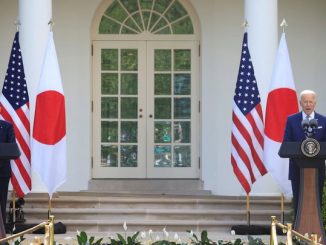
On April 16, U.S. President Joe Biden and Japanese Prime Minister Yoshihide Suga, the first foreign leader to visit the Biden White House, issued a joint statement lashing out at China.

The statement, which covers a range of issues, includes the following: “We also recognize the importance of deterrence to maintain peace and stability in the region. We oppose any unilateral attempts to change the status quo in the East China Sea. We reiterated our objections to China’s unlawful maritime claims and activities in the South China Sea.” 

On Taiwan specifically, the statement adds, “We underscore the importance of peace and stability across the Taiwan Strait and encourage the peaceful resolution of cross-Strait issues.”

What caught the most attention, though, was the statement’s assertion: “The United States restated its unwavering support for Japan’s defense under the U.S.-Japan Treaty of Mutual Cooperation and Security, using its full range of capabilities, including nuclear.”

The statement continues: “Each Party recognizes that an armed attack against either Party in the territories under the administration of Japan would be dangerous to its own peace and safety and declares that it would act to meet the common danger in accordance with its constitutional provisions and processes.” This would apply to Japan’s claim to the Diaoyu Islands in the East China Sea. 

Biden and Suga pledged to intensify military cooperation “across all domains, including cyber and space, and to bolster extended deterrence.”

At the press conference, Biden said: “Prime Minister Suga and I affirmed our ironclad support for the U.S./Japanese Alliance, and for our shared security. We [are] committed to working together to take on the challenges from China and issues like the East China Sea, the South China Sea, as well as North Korea.” 

Suga said: “We also had serious talks on China’s influence over the peace and prosperity of the Indo-Pacific and the world at large. We agreed to oppose any attempts to change the status quo by force or coercion in the East and South China Seas and intimidation of others in the region.”

China’s Global Times responded with an editorial statement:

“U.S. President Joe Biden and visiting Japanese Prime Minister Yoshihide Suga on Friday issued a joint statement which mainly focused on dealing with China. The statement talked a lot about the importance of the U.S.-Japan alliance, an alliance being touted as a ‘U.S.-Japan global partnership for a new era.’ In the statement, the two countries pledge to work together to resist ‘challenges to the free and open rules-based international order.’ The statement outlined the situation in the Indo-Pacific region, accusing China of conducting ‘economic and other forms of coercion’ in the region. It also mentioned the Taiwan question — the first time since 1969 American and Japanese top leaders have done so in their joint statement.  

“‘An ocean separates our countries, but commitments to universal values and common principles, including freedom, democracy, human rights, the rule of law, international law, multilateralism, and a free and fair economic order, unite us,’ said part of the statement. But this sentimental rhetoric is hypocritical. U.S.-Japan ties are a kind of relationship where a victorious country of World War II dominates a defeated country, Japan. There is a strong ‘master-servant’ feature in this relationship in terms of diplomacy. The joint statement has strengthened the compulsive dominance the U.S.’s extreme China policy has on Japan’s diplomacy, while Japan has actively and cautiously catered to it. 

“Japan has become the country in Asia that follows the U.S. policy of containing China most closely. There are two reasons for this: First, as mentioned above, the U.S. has so far maintained its military occupation of Japan and it can be said that Japan’s diplomacy is only at a ‘semi-sovereign’ level. It’s unlikely for Japan to contradict the U.S. 

“Second, Japan is the Asian country that most wants to contain China. The biggest ‘shared value’ between the U.S. and Japan is actually the jealousy and hatred they both have against China’s strong development momentum. The U.S.’s hegemonic thinking can’t accept its status being matched by China, while Japan can’t accept becoming a ‘second-class country’ compared to China, again. 

“Has Japan forgotten how many times it inflicted devastation on China? Has China ever truly harmed Japan and can Japan cite an example? The tiny Diaoyu Islands are just a territorial dispute between China and Japan, and in Asia there are many similar disputes. But Japan takes the dispute as a strategic-level issue and hypes it up every day. What’s the point of it?

“The U.S.-Japan alliance could evolve into an axis that can bring fatal disruption to Asia-Pacific peace, just like the Germany-Italy-Japan axis alliance before and during WWII. The core intention of the U.S. is to maintain its hegemony and contain China’s development through violating international laws and rules. The arbitrary acts of the U.S. could eventually end the peace in Asia-Pacific. And Japan is positioning itself as the top Asian accomplice of the U.S.’s vicious policy.

“Washington and Tokyo want to build the Quad mechanism, comprising Japan, the U.S., India and Australia, into an expanded and upgraded U.S.-Japan alliance, and draw more countries in to jointly confront China. They trumpeted ‘shared values,’ but the world is supposed to be diverse. The most dangerous thing is confrontation, group-based confrontation in particular. The U.S. and Japan are tearing the so-called ‘Indo-Pacific’ apart at the cost of eroding and destroying cooperation. They are attempting to make confrontation the main theme of the entire region. 

“They always emphasized ‘rules-based,’ but the rules should refer to those made by the U.N., rather than those defined by the U.S. and Japan. The U.S. has willfully wielded the stick of trade war against China, and cracked down on Chinese high-tech enterprises by cutting off the supply of key technology products. Are these actions in line with the rules? The U.S. is enticing Japan to establish supply chains that exclude China. But does this comply with rules? Besides, the U.S. and the West arbitrarily interfere in internal affairs of other countries; is this encouraged by the U.N. Charter? 

“Japan once met China halfway in the past few years, which led China-Japan relations to return to the right track. But now, it has abruptly changed course and become a part of the U.S. containment strategy against China. This has ruined the momentum of improvement in China-Japan relations. It’s not only a result of the U.S.’s pressure, but it’s also caused by Japan’s expanding strategic selfishness. Japan is too short-sighted; it formed an alliance with Germany and Italy before WWII and is now singing a chorus with the U.S.’s radical line. Japan hasn’t learned its lessons. It is, instead, proactively creating and sinking into a vortex of confrontation.   

“Finally, we advise Japan to stay away from the Taiwan question. It may play diplomatic tricks in other fields, but if it gets involved in the Taiwan question, it will draw the fire upon itself. The deeper it is embroiled, the bigger the price it will pay.”

Strugglelalucha256


Why Xinjiang is emerging as the epicenter of the U.S. cold war on China

On March 22, 2021, U.S. Secretary of State Antony Blinken authorized sanctions against Wang Junzheng, the secretary of the Chinese Communist Party Committee of the Xinjiang Production and Construction Corps (XPCC), and Chen Mingguo, director of the Xinjiang Public Security Bureau (XPSB). These sanctions, Blinken said, have been put in place against Wang Junzheng and Chen Mingguo because they are accused of being party to “genocide and crimes against humanity in Xinjiang.” The U.S. Treasury Department followed suit with its own sanctions.

Both Wang Junzheng and Chen Mingguo responded by condemning these sanctions that were not only imposed by the U.S. but also by Canada, the UK and the EU. Wang Junzheng said that the sanctions “are a gross slander,” while Chen Mingguo said that he was “very proud of being sanctioned by these countries.”

The United States Pivots to Asia

In October 2011, then U.S. Secretary of State Hillary Clinton had announced a “pivot to Asia,” with China at the center of the new alignment. While Clinton had said on numerous occasions—including in Hawaii in November 2011—that the administration of former U.S. President Barack Obama wanted to develop “a positive and cooperative relationship with China,” the U.S. military buildup along Asia’s coastline told a different story. The 2010 U.S. Quadrennial Defense Review noted “China’s growing presence and influence in regional and global economic and security affairs” and called it “one of the most consequential aspects of the evolving strategic landscape.” In 2016, U.S. Navy Admiral Harry Harris, head of the Pacific Command, had said that the United States was ready to “confront China,” a statement given strength by the U.S. military buildup around China.

The Trump and Biden administrations have largely followed the “pivot to Asia” policy, with a special emphasis on China. The United States has been struggling to keep up with China’s rapid scientific and technological advancements and has few intellectual or industrial tools in place to compete. This is the reason why it has tried to stall China’s advances using diplomatic and political power, and through information warfare; these elements comprise what is called a “hybrid war.”

Focus on Xinjiang: Information Warfare

Prior to a March 2019 event co-hosted by the U.S. Mission to International Organizations in Geneva, most people in countries like the United States were largely unaware of the existence of the Xinjiang region in China, let alone of the 13 million Uyghur people (one of China’s 55 recognized ethnic minorities). Given that the Uyghurs are the demographic majority in this westernmost province of China, the official name of the administrative unit is the Xinjiang Uyghur Autonomous Region.

The March 2019 event featured Adrian Zenz, a German researcher and a senior fellow in China studies at the Victims of Communism Memorial Foundation, an organization founded in 1993 by the U.S. government to promote anti-communist views. In April 2020, this foundation—against all evidenceaccused China of being responsible for the global deaths resulting due to the spread of COVID-19. Zenz is also associated with the conservative defense policy think tank the Jamestown Foundationfounded by William Geimer, who was close to the Reagan administration.

Zenz and Ethan Gutmann, another researcher at the Victims of Communism Memorial Foundation, would continue to repeat their conclusions regarding the genocide in Xinjiang to the U.S. Congress and in a range of mainstream publications. Hosted by the BBC and Democracy Now, Zenz provided what appeared to be documentation of atrocities meted out by the “Chinese authorities” against the Uyghur population. Zenz and Gutmann would be joined by organizations funded by Western governments but which—as NGOs—pose as independent research and advocacy groups (such as the Global Center for the Responsibility to Protect and the Uyghur Human Rights Project; the former is funded by Western governments and the latter by the U.S. government’s National Endowment for Democracy).

In June 2020, then U.S. Secretary of State Mike Pompeo attacked the Chinese government, basing his statements on Xinjiang on the “German researcher Adrian Zenz’s shocking revelations.” Zenz, who is a U.S. government-funded researcher from the intelligence-connected Jamestown Foundation, provides a set of scientifically dubious and politically charged papers, which are then used as fact by the U.S. government in its information war against China. Anyone raising questions about Zenz’s claims is, meanwhile, marginalized as a conspiracy theorist.

Diplomatic and economic warfare

The U.S. government’s information warfare against China has produced the “fact” that there is genocide in Xinjiang. Once this has been established, it helps develop diplomatic and economic warfare.

On March 22, 2021, the same day as the U.S. sanctions, the Council of the European Union unilaterally imposed asset freezes and travel bans on four Chinese government officials, including Wang Junzheng and Chen Mingguo as well as Wang Mingshan and Zhu Hailun. The United Kingdom and Canada also joined in this venture that day. It appeared to be a coordinated diplomatic assault on China in order to portray China as a country violating human rights. This assault came soon after China had achieved a major human rights goal, lifting 850 million people from absolute poverty. The U.S. government and its media outlets tried to challenge this remarkable human rights achievement.

Trump had pushed a trade war with China as soon as he came into office in January 2017; his policy framework remains in place under Biden. To draw together the trade war and the Xinjiang information war, in mid-December 2020, Adrian Zenz and the Newlines Institute for Strategy and Policy (formerly the Center for Global Policy) released an intelligence brief on “coercive labor in Xinjiang.” The claims in this briefing—building on a 2019 Wall Street Journal article on the supply chains and Xinjiang—created a media firestorm in the West, amplified by Reuters and then picked up by many widely read outlets; it led to the U.S. government ban on Xinjiang cotton.

third of the world’s textiles and clothing come from China, with the country accounting for $120 billion in exports of these products per year and $300 billion in exports of all merchandise annually. According to China’s National Bureau of Statistics87 percent of China’s total cotton output comes from Xinjiang. Most of the high-quality Xinjiang cotton—and the textiles produced from it within China—go to Western apparel companies, such as H&M and Zara. In 2009, many of these companies created the Better Cotton Initiative (BCI), which has—until last year—been upbeat about developments in Xinjiang (including co-ops of small farmers in Xinjiang). As recently as March 26, 2021, the BCI made a clear statement: “Since 2012, the Xinjiang project site has performed second-party credibility audits and third-party verifications over the years, and has never found a single case related to incidents of forced labor.”

Despite the BCI’s recent confident statement and its optimism, things are rapidly changing for Xinjiang cotton farmers as the BCI appears to get on board with the U.S.’s intensifying hybrid war on China. The BCI closed down its page on its work in China, accused China of “forced labor” and other human rights violations, and set up a Task Force on Forced Labor and Decent Work.

Officials from Xinjiang’s government contested these claims, saying that much of the field labor for cotton in Xinjiang has already been replaced by machines (many of them imported from the U.S. firm John Deere). A recent book edited by Hua Wang and Hafeezullah Memon — Cotton Science and Processing Technology—confirms this point, as do a range of media reports from before 2019. Facts like these don’t seem to stand a chance in the overwhelming information war. Xinjiang—two and a half times the size of France—is now at the epicenter of a cold war not of its own making.

This article was produced by Globetrotter.

Vijay Prashad is an Indian historian, editor and journalist. He is a writing fellow and chief correspondent at Globetrotter. He is the chief editor of LeftWord Books and the director of Tricontinental: Institute for Social Research. He is a senior non-resident fellow at Chongyang Institute for Financial Studies, Renmin University of China. He has written more than 20 books, including The Darker Nations and The Poorer Nations. His latest book is Washington Bullets, with an introduction by Evo Morales Ayma.

Jie Xiong is a Chinese technologist, translator and editor. He has participated in the digitization process of multiple leading enterprises in China. He is a founder of Shanghai Maku Cultural Communications Ltd., a company that introduces China to Global South readers. He is a senior researcher at the Sichuan Institute for High Quality Development. He has written and translated more than 10 books. His latest translation is Cybernetic Revolutionaries.

Strugglelalucha256


Biden continues the U.S. conflict with China through the Quad

On March 12, the heads of government of four countries, Australian Prime Minister Scott Morrison, Indian Prime Minister Narendra Modi, Japanese Prime Minister Yoshihide Suga, and the United States President Joe Biden, met for a virtual meeting of the Quadrilateral Security Dialogue, better known as the Quad. Modi’s opening remarks illustrate the emptiness of the public agenda; he called the Quad “a force for global good” with no details beyond a list of areas of collaboration (“vaccines, climate change and emerging technologies”). There was no direct mention of China during the meeting.

In the details relating to the launching of “an ambitious new joint partnership that is going to boost vaccine manufacturing,” a more disturbing agenda reveals itself: the vaccines are meant for Southeast Asia, which is a core area of U.S. contest against China, and the “emerging technologies” refers to the U.S. desire to substitute products from its own high-tech firms and supplant the attractiveness of the Chinese high-tech industry. The goal of the Quad is to deepen the military and economic pressure against China.

The Quad was created in the aftermath of the tsunami of 2004 and then deepened by President Obama as central to his “pivot to Asia.” But it did not take off until the U.S. administration of Donald Trump began to rely upon this grouping to tighten pressure on China. It is for that reason that in late 2020, Trump gave the heads of government of Australia (Morrison), Japan (Shinzo Abe, the former prime minister of the country) and India (Modi) the highest U.S. military decoration, the Legion of Merit. These three partners are key players in the U.S. government’s pressure campaign against China.

U.S. Primacy in the Region

In early January 2021, the U.S. government declassified a 2018 document prepared for the Trump administration. This document is called “U.S. Strategic Framework for the Indo-Pacific.” The text clearly states that the U.S. objective in Asia is to “[m]aintain U.S. primacy in the region.” The idea of “primacy” has a long history in U.S. foreign policy, going back to the early days after World War II. The United States government, in a series of documents, stated that it would seek to be the leading power in the world, and it would shape the creation of global institutions to benefit the United States above all else. This is the meaning of the word “primacy.”

The drafters of the 2018 policy from the U.S. National Security Council noted that the “threat” from China was not from its military. Rather, the United States worried about Chinese developments in “cutting-edge technologies, including artificial intelligence and bio-genetics.” The U.S. government’s objective, according to the document, was to “[m]aintain American industry’s innovation edge vis-à-vis China,” which does not mean only to enhance U.S. industry, but also to prevent China from getting access to technology and finance. The war in the Pacific promoted by the U.S. is not irrational. As this document further points out, “Loss of U.S. preeminence in the Indo-Pacific would weaken our ability to achieve U.S. interests globally.”

President Joe Biden’s administration, which inherits this document, will not set it aside. All signs show that Biden will continue to push the general line that the U.S. must undermine Chinese scientific and technological development; this goal will be achieved not by the encouragement of U.S. industry but by military threats and by the attempted use of U.S. alliances to exclude Chinese firms from doing business in other countries.

At the Quad discussions, the governments formed a Critical and Emerging Technology Working Group. The point of this group is for the four countries to collaborate on telecommunications and on tech standards. This working group is tasked with convening “dialogues on critical technology supply chains,” which is a direct reference to the attempt to shut out China from any technology or raw materials that would have dual civilian and military usage. It has also been set up to “[e]ncourage cooperation on telecommunications deployment, diversification of equipment suppliers, and future telecommunications.” The use of the word “diversification” is a direct reference to the U.S. attempt to cut out Chinese firms such as Huawei and ZTE from supplanting Western telecommunications companies, which have less sophisticated 5G tools that are also far too expensive.

Be prepared to fight

Behind all this rhetoric on vaccines, climate change, and technology lies an even uglier story. On March 9, Navy Admiral Philip Davidson, who heads the U.S. Indo-Pacific Command, appeared before the Senate Armed Services Committee. His statement before the committee was based on a report on the Indo-Pacific Command’s Pacific Deterrence Initiative. That report asked the U.S. Congress to double its outlay to $4.68 billion for 2022 ($22.69 billion for 2023 to 2027). Admiral Davidson said that this money was essential because the U.S. “absolutely must be prepared to fight and win should competition turn to conflict.” He further said that the trade war could easily accelerate into war sooner than 2050.

A week before Davidson made these remarks, U.S. Secretary of State Antony Blinken gave a wide-ranging speech about the Biden administration’s priorities. He listed the names of several countries that present the U.S. with “serious challenges, including Russia, Iran, North Korea.” “But the challenge posed by China is different,” he said.

“China is the only country with the economic, diplomatic, military, and technological power to seriously challenge the stable and open international system,” Blinken said, referring to the world order set up to the advantage of the North Atlantic countries. He was very explicit about who benefits from this system, saying that the system’s rules and values “make the world work the way we want it to, because it ultimately serves the interests and reflects the values of the American people.”

China threatens this, so Blinken said, the U.S. must “engage China from a position of strength.” This is the real purpose of the Quad, not to advance solutions to the great challenges of our time (the pandemic, climate change, war, hunger), but to pressure China to cease its technological advance. If China does not surrender, the U.S.—with the Quad in tow—is prepared to go to war.

This article was produced by Globetrotter. Vijay Prashad is an Indian historian, editor and journalist. He is a writing fellow and chief correspondent at Globetrotter. He is the chief editor of LeftWord Books and the director of Tricontinental: Institute for Social Research. He is a senior non-resident fellow at Chongyang Institute for Financial Studies, Renmin University of China. He has written more than 20 books, including The Darker Nations and The Poorer Nations. His latest book is Washington Bullets, with an introduction by Evo Morales Ayma.

Strugglelalucha256


The real reason for U.S. attacks on China: global class struggle

As the 2020 U.S. presidential campaign wound down, there was a perception held by many that a Biden win would mean a more diplomatic international approach by the new administration. 

But that presumption didn’t consider the decades of uninterrupted hostility towards countries targeted by U.S. imperialism. Hostility towards Cuba, the Democratic People’s Republic of Korea, Venezuela, Iran, Zimbabwe and other countries that try to chart a course independent of U.S. imperialism, gets passed on from administration to administration.

The vitriol toward China in particular has recently reached levels not seen in years. 

China’s victorious “people’s war” against COVID-19 drew high praise from scientists around the world. But the virus was largely ignored in the U.S. even as it overwhelmed hospitals and devastated communities. 

That stark contrast has fueled the new Cold War-level propaganda blitz. The White House pointed the finger of blame at China as Trump allowed the virus to rampage through the poorest and most vulnerable populations — Black and Brown and Indigenous. 

Trump lost the election, but the Biden administration hasn’t dropped the lies and attacks on China. That hostility has been around since that day in 1949 when Mao Zedong declared that “China has stood up.” 

Aggression and military threats are being amped up in the form of the “Pivot to Asia” — the new international orientation ushered in during the Obama administration. After decades of trying economic strangulation, and even with the inroads capitalism had made in the giant Chinese market, the imperialists haven’t achieved their goal of recolonizing China. 

The Pivot to Asia is the U.S. military’s attempt to refocus on China. Though they haven’t been able to extricate themselves from their bloody efforts to reconquer oil-rich West Asia and North Africa, important aspects of the Pivot to Asia have still proceeded. 

Repeated provocations by U.S. battleships steaming close to China have become commonplace, and the Pentagon is quietly redesigning itself – getting its ducks in a row for an all-out war.

The Quad: a tool of imperialism

Biden’s team is also continuing efforts to strengthen the as-yet loose alliance between the U.S., Japan, Australia and India against China. The alliance is called “the Quad” and the imperialists are banking on it becoming a version of NATO for Asia. 

The Quad won’t only be a military threat. It is meant to be a tool to complement all aspects of the U.S. relationship to China – a complete package. 

Immediately after their first well-publicized summit by Zoom, the Quad are already proving to be an amplifier for Washington’s imperialist voice. On March 12, Japan rejected China’s offer to supply vaccines for every Olympic athlete in the postponed Tokyo Games and next year’s Winter Games in Beijing. The International Olympic Committee had already welcomed the offer. 

Australia, for its part, has for months bolstered the false theory, once again being promoted by the White House, that the virus “leaked” from a Wuhan laboratory, the implication being a cover-up by the Chinese Communist Party.

The real foundation of the U.S.-led hostility and aggression against China is the global class struggle – “a struggle to the death between the future and the past,” as Fidel Castro, the leader of the Cuban Revolution, called it. Like Cuba, People’s China has survived, and in fact thrived, against the most destructive imperialist empire ever.

The class struggle aspect of the relationship between China and the imperialist countries is obscured by the presence of a major capitalist economy functioning inside China which, on one hand, is in competition with U.S. capitalism and other major capitalist countries, but at the same time has become a global manufacturing center that they have interests in. 

This capitalist economic sector functions in parallel to the giant economy which is owned collectively by the Chinese working class and is directed by the Chinese Communist Party. The CCP has so far exercised control over the capitalists, and through state-owned industry has lifted 800 million people out of dire poverty. 

This historic and unprecedented achievement by the workers’ state is a blow to the U.S. and other imperialist countries and is the basis for the rising beat of their war drums.

Slander to conceal class truth

The lies and slander against China are used to conceal the class struggle from workers at home at a time when millions here in the U.S. have been thrown into poverty or near poverty by the pandemic and capitalist crisis.

Millions of youth have already rejected the Cold War atmosphere that made socialism a dirty word for more than half of a century in the U.S. The Occupy Wall Street movement, the popularity of Bernie Sanders’ recent presidential runs, and the rise of left-leaning congressional representatives like “the Squad” are testament to that. 

The popularity of self-described socialist political figures doesn’t go as far as embracing the idea of workers’ ownership of the means of production that exists in China, but it’s still a  development that has the corporate ruling class in the U.S. concerned.

One of the most egregious examples of the China-bashing campaign is evident in the World Health Organization. 

Even though the Biden administration restored the U.S. share of WHO funding that was cut by Trump, the threat created by the financial attack has resulted in a split in the delegation that took a second trip to Wuhan to further investigate the origin of the virus in January. Key figures in the Biden administration are embracing those WHO delegates that are now accusing China of not cooperating with their investigation and of a coverup of the virus’ origin. 

U.S. intelligence agencies pushed the “lab leak” theory under Trump. It was discredited by the first WHO delegation in the spring of 2020, and there was a consensus among the world’s scientific community that a “lab leak” was extremely unlikely. Now the Biden administration and U.S. intelligence agencies have revived it.

Many mainstream media — even some seen as left-leaning — are writing unfounded and hypocritical criticisms on the efficacy of Chinese vaccines, cynical attacks on China’s commitment to help poor countries being excluded by capitalist countries, and support for the discredited “lab leak” story. A March 8 Politico article by Josh Rogin is one example of a liberal publication carrying water for the imperialist White House.

China’s “people’s war” against the virus and its commitment to aid the poorest countries as the pandemic continues to plague the world will stand historically as an example of resourcefulness, strength, and most of all, global solidarity. The movement for social justice, especially activists in the U.S., where the most reactionary slanders against China take root, need to make every effort to bring the truth to light.

Strugglelalucha256


China’s ‘Red Detachment of Women’ advances into 21st century

On the eve of the Communist Party of China’s centenary in July 2021, the story of the country’s first women’s military brigade in the 1930s continues to find life in popular culture and the imagination of the Chinese people.

“Are you a proletarian?” asks the brigade commander. Receiving no response, she clarifies her question: “Do you own land?”

Wu Qionghua, a young woman who is dressed in red linen and has a long plaited braid, responds defiantly, “I am a slave girl. I own nothing.” Qionghua was orphaned and enslaved after the local landlord Nan Batian (“Tyrant of the South”) killed her family. As the film plot develops, we discover that Qionghua had just escaped enslavement with the help of Hong Changqing, a Communist cadre.

We turn to the other woman onscreen, Honglian, with her head slightly bowed. “What about you?” asks the commander.

“I’m not sure whether I own land,” she shyly replies. “I was sold at the age of 10.”

“You are certainly a proletarian,” the commander affirms. “Pass.”

With that, the 121st and 122nd members are inducted into the first all-women military brigade of the Chinese Red Army. Or so it goes in this 1961 feature film iteration of the story, “The Red Detachment of Women,” directed by Xie Jin.

A story still necessary to tell

I pass through the park gates. A few minutes late, I quickstep past the snack vendors, gift shops and monumental light displays. The usher hand-signals for me to wait — the show has already started. I watch as the 2,400-capacity stands start shifting next to us, in sync with the epic symphony music blasting from above. 

I’m here for the nightly show of “The Red Detachment of Women” (红色娘子军) production in Sanya, the beach-lined holiday town in the island province of Hainan, China. The Red Detachment was the first all-women military brigade that became a much-mythologized part of Chinese modern history. It has been made and remade into countless socialist—or “red cultural”—productions over the past century.

The stands stop moving, and I am ushered into my seat. Enter stage left into the coconut groves of subtropical China. The story is set in 1931 Hainan, situated in the South China Sea. It is a region long contested and exploited by colonial interests, neighbored then by British Malaya and Singapore, French-controlled Vietnam, Dutch “East Indies” or what is now Indonesia and the United States-occupied Philippines. 

That same year (1931), Manchuria — in northeast China — was annexed by the Japanese, foreboding the fascist imperialism that would dominate the region. What is known in the Western world as World War II was in China a 14-year-long war of resistance, costing more than 35 million Chinese lives. It is in this year where we meet our protagonists Qionghua and Honglian in the founding moments of the Red Detachment brigade. Qionghua, however, is not a fictional character.

Her character is based on Pang Qionghua, who was born in 1911—the year of the Xinhai Revolution that saw the last dynasty fall in China. Arranged to be married from the age of four, Pang Qionghua would escape her fate to join the Red Army in 1930. She became the commander of the 103-strong women’s brigade. They were spies who safeguarded arms arsenals and earned the title of “Red Detachment of Women” after several successful battles against the enemy Nationalist Army. The last surviving member passed away in 2014. 

Since the 1930s, this story has been told and retold, adapted to the needs of a changing China.

First documented by Liu Wenshao in a 1957 news story, then transformed into a local Hainanese opera, the feature film version brought the real-life story to popular audiences. The film turned into a mass-print comic book, before becoming a national ballet led by Jiang Qing — or “Madame Mao” — the very ballet selected to be performed for former U.S. President Nixon in his rapprochement visit to China in 1972. 

During the years of the Cultural Revolution (1966-1976), the wordless ballet was adopted as one of the “eight model operas” suitable for a nation of 800 million people. It has been performed 4,000 times over the past five-and-a-half decades. It is an important cultural milestone in establishing a post-revolutionary national identity and for bringing modern Chinese culture to the international stage. 

More recently, the story was made into a TV series in 2006 and restaged by the National Ballet of China in 2014. In each era, the story of Qionghua and Honglian stayed contemporary because it was still deemed a story necessary to tell.

A red cultural theme park

The massive audience stands, where I am seated, start moving again to the latest mega-production of this story being staged in Sanya. Artificial bombs rain from the sky into an artificial river. A searchlight shines a red laser hammer and sickle onto the distant mountains. A landlord is paraded into the audience with a paper cone hat. Grandmothers comment aloud as if they were watching a TV drama at home. There are acrobatics, 11 movable stages, and a 300-member cast and crew. And this happens every night, for 99 yuan a ticket ($15).

This project, which is the first of its kind in China, premiered on July 1, 2018, in the Sanya Red Detachment of Women Performing Arts theme park project, which combines arts, culture and red history on one platform. The 1.2 billion yuan (more than $185 million) project stretches across an area of 179 acres and is being jointly organized by state and private actors, including Beijing Chunguang Group and Shaanxi Tourism Group, which has been responsible for many large-scale red cultural productions across the country. It is truly a project of socialist culture with Chinese characteristics.

On May 1, 2020 — International Workers’ Day — Hainan celebrated 70 years since its liberation, when the end of the Battle of Hainan Island in 1950 saw its formal incorporation in the People’s Republic of China. In June 2020, the Central Committee of the Communist Party of China (CPC) and the State Council released the master plan to turn the entire island into a pilot free trade port. By 2050, Hainan is set to become an unparalleled international financial, tourism, technology and logistics hub. 

In his opening remarks of the 13th National People’s Congress — China’s highest legislative body — Premier of the State Council Li Keqiang highlighted the importance of red culture in this strategic national project: “We need to stimulate the development of the tourism industry, fully use regional tourism potential, develop rural and ‘red’ tourism.”

In an impressive show of post-pandemic recovery, during the October 2020 national holiday week, Sanya received a record 729,000 visitors—more than doubling its permanent resident population—and generated more than 4 billion yuan in revenue (about $600 million), up 39 percent year-on-year. The Red Detachment theme park’s attendance rivaled the city’s top tourist destinations of tropical beaches, resort complexes and fantasy towns. 

The August 2020 “Youth China” Sanya Youth Culture and Art Festival drew 1,000 young people to the park—and 50,000 online participants—over three days, encouraging the country’s future generation to “continually pursue the revolutionary footsteps and carry on the spirit of the Red Detachment of Women.”

Socialist selfies

As the crowds shuffle down the stands, children scurry to take photographs with the young actors, with their parents lagging behind. This is another kind of theme park, another type of heroine story. Some come to see the spectacle, others for family time. I leave with a selfie with one of the young actor-soldiers in their gray-blue tunic suits and red-star caps and a new Red Detachment-branded notebook to write this story in. On the eve of the CPC’s centenary to be celebrated in July 2021, red culture with Chinese characteristics not only is alive but also continues to reinvent itself and find new life.

This article was produced by Globetrotter. Tings Chak is the lead designer and a researcher at Tricontinental: Institute for Social Research, an editor of Dongsheng, and a Globetrotter/Peoples Dispatch fellow.

Source: Globetrotter

Strugglelalucha256
https://www.struggle-la-lucha.org/china/page/11/