How China is addressing education inequality

Photo: CGTN

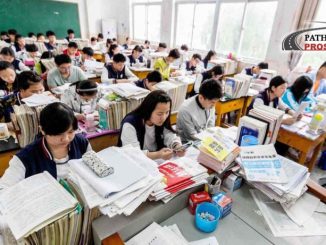
In China, the educational pressure on children is intense, and it begins when they are very young. A mother living in Shanghai describes the demands of her six-year-old child’s education, saying, “In kindergarten, children already need to spend the whole weekend learning pinyin.” Pinyin is the system of romanization of the characters based on their tones and pronunciations of Standard Chinese. “Then there’s mathematics, which includes addition and subtraction up to 20, and English,” she adds. Without this preparation, there is little hope that a student will be able to “catch up” to other students and the next grade’s curriculum, she says.

“Catch[ing] up” with the school curriculum, however, may not be enough. To “get ahead,” as the mother puts it, these children also attend weekly after-school classes in piano, computer programming, Mathematical Olympiad, and chess—both Chinese and international varieties.

Waking up at 6:40 a.m. and going to bed at 10:30 p.m. six days a week has become common practice among Chinese children today, with 67 percent of primary and middle school students not meeting the national sleep requirements—which are “nine hours per night for primary school students and eight [hours] for middle school students”—according to responses to a Chinese Ministry of Education questionnaire that was filled out by teachers, parents and students in June 2021.

China is a country that has long placed high value on learning, steeped in the Confucian belief that education develops individual moral character and contributes to social good. This prioritization of education, especially since the establishment of the People’s Republic of China, has also contributed to the country’s rapid development. With roots in the imperial-era civil exams, China’s education system is highly competitive, meritocratic, and exam-based. The annual university entrance exam, gaokaoconsidered one of the world’s most difficult tests—represents the culmination of the generational hope of 11 million families of students for them to reach the country’s top-tier universities. Few, however, get in. Families therefore opt for extracurricular after-school tutoring services to try to “get ahead.”

The boom of the after-school tutoring industry

What began as home-based supplementary tutoring in China grew into a commercial industry pumped with international capital by the 1990s. In this period of liberalization, New Oriental became the first Chinese educational institution to get listed on the New York Stock Exchange in 2006. By 2019, the after-school private tutoring industry grew to a $120 billion industry, according to market researcher Qianzhan. Meanwhile, the “nationwide student enrollments in K-12” are projected to grow from 325.3 million in 2019 to 659.5 million by 2024, according to the South China Morning Post. No longer a supplementary resource for students in need, the private tutoring sector in China has become highly capitalized and profit-driven over the years. Education had become, in the words of the Ministry of Education, “hijacked by capital.” That is, until the July 24 announcement by the Chinese government to regulate the after-school tutoring, which shook the industry.

‘Double reduction’ policy

With what is called the “double reduction” policy, the government is now aiming to simultaneously reduce the financial pressure on parents and the burden on students. The guidelines regulate extracurricular education, prevent startup platforms from being listed on stock exchanges and from receiving foreign funding, and require existing platforms to register as nonprofit entities. Firms cannot profit from teaching core curriculum material and cannot teach during holidays or on weekends. The focus on profits is an important one. In 2018, President Xi Jinping had criticized private education companies, emphasizing that—as a “sector of the conscience”—education “should not turn into a profit-driven industry.”

China’s private tutoring industry, which has been making profits off the anxieties of parents, has come under greater scrutiny for its malpractices recently. In June, 15 tutoring institutions were fined approximately $5.73 million after spikes in consumer complaints. An inspection by government authorities revealed several illegal practices, including fabricated teacher qualifications, training results and user evaluations. According to the Ministry of Education, the de facto “two-track system” expanded “educational unfairness” in China, with free and compulsory education on one side and private tutoring schools charging high fees on the other side.

“The most important issue for common prosperity is first to achieve educational fairness,” said Yao Yang, dean of the National School of Development at Peking University. Yao pointed to the country’s high wealth concentration—according to a survey by the People’s Bank of China, the central bank of the country, in 2019, “the lowest 20 percent” of urban households in China “accounted for only 2.3 percent of net assets of all sample households,” while the “highest 20 percent of households accounted for 64.5 percent” of the net assets. As a symptom of social inequality, Yao sees the elevating of education—rather than income distribution alone—as a key mechanism to expanding the middle class and building common prosperity.

While the term dates back to the eras of Chinese leaders Mao Zedong and Deng Xiaoping, “common prosperity” refers to both a vision and a cycle of reforms initiated by the government that aim to reconcile economic efficiency with the strengthening of welfare mechanisms. It is also part of the effort to combat the “three mountains” of high education, housing and health care costs faced by Chinese people today. The goal is to address the growing inequality between the countryside and the city, social classes and regions through development and income distribution, tax and social welfare reforms, and philanthropy—encouraging the country’s rich to give back to society. Since the announcement of these reforms by the government, major Chinese companies and wealthy individuals have offered donations, including tech giant Alibaba’s pledge of $15.5 billion by 2025 “to help narrow the country’s wealth gap”—this comes after the firm was fined $2.8 billion for monopolistic practices.

Meanwhile, the private tutoring overhaul rocked the stock markets, as 24 companies listed on Chinese and U.S. stock exchanges now face an uncertain future and “may need to delist or divest their academic assets.” Zhang Bangxin, the billionaire chairman of TAL Education Group, saw his personal wealth drop almost 90 percent to $1.4 billion between April and July, according to Forbes. Yu Minhong, the founder of New Oriental, who saw his personal wealth fall by 70 percent, recently announced that he will redirect his company toward selling agricultural products after the crackdown on private tutoring by the government. Closing nearly 1,500 branches of New Oriental schools, the teachers of these schools will now “participate” in selling these agricultural products via livestreams and will help “support rural revitalization.”

According to Gu Mingyuan, senior professor at Beijing Normal University, regulating private tutoring is not just a “one-off” measure, but it is necessary to “strengthen the supply of public education.” On the heels of the double reduction policy, several moves to strengthen the public education system have been made. On August 31, the Ministry of Education issued a notice criticizing the high frequency and difficulty of exams and emphasis placed on test results, which “harms the body and minds of students.” The amount of testing and homework has since been reduced in primary and middle schools, while measures have been taken to prevent test scores from being published and ranked. After-school services in public schools are being extended to support working parents, non-curriculum training sectors such as in the arts and sports are expanding, and new commitments to increase teachers’ salaries in public schools have been made. Beijing is implementing a pilot program to rotate the top teachers and principals across the city’s public schools. This will also help to cool down real estate speculation driven by elite schools. Meanwhile, the government is expected to announce price regulations for private tutoring.

The double reduction policy can be seen as the government’s affirmation that the minds and health of students and families come before the pockets of investors and billionaires. Some results are starting to show—a survey of more than 57 million parents found that 97.5 percent of them were satisfied with the double reduction policy. As stated in the official announcement, children are, after all, the “builders and successors of socialism,” and the construction of socialism is a multigenerational project.

This article was produced by Globetrotter. Tings Chak is a researcher and coordinator of the art department of Tricontinental: Institute for Social Research. She is also an editor of Dongsheng, an international collective of researchers interested in Chinese politics and society.

Strugglelalucha256


Biden targets China: Turning Taiwan into a military outpost

The Guardian reports that U.S. Secretary of State Antony Blinken threatened a U.S. military buildup in Taiwan in a “side meeting” at the G20 summit in Rome on Oct. 31. 

The Guardian added that Blinken’s threat “came a week after Biden said the U.S. may support Taiwan’s independence militarily and Blinken called for Taiwan to be recognized within U.N. institutions.”

On Oct. 7, the Wall Street Journal reported that about two dozen U.S. special operations and support troops were “secretly operating in Taiwan to train military forces there for at least a year.” 

The U.S. government officially recognizes that Taiwan is a province of China, not a separate nation. By a 1979 agreement, the U.S. promised to remove all military personnel from Taiwan. 

Therefore, what the Biden administration is now doing — secretly sending military forces into the Chinese province — is in violation of both U.S. and international law.

The Chinese province of Taiwan, once a colony of Japan, now calls itself the Republic of China. The U.S. government decided to designate Taiwan as the government of all China after Mao Zedong proclaimed the People’s Republic of China on Oct. 1, 1949. Taiwan was never the capital of China, but it has been part of China for millennia.

To the people of China, Blinken probably sounds like a reminder of the European and Japanese colonialists of the 19th century who had seized Taiwan and other parts of China and used military force to “protect” their possessions.

Century of colonialism

In China it’s known as the “century of humiliation”: the years of dismemberment and subjugation by the European and Japanese imperialists from 1839 to 1949. 

The First Opium War began in 1839. Britain grew opium in India and sold it in China, using the profits to purchase Chinese goods, including porcelain, silk and tea. When the Qing government in China tried to stop the importation of opium, Britain launched the “Opium War” to keep the drug flowing into China.

In the century of colonialism, China was fractured, with Outer Manchuria, parts of Northwest China and Sakhalin seized by Tsarist Russia; Jiaozhou Bay by Germany; Hong Kong and Tibet by Britain; Macau by Portugal; Zhanjiang by France; and Taiwan by Japan. 

Japan was a relative latecomer to the imperialist club. Taiwan was its first colony. Japanese rule of Taiwan lasted from 1895 to the end of World War II in August 1945.

At the end of the war in 1945, the U.S. military, led by General Douglas MacArthur, occupied Japan and took charge of Japan’s colonies, particularly Korea and Taiwan. The U.S. military forces put Taiwan under the administrative control of the Kuomintang-led Republic of China, with Chiang Kai-Shek at the head. This was a confirmation that Taiwan was a part of China.

Retrocession Day is the name given to the annual observance and former public holiday in Taiwan to commemorate the end of Japanese rule of Taiwan, and the retrocession (“return”) of Taiwan to the Republic of China on October 25, 1945.

From the end of World War II in 1945 to 1949, a war of liberation was fought by the People’s Liberation Army and the Communist Party of China, which led to the founding of the People’s Republic of China. In 1949, Chiang Kai-Shek and the Kuomintang army fled to Taiwan under U.S. military protection.

The U.S. strongly supported the Kuomintang forces against the Chinese Revolution. The Kuomintang received $4.43 billion from the U.S., most of it military aid, according to William Blum in his book “Killing Hope.”

In June 1950, when the U.S. launched its war on Korea, the U.S. government also sent the Seventh Fleet into the Taiwan Strait with the Chinese mainland as its target. At the time, MacArthur wanted to use nuclear weapons against China — in an interview he said he would have dropped “30 or so atomic bombs.” MacArthur also wanted to use Chiang Kai-Shek’s forces in Taiwan to invade the mainland.

In 1949, Chiang Kai-Shek and the Kuomintang had declared martial law in Taiwan, imposing a brutal military regime that wasn’t lifted until 1987. During these decades of martial law, some 140,000 Taiwanese were arrested, tortured and imprisoned, according to a 2008 report by the Executive Yuan (government) of Taiwan. Some 4,000 people were executed.

Secret U.S. military operations

In the early 1950s, a secret group of U.S. military “advisers,” led by retired Adm. Charles M. Cooke, former commander of the Seventh Fleet, launched covert military operations in Taiwan to prop up the unpopular and weak Kuomintang regime.

The struggle over Taiwan has continued to this day.

After the victory of the Chinese Revolution and the formation of the People’s Republic of China, Washington proclaimed the military dictatorship in Taiwan to be the “Republic of China” and the government of all China. The Taiwan military regime was even given China’s seat in the imperialist-dominated United Nations!

The U.S. didn’t change this policy until 1972, when it was losing the Vietnam War.

In the 1972 Shanghai Communiqué, the U.S. agreed “that all Chinese on either side of the Taiwan Strait maintain there is but one China and that Taiwan is a part of China. The United States Government does not challenge that position. It reaffirms its interest in a peaceful settlement of the Taiwan question by the Chinese themselves.”

This was followed by the Normalization Communiqué of 1979, with the U.S. formally ending recognition of the “Republic of China” and agreeing to withdraw all U.S. military personnel from Taiwan. 

However, the U.S. never stopped arms sales to Taiwan. These arms sales are supposed to be public and of a “defensive nature” only. The list of U.S. arms sales is publicly available on the Federal Register. Secret arms sales or operations are forbidden, which is what makes the Biden administration’s secret deployment of military special operations trainers a clear escalation of hostilities.  

Following the 1979 communiqué, U.S. arms sales to Taiwan have increased every year. In 2020, the Pentagon announced more than $1.8 billion in arms to Taiwan, including 135 precision-guided cruise missiles and rocket launchers.

Separatists vs. Indigenous Taiwanese

Following the end of martial law in 1987, a new political party emerged in Taiwan to challenge the Kuomintang. The Democratic Progressive Party (DPP) is a Taiwanese nationalist party and currently controls the presidency and the Legislative Yuan. The Kuomintang remains as the second major party in Taiwan.

While the Kuomintang agrees there is only one China and opposes Taiwanese “independence,” the DPP claims Taiwan to be a separate nation. The Kuomintang is based on the mainland Chinese population that came with Chiang Kai-Shek’s military occupation force; the DPP is led by the Chinese who had preceded them.

Over 95% of Taiwan’s population of 23.4 million consists of Han Chinese, whose traditional ancestral homes are in the southern part of Fujian, China.  

The Indigenous peoples in Taiwan are Austronesian Taiwanese, who make up 2.3% of the total population. The DPP does not represent the Indigenous population and, in fact, is considered to be hostile to the Indigenous Taiwanese. 

In 2016, during a legislative committee meeting, a DPP legislator used a racist, anti-Indigenous slur in responding to a request made by Indigenous legislators who opposed a move to lift a ban on Japanese food imports from the prefectures surrounding the Fukushima nuclear power plant.

The DPP’s secessionist claim is getting support in the U.S., with Washington stepping up military and diplomatic support for the island’s government. This is part of the new Cold War the U.S. is waging against China.

The U.S. has expanded its naval operations in the South China Sea and Strait of Taiwan. The increasing frequency of the exercises by aircraft carrier strike groups is extremely provocative. 

The recent sale of nuclear submarines to Australia as part of the formation of the AUKUS bloc was another aggressive move. AUKUS is an alliance between Australia, Britain and the United States that is clearly aimed at confrontation with China.

The reunification of China after the “century of humiliation” has always been seen as an essential part of building socialist China. The Chinese constitution states: “Taiwan is part of the sacred territory of the People’s Republic of China. It is the lofty duty of the entire Chinese people, including our compatriots in Taiwan, to accomplish the great task of reunifying the motherland.”

Without warfare or any kind of military incursion, China carried out the reunification of Hong Kong and Macau using an approach called “One Country, Two Systems.” Something like this was expected to happen with Taiwan, leading to a gradual reintegration. The Communist Party of China has always stressed its desire to achieve a peaceful reunification with Taiwan.

Strugglelalucha256


China is not labor’s enemy, Wall Street is

Political analyst and activist Bill Dores says China is no threat to the people in the United States; Wall Street, the Central Intelligence Agency (CIA), and the Pentagon are.

Dores, a writer for Struggle/La Lucha and longtime antiwar activist, made the remarks in an interview with Press TV on Saturday after the CIA launched a new mission center to address what it calls “the most important geopolitical threat” posed by China.

CIA Director William Burns said in a statement last week that the new unit, called the China Mission Center, will “further strengthen our collective work on the most important geopolitical threat we face in the 21st century, an increasingly adversarial Chinese government.”

Burns said that his agency will still focus on other threats as well, including those emanating from Russia, North Korea and Iran.

The CIA’s renewed attention to China is the latest evidence of the Biden administration’s focus on Beijing as its main foreign policy target.

Since taking charge of the White House earlier this year, the Biden administration has been directing resources toward countering China.

Why is CIA targeting China?

“The CIA is grabbing more tax money to start a ‘mission center’ aimed at China, which it calls the ‘most important geopolitical threat we face.’ This is ominous news, considering the agency’s history of fabricating evidence to start wars, e.g. Iraq’s nonexistent ‘weapons of mass destruction,’” Dores commented to Press TV.

“U.S. troops have left Afghanistan. But not a dime has been slashed from the bloated U.S. military budget. Indeed, it’s being increased to $778 billion from $753 billion to face the alleged ‘Chinese threat.’ That’s more than the combined military budgets of China, India, Russia, Britain, Saudi Arabia, Germany, France, Japan, South Korea, Italy and Australia,” he added.

“It’s also been revealed that U.S. Special Forces have been operating secretly on Taiwan for two years. Meanwhile, the U.S. Congress will not pass the Build Back Better Act to modestly extend our social safety net,” he added.

“The People’s Republic of China has five times the population of the United States. But it spends only $258 billion on its military. China’s forces are deployed in or around the borders and coasts of China. By no stretch of the imagination is China threatening the U.S. militarily. Why would it? For what gain?” he asked.

“So, what the Sam Hill is a ‘geopolitical threat.’ It’s a twisted concept based on the twisted premise that the United States, with 4% of the world’s population, should dominate the world politically and economically. And that really means the billionaires and millionaires that Occupy Wall Street protesters called the ‘One Percent,’” he stated.

China’s economic  ‘threat’ to U.S.

“China’s real ‘threat,’ in the minds of the U.S. corporate ruling class, is economic. China produces more than the United States, and its economy is growing much faster,” the analyst said.

“It has achieved this not by destroying the economies of other countries with war and sanctions, but by growth and trade. China’s Belt and Road Initiative has greatly weakened the stranglehold Wall Street banks once held on the world economy. An article in the U.S. magazine Foreign Policy whined that China is ‘whittling away’ at the murderous ‘sanctions regime’ the U.S. and West Europe use to ‘punish’ countries that defy their dictates,” he explained.

“U.S. corporations do of course invest in China. They make a lot of money there. But they can’t dictate to the Chinese government the way U.S. oil companies dictated to the Shah of Iran before the 1979 Islamic Revolution. Or the way they dictate to their paid servants in the White House and the Capitol today,” he observed.

“Politicians and news media tell working-class people in the United States that China’s growth is somehow a threat to our well-being. They conceal the fact that China’s dynamic growth is the biggest single factor staving off a global economic collapse,” he said.

“Yet it is their own Wall Street masters who have shut down plants all over this country and foreclosed on millions of homes. It is they who used the technological revolution as a weapon to drive down wages and destroy millions of jobs,” Dores said.

Washington’s ‘hate China’ campaign

“Washington raises several phony issues in its ‘hate China’ campaign. One is the alleged persecution of the Uighur people in Xinjiang Province. There’s nothing but hypocrisy here,” the analyst said.

“If this claim were true — and I’ve seen no reliable evidence that it is Washington would be the last to care. The United States leads the world in mass incarceration and murder by police,” he noted.

“According to the Equal Justice Initiative, ‘Millions of Americans are incarcerated in overcrowded, violent, and inhumane jails and prisons that do not provide treatment, education, or rehabilitation.’ The majority are from the oppressed Black, Latin and Native nations targeted by police,” he said.

“Among the incarcerated are dozens of political prisoners, such as Mumia Abu-Jamal, Leonard Peltier and Jamil Abdullah Al Amin, who have spent decades behind bars on frame-up charges,” he stated.

“Last year’s Black Lives Matter uprising highlighted the extent of racist police murder in the United States. Between 1980 and 2018, U.S. police killed more than 30,000 people. Half of those killings were misclassified, according to a study published in the Lancet medical journal,” he said.

U.S. supports ‘ethnic cleansing and murder of Palestinian people’

“We also cannot forget that Washington not only supports but subsidizes the ethnic cleansing and murder of Palestinian people by the racist state of Israel, including the mass imprisonment of 2 million people in the giant concentration camp called the Gaza Strip. The U.S. also has no problem with the oppression of the majority Muslim people of Kashmir by the Indian state,” Dores noted.

“The U.S. accuses China of stealing ‘intellectual property,’ a twisted concept indeed. Perhaps the West should pay China for inventing paper, iron smelting, the seed drill, the compass, rockets, gunpowder and other innovations that made its economic development possible,” he said.

“There is the accusation of currency manipulation. But Washington has flooded the world with devalued dollars ever since the Nixon administration took the dollar off the gold standard in the 1970s. The U.S. has long used the dollar as an instrument of financial warfare,” he said.

Why is the U.S. Navy in the South China Sea?

“And there is the issue of ‘free navigation’ in the South China Sea. Which raises the question, what is the U.S. Seventh Fleet doing in the South China Sea anyway? For that matter, why is the U.S. Fifth Fleet off the coast of Iran and the U.S. Fourth Fleet off the coast of Venezuela,” Dores asked.

“Every year, ships carry $3.4 trillion worth of goods through the South China Sea. Most of that is bound to and from China,” he said.

“The PRC has no interest in stopping that commerce. It does have an interest in keeping U.S. warships away from its coast and ports,” he said.

“For the past seven years, the U.S. Navy has helped Saudi Arabia impose a naval blockade that is starving the children of Yemen. U.S. sanctions, backed by the U.S. Navy, are the main obstacle to commerce between nations in the world today,” he said.

“Instead of new CIA mission centers, military bases and fleets of warships and warplanes all over the world, the U.S. should do what China does: Invest in schools, health care, housing, railroads and renewable energy. Bring all the ships, planes, troops and spies home. The world would be a much better and safer place,” he concluded.

Source: Press TV

Strugglelalucha256


Washington escalates: U.S. special forces secretly operating for past year in Taiwan

Unless the U.S. government promptly removes its military forces from China’s Taiwan province, China may send in its own military force to defend its territory, declared an Oct. 8 editorial in Global Times, the Communist Party of China’s daily newspaper. 

Global Times explains: “We must resolutely define the deployment of U.S. troops in Taiwan as an ‘invasion.’ The mainland has the right to carry out military strikes against them at any time. We will not make any promises over their safety. Once a war breaks out in the Taiwan Straits, those U.S. military personnel will be the first to be eliminated. Through such a declaration, we must make Washington understand that it is playing a dangerous game that is destined to draw fire onto itself and it is risking the lives of young U.S. soldiers.”

On Oct. 7, the Wall Street Journal reported that about two dozen U.S. special operations and support troops were “secretly operating in Taiwan to train military forces there for at least a year.” The Global Times points out that “since the U.S. has exposed the news through anonymous officials, it has taken a step forward to undermine, from covertly to semi-overtly, the key conditions for the establishment of diplomatic relations between the Chinese mainland and the U.S.” 

The U.S. government officially recognizes that Taiwan is a province of China, not a separate nation. Therefore, what the Biden administration is now doing — secretly sending special forces into the Chinese province — is in violation of both U.S. and international law.

Taiwan is a crucial issue. The struggle over Taiwan, always considered to be a province of China, has been ongoing since 1949, when the Chinese People’s Liberation Army drove U.S. puppet Chiang Kai-shek and his Nationalist Army from the mainland as it retreated to Taiwan under the protection of the Pentagon. 

Shanghai Communiqué: One China

The U.S. agreed to surrender the Chinese province of Taiwan, as promised in the Shanghai Communiqué, on Feb. 28, 1972.

The U.S. signed a promise that “The United States acknowledges that all Chinese on either side of the Taiwan Strait maintain there is but one China and that Taiwan is a part of China. The United States Government does not challenge that position. It reaffirms its interest in a peaceful settlement of the Taiwan question by the Chinese themselves.”

The Trump administration moved toward dropping most of the long-standing policies toward China and Taiwan, even suggesting the possibility of granting Taiwan official recognition and an embassy in Washington. 

The Biden administration has not changed any of the Trump policies toward China.

A Democratic congresswoman, Rep. Elaine Luria, in an op-ed published in the Washington Post Oct. 11, “Congress must untie Biden’s hands on Taiwan,” called for an act that would allow the president to bypass Congress to declare war on China.  

The Stars and Stripes daily newspaper that’s issued from the Pentagon headlined Oct. 12: “Retired Marine colonel says U.S. should weigh nuclear war with China over Taiwan.”

Ruling class behind anti-China campaign

Has the rapprochement between Washington and Beijing, as represented by the Shanghai Communiqué, ended? 

This breakup is not just the doing of Donald Trump or Joe Biden. It flows from the fear of the predominant sections of the U.S. ruling class that the attempt to overthrow Chinese socialism from within has failed, just as the previous military aggression from 1949 to 1975 also failed.

In the 1970s when China “opened up,” the giant capitalist monopolies went charging into the Chinese markets. But the strong socialist core of the People’s Republic of China has held on. And the stronger China becomes, the more Wall Street fears for its economic dominance and the more the Pentagon fears for its military dominance. 

On Feb. 25, China’s President Xi Jinping announced that 853 million Chinese people have lifted themselves out of poverty since 1981 thanks to large-scale interventions from both the Chinese state and the Communist Party of China.

China’s technological and economic strength — as well as its remarkable response to the coronavirus (4,636 total deaths compared to more than 718,000 in the U.S.) — has raised a new respect for socialism. 

U.S. ruling class hostility to China’s struggle to build a socialist society is behind the New Cold War and the real threat of hot war.

Strugglelalucha256


Happy birthday socialist China!

Seventy-two years ago, on Oct. 1, 1949, Mao Zedong declared “China has stood up!” The socialist People’s Republic of China was born after decades of struggle.

Chinese women stepped forward with unbound feet. No longer could U.S. and British warships prowl the Yangtze River. Peasants, workers and progressive intellectuals knew their liberation had come.

China shook the world as its revolution inspired oppressed people everywhere. In his autobiography, Malcolm X wrote how the Chinese Revolution boosted his spirits while he was in prison. 

China gave refuge to Mabel Williams and Robert F. Williams, who organized self-defense against the Ku Klux Klan in Monroe, North Carolina. 

While 80% of China’s population couldn’t read or write before the revolution, illiteracy was practically wiped out by 2015.

In 1949 there were just 117,000 college students in China. By 2015, there were 37 million

People in China had an average lifespan of just 36 years in 1949. By 2019, life expectancy had more than doubled, to reach nearly 77 years.

In 2021, Black men in the United States had a life expectancy at birth of just over 68 years.

All of the peoples and nationalities in socialist China have shared in these gains. One of the greatest triumphs of human rights was the abolition of serfdom in Tibet.

The coronavirus pandemic shows the failure of U.S. capitalism. While nearly 700,000 people have died of COVID-19 in the U.S., less than 5,000 people died in socialist China. That’s despite China having a billion more people than the U.S.

China’s President Xi Jinping announced plans to provide other countries with two billion vaccine doses this year. Despite President Joe Biden’s promises, the United States has so far distributed only 160 million doses

The world’s workshop

None of these gains would have been possible without a socialist revolution and the leadership of the Communist Party of China. While the banksters tell the politicians what to do in Washington, communists control China’s banks.

The result has been fantastic economic growth. China today manufactures more goods than the United States. It has built more miles of high-speed rail than the rest of the world combined.

Back in 1949, the urban working class accounted for just 1% of China’s population. By 2019, there were 442 million people employed in the cities. 

China started its industrialization with the help of the then-existing Soviet Union and other socialist countries in Eastern Europe. Today China is helping countries in Africa, Asia and Latin America with its Belt and Road Initiative.

Building bridges, housing, hospitals, railroads and schools takes a lot of steel. While China made less than a million tons of steel in 1949, it currently produces more than a billion tons.

That’s over 50% of world production. In the capitalist U.S., steel production has shrunken to 72 million tons, less than what was made in 1945. 

The deliberate deindustrialization in the United States has thrown millions of workers out of a job and helped to keep wages down for everybody. But it wasn’t China that closed nine of the 10 auto plants in Flint, Michigan. General Motors did.

While Flint’s children were lead poisoned by their drinking water, China has been going full speed ahead with its own Green New Deal. China spent $100 billion to reforest 123,000 square miles. That’s an area larger than New Mexico.

China won’t go backwards

U.S. billionaires have never forgiven the Chinese people for making a revolution. Their fortunes started with enslaving Africans, killing Indigenous people, stealing half of Mexico and smuggling opium into China.

One of the biggest drug dealers was Warren Delano, a grandfather of President Franklin Delano Roosevelt.

A few months after the People’s Republic of China was founded, Washington started the Korean War. Four million people were killed in this dirty war.

Among them was Mao Anying, a son of Mao Zedong. He was one of many Chinese volunteers who gave their lives to defend Korea.

U.S. Gen. Douglas MacArthur wanted to drop atom bombs on both China and Korea. The U.S. Air Force burned Korean children alive with napalm and phosphorus bombs, just as it did later in Vietnam and Laos.

The capitalist media is now trying to blame China for the coronavirus pandemic. Scientists reject the lie that COVID-19 was started in a Wuhan laboratory. We shouldn’t be fooled by it either.

Three decades ago, the Soviet Union and the socialist countries in Eastern Europe were overthrown. This tragedy was a greater defeat than the crushing of the German working class by Hitler.

Poor and working people still have the socialist countries of China, Cuba, the Democratic People’s Republic of Korea, Laos and Vietnam on their side. Bolivia, Iran, Nicaragua, Syria, Venezuela, Yemen and Zimbabwe are fighting U.S. economic sanctions. Palestine will be free.

History is on our side. Happy birthday to the socialist People’s Republic of China!

Strugglelalucha256


Nepal’s people resist U.S. anti-China alliance

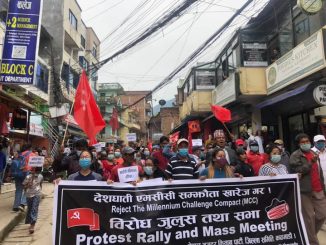
Continuous protests shook the length and breadth of mountainous Nepal in September as the U.S. pushed again to chain this Asian country of 28 million people to its anti-China alliance through the Millenium Challenge Compact (MCC).

The U.S. claims that the MCC’s $500 million grant agreement is merely a generous gift to help improve the country’s infrastructure, with no strings attached. But that story has been shot full of holes by anti-imperialist forces leading the protests.

They point out that the George W. Bush administration set up the MCC to promote “free market economies” and further Washington’s geopolitical goals. Since then, numerous statements by both Democratic and Republican administration representatives in international forums have demonstrated that the MCC is viewed as a component of the U.S. Asian-Pacific “pivot” and the New Cold War against China.

Nepal’s government signed the MCC agreement in 2017, but the country’s parliament has not taken the necessary steps to enact it so far because of mass opposition. 

A big push to have Nepal enact the MCC was made in early 2020, coinciding with President Donald Trump’s visit to neighboring India, where the U.S. inked a $3 billion weapons deal with the far-right Modi government to threaten China. Protests erupted across Nepal against the MCC and Indian territorial aggression, including a thousands-strong march to the U.S. Embassy in the capital, Kathmandu.

Now, a new U.S. administration is pushing the same anti-China agenda. The arm-twisting is intensifying again with MCC Vice President Fatima Sumar’s mid-September visit, which included closed-door meetings with government officials and opposition leaders and thinly veiled threats.

The Nepal Workers and Peasants Party (NWPP) has been leading protests in many cities, towns and villages against the MCC. Struggle-La Lucha spoke with educator and NWPP leader Surendra Raj Gosai, who has been traveling the country to participate in protests and public meetings.

“The U.S. MCC delegation headed by Fatima Sumar called upon the prime minister, ex-prime ministers and other leaders of ruling parties,” Gosai told SLL. “The NWPP and a few other organisations have organized protests against the U.S. interference. Her visit intensified the protests. 

“Everybody is raising a general question: ‘If it’s a grant, why is the U.S. trying to impose it?’ The ruling parties, under heavy U.S. pressure, are trying to forward the agreement in the parliament and amend it. But, the Nepalese people have continuously disagreed and are in the streets.”

Gosai said: “The NWPP defines MCC as a neocolonial tool. That’s why the U.S. is pushing it. Also, U.S. imperialism wants a new war in Asia, as Europe cannot bear any new war after the two world wars.”

Farmers’ organizations condemn MCC

The MCC is supposed to be independent of institutions like the State Department and U.S. Aid for International Development. But the selection process and program administration are overseen by right-wing organizations like the Heritage Foundation, Freedom House and the Brookings Institution, which loyally serve U.S. imperialism, and its criteria are largely based on countries accepting market-driven economies, austerity budgets and cooperation with the U.S. military.

On Sept. 8, six peasant farmers’ organizations issued a joint statement condemning the MCC and demanding its rejection: “The project is designed to be above Nepal’s laws and constitution and in a way that is a gross insult to Nepal, and its financial accounts cannot be audited by the Government of Nepal and the Office of the Auditor General. 

“If there is corruption in it, the Commission for Control of Abuse of Authority of Nepal cannot take any action. Provision has been made to prevent any official or person involved in this project from being tried for committing any heinous crime in accordance with the laws of Nepal. 

“In the same way, MCA will contract out all the construction works of the agreement itself, retaining all the rights in the project area. The agreement clearly states that MCC (USA) will have full ownership of all the land and underground of the project area during the agreement period and all the valuables and raw materials obtained during the construction and all the intellectual property [that] will be established. 

“The possibility of bringing U.S. troops into the country in the name of project security and conducting operations against Nepali communists and allied China cannot be ruled out. … The MCC agreement, which has many controversial issues, is against Nepal’s nationhood and the sovereignty of the Nepali people.”

On Feb. 28, 2020, the government of Sri Lanka rejected an MCC agreement on the recommendation of an expert panel, which said it would damage the country’s sovereignty and was incompatible with the constitution.

The Nepali people likewise feel that the MCC is an attack on their sovereignty and a step toward establishing a U.S. military presence in their country. Nepal only deposed the monarchy and established a parliamentary republic in 2008 after decades of struggle, including a communist-led guerrilla movement. The masses have made it clear that becoming an appendage of U.S. imperialism is something they will not accept.

Strugglelalucha256


Trump, the generals & a phone call to China

CLASS WAR COMMENTARY

Gen. Mark Milley is no hero. 

He is chair of the Joint Chiefs of Staff, top general in the Pentagon’s monstrous war machine, a global enforcer for Wall Street. Donald Trump gave him that job. 

He is, as Gen. Smedley Butler described himself in the 1930s, a “high class muscle man for Big Business, for Wall Street and the bankers. … a gangster for capitalism.”

Now, however, Trump and the right wing of the U.S. ruling class want Gen. Milley’s head. They say he should not only resign but be tried for treason. 

The hue and cry has spread beyond the usual suspects — Trump and the GOP, Fox, OAN, Newsmax, the National Review and neo-Nazis like Tucker Carlson. 

Retired Col. Alexander Vindman says Milley “broke the chain of command” and should be fired. Vindman lost his job at the National Security Council last year for testifying against Trump. He was escorted out of the White House. 

USA Today, which endorsed Biden in 2020, has also called on the general to step down. 

‘He talked to the Chinese’

What is Milley’s “cardinal sin” in the eyes of his detractors? “He talked to the Chinese.” And they say he did so without consulting Trump or his acting Defense Secretary, retired Special Forces Col. Christopher Miller. 

Milley didn’t talk to Chinese civilian officials. He phoned his counterpart, Gen. Li Zuocheng, Chief of the Joint Staff Department of the Central Military. Calls between U.S. generals and those of other countries happen often. In fact, since U.S. presidents are pretty much Pentagon figureheads, that is where most real communication takes place. 

But this time Milley did something deemed extraordinary: In a 45-minute conversation, he promised to notify the Chinese general in advance of any planned U.S. military strike. 

He made the call on Jan. 8, two days after Trump supporters tried to seize the U.S. Capitol. He had also phoned Gen. Li a few days before the 2020 presidential election. 

According to the new book “Peril” by Bob Woodward and Robert Costa, Milley feared  that Trump would start a war with China in a desperate bid to stay in the White House. 

For months the president had been making the insane claim that China manufactured the COVID-19 virus as an act of biological warfare. The Chinese military was on heightened alert. 

Milley had also warned Trump forcefully against attacking Iran.

Now if I were Gen. Li, I would not trust any assurances from the Pentagon. But the Trump gang and others in Washington say Milley’s effort to avert a possible military conflagration was “aiding and abetting the enemy.”

USA Today Editor David Mastio wrote, “Such a call would have inevitably cost the lives of American troops tasked with following the orders of the lawful commander in chief. Milley’s effort to thwart the potential demands of an unhinged president became a betrayal of the men and women he commands.” 

Milley also told his commanders to notify him of any “unusual” orders from the president. And he promised Democratic House Speaker Nancy Pelosi that he would thwart any attempt by the White House to launch a nuclear strike. This supposedly interfered with the president’s “constitutional right” to start a nuclear war. 

Milley’s critics claim the general violated Article II of the U.S. Constitution, which makes the president commander in chief of the armed forces. They say he challenged civilian control of the military, a cornerstone of U.S. “democracy.” 

Milley and MacArthur

Some have likened Milley’s actions to those of Gen. Douglas MacArthur during the genocidal U.S. war against Korea. That was a bit different. MacArthur wanted to launch a nuclear attack on China. He publicly criticized President Truman for not allowing him to do so. Truman fired him. 

Bourgeois historians hold up Truman’s act as a sterling assertion of civilian control over the military. But as brilliant U.S. Marxist theoretician Sam Marcy pointed out in his 1980 book “Generals Over the White House,” Truman consulted with the Joint Chiefs of Staff before firing MacArthur. He got their permission to fire him. 

In 1977, 26 years after Truman fired MacArthur, Gen. John Singlaub commanded U.S. occupation forces in South Korea. When President Jimmy Carter said he would reduce U.S. forces there, Singlaub criticized him publicly. The general was reassigned. But Carter backed down from his troop withdrawal plans. The Pentagon has been calling the shots in Washington for a long time now. 

George Floyd rebellion brought down Trump

The Trump gang are no defenders of the Constitution. They organized an attempted coup against the right of Black people to vote. They wanted the Army to drown last year’s Black Lives Matter protests in blood. 

That Milley refused is a testament to the power of the people’s struggle. He and the other Joint Chiefs surely feared Black and Brown soldiers would rebel and refuse orders, tearing the armed forces apart from within. That’s  what happened inside the U.S. military during the Vietnam War.  Milley even apologized for standing with Trump on his June 1 walk to St. John’s Church while federal agents were attacking protesters in Lafayette Park.  

Who has the ‘right’ to start nuclear war

The Constitution says only Congress has the right to declare war. How is it constitutional for the president to have the power to launch a nuclear war? Yet both Republicans and Democrats have accepted that illegal arrangement since 1945.

For that matter, Congress has not declared war since Dec. 11, 1941. Since the end of World War II, the Pentagon has bombed and/or  invaded Korea, Vietnam, the Dominican Republic, Lebanon, Grenada, Panama, Iraq, Somalia, Yugoslavia, Afghanistan, Haiti, Libya and Syria. If the generals, including Milley, were defenders of the Constitution, they would have refused to wage these illegal wars. 

Who ‘lost’ China … Korea … Cuba … Vietnam … Iran … Afghanistan

The rightwing campaign against Milley must be seen in the context of the global crisis facing the U.S. ruling class, both geopolitical and economic. Major setbacks for the U.S. imperialist ruling class have always set off turmoil in the political and military establishment. 

After the victory of the great Chinese Revolution in 1949, President Truman was accused of “losing” China. The ensuing political frenzy led to the rise of Sen. Joseph McCarthy and the “Red Scare.” The U.S. defeat in Korea led McCarthy to launch an attack on the military high command itself, leading to his political demise.

The victory of the Cuban Revolution in 1959 and the failure of U.S. attempts to overthrow it set off a battle between the Pentagon, the CIA and the White House. It likely led to the Kennedy assassination. The U.S. defeat in Vietnam was followed by a political crisis that led to President Richard Nixon’s resignation. The 1979 Iranian Revolution and the deliberately provoked hostage crisis that followed brought down Jimmy Carter and led to Ronald Reagan’s election. 

The right wing anti-Milley campaign comes against the background of the U.S. retreat from Afghanistan. The Pentagon’s failure there epitomizes the failure of the 20-year “war on terror” to reverse the world situation in Washington and Wall Street’s favor politically, militarily or economically. Unlike the previous defeats of the U.S. war machine, it comes at a time of extreme capitalist economic contraction.

Shut down the war machine

What should be the attitude of those who fight for the working class and oppressed, who fight for the end of endless wars and the entire racist, imperialist system? 

The issue for us is not who has the power to start a nuclear war. No one should have that power. Not the president, not the generals. China is not our enemy. Neither is Afghanistan, Iran, Russia, Cuba or Venezuela. Our enemies are here, in Washington and in the boardrooms. 

Shut down the nuclear arsenal. Disarm the ICBMs, the nuclear submarines, all of it. Close down the military bases, mothball the war fleets, ground the nuclear bombers. Bring the troops and ships home from East Asia, West Asia, Africa, the Caribbean and anywhere else. Stop the flow of arms to the Israeli occupation regime. Stop economic sanctions and CIA “regime change” operations. Get the Pentagon off our backs. Use that money for the people.

Strugglelalucha256


U.S. plan to discredit Chinese investments unmasked

Harare, Zimbabwe

The United States is sponsoring a strategy to undermine Chinese investments in Zimbabwe by smearing the Asian giant’s companies as engaging in widespread labor malpractices, as well as violation of human, community and environmental rights, among other ills, The Herald has learnt.

The strategy is part of an intricate plan, also involving some European and Nordic countries, to discredit Chinese businesses through disinformation, lies and sensationalism in the independent media and social platforms.

It entails portraying Chinese businesses as unethical, reckless, without values, criminal and causing harm to communities, environment and workers.

The weaponization of anti-Chinese sentiment is intended to harm Chinese interests here, and is said to also have the political goal of giving fodder to local opposition ahead of the elections in 2023, by portraying the government and the ruling Zanu PF as condoning the alleged excesses of its ally, China.

Exclusive details obtained by this publication last week indicated that private media journalists are being trained by an outfit called Information for Development Trust (IDT), which poses as an independent investigative journalism center, with the funding of the U.S. Embassy in Harare.

A workshop drawing about a dozen private media journalists was held last week on September 14 to 15 and the journalists were allocated regional/geographical areas of focus with emphasis on areas where Chinese businesses are involved.

These include mining, construction, energy, infrastructure, loans and environment.

The trainers justified that they were focusing on Chinese businesses because China was now the biggest investor in the country.

Our source said: “The training of journalists by the U.S. Embassy is feeding into wider activities by Western countries to equip the media, civil society and legal fraternity to fight the influence and growth of China in Zimbabwe through weaponizing anti-Chinese sentiments as well as exploiting economic vulnerabilities of journalists.

“U.S. Embassy officials bragged during the workshop that they had extended funding to the project and had also previously sponsored media institutions on the so-called accountability issues. They also funded some journalists that are now strategically positioned within the independent media.

“The officials said they were availing resources to ‘people that matter’ to focus on resource governance and labor issues and providing the ‘right instruments’.”

It has been established that U.S. Embassy, as part of its so-called public diplomacy, will plan with beneficiaries, discuss work areas, sharpen skills and help journalists improve skills.

Our impeccable source said this is a strategy coming from Washington and implemented by State Department’s Bureau of Democracy, Human Rights and Labor Affairs (DRL) through the embassy.

One attendee at the workshop revealed that journalists involved in the workshop have already been given areas and topics to work on according to areas of interests as well as geographical areas that include Mashonaland East, Mashonaland Central, Mashonaland West, Manicaland and Matabeleland North.

The next stage is the production of content and publication of stories in various media, with journalists receiving payment from the U.S. Embassy through its proxy.

Each pitch was promised US$1 000.

The U.S. Embassy’s program coincides with the European Union and some Nordic countries also sponsoring similar workshops, which indicates a well-planned anti-Chinese crusade. Last week, the European Union sponsored a workshop in Masvingo under the theme, “Strengthening the role of the media in support of accountable governance and community development in Zimbabwe.”

The goals of the training are similar to the U.S. in seeking to undermine Chinese influence in Zimbabwe.

China — charmed by President Mnangagwa’s “Zimbabwe Is Open for Business” policy — is the biggest investor in Zimbabwe at the moment with major infrastructure construction projects underway.

The world’s second biggest economy has also extended financial aid to Zimbabwe.

Various Chinese companies have ventured into mining and construction industries, oiling the government’s developmental agenda, meant to midwife Zimbabwe’s attainment of a middle income economy status by 2030, as enunciated by President Mnangagwa.

Strugglelalucha256


Vietnam resists Washington’s anti-China campaign

Vietnam and China fought an unfortunate border war in February and March of 1979, egged on by U.S. imperialist interference in the region. Nevertheless, relations between the two countries have steadily improved, based on a shared interest in peaceful socialist construction, resulting in deepening political and economic cooperation.

Currently, maritime disputes are the biggest threat to this long-lasting peace. Controversies have arisen around commercial fishing, oil exploration and other activities in the waters that China calls the South Sea, and Vietnam calls the East Sea. There are competing claims about control of various small islands. 

One-third of the world’s trade passes through these waters. But the situation must also be understood in the context of U.S. military provocations; for example, this year, Washington has deployed a Navy strike group headed by the USS Theodore Roosevelt in the sea.

Despite ongoing disputes, both the Chinese and Vietnamese governments have firmly maintained that they will resolve all issues through dialogue and recourse to maritime law.

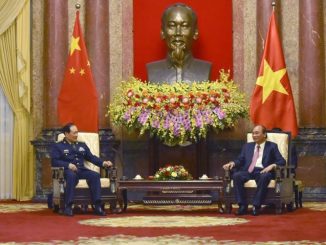
On April 26, a high-level meeting was held between Vietnamese and Chinese officials in Hanoi. In attendance were Vietnamese President Nguyễn Xuân Phúc, Communist Party of Vietnam General Secretary Nguyễn Phú Trọng and China’s National Defense Minister Wei Fenghe. The leaders pledged to strengthen bilateral ties and military cooperation. 

In Xinhua News’ paraphrase, President Phúc said that “Vietnam will stay on guard against and firmly resist any schemes to undermine Vietnam-China relations, and will never follow other countries in opposing China.”

Further, they stressed that they must resist pressures from outside the region to interfere in the maritime disputes.

This is not an abstract concern. U.S. Vice President Kamala Harris arrived in Hanoi on Aug. 24. The thrust of her visit was to try to convince the Vietnamese government to become part of an anti-China alliance. 

During the trip she said, “We need to find ways to pressure and raise the pressure, frankly, on Beijing to abide by the United Nations Convention on the Law of the Sea, and to challenge its bullying and excessive maritime claims.” Harris’s appeal to the U.N. is rich, considering that Washington has consistently flaunted the U.N.’s resolutions demanding an end to sanctions against Cuba and other unilateral imperialist bullying.

The Biden administration’s approach to the region is a continuation of Trump-era policies, as well as Obama’s “pivot to Asia.” The 2018 declassified report, “U.S. Strategic Framework for the Indo-Pacific,” lays out the overall strategy and goals. The first bullet point reads, “How to maintain U.S. strategic primacy in the Indo-Pacific region and promote a liberal economic order while preventing China from establishing new, illiberal spheres of influence, and cultivating areas of cooperation to promote regional peace and prosperity?”

The “peace and prosperity” bit is the most outrageous part. If they were serious about that, they would end their occupation of South Korea, stop providing weapons to the Duterte regime in the Philippines, etc. The generals in Washington would likely love to have a military base in Vietnam, but as part of its revolutionary sovereign policy, Vietnam does not allow foreign bases on its soil.

But the important thing here is that, despite considerable trade and diplomatic relations between Washington and Hanoi, the Socialist Republic of Vietnam is not on board with the U.S.-led anti-China coalition.

Strugglelalucha256


A working class perspective on China’s tech regulations

Bourgeois pundits are alarmed by the Chinese government’s latest regulatory changes. A Wall Street Journal headline is typical: “China’s corporate crackdown is just getting started. Signs point to more tumult ahead.”

The apocalyptic language may be warranted for certain wealthy investors. But what might these changes mean for the deeply intertwined working classes of China and the U.S.?

There’s no indication of a radical change in direction in the official pronouncements, which say that the Communist Party of China (CPC) is leading the country’s development and won’t allow the billionaires to control the economy. The state can intervene to address problems like inequality and to prevent the economic chaos tolerated by capitalist leaders. 

Recent changes are understandable if the socialist foundations of the economy remain intact. Socialist transition is still underway, though threatened from all sides. 

Furthermore, China is integrated into the global capitalist economy, the crises of which are themselves exerting pressure on Chinese leaders to shore up the basic socialist framework. That’s how China rebounded from the 2007-2009 financial crisis and how it’s tackling COVID-19. 

Because U.S. and Chinese workers are on the same side of the global class barricades, in mortal combat with the capitalist class, we must oppose Washington’s maneuvers to destroy China’s socialist system. If the country’s socialist foundations are undermined further, this will strengthen the hand of capitalists (particularly in the U.S.), and hurt the workers’ struggle everywhere; consider, for example, China’s critical partnerships with sanctioned countries like Iran and Cuba.

Insights from a capitalist

Ray Dalio chairs the world’s largest hedge fund, Bridgewater Associates, and has operated in China for 36 years. His view is guarded and sober. He said: “The [Chinese] state runs capitalism to serve the interests of most people and … policymakers won’t let the sensitivities of those in the capital markets and rich capitalists stand in the way of doing what they believe is best for the most people of the country. Rather, those in the capital markets and capitalists have to understand their subordinate places in the system or they will suffer the consequences of their mistakes. For example, they need to not mistake their having riches for having power for determining how things will go.”

He’s offering advice to concerned investors. But more to the point, his observation lines up with what the CPC says it’s doing, that is, trying to build a more prosperous and equal society.

Social problems prompt policy changes

The foundations of socialism were laid in the Mao period, through various development campaigns — based on politically conscious mass mobilization — and consolidated by the Cultural Revolution. Since 1981, Chinese socialism has brought 853 million people out of poverty. Nevertheless, integration into the global capitalist economy has generated social problems such as rising inequality, jeopardizing all revolutionary gains. Workers’ struggles have prompted the new regulations, particularly in three important areas:

Gig economy

Globally, the gig economy has emerged as a model for corporations seeking to avoid unions and paying for benefits. As elsewhere, Chinese workers have been impacted.

In March, the CPC-affiliated All-China Federation of Trade Unions proposed new protections for the country’s 200 million gig workers, while announcing a gig worker unionization drive.

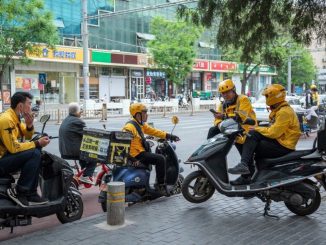
In July, the State Administration for Market Regulation and other administrative departments announced new rules for food delivery app companies like Meituan and Alibaba’s Ele.me., requiring the platforms to provide insurance, guarantee riders’ income above minimum pay and relax delivery deadlines.

Private tutoring

New regulations on the $120 billion private tutoring industry can be seen in a similar light. Now, all organizations offering tutoring on the core school curriculum must register as nonprofits. New licenses will not be issued. In 2016, more than 75% of students ages 6-18 were receiving these services. The regulations are meant to help financially burdened families, while lowering student stress by prohibiting tutoring on weekends and school holidays.

From cryptocurrency to state-run e-currency

The Communist Party of China decided decades ago to allow some capitalism to function as a stimulus to its economic development. But the party’s control over the basic underpinnings of the economy including the financial banking system has allowed  development to proceed for the most part in a planned socialist way. Crucially, state control of finance is also a pillar of China’s sovereignty, to be contrasted, for example, with the subordinate status of Greece, which the EU forced to accept devastating austerity measures.   

But, again, there are tremendous pressures on China to privatize its financial system. This comes from its own bourgeoisie as well as from without. 

The rise of cryptocurrencies has undermined state control, promoting dangerous speculation, tax evasion and money laundering.  The National Internet Finance Association of China, the China Banking Association and the Payment and Clearing Association of China, issued a joint statement, saying cryptocurrencies are “seriously infringing on the safety of people’s property and disrupting the normal economic and financial order.” Hence the new rules prohibiting banks and payment firms from offering cryptocurrency services. The Ministry of Public Security has also increased efforts to stop money laundering.

Meanwhile, China is leading the way in digital currency. The Central Bank launched the electronic yuan in four cities as part of a pilot program in 2020. The electronic Yuan is legal tender, with the same standing as paper money. Since 2020, testing has expanded in many areas, the hope being that the electronic currency will give the government better control over the financial system.

Strugglelalucha256
https://www.struggle-la-lucha.org/china/page/10/