Haitian movements caution against foreign intervention following Moïse’s assassination

In the early hours of July 7, unidentified armed men attacked the house of Haiti’s de-facto president Jovenel Moïse and shot him dead. In the attack, his wife was also severely injured and according to reports she has been hospitalized in Miami, Florida. Haiti’s interim prime minister, now acting president, Claude Joseph, confirmed the news in the early morning and declared a 14-day state of siege. Joseph assured that the “security situation of the country is under control” and called on the citizens to remain calm.

In the evening, the secretary of State Communication, Frantz Exantus, reported that two suspects in president’s assassination had been arrested by the national police in the afternoon in Pelerin.

Hours later, in a press conference, the director of the Haitian National Police (PNH), León Charles, informed that the police confronted with the alleged commando group responsible for the assassination in the immediate vicinity of Moïse’s residence in Pelerin. He confirmed that the police captured two of the presumed assassins and killed four others. “The PNH blocked the road that could allow the mercenaries to flee. Some of them had taken refuge in Pelerin, four were killed in shootings, two were arrested, and three policemen taken hostage were rescued,” said Charles.

Meanwhile, Claude Joseph reported that he held a meeting with the Core Group, composed of the ambassadors of Brazil, Canada, France, Germany, Spain, the European Union, the United States of America, as well as representatives from the United Nations and the Organization of American States. He also informed that he spoke for 30 minutes with the US Secretary of State, Antony Blinken, about the assassination and the political crisis.

Haitian civil society organizations and other progressive sectors have expressed concerns about these meetings. They warned that Moise’s assassination could be used as pretext to increase foreign interference and further deepen the socio-political crisis in the country. They condemned that the Core Group has its own economic and geostrategic interests in the country. They recalled that it supported Moïse’s illegitimate government, whose presidential term constitutionally ended on February 7, 2021, as well as his unconstitutional plans to hold legislative and presidential elections and a constitutional referendum on September 26, 2021, despite the widespread popular rejection.

In a statement, Jubileo Sur / Americas, a network of social movements, people, ecumenical, women’s and human rights organizations, political formations, campaigns in Latin America and the Caribbean, condemned Moise’s assassination and highlighted that “the democratic struggles of the Haitian people during the last years were peaceful struggles.” The organization stressed that although “there is no clear information about the origin and nature of the command that killed him, everything seems to indicate some complicity and/or participation of the security forces of the presidency.”

Jubileo Sur / Americas emphasized that “it is important to prevent a new military occupation and reject the option of the occupation of multilateral forces which have already shown that their presence exacerbated the Haitian crisis and are responsible between 2004 and 2015 for serious crimes against Haiti and multiple violations of the basic rights of the nation.”

Likewise, Social Movements of Alba, also stressed that Moïse’s murder must not be the excuse for a new intervention in Haiti. “The peoples of our America, we do not cry for the executioners of the people, but we do warn about the possible scenarios that can be unleashed with this assassination for the benefit of the imperialist interests, who live off the generation of chaos as the main strategy of domination. The memory of the Haitian resistance take us back to the time in history when in 1915 after the assassination of President Vilbrun Guillaume Sam, the US army invaded Haiti. Will they be repeating their strategy?” pointed out ALBA in a statement.

With regard to Moïse’s murder, ALBA said that it “is one of those cases where violence turns against its original generator.” “For months, Haiti has been experiencing a spiral of violence that seeks to stop and repress the popular uprisings that have been permanently maintained during the last 4 years. According to state entities and national and international human rights organizations, there have been 12 massacres, 234 kidnappings (UN), 10,000 displaced persons, and more than 76 armed groups have been identified. To these figures were added 15 new murders at the end of June,” added the organization, highlighting the alarming levels of insecurity in the country.

The Haitian government has decreed a national mourning until July 22 and has closed its airports and the land borders. The stage of siege has also been ratified for 15 days, which suspends several constitutional guarantees and rights. While it is in force, people must remain in their homes. The authorities may conduct searches at homes, prohibit meetings and establish special security measures according to the situation.

With reports on the ground from Lautaro Rivara.

Source: Peoples Dispatch

Strugglelalucha256


There’s a dirty tricks campaign underway in Peru to deny the left’s presidential victory

Half an hour’s taxi ride from the House of Pizarro, the presidential palace in Lima, Peru, is a high-security prison at the Callao naval base. The prison was built to hold leaders of Sendero Luminoso (Shining Path), particularly Abimael Guzmán. Not far from Guzmán’s cell is that of Vladimiro Montesinos, intelligence chief under former President Alberto Fujimori, who is also now imprisoned. Montesinos was sentenced to a 20-year prison term in 2006 for embezzlement, influence peddling, and abuse of power. Now, audio files from phone calls made by Montesinos from his prison indicate an attempt to influence the results of Peru’s presidential election after Pedro Castillo, the candidate of the left-wing Perú Libre party, won the election.

By the evening of June 6, 2021, Peru’s National Jury of Elections should have declared Pedro Castillo the winner of the presidential election. But it did not. A month later, matters remain in stasis as Peru does not yet have an official winner of the election.

Castillo’s opponent, Fuerza Popular’s Keiko Fujimori—the daughter of the former dictator Alberto Fujimori—has hired a range of Lima’s top lawyers to obstruct any decision by the state’s electoral commission. In addition, her team has cast aspersions against the campaign of Castillo and Perú Libre, accusing them—without evidence—of being financed by disreputable groups, including drug cartels. The Peruvian media, largely controlled by the oligarchy, have gone along with Fujimori’s allegations; their apparent goal is to paint Castillo as an illegitimate winner and to set aside the verdict of the electorate.

Bribes

Meanwhile, hard evidence continues to emerge of the dirty tricks at the heart of Fujimori’s campaign to steal the election. Montesinos, the right-hand man of Fujimori’s father, made 17 phone calls from the prison between June 2 and June 24. Twelve of these calls resulted in a phone conversation; there was no answer to five of them. The Peruvian naval authority in charge of the prison said that Montesinos had applied to call his girlfriend. On June 26, Peru’s Defense Minister Nuria Esparch indicated that the navy will conduct an investigation.

Montesinos did not call his girlfriend. Instead, the old spymaster—and former CIA agent—called Pedro Rejas, a former commander in Peru’s army who is close to the Fujimori campaign. Montesinos tells Rejas in one call on June 10 to bribe the three members of the election commission $1 million each. “The only solution is to work through Guillermo in order to transfer the payment in favor of the three electoral jury members, who are supposed to be open to the bribe, and therefore guarantee the result.” The “Guillermo” in the conversation is Guillermo Sendón, who is on record affirming his relationship with one of the members of the electoral commission, Luis Arce Córdova. Sendón says that he helped Arce in his failed campaign to become president of the Supreme Court and met Arce several times in this period. Sendón’s last recorded visit to Arce was on June 22.

The audios are damning. In Peru, the case is known as Vladiaudios. This is a nod to a 20-year-old scandal called Vladivideos, when Montesinos was caught on tape bribing congressman Alberto Kouri to support Perú 2000, the party of Alberto Fujimori. In the months that followed, more videos came out: Montesinos offering millions of dollars to Channel 2, Channel 4, Channel 5, and Channel 9 if they prevented the opposition from coming on their television programs. The Vladiaudios are as damning as the Vladivideos, both showing Montesinos attempting to use bribery to secure the electoral victory of the Fujimoris.

Where will the money come from? Montesinos proposes that Rejas approach Dionisio Romero (the CEO of Credicorp) and Rafael López Aliaga. It seems he has thought about everything: what to do and how to do it. Sitting in jail, this old intelligence agent could not do it himself. He required an accomplice and phone calls that were recorded and leaked to the media.

Involve the CIA

In one of the calls, Montesinos tells Rejas to involve the U.S. Central Intelligence Agency (CIA). “Look, what they have to do is to go to the U.S. Embassy and talk with the embassy intelligence officer. Bring all the fraud documentation… Go to the embassy and talk with the person in charge of intelligence at the embassy. That is in the Office of Regional Affairs.” The Office of Regional Affairs in Lima is the CIA station.

Montesinos gives precise instructions. Keiko Fujimori’s husband “can go [to the embassy], since he is an American citizen.” Her husband is Mark Villanella, whom she met at Columbia University in 2004. “Take the documents,” Montesinos advises. “Show them. Deliver them to the embassy and ask them to bring them to their chief in Washington… And in Washington, the chief can bring it to the notice of the president, and the White House spokesperson can issue a statement to prevent Cuba, Venezuela, or Nicaragua from imposing their will in Peru. With such a statement, they have great leverage.”

Montesinos is not the only one in Fujimori’s circle with a history of trying to involve the United States in Peru’s elections. Her close adviser Fernando Rospigliosi has a long history of walking into the U.S. Embassy and asking for assistance in preventing the left from prevailing in elections. The current U.S. ambassador in Peru — only recently appointed — is Lisa Kenna, a former CIA agent.

Unconventional warfare

Montesinos is an expert in unconventional warfare. The followers of Fujimori, he tells Rejas in one of the conversations, want to use a conventional approach, but “this will not work.”

“There is conventional warfare and unconventional warfare,” he says. “In unconventional warfare, you have to use special procedures… Conventional lawyers are not going to succeed because the procedure is irregular.” Arguments before the courts, in other words, are not sufficient; bribes are required.

Luis Arce, the man on the electoral commission, is now under investigation by Peru’s public prosecutor.

Meanwhile, the National Jury of Elections has still not closed the election in favor of the winner, Pedro Castillo. What we have instead is unconventional warfare with the U.S. Embassy as a player in the drama. Coups nowadays in Latin America do not need armies. Having good lawyers, bags of money, and a handful of thugs in and out of jail is all that is needed.

This article was produced by Globetrotter.

José Carlos Llerena Robles is a popular educator, member of the Peruvian organization, La Junta, and representative of the Peruvian chapter of Alba Movimientos.

Vijay Prashad is an Indian historian, editor and journalist. He is a writing fellow and chief correspondent at Globetrotter. He is the chief editor of LeftWord Books and the director of Tricontinental: Institute for Social Research. He is a senior non-resident fellow at Chongyang Institute for Financial Studies, Renmin University of China. He has written more than 20 books, including The Darker Nations and The Poorer Nations. His latest book is Washington Bullets, with an introduction by Evo Morales Ayma.

Strugglelalucha256


Haiti: After Delmas 32 massacre, a demonstration, accusations, and a riposte

As we go to press, we have learned that an apparent squad of mercenaries, arriving in nine brand-new Nissan Patrol vehicles, arrived at the home of Haiti’s de facto president Jovenel Moïse in the mountain heights of Pèlerin after 3 a.m. and shot him dead. His wife, Martine, was wounded and reported to have died at the hospital. The killers had knowledge of the house layout, suggesting they had an inside accomplice. The scale and sophistication of the operation suggest a well-financed and well-planned operation, not a spontaneous one.

Last week was filled with terror, trauma, and tumult in Haiti, a nation which already has been shaken by all three.

It began on the afternoon of Tue., Jun. 29, 2021, when Guerby Geffrard, the spokesman of the police union SPNH-17, was shot by two men on a motorcycle near the teeming intersection of Delmas 32 in Port-au-Prince. He was taken to Bernard Mevs Hospital, but he died there from his wounds. (In early May, a rumor circulated that Geffrard had been assassinated, but then he turned up alive at a radio station a few days later.)

Later that same evening around 11 p.m., armed gunmen killed at least 15 people in the area of Delmas 32. Leaving that area, the men on three motorcycles encountered and shot to death well-known women’s rights activist and journalist Marie Antoinette “Netty” Duclaire and Radio Télé Vision 2000 journalist Diego Charles. Duclaire was shot seven times behind the wheel of her car, while a few feet away, Charles died from two bullets in front of his home’s gate on Rue Acacia in the Christ-Roi neighborhood.

One of the 15 victims massacred on Jun. 29 in Delmas 32.

The next day, Haitian National Police (PNH) chief Léon Charles and interim Prime Minister Claude Joseph stated that the killing spree was the work of Fantôme 509, a shadowy paramilitary organization of current and former cops which has carried out jailbreaks, burned stores and vehicles, and exchanged fire with PNH units over the past year.

In a Jul. 1 press conference, Joseph called the killings “a terrorist attack,” while Charles claimed that “some of the [Fantôme 509] assailants are already identified.”

Nonetheless, also on Jul. 1, the National Human Rights Defense Network (RNDDH), headed by Pierre Espérance, issued a four-page press releasewhich claimed that “according to certain residents of Delmas 32… the individuals implicated in the organization and perpetration of these attacks were part of the Base Krache Dife [Spit Fire Gang],” which is part of the Revolutionary Forces of the G-9 Family and Allies (FRG-9), an alliance of poor neighborhood vigilance brigades led by Jimmy “Barbecue” Cherizier. (Espérance called PNH chief Charles’ declarations blaming Fantôme 509 “hasty and irresponsible.”)

Ironically, the previous day, Jun. 30, Cherizier had given a press conference to call for peace and “calm among everyone implicated in the armed confrontations in the large poor neighborhoods.” In early June, a year-long truce between armed gangs was broken when those of Grand Ravine and Village de Dieu (provided with money from Haiti’s opposition, according to a highly placed international security source) attacked that of Ti Bois, a FRG-9 member. That conflict touched off neighborhood battles across the capital.

Police union spokesman Guerby Geffrard was fatally shot on Jun. 29.

“The moment has come for us to put our forces together to overturn this system which has divided us, which has put weapons in our hands, for us to struggle against each other, so they can defend their interests,” Cherizier said. “I continue to extend my hand to all the ghettos, so we stop fighting among each other but fight against those people who have put guns in our hands. We know there are a lot of [the bourgeoisie and politicians] have no interest in seeing this country have stability. We have to open our eyes. We have to recognize our true enemies. All the ghettos are living the same reality. We have to unite our forces to liberate this nation from the claws of these birds of prey.”

Cherizier then announced a FRG-9 demonstration for Jul. 1. “In tomorrow’s demonstration, we will continue to demand our rights to have food, good schools, good houses to live in, and for us and for our children in 10 or 20 years not to have to handle weapons the same way many of us have had to do today.”

Journalist Diego Charles and activist Marie Antoinette Duclaire and were both killed in the Christ Roi neighborhood.

Many hundreds of mostly La Saline residents turned out for the lively demonstration which marched to Wharf Jérémie, then past Aviation (former Bowen Airfield), to Station Gonaïves (near the old HASCO sugar refinery), where it was turned back by police firing tear-gas. The demonstrators then marched to the Croix des Bossales market, then returned to La Saline. Chants of “we are hungry,” “hungry people don’t play,” and “Jovenel must go” were led by Cherizier during the rally in La Saline.

“Today, the government of [de facto President] Jovenel Moïse has failed,” Cherizier declared during the march. “He has failed to give the people security, food, schools, and healthcare. Today they cannot force us to go into an election under a government which has no legitimacy. By the same token, we are not going to march behind a rotten opposition, just as we have a rotten, corrupt bourgeoisie. Today, it’s the whole system which has failed… Jovenel has to go by any means necessary.”

Despite the size, success, and message of the FRG-9’s demonstration, Haiti’s traditional opposition dismissed it as government-sponsored. The demonstration was a “diversion” to distract the nation’s attention from the Delmas 32 massacre, said André Michel, leader of the Popular and Democratic Sector.

Jimmy “Barbecue” Cherizier (left) gives a press conference on Jun. 30 calling for peace among the capital’s warring neighborhoods.

On Jul. 2, Cherizier held a press conference to analyze the Delmas 32 events and respond to both Michel and Espérance.

“We are revolutionaries,” Cherizier said. “What happened in Delmas 32, we had nothing to do with it. If we had done it, we would have taken responsibility for it.”

Cherizier said that he regretted the death of Guerby Geffrard, who “was asking for a better life for police officers.”

But then “in response to what happened, his partisans acted,” Cherizier continued. “When you react with anger and emotion, that can cause a lot of damage, so a militant died, and a journalist died. Maybe if those two people didn’t die, the Delmas 32 massacre might have gone unnoticed, like many massacres in the poor neighborhoods.”

Then he turned to the RNDDH.

Pierre Espérance accused the FRG-9 of carrying out the Jun. 29 Delmas 32 massacre.

“Pierre Espérance, you are lying,” he said. “You are lying when you say that the Baz Krache Difè did the massacre in Delmas 32. The Baz Krache Difè didn’t have anything to do with the massacre in Delmas 32.” He called the RNDDH “Pierre Espérance’s political party” and a “garbage human rights organization.”

“Anybody with common sense will understand what happened in Delmas 32,” Cherizier said later in response to a question. “Guerby Geffrard said that I, Jimmy Cherizier, in an armored car, used to fire at him. He called the G-9 bandits, gangs, thieves. Explain to me what interest we would have to go up to Delmas 32 to carry out revenge for him. People who are lucid will see the absurdity of that logic. They are simply trying to blame it on us.”

Significantly, Cherizier, a former stellar policeman, also gave a warning to the PNH for tear-gassing the FRG-9 demonstration the day before.

“The police chose to fire tear-gas at us to break up the demonstration,” he said. “We make this appeal to the policemen, who are our brothers. We think that most police officers come from poor neighborhoods just like us. A rare few live in [wealthy bourgeois mountain enclaves like] Laboule, Pèlerin, or Thomassin. Most live among the masses of the people. When the people demonstrate, please avoid the abusive use of force. Yesterday, you spoke of legitimate violence. If you continue to carry out violence against the people, the people have the right to organize to carry out violence in response.”

As “responsible leaders,” Cherizier said the FRG-9 chose to avoid a confrontation with the police and “decided to peacefully lead the people back to La Saline and have everyone go home.”

On Jul. 5, Dr. Ariel Henry was appointed Jovenel Moïse’s sixth Prime Minister.

“We have to develop our strategy to continue our struggle, because this struggle will be long, and we have to win our country’s liberation,” Cherizier concluded.

Meanwhile, on Mon., Jul. 5, Jovenel Moïse appointed his sixth prime minister, Dr. Ariel Henry, 71, who has served in various posts under previous presidents in the Health, Interior, Labor, and Social Affairs ministries. Although once allied with President René Préval, most analysts view him as close to Washington for his leading role in the Democratic Convergence, the political front which worked for President Jean-Bertrand Aristide’s Feb. 29, 2004 overthrow, and then his appointment to the “Council of the Wise,” which facilitated the transition to a de facto government after the coup.

The Moïse government at the same time issued a decree wiping away the décharge requirements (the legal clearing) of all former prime ministers since 1991. Anti-corruption activists are up in arms about the wholesale slate wiping, given the patent, proven corruption, waste, and embezzlement which surrounded the distribution of billions of dollars of relief funds after the 2010 earthquake and about $2 billion in disbursements from the PetroCaribe Fund (2008-2018), made possible by a long-term loan by Venezuela.

Source: Haïti Liberté

Strugglelalucha256


Is Peru on the verge of a coup?

One month after holding the run-off election, Peru still has no President-elect. The winning candidate, leftist Pedro Castillo, hasn’t assumed the country’s leadership yet because the Peruvian right-wing insists that widespread election fraud has taken place, although justice authorities say otherwise.

Peru’s National Office of Electoral Processes (ONPE) concluded the official vote count on June 15. Since then, Castillo’s rival, right-wing Keiko Fujimori, has been waging a legal battle without solid grounds to reverse the result of this electoral process, which was labeled by international organizations who observed as “organized and democratic.”

But the daughter of dictator Alberto Fujimori (1990-2000) does not accept her defeat. Keiko accuses Castillo of being a “communist and socialist,” and assures that he wants to turn Peru “into another Cuba or Venezuela.” She is using arguments so often repeated against political figures who oppose the Western hegemonic model or those who, like Castillo, who come from the poorest sectors of society.

As in Peru, these adjectives were heard frequently during the elections in Ecuador, after leftist Andres Arauz won the first round of elections over his rivals Yaku Perez and Guillermo Lasso, the right-wing banker who eventually became president of the country. Currently, those words are being used again against one of Chile’s leading presidential pre-candidates, communist mayor Daniel Jadue.

Most of the time, these anti-communist adjectives are enough to gain the right-wing political movements and wealthy people’s support. But will they have any effect on Peru? Will Keiko really be able to change the outcome of the elections in her favor? Experts think not.

“Fujimori is making a fool of herself. She is following in the footsteps of former U.S. President Donald Trump in his desperate and baseless pursuit of widespread election fraud. The only difference between them is that Trump wanted to add votes to his candidacy while she has tried to make her opponent’s votes disappear,” political scientists Steven Levitsky and Alberto Vergara asserted in an article published in The New York Times.

Peruvian journalist Fernando Leyton added Keiko has already lost three times in a run-off election. “This is the reason why internally the right-wing is breaking up with her because she has failed to gain power,” he said.

The Popular Force Party’s leader also has on her back the reputation of her 82-year-old father, currently serving 25 years in prison for crimes against humanity, murder, bribery, kidnapping, and embezzlement. He is also under investigation for the forced sterilizations committed during his term against thousands of women, mainly Indigenous, a crime that Keiko has tried to justify.

Since Fujimori began demanding a full recount of votes, supporters of the elementary school teacher have been taking to the streets with signs reading, “The Fujimori regime’s victims and their families don’t forget,” “Respect my vote.”

According to Levitsky and Vergara, Peru’s electoral authorities have found no evidence of fraud. International observers and election experts also concluded that the elections were fair.

“Fujimori has pushed for a move tantamount to an attempted electoral coup just to bring Peru’s democracy to the brink of the abyss,” they added.

Lima’s Archbishop Carlos Castillo described as “immoral” the delay in the proclamation of the new president of the Republic. “It has already been proven that there was no fraud. Some sectors are not interested in who the President-elect is but only seek to turn the Peruvian democratic system upside down, and that is grave,” he said.

But these reasons have not been enough to stop Fujimori or dispel rumors of a coup. She has the backing of almost all of Lima’s ruling class: business leaders, the major media, and the middle class. For them, the teacher is an upstart whose rise is a threat.

“The fear around Castillo is beyond reasonable. Keiko must stop this madness and stop sacrificing democracy on the altar of anti-leftism. Peru needs a leader,” Levitsky and Vergara concluded.

Source: Resumen Latinoamericano – English

Strugglelalucha256


Final Declaration of ALBA-TCP’s 19th Summit for Heads of State & Government: Unity, fair vaccine distribution & opposition to illegal sanctions

The Executive Secretary of the Bolivarian Alliance for the Peoples of Our America-Peoples’ Trade Treaty (ALBA-TCP), Sacha Llorenti, read the Final Declaration of the 19th Summit of Heads of State and Government, repudiating the aggressive and coercive measures exercised by the United States and Europe, advocating for a fair distribution of vaccines and medical supplies to combat COVID-19, and supporting and promoting respect for the sovereignty and the unity processes of the countries that make up ALBA-TCP, among other issues.

The document was put to a vote and was approved by the delegations present. Llorenti also reported on the approval of three issues on the agenda:

  • Environment and climate change
  • Bicentennial of the Battle of Carabobo
  • ALBA-TCP’s new official banner

Below is the unofficial translation of the Final Declaration of the 19th ALBA-TCP Summit:

The Heads of State and Government and the heads of delegations of the member countries of the Bolivarian Alliance for the Peoples of Our America-Peoples’ Trade Treaty, meeting in person on June 24, 2021, within the framework of the commemoration of the bicentennial of the Battle of Carabobo in the Bolivarian Republic of Venezuela, by signing this declaration, renew our commitment to strengthening the integration and unity of our peoples as the founding ideology of Commanders Hugo Chávez and Fidel Castro Ruz; we vindicate the ideology of Bolívar, Martí, San Martín, Sucre, O’Higgins, Pétion, Morazán, Sandino, Túpac Katari, Bartolina Sisa and other heroes of Latin American and Caribbean independence, symbols of historical and cultural union of the struggle of our Indigenous peoples and the preservation of the most precious asset of freedom; we recognize the historical significance of the Battle of Carabobo, a milestone that seals the independence of Venezuela under the leadership of the Liberator Simón Bolívar, a struggle in which the combative character of the Venezuelan people was forged in defense of their right to self-determination, moral heritage and the values ​​of freedom, which have transcended Latin America, the Caribbean and the world.

  • We ratify our commitment to genuinely Latin American and Caribbean integration [unity] that allows us to face together the claims of imperialist domination and the growing threats to peace and regional stability, with multilateralism and in accordance with the principles and purposes of the Charter of the United Nations and international law, in line with the proclamation of Latin America and the Caribbean as a zone of peace.
  • We highlight the need to strengthen the Community of Latin American and Caribbean States (CELAC) as a genuine mechanism for political agreement that brings together the 33 states of Our America, based on the principle of unity in diversity.
  • We welcome the return of constitutional order in the Plurinational State of Bolivia, which—thanks to the conscience and struggle of its people—was able to dismantle the criminal and corrupt coup and open a process of national reconciliation, based on justice, self-determination and democracy, We are also pleased with its return to the legitimate regional forums of political agreement and cooperation in pursuit of the well-being and development of our peoples.
  • We highlight the excellent efforts and initiatives of President Luis Arce Catacora, both domestically and internationally, to move towards economic recovery, including financing and debt relief, as well as efficient management of the pandemic.
  • We welcome the installation of the new National Assembly of the Bolivarian Republic of Venezuela, developed with absolute adherence to constitutionality and in peace. At the same time, we welcome the holding of the next regional and municipal elections, the twenty-sixth [electoral process] in the last twenty-one years of the Bolivarian Revolution, an expression of the solid participatory and protagonist democracy of the Venezuelan people.
  • We ratify unconditional support for the Sandinista government, President Daniel Ortega Saavedra, and the Nicaraguan people in their decision to continue defending sovereignty, peace, and the notable social, economic, security and unity advances achieved.
  • We condemn the attacks and repeated destabilizing attempts against the legitimate government of the sister Republic of Nicaragua by the United States of America, promoting unilateral coercive measures, among other destabilizing actions to try to interfere in its internal affairs.
  • We welcome the preparation of the electoral process in the Republic of Nicaragua and we demand non-intervention in such matters, which are the exclusive competence of the Nicaraguan people and institutions.
  • We celebrate and support the democratic forces in the election processes of governments in the ALBA-TCP region and the efforts made to achieve gender equality and the elimination of discrimination against Indigenous peoples.
  • We welcome the relationship between ALBA-TCP and the UN System, CELAC, CARICOM (Caribbean Community), AEC (Association of Caribbean States), SICA (General Secretariat of the Central American Integration System), African Union, Arab League, CELA, ECLAC (Economic Commission for Latin America and the Caribbean), Eurasian Community and ECOWAS (Economic Community of West African States), under the principles of respect and non-interference in their internal affairs to guarantee greater equity and greater commitment in matters of social and economic policies.
  • We ratify the right of the Caribbean countries to receive fair, special and differentiated treatment, we reaffirm the unconditional and necessary support for the defense and promotion of their just claims and reparations, we strongly reject the measures adopted against the brothers of CARICOM, considered non-cooperative jurisdictions.
  • We express our deep regret for the fatal victims of the COVID-19 pandemic in the world and, in particular, in our region, while recognizing the commitment of the ALBA-TCP countries to mitigate its spread, as well as the extraordinary efforts by health personnel to face the health crisis, especially the work carried out in the front line by the Henry Reeve Brigade of the Republic of Cuba, as well as its development of five vaccine candidates, samples of development, sovereignty and solidarity.
  • We reject the discrediting campaign—promoted by the United States government—against Cuban medical cooperation, which is offensive and particularly immoral in the current context of the global health crisis.
  • We reaffirm the need for an urgent universal immunization against COVID-19, and for ensuring a prompt, equitable, supportive, non-discriminatory and affordable distribution of vaccines, supplies and equipment that allow everyone to be protected.
  • We acknowledge the efforts of the Global Collaborative Alliance under the auspices of the World Health Organization. We welcome the launch of the ALBA-TCP vaccine bank, agreed to at the 17th Summit of Heads of State and Government of ALBA-TCP, as well as the drug bank, to help improve access to medical supplies, rapid tests and PCR tests in favor of all Alliance countries.
  • We renew our most energetic condemnation of the genocidal economic, commercial and financial blockade imposed by the government of the United States of America against Cuba and the more than 240 unilateral coercive measures adopted by Trump, and kept in place by the, whose damage in the last five years has caused losses of $17 billion.
  • We appreciate the historic support of all the member states of the Alliance for the resolution of the United Nations General Assembly on the need to end the economic, commercial and financial blockade imposed by the United States of America against Cuba, adopted yesterday 23 of June.
  • We express our strong rejection of the absurd and unjustified inclusion of the Republic of Cuba in the list of state sponsors of terrorism by the imperialist United States Department of State, a unilateral action widely rejected inside and outside the United States, that has a negative impact on every sector of Cuban society and increases the country’s difficulty inserting itself in international trade, carrying out financial operations and acquiring basic supplies.
  • We express our deep concern over the massive human rights violations against the Colombian people and demand respect for the dignity of the people, as well as their right to peaceful demonstration.
  • We reject the reprehensible action of the Secretary General of the Organization of American States who, in exceeding his functions, has led that organization along an endless path of nonsense, the legitimization of violent actions, interventions in internal affairs, and breaches of the constitutional order in some countries of the region.
  • We acknowledge the commendable work of the Alliance during the events that took place in Saint Vincent and the Grenadines following the eruption of the La Soufrière volcano, as a symbol of support and solidarity of the ALBA-TCP countries with the people and the Vincentian government.
  • We reaffirm our full support to the Caribbean countries in their claim for compensation for the genocide of the Native population and the horrors of slavery and the transatlantic trade, and we also express our commitment to the defense and promotion of Latin American and Caribbean culture and the identity of the peoples of the region with particular respect for, and promotion of, autochthonous and Indigenous cultures.
  • We support promoting the development of the complementary economic zone ALBA-Petro Caribe as a true model of productive and technological development based on the values ​​of the Alliance and the principles of the Peoples’ Trade Agreement.

-Caracas, June 24, 2021

Source: Orinoco Tribune


Strugglelalucha256


Protest at Philippine Embassy exposes U.S. role in repression


Washington, D.C. — About 50 Filipino-American activists and solidarity allies throughout the metropolitan area staged a protest and program in front of the Philippine Embassy on June 15 to counter Ambassador Jose Romualdez’s reception dinner celebrating 75 years of “thriving Philippine-United States relations.” 

The protest was held to emphasize the unequal and exploitative relations of the U.S. and the Philippines, and to highlight the atrocities that the Philippine government has committed against its citizens. The protesters also expressed their anger over the contrast between the lavish reception hosted by the ambassador and the ordeal of Filipinos back home and across the diaspora suffering from hunger and COVID-19.

Calls for support of the Philippine Human Rights Act (PHRA), which was reintroduced to the U.S. House of Representatives on June 14 by Rep. Susan Wild, were made throughout the night. The PHRA is a response to the human-rights violations and extrajudicial killings committed by the Duterte administration. 

The bill calls for the suspension of U.S. military and police aid to the Philippine government until human-rights violations cease and responsible state forces are held accountable.

After the activists conducted a noise barrage to assert their presence, CJ of Anakbayan D.C. and Rob from Katarungan kicked off the night with a punk rendition of “Muog na Buo” (“Solid Fortress”) as the crowd cheered on and continued to make noise, forcing the embassy to move its lavish dinner inside. 

Throughout the protest, there were other cultural performances by Luci of the Poor People’s Campaign and QTPOC activist-singer-songwriter Black Assets.

GABRIELA D.C.’s Jo and Kai Kai performed a spoken-word piece remembering those targeted and murdered by the Filipino government, and to honor those who continue to fight and lead the movement towards victory: “The youngest Drug War victims, the families who lost their loved ones, urban poor women and youth, [Philippine National Police] shot them dead! Let us not forget.” 

‘End U.S. military aid’

Bennard from Migrante D.C., an organization of Filipino migrant workers, said: “This empire may be friends with the oppressor and ruling class of the Philippines, but it will never be friends with the Filipino people. … It may be friends with those who exploit workers, but it will never be friends with the Filipino working class.” 

Sarah from Anakbayan D.C., a Filipino youth mass organization for national democracy, addressed Ambassador Romualdez directly: 

“We challenge you to listen to the screams and cries of the Filipino people. We call for an end to U.S. military aid, murdering our people under the fascist Duterte regime. And ultimately — we call for true democracy and liberation of the Philippines, at home and abroad!”

Catherisa from Katarungan, a grassroots solidarity organization, spoke about the indigenous population of Mindanao known as the Lumad: “Earlier this month, a group of Lumad students were coerced by the Philippine military to demolish their own school under threat of arrest. 

“In addition to countless fake rescue operations and terrorist accusations, it is clear that the government demonizes the Lumad to justify their actions. But we know the truth. And it is our responsibility to advocate and spread the truth in the face of government and media corruption.” 

Colectivo Kawsay’s Marian emphasized the importance of international solidarity, as she spoke about Latin America-U.S. relations: “By providing military aid and supporting puppet leaders, the U.S. continues to destabilize our home countries while criminalizing us when we try to migrate here.”

‘Guilty of unlawful killings’

A representative from Pan-African Community Action was not able to make it to the event, but shared a message of solidarity with those there that night: “Our conditions will not change unless we organize to build community-led power, to advance our human rights, to create informed consent and self-determination.”

Posters 4 Government, also known as Johnny, shared a heart-wrenching story of a couple who were murdered by the Philippine government for setting up mutual aid efforts to feed the community. “Duterte and Ambassador Romualdez are guilty in the unlawful killings of over 30,000 people … [The War on Drugs] is an absurd lie that’s being used to kill off opposition.”

Rasha from the Palestinian Youth Movement, a collection of Arab youth fighting for the liberation of their land and all lands, spoke about the systems that perpetuate the need to fight: “The struggle of the Philippines is a product of centuries of colonization, feudalism, and, in its current iteration, imperialism. 

“We stand unequivocally against all of these systems and demand the total dismantlement of U.S. imperialism and capitalism globally.”

Jhong, coordinator for BAYAN USA in the DMV region, closed the night with a message addressed to the U.S.: “We are not your little brown brother, but a sovereign nation struggling to be free. By enabling, strengthening and celebrating these relations, Duterte’s brutality and betrayal of the nation worsens with each passing day.”

The powerful collective effort of progressive Filipino organizations and solidarity allies blossomed into a successful and meaningful protest, forcing Ambassador Romualdez’s reception to end early as the VIP guests filed out of the building escorted by D.C. Metro Police and Secret Service. 

The speakers encouraged the crowd to attend the Peoples’ State of the Nation Address event at the end of July to oppose Duterte’s supposed last State of the Nation Address and continue to fight for national liberation.

Strugglelalucha256


Peru: A president-elect, non-existent fraud, a fractured country

Pedro Castillo won the elections in Peru, but has not yet been declared president. Keiko Fujimori seeks to disavow the results through different procedures that postpone the official announcement and plunge the country into multiple tensions, a situation that could drag on for days or weeks.

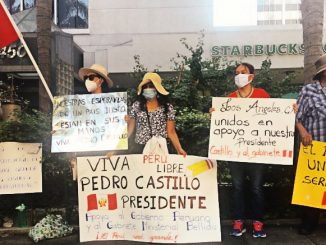
“Why do I support Professor Castillo? Because he is clear about the constitutional reforms that the country requires, and many of these reforms affect the interests of the great economic powers that today are entrenched in the State, in collusion with the corrupt governments in power”, says Carlos Manchego, behind a banner that reads: Ica Region Campaign Command.

Manchego is in Lima together with a group of people from the city of Chincha, in the province of Ica. They are not the only ones: delegations from various parts of the country arrived in the capital, in defense of Pedro Castillo’s presidential victory.

“The people are self-convening using their own resources to support Castillo and implement the ideas and reforms he intends to make in favor of the Peruvian people”. Manchego expects Castillo to speak from the balcony of what is known as the teacher’s house, where he has already spoken on several occasions since the vigil began, on the very night of the elections, June 6.

This time there is more celebration than on previous nights: the National Office of Electoral Processes (ONPE) has finished counting 100% of the votes and Castillo won over Keiko Fujimori. The professor, as he is popularly called, obtained 50.12%, 44,058 votes more than his opponent.

Castillo won, but the dispute over the result is not yet over, something that is perceived among those who are, once again, mobilized. The National Jury of Elections (JNE) has yet to declare victory, which is why another group of people stand outside the headquarters of the electoral power.

“I ask the electoral authorities that once and for all they stop dragging their feet to continue causing anxiety to the Peruvian people and respect the will of the people”, says Castillo from the balcony, with his characteristic white hat, in another night of fireworks, vuvuzelas, red and white flags with the pencil of the presidential campaign.

What is missing to proclaim Pedro Castillo president

“In practical terms Pedro Castillo is the president of Peru, in absolutely formal terms it remains for the electoral authority to resolve the nullity requests presented by Keiko Fujimori and proceed with the proclamation,” explains Ronald Gamarra, human rights defender, lawyer and former anti-corruption prosecutor, in conversation with Sputnik.

Fujimori complained of the existence of a “planned and systematic” fraud since Monday night, June 7. She said that Peru Libre, the party for which Castillo ran, had carried out “fraud at the polling station”, altering the voting records through different methods. The denunciation was followed by the presentation of a request for annulment of hundreds of minutes before the JNE and their evaluation in the National Juries of Elections (JEE) by regions.

“The fujimorismo has presented 942 requests for the nullification of polling stations, of which 803 have been rejected, 753 for being inappropriate and 50 for being unfounded, the resolutions of various JEE have the same conclusion, the nullification requests are not appropriate”, explained Gamarra on Wednesday, June 16.

The strategy of Fujimorismo “seems to be a game of lawyers and the presentation of appeal after appeal after appeal,” he affirms. “These nullities that have already been initially resolved may be subject to appeal before the JNE, and I have no doubt that this would not end there, but that fujimorismo is going to try to file other legal actions, to question the decisions of the JNE or to disregard the election of the president.”

According to the lawyer “there is no way for the results to be altered, Pedro Castillo is the president of Peru, period”. So far, Fujimori’s claims of fraud have been proven false: “They have no basis and the JNE is going to clarify this”.

Of the 733 JEE resolutions on the requests for the nullity of polling stations presented by Keiko -all of them rejected-, the Fujimori party has appealed 160 of them.

The electoral body did not state when this announcement could take place. “There is no determined deadline (…) we are not talking about the presentation of one or two appeals, we would be talking in principle of hundreds of challenges, and that is impossible for a court of justice to handle, at least not in terms of the nearest deadlines, this would have to lead the JNE to look for ways to accumulate cases, resolve them by subject, grounds and arguments.”

Fujimori’s strategy will surely be to question the JNE’s final resolution, as part of the strategy of not recognizing the democratic result and prolonging a dangerous crisis.

Escalation of tension

The delay of the results is taking place in a climate of tension, with mobilizations of both those who defend Castillo’s victory and those who maintain the existence of a fraud to Fujimori’s detriment.

“I am here to prevent communism from coming to power, brother. There has been fraud since the first round, Fuerza Popular is claiming to annul 800 precincts, if they annul 400 precincts, Keiko wins. My opinion is that there should be general elections again, the evidence has been shown on television”, said Eduardo Porras in the event organized by Fujimori before the announcement of the ONPE results.

The presidential candidate, once again, did not recognize her defeat and called on her followers to resist. “The most important thing is still to be done, the evaluation of the pending reports that the JNE has (…) the more than 800 with nullity requests”, she affirmed.

The idea of new elections has been installed among those who denounce that there was fraud. Kathy Justo, another Fujimori supporter, supports the same idea: “I think there is a lot of fraud, they have been doing it since the first round, there is a lot of evidence, the votes are not as they should be, everything has been arranged by President Vizcarra who arranged the president of the ONPE to carry out this fraud. Both elections should be invalidated and there should be new elections”.

The call to disregard the result has meant an escalation of increasingly worrying actions on the part of Fujimorismo. The house of the president of the JNE, Jorge Salas, has been under siege, and in several major media the speeches have openly called for a coup d’état.

This is serious, the extreme right no longer hides its intentions and is calling for a coup d’état. But Butters is such a coward that he does not dare to lead the takeover of the Government Palace.

What they do in Willax is a crime. Let’s see if the @FiscaliaPeru does something. pic.twitter.com/S2ON0oVRsI
– No to Keiko (@noakeikope) June 15, 2021

In this context, the Armed Forces issued two communiqués in the span of a week, to reaffirm their adherence to the constitutional order, and the ONPE used its Twitter account to deny false news aimed at propagating the matrix of fraud. The Council of State, for its part, issued a statement on Tuesday, headed by the signature of President Francisco Sagasti, calling for “respect for State institutions and dissenting opinions” and opposing the promotion of “forms other than” elections to “access power.”

We share the Declaration of the Council of State 03-2021. pic.twitter.com/zKzvLnCMuN
– Presidency of Peru (@presidenciaperu) June 16, 2021.

Awaiting the outcome

Those backing Castillo have called for a national mobilization for Saturday, June 19, under the slogan “For the defense of democracy and the homeland, no to the coup! It will be a new demonstration of support for the victory of the man who won under the slogan “no more poor people in a rich country”, and the call to carry out a constituent process to put an end to the 1993 Constitution written under the presidency of Alberto Fujimori, who laid the foundations of the neoliberal model.

This scenario of mobilizations, protests, escalation of actions on the part of Fujimorism, could continue until the announcement of the JNE and beyond, in the event that Keiko Fujimori’s strategy is to continue ignoring the results. The defeated candidate also faces a trial for money laundering that could result in thirty years in prison. “As they say in Lima, either she is president or she is a prisoner”, says Gamarra.

The pro-Fujimori strategy has the country on standby and on alert, foreshadowing what will surely be an attack on the government to be headed by Castillo as of July 28, the day of the inauguration.

“Castillo’s government is going to be precarious in the sense that he does not have a majority in Congress, but rather he has a parliament against him, I believe he could not comfortably carry out his mandate if the shadow of fraud weighs on him”, says Gamarra.

The lawyer is concerned about the social impacts of the current confrontation. “Peru is now a sum of fractures, and the latest one has been added to the existing ones,” he explains. The political divisions expressed throughout these days are a reflection of multiple cleavages, between Lima and the province, between social classes, racism, something that the voting map of June 6 clearly expressed in some points: Fujimori won with around 70 and 80% in wealthy areas of the capital; Castillo, with 70 and 80% in Andean areas.

This new fracture has had yet another effect: it has made evident once again who Keiko Fujimori, Fujimorismo, is, after her campaign with speeches of repentance for past mistakes and promising guarantees of democratic conduct. Thus, she is now opposed not only by those who voted for Castillo and those who were previously part of the anti-Fujimorism in the country, but also people who, having voted for her in fear of a Castillo government, are now disappointed by her refusal to respect the democratic will.

Translation by Internationalist 360°

Strugglelalucha256


Who’s Behind the Coup in Peru?

Pedro Castillo of the Perú Libre party has already begun to receive congratulations from around the world. It is beyond doubt that he won the June 6 presidential election. The Peruvian electoral authority, ONPE, announced the final results: Castillo won 50.127 percent of the vote (8.84 million votes), while his opponent in the second round, Keiko Fujimori of Fuerza Popular, won 49.873 percent (8.79 million votes). This is with 100 percent of the votes. By all accounts, Fujimori has lost the election.

However, Fujimori—the candidate of the right—has refused to concede. In fact, she has hired the very best of Peru’s legal minds to challenge the election results. Within hours of the election tallies being available, Fujimori’s team filed 134 challenges within the window of opportunity; they have another 811 challenges in hand. Anyone who knows the Peruvian legal fraternity will realize that some of the most important names are on the Fujimori roster: Echecopar; Ghersi; Miranda & Amado; Payet, Rey, Cauvi, Pérez; Rodrigo, Elías & Medrano; Rubio Leguía Normand; and Rebaza, Alcázar & De Las Casas. In Lima alone, the team had more than 30 lawyers at work. The Fujimori team had assembled these lawyers before the vote, anticipating the possibility of a Castillo victory and the need to tie him up in the courts. The white-collar legal army put in place a racist lawfare strategy; their entire game has been to invalidate the votes that are at the core of Castillo’s support base, namely the Indigenous communities of Peru.

The United States appointed a new ambassador to Peru. Her name is Lisa Kenna, a former adviser to former U.S. Secretary of State Mike Pompeo, a nine-year veteran at the Central Intelligence Agency (CIA), and a U.S. secretary of state official in Iraq. Just before the election, Ambassador Kenna released a video, in which she spoke of the close ties between the United States and Peru and of the need for a peaceful transition from one president to another. The “presidential transition sets an example for the whole region,” she said, as if anticipating a serious challenge. If anyone would know about interference in the electoral process in Latin America, it would be the United States.

It would also be key members inside the team of Keiko Fujimori, such as Fernando Rospigliosi. Rospigliosi, a former interior minister under President Alejandro Toledo, joined the Fujimori team for just this kind of contest (for years, Rospigliosi had been very critical of the crimes committed by Fujimori’s father, President Alberto Fujimori, who is now serving a prison sentence). Working with the U.S. Embassy is on the resume of Rospigliosi. In 2005, the former left-leaning military officer Ollanta Humala was set to enter the presidential race in April 2006. Every indication suggested that Humala, who had attempted a coup against Keiko Fujimori’s father President Alberto Fujimori in 2000, has mass support. Some even thought that Humala would follow both Hugo Chávez of Venezuela and Evo Morales of Bolivia to draw Peru leftward. In that period, Rospigliosi went to the U.S. Embassy to seek support in preventing a Humala victory in 2006.

On November 18, 2005, Rospigliosi and ex-Director of National Defense Rubén Vargas came for lunch to the embassy. They offered their “concern over prospects that ultranationalist Ollanta Humala is establishing himself as a political force to be reckoned with.” Rospigliosi and Vargas both worked for an NGO called Capital Humano y Social (CHS), which was under contract with the U.S. government’s Law Enforcement and Narcotics Affairs Section (NAS). Both Rospigliosi and Vargas asked the U.S. Embassy to urge their communications contractor Nexum to “monitor coverage of Humala and promote anti-Humala news and commentary in the coca regions.” They wanted the U.S. Embassy to use its considerable resources to undermine Humala. These are old-fashioned dirty tricks.

The United States was worried about Humala, about his statements against the U.S. military presence in Peru and his ties to Hugo Chávez. What Rospigliosi and Vargas said to the U.S. Embassy pleased the U.S. Humala lost the election in 2006. He would win in 2011, beating Keiko Fujimori; but by 2011, Humala had established himself as a candidate of the neoliberals, someone who the United States saw as harmless and useful. On May 19, 2011, Humala signed a text that yoked him to the neoliberal agenda (“Compromiso en Defensa de la Democracia”). At the gathering, he was blessed by Peru’s right-wing godfather, the novelist Mario Vargas Llosa.

Vargas Llosa is a key figure here, using the prestige of his 2010 Nobel Prize in literature as weight. As results came in that Pedro Castillo has swept rural Peru, Vargas Llosa disparaged voters in the rural areas; he warned that Peru would become like Venezuela and that it would be a catastrophe for Peru. Marinated in the bile of racism, Vargas Llosa joined other intellectuals of the extreme right to belittle the Peruvian working class and peasantry, hoping that such remarks would give sufficient cover to the coup process underway inside the ONPE.

Everything seems prepared: the U.S. ambassador with CIA credentials, a dirty tricks man with a habit of going to the embassy for help and with a record of asking the United States to malign the left, a grand old man with an allergy to his own people, and a candidate whose father was backed by the oligarchy when he conducted a self-coup in 1992.

Pedro Castillo continues to hold the streets. The crowds will gather. They do not want their election to be stolen. But there is fear in Peru. Darker forces swirl about. Will the people be able to defeat them?

This article was produced by Globetrotter.

José Carlos Llerena Robles is a popular educator, member of the Peruvian organization, La Junta, and representative of the Peruvian chapter of Alba Movimientos.

Vijay Prashad is an Indian historian, editor and journalist. He is a writing fellow and chief correspondent at Globetrotter. He is the chief editor of LeftWord Books and the director of Tricontinental: Institute for Social Research. He is a senior non-resident fellow at Chongyang Institute for Financial Studies, Renmin University of China. He has written more than 20 books, including The Darker Nations and The Poorer Nations. His latest book is Washington Bullets, with an introduction by Evo Morales Ayma.

Strugglelalucha256


Fanmi Lavalas condemns the PHTK death squad government in Haiti

Haiti Action Committee is honored to publish this statement from Fanmi Lavalas, the people’s party in Haiti. The statement was issued as a delegation from the Organization of American States (OAS) descended upon Haiti to prop up the illegitimate regime of Jovenel Moise, a government that has left Haiti shattered in every way.  Fanmi Lavalas exposes the sordid history of the OAS in Haiti and calls for continued popular mobilization as the only answer to the terror being inflicted upon the population by the current regime.

We hope you will read this statement and circulate it widely.
Unofficial English translation by Haiti Action Committee
Fanmi Lavalas Political Organization sends our deepest sympathy to all the victims of shootings by the legal bandits of the PHTK government in … Site Soleil, Bele, Delma 2, Delma 4, Delma 6, Matisan, Fontamara … and other communities. Fanmi Lavalas condemns the PHTK death squad government that has been using all means to terrorize a population that is steadfast and determined in its demand for a different form of government.
In the past ten years, the PHTK regime has completely devastated the country. The country’s institutions are non-functional: there is no public safety, no hospital, no food, no employment, no school – and the economy has collapsed as these criminals have kidnapped the people’s government while working in association with gangs to keep the population in miserable conditions. The people’s blood continues to be spilled!
Despite large mobilizations and massive demonstrations that have taken place in the country, there is still a segment of the international community that has not stopped supporting the anti-Haitian project of the PHTK. From 1990 to the present, the OAS (Organization of American States) has never worked in the interest of the Haitian people. We cannot forget the involvement of the OAS in the electoral coups d’etat of 2011 and 2017. We cannot forget their criminal silence as two coups d’etat overthrew a president who the people had democratically elected.
The declaration of the Secretary-General of the OAS Luis Almagro, supporting the extension of the so-called mandate of the indicted one* and backing the unconstitutional referendum, clearly shows that the OAS does not respect the constitution of the country nor the Haitian people.
It is clear that no OAS mission can have any credibility in resolving the crisis that is presently gripping the country.
Fanmi Lavalas Political Organization will continue to stand with the Haitian people in the struggle to overturn the cauldron. Mobilizations must continue in all forms throughout the country. Continuous mobilization is the people’s method of Self-Defense that will lead to a resolute transition to break with this rotten system that is at its end. We can then put in place the foundations of a new model of the state, with a government of “sali piblik” (public safety) to guarantee that the will of the people is respected.
The Executive Committee of Fanmi Lavalas

Dr. Maryse Narcisse

Mr. Joel-Edouard Vorbe

Dr. Myrto Julien
Agr. Anthony Dessources


Strugglelalucha256


Pedro Castillo: The man from Peru made invisible

Peru is experiencing a historic moment. Pedro Castillo, a man from the invisible country, rural, poor, with a white hat and a rising leadership, may become the next president. This is indicated by the numbers that the National Office of Electoral Processes (Onpe) releases every half hour and that everyone follows on radios, televisions, social networks, seeing how Castillo, progressively, is placed ahead of his opponent, Keiko Fujimori, who remains with little chance of victory.

The trend appears to be difficult to reverse. Fujimori affirmed on Monday night that the votes from abroad could “even out” the result, and complained about the existence of “indications of fraud at the polling stations (…) planned and systematic”. The announcement of the Fuerza Popular candidate occurred when Castillo was ahead of her by 90,000 votes, with 94.47% of the tallies, both in Peru and abroad, counted.

This is not just another election: the result will determine not only who will be the next president, but also what kind of economic and political model will be built and what conflicts there will be in a country in a prolonged political crisis. Castillo, who during the first electoral round was in the “others” category in the electoral polls, and was known centrally for his leadership in the 2017 teachers’ strike, emerged as a product of that crisis and his successes.

The transcendence of the election was clear since it was known that the peasant teacher, candidate of the Peru Libre party, but without coming from its structure, was going to face Fujimori. The threat perceived by the Peruvian status quo, the business and media powers, the right-wing parties, was proportional to the campaign of fear, often terror, that was deployed against Castillo and what a government under his presidency would mean.

The deployment against the leftist candidate was overwhelming, in the context of a country with a strong media concentration in the hands of the El Comercio group and allied media. The main newspapers and television channels began to affirm day after day that his victory would lead the country to communism, an economic crisis, with an increase in the dollar, unemployment, theft of savings, massive expropriations. That threat, in the scenario of a country hit by pandemic and recession, was joined to another threat: the possible links that would exist between Castillo and terrorism.

The latter sought to activate the mechanisms of fear, trauma and pain anchored in Peruvian society, in a different way in the interior of the country than in the capital, Lima. Castillo was terruqueado, a word used in Peruvian politics to accuse someone of being a terruco, that is, a terrorist or close to the Shining Path. The fear device thus sought to link the presidential candidate with the economic crisis and violence, two deep-seated ghosts of recent Peruvian history.

The media campaign of fear was accompanied by a process of building a democratic and maternal image of Keiko Fujimori. One of the most symbolic expressions of this operation was the role played by Mario Vargas Llosa in actively supporting Fujimori. The Nobel literature laureate completely reversed his thirty-year stance. In 2016, for example, when Keiko Fujimori reached the second round and finally lost by 40,000 votes to Pedro Pablo Kuczynski, he stated: “Keiko Fujimori is Fujimori, everything that Fujimori represented is alive in Keiko Fujimori’s candidacy and it would be a great vindication of one of the most corrupt and bloody dictatorships we have had in the history of Peru”.

One of the highlights of this turn of events occurred during Fujimori’s closing rally on Thursday before the elections. There, amidst repetitions of the campaign refrain “today we face a serious threat, we have to win against communism”, Alvaro Vargas Llosa, Mario’s son, took the stage to embrace Keiko and affirm that “the cause of freedom today is Keiko Fujimori”.

The media violence, as well as the unification of historically opposed actors, was a reflection of the perceived threat of a possible victory of Castillo, who arrived with a central proposal: to re-found the country through a constituent process. Peru Libre’s candidate brought to the table the need to dismantle the Constitution drafted in 1993 under Alberto Fujimori and recover sovereignty over strategic mining and energy resources, central to the Peruvian economy.

The speed with which his leadership emerged can be explained by the existence of a deep social discontent in the economic and political spheres. One of the latest events that evidenced this situation were the massive mobilizations in November, which took place after the impeachment of President Martin Vizcarra by Congress, followed by the appointment of Manuel Merino as head of the Executive. The latter remained in office for five days until he resigned due to the magnitude of the protests.

This event revealed three central elements. First, the political, partisan and institutional decomposition in a country where all presidents since 2001 have been accused of corruption -as well as Keiko Fujimori-, and the previous one, Alberto Fujimori, was sentenced to 25 years of imprisonment for crimes against humanity. Secondly, the magnitude of a mobilization that had not been seen in Lima since the march against Fujimori in 2000. Thirdly, the lack of organization of those who mobilized, the lack of capacity of unions, parties and movements in the country.

The leadership of the person leading the polls and who could be the next president emerges from this political context, and in a situation of profound social inequality between the provinces and the capital, and within Lima itself, as shown, for example, by the contrast between the area of Miraflores and the hills of Villa María del Triunfo.

The dimension of what is at stake could influence the time for an official result to be announced. Fujimori’s accusation of fraud, predictable in case of an adverse result as the one presented throughout the recount, could affect this process. As for Castillo, who is in Lima, he has mobilized popular support, something that could be decisive in the event of an arm wrestling match for the final result to be announced.

Translation by Internationalist 360°

Strugglelalucha256
https://www.struggle-la-lucha.org/around-the-world/page/54/