Afghan resistance ends U.S. occupation

Members of the Solidarity Party of Afghanistan protest against the U.S.-led invasion of Afghanistan ahead of its 16th anniversary in Kabul on Oct. 6, 2017.

The long and brutal U.S. imperialist war in Afghanistan is coming to a chaotic, inglorious end. For 20 years, the people of Afghanistan resisted the U.S. occupation and today the puppet government and its phony army has completely collapsed and practically disappeared. 

The Kabul airport is packed with up to 6,000 U.S. officials and expats, Afghan people who collaborated with the occupation, and presumably some of the thousands of mercenaries that the U.S. hired while privatizing the war. 

The Taliban, which claimed the victory, has announced that it will allow safe passage for those departing the country until Aug. 31. U.S. aircraft have begun ferrying people out. U.S. journalists are fretting that it’s not enough time, lecturing the Taliban to respect human rights and hypocritically predicting all manner of brutality.

The Biden White House announced in the spring that the remaining 2,500-to-3,500 U.S. troops would be withdrawn (no mention at the time of the some 6,000 so-called NATO troops or the thousands of mercenaries the big media call “contractors”). 

As the withdrawal began, Biden kept sending more troops — 6,000 as of August 19 — to the airport. Presidents Obama and Trump had each announced a withdrawal. They both delayed and went along with an over-optimistic Pentagon fabrication of the prospects for an imperialistic victory.

Collapse of the puppet army, government

As the drawdown of troops began last week, by August 14, the Taliban had 21 of 34 provincial capitals under their control. Only three of the bigger cities — Kabul, Jalalabad and Mazar-i-Sharif — were not yet in Taliban hands. When they ultimately took control of Kabul, the U.S. media feigned shock at the speed of the Taliban’s return to Kabul.  

But an Aug. 15 article in the Washington Post revealed that in the ruling circles of imperialism, they were aware that they had a “morale problem.” Afghan government soldiers could not be relied on to fight the Taliban on behalf of U.S. imperialism. 

More than a year ago, Taliban representatives began offering amnesty-for-surrender deals to Afghan puppet government troops, officers, and village officials throughout the country. Repeatedly, Afghan government troops were handing over U.S.-provided weapons and equipment – no shots fired. The Taliban let the soldiers trained and armed by the U.S. simply walk away. 

The transition happened first in rural villages, then districts, then provincial capitals. In April of this year, when Biden announced that the withdrawal deadline was being sped up from Sept. 11 to Aug. 31, the pace of the surrenders quickened. 

Then, on Aug. 15, a few days after Afghan President Ghani gave a speech brimming with confidence about his government’s prospects for fending off any Taliban assault, reports surfaced that he had fled the country. Video of Taliban figures sitting at his desk in the presidential palace appeared. There had been no resistance by the Afghan military. 

This year-long process of surrender by Afghan troops couldn’t have been investigated in so much detail by the Washington Post in the last couple of days. Imperialists and savvy journalists have known that a pro-imperialist government could not survive on its own. The choice was between continuing an unpopular war and occupation (getting little in return), or ending it.

For twenty years, the imperialist U.S. military installed successive puppet governments, headed by U.S. cronies such as CIA asset Hamid Karzai, or Columbia University educated Ghani (who, ironically, wrote a book titled “Fixing Failed States.”) None of them had anything to offer that could improve the lives of impoverished people, rebuild infrastructure, or provide health care, education or housing. None of them had a base of support among the Afghan people.

A long history of Afghan resistance

There is a long history of Afghan independence and determination. In the middle of the 19th century, the Afghan people annihilated the formidable private army of the British East India Company and held off imperialist domination. 

The example of the 1917 revolution lifting the impoverished Central Asian nations formerly oppressed by the Czars of Russia influenced neighboring Afghanistan. Between 1921 and 1929 the two countries signed a Friendship Treaty and embarked on projects to help develop Afghanistan with power generation, water resources, transportation and communications. The projects were later abandoned with a government change. 

Even during the four decades of the last King of Afghanistan who was overthrown in 1973, there was a respectful relationship between the USSR and Afghanistan. The 1978 Saur Revolution that brought socialist leaders to power was an expression of growing sentiment among youth and students in Kabul and other cities for socialism. 

The People’s Democratic Party of Afghanistan (PDPA) took over with support from a substantial part of the Afghan military. Immediately they worked to eliminate the crushing debt agricultural workers owed to feudal landlords, build up womens’ rights and workers’ rights, along with other progressive initiatives. 

The CIA’s Operation Cyclone cut their progress short. The spy agency recruited among the most reactionary fundamentalists from the region to build the mercenary mujahedeen army to overthrow the April Revolution. Later, in the 1990s, the Taliban emerged from among the mujahedeen forces that dominated Afghanistan. 

From the time that the CIA launched Operation Cyclone in 1979, until the current retreat of U.S., NATO, and mercenary troops, the U.S. imperialists have been trying to impose a pro-imperialist government on an anti-imperialist population. 

The U.S. war leaves in its wake cities crowded with internal refugees — families who lost homes or fled the warfare to save their lives. Officially, nearly 71,334 Afghan civilians and nearly 70,000 Afghan police and military were killed directly by the war. About 7,500 U.S. soldiers, NATO troops and mercenaries died. More than 50,000 Taliban were killed. Nearly 500 journalists and aid workers perished.

U.S. banks, military contractors made a fortune

Military contractors and big U.S. banks, though, made a fortune during the war. In the past, taxing the rich to pay for war expenditures wasn’t out of the question. An Aug. 17 Associated Press article noted that U.S. President Harry Truman temporarily raised top tax rates by 92% and President Lyndon Johnson by 77% to pay for the horrors of the U.S. wars against the Korean people and the Vietnamese people. 

Today’s billionaires are bigger and more privileged than ever. Lawmakers no longer even hint that U.S. corporations should pay for the wars that bolster the fortunes of the capitalists as a class. Instead, the U.S. has debt-financed the $2 trillion used for the mayhem and murder in Afghanistan. 

Taxes on the rich have been practically eliminated. The U.S. Treasury will be paying the banks for the war on Afghanistan at least until 2050. With interest added, the Treasury will have shelled out some $6.5 trillion in costs. This amount doesn’t even include a portion of the $2 trillion the U.S. has committed to pay in health care, disability or burial costs for the millions of veterans that were hoodwinked into taking part in the dirty imperialist wars against Iraq or Afghanistan. 

The U.S. war on Afghanistan was another tragic setback for humanity. The task for anti-imperialist organizers — especially in the United States — is to make it the last.

Strugglelalucha256


Washington spent more than $2 trillion on a war that it knew could not be won

On August 15, the Taliban arrived in Kabul. The Taliban’s leadership entered the presidential palace, which Afghan President Ashraf Ghani had vacated when he fled into exile abroad hours before. The country’s borders shut down and Kabul’s main international airport lay silent, except for the cries of those Afghans who had worked for the U.S. and NATO; they knew that their lives would now be at serious risk. The Taliban’s leadership, meanwhile, tried to reassure the public of a “peaceful transition” by saying in several statements that they would not seek retribution, but would go after corruption and lawlessness.

The Taliban’s entry in Kabul is a eefeat for the United States

In recent years, the United States has failed to accomplish any of the objectives of its wars. The U.S. entered Afghanistan with horrendous bombing and a lawless campaign of extraordinary rendition in October 2001 with the objective of ejecting the Taliban from the country; now, 20 years later, the Taliban is back. In 2003, two years after the U.S. unleashed a war in Afghanistan, it opened an illegal war against Iraq, which ultimately resulted in an unconditional withdrawal of the United States in 2011 after the refusal by the Iraqi parliament to allow U.S. troops extralegal protections. As the U.S. withdrew from Iraq, it opened a terrible war against Libya in 2011, which resulted in the creation of chaos in the region.

Not one of these wars—Afghanistan, Iraq, Libya—resulted in the creation of a pro-U.S. government. Each of these wars created needless suffering for the civilian populations. Millions of people had their lives disrupted, while hundreds of thousands of people lost their lives in these senseless wars. What faith in humanity can now be expected from a young person in Jalalabad or in Sirte? Will they now turn inward, fearing that any possibility of change has been seized from them by the barbaric wars inflicted upon them and other residents of their countries?

There is no question that the United States continues to have the world’s largest military and that by using its base structure and its aerial and naval power, the U.S. can strike any country at any time. But what is the point of bombing a country if that violence attains no political ends? The U.S. used its advanced drones to assassinate the Taliban leaders, but for each leader that it killed, another half a dozen have emerged. Besides, the men in charge of the Taliban now—including the co-founder of the Taliban and head of its political commission, Mullah Abdul Ghani Baradar—were there from the start; it would never have been possible to decapitate the entire Taliban leadership. More than $2 trillion has been spent by the United States on a war that it knew could not be won.

Corruption was the Trojan Horse

In early statements, Mullah Baradar said that his government will focus its attention on the endemic corruption in Afghanistan. Meanwhile, stories spread across Kabul about ministers of Ashraf Ghani’s government attempting to leave the country in cars filled with dollar bills, which was supposed to be the money that was provided by the U.S. to Afghanistan for aid and infrastructure. The drain of wealth from the aid given to the country has been significant. In a 2016 report by the U.S. government’s Special Inspector General for Afghanistan Reconstruction (SIGAR) relating to the “Lessons Learned from the U.S. Experience with Corruption in Afghanistan,” the investigators write, “Corruption significantly undermined the U.S. mission in Afghanistan by damaging the legitimacy of the Afghan government, strengthening popular support for the insurgency, and channeling material resources to insurgent groups.” SIGAR created a “gallery of greed,” which listed U.S. contractors who siphoned aid money and pocketed it through fraud. More than $2 trillion has been spent on the U.S. occupation of Afghanistan, but it went neither to provide relief nor to build the country’s infrastructure. The money fattened the rich in the United States, Pakistan, and Afghanistan.

Corruption at the very top of the government depleted morale below. The U.S. pinned its hopes on the training of 300,000 soldiers of the Afghan National Army (ANA), spending $88 billion on this pursuit. In 2019, a purge of “ghost soldiers” in the rolls—soldiers who did not exist—led to the loss of 42,000 troops; it is likely that the number might have been higher. Morale in the ANA has plunged over the past few years, with defections from the army to other forces escalating. Defense of the provincial capitals was also weak, with Kabul falling to the Taliban almost without a fight.

To this end, the recently appointed defense minister to the Ghani government, General Bismillah Mohammadi, commented on Twitter about the governments that have been in power in Afghanistan since late 2001, “They tied our hands behind our backs and sold the homeland. Damn the rich man [Ghani] and his people.” This captures the popular mood in Afghanistan right now.

Afghanistan and its neighbors

Hours after taking power, a spokesperson for the Taliban’s political office, Dr. M. Naeem, said that all embassies will be protected, while another spokesperson for the Taliban, Zabihullah Mujahid, said that all former government officials did not need to fear for their lives. These are reassuring messages for now.

It has also been reassuring that the Taliban has said that it is not averse to a government of national unity, although there should be no doubt that such a government would be a rubber stamp for the Taliban’s own political agenda. So far, the Taliban has not articulated a plan for Afghanistan, which is something that the country has needed for at least a generation.

On July 28, Taliban leader Mullah Baradar met with Chinese Foreign Minister Wang Yi in Tianjin, China. The outlines of the discussion have not been fully revealed, but what is known is that the Chinese extracted a promise from the Taliban not to allow attacks on China from Afghanistan and not to allow attacks on the Belt and Road Initiative (BRI) infrastructure in Central Asia. In return, China would continue its BRI investments in the region, including in Pakistan, which is a key Taliban supporter.

Whether or not the Taliban will be able to control extremist groups is not clear, but what is abundantly clear—in the absence of any credible Afghan opposition to the Taliban—is that the regional powers will have to exert their influence on Kabul to ameliorate the harsh program of the Taliban and its history of support for extremist groups. For instance, the Shanghai Cooperation Organization (set up in 2001) revived in 2017 its Afghanistan Contact Group, which held a meeting in Dushanbe in July 2021, and called for a national unity government.

At that meeting, India’s External Affairs Minister Dr. S. Jaishankar laid out a three-point plan, which achieved near consensus among the fractious neighbors:

“1. An independent, neutral, unified, peaceful, democratic and prosperous nation.

“2. Ceasing violence and terrorist attacks against civilians and state representatives, settle conflict through political dialogue, and respect interests of all ethnic groups, and

“3. Ensure that neighbors are not threatened by terrorism, separatism and extremism.”

That’s the most that can be expected at this moment. The plan promises peace, which is a great advance from what the people of Afghanistan have experienced over the past decades. But what kind of peace? This “peace” does not include the rights of women and children to a world of possibilities. During 20 years of the U.S. occupation, that “peace” was not in evidence either. This peace has no real political power behind it, but there are social movements beneath the surface that might emerge to put such a definition of “peace” on the table. Hope lies there.

This article was produced by Globetrotter. Vijay Prashad is an Indian historian, editor and journalist. He is a writing fellow and chief correspondent at Globetrotter. He is the chief editor of LeftWord Books and the director of Tricontinental: Institute for Social Research. He is a senior non-resident fellow at Chongyang Institute for Financial Studies, Renmin University of China. He has written more than 20 books, including The Darker Nations and The Poorer Nations. His latest book is Washington Bullets, with an introduction by Evo Morales Ayma.

Strugglelalucha256


Haiti needs aid not intervention!

Stop the deportations!

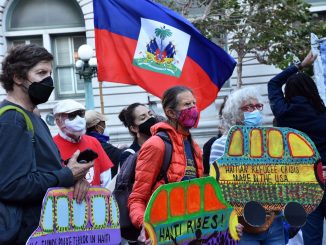
Over 1,400 people were killed by the 7.2 magnitude earthquake that struck Haiti Aug. 14. Thousands more may have died. At least 30,000 families were made homeless.

This misery was compounded by Tropical Storm Grace that struck the country shortly afterwards. The tragedy comes 11 years after the Jan. 12, 2010, earthquake that killed over 220,000 people in Port-au-Prince, Haiti’s capital.

People around the world want to help Haiti. Yet the Biden administration deported two planeloads of Haitians in the week before the earthquake.

Justice demands that deportations of Haitians be stopped. Temporary Protected Status (TPS) of Haitians must be made permanent.

The earthquake and storm comes in the wake of the July 7 assassination of Haiti’s President Jovenel Moïse. The murder involved mercenaries from Colombia and may have been planned from within the United States.

Haiti needs aid but it doesn’t need or want foreign intervention. The United States invaded Haiti in 1915 and occupied the country until 1934.

Thousands of Haitians were killed, including resistance leader Charlemagne Péralte. The U.S. Marine who assassinated Péralte was given the congressional medal of honor.

The 2004-2017 UN intervention in Haiti resulted in over 10,000 Haitians dying from 
cholera. This occupation followed the overthrow of Haiti’s democratically elected President Jean-Bertrand Aristide by U.S. President George W. Bush and the CIA.

The world capitalist class have never forgiven the Haitian people for conducting the only slave revolution in history. Every slave master in the United States feared enslaved Africans rising up in another “another Haiti.”

It was Haiti that gave crucial aid to the “Liberator of America,” Simón Bolívar.

Two hundred thirty years of revenge followed. The restored Bourbon monarchy in France actually demanded reparations for the slave masters! Haiti was forced to pay this blood money until 1947.

Haiti deserves aid and reparations, not another U.S. or UN military  intervention. Genuine aid is being given to earthquake survivors by medical workers from socialist Cuba.

Haitians in the United States are also collecting aid. Please contact the Family Action Network Movement in Miami at info@fanm.org or call 305-756-8050 if you can help.

Reparations for Haiti!

Strugglelalucha256


Sports sovereignty in Puerto Rico

Translated by Walter Lippmann for CubaNews.

A few days ago, athlete Jasmine Camacho-Quinn won a gold medal for PR in the 100-meter hurdles at the Tokyo Olympics.

You may wonder how, being a colony of the USA, PR has its own Olympic Committee.

The Olympics and politics always go hand in hand and the existence of this Committee exposes the contradictions of a colony where although there are forces that want to turn us into a state of the empire, the cultural and national identity reflected in sports is much stronger.

The origin of our Olympic participation dates back to 1948 in a very complex socio-political context. At that time, a Puerto Rican delegation traveled to London to claim – and win – a place for PR in the Olympics.

Jasmin’s victory in these days of so much anguish also motivated controversies that expose the prejudice that some people in this country suffer about who is truly Puerto Rican. La Altleta was born in the U.S., the daughter of a Puerto Rican and an African American, but the Puerto Rican diaspora in the U.S., whether they were born there or migrated there, is viewed by some with suspicion. The curious thing is that most Puerto Ricans, more than 5 million, live there, while in PR there are only 3.2 million.

But the interesting thing is that although she was not born in PR and does not even speak Spanish, Jasmín feels so Puerto Rican that she refused to represent the US in order to bring the triumph to PR. And as Albizu Campos said, “The nation is represented by those who affirm it, not by those who deny it”.

From Puerto Rico for RADIO CLARIN of Colombia, Berta Joubert-Ceci spoke to you.

Strugglelalucha256


Why Hiroshima and Nagasaki were incinerated

Barack Obama visited Hiroshima on May 27, 2016, the first sitting U.S. president to do so. Obama’s visit to the Japanese city revived the question of whether killing hundreds of thousands of people in Hiroshima and Nagasaki with atom bombs was a military necessity.

Dwight Eisenhower didn’t think so. The former president and five-star general wrote in his autobiography “Mandate for Change” that dropping atom bombs on Japan “was completely unnecessary.” Ike claimed that he said this to War Secretary Henry Stimson.

General Curtis LeMay told a Sept. 20, 1945, news conference, “The atomic bomb had nothing to do with the end of the war at all.” Even President Truman declared that dropping the bombs “did not win the war.” (“Hiroshima in America, Fifty Years of Denial” by Robert Lifton and Greg Mitchell)

A big reason why Japan surrendered was that the Soviet Army and Mongolian, Korean and Chinese allies rolled through northeastern China and all of Korea. This not only destroyed the biggest Japanese army but threatened a socialist revolution in Japan itself.

Yet talking heads at Fox News still claim that burning babies alive in Hiroshima and Nagasaki “saved the lives of U.S. soldiers” by averting an amphibious invasion of Japan.

Complete barbarism

After breaching the walls of a besieged city, Roman soldiers killed or enslaved every human being they could find. Even cats were sliced in two. Among their victims was the famous mathematician Archimedes, killed by a legionnaire after Syracuse in Sicily was overrun in 212 BCE (Before the Common Era).

Two thousand years later, international law was supposed to prevent such war crimes. Nazi leaders were hanged in Nuremberg for deliberately killing civilians.

But U.S. war leaders committed war crimes, too. General LeMay burned alive over 100,000 people during the March 9-10, 1945, firebombing of Tokyo.

At least 200,000 people, including thousands of children, were killed by the atom bombs dropped on Hiroshima on Aug. 6, 1945, and Nagasaki three days later. Even decades later people died from radiation-caused illnesses.

A diplomat from the Democratic People’s Republic of Korea told this writer that 30,000 of the people killed in Hiroshima were Korean forced laborers. Truman murdered these Korean workers held hostage by the Japanese emperor and big business.

President Teddy Roosevelt turned Korea over to the Japanese Empire in the 1905 peace treaty, signed in Portsmouth, N.H., that ended the Russian-Japanese war. Teddy got a Nobel Peace Prize for his crime.

People’s Korea has found it absolutely necessary to develop nuclear weapons to defend itself against the Pentagon. This is not only because of U.S. nuclear missiles aimed at Korea.

At least 4 million Koreans were killed during the Korean war. Using napalm and white phosphorous bombs on human flesh didn’t satisfy U.S. generals and politicians. Then Texas Congressperson Lloyd Bentsen can be seen in “The Atomic Cafe” demanding that atom bombs be dropped on Koreans.

This didn’t stop Bentsen from being the Democratic candidate for vice president in 1988 or from serving as President Bill Clinton’s first Treasury Secretary. Korea also remembers the Hiroshima holocaust.

The Manhattan Project’s real target

More than 100,000 workers were mobilized by the U.S. Army’s Manhattan Project to build the death bombs. At least $2 billion was spent, which, as a percentage of the U.S. economy, is equal to $180 billion today.

The excuse for the Manhattan Project was that the U.S. had to “beat Hitler” at developing the atom bomb. This was the reason given to scientists like the young physicist and future Nobel Prize winner Richard Feynman.

But the real target of the Manhattan Project was the Soviet Union. 

According to William Shirer in “The Rise and Fall of the Third Reich,” U.S. brass hats expected the Soviet Union to collapse within six weeks of Hitler’s invasion in June 1941.

A representative of Kansas City’s corrupt Pendergast Machine — Sen. Harry Truman — declared, “If we see that Germany is winning we ought to help Russia and if Russia is winning we ought to help Germany, and that way let them kill as many as possible.” (New York Times, June 24, 1941)

The Soviet Union didn’t collapse. At a cost of 27 million Soviet lives, Nazi forces were forced back from Stalingrad to Berlin. It was the Red Army of workers and peasants that liberated Auschwitz on Jan. 27, 1945.

Despite pleas from Treasury Secretary Henry Morgenthau, War Secretary Stimson refused to bomb the railroad lines to Auschwitz that took millions of people to their death.

USSR deterred nuclear war

The Manhattan Project was Wall Street’s response to the phoenix-like resurrection of the Red Army. The U.S. and British ruling classes dreaded Soviet forces marching all the way to Paris and being welcomed by workers.

Capitalists also feared a revival of the German working class who had been crushed by Hitler.

The physicist Joseph Rotblat was present when Leslie Groves the Manhattan Project’s director — admitted that the Soviets were the real target:

“General Leslie Groves, when visiting Los Alamos, frequently came to the Chadwicks for dinner and relaxed palaver. During one such conversation, Groves said that, of course, the real purpose in making the bomb was to subdue the Soviets. (Whatever his exact words, his real meaning was clear.)” 

During World War II, Time magazine publisher Henry Luce proclaimed an upcoming “American Century.” The Pentagon was planning to confront the USSR not just with the bomb, but also with military forces numbering 16 million GIs and the biggest air force in history.

This immense power was also to be used against the Chinese Revolution and as a threat to all oppressed people.

Super-racist U.S. General George Patton talked about rearming Nazi SS troops and marching to the Volga. Winston Churchill considered an invasion of the Soviet Union in “Operation Unthinkable.”

The U.S. had half the world’s industrial capacity in 1945. President Kennedy correctly noted in 1963 that the Nazi destruction of the Soviet Union would have equaled everything in the United States east of the Mississippi River being destroyed.

But the millions of GIs whom Wall Street wanted to use against the Soviet Union wanted to go home. Even though it was still a Jim Crow army, tens of thousands of soldiers demonstrated in Paris, Manila and other cities demanding to go home. This GI revolt was the greatest gift of the U.S. working class to the world revolution— and probably the least known.

Despite billions of aid lavished on Chiang Kai-shek, the Pentagon couldn’t stop the Chinese Revolution.

The only reason that a nuclear holocaust hasn’t destroyed humankind is that the Soviet Union, at tremendous cost, was able to develop a deterrent nuclear force against a Pentagon attack.

Strategic Air Command head Curtis LeMay and Chair of the Joint Chiefs of Staff Lyman Lemnitzer both wanted to launch a nuclear first strike on the Soviet Union. In 1968 LeMay was George Wallace’s running mate during the segregationist’s fascist presidential campaign.

LeMay actually had hydrogen-bomb-equipped planes continually in the air ready to attack. Inevitable crashes happened, including one off Spain’s Mediterranean coast in 1966. It took 12 weeks and over 20 naval ships to recover the bomb.

A 1958 accident dropped a Mark 15 thermonuclear bomb off the Atlantic Coast of Georgia. It has never been recovered.

That unexploded bomb is a real threat to people in the U.S., not the small number of nuclear weapons that People’s Korea needs to defend itself.

Strugglelalucha256


Why is the U.S. government targeting Nicaragua?

After learning that outright military invasions, which cost the lives of U.S. soldiers, are unpopular at home, the strategists of U.S. empire now prefer regime change through hybrid warfare: manipulation of mainstream and social media to spread disinformation; the use of non-governmental organizations (NGOs) to carry out work previously done by the CIA; and when those tactics fail, all-out economic warfare.

In Latin America, Cuba and Venezuela have borne the brunt of these efforts. But since 2018, so has Nicaragua.

The Sandinista National Liberation Front (FSLN) led the Nicaraguan Revolution of 1979. In the 1980s, it brought important reforms to this impoverished country, despite the Reagan administration’s counterrevolutionary war. Since returning to office in 2007, the FSLN has brought more prosperity to more Nicaraguans than at any time in the country’s history, with massive poverty reduction and health improvements, free education, land reform, vast infrastructure projects, and newly-respected rights for women, youth, Afro-descendants and Indigenous peoples.

However, covert and overt funding by U.S. regime-change outfits for opposition media and NGOs created a small but powerful network of enemies. These sprang to action with an attempted coup in April 2018 that interrupted the peace in one of Latin America’s safest countries.

The trigger was student protests over the unlikely issue of pension reform. The protests soon became violent as a cadre of NGO- and U.S. Embassy-trained social media influencers continued to spread fake news and bring more protesters into the streets, where they were sometimes targeted by anonymous snipers.

This tactic had been used previously in Ukraine in 2014 and in the Venezuelan guarimbas of 2014 and 2017. The Nicaraguan opposition and international corporate media narrative was that the National Police were violently repressing the people.

U.S.-funded NGOs spurred “spontaneous” but eerily identical uprisings in several cities simultaneously, while the country was bombarded with messages from social media bots (a tactic that was recently replicated in the July 2021 protests in Cuba).

Government supporters were publicly tortured and murdered, and over 200 people died in three months of violence that damaged the country’s economy, before peace was reinstated in July 2018. To preserve social peace, all those implicated in the violence benefited from an amnesty in 2019.

Since then, despite the sanctions imposed by the U.S. Congress at the end of 2018, the COVID-19 pandemic, and two powerful hurricanes that landed in Nicaragua last November, the country has been on the path to economic recovery. But now the U.S. government is planning to ratchet up the economic warfare with a packet of sanctions that “targets” over half of the population.

It is important to call out this RENACER Act as a significant escalation of economic warfare that could plunge the stable Nicaraguan economy into a long-term crisis, bringing death and deprivation to the population—especially the most vulnerable, such as children, the elderly and those with chronic health conditions—as we have seen in the 39 countries targeted by U.S. unilateral coercive measures.

More U.S. election interference 

Additionally, a USAID plot targeting Nicaragua’s November 2021 elections was leaked from the U.S. Embassy in Managua last year. It acknowledges that the FSLN may win in a fair election, in which case a “sudden transition” (coup) would have to take place.

Aware of the havoc that could be caused by the U.S.-funded NGO and media apparatus, Nicaragua’s legislature beefed up laws to protect national sovereignty from foreign interference, adding that calling for sanctions to be imposed on the country constitutes treason.

Starting in June, about two dozen opposition activists have been jailed while under investigation, many of them for repeating violations for which they had earlier received amnesty, others for money laundering of regime-change funds, and some for publicly calling for sanctions on their homeland.

Although the corporate media claims that these are presidential candidates targeted because they could defeat President Daniel Ortega in November, the fact is that none of them had a serious following or political movement behind them, and many do not even have a political party or qualify to be candidates.

There has been no outrage at their arrests among the Nicaraguan masses, who seem rather relieved that these individuals will not be allowed to repeat the chaos and violence of 2018.

Opinion polls consistently show that the FSLN enjoys more than 60% popular support. People demonstrated this by turning out in large numbers to celebrate the 42nd anniversary of the Revolution on July 19, despite the fact that no official gatherings were held due to pandemic health measures.

It seems more than likely that the Nicaraguan Revolution’s progress will continue after the Nov. 7 elections. However, those of us in the U.S. must help it flourish by stopping Washington from inflicting economic warfare on the Nicaraguan people with new sanctions.

No coup! No sanctions! No war!

Jill Clark-Gollub is a member of Friends of Latin America.

Strugglelalucha256


U.S. withdrawal from Afghanistan doesn’t mean peace

In April, President Joe Biden announced that the U.S. war in Afghanistan would finally end after 20 years of horrible imperialist destruction. Initially the idea was that the troops would pack up shop by Sept. 11, 2021 – the 20th anniversary of the 9/11 World Trade Center attack. The pace of the withdrawal was faster than anticipated, and by July 2 U.S. military personnel had put the bases at Bagram, Kandahar, Helmand and others in the rearview mirror.

The war stands out as an example of the destruction and waste wrought during the imperialist stage of U.S. capitalism. The official number of deaths of U.S. soldiers is 2,300, and by some estimates about 6,000 private contractors (mercenaries) died. With the advances in field medicine, battlefield deaths are less frequent now. But the death toll is only part of the story. 

What it doesn’t reveal are the untold numbers of young people used as pawns in an imperialist war, who in previous times would have died, but now survive and return home as amputees, trauma survivors or otherwise injured for life. 

Trillions of dollars were spent that should have been used to alleviate poverty, fight disease, build housing, bolster health care and provide education. U.S. defense contractors reaped the usual billions in profits.

The most terrible toll, however, was borne by the people of Afghanistan. Various sources project the number of deaths between 70,000 and 150,000. 

During the occupation and war, poverty increased dramatically. The most recent assessment by the Borgen Project said that 90% of Afghans struggle to survive. There are very high rates of impaired childhood growth, anemia and wasting. More than 2 million Afghani children have to work to support their families, and 58% of families are unable to afford adequate food. 

Afghanistan was already one of the poorest nations before the Pentagon invasion, but these grim facts illuminate the rapid further deterioration caused directly by the U.S. occupation and war.

Destruction began long before invasion

Twenty years is how long there were U.S. troops in Afghanistan, but the destruction actually goes back more than 40 years. 

For a short time, there was hope that there could be a better direction for Afghanistan. In April 1978, the People’s Democratic Party of Afghanistan, a socialist party, came to power. The PDPA reflected a growing fervor for socialism among young people in Kabul and other semi-urban areas. 

The Saur Revolution began when the entire party leadership was jailed by the old government. Soldiers mutinied and broke the jailed leaders out, the old U.S.-leaning government was overthrown, and hopes for a new era emerged. 

Afghanistan was largely feudal and run by powerful landlords. Among many progressive measures, the PDPA carried out a massive land reform program that wiped out debts of agricultural workers and began to redistribute land. The socialist government began literacy programs for everyone and made mandatory public education available for women.

Anahita Ratebzad, a Marxist-Leninist leader and member of the PDPA government’s Revolutionary Council, famously wrote an editorial in the Kabul Times just after the formation of the socialist government, saying: “Privileges which women, by right, must have, are equal education, job security, health services and free time … Educating and enlightening women is now the subject of close government attention.”  

In response to the progressive changes underway in 1978, the CIA embarked on what would eventually become its largest operation to date. Dubbed “Operation Cyclone,” the U.S. agency gathered up, armed and funded an opposition movement. 

The spy group recruited from among the Afghan landlords, and from countries near and far, to build a reactionary, anti-communist insurgency. President Jimmy Carter’s administration gave the green light and funding to the CIA for this destructive project in July 1978 — just 3 months after the formation of the PDPA’s socialist government.

Soon, young people, teachers and women who were taking part in the progressive transition were being gunned down in the streets. The socialist government was under siege. 

Media spread lie of ‘Soviet invasion’

Although the Western media has manipulated the timeline to say that the U.S. intervened after a “Soviet invasion,” it was actually only after the mayhem of the CIA’s Operation Cyclone took root that the PDPA government asked the neighboring Soviet Union for military assistance. 

The Soviet Union sent troops and equipment. In response, the Carter administration went full-court-press in terms of propaganda, boycotting the 1980 Olympics in Moscow, giving incensed speeches, and sending National Security Advisor Zbigniew Brzezinski to the Khyber Pass for an infamous publicity stunt, pointing towards Afghanistan with a rifle in his hand. 

It was Brzezinski who was the architect of the notion of using Afghanistan as a way of forcing the USSR into responding and becoming bogged down in a war. The continuous escalation by the U.S. over the years included providing shoulder-fired anti-aircraft Stinger missiles, enabling individuals to shoot down Soviet aircraft and helicopters on their own. 

Unlike the imperialist military and defense contractors that push for war and thrive from the destruction and tragedy, the socialist USSR took measure of the awful consequences and withdrew.  

Out of the reactionary army that the CIA cobbled together, distinct groups emerged, including the Taliban and Al Qaeda. The emergence of the Islamic States or ISIS can also be traced to that period in Afghanistan. ISIS is portrayed as an enemy of the U.S., but aided U.S. military aims in trying to destroy Syria. In a classic example of “blowback,” it was Al Qaeda that took responsibility for the Sept. 11, 2001, attack on the Pentagon and World Trade Center. 

The 2001 U.S. invasion of Afghanistan was justified by blaming the Taliban, who had seized the government in Kabul by that time, for providing a staging ground for the attack by Al Qaeda, and for “protecting” Osama Bin Laden afterward. After driving the Taliban from power, the U.S. aided Hamid Karzai, a known CIA asset, in becoming the interim head of the government, and later, president.

Devastation drags on

U.S. troops were in Afghanistan in diminishing numbers after the capture and execution of Osama Bin Laden during the Obama administration. By the time of Biden’s announcement, they numbered only 2,500. But even with a smaller troop deployment, the occupation and destruction dragged on. 

Exact numbers of private mercenaries are harder to come by. We now know that after Obama’s 2009 “surge” of an additional 33,000 troops, the number of U.S. soldiers started to go down, but they were often quietly replaced by mercenaries. 

In early 2017, the new Trump administration dropped the largest non-nuclear bomb, called the “Mother Of All Bombs” (MOAB), in a mountainous area of eastern Afghanistan. The claim was that it was meant for an Islamic State target and that 36 ISIS fighters were killed. More likely, Trump was demonstrating his “warmaker chops” to the Pentagon after having campaigned as a politician who favored less use of the U.S. military.

We also know now that a false and overly-optimistic view of the ability of the U.S. to “win” in Afghanistan was peddled by administration and military figures for years, under both Republicans and Democrats, in a repeat of what was revealed by the Pentagon Papers about the Vietnam War. The lies justified prolonging the war and caused an unknown number of deaths, injuries and destruction.

Upon Biden’s announcement of a complete withdrawal, critics cried that without the continued presence of contractors, the Afghan military would lose its ability to maintain an air force. They objected that more than 18,000 Afghan interpreters who had worked for the U.S. would be in danger – presumably because the U.S. war and occupation and anyone who collaborated is hated by the people of Afghanistan. Pro-Pentagon think tanks warned that Kabul would fall to a resurgent Taliban.

The Biden administration has pledged to fund Afghanistan’s government so it can directly pay for more private mercenaries. The U.S. has also offered to pay contractors to maintain Afghan aircraft from Qatar, and has openly pledged that if Kabul is under threat of a Taliban takeover, the U.S. will once again use airstrikes and drones to prop up the shaky, reactionary government.

This U.S. withdrawal should not be mistaken for peace. Imperialist war is in the DNA of capitalism. The four decades of horror suffered by the people of Afghanistan should never be forgotten, even as our anti-imperialist efforts turn toward defending Cuba and Haiti from the dangers of U.S. intervention.

Strugglelalucha256


U.S. crimes in Guatemala: The hypocrisy of Biden-Harris anti-migrant policy

The Biden administration began the month of June with further evidence of its policy of keeping to the Trump-era status quo, this time with immigration/migration policy. Vice President Kamala Harris was sent to Guatemala and Mexico to deliver a most disrespectful message: “Don’t come to the U.S.”

Here are some of her words that were caught on video: “I want to be clear to folks in this region who are thinking about making that dangerous trek to the U.S./Mexican border — do not come, do not come” (while shaking her head for emphasis). 

“The U.S. will continue to enforce our laws and secure our borders. There are legal methods by which migration can and should occur … but we, as one of our priorities, will discourage illegal migration, and I believe that if you come to our borders you will be turned back. … So let’s discourage our friends, neighbors, our family members from embarking on what is otherwise an extremely dangerous journey.”

In regard to the danger Vice President Harris is referring to: In 2018, after the well-publicized death of a child seeking asylum at the border, the U.S. government under the Trump administration intentionally created more dangerous conditions for crossing the border by placing border sentries on international bridges to force crossings at much more dangerous and remote spots, the British Guardian newspaper reported. 

So, the Biden administration is continuing the policies that have killed asylum seekers and their children — and they know it.

In fact, the speech sounded much like that of former Vice President Mike Pence regarding immigration. Some of the reactions to Harris’ speech, even amongst some Democrats, were critical of this mirror image of the Trump policy. 

In fact, the law that the Biden administration is using today is a continuation of Title 42, used by Trump to negate the U.S.’s international responsibility to provide asylum for those fleeing life-threatening circumstances.

The justification for continuing this policy supposedly includes health concerns during the pandemic. However, Title 42’s continued use has been criticized even by former officials with the Centers for Disease Control and Prevention and the administration’s own medical consultants.

Media backs anti-migrant policy

Still, the corporate media has been more sympathetic, posing the question as one of a difficult situation that Vice President Harris and the Biden administration are dealing with in their attempt to “assist” those countries in Central America whose residents are seeking safe harbor. 

As an article in the June 8 New York Times says: “Ms. Harris was similarly candid about the need to address the root causes prompting migrants to make the long, dangerous trek north from Central America, despite the hundreds of millions spent by the United States to improve prospects in the region. In Guatemala, she announced that the United States will assist an anti-corruption panel.¨ 

In 1954, Sigmund Freud’s nephew, Edward Bernay, applying the use of psychology to assist corporations, worked for the United Fruit Company in molding the views of the largest newspapers in the U.S. to that of the company’s. He did this by inviting journalists to Central America and staging events that would convince them of the point of view of a monopoly responsible for genocide in Guatemala and an earlier 1911 coup in Honduras.

The modern Times reporter’s lack of understanding or willful disregard for the truth, or unwillingness to lose their job, in the framing of this story, shows that the work of Freud’s nephew and the views of the corporations still decide what we read in the media of record.

The fact is that U.S. transnational monopolies — using the power of the U.S. military — stole land, agricultural and mineral wealth from the countries of Central America, laying the groundwork for future repression, failed economies and genocide against the people, especially Indigenous peoples. 

Despite their courageous attempts at self-determination, they were not able to overcome the millions of dollars in official aid, military advisers, military air support or one-sided “free trade” laws forced onto the population by Washington

In Guatemala, the CIA, at the behest of the United Fruit Company, began a qualitative jump in its terror, economic sabotage and regime change tactics in 1952. And the U.S. has employed all or some of this economic and warfare arsenal right up to the present day.

United Fruit: a state within the state

What was called the “October Revolution” by the Guatemalan people happened in 1944, a year that witnessed a courageous and successful uprising to bring about democracy and land reform.

Guatemala’s economy depended on agriculture and, before the revolution, the hold of the United Fruit Company (now Chiquita Brands International) of the economic and social conditions of Guatemalans was absolute. The online publication by PBS, “Frontline World – Guatemala’s History of Violence,” puts the role of the U.S. and the corporation in proper context: 

“The United Fruit Company gained control of 42% of Guatemala’s land, and was exempted from paying taxes and import duties. Seventy-seven percent of all Guatemalan exports went to the United States; and 65% of imports to the country came from the United States. 

“The United Fruit Company was, essentially, a state within the Guatemalan state. It not only owned all of Guatemala’s banana production and monopolized banana exports, it also owned the country’s telephone and telegraph system, and almost all of its railroad track. 

“The United Fruit Company was well-connected to the Eisenhower administration. Secretary of State John Foster Dulles and his New York law firm, Sullivan and Cromwell, represented the company. Allen Dulles, the director of the Central Intelligence Agency (CIA) and brother of John Foster Dulles, had served on UFC’s Board of Trustees and owned shares of the company. Ed Whitman, the company’s top public relations officer, was the husband of Ann Whitman, President Eisenhower’s private secretary.”

This is why the people of Guatemala rose up in 1944. Their actions produced the first democratic vote in the country’s history, with the election of Dr. Juan Jose Arévalo to the presidency. A constitution resembling the U.S. constitution was adopted and over 6,000 schools and health care facilities now allowed further freedom to the people, providing a great leap in education and medical needs. 

Then, in 1951, Jacobo Arbenz continued the will of the Guatemalan people to extend political freedoms, allowing communists in Guatemala to participate in politics and successfully redistributing much of the land to the landless farmers who made up 90% of the population. By 1952, Arbenz made 225,000 acres available to rural workers and farmers.

As a result of the qualitative changes in fighting inequity and decreasing poverty, which also decreased the power of the United Fruit Company, the CIA began recruitment for the planned overthrow of the Arbenz government, just two years after his election, with what they called Operation PBSUCCESS. This operation included the use of U.S. pilots to bomb strategic locations in Guatemala. 

In 1954, President Arbenz was forced to resign and leave the country, and with his ouster the economic and social progress that was being made for the people of Guatemala ended.

With a CIA-approved successor in place, then began the massive bloodshed and terror, resulting in genocide and corruption, and the infrastructure for the drug trade and human trafficking servicing the U.S., that continues to this day.

U.S. role in terror and genocide

That continued collusion of the U.S. government into the 1990s in terror and genocide, especially against the Mayan Indigenous population, was exposed in an article in the Washington Post in 1999, reporting on then-newly declassified U.S. intelligence documents. 

These documents show close cooperation and coverup of Guatemalan government and paramilitary forces that employed torture, kidnappings and genocide against Indigenous populations, including the torture and death of children – all for the purpose of maintaining the tens of millions of dollars going to assist the Guatemalan government’s protection of U.S. transnational interests in disappearing those who would fight for the community’s interests.

The documents were obtained by the National Security Archive, a private nonprofit group in Washington, and were used by the Historical Clarification Commission to investigate human-rights violations, which was part of the U.N.-brokered peace agreement that ended the Guatemalan Civil War in 1996.

“I have never seen anything like it,” said Kate Doyle, Guatemala project director at the archives, expressing amazement at “the description of our intimacy with the Guatemalan security forces.”

Today the rate of inequality in land distribution, poverty and violence in Guatemala leads Central America and much of the world.

Speaking about the Biden administration’s continuation of Trump’s policy, Lee Gelernt, a lawyer for the American Civil Liberties Union, which is suing the administration over its practice of turning migrants away, posed the question to the New York Times: “Why is this administration telling asylum seekers to stay home when we have a moral and legal duty to give those in danger an opportunity to seek refuge?”

The fact is, they won’t adhere to their moral nor legal duty unless forced to do so. That’s where our movement comes in. 

The crisis of our family in Central America is a reflection of the economic and military violence by U.S. imperialism around the world that makes the building of a stronger, more unified immigrant/migrant workers’ solidarity movement essential.

And we should know better than to think that the creators of the root causes of Central America’s crisis are really trying to find a solution. The New York Times and other corporate media, whose life support relies on the financial and industrial monopolies, can’t be depended on to tell the whole story either, since they will continue to be slipping on Freud.

Strugglelalucha256


U.S. hands off Haiti! Reparations not intervention!

Following the July 7 assassination of Haitian President Jovenel Moïse, the people of Haiti don’t need foreign troops invading their country.

The United Nations “peacekeeping” force that occupied Haiti from 2004 to 2017 was responsible for at least 10,000 deaths from cholera. Over 800,000 Haitians were made ill. 

Three thousand Haitians were killed by U.S. troops during the 19-year-long occupation of their country from 1915 to 1934. The country’s gold reserves were stolen by National City Bank. Now called Citbank, it has over $1.6 trillion in assets.

James Weldon Johnson, who wrote the lyrics to “Lift Every Voice and Sing,” described how thousands of Haitians were forced to perform slave labor. The Haitian resistance leader Charlemagne Péralte was assassinated by Marine Corps Sgt. Herman Hanneken, who wore blackface. Hanneken was awarded the medal of honor for the murder. 

The assassination of Moïse by foreign mercenaries was a large, well-financed plot. Moïse, who overstayed his term of office and ruled by decree, was no friend of poor people. He evidently got in the way of foreign financial interests who wanted someone else in office.

Centuries of revenge

The reason Haiti is poor is because of 230 years of revenge. The wealthy and powerful have never forgiven the Haitian people for rising up in 1791 to overthrow their slave masters. This revolution of an enslaved people shook the world. 

Haiti’s aid to Simón Bolívar was indispensable in overthrowing Spanish colonialism in South America.

The capitalist world market was founded on the African Holocaust and the Holocaust of Indigenous Peoples in the Americas.

Every slave master from Texas to Maryland feared revolts of enslaved Africans inspired by Haiti. The U.S. government refused to recognize Haiti until 1862, in the middle of the U.S. Civil War.

When France ruled Haiti, the average life expectancy of enslaved Africans was just 20 years. Working Africans to death was a gold mine for French merchants and slave owners.

It was also very profitable for the Philadelphia ship owner Stephen Girard, who became the richest scoundrel in the United States. 

Haiti is the second oldest republic in the Americas. The people of Haiti defeated one of Napoleon’s armies to achieve independence in 1804. They were later forced to pay 90 million in gold francs in reparations to France for freeing themselves.

Haitian President Jean-Bertrand Aristide asked for this money, now worth $21 billion, to be returned to Haiti. For righteously demanding reparations, the elected president was overthrown by U.S. President George W. Bush on Feb. 29, 2004. It was the second time President Aristide was removed undemocratically.

After being elected president of Haiti with 67 percent of the vote on Dec. 16, 1990, Aristide was driven out of office just months later on Sept. 29, 1991, by former CIA director and

White House occupant George H. W. Bush.

Wall Street was enraged by the commitment of President Aristide and the Lavalas movement to the poor. Some 195 new primary schools and 104 new high schools were built or refurbished.

The Jan. 12, 2010, earthquake killed 200,000 people in Haiti. Five thousand schools were destroyed. The people of Haiti need genuine assistance to rebuild, not foreign intervention.

It was the U.S. government that propped up the dictatorships of “Papa Doc” François Duvalier and his son “Baby Doc” Jean-Claude Duvalier in Haiti that lasted from 1957 to 1986. The White House also kept the unpopular Jovenel Moïse in office.

Haiti doesn’t need foreign troops. Haiti deserves reparations.

U.S. hands off Haiti!

Strugglelalucha256


Suspected assassins of Haitian President Moïse trained by U.S., linked to pro-coup oligarchy

As the investigation into Moïse’s murder unfolds, the U.S. is laying the groundwork to deploy troops into Haiti for the fourth time in 106 years, at the request of a figure it has spent decades grooming.

Port-au-Prince, Haiti — As shock grips the Caribbean island nation of Haiti following the assassination of President Jovenel Moïse, the Haitian government has carried out a campaign to arrest suspects it alleges are responsible for the murder.

Haitian Director of National Police Leon Charles announced at a press conference that the assassination squad that killed Moise is comprised of 28 foreigners, including two Haitian-Americans and 26 Colombian nationals. Fifteen of those Colombians have been detained while three were killed in a gun battle and eight remain fugitives. Colombian Defense Minister Diego Molano has admitted that some of the Colombians are retired military personnel. Among them are at least one highly decorated soldier who received training from the United States and another who has been implicated in the murder of Colombian civilians.

Ties to oligarchs

The Haitian-Americans have been identified as James Solages, 35, and Joseph Vincent, 55. Solages lives in Fort Lauderdale where he is the CEO of EJS Maintenance & Repair and runs a nonprofit group, the website of which has since been scrubbed of information. Prior to relocating to Florida, he lived in the southern Haitian coastal city of Jacmel.

According to The Washington Post, Solages’ Facebook profile, which has since been removed, listed him as the chief commander of bodyguards for the Canadian Embassy in Haiti. The Canadaian Embassy confirmed that Solages previously worked as a security guard. While in Florida, Solages was an “avid and vocal supporter of former President Michel Martelly,” the founder of Moïse’s Haitian Baldheaded Party (PHTK), according to Tony Jean-Thénor, leader of the Veye Yo popular organization in Miami, founded by the late Father Gérard Jean-Juste.

The Haitian Times reported Solages also used to work as a security guard for both Reginald Boulos and Dimitri Vorbe, two prominent members of Haiti’s tiny bourgeoisie. Although initially friendly to him, they both became bitter opponents of Moïse. Boulos was also a prominent supporter of previous coups in 1991 and 2004 against President Jean-Bertrand Aristide.

The Boulos family is one of the wealthiest in Haiti and owns a pharmaceutical company that, in 1996, was responsible for poisoning scores of children with its tainted fever medicine, some fatally. Since the July 6-8, 2018 national uprising against the IMF-dictated hike of fuel prices, Boulos has attempted to recast himself as a popular and progressive figure (after one of his stores was burned and looted), heading a political party called the Third Way Movement (MTV).

Vorbe is the executive director and vice president of Société Générale d’Énergie SA, one of the largest private energy companies in Haiti which had a sweet-heart deal providing power to the energy grid that Moïse sought to renegotiate after the collapse of the PetroCaribe program, under which Venezuela provided Haiti with cheap oil and credit from 2008 to 2018.

Many believe Boulos is the intellectual author and financial backer of Moïse’s murder.

“Solage’s employment by Boulos and centrality to the operation appears to confirm the growing popular consensus in Haiti that this controversial merchant-turned-politician was the principal backer of Moïse’s assassination,” explained journalist Kim Ives, continuing:

A lot of factors have been pointing to his involvement: The arrival of the mercenaries in nine brand new Nissan Patrol vehicles without license plates suggests that they were vehicles coming from the Nissan dealership owned by Reginald Boulos. The Haitian people have already concluded that Boulous was behind the assassination and have dechoukéed [uprooted] the dealership, Automeca, that he owned.”

Colombian assassin trained by the U.S.

While the Haitian-Americans reportedly served as translators, the muscle of the assassination squad came from Colombia, the U.S.’s top regional ally, which serves as a platform for destabilization and regime change plots in the region, from Venezuela to Ecuador – and now apparently Haiti.

The most prominent member of the hit squad is Manuel Antonio Grosso Guarín, a 41-year-old former special operations commando who retired from the military as a member of the Simón Bolívar No. 1 infantry battalion on December 31, 2019. According to the Colombian newspaper La Semana, Grosso “had several special combat courses, had been a member of the special forces and anti-guerrilla squads, and was known for being a skilled paratrooper who flew through the air without fear.”

In 2013, Grosso was assigned to the Urban Anti-Terrorist Special Force group, a secretive elite military detachment dedicated to counter-terrorism operations and carrying out kidnappings and assassinations (euphemistically known as ‘high value target acquisition and elimination’). This branch of the military is also tasked with providing security to VIP figures from the Colombian president to U.S. presidents Bill Clinton and George Bush.

“He was one of the most prepared,” a source remarked to La Semana.

Among Grosso’s preparations was special command instruction from the United States military, which supplies training and weapons to the Colombia military, one of the most repressive armed forces in the region and one that works to secure international corporate interests and drug trafficking routes.

“How many false positives (see the following paragraph), how many social leaders, how many signers of the peace accord, will be on this man?” left-wing Colombian Senator Gustavo Bolivar commented on Twitter.

Grosso was joined by Francisco Eladio Uribe Ochoa, who had retired from the Colombian Army in 2019, according to the Colombian newspaper El Tiempo. Eladio Uribe’s wife told the newspaper that he had been investigated for participation in the execution of civilians — a practice known as “false positives,” in which the Colombian military lured at least 6,402 civilians, murdered them, and dressed them in guerrilla fatigues in order to inflate their kill numbers. This gruesome practice helped military commanders reach lofty kill-count quotas set by the United States and was incentivized with bonus pay and vacation time for soldiers who carried out the killings.

Though Eladio Uribe’s wife said that he had been exonerated, his name has appeared in a file of the Special Jurisdiction for Peace, a court formed out of the 2016 peace accord, which has investigated several thousand cases of false positives that the Colombian government had not previously admitted. Eladio Uribe is one of two soldiers accused in the 2008 murder of Luis Carlos Cárdenas in the village of Chorros Blancos in Antioquia region.

Other alleged members of the hit squad alleged to have killed Moïse include:

  • Duberney Capador Giraldo, a retired Deputy First Sergeant (killed in a gun battle in Haiti)
  • ​​Alejandro Giraldo Zapata
  • John Jairo Ramírez Gómez
  • Víctor Albeiro Piñera

Of the 28 total people who allegedly participated in the assassination, four of the Colombians arrived in Haiti on June 6, 2021. Grosso arrived in the Dominican city of Punta Cana and crossed the land border into Haiti two days later. Photos show him and other suspects at popular tourist sites in the Dominican Republic.

Unanswered questions and a growing consensus

Questions also remain about why Moïse’s security team failed to protect him, and if any of its members were complicit in the murder. Dimitri Herard, the head of the General Security Unit of the National Palace, is under investigation by the United States government for arms trafficking, according to the Center for Economic and Policy Research (CEPR). While there is no evidence (but many rumors) linking him to the murder, “Herard is one of the individuals most responsible for the safety of the president.”

While the Haitian government has identified what appear to be Moïse’s assassins, there is still no hard evidence — just circumstantial — linking them to Boulos and possibly even Vorbe. Nonetheless, “there is a growing consensus that Reginald Boulous, for whom an arrest warrant [was] issued last week, paid for the mercenaries,” according to Ives. “It appears to be becoming more and more evident that the sector of the Haitian bourgeois, with whom Jovenel Moïse was at war, are intimately linked to his assassination.”

As the investigation into Moïse’s murder unfolds, the U.S. appears to be preparing the groundwork to deploy troops to Haiti at the request of a figure whom it has spent decades grooming. According to The New York Times, Claude Joseph, who is in a struggle against Dr. Ariel Henry to head the Haitian state in the wake of Moïse’s assassination, requested the U.S. send military forces to guard key infrastructure, including the port, airport, and gasoline reserves. White House Spokeswoman Jen Psaki announced that the U.S. would reinforce U.S. personnel in Haiti with FBI and DHS deployments.

https://twitter.com/madanboukman/status/1411684545687138309?ref_src=twsrc%5Etfw%7Ctwcamp%5Etweetembed%7Ctwterm%5E1411684545687138309%7Ctwgr%5E%7Ctwcon%5Es1_c10&ref_url=https%3A%2F%2Fwww.mintpressnews.com%2Fhaiti-suspected-moise-assassins-trained-by-us%2F277898%2F

Joseph is an asset of the United States and its regime-change arm, the National Endowment For Democracy. Wikileaks cables revealed that he first came to prominence in 2003 as the leader of a NED-spawned student front called GRAFNEH in the lead up to the coup against President Jean-Bertrand Aristide. He also founded another NED-funded anti-Aristide group Initiative Citoyenne (Citizens’ Initiative). He is reported by Haitian radio stations to have been, with prominent Haitian ex-Deputy Gary Bodeau, one of the principal assailants who severely beat the late Father Gérard Jean-Juste in a Pétionville church in 2005.

Jean-Juste, perhaps the most prominent supporter and surrogate of the then exiled-in-South-Africa President Aristide, had been falsely accused of involvement in the killing of his own cousin, Jacques Roche, a writer.

“Essentially, we have a U.S. puppet asking his puppeteer to invade Haiti for the fourth time in just over a century,” Ives concluded. “But both the region and, above all, the Haitian people are sick and tired of U.S. military interventions, which are largely responsible for the nation’s current debilitated, critical state both economically and politically. Much of the most oppressed neighborhoods are now heavily armed and have already announced a revolution against the likes of Boulos, so the U.S.-led invaders of 2021 are likely to face a resistance similar to that which emerged against the U.S. Marines in 1915 and UN ‘peace-keepers’ in 2004, only more ferocious.”

Dan Cohen is the Washington DC correspondent for Behind The Headlines. He has produced widely distributed video reports and print dispatches from across Israel-Palestine. He tweets at @DanCohen3000.

Source: MPN News

Strugglelalucha256
https://www.struggle-la-lucha.org/around-the-world/page/53/