
The money exists. In France, in Britain and in the United States, the wealth piled up at the top has never been greater.
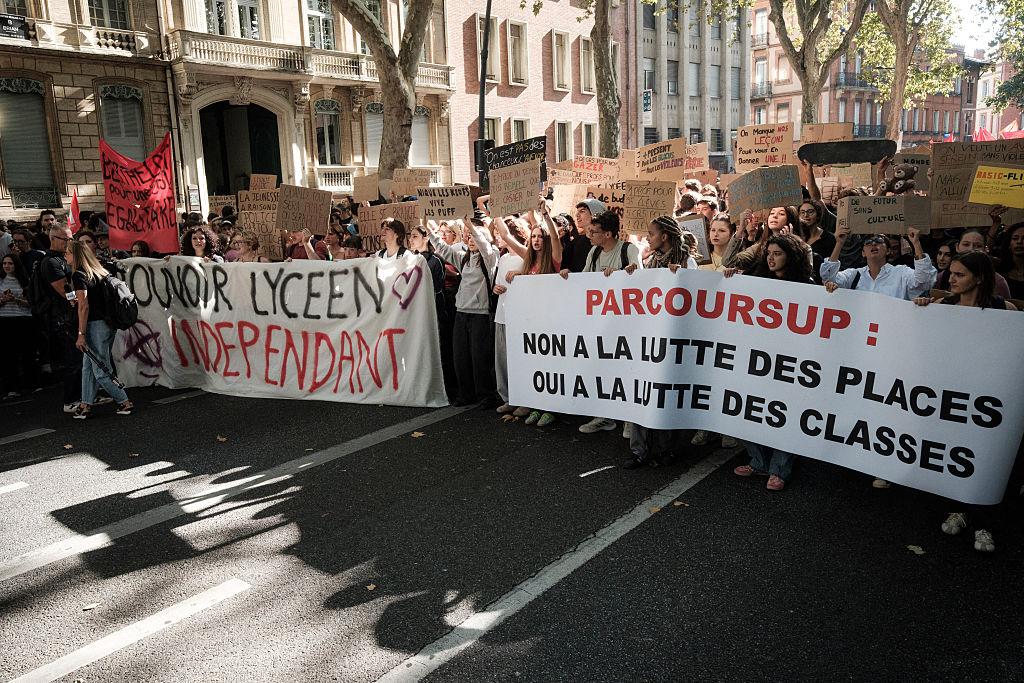
The students who have shut down French high schools since September were told there is no money for their schools. Young people filling the streets of India are told there are no jobs. Workers everywhere are paying war prices for gasoline and bread.
Liberal economists have an answer ready: the wealth exists, so tax it and share it out. That answer leaves ownership alone. The wealth was produced by workers. Capitalists claim it because they own the means of production.
France in revolt
The revolt that began in French high schools in mid-September, over cuts to education and crumbling, overcrowded schools, has become a rebellion. On Oct. 17, students, teachers and unions poured into the streets across France, and the riot police answered with tear gas, stun grenades, rubber bullets and clubs. The revolt has spread to Italy, Spain, Portugal, Belgium and Albania.
Government spending per university student has fallen by about a fifth since Emmanuel Macron took office in 2017. In Seine-Saint-Denis, the working-class suburbs just north of Paris, half the secondary school teachers are on temporary contracts or just starting out. In Paris it is one in 10.
No jobs, no vote
India’s young people have been told what the French students were told: there is nothing for you. The youth movement that calls itself the Cockroach Janta Party began in May, after the chief justice likened unemployed young people to cockroaches. A young college graduate in India is almost nine times as likely to be out of work as a young person who cannot read or write. As in France, the schools turn out graduates and the economy has no place for them.
Since Oct. 2 the movement has filled the streets of Delhi and Mumbai against the deletion of some 130 million names from the voter rolls. Poor Muslims, Dalits — the most oppressed castes — and migrant workers are the least likely to have the decades-old certificates now demanded to stay on the rolls. Papers decide who has rights, and the people stripped of them are the poorest and most exploited workers. The same government that has no future to offer young graduates is taking the vote away from the workers at the bottom.
Distribution follows ownership
Both governments say the money is not there. In 1970, private wealth in France equaled about three years of the country’s total economic output. Today it equals about six years, with much of it concentrated at the top. Across the English Channel, 50 families own more than the poorest half of Britain.
In the United States, the richest 1% hold nearly a third of all the wealth, the next 9% hold another third, and the other 90% of the country shares what is left. Between early 2025 and early 2026, the fortunes of the richest 1% grew by more than the poorer half of the country owns altogether. Not since 1929 has so much of the country’s wealth sat in so few hands.
The figures show where the wealth is. They leave out that workers produced it.
Workers produce more in a day than they are paid in wages, and the capitalists who own the factories, offices, land and banks keep the difference. In 1875, when German socialists wrote “fair distribution” into their program, Karl Marx answered the argument that the problem was simply how wealth is shared out: “Any distribution whatever of the means of consumption is only a consequence of the distribution of the conditions of production themselves.” Who gets the wealth follows from who owns the factories, the land and the banks. Workers can force the owners to give up a share of the wealth. As long as the owners keep the factories, the land and the banks, they keep the power to take that share back.
France has taxed its great fortunes before. In 1945 the working class had just come through the armed resistance to the Nazi occupation, much of it led by Communists, and the Communist Party was on its way to becoming the largest party in the country. A ruling class afraid of losing everything gave ground: a heavy one-time tax on the largest fortunes, the nationalization of Renault, the coal mines and the big banks, and the concessions of national health insurance and pensions.
The bosses gave ground, but kept the rest of the factories and the banks. In May 1947 the Communist ministers were thrown out of the government. The strikes of 1947 and 1948 were broken with troops. Over the following decades, as the balance of class forces shifted, the fortunes came back. The gains workers won in the United States in the 1930s went the same way, for the same reason.
A tax on the great fortunes is worth fighting for, and the fight can win it. But it is a concession, and a class that keeps ownership takes concessions back when the pressure eases.
So where is the wealth now, and what are its owners doing with it? Follow it and the same answer comes back at every stop: it was made by workers, it is held by capitalists, and it is being used against the people who made it.
Claims on profits not yet made
The first stop is the artificial intelligence boom, where a large share of the world’s fortunes has gone looking for the next fortune. On Oct. 13 the International Monetary Fund warned that the consequences of an AI collapse “could be global.” The Bank for International Settlements, the central bankers’ bank, reported that more than half the investment money that went into AI companies from 2021 through 2025 came from other AI companies. The research firm Gartner estimates that by 2030 the owners of AI data centers will take in only about a fifth of the revenue they need to cover their spending, their borrowing costs and payment of the profits their investors expect.
Every share and every loan in this circle is a claim on profits that have not been made yet. Those profits must ultimately come from workers, who produce more value than they receive in wages. But investors have driven up the value of their claims far faster than production can yield the profits to back them.
Anthropic, one of the biggest AI companies, shows how far this has gone. In the first six months of 2026 it brought in about $16 billion and lost money, according to documents first reported by the Wall Street Journal. It is now preparing to sell shares to the public at a value investors put at around $1.5 trillion — a price that rests entirely on profits that have yet to be made.
When the profits do not come, the claims collapse. The companies lay off workers to restore what profit they can, the shares sink in the pension funds that bought them, and the owners turn to the government, as the banks did in 2008, when the Treasury rescued them while millions of working people lost their homes.
The war in the price of everything
The second stop is the war. The government that rescues the banks also makes the wars. Monopoly capital in decline fights for control of oil, markets and trade routes, and the war on Iran is that fight carried out with bombs and blockades. Since the war began Feb. 28, gasoline in the United States has gone from about $2.90 a gallon to $4.33. World food prices are up too, and they hit hardest in the Global South.
Part of that rise is built into the cost of moving goods. Iran holds the Strait of Hormuz and runs passage through it. The Pentagon enforces a blockade, and the Treasury Department sanctions anyone who pays Iran for passage. No ship can obey both. Before the war, insuring a supertanker through the strait cost about 20 cents for every barrel of oil it carried. By September it cost $7 to $8. The giant firms that insure the insurance companies, like Munich Re and Swiss Re, met in Baden-Baden, Germany, in late October to recover a money-losing year through higher premiums on the policies that renew Jan. 1. Saudi-linked tankers in the Red Sea already pay about 10 times what other ships pay, since Yemen’s Ansar Allah began enforcing a blockade of Saudi Arabia.
The insurer charges the war premium to the shipowner. The shipowner passes it to the oil trader and the grain merchant, they pass it to the refiner and the miller, and each one adds a little extra for itself, until it lands in the price of the gasoline, bread and heating oil that working people have to buy. The world market is being carved up along the battle lines of the war, and the owners of the insurers, the ships and the oil are setting their prices on the bet that it stays that way.
The workers who build it
Every fortune in the AI boom and every profit on a barrel of oil was produced by workers. The last stop is where some of those workers are: in the custody of the government that guards the owners’ property.
Curo Churata stopped at a Home Depot on his way to work June 27. ICE agents took him. He was held at the Richwood detention center in Louisiana, and for three months he called or messaged his wife and three children every day to tell them he was all right. When he fell ill, a hospital was seven minutes away. It took the authorities hours to get him admitted. He died. The Washington Post counts 59 people dead in ICE custody since Trump returned to office in January 2025.
ICE finds these workers where they work. A worker who can be deported thinks twice before demanding unpaid wages, refusing an unsafe job or signing a union card, and the boss knows it. The threat hanging over one section of the workforce holds down wages for everyone working beside them. Neighbors, day laborers and unions have turned out against the raids from Minneapolis to Los Angeles to New York.
Who keeps it running
The class struggle is in the streets of Paris, Turin, Lisbon and Delhi, and in every one of those streets the question is the one the French students raised: the money exists, so who gets it, and who decides? The liberal answer is a tax. A wealth tax has a different political meaning when workers fight for it. Taken up in the streets and the workplaces, the demand becomes a fight between classes, and a fight can go further than its first demand.
Unions representing dockworkers at more than 40 ports in Europe and the Mediterranean have called for coordinated action against military cargo on Oct. 30, starting with strikes. France’s CGT union federation, its rail workers among them, has called a strike for Nov. 5 together with the national student union. Spain’s two major union federations have called a general strike for Nov. 11, for housing and for wages that can pay the rent, and Portugal’s largest union federation is considering joining it. Italy’s largest union federation, the CGIL, has called a general strike for Nov. 20 against low wages, the austerity budget and military spending, and to tax the wealthy.
A general strike can force the rich to pay. It also shows who keeps the ports, the railroads and the schools running.
The students in France were told there is no money. There is more than ever. It was produced by their parents, by the teachers in Seine-Saint-Denis and by a worker who stopped at Home Depot on his way to the job. It will go on piling up at the top until the workers who produce it own the factories, the banks and the data centers that it is produced with.
Join the Struggle-La Lucha Telegram channel