
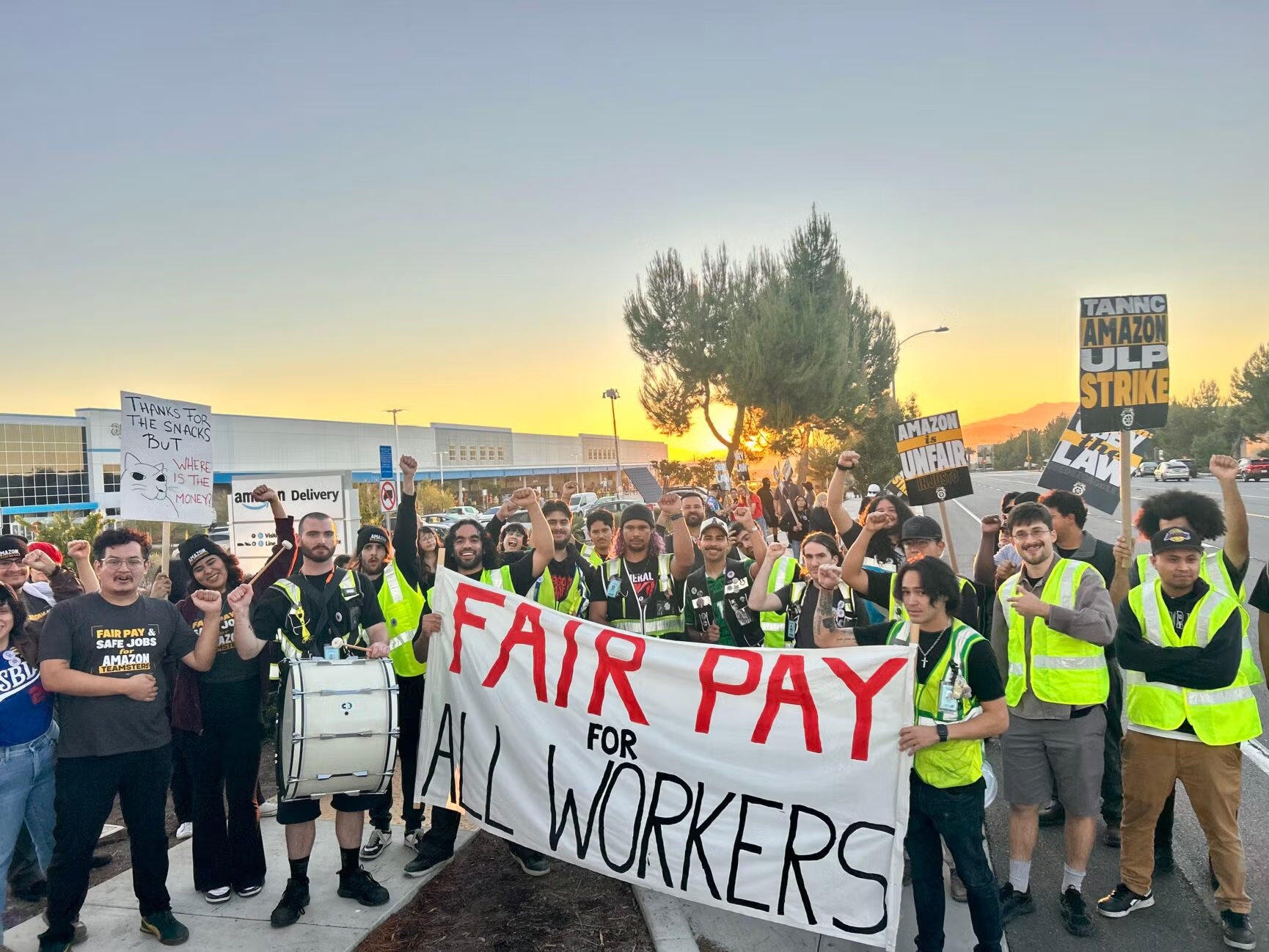
At Walmart, half the workers make less than $30,520 a year. At Dollar General, half make less than $18,876.
A new Government Accountability Office study examined 11 states representing about one-fifth of the U.S. population and counted workers at large employers who received Medicaid or SNAP food assistance. The study used employer data from September 2025. An earlier GAO study, released in October 2020, used data from February 2020.
Walmart ranked among the top employers in every state examined. The study put Walmart first and Amazon second overall. Walmart had 16,055 workers on Medicaid and 15,515 receiving SNAP. Amazon had 11,338 workers on Medicaid and 12,346 on SNAP. Both numbers were nearly three times their 2020 levels.
Corporate profits rose sharply over the same period. Walmart’s annual profit rose from $14.88 billion in fiscal 2020 to $21.89 billion in fiscal 2026. Amazon’s rose from $21.33 billion in 2020 to $77.67 billion in 2025. Amazon now plans about $220 billion in capital spending in 2026, much of it for AI, cloud and data-center infrastructure.
Walmart is one of the 100 S&P 500 corporations with the lowest median worker pay. Together, those companies keep 1,282 registered federal lobbyists in Washington.
In 2025, those corporations backed Trump’s One Big Beautiful Bill Act, the tax-and-spending package Congress passed and Trump signed into law on July 4. It extended and expanded tax cuts while cutting Medicaid and SNAP. More than 5 million people have since been removed from food assistance, most of them still eligible but cut off through new reverification paperwork.
The richest 1% of U.S. households now hold nearly 32% of the country’s wealth, roughly $55 trillion. The next 9% hold roughly another third, while the bottom 90% share the remaining third. The richest 10% own more than 87% of the stocks and investment funds held directly by U.S. households, giving them overwhelming ownership of corporate wealth.
Those fortunes make the country look far richer than most people in it are. The annual Global Wealth Report from UBS, a major Swiss bank, puts average wealth in the United States at $696,277 per adult, second only to Switzerland worldwide.
That average does not mean the typical person in the United States has anything close to that much wealth. Add the fortunes of billionaires to everybody else’s wealth and then divide by the whole population, and the billionaires pull the average far upward.
The average is distorted by the enormous fortunes at the top. Median wealth gives a better picture. It is the dividing line between the richer half and the poorer half, not what most people earn or have in the bank. In the United States, that line is about $69,000 in total wealth — a home, retirement savings, a car and other property, minus debts. Half of adults own less than that.
When countries are compared this way, the United States drops from second place to 28th in the UBS ranking. The enormous fortunes at the top make the United States look exceptionally rich by the average, while the wealth held by people in the middle ranks near the bottom of the countries UBS compared.
Extreme concentration also marked the years before the 1929 crash. Economists Thomas Piketty and Emmanuel Saez found that the richest 1% received 23.9% of all pre-tax cash market income in 1928.
How the fortunes are made
Workers create more value in a day than they receive in wages. Capitalists keep the difference as surplus value, the source of profit. They increase that surplus by holding down wages, speeding up the work, extending working hours and raising productivity.
The $55 trillion held by the richest 1% is not simply wealth created and piled up year after year. Much of it is in stocks, real estate and other assets whose prices can be driven far above their underlying value by speculation. But behind those paper fortunes are corporations, land and other property owned by capitalists, and the profits they take from workers’ labor.
On Aug. 28, 2026, Federal Reserve Chair Kevin Warsh told central bankers at Jackson Hole, Wyoming, that the U.S. economy was at or near full employment. He said hiring had slowed because the supply of workers had stopped growing — a labor force shrinking under the immigration raids. The official unemployment rate for July was 4.1%.
The official unemployment rate hides much of the damage. The Ludwig Institute counted 24.9% of the labor force as unemployed, stuck in part-time work or working full time for poverty wages in July. The rate was 27.3% for Black workers, 26.7% for Latine workers and 31% for women.
Even that leaves out workers who have stopped looking for jobs. LISEP’s broader measure, which includes people who have dropped out of the labor force, found that 53.8% of the working-age population did not have a full-time job paying a living wage in July.
Mass incarceration removes nearly 2 million people from the unemployment statistics altogether. Prisoners are not counted as employed or unemployed because they are removed from the population used to calculate the unemployment rate. If this huge population of people without jobs were included, the unemployment picture would be considerably worse.
The military absorbs another large section of the working class outside the civilian labor market. For many young workers, enlistment offers the steady paycheck, health care, education and job training that they cannot get from civilian employers. The Pentagon itself lists pay, work skills and the chance to “better my life” among the leading reasons recruits give for joining.
Immigration raids are also shrinking the official labor force. Workers who are deported or driven into hiding may no longer be counted as looking for work. That can make the unemployment rate fall even when no new jobs are being created.
Many workers are instead pushed deeper into the underground economy, where bosses pay below the legal minimum, ignore safety rules and threaten workers with immigration authorities if they protest. That superexploitation drives wages and conditions down for the whole working class.
The administration has also used immigration policy to hold wages down. Immigration raids reduced the number of farmworkers available, which would normally force growers to raise wages to attract workers. Instead, in October 2025, the Labor Department lowered the wages employers were required to pay H-2A migrant farmworkers. The administration said the change would save agricultural employers $24 billion over 10 years.
Required H-2A wages for entry-level field and livestock work fell from $19.97 to $16.45 an hour in California and from $16.08 to $12.27 in Georgia. The lower wage floor gave growers a cheaper workforce instead of forcing them to compete for workers by raising pay.
Farmworkers fought back and won the first round. On Aug. 26, a federal court struck down the wage rule and warned employers they may owe workers back pay.
Where the money went
Workers who have jobs are losing ground. Wages went up in dollars and down in what they buy: the Labor Department’s own measure of real average hourly earnings fell 0.2% over the year to July 2026. Gasoline rose 25%. Core services, including rent, health care, insurance and transportation, rose 3.7%.
Profits went the other way. U.S. corporations made a record $4.8 trillion in the second quarter of 2026, up $401 billion in just three months. Pre-tax profits took 18% of national income, while the share going to workers in wages and benefits fell to 60%, the lowest since the 1950s.
Corporations were also taking a record share as profit. After taxes, corporate profits amounted to 19.4% of all the value added in the corporate sector — nearly $1 out of every $5 — the highest since the government began keeping the figures in the 1940s.
The Institute for Policy Studies looked at 100 of the lowest-paying corporations in the S&P 500. From 2019 to 2025, worker pay rose 20.7%, less than the 25.9% rise in prices. CEO pay jumped 41.4%, reaching an average of $17.5 million a year.
From 2019 through 2025, those 100 companies spent $718 billion buying shares of their own stock back from stockholders. They spent $108.6 billion on buybacks in 2025 alone.
Buybacks do not create new value. They move corporate cash to shareholders and can drive up the price of the remaining shares, swelling the fortunes of major stockholders and executives paid heavily in stock.
Walmart spent $8.1 billion on buybacks in 2025. If that money had gone to workers instead, it would have been enough to give each of its 2.1 million workers a $3,851 bonus. Home Depot spent $37.9 billion on buybacks over seven years, enough to have paid each of its 472,400 workers another $11,449 every year.
At least 36 living billionaires draw their fortunes from these 100 low-wage corporations. Eight are tied to Walmart alone.
The corporations demanding cheap labor have offered workers little protection from immigration raids. Dollar General instructed managers at more than 20,000 stores to cooperate when agents came for an employee. A day laborer fleeing an ICE raid at a Home Depot in Monrovia, California, ran onto a highway and was killed. In July, an immigration agent in Maine shot and killed a DoorDash driver who was authorized to work and was not the person named in the arrest order.
Low wages, attacks on benefits and repression of immigrant workers all strengthen capitalists against labor and increase the pressure on the working class.
The road to 1929
The years before the 1929 crash also combined enormous fortunes with rapidly expanding production, credit and speculation.
The 1920s looked prosperous. Industry expanded, profits rose, businesses borrowed heavily and stock prices soared.
Capitalism produces for profit, not according to a social plan based on human need. Competition drives every capitalist to expand production, introduce new machinery and capture a larger market.
Credit carries that expansion further. Businesses borrow to build factories, buy machinery and enlarge production. Trade expands on credit.
Credit also feeds speculation. Instead of borrowing to produce more goods, speculators borrow money to buy stocks and other property simply because they expect the price to rise. Rising prices attract more buyers, who borrow more money and push prices higher. In the 1920s, millions of shares were bought “on margin” — with only part of the purchase price paid in cash and the rest borrowed. As long as stock prices kept rising, the debts could be paid. When prices began to fall, lenders demanded their money and forced borrowers to sell.
Credit does more than extend the boom. It allows capitalists to expand production before the goods already produced have been sold, and it allows businesses and speculators to pile up debt on the expectation that profits and prices will keep rising. Production, debt and speculation can therefore grow together on an ever larger scale. Credit pushes capitalism’s contradictions further and makes the eventual break more severe.
As overproduction develops, money markets tighten and borrowing becomes more expensive. Companies that depend on new loans to keep operating begin to have trouble refinancing old debts. Some miss payments. Banks and other lenders become more reluctant to lend.
That cuts off the credit that had helped keep production and sales expanding. Orders are canceled, inventories pile up, and factories cut production because commodities cannot be sold at prices that bring the expected profit. The overproduction built up during the boom now turns into layoffs, shutdowns and bankruptcies.
Overproduction does not mean people have everything they need. Houses can stand empty while people are homeless. Food can go unsold while people are hungry. From the capitalist’s standpoint, commodities have been overproduced when they cannot be sold at prices that bring the expected profit.
That was part of what erupted in 1929. The Wall Street crash expressed contradictions that had built through the boom. Credit contracted, production fell, and unemployment exploded.
Nearly a century later, some of the same mechanisms are developing again. Overproduction is growing, money markets are tightening, and a financial crisis is already unfolding.
The AI data-center boom is one expression of this overproduction. It stands out against much weaker investment elsewhere. Over the past decade, business investment averaged just 2.8% of GDP, down from 5.3% in 1960–1974, even with the recent rush to build AI data centers.
The AI buildout increasingly depends on borrowed money. Goldman Sachs counts nearly $500 billion in AI-related debt issued so far in 2026, compared with about $322 billion in all of last year. Analysts expect the total to reach $570 billion by year’s end. Much of the borrowing comes from data-center builders, power suppliers and other companies with far less cash than the biggest technology corporations.
Borrowing is also getting more expensive. On Sept. 2, 2026, the interest rate on 10-year U.S. Treasury bonds reached 4.81%, its highest level in nearly three years. The 30-year rate rose to about 5.28%. The war on Iran drove the increase. Oil prices climbed above $95 a barrel, adding to inflation and pushing government borrowing costs higher across the capitalist world. Japan’s 10-year rate passed 3% for the first time since 1996. The Treasury is already trying to push long-term rates back down: Treasury Secretary Scott Bessent announced in August that the government would double some purchases of long-term Treasury bonds, but rates soon climbed back.
These government rates set a benchmark for borrowing throughout the economy. When they rise, corporations refinancing old debts or borrowing to expand have to pay higher interest, as do banks and home buyers. For companies already carrying heavy debts, higher interest payments increase the danger of defaults, bankruptcies and a wider capitalist crisis.
Speculative borrowing also hit a record. Investors owed $1.50 trillion in margin debt — money borrowed from brokers to buy stocks — in June. In July, the amount fell 5.7%, as lenders pulled back and borrowers sold.
A growing share of this speculation runs through what are called shadow banks — hedge funds, private-credit funds and other financial firms outside the traditional banking system. Together they held about $260 trillion in assets at the end of 2024. Many operate with heavy debts, so when markets fall and lenders demand cash, they can be forced to dump stocks, bonds and other assets, pushing those prices down even further.
One corner of the AI boom cracked in July. AI and chip stocks fell sharply after years of soaring prices, as doubts grew that the boom could justify the enormous prices investors were paying.
The hedge fund Situational Awareness was caught heavily exposed. It had borrowed large sums to make concentrated bets on AI stocks. When those stocks fell, the value of the property backing its loans fell with them. Lenders demanded more cash. To pay them, the fund was forced to sell most of its $16 billion portfolio of publicly traded stocks.
The forced sales pushed prices down further. Situational Awareness lost 67% in July 2026. Citadel moved in and bought a large part of the portfolio for about 10% less than the stocks had been worth before the selloff.
That was not a general capitalist crisis. It showed on a smaller scale how borrowing can carry speculation upward during a boom and make the fall sharper when lenders demand their money back.
The drive to accumulate, expand production and extend credit continually creates the conditions from which capitalist crises arise. Those conditions are in place now.
A crash at the top does not redistribute wealth to workers. Between 1928 and 1932, average income among the richest 1% fell by about half. Millions of workers lost their jobs and wages collapsed. Capitalists who had money bought bankrupt companies, factories and property cheaply.
The Depression did not rescue the working class. Workers changed their conditions by organizing and fighting.
What workers changed
In 1934, nearly 1.5 million workers took part in 1,856 strikes.
Three struggles helped turn the tide. In Toledo, National Guard troops killed two strike supporters during the Auto-Lite strike. Their deaths brought thousands more workers and unemployed people into the streets, and the strike won union recognition.
In Minneapolis, police opened fire on Teamsters Local 574 pickets on Bloody Friday, killing two workers. The killings deepened support for the strike, which went on to break the employers’ system of keeping unions out of the city’s workplaces.
On the San Francisco waterfront, police killed two workers on Bloody Thursday. The killings helped set off a general strike in San Francisco as the longshore struggle spread along the Pacific Coast.
These struggles did not appear from nowhere. Marxists and communists had spent years organizing unemployed workers, organizing inside the shops and fighting conservative union officials who stood in the way.
The victories of 1934 helped open the way for the Congress of Industrial Organizations and the sit-down strikes of 1936 and 1937. Workers forced the auto, rubber and electrical corporations to recognize unions in industries where employers had fought for years to keep them out. U.S. Steel signed a union contract rather than face the same kind of battle.
The CIO, pushed by communists and other militants, also broke with much of the AFL’s Jim Crow unionism. It organized Black, Latine and white workers together in the mass-production industries, where employers had long used racism and national oppression to divide the workforce and weaken unions.
Union membership rose from 2.8 million in 1933 to about 14 million by 1945.
The working-class upsurge pushed the Roosevelt administration and Congress toward further concessions, including federal recognition of union organizing rights.
Those reforms carried the racism of U.S. capitalism. The Wagner Act and Social Security Act left out agricultural and domestic workers, hitting Black workers especially hard and helping preserve the low-wage labor system of the Jim Crow South.
Workers forced major concessions from the ruling class. But the capitalist class kept ownership of the factories, mines, banks and other major means of production. It also retained the state power protecting that ownership.
How the gains were taken back
World War II brought full employment and huge profits, but the major union leaderships accepted a no-strike pledge and wage controls for the war effort. Congress also passed the 1943 Smith-Connally Act to curb strikes. When the war ended, millions of workers struck for higher wages in the great strike wave of 1945 and 1946.
The ruling class answered with the Taft-Hartley Act of 1947, which restricted union power. The anti-communist offensive drove many of the militants who had built the industrial unions out of the labor movement. Much of the new labor leadership confined workers’ struggles to contract bargaining, settled for small wage and benefit gains, and channeled the unions’ political power into Democratic Party campaigns.
From the 1970s on, the capitalist offensive intensified. Plants closed, strikes were broken and taxes on the rich were cut. Corporations moved factories to the South and overseas in search of lower wages and weaker unions.
Union membership fell from roughly a third of the workforce after World War II to about 1 in 10 workers today.
Employers also found new ways to strip workers of protections won through earlier struggles. Millions are now classified as independent contractors. Trump went further in the federal government, stripping collective-bargaining rights from nearly 1 million federal workers.
Across the nine states that reported employer data for SNAP, workers for Uber, Lyft, DoorDash, Grubhub and Instacart together numbered 22,709 SNAP recipients — more than Walmart’s 15,515.
More than 9 million people made deliveries for DoorDash in 2025, earning about $20 billion altogether. But DoorDash classifies them as independent contractors, not employees, so none of their pay appears in the worker-pay figure the company reports to the government.
The labor remains. What disappears is the corporation’s legal responsibility to the worker.
The permanent answer
Global billionaire wealth reached $18.3 trillion at the end of 2025, up 81% in real terms in six years. The 12 richest men now hold more wealth than the poorest half of humanity.
The financial crisis is already here. A broader capitalist crisis is taking shape.
As businesses fail and fortunes shrink, the ruling class will try to restore profits by cutting jobs and wages, slashing social programs and squeezing more out of the workers who remain. But crisis can also drive millions of workers into struggle.
That struggle is already developing. On Aug. 7, California labor officials verified that the California Gig Workers Union had won enough support among Uber and Lyft drivers to move toward statewide recognition. Covering roughly 100,000 active drivers, it is on track to become the world’s largest rideshare drivers’ union even though the companies classify the drivers as independent contractors.
Another fight is developing over the fortunes at the top. California Proposition 40, on the Nov. 3 ballot, would impose a one-time 5% tax on the state’s roughly 200 billionaires, with 90% of the money going to health care. SEIU-UHW West sponsored it and projects $100 billion over five years.
The billionaires are spending heavily against the measure. Building a Better California, founded by Google co-founder Sergey Brin and former Google CEO Eric Schmidt, had raised more than $156 million as of Aug. 17, 2026 — more than $100 million of it from Brin — and had already spent more than $127 million supporting Propositions 41 and 42, two constitutional amendments designed to undercut Proposition 40. If either measure passes with more yes votes than Proposition 40, the billionaire tax is void even if Proposition 40 also wins a majority.
Other proposals call for a federal wealth tax, higher taxes on stock buybacks and higher taxes on corporations with extreme CEO-worker pay gaps.
The billionaires will fight every dollar of it. Taxes on their fortunes can reduce the wealth they control and provide money for social needs. But taxation does not change capitalist ownership of the factories, banks and monopolies that control the economy.
The history of the 1930s shows that mass struggle can force the ruling class to surrender part of its wealth and power. It also shows the limit of those victories.
Workers won union rights, relief programs, higher taxes on the rich and other reforms. But the capitalist class kept the factories, mines, banks and monopolies. When the movement that had forced the concessions weakened, the ruling class used that economic and political power to take much of the ground back.
The workers of the 1930s showed how much an organized working class can win, even in the depths of a capitalist depression.
The crisis now unfolding will pose the question again — not only how much workers can force from the capitalist class, but whether the wealth produced by the working class will remain the private property of the capitalist class at all.
Join the Struggle-La Lucha Telegram channel