
Trillions of dollars are pouring into artificial intelligence. It is the biggest bet in U.S. history, more than was spent building the canals, the railroads and the electric grid combined.
The stock market gains have gone to the rich, and workers’ pension funds are carrying the risk. Wall Street is calling it the everything bubble, and a great many people expect it to take the system down with it when it goes. The phrase that sometimes gets reached for is late-stage capitalism. From that a conclusion is being drawn: the system has finally run out of room, and what follows is its collapse.
That conclusion is a response to something real. The wreckage is there, and it has to be looked at squarely. But a crisis of sufficient depth does not bring the system down on its own. Capitalism has ways out of every crisis it has ever created, and it takes them unless it is stopped. Whether it is stopped is decided by class struggle and organization.
It is an old question in the movement. After the crisis of 1857 failed to revive the revolution of 1848, Marx and Engels gave up a view they had previously held: that the next great crisis of overproduction would itself trigger a revolutionary situation. Marx had watched the crisis come, in detail, month by month. It came, and the revolution did not.
V.I. Lenin took the question up directly on July 19, 1920, in his report on the international situation to the opening session of the Second Congress of the Communist International. He was talking to comrades wrestling with the same question, from working classes devastated by war.
What Lenin told the Second Congress
The first half of that report is a catalog of ruin. The big European powers owed seven times what they had owed in 1914. France, which before the war had been the money-lender of Europe, now owed three times what the rest of the world owed it. In every country Lenin named, the price of food had climbed faster than wages. Money itself was going bad: against the dollar, British money had lost about a third of its value, French and Italian money two-thirds, and German money nearly all of it. The trade and credit that tied the capitalist countries together, Lenin said, were breaking down.
Then he turned to what the crisis meant, and named two errors. Bourgeois economists were reducing it to “unrest.” And revolutionaries, he said, sometimes tried to prove that the crisis was absolutely insoluble.
“This is a mistake. There is no such thing as an absolutely hopeless situation. The bourgeoisie are behaving like barefaced plunderers who have lost their heads; they are committing folly after folly, thus aggravating the situation and hastening their doom. All that is true. But nobody can ‘prove’ that it is absolutely impossible for them to pacify a minority of the exploited with some petty concessions, and suppress some movement or uprising of some section of the oppressed and exploited.”
Everything said about the recklessness of the ruling class and the depth of the crisis can be true. Lenin grants all of it: they are plunderers, they are committing folly after folly, they are hastening their own doom. What he refutes is the next step — treating catastrophe as proof that capitalism has no way out, or that economic breakdown will itself produce the revolutionary outcome. That is the mechanical error Lenin was warning against.
On the demand to prove that capitalism had no way out, he was blunt:
“To try to ‘prove’ in advance that there is ‘absolutely’ no way out of the situation would be sheer pedantry, or playing with concepts and catchwords. Practice alone can serve as real ‘proof’ in this and similar questions.”
And he immediately turned the demand around on the delegates:
“All over the world, the bourgeois system is experiencing a tremendous revolutionary crisis. The revolutionary parties must now ‘prove’ in practice that they have sufficient understanding and organisation, contact with the exploited masses, and determination and skill to utilise this crisis for a successful, a victorious revolution.”
It was mainly to prepare that proof, he told them, that the Congress had gathered.
Lenin spent much of the rest of the report on opportunism, which he called the main enemy. His example was Ramsay MacDonald, a leader of Britain’s Independent Labour Party. MacDonald admitted the crisis was revolutionary. He admitted British workers were looking to the Russian Revolution and the soviets, the councils of workers and soldiers that had taken power there. Then he told his own party not to worry. It would pass. Things would settle down. On July 30, Lenin answered Giacinto Serrati of the Italian Socialist Party, who had said the situation in France was not revolutionary and so revolutionary preparation could wait. Even where the situation is not revolutionary, Lenin told him, revolutionary work can and must be carried on. The socialists refuse to do that work in every situation, he said, and that is what separates them from communists.
The idea that the crash will bring the system down and MacDonald’s idea that the crisis will pass point in opposite directions, but they share the same mechanical method. If economic catastrophe itself will compel revolutionary transformation, the outcome has already been supplied by the crisis. If the crisis will settle down on its own, there is no need to prepare for revolution. Each rests on the belief that the political outcome is already contained in the economic conditions and only has to play itself out. Lenin insisted on a third position: the outcome had to be decided in struggle.
Lenin also explained where the money for those concessions came from. Before the war, the capitalists of Britain, France and Germany were making billions a year from money invested abroad, much of it squeezed out of the colonies. Out of that, he said, hundreds of millions could be handed to union leaders and the best-paid layer of workers at home. He called it bribery, done in a thousand different ways. The plunder of the colonies paid off a section of the working class in the imperialist countries, and force was used against everyone else.
The same Congress adopted Lenin’s theses on the national and colonial question, and he ended his report on the possibility of unity between the revolutionary workers of the imperialist countries and the hundreds of millions of people in the colonized world. The two halves of his report belong together. The bribery of a layer of workers at home and the plunder of the colonies were one system, and both had to be fought together.
Capitalism’s ways out
Capitalism has ways out of the crises it creates, and every one of them has been used within living memory.
The oldest is the destruction and devaluation that the crisis itself carries out. Crises bankrupt weaker firms, strip value from factories and goods, drive down wages and concentrate more wealth and productive power in fewer hands.
An AI bubble would be no exception. In 2000, the stock market bubble in internet companies burst. Telephone and internet companies that had laid fiber-optic cable across the country and under the oceans went bankrupt. The cable was still there. It was sold off for a small part of what it cost to lay, and the companies that bought it cheap built today’s internet on it. The data centers, chips, power plants and power lines being built now will still be there when the companies and investors that paid for them go broke. They will change hands cheaply, and the buyers will be whoever still has cash. A crash would concentrate the ownership of AI, and it would leave the technology in place.
Whether or not the bubble bursts, AI is being built to deepen the exploitation of the working class, as every earlier wave of the scientific-technological revolution did: eliminate jobs, break down skilled work into low-paid work, speed up whoever is left, and push a new layer of workers into insecure, poorly paid, closely watched labor. The capitalists who own it will use it that way in the recovery and use it harder in the next bust. And the same technology is a Pentagon project from the ground up — targeting, surveillance, drone warfare, the policing of borders and cities. That is also what it is being built for, and it does not disappear when the stock prices do.
This also changes the terms of the bribery Lenin described. The scientific-technological revolution eats away at the privileged layer the plunder abroad once paid for. The skilled, secure, well-paid jobs that let that layer of workers in this country be told they were middle class have been shrinking for two generations, and AI is aimed at the ones that are left.
For decades after World War II, the enormous profits and world dominance of U.S. capitalism gave the ruling class more room to buy social peace at home. That helped sustain the illusion that a large section of the working class could permanently rise with the system. As that position has weakened and those secure jobs have been destroyed, the material basis for that compromise has narrowed too. As the material basis for those concessions narrows, the ruling class has less room to buy social peace and turns more readily to austerity and repression — unless organized workers force it to give ground.
Another way out is the bailout. In 2008, the U.S. Treasury saved the banks with government money and let the bankers keep their fortunes. Millions of working people lost their homes and their jobs, and nobody rescued them. The rescue also stopped the crisis short. The bankruptcies that cheapen everything and open the way to a new boom never ran their course, and the crisis was postponed.
It saved the capitalists by shifting their losses onto the government, and that can be done again.
In 2020 it was done again, on a bigger scale. The COVID-19 pandemic threatened what no ordinary crisis does: the working class whose labor produces the capitalists’ profits. Governments shut down much of the world economy. Unemployment went higher than after 2008. Millions of people died around the world, more than 1.2 million of them in the United States, more than in any war in U.S. history. Most were working people kept on the job in hospitals, nursing homes, warehouses and meatpacking plants, which the Trump administration ordered to stay open. Black, Latine and Native Peoples died at far higher rates. Today that toll is barely mentioned. The ruling class that kept the plants running has moved on as if it never happened.
The U.S. government poured out trillions of dollars, most of it to corporations and banks. The shutdown also halted overproduction, and the crisis building since 2008 was put off again.
But every rescue has to be paid for — through more debt, inflation, austerity or some combination of them — and the war on Iran is already piling on debt at a record rate. The ruling class can still rescue capital, but the cost has to be imposed somewhere.
On Sept. 16, the Federal Reserve raised interest rates for the first time in more than three years, because the war has driven up the price of oil and everything made or moved with it. Rising interest rates are one of the things that could set off the AI crash.
A third way out was opened by the counterrevolution in the Soviet Union and Eastern Europe. The overthrow of the workers’ states in 1989-91 handed the imperialist countries new markets, cheap labor and raw materials on a scale the capitalist world had not seen since the colonial conquests, and it gave U.S. capitalism three decades of expansion. Nobody in 1980 could have foretold that exit. Practice proved it.
And the decisive way out, in the epoch of imperialism, is war. Under monopoly capitalism, crisis sharpens the drive of the imperialist powers for markets, resources and control. Arms production is that drive in its economic form. It postpones nothing for long; it piles up debt and inflation while expanding the military machinery through which the ruling class pursues those aims. War destroys productive forces on a scale no financial crash can match and opens the struggle to divide markets and resources again. That is why the drive toward war grows out of monopoly capitalism in decline. It is a structural tendency of the system, not a bad policy that can be voted out. For the U.S. ruling class, the seizure of Venezuela’s oil in January and the war on Iran are the form that drive takes today, and both are aimed at China, the main buyer of Iranian and Venezuelan oil. The war of containment against China — which the AI buildout is openly being sold as a race to win — is the form it is being prepared to take next. U.S. imperialism kills whole peoples and wrecks whole countries in the struggle to restore the conditions for profitable investment.
Except for the destruction and devaluation carried out by the crisis itself, these ways out depend on government action. The Treasury and Federal Reserve can shift losses onto the population and rescue capital. The Pentagon organizes war. Police, courts and federal agencies are used to break resistance. The ruling class does not simply wait for a way out of crisis. It uses the government to fight for one.
Capitalism does not collapse just because its crises get deeper and more destructive. A financial bubble may burst. A new technology may deepen unemployment and crisis. War, debt and financial breakdown may bring enormous destruction. None of that proves that capitalism has reached its final crisis, or that the crisis itself will compel workers to choose revolution. Economic catastrophe can open the way to revolution, but it cannot by itself make workers revolutionaries, build their organizations or win the fight. Those have to be built through class struggle.
What the 1930s won, and how it was lost
The concessions Lenin would not rule out were paid here, in the 1930s, under the heaviest pressure the U.S. capitalists had ever faced.
The deepest crisis U.S. capitalism ever passed through did not end it, and not because the working class stood still. Unemployed councils, sit-down strikes and the Congress of Industrial Organizations won the organized power to force the capitalists to give ground. The CIO organized whole industries instead of separate crafts, and it brought Black, Latine and other oppressed workers, and women, into the unions in numbers the labor movement here had never seen before. Communists were at the center of that organizing. That is the kind of organization Lenin told the delegates to build, and the 1930s produced it on a scale this country has not seen since.
The New Deal was the concession that power extracted. It did not end the Depression. The war did. Arms production and then the destruction of most of the industrial capacity of Europe and Japan restored U.S. profits, and U.S. capitalism came out of the war with the largest share of the world market any single power has ever held. The concessions won by workers helped stabilize the system at home.
What the movement of the 1930s did not do was break with the capitalist parties. The Communist Party’s popular front line delivered the CIO to Franklin Roosevelt and the Democratic Party, and once the war was over, the ruling class collected the bill. In 1947, Congress passed the Taft-Hartley Act, which forced union officers to swear they were not communists and outlawed strikes in solidarity with other workers. The expulsion of the left-led unions from the CIO in 1949 and 1950 and the McCarthy purge finished stripping the unions of the communists who had built them. Everything the unions won over the next two decades — the wages, the pensions, the health coverage — could be taken back, and it was. The working class has forced the concentration of wealth down before. It did not take ownership of what produces the wealth, and the concentration came back. The lesson was not that organization failed, but that organization tied politically to the Democratic Party could not carry the struggle through when the ruling class turned against it.
It happened again in 2020, on a much smaller scale. With the pandemic threatening the workforce, and workers walking out of Amazon warehouses, meatpacking plants and hospitals, things that had been refused for decades suddenly became possible. There was a halt to evictions, bigger unemployment checks, cash payments to households, an expanded child tax credit and an end to water shutoffs in Detroit. Once profits recovered, all of it was taken back. The Supreme Court struck down the eviction halt in August 2021. The child tax credit was allowed to lapse at the end of that year. Detroit began shutting off water again in 2023, and in 2026 the money for its low-income water plan ran out. The ruling class gave ground while the pandemic and the walkouts pressed on it, and took it all back once the pressure eased. There was no organization of the 1930s kind to stop it.
A system that can be forced to give ground and then win it back is not one whose end can be read off a calendar. Lenin opened his report by calling imperialism the highest and final stage of capitalism, and in the same report refused to say it had no way out. Decay describes the epoch we have lived in since 1914, and that epoch has already lasted more than a century. It is not a countdown. Britain’s industrial lead peaked in the 1870s, and its empire held on for most of another century, through two world wars.
“Late-stage capitalism” becomes a political problem when it turns the decay of the system into a timetable for its collapse. Imperialism can be decaying and still survive crisis after crisis, reorganize itself, make concessions, impose defeats and find new openings for accumulation. Calling the system “late” explains nothing if it means the end is already built into the conditions. If the capitalist system is simply running out its clock, there is nothing for a revolutionary organization to do but wait for it to run out.
Closing the exits
Capitalism’s ways out are real. The boom and bust cycle runs on its own, but the other ways out are no more automatic than the system’s collapse. Every one of them has to be fought for by the ruling class, against resistance, and every one can be blocked. A war needs troops, ports, rail lines, arms plants running three shifts and a labor movement willing to keep the ships loaded. Austerity needs unions that will not strike. Repression needs neighborhoods that can be isolated and picked off one at a time. Each of those is a place where the outcome is decided by the class struggle, and each is a place where the exit can be shut.
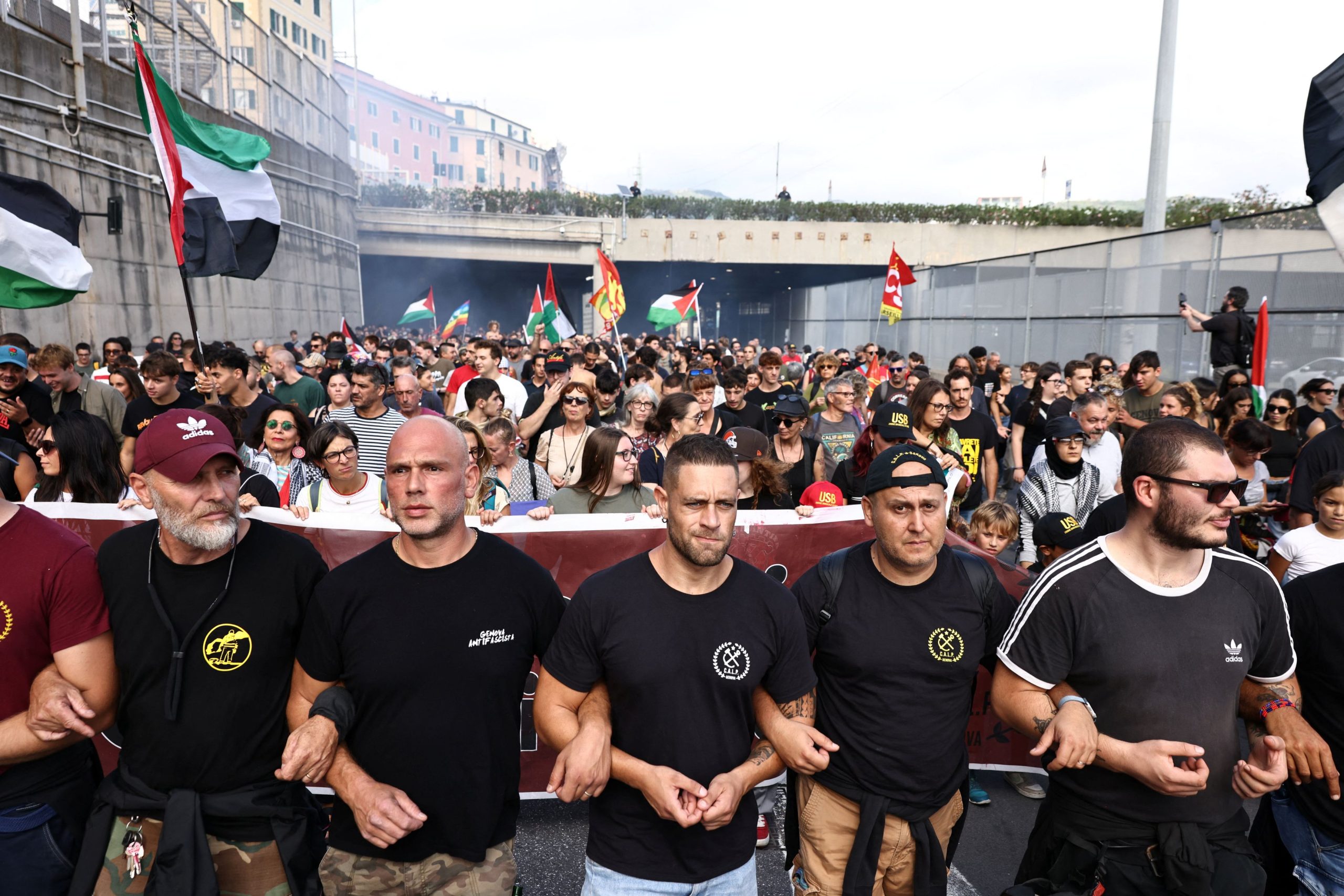
The ships have been refused before. In November 1984, longshore workers of ILWU Local 10 in San Francisco refused for 11 days to unload cargo from apartheid South Africa, until a federal court injunction threatened the union with fines. When Nelson Mandela came to the Bay Area in 1990, he singled them out for thanks. Since the genocide in Gaza began, dockworkers in Marseille, Genoa, Piraeus and Gothenburg have refused to load or unload weapons for Israel’s U.S.-armed war and forced ships to sail without their cargo, and on Feb. 6 dockworkers struck together at 20 ports in seven countries against arms shipments. Some truckers at U.S. ports, a workforce made up mostly of immigrants with few in a union, have refused to haul containers for Israel’s biggest shipping line.
Dockworkers’ unions in France, Greece, the Basque Country, Turkey, Morocco and Italy, representing workers at more than 40 ports, have called an international day of action for Oct. 30 against the genocide in Gaza and the U.S. war on Iran. Each union will choose its own form of action, starting from strikes, and together they are demanding that no port be used to move arms, ammunition or troops to a war zone and that no machine or AI be used to eliminate their jobs.
Repression is the exit the ruling class reaches for as the money for concessions runs short, and it is being taken now. Immigration and Customs Enforcement raids on workplaces, National Guard troops in U.S. cities, the militarized police in every Black and Latine neighborhood, the prosecution of women who seek abortions and of trans people who seek care, and the surveillance that AI is being built to run are the domestic side of the war abroad. The force Lenin said would be used against everyone the bribe did not reach is already deployed here. Whether it can isolate and pick off one neighborhood, one union, one community at a time is decided by whether the rest of the working class lets it.
The unity Lenin ended his report on is still the decisive question. The U.S. war on Iran, the genocide in Gaza, the containment war against China, and here at home the war on migrant workers and oppressed nationalities, the stripping of abortion rights from women, and the campaign against trans and other LGBTQ+ people are the fronts where the ruling class is trying to force its way out of this crisis. Defense of the oppressed nations and the socialist countries against U.S. imperialism, and of everyone the ruling class is attacking at home, is where a revolutionary movement in this country is tested, and where the ruling class can be beaten. Each of these struggles can block one of the ways the U.S. ruling class is trying to make workers and oppressed peoples pay for the crisis.
None of that waits on a forecast. It calls for a revolutionary organization rooted where workers and oppressed people are, a political line independent of the capitalist parties, and the capacity to move when the opening comes.
Lenin’s warning stands: never declare in advance that capitalism has no way out. He gave the delegates a task. The proof he demanded was organization, ties to the exploited masses, and the skill to use the crisis.
Source: V.I. Lenin, “Report on the International Situation and the Fundamental Tasks of the Communist International,” July 19, 1920, and “Speech on the Terms of Admission Into the Communist International,” July 30, 1920, in Collected Works, Vol. 31, pp. 213–263. marxists.org/archive/lenin/works/1920/jul/x03.htm
Join the Struggle-La Lucha Telegram channel