
India built a system that lets anyone with a phone send money for free from one bank account to another. Walmart and Google own the apps most people use to access it, and they are about to start collecting on it. Visa and Mastercard want in. The United States government is pressing their case, and the Modi administration is clearing the way.
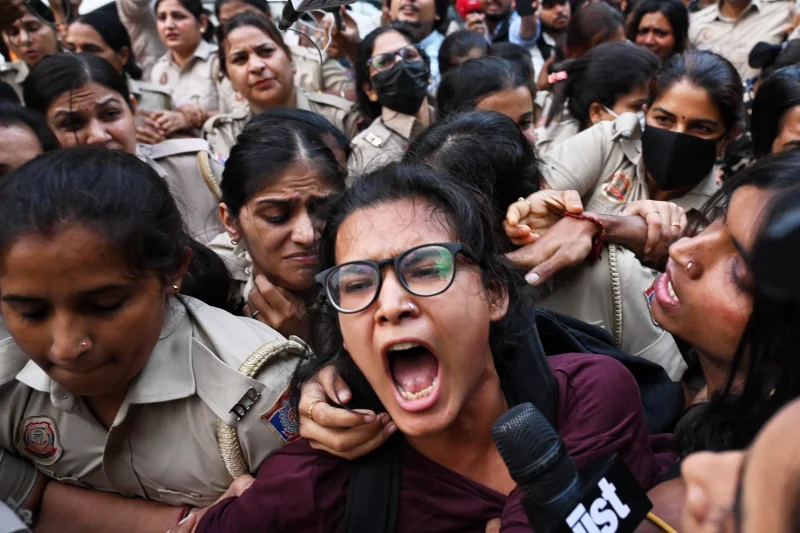
At the same time, the Modi administration is striking millions of people from the voter lists. Protesters fighting the purge have faced police, detentions and beatings.
The National Payments Corporation of India, which runs the Unified Payments Interface, set a 0.4% fee on merchant payments over 2,000 rupees (about $21), starting Oct. 15. Smaller payments stay free. The Finance Ministry says 96% of merchant payments remain free. The other 4% are the big payments that make up most of the money.
On Oct. 13, after shopkeepers protested, the fee was put off until after the Diwali festival on Nov. 8. It is still coming.
A free network, monopoly apps
India’s banks built UPI in 2016, and the Modi administration pushed the country onto it.
On Nov. 8, 2016, Prime Minister Narendra Modi went on television and announced that India’s two biggest bills, the 500- and 1,000-rupee notes, would stop being legal money at midnight. Those two bills were most of the cash in the country. Workers, farmers and small traders who lived on cash stood in bank lines for weeks to turn in their old bills, while cash machines ran dry. Modi said he was targeting the rich’s hidden cash. Nearly all the banned money returned to banks, so the move caught almost no hidden cash.
What the move did was push millions of people into paying by phone. Then in 2020, the government made it illegal to charge any fee on UPI payments. Because it was free, UPI spread nearly everywhere, from vegetable carts to rickshaws. Cash is still used every day in India, but more than 500 million people now pay with UPI, and no similar system on earth handles more payments.
UPI itself is the system underneath. People reach it through apps on their phones, and those apps belong to two United States monopolies. Walmart’s PhonePe and Alphabet’s Google Pay handle four of every five rupees on the network.
UPI moves money at almost no cost. Now Walmart and Google stand to collect a toll on larger payments through a network they did not build. Wall Street analysts estimate the fee could bring payment apps as much as $1.1 billion a year by 2028, with about $900 million going to PhonePe and Google Pay.
A ‘level playing field’ for the monopolies
The fee came as the Trump and Modi administrations were finishing a trade deal, and that deal is about more than tariffs. In February, when the two governments agreed to cut the tariff on Indian goods, India also promised to negotiate new rules for digital trade. In March, the Office of the United States Trade Representative listed India’s payment policies as a trade barrier, starting with the law that kept UPI free. Five months later, the Modi administration changed that law.
The United States Trade Representative’s demands are simple. Visa and Mastercard get rich off fees on every card payment. A free network leaves them nothing to collect, so the Trade Representative wants a “level playing field” with RuPay, India’s own card network. It also objects to India’s long-delayed plan to cap any single app at 30% of UPI payments. That cap, now due in December 2026, would force Walmart and Google to give up part of the business they now control.
Brazil got the same treatment
Brazil’s central bank built and owns Pix, a free payment system. Brazilians now make more payments with Pix than with cards, checks and bank transfers combined. In July 2025, the United States Trade Representative opened an investigation of Pix and other Brazilian policies, a move to intervene in Brazil’s economy.
President Luiz Inácio Lula da Silva refused to budge: “Pix is from Brazil. It’s public, it’s free and it’s going to stay that way.”
Tariffs as a club
Payments are one front in the United States’ intervention in India’s economy. Tariffs are another. The Trump administration slapped a 50% tariff on Indian goods in 2025. Now it threatens a 100% tariff on any country that buys Russian oil, as part of its blockade of Russia. About half of India’s oil comes from Russia. Yet on Oct. 9, the Trump administration made its own deal to buy Russian diesel. The rule against Russian oil is for every country but the United States.
The pressure extends to weapons. Russia supplies about two of every five weapons India buys abroad, and India’s military depends on Russian spare parts. The United States already uses the banks against that supply. Since 2022, fear of United States sanctions has kept India from paying Russia in dollars, and billions in arms payments were held up. Breaking with Russia would cut off the supply altogether. Meanwhile, the Trump administration is spending about $686 million to keep Pakistan’s F-16s flying. Pakistan fought a short war with India in May 2025.
Every UPI payment also depends on India’s phone networks. Mukesh Ambani’s Jio and Sunil Mittal’s Airtel control more than 80% of India’s phone and internet market. Elon Musk wants in with Starlink. Here too, rival capitalists are fighting over who controls an essential network and collects from its users.
A capitalist government
The Modi administration is no victim. It let Walmart and Google take over the apps people use to reach UPI. It governs for India’s capitalist class: it builds up Ambani’s Reliance and Adani’s ports and power plants, invites foreign investment, and sends the police against anyone in the way.
Indian billionaires and United States monopolies are fighting over India’s markets, its payment and phone networks, and the profits made from Indian workers’ labor. The two sides are not equals. The monopolies have an imperialist power behind them, with its tariffs and its war in West Asia. But when Indian capital stands up to a United States demand, Indian workers win nothing. When Jio and Airtel keep Starlink out, the phone bills stay in Ambani’s and Mittal’s hands. The fight decides only which capitalists collect.
Lula could refuse because Brazil’s central bank owns Pix and sets its rules. In India, the Modi administration changed the law so Walmart and Google could start collecting.
Who pays
The fee falls first on bigger merchants. Gas station owners have already asked to be exempted. A merchant who pays the fee out of pocket takes a smaller profit. A merchant who raises prices to cover the fee passes the cost to everyone who buys. Either way, a network that was free to use now makes money for private companies, most of it for Walmart and Google.
The payment fee has yet to take effect, but working people are already facing price rises from the war the United States launched on Iran on Feb. 28. The war cut off India’s cooking gas from the Persian Gulf and drove the rupee to record lows. At Delhi’s Kashmere Gate metro station, a young vendor told Scroll that onions now cost 80 rupees and sugar 70, up from 50. A cylinder of cooking gas that cost 400 rupees now costs 1,000.
Erasing voters
The protests that began in early October demand that the purge be stopped and that Chief Election Commissioner Gyanesh Kumar, who runs it, step down. The purge has struck some 130 million people from the voter lists. Voters now have to prove they belong, with records from more than 20 years ago or other documents. The poor, migrant workers and women whose names changed at marriage are the least likely to have them. Being on the voter lists is tied to food rations, so those struck off can lose more than the vote.
The purge carries out the BJP’s Hindu-nationalist program, which has long sought to deny full citizenship to Indian Muslims. In West Bengal, nine million names were struck before the April 2026 state election, which the BJP won for the first time. Muslims are a quarter of the state’s people but a third of those removed. The BJP calls them “illegal Bangladeshi migrants.” Of the few appeals decided so far, nine in ten put the voter back on the lists. Removing Muslims, oppressed castes, migrant workers and women from the voter lists brands them as outsiders in their own country.
Young people are leading the fight. The Cockroach Janta Party, a youth movement named for the chief justice’s insult against unemployed youth, forced out the education minister in July. Now it has joined forces with student groups and left parties against the purge. On Oct. 10, the Modi administration shut metro stations, canceled trains, cut the internet and flooded central New Delhi with police to stop one protest. Thousands were detained and beaten. People kept coming.
Organized workers are starting to come in. Communist-led and independent union federations have signed on to the movement’s demands and are carrying them to their millions of members. These workers have their own score to settle with the Modi administration, which pushed through labor codes to weaken the unions. The last full retreat the Modi administration was forced into came in 2021, when farmers camped on the roads into New Delhi for a year until it repealed its farm laws.
“Only Adani and Ambani have flourished under him,” Mohit Paswan, a migrant worker from Bihar, told Scroll.
The fee and the purge are separate fights with separate demands. The Modi administration stands behind both. A government that hands the country’s networks to private profit, bargains for India’s billionaires and weakens the unions can’t count on the votes of the working people who pay the price. So it strikes them off the voter lists and sends in the police.
The police have not stopped the movement. Now organized workers are joining it — workers with the power to stop the railways, ports, power plants and phone networks that India’s capitalists depend on.
Join the Struggle-La Lucha Telegram channel