
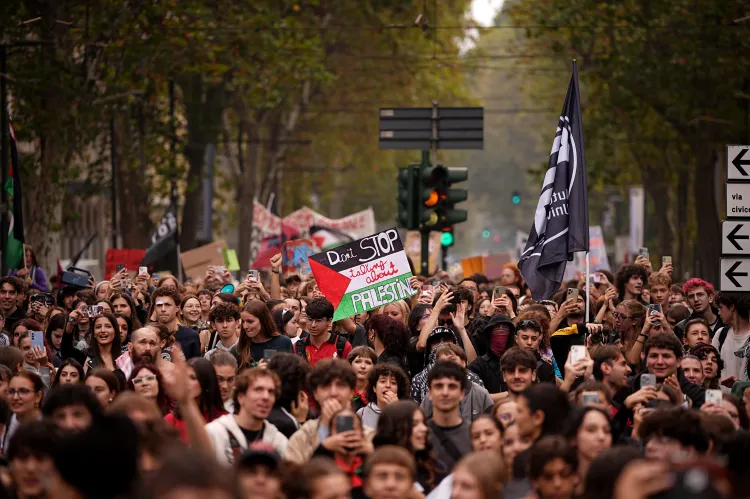
Today’s revolts — from France to Spain, from Italy to Portugal and Belgium, and east to Albania — are the product of years of capitalist austerity that have finally hit a boiling point, made all the more explosive by the United States proxy war in Ukraine and its war in West Asia. European rearmament against Russia, demanded by United States imperialism, is a major accelerant. The bankers’ war is being waged against students, workers and tenants at home too — and they are fighting back.
France: from protest to rebellion
In France, the demonstrations began with high school students and teachers protesting run-down conditions in schools and poorly funded education. On Oct. 17, the protests erupted into rebellion. The student movement converged with teachers, labor unions — including the CGT, one of France’s major union federations — and other groups, bringing an estimated 550,000 to 800,000 people into the streets across France, with clashes in cities including Paris, Marseille and Lyon.
The protests have been joined by the Yellow Vests, the movement against fuel prices and the cost of living that first rose up in 2018. Members of Parliament from Jean-Luc Mélenchon’s France Unbowed, the left-wing anti-austerity party the prime minister has singled out for attack, have joined to protect students from the police. The Palestinian flag is prominent across all the protests.
The government’s response has been brutal. The notorious French riot police have repeatedly fired tear gas grenades, stun grenades and rubber bullets at students and beaten them with batons; as a result, one student has lost an arm, another an eye, a third a hand and a 14-year-old’s jaw was shattered. Thousands have been arrested. This is what the “democratic” French state does when the children of the working class demand a future.
Italy
Resistance has broken out in Italy. Rome, Florence, Milan and Bologna have all seen mass anti-austerity protests that were also directly anti-war, demanding that the government of far-right Prime Minister Giorgia Meloni abandon its austerity program. The same government has capped the number of immigrant students allowed in each classroom.
Spain
In Spain, mass housing protests continue after forcing Socialist Prime Minister Pedro Sánchez to call an early election for Nov. 29. The protests erupted after the televised eviction of an 87-year-old woman in Madrid, and protesters set up a camp that has occupied the city’s main square. The vote will test whether Sánchez has made enough concessions to keep voters on his side. The streets, not the ballot box, are setting the terms.
Portugal
In neighboring Portugal, mass street demonstrations exploded. Answering a call from the CGTP — Portugal’s biggest union federation — tens of thousands marched through central Lisbon against rising living costs and a worsening housing crisis. Since Trump’s attack on Iran, higher food and fuel prices have pushed the cost of living up faster than at any time in three years. House prices have more than doubled since 2017, and rents for new leases have nearly doubled.
Belgium
In Belgium, protests have been banned. High school students in Liège condemned as authoritarian the police ban on gatherings there, imposed after recent clashes. Their protests began in Liège on Oct. 1 and spread to Brussels last week, targeting rising education costs, overcrowded classrooms and reforms they fear will make higher education less accessible. Banning protest is the only answer the capitalist government has.
Albania
In Albania, police and protesters clashed in Tirana on Oct. 18, the sixth straight day of student-led demonstrations over corruption, unemployment and poor education. That anger has turned incendiary: the Ministry of Education has been set ablaze, police stations have been attacked, and fires have broken out at the prime minister’s office itself. The movement began months ago, when Trump’s son-in-law Jared Kushner moved to buy Albania’s coast for a $1.6 billion resort on land prosecutors allege was bought with forged deeds and laundered drug money. That corruption, and the government’s servility to it, is what exploded.
1968: questions for the movement
This is possibly the largest Europe-wide protest movement in a generation, already being compared with the watershed European revolt of 1968. Protesters have revived the old 1968 slogan: “London, Rome, Paris, Berlin, we will fight and we will win.”
While youth have been the catalyst in the streets, unions and workers are becoming increasingly involved. In France, the CGT — including rail transport workers — and the national student union have called a general strike for Nov. 5.
Dockworkers in more than 40 ports in Europe and the Mediterranean are planning an Oct. 30 strike against military cargo and the war economy. The strike was called by dockworkers’ unions in France, Greece, the Basque Country, Turkey, Morocco and Italy, including the World Federation of Trade Unions and the Italian Unione Sindacale di Base.
An “Iberian General Strike” has been called for Nov. 11 by Spain’s two major trade unions (CCOO and UGT) together with Portuguese union leaders, forming a joint general strike across both countries. Italy’s largest union federation, the CGIL, announced a one-day general strike for Nov. 20, to protest low wages, the 2027 austerity budget and increased military spending, and to demand taxing the wealthy. Nov. 20 is also the date of a Europe-wide student strike.
The movement faces two key questions: Will these developments produce organizational forms adequate to the crisis? Will these and future events find expression in a revolutionary program and actions that raise the question of power?
[inset] “No viable class or nation in modern capitalist society can hope to take destiny in its own hands by spontaneous struggles alone. Spontaneity as an element of social struggle must beget its own opposite: leadership and organization. Consciousness of this will inevitably grow.”
— “A Marxist Defense of the LA Rebellion,” Sam Marcy
Will repression crush the movement?
The French bourgeoisie — in fact, all of the European ruling classes — has reached for more repression, justified by anti-immigrant and racist rhetoric. In France, the center-right has dangled the specter of the election of far-right Marine Le Pen.
Predictably and hypocritically, the Oct. 17 rebellion has been denounced by all the mouthpieces of the French elites as the intolerable work of outsiders and migrants — though even the AP has admitted that authorities have not linked immigrants to the rioting.
Donald Trump claimed that France was being “conquered, looted, and burned to the ground by migrants, jihadists, and communists.” Emmanuel Macron has objected, but his government answered the rebellion with curfews in Paris, Lyon, Lille and other cities — imposed to protect the stores.
The destruction of a Louis Vuitton luxury store that sells women’s handbags for thousands of dollars, and the damage to the buildings of a government that has ignored the pain and suffering of workers languishing in what the French refer to as the banlieues, the working-class suburbs that ring French cities, have been elevated to the worst crime in history, not France’s exploitation and murder in Africa or the present genocide in Palestine.
These same voices do not condemn the violence of the oppressor — the United States imperialist war machine, whose missiles killed more than 100 children at the Shajareh Tayyebeh Primary School in Minab, Iran, on the first day of the war, and the genocide of the Palestinian people. Their outrage is reserved for the oppressed who fight back; for the oppressors, there is only silence.
V.I. Lenin defended the violence of the oppressed in “Two Tactics of Social-Democracy in the Democratic Revolution”: “Revolutions are the locomotives of history, said Marx. Revolutions are festivals of the oppressed and the exploited.”
So far, violence by police and gendarmes in defense of the bankers and militarists has not crushed the struggle.
Connections to the international struggle
The French revolutionary upsurge of 1968 was in part a product of the Vietnam War. The heroic struggle of the Vietnamese people created a wave of solidarity in both the United States and Europe. There are, of course, differences — particularly in the present state of capitalism itself, which was still in its postwar boom in 1968 and is in decline today.
Today it is solidarity with Palestine and with the resistance in West Asia.
Iran — its people, its military and its government — has done what would have seemed impossible: it is holding off the colossal United States imperialist war machine and its puppet, Israel. It has made a number of United States military bases in West Asia inoperable — the Navy’s top officer has admitted it won’t be back in its Fifth Fleet headquarters in Bahrain anytime soon — and it effectively controls the Strait of Hormuz. Its resistance is changing the equation in the Gulf.
Ansar Allah — the Yemeni resistance movement the corporate media calls the Houthis — which governs the areas where most Yemenis live, has shown that it can target oil-rich Saudi Arabia — long the holiest of holies for United States big business. The attacks on Aramco, the Saudi oil company, and on its headquarters have shaken the reactionary United States-backed Saudi regime and threaten to change United States imperialism’s long-standing relations in the region.
Events in West Asia have clearly reverberated in Europe. The resistance of Iran, Yemen, Lebanon and Palestine has already had — and will continue to have — an impact in the very metropolis of capitalism, the United States.”
In the United States
At present, a large part of the working class and the general population is focused on the Nov. 3 midterm elections. They will certainly be a barometer, but at the same time they will solve nothing for the masses of people in terms of relief from runaway inflation, low wages, underemployment or unemployment, lack of health care, racist violence and — most importantly — ICE attacks, murders and detention.
Undoubtedly, the resurgence of class struggle taking place in Europe and around the world will have an impact on workers in the United States.
The struggle is boiling far beyond Europe: from the “Cockroach Movement” in India and huge protests against Prime Minister Narendra Modi’s government, to the recent strikes in Senegal, angry protests in Argentina, and defiant youth protests in Brazil against the far-right Bolsonaro family’s bid to retake the presidency.
This is a revolt against capitalism and the imperialist war machine. The resistance of the workers and poor of West Asia has brought about what Malcolm X called “the chickens coming home to roost.” And the roost is the metropolis of capitalism itself.
Join the Struggle-La Lucha Telegram channel