New York City: 79 Minutes for Leonard Peltier
Imperialism and the new Cold War
War and Lenin in the 21st century, part 4

In a 1917 preface to “Imperialism, the Highest Stage of Capitalism,” Vladimir Lenin says,
“I trust that this pamphlet will help the reader to understand the fundamental economic question, that of the economic essence of imperialism, for unless this is studied, it will be impossible to understand and appraise modern war and modern politics.”
Lenin summarizes in a 1920 preface: “Capitalism has grown into a world system of colonial oppression and of the financial strangulation of the overwhelming majority of the population of the world by a handful of ‘advanced’ countries. And this ‘booty’ is shared between two or three powerful world plunderers armed to the teeth (America, Great Britain, Japan), who are drawing the whole world into their war over the division of their booty.”
Today, the biggest difference is that there is a single dominant imperialist power, the United States.
As the top “superpower” after World War II, the U.S. imposed the dollar as the world’s reserve currency when the Bretton Woods system was established in 1944. At the height of its power, Great Britain was also a major imperial power. However, it never achieved the same dominance in the global economy as the United States today. The British pound was never the world’s reserve currency.
The fact that the dollar is the world’s reserve currency means it is used to price all essential commodities, such as oil. This gives the United States a dominant role over the global oil market, for example. Additionally, the bulk of the world’s debts are also denominated in dollars. This means that countries that owe money must pay in dollars.
The Council on Foreign Relations says in its report on “The Future of Dollar Hegemony” that “almost 60% of global foreign exchange reserves are held in dollars, with the euro a distant second at around 20%. Around 90% of transactions in foreign exchange markets are invoiced in dollars, as is half of international trade.”
The dollarization of the world capitalist economy meant U.S. domination of the global economy. The U.S. Federal Reserve System controls the supply of U.S. dollars. The U.S. Federal Reserve System is, in effect, the world’s central bank. Indeed, most U.S. currency — green dollar bills — circulate outside the U.S.
IMF and World Bank
The International Monetary Fund (IMF) and the World Bank are two other institutions closely associated with the dollar system. The IMF was created in 1944 at the Bretton Woods Conference, along with the World Bank.
The IMF provides short-term loans to countries facing severe short-term liquidity crises. The World Bank provides long-term loans to countries for major infrastructure projects.
The IMF and World Bank usually impose harsh austerity measures on countries that borrow from them. They promote policies that benefit wealthy countries at the expense of developing countries. Also, they tend to fund projects with negative environmental and social impacts. For example, the World Bank funds projects that have led to deforestation and to the displacement of Indigenous peoples.
BRICS is a grouping of the world economies of Brazil, Russia, India, China, and South Africa formed in 2006. In Johannesburg, South Africa, on Aug. 24, 2023, the BRICS group of nations announced the addition of Argentina, Egypt, Ethiopia, Iran, Saudi Arabia and the United Arab Emirates.
The BRICS countries have created some alternatives to the IMF and World Bank, including the New Development Bank (NDB) and the Contingent Reserve Arrangement (CRA).
The NDB provides financial and technical assistance for infrastructure and sustainable development projects in BRICS and other emerging and developing economies. The CRA is a financial safety net that BRICS countries can use to deal with balance of payments crises. The CRA is designed to reduce member countries’ dependence on the IMF and other external sources for financial assistance during times of economic stress.
However, the BRICS countries have yet to be able to offer a viable alternative to the U.S. dollar as a world currency.
The BRICS countries have been working to reduce their reliance on the U.S. dollar by increasing their use of each other’s currencies in trade. There have been proposals to price key commodities like oil in a basket of currencies, including the Chinese yuan, but the dollar is still the primary pricing mechanism.
The military arm
Just as important as the dollar system is the military arm of the U.S. world empire.
The U.S. military budget was $877 billion in 2022, according to the Stockholm International Peace Research Institute (SIPRI), which is more than the combined military budgets of China, Russia, India, Saudi Arabia, Britain, Germany, France, South Korea, Japan, and Ukraine. The SIPRI figure does not include the CIA’s military budget, the Department of Energy’s nuclear armaments, or countless other hidden and covert military agencies and operations in the U.S.
The Pentagon has more than 750 bases in more than 80 countries. The largest number of U.S. bases are located in Japan (120), Germany (119), and South Korea (73).
In addition, NATO acts as a military arm of the U.S. empire. The heavy costs of NATO membership require countries to fund U.S. military expansion.
The post-Cold War expansion of NATO has incorporated nine countries that were allies of the Soviet Union or former Soviet republics.
NATO members are expected to spend at least 2% of GDP on “defense” spending. For most countries, meeting this threshold requires a substantial increase in military budgets at a significant financial cost. NATO members are expected to contribute troops and resources to NATO missions. There are human and material costs to participating in operations like Afghanistan.
The combined military expenditure of NATO members was approximately $1.26 trillion in 2023. NATO armaments must be compatible with U.S. weapon systems, which means NATO members mostly purchase U.S.-made arms.
Following the collapse of the Soviet Union, NATO’s role changed. NATO has been involved in many U.S.-commanded military interventions since 1991.
- U.S. Army General Wesley Clark commanded NATO’s 78-day-long aerial bombing war on Yugoslavia in 1999;
- U.S. launched its war on war on Afghanistan in 2001 as a NATO operation;
- Secretary of State Hillary Clinton and Secretary of Defense Robert M. Gates directed NATO’s seven-month bombing war on Libya in 2011;
- The U.S. and NATO are engaged in a proxy war in Ukraine against Russia, providing billions of dollars in military aid, including weapons, ammunition, and training, and building major troop deployments in Poland, Romania, the Baltic states, and other countries surrounding Russia. NATO has also activated its rapid response force, a multinational force of around 40,000 troops.
Colonialism and neocolonialism
Central to Lenin’s analysis of imperialism was the expansive growth of colonialism in the second half of the 19th century and the first decades of the 20th century.
The imperialist powers acquired colonies to secure sources of raw materials, markets for manufactured goods, and investment opportunities. Also, the imperialist powers used their control of colonies to exploit the labor of the colonized peoples.
Lenin’s analysis was essential in the development of anti-colonial movements around the world. It explained the causes of colonialism and the need for liberation from capitalist imperialism.
One difference between imperialism in 1914 and today is the change from colonialism to neocolonialism.
In his 1965 book “Neocolonialism: The Last Stage of Imperialism,” Ghanaian President Kwame Nkrumah defined neocolonialism as the continued economic and cultural influence of the old imperial powers and other Western nations over their former colonies after the end of overt political control and formal colonialism. Power is no longer exerted directly through colonial rule and governors but indirectly through economic and cultural policies that benefit the interests of Western corporations and nations.
The global class war
The Soviet Red Army liberated many countries in Eastern Europe from fascism at the end of World War II, including Poland, Estonia, Lithuania, Latvia, Ukraine, Czechoslovakia, Bulgaria, Romania, Austria, Hungary, Albania, and the eastern half of Germany. The Yugoslav communists led by Josip Broz Tito also liberated Yugoslavia.
The Soviet Union emerged as the second-strongest world power after World War II.
Asia became the center of communist-led revolutions. In Hanoi on Sept. 2, 1945, the Viet Minh (led by Ho Chi Minh and Vietnam’s communist party) established the Democratic Republic of Vietnam. On Sept. 9, 1948, the Korean communists, led by Kim Il Sung, established the Democratic People’s Republic of Korea.
The Communist Party of China, led by Mao Zedong, guided a successful revolution against the ruling Nationalist Party (KMT) in October 1949, establishing the People’s Republic of China.
Once Chinese communists took power, two-fifths of the world’s population were in countries ruled by communist parties.
The flames of communist-inspired revolution and national liberation movements swept Africa, Asia, Latin America, and the Middle East.
The Laotian civil war began in 1954 and lasted until 1975. The war ended with the victory of the communist Pathet Lao and the establishment of the Lao People’s Democratic Republic. The Cambodian civil war began in 1967 and lasted until 1975.
The Indian independence movement achieved independence from British rule in 1947. The uprising of the Kenya Land and Freedom Army (labeled the Mau Mau by British authorities) from 1952 to 1960 led to Kenya’s independence in 1963.
The Algerian Revolution of 1954-1962 was led by the National Liberation Front (FLN). The revolution overthrew the French colonial government and established the independent Republic of Algeria.
The Cuban Revolution (1953-1959), led by Fidel Castro and the 26th of July Movement, which later became the Communist Party of Cuba, established the socialist Republic of Cuba.
Africa
Anti-imperialist national liberation movements swept Africa.
- Frente de Libertação de Moçambique (FRELIMO) fought against Portuguese rule in Mozambique and achieved independence in 1975.
- African National Congress (ANC) fought South African apartheid and was victorious in 1994, led by Nelson Mandela.
- Zimbabwe African National Union (ZANU) achieved independence in 1980, with Robert Mugabe as the founding leader.
- The MPLA fought against Portuguese rule in Angola. Led by Agostinho Neto, independence was won in 1975.
- SWAPO is a socialist party that fought against South African rule in Namibia, winning independence in 1990.
- The socialist Guinea-Bissau African Party for Independence of Guinea and Cape Verde (PAIGC), led by Amílcar Cabral, fought against Portuguese rule in Guinea-Bissau and Cape Verde and achieved independence in 1974 and 1975, respectively.
- The Ethiopian Revolution (1975 to 1991) founded the People’s Democratic Republic of Ethiopia, led by Mengistu Haile Mariam of the Workers’ Party of Ethiopia.
- Thomas Sankara and Blaise Compaoré led the August Revolution in Burkina Faso. Sankara was a revolutionary inspired by Cuba’s Fidel Castro and Che Guevara.
The Philippines
Led by the Communist Party of the Philippines (founded by Jose Maria Sison in 1968), the New People’s Army liberation war is the world’s longest-ongoing communist insurgency.
Indonesia
In 1964, Indonesia had the largest communist party outside of the socialist countries. Its membership was over three million, and there were estimated to be between 15 and 20 million active supporters.
The government of President Sukarno pursued a militantly anti-imperialist foreign policy. A right-wing military coup put General Suharto into power with the aid of the CIA.
As Wikipedia puts it, “The U.S. was very much involved with providing money, weapons, radios, and supplies. … The U.S. government, along with the CIA, provided death lists with names of leftist public leaders with the intent to eliminate them.” Some two million were slaughtered.
Central America, South America, and the Caribbean
There have been many revolutionary liberation movements in Central and South America from 1945 to 2020. In addition to the victorious revolution in Cuba, there was the Sandinista Revolution in Nicaragua and the Bolivarian Revolution in Venezuela, led by Hugo Chavez. The New Jewel Movement’s People’s Revolutionary Government in Grenada was crushed by a U.S. military invasion in 1983.
From 1945 to 2020, revolutionary movements fought in Haiti, El Salvador, Peru, Colombia, Argentina, Chile, Bolivia, Puerto Rico, the Dominican Republic, Bolivia, Uruguay, and Paraguay.
The Non-Aligned Movement
The Bandung Conference was a meeting of Asian and African leaders held in Bandung, Indonesia, from April 18 to 24, 1955. The conference was organized by Indonesia, Burma (Myanmar), India, Ceylon (Sri Lanka), and Pakistan and was attended by 29 countries, most of which had recently gained independence from colonial rule. The conference’s goals were to promote economic and cultural cooperation and to oppose colonialism or neocolonialism by any nation.
The Bandung Conference paved the way for founding the Non-Aligned Movement (NAM) in 1961. The founders of the NAM were Sukarno of Indonesia, Jawaharlal Nehru of India, Josip Broz Tito of Yugoslavia, Gamal Abdul Nasser of Egypt, and Kwame Nkrumah of Ghana. The NAM goals included the fight against colonialism and neocolonialism.
In his speech at the BRICS summit, South Africa’s President Cyril Ramaphosa compared the bloc to the 1955 Bandung Conference, which was organized to oppose colonialism.
“When reflecting on the purpose and role of BRICS in the world today, we recall the Bandung Conference of 1955, where Asian and African nations demanded a greater voice for developing countries in world affairs,” he said.
“We still share that common vision,” Ramaphosa added. “Through the 15th BRICS Summit and this dialogue, we should strive to advance the Bandung spirit of unity, friendship, and cooperation.”
The Cold War
On April 16, 1947, Bernard Baruch, a multimillionaire financier and “adviser” to presidents from Woodrow Wilson to Harry S. Truman, coined the term “Cold War.” In a speech to the South Carolina House of Representatives, Baruch said: “Let us not be deceived; we are today in the midst of a Cold War. Our enemies are to be found abroad and at home.”
The Cold War was different. Instead of inter-imperialist rivalries that had wracked the globe with two world wars and countless other smaller wars, this was a war of the imperialist powers, led by the United States, against the USSR, the socialist countries in Eastern Europe, China, Korea, Vietnam, Cuba and so on. It was a class war between imperialism and socialism.
The overturn of the USSR
The Cold War ended with the overturn of the USSR. And with that, the nature of neocolonialism changed.
Before 1991, the existence of a socialist camp made it possible for the neocolonial countries to resist neocolonial rule and win a greater degree of political independence without completely overthrowing the neocolonial economic bonds. The latter was only possible if a country joined the socialist bloc — as Cuba did in 1960.
The existence of the socialist camp headed by the Soviet Union gave life to the slogan: Workers and oppressed peoples of the world unite!
The Communist Manifesto concludes, “Workers of the world, unite!” which was amended by the Communist International in 1920 at the Congress of the Peoples of the East in Baku, Azerbaijan, to “Workers of the world and oppressed peoples, unite!” to reflect the changed character of capitalism, the transformation into monopoly capitalism and imperialism.
The Chinese Revolution enjoyed the support of the Soviet Union, and Vietnam greatly benefited from the support of the socialist bloc during both the French and U.S. wars.
Cuba’s heroic role in the Battle of Cuito Cuanavale is the most outstanding example of revolutionary internationalism. In the spring of 1988, the armed forces of apartheid South Africa and the U.S.-backed mercenaries of Jonas Savimbi were defeated by the combined force of the Cuban military, the Angolan army, and the military units of the liberation movements of South Africa and Namibia. This led directly to the independence of Namibia and then to the fall of the apartheid regime in South Africa itself.
The collapse of the USSR ended this international solidarity and broke up the socialist camp. It’s like when workers are on strike, walking the picket line, and the labor union backing the strikers collapses. The strike can continue, but it’s hard without a central organization for the workers.
When Lenin was writing his pamphlet on imperialism, his biggest political challenge was the collapse of the Second International in August 1914. As a supplement to the pamphlet, he included the Basel Manifesto of 1912, “which speaks precisely, clearly, and definitely of the connection between that impending war and the proletarian revolution.”
If war were to break out, the working class must utilize the economic and political crisis not merely to end the war but to rouse the people and thereby hasten the downfall of capitalist rule.
The failure of the Second International when confronted with the imperialist world war represented the collapse of the hopes of an entire revolutionary generation.
The only other event in the history of the workers’ movement that compares — and exceeds — is the betrayal by the USSR’s Gorbachev leadership and the collapse of the Soviet Union.
The counterrevolutionary destruction of the Soviet Union resulted from a long retreat by the Soviet leadership in the face of the tremendous power of U.S. imperialism.
Today, the former socialist countries of Eastern Europe and some former Soviet socialist republics are members of NATO.
The anti-imperialist national liberation struggle has never ended, though it has been set back by the collapse of the Soviet Union and the socialist camp.
On July 26, 2023, a military coup ousted Niger president Mohamed Bazoum. This followed recent coups in Burkina Faso, Guinea-Conakry, Mali, and Chad. These countries are bound together by the Sahel, a semi-arid region on the Sahara desert’s edge stretching from the Atlantic Ocean in the west to the Red Sea in the east.
France has been the neocolonial power in the Sahel, with the U.S. also deeply involved. The biggest U.S. military drone base in Africa is in Niger.
Reports indicate that the coup has the support of the people, with many mass demonstrations in Niger’s capital city Niamey against the oppressive neocolonial conditions.
The new Cold War
The Cold War was a class war between two irreconcilable social systems — imperialist capitalism and socialism. It was called cold because there wasn’t an outright military war. In form, it’s more like what today is called a hybrid war, including extensive covert operations, economic sanctions, cyber warfare, and heavy propaganda (the Pentagon says specifically that the use of mass communications for propaganda is in its hybrid war arsenal).
U.S. sanctions are economic warfare. Though the Cold War may have ended, the U.S. has continued its war on Cuba with a blockade and economic sanctions.
The U.S. sanctions war also includes Venezuela, Iran, Zimbabwe, North Korea, Nicaragua, Syria, and Yemen. Other countries subject to U.S. sanctions include China, Russia, Belarus, Myanmar, Lebanon, Libya, Mali, Somalia, Sudan, South Sudan, Congo, Eritrea, Burundi, Afghanistan, and Turkmenistan.
The current economic, diplomatic, political, and military conflict between the United States and China is often called the “new Cold War.”
The United States has long sought to overthrow socialism in China. This effort intensified after the collapse of the Soviet Union and the socialist camp, as the United States saw China as the last major socialist country in the world.
Countries like China are identified as socialist, but they are still in the process of developing their socialist systems. The revolutions in these countries laid the foundations for socialism, but they have faced many obstacles, including imperialist blockade, war, and subversion.
The new Cold War against China, a class war, is U.S. imperialism’s response to China’s great technological advances.
China’s advances have the potential to strengthen its socialist foundations. The Guardian reports: “China leads in 37 of 44 technologies tracked in a year-long project by thinktank the Australian Strategic Policy Institute. The fields include electric batteries, hypersonics, and advanced radio-frequency communications such as 5G and 6G.”
Socialist China has lifted hundreds of millions of people out of poverty. According to a 2019 World Bank report, the number of people living in extreme poverty in China fell from 770 million in 1990 to 5.5 million in 2015. This represents a decline of 99%.
The United Nations says that China is responsible for more than 70% of the global decline in poverty since 1990. This is a remarkable achievement, never seen before in world history.
China’s universities have played a role in reducing poverty. China is training more engineers and researchers than the U.S. and Europe combined. They have graduated millions of engineers, scientists, and technicians, who have helped to drive economic growth and create jobs.
Marx said that society advances with the development of productive forces through technology. “The hand-mill gives you society with the feudal lord; the steam-mill society with the industrial capitalist.” (“The Poverty of Philosophy,” 1847)
Today, the revolution in high technology lays the basis for the workers and oppressed peoples to overthrow imperialist rule and organize a system of international socialism.
War and Lenin in the 21st century
- Introduction: Imperialism and the road to socialist revolution
- Part 1: U.S. funds war, takes over Ukraine assets
- Part 2: Five key features of imperialism
- Part 3: NATO, the imperialist war machine
- Part 4: Imperialism and the new Cold War
- Part 5: Low-wage workers of the world, unite!
- Epilogue: U.S. complicity in Gaza genocide and military profiteering
- Appendix: Is Russia imperialist?
A gathering of heroes: Harlem street naming honors Black Panthers
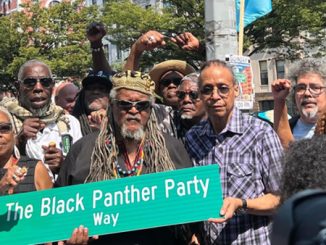
African drums and the words “All power to the people” echoed in Harlem, New York, on Sunday, Aug. 20, as the blue flag emblazoned with a black panther flew again.
On that day, veterans of the Black Panther Party and the Black Liberation Army and supporters old and young assembled to rename 122nd Street and Adam Clayton Powell Boulevard as Black Panther Way. The Harlem Headquarters of the BPP stood at 2026 Adam Clayton Powell from 1968 to 1976.
Other Panther veterans present included Rosemarie Mealy, Sam Anderson, Shaba Om and longtime political prisoner Sundiata Acoli. Panther veteran and New York City Council Member Charles Barron addressed the gathering by telephone. State Senator Cordell Cleare, City Council Member Kristin Richardson Johnson and Community Board District Manager Shatic Mitchell, who had worked for the renaming, also attended and spoke.
Senator Cleare read a proclamation honoring the Panther veterans and legacy and describing the brutal campaign against the BPP by the state apparatus. “I am justly proud to honor all distinguished members of the Black Panthers’ Harlem branch,” she said.
Honor and tribute was given to the fallen comrades of the Harlem office, to Black Panthers martyred in captivity, and to six freedom fighters still imprisoned by the racist U.S. state apparatus – Ed Poindexter (52 years), Veronza Bowers (50 years), Kenny “Zulu” Whitmore (45 years), Mumia Abu-Jamal (41 years), Jamil Abdullah Al-Amin, aka H. Rap Brown (23 years) and Kamau Sidiki, aka Fredie Hilton (22 years).
A multigenerational crowd of over 200, including veterans of the Young Lords Party, turned out to honor the Panther freedom fighters, their work, sacrifice and legacy. When the 10-point program of the Black Panther Party was read aloud, the chant “Stick to the platform” rang out.
Speakers described the work of the Harlem-Bronx branch of the Party, including the free breakfast for children program and community health programs. They explained the vicious attack launched against the BPP by federal and local state apparatus. “We were at war and still are,” Rosemarie Mealy declared. She described the powerful role of the Panther women in sustaining the work of the party in the face of severe repression.
“The government unleashed total terror against us,” said Jamal Joseph, who was the youngest member of the framed-up and exonerated New York Panther 21. “Because of that class struggle we were building a united front against fascism.” Joseph stressed that the work of the Panthers was guided by their creed, “undying love for the people.”
The ceremony concluded with the release of blue and black balloons into Harlem’s skies and the unveiling of the street sign naming 122 Street and Adam Clayton Powell Boulevard Black Panther Way. In the words of Council Member Charles Barron, it was “a glorious day, long overdue.”
A 7 años de Junta de Control Fiscal dictatorial
Esta semana se cumplieron 7 años de la imposición en Puerto Rico de una Junta de Control Fiscal por el gobierno de Barack Obama que fue avalada tanto por Republicanos como por Demócratas estadounidenses.
Una Junta que supuestamente venía y que a “enderezar” las finanzas de PR y sacar al país de una deuda de más de $72 mil millones de dólares para que PR se pudiera volver a endeudar en los mercados internacionales.
Y para eso crearon una ley que en sus siglas lee eufemísticamente PROMESA.
Pues a siete años de la imposición de esa dictatorial Junta de 7 personas, se ha podido constatar la verdadera intención criminal de los EUA. Al ser una colonia, PR no tiene poderes propios, sino que es el Congreso estadounidense quien decide e impone lo que le convenga a los EUA.
Y lo que le conviene es ensayar en PR lo que poco a poco quieren imponer en el resto del mundo: la profundización del capitalismo neoliberal. Parte de ese esquema es la Privatización de servicios esenciales como el agua, la luz, el transporte, la educación, la vivienda, y hasta la seguridad para beneficiar a las compañías gringas.
Para eso necesitan destruir la resistencia organizada, sobre todo los sindicatos. Y esto es exactamente lo que ocurre aquí donde hay un gobierno local que es fiel al mandato yanqui y a la Junta. De hecho, el mismísimo gobernador actual Pedro Pierluisi, era abogado de la Junta y por su actuación ahora en beneficio de las privatizadoras y por ende, en contra del pueblo, sigue siendo el más fiel defensor de esta nueva invasión estadounidense.
Siete años de la implantación de las políticas de esta Junta ha empobrecido al pueblo boricua; ha profundizado el estado colonial, ha hecho desaparecer escuelas, programas de servicios básicos, robado y vendido bienes y terrenos del pueblo a extranjeros millonarios y en general, ha intentado quitar la esperanza de un futuro para los y las boricuas.
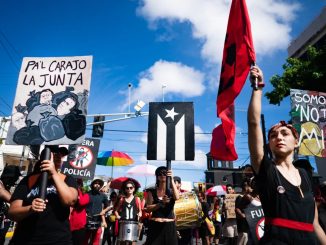
Pero la batalla no está perdida mientras exista la Resistencia a este ultraje. Y la hay y se demostró en la manifestación del 7mo aniversario de la Junta donde la organización Jornada se Acabaron las Promesas terminó el acto quemando los trapos sucios que son las banderas yanquis. Y las palabras de Jocelyn Velázquez, portavoz de la Jornada resume el futuro: “Esta patria es nuestra y la vamos a defender con uñas y dientes”.
Desde Puerto Rico para Radio Clarín de Colombia, les habló, Berta Joubert-Ceci.
Cuba: New actions against the island are being prepared
The war that the United States is waging against Cuba is broad and covers politics, economy, culture, sports, health, education, and everything they can do to hinder the development of the island, with the purpose of preventing the satisfaction of the people through their media campaigns projecting socialism as a failed system.
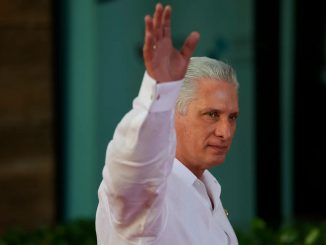
The new plan is centered on the upcoming visit to the UN in September of Cuban President Miguel Díaz Canel, where he will intervene as the current president of the Group 77 plus China, something that the Yankees could not prevent and which gives the Island an important role in the international arena, and something that counteracts the lies fabricated against the Revolution.
In Miami, the City of Hate, the elements financed by the State Department and the CIA to carry out the anti-Cuban plans designed by the specialists of the Internet Task Force for Subversion in Cuba, created in January 2018, and others dedicated to creating defamatory campaigns, are taking steps to organize acts of repudiation against the visit of the Cuban president and to create an atmosphere that will hinder his participation in the UN.
The memory of these specialists, many of them young, who have not searched their archives for the failures of their predecessors when they tried for years to do the same to Fidel Castro during his visits to New York, is bad. It always backfired, but hatred blinds them and does not allow them to reason.
For its part, the State Department is already deploying its guidelines and pressures on a group of journalists at its service so that they may quickly disseminate the information generated by the specialists in subversion against Cuba, as some Florida newspapers and television stations are doing.
Meanwhile, presidents and chancellors of countries where repression against popular protests is brutal are not subjected to a single word of criticism, among them the president of France, who has a long record of brutal beatings of workers, or that of Peru, which in less than a year has accumulated 70 deaths due to repression and more than 2000 wounded, pending trial, a situation that has never happened in Cuba after 1959.
The same Yankee president who allows his police forces to shoot to kill and use actions to immobilize detainees, causing their death by asphyxiation, the one who finances the war in Ukraine and even delivered cluster bombs prohibited by the United Nations, is not the object of accusatory campaigns.
The United States has an infinite sheet of crimes against humanity, during its recent wars against Afghanistan, Iraq, Syria, and Libya, with thousands of civilian deaths, mutilated, and the destruction of those countries, so it lacks morals to point out Cuba because it faced the disorders that occurred in 2021, incited by the imperial media machine itself, as has been proven.
The United States applies the death penalty to men, women, and even children and does not receive a single international condemnation. Its prisons are full of women and minors, many of them serving life sentences in adult facilities, in total violation of human rights; therefore, it should look inward before creating campaigns to countries that do not agree to submit to its dictates.
Recently, official documents were published revealing the covert actions of the CIA to overthrow the Chilean government of Salvador Allende, some of them with notes in the handwriting of Richard Helms, director of the CIA, during the meeting held on September 15, 1970, with Richard Nixon, then president of the United States.
In that meeting, Nixon directed the CIA to “work full time with the best men we have.” “Make the Chilean economy howl” and stressed: “I was not concerned about risks involving the United States.”
That same position was assumed by John F. Kennedy against Cuba, and that is why he approved in 1962 the Cuba Project, where also the economy was the main target, which remains unchanged with its criminal economic, commercial, and financial war, to prevent any satisfaction of the population, coupled with propaganda actions to achieve the resentment of the people against the revolutionary government.
Just as Nixon expressed in 1970, on January 19, 1962, Richard Helms, Chief of Operations of the CIA, sent a report to its director John McCone, of the result of a meeting with Robert Kennedy, Attorney General of the United States, on Cuba, where this among other things expressed:
“The overthrow of the Castro regime is possible. We urgently need to take actions that will keep Castro occupied with internal economic, political and social problems, preventing him from spending time on foreign policy issues, especially in Latin America”.
“A solution to the Cuban problem constitutes at this time, a high priority of the U.S. government, everything else is secondary and no time, money, effort or human resources will be spared.”
“The Attorney General of the United States expressed that the day before, January 18, 1962, President Kennedy indicated to me: The last chapter on Cuba has not yet been written, it must be done and it will be done. That is why he ordered the attendees at that meeting, their absolute and resolute dedication not to fail in the fulfillment of the 32 tasks of the Cuba Project”.
Nothing has changed. The destabilization of the economy of the countries that refuse to submit to the United States is the Yankees’ favorite weapon, but they try to create the matrix of opinion that it is false and only pretexts of those who suffer it to hide their failures.
The declassified documents of the CIA and the White House expose the truth, although the mercenaries of the pen in the service of the State Department never make reference to this information that demonstrates the irrefutable reality of who are the real violators of human rights, who cannot give lessons to anyone.
Cuba has nothing to be ashamed of, the Yankees cannot hide the work of the Revolution, and as José Martí expressed:
“To raise one’s brow is more beautiful than to lower it.”
Source: Razones de Cuba, translation Resumen Latinoamericano – English
African Union suspends Gabon after military coup ousts President Ali Bongo
The Peace and Security Council of the African Union (AU) on Thursday, August 31, suspended Gabon from all its activities, organs and institutions. The announcement followed a day after a military-led coup ousted Gabonese President Ali Bongo Ondimba.
The coup followed just minutes after Bongo was proclaimed the winner of the general elections held in the Central African country on August 26.
In the early hours of August 30, the Gabonese Center of Elections (CGE) announced that Bongo had won Saturday’s polls with 64.27% of the votes. Albert Ondo Ossa, former education minister and the consensus candidate put forward by a platform of major opposition parties, Alternance 2023, won 30.77%.
Soon after the results were announced, 12 men, including the police, soldiers from the elite Republican Guard, and the National Gendarmerie, appeared on the television channel Gabon 24 and declared that the election results stood canceled and that they had seized power “to put an end to the regime.”
“Today, the country is going through a serious institutional, political, economic and social crisis,” the statement read. “The organization of the general elections of [August 26, 2023] did not meet the conditions for a transparent, credible and inclusive ballot so much hoped for by the people of Gabon.”
“Added to this is irresponsible and unpredictable governance, resulting in a continuing deterioration in social cohesion, with the risk of leading the country into chaos.”
The soldiers added that they would respect Gabon’s commitments to the national and international community.
Identifying themselves as the Committee of Transition and the Restoration of Institutions (CTRI), the group announced that the election results were canceled and that the borders of the country had been closed. All the institutions of the Republic were dissolved, including the government, the Senate, the National Assembly, the Economic, Social, and Environmental Council, and the CGE.
The announcement was followed by sounds of gunshots in Libreville. However, according to Harold Leckat, the director of news publication Gabon Media Time, the shots fired were a form of military communication, which was confirmed to him by senior army officials. “Through these shots, they called out to other corps commanders who then responded with warning shots. It was in fact a way of giving their approval to the movement orchestrated by the Comité de Transition et de Restauration des Institutions [CTRI],” he told Peoples Dispatch.
The CTRI placed Bongo under house arrest and proceeded to arrest others, including his son, on charges such as corruption, embezzlement, and treason.
Following a meeting, the group proceeded to name General Brice Oligui Nguema, the head of the Republican Guard, as the president of the transition. He will be sworn in on September 4.
Nguema had been an assistant to former President Omar Bongo until 2009 when Ali Bongo came to power. The General worked in Gabon’s embassies in Senegal and Morocco before returning to the country and joining the Republican Guard in 2018. Some reports also suggest familial ties between Nguema and Bongo.
Meanwhile, crowds of people took to the streets in celebration on Wednesday, raising slogans of “Down with Bongo” and “Down with the PDG!” (Bongo’s Gabonese Democratic Party). “Thousands of Gabonese took to the streets, flying the national flag, singing the national anthem and celebrating with the security forces who overthrew the regime in Libreville,” Leckat said.
“The Gabonese people came to demonstrate their joy at finally seeing this system, which has multiplied constitutional coups d’états since 1990, finally overthrown.”
Speaking to Democracy Now, Daniel Mengara, a professor and founder of the Bongo Must Leave movement, noted: “[The people] are very happy that for once the Bongo family has been at least disabled to the point of opening up the possibility of perhaps later on democracy for Gabon… This is a rare opportunity for the Gabonese people to engage in national dialogue that would allow for…after the transition to go into democratic rule.”
Gabonese nationals also gathered outside the country’s embassy in Senegal on Wednesday to welcome Bongo’s removal from power. However, the protestors were dispersed by Senegalese forces who deployed tear gas. Violence was also reported outside the Gabonese embassy in Rabat, Morocco.
Questions surrounding the electoral process
Saturday’s elections had been conducted under an internet blackout, border closures, and a curfew. Foreign journalists were reportedly not issued press accreditation to cover the election. There were also concerns about the ability of Gabonese citizens living abroad to vote in the election, given that only 14 polling stations in 12 countries had been approved.
The announced results would have given Bongo a third term in office, extending the rule of his family which has been in power in Gabon for the past 56 years.
“The August 26 election was organized in an amateurish way that surprised many. Already, it was a general election, which meant that deputies in parliament, local elected officials and the President of the Republic had to be elected within a sufficiently short timeframe, with an electoral list on which there were deceased persons, and on which there were duplicates,” Leckat said.
He added that the list had been put together hastily in a period of just two weeks, despite the fact that several localities “were, and still remain inaccessible.” Another concern was related to the appointment of the head of the CGE, Michel Stéphane Bonda.
A former advisor to both President Ali Bongo and his father and predecessor Omar Bongo, as well as the former minister delegate for water and forests, Bonda is a close associate of the ousted president, Leckat said.
Another major challenge was related to the voting system itself. In July, the CGE announced a single-ballot system for the legislative and presidential elections, which would in effect mean that a vote for a party’s parliamentary candidate from a particular constituency would automatically mean a vote for that party’s presidential candidate.
The change was rejected by the opposition which argued that it would allow Bongo to unduly benefit from votes given to PDG candidates in the legislative elections. Moreover, not all opposition parties had fielded candidates for the legislative elections. Albert Ondo Ossa himself was also an independent candidate.
Prior to these changes, reforms to Gabon constitution were approved in April, under which all political mandates were reduced to five years (which would make the presidential election take place simultaneously with the parliamentary elections) and the double round voting system was canceled. A term limit for the presidency was removed in 2003.
“Even though it was a question of electing [officials] to two different institutions, we ended up voting for the president and the deputy [for the National Assembly, or the Lower House of parliament] on the same ballot paper, unheard of in a democracy,” Leckat said.
“It is all these elements that prompted the uprising, certainly of the army. And if this army uprising hadn’t taken place, I’m convinced that the Gabonese people would have shown defiance, because they massively voted for the consensus candidate of the opposition [Albert Ondo Ossa].”
Gabon had witnessed violent protests in the aftermath of the previous presidential elections held in 2016, in which Bongo had won with a slim majority of 49.80% (by 5,500 votes) against his opponent, Jean Ping, who secured 48.23% of the vote share. At least five people were killed according to the government’s own estimates.
Members of the armed forces had also mounted a foiled coup attempt in 2019 while Bongo was seeking medical treatment in Morocco.
Even though the Bongo family has amassed vast personal fortunes, Gabon’s substantial oil wealth has not translated into an improvement in the living conditions of a large part of the country’s population, about one-third of whom are impoverished. The country’s unemployment rate stands at around 30%.
As of August 31, the country remains under curfew from 6pm to 6am. However, the CTRI has since announced the restoration of the internet and broadcasting of international radio and television channels in the country.
The Alternance 2023 platform has called upon the CTRI to continue the vote counting process, and has expressed willingness to engage in dialogue.
International response
As international responses to the coup continue to trickle in, a call for Bongo’s restoration to power is notably absent.
However, in a statement issued on Wednesday, the head of the African Union Commission strongly condemned the “attempted coup” as a “way to resolve its current post-election crisis” and called upon the national army and security forces to adhere to their republican roles and to guarantee the physical integrity of the deposed president and the members of his family and government.
Following a meeting on August 31, the African Union’s Peace and Security Council, currently chaired by Burundi, announced that Gabon’s suspension would remain in place “until the restoration of constitutional order in the country.”
The Economic Community of Central African States (ECCAS) has also issued a communique condemning “the use of force as a means of resolving political conflict and gaining access to political power.” It called for a “rapid return to constitutional order” and indicated that it is waiting for an “imminent” meeting of the Central African Peace and Security Council (COPAX) to discuss the current situation in Gabon and the way forward.
Nigerian President Bola Tinubu, who is the current chair of the Economic Community of West African States (ECOWAS), also expressed “deep concern” regarding Gabon’s socio-political stability and the “seeming autocratic contagion appearing to spread to other parts of the African continent.”
ECOWAS has imposed severe sanctions and threatened a military intervention in Niger in West Africa, where military officers had seized power in a popularly-supported coup on July 26.
Meanwhile, European Union’s foreign policy chief Josep Borrell told reporters that Gabon’s election had been “plagued by irregularities.”
“There are military coups and institutional coups, where you don’t need to take up arms, but if I rig an election to seize power, that is also an irregular way to do it,” he said.
France, in a statement issued by government spokesperson Olivier Véran, condemned the military coup and reiterated its “commitment to free and transparent elections,” adding that “the result of the election, when it is known, must be respected.” The Bongo family has held close ties with France—to the extent that Gabon has been considered a “central pillar” and “example par excellence” of Francafrique, an enduring economic and political system of control between France and its former colonies.
Gabon is among 14 countries on the African continent that uses the neocolonial CFA Franc currency. France also has about 350-400 troops stationed in Gabon and French companies have historically enjoyed preferential treatment in the country, including in oil licensing.
French company Eramet, which is the world’s largest producer of manganese ore, has resumed mining in Gabon after briefly suspending operations on August 30.
“Gabon has only been able to get rid of its presidential puppet through the intervention of its military. Macron will, once again, have compromised France in supporting the unbearable until the end. Africans are turning the page,” stated Jean Luc-Melenchon, a left-wing French politician and former member of the National Assembly.
Meanwhile, White House spokesperson John Kirby stated, “It is obviously deeply concerning (to see) yet another country where military officers have taken these dangerous and reckless steps and attempted takeovers of democratically elected governments.” A separate statement from the US State Department noted “with concern, the lack of transparency and reports of irregularities surrounding the election.”
China has called on all relevant parties in Gabon to “resolve differences peacefully through dialogue, and restore normal order as soon as possible.”
UN Secretary General António Guterres firmly condemned the coup in a statement, noting with “deep concern the announcement of the election results amidst reports of serious infringements of fundamental freedoms.” He called on “all actors involved” to hold an “inclusive and meaningful dialogue.”
How Reagan’s war drive exploited a tragedy: The real story of Korean Air Lines Flight 007
Updated. First published September 1, 2021.
Forty years ago, 269 people were killed when Korean Air Lines flight 007 was shot down over the Soviet Union on Sept. 1, 1983.
President Ronald Reagan called it “an act of barbarism.” U.S. cops kill as many people every three months.
Less than five years later, the U.S. Navy blew up Iran Air flight 655 on July 3, 1988, killing 290 people. Reagan’s Vice-President, George H.W. Bush, declared a month afterwards, “I will never apologize for the United States — I don’t care what the facts are.”
The Korean airliner flew as far as 365 miles off course to go over sensitive Soviet military bases at night. Monitoring Soviet communications, the National Security Agency later admitted the socialist country’s air defense personnel thought the jet was a U.S. RC-135 spy plane, a Boeing military plane that’s identical to the Boeing 707 commercial aircraft.
The Iranian airliner, on the other hand, was on its expected course when it was shot down in broad daylight, 7,600 miles from the U.S., by a missile fired by the USS Vincennes. Both tragedies were used by the military-industrial complex to get what it wanted.
After its airliner was shot down, Iran was compelled to end the Iran-Iraq war on poor terms. Using the “divide and conquer” tactic, both the Carter and Reagan administrations promoted this bloody war that killed hundreds of thousands of people. Now it was time to end it, with both Iran and Iraq severely weakened.
The shootdown of the Korean airliner unleashed a tidal wave of hate against the Soviet Union. Corporate media acted as cheerleaders. Reagan used the 269 deaths to push through huge increases in the Pentagon budget.
A crucial part of this war drive was deploying Pershing II medium range nuclear missiles in West Germany in November 1983. These mass murder weapons — that could hit Soviet soil in eight minutes — were installed despite millions of people having demonstrated against them.
War propaganda at the U.N.
Pumping up the anti-communist campaign was a Hollywood spectacular at the United Nations Security Council, courtesy of the U.S. Information Agency. Its director was Reagan’s buddy Charles Wick, co-producer of “Snow White and the Three Stooges.”
Five TV screens were set up in the council chamber to show the video. The MC was U.S. Ambassador Jeane Kirkpatrick.
She had dismissed the murder and rape of four churchwomen in El Salvador by the oligarchy’s National Guard. “The nuns were not just nuns,” Kirkpatrick said. “The nuns were also political activists.”
Thirteen years later the video’s producer, Alvin Snyder, admitted that “the video was powerful, effective and wrong.” It featured alleged comments of Soviet pilots, many of which were mistranslated.
Adding to the right-wing uproar was the death on flight 007 of John Birch Society leader and Congress member Larry McDonald. The fascist had nominated Nazi war criminal Rudolf Hess for a Nobel Peace Prize.
The Birchers claimed that flight 007 was actually captured by a secret Soviet weapon with McDonald and the other passengers being held captive. Interestingly, other Congress members — including Ku Klux Klan Senator Jesse Helms — flew on KAL flight 015, which followed flight 007 and kept on the correct flight path.
All the while, the Reagan regime was conducting a massive cover-up that rivaled Watergate. Key radar tapes were destroyed. Gag orders were issued to silence witnesses.
By law, the National Transportation Safety Board was supposed to investigate the shootdown. It was illegally ordered instead to turn over its evidence to the State Department, which sat on it.
Deliberately off course
One of few voices to question the White House story about flight 007 was British journalist R.W. Johnson. His book “Shootdown” was published in 1986 and is worth reading today.
Johnson described the tremendous odds against the Korean airliner having accidentally flown so far from its designated flight path. He quotes retired Canadian Major-General Richard Rohmer: “Did the [Korean] 747’s crew know the aircraft was off course? … Yes, they knew exactly where they were …”
Here’s some of the reasons “Shootdown” gives for disbelieving that flight 007 flew 250 miles over Soviet territory by “mistake”:
- *The Boeing 747 was equipped with the Inertial Navigation System. The INS has three computers so it can continue to function even if two of the computers crash. Over a five-year period there was only one INS error per every 20,000 flights, most likely caused by programming errors.
- It’s hard to believe that such an error was made by the captain of flight 007, Chun Byung-in. The experienced pilot was known as a “human computer.”
- Chun wasn’t alone on the 747 flight deck. Even if the INS and the autopilot were uncoupled, the crew would have had to ignore the amber warning light. They also would have had to fail to notice the reading on the magnetic compass.
- Standard procedure would be for the plane’s weather radar to be in its ground-mapping model. This would have clearly shown the Soviet Union’s rocky Kamchatka peninsula that the plane flew over.
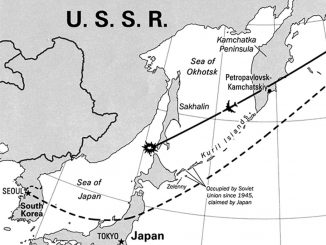
- Captain Chun repeatedly gave false positions of his location. He flew almost directly over the Soviet bases of Petropavlovsk and Korsakov. Chun turned to go over the Soviet Union’s Sakhalin Island.
- In order to make evasive maneuvers, including increasing the speed, Captain Chun took 10,000 pounds more fuel than he put on the flight release sheet.
- Retired Trans World Airlines pilot and navigator Robert Allardyce along with his associate James Gollin listened to the last words of flight 007’s First Officer Son Dong-Hui. It was first broadcast on ABC’s “20/20” program. They heard: “For South Korean Director … repeating instructions. Hold your bogey (or ‘bogies’) north (or ‘course’) … repeat conditions. Gonna be a bloodbath … you bet.”
As R.W. Johnson pointed out, both “director” and “bogey” are military, not civilian, aviation terms. He wrote that First Officer Son “was in touch with the mission director of what could only have been a surveillance mission.”
Using passengers as bait
Flight 007 wasn’t the first Korean Air Lines plane to go over Soviet territory by “mistake.” On April 20, 1978, KAL flight 902 flew over the Soviet base at Murmansk before it was forced to land by a Soviet fighter. One passenger was killed.
South Korea is a virtual colony of Wall Street and its military-industrial complex. In the middle of Seoul is a U.S. military base. That’s like British or German troops occupying New York City’s Central Park.
The CIA uses South Korea to spy on the socialist Democratic People’s Republic of Korea and, at that time, the Soviet Union. KAL flight 007 was used as bait to “light up” every Soviet radar in the region, as well as to listen to radio communications.
Collecting info for the Pentagon were at least two RC-135 spy planes; another spy plane, the Orion P-3C; the USS Observation Island, operating the Cobra Judy radar; and the 1982-41c spy satellite. The U.S. also had a series of ground radar stations. Meanwhile the space shuttle Challenger was circling the earth.
Ernest Volkman, editor of “Defense Science,” described the results:
“As a result of the KAL incident, United States intelligence received a bonanza the likes of which they have never received in their lives. Reason: because of the tragic incident it managed to turn on just about every single Soviet electromagnetic transmission over a period of about four hours and an area of approximately 7,000 square miles, and I mean everything. … Now, admittedly, that’s a cynical statement, but we’re talking about a very cynical business here.”
More good news from the 269 dead passengers and crew was a boom in “defense” stocks, including Lockheed.
Risking nuclear war
The Reagan administration was possibly the most adventurist in U.S. history. It wanted to put MX nuclear missiles on Japanese bullet trains.
Secretary of Defense Caspar Weinberger wrote that Secretary of State Alexander Haig wanted “to invade Cuba and, one way or another, put an end to the Castro regime.”
Reagan worshipper Peter Schweizer bragged how U.S. bombers would fly to the edge of Soviet air space before peeling off at the last minute. Every time Soviet fighters were forced to scramble. Pretending to launch a nuclear first strike must have been great fun!
This was the most dangerous time of the Cold War since the Cuban missile crisis. A Soviet diplomat told Brian Becker — now the ANSWER Coalition’s national director — that the KAL 007 crisis reminded him of John F. Kennedy’s assassination. Many on the far right claimed that accused JFK assassin and patsy Lee Harvey Oswald was a Soviet and/or Cuban agent.
Starting on Nov. 7, 1983 — the anniversary of the Bolshevik Revolution — U.S. and other NATO forces staged the Able Archer ‘83 exercise, which included a simulated nuclear attack. Soviet Defense Minister Dmitry Ustinov warned that NATO’s exercises “are becoming increasingly difficult to distinguish from a real deployment.”
Meanwhile U.S. naval exercises were staged in the northern Pacific near Soviet waters. These included the Fleetex ‘83 exercise and a simulated amphibious assault on Okinawa. This was seen as preparation for invading Soviet territories like the Kuril Islands, Sakhalin or Kamchatka.
The same year racist Reagan invaded the Black Caribbean island of Grenada while U.S. Marines landed in Lebanon. The CIA continued the Contra war in Nicaragua that cost 50,000 lives and was paid for by starting the crack epidemic.
Billions were spent to overthrow a progressive government in Afghanistan. Reagan did everything he could to prop up the apartheid regime in South Africa that was keeping Nelson Mandela in jail.
Gambling with 269 lives
Like Trump, the Reaganites wanted to ditch arms-control treaties. Part of this campaign was leaking to journalists Rowland Evans and Robert Novak that a huge radar was being built at Krasnoyarsk in Siberia. In their July 27, 1983, newspaper column, they claimed the facility would violate the anti-ballistic missile treaty.
What was needed to whip up this allegation was finding out if there was a radar gap on the Soviet Union’s Pacific border. Hence the flight of KAL 007 over a string of Soviet military bases, forcing its military to turn on every radar.
U.S. electronic platforms jammed as many Soviets radars as they could. This allowed flight 007 to get clean across Kamchatka.
Soviet fighters were sent to stop the intruder. Flight 007’s pilot Chun Byung-in ignored warnings that included tracer shells shot by Soviet pilot Vassily Kasmin.
Chun instead staged diversionary tactics like a military aircraft would. (Chun was a former Korean Air Force pilot.) These tricks included reporting that he was climbing when he was actually descending.
Kasmin was finally given an order to fire missiles at the intruder. The Soviets had no idea that it was a commercial airliner.
R.W. Johnson believes that National Security Advisor “Judge” Bill Clark and CIA director William Casey were responsible for sending flight 007 into Soviet airspace.
If worse came to worse, flight 007 might be forced to land on Soviet territory, like KAL flight 902 did in 1978. But 007 pilot Chun Byung-in tried to escape instead. Two hundred sixty-nine people were killed.
Clark looked for an exit. When the Secretary of Interior James Watt was forced to resign after making bigoted remarks, Clark slipped into the job. Within a year he was back at his California ranch.
The sad tale of flight 007 should be remembered for the deadly risks taken by the U.S. military-industrial complex. Poor and working people shouldn’t believe White House lies about the Soviet Union 38 years ago or the People’s Republic of China today.
Unless otherwise noted, the source is “Shootdown: Flight 007 and the American Connection” by R.W. Johnson.
Free all political prisoners! Black August in San Diego
This year, Black August was commemorated in cities across the United States and internationally in Central and South America, France, and Africa.
The growing international interest in commemorating Black August is evident when you search those two words online. We must always be mindful of the search results and check the source.
In San Diego, the Coalition to Free Mumia Abu-Jamal and All Political Prisoners, community activist Dahryan Muhammad, and the Black Panther Party of San Diego (BPPSD) began organizing in June for three activities at the Malcolm X Library addressing the history of Black resistance.
The groups recognize that all prisoners are political prisoners because of this corrupt criminal justice system, and that we must emphasize the urgency in freeing all political prisoners, especially those who are sentenced to “death by incarceration.”
We have witnessed too many of our freedom fighters die within months of their long-delayed releases. We must do better at educating, organizing, and mobilizing the people. We must believe it when we say “power to the people.” We must believe that we the people, working-class people, have the power to free them all!
On Aug. 12, the Coalition to Free Mumia hosted a video screening of “Free Angela & All Political Prisoners,” an inspiring documentary that takes a gripping look at the historical incident that created an international movement to free activist Angela Davis.
That struggle ended with the acquittal of Angela Davis, but left her co-defendant Ruchell Magee to be named the longest-held political prisoner in the U.S., having been locked up since 1963 in California prisons and eight years prior in Louisiana, beginning in 1955.
Ruchell Cinque Magee was born on March 17, 1939, in the small town of Franklin, Louisiana. Across the Deep South, Jim Crow laws, white supremacist lynchings, KKK terror, segregation, and legal bias against Black people were common. He was politicized in prison and worked tirelessly as a jailhouse lawyer, helping many other prisoners win their freedom.
Magee was in the courtroom on Aug. 7, 1970, when Jonathan Jackson courageously entered the Marin County Courthouse with the intent of taking hostages and negotiating the freedom of his brother, George Jackson, and the other two Soledad Brothers.
Magee joined the courthouse rebellion, which ended with Jonathan Jackson’s death. He was charged with kidnapping and given a life sentence.
Magee was just 16 years old in 1955 at the time of his first arrest. When he was finally released in July 2023 from a California prison medical facility, he was 84 years old. Most of the youth at the video screening had never heard of Ruchell Magee.
On Aug. 19, the San Diego Black Panther Party hosted a Black August forum entitled “Our Resistance is Essential.” The panelists included representatives of the International People’s Democratic Uhuru Movement (InPDUM) and the Coalition to Free Mumia. Discussion focused on the importance of building the resistance.
The final Black August event at Malcolm X Library on Aug. 26 was hosted by the Coalition to Free Mumia. It began with a slide presentation with pictures of some of our current and released political prisoners, as well as those who have joined the ancestors. Most of their names can be found on the National Jericho Movement website.
Remembering the first Black August
Participants included BPP-SD, John Parker from the Harriet Tubman Center and Black Alliance for Peace from Los Angeles, organizers from the Socialist Unity Party (SUP) and Women in Struggle.
We reviewed some of the many historical dates associated with Black August, beginning with George and Jonathan Jackson. Aug. 28, 1971, seven days after the prison murder of George Jackson, marked the first Black August event.
At Jackson’s memorial service, there were 200 Black Panthers in full uniform, while 8,000 people listened outside, perched on rooftops, hanging from telephone poles, and filling the streets. They raised their fists in the air and chanted “Long live George Jackson” as his body was brought out.
We listened to an audio commentary by Ramona African covering the case of the MOVE 9 political prisoners, recently released after 40 years in prison. Ramona spoke of the August 1978 massive police raid on MOVE – where the cops killed one of their own and charged nine MOVE members for the murder.
She followed that with a description of the May 1985 attack when Philadelphia police bombed the MOVE house, killing 11 people, including five children. No one was ever charged with those murders.
We agreed that we will have more teach-ins discussing the history of the Black liberation struggle and educating the community about political prisoners.
We ended our discussion by asking ourselves, “What will it take to free all political prisoners?” We know that it’s going to take millions of people who are committed and ready to go out into the streets and do what it takes to support our political prisoners and demand that the U.S. criminal justice system “Free them all!”
It’s going to take a revolution! A socialist revolution!
We each grabbed a book, a poster, or just held up our fists as we shouted: “All power to the people! Free Mumia! Free them all!” We stood our ground and maintained our position for a picture to confirm our commitment. In solidarity!
Los Angeles Black August: putting knowledge into action
In Los Angeles, the Black Alliance for Peace held a Black August teach-in at Book Club HQ with the participation of the All-African People’s Revolutionary Party and the Harriet Tubman Center for Social Justice. Political prisoners’ historic contributions were celebrated, along with reflecting on the systemic crimes of the capitalist state.
The question of what constitutes a political prisoner was discussed. In addition to those jailed for fighting for justice and liberation, the laws of the ruling class targeting the working class, especially Black and Brown communities, show that the political targeting of almost the entire incarcerated population makes them political prisoners (excluding the most dangerous individuals who are rarely jailed – like murderous cops and others who practice white supremacy).
The teach-in was also about putting knowledge into action. Lists of organizations were called out by participants – organizations that we could immediately join to facilitate coordination and unified actions to free all the political prisoners and continue their fight for liberation and systemic change.
The teach-in ended by highlighting the contribution of the courageous former Black Panther and political prisoner who escaped to Cuba – Assata Shakur.
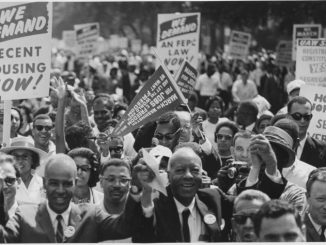
Still marching for Jobs and Freedom: A. Philip Randolph demanded $20 minimum wage
Aug. 28 was the 60th anniversary of the 1963 March on Washington for Jobs and Freedom. That year was the centennial of the Emancipation Proclamation, which allowed the United States to defeat the slave owners’ confederacy.
It was Black soldiers, sailors and the Black general strike behind enemy lines that made the Northern victory possible. After a brief springtime of democracy during Reconstruction, Northern capitalists betrayed Black people, who endured decades of lynchings and Jim Crow segregation.
This year thousands of people gathered on Aug. 26 at the Lincoln Memorial to remember that great march and continue the struggle against racism and poverty. The People’s Organization for Progress brought a busload of activists from New Jersey.
The establishment wants the historic 1963 march to be seen as simply a feel-good moment. Only the soaring “I have a dream” portions of Dr. King’s great speech are usually quoted in the media.
Far less mentioned was King saying that “the whirlwinds of revolt will continue to shake the foundations of our nation until the bright day of justice emerges.”
Capitalists didn’t want the March on Washington to take place. They feared those “whirlwinds of revolt” as hundreds of thousands of Black people and their allies were coming to Washington, D.C.
The wealthy and powerful were still keeping their capital a thoroughly segregated town. It would be another decade before people in the Black city would be allowed to vote for mayor.
A quarter-million people came to Washington on Aug. 28, 1963. A. Philip Randolph, the 74-year-old leader of the Brotherhood of Sleeping Car Porters, had wanted to call such a march decades earlier.
Randolph led the March on Washington Movement in the early 1940s that demanded an end to job discrimination and the desegregation of the military. Its threat to march on Washington forced President Franklin Roosevelt to create the Fair Employment Practices Committee.
Now, Randolph was the director of the March on Washington for Jobs and Freedom with Bayard Rustin as his deputy.
Honoring W.E.B. Du Bois
The day before the march, the legendary scholar W.E.B. Du Bois died at the age of 95 in Ghana. Du Bois wrote “Black Reconstruction in America” and many other classic works.
Florida Gov. Ron DeSantis wants to ban them from the Sunshine State’s schools as part of his war on Black History.
Du Bois co-founded the National Association for the Advancement of Colored People (NAACP) in 1909 and was editor of its publication, The Crisis, for many years. He gave the eulogy at the funeral of Ethel and Julius Rosenberg, who were framed and burned to death in the electric chair on Juneteenth 1953.
Du Bois helped organize Pan-African conferences and joined the Communist Party USA in 1961. As NAACP Executive Secretary Roy Wilkins announced the passing of Du Bois, a hush came over the 250,000 people at the Lincoln Memorial.
Wilkins said, “regardless of the fact that in his later years Dr. Du Bois chose another path, it is incontrovertible that at the dawn of the twentieth century his was the voice that was calling to you to gather here today in this cause. If you want to read something that applies to 1963 go back and get a volume of ‘The Souls of Black Folk’ by Du Bois, published in 1903.”
Racist violence hasn’t stopped
In 1963, bigots in Congress and newspaper editorial offices were predicting violence if “too many” Black people came to Washington, D.C. President John F. Kennedy also wanted the march canceled.
He told Dr. King and other leaders at the White House, “Well, we understand that injustice, and we want to help you any way we can. But I don’t think it’s a good idea to bring a large group of people here.”
The real violence was happening elsewhere. That spring Bull Connor’s cops were using dogs to attack Black people in Birmingham, Alabama, with the approval of Gov. George Wallace.
Medgar Evers, the NAACP’s Mississippi field secretary, was assassinated on June 12, 1963, at his home in Jackson. His assassin Byron De La Beckwith wouldn’t be jailed until 1994.
The Ku Klux Klan bombed Birmingham’s 16th Street Baptist Church on Sept. 15, 1963, killing four Black girls: Addie Mae Collins, 14; Cynthia Wesley, 14; Carole Robertson, 14; and Carol Denise McNair, 11.
President Kennedy himself would be assassinated in Dallas – a stronghold of the ultra-right – three months after the march on Nov. 22, 1963.
The great march was held on the eighth anniversary of the murder of 14-year-old Emmett Till. The Black youth was tortured to death in Mississippi on Aug. 28, 1955.
An all-white jury acquitted Till’s murderers after 67 minutes of deliberation. The killers then bragged about their bloody crime.
This year, while people rallied in Washington on Aug. 26, a white neo-Nazi murdered three Black people in Jacksonville, Florida. They were Angela Michelle Carr, 52; Jerrald Gallion, 29; and Anolt Joseph Laguerre Jr., 19.
A. Philip Randolph grew up in Jacksonville. Longtime NAACP leader James Weldon Johnson, who wrote the lyrics to the anthem, “Lift Every Voice and Sing,” was born there.
When the race-baiting presidential candidate Ron DeSantis came to a vigil honoring the three victims, he was righteously booed and called a hypocrite.
Ten demands
The capitalist media almost never mentions the ten demands of the 1963 march. Among them was demanding a federal minimum wage of at least $2 per hour – adjusted for inflation, that’s now worth nearly $20 per hour. This demand was championed by A. Philip Randolph.
“What We Demand:
“1.) Comprehensive and effective civil rights legislation from the present Congress – without compromise or filibuster – to guarantee all Americans access to all public accommodations, decent housing, adequate and integrated education, and the right to vote
“2.) Withholding of Federal funds from all programs in which discrimination exists.
“3.) Desegregation of all school districts in 1963.
“4.) Enforcement of the Fourteenth Amendment, reducing Congressional representation of states where citizens are disfranchised.
“5.) A new Executive Order banning discrimination in all housing supported by federal funds.
“6.) Authority for the Attorney General to institute injunctive suits when any constitutional right is violated.
“7.) A massive federal program to train and place all unemployed workers – Negro and white – on meaningful and dignified jobs at decent wages.
“8.) A national minimum wage act that will give all Americans a decent standard of living. (Government surveys show that anything less than $2.00 an hour fails to do this.)
“9.) A broadened Fair Labor Standards Act to include all areas of employment which are presently excluded.
“10.) A federal Fair Employment Practices Act barring discrimination by federal, state, and municipal governments, and by employers, contractors, employment agencies, and trade unions.”
All these demands were in the interest of the working class. After years of struggle, the billionaire class was forced to concede some of them.
The Voting Rights Act was enacted by Congress in 1965. It was largely gutted by five members of the U.S. Supreme Court in its 2013 Shelby v. Holder decision.
Instead of a minimum wage that gives workers “a decent standard of living,” the current federal minimum wage of $7.25 per hour is worth half of what the minimum wage in 1968 could buy.
Instead of unemployed workers being placed “on meaningful and dignified jobs at decent wages,” at least 11 million workers are unemployed, according to the Bureau of Labor Statistics. This includes 5.8 million workers officially unemployed and 5.2 million “not in the labor force who currently want a job.”
Fifty years of reaction
After the struggles of the 1960s and early 1970s, capitalists have counterattacked. Millions of union jobs were destroyed because of deliberate deindustrialization.
An important step towards building the March on Washington was the June 23, 1963, Walk to Freedom in Detroit. One hundred thousand people marched down Woodward Avenue in Motown.
A key organizer was Reverend C.L. Franklin, pastor of Detroit’s New Bethel Baptist Church and father of Aretha Franklin. Since then Detroit has been devastated by plant closings.
Instead of getting jobs in the big plants, many Black, Indigenous and Latinx youth were railroaded to the big prisons. The prison population increased nearly seven times between 1970 and 2014. Over two million members of the working class were locked-up.
Forty-two years and one day after the March on Washington for Jobs and Freedom, Hurricane Katrina struck New Orleans on Aug. 29, 2005. President George W. Bush let Black and poor people drown and starve. Bush refused help from Cuba and Venezuela, who offered hundreds of doctors and other healthcare workers.
All these attacks make the words of Dr. King, given in his 1963 speech all the more important today. After referring to the “promise” of “the unalienable rights of life, liberty and the pursuit of happiness” given to Black people, King said:
“It is obvious today that America has defaulted on this promissory note insofar as her citizens of color are concerned. Instead of honoring this sacred obligation, America has given the Negro people a bad check, a check which has come back marked insufficient funds.” This was really a demand for reparations.
Scabbing without and within
It wasn’t just die-hard Jim Crow segregationists like South Carolina Senator Strom Thurmond who wanted to stop the March for Jobs and Freedom.
To the shame of the labor movement, the American Federation of Labor and Congress of Industrial Organizations refused to endorse the demonstration. However its Industrial Union Department, led by United Auto Workers President Walter Reuther, did endorse it.
AFL-CIO President George Meany represented the building trades which at the time were virtually all-white. He hated A. Philip Randolph, who for decades fought discrimination in the labor movement.
Right up to the AFL-CIO merger in 1955, many AFL unions had membership clauses that barred Black people from joining. At the 1959 AFL-CIO convention, Meany attacked Randolph, spewing, “Who the hell appointed you as the guardian of all the Negroes in America?”
Ted Dostal, a revolutionary steel worker employed at U.S. Steel’s Ohio Works – now closed – got the Youngstown, Ohio, AFL-CIO Labor Council to pass a resolution denouncing Meany.
In 1963, a sit-in occurred at Meany’s home union – Local No. 1 of the Plumbers Union, located in the racist Howard Beach neighborhood of Queens, New York. At the time the local didn’t have a single Black or Puerto Rican apprentice.
Meany went on to scab on poor people everywhere by supporting the Vietnam War. The labor movement, now with many Black, Latinx and women leaders, has advanced since then.
Even endorsers of the March on Washington were worried about its militancy. They had reason to. People were on the move.
Walter Reuther, who spoke at the march, and some other speakers, demanded changes in the speech of John Lewis. The talk of the future congressperson – who was later nearly beaten to death by Alabama state troopers at Selma – was still pretty militant.
Key Martin, who led Youth Against War and Fascism and had been a participant in the sit-in at the Plumbers union, told this writer about the great response to Mao Zedong’s statement to the march.
Ten thousand copies were mimeographed and handed to marchers by YAWF members. People were thrilled that China was on their side.
Robert F. Williams, former leader of the Monroe, North Carolina, NAACP branch, asked Mao to write the statement. Mabel and Robert Williams organized armed self-defense against Klan terror and were driven into exile, finding refuge first in Cuba and then in China.
The best way to honor Dr. King’s memory is for the labor movement to call a new Solidarity Day against cutbacks, bigotry and war. And to organize millions of workers at Amazon, Wal-Mart and every sweatshop.
1