U.S. orders Ukrainian proxy forces to accept more casualties

The idea that the West, primarily the United States, is ready to fight Russia to the last Ukrainian has been common in the Russian media since the start of what the Kremlin continues to call a special military operation, a war in which it has already lost more soldiers than the Soviet Union lost in 10 years in Afghanistan. 

The intensity of the war, the means used and the strength of both armies, one backed by a powerful military industry and the other by that of its NATO partners, make this a different war from those that the great powers have fought in recent decades. 

The comparison with Afghanistan is also valid for the United States, not in terms of the war that it waged for two decades, but the one that it fought indirectly by arming groups linked to Ahmad Shah Massoud, Gulbiddin Hekmatyar or Yunnus Khalis, among whose followers are found the patriarch of what would eventually become the Haqqani network, the base of both the Taliban and al-Qaeda. Those were the tools with which Washington was willing to fight the Soviet Union down to the last Afghan. 

The well-being of the population did not come into play in that equation, just as that of the Ukrainian people does not now. Moreover, the reality of proxy warfare is already widely accepted even in the Western press; the need to fight Russia to the last Ukrainian soldier starts to appear more and more, not only in the analysis of the situation, but even in the recipes for success.

The limited success of the Ukrainian counteroffensive, already in its third month, has provoked three kinds of rational reactions and one irrational, the denial of reality. In the latter are found both the fanatics who continue to claim that “everything is going according to plan,” such as Andriy Ermak, or those who want to exaggerate the Russian losses in order to give Ukraine a better position than their own authorities claim, as was the case of Evgeny Prigozhin, who in one of his few appearances in the last weeks before his death, stated that what is happening at the front “is a shame.” 

Apart from these positions that are clearly far from reality, analysts and the media have been divided between those who believe that the Ukrainian offensive can be successful and those who seek to give their recipe to change the situation.

The former are, in turn, divided between those who claim that Ukraine has everything it needs to achieve its objectives and those who justify the lack of success by implicitly or explicitly criticizing the suppliers, mainly Joe Biden, for not having delivered the necessary weaponry to Kiev. The former are led by Antony Blinken, who has repeatedly stated that Ukraine already has the necessary material and has pinned his hopes on the introduction into the battlefield of brigades trained abroad specifically for the current offensive.

The group of the latter is clearly led by the most strident voices in the Ukrainian government, such as Mikhailo Podolyak and his most fanatical supporters, including those who are now campaigning to defend the use of cluster bombs, even using arguments in defense of human rights. Of course, this group not only demands speedy delivery of F-16 fighters, which several European countries have already promised Zelensky and which will arrive once the training of the pilots is complete, but also long-range missiles with which Ukraine has not hidden that it would attack the basic infrastructure of Crimea.

Benefits of proxy war

All of them have in common the defense of continuing to supply arms to Ukraine, something that is fundamentally done from economic arguments of cost and benefit. For example, Mitch McConnell, U.S. Senate minority leader and a member of the Republican Party, reportedly less supportive of unlimited assistance to Ukraine, has recently asserted that “we haven’t lost a single American. Most of the Ukraine-linked money we spend is actually spent in the U.S., replenishing weapons and so on. So we’re really employing people here and upgrading our own military for what may come in the future.” 

Without the need for many words, McConnell sums up some of the great benefits of proxy warfare for the world’s leading military power, which not only views the war from a distance, but can even achieve some economic benefits. The idea that the war is cheap for Washington is another of the arguments on the rise as one of the benefits of proxy warfare.

There are many articles published in large media outlets that, in order to avoid losing hope in the possibility that Ukraine can achieve at least part of the objectives, have opted for the position of giving recipes on how the Kiev troops could improve their position and their performance. Perhaps the best example of this position is the article published Aug. 22 by the New York Times and promoted on social media, stating that “Ukraine’s grinding counteroffensive is struggling to break through entrenched Russian defenses in large part because it has too many troops, including some of its best combat units, in the wrong places.”

The report is not the first, and likely will not be the last, to point out actions that U.S. officials consider a mistake. The press had already reported, not without some concern, Ukraine’s reluctance to continue with plans that had caused enormous casualties of people and loss of equipment. As it has been possible to read in big U.S. media, Kiev chose to modify its tactic to limit those casualties, even against the criteria of the United States. Casualties among the Ukrainian military as collateral damage are not only acceptable, but necessary.

Now, U.S. officials use the New York Times to deepen their message. In short, the U.S. plan is to convince – or coerce – Ukraine into opting for a strategy that emphasizes the initial target: Melitopol. Hence, the main criticism of the Ukrainian tactic is that it has not focused solely on the area of ​​the front where it is suffering the most casualties. That is where Washington wants to see progress and not in other areas of the front, like Artyomovsk, that are irrelevant at the moment. 

Ukraine, which in the past year has given enormous symbolic importance to the site and has gone so far as to falsely claim that, in the event of a Russian capture, the rest of [Ukrainian-occupied areas of] Donbass would be within its reach – Russia captured Artyomovsk in May and has failed to advance towards Slavyansk and Kramatorsk – has continued to fight fiercely to regain ground in that sector. There they no longer face Wagner’s troops, withdrawn after the capture of the city, but units of the Donetsk and Lugansk People’s Republics and regular Russian troops. 

It is likely that the Russian contingent is currently less numerous – not only because defense requires fewer troops than assault, but because those units do not have the recruiting capacity that Wagner enjoyed in the months in which it had the option to recruit soldiers in Russian prisons – which could give Ukrainian troops more likelihood to advance in that direction.

Azov and Artyomovsk

Aware that it is an area in which Russia has not had the time that it has had in Zaporozhye to prepare a defense, Ukraine has chosen the Artyomovsk sector to put pressure on the Russian troops and try to achieve a great success to present to its partners and its population. Kiev needs this good news to offset war fatigue, especially if, as is speculated, it is preparing to expand and speed up the mobilization [military draft]. In his press conference yesterday, Zelensky did not confirm those plans, although that is the proposal that he has received from his military authorities. 

The recapture of Artyomovsk would not only have more impact than the capture of towns like Rabotino, which is currently being fought for, but it is more feasible than the approach to Melitopol. Zelensky has sent Andriy Biletsky and his unit created around the Azov movement to Artyomovsk to lead that sector of the front and not the units considered elite, reserved for the front that both Ukraine and the United States consider a priority. 

As in Mariupol last year, the Azov troops are perfectly expendable. Zelensky has elevated the regiment enough to make any success his own, but also to glorify its fallen as martyrs for the fatherland. Those soldiers are useful both alive and dead. 

Even so, the United States seems to consider that this quota is excessive and demands that Ukraine concentrate all its efforts in the directions of Melitopol and Berdyansk, two of the clearest objectives since the preparation of the offensive began, where Russia has concentrated its defensive efforts. 

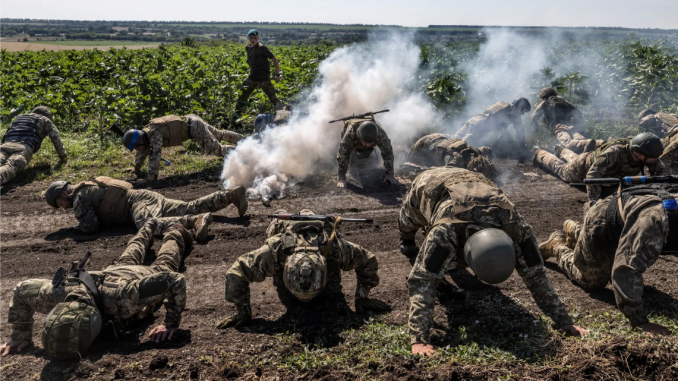
The Zaporozhye front not only entails heavy casualties because of the extensive minefields but also because Washington’s proposed tactic involves reusing large numbers of armored columns, an easy target for Russian aircraft. This American demand, which, judging by the insistence in the Rabotino sector, has already been accepted by Zaluzhny, is not only a recipe that guarantees enormous casualties, but it is a tactic that, as even Ukrainian officers have criticized, Washington itself would never agree to use without air and artillery superiority. 

However, the rules and demands are different for a proxy army, which must accept that, for its boss, they are only a tool that must continue with the plans, assuming both casualties and a strategy with no guarantee of success. Even so, The Wall Street Journal reported Aug. 24 that Ukraine has agreed to focus on the Orehovo front to please the United States, the main supplier of this war.

The subtext of all these articles, which admit the problems that Ukraine is suffering, is not to move towards a resolution of the conflict or a possible peace or ceasefire negotiation, but quite the opposite. The United States accepts that its own troops would never advance on minefields without first carrying out massive attrition work and bombardment of its enemy’s rear. Ukraine lacks the missiles and aviation that the U.S. command would use to carry out this attack prior to the ground assault; hence the message behind the criticism and the proposals for change is to speed up the delivery of this material and follow the doctrine of Mikhailo Podoliak, who describes the delivery of the F-16 as “de-escalation” and ends with “weapons, weapons, arms” messages about the military solution to the conflict as the only acceptable option. 

To this end, the United States is willing to supply and finance the Ukrainian Armed Forces indefinitely as long as the Ukrainian proxy army follows orders and accepts an even higher level of casualties.

Translated by Melinda Butterfield

Source: Slavyangrad.es

 

Strugglelalucha256


Mass protests against French troops intensify in Niger as the deadline for their withdrawal approaches

Niger’s military government reportedly cut off electricity and water supply to the French embassy in the capital Niamey on Sunday, August 27, after the expiry of the 48 hours it gave the French ambassador, Sylvain Itte, to leave the country.

It has also instructed suppliers to stop providing the water, electricity and food supplies to the French military base, warning that anyone continuing to supply the base with goods and services will be treated as “enemies of the sovereign people.”

The 1,500 troops-strong military base in Niamey has become a site of frequent demonstrations, with people demanding that Niger’s former colonizer withdraw its troops. Thousands gathered outside this base on Sunday, demanding that its ambassador and troops leave the country, waving the national flag of Niger, reportedly alongside those of the BRICS countries and the DPRK.

A similar protest was also held on Friday, August 25, hours after the military government, the National Council for the Safeguarding of the Country (CNSP), ordered the French ambassador out of Niger. Protesters raised anti-French slogans and threatened to invade the base if the troops did not leave Niger in a week.

Earlier this month, the CNSP ended Niger’s military agreements with France and ordered its troops to leave by September 2. With France refusing to withdraw on the grounds that it does not recognize the authority of the military government, protests are expected to intensify as this deadline approaches.

‘Niger doesn’t belong to France’

“Niger doesn’t belong to France. We told the French to leave, but they said ‘no’,” complained Aicha, a supporter of CNSP protesting outside the base. “As citizens we don’t want the French here. They can do whatever they want in France, but not here,” she told Al Jazeera.

The popular sentiment against the presence of French troops has manifested in several mass demonstrations, especially militant, over the last two years. By cracking down on the anti-French movement and inviting into the country more French troops, ordered out of neighboring Mali by its military government, former Nigerien president Mohamed Bazoum had consolidated domestic perception of him being a puppet of France.

His removal from office on July 26 in a military coup led by the then head of the presidential guard, Gen. Abdourahmane Tchiani, has won popular support, with thousands repeatedly taking to streets to rally behind the CNSP, reiterating the demand for the withdrawal of French troops.

‘The fight will not stop until the day there are no longer any French soldiers in Niger’

“The fight will not stop until the day there are no longer any French soldiers in Niger,” CNSP member Colonel Obro Amadou said in his address to a crowd of around 20,000 supporters who had gathered in Niger’s largest stadium in Niamey on Saturday, August 26. “It’s you who are going to drive them out,” he added.

Insisting that “France must respect” the choice of Nigerien people, Ramatou Boubacar, a CNSP supporter in the stadium, complained about the continued control France maintained over successive Nigerien governments even after the end of colonial rule. “For sixty years, we have never been independent [until].. the day of the coup d’etat,” she told the AFP.

French President Emmanuel Macron has, however, remained obstinate. “[W]e do not recognize the putschists, we support a president [Bazoum] who has not resigned,” he said in his remarks on Monday, August 28, reiterating French support for a military invasion of Niger by the Economic Community of West African States (ECOWAS), “when it decides.”

Expressing its “full support” to France and reiterating that the European Union (EU) “does not recognize” the CNSP, its spokesperson for foreign affairs, Nabila Massrali, also raised the specter of war. “The decision of the putschists to expel the French ambassador,” she said, “is a new provocation which cannot in any way help to find a diplomatic solution to the current crisis.”

‘ECOWAS is determined to bend backwards to accommodate diplomatic efforts’

However, the current chair of ECOWAS, Nigeria’s president Bola Tinubu, said on Saturday, August 26: “We are deep in our attempts to peacefully settle the issue in Niger by leveraging on our diplomatic tools. I continue to hold ECOWAS back, despite its readiness for all options, in order to exhaust all other remedial mechanisms.”

Tinubu has toned down his initially aggressive and threatening rhetoric against Niger after facing anti-war protests and opposition domestically. On August 5, a day before the one-week deadline given by ECOWAS on July 30 to the CNSP to reinstate Bazoum was to expire, the senate of Nigeria refused to support military action.

Without the participation of Nigeria — which has Africa’s largest economy, amounting to about 67% of ECOWAS’ GDP, and the largest military in the sub-region — the bloc’s capability of undertaking a military action is drastically reduced.

This is especially the case because Mali, Burkina Faso, and Guinea — which are among the 15 countries in ECOWAS but suspended and sanctioned after similar popularly-supported coups backed by the domestic anti-French movement — have extended support to Niger.

Mali and Burkina Faso, whose military governments have successfully ordered the French troops out of the country, have committed to mobilize their military in defense of Niger. Together, these four countries amount to nearly 60% of ECOWAS’ land area.

Nevertheless, the ECOWAS heads of state met again in Nigeria on August 10 and ordered their Chiefs of Defense Staffs “to immediately activate” the bloc’s stand-by force. The Chiefs of Defense Staffs of ECOWAS member states subsequently held a two-day meeting on August 17 and 18 in Ghana.

Ghana’s president is also facing domestic opposition and may be unlikely to be able to secure approval of the parliament where the main opposition party, opposed to military intervention, has the same number of seats as the ruling party.

Nevertheless, “We are ready to go any time the order is given,” Abdel-Fatau Musah, the ECOWAS Commissioner for Political Affairs, Peace and Security, declared at the conclusion of this meeting, adding that an unspecified “D-day is also decided. We’ve already agreed and fine-tuned what will be required for the intervention.”

He introduced a caveat, however, that, “As we speak, we are still readying [a] mediation mission into the country, so we have not shut any door.”

A week later, on Friday, July 26, the ECOWAS said it was still “determined to bend backwards to accommodate diplomatic efforts.” ECOWAS commission president Omar Touray, former Secretary of State for Foreign Affairs of Gambia, told the media: “For the avoidance of doubt, let me state unequivocally that ECOWAS has neither declared war on the people of Niger nor is there a plan, as is being rumored, to invade the country.”

Invading Niger will not be the walk in the park, warns CNSP President, Gen. Tchiani

Nevertheless, stating that “threats of aggression on the national territory are increasingly being felt,” Brigadier General Moussa Barmou placed the Nigerien military on “Maximum alert” on August 25, “in order to avoid a general surprise”.

Abdoulaye Diop and Olivia Rouamba, Foreign Ministers of Mali and Burkina Faso, visited Niamey on Thursday, August 24, reiterating their “rejection of an armed intervention against the people of Niger which will be considered as a declaration of war” on their own countries.

They also welcomed the two orders signed by the CNSP president Abdourahamane Tchiani that day, “authorizing the Defense and Security Forces of Burkina Faso and Mali to intervene on Nigerien territory in the event of an attack.”

“If an attack were to be undertaken against us,” Tchiani said in his televised address on Saturday, “it will not be the walk in the park some people seem to think.”

Source: Peoples Dispatch

Strugglelalucha256


How U.S. sanctions are a tool of war: The case of Venezuela

On March 26, 2022, Francisco lay in a public hospital bed in Bolívar, Venezuela, roughly eight hours inland from the capital of Caracas. He had been waiting for more than twenty-four hours to be seen by a doctor for fluids filling his stomach in a hot room with no fan or air conditioning. By then he was stick thin, his skin clinging to his bones as he lay on his side, waiting.

When he was finally seen by a doctor and given a prescription, he was also told that the hospital did not have the medicines he needed. His family would need to try to find them on their own. At the pharmacy, the initial prescription totaled $35 (well beyond the monthly earnings of many), in addition to the $5 the family had already spent on saline solution—of which the hospital had run out. Though public pharmacies are available in many places throughout the country with subsidized prices, they don’t always have access to the medicines needed, or if they do (especially as the worst of the shortages has subsided), even the lower prices—for medicines that were once free—are unattainable for many.

In fact, UN Special Rapporteur Alena Douhan reported in 2021 that Venezuela was experiencing 85 percent shortages of medicine, according to the national pharmaceutical federation while high-cost procedures such as heart surgery, dialysis, and cancer treatment remain especially out of reach—a result of sanctions imposed and increasingly tightened as part of the U.S. “maximum pressure campaign” since 2017. For the same reason, Venezuela has experienced a 45.7 percent decrease in the number of registered doctors, leaving public hospitals with 50 to 70 percent shortages of qualified medical personnel and up to 80 percent of hospital equipment in disrepair, much of which is missing parts that were once imported from the United States. In other cases, the purchase of equipment from other countries has been blocked by the U.S. sanctions, which prevent other countries from doing business with Venezuela lest they be punished with the same sanctions as a result.

This would explain why, when Francisco’s roommate—who was in for a collapsed lung after a surgery-gone-wrong at a private clinic, where he could not afford to continue receiving care that would have cost in the realm of $1,000 a day—was told he needed an x-ray, he was also told that the hospital had no working x-ray machines and he would have to seek out and pay a private lab that had working equipment. Since the hospital only had one wheelchair and was severely understaffed, his family would also need to arrange transportation since he was in no condition to walk.

Meanwhile, Francisco waited with his daughter-in-law and his son, who had been out of work for some time. Two weeks later, on April 12, Francisco died, unable to get the medical tests he needed that could have helped diagnose and treat his condition.

In a single year, 40,000 people in Venezuela, like Francisco, died as a result of the U.S. sanctions that have devastated the country’s ability to import medicines and export key goods such as oil, paralyzing the economy and stunting the country’s ability to meet the basic needs of the population. The same year, another 300,000 people were at risk of dying because they were not able to access essential medicines for diabetes, cancer, HIV, kidney disease, and other treatable conditions for more than a year. Many have left the country in search of accessible medicine, while many others have died, as Alexis Bolívar of Rompiendo la Norma reported in the case of those with HIV/AIDS, the brunt of which have been disproportionately borne by the LGBTQ+ community.

The timeline that I have heard over and over again—from people of all political persuasions including family members of patients, the wheelchair attendant who spoke to me about the breaking-down elevators with missing doors, and members of communes across the country—coincides with the years that the United States ramped up its maximum pressure campaign against Venezuela under Donald Trump, allegedly propelled by a concern for human rights over the country’s democracy and electoral process. But not only has this rhetoric proved, again and again, to be false­­—Trump himself dispelled the myth, declaring in June 2023: “When I left [office], Venezuela was ready to collapse. We would have taken it over. We would have gotten all that oil. It would have been right next door.” This declaration echoed a statement made by his secretary of state Mike Pompeo four years earlier that “We always wish things could go faster.… The circle is tightening, the humanitarian crisis is increasing by the hour.… You can see the increasing pain and suffering that the Venezuelan people are suffering from.”

Based on a bilateral study of thirty-six other oil-producing countries, economist and opposition supporter Francisco Rodriguez found that, beginning with Trump’s 2017 blanket sanctions on Venezuela’s oil sector, “the collapse in Venezuela’s oil production is of a dimension seen only when armies blow up oil fields,” explaining that “the only country that suffered a change in trend similar to Venezuela in that period was Yemen, whose oil fields were the target of a Saudi bombing campaign at the time.”

According to figures released the following year, the U.S.-imposed sanctions caused the government’s revenue to shrink to a mere 1 percent of what it had been before the sanctions—in other words, a 99 percent decrease. A 2023 government report estimates that “since 2015, Venezuela lost on average $40 billion per year” while the production of the state oil company PDVSA—the source of most of the country’s social spending—fell by 87 percent from January 2015 to June 2020 as a result of the U.S. blockade.

The situation has improved slightly, but the government’s ability to fund social programs remains a shadow of what it once was as a result of the U.S. blockade. As the report explains, “although the country experienced a slight recovery between 2021 and 2022, the income of the latter year represents only 10% of what Venezuela received in the year when the economic aggression began.” As economist Pasqualina Curcio puts it, the resources lost as a result of the economic war from 2016 to 2019 alone could have provided “resources sufficient to import enough food and medicine for 45 years” or fund the health system (both public and private) for twenty-nine years.

Furthermore, Rodriguez notes that “Venezuela’s deep deterioration in health, nutrition, and food security indicators occurred alongside the largest economic collapse outside of wartime since 1950,” with a 31 percent increase in mortality the year after the sanctions were imposed. By March 2020, former UN Special Rapporteur Alfred de Zayas estimated that 100,000 Venezuelans had died as a result of the sanctions.

The hospital where Francisco was admitted, like others across the country, is a shell of what it once was: a robust, free, and well-stocked facility with quality doctors that tended to its patients with care in a country with one of the highest human development indexes in the world. This is because, after the Bolivarian Revolution in 1999, the government began to dedicate 75 percent of its resources on social spending, a 50 percent increase from what it had been previously. Among these programs, largely funded with oil revenues, are Mission Barrio Adentrosetting up health clinics in 320 of Venezuela’s 355 municipalities; Mission Sonrisa, providing free dental care; and Mission Milagro, restoring the eyesight of some 300,000 Venezuelans and providing eye surgery to 1 million.

But these programs and many others were shattered with the U.S. sabotage of the Venezuelan economy, following Richard Nixon’s old mandate to “make the economy scream” as a key part of the strategy for regime change. As an independent expert wrote in a 2018 UN report, “Modern-day economic sanctions and blockades are comparable with medieval sieges of towns with the intention of forcing them to surrender. Twenty-first century sanctions attempt to bring not just a town, but sovereign countries to their knees.”

Three years later, UN Special Rapporteur Douhan released a report on the impact of unilateral coercive measures in Venezuela, concluding, among other key points, that “the tightening of sanctions from 2017 undermined the positive impact of the multiple reforms and the State’s capacity to maintain infrastructure and continue to implement social programmes.” The report shows, for example, that as a result of these measures, the children’s heart hospital, which Douhan refers to as the most modern in the country and which handles 90 percent of children’s heart operations nationwide, decreased its surgeries by 94 percent from 2015 to 2020. Meanwhile, at the J. M. de Los Ríos children’s hospital in Caracas, the main hospital treating children from outside the capital, “care in several of its 34 specialist areas is reportedly no longer available. The hospital lacks basic medicine, medical equipment and instruments, and can no longer provide food for the patients. Patients requiring oncology and haematology services cannot receive complete treatment, which has forced families to seek supplemental treatment elsewhere—if they can afford it. Here again, the poorest are the most affected.”

On July 27, 2023, Dr. Isabel Iturria, the director of the Children’s Cardiology Hospital Dr. Gilberto Rodriguez Ochoa—which performs surgeries for children across the country, with 85 percent of its patients coming from the inland—told a delegation from the International People’s Tribunal that, even though they have begun to perform more surgeries (406 so far this year) and maintain a high success rate of 96 percent, the surgeries are performed under less than ideal conditions. For instance, whereas before the blockade they were able to use catheters to perform less invasive and risky heart surgeries on children, from newborns to adolescents, they now have to perform much more invasive heart surgeries on children because they have been unable to purchase catheters as a result of the U.S. blockade. In addition, she explains, “there are no saws to open children’s chests; we operate on four children every day, and we need four saws. We have one. Why don’t we have more? Because it’s impossible to buy them [because of the blockade].… So, we have to function with just one, and we have to use an external knife to open the thorax, which is a methodology that we stopped using many years ago because of the consequences it can bring.” Other surgeries are limited by insufficient air conditioning, without which they are unable to safely operate. “They won’t sell us anything,” she told us, speaking of the hospital’s many thwarted attempts to purchase medical equipment—even when they have the money.

Venezuela is by no means an isolated case, though it is one of the most severe. According to 2021 data from the U.S. Treasury Department, U.S. sanctions have increased by 933 percent over the last twenty years, meaning that nearly a third of the world economy and one-fourth of the countries in the world are subjected to them. If the U.S. can’t win with tanks and guns, it calculates, perhaps a campaign to suffocate the people will expedite regime change.

Despite killing tens of thousands, and despite figures of everyday life only comparable with battlefields, the sanctions have not been able to strip joy from the life of Venezuelans, nor have they been able to accomplish their objective of regime change. While getting sick may very well cost the average Venezuelan their life as a result of the devastating U.S. blockade, it has not been able to stop the plazas from filling with music, theater, and bustling life. Nor has it hampered the warmth, ingenuity, and resilience of its people, who refuse to be beaten down.

Celina della Croce is the publications director at Tricontinental: Institute for Social Research as well as an organizer and activist.

Source: MRonline

Strugglelalucha256


On the anniversary of Katrina: Capitalist murder is not a ‘natural disaster’

[su_row]
[su_column size=”1/3″] [/su_column]
[su_column size=”1/3″]
[/su_column]
[su_column size=”1/3″]
[/su_column]
[/su_row]
Crimes of capitalism: New Orleans 2005, Lāhainā 2023.

Aug. 27 — As many people prepare for last-minute summer outings and back-to-school shopping this Labor Day weekend, it is important to remember the anniversary of Hurricane Katrina, particularly in the context of the fires in Maui and Lāhainā.

Aug. 29 marks the 18-year anniversary of Katrina making landfall in Louisiana. At least 1,823 people, mostly Black and poor, lost their lives when the storm struck and the levees broke. The unfolding disaster created a permanent diaspora of over a million people.

Katrina destroyed whole communities and the people who lived in them. Much of the suffering, death, and destruction was preventable.

Nothing natural about it

The levees that broke, resulting in the destruction of the Ninth Ward and the loss of hundreds of lives in New Orleans, was not an “act of god,” but rather the negligence of the government that failed to repair the levee system.

Neither “god” nor “nature” blocked people trying to flee the city in the aftermath of the hurricane.  Witnesses reported that police fired over the heads of desperate people. 

On Sept. 4, 2005, New Orleans police shot and killed two unarmed victims and badly wounded four others on Danziger Bridge. 

“Nature” did not herd displaced people into the Louisiana Superdome in conditions unfit for animals.

Prisoners were abandoned by prison officers who evacuated themselves. Close to 1,000 prisoners at the Orleans Parish Prison, a third of whom were awaiting trial and had not been convicted of any crime, were left to fend for themselves. 

When generators failed, prisoners waited for four days in total darkness, in chest-high water, with no food or water. Some 517 were never found. 

These are all human-made failures. More accurately, capitalist failures.

The inadequate response to saving lives is also directly related to resources diverted to imperialist war – in this case, the war on Iraq.  

The 256th Infantry Brigade of the Louisiana National Guard was sent to Iraq. Ironically, when they returned on Sept. 8, some 80% had lost their homes. Many lost their families, too.

On the other hand, Cuba, a small island nation led by President Fidel Castro, offered the assistance of 1,000 doctors and medical personnel. Bolivarian Venezuela offered oil shipments.  

President George W. Bush, deeply engaged in the war against Iraq, turned down this assistance. 

Cuba’s offer, while spurned, marked the founding of the Henry Reeve International Medical Brigade, which has since provided assistance to people throughout Africa, Latin America, Asia and Europe.

Maui and Lāhainā

Those glued to the news from the Pacific can’t help but reflect on the gruesome similarity of Xs marked on burnt-out homes in Lāhainā to the Xs marked on homes in New Orleans’ Ninth Ward after they were searched for bodies.

During Katrina, people clung to roofs without food or water, writing S.O.S. messages; in Lāhainā, people were forced to jump into the Pacific Ocean to escape the smoke and flames, risking hypothermia and drowning.

The death toll in Maui now stands at 115, while at least a thousand people are still unaccounted for. Over 3,000 acres burned in Lāhainā and neighboring communities. Eighty percent of this historic town was burned.  

Called Lele in the Hawaiian language, Lāhainā was the capital of the Kingdom of Hawai’i from 1802-1812 and again from 1820-1845.  Native Hawai’ians have inhabited the islands for about 1,500 years. U.S. imperialism annexed Hawai’i in 1898.

Native heritage was torched while its present-day people remain unhoused, fending for themselves through mutual aid and solidarity.

While there are differences between Katrina and the Maui fire, the negligence and contributing factors to this disaster have similar causes and culprits.

There were no warning sirens enacted by the local government, leaving families to scramble, trapped in the inferno. Many died in cars trying to escape.

Just as New Orleans levees went unrepaired, there is mounting evidence pointing to the Hawaiian Electric Company, which failed to properly shut off the electricity. Today there are nine different lawsuits aimed at holding the electric company accountable. 

Like the irony of Louisiana National Guard members who returned to no homes, it is unnerving that there was no action by the U.S. military to counter the fires in Hawai’i’.  

Hawai’i’ is the headquarters of the U.S. Indo-Pacific Command. While trillion-dollar warships, aircraft carriers, and submarines are dispatched to the South China Sea to threaten the people of China, no one from the U.S. military base was rushed to the dreadful scene to save the people of Maui.

Almost simultaneously, President Biden met at Camp David, Maryland’s presidential retreat, with Japanese and South Korean leaders to escalate threats against both China and the Democratic People’s Republic of Korea (North Korea). 

While $200 million in additional military aid to the U.S./NATO proxy war in Ukraine was announced, the Federal Emergency Management Agency (FEMA) plans to pay out a measly $700 per Lāhainā household.

The latest threat is from profit-mad developers who seek to permanently displace the working class and Indigenous people who lived on the land. The story is the same whether it is New Orleans or Puerto Rico — capitalists, land-grabbers, profit while people die and suffer. 

Resistance will be crucial.  

It’s high time to change our language. There is nothing natural about what happened in New Orleans, Maui, Puerto Rico, or in many other places – far too many to enumerate in a short article. 

Global capitalism, its systemic climate crisis, imperialist war and occupation, white supremacy and colonialism, and the refusal to plan or prevent the loss of life and horrific suffering that follows, is not natural — it is murder by a ruthless system that not only has a name, capitalism, but also faces: the capitalist ruling class.

This writer traveled to New Orleans following Hurricane Katrina to participate in protests demanding justice for the Ninth Ward, witnessing much of the destruction following the storm.


Strugglelalucha256


How the U.S. continues to orchestrate chaos in Haiti

The Caribbean nation of Haiti, the poorest in the Western Hemisphere, has an estimated large portion of the country, including almost 80% of the capital Port-au-Prince, directly under gang control, leaving economic life crippled amid a rise in murders, kidnappings, and sexual violence.

United Nations Secretary-General Antonio Guterres has urged for the deployment of a “robust use of force” through a multinational mission allegedly to restore law and order to the “nightmarish” situation, as he put it.

People took to the streets and social media to oppose that, considering that gang warfare was less of an issue than foreign intervention, which the nation fought to end.

After its independence from France in 1804, the U.S. occupied Haiti between 1915 and 1934, but in 1991, a former priest with strong anti-imperialist motives Jean-Bertrand Aristide became Haiti’s first democratically-elected president.

A few months later, he was removed in a coup, and the Clinton administration restored Aristide to power in 1994 and made him sign an agreement to introduce market-oriented reforms in Haiti. Clinton admitted this later, saying, “It was a mistake… I had to live every day with the consequences of the loss [of] capacity to produce a rice crop in Haiti to feed [its] people because of what I did, nobody else.”

Read next: UN: 19,000 Haitians face starvation, catastrophic food insecurity

A U.S.-prompted coup

Another coup took place three years later, and Aristide accused the U.S. of having a role in it, claiming that U.S. forces kidnapped him and brought him out of the country forcibly.

Maxine Waters, a Democratic Congresswoman close to Aristide, said, “The way I see it is [U.S. soldiers] came to his house, uninvited,” adding, “They had not only the force of the embassy but the Marines with them. They made it clear that he had to go now or he would be killed.”

The U.S. denied Aristide’s claims, and in 2002, the French Ambassador to Haiti told The New York Times that France and the U.S. “effectively orchestrated ‘a coup’ against Aristide” by coercing him to resign and go into exile.

A transitional government took over, which called on the UN Security Council for the intervention of a peacekeeping force, and shortly after, the UN officially launched its “Stabilization Mission” made of a 7,000-strong force by Brazil and other countries.

Despite its presence, Haiti continued to be ravaged by violence, followed by the 2010 earthquake, which killed around 250,000 people, leaving Haiti crippled.

In 2021, President Jovenel Moïse was assassinated inside his home by mercenaries, allegedly 26 Colombians and two Haitian Americans. Only one person, a Haitian-Chilean businessman, was sentenced in the U.S. for the crime.

Bowing to U.S. imperialism

A struggle has been ensuing between the nation’s acting prime minister Claude Joseph, and Ariel Henry, a neurologist by training, who was named PM by Moïse but was never officially sworn in. Later on, Henry was backed by foreign powers, alongside the Organization of American States and the United Nations, and was imposed as acting PM, but he lacked any political legitimation and remains unpopular.

The Montana Accord opposition group, a broad part of Haiti’s civil society, opposed the legitimacy of Henry’s government and has been demanding elections, and this past December, he finally agreed to hold elections this year, but no date has been revealed.

It is said that Henry may have had a finger in Moïse’s killing, while Haiti’s chief prosecutor stated that he had contacted one of the chief suspects in the days before and hours after the assassination. The Justice Minister was requested to formally charge Henry.

Read more: Tracing the roots of Haiti’s U.S.-sponsored troubles

In recent weeks, Haiti has witnessed a rise in violence once again as the country continues to oppose any foreign intervention. Although part of it is due to the mistrust in Henry, it also has to do with national resentment over more than a century of neocolonial interventions mostly by the U.S.

Jean Eddy Saint Paul, a Haitian sociology professor, explained, “Throughout Haitian history, the U.S. has been actively engaged in undermining the legitimacy of Haitian leaders who refused to bow to American imperialism.”

The UN is not helping either, since during their 13 years in the country, UN “peacekeepers” raped women and girls and sexually exploited them for food in return. They are also responsible for the toxic waste in the Artibonite River, the longest on the island of Hispaniola, which caused a cholera epidemic in 2010 and killed 10,000 people. The UN hasn’t paid any compensation to the victims or their families.

Source: Resumen

Strugglelalucha256


Struggle ★ La Lucha PDF – August 28, 2023

Get PDF here

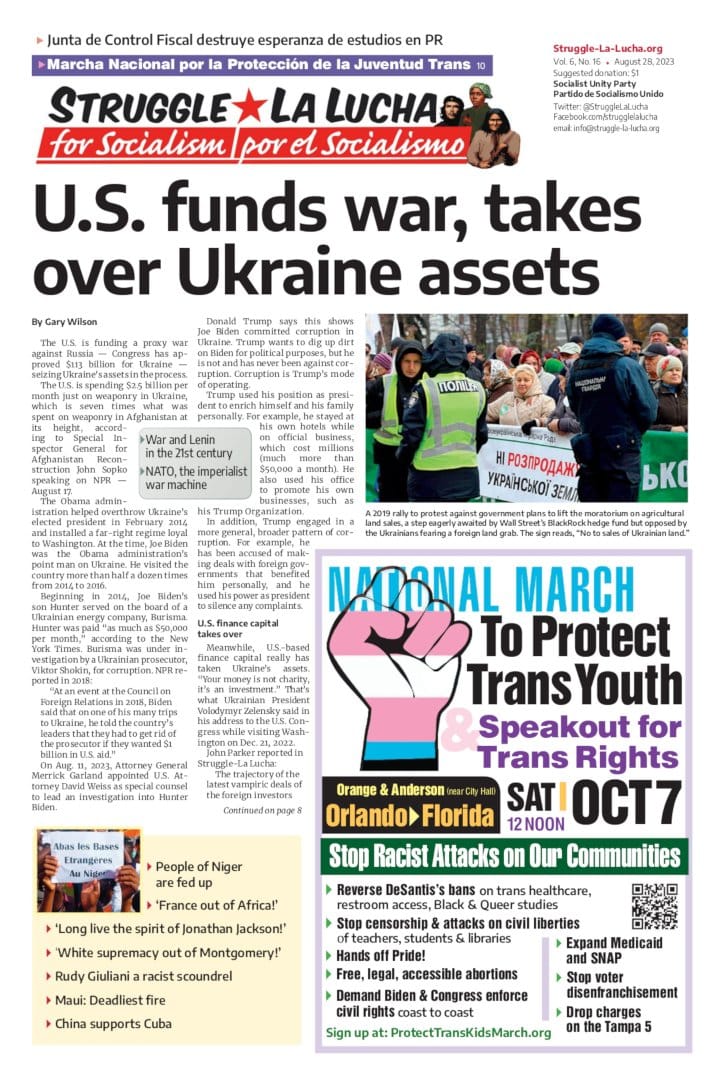
  • U.S. funds war, takes over Ukraine assets
  • ‘Long live the spirit of Jonathan Jackson!’
  • Knocking out white supremacy in Montgomery, Alabama
  • Rudy Giuliani was always a no-good racist scoundrel
  • China’s Xi vows to support Cuba’s sovereignty
  • Five key features of imperialism
  • NATO, the imperialist war machine
  • The people of Niger are fed up
  • France out of Africa!
  • Deadliest U.S. fires in a century
  • Junta de Control Fiscal destruye esperanza de estudios en PR
Strugglelalucha256


The people of Niger are fed up

The past few years have witnessed militant defensive actions and campaigns around the world defending the working-class movements that are collectively “fed up.”

They are fed up with the putrid smell of the deteriorating U.S. and West European imperialism — which rides on white supremacy.

Following the U.S.-backed 2014 coup in Ukraine, Nazi organizations were put into leading positions of power. The “ethnic cleansing campaign” they executed in the predominantly Russian-speaking Donbass region was finally countered last year despite the U.S.-led NATO proxy war.

On the continent of Africa, the actual impact of the “non-invasion” invasion of AFRICOM and U.S.-led NATO has been justified as a “war on terror.” However, even the United Nations was forced to expose that the U.S. is the source of terror — exposing another version of genocide on the African continent. The U.S. proxy wars have created and supported terrorists and policies that ensure the continuation of the U.S. and Western European plunder of resources, creating scarcity of water, food, health care, and electricity on top of debilitating sanctions.

Biggest U.S. drone base

That horror has been escalating, using Niger as the home to the biggest U.S. drone base at Agadez, Niger, built during the former government. But, that consent of subservience has now come into question with a military coup that is feeding off the frustration of the people of Niger and much of Africa’s populace. They are again showing they are fed up with imperialism and demand the removal of any influence of France, including the removal of U.S. troops and bases in Niger.

There comes a time when the oppressed will not be frozen in fear by genocidal repression or the politics of reform and stifling pacifism. The coups of governments loyal to imperialists or the loosening of that loyalty in the last few years in Africa is increasing at a quicker pace as that fear turns into militant self-defense – and is becoming contagious.

Fed up in Montgomery

That historical “fed up” connection of oppression, colonialism, and slavery was recently reflected in the U.S. in Montgomery, Alabama, when a Black person was attacked by a mob of violent white thugs practicing white supremacy. What followed was an immediate collective defense of that Black person by many Black people on the riverfront. The triumphant ending of that attack was videoed. There was an immediate, palpable understanding, especially by African/Black people, of the right to self-defense in a country with increasing domestic militarized repression of the cops and the FBI (Department of “Justice”) in the U.S., regardless of who is president.

So, here in the U.S., we can understand the contagious “fed up” in Niger, where 1,100 U.S. troops and a fleet of drones are a launching pad of terror. The facility is the largest base-building effort in the history of the Pentagon — Air Base 201, costing well over $240 million. The Pentagon’s line of calling this base primarily a place for surveillance against terrorism falls flat against the MQ-9 Reaper drone usage (in Afghanistan, Iraq, and Syria) and even their own words.

Deputy Pentagon Press Secretary Sabrina Singh said on Aug. 15, regarding Niger: “We have assets and interests in the region, and our main priority is protecting those interests and protecting those of our allies.”

According to Military.com: “The MQ-9 Reaper is the primary offensive strike unmanned aerial vehicle for the U.S. Air Force. Given its significant loiter time, wide-range sensors, multi-mode communications suite, and precision weapons — it provides a unique capability to perform strike, coordination, and reconnaissance against high-value, fleeting, and time-sensitive targets.”

As the New York Times noted, the MQ-9 Reaper is known for its high rate of civilian casualties.

In a recent demonstration in Agadez, protesters pointed out that they were the family, including children, of those targeted and demanded the U.S. troops and their terror drones leave Niger.

Ten of thousands in Niger are demonstrating in support of the coup by the army.

The military coup government of the National Council for the Safeguard of the Homeland, led by General Abdourahmane Tchiani, has called into question Niger’s growing military budget, with the biggest U.S. military presence in West Africa, enabling the neo-colonialist economic devastation of a country rich in uranium, with over 40% of of the population in poverty.

Opposed to imperialist intervention

Although it may not be clear how the opposition to France and the U.S. will continue, it has inspired the people. Polls have shown that the majority of African people are not behind governments that support the U.S., France, and the most loyal countries in the Economic Community of West African States (ECOWAS) proposing imperialist intervention in Niger.

Burkina Fuso, Mali, Algeria, Guinea, and even much of the population belonging to the ECOWAS countries do not support the ECOWAS position nor the economic sanctions against Niger. This has inspired an opposition against governments complicit with imperialism, riding on white supremacy and denying self-determination.

Like in Montgomery, Alabama, this viral sentiment of resistance presents an excellent opportunity for world solidarity and the unification of the working class.

As Vladimir Lenin said: “There are decades where nothing happens; and there are weeks where decades happen.”

These weeks present the opportunity to ride the momentum of African/Black peoples and push social progress further.

Let’s let our actions of being fed up with imperialism and white supremacy support the strength of the people of Montgomery and Niger.

Maybe in the U.S., in solidarity with the people of Niger, protests against French consulates and the U.S. federal buildings would be in order, with a viral video of Montgomery.

Strugglelalucha256


France out of Africa!

An Aug. 22 rally outside the French mission to the United Nations in New York City demanded that French banks and corporations get their bloody hands off Niger. The December 12th Movement called the action.

Niger and other former French colonies in Africa have been looted for generations. While French nuclear power plants depend on Niger’s uranium, less than one-fifth of Niger’s population can access electricity.

The neighboring country of Mali — also a former French colony — has over 800 gold mines but no gold reserves in its treasury. France has zero gold mines, yet it has 2,437 tons of gold worth over $160 billion. That’s what imperialism looks like.

Backed by the people, on July 26, Niger’s military overthrew a neo-colonial regime that answered to Paris. Seventy years before, on the same date, Fidel Castro led an attack on the Moncada barracks that began the Cuban Revolution in 1953.

Demonstrators at the French mission carried signs “Hands Off Niger!” They also made it clear that this also applies to the United States, which has over a thousand troops in Niger. The Pentagon’s collection of bases in Africa, known as AFRICOM, is a threat to all Africans.

Speakers from the December 12th Movement and other organizations voiced their support for Niger. Dahoud Andre from KOMOKODA, the Committee to Mobilize Against Dictatorship in Haiti, noted that it was the 232nd anniversary of the July 22, 1791, Haitian uprising against the Haitian slave masters.

Jason Corley from the New York/New Jersey Cuba Sí Coalition spoke of the solidarity given by Cuba to African liberation. Over two thousand Cuban soldiers died fighting the Nazi armies of apartheid South Africa.

The December 12th Movement will hold a People’s Forum — “France Out of Africa — Hands Off Niger” — in Brooklyn, New York, on Tuesday, Aug. 29, starting at 7 p.m. It will be held at Sistas’ Place, at Frederick Douglass Square, 456 Nostrand Ave., corner of Jefferson Avenue.

France and U.S. hands off Niger!  

Strugglelalucha256


Maui: Deadliest U.S. fires in a century

The Aug. 8 wildfires that devastated parts of Maui are the deadliest in the U.S. since the 1918 Cloquet fire in northern Minnesota. Some two weeks after the fires, the official death toll stands at 115, and authorities in Hawaii have released the names of 388 people still unaccounted for. Tens of thousands have evacuated. Over 3,000 acres burned in Lahaina and neighboring communities.

Eighty percent of Lahaina burned. The town of 13,000 was called Lele in the Hawaiian language and was the capital of the Kingdom of Hawai‘i from 1802-1812 and again from 1820-1845. Native Hawaiians have inhabited the islands for about 1,500 years. The U.S. imperialists annexed Hawaii in 1898.

Investigations into the causes of the fire are still ongoing, but, as the Washington Post put it, “there is mounting evidence that Hawaiian Electric’s wind-damaged equipment sent sparks into the dry, overgrown vegetation surrounding its poles.”

Maui County is suing Hawaiian Electric, alleging that the power company negligently failed to shut off power despite high winds from category 4 storm Dora. The dangers produced by drought conditions combined with hurricane winds were not unforeseen. On Aug. 7, Chevy Chevalier with KHON2 had written:

“Although Hurricane Dora is passing well to the south of the Big Island, it will still be able to help pack a good punch with strong winds over Hawaii with high pressure building to the north at the same time. It will be windy, especially Tuesday morning through the afternoon, but it will also be dry with humidity levels down to around 40%. This can be a dangerous combination to start and quickly spread wildfires.”

People’s fightback needed, not conspiracy theories

In 2022, a United Nations team comprising 50 researchers from six continents issued a report on devastating fires worldwide. They estimate that the incidence of such fires could increase by up to 57% by the end of this century.

This summer – amid record temperatures – Canada had its worst wildfire season on record. Over a third of the U.S. population was under air quality alerts because of the Canadian wildfires.

Clearly, increasingly devastating wildfires are emerging as a major component of the climate crisis and from profit-driven land-management practices. Working-class and oppressed people the world over are on the frontlines and need to band together to take on the fossil fuel companies, banks, governments, and military establishments (especially the Pentagon) driving the crisis. We need a movement demanding public ownership and peoples’ democratic control of the utility companies; Hawaiian Electric is not the only private power company implicated in recent climate-related disasters. We need to stand behind indigenous communities and others affected by environmental racism.

What we don’t need are conspiracy theories. Aside from stoking faux-outrage, these do nothing to empower people and disempower us by making it more difficult to organize a fightback against the rich and powerful people who are causing the crises. When we spread this type of disinformation, we do the work of the banks and corporate executives.

From the Satanic Panic playbook

Unfortunately, these conspiracy theories have been amplified by social media algorithms. For example, some influenced by the dangerous QAnon movement have claimed that the fires were started by shadowy ‘’elites’’ to destroy evidence of underground tunnels where human trafficking occurs.

The idea of underground tunnels of this sort goes back at least to the 1980s with the outbreak of the ‘’Satanic Panic’’ – a witch craze 2.0. The basis of Satanic Panic was the idea that there was a vast conspiracy of Devil worshipers ritually abusing and sacrificing children. The unsubstantiated claims were popularized through the 1980 book ‘’Michelle Remembers,’’ written by a psychiatrist and his patient, whose memories of childhood Satanic abuse were ‘’recovered’’ through hypnosis. That is to say, these were false memories implanted through the hypnosis process itself. The stories spread through daytime talk shows and tabloids.

Although no evidence of Satanic ritual abuse ever emerged, lives were destroyed. In Manhattan Beach, California, hundreds of children were interviewed during the McMartin preschool investigations and trial – likely traumatizing them in the process. They were questioned in leading and coercive ways, some even stating that they saw witches fly. Claims about tunnels entered into the investigations. Multiple excavations revealed only old structures and debris on the school property, no tunnels. Nobody was convicted in the 1987-1990 trials.

To return to the present situation in Lahaina, the claims about the intentional destruction of tunnels merely obscure the reality of climate change. For the social media figures benefitting from such conspiracy-mongering – as for fossil fuel CEOs – the name of the game is ‘’anything but climate change,’’ no matter how outrageous.

Land grabs don’t require sabotage

Another conspiracy theory circulating especially through right-wing media spheres is the claim that ‘’elites’’ caused the fires intentionally – sometimes with lasers, as conspiracy theory influencers preposterously alleged about California wildfires in 2018 and 2020 – in order to buy up land for low prices, effectively robbing residents.

In fact, residents of Lahaina have been receiving calls from real estate investors wanting to buy up their properties. But this is opportunism, not evidence of arson.

Where this writer lives in the New Orleans area, waves of gentrification followed hurricanes Katrina and Rita in 2005. New Orleans was not intentionally flooded, but developers and others saw their opportunity. The storms displaced thousands of mainly Black, working-class New Orleanians, and many could not return because the government never funded a people’s recovery. The rich and their politicians remade the city, demolishing public housing, replacing public schools with a mishmash of private and charter schools, and more.

Ruling-class offensives like that of post-Katrina New Orleans and potentially what is happening in Maui are likely to increase as climate change continues. We need to be prepared for this. But, again, we can only wage effective struggles when our analyses are based in fact. Conspiracy theorists co-opt the language of rebellion, but by sowing confusion and division, they prevent people from resisting and thereby aid the rich and powerful.

Strugglelalucha256


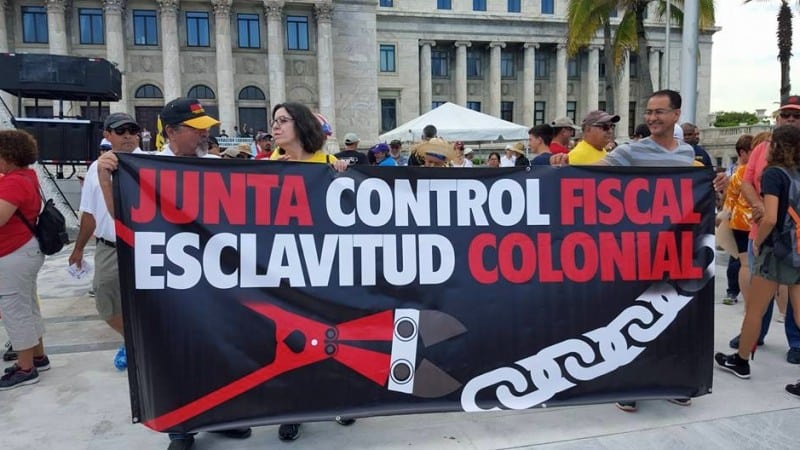
Junta de Control Fiscal destruye esperanza de estudios en PR

Esta semana se graduaron 4 estudiantes de la Universidad de Puerto Rico, 2 mujeres y 2 hombres. Esto parecería ser algo rutinario en esta época, sin embargo, esta es la segunda vez que personas que están aún en prisión, logran alcanzar el cuarto año de universidad bajo el Programa de Estudios para Confinados, y algunas de ellas seguirán estudios para la maestría. Además, será la primera vez que podrán asistir a clases en la mismísima universidad; porque hasta ahora eran los maestros quienes impartían las clases en la prisión. 

Es un programa realmente modelo, instituido a través de la colaboración de nuestra Universidad pública y el Departamento de Corrección. 

Con el incremento en la criminalidad y la violencia debido mayormente al Narco Estado en que se ha convertido nuestro país, esta iniciativa que surgió de un profesor de la UPR en los años 90, el Profesor Fernando Picó, quien firmemente creía en el valor de la educación para rehabilitar, está sin embargo, en peligro de desaparecer.  Los profundos recortes que la infame y dictatorial Junta de Control Fiscal, el verdadero gobierno no electo de Puerto Rico, ha impuesto en el presupuesto de nuestra Universidad pública, la hacen inoperante. 

Cuando más el país necesita de programas educativos a todos los niveles, la Junta, en complicidad con el gobierno, intenta destruir la esperanza de un futuro digno para nuestra juventud. Desde las cientos de escuelas que se cerraron dejando a miles de estudiantes sin un centro escolar cerca de su hogar, hasta las que no se han rehabilitado por los destrozos del Huracán María en el 2017 y del terremoto del 2020, a nuestra niñez y juventud se les empuja así a trabajar para la mafia del narco como única opción de subsitir.  

Mientras se dan las condiciones para que el pueblo salga masivamente a descolonizar el país, la lucha inmediata es para sacar a esta Junta de Control Fiscal que la próxima semana cumplirá 7 años de establecida y  ya hay protestas convocadas para esa fecha.

¡Fuera Junta de Control Fiscal! 

Desde Puerto Rico, para Radio Clarín de Colombia, les habló Berta Joubert-Ceci

Strugglelalucha256
https://www.struggle-la-lucha.org/2023/page/27/