National Network on Cuba FALL MEETING
University of Massachusetts Boston

National Network on Cuba FALL MEETING
University of Massachusetts Boston
From the United States, the members of Women in Struggle-Mujeres en Lucha strongly reject the hostile resolution proposed by the European Union against the Republic of Cuba.
The resolution raised in the European Parliament, which deals with the agreement on EU-Cuba cooperation and political dialogue, reflects once again the imperialist interference of the state that causes most wars and political instability in the world: the United States of America.
We do not doubt that these right-wing European representatives are mere messengers, lackeys of imperialism and its fascist impulse around the world, that feed the lowest and most inhuman political tendencies.
We see it in the resurgence of racist attacks on African immigrants in various countries of the European Union, where their governments have chosen to make the lives of their own population more expensive to satisfy the cravings of U.S. warmongers.
As people who reside in the United States, we are witnesses to the attacks committed daily against the poor, Black, Latinx and immigrant population.
We stand in solidarity with the people and leadership of Revolutionary Cuba, which instead sends armies of teachers, doctors, firefighters and emergency personnel abroad. A Cuba that overflows with love instead of weapons. That promotes and embraces negotiation, as it has shown very well with our sister country Colombia.
So again we say: Long live Revolutionary Cuba, down with the Yankee empire!
Women in Struggle-Mujeres en Lucha
July 13, 2023
Desde los Estados Unidos, la membresía de Mujeres en Lucha-Women in Struggle rechazamos contundentemente la hostil resolución propuesta por la Unión Europea en contra de la República de Cuba.
La resolución elevada en el Parlamento Europeo, y que trata sobre el acuerdo de cooperación y diálogo político UE-Cuba, refleja una vez más la injerencia imperialista del estado que más guerras e inestabilidad política provoca en el mundo: los Estados Unidos de América.
Porque no dudamos que estos representantes europeos de derecha son meros mensajeros, lacayos del imperialismo y de su impulso fascista alrededor del mundo que alimenta las más bajas e inhumanas tendencias políticas. Lo vemos en en resurgimiento de ataques racistas a inmigrantes africanos en varios países de la Unión Europea. Donde sus gobiernos han optado por encarecer la vida de su propia población por satisfacer las ansias guerristas de EUA.
Como personas que residimos en EUA, somos testigos de los ataques cometidos diariamente en contra de su propia población pobre, negra, latina e inmigrante.
Nos solidarizamos con el pueblo y dirigencia de esa Cuba Revolucionaria que sí envía ejércitos: ejércitos de maestros, de médicos, de bomberos y de personal de emergencias. Una Cuba que desborda amor en vez de armas. Que promueve y abraza la negociación como muy bien ha demostrado con nuestra hermana Colombia.
Así que de nuevo decimos: ¡Viva Cuba Revolucionaria y Abajo el Imperio Yanqui!
Mujeres en Lucha-Women in Struggle
13 de julio de 2023
Elliot Abrams oversaw death squads in Central America and was convicted of lying to Congress. So why did President Joe Biden appoint this evil war criminal to the U.S. Advisory Commission on Public Diplomacy?
Abrams tried to cover up the 1981 El Mozote massacre in El Salvador. It was the small, even tiny, skulls found there that proved he lied about this atrocity.
Of the 143 skulls identified by the Argentine Forensic Anthropology Unit in El Mozote, all but a dozen belonged to children less than 12 years old.
Yet Abrams insisted to the U.S. Senate Foreign Relations Committee that the massacre was a myth. The Reagan administration claimed the bodies found in the village were those of guerrilla soldiers killed in battle.
The U.S.-trained Atlácatl Battalion murdered as many as a thousand people in El Mozote on Dec. 11-12, 1981. Many young girls were raped before being executed.
A United Nations Truth Commission supervising the forensic investigation revealed these horrible facts in 1992. Elliot Abrams and other Reagan officials always knew the bloody truth.
Reagan was pouring billions into El Salvador to fight a poor peoples’ movement called the Farabundo Martí National Liberation Front (FMLN). A handful of rich families were running the country, but the real power center was the U.S. Embassy.
As Reagan’s Assistant Secretary of State for Human Rights and Humanitarian Affairs – what a lying job title! – Abrams’ task was to deny El Mozote happened. The Reaganites remembered how the My Lai massacre in Vietnam turned millions against that war.
A mass movement against U.S. intervention in Central America was growing. It included many Catholics who remembered how San Salvador Archbishop Óscar Romero was assassinated while he was celebrating mass on March 24, 1980.
One hundred thousand people marched on the Pentagon on May 3, 1981, to stop Reagan and his war plans. The idea for this march came from the late communist leader Sam Marcy.
Reagan’s counteroffensive was helped by the Wall Street Journal. It attacked New York Times reporter Raymond Bonner, who along with Washington Post correspondent Alma Guillermoprieto exposed the El Mozote massacre.
New York Times management went along with this right-wing campaign by removing Bonner from reporting about Central America.
Uncle Sam sells crack
Elliot Abrams was the godfather of death squads. U.S.-backed tyrant Efraín Rios Montt murdered 200,000 people in Guatemala.
Five out of six people killed there were Indigenous, with over 400 communities destroyed. Death squads would pour gasoline over people and set them on fire.
While Marine Colonel Ollie North got more publicity, Abrams helped supervise the Contra terrorists who killed 30,000 people in Nicaragua.
The people of Nicaragua overthrew the decades-long Somoza family dictatorship in 1979. The CIA was determined to crush the new revolutionary government, who were called Sandinistas.
Their movement was named after the liberator Augusto César Sandino, who fought U.S. Marines in the 1920s to free Nicaragua from Wall Street’s domination.
After the bloody war against Vietnam, Laos and Cambodia, people in the United States were overwhelmingly against a new conflict. The House of Representatives passed the Boland Amendment – named after Massachusetts Congressperson Edward Boland – that initially barred any aid to the Contras in Nicaragua.
That didn’t stop Elliot Abrams, Ollie North and the rest of the Reagan gang. They continued to secretly finance the Contra terrorists.
They did so by two methods. The first was to flood the Black and Latinx communities with crack cocaine, with some of the profits going to the Contras.
Journalists Robert Parry and Gary Webb helped expose this Contra drug connection. (See Gary Webb’s book, “Dark Alliance, the CIA, the Contras, and the Crack Cocaine Explosion.”)
Webb deserved a Pulitzer Prize for his articles but was driven to suicide – or was perhaps “suicided” – instead.
When Barry Seal – the #1 U.S. drug smuggler – was murdered in 1986, he carried the personal phone number of Reagan’s vice president (and future president), George Herbert Walker Bush.
The crack epidemic also served as an excuse to increase the prison population by seven times between 1980 and 2020. The 2.2 million poor people in jail are members of the working class.
The second method to fund the Contras was to shake down U.S. client regimes. In 1986, Elliott Abrams met in London with Brunei’s Defense Minister General Ibnu to exhort a $10 million “contribution.”
It’s unclear whether this loot went to the right Swiss bank account or was just scooped up by “unknown parties.”
Unlimited coup plotting
Going around Congress to fund the Contras wasn’t just illegal. It was as subversive as Trump’s Jan. 6, 2021, insurrection at the U.S. Capitol.
A president that can ignore Congress to finance a dirty war is on the way to being a dictator. Historically it was the “power of the purse” – meaning the control of tax money – that allowed parliaments to shrink the power of kings.
The Contragate scandal was finally exposed when CIA mercenary Eugene Hasenfus was shot down over Nicaragua on Oct. 5, 1986. His plane was owned by the CIA front Southern Air Transport, whose employees included future Attorney General (for both George W. Bush and Donald Trump) William Barr.
Even Elliot Abrams had to face the music, but not for his war crimes. For lying to Congress, Abrams was sentenced to a $50 fine and 100 hours of community service. He was later pardoned by President George H.W. Bush.
In contrast, Frank Wills – the Black security guard who caught the Watergate burglars – was sentenced to a year in jail for allegedly shoplifting a pair of sneakers.
Elliot Abrams went on to conspire to overthrow Venezuela’s elected President Hugo Chávez in 2002. The CIA-backed coup was defeated by the Venezuelan people, who came out in the streets to defend their democracy.
Abrams was one of those behind the May 1, 2019, coup attempt against Venezuelan President Nicolás Maduro that fizzled. Abrams was Trump’s stage manager for the now all-but-forgotten presidential pretender Juan Guaidó.
Abrams was also Trump’s choice to conspire to overthrow Iran’s government.
Biden’s selection of Abrams shows that whether there’s a Democrat or Republican in the White House, there’s a permanent capitalist establishment. It will get its way unless the people stop it.
Abrams himself worked for Henry Jackson, the Democratic senator from Washington state who was known as the “senator from Boeing” for demanding war contracts. Jackson sought the Democratic presidential nomination in 1976 by attacking school integration.
Abrams was later chief of state for New York Senator Daniel Moynihan, who had urged President Nixon to show “benign neglect” towards Black people. So many of Washington’s war plotters got their start in the war against Black people.
The 81 million people who voted for Joe Biden didn’t want war criminals back in government. The U.S. senate should refuse to confirm Elliot Abrams. He should face Nuremberg justice instead.


SATURDAY, JULY 22, 2023, AT 6:00 PM EDT
The Growing Fascist Threat to Transgender Lives
5920 2nd Ave, Detroit
Attend a Public Meeting on the Current Crisis:
The Growing Fascist Threat to Transgender Lives
Saturday – July 22 – 6:00 PM ET, 3:00 PT
Hybrid meeting, either online or in-person in Detroit
Zoom participation by registering at https://tinyurl.com/FasThrt2TransLives-Reg
or
Detroit in-person meeting at 5920 Second Avenue , 48202
Hear Cassandra Devereaux, a transgender neurodivergent writer and artist living in the outer San Francisco Bay Area. In 2020 she ran for State Assembly as a Peace and Freedom Party candidate in order to draw attention to the problem of police murder of Black and Brown people in Vallejo, California. She concerns herself with issues of trans rights and the threads of fascism in the United States from the past to the modern day.
For those planning to attend in-person in the Detroit area dinner will be served at 5:00 PM. Program will start in person and via zoom at 6:00 PM Eastern time
(Read the writings by Cassandra Devereaux at https://fighting-words.net/?s=Cassandra+Devereaux))
Sponsored by: Communist Workers League
Email: cwl@communistworkersleague.org
Facebook – Detroit: @CommunistWorkersLeague
@Communist Workers League – Bay Area
@Communist WorkersLeage – Wisconsin
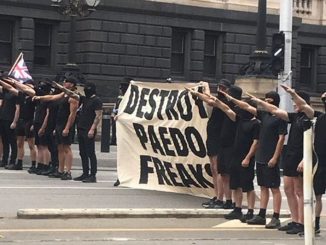
Event pic description: Nazis show up in support of a TERF, let women speak rally in Australia”

Monday, July 17 – 3:00 p.m.
5th Circuit Court, 600 Camp Street, New Orleans
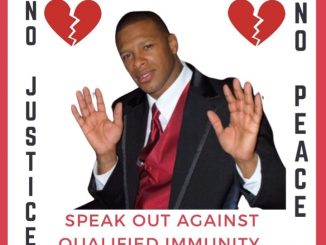
In 2019, Daviri Robertson and Chris Joseph were murdered by police in Jefferson Parish. Last month, these killer cops were granted qualified immunity, meaning they cannot be held accountable, and Robertson’s family is appealing the decision.
Robertson and Joseph were entrapped by two cops in unmarked police vehicles. The cops shot up their car, claiming it was reversing at high speed and endangering a cop between the car and truck, but no police were injured by Robertson or Joseph and their vehicles were not damaged. The bogus claims of the police are part of a pattern and practice of the police that has been used time and again to incriminate victims of police terror.
For the last four years, the Robertson family has been fighting for justice. Join them in solidarity on Monday, July 17, at 3 PM, at the 5th Circuit Court in New Orleans at 600 Camp St. to protest qualified immunity and to demand that killer cops be held to account for their crimes.
#JusticeForDaviriRobertson
#JusticeForChrisJoseph
#JailKillerCops
#EndPoliceTerror
#NoJusticeNoPeace
New Yorkers answered the call from Students for a Democratic Society for a national day of action for the Tampa 5 on July 12. They gathered during the evening rush hour outside New York City Hall with banners, signs and chants to demand: “Protesting is not a crime, justice for the Tampa 5!”
Last March 6, five students and campus workers at the University of Southern Florida in Tampa Bay – Chrisley Carpio, Gia Davila, Lauren Pineiro, Laura Rodriguez, and Jeanie K – were brutally attacked by campus police during a peaceful protest against Florida Gov. Ron DeSantis’s attacks on diversity, equality, inclusion (DEI) and multicultural programs. The five women were arrested on trumped-up felony charges, with three of them facing up to 10 years in prison.
A June 21 update from the Tampa 5 reports: “The state attorney had offered one plea deal to potentially drop the charges in exchange for us admitting guilt for attacking police and writing letters of apologies to the cops. We refused to tell such a lie and sell out the movement, and we now face a deepened legal attack as a result.
“It is clear that the prosecutors want to make an example of us and quell social movements by throwing us into prison. We will need all the support we can get to keep our freedom and see justice.”
Speakers at the New York rally included Sharif Hall and Michela Martinazzi of New York Community Action Project, Nina Macapinlac of Bayan USA, Raphael Agosto-Miranda of New York Boricua Resistance, Melinda Butterfield of Women in Struggle and Socialist Unity Party, Tony Murphy of Workers World Party, and Jessica Lee of Freedom Road Socialist Organization.
“In Ron DeSantis’s Florida, trans people like me can’t use public restrooms without facing arrest or receive life-saving gender affirming health care,” said Melinda Butterfield. “The Tampa 5 fought for me and all trans people, for immigrants, for students and educators who want ethnic studies, for all of us. And we must fight for them.”
July 14 is Bastille Day. On that date in 1789 tens of thousands of poor people in Paris attacked a hated prison called the Bastille and began the French Revolution. The continual intervention of poor people in the cities and countryside — particularly in Paris — drove the revolution forward.
Karl Marx and Frederick Engels — the founders of communism — lived in that revolution’s afterglow. Lenin and the other leaders of the Russian Revolution studied the French Revolution. Lenin became chairperson of the Council of People’s Commissars, a term derived from the French “commissaire.”
Even the terms “left” and “right” derive from the French upheaval. When the National Assembly met in 1789, the supporters of the king seized the right portion of the chamber and forced revolutionaries to sit on the left. They did this because of an ancient prejudice against left-handed people.
The French Revolution started in Europe, but it belongs to the world. And there would have been no French Revolution without Haiti.
Capitalist riches from enslaved workers
The French Revolution was a capitalist, or bourgeois, revolution. It swept away all the old feudal rubbish, like the remnants of serfdom, that oppressed people. Even the formation of a national market, a necessity for capitalism, had to be fought for.
The capitalist class or bourgeoisie was not a new class. It began its rise centuries earlier in merchant trading. Its earliest attempts to challenge the old feudal order, usually under the guise of religious differences, were thrown back with bloody reprisals.
The Bourbon kings and the big nobles of France were aristocratic parasites who feasted while millions lived in rags. They were symbolized by Queen Marie Antoinette, who, when informed that people had no bread, exclaimed “Let them eat cake!” referring to the burnt remnants of bread caked inside communal ovens.
During the 1700s, the Bourbon monarchy was increasingly challenged by the bourgeoisie. Its ideologues, led by Voltaire, questioned everything and led the great intellectual movement known as the Enlightenment. Voltaire campaigned against executing people on “the wheel,” a torture device to which people were tied while their bodies were broken, sometimes just for allegedly mocking a religious procession.
But what gave the bourgeoisie its newfound confidence to oppose the monarchy were the profits flowing into its coffers from the labor of people held in slavery.
As C.L.R. James pointed out in his classic book “The Black Jacobins”: “Nearly all the industries which developed in France during the eighteenth century had their origin in goods or commodities destined either for the coast of Guinea or for America. The capital from the slave-trade fertilized them; though the bourgeoisie traded in other things than slaves, upon the success or failure of the traffic everything else depended.”
The livelihood of 2 to 6 million people in France — out of a total population of 25 million — depended on slavery and products grown by enslaved people. French possession of Haiti meant it owned the richest colony in the world. Its trade employed 24,000 French sailors on 750 ships.
While Britain had an export trade of 27 million British pounds, the French were close behind with 17 million. The wealth produced by the Haitian people in slavery accounted for nearly 11 million pounds alone.
Liberty seized by enslaved people
The French bourgeoisie declared “Liberty, Equality, Fraternity” as the watchwords of their revolution. This is still the motto of France today.
But most French capitalists never wanted to abolish slavery or grant liberty to Black people kidnapped from Africa who were worked to death in Haiti, Guadeloupe and Martinique.
At that time, conditions were such in Haiti that the average life expectancy for a Black person on the island was 21 years. Then, news of the French Revolution reached Haiti and created a political ferment as it became known to people in slavery.
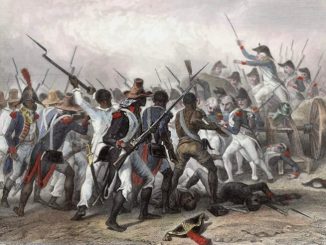
Dutty Boukman, an African originally enslaved in Jamaica, started a revolt in August 1791. Over 1,800 plantations were burned. Boukman was eventually killed, bravely fighting. But new leaders like Toussaint Louverture and Jean-Jacques Dessalines arose. The rising of Haiti’s enslaved people could not be stopped, and it found support among the French poor.
“The Blacks were taking their part in the destruction of European feudalism begun by the French Revolution,” James wrote, “and liberty and equality, the slogans of the revolution, meant far more to them than to any Frenchman.”
‘The aristocracy of the skin’
While the French Revolution was a bourgeois revolution, it was poor people in the cities and countryside who fought for it. In Europe, there was as yet no modern working class because there were no big industries. The Industrial Revolution had just started in Britain a few years before with the first cotton spinning machines.
Haiti was different. As James pointed out, “Working and living together in gangs of hundreds on the huge sugar-factories which covered the North Plain, they were closer to a modern proletariat than any group of workers in existence at the time.”
The French poor hated aristocrats and royalty like Marie Antoinette. But it was the “aristocracy of the skin,” as it became known, that became the most hated. Poor people in Paris found it detestable that people could be enslaved, branded and sold like cattle just because of their skin color.
James wrote: “In these few months of their nearest approach to power [the French poor] did not forget the Blacks. They felt towards them as brothers, and the old slave-owners, whom they knew to be supporters of the counterrevolution, they hated as if Frenchmen themselves had suffered under the whip.
“It was not Paris alone but all revolutionary France. ‘Servants, peasants, workers, the laborers by the day in the fields all over France were filled with a virulent hatred against the ‘aristocracy of the skin’ [James was quoting a supporter of slavery]. There were many so moved by the sufferings of the slaves that they had long ceased to drink coffee, thinking of it as drenched with the blood and sweat of men turned into brutes.”
As the French Revolution went forward, those bourgeois political leaders who opposed radical measures became known as Girondists. They were named for the region surrounding the French port of Bordeaux. Like Liverpool in England, Bordeaux’s economic life depended on the slave trade.
The opponents of the Girondists were known as Jacobins. Most schoolbooks slander Jacobins like Maximilien Robespierre or other radicals like Jean-Paul Marat as bloodthirsty “terrorists.”
But most of the Girondist leaders who talked so grandly about liberty didn’t want to abolish slavery. It was only when Robespierre and the radical Jacobins were in power that slavery was formally ended in all French possessions by the decree of Feb. 4, 1794.
This was a historic measure by France’s National Convention, but it only confirmed the freedom that had already been seized by the enslaved people themselves.
Defending the revolutions
The French Revolution was opposed by all of feudal Europe and by Britain, its commercial rival. Like the Russian Revolution more than a century later, France was invaded on a dozen fronts. The Duke of Brunswick, commander of the Allied Army (principally Austrian and Prussian), issued a manifesto threatening the destruction of Paris.
Although Britain bankrolled some of the armies invading France, its own army was absent. That’s because it was invading Haiti. This move was a disaster for the British ruling class. “By the end of 1796, after three years of war, the British had lost in the West Indies 80,000 soldiers including 40,000 actually dead,” wrote James.
If the British army that invaded Haiti had marched on Paris along with other European powers, the French Revolution might have been crushed. By defending their own freedom in a battle with British invaders, the Haitian people also defended the freedom of 25 million people in France.
“It was the decree of abolition, the bravery of the Black [people], and the ability of their leaders, that had done it,” wrote James. “The great gesture of the French working people towards the Black slaves, against their own white ruling class, had helped to save their revolution from reactionary Europe. Held by Toussaint and his raw levies, singing the Marseillaise and the Ça Ira [two revolutionary songs], Britain, the most powerful country in Europe, could not attack the revolution in France.”
In “A History of the British Army,” J.W. Fortescue concluded that people who had been enslaved “had practically destroyed the British Army.” He admitted that “the secret of England’s impotence for the first six years of the war may be said to lie in the two fatal words, St. Domingo [the old name for Haiti].”
Two centuries of revenge
After the French Revolution, the radical Jacobins were overthrown and many were executed. Napoleon Bonaparte eventually seized power and became a military dictator.
Napoleon defeated one European feudal army after another. But he couldn’t conquer Haiti. Napoleon sent an army to Haiti commanded by his brother-in-law, Charles Leclerc, and Toussaint Louverture was kidnapped and died in a French prison.
But as Leclerc wrote to a French government minister: “It is not enough to have taken away Toussaint, there are 2,000 leaders to be taken away.” Leclerc died in Haiti knowing he was defeated. (Aldon Lynn Nielsen, “C.L.R. James: A Critical Introduction”)
Despite massacres that included drowning a thousand Black people at a time, as well as public burnings and hangings, the French army suffered a worse defeat than the British. Out of 34,000 French troops, 24,000 died.
Dessalines declared Haiti’s independence on Jan. 1, 1804. But the world capitalist class has never forgiven Haiti for its revolution. U.S. slave masters had nightmares about leaders in the mold of Dessalines, like Nat Turner who led an 1831 uprising of enslaved people in Virginia. Haiti is still deliberately kept the poorest country in this hemisphere by the United States and other capitalist countries.
But the Haitian Revolution changed history forever.
Tear down the walls
French capitalists use Bastille Day to glorify French colonialism. But socialist revolutionaries should celebrate Bastille Day by demanding that the more than 2 million prisoners locked up in U.S. bastilles be freed, starting with Leonard Peltier, Mumia Abu-Jamal, Dr. Aafia Siddiqui and Simón Trinidad.
Bastille Day should also be celebrated because of the Iraqi Revolution that overthrew the U.S.-backed and British-backed monarchy on Bastille Day: July 14, 1958. Capitalists never forgave Haiti’s revolution and haven’t forgiven Iraq’s people for taking over their own oil. The Pentagon has invaded Iraq twice and still occupies it.
The U.S. capitalist class is as obsolete and useless as the French aristocracy was 228 years ago. Capitalists want to take away health care, privatize Social Security and cut wages even further. A socialist revolution is needed just to stop capitalism from cooking the earth.
The multinational working class in the U.S. will be forced to rise, as the French and Haitian masses did. An absolutely necessary requirement for success is that millions of white workers, part of this multinational class, break with racism. They need to see, and will see, that they are being used as political cattle by the wealthy and powerful, like Donald Trump, who actually despise them.
Tear down the Bastilles! Down with the aristocracy of the skin! Reparations for Haiti!
Source: C.L.R. James, “The Black Jacobins: Toussaint L’Ouverture and the San Domingo Revolution.”

Declaration of the Ministry of Foreign Affairs of Cuba
The Ministry of Foreign Affairs strongly rejects the arrival of a nuclear-powered submarine in the Guantanamo Bay on July 5, 2023, that stayed until July 8 at the U.S. military base located there, which is a provocative escalation of the United States, whose political or strategic motives are not known.
The U.S. military base, as is known, has occupied that 117 square kilometers territory for 121 years against the will of the Cuban people. It stands as a colonial remnant of the illegitimate military occupation of our country that started in 1898, after the expansionist intervention during the independence war waged by Cubans against the Spanish colonial power.
This is an enclave that has long lost its strategic or military importance for the United States. Its permanence only pursues the political objective of trying to outrage Cuba’s sovereign rights. Its practical usefulness in recent decades has been limited to operating as a center of detention, torture and systematic violation of the human rights of dozens of citizens from several countries.
The presence of a nuclear submarine there at this moment makes it imperative to wonder what is the military reason behind this action in this peaceful region of the world; what target is it aiming at and what is the strategic purpose it pursues.
It should be remembered that the 33 nations of the region are signatories of the Declaration of Latin America and the Caribbean as a Zone of Peace, signed in Havana in January of 2014.
It is also important to take into account the fact that, as a threat to the sovereignty and the interests of Latin American and Caribbean peoples, the United States has established more than 70 military bases in the region with different times of permanence, plus other operational forms of military presence. Recently, its high military commands have publicly announced their intention to use their war capabilities to realize the U.S. ambitions over the natural resources of Latin America and the Caribbean.
The Ministry of Foreign Affairs, while reiterating the rejection of the U.S. military presence in Cuba and demanding the return of the illegally occupied territory in the province of Guantanamo, warns about the danger of the presence and circulation of nuclear submarines of the United States armed forces in the nearby Caribbean region.
Havana, July 11, 2023.
1