Stop the state police harassment and targeting of Rev. Edward Pinkney of Benton Harbor, Mich.
written by Struggle – La Lucha
April 10, 2022
Letter from Moratorium NOW Coalition
Rev. Edward Pinkney
Friends – Rev. Pinkney of Benton Harbor, Michigan, is under attack again. Please read the letter below and then write or phone the state officials to demand an end to the harassment.
Take Immediate Action: Give your name and city. Express your concern clearly and briefly over the phone or via email. Be polite. On the phone ask them to please take down your message and deliver it to the Governor or State Police Director.
Governor Gretchen Whitmer 517-335-7858
Michigan.gov/Whitmer/contact, click Contact the Governor, fill in the information and type in your message
David Knezek, Deputy Director for Administration, Department of Health and Human Services 313- 864-0161 (cell phone)
To Governor Gretchen Whitmer, State Police Director Colonel Joseph Gafper and DHHS Deputy Director David Knezek:
We are greatly alarmed that Michigan State police are being sent to target and harass Rev. Edward Pinkney, the noted community activist in Benton Harbor, Michigan. On March 25, 2022 Sgt. Hayward of the Paw Paw State Police post and another officer went to Rev. Pinkney’s home. They raised several ridiculous allegations that Rev. Pinkney was selling (donated) water in South Bend, Indiana and that Rev. Pinkney might be tampering with water test results in Benton Harbor. When Rev. Pinkney asked about why the State of Michigan had not paid him for the use of two rooms in his church contracted by the Department of Health and Human Services (DHHS) to store filters and water for the past months, the officers accused him of “holding the supplies hostage.” On another recent occasion state troopers came to the church and watched while water was being distributed to community members.
We cannot help but recall that Rev. Pinkney has been the victim of persecution for his community service. He was imprisoned for literally quoting the Bible in an article. This case was thrown out upon appeal but only after Rev. Pinkney spent one year in prison.
On another occasion Rev. Pinkney was arrested, tried and convicted for petitioning to recall the Mayor of Benton Harbor. He spent two and one half years in State prisons. Only after those long years Rev. Pinkney’s case was overturned by the Michigan Supreme Court which found that he had not broken any law. We believe that without mass public support and pressure Rev. Pinkney would have been killed by the guards in Marquette Prison.
So we take it very seriously when State troopers start harassing the Reverend and when spurious charges start to be floated against him.
We demand that you take immediate action to stop the harassment, apologize to Rev. Pinkney and ensure that all officials under your direction cease and desist from any and all further actions that target and endanger Rev. Pinkney.
Sincerely,
Moratorium NOW Coalition
Will Japan and Russia tensions over contested Pacific Islands spill over into war?
written by Struggle – La Lucha
April 10, 2022
Each year, Japan’s Foreign Ministry releases a Diplomatic Bluebook, a guide to the government’s views on the world. Kyodo News, a reputed Japanese wire service, reports that the 2022 Bluebook will have strong language against Russia. This Bluebook will be released to the public before the end of April, but Kyodo News’ reporters have seen a leaked text. The text that the news agency has seen has not been finally vetted by the government of Japan’s Prime Minister Fumio Kishida.
Two startling changes appear in this draft text. First, the Bluebook refers to the Russian control over some islands north of Hokkaido as an “illegal occupation.” The last time the annual Bluebooks used this phrase was in 2003. Then, the Bluebook pointed out that Japan “renounced its right to the Kuril Islands” in the 1951 Treaty of Peace with Japan, signed in San Francisco (Chapter II, Article 2[c]); these islands were then part of the USSR. Nonetheless, the 2003 Bluebook said, “In the Four Northern Islands, the illegal occupation by the Soviet Union and Russia continues today.” Japan calls these “Four Northern Islands” Etorofu, Habomai, Kunashiri, and Shikotan (Russia calls the “Southern Kurils” Iturup, Khabomai, Kunashir, and Shikotan, respectively). Second, the 2006 Bluebook called the islands “inherently Japanese.” This phrase has not been used since then but has reappeared in the 2022 draft Bluebook. Phrases such as “illegal occupation” and “inherently Japanese” in the Bluebook suggest that the tensions between Japan and Russia will certainly increase.
Japan’s Sanctions on Russia
On February 24, 2022, as Russian forces entered Ukraine, Japanese Foreign Minister Hayashi Yoshimasa released a statement to condemn the action and to demand that Russian military forces return to their territory. The next day, Japan, in line with its fellow G-7 countries, announced measures against Russia. These included the freezing of Japan-based assets of three Russian banks, Bank Rossiya, Promsvyazbank, and VEB (Russia’s development bank). Not long afterward, Japan agreed with the European Union position to exclude seven major Russian banks (including the three already sanctioned by Japan) from the SWIFT system. These four other banks are Bank Otkritie, Novikombank, Sovcombank, and VTB.
In addition, Japan’s finance ministry said that it would prevent the major Japanese banks from doing business with Russia’s largest financial institution, Sberbank. Three of Japan’s principal banks—Mizuho Bank, MUFG, and Sumitomo Mitsui Banking Corporation—have considerable exposure inside Russia since these banks have provided long-term financing for oil and natural gas projects; they are set to lose $4.69 billion, 20 percent of these banks’ expected net annual profits. The government’s Japan Bank for International Cooperation has large investments in Russian gas fields and gas pipelines (including with Russia’s sovereign wealth fund, the Russian Direct Investment Fund). This exposure will pose problems for its balance sheets.
Russia retaliated by placing Japan on its list of “unfriendly countries,” whose diplomatic staff must be reduced and whose citizens will have a difficult time getting a visa into Russia.
Japan’s Energy Dependence
On March 31, 2022, as his government pledged to sanction Russian banks, Japanese Prime Minister Kishida told Japan’s parliament, the Diet, that his government would remain involved with Russia’s Sakhalin 2 natural gas and oil project. This project, Kishida said, will provide Japan with “long-term, inexpensive, and stable LNG [liquefied natural gas] supplies.” “It is an extremely important project in terms of our energy security,” he said. “Our plan is not to withdraw.”
Japan’s government owns a significant part of Sakhalin Oil and Gas Development Co (SODECO), which has built and manages the Sakhalin 1 and Sakhalin 2 projects. Four of the investors in Sakhalin 2 are Gazprom (the Russian energy company), Shell, and two Japanese firms (Mitsubishi and Mitsui). About 60 percent of the 9.6 million tons of LNG produced by Sakhalin 2, located on Sakhalin Island (about 28 miles off the coast of Japan), is delivered to Japan. Japanese investment in the oil fields of Sakhalin 1 had been intended to reduce its crude oil reliance on the Middle East (now 80 percent of Japan’s oil comes from the Gulf).
Last December, the Japan Bank for International Cooperation partnered with banks from China (China Development Bank and Export-Import Bank of China) as well as from Russia (Gazprombank, Sberbank, and VEB) to finance the Arctic LNG 2 Project in Russia’s Gydan Peninsula on the Kara Sea (Arctic Ocean). When this plant comes online, it will provide 19.8 million tons of LNG, twice the current production from Sakhalin 2.
Prime Minister Kishida’s hesitancy to walk away from Russian energy imports requires explanation. Japan imports most of its energy from countries other than Russia. In 2019, Japan imported 88 percent of its energy needs, mostly fossil fuels. These fuels come from a range of countries, which includes Saudi Arabia and the United Arab Emirates for 58 percent of its crude oil, Australia for 65 percent of its coal, and Australia and Malaysia for 40 percent of its liquefied natural gas. Russia is a small, but important provider of crude oil (9 percent), coal (8.7 percent) and LNG (9 percent). Due to the proximity of Russia’s fuels, and to the price of Russian gas on the spot market, the overall cost of Russian energy is much less than that of energy from the Gulf States. If Japan stopped importing LNG from Sakhalin 2, its bills would immediately go up by between $15 and $25 billion. That is the reason why Prime Minister Kishida has refused to cease energy imports from Russia. Whether Russia will stop exports to Japan or whether it will insist on the trade being denominated in rubles is to be seen (thus far, Russia has only insisted that payment for the gaseous form of national gas be made in rubles).
Tensions in the Sea of Okhotsk
In 1956, the USSR and Japan signed a declaration that promised to settle outstanding issues between the two countries. The USSR agreed that it would hand over two of the four islands (Habomai and Shikotan) “after the conclusion of a Peace Treaty” between the two countries. No such treaty was completed. Each Bluebook over the past decades notes that these small islands form “the most outstanding issue in Japan-Russia relations.” The previous prime minister of Japan, Shinzo Abe, met with Russia’s President Vladimir Putin more than 20 times, but they were not able to make a breakthrough.
These small islands in the Sea of Okhotsk allow Russia to extend its territorial waters into the Pacific Ocean. It is from these passages that Russia’s Pacific and Northern Fleets—based in Fokino and Severomorsk, respectively—traverse the increasingly important Arctic waters and the northern waters of the Pacific (where Russia rubs shoulders with an increased NATO presence). The loss of these islands will be an issue not merely of prestige, but also of Russian commercial ambitions in its northern waters.
It is unlikely that these islands will draw these two countries into any kind of conflict beyond the sanctions that Japan has placed upon Russian banks. But these are dangerous times, and it is impossible to guess exactly what comes next. Any accidental clash between Japan and Russia would trigger Article V of the 1960 treaty that Japan signed with the United States; if that were to happen, it would be a catastrophe.
Tensión entre Japón y Rusia por islas del Pacífico ¿Podría terminar en una guerra?
written by Struggle – La Lucha
April 10, 2022
Cada año, el Ministerio de Asuntos Exteriores de Japón publica el “Libro Azul Diplomático”, un informe que expone los puntos de vista del Gobierno sobre lo que sucede en el mundo. Kyodo News, un reconocido servicio de noticias japonés, informó que el Libro Azul del 2022 utilizará un lenguaje fuerte contra Rusia. Esta edición del Libro se publicará antes de que termine abril, pero el personal de Kyodo News tuvo acceso a un texto filtrado. El material que vio la agencia de noticias no ha pasado por la revisión final del Gobierno de Fumio Kishida, Primer Ministro de Japón.
En este borrador aparecen dos novedades alarmantes. En primer lugar, la referencia al control ruso sobre algunas islas al norte de Hokkaido como una “ocupación ilegal”. La última vez que algún Libro Azul utilizó esta frase fue en 2003. En ese momento, el Libro Azul señaló que Japón “renunció a su derecho sobre las islas Kuriles” en el Tratado de Paz con Japón de 1951, firmado en San Francisco (capítulo II, artículo 2[c]); para entonces, estas islas formaban parte de la Unión Soviética. Sin embargo, en el Libro Azul de 2003 se leía: “En las Cuatro Islas del Norte continúa la ocupación ilegal por parte de la Unión Soviética y Rusia”. Japón llama a estas “Cuatro Islas del Norte” Etorofu, Habomai, Kunashiri y Shikotan (Rusia llama a las “Kuriles del Sur” Iturup, Khabomai, Kunashir y Shikotan, respectivamente). La segunda novedad alarmante, es que en el 2006 el Libro Azul denominó a estas islas como “inherentemente japonesas” y esta frase no se había vuelto a utilizar, pero reaparece en el proyecto de Libro Azul de 2022. Frases como “ocupación ilegal” e “inherentemente japonesa” en el Libro Azul sugieren que las tensiones entre Japón y Rusia, sin duda, aumentarán.
Las sanciones de Japón a Rusia
El 24 de febrero de 2022, cuando las fuerzas rusas entraron en Ucrania, el ministro de Asuntos Exteriores japonés, Hayashi Yoshimasa, realizó una declaración condenando la acción y exigiendo que las fuerzas militares rusas regresaran a su territorio. Al día siguiente Japón, en consonancia con sus compañeros del G-7, anunció medidas contra Rusia. Éstas incluían la congelación de los activos de tres bancos rusos tenían en Japón: el Banco Rossiya, el Promsvyazbank y el VEB (el banco de desarrollo de Rusia). Poco después, Japón se alineó con la decisión de la Unión Europea de excluir a siete grandes bancos rusos (incluidos los tres ya sancionados) del sistema SWIFT. Estos otros cuatro bancos son Bank Otkritie, Novikombank, Sovcombank y VTB.
Además, el Ministerio de Finanzas de Japón declaró que impediría a los principales bancos japoneses hacer negocios con la mayor institución financiera de Rusia, el Sberbank. Tres de los principales bancos japoneses – el Banco Mizuho, MUFG y la Corporación Bancaria Sumitomo Mitsui – tienen una inversión considerable dentro de Rusia, ya que han proporcionado financiamiento a largo plazo para proyectos de petróleo y gas natural. Estos bancos perderán 4.690 millones de dólares, el 20% de los beneficios netos anuales que estaban previstos. El Banco de Cooperación Internacional de Japón, dependiente del Gobierno, tiene grandes inversiones en yacimientos y gasoductos rusos (incluso con el fondo soberano de Rusia, el Fondo Ruso de Inversión Directa). Esta situación traerá problemas en sus balances.
Rusia tomó represalias al incluir a Japón en su lista de “países hostiles”, en los que el personal diplomático debe reducirse y cuyos ciudadanos tendrán dificultades para obtener visas de ingreso a este país.
La dependencia energética de Japón
El 31 de marzo de 2022, mientras su Gobierno se comprometía a sancionar a los bancos rusos, Kishida (el primer ministro de Japón) dijo ante el parlamento japonés, la Dieta, que su Gobierno seguiría participando en el proyecto ruso de gas natural y petróleo Sajalín-2. Este proyecto, dijo Kishida, proporcionará a Japón “suministros de GNL [gas natural licuado] a largo plazo, baratos y estables”. “Es un proyecto extremadamente importante en términos de nuestra seguridad energética” dijo. “Nuestro plan es no retirarnos”.
El Gobierno japonés posee una parte significativa de Sakhalin Oil and Gas Development Co (SODECO), que ha construido y gestiona los proyectos Sajalín-1 y Sajalín-2. Cuatro de los inversores en Sajalín-2 son Gazprom (la compañía energética rusa), Shell y dos empresas japonesas (Mitsubishi y Mitsui). Alrededor del 60% de los 9,6 millones de toneladas de GNL producidos por Sajalín-2, situado en la isla de Sajalín (a unas 28 millas de la costa de Japón), es enviado a Japón. La inversión japonesa en los yacimientos petrolíferos de Sajalín-1 tenía como objetivo reducir su dependencia del crudo de Oriente Medio (ahora el 80% del petróleo de Japón procede del Golfo).
El pasado diciembre, el Banco de Cooperación Internacional de Japón se asoció con bancos de China (el Banco de Desarrollo de China y el Banco de Exportación e Importación de China) y de Rusia (Gazprombank, Sberbank y VEB) para financiar el proyecto Arctic LNG-2 en la península rusa de Gydan, en el mar de Kara (océano Ártico). Cuando esta planta entre en funcionamiento, proporcionará 19,8 millones de toneladas de GNL, el doble de la producción actual de Sajalín-2.
La vacilación del primer ministro Kishida para abandonar las importaciones energéticas rusas requiere una explicación. Japón importa la mayor parte de su energía de otros países, además de Rusia. En 2019, Japón importó el 88% de sus necesidades energéticas, en su mayoría combustibles fósiles. Estos combustibles provienen de una serie de países, que incluyen a Arabia Saudita y los Emiratos Árabes Unidos (para el 58% de su petróleo crudo), Australia (para el 65% de su carbón), y Australia y Malasia (para el 40% de su gas natural licuado). Rusia es un pequeño pero importante proveedor de crudo (9%), carbón (8,7%) y GNL (9%). Debido a la proximidad de los combustibles rusos, y al precio al contado del gas ruso en el mercado, el coste global de la energía rusa es mucho menor que el de la energía procedente de los Estados del Golfo. Si Japón dejara de importar GNL de Sajalín-2, sus facturas aumentarían inmediatamente entre 15.000 y 25.000 millones de dólares. Esa es la razón por la que el primer ministro Kishida se ha negado a dejar de importar energía de Rusia. Está por verse si Rusia dejará de exportar a Japón o si insistirá en que el comercio se denomine en rublos (hasta ahora, Rusia sólo ha insistido en que el pago por la forma gaseosa del gas nacional se haga en rublos).
Tensiones en el Mar de Okhotsk
En 1956, la URSS y Japón firmaron una declaración en la que se comprometían a resolver los asuntos pendientes entre ambos países. La URSS acordó que entregaría dos de las cuatro islas (Habomai y Shikotan) “tras la conclusión de un Tratado de Paz” entre ambos países. Dicho tratado no se completó. Todos los Libros Azules de las últimas décadas señalan que estas pequeñas islas constituyen “el asunto más pendiente en las relaciones entre Japón y Rusia”. El anterior primer ministro de Japón, Shinzo Abe, se reunió más de veinte veces con el presidente de Rusia, Vladimir Putin, pero no lograron avanzar.
Estas pequeñas islas en el Mar de Okhotsk permiten a Rusia extender sus aguas territoriales hacia el Océano Pacífico. Desde estos pasos, las flotas rusa del Pacífico y del Norte – con base en Fokino y Severomorsk, respectivamente – atraviesan las aguas del Ártico, cada vez más importantes, y las aguas septentrionales del Pacífico (donde Rusia se codea con una mayor presencia de la OTAN). La pérdida de estas islas no sería únicamente un asunto de prestigio, sino también de las ambiciones comerciales rusas en sus aguas septentrionales.
Es poco probable que estas islas arrastren a estos dos países a cualquier tipo de conflicto más allá de las sanciones que Japón ha impuesto a los bancos rusos. Pero estos son tiempos peligrosos, y es imposible adivinar exactamente lo que vendrá después. Cualquier choque accidental entre Japón y Rusia pondría en marcha el artículo V del tratado de 1960 que Japón firmó con Estados Unidos; si eso llegara a ocurrir, sería una catástrofe.
Union victory for Amazon workers: A turning point for labor?
written by Struggle – La Lucha
April 10, 2022
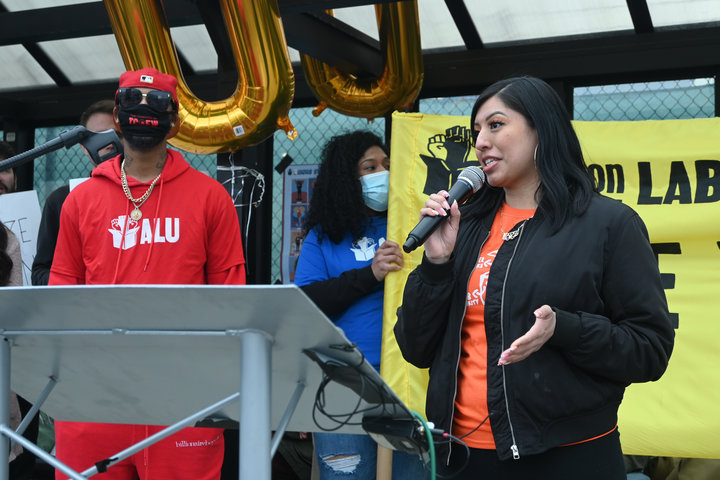
The first crack in the Amazon empire is officially opened! It came on April 1, when the Amazon Labor Union (ALU) won its election to represent the 8,000 warehouse workers at the JFK8 facility in Staten Island, New York.
We can’t help but think that bazillion-dollar boss Jeff Bezos – whose racist anti-union attorney had earlier declared in a leaked memo that Chris Smalls, the young Black rank-and-file leader of ALU, to be “not smart or articulate” – woke up with a giant headache that day.
On the other hand, news of the victory elated workers everywhere.
It has given confidence to workers in Amazon warehouses and facilities across the country. Chris Smalls, interim Amazon Labor Union president, has stated that the ALU has already heard from 50 warehouses interested in organizing.
In Maryland, warehouse workers who have been building a committee made plans to launch the Maryland Amazon Workers Union, based on the example of the ALU. The group has been distributing flyers to workers at bus stops.
Bessemer, Alabama
The outcome of the BAmazon vote in Bessemer, Alabama has yet to be decided. But what is clear is that there was a dramatic gain for the union in this second election for union representation.
This time the difference is only 118 votes, 993 “against” to 875 “in favor.” And there are 416 contested ballots. While there is a slim chance that Retail, Wholesale and Department Store Union (RWDSU) will win representation, it’s not over yet.
Comparing Bessemer to Staten Island is like comparing apples and oranges. The Bessemer election took place in a “right to work” state (better known as a right to fire state).
Just 30 minutes away from the Bessemer warehouse, the mine workers from Warrior Met Coal have been on a strike now going into its second year. The mine workers have been heroically holding out in a battle that symbolizes not just 900 miners fighting for justice, but workers everywhere fighting against billion-dollar bosses who do not want to let go of even a crumb of their overblown profits.
Some of the miners have taken jobs at the Amazon warehouse and this tends to strengthen union consciousness. But there is contradictory pressure also. The fact that these workers have been fighting for so long, under dire economic conditions, compounds the fear Amazon bosses have spread.
In addition, the average wages in Alabama are far lower than Staten Island, which makes Amazon’s pay look attractive.
But the pay does not mitigate the grueling conditions inside Amazon or the lack of power workers have without representation.
Some key lessons of Staten Island
Many of us who have been in the trenches looking for ways to organize will be evaluating what worked and what didn’t at the Staten Island warehouse.
One clear fact that stands out is that the initiative and organizing was built by the workers themselves inside the warehouse.
Equally important is that the core organizers who took on this battle were representative of younger activists influenced by the Black Lives Matter movement. They spent time in the streets fighting police terror and other struggles against capitalism, including the development of mutual aid groups. Some of these workers consciously choose to take jobs at Amazon to help with organizing.
One thing that struck those of us from Baltimore who attended an ALU rally outside the Staten Island facility on March 20 was the care that ALU organizers had for fellow workers, similar to many grassroots community groups and assemblies.
The Amazon Labor Union assisted and worried about workers faced with health and family crises, memorialized and marked the deaths of workers, and took on successfully fighting sexual harrassment in the adjoining LDJ5 warehouse.
It is the example of this solidarity that is necessary to win struggles.
In terms of tactics, it is likely that there will not be a “one size fits all” solution to organizing Amazon. Workers will have to experiment – win, lose, or draw – and embrace each other in solidarity. It is the goal of building working-class power that must remain front and center.
We are sure that debates and discussions will continue. Certainly what’s considered the “mainstream” union movement will be important in the coming battles. Its resources and especially the members that they represent are incredibly important.
But it cannot and will not be the ultimate answer. The dynamic force of younger, more militant workers, who reject capitalism and worn-out models, and the engagement of the rank and file, will have to play the key role in reviving class struggle in this country.
Will this mark a new stage of the labor movement?
We believe it will.
The pandemic has laid bare the deep and undeniable problems of capitalism. Bezos and his class of billionaire bosses and bankers have scored a windfall of profits on the backs of workers. These are the conditions that are propelling struggle.
We cannot forget that the Staten Island victory actually began with the walk-out of Amazon workers, led by Chris Smalls, against the callous disregard of the company for the health and well-being of workers during the early days of the COVID-19 pandemic.
This stunning fightback proves that the huge multinational, multi-gendered, multi-generation, multi-abled working class is just beginning to be heard, both in the workplace and the community. Everyone’s task is to join in and strengthen this movement.
Sharon Black is a former Amazon worker and author of the pamphlet “Amazon Worker Tells All,” available free to download.
‘Wall of lies built up by West will collapse under its own weight’
written by Struggle – La Lucha
April 10, 2022
The following interview with Struggle-La Lucha co-editor Greg Butterfield originally appeared in the Russian-language web publication Ukraina.ru on April 8.
Ukraina: How do people in the United States react to anything related to Russia and to Russians in the U.S.? Are you aware of any cases of discrimination against Russians in the U.S.?
Greg Butterfield: It must be said first of all that the war propaganda against Russia is overwhelming and monolithic in the U.S. mass media, from government officials and all but the most radical public organizations. There is intense censorship on Facebook, Twitter and other social media platforms. In this sense, the climate is similar to the months after the Sept. 11, 2001, attack in New York, when any dissenting voices were not permitted.
There have been awful attacks on Russians and Russian-speakers in the past weeks. People have been harassed on the street and threatened for speaking Russian. Russian shops and restaurants have been vandalized and received bomb threats. In one particularly ridiculous case, a college in Florida with a library named for Karl Marx changed its name because of Marx’s association with the former Soviet Union!
This is a common occurrence in the U.S. whenever the government decides to demonize another country. For example, when the Trump administration blamed China for COVID-19, Asian people (not just Chinese) were attacked, and this is still going on today.
Of course it is only a small minority of the U.S. population that engages in such antisocial behavior. Most workers are simply overwhelmed by the propaganda barrage and don’t have the information or context to stand up against it. That’s where the leftist movement has to act, to present true information and organize people to stand up to the official lies.
On April 2 we organized the first anti-U.S., anti-NATO protest held in New York City since the Russian-Donbass joint operation in Ukraine began. Unfortunately, many anti-war and left groups have surrendered to the anti-Russia propaganda or are hiding their heads. But those of us who rallied in the busy Herald Square shopping area found that there was great interest among the people to hear a different point of view on the conflict, and great skepticism about the Biden administration’s rationale for antagonizing Russia. To our surprise, there was hardly any hostility at all.
I think this bodes well. The wall of lies built up by the West is going to collapse under its own weight, but we need to push it.
Ukraina: The entire U.S. leadership unanimously claims that “Putin is to blame” for skyrocketing fuel prices. Do people in the U.S. mostly believe this accusation? What do people say about it?
GB: A key component of the Western propaganda war is to make people blame Russia whenever they go to the gas pump or the grocery store and have to pay inflated prices. But most people are not buying this story so far. Inflation was already high in the U.S. before the latest conflict began.
When we talk to workers about the crisis, we always point out that the Big Oil companies and Wall Street banks are the beneficiaries of high fuel prices. They are not under any orders to raise prices to consumers. Also, the government has the power to enforce price controls, but chooses not too.
People understand that the oil companies have been a major force behind all recent U.S. wars around the world, like the devastation of Iraq, so pointing this out is a strong argument.
Ukraina: How do Americans generally feel about sanctions against Russia?
GB: People generally don’t understand that sanctions affect common people in Russia and the many, many other countries sanctioned by the U.S. In the media it is only reported that there are consequences for Russian oligarchs, like seizing yachts or vacation homes in the West. In our work we emphasize that sanctions are an act of war, and what the consequences are for working people in the sanctioned countries – on jobs, healthcare, housing and so on.
I’ve noted a good trend by young people on social media here – many are asking if Russian oligarchs are sanctioned, why shouldn’t we sanction U.S. oligarchs like Jeff Bezos and Elon Musk who rip off their workers?
Ukraina: Google removed the website of the Russian Ministry of Defense and other state websites of the Russian government from its search results. How do you think Russia should respond to such “blows” in the information war?
GB: Generally I think it is better for Russia’s government to take the high road on this issue, since the flow of factual information is already being so badly inhibited by the West. On the other hand, I completely understand Moscow’s decision to designate Facebook/Meta as a terrorist organization after it explicitly allowed Azov Nazi propaganda and calls for killing Russians.
It is not only Russian and other foreign sites that are affected by Google censorship. The publication that I work on, Struggle-La Lucha, has also recently been removed from the Google News aggregator’s search results because of our anti-imperialist content.
I think it is urgent for Russia, the Donbass republics, China, Venezuela and other ostracized countries to work to jointly develop new social media platforms and alternatives in conjunction with people’s movements here and worldwide.
Ukraina: What can you say about U.S. President Joe Biden’s call for regime change in Russia?
GB: It was outrageous, but not surprising. The tactic of demonizing the leadership of an “enemy” country has been an effective one for the U.S. rulers over many decades. Think of how they demonized Saddam Hussein, Slobodan Milosevic, Mummar Gaddahfi, Bashar Assad and now Vladimir Putin. Each of them has been declared the “new Hitler” by the Western media at one time.
It’s unfortunate and somewhat vexing for us that President Putin continues to court the U.S. far-right by demeaning the Black Lives Matter movement and transgender people when speaking to U.S. media. The ultra-right groups in the U.S. that support this view are akin to the Ukrainian neo-Nazis and in some cases even have direct relations with them, send supporters to fight alongside them! It would be much better for the Russian government to appeal to the multinational working class and people’s movements of the left.
But regardless, for us the issue is not the politics expressed by the leaders of countries under attack from imperialism, but the fact that they are resisting and objectively taking positive action in the global struggle, as Russia is doing today in conjunction with the Donetsk and Lugansk People’s Republics.
Ukraina: How do you assess the prospects for denazification of Ukraine (the struggle against Nazi ideology there)?
GB: So far the progress appears very good on the denazification front. Certainly the liberation of Mariupol is a heavy blow to the Azov Nazis who have been a backbone of Ukraine’s war of terror on Donbass. Strong measures have been taken against the Aidar Battalion, leading figures in the Right Sector and so on.
It’s crucial that the Ukrainian anti-fascist underground is included in the process, along with the DPR and LPR. Ultimately, it will really be up to them to root out the poisonous elements of Ukrainian society.
I hope that in the short term, this can include liberating the many Ukrainian leftists and others swept up in the latest witch hunt by the Security Service of Ukraine and neo-Nazis. Also important will be helping those Ukrainian activists living in exile for the last eight years to safely return home to continue their work.
Al-Awda: The Palestine Right To Return Coalition National Conference May 6-8
written by Struggle – La Lucha
April 10, 2022
May 6 – 8 opening Friday, 5:30 pm The People’s Forum, 320 W. 37TH St, NYC 10018
RISING TO RETURN:
Mapping strategies to advance Palestinian liberation and return;
Devising tactics to dismantle zionist supremacy and colonization
Join us for a weekend of strategic collaboration for advancing Palestinian liberation and return. The conference will include film screenings, poetry, music, organizers, activists and speakers from Palestine and globally ~ combined in a weekend of intensive workshops geared to craft advanced strategies for advancing the Palestinian liberation movement.
Sneak Preview of Partial Speakers List: Samia Halaby • Ahlam Muhtaseb • Ubai Aboudi • Said Arikat • Adel Samara • Ramzy Baroud • Seif Dana • Lara Kiswani • Miko Peled • David Sheen
Music, poetry and Dance (partial list)
Freedom Debka • Turath Band: featuring Zafer Tawil, a virtuoso on ‘oud, violin and qanan, and a master of Arab percussion.
Featuring the first live stateside Book Launch of Ramzy Baroud and Ilan Pappe’s latest publication “OUR VISION FOR LIBERATION: Engaged Palestinian Leaders & Intellectuals Speak Out”
On Opening Night, Friday May 6, 5:30 pm Speakers, activists, organizers and student groups from Palestine and across the US and Palestinian entertainment including Watani Music and Turath Band, film screening of Gazas Angel, 1948: Catastrophe & Creation, and Kufr Qassem, with more surprises in store…
A sneak preview, with more to be announced soon
Samia Halaby. World Renowned artist, politico, and author,
Dr. Ahlam Muhtaseb, Professor of Media Studies and Director of the film “1948: Creation & Catastrophe”
Lara Kiswani, Executive Director of the Arab Resources and Organizing Center and the 2021 Yerba Buena Center for the Arts 100 Honoree,
Ayah Ziyadeh: Advocacy Director of American Muslims for Palestine, human rights scholar, activist,
Said Arikat, Bureau Chief Quds News
Dr. Seif Dana, Sociology Professor and author,
Andom Ghebreghiorgis, son of Eritrean immigrants, teacher, ran a progressive campaign for Congress in NY’s 16th District in 2020
Dr. Adel Samara, Political economist, author, former political prisoner, and editor of Kanan Magazine,
Miko Peled, Author of books The General’s Son: The Journey of an Israeli in Palestine and Injustice: The Story of the Holy Land Foundation Five,
David Sheen, Journalist who will be sharing explosive investigation of the connections between Zionist terrorist groups in Palestine and their U.S. sponsors.
Clarence Thomas ILWU Local 10 retired: Labor activist, author of “Mobilizing In Our Own Name”, and key supporter of the Block the Boat Actions in the U.S.
More soon…
Also: Messages from Abdul Bari Atwan, Ilan Pappe, Masoud Hayoun and TBA
And by video:
Lowkey (banned from U.S.) British rapper under attack by Zionists and
Dr. Salman Abu Sitta, Father of Palestinian Return, author and historian
Please use the donation button at the bottom to help us cover the costs of this amazing conference.
Please contact us at alawdany@gmail.com if you can donate frequent flyer miles to help get our speakers and some students to NYC.
A few nearby hotels include: Hampton Inn Times Square Central, TRYP New York City Times Square South, Doubletree Times Square South, La Quinta Inn and Suites by Wyndham, Hotel Shocard, The New Yorker Hotel, Pestana CR7 Times Square, and Fairfield Marriott Times Square South.
‘We will prevail’: A conversation with Cuba’s President Miguel Díaz-Canel
written by Struggle – La Lucha
April 10, 2022
In 1994, Miguel Díaz-Canel began a new position in Santa Clara, not far from his birthplace of Placetas, as the provincial secretary of the Cuban Communist Party. He set aside the air-conditioned car given to him and went to work each morning on his bicycle, his long hair and jeans defining him. Díaz-Canel organized rock concerts, spent time with his family at El Mejunje, the local LGBTQ cultural center, and roamed about talking to people on the streets. This closeness to the people defined his tenure at Santa Clara, which shaped the man who is now the president of Cuba.
In March, I spent a few hours talking to Díaz-Canel, who—born in 1960—has lived his entire life as Cuba struggled against the suffocating policies from Washington to shape its socialist path. Raised by a teacher and a factory worker, Díaz-Canel saw firsthand the Cuban Revolution’s comprehensive program of social justice in which millions of members of the working class, peasants, Black people, and women began to access for the first time on equal terms the right to work, study and live with dignity. Díaz-Canel’s generation grew up in a period under Fidel Castro’s leadership in which, despite the existence of a U.S. blockade, most Cubans saw their standards of living and quality of life rise significantly due to national development plans, favorable trade relations with the Soviet Union and a growing network of support in the nonaligned world. Díaz-Canel studied electrical engineering at the Central University of Las Villas, but early on in his career teaching engineering there, he devoted much of his time to local activism with the Young Communist League. That led him to an internationalist mission in Nicaragua where, along with thousands of Cuban doctors and teachers, he served among the poorest, often in remote corners of this Central American country that was then trapped under a U.S.-funded war of counterinsurgency.
Díaz-Canel returned from Nicaragua in 1989 as the USSR neared its final days and as the U.S. government seized the opportunity to tighten restrictions on Cuba. In 1991, Cuba entered a Special Period as trade fell by 80 percent. Cubans were eating less (caloric intake decreased by 27 percent from 1990 to 1996), long queues for food became common, electricity became a rare occurrence, and millions took to riding bicycles as the island faced a severe oil shortage under an intensified blockade. Díaz-Canel was one of those on a bicycle. Cuba’s resilience during the Special Period shaped his view of the world.
Special Period II
In 2018, Díaz-Canel was elected to be the president of Cuba. U.S. President Donald Trump had tightened the U.S. blockade on Cuba, with 243 new sanctions measures, the prevention of remittances from overseas Cubans coming to the island, and Cuba being placed back on the United States’ State Sponsors of Terrorism list. This campaign of maximum pressure has hurt the Cuban economy, which began to see fuel and food shortages that echoed the Special Period. The Biden administration has kept each and every one of these measures in place.
During the pandemic, the U.S. did not allow Cuba any relief from its unilateral blockade. The Cuban government spent $102 million on reagents, medical equipment, protective equipment, and other material; in the first half of 2021, the government spent $82 million on these kinds of materials. This is money that Cuba did not anticipate spending—money that it does not have because of the collapsed tourism sector. Despite the severe challenges to the economy, the government continued to guarantee salaries, purchase medicines, and distribute food as well as electricity and piped water. Overall, the Cuban government added $2.4 billion to its already considerable debt overhang to cover the basic needs of the population.
In this context, public discontent spilled onto the streets in 2021, notably on July 11. Díaz-Canel’s first instinct was to go to the heart of the matter and speak with the people. He went to great lengths not merely to dismiss their concerns but rather to understand them within the broader context of what Cuba was facing. Díaz-Canel said of the people that most of them are “dissatisfied,” but that their dissatisfaction was fueled by “confusion, misunderstandings, lack of information, and the desire to express a particular situation.” “Imagine facing that situation in a country that is attacked, blocked, demonized on social networks, and then COVID-19 arrives,” he told me. “Therefore, I am convinced that they [the U.S.] bet that Cuba had no way out: ‘They cannot sustain the revolution; they cannot get out of this situation.’”
Among the many creative responses to these many challenges was the decision by the Cuban government to develop its own vaccine. On May 17, 2020, Díaz-Canel called together Cuba’s scientists. “I told them, ‘Look, there is no alternative; we need a Cuban vaccine. Nobody is going to give us a vaccine. We need a Cuban vaccine that guarantees us sovereignty,’” he told me. Seven weeks later, in the second half of July, the first bottle of a Cuban vaccine candidate was ready. Soon after Cuba would have five vaccine candidates. Of these, three are already in use: Abdala, Soberana 02, and Soberana Plus. Two others are in the final stages of clinical trials and are quite promising, including one called Mambisa, which can be applied nasally. This is all short of a miracle considering that Cuba was only able to invest $50 million to develop these vaccines.
With the many economic problems that Cuba faces, President Díaz-Canel, in line with his predecessors Fidel and Raúl Castro, has renewed the principle of self-reliance. “We have to face the economic battle ourselves with the concept of creative resistance,” he said. With a growing number of workers in the non-state sector, the economy has encouraged small local businesses. A new energy has emerged between the state-led sectors of the economy and these growing new businesses.
In regular visits made by Díaz-Canel across the island, a great deal of emphasis is being placed on the local capacities of each municipality. He advocates a line of continuity with politics based on the ethics of José Martí and Fidel Castro, whose premise is to study the contradictions that exist in society, find the causes of those contradictions, and propose solutions that eliminate the causes. “We are defending the need to increasingly expand democracy on the basis of people’s participation and control in our society,” said Díaz-Canel. This approach has already opened the door to deep debates about how to eradicate the vestiges of racism that remain in society, the transformation of neighborhoods in disrepair, and a proposed legal code that would radically expand the rights of LGBTQ people, including marriage. In hundreds of meetings, many of which are recorded and televised, Díaz-Canel listens patiently to religious leaders, university students, artists, intellectuals, community organizers, social activists, and other sectors of Cuban society who have much to say. These meetings can quite often be tense. Díaz-Canel smiles and says, “We have learned tremendously, proposals are made, we can share criteria, we can clarify doubts, and then we all go out together to work.”
Cuba continues to face great challenges, and many problems remain to be solved.
Yet it’s clear that Díaz-Canel is leading a profound renewal of the Cuban Revolution in a process that seeks to face many complex challenges by empowering local leaders and citizens to become democratic problem-solvers within their communities. Those who continue to see the Cuban system as a repressive dictatorship refuse to come to terms with an evolving society that, despite the cruel violence from Washington, exists and is creating its own future.
Voices from Donbass speak to U.S. anti-war movement
written by Struggle – La Lucha
April 10, 2022
On March 27, the Socialist Unity Party and Struggle-La Lucha newspaper hosted a webinar called “Stop the War Lies: Voices from Donbass.” This was a unique opportunity for the U.S. anti-war movement to hear directly from people in the Donetsk and Lugansk People’s Republics (DPR and LPR), whose voices are silenced by the Western mass media’s pro-Ukraine war propaganda.
A day before the event, organizers learned that the Zoom video conferencing service had suddenly blocked users in the DPR and LPR. Efforts to work around the ban through other services were unsuccessful, but thanks to pre-recorded messages from three speakers, the webinar was held successfully. The webinar was live streamed to Facebook and the full recording is available to watch on YouTube.
The webinar was chaired by John Parker, Socialist Unity Party candidate for U.S. Senate in California, and SLL co-editor Greg Butterfield. Messages of solidarity were delivered by Jacqueline Luqman of the Black Alliance for Peace and Carlos Martinez of the International Manifesto Group. Solidarity messages were also received from the Workers Voice Socialist Movement, Communist Workers League, International Action Center and others.
Special thanks to translators Jane Letova, a Donbass solidarity activist from Moscow, and Leonid Ilderkin, a leader of the Union of Political Refugees and Political Prisoners of Ukraine.
Following are transcripts of the speakers’ remarks.
Kristina Melnikova, journalist in Donetsk
Melnikova has covered Ukraine’s war on Donbass for several years.
Heavy shelling of the Donetsk People’s Republic continues. There are wounded people every day among civilians. There are civilian deaths. I think it’s very important that you get to hear about this, because this is something that is not covered in Western media.
The most civilian casualties are happening in the territories that are being liberated from the Ukrainian military by the army of the Donetsk People’s Republic, such as Mariupol. But in spite of this, shelling of front line cities and villages continues.
The biggest tragedy of the last few days, as you may have heard, is the rocket that fell in the center of Donetsk on March 14. There were over 20 killed and 30 wounded. There is a library next to the site and a lot of public transportation goes through there.
A few days later, another rocket hit a busy area of Donetsk at 8 a.m., the time people go to work. Four women were killed – workers in the market area who were going to their jobs that day.
One good thing is that, as more territories are liberated in the Donetsk People’s Republic, the less shelling and other attacks like this will happen.
I was recently in contact with refugees from Mariupol and Volnovakha. These people report about the cruelty of the Ukrainian military, such as at the hospital in Volnovakha, where two floors were occupied by the Ukrainian military, and patients and doctors were locked in the basement. They wouldn’t let them go – they were kept as hostages.
The Ukrainian army sees such situations as an opportunity for revenge against those who voted for independence from Ukraine in 2014. They’re trying to create as many civilian casualties as they can while they are being forced out by the Donetsk and Lugansk People’s Militias.
The Ukrainian army uses tactics like putting its tanks in highly populated areas where there are buildings with many apartments. They are using the buildings and the people inside them as a human shield. This is a tactic they also used in 2014 and 2015 in Donetsk.
Albu is a coordinator of the Marxist organization Borotba (Struggle), banned in Ukraine. He is a survivor of the May 2, 2014, massacre at the Odessa House of Trade Unions.
I’m pleased to have the opportunity to speak to you, comrades.
In the Lugansk People’s Republic, life has changed a lot since the beginning of the joint military operation by Russia and the Donbass republics. The shelling of cities and towns has been stopped. Terrorist actions have been stopped.
I remember the days when the Ukrainian military was trying to place as many of their forces as possible near the LPR’s borders. And I also remember how, when that happened in January and February, the republic tried to bring it to the world’s attention that the Kiev regime was bringing more and more forces and weapons to the frontline.
The situation reached the point where the army and nazi regiments like Azov Battalion brought their reserves of artillery shells, explosive devices and fuel for their military vehicles to the closest point to the LPR and Lugansk, the capital city. This was clearly preparation for a major assault. It was at this point that the people of the republic began to evacuate their families abroad, to safety.
By March 4, everyone who evacuated from the LPR could have returned safely. Life began to return to the LPR because the People’s Militia, with some help from the Armed Forces of the Russian Federation, pushed back the nazis and nationalist forces of Kiev to a point where they could no longer shell the towns, cities and villages of the Lugansk region.
The situation in Donetsk is not as good, because there the Ukrainian forces are much stronger and larger in number, and they keep shelling the capital and surrounding cities.
There were terror attacks by Kiev in Donetsk with powerful missiles of great explosive capacity. For instance, the March 14 attack on central Donetsk that instantly killed 23 people in the street. Because of this type of attack by the Kiev regime, the LPR has temporarily closed schools as a precaution. Now the children are learning remotely. We hope this situation will soon be overcome as well.
Speaking about the achievements of the joint military operation, today the first stage has been achieved. The forces of the Kiev regime have been pushed back deeper into the country so they are not such a threat to the Lugansk and Donetsk People’s Republics, Russia and Belarus. They are now pushed back toward central Ukraine and westward. But in the Donetsk People’s Republic they are still present at several points in range to shell the city of Donetsk and other places like Gorlovka and Makeevka.
Another great achievement of the current operation in Ukraine is to secure the nuclear power stations. The biggest is the nuclear plant near Zaporozhye. Several of these nuclear power stations are now secured by the alliance of the Ukrainian opposition and Russian military. There are still a few in Western Ukraine. But the rest are very secure right now.
Another important accomplishment was to uncover biological research laboratories created by foreign powers in Ukraine. Some say they are of U.S. origin, others that they are British. And these biological laboratories, apparently for the creation of viral weapons, were discovered and documentation partially secured. There is evidence of what these laboratories did. There are about 15 of them throughout Ukraine. Some of them are already captured by the approaching forces of Ukrainian opposition with the help of the Russian Federation.
Concerning casualties of this conflict: You see that the civil war has had a very cruel development. It’s not a very pleasant situation with this ongoing civil war, including the current involvement of the Russian Federation. The scale of casualties is high. The Ukrainian army accounts for about 50,000 casualties, including many wounded. Most likely, it is less than this number for the advancing forces of the Ukrainian opposition, the People’s Republics and the Russian Federation. But we cannot count it exactly at this point.
Nevertheless, the tragedy is large-scale, as it was in other civil wars. For instance, the Spanish Civil War, when the republic tried to defend itself from the approaching fascist rebels, and failed. The situation for now is not finished on either side. In my native city, Odessa, I must admit the situation is not certain.
Long live the struggle against imperialism! No pasarán!
Katya A. is leader of the Aurora Women’s Club and a feminist, socialist and internationalist organizer.
I have been living in Donetsk for most of my life. I lived through almost the entire war and the economic blockade.
For more than a month we have been living in a phase of active escalation of the conflict. But I want to note that the escalation of the conflict to one degree or another took place through all eight years of the war. Since 2017, the intensity of shelling has gradually decreased, but people continued to die – from artillery shelling, mines and even from snipers. I’m talking about the civilian population of Donbass.
The Organization for Security and Cooperation in Europe (OSCE) report says that in the “territories not controlled by Ukraine” (LPR and DPR) since 2017, three times more civilians have suffered from the war than in the controlled ones. I do not take into account now the destruction of infrastructure, residential buildings and psychological harm.
According to official data, more than 1,600 residential buildings, more than 400 infrastructure facilities, including hospitals, schools, gas supply and water supply facilities, have been damaged in the DPR since Feb. 17 this year. The threat of complete disconnection of the republic from the water supply is hanging over us. You can imagine what this means in a pandemic.
People in frontline areas especially suffer from this situation. For example, in the Petrovsky district of Donetsk, the shelling is non-stop. In some areas, there’s been no water supply at all for a long time. This situation places a heavy burden on the shoulders of women, who still do most of the housework.
Our authorities have also been evacuating people since Feb. 17. But many people decided to stay. Many have elderly relatives who find it extremely difficult to make such trips. Some refused to go because they had already experienced the terrible phases of the 2014-2015 war. Some are afraid of the unstable refugee status.
We have no problems with food yet, but everything has significantly increased in price. And we are feeling the consequences of the sanctions policy. Important medicines are disappearing from sale.
The biggest problem is with the water supply. Otherwise, our workers are trying to fix breakdowns quickly. In February, one of the workers of the gas service was killed due to shelling when he and other colleagues came to repair the consequences of another shelling that happened about an hour earlier.
The people of Donbass need peace more than anything else in the world. We’ve been talking about this for many years. A humanitarian catastrophe has developed in the newly liberated cities. People need the most basic things – food, clean water, medicines.
I think the socialists of the Western world should condemn the warmongers. It is necessary to prevent a full-scale NATO intervention in the war. It should be understood that all the weapons that are supplied to Ukraine are used, among other things, against the people of Donbass.
It is also necessary to consistently criticize the hypocritical sanctions policy. Such a policy harms the poorest segments of the population. In particular, people in the Donbass, against whom the Ukrainian state is waging war, suffer from sanctions.
We want to express our gratitude to all our comrades for their solidarity. We admire the struggle of the U.S. workers in the very center of global imperialism. Capitalism brings a lot of grief to the working class. But together we can overcome injustice and build a new world.
Washington watches as China and Latin America deepen their ties
written by Struggle – La Lucha
April 10, 2022
Less than a week after the start of Russia’s military intervention, Juan Sebastian Gonzalez, senior director of Western Hemisphere affairs at the U.S. National Security Council, in an interview with Voice of America (a State Department asset), stated that “the sanctions against Russia are so robust that they will have an impact on those governments that have economic affiliations with Russia, and that is by design. So, Venezuela will start feeling the pressure; Nicaragua will start feeling the pressure; as will Cuba.” A recent article in Foreign Affairs magazine, which by way of the Council on Foreign Relations serves unofficially as a kind of discussion forum of the U.S. State Department, titled “The Eurasian Nightmare,” defended the thesis that Washington has no choice but to fight Russia and China at the same time. However, Gonzalez hints that the Biden administration’s strategy not only contemplates attacking the main front in the east (Moscow and Beijing), but also opens a front in the south—secondary, but important—against three Latin American countries that have challenged Washington the most in recent years (Venezuela, Nicaragua, and Cuba). The southern front, however, may be broader than what the Colombia-born Juan Gonzalez makes clear.
On March 24, the commander of the U.S. Armed Forces Southern Command, General Laura Richardson, testified before the U.S. Senate Armed Services Committee. She said that although Russia is the “more immediate threat” in Latin America and the Caribbean, China would pose a diplomatic, technological, informational, and military challenge to the United States. Richardson had given similar testimony in the House of Representatives about two weeks earlier, where she also stated that without “U.S. leadership,” Chinese influence in the region could “soon resemble the self-serving predatory influence it now holds in Africa.” She refers to the advance of the Belt and Road Initiative across the African continent since 2013, responsible for unprecedented tens of billions of dollars in Chinese investment in basic infrastructure (energy, telecommunications, ports, railroads, highways, etc.) in exchange for the natural resources China needs to feed its industry, which is responsible for 28.7 percent of all manufacturing produced in the world and consumed globally.
General Richardson’s statements are based on two principles. First, that the United States views Latin America and the Caribbean as its “backyard,” expressed in the Monroe Doctrine since 1823 and put into practice in countless military invasions, coups, and, more recently, hybrid wars against peoples and governments not aligned with Washington. Biden recently said that “Latin America is not our backyard,” but rather that it is “America’s front yard.” Latin Americans do not want to be anyone’s yard, whether front or back. Second, that the United States believes that the foreign policy of the region’s governments should be defined by Washington.
China in Latin America
In 2000, the U.S. Congress set up the U.S.-China Economic and Security Review Commission, which offers Congress its assessment of China on U.S. national security. In November 2021, the commission’s report had an important chapter on the relations between China and the governments of Latin America and the Caribbean. The report worried about China’s support for what it termed “populist” governments from Argentina to Venezuela. It remarked on the increase in the region’s trade with China: from $18.9 billion (2002) to $295.6 billion (2020), in addition to its growing importance as a source of loans, financing ($137 billion from 2005 to 2020) and direct investments ($58 billion between 2016 and 2020). Due to this investment, China was able to assist the region in lessening the impact of the 2008 financial crisis; this investment created jobs (1.8 million between 1995 and 2016) and decreased poverty (falling from 12 percent in 2002 to 4 percent in 2018). Chinese vaccines rushed in during the pandemic, and Latin American commodity exports to China dampened the burden of the COVID recession.
The U.S.-China Commission worried about the increased connections between China and the region in telecommunications and transportation networks. Huawei’s leadership in 5G in the region as well as Sino-South American partnerships in the development of satellites (21 launched in joint ventures, most of which were with Argentina) are offered as examples. The commission also expressed alarm that China’s control or influence over ports in the region, particularly in the Caribbean, since these could—in the future—be used for military purposes (although there is no indication of any such military use by China or by the Latin American and Caribbean states).
Washington’s Cold War
Washington’s hard-right elements reacted to this report with speed. In February 2022, Senators Marco Rubio and Bob Menendez, both Cuban-Americans, introduced the Western Hemisphere Security Strategy Act of 2022 in Congress. This bill, drawing from the commission’s recommendations, proposes that the United States government directly challenge China’s role in the region. It characterizes the existence of China and Russia in the region as a “harmful and malign influence.” The bill is vague and short on details.
Dr. Evan Ellis, a professor at the U.S. Army War College whose testimony was part of the commission’s report, wrote a report in January 2022 for the Center for Strategic and International Studies. The report—“Preparing for Deterioration of the Latin America and Caribbean Strategic Environment”—points to the revival “of a particular model of leftist authoritarian populism” in Latin America and the Caribbean. The new governments, he writes, have developed links with China to help them over the COVID recession. The United States, Ellis argues, cannot mobilize sufficient resources for investment in the region because the U.S. Congress is divided and because the private sector is unwilling to take on this mission. He remains skeptical of U.S. policy in the region, particularly as Chinese state-owned companies have been effectively investing in sectors such as construction, mining, energy, and finance.
Ellis recommends four immediate actions, many of them part of what is known as “hybrid war.” First, he says that Washington should promote a media narrative that denounces the leftist governments and their relations with China. Second, the United States should support protest movements against these governments. Third, the United States must deepen its alliances with regional elites. Fourth, the United States must apply sanctions to these left-leaning governments.
Two elections in the coming months could make things more difficult for the United States. In Colombia (May), the main ally of the United States in the region, leftist candidate Gustavo Petro could push the right wing out of power. In Brazil (October), Lula leads the polls against President Jair Bolsonaro.
Ellis suspects that the arrest and imprisonment of Lula had “deepened the radicalism of his leftist populist orientation.” In May 2021, Lula told the Chinese website Guancha: “It’s not possible that every time a Latin American country starts to grow, there is a coup. And in this coup, there is always someone from the U.S., there is always the U.S. ambassador. It is not possible.”
Lula is not a radical, but if he is re-elected president of Brazil, he will bring a realistic attitude toward his country’s development. He has stressed the importance of rebuilding the Latin American and Caribbean regional bloc (Community of Latin American and Caribbean States, or CELAC) and BRICS (Brazil, Russia, India, China, and South Africa), both of which have been weakened in recent years. Chinese investment and trade are already a key part of Brazil’s plans for its future, but Lula also knows that this partnership must evolve, and Brazil needs to be more than an exporter of commodities to China.
Will the United States be able to roll back the influence of China and Russia on the region? Even Ellis does not feel confident about such an outcome. Along with Senators Rubio and Menendez, Ellis would prefer to destabilize the region than allow it to become a protagonist in a possible new world order.
‘Stop War Lies’ protest gets positive response in New York
written by Struggle – La Lucha
April 10, 2022
On April 2, about two dozen activists gathered in New York City’s Herald Square shopping district for an action called “Stop the War Lies.” The protesters raised signs declaring “No war on Russia and Donbass,” “Stop supporting neo-nazis in Ukraine,” “Money for jobs and schools – not NATO,” and “Roll back gas and food prices.”
Given the overwhelming war propaganda broadcast by the White House, Congress and the media demonizing Russia’s intervention in Ukraine to aid the Donbass republics, no one was quite sure how it would be received.
The action was called by Solidarity with Donbass & Antifascists in Ukraine, the Socialist Unity Party and Struggle-La Lucha newspaper. Several anti-war organizations were invited, but declined to participate. However, individual activists who heard about the protest came.
Notably, none of these groups have called street actions in New York or other major cities since the Russian Federation recognized the independent Donetsk and Lugansk People’s Republics on Feb. 21 and the U.S.-NATO war propaganda reached full-throttle.
Over a mobile sound system, protesters chanted: “Stop the U.S. war machine from Ukraine to the Philippines” and “Hands off Russia, hands off Donbass, bring the troops home!” They distributed hundreds of fact-sheets and newspapers to passersby.
The reception was, significantly, overwhelmingly positive. People were eager to hear a different perspective from the war propaganda that has been drummed into their ears for months.
Many were openly skeptical of the U.S. government’s motivations for drawing the country into confrontation with Russia. Some even took up seats in the plaza where the event was held, including an Iraq War veteran with first-hand knowledge of U.S. war crimes.
Seeing Black and white people standing together to denounce the U.S. war lies encouraged many workers of color to stop and listen to the speakers and take informational leaflets.
Over the course of the nearly two-hour street meeting, several passersby, including parents with children, stopped to listen, hold signs and take selfies with the anti-war demands.
Get Pentagon off our backs!
Andre Powell of the Socialist Unity Party emceed the speak-out.
“This weekend marks the anniversary of the death of Dr. Martin Luther King Jr. on April 4, 1968,” Powell reminded the crowd. “Just one year before his death, Dr. King spoke out strongly against the Vietnam War. We have chosen this weekend to honor his memory and his stance against wars around the world, to raise our voices in support of the people of the Donbass region – the Donetsk and Lugansk People’s Republics.
“U.S. corporations and banks don’t have the right to decide that the people of the Donbass region should not be independent of Ukraine. But since the Donbass region made its declaration, they have been continuously bombed by Ukraine. And you heard not one damn word in the U.S. media. None of them mention the eight years of killing in the Donbass region by the neo-Nazi Ukrainian government.
“Now they’re crying crocodile tears because Russia intervened at the request of the Donbass people for help. Russia did not invade; it intervened to protect the Donbass people who were being slaughtered by the Ukrainian government.”
“The U.S. has one of the highest death rates in the world from COVID-19,” said Lallan Schoenstein of Women in Struggle/Mujeres en Lucha. “That is no natural disaster. It is because the U.S., with all its wealth, does not provide for a national health care system. Now the U.S. Congress has withdrawn funds for fighting COVID in order to spend another $13.6 billion for the U.S. war machine in the Ukraine.
“Will the U.S./NATO military funds bring peace to Ukraine — and improve our lives as well? No! It is dragging the Ukrainians into catastrophe and threatening the well-being of the entire world.”
Struggle-La Lucha reporter Bill Dores explained: “The media and the corporate flunkies on Capitol Hill and the White House want you to believe that one day Russia just up and attacked Ukraine. They don’t tell you that this war has been going on for eight years, since a CIA-led U.S.-backed coup in Ukraine in 2014. The Kiev regime has been waging war against its own people, who don’t want to live under NATO, who want to live in peace with their neighbors.
“For the past 30 years we have watched the U.S. military destroy country after country – Iraq, Afghanistan, Libya, Syria, Yemen, Somalia, Yugoslavia – for no other reason than to enrich giant corporations, particularly the oil monopolies that want to control the world’s energy reserves. And now we’re supposed to believe the U.S. government is pouring weapons, money and advisers into Ukraine to support democracy.”
‘Can you afford a war for Big Oil?’
Sharon Black of the Unemployed Workers Union saluted the victory of the pro-union vote by Amazon workers in Staten Island. She declared: “It’s the billionaires like Jeff Bezos and the military industry that are benefitting from the war. When you go to your food market, can you afford food right now? Can you afford a war that’s being waged on behalf of the bankers and the oil industry? I don’t think so!
“This is part of a series of educational actions around the country to ‘Stop the War Lies.’ Because that’s what’s happening. When we go to fill our gas tanks and we can’t afford it, they want us to blame it on Russia instead of the oil oligarchs who live right here in this country. It’s their greed that’s responsible. No one has a gun to their head to raise prices. It’s capitalist greed, plain and simple. They created this disruption so they can increase their profits.
“As much as it hurts us here, it’s the people of eastern Ukraine, of the Donbass region, that are paying with their lives.”
Other speakers included Greg Butterfield, Solidarity with Donbass & Antifascists in Ukraine;
Lee Patterson, Peoples Power Assembly; Heather Cottin, longtime teacher and activist; Andrew Mayton, Youth Against War & Racism; Johnnie Stevens, Parents to Improve School Transportation (PIST); and Julius Kroll, one of a group of visiting University of Pennsylvania students who came upon the protest by chance.
Organizer Greg Butterfield told SLL, “Some groups have abandoned their professed anti-imperialist principles, condemning Russia and belittling the heroic resistance of the Donbass people, downplaying the role of neo-Nazi and white supremacist forces in the Ukrainian state, and giving backhanded support to the U.S.-NATO war drive. Others, while taking a better position on paper, are keeping their heads down, confining their opposition to statements and webinars.
“For us, the most important thing is to reach the working class and oppressed communities. We want to see what our class is feeling, and figure out the best ways to reach them with an anti-war message. That means getting out into the streets even at the risk of being confronted by right-wingers or even hostility from confused workers.
“Hopefully, the success of this initiative and the positive response will help the rank-and-file of the larger anti-war organizations push their leaders to be less timid and encourage more street actions. Visible, vocal opposition to the U.S. war drive, boldly exposing the lies it’s based on, is what is most urgently needed right now.”