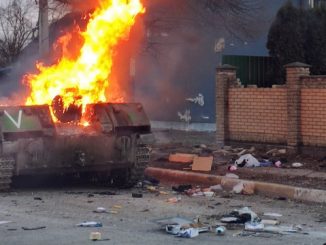
Refuting lies about “Bucha atrocities” by Russian military

From Dmitri Kovalevich (Borotba) in Kiev, Ukraine:

The war of fakes is being escalated. Regarding the alleged atrocities in Bucha, Kiev region. The Russians left Bucha on March 30. On March 31 the Bucha’s mayor reported that the town is free. On April 2 Ukrainian police and nationalist detachments entered Bucha and there were no dead bodies on streets. On April 3 there appear pictures of dead bodies on its streets. Why exactly Bucha but not Hostomel, Irpen or Makariv – neighboring towns which the Russians also left. Because the name of Bucha resonates for English-speaking people with the term ‘butchery’.

Simultaneously the Russians receive messages about alleged Ukrainians’ atrocities. They are told via anonymous chats that exchanged Russian POWs were castrated and have fingers cut off. The Russians especially checked the released former POWs – and tell that it’s a fake, nothing of that kind happened to former POWs. The messages are evidently distributed to inspire more anger. The purpose of the fakes – to cause more real atrocities from both sides.

https://www.facebook.com/dmitri.kovalevich.94/posts/481275803699691

Russia to demand convening UN SC session over Bucha provocation again

MOSCOW, April 4. /TASS/. Russia on Monday will demand again the UN Security Council meet in session to discuss the Ukrainian military’s provocation in Bucha, Russian Foreign Ministry spokeswoman Maria Zakharova said on her Telegram channel.

“Yesterday, the current UN SC president, Britain, acting in accordance with its worst traditions, once again refused to give consent to holding a Security Council meeting on Bucha. Today, Russia will demand once again the UN Security Council meet in session to discuss criminal provocations by the Ukrainian military and radicals in that city,” Zakharova said.

The Russian Defense Ministry on April 3 dismissed the Kiev regime’s charges its forces had allegedly killed civilians in the community of Bucha, the Kiev Region. The ministry recalled that Russian forces left Bucha on March 30 while faked evidence of alleged killings was presented four days later, when Ukrainian security service SBU agents arrived in the locality. The Russian Defense Ministry also said that on March 31 Bucha’s Mayor Anatoly Fedoruk said in a video address that there were no Russian soldiers in the community. Nor did he mention any locals allegedly shot on the streets.

https://tass.com/politics/1431949

Russian MoD Denies Killings in Bucha, Says Footage Was Staged for Western Media

TEHRAN (FNA)- Russia’s Defense Ministry rejected allegations promulgated by Kiev, claiming that Russian troops had killed civilians in the Ukrainian city of Bucha.

The ministry stated that the images and videos claiming to depict dead civilians on the streets of Bucha were staged photos and videos created specifically to distribute via the Western media, Sputnik reported.

“[These images are] yet another provocation. During the time this settlement was under the control of the Russian armed forces, not a single local resident was hurt […][This is] yet another example of providing staged material from the Kiev regime for the consumption of Western media, as it was the case with the Mariupol maternity hospital, not to mention other cities”, the ministry said.

The defense ministry stressed that Russian troops abandoned the city on March 30 and reminded the audience that the city’s mayor, Anatoly Fedoruk, confirmed this fact the next day. Furthermore, the mayor never mentioned in his March 31 that any civilians had been shot in the street with their hands tied, as claimed by Kiev.

During the whole time – right up until Sunday – that the city was under the control of Russian troops, residents of Bucha could move freely and had access to cell networks, the defense ministry stressed.

The ministry further noted that the images of the bodies on the streets emerged four days after the Russian troops left the city and immediately after the Ukrainian Security Service (SBU) and the Ukrainian media arrived at the scene. The bodies which have been videoed and photographed show no signs of rigor mortis or lividity, and the blood on the wounds is fresh.

According to the Russian Defense Ministry, the residents of Bucha had several possibilities for leaving the city, except for from the South which was routinely shelled by Ukrainian forces who targeted, among other things, residential quarters using artillery, tanks and MLRSs.

Russian troops withdrew from Bucha after the last set of talks between Russia and Ukraine, during which Moscow announced a military de-escalation, which includes drastic reduction of military activities in the direction of Kiev. The Kremlin explained it was taking that step to ensure the safety of decision-makers in Kiev to expedite talks.

The talks are aimed at ending Russia’s special military operation in Ukraine, which was launched by President Vladimir Putin on February 24 in response to a request for help from the Donetsk and Lugansk People’s republics (DPR and LPR). The latter had said that there had been intensified shelling by Ukrainian armed forces and nationalist battalions in the weeks running up to the start of the operation.

https://www.farsnews.ir/en/news/14010115000078/Rssian-MD-Denies-Killings-in-Bcha-Says-Fage-Was-Saged-fr-Wesern-Media

The Bucha Provocation

The Bucha ‘Russian’ atrocities propaganda onslaught may have worked well in the ‘west’ but it lacks evidence that Russia had anything to do with it.

The former Indian ambassador M.K. Bhadrakumar calls it an outright fake:

An indignant Moscow has angrily demanded a United Nations Security Council meeting on Monday over the allegations of atrocities by Russian troops in areas around Kiev through the past month. Prima facie, this allegation is fake news but it can mould misperceptions by the time it gets exposed as disinformation.

Tass report says: “The Russian Defense Ministry said on Sunday that the Russian Armed Forces had left Bucha, located in the Kiev region, on March 30, while “the evidence of crimes” emerged only four days later, after Ukrainian Security Service officers had arrived in the town. The ministry stressed that on March 31, the town’s Mayor Anatoly Fedoruk had confirmed in a video address that there were no Russian troops in Bucha. However, he did not say a word about civilians shot dead on the street with their hands tied behind their backs.”

Even more surprising is that within minutes of the “breaking news”, western leaders — heads of state, foreign ministers, former politicians — popped up with statements duly kept ready and only based on the videos, seconds-long videos and a clutch of photos, ready to pour accusations. No expert opinion was sought, no forensic work was done, no opportunity given to the accused to be heard.

https://www.moonofalabama.org/2022/04/the-bucha-provocation.html
Strugglelalucha256


Malvinas War: a challenge to imperialism

This week the people of Argentina are commemorating the 40th anniversary of the April 2, 1982, war to take back the Malvinas archipelago from imperialist Britain. In the English-speaking world, the imperialist media usually calls this Britain’s “Falklands War.”

Six hundred forty-nine Argentine soldiers lost their lives and ultimately the British military held onto their colonialist-era possession of the islands. Yet the military campaign — being a fight against imperialism – is a great point of pride for the people of Argentina. 

Argentina’s military sank the HMS Sheffield and damaged other British warships with Exocet missiles that were sold to them by imperialist France. Anti-imperialist demonstrators filled the streets of Buenos Aires, calling for victory over Britain. 

The fact that Argentina was ruled by a repressive, right-wing military junta didn’t hinder the masses’ support for anti-imperialist action at all.

In fact, the momentum of the anti-imperialist struggle fueled a desire for justice that burned in the hearts of Argentine people. The war to take back the Malvinas ignited a resurgent people’s movement that ended the junta’s rule over Argentina within months.

Possession of the Malvinas had been contested between Spain, France and Britain in the 18th century. The islands could serve as a naval asset – valuable in the colonial mission of dominating South America. 

After winning independence from Spain, the flag of Argentina was hoisted on the Malvinas in 1820, but Britain invaded and stole the archipelago in 1833 and held it for nearly 150 years.

By April 1982, negotiations for possession of the islands had yielded nothing. The junta’s long hold on Argentina’s government was shaky. Runaway inflation and working-class anger against bloody repression led them to launch an invasion to take back the Malvinas as a distraction.

The fact that the war was launched by the Argentine side, and that it was launched by a right-wing government, confused much of the U.S. anti-war movement. The limitations of pacifism prevented them from looking at the world situation in the context of the imperialist epoch. Moreover, the hated Reagan administration initially sided with the Argentine junta and that muddied the waters even more.

Imperialist secret diplomacy

In a 1990 article written during the leadup to the U.S. attack on Iraq, Marxist-Leninist leader Sam Marcy used the example of the Malvinas War to try to strengthen the movement’s understanding of imperialism. He described a moment in the early days of the war when the fog lifted and the relationship between imperialist countries and against all challengers to imperialism was illuminated.

Marcy wrote: “When the Argentine military decided to take the plunge and retake the islands, this greatly upset the reactionary Thatcher regime in Britain, which decided to militarily challenge the Argentine takeover.

“This in turn upset General Alexander Haig, who at that time was secretary of state under the Reagan administration. They had such a chummy relationship with the Argentine fascist military that they forgot the secret agreement the U.S. had with Britain over the Malvinas.

“When Haig was called to London, Thatcher virtually read the riot act to him. She recalled to him the specific secret agreement: that when the British needed military support in the North or South Atlantic, and especially those islands, the U.S. was obligated to give not only the necessary intelligence, but also air reconnaissance, satellite photos and other material assistance as needed.

“Haig’s efforts to persuade Thatcher not to challenge the Argentine military were thwarted when she threatened to break up the agreement altogether, unless Washington supported Britain and lived up to the secret agreement. The Reagan administration, seeing the better part of wisdom, lined up quickly with the Thatcher government against the Argentine military in order to save the alliance, which was far more important to them.”

The imperialist powers side with each other to this day to defend their respective “spheres of influence.” The fact that they each fight for their own interests at times doesn’t shake their alliance. 

The U.S., the European imperialist powers and Japan have the world divided up amongst them. The clear example of how they guard their world dominance is that capitalist Russia, over more than three decades, has been unable to reach a stage in its economic development when it exports capital – a feature of the imperialist state of capitalism. 

The already-existing imperialist countries are united in hemming in Russia and trying to hinder the development of socialist China. At this stage in history, even capitalist countries have to either be an appendage or a proxy of imperialism or they will be starved and punished.

Today, U.S.-led NATO is the most prominent expression of this circumstance. The confusion over Russia’s operation in Ukraine, and of Russia’s defense of the people of the Donbass region, is similar to the U.S. movement’s reaction to Argentina’s war against imperialist Britain. 

The political character of the military junta didn’t matter to the people of Argentina. They cheered the war as a rebellion against imperialism and dealt a death blow to the junta afterward. 

Russia is not led by a fascist military, but in any case, Putin’s character, or the nature of the Russian state, are not the question today. NATO’s expansion strengthens imperialism – U.S. imperialism in particular — and the abolition of NATO should be the rallying cry of the U.S. anti-war movement.

Strugglelalucha256


The Ukrainians that aren’t mentioned

The corporate media claim that all Ukrainians support President Zelenskyy, who has banned most political parties except his own and the far-right. These news outlets also whitewash the fascist gangs―integrated into the Ukrainian army―that engage in torture.

The sleazy London Daily Mail even mourned the death of Maksym Kagal, a member of the neo-Nazi Azov Battalion.

The real history of Ukraine includes a rich revolutionary tradition both in Europe and North America. Even the anti-communist “Encyclopedia of Ukraine” admits that 4.5 million Ukrainians were members of the Red Army that defeated Hitler.

Around 1.7 million Ukrainians earned medals for bravery. Over a million died in combat or were murdered in concentration camps.

One of the many sheroes was Lyudmila Pavlichenko, who was born near Kiev. She was the most successful woman sniper in history with 309 confirmed kills. Among them were 36 enemy snipers.

Pavlichenko was decorated as a Hero of the Soviet Union and made a tour of the United States. She spoke of how the Red Army was made of many nationalities on the basis of equality.

In contrast, the Jim Crow U.S. Army was so racist that even the blood supply was segregated. The folk singer Woody Guthrie wrote a song about  Pavlichenko

Oleksiy Fedorov was born in a Ukrainian peasant family. Federov was an outstanding leader of the partisan units that fought behind Nazi lines. 

By 1943 Federov led 12 guerrilla groups that included 5,462 fighters. They engaged in 158 major battles with the fascists, derailing 8,675 armored trains and blowing up 47 bridges.

Federov became a major-general and was one of only two partisan leaders to be awarded the Hero of the Soviet Union medal twice.

Another partisan leader who became a Hero of the Soviet Union was Pyotr Vershigora. He was a son of two Ukrainian teachers.

Ace fighter pilot Ivan Kozhedub shot down 62 Nazi aircraft. The son of Ukrainian parents, he was made a Hero of the Soviet Union three times.

Kozhedub became the first Soviet pilot to shoot down a Nazi Me-262 jet fighter. He later commanded a Soviet Air Division along the China-Korea border during the Korean War. The National Air Force University in Kharkov, Ukraine, is named after Kozhedub.

Millions of Ukrainians revere these anti-fascist heroes. They want to put a stop to the fascist gangs that worship Nazi collaborators like Stepan Bandera.

Bandera’s thugs helped the Nazis kill more than a million Jewish Ukrainians as well as tens of thousands of Polish and Roma people. The current Ukrainian regime has allowed memorials to Bandera to be erected while statues commemorating the Red Army have been torn down.

Ukrainian miners vs. Mounties 

Like other immigrants from the Tsarist empire, Ukrainians joined the labor movements in both Canada and the United States.

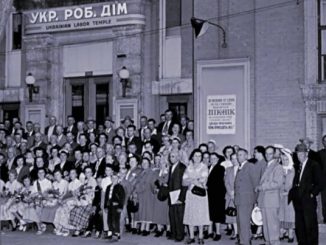
In the early 20th century, they founded meeting halls called labor temples. The Ukrainian Labour Temple in Winnipeg, Canada, still stands, though it was raided by police during the 1919 Winnipeg general strike.

Over its entrance are two clasping hands reaching across a globe with the slogan “Workers of the World Unite.” The pro-Soviet Ukrainian Labor News was published there weekly. (Manitoba Historical Society)

Another progressive Ukrainian publication was “Robitnytsia” (“The Working Woman”). 

It was Ukrainian immigrants who were the backbone of the communist movement in Western Canada. Jeff Kochan In “Canadian Dimension” (Jan. 3, 2020) describes some of their activities:

“In 1926, Ukrainian-Canadian leftists helped to elect Canada’s first communist politician, Winnipeg alderman William Kolisnyk. Ukrainian-Canadian communists served on Winnipeg’s council well into the 1930s, much to the alarm of the Ukrainian-Canadian right.

“Historian Orest Martyowych notes that when one Ukrainian-Canadian alderman urged the city to assist Jewish refugees, he was ferociously attacked in the right-wing Ukrainian-Canadian press. Ukrainian-Canadian leftists were denounced as the useful idiots of a ‘Judeo-Bolshevik’ plot.”

It’s the political descendants of these fascists who support the Azov Battalion and the Right Sector today.

Following the Bolshevik Revolution, the Ukrainian Labour Farmer Temple Association (ULFTA) founded 25 branches in Saskatchewan alone. (Encyclopedia of Saskatchewan)

This association supported the 1931 coal miners’ strike in Bienfait, Saskatchewan. The workers were organized by the Workers Unity League, which was led by Communist Party members.

Royal Canadian Mounted Police killed three of these strikers on Sept. 29, 1931, in nearby Estevan. The inscription “Murdered by RCMP” is on their tombstones. Many more workers were wounded or arrested.

The Ukrainian Labour Farmer Temple Association was shut down by the Mounties in January 1940. The Association of United Ukrainian Canadians continues the ULFTA’s progressive work.

This is the real tradition of Ukrainian working people.

Strugglelalucha256


Will U.S./NATO militarization bring peace to Ukraine?

From the Emergency Campaign to Stop the War Lies street meeting in New York City’s Herald Square April 2.

When I woke up this morning, I thought about the protest today and I asked myself: Why are we engaged in another war?

Look at the recent withdrawal of the U.S. military from Afghanistan. Are the Afghani people better off after years of a war that plundered their economy? If the U.S occupation improved the lives of those people would the U.S. forces have been driven out?

Did the U.S. war in Afghanistan benefit us here? Only a very small percent benefited. The rich are richer and we are poorer than before.

The U.S. has one of the highest death rates in the world from COVID-19. That is no natural disaster. It is because the U.S., with all its wealth, does not provide for a national health care system.

Now the U.S. Congress has withdrawn funds for fighting COVID in order to spend another $13.6 billion for the U.S. war machine in the Ukraine.

Inflation fueled by the U.S. war machine is cutting down our income. Prices of gas, food and rents are skyrocketing.

It is another U.S. war. The horrors on the evening news were conceived in the Pentagon. Leon Pantetta, former head of the Pentagon and the CIA, has declared this a U.S. proxy war against Russia.

NATO is not a peacekeeping alliance. It is a war machine commanded by the Pentagon, spawned by the U.S. to threaten the Soviet Union during the Cold War. During the last 20 years NATO has expanded into most countries along the Russian border filling them with ever more lethal weapons.

The Russians have seen the U.S. and NATO invade Afghanistan and Iraq. They saw it demolish Libya and attempt the same operation in Syria. In Iraq alone, the war and the embargo has killed about 2 million people including half a million children.

Will the U.S./NATO military funds bring peace to Ukraine — and improve our lives as well? NO! It is dragging the Ukrainians into catastrophe and threatening the well-being of the entire world.

Fight racism, not war!

Strugglelalucha256


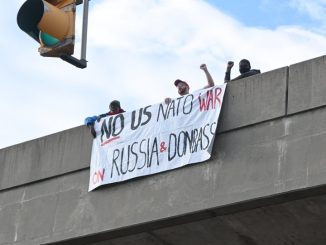
Baltimore banner drop: No U.S.-NATO war

During rush hour on March 25, anti-war protesters in Baltimore held a banner drop and street meeting to demand “No U.S.-NATO War on Russia & Donbass.” 

Activists handed out fact sheets and Struggle-La Lucha newspapers to drivers at red lights. They reported many honks of support for the slogan on the banner. 

Strugglelalucha256


Ante un gobierno criminal y fallido, un pueblo se levanta y lidera

La sustitución y el desplazamiento del pueblo boricua ha tomado un ritmo sumamente acelerado, particularmente luego de la destrucción que causaron los huracanes Irma y luego María, en el año 2017. Para entonces, ya hacía 5 años – en el 2012 – que se habían implantado las nefastas Leyes de incentivos fiscales 20 y 22. Las que yo llamaría Leyes de Paraíso Fiscal que han atraído cientos de millonarios extranjeros. Pero lo que supuestamente iba a ser una inversión para la economía en Puerto Rico, ha demostrado que su verdadero propósito era el de terminar – más bien exterminar – la población isleña y hacer de Puerto Rico un centro de vacaciones y residencias para millonarios.

Han estado comprando las mejores tierras en las costas y montañas, sacando residentes de viviendas de interés social para convertirlas en habitaciones de arrendamiento corto. Han destruido los mangles y los corales en las costas, rellenando con cemento y poniendo en riesgo las comunidades aledañas al ser más susceptibles de ser arrasadas por marejadas y tsunamis.

Y todo con el aval del gobierno y sus agencias. 

Pero ante este gobierno fallido, hay un pueblo que no cesa de luchar en defensa de nuestra tierra, exponiendo estos crímenes constantemente por las redes sociales y en manifestaciones. Y esto quedó demostrado esta semana cuando por fin, después de que expusieran públicamente los crímenes contra la costa sur en una Reserva Natural en Salinas, el Tribunal de Justicia ha hecho acusaciones de crimen ambiental contra agencias del gobierno, lo que ha hecho renunciar al titular del Departamento de Recursos Naturales.

Ante un gobierno criminal y fallido, un pueblo se levanta y lidera. Y así seguimos hasta que logremos la independencia y nuestra soberanía.

Desde Puerto Rico, Para Radio Clarín de Colombia, les habló Berta Joubert-Ceci.

Strugglelalucha256


‘Revolutionary Marxists look below surface’ to understand war crisis

Presentation by Struggle-La Lucha co-editor Greg Butterfield on behalf of the Socialist Unity Party at the international online forum “Marxists Speak Out on the Conflict Between Russia and Imperialism” on March 26. The event featured representatives of communist and socialist organizations based in Argentina, Australia, Britain, Greece, South Korea, Turkey, the U.S. and more.

I want to thank the organizers for inviting us to participate in this important event. 

There are turning points in history where the principles of organizations and individuals are tested and clarified. This is one of those moments. In the past month we have seen so many anti-war and left formations bow to the intense pressure of imperialist propaganda at the expense of anti-imperialism and the interests of the workers and oppressed.

The other side is that the war crisis is separating the wheat from the chaff. Leaders and organizations that have coasted through recent years on past accomplishments are now forced to show where they really stand. At the same time, groups separated by historical differences and secondary issues may now find a new basis to work together and learn from each other.

The Socialist Unity Party and Struggle-La Lucha newspaper call for the victory of the Donbass republics and Russia in their defensive joint military operation to denazify and demilitarize Ukraine. What this really means is: to end the eight-year genocidal war against the people of Donbass; to remove the neo-Nazi bootheel from the neck of the Ukrainian people; to reverse Ukraine’s transformation into a NATO war base that poses a threat to Russia; and return it to the formally neutral status before the U.S.-backed coup of 2014.

We call for the defeat of U.S. imperialism, which instigated this war and is a combatant as surely as it is in Yemen or anywhere else Washington’s proxy wars are carried out. After this week’s NATO summit, the imperialists are moving closer to direct intervention, which could precipitate an unprecedented global war.

We believe it is very important to elevate the struggle of the people of the Donbass region, the Donetsk and Lugansk People’s Republics. Too often their struggle is ignored by the left or, following the lead of the corporate media, written off merely as “Russian separatists” or “Putin’s proxies.” Such a view can only be argued by people who are completely ignorant of the Donbass and the anti-fascist struggle of the people there for the last eight years, or by those who know better but are adapting their views to the needs of imperialism. 

The people of Donbass have resisted through eight years of constant terror by the Ukrainian Armed Forces and neo-Nazi battalions, and a blockade that has deprived the people of food, medicine and the essentials needed for the maintenance of basic industry. This resistance draws upon the deep traditions of internationalism and anti-fascism of the Soviet people and it found an echo among people in Russia. 

Marxist view of Russia’s contradictions

Revolutionary Marxists look below the surface to understand the class forces and contradictions at work. Those who focus on President Vladimir Putin’s and Russian capitalists’ reactionary ideology ignore the dialectical relationship between Russia’s struggle to maintain its sovereignty against the U.S. and NATO, and the anti-fascist struggle in Donbass and Ukraine. 

The same dynamic exists on a global scale. Looking at it purely on the surface level of Putin’s domestic pronouncements, you could come to the conclusion that there’s little difference from Bolsanro in Brazil or Modi in India, whose ruling classes are fundamentally subservient to the U.S. But the life-and-death struggle of Russia to not be dissected and swallowed by Western imperialism has pushed it into the camp of countries and movements resisting U.S. imperialism, including Venezuela, Cuba, China, the Democratic People’s Republic of Korea, Zimbabwe, Syria, Yemen and Iran.

With our modest forces and resources, we are doing what we can to clarify the issues and bring a genuine anti-war position to the working class. We have launched a campaign called “Stop the War Lies,” aimed at exposing the U.S.-NATO role in Ukraine and imperialism’s cozy relationship with Ukrainian fascists, educating about the cause of Donbass, and explaining how Wall Street, Big Oil and the military industry profit from the war at the expense of people here.

We and allied groups have been getting out into communities with fact sheets, holding picket lines and speak-outs. Last night, our comrades in Baltimore held a rush hour banner drop and leafleting action. Today folks in New Orleans and San Diego are doing community outreach. Next weekend, on April 2, we are building protests in New York and Los Angeles. 

On March 27, we will hold a webinar featuring speakers from the Donbass republics, to help inform the anti-war movement and the left about the reality of the U.S.-Ukraine war. 

We invite the organizations here to join this effort. We are open to collaborating with groups here in the U.S. and internationally. This is the moment to overcome secondary differences and build a united front against imperialism and war that can lay the foundation for future revolutionary struggles.

Victory to the Donbass republics and their allies! U.S.-NATO out of Ukraine!

Strugglelalucha256


Struggle-La Lucha joins 24-hour marathon against U.S. blockade of Cuba

Struggle-La Lucha and the Socialist Unity Party based in the United States will join this weekend’s media marathon called by the Europe for Cuba and Europe for Cuba-Russia against the U.S. blockade on Cuba.

For 24 hours from April 2 to 3, media from around the world will broadcast a special uninterrupted program aimed at opposing the U.S. blockade of Cuba. People from around the world, those representing organizations large and small, will be saying: “Cuba, you are not alone! End the blockade!”

The U.S. blockade is now over six decades long. The tightening of the blockade during the COVID-19 pandemic is nothing short of criminal. The intention of these policies is to strangle the Cuban economy, create unbearable hardships for the Cuban people in an attempt to intervene, and overturn the right of the Cuban people to determine their own government.

Larger networks including teleSUR, Al Mayadeen, Cubavision International, HispanTV, Prensa Latina, Sputnik news agencies, along with radio stations Radio Rebelde, Radio del Sur, Radio Habana and others, will be participating.

The World Federation of Trade Unions and Latin American Network of Solidarity with Cuba are also supporting.

Struggle-La Lucha is proud to participate. You will see links on our website, Facebook page, Twitter and Telegram where you can access the program on April 2-3. The marathon begins on April 2 at 8 p.m. Eastern / 5 p.m. Pacific, and runs for 24 hours.

Watch here on YouTube: Europa X Cuba – Maratón Mediático contra el Bloqueo.

Strugglelalucha256


Dock workers in Genoa protest transit of arms through their port

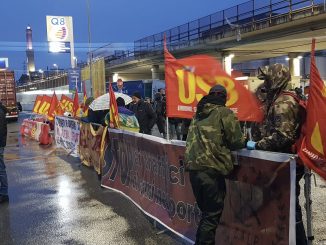
On March 31, dock workers of the Italian port of Genoa observed a 24-hour strike protesting the usage of the port for the transit of arms which are likely to be used in deadly imperialist wars going across the world. The call of the strike was given by USB Italia trade union. Activists from various left, anti-war groups including Potere al Popolo participated in the blockade held at the Ethiopia crossing at the Genoa port and an assembly of workers at Cap in via Albertazzi.

During the protest, workers raised a banner which read “Not a penny, a rifle or a soldier for war“ and also stated that Italian ports and airstrips must not be used to make arms deliveries for imperialist war. The protesting workers also resolved for a greater participation in national mobilization of Italian workers on April 22 in Rome against the anti-worker policies of the Mario Draghi government.

Dock workers in Genoa have a legacy of anti-war interventions as the port has become a major transit point for cargo ships carrying weapons allegedly destined for use in the ongoing wars in Yemen and Ukraine. Earlier, in the first week of March, dock workers of Genoa protested the disembarking of camouflage tanks at the port from a ferry coming from Palermo, allegedly destined for Ukraine. On March 14, cargo workers at the Pisa airport refused to load cartons of arms and ammunition in planes destined to deliver humanitarian aid to Ukraine. Workers and trade unions in Italy have already denounced the transfer of arms and ammunition to Ukraine from Italian seaports and airports disguised as humanitarian aid.

The USB Italia union has stated that “on behalf of the interest of the US and NATO, the Mario Draghi government in the country is dragging Italy into more imperialist conflicts with the sending of our resources and the adoption of sanctions. The price of such conflict will be paid by workers with austerity and layoffs. As port workers have no intention of staying indifferent in the face of the new war winds that are blowing in Europe again”

“Not a penny, a rifle, or a soldier for war. Let’s block our gates to gun traffic. It’s time for the labor variant,” added the USB.

Potere al Popolo has demanded that there should not be any increase in military spending and that public money should be used for urgent social measures. “It is the workers more than anything else paying very dearly the price increase, the crisis of raw materials and energy etc. Italian workers are the ones with the lowest salaries in Europe. We want the government to stop the military escalation. This is why we stand by the workers who oppose the war.”

Source: Peoples Dispatch

Strugglelalucha256


Behind NATO’s war on Yugoslavia

On March 24, 1999 – 23 years ago – the U.S./NATO armed forces started a 78-day long aerial bombing campaign against the Federal Republic of Yugoslavia. The brutal bombing campaign targeted civilians, city centers, public transportation, schools, hospitals, hotels and even the Embassy of the People’s Republic of China. 

More than a thousand aircraft were used to drop more than 3,000 cruise missiles and about 80,000 tons of bombs. More than 3,000 people were killed, and up to 20,000 seriously injured. 

NATO flattened 25,000 residential buildings, 300 miles of roads, almost 375 miles of railroads, nearly 40 bridges, 100 schools and childcare facilities, 30 hospitals and 14 airfields. 

The bombardment ended June 10 with the declaration of a “NATO victory,” as Wikipedia puts it. The real background to NATO’s war on Yugoslavia can’t be found on Wikipedia, however. 

Reprinted below is an article by Marxist leader Sam Marcy, originally published in 1992. It also appeared as a chapter in the book “NATO in the Balkans,” published in 1998, only months before the bombing began.

NATO is a U.S.-commanded military alliance established in 1949 as a military force aimed against the Soviet Union and the Eastern European socialist states. NATO now acts to enforce Washington’s dominance in Europe and to intervene in other parts of the world. NATO’s war on Yugoslavia asserted suzerainty over the Balkans.

After the overturn of the Soviet Union, NATO was expanded to every country of Eastern Europe to lock in place capitalist restoration of the formerly socialist countries. The threatened expansion of NATO’s military force to Ukraine, on the border of Russia, along with NATO naval operations in the Black Sea, are direct provocations of Russia. As Leon Panetta — White House Chief of Staff under Bill Clinton, CIA Director and Secretary of Defense under Barack Obama — explained, the conflict in Ukraine is a NATO “proxy war” against Russia.

How imperialism broke up Yugoslav Socialist Federation

By Sam Marcy
June 11, 1992

It is impossible to seriously consider the Yugoslav situation without first taking into account some pertinent aspects of history and politics.

The imperialist conspiracy to break up the Socialist Federation of Yugoslavia didn’t start yesterday. It didn’t start with the U.N. Security Council voting for sanctions. It didn’t start with the earlier meeting of the European Economic Community in Spain.

It started a long time ago, when the Anti-Fascist Council of National Liberation of Yugoslavia (AVNOJ), led by Tito (Josip Broz) and the Communist Party, defeated the royalist, reactionary and pro-fascist forces of Col. Draza Mihajlovic and his Chetniks.

The front mobilized the workers, peasants, progressive intellectuals and thousands of middle class people in the Partisan guerrilla army that defeated the German Nazi and Italian fascist invaders and their quisling regimes.

The U.S. and the British until 1943 recognized Mihajlovic and his Nazi-sympathizing coalition and refused recognition to the representatives of the Yugoslav people organized in the AVNOJ.

Then, seeing that the progressive and revolutionary forces were on the verge of scoring a historic victory, the imperialists suddenly changed sides and began to give token support to the Partisans. They did so largely to disrupt the socialist solidarity between the Yugoslav leaders and the Soviet Union.

The very same forces which fought in Yugoslavia against the revolution, particularly the royalist riff-raff and pro-fascist groupings, have all these years been promoted, secured, cultivated and supported financially by the U.S. and European imperialists. Now they are being pushed forward as an authentic leadership to replace the Yugoslav government in Belgrade.

Monarchist democrats?

In recent days, the imperialist press have written about a “democratic opposition” in Serbia. Who are they?

There is “the Democratic Movement of Serbia, which embraces the old monarchy and enjoys the support of many Serbian traditionalists.” (Washington Post, May 31, 1992)

What are these monarchist traditions? Suppression of the Serbian people! These idle rich have for decades been living it up in the decadent casinos and watering places of Europe.

The Post continued: “Crown Prince Alexander — the son of the last king of Yugoslavia who was forced into exile during World War II — met recently in Washington with senior White House and State Department officials. This week he expressed his willingness to preside over a constitutional monarchy in cooperation with the democratic movement and spoke of a coalition government that would fall into the mainstream of European democracy. It seems likely that the opposition will win the backing of the Serbian Orthodox Church, which reportedly has dispatched senior clerics to meet with the prince.”

This stooge, who is ordered around by U.S. imperialism like an errand boy, has expressed his willingness to head up a “democratic government.” And giving him their blessing are the reactionary clergy that supported the Mihajlovic forces. This “Democratic Movement of Serbia” is nothing but the old reactionaries in a new form.

They are now boycotting the elections in Serbia because they haven’t got the forces to contest them. The sanctions against Serbia just passed by the U.N. Security Council (the same council that okayed sanctions and then outright imperialist war against Iraq) are timed to coincide with and disrupt the elections.

An editorial headed “Popular Opposition” (!) in the Financial Times of London (June 2, 1992) calls for the isolation of Serbia: “The demonstration inside Belgrade by some 50,000 anti-war protesters was an indication that popular opposition to [Serbian leader Slobodan Milosevic’s] policies is growing, at least in the capital. However, the peace movement in Serbia is mainly middle-class based.” 

In other words, it’s a bourgeois, pro-capitalist, pro-imperialist opposition. The demonstrations seem to be precisely timed to undermine the government of Milosevic.

“It would be an illusion to believe,” concedes the London big business paper, “that it finds much of an echo in the rural Serb and Montenegrin population, not least the Serbs in Bosnia who look on the Belgrade government as their main protector and champion.”

A valuable admission from the mouth of the enemy.

What’s missing here is any word on the attitude of the workers. Notwithstanding the political confusion caused by the maneuvers of the principal imperialist powers involved in the current struggle, the workers of these areas support the Yugoslav government.

Most deeply involved among the European imperialist powers are the Germans and Austrians and, to a lesser extent, France and Italy. That’s who dominated the European Community conference on the Balkans held recently in Spain. …

Germany made it clear it would recognize Slovenia and Croatia. By Dec. 23, 1991, Bosnia-Herzegovina and Macedonia indicated they too were moving toward secession.

Imperialism and self-determination

What is the Leninist point of view in a case like this? Is the secession of these republics from Yugoslavia an example of self-determination?

Each and every nation has a right to determine its destiny. This can mean integration; it can mean joining in a federation; it can also mean exercising the right to leave, to secession. In any case it has to express the will of the nation or nationality.

But when the choice is the product of external imperialist pressures of an economic, political and even military character, that is another matter.

Was the president of Croatia defending genuine self-determination when he openly called for the U.S. Sixth Fleet to come to Dubrovnik? (CNN Prime News, May 29, 1992; the president spoke in English.)

The strategy of the imperialists has been to lure the republics away from the Yugoslav federation.

But they are not united. There is a struggle between Germany and the U.S. over who will get the dominant position in the entire Balkan area. Each has its own forum. Germany has used the European Community as its instrument. The U.S. is using the United Nations.

Germany and the U.S. are both seeking to make pawns of the republics. The U.S. may at one time support the Yugoslav Federal Republic and later come out against it; Germany may support Croatia and Slovenia at one point and later change. It all depends strictly on the military and political exigencies of the situation. But each is attempting to win overall control for itself.

Rich vs. poor republics

As in so many other areas of the world, there is a more developed so-called northern part of Yugoslavia where the bourgeoisie is stronger, and a southern, poorer part. Slovenia and Croatia are more developed, whereas Bosnia-Herzegovina, Macedonia and Montenegro, as well as the province of Kosovo in Serbia, are less developed.

As of 1975, Croatia was the most industrialized and prosperous. Said the New Columbia Encyclopedia of that year: “More than one-third of Croatia is forested and lumber is a major export. The region is the leading coal producer of Yugoslavia and also has deposits of bauxite, copper, petroleum and iron ore. The republic is the most industrialized and prosperous area of Yugoslavia.”

Since then, Slovenia has overtaken Croatia as the most developed.

Henry Kamm wrote in the New York Times on July 13, 1987, about the rich-poor split in Yugoslavia. “The southern republics — Bosnia-Herzegovina, Macedonia, Montenegro as well as the province of Kosovo — are subsidized by the more prosperous areas through a federal fund and direct contributions. … Slovenia [is aware] that its 2 million people have the highest level of economic development among the republics and provinces that make up the federal country of 23 million. Slovenia is a small Slavic republic. The economic crisis has sharpened the contrast between the rich and the poor.”

Kamm interviewed people in Slovenia who resented the southern republics. Milos Kobe said, “Fantastic sums go to the south and they don’t know how to use them economically.” A man named Kmecl told the U.S. reporter, “We cannot invest in renewal because our capital is going for the development of the underdeveloped. A small country like this cannot afford this. After 40 years of this policy, [the southern republics] are still not developed and we can’t maintain the pace. We’re immobilized. A technologically highly developed society like Slovenia always needs more for its own science and culture while the underdeveloped need more for social protection than they produce.”

We have heard this refrain before. It sounds just like the rich bourgeois elements in any capitalist country who complain that they have to subsidize the poor. They forget that their riches come from the sweat and blood of the workers in every one of these republics and that they became industrialized only because of the socialization of the means of production and centralized planning. This is what protected them from the ravages of imperialist penetration. The federation was like a security blanket that helped them develop.

The imperialists have lured the bourgeois elements of Slovenia and Croatia in particular with the promise of becoming an integral part of the European Community and sharing in its alleged prosperity. They think they’ll get a market for their products and be able to deal with the West Europeans on an equal basis, without being “encumbered” by the poorer republics in the federation. All of them, including Serbia, are being lured to invest their foreign exchange in Europe or America and thereby become (they hope) a prosperous part of the imperialist system. …

Socialist federation a great breakthrough

It is impossible to understand the situation in Yugoslavia if we accept the imperialist premise that what has happened is merely the surfacing of national antagonisms that had been smothered or driven underground following the Yugoslav Revolution.

The establishment of the socialist federation of Yugoslavia was a historic victory. For the first time, a united front of the Balkan countries was formed that was able to detach them from imperialist domination, either Allied or Axis. It was the product of a revolutionary upsurge that engulfed the working class movements of Europe.

The federation developed over a period of years. Its collective presidency was a progressive new political conception. Each republic had an opportunity to run the federation for a specified time and in rotation. The same concept prevailed in the structure of the communist parties. They were also organized on the basis of the collective principle that the party in each republic had an opportunity to run the federated communist party.

What opened the gates to imperialism? Unquestionably, a contributing factor was the unfortunate and ill-considered split between Yugoslavia and the Soviet Union. Yugoslavia was expelled from the Cominform in 1948 and thereafter isolated from the socialist camp. Years later an attempt was made by the USSR leadership to repair the situation so Yugoslavia could exist without leaning on or getting aid from imperialism. But the socialized, centralized economy of Yugoslavia had already been damaged.

The gates to imperialism opened wide when Yugoslavia established its so-called workers’ control of management. This sounded highly democratic — a step away from the rigid, centralized control that stifled the creative energy of the working class. Now the workers’ talents and abilities to manage Yugoslavia’s affairs would be utilized.

Workers’ control as a step away from capitalism is progressive. But it’s a backward step when it leads away from centralized socialist planning. The concept of workers’ control soon degenerated into managerial control and the abandonment of centralized planning. Yugoslavia fell into the coils of the International Monetary Fund and the World Bank. By 1981, it was completely dominated by world finance capital. It had opened wide the gates to so-called free enterprise.

Decentralization, then dismemberment

This intensified competition among the various enterprises in each republic and among the republics themselves in a thoroughly bourgeois manner. Under such conditions, socialist solidarity was lost and more significantly the standard of living plummeted to such an extent that workers were no longer able to purchase basic necessities.

By 1991, the new government had acquired a debt of $31 billion. Unemployment was over a million and inflation was 200% .

From free enterprise, the necessity arose for free, sovereign, independent republics. Economic decentralization soon led to political decentralization. The dismemberment of Yugoslavia had already begun.

This was not an automatic, spontaneous development. No sooner had there developed the greater autonomy of the republics than the imperialists began to funnel funds into the republics with a view to encouraging and promoting separatist and secessionist objectives. It is they who unloosed the forces of virulent national hatred.

The stimulation of national hatred is a byproduct of imperialist finance capital’s investment in Yugoslavia.

Slobodan Milosevic, the Serbian leader, is also a product of that tendency. From the earliest days of his ascendancy to CP leadership, the imperialist press played him up as a “charismatic personality.” They supported his nationalist demagogy. It was only later that they found it might become disadvantageous to them if he went too far.

It must be taken into account that there was no unified policy of the imperialists in Yugoslavia. Germany, Italy, France and the U.S. had divergent views on how to approach the situation. Each had its own sordid material interests, which often are hidden. Their policies can also be mistaken. It is not an easy task to stimulate, promote and finance nationalist tendencies in the republics and then get them to carry out the wishes of individual imperialist countries without arousing all sorts of internecine struggles.

The very forces that they stimulated and brought into motion got out of control.

Each imperialist power, even if it has no direct economic interest in Yugoslavia, is inevitably drawn into the struggle so as not to be left out of the picture. Each tries to find a basis for a relationship with Yugoslavia that will bring it advantage.

It is no wonder that the U.S. State Department did not always know what to do. But one thing they were expert at: financing the counterrevolution.

It is true that earlier they had tangentially supported the Yugoslav regime. They felt a so-called nonaligned entity was useful in the struggle against the USSR. But after Tito died there was no basis for tolerating any remaining communist experiments. Then the dismantling began in earnest — not overtly, but covertly.

Secret diplomacy is one of the most important weapons of imperialism. But the different imperialists often find themselves at loggerheads. While each of the imperialists would want to outdo the others in exerting influence over a dominant Serbia, they are not in favor of a Milosevic who postures as an extreme nationalist and who occasionally flouts European and U.S. intervention.

Role of Milosevic

Milosevic is not very different from any bourgeois nationalist in the oppressed countries. Certainly we are opposed to the ideology of a Bonapartist, especially if he has degenerated with the abandonment of communism. But that’s no excuse for supporting imperialist intervention.

Really, Milosevic is not much different from Saddam Hussein. His espousal of bourgeois nationalism is no reason for us to fall on all fours and allow U.S. imperialism to run roughshod over the country.

It reduces itself again to the U.S., Britain and France, notwithstanding their differences, attempting to do what they did in Grenada, Panama, Iraq, Nicaragua and elsewhere. The fact that it is taking place in Europe does not change the situation at all.

It is not impossible that Serbia or a coalition of some of the republics will reunify on the basis of socialist conceptions. In any event, a federation, even on a bourgeois basis, is bound to be more progressive and productive, more independent of imperialism, than if they are cut up into small principalities with no real power in the world community.

We in this country tend to think of the oppressed nations as mainly those in the less developed world — Latin America, the Middle East, Africa and most of Asia. Of course, the bourgeoisie will turn heaven and earth to deny that there is national oppression in the U.S. From kindergarten on, they drum it into the heads of everyone that this is “one nation, indivisible, with liberty and justice for all.”

But not well publicized is the fact that national oppression exists also in Europe.

Just saying that one nationality in the Balkans is more developed industrially than another blurs the relationship of oppressor to oppressed. For instance, Slovenia may be more developed with a higher standard of living, but once it is involved in an internecine war and becomes completely dependent on imperialism, it may well find itself in a position of subordination and potentially of oppression.

The tendency in the capitalist press is to obliterate the relationship between oppressor and oppressed and present the internecine struggle as a purely Balkan affair between the nationalities. Overlooked entirely is that for a period of time there existed a federation that not only increased the standard of living but was able on its own to play a more or less important role, even on the international arena.

Under present conditions, particularly if the war continues, all the nationalities risk being reduced to pawns of the imperialist powers. It may be true that the Yugoslav regime can hold out for a considerable period against imperialist sanctions, but even should it come out victorious it will have been drained of much of its life blood and material resources, assuming it is able to overcome overt and covert imperialist domination.

Bourgeois radicals tend to neglect the class essence of the struggle in Yugoslavia. No matter how carefully they may try to analyze the relations among the nationalities, if they leave out the relation between the bourgeoisie and the proletariat, between the national bourgeoisie and the imperialist banks and industrialists, they are left completely at the mercy of monopoly capitalism.

Proletariat is leaderless

Of course, the most important aspect of the situation in Yugoslavia is the position of the proletariat itself. The proletariat at the present time is leaderless, the Communist Party having abandoned its vanguard role as leader in the struggle for socialist construction.

Only the proletariat can play a consistent internationalist role. The bourgeoisie, on the other hand, by virtue of its overriding interest in overturning socialist and state property and promoting private property, not only sharpens its class relations with the proletariat but promotes and stimulates antagonisms between the nationalities.

No nation in modern times is free from class rule. Every state rules in the interests of either the workers or the bourgeoisie. The mere fact it is small or exploited by an imperialist power may obscure that fact but does not invalidate it. This must be borne in mind in approaching the national question. One can easily get lost in the struggle for nationality, for freedom from oppression, and forget the existence of an exploiting class within the nation.

In the epoch of the bourgeoisie, a nation is merely an instrument of domination by the propertied and exploiting class. Of course, the struggle against the imperialist oppressor must be led by a proletarian vanguard to be effective and the duty of the vanguard is to mobilize all the progressive elements in society on a democratic and anti-imperialist basis. An excellent example of this was the Yugoslav struggle for liberation.

The current Yugoslav regime is in large measure a product of the events in the Soviet Union, beginning with the Gorbachev administration. His reactionary program accelerated all the social antagonisms in Yugoslavia as elsewhere in Eastern Europe. Certainly the sweeping bourgeois restorationist measures taken by the new regimes in the East and particularly the swallowing up of the German Democratic Republic could not but have a detrimental effect on class and socialist consciousness in Yugoslavia.

The leadership, such as it was, panicked under the impact of these events. They not only changed the name of the party, they began to compete with each other over who would go further in bourgeois economic reforms.

The monolithic imperialist press have never had such a clear field to lie and deceive the masses, now that they are no longer restrained by the existence of a socialist camp. The absence of a strong and vigorous working class press also facilitates the task of the bourgeoisie. They are riding high.

But then comes one of those elemental and spontaneous risings, as in Los Angeles, which demonstrate the fragility of bourgeois rule over the working class and the oppressed masses.

Truth crushed to earth will rise again, and with it so will the working class.

Strugglelalucha256
https://www.struggle-la-lucha.org/2022/page/61/