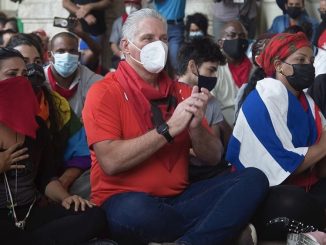
“Venceremos”: Una conversación con el presidente de Cuba, Miguel Díaz-Canel

En 1994, Miguel Díaz-Canel asumió un nuevo cargo en Santa Clara, no lejos de su lugar de nacimiento, Placetas, como secretario provincial del Partido Comunista de Cuba. Dejó de lado el carro con aire acondicionado que le asignaron y fue cada mañana a trabajar en bicicleta, con el pelo largo y los jeans que lo caracterizaban. Díaz-Canel organizaba conciertos de rock, pasaba tiempo con su familia en El Mejunje, el centro cultural LGBTQ local, y deambulaba conversando con la gente por las calles. Esta cercanía con el pueblo definió su mandato en Santa Clara, que formó al hombre que ahora es el presidente de Cuba.

En marzo pasé unas horas hablando con Díaz-Canel, quien nació en 1960 y, por tanto, ha vivido toda su vida en una Cuba que lucha contra las políticas asfixiantes de Washington para poder forjar su camino socialista. Criado por una maestra y un obrero de fábrica, Díaz-Canel vio, en primera línea, el amplio programa de justicia social de la Revolución Cubana, en el que millones de miembros de la clase obrera, campesinos, negros y mujeres tuvieron, por primera vez, acceso en igualdad de condiciones al derecho a trabajar, estudiar y vivir con dignidad. La generación de Díaz-Canel creció en un período bajo el liderazgo de Fidel Castro en el que, a pesar de la existencia de un bloqueo estadounidense, la mayoría de los cubanos y cubanas vieron elevarse significativamente su nivel y calidad de vida gracias a los planes de desarrollo nacional, las relaciones comerciales favorables con la Unión Soviética y una creciente red de apoyo en el mundo de los no alineados. Díaz-Canel estudió ingeniería eléctrica en la Universidad Central de Las Villas, pero allí, al principio de su carrera como profesor de ingeniería, dedicó gran parte de su tiempo al activismo local con la Unión de Jóvenes Comunistas. Eso le llevó a una misión internacionalista en Nicaragua, donde, junto con miles de médicos y profesores cubanos, trabajó entre los más pobres, a menudo en rincones remotos de este país centroamericano que entonces estaba atrapado bajo una guerra de contrainsurgencia financiada por los Estados Unidos.

Díaz-Canel regresó de Nicaragua en 1989 cuando la URSS se acercaba a sus últimos días y el Gobierno estadounidense aprovechaba la oportunidad para endurecer las sanciones contra Cuba. En 1991, Cuba entró en un Período Especial cuando el comercio cayó un 80%. Los cubanos comían menos (la ingesta de calorías se redujo un 27% entre 1990 y 1996), las largas filas para conseguir alimento se convirtieron en algo habitual, la electricidad se convirtió en algo raro y millones de personas empezaron a movilizarse en bicicleta mientras la isla se enfrentaba a una grave escasez de petróleo bajo un bloqueo intensificado. Díaz-Canel era uno de los que iban en bicicleta. La resistencia de Cuba durante el Período Especial moldeó su visión del mundo.

Período Especial II

En 2018, Díaz-Canel fue elegido presidente de Cuba. El presidente de Estados Unidos, Donald Trump, había recrudecido el bloqueo estadounidense contra la isla, con 243 nuevas sanciones, la prohibición de que las remesas de los cubanos en el extranjero ingresaran al país y la reincorporación de Cuba a la lista estadounidense de “Estados patrocinadores del terrorismo”. Esta campaña de máxima presión ha perjudicado a la economía cubana, que empezó a ver una escasez de combustible y alimentos que recuerda el Período Especial. La administración Biden ha mantenido todas y cada una de estas medidas.

Durante la pandemia, Estados Unidos no permitió a Cuba ningún alivio del bloqueo unilateral. El Gobierno cubano gastó 102 millones de dólares en reactivos, equipos médicos, equipos de protección y otros materiales; en el primer semestre de 2021, el Gobierno gastó 82 millones de dólares en este tipo de materiales. Este es un dinero que Cuba no preveía gastar, un dinero con el que no cuenta, debido al colapso del sector turístico. A pesar de los graves desafíos económicos, el Gobierno siguió garantizando los salarios, comprando medicamentos y distribuyendo alimentos, así como electricidad y agua corriente. En total, el Gobierno cubano añadió 2,400 millones de dólares a su ya considerable sobreendeudamiento para cubrir las necesidades básicas de la población.

En este contexto, el descontento de la población se extendió a las calles en 2021, especialmente el 11 de julio. El primer instinto de Díaz-Canel fue ir al corazón del asunto y hablar con la gente. Se esforzó por no descartar sus preocupaciones sino más bien entenderlas, dentro del contexto más amplio de lo que Cuba estaba enfrentando. De ellos y ellas, Díaz-Canel dijo que la mayoría están “descontentos”, pero que su descontento estaba alimentado por “la confusión, los malentendidos, la falta de información y el deseo de expresar una situación particular”. “Imagínate enfrentar esa situación en un país que es atacado, bloqueado, satanizado en las redes sociales, y entonces llega COVID-19”, me dijo. “Por eso, estoy convencido de que ellos [los Estados Unidos] apostaron a que Cuba no tenía salida: ‘No pueden sostener la revolución; no pueden salir de esta situación’”.

Entre las muchas respuestas creativas a estos numerosos desafíos, estuvo la decisión del Gobierno cubano de desarrollar su propia vacuna. El 17 de mayo de 2020, Díaz-Canel convocó a los científicos de Cuba. “Yo les dije ‘Mira, no hay alternativa; necesitamos una vacuna cubana. Nadie nos va a dar una vacuna. Necesitamos una vacuna cubana que nos garantice la soberanía’”, me dijo. Siete semanas después, en la segunda quincena de julio, estaba listo el primer frasco de una vacuna candidata cubana. Poco después, Cuba dispondría de cinco vacunas candidatas. De ellas, tres ya están en uso: Abdala, Soberana 02 y Soberana Plus. Otras dos están en la fase final de los ensayos clínicos y son bastante prometedoras, incluida una llamada Mambisa, que puede aplicarse por vía nasal. Todo esto es poco menos que un milagro si se tiene en cuenta que Cuba sólo ha podido invertir 50 millones de dólares para desarrollarlas.

Con los múltiples problemas económicos a los que se enfrenta Cuba, el presidente Díaz-Canel, en línea con sus predecesores Fidel y Raúl Castro, ha renovado el principio de autosuficiencia. “Tenemos que afrontar la batalla económica nosotros mismos con el concepto de resistencia creativa”, dijo. Con un número creciente de trabajadores en el sector no estatal, la economía ha fomentado las pequeñas empresas locales. Ha surgido una nueva energía entre los sectores estatales de la economía y estas nuevas empresas en crecimiento.

En las visitas periódicas que Díaz-Canel realiza por toda la isla, se hace mucho hincapié en las capacidades locales de cada municipio. Aboga por una línea de continuidad con la política basada en la ética de José Martí y Fidel Castro, cuya premisa es estudiar las contradicciones que existen en la sociedad, encontrar las causas de esas contradicciones y proponer soluciones que las eliminen. “Defendemos la necesidad de ampliar cada vez más la democracia sobre la base de la participación y el control popular en nuestra sociedad”, dijo Díaz-Canel. Este enfoque ya ha abierto la puerta a profundos debates sobre cómo erradicar los vestigios de racismo que quedan en la sociedad, la transformación de los barrios en mal estado y una propuesta de código legal que ampliará radicalmente los derechos de las personas LGBTQ, incluido el matrimonio. En cientos de reuniones, muchas de ellas grabadas y televisadas, Díaz-Canel escucha pacientemente a líderes religiosos, estudiantes universitarios, artistas, intelectuales, líderes comunitarios, activistas sociales y otros sectores de la sociedad cubana que tienen mucho que decir. Estas reuniones, frecuentemente, pueden ser tensas. Díaz-Canel sonríe y dice: “Hemos aprendido muchísimo, se hacen propuestas, compartimos criterios, aclaramos dudas, y luego salimos todos juntos a trabajar”.

Cuba sigue enfrentándose a grandes desafíos, y quedan muchos problemas por resolver.

Sin embargo, está claro que Díaz-Canel está liderando una profunda renovación de la Revolución Cubana, en un proceso que busca enfrentar muchos y complejos desafíos, empoderando a los líderes locales y a los ciudadanos para que se conviertan en solucionadores democráticos de problemas dentro de sus comunidades. Los que siguen viendo el sistema cubano como una dictadura represiva se niegan a aceptar una sociedad en evolución que, a pesar de la cruel violencia de Washington, existe y está creando su propio futuro.

Este artículo fue producido para Globetrotter.

Manolo De Los Santos el codirector ejecutivo del People’s Forum e investigador del Instituto Tricontinental de Investigación Social. Coeditó, recientemente, Viviremos: Venezuela vs. Hybrid War (LeftWord Books/1804 Books, 2020) y Comrade of the Revolution: Selected Speeches of Fidel Castro (LeftWord Books/1804 Books, 2021).

Strugglelalucha256


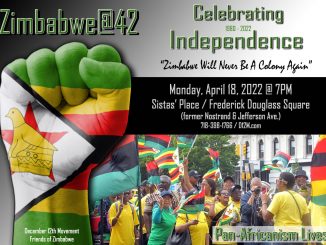
April 18 – Celebrating independence: Zimbabwe will never be a colony again

Strugglelalucha256


Washington observa cómo China y América Latina profundizan sus lazos

Menos de una semana después del inicio de la intervención militar rusa, Juan Sebastián González, director senior de asuntos del hemisferio occidental en el Consejo de Seguridad Nacional de Estados Unidos, en una entrevista con Voice of America (un activo del Departamento de Estado), declaró que “las sanciones contra Rusia son tan robustas que tendrán un impacto en aquellos Gobiernos que tienen afiliaciones económicas con Rusia, y eso es por diseño. Así, Venezuela empezará a sentir la presión; Nicaragua empezará a sentir la presión; al igual que Cuba”. Un reciente artículo en la revista Foreign Affairs, que a través del Consejo de Relaciones Exteriores sirve extraoficialmente como una especie de foro de discusión del Departamento de Estado de EE. UU., titulado “La pesadilla euroasiática”, defendía la tesis de que Washington no tiene más remedio que luchar contra Rusia y China al mismo tiempo. Sin embargo, González insinúa que la estrategia de la administración Biden no sólo contempla atacar el frente principal en el este (Moscú y Pekín), sino que también abre un frente en el sur – secundario, pero importante – contra los tres países latinoamericanos que más han desafiado a Washington en los últimos años (Venezuela, Nicaragua y Cuba). El frente del sur, sin embargo, puede ser más amplio de lo que aclara el colombiano por nacimiento Juan González.

El 24 de marzo, la General Laura Richardson, comandante del Mando Sur de las Fuerzas Armadas de EE. UU., testificó ante el Comité de Servicios Armados del Senado de los Estados Unidos. Afirmó que, aunque Rusia es la “amenaza más inmediata” en América Latina y el Caribe, China supondrá un reto diplomático, tecnológico, informativo y militar para los Estados Unidos. Richardson había dado un testimonio similar ante la Cámara de Representantes unas dos semanas antes, donde también afirmó que sin el “liderazgo de Estados Unidos”, la influencia china en la región podría “parecerse pronto a la influencia depredadora egoísta que ahora tiene en África”. Se refiere al avance de la Iniciativa de la Franja y Ruta a través del continente africano desde 2013, responsable de decenas de miles de millones de dólares sin precedentes en inversiones chinas en infraestructuras básicas (energía, telecomunicaciones, puertos, ferrocarriles, carreteras, etc.) a cambio de los recursos naturales que China necesita para alimentar su industria, responsable del 28,7% de todas las manufacturas producidas en el mundo y consumidas globalmente.

Las declaraciones del General Richardson se basan en dos principios de los Estados Unidos. El primero, considerar a América Latina y el Caribe como su “patio trasero”, expresado en la Doctrina Monroe desde 1823 y puesto en práctica en innumerables invasiones militares, golpes de Estado y, más recientemente, guerras híbridas contra pueblos y Gobiernos no alineados con Washington. Hace poco, Biden dijo que “América Latina no es nuestro patio trasero”, sino que es “el patio delantero de Estados Unidos”. Las y los latinoamericanos no quieren ser el patio de nadie, ni delantero ni trasero. El segundo principio, es que los Estados Unidos creen que la política exterior de los Gobiernos de la región debe ser definida por Washington.

China en América Latina

En el año 2000, el Congreso estadounidense creó la Comisión de Revisión Económica y de Seguridad Estados Unidos-China, que ofrece al Congreso su evaluación de China en relación a la seguridad nacional de Estados Unidos. En noviembre de 2021, el informe de la comisión contenía un importante capítulo sobre las relaciones entre China y los Gobiernos de América Latina y el Caribe. El informe se preocupaba por el apoyo de China a lo que denominaba Gobiernos “populistas” desde Argentina hasta Venezuela. Destacaba el aumento del comercio de la región con China: de 18.900 millones de dólares (2002) a 295.600 millones de dólares (2020), además de su creciente importancia como fuente de préstamos, financiación (137.000 millones de dólares de 2005 a 2020) e inversiones directas (58.000 millones de dólares entre 2016 y 2020). Gracias a esta inversión, China pudo ayudar a la región a aminorar el impacto de la crisis financiera de 2008; esta inversión creó puestos de trabajo (1,8 millones entre 1995 y 2016) y disminuyó la pobreza (pasó del 12% en 2002 al 4% en 2018). Las vacunas chinas llegaron rápidamente durante la pandemia, y las exportaciones de materias primas latinoamericanas a China amortiguaron el peso de la recesión COVID.

La Comisión Estados Unidos-China se preocupó por el aumento de las conexiones entre China y la región en las redes de telecomunicaciones y transporte. El liderazgo de Huawei en 5G en la región, así como las asociaciones chino-sudamericanas en el desarrollo de satélites (21 lanzados en empresas conjuntas, la mayoría de ellos con Argentina) se ofrecen como ejemplos. La comisión también expresó su alarma por el control o la influencia de China sobre los puertos de la región, en particular en el Caribe, ya que estos podrían – en el futuro – ser utilizados con fines militares (aunque no hay indicios de ningún uso militar de este tipo por parte de China o de los Estados latinoamericanos y caribeños).

La guerra fría de Washington

Los elementos de la derecha dura de Washington reaccionaron a este informe con rapidez. En febrero de 2022, los senadores Marco Rubio y Bob Menéndez, ambos cubanoamericanos, presentaron en el Congreso la Ley de Estrategia de Seguridad del Hemisferio Occidental de 2022. Este proyecto de ley, basado en las recomendaciones de la comisión, propone que el Gobierno de los Estados Unidos desafíe directamente el papel de China en la región. Caracteriza la existencia de China y Rusia en la región como una “influencia dañina y maligna”. El proyecto es vago y escaso en detalles.

El Dr. Evan Ellis, profesor de la Escuela de Guerra del Ejército estadounidense cuyo testimonio formó parte del informe de la comisión, escribió – en enero de 2022, para el Centro de Estudios Estratégicos e Internacionales – un texto titulado “Preparación para el deterioro del entorno estratégico de América Latina y el Caribe”. En este, señala el resurgimiento “de un modelo particular de populismo autoritario de izquierda” en América Latina y el Caribe. Los nuevos Gobiernos, escribe, han desarrollado vínculos con China para ayudarles a superar la recesión COVID. Los Estados Unidos, sostiene Ellis, no pueden movilizar suficientes recursos para invertir en la región porque el Congreso está dividido y porque el sector privado no está dispuesto a asumir esta misión. Sigue siendo escéptico con respecto a la política estadounidense en la región, sobre todo porque las empresas estatales chinas han estado invirtiendo eficazmente en sectores como la construcción, la minería, la energía y las finanzas.

Ellis recomienda cuatro acciones inmediatas, muchas de ellas parte de lo que se conoce como “guerra híbrida”. En primer lugar, dice que Washington debería promover una narrativa mediática que denuncie a los Gobiernos de izquierda y sus relaciones con China. En segundo lugar, EE. UU. debe apoyar los movimientos de protesta contra estos Gobiernos. Tercero, los Estados Unidos debe profundizar sus alianzas con las élites regionales. En cuarto lugar, debe aplicar sanciones a estos Gobiernos de izquierda.

Dos elecciones en los próximos meses podrían complicar aún más las cosas a los Estados Unidos. En Colombia (mayo), el principal país aliado de EE. UU. en la región, el candidato de la izquierda, Gustavo Petro, podría apartar a la derecha del poder. En Brasil (octubre), Lula lidera las encuestas frente al presidente Jair Bolsonaro.

Ellis sospecha que la detención y el encarcelamiento de Lula han “profundizado el radicalismo de su orientación populista de izquierda”. En mayo de 2021, Lula dijo al sitio web chino Guancha: “No es posible que cada vez que un país latinoamericano comienza a crecer, haya un golpe de Estado. Y en ese golpe siempre hay alguien de los Estados Unidos, siempre está el embajador de los Estados Unidos. No es posible”.

Lula no es un radical, pero si es reelegido presidente de Brasil, aportará una actitud realista hacia el desarrollo de su país. Ha subrayado la importancia de reconstruir el bloque regional latinoamericano y caribeño (Comunidad de Estados Latinoamericanos y Caribeños, o CELAC) y el BRICS (Brasil, Rusia, India, China y Sudáfrica), ambos debilitados en los últimos años. La inversión y el comercio chinos son ya una parte fundamental de los planes de futuro de Brasil, pero Lula también sabe que esta asociación debe evolucionar, y que Brasil necesita ser algo más que un exportador de productos básicos a China.

¿Podrán los Estados Unidos hacer retroceder la influencia de China y Rusia en la región? Ni siquiera Ellis confía en ese resultado. Junto con los senadores Rubio y Menéndez, Ellis preferiría desestabilizar la región antes que permitir que se convierta en protagonista de un posible nuevo orden mundial.

Este artículo fue producido para Globetrotter.

Marco Fernandes es investigador del Instituto Tricontinental de Investigación Social. Es miembro del colectivo No Cold War. Vive en Shanghai.

Strugglelalucha256


Ukraine and the Bolshevik Revolution


The struggle to overthrow the cruel tyrant called the Russian Czar was long and difficult. The czarist empire was a prison house of nations.

Czarist Russia’s conquering of Siberia meant killing and exploiting Indigenous peoples like what was done in the United States and Canada.

Poland was divided between Russia, Germany and Austria. Unlike Poland, which had been a powerful state for centuries before its partition, Ukraine was a nation in formation.

Revolutionaries fought against the oppression of dozens of nationalities in Czarist Russia. 

“The situation of the Ukrainian working people today is tragic in the extreme,” wrote the Russian novelist Maxim Gorky in 1916. “The czarist cutthroats give them no chance to develop their language, literature and art.”

It was even illegal to publish books and newspapers in Ukrainian.

Before the Bolshevik Revolution, 76% of Ukrainians didn’t know how to read or write. In 1900, there were only 35 Ukrainian women who had attended college. 

The treatment of the Ukrainian poet, writer and artist Taras Shevchenko (1814-1861) was particularly outrageous. Born into serfdom, a form of feudal enslavement, he became the most famous figure of the Ukrainian national renaissance.

Czar Alexander II had Shevchenko imprisoned for writing a satirical poem, an action that helped shorten his life. Besides criticizing serfdom and the czarist dictatorship, Taras Shevchenko also opposed the grotesque discrimination suffered by Jewish people.

The great majority of Ukrainian people had been serfs. So had Russians and other nationalities in the empire. Thirty thousand serfs were worked to death in building St. Petersburg.

Serfs could be bought and sold like cattle. They were beaten by their owner with a leather whip called the knout.

But unlike enslaved Africans in the United States, their families couldn’t be broken up. Their names and languages weren’t stolen from them. Children of serfs weren’t thrown to the sharks in the Atlantic Ocean.

Serfdom was abolished in 1861 by the same czar that had persecuted Taras Shevchenko. Alexander II did so before serfdom was overthrown from below.

One factor might have been the anti-slavery struggle in the United States and the outbreak of the U.S. Civil War there in 1861.The martyrs of Harpers Ferry were not able to immediately overthrow the slave masters but they may have helped frighten the Czar into getting rid of serfdom.

Poverty and pogroms

Ukraine was rich but Ukrainians were desperately poor. The country has some of the richest topsoil in the world.

The czarist empire was the greatest exporter of wheat during most of the 1800s with Ukraine producing the greatest share. It was only after 1870 that the United States, Argentina and Canada became major wheat exporters.

Yet the Ukrainian peasants who harvested wheat and other crops were often hungry themselves. Farm laborers would suffer night-blindness because of a lack of vitamins.

The Czarist regime was hated. It was almost overthrown in the 1905 revolution.

The Czar sought to turn this anger into racist violence directed at minorities. These spasms of terror in which hundreds of people were lynched were called pogroms. They were deliberately instigated by the regime.

The 1917 riot in East St. Louis, Illinois, where the police allowed over 100 Black people to be murdered by white mobs was a pogrom. So were the race riots in Chicago and other U.S. cities in 1919.

The burning of “Black Wall Street” in Tulsa, Oklahoma by white supremacists in 1921 and the mass graves of African Americans there was certainly a pogrom.

The biggest target of czarist pogroms were Jewish people. Thousands of Jews were murdered, tortured and raped.

The Bolsheviks fought pogroms with guns. The revolutionary movement had been centered in the cities and minefields where the working class was concentrated.

Workers in St. Petersburg prevented pogroms from being organized. The greatest center of pogroms was Ukraine and Moldova where the working class was smaller.

None of this prevented the centuries-old czarist police state from being overthrown in March 1917. Eight months later, workers organized into councils known as soviets took power. They were led by socialists who were called Bolsheviks.

Lenin led the Bolsheviks. Their slogan of “bread, peace and land” appealed to millions of people.

They wanted an end to hunger, poverty and war. Two million soldiers from the former Czarist Empire had died in World War I.

Peasants ― the vast majority of society ― wanted to take the land that they had plowed for generations. The Bolsheviks told them to kick out their landlords and seize the land.

In contrast, capitalists betrayed Black people after the U.S. Civil War. Instead of the former slave masters being forced to give up their plantations, most Black people became landless sharecroppers.

Lenin and Ukraine

When the peasants and workers took power on Nov. 7, 1917, the Russian landlords and capitalists were demoralized. The support given by capitalists in other countries sparked a civil war.

The counter revolutionaries were called White Guards, who were a Russian terrorist army much like the Ku Klux Klan. The United States and other countries sent troops to support the White Guards and attempted to drown the socialist revolution in blood.

The Red Army of workers and peasants defeated the White Guards and foreign troops. Dock workers in Seattle and Britain refused to load weapons for the White Guards.

This was what Italian and Greek workers are doing now. They’re stopping NATO weapons from going to the Kyiv regime that depends on fascist thugs to remain in power.

In the Russian Civil War of 1918-20, most of Ukraine had been overridden by White Guards. They murdered 100,000 Jewish people there.

A well-to-do minority of Ukrainians supported the White Guards and joined the pogroms. Their political descendents supported the Nazis in World War II and today they comprise the fascist Azov Battalion and Right Sector thugs.

After hundreds of years of Czarist oppression, Ukrainians and other nationalities wanted freedom. Lenin, who was Russian, said in effect, “right on!”

He drafted a resolution for the Communist Party about Ukraine in November 1919. Here are some excerpts:

“In view of the fact that Ukrainian culture (language, school, etc.) has been suppressed for centuries by Russian czarism and the exploiting classes, the [central committee of the Communist Party] makes it incumbent upon all party members to use every means to help remove all barriers in the way of the free development of the Ukrainian language and culture…

“[Communist Party] members on Ukrainian territory must put into practice the right of the working people to study in the Ukrainian language and to speak their native language in all Soviet institutions; they must in every way counteract attempts at Russification that push the Ukrainian language into the background and must convert that language into an instrument for the communist education of the working people. Steps must be taken immediately to ensure that in all Soviet institutions there are sufficient Ukrainian-speaking employees and that in future all employees are able to speak Ukrainian.” 

Famines and industrialization

The Ukrainian Soviet Republic was established. In 1922 Ukraine joined with the other soviet republics to form the Union of Soviet Socialist Republics.

Socialism brought great advances. By 1939, some 88% of Ukrainians could read and write. The literacy rate in 1959 was 99%.

Whereas printing in Ukrainian had been forbidden by the Czar, in 1980 there were around 1,500 newspapers and magazines printed in that language. 

Ukraine is a multinational country. Besides millions of Ukrainian and Russian speakers, there are Greek, Hungarian, Jewish, Roma and other peoples. Ukrainian fascists call these people “scum.”

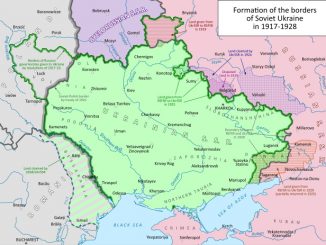
Some have asked why the Bolsheviks included predominantly Russian speaking areas, like the Donbass, within Ukraine’s boundaries. (The boundaries drawn by communists are the same ones used today.)

The reason was that in 1917, the vast majority of Ukrainians were peasants who lived in the countryside. Most of the workers were Russian, like coal miners in the Donbass. Including these workers in Ukraine helped promote socialism.

After the civil war came the famine in 1921-1922 in which millions died. This was the era before the “green revolution.”

Farmers in Ukraine and Russia often used wooden ploughs. Even with good weather crop yields could be low. The loss of millions of agricultural workers because of World War I, the civil war and the 1918 influenza pandemic further reduced the harvest.

More controversial is the 1932-1933 famine. At least 3.3 million people died in this tragedy.

Many Ukrainians, who are not communists, claim this famine was deliberate genocide against the Ukrainian people. Yet the famine affected millions of Kazakhs and Russians outside Ukraine.

This famine took place during the first five-year plan which was rapidly industrializing the Soviet Union. Part of this offensive was bringing socialist production to the countryside.

Millions of peasants got land because of the Bolshevik Revolution. But these plots were too small to employ modern agricultural machinery.

Peasants were encouraged to join cooperatives and form collective farms. The richer farmers, called kulaks, resisted.

This was an intense class struggle which amounted to a second revolution. Sometimes the worst exploiters are the small property owners like small slumlords or other small-time cockroach capitalists.

Kulaks helped sabotage the harvest by concealing grain stocks and slaughtering livestock. Detachments of workers and poor peasants defeated the kulaks.

The forming of collective farms went hand-in-hand with constructing factories making tractors and harvesters. The countryside was electrified. Ukrainians left wooden ploughs behind and built a modern society.

Defeating Hitler and NATO

Looking back, some argue that collectivization should have started sooner and/or more slowly. Soviet leader Joseph Stalin in his article “Dizzy with Success,” urged activists to be more careful.

Often overlooked in this famine, as historian Mark B. Tauger points out, is the devastating role of the wheat rust fungus. This plant disease would have been disastrous whether there had been a collective farm movement or not.

And where was U.S. President Herbert Hoover? In 1921, before he became president, Hoover led a relief campaign that aided starving people in the Soviet Union.

But in the early 1930s Hoover did nothing, even while many U.S. farmers couldn’t sell their crops during the Great Depression.

Also questioned is that the Soviet Union exported crops while people were starving. Professor Tauger estimates that as many as two million people might have lived if these exports ceased.

This is heartbreaking. But as Tauger mentions, both Germany and Britain threatened to stop lending credit to the Soviet Union unless it paid more of its debts.

What the Soviet Union had to sell at the time was largely oil, lumber and wheat ― all at the low Depression prices. As it was, the Soviets did cut farm exports. (“The 1932 Harvest and the Famine of 1933,” by Mark B. Tauger, Slavic Review, Spring, 1991.)

Imports of machinery were absolutely necessary to industrialize the Soviet Union. And the industrialization carried out by the five-year plans enabled the Soviet peoples to defeat the Nazi invasion, which killed over 5 million Ukrainians.

So many of the new industries were built in Ukraine. One of the best known projects was the Dnieprostroi hydroelectric dam. By 1940, over a half-million Ukrainian workers had high school or college educations. 

Today the greatest racist hellhole is the United States. Wall Street was finally able to overthrow Soviet power in 1991. This was despite an overwhelming majority of Soviet citizens ― including 78% of Ukrainians ― voting to retain the Soviet Union in a March 17, 1991 referendum.

This tragedy was a greater defeat than the victory of Hitler over the bones of the German working class. World capital and its media have been able to poison the minds of too many Ukrainians, Russians and other peoples living in the former Soviet Union.

We look forward to NATO’s defeat and a revival of a revolutionary movement in Ukraine. Long live the unity of all the workers and progressive peoples in Ukraine! Workers and oppressed peoples of the world, unite!

Strugglelalucha256


Ukraine, war crimes and white power: The Black Alliance for Peace calls for the dismantling of NATO, AFRICOM and all imperialist structures

For Immediate Release
Media Contact:
communications@blackallianceforpeace.com
(202) 643-1136

“De-center Europe and Focus on Imperialism” Those words sum up the Black Alliance for Peace March 1, 2022 statement on the war now taking place in Ukraine. As an anti-imperialist formation BAP is committed to a call for peace, for an end to militarism and domination in Ukraine and elsewhere.

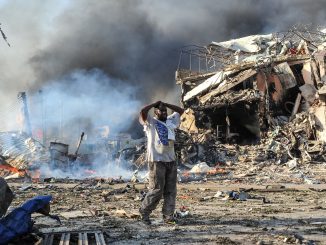
On the same day that Russian troops entered Ukraine, U.S. drones bombed Somalia, a nation that has suffered from U.S. interventions for 30 years. An estimated 250,000 Somalians have died and 3 million have been displaced as refugees during this time. The latest assault went without notice in the corporate media of the U.S. and its NATO allies.

At the same time Ukrainian refugees were elevated in importance, with some commentators explicitly noting “blonde hair and blue eyes” or pointing out that the carnage of war is acceptable in the Global South but is unthinkable in Europe. Now allegations of war crimes against Russia are loudly announced by U.S. president Joe Biden and his NATO partners with calls for prosecution in the International Criminal Court (ICC).

Yet war crimes have been committed from Somalia to Libya to the Democratic Republic of Congo and all of NATO is culpable. These crimes are rarely described as such and U.S. presidents escape condemnation. The charges against Russia should not be discussed without also acknowledging that the United States is not a signatory to the Rome Statute which brought the ICC into existence. Additionally, in 2002 Congress passed and George W. Bush signed the American Servicemembers’ Protection Act which prohibits Americans being extradited to the ICC and allows the U.S. to forcibly release any American or ally held there. “It is the height of hypocrisy for the U.S. to accuse other nations of committing war crimes while exempting itself from any possibility of punishment,” says BAP Africa Team Co-Coordinator Margaret Kimberley.

Neither Bill Clinton nor George W. Bush nor Barack Obama, Donald Trump or Joe Biden will be held to account for drone attacks on Somalia, or for continuing the destruction of the Somali state. In a just world the Obama administration’s destruction of Libya in 2011 and the ongoing humanitarian crisis would be prosecuted as a war crime. The Democratic Republic of Congo has the highest death rate of all, with some 6 million people killed when Uganda and Rwanda, U.S. proxies, invaded that country in 1996. NATO is far from the defensive alliance it claims to be. It is an aggressor and must be dismantled.

This hypocrisy explains why 17 African nations abstained from the March 2, 2022 United Nations resolution condemning Russia, and one, Eritrea, voted no. Their experiences with NATO and AFRICOM ensure skepticism of self-proclaimed noble motives. BAP Africa Team member Djibo Sobukwe points out, “The U.S./NATO death toll inflicted on the African continent makes any claim of concern for human rights hypocritical.”

BAP calls for the dismantling of NATO, AFRICOM and all imperialist structures. Africa and the rest of the world cannot be free until all peoples have a right of sovereignty, and the right to live free of domination.

No Compromise! No Retreat!

Strugglelalucha256


Los archivos de los cinco cubanos regresan a casa

Hace una semana Cheryl LaBash y yo iniciamos el viaje para llevar a casa los Archivos de la larga lucha por la liberación de los 5 cubanos que con Alicia Jrapko acumulamos durante un período de 13 años, cuidadosa y metódicamente guardados en nuestro sótano; desde la primera carta que Gerardo Hernández le envió a Alicia a fines de 2001 desde una prisión federal en Miami hasta la última que nos envió desde el Hueco en la prisión de transferencia de Oklahoma City el 12 de diciembre de 2014.

Junto con las cartas hay material de las muchas campañas y proyectos que tuvieron lugar durante ese tiempo. Si bien es una cantidad significativa del registro histórico, no representa toda la información acumulada durante ese tiempo por el movimiento internacional que apoyó a los Cinco.

La singularidad de la lucha por la libertad de los Cinco Cubanos fue que, a diferencia de la mayoría de las luchas, estuvo claramente enmarcada en el tiempo desde el momento en que fueron arrestados en Miami el 12 de septiembre de 1998, por defender su patria de los ataques terroristas organizados en esa misma ciudad hasta su liberación el 17 de diciembre de 2014, a través de esa estrecha ventana que se abrió por un breve momento bajo Obama.

Lo más inspirador fue que se llevó a cabo cuando Internet se estaba convirtiendo en una herramienta de organización cada vez más importante que conectaba al movimiento como nunca antes, lo que permitía que se llevaran a cabo eventos internacionales en Londres; Holguín, Cuba; Toronto; Puerto Allegre, Brasil; Tijuana, México, por mencionar algunos, y en Washington D.C. donde durante varios años simpatizantes de Cuba de todo el mundo se reunieron para protestar por la libertad de los Cinco frente a la Casa Blanca y cabildearon en el Capitolio contra la legislación que atrinchera el bloqueo de la isla.

Cuando llegamos a Kramer Junction, nuestra ruta era continuar hacia el este hasta Arizona, pero no pude evitar tomar un desvío hacia el sur con el automóvil lleno de la historia de los 5 Cubanos hasta las puertas de la penitenciaría que encarceló a Gerardo durante tanto tiempo, una vuelta de victoria modesta pero significativa para una lucha librada por todo el pueblo cubano y apoyada por millones en el mundo.

Nos pareció apropiado hacerlo. Decidimos también salir de la Interestatal 40 en la ciudad de Oklahoma para repetirlo en el Centro Federal de Transferencia donde los prisioneros son trasladados hacia y desde las prisiones federales de los EEUU. Fue aquí donde Gerardo terminó en el Hueco durante una semana antes de ser enviado a Butner Prison Carolina del Norte donde se reencontró con sus hermanos Ramón Labañino y Antonio Guerrero antes de su regreso triunfal a casa. Fue desde esta prisión de Oklahoma donde pudo sacar su última carta de prisión para Alicia diciendo que no sabía a dónde lo llevarían pero sabía que su tiempo en California había terminado y le agradecía todo lo que había hecho.

Las 3100 millas recorridas con esta carga histórica fueron para mí, en lo personal, un momento de reflexión y un avance desde el fallecimiento de Alicia en enero pasado.

Devolver todo esto a sus legítimos dueños, el pueblo cubano, era algo que ella y yo habíamos discutido muchas veces, ahora se había convertido en el cumplimiento de una promesa, en mi percepción de urgencia.

La entrega de los Archivos a la Embajada de Cuba fue un momento de solidaridad y un paso importante hacia su destino final. El cierre del viaje tuvo lugar anoche cuando activistas solidarios con Cuba del área de D.C. y diplomáticos de la Embajada de Cuba se reunieron para compartir recuerdos de Alicia y su vida bien vivida.

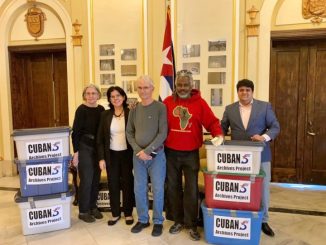
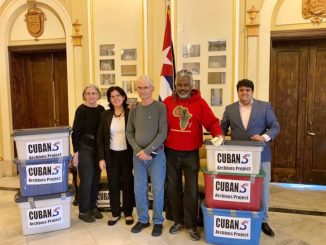
Fuente: Resumen Latinoamericano – English / Foto de portada: Cheryl LaBash, Bill Hackwell y Netfa Freeman en la entrega de archivos a la Embajada de Cuba en Estados Unidos junto a la Embajadora Lianys Torres Rivera y el funcionario Daniel Menocal.

Strugglelalucha256


Facebook censorship of Filipino revolutionary forces is the handiwork of the U.S. imperialists

STATEMENT from CPP.ph

Marco Valbuena | Chief Information Officer | Communist Party of the Philippines
April 10, 2022

(1) Over the past two weeks, Facebook deleted several accounts, groups and pages maintained by various revolutionary outfits in the Philippines, including those of the CPP’s information arm, and those belonging to different units of the New People’s Army (NPA). These account served as a means for of reaching out to the public, sharing information, and expressing views on important issues the Filipino people are facing.

This is not the first time that Facebook censored the revolutionary forces in the Philippines on its platform. In 2017, the PRWC Facebook Page, which had more than 10,000 followers was shut down by Facebook without warning or explanation. Since then, it has repeatedly taken down accounts and pages maintained by the CPP and other Filipino revolutionary forces. Last February, it permanently removed the account of Prof. Jose Ma. Sison, which for many years was used to promote Ka Joma’s academic work and views on Philippine issues.

These accounts censored by Facebook have consistently provided information about the human rights situation in the Philippines, especially in rural areas where reporters of major media organizations do not have access to or which have been subjected to news blackouts by the AFP. On several occasions, these accounts carried content which exposed the involvement and culpability of units of the Armed Forces of the Philippines (AFP) and Philippine National Police (PNP) in extrajudicial killings and massacres, as well as unlawful arrests, abductions, torture and other abuses perpetrated by state armed forces in the course of the Duterte regime’s counterinsurgency operations.

Information posted by these accounts also exposed foreign and local mining companies and big infrastructure projects which brought destruction to the environment and to people’s lives. These accounts have carried information that challenged the views promoted by state agencies especially regarding the current armed conflict, and explain the social, political and economic reasons why people take up arms in the struggle for democracy and freedom.

By taking down the accounts of revolutionary forces in the Philippines who are waging a struggle for national liberation, Facebook has effectively censored information that for years has challenged the dominant narrative being promoted and peddled by the reactionary government and the AFP. In doing so, it denies a large segment of the Filipino public, who rely on Facebook for information, a critical or alternative view that is essential for democratic life and action. Information on Facebook about the civil war in the country will now be monopolized by the AFP and the NTF-Elcac which long have been discredited sources of lies and disinformation.

(2) The banning of the CPP and NPA on Facebook is just one of the most recent evidence of the company’s exercise of arbitrary powers to censor information that are anti-imperialist and anti-fascist on the social networking platform. It has trampled on the right to free expression on the pretext of fighting “terrorism,” “hate speech,” “fake news” and “misinformation.” Facebook foists its “community standards,” an opaque set of rules, mainly against those groups who oppose the narrative promoted by the U.S. government. There are no legal or bureaucratic procedure that govern Facebook’s decisions to take down accounts and pages.

Facebook’s policy is firmly linked with the policies U.S. imperialism through its partnership with the Atlantic Council, a Washington-based agency that is known to be a NATO lobby group. According to Facebook, the Atlantic Council, specifically its Digital Forensic Research Lab, helps it “weed out fake news” from its platform.

The Atlantic Council is a veritable bulwark of U.S. ultra-conservatives and war hawks. It counts among its directors retired U.S. military officers (such as Wesley Clark and David Petraeus), at least seven former top officers of the U.S. CIA (including Robert Gates, Leon Panetta and Stephen Kappes) and known former U.S. ultra-conservative and war-mongering officials (Condoleezza Rice, Henry Kissinger and James Baker). The Atlantic Council receives funding from the U.S. State Department, ultra-wealthy corporate donors, defense contractors, major oil companies, and NATO governments.

The Atlantic Council promotes U.S. global economic interests, propping up dictatorships, anti-communism, U.S. military and political interventions, and “regime change” against governments that assert national sovereignty against U.S. hegemonism. It has openly supported subversive activities of the Venezuelan pro-U.S. opposition and destabilization of the Maduro government, and has advocated the arming of fundamentalist groups in Syria. It has promoted U.S. war provocations against Russia in Ukraine and for extending military support to the neo-Nazi Ukrainian government.

Facebook is strewn with spies. Officers heading its Security Policy, Security Communications, Cyber Espionage Investigations, Influence Operations Product Policy Manager, Threat Intelligence Analyst are all once connected with the National Security Agency, the CIA, the FBI or intelligence agencies of other governments.

With the Atlantic Council as partner and former CIA spies as employees, Facebook’s “community standards,” “fight against fake news” and “ban on hate speech” are all worthless and hypocritical declarations that only serve to conceal its pro-U.S., ultra-conservative, anti-progressive and counterrevolutionary agenda. This has been repeatedly demonstrated over the past few years.

Last March, despite having included the Azov Battalion in its list of “violent organizations”, Facebook recently announced that it will allow praise for the neo-Nazi Russophobe armed group that is known to have been involved in attacks, rape and torture against civilian Russian population in Ukraine. In addition, it will allow for content calling for “death” against Russia’s leaders and military forces.

Last year, Facebook censored content posted by Palestinians surrounding the violent attempts of the Israeli state to drive them away from their homes in Sheikh Jarrah, a neighborhood in East Jerusalem. The ban was made upon the request of the Israeli government. At the same time, Facebook is known to be liberal in allowing content promoting violence against Palestinians.

In 2020, after the Iranian general Qassem Soleimani was assassinated on orders of U.S. President Trump, Facebook banned all positive references to the general to support the U.S. government’s narrative that the general was a “terrorist” and suppress the voices of Iranians who widely consider Soleimani positively. Last year, Facebook allowed content that featured calls of “death to Khamenei” in specific reference to Iran’s supreme leader Ali Hosseini Khamenei.

At the height of the elections in Nicaragua last year, Facebook deleted the accounts of top news outlets, journalists and activists, all of which were supportive of the Sandinista government. Facebook claimed these accounts were “bots” engaged in “inauthentic behavior” in what was described as an “appalling interference” by Facebook on the elections of a sovereign country.

In the Philippines, while Facebook bans the NPA for having “a violent mission,” it continues to allow content consistently promoted by the AFP and its units, by the NTF-Elcac and its network of trolls that engage in red-tagging against human rights defenders and legal democratic parties and organizations, and foment hate, and encourage and applaud violent death against activists and revolutionaries.

(3) Facebook is one of the biggest monopoly companies in the market of social networking. Its mother company, Meta, has a $1 trillion market capitalization, and also owns Instagram, WhatsApp, Messenger and other platforms. Facebook, together with other monopoly internet companies such as Google, Apple, Amazon and others have been widely denounced for its monopoly business practices to kill or gobble up smaller companies.

Facebook employs close to 19,000 workers, mostly contractual project-based employees. It produces applications for massive data mining of private information shared by its 2.85 billion active users, which it then sells to advertisers.

With its capital and global infrastructure, Facebook wields strong monopoly power in terms of controlling the flow of news and information. It has reshaped the world of news media. In the U.S., more than 1/3 of Americans get their news from Facebook. In the Philippines, it is reported that more than 80% of Filipinos use Facebook, with many accessing the internet through Facebook Basics (free access to Facebook paid by the company). Around 25% of Filipinos rely on Facebook as news source.

Facebook is also denounced for engaging in mind manipulation. It has worked with “consultancy groups” as the Cambridge Analytica to conduct political, social, cultural and psychological surveys in order to determine methods to manipulate and influence the views of its users, and give it the means to intervene in the elections of countries and influence its voters. It has been reported that Cambridge Analytica worked with the campaign of Rodrigo Duterte in 2016. Moneyed politicians and big companies use Facebook and its analytics (data) to deploy bot accounts and trolls that daily hammer users’ minds to shape by information tailored to fit their cultural, ideological and psychological makeup.

Although its service is in the nature of a conveyor of information among its users, and from news producers to subscribers, Facebook has wielded its vast monopoly power to influence and shape the flow of information in line with its commercial and political interests, which are subsumed to the interests of U.S. imperialism and its global hegemonism, military interventionism and policy of war.

(4) As a social networking platform, Facebook is ironically anti-social and anti-democratic, having assumed powers to determine what information should be suppressed and what should be promoted. It has abused its power of “moderation” using its so-called “community guidelines” as vague pretext. By determining what its users could read, Facebook has assumed the role of global dictator in the realm of news and information.

Facebook has been compared to a devious newspaper delivery driver, who along the route stops to read the news, disagrees with how the news is written, and decides not to deliver the papers to its readers.

Facebook is using its monopoly position to carry out what it calls “content moderation,” which essentially, is determining which news organizations and information are “trustworthy,” which to defame as “serving foreign interference,” or which would be deranked and deprived of readers using its “algorithms.” It is basically an instrument of global U.S. psyops to shape the opinion and worldview of people around the world.

(5) Facebook users should be made critically aware of the fact that the information that they are being fed by the social media monopoly giant are filtered and selected in partnership with pro-war and pro-interventionist U.S. policy makers to serve the interests and policies of U.S. imperialism.

People should denounce Facebook for being the omni-censor that suppresses their right to freely express their opinion and share information, and thus uphold their democratic right to choose what beliefs they will adhere to.

There are democratic sectors demanding that Facebook and other monopoly internet companies be dismantled and turned into non-profit organizations, where content moderation will be placed under transparent community control.

In analyzing or understanding one issue or another, we advise people to exert more effort to seek information from sources outside Facebook, and, thus, demand free access to these sources (free internet).

Of course, the internet is dominated by western media sources that are also under the sway of Washington-based policy makers. They have all the resources and infrastructure to dominate the global information environment in line with the interests of the U.S..

However, the internet also provides the means for the broad masses of the people and their organizations to promote their own ideas and views by maintaining their own websites, email lists, chat groups, and other means of information exchange. But the more that these are put to effective use for revolutionary propaganda and education, the more certain that these will also be met with anti-democratic suppression, through DDoS attacks, malware and other means. We will, however, never allow ourselves to be silenced. Persistence is the key.

Strugglelalucha256


The Cuban 5 archives begin their journey home

A week ago Cheryl LaBash and I started the journey to take home the archives of the long struggle to free the Cuban 5 that Alicia Jrapko and I accumulated over a period of 13 years, carefully and methodically stored in our basement; from the first letter Gerardo Hernandez mailed to Alicia in late 2001 from a federal prison in Miami to the last one he sent us from the hole in the Oklahoma City transfer prison on December 12, 2014. Along with the letters are material from the many campaigns and projects that took place over that time. While this material is a significant amount of the historical record it does not represent all of the information accumulated during that time by the international movement that supported the Five.

The uniqueness of the struggle to free the Cuban 5 was that, unlike most struggles, it was clearly framed in time from the moment they were arrested in Miami on September 12, 1998, for defending their homeland from terrorist attacks organized in that very city to their release on December 17, 2014, through that narrow window that opened for a brief moment under Obama.

What was most inspiring was that it took place as the internet was becoming an increasingly prominent organizing tool that connected the movement like never before enabling international events to take place in London; Holguin, Cuba; Toronto; Puerto Allegre, Brazil; Tijuana, Mexico, to name a few, and in Washington D.C. where for several years supporters of Cuba gathered from all over the globe to protest for the freedom of the five in front of the White House and lobbied on Capitol Hill against the legislation that entrenches the blockade of the island.

Ironically our endeavor to bring this material to its first stop, the  Cuban Embassy in Washington, began by retracing the highways of California that Alicia and I traveled during the more than 100 visits we made to Gerardo over that time. Every town and every turn of the 404 miles from our home in Oakland to the doors of the Victorville prison is indelibly stamped into my memory forever; starting by taking Interstate 5 down through the vast Central Valley of California that grows around 20% of the world’s produce, then over the Tehachapi Pass dropping down into the wonders of the desolate Mojave Desert with its twisted but majestic Joshua Trees.

When we arrived at Kramer Junction our route was to continue east to Arizona but I could not help myself but take a detour south with the utility vehicle full of the story of the Cuban 5 to the gates of the penitentiary that imprisoned Gerardo for so long taking a modest but significant victory lap for a struggle waged by the Cuban people and supported by millions around the world. It seemed like an appropriate thing to do. It also seemed right to get off Interstate 40 in Oklahoma City to repeat it at the Federal Transfer Center where prisoners are shuffled to and from federal prisons around the U.S. It was here where Gerardo ended up in the hole for a week before he was sent to Butner Prison North Carolina where he reconnected with his brothers Ramon Labanino and Antonio Guerrero before their triumphant return home. It was from this Oklahoma prison where he was able to get out his final prison letter to Alicia saying he didn’t know where they were taking him but he knew his time in California was over and he thanked her for everything she had done.

The 3,100 miles driven with this historic cargo was personal for me, a time of reflection, and a moving forward since Alicia’s passing this past January. Getting this all back to its rightful owners, the Cuban people, was something she and I had discussed many times and now it had become a fulfillment of a promise in my perceived urgency.

The delivery of the archives to the Cuban Embassy was a moment of solidarity and an important step to its ultimate destination. The finality of the trip took place last night when D.C. area Cuba solidarity activists and the diplomats of the Cuban Embassy gathered to share remembrances of Alicia and her life well lived.

Source: Resumen Latinoamericano – English

Strugglelalucha256


Ukrainian secret service and neo-nazis abduct left-wing activist in Dnipro

Around noon on March 3, five persons forced their way into the apartment of 31-year-old hotel clerk Alexander Matyushenko and his partner Maria M. in Dnipro (Dnipropetrovsk). As the latter told jW, they were both shouted at, forced to lie on the floor, and not allowed to move. The aggressors reportedly did not disclose identification, but two of them were apparently recognized as members of the Security Service of Ukraine (SBU) thanks to insignia on their clothing. The officials searched the rooms, while another man in a military uniform showing emblems of the fascist Azov Battalion beat up Matyushenko to extort information. “The same person was spitting in my face and cutting my hair with a knife,” Maria M. said. Accordingly, Matyushenko was beaten and maltreated for a total of two hours.

These accounts are backed up by footage allegedly posted by a thug involved in the assault on the Dnipro city Telegram channel, which has around 335,000 followers. A photo shows Matyushenko lying on the ground bleeding all over his face with a gun pressed to the back of his head. A video shows him being kicked and forced to repeatedly shout the greeting of the fascist banderists, “Slava Ukrajini – Gerojam slava!”

Matyushenko is an anti-fascist and a member of Livitsya (Left), an alliance founded by activists from various social movements in Dnipro two years ago. The left-wing organization supports strikes and uses both public rallies and publications to protest social cuts, low wages, the curtailment of democracy, and the enforced conformity of the media – which has been used by Ukrainian oligarchs to established a “right-wing consensus” in society, as Matyushenko criticized in a newspaper article in 2020. “The right-wing government and the right-wing opposition are competing in anti-communism and xenophobia.”

According to Maria M., Alexander has repeatedly been subjected to attempts of intimidation in the past, both by fascists and the police. Now the repressive organs apparently want to get serious and silence him. After maltreating the man, the officials issued a protocol and confiscated computers, smartphones and other belongings. “Then they pulled bags over our heads, tied our hands with tape and took us to the SBU building. There they interrogated us and even threatened to cut off our ears,” Maria M. recalls. She was released after spending the night in a detention cell, she said. Matyushenko, however, was taken to a remand prison, where eventually a physician treated his injuries – multiple rib fractures, bruises, and lacerations to the eyes and face.

Only his lawyer has been allowed to visit him so far. Matyushenko, who says he has actually never held a gun, is under investigation as per Section 437 of the Ukrainian Criminal Code for “conducting an aggressive war or aggressive military operation,” a crime punishable by 10 to 15 years in prison. At a March 26 detention review hearing, his provisional release on bail was denied. The number of reports from Dnipro about similar cases of arbitrariness of authorities is increasing: “The war is being used to kidnap, imprison, even kill members of the opposition who criticize the government,” a left-wing activist told jW. “We must all fear for our freedom and our lives.”

The original article was published in the German daily newspaper junge Welt on April 2, 2022.

Strugglelalucha256


Struggle ★ La Lucha PDF – April 11, 2022

Get PDF here

  • Union victory for Amazon workers. A turning point for labor?
  • Minneapolis teachers reach agreement on 18th day of strike
  • Will U.S./NATO militarization bring peace to Ukraine?
  • ‘Stop War Lies’ protest gets positive response in New York
  • Voices from Donbass speak to U.S. anti-war movement
  • Refuting lies about ‘Bucha atrocities’
  • The Ukrainians that aren’t mentioned
  • ‘Revolutionary Marxists look below surface’ to understand war crisis
  • Malvinas War: a challenge to imperialism
  • Ante un gobierno criminal y fallido, un pueblo se levanta y lidera
Strugglelalucha256
https://www.struggle-la-lucha.org/2022/page/59/