San Diego: May 1st International Workers’ Day rally
written by Struggle – La Lucha
April 18, 2022
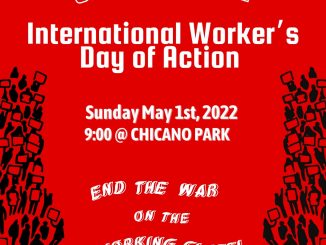
SUNDAY, MAY 1, 2022
May 1st Int’l Workers Day | 1ro de Mayo Día Int’l Trabajadores
Chicano Park
END THE WAR ON THE WORKING CLASS!
¡ALTO A LA GUERRA CONTRA LA CLASE OBRERA!
Wakasan ang digmaan sa uring manggagawa
إنهاء معاناة الطبقة العاملة
WORKERS WILL CONVENE ACTIONS AND EVENTS TO BUILD WORKERS POWER TO CHALLENGE THE ATTACKS ON WORKING FAMILIES
Organizations throughout San Diego unite to push back on the anti-worker climate currently facing both non-union and unionized workers. Organizations from throughout San Diego County will mobilize in a demonstration of class unity and internationalist solidarity with workers throughout the world to demand an end to all expressions of war, exploitation and the growing gap between the financial capitalist billionaire class and the working class.
The $770 billion dollars war budget passed by congress surpasses all social priorities such as healthcare, (medical, and medicaid), housing, education, and protecting the environment. Instead we have seen an escalation in funding for war on working people the world over.
The continued funding of war at home with increased budgets for police, border patrol, immigration enforcement and detention of migrant workers has aggravated the economic recovery of black and brown communities.
In an expression of class unity we San Diego workers will rally behind the following demands:
– Dignity for all Workers
– End To War Funding
– Housing as a Human Right
– End to the Domestic War on Black and Brown Communities
– Critical Education and Democratic Schooling
– Health Care for All
May 1st Endorsing Organizations include: AnakBayan San Diego, Association of Raza Educators- San Diego, American Friends Service Committee, International People’s Democratic Uhuru Movement, San Diego Educators Association, American Federation of Teachers, United Food and Commercial Workers Local 135, Palestinian Youth Movement, Socialist Unity Party, PTE-CWA 9119 Local 9, Human Rights Council of Oceanside, United Auto Workers 2350, San Diego Tenants Union, San Diego and Imperial Counties Labor Council, Unión del Barrio
NYC Emergency Palestine protest on WEDNESDAY April 20th at 5 PM meet at the Zionist mission, 800 2nd Ave, NY. Join us to demand an end to the ongoing Nakba and escalation of Zionist colonial violence at Al-Aqsa and all of Palestine and declare your support for the heroic Palestinian resistance defending Palestinian people and land, and their right to resist until liberation and return, by any means necessary. We are also rallying in support of Palestinian prisoners and the demand to free them all!
Hundreds of Palestinians continue to be attacked, shot at, beaten, and prevented from worshipping by the Zionist army. Every year in Ramadan these attacks escalate and Palestinian Christians and Muslims alike are risking their lives just fo be able to worship. Zionism has no place in Palestine and it must be eradicated to achieve full liberation.
As we mark Palestinian Prisoners’ Day today on April 17th, there are nearly 4,500 Palestinian prisoners behind bars in Zionist jails. 530 are jailed without charge or trial under administrative detention. 160 child prisoners, 32 women prisoners and 549 serving life sentences. Palestinian prisoners are from all areas of occupied Palestine: 70 from occupied Palestine ’48; over 500 Palestinian Jerusalemite prisoners; and 210 Palestinian prisoners from besieged Gaza.
This rally also part of @samidounnetwork’s Call to Action for 10 Days of Struggle for Palestinian Prisoners’ Liberation, 15 to 25 April 2022 and in support of The committee against the dissolution of the Collectif Palestine Vaincra, which is being repressed by the French government go to @dissolutioncpv2022 for more information.
Cuba: 61 years ago we learned not to fear our enemies
written by Struggle – La Lucha
April 18, 2022
April 17, Havana — In mid-April 1961, fifteen hundred mercenaries trained and financed by Washington set sail from a port in Miami and headed to Cuba with a single purpose: to destroy the newborn Revolution. In the early morning of April 17 of that year, five merchant ships, two war units, three barges, and four cargo boats touched Cuban soil at the Bay of Pigs in Matanzas.
As soon as the news broke, all of Cuba was shaken with anger. Historians assured later that there was not a single Cuban who was not ready to fight on the sands of Playa Giron, where the first impacts of the U.S. Martin B-26 Marauder bombing raids were felt.
“Imperialism has launched its cowardly aggression against Cuba.” Those were the first words heard by the Cuban people that morning on April 17 on all the country’s radio stations, from the voice of the then-Cuban president, Osvaldo Dorticos. “We will answer with iron and fire against the barbarians who despise us and want us to return to slavery,” he added in his message.
Operation Pluto, approved by U.S. President Dwight D. Eisenhower in 1960 and inherited by President John F. Kennedy a year later, had a sentence of failure from the beginning. The invasion did not take us by surprise.
Since April 15, planes camouflaged with Cuban insignias had attacked three air terminals in the country in an attempt to show the international community that an internal rebellion was taking place in Cuba.
The whole country mobilized after those strikes. It was known that an invasion would take place, but it was unknown the exact place or where the mercenaries would disembark. Since the bombings of April 15, Cuban troops and militias, led mainly by Fidel Castro, were deployed throughout the island. Everyone was on the alert, waiting for the slightest sign of danger.
In Playa Giron, the Cuban resistance lived through some very intense hours. The residents of the surrounding communities keep intact in their memory those days of tension, fear, and courage. Nemesia Rodríguez, for example, does not forget the pain of losing almost her entire family to enemy bullets.
“On that day, I didn’t just lose my mother, I lost everything. During the invasion they killed my mother, my paternal grandmother was paralyzed from her waist down, my younger brother was shot in the leg and in the arm; my older brother was shot in the neck. Whenever April comes, I cry. Even though the years go by, the pain is still there,” Nemesia told the press a couple of years ago.
The mercenaries surrendered on April 19 at Playa Giron, just 72 hours after the beginning of the invasion. The tank in which Fidel was traveling neutralized the last redoubt of attackers in the early hours of that morning when imperialism suffered its first major defeat in Latin America.
“Our Victory at the Bay of Pigs is an important historical event. Due to that invasion, we proclaimed the socialist character of the Cuban Revolution,” recalled Fidel in a speech delivered on April 19, 1991.
“The secret of our victory: we fought for ideals. We knew how to defend sovereignty and independence at whatever price was necessary. On April 19, 1961, we lost our fear of our enemies,” Fidel added.
Today, it is not that unreasonable to think that this history could repeat itself. Cuba is under continuous hostilities from Washington and the region’s ultra-right-wing. Hate messages against the country’s main leaders or against any of its political decisions are a common practice. We are facing an unconventional war scenario that essentially seeks a regime change on the island and, if necessary, through a military invasion. But Cuba is ready to defend itself at whatever cost, as it did 61 years ago. We are not afraid.
Former NATO military analyst exposes West’s Ukraine invasion narrative
written by Struggle – La Lucha
April 18, 2022
Jacques Baud is a former Colonel of the General Staff in the Swiss armed forces, and between 1983 and 1990 was a member of the Swiss Strategic Intelligence Service.
Baud was involved in discussions with Russian military and intelligence officials at the highest level, just after the fall of the USSR.
He was trained in the American and British intelligence services. He was the head of doctrine for United Nations peace operations. A United Nations expert for the rule of law and security institutions, he designed and led the first multidimensional United Nations intelligence service in Sudan. He worked for the African Union and was responsible for the fight against the proliferation of small arms at NATO for 5 years.
Within NATO, he followed the Ukrainian crisis of 2014, then participated in programs of assistance to Ukraine. He is the author of several books on intelligence, war and terrorism.
For years, from Mali to Afghanistan, I worked for peace and risked my life for it. It is therefore not a question of justifying the war, but of understanding what led us to it. I note that the “experts” who take turns on the television sets analyze the situation based on dubious information, most often hypotheses turned into facts, and therefore we no longer manage to understand what is happening. That’s how you create panic.
The problem is not so much who is right in this conflict, but how our leaders make their decisions.
Let’s try to examine the roots of the conflict. It starts with those who for the past eight years have been talking to us about “separatists” or “independence” from the Donbass. It’s wrong. The referendums conducted by the two self-proclaimed republics of Donetsk and Luhansk in May 2014 were not ” independence ” (независимость) referendums , as some unscrupulous journalists claimed , but ” self-determination ” or ” autonomy (самостоятельность). The term “pro-Russian” suggests that Russia was a party to the conflict, which was not the case, and the term “Russian speakers” would have been more honest. Moreover, these referendums were conducted against the advice of Vladimir Putin.
In fact, these republics did not seek to separate from Ukraine, but to have a statute of autonomy guaranteeing them the use of the Russian language as an official language. Because the first legislative act of the new government resulting from the overthrow of President Yanukovych, was the abolition, on February 23, 2014, of the Kivalov-Kolesnichenko law of 2012 which made Russian an official language. A bit as if putschists decided that French and Italian would no longer be official languages in Switzerland.
This decision causes a storm in the Russian-speaking population. This resulted in fierce repression against the Russian-speaking regions (Odessa, Dnepropetrovsk, Kharkov, Lugansk and Donetsk) which began in February 2014 and led to a militarization of the situation and a few massacres (in Odessa and Mariupol, for the most important). At the end of summer 2014, only the self-proclaimed republics of Donetsk and Lugansk remained.
At this stage, too rigid and stuck in a doctrinaire approach to the operational art, the Ukrainian staffs suffered the enemy without succeeding in imposing themselves. Examination of the course of the fighting in 2014-2016 in the Donbass shows that the Ukrainian general staff systematically and mechanically applied the same operational plans. However, the war waged by the autonomists was then very close to what we observed in the Sahel: very mobile operations carried out with light means. With a more flexible and less doctrinaire approach, the rebels were able to exploit the inertia of the Ukrainian forces to “trap” them repeatedly.
In 2014, I am at NATO, responsible for the fight against the proliferation of small arms, and we are trying to detect Russian arms deliveries to the rebels in order to see if Moscow is involved. The information that we receive then comes practically all from the Polish intelligence services and does not “match” with the information from the OSCE: in spite of rather crude allegations, we do not observe any delivery of arms and materials Russian military.
The rebels are armed thanks to the defections of Russian-speaking Ukrainian units which cross over to the rebel side. As the Ukrainian failures progressed, the entire tank, artillery or anti-aircraft battalions swelled the ranks of the autonomists. This is what drives the Ukrainians to commit to the Minsk Accords.
But, just after signing the Minsk 1 Accords, Ukrainian President Petro Poroshenko launched a vast anti-terrorist operation (ATO/Антитерористична операція) against Donbass. Bis repetita placent : poorly advised by NATO officers, the Ukrainians suffered a crushing defeat at Debaltsevo which forced them to commit to the Minsk 2 Agreements…
It is essential to recall here that the Minsk 1 (September 2014) and Minsk 2 (February 2015) Agreements provided for neither the separation nor the independence of the Republics, but their autonomy within the framework of Ukraine. Those who have read the Accords (they are very, very, very few) will find that it is written in full that the status of the republics was to be negotiated between Kiev and the representatives of the republics, for an internal solution in Ukraine .
This is why since 2014, Russia has systematically demanded their application while refusing to be a party to the negotiations, because it was an internal matter for Ukraine. On the other side, the Westerners – led by France – systematically tried to replace the Minsk Accords with the “Normandy format”, which brought Russians and Ukrainians face to face. However, let us remember, there were never any Russian troops in the Donbass before February 23-24, 2022. Moreover, OSCE observers have never observed the slightest trace of Russian units operating in the Donbass. Thus, the US intelligence map published by the Washington Post on December 3, 2021 does not show Russian troops in Donbass.
In October 2015, Vasyl Hrytsak, director of the Ukrainian Security Service (SBU), confessed that only 56 Russian fighters had been observed in the Donbass. It was an even comparable to that of the Swiss going to fight in Bosnia during the weekends, in the 1990s, or the French who are going to fight in Ukraine today.
The Ukrainian army was then in a deplorable state. In October 2018, after four years of war, Ukraine’s chief military prosecutor Anatoly Matios said that Ukraine had lost 2,700 men in the Donbass: 891 from disease, 318 from traffic accidents, 177 from other accidents, 175 from poisoning (alcohol, drugs), 172 from careless handling of weapons, 101 from breaches of safety rules, 228 from murder and 615 from suicide.
In fact, the army is undermined by the corruption of its cadres and no longer enjoys the support of the population. According to a UK Home Office report , when reservists were called up in March-April 2014, 70% did not show up for the first session, 80% for the second, 90% for the third and 95% for the fourth. In October/November 2017, 70% of callers did not show up during the “ Autumn 2017 ” callback campaign. This does not include suicides and desertions(often for the benefit of the autonomists) which reach up to 30% of the workforce in the ATO zone. Young Ukrainians refuse to go and fight in the Donbass and prefer emigration, which also explains, at least partially, the country’s demographic deficit.
The Ukrainian Ministry of Defense then turned to NATO to help it make its armed forces more “attractive”. Having already worked on similar projects within the framework of the United Nations, I was asked by NATO to participate in a program intended to restore the image of the Ukrainian armed forces. But it’s a long process and the Ukrainians want to go quickly.
Thus, to compensate for the lack of soldiers, the Ukrainian government resorted to paramilitary militias. They are essentially made up of foreign mercenaries, often far-right activists. As of 2020, they constitute around 40% of Ukraine’s forces and number around 102,000 men according to Reuters . They are armed, financed and trained by the United States, Great Britain, Canada and France. There are more than 19 nationalities – including Swiss.
Western countries have therefore clearly created and supported Ukrainian far-right militias . In October 2021, the Jerusalem Post sounded the alarm by denouncing the Centuria project . These militias have been operating in the Donbass since 2014, with Western support. Even if we can discuss the term “Nazi”, the fact remains that these militias are violent, convey a nauseating ideology and are virulently anti-Semitic. Their anti-Semitism is more cultural than political, which is why the adjective “Nazi” is not really appropriate. Their hatred of the Jew comes from the great famines of the years 1920-1930 in Ukraine, resulting from the confiscation of crops by Stalin in order to finance the modernization of the Red Army. However, this genocide – known in Ukraine under the name of Holodomor – was perpetrated by the NKVD (ancestor of the KGB) whose upper echelons of leadership were mainly composed of Jews. That is why, today, Ukrainian extremists are asking Israel to apologize for the crimes of communism , as the Jerusalem Post reports . We are therefore a long way from a “ rewriting of history ” by Vladimir Putin.
These militias, stemming from the far-right groups that led the Euromaidan revolution in 2014, are made up of fanatical and brutal individuals. The best known of these is the Azov regiment, whose emblem is reminiscent of that of the 2nd SS Das Reich Panzer Division , which is the object of real veneration in Ukraine, for having liberated Kharkov from the Soviets in 1943, before to perpetrate the massacre of Oradour-sur-Glane in 1944, in France.
Among the famous figures of the Azov regiment was the opponent Roman Protassevich, arrested in 2021 by the Belarusian authorities following the case of RyanAir flight FR4978. On May 23, 2021, there is talk of the deliberate hijacking of an airliner by a MiG-29 – with Putin’s agreement , of course – to arrest Protassevich, although the information then available does not confirm this scenario in any way.
But it must then be shown that President Lukashenko is a thug and Protassevich a “journalist” in love with democracy. However, a rather edifying investigation produced by an American NGO in 2020 , highlighted Protassevich’s far-right militant activities. Western conspiracy then sets in motion and unscrupulous media “groom” his biography . Finally, in January 2022, the ICAO report is published and shows that despite some procedural errors, Belarus acted in accordance with the rules in force and that the MiG-29 took off 15 minutes after the RyanAir pilot decided to land in Minsk. So no Belarus plot and even less with Putin. Ah!… One more detail: Protassevich,cruelly tortured by Belarusian police, is now free. Those who would like to correspond with him, can go to his Twitter account .
The labeling of “Nazi” or “neo-Nazi” given to Ukrainian paramilitaries is considered Russian propaganda . Perhaps ; but that is not the opinion of The Times of Israel , the Simon Wiesenthal Center or the Counterterrorism Center at West Point Academy. But this remains debatable, because, in 2014, Newsweek magazine seemed to associate them with… the Islamic State. A choice !
So the West supports and continues to arm militias that have been guilty of numerous crimes against civilian populations since 2014 : rape, torture and massacres. But while the Swiss government has been very quick to impose sanctions against Russia, it has not adopted any against Ukraine, which has been slaughtering its own population since 2014. In fact, those who defend the rights of the men in Ukraine have long condemned the actions of these groups, but have not been followed by our governments. Because, in reality, we are not trying to help Ukraine, but to fight Russia.
The integration of these paramilitary forces into the National Guard was not at all accompanied by a “denazification”, as some claim . Among the many examples, that of the insignia of the Azov Regiment is edifying:
In 2022, very schematically, the Ukrainian armed forces fighting the Russian offensive are structured as:
Army, subordinate to the Ministry of Defense: it is articulated in 3 army corps and composed of maneuver formations (tanks, heavy artillery, missiles, etc.).
National Guard, which depends on the Ministry of the Interior and is articulated in 5 territorial commands.
The National Guard is therefore a territorial defense force which is not part of the Ukrainian army. It includes paramilitary militias, called ” volunteer battalions” (добровольчі батальйоні), also known by the evocative name of ” retaliatory battalions “, composed of infantry. Mainly trained for urban combat, they now ensure the defense of cities such as Kharkov, Mariupol, Odessa, Kyiv, etc.
Part Two: The war
Former head of the Warsaw Pact forces in the Swiss strategic intelligence service, I observe with sadness – but not astonishment – that our services are no longer in a position to understand the military situation in Ukraine. The self-proclaimed “experts” who parade across our screens tirelessly relay the same information modulated by the assertion that Russia – and Vladimir Putin – is irrational. Let’s take a step back.
1. The outbreak of war
Since November 2021, the Americans have constantly brandished the threat of a Russian invasion against Ukraine. However, the Ukrainians do not seem to agree. Why ?
We have to go back to March 24, 2021. On that day, Volodymyr Zelensky issued a decree for the reconquest of Crimea and began to deploy his forces towards the south of the country. Simultaneously, several NATO exercises were conducted between the Black Sea and the Baltic Sea, accompanied by a significant increase in reconnaissance flights along the Russian border. Russia then conducts a few exercises to test the operational readiness of its troops and show that it is following the evolution of the situation.
Things calm down until October-November with the end of the ZAPAD 21 exercises, whose troop movements are interpreted as a reinforcement for an offensive against Ukraine. However, even the Ukrainian authorities refute the idea of Russian preparations for a war and Oleksiy Reznikov, Ukrainian Minister of Defense declares that there has been no change on its border since the spring.
In violation of the Minsk Accords, Ukraine is conducting aerial operations in Donbass using drones, including at least one strike against a fuel depot in Donetsk in October 2021 . The American press points this out, but not the Europeans and no one condemns these violations.
In February 2022, events rush. On February 7, during his visit to Moscow, Emmanuel Macron reaffirms to Vladimir Putin his attachment to the Minsk Accords , a commitment he will repeat after his interview with Volodymyr Zelensky the next day. But on February 11, in Berlin, after 9 hours of work, the meeting of the political advisers of the leaders of the ” Normandy format “ ends, without concrete result: the Ukrainians still and always refuse to apply the Accordsof Minsk, apparently under pressure from the United States. Vladimir Putin then notes that Macron has made empty promises to him and that the West is not ready to enforce the Accords, as they have been doing for eight years.
Ukrainian preparations in the contact zone continue. The Russian Parliament is alarmed and on February 15 asks Vladimir Putin to recognize the independence of the Republics, which he refuses.
On February 17, President Joe Biden announces that Russia will attack Ukraine in the coming days. How does he know? Mystery… But since the 16th, the artillery shelling of the populations of Donbass has increased dramatically, as shown by the daily reports of OSCE observers. Naturally, neither the media, nor the European Union, nor NATO, nor any Western government reacts and intervenes. We will say later that this is Russian disinformation. In fact, it seems that the European Union and some countries purposely glossed over the massacre of the people of Donbass, knowing that it would provoke Russian intervention.
At the same time, there are reports of acts of sabotage in the Donbass. On January 18, Donbass fighters intercept saboteurs equipped with Western equipment and speaking Polish seeking to create chemical incidents in Gorlivka . They could be CIA mercenaries , led or “advised” by Americans and made up of Ukrainian or European fighters, to carry out sabotage actions in the Donbass Republics.
In fact, as early as February 16, Joe Biden knows that the Ukrainians began to shell the civilian populations of Donbass, putting Vladimir Putin in front of a difficult choice: to help Donbass militarily and create an international problem or to sit idle and watch Russian speakers. from the Donbass being run over.
If he decides to intervene, Vladimir Putin can invoke the international obligation of “ Responsibility To Protect ” (R2P). But he knows that whatever its nature or scale, the intervention will trigger a shower of sanctions. Therefore, whether its intervention is limited to the Donbass or whether it goes further to put pressure on the West for the status of Ukraine, the price to be paid will be the same. This is what he explains in his speech on February 21.
That day, he acceded to the request of the Duma and recognized the independence of the two Republics of Donbass and, in the process, he signed treaties of friendship and assistance with them.
The Ukrainian artillery bombardments on the populations of Donbass continued and, on February 23, the two Republics requested military aid from Russia. On the 24th, Vladimir Putin invokes Article 51 of the United Nations Charter which provides for mutual military assistance within the framework of a defensive alliance.
In order to make the Russian intervention totally illegal in the eyes of the public we deliberately obscure the fact that the war actually started on February 16th. The Ukrainian army was preparing to attack the Donbass as early as 2021, as certain Russian and European intelligence services were well aware… The lawyers will judge.
In his speech on February 24, Vladimir Putin stated the two objectives of his operation: to “demilitarize” and “denazify” Ukraine. It is therefore not a question of seizing Ukraine, nor even, in all likelihood, of occupying it and certainly not of destroying it.
From there, our visibility on the course of the operation is limited: the Russians have an excellent security of operations (OPSEC) and the detail of their planning is not known. But fairly quickly, the course of operations makes it possible to understand how the strategic objectives were translated into the operational plan.
Demilitarization:
ground destruction of Ukrainian aviation, air defense systems and reconnaissance assets;
neutralization of command and intelligence structures (C3I), as well as the main logistics routes in the depth of the territory;
encirclement of the bulk of the Ukrainian army massed in the south-east of the country.
Denazification:
destruction or neutralization of volunteer battalions operating in the cities of Odessa, Kharkov and Mariupol, as well as in various facilities on the territory.
2. The ‘demilitarization’
The Russian offensive proceeds in a very “classic” manner. At first – as the Israelis had done in 1967 – with the destruction on the ground of the air forces in the very first hours. Then, we witness a simultaneous progression on several axes according to the principle of “flowing water”: we advance wherever resistance is weak and we leave the cities (very voracious in troops) for later. To the north, the Chernobyl plant is occupied immediately to prevent acts of sabotage. The images of Ukrainian and Russian soldiers jointly guarding the plant are naturally not shown…
The idea that Russia is trying to take over Kiev, the capital, to eliminate Zelensky, typically comes from the West: this is what they did in Afghanistan, Iraq, Libya and what they wanted to do in Syria with the help of the Islamic State . But Vladimir Putin never intended to take down or overthrow Zelensky. On the contrary, Russia seeks to keep him in power by pushing him to negotiate by encircling kyiv. He had refused to do so far to apply the Minsk Accords, but now the Russians want to obtain Ukraine’s neutrality.
Many Western commentators marveled that the Russians continued to seek a negotiated solution while conducting military operations. The explanation is in the Russian strategic conception, since Soviet times. For Westerners, war begins when politics ceases. However, the Russian approach follows a Clausewitzian inspiration: war is the continuity of politics and one can pass fluidly from one to the other, even during combat. This creates pressure on the opponent and pushes him to negotiate.
From an operational point of view, the Russian offensive was an example of its kind: in six days, the Russians seized a territory as vast as the United Kingdom, with a speed of advance greater than what the Wehrmacht made in 1940.
The bulk of the Ukrainian army was deployed in the south of the country for a major operation against Donbass. This is why the Russian forces were able to encircle it from the beginning of March in the “cauldron” between Slavyansk, Kramatorsk and Severodonetsk, by a thrust coming from the east via Kharkov and another coming from the south from the Crimea. The troops of the Republics of Donetsk (DPR) and Lugansk (RPL) complete the action of the Russian forces with a push from the East.
At this stage, the Russian forces are slowly tightening the noose, but are no longer under time pressure. Their objective of demilitarization is practically achieved and the residual Ukrainian forces no longer have an operational and strategic command structure.
The “slowdown” that our “experts” attribute to poor logistics is only the consequence of having achieved the objectives set. Russia does not seem to want to engage in an occupation of the whole Ukrainian territory. In fact, it seems rather that Russia is trying to limit its advance to the country’s linguistic border.
Our media speak of indiscriminate bombardments against civilian populations, particularly in Kharkov, and dantesque images are broadcast on a loop. However, Gonzalo Lira, a Latin American who lives there, presents us with a calm city on March 10 , and on March 11 . Admittedly it’s a big city and you can’t see everything, but that seems to indicate that we are not in the total war that we are being served continuously on our screens.
As for the Republics of Donbass, they have “liberated” their own territories and are fighting in the city of Mariupol.
3. ‘Denazification’
In cities like Kharkov, Mariupol and Odessa, defense is provided by paramilitary militias. They know that the objective of “denazification” is aimed primarily at them.
For an attacker in an urbanized area, civilians are a problem. This is why Russia seeks to create humanitarian corridors to empty the cities of civilians and leave only the militias in order to fight them more easily.
Conversely, these militias seek to keep civilians in the cities in order to dissuade the Russian army from coming to fight there. This is why they are reluctant to implement these corridors and do everything so that Russian efforts are in vain: they can thus use the civilian population as “human shields”. Videos showing civilians trying to leave Mariupol and being beaten up by fighters from the Azov regiment are naturally carefully censored here.
On Facebook, the Azov group was considered in the same category as the Islamic State and subject to the platform’s ” dangerous individuals and organizations policy ” . It was therefore forbidden to glorify him, and the “posts” that were favorable to him were systematically banned. But on February 24, Facebook changed its policy and allowed posts favorable to the militia. In the same spirit, in March, the platform authorizes, in the former Eastern European countries, calls for the murder of Russian soldiers and leaders . So much for the values that inspire our leaders, as we will see.
Our media propagate a romantic image of popular resistance. It is this image that has led the European Union to finance the distribution of arms to the civilian population. It is a criminal act. In my role as chief of doctrine for peacekeeping operations at the UN, I worked on the issue of the protection of civilians. We then saw that violence against civilians took place in very specific contexts. Especially when weapons abound and there are no command structures.
Now, these command structures are the essence of armies: their function is to channel the use of force according to an objective. By arming citizens in a haphazard fashion as is currently the case, the EU turns them into combatants, with the attendant consequences: potential targets. Moreover, without command, without operational goals, the distribution of arms inevitably leads to settling of scores, banditry and actions that are more deadly than effective. War becomes a matter of emotions. Force becomes violence. This is what happened in Tawarga (Libya) from August 11 to 13, 2011, where 30,000 black Africans were massacred with weapons parachuted (illegally) by France. Moreover, the British Royal Institute for Strategic Studies(RUSI) sees no added value in these arms deliveries.
Moreover, by delivering arms to a country at war, one exposes oneself to being considered as a belligerent. The Russian strikes on March 13, 2022, against the Mykolaiv air base follow Russian warnings that weapons transports would be treated as hostile targets.
The EU repeats the disastrous experience of the Third Reich in the last hours of the Battle of Berlin. War should be left to the military and when one side has lost, it should be admitted. And if there is to be resistance, it must imperatively be led and structured. However, we are doing exactly the opposite: we are pushing citizens to go and fight and at the same time, Facebook is allowing calls for the murder of Russian soldiers and leaders . So much for the values that inspire us.
In some intelligence services, this irresponsible decision is seen as a way of using the Ukrainian population as cannon fodder to fight Vladimir Putin’s Russia. This kind of murderous decision had to be left to the colleagues of Ursula von der Leyen’s grandfather. It would have been wiser to engage in negotiations and thus obtain guarantees for the civilian populations than to add fuel to the fire. It’s easy to be combative with other people’s blood…
4. The Maternity Hospital At Mariupol
It is important to understand beforehand that it is not the Ukrainian army which ensures the defense of Mariupol, but the Azov militia, composed of foreign mercenaries.
In its summary of the situation of March 7, 2022, the Russian UN mission in New York states that ” Residents report that the Ukrainian armed forces have expelled the personnel of the Natal Hospital No. 1 from the city of Mariupol and have installed a shooting station inside the establishment . »
On March 8, the independent Russian media Lenta.ru published the testimony of civilians from Mariupol who said that the maternity hospital was taken over by the militias of the Azov regiment, and chased out the civilian occupants, threatening them with their weapons. They thus confirm the statements of the Russian ambassador a few hours earlier.
The Mariupol hospital occupies a dominant position, perfectly adequate for installing anti-tank weapons and for observation. On March 9, Russian forces hit the building. According to CNN , there are 17 injured, but the footage shows no casualties on the premises and there is no evidence that the reported casualties are related to this strike. We talk about children, but in reality, we see nothing. It may be true, but it may be false… Which does not prevent EU leaders from seeing it as a war crime … Which allows Zelensky, just afterwards, to claim a no-fly zone over Ukraine…
In reality, we don’t know exactly what happened. But the sequence of events tends to confirm that the Russian forces struck a position of the Azov regiment and that the maternity ward was then free of all civilians.
The problem is that the paramilitary militias that ensure the defense of cities are encouraged by the international community not to respect the customs of war. It seems that the Ukrainians have re-enacted the scenario of the maternity hospital in Kuwait City in 1990 , which had been completely staged by the firm Hill & Knowlton for the amount of 10.7 million dollars in order to convince the United Nations Security Council to intervene in Iraq for Operation Desert Shield/Storm .
Western politicians have also accepted strikes against civilians in Donbass for eight years, without adopting any sanctions against the Ukrainian government. We have long since entered into a dynamic where Western politicians have agreed to sacrifice international law to their objective of weakening Russia .
Part Three: Conclusions
As a former intelligence professional, the first thing that strikes me is the total absence of Western intelligence services in representing the situation for a year. In Switzerland, the services have been criticized for not having provided a correct picture of the situation. In fact, it seems that all over the Western world, the services have been overwhelmed by the politicians. The problem is that it is the politicians who decide: the best intelligence service in the world is useless if the decision-maker does not listen to it. This is what happened during this crisis.
That said, while some intelligence services had a very precise and rational image of the situation, others clearly had the same image as that propagated by our media. In this crisis, the services of the countries of the “new Europe” played an important role. The problem is that, by experience, I found that they were extremely bad on the analytical level: doctrinaire, they do not have the intellectual and political independence necessary to appreciate a situation with a military “quality”. It is better to have them as enemies than as friends.
Then, it seems that in some European countries, politicians have deliberately ignored their services to respond ideologically to the situation. This is why this crisis has been irrational from the start. It will be observed that all the documents that have been presented to the public during this crisis have been presented by politicians on the basis of commercial sources…
Some Western politicians obviously wanted there to be a conflict. In the United States, the attack scenarios presented by Anthony Blinken to the Security Council were only the fruit of the imagination of a Tiger Team working for him : he did exactly like Donald Rumsfeld in 2002, who thus “bypassed” the CIA and other intelligence services that were far less assertive about Iraqi chemical weapons.
The dramatic developments we are witnessing today have causes we knew about, but refused to see:
on the strategic level, the expansion of NATO (which we have not dealt with here);
on the political level, the Western refusal to implement the Minsk Agreements;
and on the operational level, the continuous and repeated attacks on the civilian populations of Donbass for years and the dramatic increase at the end of February 2022.
In other words, we can naturally deplore and condemn the Russian attack. But WE (that is to say: the United States, France and the European Union in the lead) have created the conditions for a conflict to break out. We show compassion for the Ukrainian people and the two million refugees . It’s good. But if we had had a modicum of compassion for the same number of refugees from the Ukrainian populations of Donbass massacred by their own government and who have been accumulating in Russia for eight years, none of this would probably have happened.
Whether the term “genocide” applies to the abuses suffered by the populations of Donbass is an open question. This term is generally reserved for larger cases (Holocaust, etc.), however, the definition given by the Genocide Convention is probably broad enough to apply. Lawyers will appreciate.
Clearly, this conflict has led us into hysteria. Sanctions seem to have become the preferred tool of our foreign policies. If we had insisted that Ukraine respect the Minsk Accords, which we negotiated and endorsed, none of this would have happened. The condemnation of Vladimir Putin is also ours. There is no point in whining after the fact, we had to act before. However, neither Emmanuel Macron (as guarantor and as a member of the UN Security Council), nor Olaf Scholz, nor Volodymyr Zelensky have respected their commitments. Ultimately, the real defeat is that of those who have no voice.
The European Union was unable to promote the implementation of the Minsk agreements, on the contrary, it did not react when Ukraine bombarded its own population in the Donbass. Had she done so, Vladimir Putin would not have needed to react. Absent from the diplomatic phase, the EU distinguished itself by fueling the conflict. On February 27, the Ukrainian government agrees to start negotiations with Russia. But a few hours later, the European Union voted a budget of 450 million euros to supply arms to Ukraine, adding fuel to the fire. From there, the Ukrainians feel that they will not need to come to an agreement. The resistance of the Azov militias in Mariupol will even causea raise of 500 million euros for weapons .
In Ukraine, with the blessing of Western countries, those who are in favor of a negotiation are eliminated. This is the case of Denis Kireyev, one of the Ukrainian negotiators, assassinated on March 5 by the Ukrainian secret service (SBU) because he is too favorable to Russia and is considered a traitor. The same fate is reserved for Dmitry Demyanenko, former deputy head of the main directorate of the SBU for Kiev and its region, assassinated on March 10 , because too favorable to an agreement with Russia: he is killed by the Mirotvorets militia (” Peacemaker “). This militia is associated with the Mirotvorets website which lists the ” enemies of Ukraine”, with their personal data, address and telephone numbers, so that they can be harassed or even eliminated ; a punishable practice in many countries, but not in Ukraine . The UN and some European countries have demanded its closure… refused by the Rada.
Eventually, the price will be high, but Vladimir Putin will likely achieve the goals he set for himself. Its ties with Beijing have solidified. China emerges as a mediator of the conflict, while Switzerland enters the list of enemies of Russia. The Americans must ask Venezuela and Iran for oil to get out of the energy impasse in which they have gotten themselves: Juan Guaido leaves the scene definitively and the United States must pitifully reverse the sanctions imposed on their enemies.
Western ministers who seek to collapse the Russian economy and make the Russian people suffer , even calling for the assassination of Putin, show (even if they partially reversed the form of their remarks, but not on bottom!) that our leaders are no better than the ones we hate. Because, sanctioning Russian athletes from the Para-Olympic Games or Russian artists has absolutely nothing to do with a fight against Putin.
Thus, therefore, we recognize that Russia is a democracy since we consider that the Russian people are responsible for the war. If not, then why are we trying to punish an entire population for the fault of one? Remember that collective punishment is prohibited by the Geneva Conventions…
The lesson to be drawn from this conflict is our sense of variable geometry humanity. If we were so attached to peace and to Ukraine, why didn’t we encourage her more to respect the agreements that she had signed and that the members of the Security Council had approved?
Media integrity is measured by their willingness to work under the terms of the Munich Charter. They had succeeded in propagating hatred of the Chinese during the Covid crisis and their polarized message leads to the same effects against the Russians . Journalism is stripping itself more and more of professionalism to become militant…
As Goethe said: “ The greater the light, the darker the shadow ”. The more the sanctions against Russia are excessive, the more the cases where we have done nothing highlight our racism and our servility. Why has no Western politician reacted to the strikes against the civilian populations of Donbass for eight years?
After all, what makes the conflict in Ukraine more blameworthy than the war in Iraq, Afghanistan or Libya? What sanctions have we adopted against those who have deliberately lied before the international community to wage unjust, unjustified, unjustifiable and murderous wars? Did we try to “make suffer” the American people who had lied to us (because it’s a democracy!) before the war in Iraq? Have we even adopted a single sanction against the countries, companies or politicians who are fueling the conflict in Yemen, considered the ” worst humanitarian disaster in the world “? Have we sanctioned the countries of the European Union who practice the most abject torture on their territory for the benefit of the United States?
To ask the question is to answer it… and the answer is not glorious.
The offensive launched on February 24 is articulated in two lines of effort, in accordance with Russian operational doctrine:
1) A main effort directed toward the south of the country, in the Donbass region, and along the Azov Sea coast. As the doctrine states, the main objectives are—the neutralization of the Ukrainian armed forces (the objective of “demilitarization”), and the neutralization of ultra-nationalist, paramilitary militias in the cities of Kharkov and Mariupol (the objective of “denazification“). This primary push is being led by a coalition of forces: through Kharkov and Crimea are Russian forces from the Southern Military District; in the center are militia forces from the Donetsk and Lugansk republics; the Chechen National Guard is contributing with engagement in the urban area of Mariupol;
2) A secondary effort on Kiev, aimed at “pinning down” Ukrainian (and Western) forces, so as to prevent them from carrying out operations against the main thrust or even taking Russian coalition forces from the rear.
This offensive follows, to the letter, the objectives defined by Vladimir Putin on February 24. But, listening only to their own bias, Western “experts” and politicians have gotten it into their heads that Russia’s objective is to take over the Ukraine and overthrow its government. Applying a very Western logic, they see Kiev as the “center of gravity” (Schwerpunkt) of Ukrainian forces. According to Clausewitz, the “center of gravity” is the element from which a belligerent derives his strength and ability to act, and is therefore the primary objective of an adversary’s strategy. This is why Westerners have systematically tried to take control of capitals in the wars they have fought. Trained and advised by NATO experts, the Ukrainian General Staff has, predictably enough, applied the same logic, focusing on strengthening the defense of Kiev and its surroundings, while leaving its troops helpless in the Donbass, along the axis of the main Russian effort.
If one had listened carefully to Vladimir Putin, one would have realized that the strategic objective of the Russian coalition is not to take over the Ukraine, but to remove any threat to the Russian-speaking population of the Donbass. According to this general objective, the “real” center of gravity that the Russian coalition is trying to target is the bulk of the Ukrainian armed forces massed in the south-southeast of the country (since the end of 2021), and not Kiev.
Russian Success or Failure?
Convinced that the Russian offensive is aimed at Kiev, Western experts have quite logically concluded that (a) the Russians are stalling, and that (b) their offensive is doomed to failure because they will not be able to hold the country in the long term. The generals who have followed each other on French TV seem to have forgotten what even a second lieutenant comprehends well: “Know your enemy!”—not as one would like him to be, but as he is. With generals like that, we don’t need an enemy anymore.
That being said, the Western narrative about a Russian offensive that is bogged down, and whose successes are meager, is also part of the propaganda war waged by both sides. For example, the sequence of maps of operations, published by Libération from the end of February, shows almost no difference from one day to the next, until March 18th (when the media stopped updating it). Thus, on February 23rd, on France 5 [TV station], the journalist Élise Vincent evaluated the territory taken by the Russian coalition as the equivalent of Switzerland or the Netherlands. In reality, we are more in the area of Great Britain.
As an example, let us observe the difference between the map of the situation on March 25, 2022, as published by Ouest-France:
In addition, it should be noted that Ukrainian forces do not appear on any map (presented in our media) of the conflict-situation. Thus, if the map of the French Ministry of Armed Forces gives a slightly more honest picture of reality, it also carefully avoids mentioning the Ukrainian forces encircled in the Kramatorsk cauldron.
In fact, the situational map, as of March 25, should look more like this:
Moreover, Ukrainian forces are never indicated on our maps, as this would show that they were not deployed on the Russian border in February 2022, but were regrouped in the south of the country, in preparation for their offensive, the initial phase of which began on February 16th. This confirms that Russia was only reacting to a situation initiated by the West, by way of the Ukraine, as we shall see. At present, it is these forces that are encircled in the Kramatorsk cauldron and are being methodically fragmented and neutralized, little by little, in an incremental way, by the Russian coalition.The vagueness maintained in the West about the situation of the Ukrainian forces, has other effects. First, it maintains the illusion of a possible Ukrainian victory. Thus, instead of encouraging a negotiation process, the West seeks to prolong the war. This is why the European Union and some of its member countries have sent weapons and are encouraging the civilian population and volunteers of all kinds to go and fight, often without training and without any real command structure—with deadly consequences.We know that in a conflict, each party tends to inform in order to give a favorable image of its actions. However, the image we have of the situation and of the Ukrainian forces is based exclusively on data provided by Kiev. It masks the profound deficiencies of the Ukrainian leadership, even though it was trained and advised by NATO military.Thus, military logic would have the forces caught in the Kramatorsk cauldron withdraw to a line at the Dnieper, for example, in order to regroup and conduct a counteroffensive. But they were forbidden to withdraw by President Zelensky. Even back in 2014 and 2015, a close examination of the operations showed that the Ukrainians were applying “Western-style” schemes, totally unsuited to the circumstances, and in the face of a more imaginative, more flexible opponent who possessed lighter leadership structures. It is the same phenomenon today.
In the end, the partial view of the battlefield given to us by our media has made it impossible for the West to help the Ukrainian general staff make the right decisions. And it has led the West to believe that the obvious strategic objective is Kiev; that “demilitarization” is aimed at the Ukraine’s membership in NATO; and that “denazification” is aimed at toppling Zelensky. This legend was fueled by Vladimir Putin’s appeal to the Ukrainian military to disobey, which was interpreted (with great imagination and bias) as a call to overthrow the government. However, this appeal was aimed at the Ukrainian forces deployed in the Donbass to surrender without fighting. The Western interpretation caused the Ukrainian government to misjudge Russian objectives and misuse its potential of winning.
You don’t win a war with bias—you lose it. And that’s what is happening. Thus, the Russian coalition was never “on the run” or “stopped” by heroic resistance—it simply did not attack where it was expected. We did not want to listen to what Vladimir Putin had explained to us very clearly. This is why the West has thus become—volens nolens—the main architect of the Ukrainian defeat that is taking shape. Paradoxically, it is probably because of our self-proclaimed “experts” and recreational strategists on our television sets that the Ukraine is in this situation today.
The Conduct of Battle
As for the course of operations, the analyses presented in our media come most often from politicians or so-called military experts, who relay Ukrainian propaganda.
Let’s be clear. A war, whatever else it is, is drama. The problem here is that our strategists in neckties are clearly trying to overdramatize the situation in order to exclude any negotiated solution. This development, however, is prompting some Western military personnel to speak out and offer a more nuanced judgment. Thus, in Newsweek, an analyst from the Defense Intelligence Agency (DIA), the American equivalent of the Direction du Renseignement Militaire (DRM) in France, noted that “in 24 days of conflict, Russia has carried out some 1,400 strikes and launched nearly 1,000 missiles (by way of comparison, the United States carried out more strikes and launched more missiles on the first day of the Iraq war in 2003).”
While the West likes to “soften up” the battlefield with intensive and prolonged strikes, before sending in ground-troops, the Russians prefer a less destructive, but more troop-intensive approach. On France 5, the journalist Mélanie Tarvant presented the death of Russian generals on the battlefield as proof of the destabilization of the Russian army. But this is a profound misunderstanding of the traditions and modes of operation of the Russian army. Whereas in the West, commanders tend to lead from the rear, their Russian counterparts tend to lead from the front—in the West they say, “Forward!” In Russia, they say, “Follow me!” This explains the high losses in the upper echelons of command, already observed in Afghanistan—but it also tells of the much more rigorous selection of staff-personnel than in the West.
Furthermore, the DIA analyst noted that “the vast majority of the airstrikes are over the battlefield, with Russian aircraft providing ‘close air support’ to ground forces. The remainder—less than 20 percent, according to U.S. experts—has been aimed at military airfields, barracks and supporting depots.” Thus, the phrase “indiscriminate bombing [that] is devastating cities and killing everyone” echoed by the Western media seems to contradict the U.S. intelligence expert, who said, “If we merely convince ourselves that Russia is bombing indiscriminately, or [that] it is failing to inflict more harm because its personnel are not up to the task or because it is technically inept, then we are not seeing the real conflict.”
In fact, Russian operations differ fundamentally from the Western concept of the same. The West’s obsession with having no fatalities in their own forces leads them to operations that are primarily in the form of very lethal air strikes. Ground troops only intervene when everything has been destroyed. This is why, in Afghanistan or in the Sahel, Westerners killed more civilians than terrorists did. This is why Western countries engaged in Afghanistan, the Middle East and North Africa no longer publish the number of civilian casualties caused by their strikes. In fact, Europeans engaged in regions that only marginally affect their national security, such as the Estonians in the Sahel, go there just to “get their feet wet.”
In the Ukraine, the situation is very different. One only has to look at a map of linguistic zones to see that the Russian coalition operates almost exclusively in the Russian-speaking zone; thus, among populations that are generally favorable to it. This also explains the statements of a US Air Force officer: “I know that the news keeps repeating that Putin is targeting civilians, but there is no evidence that Russia is intentionally doing so.”
Conversely, it is for the same reason—but in a different way—that the Ukraine has deployed its ultra-nationalist paramilitary fighters in major cities, such as Mariupol or Kharkov—without emotional or cultural ties to the local population, these militias can fight even at the cost of heavy civilian casualties. The atrocities that are currently being uncovered remain hidden by the French-speaking media, for fear of losing support for the Ukraine, as noted by media close to the Republicans in the United States.
After “decapitation” strikes in the first minutes of the offensive, the Russian operational strategy was to bypass the urban centers, and to envelop the Ukrainian army, “pinned down” by the forces of the Donbass republics. It is important to remember that the “decapitation” is not intended to annihilate the general staff or the government (as our “experts” tend to understand it), but to sunder the leadership structures so as to prevent the coordinated maneuver of forces. On the contrary, the aim is to preserve the leadership structures themselves in order to be able to negotiate a way out of the crisis.
On March 25, 2022, after having sealed the cauldron of Kramatorsk which denied any possibility of retreat to the Ukrainians and having taken most of the cities of Kharkov and Marioupol, Russia has practically fulfilled its objectives—all that remains is to concentrate its efforts on reducing the pockets of resistance. Thus, contrary to what the Western press has claimed, this is not a reorientation or a resizing of its offensive, but the methodical implementation of the objectives announced on February 24.
Encouraged by the media that present a routed Russian army, many of these young people head off, imagining they are going—literally—on a hunting trip. However, once there, disillusionment is high. Testimonies show that these “amateurs” often end up as “cannon fodder,” without having any real impact on the outcome of the conflict. The experience of recent conflicts shows that the arrival of foreign fightersbrings nothing to a conflict, except to increase its duration and lethality.
Moreover, the arrival of several hundred Islamist fighters from the Idlib region, an area under the control and protection of the Western coalition in Syria (and also the area in which two Islamic State leaders were killed by the Americans) should arouse our concern. Indeed, the weapons we are very liberally supplying to the Ukraine are already partly in the hands of criminal individuals and organizations and are already beginning to pose a security problem for the authorities in Kiev. Not to mention the fact that the weapons that are being touted as effective against Russian aircraft could eventually threaten our military and civilian aircraft.
The volunteer proudly presented by the RTBF on the 7:30 p.m. news of March 8, 2022 was an admirer of the “Corps Franc Wallonie,” Belgian volunteers who served the Third Reich; and he illustrates the type of people attracted to the Ukraine. In the end, we will have to ask ourselves, who gained the most—[in this case] Belgium or the Ukraine?
Distributing weapons indiscriminately could well make the EU—volens nolens—a supporter of extremism and even international terrorism. The result—we are adding misery to misery, in order to satisfy the European elites more than the Ukraine itself.
Three Points Deserve to be Highlighted by Way of Conclusion
1. Western Intelligence, Ignored by Policymakers
Military documents found in Ukrainian headquarters in the south of the country confirm that the Ukraine was preparing to attack the Donbass; and that the firing observed by OSCE observers as early as February 16 heralded an imminent outbreak in days or weeks.
Here, some introspection is necessary for the West—either its intelligence services did not see what was happening and they are thus very bad, or the political decision-makers chose not to listen to them. We know that Russian intelligence services have far superior analytical capabilities than their Western counterparts. We also know that the American and German intelligence services had very well understood the situation, since the end of 2021, and knew that the Ukraine was preparing to attack the Donbass.
This allows us to deduce that the American and European political leaders deliberately pushed the Ukraine into a conflict that they knew was lost in advance—for the sole purpose of dealing a political blow to Russia.
The reason Zelensky did not deploy his forces to the Russian border, and repeatedly stated that his large neighbor would not attack him, was presumably because he thought he was relying on Western deterrence. This is what he told CNN on March 20th—he was clearly told that the Ukraine would not be part of NATO, but that publicly they would say the opposite. The Ukraine was thus instrumentalized to affect Russia. The objective was the closure of the North Stream 2 gas pipeline, announced on February 8th, by Joe Biden, during the visit of Olaf Scholz; and which was followed by a barrage of sanctions.
2. Broken Diplomacy
Clearly, since the end of 2021, no effort has been made by the West to reactivate the Minsk agreements, as evidenced by the reports of visits and telephone conversations, notably between Emmanuel Macron and Vladimir Putin. However, France, as guarantor of the Minsk Agreements, and as a permanent member of the United Nations Security Council, has not respected its commitments, which has led to the situation that the Ukraine is experiencing today. There is even a feeling that the West has sought to add fuel to the fire since 2014.
Thus, Vladimir Putin’s placing of nuclear forces on alert on February 27 was presented by our media and politicians as an irrational act or blackmail. What is forgotten is that it followed the thinly veiled threat made by Jean-Yves Le Drian, three days earlier, that NATO could use nuclear weapons. It is very likely that Putin did not take this “threat” seriously, but wanted to push Western countries—and France in particular—to abandon the use of excessive language.
3. The Vulnerability of Europeans to Manipulation is Increasing
Today, the perception propagated by our media is that the Russian offensive has broken down; that Vladimir Putin is crazy, irrational and therefore ready to do anything to break the deadlock in which he supposedly finds himself. In this totally emotional context, the question asked by Republican Senator Marco Rubio during Victoria Nuland’s hearing before Congress was strange, to say the least: “If there is a biological or chemical weapon incident or attack inside the Ukraine, is there any doubt in your mind that 100% it would be the Russians behind it?” Naturally, she answered that there is no doubt. Yet there is absolutely no indication that the Russians are using such weapons. Besides, the Russians finished destroying their stockpiles in 2017, while the Americans have not yet destroyed theirs.
Perhaps this means nothing. But in the current atmosphere, all the conditions are now met for an incident to happen that would push the West to become more involved, in some form, in the Ukrainian conflict (a “false-flag” incident).
Brooklyn, N.Y.: Emergency rally to defend al-Aqsa, April 16
written by Struggle – La Lucha
April 18, 2022
Rally to Defend Al-Aqsa, Jerusalem, Jenin, & every inch of Palestine 🇵🇸
Join us on Saturday, April 16th at 4:30PM as we gather in the heart of the Palestinian Community, Bay Ridge, to defend Al-Aqsa, Bab Al-Amoud, Jerusalem, Jenin, Sheikh Jarrah, Silwan, & every inch of Palestine.
In this holy month of Ramadan, the zionist occupation forces arrested countless of Palestinians & have attacked many villages and homes across Palestine. The occupation forces have also targeted worshippers and Palestinians celebrating Ramadan in Bab Al-Amoud and Al-Quds. Far-Right zionist politicians & settlers also plan to storm Al-Aqsa Mosque this upcoming week. Therefore, it’s crucially important to hit the streets to Defend Al-Aqsa, & demand an end to the occupation & settler colonialism.
We are also here to demand the freedom of all Palestinian Prisoners including Ahmad Manasrah who has been tortured by the occupation forces. Ahmad has suffered physical and mental torture for the past 7 years, since he was 13 years old. These are the horrific war crimes committed by the IOF on a daily basis In Palestine. Since 2022, more than 30+ Palestinians were martyred for simply being Palestinian & resisting for their liberation. This number is increasing as more Palestinians are being murdered by the IOF on a daily basis. Just as Palestinians resist back home, we must show solidarity & resist with them.
Join us on April 16, iftar will be served after the rally.
Baltimore: Poor People’s March & Caravan, June 17-18
written by Struggle – La Lucha
April 18, 2022
JUNE 17 – JUNE 18
Baltimore Poor Peoples Campaign March & Caravan
100 Holliday Street, Baltimore, MD 21202
Join the Baltimore Poor People’s Campaign Unity March & Caravan to D.C.
Friday, June 17th, we will March and Caravan from Baltimore City to Washington D.C. to highlight our local and national grievances and demands.
The National Welfare Rights Organization will be holding a national conference in Baltimore from June 15 to 16th and the caravan will be the culmination of the conference.
This March and Caravan will leave Baltimore City Hall, 100 Holliday Streets at 10 am Saturday, June 17 and will arrive on Saturday, June 18th for the national Poor People’s Campaign Low Wage Workers Assembly Gathering in D.C. No one is expected to walk the entire 41 miles, we will have plenty of transportation for those who are unable to walk distances.
Reverend Chambers will be speaking on Saturday at the D.C. gathering.
Your energy and voice are needed!
It is critical that we make our demands heard loud and clear.
Food is a Right! Roll back food, gas & utility prices – Increase food stamps & lower the income criteria to include more Marylanders and seniors.
Jobs, or income now – Maryland pay unemployed workers their benefits now. Living wage and union rights for all workers
Roll back predatory rent increases – Rent control now – No evictions – Stop privatization of public housing – affordable housing for all
Expand and protect voter rights – No to racism, sexism & bigotry – End police terror – Immigrant & Indigenous rights – Human rights for all prisoners.
Fund education, healthcare & housing, Not war! Feed the people, not the Pentagon.
Please endorse the event and consider joining a focus group: youth & students; unions & workers; community outreach; food is a right; logistics and fundraising.
There are a million ways your organization can be helpful. Build a contingent of your group or issue in the March, help with food and transportation, greet us on the day of the March along the route. We will be taking the historic civil rights March route on Rt 1.
If you are interested there will be an orientation zoom meeting Saturday, April 16, 11 am to 12 noon. We will send out information to those interested in attending.
Yours in struggle,
Rev Chambers, National Co-Chair Welfare Rights Organization; Rev. CD Witherspoon; Sharon Black, Peoples Power Assembly; Dr. Marvin ‘Doc’ Cheatham, Seniors United, Matthew Henson Neighborhood Association; Attorney Alec Summerfield, Unemployed Workers Union; Ellie McCraw, Youth Against War & Racism; Rasika Ruwanpathirana, Md Amazon Workers Union
Sign up: https://forms.gle/gDiPE2HSmU4Nzfxi6
On Transgender Day of Visibility, Baltimore Safe Haven vandalized
written by Struggle – La Lucha
April 18, 2022
On March 31 — the International Transgender Day of Visibility — Baltimore Safe Haven reported that their Charles Village office had been vandalized with a bigoted message that read “Fuck Pride DIE.”
Founded in 2018, Baltimore Safe Haven is a local, trans-led nonprofit that provides the city’s at-risk TLGBQIA community — particularly Black trans women — with food, housing, health care and more. According to the organization’s website, their aim is to serve individuals “with an annual median income of less than $10,000, who are currently engaged in or have a history in sex work, who are substance users, and who are either homeless or at risk of becoming homeless.”
Key members of Safe Haven’s staff have expressed their outrage and frustration in the wake of this attack and the online harassment that has accompanied it. “We’re devastated. I’m afraid for my own safety and the safety of my staff at this moment,” remarked founder and executive director Iya Dammons. Case manager Nicole Wells was the first to notice the graffiti and shared a similar comment: “I was shaking. At this point, I don’t even want to go outside by myself.” Program Manager Ngaire Philip added, “We haven’t done anything to hurt anyone.”
Unfortunately this isn’t the first attack they’ve had to endure: last October, Safe Haven’s “Project Genesis” youth shelter in West Baltimore was burglarized and vandalized by a man who previously threatened staff and made “derogatory comments around sexuality and gender.” This time, Dammons believes the organization is being targeted due to the upcoming Baltimore Trans Pride ‘22 Block Party they are heading this June.
Despite these hardships Baltimore Safe Haven remains committed to their vision: “a world in which all transgender, lesbian, gay, bisexual, and queer (TLGBQ) people enjoy healthy, self-determined and -sufficient lives, liberated from the stigma, violence, and oppression they have suffered.”
“We all just had to take a breath for a second,” says Dammons, who then continued: “We’re not going to let this break us. We’re not going to bend. We’re going to do the job.” The vandalism is currently being investigated as a hate crime.
Baltimore’s Peoples Power Assembly previously marched alongside Baltimore Safe Haven in 2021 for their 2nd annual Black Trans Lives Matter march, and will continue to support the organization’s valiant struggle to uplift the most vulnerable members of our community.
Regarding the upcoming festivities Dammons said, “This is the first time we have ever thrown a major, big Pride like this for the trans community. I would like to see people come out on June 4 and let them know that this will not happen in Baltimore City at all.”
Howard University Hospital nurses stage one-day strike
written by Struggle – La Lucha
April 18, 2022
The District of Columbia Nurses Association staged a one-day strike to highlight the failure of Adventist Healthcare to sit down and bargain in good faith. Adventist Healthcare is the administration for Howard University Hospital. The day-long rally ran from 7:30 a.m. until 8 p.m. on April 11. The nurses that attended represented many different nationalities. For the morning rally over 200 participants were in attendance.
Adventist Healthcare on several occasions has come to the bargaining table claiming that they had not seen any proposals. The union officials assert that all proposals were properly forwarded to the hospital administration. Just one day before the one-day strike was held, the hospital chief negotiator claimed at the start of the session that the union was attempting to back-date proposals for back pay that was owed to the nursing staff. He proclaimed the proposal was invalid and that the hospital couldn’t afford it. He told them that there was nothing to talk about and left the room.
Many issues have been raised by the union in this round of contract negotiations. Among them are patient ratios that make sure that nurses are not assigned more than a reasonable number of patients for care. Additionally, management has eliminated the differential pay for evening and weekend shifts which results in a cut in pay of several thousand dollars.
Chants demanding safe staffing levels were heard continuously throughout the day along with chants demanding fair negotiations. The nurses on the picket line received tremendous support from the public as many drivers honked their horns in support. Just about every bus driver that drove by honked loudly to show support. Many people walking by stopped to listen and discuss the issues with the nurses.
Ukrainian refuseniks on why many won’t fight for Ukraine
written by Struggle – La Lucha
April 18, 2022
Since Russia began what they call the “special operation” on February 24 in Ukraine, the corporate media has reported the Ukrainian population is united in resistance against the Russian military offensive. Aside from reports of civilians volunteering in a variety of non-military support roles, Ukrainian President Volodomyr Zelensky and other state officials have urged civilians to take up arms. Then, on March 9, Zelensky approved a law that allows Ukrainians to use weapons during wartime and negates legal responsibility for any attack on people perceived to be acting in aggression against Ukraine. The Ukrainian Ministry of Defense even posted a graphic online with instructions on how to launch Molotov cocktails at tanks.
We will give weapons to anyone who wants to defend the country. Be ready to support Ukraine in the squares of our cities.
— Volodymyr Zelenskyy / Володимир Зеленський (@ZelenskyyUa) February 24, 2022
A poll conducted in early March by the Ukrainian sociological group, “Rating,” indicated that, of those Ukrainians surveyed, over 90 percent supported their government’s war effort, and 80 percent claimed willingness to participate in armed resistance. However, this survey excluded people who live in the self-proclaimed independent republics of Donetsk and Lugansk in eastern Ukraine’s Donbass region. It also did not include the 1 million Ukrainians who had by then already fled the country. Since the survey, an additional 3.6 million have fled.
Beneath the façade of chest-beating patriotism, however, lies an anti-war movement. Just as it is diverse in its motivations to oppose the war, this movement is decentralized geographically and appears not unified enough to move as one force.
In post-Maidan Ukraine, opposition to militarism had already been a slippery slope, well before the current Russian incursion. The case of Ruslan Kotsaba, a Ukrainian journalist and conscientious objector, was perhaps the first such of state suppression under military law that had gained some degree of international attention, at least from human rights and pacifist organizations. Kotsaba was originally a proponent of the 2013-14 Euromaidan protests against the government of later-ousted President Viktor Yanukovych. But he began changing course when he spoke out against the 2014 violence in the majority ethnic Russian Ukrainian region of Donbass. He posted a now-notorious YouTube video in 2015, calling for a mass boycott against the mobilization in the far eastern region. After garnering hundreds of thousands of views, Youtube yanked it. For these statements, Kotsaba was arrested, detained, and charged with treason and “obstruction of the legitimate activities of the armed forces of Ukraine.” After being sentenced to 3-1/2 years on the latter charge, and spending more than a year in prison, his conviction was overturned on appeal. But, in 2017, a higher court reopened the case and his trial recommenced in 2021. Shortly before the recent escalation with Russia, the state prosecution was suspended, though not entirely concluded. This article provides a glimpse into the prevailing sentiments toward anti-war expressions in Ukraine. It comes from a Kharkiv-based “human rights protection group,” yet it describes the suspension of his prosecution as unjust, given his “active collaboration with the Russian state.”
‘Anyone Will Rat You Out’
This reporter spoke with someone who would only go by the name, “Pavel.” He belongs to a now-banned Kyiv-based Ukrainian Marxist group. Pavel recently moved from Ukraine to Bucharest, Romania, and declined to give his real name or the name of his group. In 2015, the Communist Party was outlawed in Ukraine, on grounds it promoted “separatism.” More recently, on March 22, a month into the Russian incursion, Zelensky banned 11 mostly left-wing opposition parties. Pavel cited these bans, and the well-being of his family remaining in Ukraine, as reasons for his anonymity.
“Anyone who says anything against the military, protests against NATO, or really, opposes the government from any direction, is immediately labeled ‘pro-Russian,’” the 26-year-old told Toward Freedom. “Anyone is bound to rat you out as a Russian spy if they disagree with you: Nationalists or even other ‘leftists,’ like anarchists or progressives. Most of the country has joined forces with the nationalists. SBU [Ukrainian Secret Service] will catch wind of a protest, a meeting, or an article, and they’ll speak to their friends in the ‘civil society,’ who will send armed nationalists to ‘handle’ you.”
He spoke of a close comrade from the Ukrainian city of Kharkiv, who had made statements on Facebook before February 24 against NATO interference in Ukraine and in support of the Minsk Agreements, the 7-year-old brokered cease-fire accords between the Ukrainian government and Donbass separatists, who had declared independence for two Ukrainian oblasts (states), Donetsk and Lugansk. Pavel said this person had gone into hiding in early March because nationalist groups had threatened their life. The person believed nationalists were still searching for them. Pavel and the person in hiding know of others who had disappeared in years prior.
Beyond this exchange, and a handful of correspondences on WhatsApp and Telegram, it has been next to impossible to find Ukrainian war resisters who had left the country to speak on the record. This is unsurprising given that one month ago, Zelensky issued a decree of martial law, banning most men ages 18 to 60 from leaving the country.
Military Service a ‘Form of Slavery’
Ukrainian pacifist leader Yurii Sheliazhenko told this reporter the pre-wartime penalty for evading military service had been up to three years in prison, but penalties have been increasing indefinitely since February 24. It’s impossible to verify what the exact penalties are, he said, as such hearings and verdicts are now closed to the public, ostensibly for the “safety of the judges” involved. As of April 10, Ukraine’s border guard reported roughly 2,200 detentions of “fighting age” men who were trying to escape the country. Many reportedly used forged documents or attempted to bribe officials, and others have been found dead in rural border areas.
The 31-year-old Sheliazhenko, on the other hand, has not left Kyiv. Instead, he is working tirelessly with his organization, the Ukrainian Pacifist Movement (UPM), to promote a message of worldwide non-violent resistance to all forms of armed conflict, including on behalf of his own country. His organization was founded in 2019, initially to oppose mandatory military service, which he calls a “form of slavery.”
Toward Freedom had the opportunity Sunday to speak by phone for two hours. He noted that he was equally opposed to the practice in Russia, or in any other country. But, in 2019, as the war raged on in the Donbass region, conscription in Ukraine began to take on an “especially cruel nature. Young men were being given military summonses off of the streets, out of night clubs and dormitories, or snatched for military service for minor infractions such as traffic violations, public drunkenness, or casual rudeness to police officers. In Ukraine, if you do not respond to such a summons, you will be detained.”
Sheliazhenko’s pacifism developed in childhood, where in the final days of the former Soviet Union, he immersed himself in the works of authors Ray Bradbury and Isaac Asimov at “peaceful” summer camps in the Ukrainian countryside. These were a contrast to today’s militarized, nationalist-themed summer camps springing up all over the country since the Euromaidan.
Now, he is a conscientious objector. “[There is] no exemption for conscientious objectors in Ukraine, even for clergy or religious organizations.” He noted that a 2016 UN Declaration on the Right to Peace failed to protect conscientious objection on the level of international law. Plus, transgender and gender-non-conforming people are caught in a Catch-22. “In Ukraine, because trans women are treated legally as men, they are not exempt from the martial law order,” Sheliazhenko said. “But then, they are also prohibited from fighting in the military. There are some horrible stories about LGBT people being abused both on the borders—attempting to leave—and within the military here in Ukraine.”
He describes Ukrainian society as increasingly militarized and that Nazism has become a real issue: “Our country has created an existential enemy, and now they say all people should unite around a nationality and a leader! The country has generally shifted far to the right. There are of course Neo-Nazis. But then many of these people are not perceived as ‘Neo-Nazis,’ but as ‘defenders of the country.’” He noted that the cease fires in the Minsk Agreements had been violated on an almost daily basis, by both Ukrainian forces and separatist militants. That said, a perusal of the OSCE Special Monitoring Mission to Ukraine’s camera logs in Donbass, especially in the days leading up to February 24, show that almost every day, the first strikes were recorded from “government-controlled” locations, meaning Ukrainian military territory. By the time the war escalated in February, the UPM’s mission expanded past its usual opposition to conscription, and into directly challenging the military mobilization in Ukraine and in Russia. Of particular concern to the UPM is the role of NATO, and the unlimited shipment of weapons coming from the West. “When the UN failed to become a true organization of global, peaceful law enforcement, the U.S. developed NATO to institute global violent governance,” Sheliazhenko said. “These NATO weapons are moving this war to escalation, and it’s very profitable to the weapons corporations, like Raytheon, Lockheed and Boeing. [U.S. Secretary of Defense] Lloyd Austin is a board member of Raytheon!” The latter claim is correct.
This reporter asked Sheliazhenko if he was concerned for his own safety and about the nature of the risk he takes in publicly opposing his government and the war. “I will not fight in a fratricidal war, and no one should. But luckily, I am a consistent pacifist,” he replied. “If my summons comes, I will not go. And I have taken some precautions.”
Sheliazhenko said he also speaks against Russian military actions. However, he went on to explain peace activists would put themselves in danger of being arrested if they suggested Ukraine give up the Donbass region to the self-proclaimed independent republics. Fortunately for him, because he does not discuss territorial concessions, he is not deemed a threat. “I am seen maybe more as a freak, a clown.”
‘Millions Don’t Support Authorities’
Another perspective came from Alexey Albu, 36, a self-described communist and anti-fascist from Borotba, a Ukrainian revolutionary union that was banned along with communist parties in 2015. Albu represented the anti-Maidan movement in 2014 mayoral elections in Odessa, his home city. But he was forced to flee after massacres that took place May 2, 2014. Dozens had been left dead.
“In the press, there began to appear some accusations that it was my demand to shelter in the trade union building, and so I was guilty in the deaths of 42 people. Of course, this was not true,” Albu explained in Russian to this reporter. “But I realized that the authorities were preparing public opinion. On the 8th of May, I got information that the SBU would arrest me and my comrades the next morning. After that, I was put on a most-wanted list, but I was already in Crimea.”
Albu is now in the city of Lugansk, in the Lugansk People’s Republic. From there, he remains in regular contact with comrades back in territory controlled by the Ukrainian government.
“I want to say that millions of people in Ukraine do not support the far-right authorities, but all of them are really frightened.” A similar sentiment was documented in Toward Freedom’s March 21 article. “They are afraid of arrests, tortures, kidnappings,” Albu added. “Many notable people in opposition have been kidnapped and disappeared since the beginning of the military operation.” Some of those include former leader of the Ukrainian Union of Left Forces, Vasiliy Volga, and political scientist Dmitriy Dzhangirov. “Worse, many people who were in opposition to Kiev were detained, and we still don’t know about their fate. For example, the Kononovich brothers, leaders of the Komsomol [Young Communist League], and hundreds of other people.” Accounts of the March 6 detention of the Konovich brothers, accused of being “pro-Russian,” were widespread in international left-wing circles, as were demands to set them free.
Albu reiterated the anti-war movement’s demand that the Ukrainian state demilitarize right-wing Ukrainian state forces. He also emphasized that, behind media narratives that show a nation of unified anti-Russian freedom fighters, much dissent can be found.
“You can see the real relation of so many of the people to the military operation in liberated zones, like Kherson or Melitopol,” Albu said, suggesting fear of state repression often veiled popular opinion until Russian forces would take control of an area. “Once the Kiev government is not in control, people [will] support the end of this right-wing occupation very widely.”
Fergie Chambers is a freelance writer and socialist organizer from New York, reporting from eastern Europe for Toward Freedom. He can be found on Twitter, Instagram and Substack.
Pentagon mania 1992: Bush disowns but won’t denounce plan for world domination
written by Struggle – La Lucha
April 18, 2022
The following article by Marxist leader Sam Marcy was first published on March 19, 1992. It gives crucial background to the expansion of a “U.S.-led” NATO over Europe with the Pentagon at the head.
On March 8, the New York Times published excerpts from a 46-page secret Pentagon draft document that it said was leaked by Pentagon officials. This document is truly extraordinary.
It asserts complete U.S. world domination in both political and military terms, and threatens any other countries that even “aspire” to a greater role. In other words, the U.S. is to be the sole and exclusive superpower on the face of the planet. It is to exercise its power not only in Europe, Asia, the Middle East and Latin America, but also on the territory of the former Soviet Union.
The position laid out in this document is so extreme that it must have terrified the governments under U.S. pressure. Telephone calls must have poured into Washington from around the world after its disclosure.
Yet it took several days for the White House to finally comment on it. And even then, the language used only disowned or dismissed the document, but did not denounce it.
No official comment
First the Times published a second article datelined March 10 citing “senior U.S. officials” as critical of the document. However, they are not identified. Pete Williams, a Pentagon spokesperson, disavowed some parts of the document, but no “senior officials” with the stature of the Secretary of Defense, Chairman of the Joint Chiefs of Staff, Secretary of State, CIA Director, or the President would comment on it.
At a news conference the next day, however, President George Bush responded to a question about the document by claiming he hadn’t seen it and hadn’t read the press accounts about it. Instead of attacking the very idea of such a plan, he emphasized that “we are the leaders and we must continue to lead.”
A Pentagon official tried to pass off the document as “couched in language that is a little like the bluster of the officers’ club.” But this document doesn’t come from the officers. Rather, it was written by civilians in the Pentagon.
This document surpasses in importance the Pentagon Papers, which the New York Times, followed by the Washington Post and other papers, published in 1971. At that time a considerable section of the ruling class, under the pressure of the massive anti-war movement in the United States and the unrelenting determination of the Vietnamese people to free themselves from colonial tutelage, had become convinced of the hopelessness of the U.S. imperialist adventure in Southeast Asia.
It should be noted that at the time the USSR was a formidable military power, a superpower if you will, and was giving political and military support to the Vietnamese war effort, as was the People’s Republic of China. The case is otherwise today.
The ruling class this time is solidly for maintaining, strengthening and invigorating the U.S. military position worldwide in order to regain its economic superiority against its imperialist rivals, principally Japan and Germany.
It is one thing for the Pentagon to assert in a document that it plans to exercise domination over the entire globe. It is another matter altogether to brazenly announce this to the public in such terms as to threaten not only its alleged foes but its allies as well.
Considering the worldwide repercussions that the publication of such a document would have, one would have expected an outburst of open protest — from abroad but most particularly from here at home. What is really astonishing about the publication of this document is how little public response there has been to it, although there certainly must have been private ones.
Not suppressed like Pentagon Papers
There’s no question that this leak to the Times for publication had the blessing, to one degree or another, of the Pentagon and the Bush administration. Otherwise the White House would have quickly set in motion the kind of attack mounted by the Nixon administration against the publication of the Pentagon Papers. It ordered the Justice Department to obtain an immediate restraining order after the first installments of the Pentagon Papers began to appear in the New York Times. But the Supreme Court upheld the press at the time and overruled the Nixon administration.
Isn’t it obvious that the disclosure of this Pentagon plan for world domination, coming almost at the climax of the presidential primaries, could have become a principal issue for public debate? However, as of this writing, it has been virtually ignored. Perhaps it will be picked up later, but right now the momentous issues raised by this document seem headed for the dead-letter department, if the capitalist media and politicians have their way.
And even where the capitalist newspapers did subject it to some criticism, as have the Boston Globe, the Times itself and a few other newspapers, this has been directed not at the substance of the document, which concerns the domination of the world by U.S. military might, but at the way in which it was so brazenly and publicly expressed.
`Prevent re-emergence of a new rival’
Precisely what does this draft document, called in Pentagonese the “Defense Planning Guidance,” have as its aim?
“Our first objective,” it states, “is to prevent the re-emergence of a new rival, either on the territory of the former Soviet Union or elsewhere, that poses a threat on the order of that posed formerly by the Soviet Union.”
This is aimed not only against a new revolutionary government or a new socialist revolution in the world. It is also aimed at any potential new capitalist rival to the U.S. In fact, one wonders whether this document is not really intended to let the imperialist competitors know that they should not even dare to aspire to a greater role, let alone attempt to surpass the U.S.
The document says that to achieve this objective, “First, the U.S. must show the leadership necessary to establish and protect a new order that holds the promise of convincing potential competitors that they need not aspire to a greater role or pursue a more aggressive posture to protect their legitimate interests.” (Our emphasis.)
There is no question that this is a message to the imperialist rivals — Japan, Germany, France, perhaps even Britain. The language is so rude as to be unprecedented in a public document.
Next, says the document, “we must account sufficiently for the interests of the advanced industrial nations to discourage them from challenging our leadership or seeking to overturn the established political and economic order. Finally, we must maintain the mechanisms for deterring potential competitors from even aspiring to a larger regional or global role.”
This is meant for Japan, China and India in Asia; certainly for Germany and other imperialist countries in Europe; and for countries like Brazil and Argentina or a new revolutionary government in Latin America.
Later on, the document speaks specifically of Europe: “[I]t is of fundamental importance to preserve NATO as the primary instrument of Western defense and security, as well as the channel for U.S. influence and participation in European security affairs.”
But then it adds: “While the United States supports the goal of European integration, we must seek to prevent the emergence of European-only security arrangements which would undermine NATO, particularly the alliance’s integrated command structure.” The latter, of course, is led by the U.S.
So, while on the one hand it seems to support NATO, it only does so as a channel for “U.S. influence,” as it says so crudely.
Elsewhere in the document, it says that what is most important is “the sense that the world order is ultimately backed by the U.S.,” and “the United States should be postured to act independently when collective action cannot be orchestrated.”
This indicates frustration by the Pentagon. Its allies appear to be quite openly disappointed with the results of the war against Iraq and the benefits accruing to each of them. It indicates the U.S. reneged on the promises it made when rounding up their support.
Of singular significance is the scorn and contempt this document demonstrates for the United Nations. It says it is for NATO and the UN, as long as they will follow U.S. military orders. If not, it will act without them.
How will Japan and Germany react?
How the Japanese and German imperialist governments react to this remains to be seen. The document cannot be very comforting, coming at a time when Japan has now followed the U.S. into a deep economic crisis. Britain is also in economic turmoil, while Germany has begun closing down shipyards in what was originally the GDR, a measure it would rather have avoided had not the signs of economic recession already begun to appear.
It should be plain that the publication of this document is not likely to soften the sharp economic rivalry between U.S. finance capital and its imperialist allies. On the contrary, this will sharpen it.
The document is not directed solely at the imperialist rivals.
“Defense of Korea will likely remain one of the most demanding major regional contingencies. … Asia is home to the world’s greatest concentration of traditional Communist states, with fundamental values, governance, and policies decidedly at variance with our own and those of our friends and allies. …”
“Cuba’s growing domestic crisis holds out the prospect for positive change, but over the near term, Cuba’s tenuous internal situation is likely to generate new challenges to U.S. policy. Consequently, our programs must provide capabilities to meet a variety of Cuban contingencies which could include an attempted repetition of the Mariel boatlift, a military provocation against the U.S. or an American ally, or political instability and internal conflict in Cuba.”
Translated, this means that the Pentagon is already planning new attacks on Cuba and the DPRK. This should be of fundamental importance for us in the anti-imperialist movement and signal the need to plan for major activities to counter-act this danger not only to Cuba and the DPRK but to the oppressed people all over the world.
New world order
The Pentagon document is one more example that, notwithstanding all the talk of a “new world order” and a cooperative world commonwealth of freedom and peace, etc., etc., these phrases are only calculated to deceive world public opinion, and in particular the broad working class and the oppressed masses.
In the criticisms that have appeared thus far, only Patrick Buchanan — Bush’s ultra-right opponent in the primaries — has dug up the old isolationist rhetoric expounded by Sen. William E. Borah (R-Idaho) in the 1920s and Sen. Robert Taft (R-Ohio) in the 1950s.
According to Buchanan, “This is a formula for endless American intervention in quarrels and war where no vital interest of the United States is remotely engaged. It’s virtually a blank check given to all of America’s friends and allies that we’ll go to war to defend their interests.” (New York Times, March 10)
Such is the criticism of the extreme right-wing of the ruling class. It’s a fraud from beginning to end. The inference from all this is that the U.S. is intervening to help foreign powers at the expense of American taxpayers, and that the U.S. ruling class has no vital interests abroad. Of course it’s a lie.
The tremendous weight of the U.S. transnational corporations, especially the giant banks like Citicorp, Chemical, Manufacturers Trust and BankAmerica, is spread all over the world. It is to defend these interests that the Pentagon has conceived this monstrous picture of a world they totally dominate.
Yes, the document says the U.S. military machine will defend its European military allies. It will defend them against the oppressed countries in which they operate and garner vast profits, should there be an insurrectionary movement against their overlordship.
The U.S. military machine will also defend its allies against the working classes of their own countries. But it will in no way defend the imperialist rivals against the interests of U.S. finance capital. And it would certainly never extend any lavish aid to them without a quid pro quo.
The right-wing demagogy of the Buchanans and others actually aids Bush in this way: it inevitably creates fear in large masses of people of the specter of fascism, of a right-wing political assault upon the progressive movement, which can push them toward Bush and his cohorts.
In the current situation as it is unfolding, however, the conservative constituency in the Republican party is really narrow by comparison to the broad mass of the workers and oppressed masses. Together the latter constitute an overwhelming progressive force, vastly superior to the ultra-right and its fascist tail in the form of David Duke, whose followers are scurrying to the Buchanan camp.
The workers will not be easily fooled to go over to the Bush camp solely as a reaction to the fear raised by Buchanan’s racist, reactionary, anti-lesbian/gay and anti-Semitic propaganda.
Candidates Paul Tsongas and Bill Clinton were also interviewed by the Times about the Pentagon document. They took the standard Democratic Party approach that the U.S. should not engage in these military hostilities without first attempting to get the UN to support it. They also questioned the magnitude of the expenditures, but not the overall purpose.
Document written by civilian sector
This document is the product of the civilian leadership in the Pentagon and not the military camarilla, as one might assume. It is, according to the New York Times, written by Paul D. Wolfowitz, who is described as the Pentagon’s Under Secretary for Policy. Wolfowitz also represents the Pentagon on the Deputies Committee (deputies to the secretaries of State, Defense, Treasury, etc.) which formulates policy in an inter-agency process dominated by the State and Defense departments.
It is impossible to properly decipher exactly what is meant by this. Suffice it to say that they are civilians, and not the military staff.
These civilians are mostly the representatives of the military-industrial-technological complex — the military contractors and the banks that support them.
It is often assumed in literature written by bourgeois liberal critics that the military is autonomous, more often dictating policy to the industrialists and the government than the other way around.
Of course, there have been times when the military did assume an independent role or tried to in times of great international crises, as MacArthur did during the Korean War. He was fired by Truman for advocating the invasion of China.
The reaction to this Pentagon document is more reminiscent, however, of Carter’s dismissal of Gen. John Singlaub after he criticized plans to withdraw U.S. troops from Korea, or of Bush’s retirement of Air Force Gen. Paul Dugan last year after he disclosed the plans to bomb Iraq. In both cases, the reprimand was because these officers acted out of turn, making public what the capitalist government wanted kept secret. But the policy pursued thereafter was exactly in step with what these top brass had advocated.
Overall, the military is an instrument of class rule. Nowhere is that better demonstrated than in this document written by the civilians in the Pentagon — copies of which were sent to the military chiefs and to the White House.
It is clear from this document that it is the industrial half of the military-industrial complex that is speaking here. It is they who are most in need of expanding the military establishment and continuing to build weapons of mass destruction in the face of a looming economic debacle. But this doesn’t mean that the military is indifferent or opposed to it. Far from it.
However, to build more nuclear weapons at this time, after the collapse of the Soviet Union, is superfluous. The nuclear weapons program has cost hundreds of billions of dollars. Now that the military struggle with the USSR is over, the entire military-industrial-technological apparatus faces a diminished exchange value, or market value. It shrinks particularly in relation to the industrial-technological apparatus of the Japanese and Germans, most of all because they have no military baggage.
This will be reflected in the daily currency wars between these capitalist countries. The exchange value of military items, in terms of world currencies, has sunk sharply. But their capitalist production continues to mount.
Criticism skirts issue
Such criticism of this document as has appeared to date doesn’t go to the essence of the matter. It is narrow, very mild, and would scarcely raise an eyebrow in the military-industrial complex.
Leslie Gelb, in his column in the New York Times (March 9), pretends to criticize the Pentagon plan but in fact goes along with the whole program. The only fault Gelb finds is that the document makes no mention of Israel! He is appalled by this without really analyzing why Israel does not appear under the umbrella of U.S. protection.
The U.S. genocidal war against Iraq demonstrated one thing: with the absence of the USSR as a protagonist against U.S. imperialism (the Gorbachev regime collaborated with the U.S.), the Pentagon did not need Israel very much. Israel has really served as a super-giant military base for U.S. military operations.
However, when the Pentagon assembled a vast armada in the Mediterranean and the Gulf area, it made Israeli military support superfluous.
Furthermore, the U.S. also demonstrated its military prowess when it air-lifted in tens of thousands of soldiers and their military gear, allowed them to directly attack Iraq.
The new Pentagon strategy, which reflects the new position of the U.S. since the collapse of the USSR, diminishes the significance of Israel. This is especially true in light of the fact that the U.S. cowed and subjugated countries in the Middle East like Egypt and Saudi Arabia, and even Syria, Iran and others. The Israelis can now play a role only in minor skirmishes that the U.S. encourages.
The fact that the U.S. told Israel it would not guarantee a $10-billion loan (a piddling sum when you consider the many billions used to build up the Israeli military machine), so that now Israel is on the verge of withdrawing its request for the loan, reveals an altogether different situation in the Middle East. Unfortunately, it does not at this particular historical conjuncture necessarily help the Palestinians in their struggle. But that will come as surely as the rising sun.
Monstrous growth of Pentagon
Before World War II, the U.S. War Office occupied a modest building in the heart of Washington, D.C. It soon felt compelled to change its name from War Office to Defense Department — an attempt to take into account the anti-war sentiment of the masses while at the same time retaining the essence of its function.
It then went on to build the largest office building in the world — the Pentagon — where it resides to this date. While utilizing pacifist phrases, it was at the same time preparing for war. What need was there to go from a modest structure in downtown D.C. to a metropolis packed into one building?
It was necessary because of the vast increase in the military-industrial-technological complex. War has become a function of the capitalist state on such an enormous scale that it virtually threatens to swallow up all of society.
How is it possible that in the midst of what is admittedly the worst capitalist crisis since the early 1930s, with almost 10 million people unemployed, the Pentagon planners betray such utter disregard for the needs of the masses of people, let alone their aspirations for a better life?
One tends to ponder this when one reads that the Pentagon is demanding $1.2 trillion over five years to promote the program outlined in this infamous document.
That’s $1,200,000,000,000.
For the ordinary worker a million is a lot. A billion is phenomenal.
A trillion — which is a thousand billion — is out of sight!
Compare this to the paltry demands made by authentic popular organizations, which are resisted down to the last penny.
It is impossible for this to go on for any length of time. Sooner or later there will be a reckoning. What the military leaders, the industrialists, the bankers, the politicians, propose, the masses will ultimately dispose.
It’s still premature to speculate whether the publication of this document represents a split in the ruling class regarding the economic prospects of the military-industrial complex. Its economic and political weight has been so great up until now that it may be in for a readjustment at a time when it is demanding greater, not less, financial support. It is inevitable that some fissures will arise in the course of the struggle.
The working class movement must have an independent position in this and not be beguiled by fraudulent promises of a peaceful conversion of the capitalist economy, as happened right after the Vietnam War.