Leonard Peltier’s 46 years in prison: ‘What else do you want?’

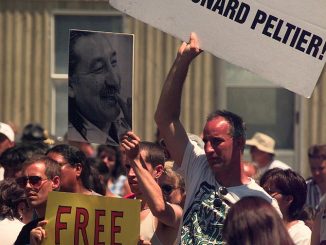
A group of spectators raise signs and a photo in support of Leonard Peltier during former President Clinton’s speech July 7, 1999, at Pine Ridge High School on the Pine Ridge Indian reservation.

Leonard Peltier’s name has become a story that reflects other stories. One narrative describes Peltier as America’s longest political prisoner, serving more than 46 years in a federal maximum security prison. In that telling, Peltier has become a humanitarian and a 78-year-old Turtle Mountain elder who has been incarcerated for far too long.

There is a long list of people, tribes and organizations that have called for Peltier’s freedom. The former prosecutor in the case. Members of Congress. Amnesty International USA. Pope John Francis. The Dalai Lama. The National Congress of American Indians. Dozens of tribal nations, including Peltier’s own tribe, the Turtle Mountain Band of Chippewa Indians. And, as of this month, the Democratic National Committee.

That’s one version. A contrary account casts Peltier as the lead character for the crimes committed by the American Indian Movement during the Wounded Knee era, including internal community violence, and he is described as a remorseless murderer.

That last story is still promoted by the Federal Bureau of Investigation on its website. But Peltier is not in prison for murder. The government could not justify a murder case, so it switched gears and today Leonard Peltier is Inmate #89637-132 serving at the United States Penitentiary, Coleman, in central Florida, on charges of “aiding and abetting” the murder of federal officers, plus a seven-year sentence for an escape attempt.

Indeed Peltier has already served a longer sentence than most principals in murder convictions. There is no way to look at the evidence and come away with any conclusion other than Peltier is being punished for crimes that could not be proven beyond a reasonable doubt in a court of law.

Kevin Sharp is a Nashville attorney, and former U.S. District Court judge, who is representing Peltier pro bono with a petition to President Joe Biden calling for clemency. That petition questions the role of the United States government saying “the FBI redoubled their efforts to secure a conviction,” including dropping other charges, so that the “weight of the Federal Government could be directed against Leonard Peltier.”

One of the problems is that even if guilty, Peltier has overserved.

“He’s overserved any sentence he should have,” Sharp said. “You got your pound of flesh. If that’s what you wanted, you got a guy who was there and you, he’s now 78 years old, and he’s got 46 years behind bars. What else do you want? Except for him to die. And we stopped talking about him that way, but that’s the worst thing that can happen because now you don’t start, stop talking about him. Now you’ve got this guy that you allowed to die in prison. It gets louder, not softer.”

Over the years the government first said Peltier shot the agents. Then later the prosecution switched the story to “we don’t know who killed the agents, but we know Leonard was there,” Sharp said.

“Okay. Congratulations. There were 40 other people there with weapons. There were lots of other people there that day. There were 150 agents there. One of them killed Joe Stuntz, a 21-year-old Native boy. We don’t know who killed him. We know it was one of the agents that they never went to figure it out. So those are the facts that we know. And if that case was tried today, there is no way it stands.”

Sharp said the Peltier’s trial would not stand scrutiny today.

“There aren’t even two sides,” he said. “We know that the witnesses were intimidated. We know that witnesses were threatened. We know that affidavits knowingly false affidavits were submitted to the courts. We know that when the trial took place and the prosecutor said, we only have this one piece of evidence, this shell casing, this ties Leonard too, to this shooting. We know now that they knew that wasn’t true. And we only learned years later after his conviction, that there had been a ballistics test that showed it wasn’t his weapon.”

In the White House petition Sharp argues that Peltier “remains a casualty of this country’s cruel and lawless war against American Indians his continued incarceration, moreover, is a constant reminder to Native communities that they are disposable in the eyes of the U.S. government and unworthy of the most basic protections afforded by our Constitution.”

It’s the failure of basic constitutional protections that power Sharp’s message: He left the federal bench because of what he saw as structural issues in the criminal justice system.

“I was forced because of mandatory minimums to sentence a young man to two life sentences,” Sharp recalled. “It was very frustrating to me because in order to become a federal judge, you’re vetted and investigated by the FBI, vetted and investigated by the White House, the Department of Justice, the Senate Judiciary Committee, and they have their own investigators all for one reason … and that’s to satisfy themselves that you have the intellect and the temperament and the judgment to rule on these most important items in our country and that is dealing with somebody’s liberty.”

Sharp sent Chris Young to prison. And that crossed a line for him. So after six years as a federal judge, Sharp shifted gears and set out to defend justice.

“That led me to the Trump Oval Office and working with Kim Kardashian to help free this young man,” he said. “His name was Chris Young … and Chris is free today. We actually were able to secure clemency.”

It was in that context that Sharp became interested in Leonard Peltier.

He received a package from Connie Nelson, the former wife of Willie Nelson.

“And I sat down with this package and it was the trial transcripts from Leonard’s trial,” he said. “It was newspaper articles, court opinions, photographs, and I just started going through it and I am sucked in.”

Sharp saw holes in the government’s story.

“It was easy for me to see what happened, the misconduct by the prosecutors, by the investigators, the rulings by the court that would never stand today because the standard of review is different. All of that was easy for me,” he said. “What then has sucked me in for years since I first opened that package is the ‘why?’”

Why are there so many constitutional violations? What was going on? What led to this point?

“It was the context. That’s what sucked me into this and has aggravated me, has, you know, made me angry, made me sad, made me confused,” Sharp said. “‘What are we doing? And why are we here? And that’s why Leonard Peltier is so important.’ This isn’t about people with guns on Pine Ridge, you know, South Dakota on June 26th, 1975. That’s part of it. But the real story is the why. And as, as one of the courts said in one of the court opinions, the United States government needs to take responsibility for what happened there that day.”

Sharp said there is no way that Peltier’s trial would meet today’s minimum standards of justice.

In 1986 the 8th U.S. Court of Appeals found that the government had failed to disclose evidence favorable to Peltier. This is what’s known as a “Brady violation” and it’s enough to require a new trial. But in Peltier’s case the rule was ignored. The district court “held that the October 2, 1975, teletype, evaluated in the context of the entire record, would not have affected the outcome of the trial and that, therefore, Peltier was not entitled to relief.”

Or consider the story of a self-proclaimed racist juror. Three women in Fargo slipped a note to the trial judge, Paul Benson, that said they were friends with the juror and she told them that she was really prejudiced against Indians. The judge asks her about the statement. “Yep, I said it. But I told you when you were asking me questions that I would set any prejudice I had. I’d be fair.” The judge says, “Thank you very much.” And the trial continued on and Juror Number 10 voted “guilty.”

That fact alone would be enough to reverse a trial.

“If that happened today, he gets a new trial,” Sharp said. “So it’s those things that drive me crazy. When I talk about, look, I, believe in the Constitution, those are all constitutional violations. We get a new trial.”

The government’s prosecutors changed their theory in 1985 — after Peltier’s conviction. As the prosecutor Lynn Crooks told the appeals court, “we can’t prove who shot those agents.” Thus, Peltier was not actually convicted of murder instead he’s been in prison since 1977 on “aiding and abetting” the murder of federal officers.

Another former prosecutor in the case, James Reynolds, has called for clemency. In a letter to the president, Reynolds wrote that with the benefit of hindsight “I have realized that the prosecution and continued incarceration of Mr. Peltier was and is unjust. We were not able to prove that Mr. Peltier personally committed any offense on the Pine Ridge Reservation.”

One other story told about Peltier is not directly related to his aiding and abetting conviction — and that’s the tie to the Anna Mae Aquash murder investigation. The American Indian Movement at first blamed the FBI for Anna Mae Aquash’s murder in February of 1976. But later information surfaced that she was murdered by AIM because she was suspected of being an informer. Aquash’s family said Peltier was involved and was aware of her killer. Two former AIM members, Arlo Looking Cloud and John Graham, were convicted of killing Aquash.

Sharp points out that Peltier has never been charged in connection with Aquash.

In a statement the last week of September, Thalia Carroll-Cachimuel, executive director of the International Leonard Peltier Defense Committee, said “there has been an extraordinary volume of misinformation spread regarding Leonard Peltier. Leonard Peltier’s conviction and perverse length of his incarceration are emblematic of the racist mistreatment of American Indians by law enforcement that existed throughout Indian Country for decades. If there is evidence that has never before been produced, then we encourage its unveiling if the true motive is justice. If the motive is simply to support Mr. Peltier’s unjust imprisonment, the bar must be set much higher.”

Peltier’s petition for clemency will be up to Biden. Just this month a resolution enacted by the Democratic National Committee said the party’s platform already says the president should use clemency “to secure the release of those serving unduly long sentences.”

And, in Peltier’s case, “given the overwhelming support for clemency, the constitutional due process issues underlying Mr. Peltier’s prosecution, his status as an elderly inmate, and that he is an American Indian, who suffer from greater rates of health disparities and severe underlying health conditions, Mr. Peltier is a good candidate to be granted mercy and leniency; and … it is highly appropriate that consideration of clemency for Mr. Peltier be prioritized and expedited, so that Mr. Peltier can return to his family and live his final years among his people.”

Peltier’s petition says the time for clemency is now because his health is fading.

“Leonard suffers from a variety of ailments, including kidney disease, Type 2 diabetes, high blood pressure, a heart condition, bone spurs in his feet, a degenerative joint disease, constant shortness of breath and dizziness, and painful injuries to his jaw. A stroke in 1986 left Leonard virtually blind in one eye,” the clemency petition says. “Prison doctors advised Leonard that the condition required surgery, but the maximum-security prison where he is incarcerated does not have the capacity to treat the condition. Leonard’s physical condition is dire, and he cannot physically defend himself in prison, let alone threaten anyone with harm.”

North Dakota state Rep. Ruth Buffalo, Mandan Hidatsa Arikara, brought the resolution forward at the September DNC meeting. She said it started with a coordinated message from a variety of state legislators and the North Dakota Democratic–Nonpartisan League Party. That was followed by a similar call from the Native American caucus of Native American state legislators. All that built toward the DNC resolution.

Buffalo represents Fargo in the legislature, the city where Peltier’s trial originally took place. She said has heard from constituents “regardless of party affiliation” supporting clemency because of the constitutional violations.

“One thing that has kept us going is so many of us, unfortunately, have relatives and loved ones who are currently in the criminal justice system or who have thankfully made it out of serving time behind bars,” she said. And so Peltier’s long prison time is “something an issue that definitely hits home for many of us.”

She said Peltier should come home.

“I know there are so many people who have been praying since the seventies for Leonard’s release,” Buffalo said. “And so we know that there’s many grandmas and elder women at Turtle Mountain who pray for Leonard on a daily basis.”

This whole case is a reflection of injustice, she said, and it must be resolved in order to heal communities.

“Leonard’s release is one sure way to make sure that we are on a path towards healing,” Buffalo said.

Source: Resumen

Strugglelalucha256


Situaciones indignantes por ser colonia

Estos pasados días han sucedido particularmente dos situaciones que abonan a la indignación de ser un estado colonial.

Una tiene que ver con la energía y la otra con la migración hacia Puerto Rico. Pero ambas demuestran la impotencia que tenemos como pueblo para solucionar graves problemas que afectan miles de vidas humanas.

La privatización impuesta en nuestro país de la industria energética ha creado plantas de generación ajenas a la realidad que tenemos como isla caribeña donde tenemos sol la mayor parte del año. Plantas ultra tóxicas que queman carbón y otras a base de gas natural. Carbón que llega de Colombia y gas proveniente de los Estados Unidos. 

Una de las plantas a base de gas se quedó sin suministro en medio de la crisis desatada por el Huracán Fiona, pero el cargamento llegó en un barco con bandera de las Islas Marshall. Por una Ley de Cabotaje impuesta a PR que obliga a que toda mercancía debe llegar en barco, tripulación y bandera estadounidense, no se pudo descargar el gas, afectando la vida de miles de personas que quedaron sin luz. Tuvo que Biden proclamar una dispensa de 10 días para que el barco pudiera tocar tierra en PR.

La otra ignominia ha sido que más de cien refugiados de Haití, hermanos y hermanas caribeñas que llegaron aquí huyendo del terrible conflicto en su país, no puedan ser bienvenidos por el pueblo boricua para brindarles el apoyo que necesitan y que queremos darle. Porque es la Guardia Costanera y otras autoridades estadounidenses las que deciden quién entra a Puerto Rico. Porque es Estado Unidos quien controla nuestras fronteras aéreas y marítimas.

Una razón más para acelerar la lucha por la independencia. ¡Viva Puerto Rico Libre!

Desde Puerto Rico para Radio Clarín en Colombia, les habló Berta Joubert-Ceci.

Strugglelalucha256


Cuba: 60 Years of the missile crisis

This October, Cuba remembers the installation of Soviet nuclear missiles in Cuba, a decision that triggered one of the worst crises of the so-called Cold War. For several days, the world was on the brink of a war with incalculable consequences, which showed the will of the Cuban people to defend their sovereignty at any cost.

Sixty years after the crisis, Resumen Latinoamericano takes a look back at the days of terror in which the world was on the brink of World War III in an unprecedented nuclear conflict.

It isn’t possible to understand the crisis without an in-depth analysis of the events in the US policy towards Cuba, which led to the presence of the missiles in Cuba.

The story goes back to 1959, when the Cuban Revolution led by Fidel Castro overthrew the US-backed dictator Fulgencio Batista and emerged as a new social justice paradigm, something Washington was unwilling to tolerate. Its new social and political initiatives put the island in the crosshairs of hostilities between Havana and the White House, a situation that worsened after the implementation of an agrarian reform, which included the nationalization of US-owned land and businesses.

The United States counter-attacked with a commercial, economic and financial blockade to prevent Cuba from buying or selling products. In this context, the newly born revolution declared itself socialist and had the Soviet Union as its main trading partner and ally amid the Cold War between Moscow and Washington.

On January 3, 1961, the then-President of the United States, Dwight Eisenhower, broke diplomatic relations with the Cuban government. Three months later, more than a thousand military personnel trained and paid by the US Central Intelligence Agency (CIA) invaded the Bay of Pigs in Cuba with the aim of overthrowing the revolutionary government. In less than 72 hours, the Cuban army thwarted their plans, an event that would go down in history as the first great defeat of US imperialism in Latin America.

In 1961, the arrival of J. F. Kennedy to the White House launched the most dynamic period of US diplomacy, a period of failures. The US administration’s revengeful spirit was born out of the humiliation suffered by the defeat of the US orchrastrated mercenary invasion. Cuba became a real obsession for Kennedy.

At the end of that year, Operation Mongoose was born, the biggest subversive plan orchestrated against Cuba from Washington, which was due to end with the direct military intervention on the island by the US Armed Forces in October 1962.

When Soviet intelligence (KGB) became aware of the plans, it offered the island to deploy missiles as a deterrent-defensive measure. However, Moscow had another interest in the background. In 1962, the US had installed a series of nuclear ballistic missiles called Jupiter in Turkey, capable of hitting Soviet territory within minutes in the event of a confrontation.

The proposal took Fidel by surprise. He didn’t want to accept at first, because of the risk it represented and because he didn’t want Cuba to be seen as a Soviet military base. After much thought, the revolutionary government agreed to accept the installation of the rockets under five conditions: that the United States lift the blockade, withdraw from the Guantanamo Naval Base, and put an end to pirate attacks, subversive activities, and violations of Cuban airspace.

The eyes of the world were on the island and Kennedy was beginning to feel a heavy pressure on his shoulders. He knew that the US people wouldn’t accept a nuclear conflict with the island, a war that would have been unleashed just because of his whim of wanting to subjugate the island. His chances for reelection were at stake, and it was then that he negotiated with Moscow the withdrawal of the rockets.

Cuba was excluded from the negotiations and its demands were ignored. Cowardly, the then-leader of the Soviet Union, Nikita Khrushchev, decided to accede to Kennedy’s request, and the missiles were dismantled over three weeks.

In an interview years later, Fidel stated that the island did not feel betrayed but very irritated and upset. “We think it was completely wrong. To exchange Cuba’s rockets for Turkey’s was immoral and unacceptable. Withdraw the rockets without discussing it with us beforehand was also wrong. I understand that there was a situation of great tension, of danger, but it was unacceptable to decide to withdraw the projectiles without consulting Cuba,” he said.

The island would not have objected, but “we would have demanded conditions. Khrushchev could have said he would withdraw the missiles if there were guarantees for Cuba. But this didn’t happen. The Guantanamo Base remained there, as well as the pirate attacks, the dirty war, the subversive plans. Everything remained,” he concluded.

The Cold War lasted until 1991, with the dissolution of the USSR. Kennedy was assassinated in 1963. Khrushchev died in 1971 at the age of 77. Neither witnessed the end of the conflict that almost led the world to disaster. Meanwhile, Cuba has been living for 60 years under the impact of an obsolete and failed policy. It is hard for us to not think about where we would be today if the new blockade at the time had been ended as part of the deal for removing the missiles.

Source: Resumen Latinoamericano – US

Strugglelalucha256


Los Angeles: Film showing – Cuba’s Life Task: Combatting Climate Change, Oct. 26

WEDNESDAY, OCTOBER 26, 2022 AT 6 PM
Documentary: Cuba’s Life Task: Combating Climate Change
Harriet Tubman Center for Social Justice – L.A.

Documentary film by Cuba expert Helen Yaffe

Join us for this remarkable film, made in Cuba, featuring Cuban leaders and experts describing the revolutionary socialist campaign, Tarea Vida. Inspired by Fidel Castro’s visionary passion for the environment, Tarea Vida is a mass-education campaign, a highly practiced system of evacuation during hurricanes, a world-renowned reforestation campaign, and an international solidarity mission to share the Cuban experience and to learn from other nations! This is in contrast with imperialist countries that view climate change as a highly competitive business opportunity. Cuba’s Tera Vida shows that socialism is the only way to save the planet.

Join us to view this inspiring film and discuss upcoming actions to End the U.S. Blockade of Cuba.

Please wear a mask and social distance …. it’s not over, yet!
Call for more information: 323-306-6240

Strugglelalucha256


New York International Day to Lift Sanctions Off Zimbabwe, Oct. 25

New York City: International Day to Lift Sanctions Off Zimbabwe

Tuesday, October 25 – 4:00 p.m.

U.S. Mission to the United Nations, E. 45 St. & 1st Ave., Manhattan

Sponsored by December 12th Movement

Strugglelalucha256


Lula and the challenging Brazilian situation

The second round of the Brazilian elections, on October 30, is probably the most important and bitter electoral confrontation in our America since the election of Hugo Chavez in 1998.  This election goes further than just deciding who will govern the South American giant for the next 5 years, the largest and most populated country with the most important economy in our region, eighth in the world in terms of GDP. Nor will it only decide who will rule the country between neoliberalism and anti-neoliberalism, since in Brazil the first thing at stake is the defense and reconquest of basic democratic rights, already greatly diminished social and labor rights by Temer and Bolsonaro, which the former military man threatens to overthrow together with the politicians, in order to satisfy the businessmen who support him. This election is also about – how much – whether the death blow will be dealt to what is left of the Amazon forest, the planet’s oxygen lung, as is the goal of Bolsonaro’s agribusiness capital partners. It is, at the same time, a key episode in the dispute for our America between democratic and progressive forces, which fight for national sovereignty, multipolarity, and the fight against inequality and hunger, and those who advocate surrendering everything to the market and financial capital.

Lula was enabled to compete electorally when the Brazilian Supreme Court acquitted him of the false charges brought against him by the venal judge Sergio Moro and his crony prosecutor Deltan Dallagnol.  But this could not erase the image of a corrupt governmental performance of Lulismo in government installed in wide layers of the population due to the huge campaign of lies unleashed by the Brazilian and international hegemonic media.  Together with the political advance of Bolsonarismo, Lula has had to create a great coalition that includes important sectors of the center-right that previously opposed him, but also his traditional allies of the center-left and the most combative social movements in Brazil, as a formula to ensure a convincing victory in the face of the serious anti-democratic threat of Bolsonarismo.

Sergio Moro and Dallkagnol are trained and part of the program of the US State Department to, under the pretext of fighting corruption, implement in our region the lawfare against candidates or officials who defend proposals contrary to neoliberalism and favorable to popular causes in order to liquidate them politically; a sort of civil death. All this in perfect conjunction with the work of disinformation and defamation of the overwhelming network of hegemonic media and new structures of digital networks at the service of the empire. Lawfare has also been applied against former presidents Manuel Zelaya, Fernando Lugo, Cristina Fernández, Rafael Correa, Evo Morales and several of their followers. In addition, it was the instrument to carry out the coup d’état against Dilma Rousseff and to disqualify Lula as presidential candidate when he was ahead in all polls and thus opened the way for Bolsonaro.

Although Bolsonaro’s eruption into the political arena after decades of gray and extremely corrupt performance as a congressman is not only due to that, he did remove the formidable obstacle that Lula had placed in his way. Today we know that two years earlier the former captain had received the green light from the then commander-in-chief of the army, General Villas Boas, to run for the presidency. At the same time, it is evident that the crisis of neoliberal policies and the success of the progressive and redistributive policies of the PT had exhausted the hegemony of the Brazilian elite, which needed an “outsider” like Bolsonaro: a sort of political lumpen, barely educated, but with unquestionable charisma, liveliness and the ability to connect with large sectors of Brazilian society characterized by their ignorance, obscurantism and religious fanaticism, or their links to organized crime – such as the famous militiamen -, or with retired military men full of ambitions of power and enrichment. About 6 thousand of these have been dispersed by Bolsonaro throughout the public administration, another problem that Lula would have to deal with.

Lula continues to put up a heroic fight in route to the second round in the face of very difficult forces and obstacles to overcome. One of them is how he would govern with a Bolsonarist and right-wing majority congress, which even has the votes to impeach him. His campaign has been such an outpouring of masses that it would seem to lead him directly to the Alborada Palace. Although after the errors of the polls in the first round, the 5 points of advantage that they assign him now open room for doubt. Again, I prefer to trust in the optimism of will than in the pessimism of reason.

Source: Resumen

Strugglelalucha256


The last thing that Haiti needs is another military intervention

At the United Nations General Assembly on 24 September 2022, Haiti’s Foreign Minister Jean Victor Geneus admitted that his country faces a serious crisis, which he said ‘can only be solved with the effective support of our partners’. To many close observers of the situation unfolding in Haiti, the phrase ‘effective support’ sounded like Geneus was signaling that another military intervention by Western powers was imminent. Indeed, two days prior to Geneus’s comments, The Washington Post published an editorial on the situation in Haiti in which it called for ‘muscular action by outside actors’. On 15 October, the United States and Canada issued a joint statement announcing that they had sent military aircraft to Haiti to deliver weapons to Haitian security services. That same day, the United States submitted a draft resolution to the UN Security Council calling for the ‘immediate deployment of a multinational rapid action force’ into Haiti.

Ever since the Haitian Revolution won independence from France in 1804, Haiti has faced successive waves of invasions, including a two-decade-long US occupation from 1915 to 1934, a US-backed dictatorship from 1957 to 1986, two Western-backed coups against the progressive former President Jean-Bertrand Aristide in 1991 and 2004, and a UN military intervention from 2004 to 2017. These invasions have prevented Haiti from securing its sovereignty and have prevented its people from building dignified lives. Another invasion, whether by US and Canadian troops or by UN peacekeeping forces, will only deepen the crisis. Tricontinental: Institute for Social Research, the International Peoples’ AssemblyALBA Movements, and the Plateforme Haïtienne de Plaidoyer pour un Développement Alternatif (‘Haitian Advocacy Platform for Alternative Development’ or PAPDA) have produced a red alert on the current situation in Haiti, which can be found below and downloaded as a PDF.

What is happening in Haiti?

A popular insurrection has unfolded in Haiti throughout 2022. These protests are the continuation of a cycle of resistance that began in 2016 in response to a social crisis developed by the coups in 1991 and 2004, the earthquake in 2010, and Hurricane Matthew in 2016. For more than a century, any attempt by the Haitian people to exit the neocolonial system imposed by the US military occupation (1915–34) has been met with military and economic interventions to preserve it. The structures of domination and exploitation established by that system have impoverished the Haitian people, with most of the population having no access to drinking water, health care, education, or decent housing. Of Haiti’s 11.4 million people, 4.6 million are food insecure and 70% are unemployed.

The Haitian Creole word dechoukaj or ‘uprooting’ – which was first used in the pro-democracy movements of 1986 that fought against the US-backed dictatorship – has come to define the current protests. The government of Haiti, led by acting Prime Minister and President Ariel Henry, raised fuel prices during this crisis, which provoked a protest from the trade unions and deepened the movement. Henry was installed to his post in 2021 by the ‘Core Group’ (made up of six countries and led by the US, the European Union, the UN, and the Organisation of American States) after the murder of the unpopular president Jovenel Moïse. Although still unsolved, it is clear that Moïse was killed by a conspiracy that included the ruling party, drug trafficking gangs, Colombian mercenaries, and US intelligence services. The UN’s Helen La Lime told the Security Council in February that the national investigation into Moïse’s murder had stalled, a situation that has fuelled rumours and exacerbated both suspicion and mistrust within the country.

How have the forces of neocolonialism reacted?

The United States and Canada are now arming Henry’s illegitimate government and planning military intervention in Haiti. On 15 October, the US submitted a draft resolution to the United Nations Security Council calling for the ‘immediate deployment of a multinational rapid action force’ in the country. This would be the latest chapter in over two centuries of destructive intervention by Western countries in Haiti. Since the 1804 Haitian Revolution, the forces of imperialism (including slave owners) have intervened militarily and economically against people’s movements seeking to end the neocolonial system. Most recently, these forces entered the country under the auspices of the United Nations via the UN Stabilisation Mission in Haiti (MINUSTAH), which was active from 2004 to 2017. A further such intervention in the name of ‘human rights’ would only affirm the neocolonial system now managed by Ariel Henry and would be catastrophic for the Haitian people, whose movement forward is being blocked by gangs created and promoted behind the scenes by the Haitian oligarchy, supported by the Core Group, and armed by weapons from the United States.

How can the world stand in solidarity with Haiti?

Haiti’s crisis can only be solved by the Haitian people, but they must be accompanied by the immense force of international solidarity. The world can look to the examples demonstrated by the Cuban Medical Brigade, which first went to Haiti in 1998; by the Via Campesina/ALBA Movimientos brigade, which has worked with popular movements on reforestation and popular education since 2009; and by the assistance provided by the Venezuelan government, which includes discounted oil. It is imperative for those standing in solidarity with Haiti to demand, at a minimum:

  1. that France and the United States provide reparations for the theft of Haitian wealth since 1804, including the return of the gold stolen by the US in 1914. France alone owes Haiti at least $28 billion.
  2. that the United States return Navassa Island to Haiti.
  3. that the United Nations pay for the crimes committed by MINUSTAH, whose forces killed tens of thousands of Haitians, raped untold numbers of women, and introduced cholera into the country.
  4. that the Haitian people be permitted to build their own sovereign, dignified, and just political and economic framework and to create education and health systems that can meet the people’s real needs.
  5. that all progressive forces oppose the military invasion of Haiti.

The common sense demands in this red alert do not require much elaboration, but they do need to be amplified.

Western countries will talk about this new military intervention with phrases such as ‘restoring democracy’ and ‘defending human rights’. The terms ‘democracy’ and ‘human rights’ are demeaned in these instances. This was on display at the UN General Assembly in September, when US President Joe Biden said that his government continues ‘to stand with our neighbor in Haiti’. The emptiness of these words is revealed in a new Amnesty International report that documents the racist abuse faced by Haitian asylum seekers in the United States. The US and the Core Group might stand with people like Ariel Henry and the Haitian oligarchy, but they do not stand with the Haitian people, including those who have fled to the United States.

In 1957, the Haitian communist novelist Jacques-Stéphen Alexis published a letter to his country titled La belle amour humaine (‘Beautiful Human Love’). ‘I don’t think that the triumph of morality can happen by itself without the actions of humans’, Alexis wrote. A descendent of Jean-Jacques Dessalines, one of the revolutionaries that overthrew French rule in 1804, Alexis wrote novels to uplift the human spirit, a profound contribution to the Battle of Emotions in his country. In 1959, Alexis founded the Parti pour l’Entente Nationale (‘People’s Consensus Party’). On 2 June 1960, Alexis wrote to the US-backed dictator François ‘Papa Doc’ Duvalier to inform him that both he and his country would overcome the violence of the dictatorship. ‘As a man and as a citizen’, Alexis wrote, ‘it is inescapable to feel the inexorable march of the terrible disease, this slow death, which each day leads our people to the cemetery of nations like wounded pachyderms to the necropolis of elephants’. This march can only be halted by the people. Alexis was forced into exile in Moscow, where he participated in a meeting of international communist parties. When he arrived back in Haiti in April 1961, he was abducted in Môle-Saint-Nicolas and killed by the dictatorship shortly thereafter. In his letter to Duvalier, Alexis echoed, ‘we are the children of the future’.

Source: Resumen

Strugglelalucha256


Palestinians observe general strike to honor young man killed in West Bank

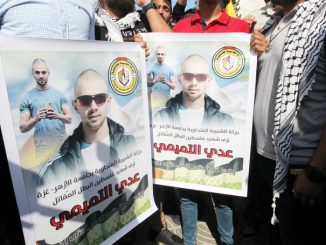
Palestinians are observing a general strike across the occupied West Bank and al-Quds to mourn a young Palestinian man who was killed by Israeli forces in a confrontation.

Heeding a call from nationalist factions, Palestinians observed the one-day general strike on Thursday to pay homage to Udai Tamimi, who was gunned down during a reported firefight with the Israeli forces at the entrance of the West Bank settlement of Maale Adumim in the east of the holy occupied city of al-Quds on Wednesday.

Businesses, schools and different facilities shut down their doors in different areas of the West Bank and al-Quds. The strike also included public transportation.

Tamimi, 22, was wanted by the Israeli military after killing an Israeli soldier, identified as Noa Lazar, at a checkpoint near the Shuafat Palestinian refugee camp in al-Quds on Oct. 8.

The 10-day search for Tamimi witnessed the Israeli military shutting down the entrances to the camp and laying siege that paralyzed healthcare services and schools there.

Palestinian resistance factions called for the strike and urged Palestinians to take to the streets to denounce Tamimi’s killing and other acts of violence by the Israeli regime, including the ongoing blockade on Nablus.

The Israeli regime has intensified its deadly crackdown on Palestinians in the occupied territories.

According to the Health Ministry, a total of 174 Palestinians, including 41 minors, were killed by Israeli forces since the start of 2022.

It added that 123 Palestinians were killed in the West Bank and 51 others in the besieged Gaza Strip.

The Israeli regime occupied the West Bank during a heavily-Western-backed war in 1967. Ever since, it has dotted the territory with hundreds of illegal settlements that have come to house more than 600,000 Israeli settlers.

Palestinian youth succumbs to wounds from Israeli violence in West Bank

Meanwhile, another Palestinian youth on Oct. 20 lost his life due to Israeli violence in the occupied West Bank, according to the Health Ministry.

The Ministry said in a press release that 16-year-old Muhammad Fadi Nuri died of his critical wounds he had sustained after being shot by Israeli forces in the abdomen at the northern entrance of al-Bireh city in September.

Source: Press TV

Strugglelalucha256


Stop Police Brutality National Day of Protest March & Rally Oct. 22

Strugglelalucha256


Resist U.S. war, extend solidarity to the people of Donbass!

Remarks given by Melinda Butterfield, Struggle-La Lucha co-editor, at the “No to NATO, War and Racism” protest in the Bronx, New York, on Oct. 15.

I think it’s important to bring up the struggle of the people who are directly affected by the conflict in Ukraine – that is, the people of the Donbass region and Ukrainian anti-fascists who have been forced into exile for the last eight-and-a-half years. 

This summer, the people in the city of Donetsk, who have lived under Ukrainian bombs for more than eight years, have faced their toughest stretch ever surviving. The attacks have been constant and getting worse because of the infusion of more advanced U.S. and NATO weapons.

This war didn’t start last February, when Russia intervened. It started with a coup against the elected Ukrainian government, sponsored by the United States, in 2014. We know how that works – we’ve seen it many times in Latin America and other places around the world. 

The people in the eastern part of Ukraine said “No – we don’t want to live under a regime that’s filled with fascists. We don’t want to live under a regime that answers to Washington and NATO.” And they had a big struggle. 

Unfortunately, it was crushed in many parts of the country. But in Donetsk and Lugansk, in the Donbass region bordering Russia, they were able to declare independence, form a people’s militia, and defend their independence for the last eight-and-a-half years. 

When we talk about the struggle here, we use the slogan, “When people’s rights are under attack, what do we do? Stand up, fight back.” When trans rights, Black people’s rights, abortion rights, immigrant rights are under attack, we say: Stand up and fight back. In Donbass, they stood up and fought back! Just like they are doing now in Haiti. And in the same way, the people there have been demonized and discounted. 

Unfortunately, here in the United States, even in the anti-war movement and the left, there’s very little consciousness about the Donbass people’s struggle. But they are the ones on the front lines. They are the ones who have been taking the brunt of the Ukrainian attacks for almost a decade. It is imperative that we extend our solidarity to them, build bridges of unity with them, with our struggles, our communities and other liberation struggles from Palestine to Haiti to Puerto Rico.

There’s another development that could confuse the movement here, and we’ve got to be alert to it. That is the referendum held at the end of September in Donetsk, Lugansk and the Zaparozhye and Kherson regions to join the Russian Federation.

The reason that happened is not because Russia was trying to make a land grab against Ukraine. It’s something Russia has resisted for the last eight years, even as a movement to join Russia was building in those areas. It was an emergency measure of last resort. 

The people don’t want to live under Ukrainian bombs and fascists anymore. Now they have the constitutional protection of the Russian Federation, which gives Russia more power to protect them with their nuclear deterrent and other measures. 

The way the referendum is being presented here is just the U.S. projecting its land-grabbing imperialist policies onto Russia. It discounts the context and the wishes of the people there. It’s against self-determination. So it’s important that we not get confused about this or let it turn into another thing to divide and shut down the anti-war movement, like what happened last February. 

Solidarity with the people of Donbass! Let’s build a fighting anti-war movement. Let’s fight for what we need here at home, and take back that $70 billion the U.S. has committed so far this year for war in Ukraine. 

Strugglelalucha256
https://www.struggle-la-lucha.org/2022/page/16/