What did the unions do?

Black workers fold hides at Chicago Union’s Stockyards. Photo: Chicago History Museum

The long shadow of the Chicago race riot, Part 3

Up to the 1920s, Chicago was the center of the labor movement in the United States. It was the heart and soul of the eight-hour-day struggle in 1886. Workers marched from factory to factory and shut them down.

Chicago’s working class and its leaders, the Haymarket martyrs, gave May Day to the world. The capitalists violently crushed this movement and hanged its leaders—George Engel, Adolph Fischer, Albert Parsons and August Spies—on Nov. 11, 1887. Another activist, Louis Lingg, either committed suicide or was killed in his jail cell.

Because of its central location, sitting at the foot of Lake Michigan, Chicago became the industrial capital of the U.S. It was the railroad and meatpacking center of the country. In those days, railroads employed 2 million workers, 10 times as many as today.

Chicago was the headquarters of the Industrial Workers of the World (IWW, nicknamed “Wobblies”). In the fall of 1919, the Communist Party would be founded there in two conventions. (The two communist parties that were formed, the Communist Labor Party and the Communist Party of America, would merge in 1921.) 

However, the workers’ movement was virtually all-white. It ignored the super oppression of African Americans. What finally changed this around was the impact of the Bolshevik Revolution and the struggles of oppressed peoples. 

The best of these socialists would have used guns to stop a lynching. Left-wingers attacked the color line that existed in most of the unions belonging to the American Federation of Labor. (The United Mine Workers was a notable exception in having a large Black membership.)

Eugene Debs won over 900,000 votes as the Socialist Party presidential candidate in 1920 while he was imprisoned for opposing World War I. Debs wrote that “the history of the Negro in the United States is a history of crime without parallel,” in a 1903 issue of the International Socialist Review. The article was a fiery attack on racism and ridiculed white supremacy. 

Yet for Debs nothing more was required from socialists concerning the struggle against racism except to say “the class struggle is colorless.”

Debs was beloved for leading the American Railway Union’s 1894 Pullman strike that shut down many railroads. President Grover Cleveland crushed the walkout by sending U.S. troops to Chicago.

Soldiers under the command of Gen. Nelson Miles shot down strikers. Miles had earlier captured Geronimo and would later invade Puerto Rico, making the beautiful island a U.S. colony.

But the ARU wasn’t “colorless.” Its convention delegates had voted 112-100 to bar Black workers from joining their union. Debs argued passionately against this racist ban. It would have been better if Debs had quit the Jim Crow ARU and organized an alternative open to all workers.

Members of IWW Timber Workers jailed in Grabow, La., in 1912. The union organized Black and white workers together and led the Merryville strike soon after. Photo: RootsWeb

The legendary IWW 

The IWW sought to organize all workers. The Wobblies despised racism and at a time of almost universal anti-Asian racism, published literature in Japanese. African American IWW leader Ben Fletcher successfully organized Black and white dockworkers in Philadelphia.

It was their deeds that made the Wobblies an unforgettable part of working-class history. The Brotherhood of Timber Workers was particularly heroic.

It affiliated with the IWW at its May 1912 convention in Alexandria, La. Upon the urging of IWW leader Big Bill Haywood, the union members met together in defiance of the state’s segregation laws.

The biggest IWW-led strike in the region was against the American Lumber Company in Merryville, La. Thirteen hundred workers went on strike there beginning Nov. 11, 1913.

These Black, Indigenous and white strikers stood together against company terror. Mexican workers brought in as strikebreakers joined the picket line. But the triple combination of the timber barons, the Santa Fe railroad and the state of Louisiana finally broke this strike.

Five union organizers were kidnapped. Four were terribly beaten. The African American F.W. Oliver was shot. By Feb. 19, 1914, all remaining union members in Merryville had been driven out of the town. Strikers were told that they would be killed if they returned.

Although the strike was crushed, the unity of these workers was never broken. This remarkable struggle took place only 30 miles away from Jasper, Texas, where James Byrd Jr. would be dragged to his death in 1998. 

However, the IWW at the time would have agreed with Debs that socialism had nothing “special” to offer African Americans. This attitude ideologically disarmed the left.

Organizing the stockyards

Two years before the Chicago race riots there was a terrible massacre in East St. Louis, Ill. In his autobiography, W.E.B. Du Bois estimated that 125 African Americans were killed there in 1917. 

“The area became a ‘bloody half mile’ for three or four hours; streetcars were stopped, and Negroes, without regard to age or sex, were pulled off and stoned, clubbed and kicked, and mob leaders calmly shot and killed Negroes who were lying in blood in the street,” according to the Kerner Commission report.

This bloodbath inspired the NAACP’s famous “silent march” on July 28, 1917, down Manhattan’s Fifth Avenue. 

The memory of East St. Louis hung over the efforts to organize the 50,000 to 60,000 workers in Chicago’s Union Stockyards.

Meatpacking and poultry workers still have some of the highest injury rates of any occupation. A century ago it was worse.

People were horrified by Upton Sinclair’s description in his novel “The Jungle” of a worker falling into a boiling vat. People wondered what was really in their sausage. (“The Jungle” is irredeemably spoiled by a racist description of Black workers.)

William Z. Foster set out to organize these workers. Foster was a former IWW member who realized that most workers looked towards the American Federation of Labor. He believed that union activists should struggle within the AFL to make it fight.

The problem with this formulation was that, in 1919, Black workers knew they were unwanted by almost all of the craft unions and railroad brotherhoods, which at that time constituted the majority of organized labor. 

Foster organized the Stockyards Labor Council with the backing of Chicago Federation of Labor President John Fitzpatrick. The idea was to get the different craft unions to back an organizing drive. Any jurisdictional problems could be worked out later.

This was meant to be a half-step towards industrial unionism. Even if the workers would later be separated into different craft unions, they would be united at the bargaining table. Any “unskilled” workers not wanted by these craft outfits would be members of a “federal labor union” directly affiliated to the AFL.

Workers responded enthusiastically to this organizing drive. Among those who signed union cards were thousands of African Americans.

Future Black communist leader Harry Haywood’s sister Eppa was a union activist at Swift. It seemed that the color line within the labor movement was about to be broken.

But the Amalgamated Meat Cutters and Butcher Workmen never joined the Stockyards Labor Council. The New Majority, published by the Chicago Federation of Labor. continued to print racist “jokes.” 

Even the craft unions that were members of the council refused to drop their whites-only membership policy. African Americans weren’t allowed to join them. Instead they were stuck in the federal labor unions, some of which became all-Black Jim Crow locals.

This was poison to the organizing campaign. Close to one out of four meatpacking workers in Chicago was Black. They were sick of paying union dues for second-class union membership. 

Doomed by the race riot, this union drive eventually fizzled out. It would be another 20 years before the workers in the stockyards would be organized, largely by Communist Party members, in a genuine industrial union: the Packing House Workers of the CIO.

Labor’s failure to confront racist violence

Swift, Armour and the rest of the packers were the greatest beneficiaries of the Chicago race riot. They got the cops to prevent a union march in early July 1919 that was to go through African American and white neighborhoods. Two separate parades were held instead, with the Black and white marches coming together at a playground.

What did the the left do to stop the attacks on African Americans?

Alongside the red summer of lynchings, there was also a red scare. Hundreds of socialists were still locked up for opposing World War I. The IWW headquarters had been raided and its leaders were jailed.

Some union leaders were outspoken against racism. Among them was John Kilkulski, who published the Polish newspaper Glose Rabotnica. He would be assassinated on May 17, 1921. His killers were never found.

What was absolutely necessary was for the Stockyards Labor Council to organize defense squads of Black and white union members. But how could these unions have done so when most of them refused to let African Americans join their organizations in the first place?

Some must have wanted to intervene. The base of the Amalgamated Clothing Workers was thousands of workers making suits at the Hart, Schaffner & Marx factories. 

Most of these workers were Jewish immigrants from the Russian Empire. Some had participated in the Russian revolutionary movement. They were as familiar with anti-Jewish pogroms as African Americans were with lynch mobs. 

It was only years later that the labor movement and the left realized the necessity of stopping racist violence. An outstanding example was the campaign led by the Communist Party to save the lives of the Scottsboro defendants.

Another was the Dec. 14, 1974, march against racism in Boston, which was conceived by the communist leader Sam Marcy.

The mob violence in 1919 injected a higher level of race hatred into many white workers in Chicago. A long-reaching effect of this poison was to conservatize large sections. The inevitable result was to eliminate Chicago’s leadership in the working-class movement.

Next: Communists fight racism and evictions

Sources: “The Kerner Report: The 1968 Report of the National Advisory Commission on Civil Disorders”; “Organized Labor and the Black Worker 1619-1973” by Philip S. Foner; “History of the Labor Movement in the United States, Volume 6, Postwar Struggles 1918-1920” by Philip S. Foner; “Black Bolshevik, Autobiography of an Afro-American Communist” by Harry Haywood; “Down on the Killing Floor, Black and White workers in Chicago’s Packinghouses, 1904-54” by Rick Halpern; “A Few Red Drops, the Chicago Race Riot of 1919” by Claire Hartfield.


Part 1: The long shadow of the 1919 Chicago race riot

Part 2: Bombings greet the Great Migration

Part 3: What did the unions do?

Part 4: Communists fight racism and evictions

Part 5: Chicago Mayor Daley’s racist machine

Part 6: Never forget Fred Hampton

Part 7: The people put Harold Washington in City Hall

Part 8: A city of struggle

Strugglelalucha256


Zimbabwe Anti-Sanctions Day – NYC, Oct. 25

Strugglelalucha256


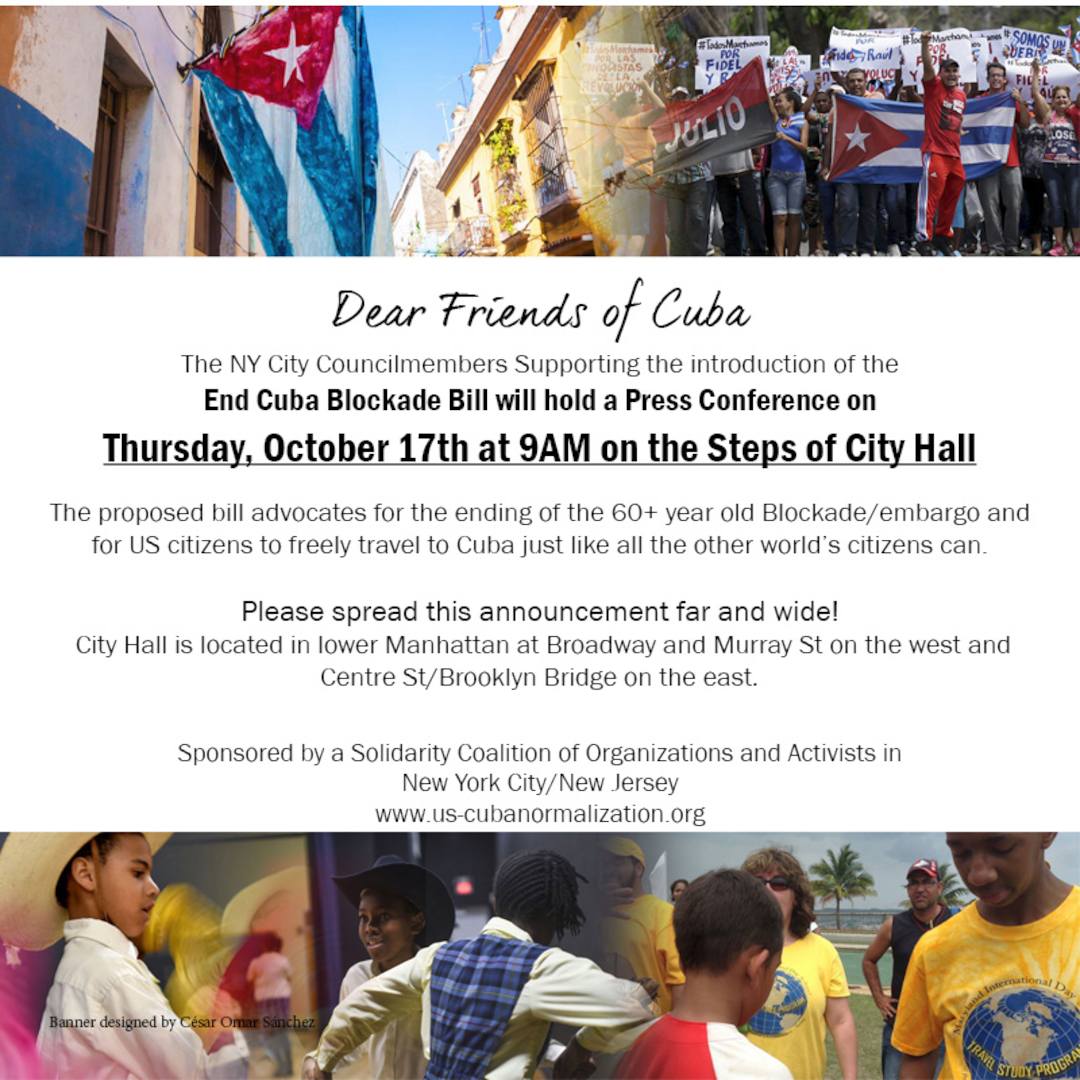
Oct. 17 NYC: End Cuba Blockade Bill at City Hall

Strugglelalucha256


Solidarity with Ecuador

New York — Hundreds of people gathered in Corona Plaza in the Borough of Queens on Oct. 13 to demand that Ecuador’s president, Lenin Moreno, resign. Ecuadorian immigrants and their supporters hailed the mass uprising in the South American country. People stayed on the elevated platform of the No. 7 train to watch.  

Ecuador’s president betrayed his election promises and instituted wholesale cutbacks. The last straw was an increase in the price of fuel, which was demanded by the International Monetary Fund.

Chevron has pillaged the country for decades and has left vast ecological damage.

Indigenous peoples have been the most hard hit. They’ve taken the lead in the struggle. Five hundred years ago, before the genocide committed by the Spanish crown, the country’s capital Quito had been part of the Inca Empire.

Among the signs in Spanish that demonstrators carried were the messages that “We support our Indigenous siblings” and “Moreno out.”

SLL photos: Stephen Millies

Strugglelalucha256


Mumia Abu-Jamal: When trans women die

Oct. 13 — In recent weeks, we have seen naked violence unleashed against Black trans women, directed against them by the state in the form of police beatings and by rightist forces in this emerging fascist movement in America.

What does this mean? Why now?

I believe it comes now for specific strategic purposes, for trans women stand on the periphery of the gay rights movement, not its nucleus. This means they are isolated, and as such they are targeted by rightist forces to isolate them further. We must not forget that they are, after all, Black folks in a land and in an era where and when Black life remains cheap. Now, as Black, gay and transgender: See where the analysis goes?

And if it’s Black trans women today, it’ll be Black straight women tomorrow. And Black children soon thereafter.

That’s the nature of the fascist beast. Attack those who seem weak, isolate them, destroy them. Since Charlottesville, we’ve seen the emergence of rightist racist forces who are committed to destroying Black life and to proving that Black lives don’t matter.

The lives of Black people are the literal foundation, not just of America, but of all of us. We need to build a radical movement that protects all of us, for all of us — that consigns such racist violence to the trash heap of history.

From Prison Nation, this is Mumia Abu-Jamal.

Listen to Mumia’s commentaries on Prison Radio

Strugglelalucha256


Ecuador’s people have a won a victory but government repression continues

Following 12 days of massive protests, the government of Lenín Moreno repealed Decree 883 which formalized neoliberal reforms. At the same time, it launched a crackdown on political opponents.

On October 13, the people of Ecuador won a major victory when the government of Lenin Moreno was forced to withdraw the deeply unpopular package of neoliberal reforms. Hundreds of thousands, led by the Indigenous people of the country, had taken part in mass protests for over 10 days against Decree 883 which formalized these reforms. While the people won this round, the larger struggle against the government continues. Shortly after making the concession, the government arrested members of former president Rafael Correa’s political movement, indicating that it had no intention of ceasing its repression.

The withdrawal of the decree took place during talks between representatives of Indigenous movements and organizations and the government team, which included Moreno himself. Decree 883 removed subsidies on fuel, leading to massive price rises, and anti-labor measures. It was imposed as part of a USD 4.2 billion agreement with the International Monetary Fund.

The negotiations between the organizations and the government were broadcast live though only 16 journalists and media organizations were allowed to participate. In the opening address, Moreno announced that Decree 883 would be repealed and a new one would be formulated after further discussions.

At the discussions, Jaime Vargas, the president of CONAIE (Confederation of Indigenous Nationalities of Ecuador), spoke representing Ecuador’s Indigenous nationalities and peoples. “I am indignant for everything that has happened and it hurts my heart,” stated Vargas. He later said that during the protests, 10 people were killed, 2,000 were injured and over 1,000 were detained (official government statistics say that 7 people were killed).

According to the president of CONAIE Jaime Vargas, 2,000 were injured in the 12 days of protest.
The violent repression of the protests was unprecedented. The deployment of the Armed Forces was facilitated through the State of Emergency declared by Moreno on October 3.

Vargas also highlighted the importance of solidarity and and hailed the participation of social movements, the youth and people of Quito who welcomed, supported and fought besides the Indigenous movements for 12 days.

He said that Decree 883 hurt “the most impoverished of the population because their costs for basic needs and transportation increase…it does not generate any social benefit.” He later added that these actions taken by the government show that the right-wing and the International Monetary Fund are administering the country.

Jaime Vargas is the president of CONAIE and spoke in the dialogue with the government on October 13

He also warned the government, “We are not going to negotiate dignity. We will not negotiate our martyrs. We hope that today we will find a definitive and lasting solution, and if this is not achieved, we will continue, firm and united and with the unrelenting commitment of defending our people and we are ready to make all of the possible sacrifices. And if that means giving our lives, we will do it.”

These words are significant in light of Lenin Moreno’s attempts earlier to divide the masses who had taken part in the protests. Moreno claimed that he has “always respected Indigenous people” and “treated them with care” but then went on to say that the rest of the people protesting are violent and bad, those that “created chaos and an apocalyptic situation”. Moreno even resorted to the tired tropes of accusing the ‘violent’ protesters of having links to drug trafficking, being foreigners and employing tactics used by guerrilla groups in Colombia. He also reiterated the claim that they were instigated by Rafael Correa and his followers.

The distinction between protesters, was of course refuted by Vargas who highlighted the unity of those on the streets, as well as the righteous indignation of the people in Ecuador. The brutal repression of the Indigenous movements by the police and military is further evidence that Moreno both does not respect and treat Indigenous people and their demands with care, and that all protesters faced the same violence from the repressive forces.

Moreno’s words were followed by a wave of detentions on October 14 of key leaders and activists who are being accused of causing “violent episodes” during the protests. Many of them face serious charges.

On Monday morning, the attorney general of Ecuador announced on Twitter that after ‘investigations,’ three individuals – Paola Pabón, Christian González and Pablo D – had been detained. It is no accident that those who were arrested are active in the Citizen Revolution (a political project started by Rafael Correa) and two of them were members of his government.

Paola Pabón is the current prefect of the Pichincha province and served in the government of Correa. She said she was detained early in the morning on October 14 after an illegal raid was conducted in her home: “Today, they entered my house at dawn and knocked down the door while I was sleeping. They arrested me without any proof. To be from the opposition in a democracy cannot be a crime. It is not democracy when members of the political opposition are persecuted in this way.” She is accused of being one of the instigators of the protests against the package of neoliberal economic measures.

Christian González, a militant with the social organization Bulla Zurda, was also detained without any evidence on charges of  “rebellion,” according to Ecuadorian activists. González served as the sub-secretary of movements, organizations, and social and political actors in the government of Correa. Pablo Lastra, who was also arrested, is a member of Bulla Zurda.

The platform, Social Movements of ALBA, denounced the arrest of González in a communique, “[The arrest] is part of political persecution against members of the Citizen Revolution, and is a sign of an authoritarian and anti-democratic government. We hold Lenín Moreno responsible for the safety of this young person [Christian] and those detained for their political position.”

The state of emergency which was imposed on October 3, as well as the curfew, has been suspended.

Source: Peoples Dispatch

Strugglelalucha256


All occupying foreign forces out of Syria! Defend Syria’s national sovereignty and territorial integrity

U.S. Peace Council statement on Turkish incursion into Syria

The U.S. Peace Council strongly condemns the illegal incursion of the Turkish forces into Syria with the approval of the Trump Administration and in direct violation of the United Nation’s Charter and international law.

Immediately after Turkish incursion, the US war establishment, Republican and Democrat alike, went on a broad attack on Trump’s decision to “withdraw” US forces from Syria, calling it a disaster for US foreign policy. According to the New York Times (October 14): “Mr. Trump says his decision to pull American troops out of the way of the Turkish advance was part of his effort to extricate the United States from ‘endless wars’ in the Middle East and elsewhere.” For the New York Times and many others in US foreign policy circles, the extrication of the US from its many foreign adventures represents a grave threat to the bipartisan commitment to US policy of global “Full Spectrum Dominance.”

Despite the public outcry and opposition from forces in both parties, it is quite clear to us that Trump’s plan to “withdraw” US forces from Syria has nothing to do with extricating the US from “endless wars” as the Turkish incursion demonstrated. On the contrary, the Trump Administration’s approval of the Turkish incursion is a clear sign of the failure of US policy of regime change in Syria and represents a last-ditch effort to partition the Syrian territory in the hope of securing a permanent military presence by the US and its NATO allies on Syrian soil. It appears that the Trump Administration’s real plan is to replace US occupying forces in Syria with the Turkish (NATO) forces, driven by Trump’s desire to quell the growing anti-war sentiment in the US before the 2020 elections.

The corporate media has even taken a step further by shedding crocodile tears for the Syrian Kurds. In the past several days, the corporate media outlets throughout the country have been bombarding the public with a barrage of moral condemnation of Trump’s decision to “betray the Kurds” without mentioning that the US and other imperialist powers have been directly responsible for the suffering of the Kurdish people not only in Syria but also in Iraq, Iran and Turkey for several decades.

As regards the Syrian Kurds, US decision-makers never had any regard for the plight of the Kurds. They were just seen as a convenient tool to advance U.S. efforts to partition Syria. The US attempts to block and undermine any reconciliation process between the Kurds and the Syrian government is a case in point.

However, this effort was also defeated this past Sunday when the Kurdish forces finally signed an agreement with the Syrian government to allow the Syrian Arab Army to enter the northern Kurdish areas of the country. According to the same article in New York Times, “The Kurdish-led militia said the Syrian government had a ‘duty to protect the country’s borders and preserve Syrian sovereignty,’ and would deploy along the Syrian-Turkish border.”

Barring new sabotages by the US warmongers, this agreement might be the final nail in the coffin of US policy in Syria. It will allow, for the first time since 2011, for the Syrian people to unite in defense of their national sovereignty and their country’s territorial integrity.

Now everything depends on how persistent the Trump Administration and the Turkish government are in holding on to the occupied Syrian territory. The US and Turkey can either abide by international law and the UN Charter and leave Syria, or can cause severe casualties on the Syrian people, and especially on the Syrian Kurds, by continuing their imperialistic project in Syria.

It is our collective responsibility in the US peace movement to organize a united national campaign in support of the Syrian people and demand the total withdrawal of all occupying forces from Syria.

Leave Syria to the Syrian People!

Executive Committee of the U.S. Peace Council
October 14, 2019

Source: U.S. Peace Council

Strugglelalucha256


Stand with Okinawa NY Action Oct. 22: Save the Sea, No New Base in Henoko

Hosted by Stand With Okinawa

Tuesday, October 22, 2019 at 12:00 PM – 1:30 PM

At the stairs of NY Public Library on 5th Ave. between 40 & 42 Sts, NYC

From October 21 to 25 in Okinawa a series of non-violent intensive protest actions are being called for focusing on the piers of Awa and Shiokawa, where the dirt and sand transported by dump trucks are loaded on the ships to be delivered to the reclamation site.

In solidarity with Okinawa, Stand with Okinawa NY invites you for a vigil to advocate and raise awareness about the indigenous/human rights, rights for self-determination and ecological justice, which have been violated by both U.S. and Japanese governments in Okinawa.
————-
Based on the belief that military bases can only bring menace and victimization of war, the people of Okinawa have consistently opposed to the construction of a new US military base in Henoko, and demanded the immediate return of MCAS Futenma airfield, known as “the most dangerous base in the world.”

However, despite the people’s persistent protests at the Camp Shcwab Gate, at the piers and at sea, as well as the referendum held in February, in which more than 70 % voted no to the landfill work in Henoko, the Japanese government has ignored the people’s will and kept using all their power at its disposal to defeat Okinawa.

The beautiful sea of Henoko/Oura Bay, which provides a rich marine ecosystem for 5,800 species, including 262 endangered ones, is being threatened by the ongoing landfill reclamation for the construction.

Although the area of Okinawa is only 0.6 % of the whole of Japan, more than 70 % of the U.S. military bases in Japan are concentrated in Okinawa.

———
Together we celebrate the dignity of the descendants of Ryukyu Kingdom, which was forcibly merged by Japan in 1879, with music and dances.

Come to join us.

*In case of rain, we’ll move to the Grand Central Station.
**This event is hosted by Stand With Okinawa NY

On Facebook

Strugglelalucha256


Baltimore Oct. 17: Commemorate Indigenous People’s Day & Organizing Meeting

Hosted by Peoples Power Assembly and ICE Out of Baltimore

Thursday, October 17,

Join us for a short film screening commemorating Indigenous People’s Day and for an organizing meeting to discuss our current campaigns and plan future actions! Open to ALL

– Film for Indigenous People’s Day
– Meeting of ICE Out of Baltimore coalition
– Justice for Marlyn Barnes and all prisoners (Prisoners Solidarity Committee)
– Petition & future action to support Amazon workers

WHERE: 2011 N Charles St, Baltimore, MD 21218
WHEN: 7-8:30 pm

On Facebook

Strugglelalucha256


Why the victory of the Indigenous Movement in Ecuador is not total

There are celebrations in Ecuador. They began Sunday night when the national government and the Indigenous movement centrally grouped in the Coordinadora de Nacionalidades Indígenas de Ecuador (Conaie) announced that they had reached an agreement on Decree 883, which removed gasoline subsidies.

The response was twofold. On the one hand, the streets were filled with euphoria after what was considered a victory after 11 days of protests in the face of strong repression. The battlefield in downtown Quito was then a scene of applause, horns, trucks carrying Ecuadorian flags, taxi drivers, and popular neighborhoods.

On the other hand, the question arose as to what exactly had been achieved. This was either an immediate and effective repeal, as announced and celebrated by Conaie, or an undated substitution, as President Lenín Moreno announced in his Twitter account.

Part of the response was clarified by the communiqué of the United Nations Ecuador, a mediating body in the dialogue, which stated that “Decree 883 is left without effect” and ” we will proceed immediately to work on the elaboration of a new decree that will allow a policy of subsidies, with an integral approach, that will take care that these are not destined to the benefit of people with greater resources and smugglers, with rationalization, targeting and sectorializating criteria”.

On the same night, Conaie reported that the commission was set up to “draft the decree that replaces it 883 – that this does not end until the agreement is fully implemented”.

In this way a partial victory was achieved within the set of measures agreed between the Government and the International Monetary Fund (IMF), with Decree 883 being the one with the greatest impact on the economy and on the symbolic battle. The final result of this partiality will depend on the new decree agreed upon.

Outside the space for dialogue there was also, up to now, an agreement on a procedure to investigate the actions and abuses of the State security forces that resulted in at least 7 deaths, 1,152 detained and 1,340 wounded.

Is there a chance for a major victory? That question brings together the most important questions. According to those who took part in the meetings, namely Conaie, there was not. And the mobilizations, although they were not exclusively of the indigenous movement, focused mainly on its capacity for action, both in Quito and in the road blockades throughout the country.

Another scenario unfolded parallel to the debate on the decree: the persecution of leaders of the Citizens’ Revolution and the political space of former president Rafael Correa. This action had been announced by Moreno when he discharged responsibility for the acts of violence that took place behind Correa’s back. The Government’s tactic was to recognize the indigenous people as legitimate representatives and criminalize Correism.

The persecutory deployment began during the days of the mobilization: the assemblywoman Gabriela Rivadeneira had to take refuge in the Mexican embassy and ex-mayor Alexandra Arce was arrested. The prefect of Pichincha, Paola Pabón, was arrested in the early hours of Monday, and the house of ex-assembly member Virgilio Hernández was raided this morning.

These arrests and persecutions through the judiciary, together with media condemnation, added to previous cases, such as that of former Vice President Jorge Glas, former Foreign Minister Ricardo Patiño, a refugee in Mexico, and Correa himself.

Therefore, Ecuador advances over several simultaneous events: the celebration of the partial victory of Conai and the popular mobilization that lasted 11 days, the persecution of Correism as part of Moreno’s political attack on his adversary, and that of the government that surrendered to Decree 883, which is seeking ways to avoid a substantial modification.

Within this scenario, an element of greater complexity is evident: the differences between the direction of the Conaie and Correísmo, which has taken place over several years, highlighted via Twitter during the days of protest, and were brought to the forefront during the dialogue when the president of the indigenous movement Jaime Vargas attacked the Citizens’ Revolution.

Ecuador, which is beginning its first day with the decompression of mobilizations, is experiencing a complex situation. Moreno’s government will not cease in its attempt to neoliberalize the economy, which has reached a point of deepening in the IMF, as well as in its alignment with the United States as the epicenter of its foreign policy. What will the next steps of Conaie be? What will Correism do in the face of political persecution? The pieces are in motion.

Source: Resumen

Strugglelalucha256
https://www.struggle-la-lucha.org/2019/10/page/4/