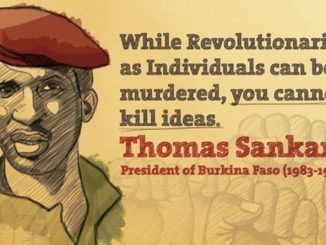
Thomas Sankara, “Africa’s Che Guevara” Dec. 21, 1949 – Oct. 15, 1987

On Oct. 15, 1987, Thomas Sankara, Burkina Faso’s West African revolutionary leader, was assassinated. Sankara, a Marxist and revolutionary, has been nicknamed “Africa’s Che Guevara.”

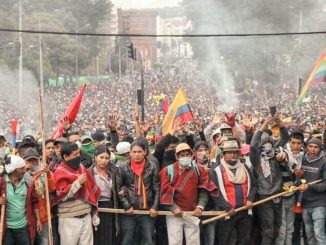
It is interesting to note that at a time when youth have focused the world’s attention on the dire issue of climate crisis, and workers and Indigenous people in Ecuador are rising up against the International Monetary Fund’s austerity demands — that Sankara spearheaded major programs in both areas.

He promoted and led a massive people’s campaign called the “One village, one grove” program to combat desertification of the Sahel (the area between the Sahara Desert and Sudanian Savanna). Over 10 million trees were planted. That legacy lives on. 

Under Sankara’s leadership, Burkina Faso nationalized land and mineral wealth and refused aid from the International Monetary Fund and World Bank, which incurred the wrath of both U.S. and French imperialism. 

This began in 1983, when a group of revolutionaries under the leadership of 33-year-old Thomas Sankara led a popular revolt that took power. 

One of the first acts of Sankara and the new revolution was to rename the colonial Upper Volta to Burkina Faso, which means “The Land of the Upright People” in Mossi. It was an act in defiance of French imperialism, which had coined the name “Upper Volta.” Burkina Faso was meant to instill people’s pride.

In just four years, amazing progress was made. Education and health care were made a priority. A national literacy campaign was developed and 2.5 million children were vaccinated against yellow fever, meningitis and measles. Women were appointed to government positions and their status was elevated so that they could go to school and work outside the home. Forced marriages, polygamy and female genital mutilation were all outlawed.

The assassination of Thomas Sankara and the overturn of this amazing revolution is reminiscent of the Paris Commune. While brief, the revolution’s legacy deserves to be studied and remembered by generations to come. The spirit of revolution continues today in the fight of the workers and Indigenous people in Ecuador and those in the streets everywhere fighting capitalist crisis and imperialist domination and war.

Thomas Sankara, presente!

Struggle-La Lucha would like to commemorate and recognize Sankara’s legacy by reprinting the following speech. This speech was given Feb. 5, 1986, at the first International Silva Conference for the Protection of the Trees and Forests in Paris: 

Imperialism is the arsonist of our forests and savannas

My homeland, Burkina Faso, is without question one of the rare countries on this planet justified in calling itself and viewing itself as a distillation of all the natural evils from which mankind still suffers at the end of this twentieth century.

Eight million Burkinabè have painfully internalized this reality for twenty-three years. They have watched their mothers, fathers, daughters, and sons die, with hunger, famine, disease, and ignorance decimating them by the hundreds. With tears in their eyes, they have watched ponds and rivers dry up. Since 1973, they have seen the environment deteriorate, trees die, and the desert invade with giant strides. It is estimated that the desert in the Sahel advances at the rate of seven kilometers per year.

Only by looking at these realities can one understand and accept the legitimate revolt that was born, that matured over a long period of time, and that finally erupted in an organized way the night of August 4, 1983, in the form of a democratic and popular revolution in Burkina Faso.

Here I am merely a humble spokesperson of a people who, having passively watched their natural environment die, refuse to watch themselves die. Since August 4, 1983, water, trees, and lives—if not survival itself—have been fundamental and sacred elements in all action taken by the National Council of the Revolution, which leads Burkina Faso.

In this regard, I am also compelled to pay tribute to the French people, to their government, and in particular to their president, Mr. François Mitterrand, for this initiative, which expresses the political genius and clear-sightedness of a people always open to the world and sensitive to its misery. Burkina Faso, situated in the heart of the Sahel, will always fully appreciate initiatives that are in perfect harmony with the most vital concerns of its people. The country will be present at them whenever it is necessary, in contrast to useless pleasure trips.

For nearly three years now, my people, the Burkinabè people, have been fighting a battle against the encroachment of the desert. So it was their duty to be here on this platform to talk about their experience, and also benefit from the experience of other peoples from around the world. For nearly three years in Burkina Faso, every happy event—marriages, baptisms, award presentations, and visits by prominent individuals and others—is celebrated with a tree-planting ceremony.

To greet the new year, 1986, all the school children and students of our capital, Ouagadougou, built more than 3,500 improved cookstoves with their own hands, offering them to their mothers. This was in addition to the 80,000 cookstoves made by women themselves over the course of two years. This was their contribution to the national effort to reduce the consumption of firewood and to protect trees and life.

The ability to buy or simply rent one of the hundreds of public dwellings built since August 4, 1983, is strictly conditional on the beneficiary promising to plant a minimum number of trees and to nurture them like the apple of his eye. Those who receive these dwellings but were mindless of their commitment have already been evicted, thanks to the vigilance of our Committees for the Defense of the Revolution, committees that poisonous tongues take pleasure in systematically and unilaterally denigrating.

After having vaccinated throughout the national territory, in two weeks, 2.5 million children between the ages of nine months and fourteen years—children from Burkina Faso and from neighboring countries—against measles, meningitis, and yellow fever; after having sunk more than 150 wells assuring drinking water to the 20 or so districts in our capital that lacked this vital necessity until now; after having raised the literacy rate from 12 to 22 percent in two years—the Burkinabè people victoriously continue their struggle for a green Burkina.

Ten million trees were planted under the auspices of a fifteen-month People’s Development Program, our first venture while awaiting the five-year plan. In the villages and in the developed river valleys, families must each plant one hundred trees per year.

The cutting and selling of firewood has been completely reorganized and is now strictly regulated. These measures range from the requirement to hold a lumber merchant’s card, through respecting the zones designated for wood cutting, to the requirement to ensure reforestation of deforested areas. Today, every Burkinabè town and village owns a wood grove, thus reviving an ancestral tradition.

Thanks to the effort to make the popular masses aware of their responsibilities, our urban centers are free of the plague of roaming livestock. In our countryside, our efforts focus on settling livestock in one place as a means of promoting intensive stockbreeding in order to fight against unrestrained nomadism.

All criminal acts of arson by those who burn the forest are subject to trial and sanctioning by the Popular Courts of Conciliation in the villages. The requirement of planting a certain number of trees is one of the sanctions issued by these courts.

From February 10 to March 20, more than 35,000 peasants—officials of the cooperative village groups—will take intensive, basic courses on the subjects of economic management and environmental organization and maintenance.

Since January 15, a vast operation called the “Popular Harvest of Forest Seeds” has been under way in Burkina for the purpose of supplying the 7,000 village nurseries. We sum up all of these activities under the label “the three battles.”

Ladies and Gentlemen:

My intention is not to heap unrestrained and inordinate praise on the modest revolutionary experience of my people with regard to the defense of the trees and forests. My intention is to speak as explicitly as possible about the profound changes occurring in the relationship between men and trees in Burkina Faso. My intention is to bear witness as accurately as possible to the birth and development of a deep and sincere love between Burkinabè men and trees in my homeland.

In doing this, we believe we are applying our theoretical conceptions on this, based on the specific ways and means of our Sahel reality, in the search for resolutions to present and future dangers attacking trees all over the planet.

Our efforts and those of the entire community gathered here, your cumulative experience and ours, will surely guarantee us victory after victory in the struggle to save our trees, our environment, and, in short, our lives.

Excellencies, ladies and gentlemen:

I come to you with the hope that you are taking up a battle from which we cannot be absent, we who are attacked daily and who are waiting for the miracle of greenery to rise up from the courage to say what must be said. I have come to join with you in deploring the harshness of nature. But I have also come to denounce the ones whose selfishness is the source of his fellow man’s misfortune. Colonial plunder has decimated our forests without the slightest thought of replenishing them for our tomorrows.

The unpunished disruption of the biosphere by savage and murderous forays on the land and in the air continues. One cannot say too much about the extent to which all these machines that spew fumes spread carnage. Those who have the technological means to find the culprits have no interest in doing so, and those who have an interest in doing so lack the technological means. They have only their intuition and their innermost conviction.

We are not against progress, but we do not want progress that is anarchic and criminally neglects the rights of others. We therefore wish to affirm that the battle against the encroachment of the desert is a battle to establish a balance between man, nature, and society. As such it is a political battle above all, and not an act of fate.

The creation of a Ministry of Water as a complement to the Ministry of the Environment and Tourism in my country demonstrates our desire to clearly formulate the problems in order to be able to resolve them. We must fight to find the financial means to exploit our existing water resources—drilling operations, reservoirs, and dams. This is the place to denounce the one-sided contracts and draconian conditions imposed by banks and other financial institutions that doom our projects in this field. It is these prohibitive conditions that lead to our countries’ traumatizing debt and eliminate any meaningful maneuvering room.

Neither fallacious Malthusian arguments—and I assert that Africa remains an underpopulated continent—nor the vacation resorts pompously and demagogically christened “reforestation operations” provide an answer. We and our misery are spurned like bald and mangy dogs whose lamentations and cries disturb the peace and quiet of the manufacturers and merchants of misery.

That is why Burkina has proposed and continues to propose that at least 1 percent of the colossal sums of money sacrificed to the search for cohabitation with other stars and planets be used, by way of compensation, to finance projects to save trees and lives. We have not abandoned hope that a dialogue with the Martians might lead to the reconquest of Eden. But in the meantime, earthlings that we are, we also have the right to reject a choice limited simply to the alternatives of hell or purgatory.

Explained in this way, our struggle for the trees and forests is first and foremost a democratic and popular struggle. Because a handful of forestry engineers and experts getting themselves all worked up in a sterile and costly manner will never accomplish anything! Nor can the worked-up consciences of a multitude of forums and institutions—sincere and praiseworthy though they may be—make the Sahel green again, when we lack the funds to drill wells for drinking water a hundred meters deep, while money abounds to drill oil wells three thousand meters deep!

As Karl Marx said, those who live in a palace do not think about the same things, nor in the same way, as those who live in a hut. This struggle to defend the trees and forests is above all a struggle against imperialism. Because imperialism is the arsonist setting fire to our forests and our savannas.

Excellencies, ladies and gentlemen:

We rely on these revolutionary principles of struggle so that the green of abundance, joy, and happiness may take its rightful place. We believe in the power of the revolution to stop the death of our Faso and usher in a bright future for it. … 

This fight can be waged. We must not retreat in face of the immensity of the task. We must not turn away from the suffering of others, for the spread of the desert no longer knows any borders.

We can win this struggle if we choose to be architects and not simply bees. It will be the victory of consciousness over instinct. The bee and the architect, yes! If the author of these lines will allow me, I will extend this twofold analogy to a threefold one: the bee, the architect, and the revolutionary architect.

Homeland or death, we will win!

Strugglelalucha256


CUBA: We hear you and see you

You have heard a lot about Cuba. Maybe your friends or neighbors traveled there after direct commercial flights from U.S. airports resumed in 2015. Or had their cruise to Cuba cancelled in June 2019. Or you could have been one of the hundreds of Venceremos brigadistas who have defied the U.S. ban on travel to see Cuba and work alongside Cubans, cutting sugar cane in 1969 and in annual solidarity brigades celebrating their 50th year last summer. 

In the past, it was very difficult to get news directly from Cuba. During the anti-Vietnam-War years, Radio Havana Cuba, on shortwave radio, reported war news censored in the U.S. corporate media. Print issues of Granma, the newspaper of the Cuban Communist Party Central Committee, were rarely seen and were already months old when they did become accessible in the U.S.

Now you can read, listen to or even watch what Cuba and Cubans — in Cuba — are doing and saying. Cuban media are now available on the internet, in English. But your U.S. search engines will not include them. 

Recently, Twitter blocked most major Cuban news accounts. Although some were restored with far fewer followers, others, like Cuba Debate, are still blocked. This is a tribute to the effectiveness of Cuba’s revolutionary voice in the digital arena. 

So, where can you find Cuban websites? Granma is available on the web at en.granma.cu, on Facebook at GranmaEnglish and on twitter @Granma_English.

Find the official website of Cuba’s Ministry of Foreign Affairs at minrex.gob.cu/en. The Cuban Central Workers union newspaper, Trabajadores, is available at trabajadores.cu/ingles. Other sites include:

  • Prensa Latina news service: plenglish.com

  • The Cuban News Agency: cubanews.acn.cu

  • Radio Havana Cuba: radiohc.cu/en

  • Radio Rebelde: radiorebelde.cu/english


  • CubaDebate: En.cubadebate.cu, on Facebook at Cuba Debate (English), and on twitter [@cubadebate_en] twitter account censored, suspended.

This sampling represents only major news outlets; Cuban provinces have newspapers and radio programming, too.

In addition, in Spanish, the 1 p.m. and 8 p.m. news programs can be viewed live on Facebook at Cubatv — Canal ­Caribe. Other important Spanish-language programming, like Mesa Redonda, also broadcasts live on Facebook.

The National Network on Cuba, the umbrella organization of U.S. solidarity organizations, is working to overcome technology issues to enable representatives from the Cuban Institute for Friendship with the Peoples to communicate through future webinars.

The U.S. economic, financial and commercial blockade against Cuba actively limits Cuba’s economy, but it also negatively impacts urban and rural communities in the U.S. But technology is now piercing the U.S. information blockade that has, for nearly 60 years, limited what U.S. residents learn about Cuba. 

LaBash is one of five NNOC co-chairs.

Strugglelalucha256


Success and joy as IMF agreement in Ecuador is revoked after days of resistance

October 14 — Sunday night all of Ecuador turned into a celebration when authorities announced that Decree 883 that eliminated public oil subsidies would be revoked after eleven days of popular unrest. The information was released after tense talks between the Lenin Moreno Administration and the indigenous movement mainly represented by the Confederation of Indigenous Nationalities of Ecuador (CONAIE).

“As a result of talks, a new decree has been issued invalidating Decree 883,” informed Arnaud Peral, the representative of the United Nations in Ecuador.

“This is evidence that we can do everything if we are united,” said a demonstrator when she heard the news, while a crowd celebrated what they considered a victory over the Moreno Administration.

“Thanks brothers and sisters for supporting the indigenous people, helping everywhere. Thanks! This has not been in vain. We’ve won the struggle. We will always be united. The indigenous people will always be in the front,” said an excited young boy.

Possible talks between the stakeholders had been announced the previous day, right before Moreno decreed an indefinite curfew in the city. That day had been marked by a large mobilization in which many groups in the capital city had been gathering in the main area of protest, turning the downtown into streets of barricades faced with the Government’s repression.

The talks were being expected as a decisive moment but in case Moreno did not back down on Decree 883, then CONAIE would continue mobilizing, resulting in the extension of the crisis not only in Quito but throughout the country. In fact, protests were being carried out in different neighborhoods of the capital city, as well as road blocks across the country, “cacerolazos” or pot-banging protests day and night continued, amidst a scenario of a territorial extension of the unrest evidencing that it was not just an indigenous issue or a specific area of the country in conflict.

The Government’s refusal to revoke the decree that eliminated public oil subsidies seemed irreversible. Nevertheless, after talks with the mediation of the United Nations and Ecuador’s Episcopal Conference —despite moments of interruption—, the announcement expected by the whole country finally arrived.

Celebrations were to be expected. The place where repression, burning tires, tear gas bombs and nights of resistance had taken place in Quito became an explosion of honking horns, cheering, and chants of “the people united will never be defeated” rang from trucks loaded with people, taxi drivers, along with people who came from different areas of the city.

Another phase is now being entered with the agreement reached between the Government and people’s mobilization mainly expressed in the indigenous movement. How will be the decree be revoked? Will it be replaced by another to be debated later? Moreno promised a discussion after the meeting, while indigenous leaders reiterated that they would only accept a repeal.

Following several days, the night in Quito came to an end amidst celebration. Points about what will happen with the decree are still to be discussed, the same as other aspects signed in the agreement with the International Monetary Fund. And what about the abuses committed by the Government during its repression, which resulted in at least seven deaths according to the latest report issued by the Ombudsman.

Republished from Resumen

Strugglelalucha256


Indigenous Peoples’ Day

Monday, Oct. 14, 2019, is Indigenous Peoples’ Day in the U.S. In 1977, Indigenous leaders from around the world organized a United Nations conference in Geneva to promote Indigenous sovereignty and self-determination. Their first recommendation was “to observe October 12, the day of so-called ‘discovery’ of America, as an International Day of Solidarity with the Indigenous Peoples of the Americas.”

Strugglelalucha256


Ecuador is a Time Bomb: How long will the crisis last?

October 11 — The Lenin Moreno Administration informed they would not retract its economic adjustment measures. The indigenous movement said they will continue mobilizing. What will be the ending of this arm wrestle? In Quito, Sputnik interviewed Ecuadorean sociologist Irene Leon.

The agreement between the Government of Ecuador and the International Monetary Fund (IMF) is part of a plan devised since Lenin Moreno took office in 2017, explained Irene Leon, member of the Network of Intellectuals in Defense of Humanity.

“They’ve tried to fulfill the necessary conditions for the IMF to accept us, they sought indebtedness when the country was able to solve its economy in a different way,” Leon said at the end of another day marked by a confusion of events in Quito and several areas of the country, with roadblocks and mobilizations since October 3rd against adjustment measures announced by Moreno to observe the demands of the international organization.

If an agreement with the Fund was part of the “neoliberal reconquest” initially proposed, implementing it in October was a result of Fund’s own demands. In fact, the letter of intention included a series of steps to be achieved by December 2019, so the Government was running out of time.

Leon, also member of the Foundation of Studies, Action and Social Participation, explained that Ecuador’s Constitution envisages a limit of indebtedness and a series of requirements to engage with foreign organizations.

The state of emergency announced on October 3rd “is issued to obviate those provisions and to create a situation in which things can be done through different means,” she commented.

The different steps had been probably devised even envisaging the little approval they would receive. The unexpected aspect was the size of the contempt against the measures: protests since last Thursday 3rd brought back memories of those which forced several presidents to resign, the last of them was Lucio Gutierrez in 2005.

Overestimating and underestimating

“These are very arrogant elites. They are anchored in financial capital, exporting companies, people who live tied to capital,” more related to “the dynamics of global capital rather than to Latin American dynamics,” analyzed Irene Leon.

Besides overestimating itself, the Moreno Administration committed another mistake which was underestimating people’s response: “They though there was not such a capacity for mobilization as the one occurring today and they did not think that rural sectors and indigenous communities would raise their voices too.”

This combination paved the way for a scenario of huge instability and the country advanced to a dynamic of nationwide protests, in Quito, Guayaquil, and the country’s most important highways. This is a response headed by different social and political sectors which, altogether, made up a process that overwhelmed the conviction of plans devised by the IMF, Moreno, and their economic allies.

There are several actors mobilizing, Leon said. First, what she calls the “people identified with the process of Citizen’s Revolution,” the political process headed by ex-president Rafael Correa. This leadership has some major features, such as “a mindset opposed to neoliberalism” and to not having a space for their own organization.

Second, she identified sectors reemerging into this scenario, such as labor unions, particularly a major movement was it is the workers’ union. This was the first one going out to reject the package of adjustment measures, especially the elimination of fuel subsidies. This was the kick-starter given its impact on the price of combustible and therefore on transportation and the price of commodities.

These sectors had been approaching Moreno’s rhetoric during the last two years and this new scenario allowed them to organize themselves again, the same as the indigenous movement mainly gathered under the Confederation of Indigenous Organizations of Ecuador (CONAIE), with a leading role in the agenda and in radicalizing the protests this last week.

Irene Leon noted as well the participation of two other important sectors: women and youth. In the case of women, the sociologist highlighted their role not only this last week but in the two years of resistance against the Moreno Administration and vindicating the achievements of the Citizen’s Revolution.

Arm wrestle

President Moreno is still supported by sectors of power, “elites and the Army,” the Ecuadorean sociologist noted. But he has a very low rate of approval and it is decreasing day to day, “less than 10 percent according to surveys,” she stated. How long can this situation stand?

The strength of mobilizations face difficulties too. One of them is regarding time. The indigenous movement, for instance, “these communities coming from a faraway Ecuador endure a huge human collective cost in order to be in Quito. Many of them came by foot from their places of origin, leaving their lands, crops, animals, and ways of living behind.”

Besides that, they are facing a very strong repression on behalf of the Government. CONAIE in fact has denounced that five of their members have been murdered and hundreds are injured or arrested. “It’s very difficult to think that Quito is going to continue like this,” explained Irene Leon.

CONAIE affirmed they would not hold talks until Moreno retracts the package of measures requested by the IMF. The President, in turn, said he won’t. How long will this arm wrestle last? “This situation cannot last too long. There has to be an ending,” Leon concluded.

Republished from Resumen

Strugglelalucha256


Hurricanes

This statement is a personal one intended to support opinions, especially in the Caribbean, that the costs of practical recovery from annual hurricanes should not fall, as they mainly do, on the victims of these natural disasters.  As it is, the pain, the agony, the distress, the abandonment, the unpredictable fatalities and other psychological costs of re-organizing and re-establishing their homes, their communities and their livelihoods are borne logically by the residents of the hurricane-prone countries.  It is the argument of this statement that the unfortunate victims should not be expected to bear the capital, recurrent, and other financial costs of rehabilitation after these more and more ruinous disasters.

Before making recommendations, it is only fair to note that big-hearted, generous and humane individuals and institutions of other countries, often with no relationship to the victims, have always been ready to organize and deliver critical items and services to relieve the extremes of suffering.  Our people will not forget these acts of generosity. In the case of the Bahamas, parts of which were devastated a month ago by hurricane Dorian, the assistance of the U.S. Coast Guard was frequently noted in dispatches, an intervention which might have justly attracted the attention of the people of Puerto Rico.  In a different mood, the United States civilian authorities received orders not to admit people in flight from the natural disaster, if they could not present visas and passports.

We now feel compelled once again, as a responsibility to history, to remind ourselves and the international community that the majority of residents in the hurricane-prone countries of the Caribbean, such as Bahamans, Barbudans, Haitians and others are there as a result of a specific centuries-long crime wave, known as the Atlantic Slave Trade.  These Caribbean people are in the hazardous paths of these annual and all-powerful winds, now seen as growing in force and frequency, as global warming increases.

High benefits with no sense of obligation

As a subset of the general demands for Reparations, the claims in this statement, made on European slave-owning of powers of the past, can be supported by repeating a selection of facts from world economic history:

  • In the French empire, Haiti produced more revenue for France than any other possession owned by that nation.
  • “How Europe Underdeveloped Africa” by Walter Rodney has laid bare the process by which one continent enriched itself at the expense of another.
  • Looking back at the Atlantic Slave Trade, Karl Marx wrote in his classic enquiry that the entombment in minds of Indigenous populations and the turning of Africa into a warren for the hunting of Blackskins marked what he called the Rosy Dawn of capitalist expansion.
  • For a whole century, it was admitted that India was “the most precious jewel” in the British crown.

Against this background, this statement makes a very logical and human claim:  The Caribbean countries randomly affected by hurricanes are populated by the descendants of people traded from the African continent, without any semblance of their consent.  As one African woman poet puts it:

“We had no part in it

You brought us in your ship

You beat us with your whip …”

To make the lack of consent more emphatic, any attempt of the enslaved to escape from the plantations was punishable under the slave codes.

It is the argument of this statement, therefore, that the successor governments of the slave-owning empires cannot escape responsibility for the suffering and loss which the descendants of their captives experienced from natural disasters in countries to which their fore-parents had been forcibly transported.

Attempts of the enslaved populations to free themselves and claim rights as human beings were regularly answered by the dispatch of gunboats and warships from the oppressor nations to reduce the rebels to submission.  This in brief is the process by which the populations of the countries randomly assaulted by hurricanes have become sitting ducks to these natural disasters. Moreover, the economic frameworks into which the Africans, and later others, were entrapped proved in time unsustainable as the powers concerned and the USA conducted their economic rivalries.  The cotton industry, the sugar industry and the banana industry are examples of how several Caribbean populations have been forced to experience a loss of economic security and have been left to survive mainly by their own devices.

Decades ago, the Working People’s Alliance, as an organization outside of government, had proposed publicly that small, disaster-prone countries should be protected by a new kind of multilateral Insurance Scheme from the injustice of bearing the cost of rebuilding and rehabilitation after a disaster.  The recommendation fell on deaf ears. Since those years, the problem has become more acute, as carbon emissions increase and render hurricanes more destructive.

The present personal statement is made in the hope that although it does not come from an organization, it can be the subject of critical study, leading to action that places responsibility where it really belongs, at the feet of the European empires referred to above.  It is hypocritical and impractical for the successor governments of the slave-owning powers to expect CARICOM [the Caribbean Community, an organisation of fifteen Caribbean nations and dependencies] and its citizens to muster the resources to respond to these calamities.  On the other hand, for CARICOM to aspire heroically to assemble the human resources, the financial resources and the hardware necessary in these emergencies is a serious misunderstanding, exaggeration and distortion of the principle of self reliance.

  1. Since the slave-owning powers had assumed the super-human right to deploy populations from their natural homes, their successor governments should consider themselves mainly liable.
  2. Since the hurricane season can be accurately predicted, it is not too much to ask that the governments concerned anticipate the needs of the hurricane-prone countries and deploy peace ships with necessary forms of relief to strategic locations in the region on a precautionary basis to make timely delivery of search and rescue and relief in the affected countries at the earliest possible moment.  In the same spirit and as advised by CARICOM or any other empowered regional organization, they should be ready to assist in the transport of medical and other service volunteers to the affected locations with as little delay as possible.

In making this statement, my purpose is clearly not to assign to the slave-owning powers and their successor governments any guilty knowledge of all the results of their expansionist activities of the centuries after the invasions of Columbus.  Rather, the purpose of this statement is to apply the standards of judgment of the present day and the 21st century to argue that they cannot escape the moral responsibility for the consequences of their self-serving and inhuman population transfers, and that it is time to apply adequate reparatory measures.

Eusi Kwayana
Of Guyana
And
Atlanta, Georgia, USA
10/8/19

Strugglelalucha256


Moreno declares curfew and militarization of Quito, Ecuador

Repression against protesters continues and will likely intensify with the decree of the curfew and militarization in Quito

On October 12 at 2:20pm, Ecuadorian President Lenín Moreno declared that a curfew and complete militarization of the capital city Quito would take effect at 3pm. The curfew is the latest desperate move by Moreno’s government to put an end to the massive people’s uprising against the neoliberal economic measures announced on October 1.

Moreno wrote on Twitter: “I have declared a curfew and militarization of the Metropolitan District of Quito and the valley. It will begin at 15:00. This will facilitate the acting of the Public Force against the intolerable excesses of violence.” Moreno is able to decree a curfew because he declared a state of emergency on October 3 which affords the executive branch special powers in order to maintain ‘security and order.’ However, the only thing the government has done is threaten peace and act with extreme violence against its own citizens. Videos have already circulated on social media of the entry of military vehicles to the capital.

An hour before the curfew was decreed, one of the most prominent organizations participating in the mobilizations, the Confederation of Indigenous Nationals of Ecuador (CONAIE), declared that “After a process of consultation with the communities, organizations, peoples, nationalities, and social organizations we have decided to participate in a direct dialogue with Lenín about the striking down or revision of Decree 883.” Decree 883 was announced by Moreno on October 1 and outlines the latest neoliberal economic measures in the country, including the elimination of a four decades old fuel subsidy. Many other organizations however, have declared that they will not leave the streets until the decree is completely abolished.

In response to the curfew, Ecuadorian movements and organizations have called on people to remain on the streets in defiance of the repressive measure and have called for international organizations to denounce the actions of Moreno’s government in order to prevent a human tragedy. The unprecedented levels of violent repression of protesters in the last 9 days of protests in Ecuador has caused at least eight deaths and hundreds of injured. According to the Ombudsman of Ecuador, 1,070 people have been detained.

Video shows moment in which protester was shot by Ecuadorian Public Force.

On Friday October 11, hundreds of Indigenous protesters, students, trade unionists, and citizens of Quito, mobilized towards the National Assembly in order to denounce the inaction of the government to the demands of the citizens and their violent response to protesters. Since the protests started on October 2, the National Assembly has not met to address the pressing issues. While thousands surrounded the area around the Assembly in a peaceful protest, the Police began a brutal attack. Organizations denounced that there were many children, youth, and old people present during the attack and police attempted to violently evict protesters from where many have been camping for the last week.

While most attention has been directed on the protests in Quito, people have also been mobilizing in the cities of Guayaquil, Ambato, Cuenca, among others.

As of now, thousands remain on the streets and the cries of “Out Moreno! Out!” can be heard far and wide, but Ecuadorians are gearing up for what could be one of the most brutal attacks by the repressive forces in recent history.

Republished from Peoples Dispatch

Strugglelalucha256


The coming economic crisis

Dear friends,

You don’t need me to tell you that times are tough. Not only is the cliché about living one paycheck away from disaster absolutely true; for many who have jobs, the crisis is already here, and it never ends.

You’ve probably heard about at least one of the many studies in the last few years showing how precariously workers are living. A recent example says that almost half of U.S. residents can’t afford even a $400 emergency, such as an unexpected medical bill or car repair.

Millions are working more hours for fewer wages than before the Great Recession a decade ago. Others are desperate for more work. Many of us are supplementing low-wage, no-benefit jobs with gig work (Uber, Lyft, etc.). Others are working in inhuman conditions at Amazon.com fulfillment centers, where every step and bathroom break is timed to the second.

Families are doubling up, tripling up, living in garages and cars as rents climb through the roof. Nowhere in the U.S. can a person earning the minimum wage afford to rent a two-bedroom apartment. In May, the median cost for a month’s rent on a one-bedroom apartment in New York City was $2,980.

Profits have soared since the government bailed out big banks and companies with workers’ tax dollars during the Great Recession. But wages have not. Even as the official unemployment rate fell in September — while leaving millions of underemployed and permanently unemployed workers uncounted — average wages actually fell.

The gap between the rich and the rest of us continues to grow, aggravated by President Donald Trump’s tax cuts for the wealthy (who barely paid taxes to begin with). A Federal Reserve report showed that the top 1 percent gained $21 trillion in wealth since 1989, while the bottom 50 percent lost $900 billion. New data from the U.S. Census Bureau show income inequality is at the highest level in more than 50 years.

But these general trends, stark as they are, don’t tell the whole story. For Black, Latinx, Indigenous, Arab and Asian workers, for women and lesbian, gay, bisexual, transgender, queer and two-spirit workers, for migrants and refugees, young and disabled workers, there is discrimination in hiring, wages are lower, jobs more precarious, and there is the constant danger of repression, sexual assault or deportation.

As if all this wasn’t bad enough, now we’re bombarded with warnings that a new recession is starting.

Signs of crisis

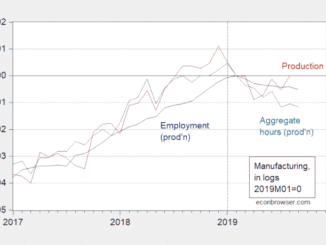
The evidence of a downturn has been building all year, but it really hit at the beginning of October. The manufacturing sector of the economy is now officially in a recession, not only here but globally. In September, the U.S. manufacturing index declined to its lowest level since the 2009 recession.

While some defenders of the status quo hold out hope that the recession won’t affect other sectors of the U.S. economy, it’s just wishful thinking. “That argument does not recognize that many service sectors depend on manufacturing for their own expansion,” explains economist Michael Roberts. “The spillover from a manufacturing slump has usually been significant in previous recessions. If global employment growth should weaken or stop, workers’ purchasing power will wane and the services sector will start to suffer as well.”

Roberts cites a new JPMorgan analysis which shows that “global profits in [the second quarter of] 2019 have stalled. Each of the 10 sectors comprising the total market shows a sharp slowing in profit growth, with half experiencing outright contractions in profits over the past year. … As Marxist theory would predict, slowing or falling profits will eventually mean slowing or falling business investment, and JPMorgan agrees.”

Already, industries related to manufacturing are showing signs of crisis. Some 4,200 truck drivers lost their jobs in September – on top of 5,100 in August. And 640 trucking companies went bankrupt in the first half of 2019.

Many workers rely on low-wage retail jobs to survive. Retail stores sell the finished products created by workers in factories here and worldwide.

Everyone knows the toll online sellers like Amazon.com have taken on retail stores. But this year the collapse has spread beyond those bounds and is getting worse – threatening what CNN called a “retail apocalypse and massive layoffs in the coming year.

Forever 21 and Bed Bath & Beyond are two retail chains that recently announced big store closings and layoffs. In September, the Wall Street Journal reported that the number of store closings and bankruptcies in the first half of 2019 had already exceeded the total for 2018. An in-depth report by industry website Retail Dive lists 28 major chains in danger of going bankrupt next year, including JCPenney, Rite Aid, Pier 1 and J. Crew.

This may all seem overwhelming. But the truth is, we can fight back. 

Next: Together we can build enough strength to challenge the capitalist system itself and replace it with one organized on the basis of planning for people’s needs and protecting the planet, instead of profits. We call that socialism.

The coming economic crisis, Part 2: Socialism is the solution!

Strugglelalucha256


Haiti gripped by protests


After 15 years of a military occupation of Haiti, the United Nations “peacekeeping” force will close operations on Oct.15. 

Growing protests now gripping Haiti began last year in reaction to the announcement by President Jovenel Moïse’s government of up to 50 percent increases in fuel prices. Protests have shut down businesses, airports and legislative buildings. 

The UN.org website says: “The current U.N. peacekeeping mission closes on 15 October 2019 and will be replaced by a political mission, building on the progress made with the Haitian authorities to reinforce stability, security and governance as well as the rule of law and human rights.”  

According to the publication Dominican Today, the Dominican Republic requested a meeting of the U.N. Security Council on Oct. 3 to encourage a continuation of the U.N. presence. Dominican Foreign Minister Miguel Vargas stressed his government’s support for Haiti’s “democratically elected” President Jovenel Moïse. “What we see there [in Haiti] these days would seem routine, but it is unacceptable for countries such as those represented in the Security Council, who believe in dialogue, the rule of law and the scrupulous observation of human rights,” Vargas said in a statement.

Both the U.N. statement and Foreign Minister Vargas’ concern for maintaining “the rule of law” run in the face of the killing of hundreds of protesters by the Haitian government and paramilitary forces who were enforcing “the rule of law.” Rules and laws, like everywhere, serve class interests and the representatives of the ruling class in Haiti, who held rigged elections with the assistance of the U.S. and other imperialist supporters of the Moïse government. They use the U.N. to maintain their dictatorial and brutal rein on the Haitian people, especially in the interests of U.S. imperialism.

It’s interesting that on Oct. 4, the day after the special meeting of the Security Council, thousands upon thousands of people protested at the U.N. headquarters in Haiti. According to the publication Haïti Liberté:  “A gargantuan demonstration of many, many thousands marched from the capital’s Nazon/Delmas Roads intersection (the traditional starting point these days) to the U.N. headquarters in Haiti. The demonstrators’ message: no more foreign military occupation, no more foreign meddling, stop supporting the Moïse regime.”

On Oct. 7, Haïti Liberté reported another killing of a protester by government supported thugs. 

In addition to voter fraud, brutality and assassinations, the Moïse government has been saddled with continuing corruption charges where billions of dollars have been pocketed by officials. Four billion dollars in Petrocaribe loans given by Venezuela to Haiti for social service relief programs wound up in the pockets of government officials and members of parliament. 

Both the Nicolás Maduro and Hugo Chávez governments in Venezuela tried to assist the Haitian people with debt forgiveness and continued relief efforts, but met a wall of corruption by a government propped up by the U.S.

In fact, the Moïse government was given a lifeline when it–like other Organization of American States countries that voted last January under pressure from the U.S. — helped pass a resolution no longer recognizing the genuinely elected Maduro government of Venezuela.

Haiti and Venezuela

The imperialist assault on Haiti by the U.S. is linked to its assault on Venezuela, but neither Republicans nor Democrats want that connection to be seen.

In Miami, at a town hall meeting on Oct. 3 hosted by U.S. Representative Frederica Wilson, with House Speaker Nancy Pelosi and six Haitian panelists, Pelosi made that clear, responding to the Haitian panelists.

As reported by Haïti Liberté: “The meeting began with mostly vapid politician remarks by Pelosi, Wilson, Monestime and Joseph. But then it erupted (much to Pelosi’s discomfort) into a trial of and outcry against U.S. policy in Haiti.”

After indictment upon indictment of the U.S. for supporting weapons and rigged elections and imperialism in general against the Haitian people, Carline Paul, one of the panelists, felt empowered to speak and charged that the Trump administration “is supporting Jovenel Moïse for voting [at the OAS] against [President Nicolás] Maduro in Venezuela.” Washington “didn’t like it, because Venezuela has helped Haiti” and then the Haitian government was “forced to vote against Venezuela.”

“The United States is telling them: Don’t get in contact with China. Don’t get in contact with Venezuela. Don’t get in contact with so and so,” she said, concluding that “Trump, in the background, is supporting Jovenel Moïse; the people of Haiti say no interference … no more support for Jovenel Moïse as president of Haiti.”

Pelosi made a floundering and desperate defense of the policy of Trump and the Democrats in Venezuela, while dismissing the vital aid Venezuela sent to Haiti to save Haitian lives: 

“You’ve been candid, and I’m going to be candid,” Pelosi lied. “Maduro is a thug, so I’m not taking any respect for what Maduro might be doing in Haiti [sic]. I’m glad that there may be some benefit, but I’m not … erasing the injustices, the horror, the killings that he is doing in Venezuela because he is part of spreading a global and certainly a hemispheric exporting corruption and the rest [sic] … Not to get involved in a full-fledged discussion about Maduro, but I can’t leave a meeting where you’re saying … I cannot let my view of Maduro go unspoken in a group of this kind.” According to the article in Haïti Liberté, the room remained stonily silent.

According to the Haiti Action Committee Facebook page reporting on acts of solidarity with the people of Haiti, there were militant protests in San Jose, Calif. “As part of this week of action in solidarity with Haiti that spanned from California to Montreal, South Bay students, teachers, human rights and community activists held a march and rally in downtown San Jose, California, today in solidarity with the uprising of the Haitian people demanding an end to U.S. support for dictatorship and death squads in Haiti. As the rally drew to a close, six Haiti activists blocked the entrance to the Federal Building, representative of the U.S. government, chanting: ‘Stop massacres in Haiti!’ ”

Also last week, as heat from Haiti hits politicians and officials here in the U.S., it’s also hitting other imperialists complicit in the corruption and state violence in Haiti. Reported on the Facebook page of the Haiti Action Committee: “On Monday, 15 Haitian community members and allies occupied Justin Trudeau’s election office for a little over three hours. The Solidarité Québec-Haiti #Petrochallenge 2019 activists called on the PM to withdraw Canada’s backing of a repressive, corrupt and illegitimate president of Haiti. Trudeau’s government has provided financial, policing and diplomatic support to Jovenel Moïse, whose presidency is dependent on Washington, Ottawa and other members of the Core Group.”

What’s needed now here in the U.S. is more pressure on both the Democrats and Republicans, whose policies run counter to the interests of the people of Haiti, Venezuela and the world.

Strugglelalucha256


Defying repression, tens of thousands of Ecuadorians take part in national strike

On October 9, the people of Ecuador took part in a massive national strike called by a number of organizations against the neoliberal reforms of President Lenin Moreno. Tens of thousands of workers, students, Indigenous people, peasants, Afro-descendant people, women and citizens took over the streets of Quito. The mobilization was directed towards the Historic Center where the Candolet Palace is located, but the area continues to be heavily militarized and barricaded and protesters were met with heavy repression.

In the midst of the strike, Moreno returned to the capital from Guayaquil, where he had temporarily shifted the seat of government to on Monday, as permitted by the state of emergency. He claimed that the primary focus of his return was to engage in dialogue with the mobilized organizations. Yet he has yet to meet their conditions which include the repeal of the economic measures and the resignation of interior minister Maria Paula Romo and minister of defense Oswaldo Jarrín. These ministers have been identified by movements as directly responsible for the brutal repression of protesters.

Last night, following the day’s massive march, police launched tear gas bombs and attacked the humanitarian refuge and aid distribution centers at the Catholic and Salesiana Universities where old senior citizens, women and children were staying. Many members of the Indigenous movements are staying in the centers as they came from outside the capital.

Organizations have condemned the use of tear gas, unconventional weapons, firearms and batons by the police and military. Eight protesters have been killed and hundreds are suffering from grave injuries. According to official figures, in the past seven days of protests, over 766 people have been arrested and 128 have gone through legal proceedings.

The mobilizations that have been occurring daily since October 2 are in response to a set of neoliberal economic measures or the paquetazo (package) announced by Moreno on October 1, including the elimination of a decades-old fuel subsidy. Despite the plurality of voices, organizations, and movements that have been on the streets for the past week rejecting the measures, the government and its regional allies claim that the protests have been instigated by former president Rafael Correa and Venezuelan President Nicolás Maduro. Furthermore, Lenín Moreno has reiterated, several times, that he will not change his position on the economic measures.

On October 8, Moreno ordered a partial curfew from 8 pm to 5 am in areas near government buildings through an executive decree 888. The curfew restricting the circulation of vehicles and people will remain in force throughout the state of emergency declared by the president last week, which could continue for a period of 30 days.

The Confederation of Indigenous Nationals of Ecuador (CONAIE), one of the biggest social organizations in the country, condemned the measure of curfew and called on people to continue mobilizing.

On October 8, 2,000 protesters from different Indigenous, peasant and social organizations and trade unions occupied the Ecuadorian Assembly and held a People’s Assembly. They too were brutally repressed by the national security forces, who threw tear gas and shot rubber bullets at the demonstrators. Several dozen who participated in this action were arrested and processed.

CONAIE also denounced police repression on the Indigenous community demonstrating at the museum, La Casa de la Cultura Ecuatoriana, in Quito, where the police used tear gas and rubber pellets to disperse peacefully the protesting crowd consisting of children and elderly people.

Several alternative media projects that have been closely following the protests have also been subjected to raids and censorship. The radio station ‘Pichincha Universal’ denounced a raid carried out by the national police and the Attorney General’s Office on its headquarters. Through its Twitter account, the media outlet informed that the measure was executed “for the alleged crime of inciting discord among citizens.” Pichincha Universal has been extensively reporting on incidents of police repression across the country.

Social Movements of ALBA expressed its support for the people of Ecuador in their fight against the “lackey and subordinate government”. ALBA denounced the deaths caused by police repression and held Moreno and his government responsible for them.

“In less than three years, Moreno’s administration has indebted Ecuador to the tune of more than 20 billion dollars and effected tax cuts worth 4.295 billion for the rich. This income is now what the State pretends to recover from the rest of the people. Meanwhile, the winners of this neoliberalist party, the bankers, have reported earnings for more than 500 billion dollars. In other words a massive theft endorsed by mass media and international institutions. Nothing we haven’t seen before. But the straw that broke the camel’s back was the paquetazo to make the people of Ecuador pay its debt, by removing subsidies to fuel, whose consequence will be rising prices of food and basic products consumed by the working class,” said ALBA in an official statement.

Republished from Peoples Dispatch

Strugglelalucha256
https://www.struggle-la-lucha.org/2019/10/page/5/