How Covid-19 shows U.S. dependence on workers

Health care workers, nurses, farmworkers, transit operators, grocery store clerks, warehouse packers, delivery workers, truck drivers, dockworkers, restaurant order takers, call center workers, service and industrial workers form the backbone of the U.S. economy. 

When the coronavirus pandemic struck, the public health system was functioning at a minimal level. Cutbacks in health care services accelerated after the 2008 Great Recession and the giant bank bailout. Under the slogan “Repeal and Replace Obamacare,” the cutbacks became more severe under Donald Trump. The system was not prepared or able to respond to the pandemic.

Without an adequate public health care system, the only possible response left to contain the contagion was social distancing and self-isolation: a shutdown. That shutdown has exposed that workers are essential. Life would grind to a halt without them.

The shutdown has also exposed some who aren’t essential. For example, a Wall Street hedge fund billionaire hiding out on a yacht doesn’t do anything we find to be essential. Completely nonessential, in fact.

Karl Marx, writing about the value of labor, said, “Every child knows that any nation that stopped working, not for a year, but let us say, just for a few weeks, would perish.”

Yes, today there has been a general shutdown of all businesses and everyone told to stay secluded at home. But there is an exception and that is for so-called essential workers. That includes not just health care workers, but also anyone producing food as well as transportation, electrical power and other services. Labor is essential or we would perish.

Of course, Marx also showed that labor power is the source of capitalist profits.  

Workers are essential, so why aren’t we being protected?

Benefits system overwhelmed

With the shutdown came mass layoffs and furloughs. As of April 23, more than 26 million workers have lost their jobs in just the last five weeks. 

The unemployment benefits system is overwhelmed. Many unemployment offices are not open to the public. Phone systems are overloaded and understaffed. State unemployment websites are no better, if you even have a computer with broadband access at home. (A study by Microsoft in 2018 estimated that about half the U.S. population — 163 million — have no high-speed internet service at home). 

Jobless, no paycheck, unemployment benefits unreachable. What has been the government’s response?

When the most urgent need was to protect jobs, pay unemployment benefits to anyone without a job, halt evictions and foreclosures, and suspend all rent and mortgage payments, Trump and Congress passed a “stimulus” package that was mostly a giveaway to the Wall Street banks and financiers. About $454 billion was given directly to the Federal Reserve Bank. Another $340 billion went to Small Business loans. Some $250 billion went to unemployment insurance and a one-time payment to all adult taxpayers.

The one-time $1,200 check was not enough to carry anyone through a three-month shutdown. But even that was tied into the banks, who are able to claim any or all of the $1,200 for so-called debt payment. The $1,200 payments have been made only to those who have a bank account registered with the IRS.

The Paycheck Protection Program small business loans are supposed to be forgivable if the small businesses maintain current employee and compensation levels. But first, the program was set up in a way that encouraged businesses to lay off workers before applying for the loan.  

The loan program was riddled with backdoors and loopholes, and the level of corruption was staggering. The $340 billion program ran out of money in just 13 days. The loans, which were supposed to go only to businesses with less than 500 employees, mostly went to larger ones because of the way the law was written.

One big loophole is the legal shell game called franchises. Giant corporations often operate through local outlets that are set up as franchises in order to evade laws and regulations. McDonald’s, for example, has used the franchise game to block labor unions and avoid enforcement of federal labor laws.

All the loans went through the big banks, which were paid hefty fees. And the banks made sure to maximize the fees they collected, even though it was not their money being loaned and they took absolutely no risk. 

According to a suit filed by a group of small businesses in California, four of the biggest Wall Street banks — Bank of America, Wells Fargo, JPMorgan Chase and US Bank — unfairly prioritized emergency loan requests from large customers to earn fatter fees. Each bank “prioritized corporate greed at the expense of its small business customers,” the suit says

The small business loans turned out to be another giveaway to the big banks.

So far, Trump and Congress have been heavy on giving funds to the rich, big businesses and the banks. It’s time to put an end to that and put the money and resources where they are most needed. Stop the layoffs, fund unemployment benefits for all who are jobless, halt evictions and foreclosures, and make sure that there is access to food for all.

It is time to declare that a job is a right. Housing is a right. Health care is a right. Education is a right. 


Strugglelalucha256


Longshore union demands protection for members and community

Leaders and members of the International Longshore and Warehouse Union (ILWU) Locals 10, 34, 75 and 91 protested outside the office of the Stevedores Services of America (SSA) terminal at the Port of Oakland, Calif., on March 20 to demand that the company provide proper health and safety for longshore workers loading and unloading the ships. 

Trent Willis, president of ILWU Local 10, and Keith Shanklin, president of ILWU Local 34, talked about the fight to protect Bay Area longshore workers and their communities from Covid-19.

An issue that poses a grave danger to all port workers and the surrounding community is the disposition of the Grand Princess cruise ship. Over 300 crew members are being held on the ship. Most are Filipino seafarers who have lost their labor and human rights.

ILWU 34 President Keith Shanklin: Brothers and sisters, we are requesting members of all our locals to stand with us in solidarity during this crisis and beyond due to the ongoing changes that happen every day with the coronavirus.

We are standing in solidarity with Locals 10, 34, 75 and 91 to demand the Pacific Maritime Association (PMA), SSA and all Bay Area terminals honor the collective bargaining agreement and the safety code book — our contractual rights.

We requested that the PMA clean and sanitize all the equipment that is vital to our ability to provide safe labor to the port without interruptions. It is imperative for us as workers as well as to the public that the equipment we work with every day be sanitized to prevent the spread of the coronavirus. The employers are obligated under Contract Section 3 of the Pacific Coast Safety Code Book to provide a safe workplace for all operations.

The threat of longshore workers contracting coronavirus and the threat of spreading it to our families and the surrounding community is too great for the employer not to take proactive measures.

The port is a main area for food, medical supplies and basic products for the community to maintain a decent quality of life. Your immediate response is requested. An injury to one is an injury to all.

Now, just to say: All the other terminals have complied with the Pacific Coast Safety Code except for the Stevedore Services of America Terminal. We want you to understand that we are not trying to target you. It is SSA that is targeting us by not following safety procedures.

ILWU Local 10 President Trent Willis: First, I’d like to send solidarity to our sister ILWU locals in this area and to all port workers who are not members of our union, as well as workers in general. 

Today, we are here to demand that Stevedoring Services of America as well as Pacific Maritime Association adhere to previously agreed language in our Pacific Coast Safety Code which requires them to make sure that the longshore workers’ equipment and facilities are safe for everyday operation.

Now a longshoreman contracting the coronavirus can have a lot of different effects:

  • First, we don’t want to be responsible for spreading the coronavirus to each other.
  • Second, we don’t want to be responsible for spreading the coronavirus among port workers.
  • Third, we don’t want to be responsible for spreading the coronavirus to the community.

If the longshore workers contract the coronavirus because the equipment and the facilities are not being disinfected, we stand the possibility of the Port of Oakland being shut down.

The Port of Oakland is a vital artery to supplying the community in this area. Also, communities that are not in this area. For example the rail system here is directly connected to the main hub of the U.S. rail system in Chicago. There are goods and services that leave this port and get shipped to different communities all across this country.

If this port is shut down because of the coronavirus, it will bring about a health and safety risk to the public and to this entire country. This is a main hub for shipping out agricultural products. This port is responsible for feeding communities all across this nation. We want to be in a proactive position where we are making sure that the equipment and the machines that we operate are sanitized so that longshore workers are protected from contracting this virus.

Disposition of the infected cruise ship Grand Princess

We are also here today to talk about the Grand Princess, which docked at Birth 22. First off, we have not been informed of the condition of the crew members who remain on the Grand Princess. As we speak, there are approximately 300 crew members still aboard. We have no idea if they are receiving the proper medical care. We have absolutely no information whether the terminal in Oakland where the ship was docked for a number of days has been disinfected after they left. That is a risk to the port workers as well as the vitality and the continuation of operations at this port.

We are here standing with our sister locals, the ILWU port workers, together with the community, to demand that these items be addressed: That our port be sanitized and that we learn the condition of the crew members aboard the Grand Princess. 

We hope that the community will stand with us. The ILWU has always been a vanguard for workers all over the world. We stand as the first line of defense here in the Port of Oakland and ports up and down the entire coast.

Bishop Bob Jackson, Acts Full Gospel Church in East Oakland: I’m here to stand with the ILWU to advocate for cleanliness in the terminal so these women and men can work. They’re doing essential work. We can’t afford to see the ports shut down. We can’t afford to see their families and the other people that they have to work with being impacted.

Without them working, without this port being open, without these terminals being able to do what they do, we will be in dire straits in Oakland. I’m here to say: Please do all you can to make sure their environment is cleaned and that they get the things that they request, because we need them to continue to work. We need them to continue to be healthy and for their families to be safe. 

We thank you for this opportunity to support the ILWU.

ILWU Local 10 Business Agent John Hughes: I wanted to touch a little bit about the cruise ship sitting in Bayview-Hunters Point and piggyback on what President Willis has said. It has become a pattern when it comes to a disenfranchised group of people in West Oakland and to another disenfranchised group of people out in Bayview-Hunters Point. 

We’ve already touched on the lack of sanitation. To be perfectly honest, this company has blatantly ignored the fact that if coronavirus is contracted by us it spreads to our families, and not just our families, but our communities and adjacent communities.

Then you have a worst-case. They take a ship that has not yet been disinfected and they sail it in the Bayview-Hunters Point Naval Shipyard to dump the toxic waste out there. We know that a ship has to get rid of the toxins. They want to dump it there simply because it’s already an area that’s been infected in the past by the stuff that the Navy was doing.

We’re here to stand up to that. We’re here to stand up to big corporations and make sure that not only our jobs but our community, our families and our people are safe and protected from this virus.

Brothers and sisters, as you can see behind me, we are represented by the unions and also the community. Those two entities go hand in hand. We plan to continue to fight. We are asking the public to please join our fight because not only are we fighting for ourselves, we are also fighting for the rights of the community to be safe and our families to be safe.

Pres. Trent Willis: We have to recognize one point: We’re not just addressing you as longshore workers and ILWU union members, we are also members of the community. The biggest threat to longshore workers and ILWU members is the possibility of infecting the community because we work with ships that are coming from all over the country, from all of these different countries where the coronavirus is spreading. We want to make sure that while we’re doing this vital work in the Port of Oakland that all of our members are safe. 

Now you hear a lot of talk from the governor and from local elected officials about how essential the Port of Oakland is. Well, the ILWU’s position is that the health and safety of the workers and the community are essential. The port being essential is second to that.

We appreciate your supporting us in this time of need. Once again, ILWU Local 10 promises to stand strong with the community and to be the first line of defense at the port.

Steve Zeltzer, “WorkWeek” on KPFA Pacifica Radio: One of the things that I want to bring up is that of the California Division of Occupational Safety and Health. We pay for Cal/OSHA to protect 19 million workers in California. The question we have for Gov. Newsom is: Where is Cal/OSHA when the SSA is not properly protecting the workplace? Cal/OSHA should shut the job down. We have learned that Cal/OSHA has only one doctor and one nurse, with less than 200 inspectors. What kind of protection is that in this dire emergency?

We’re calling on Gov. Newsom to staff up Cal/OSHA, to make sure inspectors are down here demanding that the company clean the equipment for the workers or shut this facility down. Cal/OSHA’s job is to protect the health and safety of working people who are doing critical work like shipping. They are getting supplies out in this dire emergency and the workers need to be protected.

Pres. Keith Shanklin: If you can put any pressure on, do it for the community, do it for yourself. We have to understand one thing: if this dock continues to go unsanitized and our members get this virus, the dock would shut down immediately. You would not have the goods, the way of life that you enjoy right now. It would not be the same. I guarantee it.

Strugglelalucha256


From AIDS to Covid-19

From a presentation at the online press conference, “Fighting Racism During the Coronavirus Crisis,” on April 4, 2020.

In 1981, a mysterious illness began to appear in the gay community. One of the first and most noticeable symptoms was Kaposi’s Sarcoma (KC), which created purplish lesions on the skin of the afflicted. 

Because the first people diagnosed with the syndrome were gay men, many in the ruling class started calling it “Gay Cancer.” It wasn’t until the latter part of 1982 that leaders and the media stopped calling it this. But the next name chosen was just as bad and even more stigmatizing to the sufferers: gay-related immunodeficiency syndrome (GRID). 

In addition to KC, a cluster of gay men in Southern California and New York City were also getting sick with pneumocystis pneumonia. This led to the diagnosis of acquired immunodeficiency syndrome (AIDS), caused by the human immunodeficiency virus (HIV). Today many researchers believe that KC and AIDS were and are two separate epidemics. 

The attitude of the government, including then-President Ronald Reagan, was that the affected appeared to be only gay men and intravenous drug users — people who didn’t deserve any special attention, much less support. It wasn’t until hemophiliacs developed PCP pneumonia and other opportunistic infections that the government suddenly felt it should respond. 

We must never forget Reagan’s shameful legacy, the lack of leadership he showed in the fight against AIDS. Reagan is to blame for the thousands who died and continue to die as a result of his cowardice, his fear of the powerful religious right and the “immoral majority,” who gave Reagan his road to the White House. 

These included the misogynist Rev. Jerry Falwell, who used AIDS as the tool and gay men as the target for the politics of fear, hate and discrimination. Falwell said, “AIDS is the wrath of god upon homosexuals.” And Reagan’s communications director Patrick Buchanan stated that AIDS was “nature’s revenge on gay men.” 

On May 31, 1987, as his second term was coming to an end, Reagan finally spoke on the issue of the day. But not before 36,058 people in the U.S. had been diagnosed with AIDS and 20,849 had died. 

Although the Centers for Disease Control reported that HIV could not be transmitted by casual contact and Reagan knew this, he continued to fan irrational fear by saying: “And yet medicine has not come forth unequivocally and said, ‘This we know for a fact, that it is safe.’ And until they do, I think we just have to do the best we can with this problem. I can understand both sides of it.” By both sides he meant parents who were demanding that children with AIDS be kicked out of their schools — including kindergarteners. 

That is what I remember Reagan for, wiping out a whole generation of gay men, many of whom were my dear friends! When I visit a gay bar today, I’m struck by the lack of gay men my age. Most are in their twenties, thirties, some in their forties, or in their seventies. Very few are in their fifties or sixties. A whole generation is gone due to Reagan’s unequivocal indifference towards the lives of the poor and the oppressed. 

It was the activists and freedom fighters of the 1980s and 1990s and even today that made the U.S. government provide housing, health care, financial assistance, needle exchange, treatment and many of the services that people with AIDS have today, though it is still far from sufficient. The fight is not over. 

Today we see much the same murderous response from the ruling class and all its cronies to Covid-19. They show the same callousness towards all of us that they did to people with AIDS. Some on the right want to blame Covid-19 on the so-called “acceptance” of the gay community. Racist 45 started calling it the “Chinese virus” and condoned violence against our Chinese and other Asian siblings.

We can’t depend on them. We have to stand up for each other, especially the most oppressed, the prisoners, the homeless, the poor, the immigrants, including those being held in concentration camps, and for the working class in general. 

We will not die for Wall Street! We demand:

Freedom for all prisoners, including political prisoners;
Provision of a healthy, safe place for released prisoners;
Release of immigrants from all concentration camps;
Unemployment insurance or income for all workers;
Health care for all;
Increase in food stamps;
Increase in Social Security Insurance benefits and for the disabled;
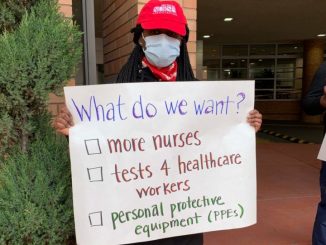
Personal protective equipment (PPE) for all workers required to stay on the job;
Paid medical leave for all.

Strugglelalucha256


Baltimore caravan demands protection for prisoners

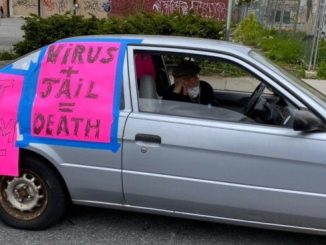
On April 18, progressive working-class activists in Baltimore held a car caravan in solidarity with those currently incarcerated in Maryland jails and prisons. The caravan, organized by the Prisoners Solidarity Committee and the Peoples Power Assembly, demanded that Gov. Larry Hogan immediately begin to release prisoners from facilities that have become Covid-19 hotspots. 

The situation developed even though local news outlets warned for over a month that prisons were prime candidates for severe corona virus outbreaks. Since that time, over 100 cases of the virus have been reported in Maryland prisons. One prisoner has died. In all likelihood, those reported are far lower than the actual number of cases. 

Individuals inside Maryland prisons have described terrible conditions and a complete lack of preparedness. Prisoners have been denied soap, showers, any personal protective equipment (PPE) and medical care. Prisoners with symptoms have been left to their own devices inside solitary cells. 

For these reasons, the Baltimore caravan demanded proper care for prisoners during the coronavirus pandemic. Cars were covered with signs demanding “Free them all!” and “No bars but soap bars!” 

One car had the names of prisoners currently being denied PPE and medical treatment in a prison in Cumberland, Md.: James Young III, Alfred Shinard, Tracy Skinner and Terrance Mahogany. 

Members of the caravan chanted out their windows against institutions that are simply concentration camps for working-class and oppressed people. 

As the caravan passed the Baltimore prisons, hundreds of prisoners could be heard out of their cell windows chanting, whistling and whooping in support. At one point, prisoners even started chanting along with the caravan. This included a chant decrying the lack of action taken by Baltimore Mayor Jack Young. The moment was powerful and filled with solidarity. 

The United States prison system is based on racism and exploitation. 

Simultaneously, another car caravan took place in Annapolis, Maryland’s state capital. However, this caravan was neither progressive nor pro-worker. Various right-wing, white supremacist and frankly fascist organizations held this caravan to demand that Gov. Hogan “reopen” the Maryland economy.  

The fascist caravan echoed the words of demagogue Donald Trump. The leaders of the caravan were business owners and petty capitalists. Their message was clear — they would be more than willing to sacrifice thousands of workers’ lives to the virus as long as they were profiting. 

The contrast between these two caravans was dramatic. One called for human rights for prisoners and all workers. The other would have workers believe they should sacrifice themselves for Trump and the bosses. 

Baltimore stands firmly in solidarity with all prisoners during this pandemic and against those who would put millions of workers at risk for profits. 

Video: https://www.facebook.com/PeoplesPowerAssembly/videos/226570578562064/

SLL photos by Miranda Etel

Strugglelalucha256


Coronavirus central in Queens, N.Y.

As of April 19, some 8,798 people in five adjoining zip codes in the Queens borough of New York City have the coronavirus. About 350,000 people live there. One out of 40 has the virus.

This writer lives in one of these zip codes, 11372, the Jackson Heights neighborhood. Within its 475 acres are 1,732 people who’ve tested positive for Covid-19.  

People line up, sometimes for an hour, to enter supermarkets and drugstores. They wear masks or other face coverings and try to stand six feet apart.

I can’t recall seeing anyone wearing a Trump hat. Some “essential” stores, like bodegas and even Dunkin Donuts franchises, have closed because the owners are worried about catching the virus.

Just about every Chinese restaurant has shut down, even for take-out and delivery orders. Was this due to health concerns or because of the danger of racist attacks fueled by Trump and Fox News?

The 545-bed Elmhurst Hospital is the closest hospital for almost all of the third of a million people who live in these five zip codes. Refrigerator trucks there hold the dead. A line of people wraps around the building to get tested.

In the richest city on earth, there are less than two hospital beds per thousand people in the borough of Queens with its 2.3 million people.

Despite the vicious U.S. economic blockade of socialist Cuba, that country has almost three times as many beds per person. 

Overcrowded housing = death

Next to Jackson Heights is the Corona neighborhood where Louis Armstrong lived. Its 11368 zip code has 2,817 cases of Covid-19, the most of any zip code in New York City.

A block from Armstrong’s house, Manuel “Manny” Mayi was beaten to death by a white racist mob with baseball bats and a fire extinguisher on March 29, 1991. None of the lynchers of the 18-year-old Dominican honor student were even indicted. 

Across Northern Boulevard from Corona is East Elmhurst, zip code 11369, which has 1,055 cases. Malcolm X and his family lived in East Elmhurst at 23-11 97th Street.

Northern Boulevard is still a death strip for pedestrians attempting to cross. The local chapter of the Black Panther Party helped lead a struggle to get stop lights installed on this busy thoroughfare.

Elmhurst, zip code 11373, has 2,196 people who’ve tested positive for the coronavirus. Zip code 11370, which includes the Rikers Island jail complex, has 998 cases.

New York City is a densely populated metropolis. But the reason this seven-square-mile area in Queens has so many people who are ill is because of overcrowding.

The five zip codes have an average of over 48,000 people per square mile. That’s high and may seem to be unbelievably so to most people living in the U.S. 

But there are some pretty ritzy Manhattan neighborhoods that are even more dense. A lot of people can fit comfortably in a luxury high-rise.

Manhattan, of course, has many neighborhoods with poor and working people, including Harlem, El Barrio (East Harlem), Washington Heights, Loisaida (the Lower East Side) and Chinatown. 

Black and Latinx communities in the Bronx and Brooklyn have also been hard hit.  

What sets neighborhoods like Corona and Elmhurst apart is the number of families and individuals who are forced to live in just a few rooms or just one room. 

These are largely immigrant communities with people from all over the planet. From the notices taped, sometimes one on top of another, on almost every light pole, the cheapest monthly rent for a single room is $600. That’s with a shared bathroom.

The least expensive one-bedroom apartment might be $1,400. That is a big increase from 2011, when $1,100 was the going rate for renting a one-bedroom apartment.

Meanwhile, there are at least 200,000 apartments in New York City that landlords keep empty in order to maintain high rents. 

It isn’t just overcrowding that helps transmit the virus. Many of the people living here are considered to be “essential workers” and have to continue to go to work.

Sixty New York City transit workers have already died from the coronavirus. The Number 7 train that goes through Corona, Elmhurst and Jackson Heights continues to take thousands of hospital and supermarket workers to their jobs. 

Trump spits on these workers, many of whom are Asian, Black, Latinx and immigrants.

Inequality spurring reaction

If the entire U.S. had the same infection rate as these zip codes in Queens, it would have 8 million cases of Covid-19. Thirty-three states have fewer cases than this slice of Queens. 

The fascist organizers of the white mobs protesting in Lansing, Mich., and other state capitals to “Reopen America” are taking advantage of this unevenness.  

New York City isn’t the only place that’s been devastated by the pandemic. Seven thousand people have died in nursing homes.

Thousands of meatpacking and poultry workers across the country have fallen ill. So have incarcerated workers at Chicago’s Cook County jail and hundreds of other prisons.

Covid-19 has swept through Black communities in Detroit, Chicago, St. Louis and New Orleans. Over a thousand members of the Navajo Nation have the virus. Forty-one have died. 

Trump supporters use the concentration of deaths among Black, Indigenous and Latinx peoples to spread the lying message that it’s just a disease for “them.” Forty percent of Michigan’s deaths from the disease are of African Americans while only 14 percent of the state’s population are Black.

The reactionary rallies against the necessary public health measures needed to contain the virus are not grassroots efforts. These astroturf events are funded by billionaires like Michigan’s DeVos family. They’re attempts to divert attention from the wholesale failure of the capitalist state to protect people against pandemics.

South Dakota Gov. Kristi Noem is one of those who wants to lift the health restrictions. She ignores over 500 workers, largely immigrants, who have fallen ill at the Smithfield Foods pork plant in Sioux Falls. 

Not all white workers believe the garbage spewed out by Trump and Fox News. The tragic progression of the coronavirus, spreading to largely white suburbs and rural areas, will challenge the belief that it’s just an inner city problem.

Nurses and their unions will serve as a political connecting rod between the oppressed communities and many of the segregated white neighborhoods. The people united will defeat the Trump virus.

Strugglelalucha256


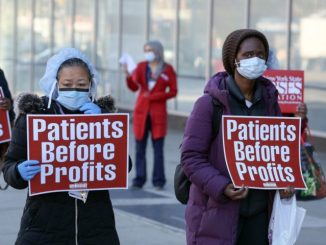
Profits first, patients last

Two thousand people a day are dying from the coronavirus in the United States. New York Gov. Andrew Cuomo has begged retired doctors and nurses to return to work.

All hands on deck to fight the pandemic, right?  Wrong. In the midst of a public health emergency, hospitals and doctors’ offices are firing workers.

“Last week, Bon Secours Mercy Health, which runs 51 hospitals in seven states, announced it would furlough 700 workers. On Wednesday, Ballad Health, which operates 21 hospitals across Tennessee and southwest Virginia, delivered the same bad news to 1,300 employees and said executives would take pay cuts. Employees at Children’s National Hospital in the District [Washington, D.C.] were informed this week that they must take off one week, using either vacation time or, if they have none, unpaid leave.” (Washington Post, April 9)

These outfits claim they’re “starved for cash” because the Covid-19 pandemic forced hospitals to delay “elective” surgeries like hip replacements. These necessary but deferrable procedures are the moneymakers for health factories. 

That’s capitalist health care for you. Everything is subordinated to the dollar, even during this crisis.

Hospital executives, like Beaumont Health CEO John Fox, are worried that the financially weakest 25 percent of hospitals could tank. “There’s no way the other hospitals can absorb their patients,” he told the Post.

Fox runs Michigan’s biggest hospital chain, which made a $132 million profit in 2018. He personally raked in over $5.6 million in 2017, an 82 percent increase from the year before. Yet starting wages at Beaumont were as low as $9.45 per hour last year.   

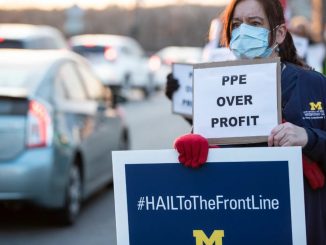
As Abayomi Azikiwe reported in Fighting Words, nurses at Beaumont Hospital are demanding additional personal protective equipment and other necessary measures. As of April 6, some 1,500 of Beaumont’s employees, including 500 nurses, may have the coronavirus. 

Fox used every dirty trick to try to defeat a union organizing drive by nurses. The National Labor Relations Board ruled against Beaumont in February.

After New York and New Jersey, Michigan has the largest number of coronavirus cases. Black people account for 40 percent of the deaths, even though they are just 14 percent of the state’s population.

The war against the coronavirus is too important to be left to generals like John Fox and the rest of the medical-industrial complex.

It isn’t just greed

Brokers selling absolutely necessary medical supplies are ripping off states by charging as much as they can. Why should capitalists pass up the chance to make millions just because people are dying?

“In Illinois, the state is lucky to get N95 masks, which typically cost $1.75 a piece, for $4.75 each, said an aide to [Illinois] Gov. J.B. Pritzker (D), who spoke on the condition of anonymity to discuss the bidding process. Prices can sometimes go up to $10 or $12 per mask, the aide said.

“Prices for medical gowns have soared to four or five times the usual cost, officials in several states said. A ventilator can now price for close to six figures.” (Washington Post, April 11

As repulsive and criminal as this swindling is, the real culprit is capitalist competition. Under capitalism, life-saving items like masks, gowns and ventilators are commodities to be sold at the highest profit, just like soda pop.

The result is that the states and the federal government bid against each other and send prices through the roof. 

This profiteering isn’t a problem for socialist countries like China or Cuba. Health care there is able to be planned, with workers and resources going where they are needed.

Under socialism, people are encouraged to organize and help each other. Members of Cuba’s Committees for the Defense of the Revolution check up on neighbors, particularly the elderly. So do over four million members of the Federation of Cuban Women and 300,000 Young Communist League members. The Workers Central Union of Cuba organizes workers to make masks and other personal protective equipment.

Contrast that with the United States, where racist police killed dozens of members of the Black Panther Party who organized free health clinics and programs providing free breakfasts to children.

What does affect Cuba is the U.S. government’s economic blockade, which has been intensified by Trump. That hasn’t stopped Cuba from sending health care workers to other countries to help people.

The Covid-19 crisis shows that Medicare for All, as proposed by Sen. Bernie Sanders, would be a big step forward. 

Even better is to fight for what socialist Cuba has: free health care for all. 

Strugglelalucha256


How China broke the chain of infection

As information about coronavirus emerged, the Chinese government and Chinese society began to organize an immense campaign against its spread.

On March 31, 2020, a group of scientists from around the world—from Oxford University to Beijing Normal University—published an important paper in Science. This paper—“An Investigation of Transmission Control Measures During the First 50 Days of the COVID-19 Epidemic in China”—proposes that if the Chinese government had not initiated the lockdown of Wuhan and the national emergency response, then there would have been 744,000 additional confirmed COVID-19 cases outside Wuhan. “Control measures taken in China,” the authors argue, “potentially hold lesso[n]s for other countries around the world.”

In the World Health Organization’s February report after a visit to China, the team members wrote, “In the face of a previously unknown virus, China has rolled out perhaps the most ambitious, agile and aggressive disease containment effort in history.”

In this report, we detail the measures taken by the different levels of the Chinese government and by social organizations to stem the spread of the virus and the disease at a time when scientists had just begun to accumulate knowledge about them and when they worked in the absence of a vaccine and a specific drug treatment for COVID-19.

The Emergence of a Plan

In the early days of January 2020, the National Health Commission (NHC) and the Chinese Center for Disease Control and Prevention (CDC) began to establish protocols to deal with the diagnosis, treatment, and laboratory testing of what was then considered a “viral pneumonia of unknown cause.” A treatment manual was produced by the NHC and health departments in Hubei Province and sent to all medical institutions in Wuhan City on January 4; city-wide training was conducted that same day. By January 7, China CDC isolated the first novel coronavirus strain, and three days later, the Wuhan Institute of Virology (Chinese Academy of Sciences) and others developed testing kits.

By the second week of January, more was known about the nature of the virus, and so a plan began to take shape to contain it. On January 13, the NHC instructed Wuhan City authorities to begin temperature checks at ports and stations and to reduce public gathering. The next day, the NHC held a national teleconference that alerted all of China to the virulent novel coronavirus strain and to prepare for a public health emergency. On January 17, the NHC sent seven inspection teams to China’s provinces to train public health officials about the virus, and on January 19 the NHC distributed nucleic acid reagents for test kits to China’s many health departments. Zhong Nanshan—former president of the Chinese Medical Association—led a high-level team to Wuhan City to carry out inspections on January 18 and 19.

Over the next few days, the NHC began to understand how the virus was transmitted and how this transmission could be halted. Between January 15 and March 3, the NHC published seven editions of its guidelines. A look at them shows a precise development of its knowledge about the virus and its plans for mitigation; these included new methods for treatment, including the use of ribavirin and a combination of Chinese and allopathic medicine. The National Administration of Traditional Chinese Medicine would eventually report that 90 percent of patients received a traditional medicine, which was found to be effective in 90 percent of them.

By January 22, it had become clear that transport in and out of Wuhan had to be restricted. That day, the State Council Information Office urged people not to go to Wuhan, and the next day the city was essentially shut down. The grim reality of the virus had by now become clear to everyone.

The Government Acts

On January 25, the Communist Party of China (CPC) formed a Central Committee Leading Group for COVID-19 Prevention and Control with two leaders—Li Keqiang and Wang Huning—in charge. China’s President Xi Jinping tasked the group to use the best scientific thinking as they formulated their policies to contain the virus, and to use every resource to put people’s health before economic considerations. By January 27, Vice Premier of the State Council Sun Chunlan led a Central Guiding Team to Wuhan City to shape the new aggressive response to virus control. Over time, the government and the Communist Party developed an agenda to tackle the virus, which can be summarized in four points:

1. To prevent the diffusion of the virus by maintaining not only a lockdown on the province, but by minimizing traffic within the province. This was complicated by the Chinese New Year break, which had already begun; families would visit one another and visit markets (this is the largest short-term human migration, when almost all of China’s 1.4 billion people gather in each other’s homes). All this had to be prevented. Local authorities had already begun to use the most advanced epidemiological thinking to track and study the source of the infections and trace the route of transmission. This was essential to shut down the spread of the virus.

2. To deploy resources for medical workers, including protective equipment for the workers, hospital beds for patients, and equipment as well as medicines to treat the patients. This included the building of temporary treatment centers—including later two full hospitals (Huoshenshan Hospital and Leishenshan Hospital). Increased screening required more test kits, which had to be developed and manufactured.

3. To ensure that during the lockdown of the province, food and fuel were made available to the residents.

4. To ensure the release of information to the public that is based on scientific fact and not rumor. To this end, the team investigated any and all irresponsible actions taken by the local authorities from the reports of the first cases to the end of January.

These four points defined the approach taken by the Chinese government and the local authorities through February and March. A joint prevention and control mechanism was established under the leadership of the NHC, with wide-ranging authority to coordinate the fight to break the chain of infection. Wuhan City and Hubei Province remained under virtual lockdown for 76 days until early April.

On February 23, President Xi Jinping spoke to 170,000 county and Communist Party cadres and military officials from every part of China; “this is a crisis and also a major test,” said Xi. All of China’s emphasis would be on fighting the epidemic and putting people first, and at the same time China would ensure that its long-term economic agenda would not be damaged.

Neighborhood Committees

A key—and underreported—part of the response to the virus was in the public action that defines Chinese society. In the 1950s, urban civil organizations—or juweihui—developed as way for residents in neighborhoods to organize their mutual safety and mutual aid. In Wuhan, as the lockdown developed, it was members of the neighborhood committees who went door-to-door to check temperatures, to deliver food (particularly to the elderly) and to deliver medical supplies. In other parts of China, the neighborhood committees set up temperature checkpoints at the entrance of the neighborhoods to monitor people who went in and out; this was basic public health in a decentralized fashion. As of March 9, 53 people working in these committees lost their lives, 49 of them were members of the Communist Party.

The Communist Party’s 90 million members and the 4.6 million grass-roots party organizations helped shape the public action across the country at the frontlines of China’s 650,000 urban and rural communities. Medical workers who were party members traveled to Wuhan to be part of the frontline medical response. Other party members worked in their neighborhood committees or developed new platforms to respond to the virus.

Decentralization defined the creative responses. In Tianxinqiao Village, Tiaoma Town, Yuhua District, Changsha, Hunan Province, Yang Zhiqiang—a village announcer—used the “loud voice” of 26 loudspeakers to urge villagers not to pay New Year visits to each other and not to eat dinner together. In Nanning, Guangxi Zhuang Autonomous Region, the police used drones to play the sound of trumpets as a reminder not to violate the lockdown order.

In Chengdu, Sichuan Province, 440,000 citizens formed teams to do a range of public actions to stem the transmission of the virus: they publicized the health regulations, they checked temperatures, they delivered food and medicines, and they found ways to entertain the otherwise traumatized public. The Communist Party cadre led the way here, drawing together businesses, social groups, and volunteers into a local self-management structure. In Beijing, residents developed an app that sends registered users warnings about the virus and creates a database that can be used to help track the movement of the virus in the city.

Medical Intervention

Li Lanjuan was one of the early medical doctors to enter Wuhan; she recalled that when she got there, medical tests “were difficult to get” and the situation with supplies was “pretty bad.” Within a few days, she said, more than 40,000 medical workers arrived in the city, and patients with mild symptoms were treated in temporary treatment centers, while those who had been seriously impacted were taken to the hospitals. Protective equipment, tests, ventilators, and other supplies rushed in. “The mortality rate was greatly reduced,” said Dr. Li Lanjuan. “In just two months, the epidemic situation in Wuhan was basically under control.”

From across China came 1,800 epidemiological teams—with five people in each team—to do surveys of the population. Wang Bo, a leader of one of the teams from Jilin Province, said that his team conducted “demanding and dangerous” door-to-door epidemiological surveys. Yao Laishun, a member of one of the Jilin teams, said that within weeks their team had carried out epidemiological surveys of 374 people and traced and monitored 1,383 close contacts; this was essential work in locating who was infected and treated as well as who needed to be isolated if they had not yet presented symptoms or if they tested negative. Up to February 9, the health authorities inspected 4.2 million households (10.59 million people) in Wuhan; that means that they inspected 99 percent of the population, a gargantuan exercise.

The speed of the production of medical equipment, particularly protective equipment for the medical workers, was breathtaking. On January 28, China made fewer than 10,000 sets of personal protective equipment (PPE) a day, and by February 24, its production capacity exceeded 200,000 per day. On February 1, the government produced 773,000 test kits a day; by February 25, it was producing 1.7 million kits per day; by March 31, 4.26 million test kits were produced per day. Direction from the authorities moved industrial plants to churn out protective gear, ambulances, ventilators, electrocardiograph monitors, respiratory humidification therapy machines, blood gas analyzers, air disinfectant machines, and hemodialysis machines. The government focused attention on making sure that there was no shortage of any medical equipment.

Chen Wei, one of China’s leading virologists who had worked on the 2003 SARS epidemic and had gone to Sierra Leone in 2015 to develop the world’s first Ebola vaccine, rushed to Wuhan with her team. They set up a portable testing laboratory by January 30; by March 16, her team produced the first novel coronavirus vaccine that went into clinical trials, with Chen being one of the first to be vaccinated as part of the trial.

Relief

To shut down a province with 60 million inhabitants for more than two months and to substantially shut down a country of 1.4 billion inhabitants is not easy. The social and economic impact was always going to be very great. But, the Chinese government—in its early directives—said that the economic hit to the country was not going to define the response; the well-being of the people had to be dominant in the formulation of any policy.

On January 22, before the Leading Group was formed, the government issued a circular that said medical treatment for COVID-19 patients was guaranteed and it would be free of cost. A medical insurance reimbursement policy was then formulated, which said that expenses from medicines and medical services needed for treating the COVID-19 would be completely covered by the insurance fund; no patient would have to pay any money.

During the lockdown, the government created a mechanism to ensure the steady supply of food and fuel at normal prices. State-owned enterprises such as China Oil and Foodstuffs Corporation, China Grain Reserves Group, and China National Salt Industry Group increased their supply of rice, flour, oil, meat and salt. All-China Federation of Supply and Marketing Cooperatives helped enterprises to get direct connection with farmers’ cooperatives; other organizations like China Agriculture Industry Chamber of Commerce pledged to maintain supply and price stability. The Ministry of Public Security met on February 3 to crack down on price gouging and hoarding; up to April 8, the prosecutorial organizations in China investigated 3,158 cases of epidemic-related criminal offenses. The state offered financial support for small and medium-sized enterprises; in return, businesses revamped their practices to ensure a safe working environment (Guangzhou Lingnan Cable Company, for instance, staggered lunch breaks, tested the temperature of workers, disinfected the working area periodically, ensured that ventilators worked, and provided staff with protective equipment such as masks, goggles, hand lotion, and alcohol-based sanitizers).

Lockdown

A study in The Lancet by four epidemiologists from Hong Kong show that the lockdown of Wuhan in late January prevented the spread of infection outside Hubei Province; the major cities of Beijing, Shanghai, Shenzhen, and Wenzhou, they write, saw a collapse in numbers of infections within two weeks of the partial lockdown. However, the scholars write, as a consequence of the virulence of COVID-19 and the absence of herd immunity, the virus might have a second wave. This is something that worries the Chinese government, which continues to be vigilant about this novel coronavirus.

Nonetheless, the lights of celebration flashed across Wuhan as the lockdown was lifted. Medical personnel and volunteers breathed a sigh of relief. China had been able to use its considerable resources—its socialist culture and institutions—to swiftly break the chain.

(This is the third part of a three-part series, the first part is available here and the second here.)

Vijay Prashad is an Indian historian, editor and journalist. He is a writing fellow and chief correspondent at Globetrotter, a project of the Independent Media Institute. He is the chief editor of LeftWord Books and the director of Tricontinental: Institute for Social Research. He has written more than twenty books, including The Darker Nations: A People’s History of the Third World (The New Press, 2007), The Poorer Nations: A Possible History of the Global South (Verso, 2013), The Death of the Nation and the Future of the Arab Revolution (University of California Press, 2016) and Red Star Over the Third World (LeftWord, 2017).

Du Xiaojun works as a translator and is based in Shanghai. His research is in international relations, cross-cultural communication, and applied linguistics.

Weiyan Zhu is a lawyer based in Beijing. She is interested in social and political issues.

This article was produced by Globetrotter, a project of the Independent Media Institute.

Source: Peoples Dispatch


Strugglelalucha256


Capitalism & racism + Covid-19 = murder

April 11 — The Covid-19 pandemic is devastating New York City. Eighty refrigerator trucks are serving as mobile morgues to store the bodies.As of April 10, 92,384 people have been infected.

Inmates in the Rikers Island prison are being offered $6 per hour to dig mass graves on Hart’s Island off the Bronx. That’s the site of Potter’s Field, where a million people too poor to afford a funeral had their bodies dumped.

What’s happening in New York City is being repeated in Detroit, Chicago, New Orleans and Los Angeles. The coronavirus is ripping through the South with Black people suffering the most. About one in ten deaths has occurred in the adjoining states of Louisiana, Mississippi. Alabama and Georgia.

The Pentagon is seeking 100,000 body bags. The government’s stockpile of personal protective equipment ― a life and death matter for health care workers ― is almost depleted. But the Immigration and Customs Enforcement gestapo conducting deportation raids are guaranteed N95 face masks.

A hundred racist attacks against Asian Americans are occurring every day. Trump incited these attacks by calling the coronavirus “the Chinese virus.” We should call it the Trump virus. 

New York Gov. Andrew Cuomo has taken advantage of the pandemic to roll back bail reform and ram through Medicaid cuts in the state’s budget. 

Cuomo calls the virusthe great equalizer.” That isn’t true even if his own brother, CNN host Chris Cuomo, caught it. It’s certainly false with the city’s wealthy and powerful fleeing to the countryside. 

There’s nothing equal about this pandemic

The coronavirus has been much worse for New York City’s Black and Latinx communities. Orthodox Jewish communities in Brooklyn have been hard hit.

This writer lives two blocks from the Corona, Queens, N.Y., neighborhood where Louis Armstrong lived. Its 11368 ZIP code had 2,248 cases of the coronavirus as of April 10, the most of any in New York City.

Experts say New York City has been hardest hit because of its density. Nearly 9 million people live on about 300 square miles of land. 

Corona, Queens, is crowded with 41,768 people living per square mile. Two percent ― have been infected. 

Murray Hill ― ZIP code 10017 ― on midtown Manhattan’s East Side is even more crowded, with 51,775 people per square mile. Yet the neighborhood’s infection is just a quarter of Corona’s.

The difference is that while Corona’s median household income is $45,964, the figure for Murray Hill is $100,652, over twice as high.

Adjoining Corona in Queens is Elmhurst (ZIP code 11373) with 1,737 cases and Jackson Heights (ZIP code 11372) with 1,322 people infected. The Elmhurst Medical Center is being overwhelmed. (Figures for the different zip codes are updated every few hours at https://github.com/nychealth/coronavirus-data/blob/master/tests-by-zcta.csv)

All these neighborhoods are immigrant communities with many service and construction workers who had to continue going to their jobs while the pandemic was gripping the city. 

Black and Latinx neighborhoods in the Bronx, Brooklyn and Manhattan have also been hard hit. The eastern Far Rockways in Queens, home to four largely Black housing projects, have 993 cases.

The capitalist government is covering up the impact on Asian, Black, Indigenous and Latinx communities. Maryland lawmakers are demanding a breakdown of those who’ve caught the virus.

Social distancing an impossibility

Medical experts recommend that people keep a “social distance” of six feet from each other. How are the 2.2 million prisoners locked up supposed to follow that advice? Cook County Jail in Illinois already has 289 prisoners with the virus.   

For thousands of prisoners across the country, the coronavirus will be a death sentence. Activists like those in the Chicago Alliance Against Racist and Political Repression are fighting to free the most vulnerable prisoners. 

The hundreds of thousands in homeless shelters are also not able to keep six feet from each other. 

Social distancing is also impossible for the hospital and other “essential” workers taking overcrowded buses and subways in New York City. Fifty members of Transit Workers Union Local 100 have died of the coronavirus. 

Many essential workers who are risking their lives are among the lowest paid. The 3.6 million cashiers have an average annual income of just $22,430.  

Experts are recommending that trips to the food store be limited to once every two weeks. How many working-class families can do that? Not the ten million workers who have already been fired.

Density and lack of social distancing won’t account for all the deaths. We’re told to wash our hands, yet 141,000 Detroit families have had their water shut off since 2014. Service hasn’t been restored for thousands.

It’s worse on the Indigenous reservations. Forty percent of Navajo nation households aren’t connected to a water pipe. They have to haul water to their home. 

Overcrowded housing has skyrocketed because of rising rent. Many families are forced to move in with relatives.

Between 1980 and 2010, the number of these doubled-up families increased almost four-fold, 1.15 million to 4.3 million. (2012 U.S. Statistical Abstract, Table 59). Social distancing is impossible for them.

Millions of housing units are kept off the market to keep the rent high. A people’s movement is needed to seize them. 

Homeless families in Los Angeles have taken over over 12 empty homes. We need to follow their example.

Strugglelalucha256


Covid-19: Weapons of mass incompetence

April 6 — As of this writing, 10,000 people [in the U.S.] have died from the impact of the coronavirus, also known as Covid-19. Ten thousand! And unless I miss my guess, it ain’t over yet. That’s because the coronavirus is not slowing down. If anything, it’s picking up speed. 

Almost everything we’ve heard about the virus from the media during the first weeks is false or misleading. I’m not talking about the big idiots crowing about “It’s a hoax.” It’s not. 

Originally, it was a virus attacking old people. We now know better. Young people, including children and even infants, have succumbed to this disease. There was an old woman in Italy who contracted the virus. She was sick, and then recovered. She was 102 years old. 

Viruses are living things. And like all living things, they surprise us. 

The U.S. government had months to prepare for the coming of the coronavirus. They treated it lightly, and nearly a thousand deaths a day proved that it is indeed deadly serious. We will see worse.

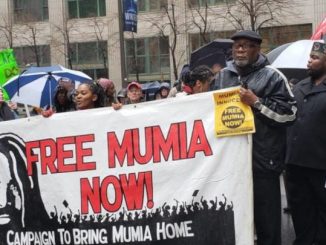
From imprisoned nation, this is Mumia Abu-Jamal.

Listen to Mumia’s commentary at PrisonRadio.org.

Strugglelalucha256


Maryland grocery worker who wanted to help seniors dies of Covid-19

Twenty-seven-year-old Leilani Jordan told her mother, Zenobia Shepard, “Mommy, I’m going to work because no one else is going to help the senior citizens get their groceries.”

Jordan worked at the Giant Food at the Campus Way South store.  She was a greeter. Her mother described to local TV station WUSA9 how Jordan had worked at the Giant store for six years as part of a disability program. “She loved her little job,” and “She did whatever they needed to help people.”

In late March, Leilani Jordan became ill, was eventually diagnosed as being positive for Covid-19 and was hospitalized at Walter Reed Medical Center. Before she was placed on a ventilator, she called her mother, telling her, “Mommy, I can barely breathe.”  On April 1 she died.

In a recent article, published in the Atlantic magazine, Ibram X Kendi documents how the virus has disproportionately impacted Black and Brown people.

Jordan is not the only grocery and retail worker to die.  

Walmart workers’ rights group, United for Respect, reported that in Illinois, Walmart workers Phillip Thomas, 48, and Wando Evans, 51, both of whom worked at a store in Evergreen Park near Chicago, died in late March. In addition, a Trader Joe’s worker in Scarsdale, N.Y., died.

The United Food and Commercial Workers Union has been demanding that Maryland Gov. Larry Hogan designate grocery workers as first responders so that they can receive personal protective equipment.

In Maryland, two Amazon warehouses have already reported positive cases of coronavirus, one at the Baltimore location and two other cases at the Sparrow’s Point warehouse.  Baltimore and Maryland Amazon workers have initiated a petition and Amazon has responded, but on a scale that workers describe as being far too limited.

The company is now doing temperature checks.  But in one case, a worker reported that the company distributed cleaning supplies and some masks for the first floor of the building, where management resides, but on the second, third and fourth floor, no one has received supplies.

Workers have also developed the hashtag #STRIKEdontdie, which expresses their sentiments at being unrecognized front-line workers whose lives are being sacrificed to preserve the profits of the companies they work for without adequate hazard pay or the power to control their working conditions

Strugglelalucha256
https://www.struggle-la-lucha.org/covid-19/page/5/