The U.S. war drive against China

Introduction

Oct. 1, 2024, marks the 75th anniversary of China’s earth-shaking revolution, which broke the chains of feudal slavery and imperialist domination.  

The Communist Party of China, under the leadership of Mao Zedong, commonly known as Chairman Mao, both inside China and among the world’s oppressed, did what was considered near impossible.  The revolution ended China’s “Century of Humiliation,” which began with the British imperialists’ First Opium War in 1839.

Widespread famine, floods, and forced labor, as well as severely shortened lifespans, marked the era of imperialist domination.  China’s huge landmass and difficult terrain made it seemingly impossible to unite the diverse population, including its numerous ethnic groups. 

In 1949, only 20% of the population could read, and the life expectancy was 35 years.  China was primarily a rural peasant economy; its working class was tiny in comparison. There was almost no industrialization or education. But by 1975, the revolution had increased life expectancy to 65.5 years.

The newly founded People’s Republic of China, under the banner, “Women hold up half the sky,” abolished arranged marriage, child brides, and concubinage.  The status of women was uplifted and enshrined in the 1950 Marriage Law and the Land Law.

In the last 75 years, progress for the masses and China’s working class has been remarkable. 

In 2012, China’s President Xi Jinping, General Secretary of the CPC Central Committee, vowed to eradicate the vestiges of extreme poverty by 2020. Despite the additional challenges posed by the COVID-19 pandemic, the Chinese government proudly proclaimed the eradication of extreme poverty on November 23, 2020. 

The World Bank, indeed no friend of the Communist Party of China, declared that China has lifted over 850 million people out of poverty. “By any measure, the speed and scale of China’s poverty reduction is historically unprecedented. With this, China has contributed close to three-quarters of the global reduction in the number of people living in extreme poverty.”  

China is now a world scientific power.  It has built high-speed trains and affordable electric cars, reduced pollution and carbon emissions, and engaged in space exploration. The People’s Republic of China’s accomplishments have spanned the gamut from health care to education and sports. 

China is the world’s second-largest economy by nominal GDP (Gross Domestic Product), behind the United States, and since 2017 has been the world’s largest economy when measured by purchasing power parity (PPP).

GDP is the monetary market value of all final goods and services made within a country during a specific period.  What is not measured by this standard is how that is distributed.  

PPP is an alternative way to measure GDP that takes into account the differences in the cost of living between countries. It adjusts the GDP figures to reflect the actual purchasing power of a country’s currency. When measured by PPP, China’s economy has been larger than that of the United States since 2017. The cost of living in China is generally lower than in the United States. This means that the same amount of money can buy more goods and services in China than in the U.S.

The development of the Belt and Road Initiative (BRI) by China, in contrast to the International Monetary Fund (IMF), which demands austerity and cutbacks for loans, has contributed to the developing countries of the Global South. 

The BRI is aimed at building infrastructure that links land and sea.  In Africa, this includes railways in Kenya, an electric railway in Ethiopia, and hydropower stations in Uganda. Washington, which does not contribute to local development, mainly ships weapons and war munitions to Africa, building AFRICOM — the U.S. Africa Command, a unified combat command of the Pentagon.

Global class war and China

Revolutionary change and the struggles of the working class don’t happen in isolation; international events and global pressures influence them. The same applies to the material conditions that shape them.

What the Communist Party of China and the Chinese working class have faced, whether through external or internal pressure, trade wars, attempts at dismemberment, military threats, or hot war, can best be described as a global class war. This struggle primarily pits U.S. imperialism against the working class worldwide, especially in countries intent on building socialism and liberating themselves from imperialist control.

The approach of U.S. monopoly capitalism has not, at any moment, adopted a hands-off policy regarding building socialism in China, nor, for that matter, anywhere else in the world. They are for intervention against socialism everywhere.

It’s important to underscore that in the decades preceding the success of the 1949 revolution, the United States military and government were already playing a role in attempting to defeat the Chinese communist revolutionaries by supplying arms to the reactionary Kuomintang. 

Both the bloody Korean and Vietnam wars were equally about containing, encircling, and strangling China, along with defeating the liberation aspirations of the Korean and Vietnamese people. 

The Pentagon visited unfathomable destruction on both northern Korea and Vietnam. It bombed North Korea to rubble and engaged in carpet bombing and deforestation in Vietnam.  An estimated 2.5 million Koreans lost their lives, and the estimated deaths of Vietnamese range from 1 to 3 million. The people of both the Democratic People’s Republic of Korea and the Socialist Republic of Vietnam successfully moved heaven and earth to rebuild.

The 1989 reactionary Tiananmen Square “student rebellion” characterized as a massacre by the West and later exposed as a lie might possibly be described as a much earlier attempt, failed as it was, at “color revolution” (the name given to Western-backed attempts at regime change starting with the Rose Revolution in the country of Georgia in 2003). 

Throw in the Dalai Lama and the CIA-ledTibetan independence movement,” and the Falun Gong project, and you can see the pattern of lies meant to turn all manner of sympathy against the CPC and direct efforts to divide and dismember the People’s Republic of China.

The key to China’s ability to hold off counter-revolution and to weather imperialist schemes is that the Communist Party of China and its government, backed by the People’s Liberation Army, have continued to hold state power in the name of the working class. China continues to have a planned economy based on the state-owned infrastructure.  

Today’s heightened danger

The present decade has brought bigger challenges. The maneuvers by U.S. imperialism have been increasingly more dangerous and point in the direction of a hot war centered around Taiwan. The U.S. NATO proxy war against Russia and the increasing regional war in Western Asia, with Palestine as its central flash point, should be seen as one.

What undergirds and fuels this crisis is the contraction of monopoly capitalism.  More than ever, the U.S. economy relies less on production for use and more on spending and development for what is popularly called the military-industrial complex.  The capitalist banking system is intertwined with these developments.  It is the super fuel for inflation and the deepening impoverishment of the broader working class, making larger war inevitable.

Lenin’s thesis on imperialism is more important than ever. The drive toward war is independent of political administrations or individual intentions, regardless of how venal or corrupt.  As the global capitalist crisis deepens, the U.S. imperialist system is propelled toward wider war. 

Our role in the “belly of the beast” is clear.  

The global working class, including U.S. workers, who increasingly embody a diverse collective of nations, must be united in solidarity with the working class of China.

The vast majority of the people of the United States have nothing in common with the multi-trillion dollar bankers and war profiteers who are promoting the war buildup against China.

This book, “The U.S. War Drive Against China: What it means for workers,” is an effort to expose the increasing danger of a U.S. war against China and to reveal the real enemies of the working class.

Strugglelalucha256


A student’s pursuit of justice leads to China

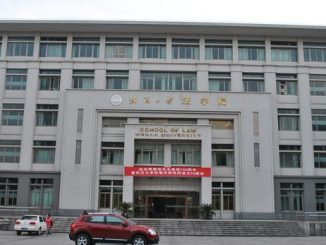
Sept.  24 — Why China? That’s a question I have had to answer a lot these past few months. Whether it be family, friends, or previous co-workers, everyone wants to know why I have chosen to apply to Wuhan University for law school. 

I’m 23 years old and a recent graduate of college. I am also the first person in my Black working-class family to graduate from college.  Since I was a teenager, I’ve always wanted to be a lawyer, with my specific interest being international law. 

It was my dream to serve as counsel on the International Criminal Court. However, given the recent failure of ICC lawyers to bring Israel and its genocidal supporters to heel, I no longer live under any delusions about international law’s capabilities in the current world order. 

While it is true that there are a myriad of U.S.-based law schools that provide international law programs for students to enroll in, the problem that I have continuously found myself in is cost. I have no help to finance furthering my education and already have around $20,000 of student loan debt. 

The slight humor to this situation is that I’m considered lucky compared to other recent Gen-Z graduates, as the average student loan debt is currently over $37,000. I offer this to give perspective on why I would consider what most have politely told me is a drastic change of scenery. 

While I must admit the prospect of such change at first was scary, especially since this would be the furthest I have ever traveled, I now embrace the change. The first two reasons I offer to those who ask are cost and cultural experience. Like so many others my age, I want to receive an education for my passions and have ambitions of turning those passions into a career. 

The better option is obvious

The School of International Law at Wuhan University has one of the world’s top international law programs and thousands of students worldwide enroll every semester. The total cost for the duration of the program, 2 years, is currently a little over $9,000. In comparison, the tuition costs for Georgetown University Law Center’s three-year program are over $79,000 per year. To any student, the better option is obvious. 

Most, if not all, young adults in Gen-Z cannot afford to take out loans to cover this amount of money, nor can they attach all their hopes to receiving scholarships from philanthropists who are only interested in receiving a tax write-off. 

China has a rich history that more people should want to experience, not to mention their public transportation systems allow both the Chinese people and visitors to fully enjoy what the country has to offer. 

It surprised me when I found out that the Chinese government allots money in the form of scholarships to students from dozens of countries around the world, the U.S. being one of them. All that is required is that an interested student applies directly with the Chinese government, most likely through an embassy in their country or the university itself. 

Unsurprisingly, the U.S., Britain, and Australia are amongst the lowest student populations to utilize the scholarship monies provided. This needs to change, as there should be as few barriers to higher education as possible, despite the ruling class’s desire to keep people stuck in perpetual debt. If the international community welcomes me with open arms, I think it only makes sense to accept the invitation and learn from people worldwide.  

While I’m sure many may not understand my decision to go outside the box of U.S. conventionalism, all I have to offer is that those with my circumstances, will and do understand. Some have even offered to visit me while I’m there. I am the first in my family to graduate from college, and while that is something to celebrate, my story does not end there. I have always wanted to be part of the international community, to see for myself what is true and what is not, and to work with others around the world to bring true justice to the working class. 

True international solidarity rooted in the working class is not something any U.S. law program could ever offer, and thus, it’s not for me anymore. Although I wrote this to explain why I decided to make this decision, I’m hoping that this gives information to other young people interested in doing the same. 


Strugglelalucha256


A retired railroader looks at China’s fantastic railroad system

A telling comparison between capitalist decay in the United States and surging economic growth in the socialist People’s Republic of China is in their railroad systems.

Between 1950 and 2000, more than 79,000 miles of railroad lines were abandoned in the United States. Passenger service, now run by Amtrak, has withered.

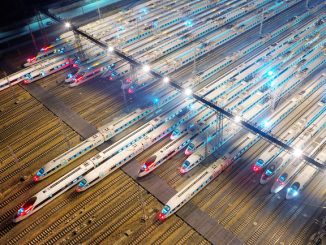
Meanwhile, China has greatly increased its railroad network and now has 100,000 miles of track. China has built twice as many miles of high-speed rail than the rest of the world combined.

Last year, Chinese railways carried 3.68 billion passengers. That’s 10 million passengers daily, a hundred times Amtrak’s ridership.

China’s railroads are on schedule to move 4 billion metric tons of freight in 2024. That’s about three times the U.S. total. 

Socialist China will invest almost $108 billion in its railroads this year. That’s four-and-half times the $23 billion railroad monopolies in the capitalist United States spend on average. 

How about urban transport? China has 55 cities with subway systems. Just in Beijing, three new metro lines will open this year. 

In contrast, New York City has been trying to complete the construction of the Second Avenue subway for a century. Wall Street’s hometown may be the only metropolis with less rapid transit than it had in the 1930s. That’s because elevated lines were torn down without replacing them with subways.

The biggest victims of capitalist railroad shrinkage in the U.S. are railroad workers. There were two million workers on the railroads in 1920.

The Great Depression helped reduce railroad employment to 1.5 million workers in 1947. Since then, railroad jobs have fallen by 90%, with just 151,200 railroaders working in August 2024.

That’s a smaller number of railroad workers than in 1870, one year after the first transcontinental railroad in the United States was completed. These massive job cuts devastated railroad towns coast to coast.

Railroads and racism

Before any railroads were built in China, 15,000 Chinese immigrants were indispensable to building the transcontinental railroad across the Sierra Nevada mountains in California and Nevada. At least a thousand were killed.

Chinese workers, who were 90% of the Central Pacific’s workforce, were paid as low as $26 a month, considerably less than their white counterparts. When they went on strike in 1867 over these dangerous conditions and low pay, their demands were ignored by the wealthy railroad moguls.

These tycoons included Leland Stanford, who founded Stanford University, and Charles Crocker, whose Crocker National Bank was merged into Wells Fargo in 1986.

When you hear reactionaries from Stanford University and its Hoover Institution attack the People’s Republic of China, remember that Stanford’s endowment includes the blood of Chinese immigrants.

Chinese workers were not given any thanks for their vital contribution. At the May 10, 1969, centennial of the Golden Spike ceremony, marking the transcontinental railroad’s completion — now all part of the Union Pacific — Transportation Secretary John Volpe refused even to mention the Chinese railroad workers.

Two years after the Golden Spike, working people in Paris “stormed heaven,” in Karl Marx’s words, and formed the Paris Commune, the first working-class government. The same year, in Los Angeles, then a village with a population of 6,000, 18 Chinese people were lynched in an 1871 pogrom.

Ten percent of the local Chinese population were murdered. Sixty years later, the city’s Chinese community was forced to move so Union Station could be built.

In the capitalist United States, railroads and racism went hand-in-hand. Before the Civil War, 9,000 miles of railroads were built by enslaved Africans.

Thousands more miles of tracks were laid after the Civil War by Black prisoners. Among them was the “steel-driving man” John Henry, who was worked to death building the Chesapeake and Ohio, now part of the CSX system. The capitalist running the C&O was Collis P. Huntington, one of the Central Pacific’s founders.

Another big railroad capitalist was the former slave owner Johns Hopkins, whose fortune came from the Baltimore and Ohio Railroad (B&O), now also part of CSX. His loot established Johns Hopkins University and its medical school in Baltimore.

General George Custer had it coming. He died for the Northern Pacific — now part of billionaire Warren Buffet’s BNSF — that was invading Lakota Sioux land.

Capitalism vs. socialism

About 41 high-speed trains travel daily between the Chinese capital of Beijing and Shanghai. They take around four-and-a-half hours to make the 819-mile trip.

Amtrak has one train, the Capitol Limited, between Washington D.C. and Chicago. It takes 17.5 hours to cover the 764-mile distance.

None of this is the fault of Amtrak workers. It’s the result of decades of a capitalist class allowing much of the railroad system to decay.

On Oct. 1, 1949, Mao Zedong declared that “China has stood up.” The People’s Republic of China was born. At the time there were maybe 12,000 miles of operable railroad track in the country.

Seventy-five years later, China’s railroad network has increased eight times in length and many more times in capacity. Almost all of it is owned and operated by the socialist government. There are 2.2 million railroad workers in China.

U.S. railroads were so dangerous that one in nine rail workers was injured in 1909. One in 205 were killed.

The response of the old Interstate Commerce Commission – abolished in 1996 in the name of deregulation – was to stop collecting these embarrassing statistics. (“The Economic History of the United States” by Ernest Bogart)

Two years ago, railroad tycoons like Warren Buffett refused to agree to sick days for railroaders whose work schedules could include any time of day or night, any day of the week.
We need what the People’s Republic of China has: a socialist railroad system. The people need to take over the railroads.

The writer is a retired Amtrak worker and a member of the American Train Dispatchers Association and Transportation Communications International Union.

Strugglelalucha256


U.S. targeting China, deploying previously banned missiles in Japan

As U.S. strategic capabilities keep sinking (primarily due to its growing technological backwardness), the world’s most aggressive thalassocracy is determined to use its current imperial overstretch to jeopardize several adversaries simultaneously. Namely, the Pentagon is deploying previously banned medium and intermediate-range missiles in the vicinity of Russia, China and North Korea. The United States believes this could give it the best first-strike capabilities and possibly even put Moscow, Beijing and Pyongyang into a checkmate position. Warmongers and war criminals in Washington, D.C., are surely aware that this approach is extremely risky, but they’re convinced that they could pull it off. This is precisely why they’re escalating their belligerence toward the two (Eur)Asian giants (as well as their North Korean allies). Namely, the U.S. decided to install the previously banned missiles in Japan in a very clear message to China.

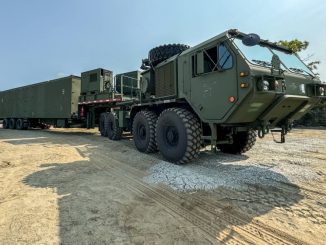
The system in question is the “Typhon”, a modular platform that can fire land-based SM-6 multipurpose and “Tomahawk” cruise missiles. The latter can hit targets at ranges of approximately 1,600 km. Their ability to carry the W80 thermonuclear warheads means that the old GLCM (Ground Launched Cruise Missile, officially designated as the BGM-109G “Gryphon”) is effectively resurrected, while the very usage of the name “Typhon” indicates that the system is a successor to the “Gryphon”. The multipurpose SM-6 missiles have a range of up to 500 km and effectively play the role of SRBMs (short-range ballistic missiles). On September 4, U.S. Secretary of the Army Christine Wormuth said that the U.S. informed Japan it will be deploying the “Typhon” missile systems there. According to her statement during a Defense News conference in Virginia, “[the U.S.] made the interest in this clear with the Japanese Self-Defense Forces”.

Secretary Wormuth also said that the U.S. wants to keep these missiles in Japan “for several months”, adding that the U.S. Army’s goal is to “really try to have as much combat-credible capability forward in the Indo-Pacific west of the international dateline.” She insisted that the deployment “strengthens deterrence in the region” and that the “Typhon” missile system “has gotten the attention of China.” Wormuth also added that “there is a lot of potential for moving U.S. troops and equipment around Japan’s southwestern islands,” which are close to Taiwan. These could certainly be used to jeopardize Chinese naval forces, particularly as the SM-6’s capabilities include the role of an anti-ship missile. And while Washington, D.C., insists that these troops are there to supposedly “deter” Beijing, the truth is that these are highly offensive forces that China certainly sees as a direct threat to the full restoration of its territorial integrity.

Worse yet, foreign troops stationed so close to the Asian giant’s shores are jeopardizing both its sovereignty and basic national security interests. Despite U.S. claims that it would like to “avoid war”, its actions suggest the complete opposite, as they’re actually increasing the likelihood of a conflict exponentially. It would seem that’s exactly the goal, as Washington, D.C., is determined to deploy a “dragon trap” against Beijing, just like it did to Russia with a “bear trap” in Ukraine. This is designed to force a reaction, which the U.S. could then present as “proof” of how supposedly “aggressive” the targeted country is. However, while this usually didn’t have consequences of global proportions when used against relatively small and helpless countries, it’s a whole different story when it comes to superpowers such as China and Russia. Poking the “Bear” and the “Dragon” simultaneously, mind you (among others), is a really great way to start WW3.

Needless to say, given how heavily armed top military superpowers are, such a confrontation would surely turn into a global thermonuclear annihilation. Unfortunately, Washington, D.C., doesn’t really care about that. Last year, Secretary Wormuth herself stated that “the U.S. is preparing to fight and win a war with China”, adding that “[she] personally is not of the view that an amphibious invasion of Taiwan is imminent”, but that “[the U.S.] obviously has to [be] prepared”. This is certainly not the first time that top-ranking U.S. officials are calling for war with China. In addition, late last year, Washington DC made a similar “Typhon” deployment to the Philippines, where the missile system likely remains to this day. The move was also conducted under the guise of “deterrence”. The latest announcement about the imminent deployment to Japan would mean that the U.S. is capable of targeting mainland China from both the East and South China Sea.

In addition, the very usage of the name “Typhon” has more symbolism than just the similarity to the word “Gryphon”. Namely, the term could also be seen as a wordplay, as it’s quite close to “typhoon”, revealing that its primary purpose is to devastate targets along Beijing’s Asia-Pacific shoreline. To that end, the Pentagon has also been expanding its military presence in the Philippines, Guam, and elsewhere in the region. This includes the deployment of similar “Tomahawk” launchers by the U.S. Marine Corps (U.S.MC), while the U.S. Navy already has numerous sea-based “Tomahawk” launch platforms. As previously noted, all this clearly indicates a concerted effort to surround China with hostile military bases and infrastructure that would force it to respond accordingly. And while Beijing might prioritize peace talks and detente, it will not do so at all costs, particularly if it concludes that the U.S. simply doesn’t respect civilized and diplomatic solutions.

Beijing certainly doesn’t desire war, but the barbarism of the Washington DC warmongers and war criminals is a harsh reality that the world needs to take into account. The Asia-Pacific is an increasingly contested region and its busy sea lanes are of vital importance to the Asian giant’s heavily export-oriented economy. Any sort of dangerous deployments that could jeopardize them will not be tolerated or left unanswered, particularly as Chinese hypersonic capabilities far eclipse that of the U.S. The same goes for Russia and its positions in Europe, where the political West is also conducting a crawling aggression, including with the deployment of the exact same weapons systems. This has already prompted Moscow to respond, resulting in the return to a dangerous ’80s-era standoff that could’ve easily ended in the destruction of Europe and the world. Unfortunately, the U.S.-led political West is replicating the same scenario everywhere.

Source: InfoBrics
Strugglelalucha256


China shines at the Olympics, but some ‘don’t want that’

The people and the media in China are excited about Team China’s outstanding results at the Olympics, though without ignoring the victories of other athletes or looking down on them. Those pushing for war totally dislike this.

Last Sunday, 21-year-old Zheng Qinwen defeated her opponent in the singles tennis final. She made history in Chinese tennis, winning the first gold medal for a Chinese and even for an Asian athlete in that event. Earlier, on Thursday, in the final of the men’s 100-meter freestyle swimming, Pan Zhanle had won and broken his own world record with an astonishing time of 46.40 seconds. Pan is a member of the foursome that won the 4×100-meter medley relay on Sunday.

Exceptional sports performances provoke mixed reactions: admiration, amazement, but sometimes also suspicion. Cyclist Tadej Pogacar, who achieved a spectacular double and more this cycling season, had to deal with doubts from certain quarters. However, the positive usually prevails.

The positive

Swimming champion Pan Zhanle experienced both positive and negative reactions. His closest sporting rivals, Kyle Chalmers, the Australian silver medal winner, and a previous world record holder, Romanian Popovici, warmly congratulated him. They predicted that swimmers would go even faster as long as they keep working hard and in the right way. Pan has indeed done that and so, after a somewhat hesitant start as a 16-year-old, he managed to make a steep ascent and reach the absolute top just days before he turned 20. Pau Gasol, member of the International Olympic Committee’s (IOC) Athletes’ Commission, and until recently an Olympic athlete himself, stressed that in the “many World Anti-Doping Agency (WADA) doping tests that all Chinese swimmers had to undergo, absolutely nothing was found”. At a press conference Gasol also made clear that “he thought those tests that cause a lot of stress and turn athletes’ lives upside down were excessive” and that “he was not sure whether the measure [of testing Chinese swimmers two or three times more than others] is right or not”. IOC spokesman Mark Adams also confirmed that the Chinese swimming team was “the most tested team” at the Paris Olympics. Since January, the team has undergone more than 600 tests.

The negative

But according to certain western media, Pan Zhanle was “the winner nobody wanted” (as Belgian television journalists stated). Indeed, there were a few ‘boos’ in the stands. There is a connection with insinuations and accusations poisoning the minds of part of the sports world and the Western public. German TV channel ARD and ‘quality newspaper’ the New York Times have published articles in recent months alleging that doping scandals among Chinese swimmers were covered up by the World Anti-Doping Agency (WADA). Politicians in the U.S. have also colluded in this attack on the integrity of Chinese and global sports organisations: at the request of the U.S. Congress, the FBI has been called in. Some in the West cannot accept that China is so glaringly successful: the Australian swimming coach, and even some U.S. swimmers, showed themselves to be bad losers. They refuse to believe that Chinese athletes won their medals in a fair way.

Whence the Chinese success?

The Global Times offers some convincing explanations for China’s success. It is due to “physical fitness and skills and a comprehensive competition integrating nutrition, sports science, production science and other disciplines. In those fields, the Chinese government, as we know, has been making efforts for years and with excellent returns. That we see Chinese athletes on the Olympic podium is the result of Chinese participation in global competition… a fair, equitable and open competition.”

Finally, there is another global trend, which we see today in cycling and other competitions: “In large-scale international sporting events, winning gold medals is no longer the preserve of developed countries”. The Chinese newspaper points to a necessary historical catch-up: “according to a study by the British Lawn Tennis Association, developing a professional tennis player aged 5 to 18 can cost more than $300,000. The same applies to swimming. In terms of venues, swimming pools have long been popular in western developed countries, while developing countries started using them much later… Countries in the Global South are increasingly participating and are even among the world leaders.” Thanks to the economic development of emerging countries, “the Olympic movement is really becoming more international”.

New generation

In China, there is also lots of satisfaction with and admiration for the attitude of the new generation of Chinese athletes and what these youngsters exude. The Global Times notes: “Many people have noticed that the new generation of Chinese athletes are increasingly showing the grandeur of a great nation. They naturally praise and encourage athletes from other countries, are proficient in speaking English off the field, and are confident and inclusive in cross-cultural interactions. They use the universal language of sports to present a new understanding of China to the world – always striving for excellence and breakthroughs, and promoting cultural exchanges and mutual learning in a peaceful and cooperative manner, fostering mutual understanding among people. This is evident both on and off the sports field.”

That was certainly the case when Pan Zhanle had to cope with the negative reactions from some in the public and Western media. Pan acknowledged that the testing regime was tough, but remained positive: “Last year I was tested 29 times, none positive. This year, I was tested 21 times between May and July, again no positive. During the Olympics I was tested twice, let the results come. All those tests didn’t affect me much and I don’t find it that annoying. It’s part of the rules”, he said.

Clearing misunderstandings

The swimming champion had understandably got angry for a while after the outrageous hostility with which his victory was greeted and he had misinterpreted Kyle Chalmers’ behavior. But Chalmers had been quick to say that, in his opinion, there was no cheating. “I trust he did everything he could to get to this point and he deserves that gold medal”. The two swimmers have since agreed that there had been a misunderstanding and a language problem. Moreover, this is confirmed by the photo of the medalists standing amicably together on the podium.

Racism and war

So, “all’s well that ends well?” No, it is not. The mainly Western suspicion and hostility has a decidedly racist, Sinophobic undertone: “Chinese are not capable of that,” “Chinese cannot be trusted.” Those are racist reflexes on the Olympics of which also other Chinese athletes, as well as athletes from other third-world countries, are the victims. Moreover, when it comes to attacking China, a dimension is added: racism and war preparation go hand in hand. A campaign is underway against the People’s Republic of China in which lies and distortions of the truth in many areas breed hostility and fear of the country, its leaders and even its people. In the case of the accusations against Chinese athletes at the Olympics, it can be seen how easily some journalists from established media go along with this.

In the case of the accusations against Chinese athletes at the Olympics, it is obvious how easily some journalists from established media go along with this. Reporters of Belgian television VRT, provided a typical example regarding the Pan Zhanle incident. The journalists are not outraged because of the booing of a medalist. They go along, somewhat meekly, with the U.S. narrative (“in the U.S., they don’t shy away from using any measure to prove themselves right”) and invoke anonymous experts. The Chinese meanwhile are accused of constructing “questionable arguments” and “totally implausible stories”, and can only “fuss” about “mental stress”. Pan is said to have “lashed out unusually hard at his opponents”. He is the “winner that nobody wanted.”

Olympics revisited

Is it a stretch to point to the New Cold War against China and to the top dogs in the two major U.S. parties and in the EU and NATO leadership who seem to be pushing for a ‘hot’ war? How much has public opinion changed since say 2008 around issues that basically only concern the Chinese themselves – Xinjiang, Tibet, Hong Kong, Taiwan, and especially around the fable of China’s aggressiveness in the Pacific? To return to the Games for a moment: before the 2008 Beijing Olympics, Western anti-Chinese campaigns were still mainly focused on Tibet, with unashamed disruptions of the Olympic torch relay by separatists and their supporters. Jude Woodward, who was among those in charge of the City of London’s relations with China at the time, was so shocked that it motivated her to write the prophetic book The U.S. versus China.

Compare all this to what is going on in Europe now. That there is still a majority in the West prepared to accept Washington and NATO’s views on the war in Ukraine and to approve arms deliveries to Kiev has been carefully prepared by poisoning people’s minds. In the process, Russia and its president Putin have been and are being demonized to such an extent that political parties, movements and citizens hardly dare to criticize the West’s Ukraine policy, or do not want because they fear they will be ostracized. Let’s return to the Olympics and other sports tournaments: Russian athletes are simply refused entry there, a disgraceful undermining of the Olympic spirit against which there seems to be little opposition. Food for thought when all those stories about “unstoppable, unreliable and aggressive Chinese” are trumpeted.

This article originally appeared in the Belgian website China Square, and has been translated into English by the author, Friends of Socialist China advisory group member Dirk Nimmegeers.

Source: Friends of Socialist China

Strugglelalucha256


U.S. economists ‘expose’ China’s economy

Bourgeois economists, ever ready to proclaim the impending demise of the socialist economic model in the People’s Republic of China (PRC), find every opportunity to throw shade on China’s economic system.

At the same time, they devote their energy to proclaim the supposed superiority of the capitalist economies in the imperialist world, in Europe and the U.S.

And sometimes they have to stretch all logic and common sense to make their billionaire masters and the workers and oppressed here believe in the eternal superiority of U.S. imperialist hegemony over the social and economic system of China, even as the Pentagon scrambles to prepare their war on the PRC.

On July 16, the bourgeois economist web site Axios posted an article titled “1 Big Thing: China’s Consumption Problem”.  The article tries to paint a “doom and gloom” picture of China’s economy. But instead, it ends up describing something quite different, an economic situation for the Chinese people that contrasts sharply with the stagnant income and still high prices that the workers and oppressed face here in the United States.

Here are some examples:

Follow the money: Household income growth [in China] is outpacing that of spending. Disposable income per capita rose 5.4% in the first half of the year, compared to the same period a year ago.

According to Axios, it’s a bad thing that Chinese workers have increased their incomes to such a degree that they are putting more of their money into savings.

In the U.S, 60% of the workers live paycheck to paycheck, putting them and their families at risk in case of an unforeseen crisis. Yet bourgeois economists seem to believe that it is a bad thing for Chinese families to be able to sock some of their income away for emergencies.

It’s important to remember that the banks in China, unlike in the U.S., are publicly owned, so the savings are used to fund the country’s development instead of stock buybacks and cryptocurrency manipulation.

Two other signs of weak demand: Prices are barely rising, and imports keep falling, even as exports soar.

To the well-heeled economists at Axios, it’s a bad thing that the inflation rate in China is a fraction of 1%, while in the U.S. workers now face an inflation rate of some 4%, with prices remaining sky high after previous climbs of over 9% for essential items like food and gas.

To slow the rate of inflation in the U.S., the Federal Reserve raised interest rates to deliberately drive up the unemployment rate, thus slowing demand as poor families can no longer buy things. Sure enough, unemployment is creeping up, and higher mortgage rates and rents are putting decent housing out of reach for our class, particularly young workers.

In China, government controls on necessary commodities keep prices in check.

The big picture: China’s economy grew 4.7% last quarter from the same period a year ago.

Manufacturing is the engine, much to the ire of a growing number of nations that assert China is producing more than its economy can absorb. Factory output rose more than 5% from a year ago, only slightly lower than that seen in May.

Contrast that with the U.S. economy, which had only a 1.9% growth rate year-to-year.

What’s not pointed out in this article is that China went from a poverty rate of 98% after the revolution in 1949 to less than 1% today, a stunning and unprecedented achievement. Meanwhile, in the U.S., the official poverty rate in 2022 was 11.5 percent, with 37.9 million people in poverty.

U.S. imperialism’s dream of China’s collapse crashes into reality

Articles like this Axios one are now commonplace. Trump and Biden’s trade war with China is in full swing, with Biden undermining his own campaign against global warming with a whopping 100% tariff on Chinese electric vehicles and Trump pledging a 60% tariff on all imports from China.

Of course, these will surely raise prices across the board and will not yield many jobs for workers here. But whoever wins the next election, the billionaire class and their minions from both parties in Washington will no doubt blame the unfolding crisis here on the People’s Republic of China.

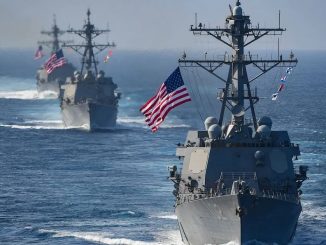
With U.S. warships stalking the Chinese coastline and U.S. soldiers stationed on islands just a stone’s throw from the Chinese coast, there is the real threat that this economic war could turn into a massive military conflict, perhaps even nuclear.

The high prices that we face for food and gas, the lack of affordable housing, the sky-high prices for education, health care and childcare, the collapse of the infrastructure, the catastrophic effects of global warming, the monstrous prison system, the billions wasted on the war industry, none of these are the fault of the Chinese working class or their Communist Party. The blame lies entirely with the tiny parasitic ruling class of billionaires right here at home.

We must explain to our class here that the extraordinary development by China provides us a beacon of hope. It tells us  that the struggle here to empower the workers and oppressed communities, to wrest the ownership and control of the productive apparatus from the billionaires, to use scientific planning to direct both the production and distribution of goods and services instead of Wall Street’s drive for massive profits,all this can offer real benefits for ourselves and our families and for the planet as a whole.

That is what is called revolutionary socialism.

Source: Fighting Words
Strugglelalucha256


China’s Third Plenum directed toward quality growth and improved living standards

The Third Plenum of the Communist Party of China ended last week.  The Third Plenum is a meeting of China’s Communist Party Central Committee, composed of 364 members, which discusses China’s economic policy for the next several years.  As China is a one-party state, in effect this sets out the policies of the government and, in particular, that of President Xi.

What did we learn from the Third Plenum about China’s economic policies?  Not very much that we did not already know. According to the state media release, the Plenum agreed that economic policy should concentrate on achieving a new round of “scientific and technological revolution and industrial transformation,” Chinese-style. In the next decade, “education, science and technology, and talents are the basic and strategic support for China’s modernization.”

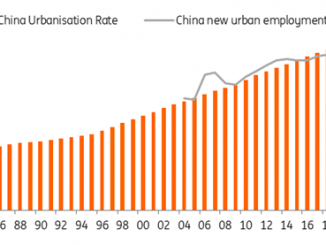
So it appears that the CPC leaders are looking to sustain economic growth and meet all their proclaimed social objectives through what they have called ‘quality growth.’  The expansion of the economy, mainly through using plentiful labor from the countryside coming into the cities to work in manufacturing, property development, and infrastructure, is over.  It has been over for some time.  Urbanization is slowing.

Instead, the Chinese economy has rocketed upward mainly from a massive increase in productive investment in industry and export-oriented sectors.  But that, too, has reached somewhat of a peak since the Great Recession of 2008-9.  The global economic slowdown and stagnation in the major economies since then – what I have called a Long Depression – have also affected the rate of economic growth in China.  World trade growth has stagnated and so has China’s share.

China’s real GDP growth has slowed since the Great Recession, although the economy is still expanding at around 5% a year, more than twice as fast as the US economy, the best-performing of the top seven capitalist economies.

But other causes of slowing growth include the relative exhaustion of labour from the rural areas and also the expansion of unproductive investment in real estate, which eventually ended in a property bust that is still being managed.  As I have argued in many previous posts, this was the result of the huge policy mistake that the Chinese government made back in the 1990s in trying to meet the housing needs of a fast-urbanizing population through the private sector: i.e. homes to buy, financed by mortgages and built by private developers.  This housing model used in the West triggered the global financial crash in 2008 and eventually led to a similar property slump in China.

But the key issue for the Third Plenum is the ‘demographic challenge’.  China’s population, like many others, is set to fall over the next generation, and its working-age population will also drop.

Economic growth and further improvements in living standards will increasingly depend on raising the productivity of the labor force.  I have argued in previous posts that this is perfectly possible to achieve.

The Federal Reserve Bank of Dallas shows that China’s ‘total factor productivity’ (which is a crude measure of innovation) is growing at 6% a year, while it has been falling in the US.  Slower growth but still much faster than G7 economic growth and based on technological success.

But Western media and mainstream economists continue to argue that China’s economy is in deep trouble.  Here is the assessment of the UK’s Financial Times:

“China’s growth is too slow to provide jobs for legions of unemployed young people. A three-year property slump is hammering personal wealth. Trillions of US dollars in local government debt are choking China’s investment engines. A rapidly ageing society is adding to healthcare and pension burdens. The country has continued to flirt with deflation.”

I could deal with these issues one by one.  But I have already done so in many previous posts.  Suffice it to say that the size of youth unemployment is a serious challenge.  There is a sharp mismatch between young graduate students looking for well-paid high-tech jobs, while available employment is still concentrated in lower-paid less skilled work.  This is a problem in many economies, including the advanced capitalist economies.  The solution, it seems to me, is in the expansion of high-tech sectors, but also in re-training for other jobs.

2) the property slump has been severe.  It is no bad thing, however, for property prices to fall sharply so that housing becomes more affordable.  The solution from here must be an expansion of public housing, not more private development.

3) as for the debt issue, it’s true that China leverage ratios have surged in past decades, but they are manageable, especially as most of the debt is concentrated in local government sectors and so can be bailed out by central government.  And China has a state banking system, state-owned companies and massive FX reserves to cover any losses.

China: debt to GDP

4)  Apparently falling consumer prices in China is a bad thing, according to the FT.  But is it so bad that basic purchases get cheaper?  Is it better to suffer the inflationary spike that consumed Western economies and households in the last two years?

The other critique continually hammered by the likes of the FT and Western economists is that“Beijing pledged to reorientate its growth model away from an over-reliance on investment and exports towards household consumption. This, western governments have long hoped, would help reduce China’s huge trade surpluses and invigorate global demand.”  But “Not only has China failed to deliver on its rebalancing pledges, it has actually regressed.”  The FT is upset that “The plenum communique does not pledge to boost consumer spending or rebalance the economy away from investment and exports.”

The FT then goes on to blame China for the US tariff war likely to be accelerated if Donald Trump rewins the presidency in 2025.  “Xi and his politburo should realize that China’s trade imbalances are becoming an ever more incendiary issue. Its monthly trade surplus reached an all-time record in June. The resurgence of Donald Trump, who imposed hefty tariffs on Chinese imports during his term as US president, should give real pause for thought.”  China is apparently at fault for the trade war, not U.S. government attempts to curb Chinese export success and technology advances.

Once again, the Western media and economists argue for a ‘rebalancing’ by which they mean a switch to a consumer-led, private sector-led economy from the current investment-led, export-oriented, state-directed one.  “The Chinese economy is foundering,” said Eswar Prasad, professor of trade policy at Cornell University and former head of the International Monetary Fund’s China division. “More stimulus to pep up spending and economic overhauls to revive private-sector confidence in China are urgently needed,” he said.

But for me, trying to boost consumer spending and expand the private sector is just not what the Third Plenum should aim for.  Actually, the Third Plenum release reminds us that China still has planning, not the centralized one of the Soviet Union, but ‘indicative planning’ with targets set for many sectors.  The release said that “We must summarize and evaluate the implementation of the “14th Five-Year Plan” and do a good job in the early planning of the “15th Five-Year Plan.”

China is fast developing a ‘new economy’ based on high-value-added tech sectors. These sectors have significantly outpaced headline GDP growth in recent years. Between 2017 and 2023, the new economy grew by an average of 10.2% per year, far faster than the 5.5% average overall GDP growth.

As a piece in the Asian Times put it: “A common narrative bandied about by the Western business press is that China’s subsidized industries destroy shareholder value because they are not profitable – from residential property to high-speed rail to electric vehicles to solar panels (the subject of the most recent The Economist ‘meltdown’).  But what China wants from BYD and Jinko Solar (and the US from Tesla and First Solar) should be affordable EVs and solar panels, not trillion-dollar market-cap stocks. In fact, mega-cap valuations indicate that something has gone seriously awry. Do we really want tech billionaires or do we really want tech?  Value is not being destroyed; it’s accruing to consumers ins lower prices, higher quality and/or more innovative products and services.”

This is very visible in environmental investment.  China’s carbon intensity has dropped at an unprecedented pace.

As the Asian Times writer put it: “what is economic success, what is value creation? Maybe, just maybe, it’s the approach that delivers the most tangible improvements in people’s lives, instead of trillion-dollar companies and billionaire CEOs.”


Strugglelalucha256


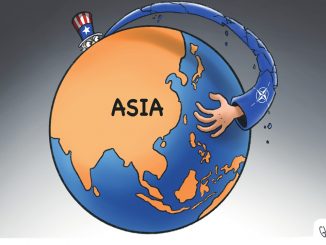
NATO accelerates its conflict with China

At the North Atlantic Treaty Organization (NATO) summit in Washington, the focus was on Ukraine. In the Washington Declaration, the NATO leaders wrote, “Ukraine’s future is in NATO.” Ukraine formally applied to join NATO in September 2022, but soon found that despite widespread NATO support, several member states (such as Hungary) were uneasy with escalating a conflict with Russia. As early as NATO’s 2008 Bucharest Summit, the members welcomed “Ukraine’s and Georgia’s Euro-Atlantic aspirations for membership in NATO. We agreed today that these countries will become members of NATO.” However, the NATO council hesitated because of the border dispute with Russia; if Ukraine had been hastily brought into NATO and if the border dispute escalated (as it did), then NATO would be dragged into a direct war against Russia.

Over the last decade, NATO has expanded its military presence along Russia’s borders. At the NATO summit in Wales (September 2014), NATO implemented its Readiness Action Plan (RAP). This RAP was designed to increase NATO’s military forces in Eastern Europe “from the Baltic Sea in the north to the Black Sea in the south.” Two years later, in Warsaw, NATO decided to develop an enhanced Forward Presence (eFP) in the Baltic Sea area with “battlegroups stationed in Estonia, Latvia, Lithuania, and Poland.” The distance between Moscow and the border regions of Estonia and Latvia is a mere 780 kilometers, which is well within the range of a short-range ballistic missile (1,000 kilometers). In response to the NATO build-up, Belarus and Russia conducted Zapad 2017, the largest military exercise by these countries since 1991. Reasonable people at that time would have thought that de-escalation should have become the priority on all sides. But it was not.

Provocations from the NATO member states continued. After Russia invaded Ukraine in 2022, the NATO countries settled on a course of fully backing Ukraine and preventing any negotiations toward a peaceful settlement of the dispute. The United States and its NATO allies sent arms and equipment to Ukraine, with U.S. high military officials making provocative statements about their war aims (to “weaken Russia,” for instance). Ukrainian discussions with Russian officials in Belarus and Turkey were set aside by NATO, and Ukraine’s own war aim (merely for Russian forces to withdraw) was ignored. Instead, NATO countries spent billions of dollars on weapons and watched on the sidelines as Ukrainian soldiers died in a futile war. On the sidelines of the NATO summit in Washington, Royal Netherlands Navy Admiral Rob Bauer, who is the chair of NATO’s Military Committee, told Foreign Policy, “The Ukrainians need more to win than just what we have set up.” In other words, the NATO states provide Ukraine with just enough weapons to continue the conflict, but not to change the situation on the ground (either by a victory or a defeat). The NATO states, it seems, want to use Ukraine to bleed Russia.

Blame China

NATO’s Washington Declaration contains a section that is puzzling. It says that China “has become a decisive enabler of Russia’s war against Ukraine.” The term “decisive enabler” has attracted significant attention within China, where the government immediately condemned NATO’s characterization of the war in Ukraine. China’s Foreign Ministry spokesperson Lin Jian said that NATO’s statement “is ill-motivated and makes no sense.” Shortly after Russian troops entered Ukraine, China’s Wang Wenbin of the Foreign Ministry said that “all countries’ sovereignty and territorial integrity should be respected and upheld.” This is precisely the opposite of cheerleading for the war, and since then China has put forward peace proposals to end the war. Accusations that China has supplied Russia with “lethal aid“ have not been substantiated by the NATO countries, and have been denied by China.

Lin Jian asked two key questions at the July 11, 2024, press conference in Beijing: “Who exactly is fueling the flames? Who exactly is ‘enabling’ the conflict?”. The answer is clear since it is NATO that rejects any peace negotiations, NATO countries that are arming Ukraine to prolong the war, and NATO leaders who want to expand NATO eastwards and deny Russia’s plea for a new security architecture (all of this is demonstrated by German parliamentarian Sevim Dağdelen in her new book on NATO’s 75-year history). When Hungary’s Viktor Orban—whose country holds the six-month presidency of the European Union—went to both Russia and Ukraine to talk about a peace process, it was the European states that condemned this mission. Ursula von der Leyen, president of the European Commission, responded with a harsh rebuke of Orban, writing that “Appeasement will not stop Putin.” Alongside such comments come further promises by the Europeans and the North Americans to provide Ukraine with funds and weapons for the war. Strikingly, the new NATO Secretary General Mark Rutte even allowed Ukraine to use an F-16 jet from the Netherlands given to Ukraine when Rutte was the prime minister of that country to strike Russian soil. That would mean that weapons from a NATO country would be used directly to attack Russia, which would allow Russia to strike back at a NATO state.

NATO’s statement that characterizes China as a “decisive enabler” permitted the Atlantic alliance to defend its “out of area” operation in the South China Sea as part of its defense of its European partners. That is what permitted NATO to say, as outgoing Secretary General Jens Stoltenberg said in a press conference, that NATO must “continue to strengthen our partnerships, especially in the Indo-Pacific.” These Indo-Pacific Partners are Australia, Japan, New Zealand, and South Korea. Interestingly, the largest trading partner of three of these countries is not the United States, but China (Japan is the outlier). Even the analysts of the U.S. Federal Reserve Bank have concluded that “a delinking of global production processes and consumption from China is not in sight.” Despite this, these countries have recklessly increased the pressure against China (including New Zealand, which is now eager to join Pillar II of the AUKUS Treaty among Australia, the United States, and the United Kingdom). NATO has said that it remains open to “constructive engagement” with China, but there is no sign of such a development.

This article was produced by Globetrotter

Strugglelalucha256


China responds to Wall Street Journal publication slandering its relationship with Cuba

Foreign Ministry spokeswoman Mao Ming told a press conference in Beijing on Wednesday that China will not allow third parties to slander her country’s relations with Cuba.

In response to a Wall Street Journal publication, according to which there are listening stations in Chinese military bases on the island, she commented, “We have taken note of the report and also of the fact that the Cuban Vice Minister of Foreign Affairs, Carlos Fernandez de Cossio, has pointed out that the report has no basis whatsoever. The alleged Chinese military bases have never existed, nor have they ever been seen by anyone.”

Mao pointed out that not even the U.S. embassy on the island seemed to believe in friendship, camaraderie, and brotherhood between the two peoples.

She stressed that China and Cuba’s cooperation is solemn and, above all, open and direct. It is not directed against a third party and will never be accepted, nor will slander be allowed, as the report maliciously discredits both countries.

The spokeswoman urged Washington to stop interfering in the internal affairs of the Caribbean nation and denounced the economic, commercial, and financial blockade imposed on Cuba from the White House for more than half a century.

“The report mentions Guantánamo, which is the clear evidence of more than a century of illegal U.S. occupation of Cuba. The United States has imposed the blockade and sanctions against Cuba for more than 60 years, which has brought great disasters to the Cuban people,” he said.

She also denounced the permanence of the largest of the Antilles by the U.S. on the list of so-called state sponsors of terrorism.

“Throwing mud at others will not alleviate or take attention away from their own crimes. The United States must do the opposite. Stop interfering in Cuba’s internal affairs. Remove Cuba immediately from the list of so-called state sponsors of terrorism. Lift the blockade and sanctions against Cuba.”

Meanwhile in Havana, Radio Havana Cuba (RHC) reported that Cuban Foreign Minister Bruno Rodríguez sent out a similar response to the absurdity and slander of the accusation by reiterating his country’s rejection of the unfounded accusations reported in the United States media about the alleged existence of Chinese military bases on the Caribbean island.

The top Cuban diplomat denounced that, in contrast, (those institutions) “ignore the almost 800 bases the United States has around the world, including the one illegally occupied in Guantánamo (eastern Cuba), and converted into a center of espionage, torture, and interference in global instability.”

The day before, the Government of Cuba denied such slander, repeated on other occasions by the U.S. administration and the media, as part of a campaign of intimidation related to the island.

The continuous stream of absurd lies against Cuba coming out of the US government and their loyal corporate media outlets would be laughable if they didn’t have such serious consequences for the Cuban people.

Source: Cuba en Resumen

Strugglelalucha256


Biden’s tariffs on China: A union worker responds – part 2

International solidarity, not corporate protectionism, key to union drives, jobs, and higher wages and benefits

Part 1 discussed how Biden has undermined his own publicized campaign to fight global warming by imposing huge tariff increases on China. Part 2 explores how the billionaire ruling class, patrons to both major political parties, is pressuring the government to suppress the re-awakening union movement, to “nip it in the bud” before it threatens its huge profits. So, it is now necessary for the labor movement to create its own independent viewpoint and stance of national and international government policies, including Biden’s escalation of Trump’s anti-China tariffs on EVs, batteries and other green energy products.

On May 16, Biden’s White House issued a statement quoting union leaders from the AFL-CIO, the United Steelworkers, the Teamsters, the International Brotherhood of Electrical Workers, and the United Auto Workers all applauding Biden’s anti-China tariffs. Most of those union leaders echoed the business leaders who were also on the White House statement, commending Biden for “defending American industries” from Chinese “overcapacity” in production of electric vehicles (ERVs) and their batteries.

Even the supposed environmental group Sierra Club was quoted as supporting Biden’s tariffs, despite gasoline-powered vehicles currently producing some 25% of carbon emissions that are accelerating global warming.

But the UAW, under the leadership of Shawn Fain, struck a markedly different tone in its statement supporting the tariffs. There was no defense of American industry. Instead, it condemns “corporate greed” that is “pitting worker against worker, pushing wages lower and lower”:

“The UAW applauds today’s decisive action from the White House on ensuring that the transition to electric vehicles is a just transition. We have warned for many months that, left to the forces of corporate greed, the EV future was threatened by a race to the bottom, from China to Mexico to right here in the United States. Making sure that major corporations have to pay a price for pitting worker against worker, pushing wages lower and lower, is a key part of a pro-worker trade policy. America’s autoworkers, our families, and working-class communities across this country want a trade policy that puts workers first. Today’s announcement is a major step in the right direction.”

UAW reaches a contract agreement for battery workers.

The historic UAW “Stand Up” 2023 contract, won after a militant strike of all three of the “Big 3” companies (General Motors, Ford and Stellantis), placed their electric vehicle and battery factories under the national contract. This also applies to all jointly owned facilities with other companies, typically with foreign ones.

On June 10, the union reached a tentative agreement covering 1600 workers at the Ultium Cells plant in Lordstown, Ohio, a joint venture between General Motors and a South Korean partner, LG Energy Solution. It produces batteries for G.M. electric vehicles.

The New York Times reports that:

The Ultium Cells contract calls for moving workers to a new wage of $30.50 an hour. Over three years, wages will rise to $35 an hour. The national contract signed last fall had increased the Ultium Cells starting wage to $26.91, up from $16.50 an hour when the plant opened.

The Ultium Cells contract also calls for the plant to employ four U.A.W. members as full-time safety representatives, and one full-time industrial hygienist. The union and Ultium workers have raised concerns about working with high-voltage electricity and potentially harmful compounds used in the production of E.V. battery packs.

Some 200 former Lordstown workers who transferred to other plants when GM shuttered the giant plant will soon be transferring to the Ultium plant so they can return to the area.

UAW President Fain indicates that this agreement if ratified by the members, will be a model for negotiations at the other EV and battery plants.

This agreement comes some two months after a historic union organizing drive at the Chattanooga, Tennessee, Volkswagen plant, the first such success in a Southern plant in decades.

The corporate empire strikes back

On June 11,the day after the Ultium agreement, a court-appointed monitor, Neil Barofsky, appointed in a 2020 agreement to prevent the UAW from being taken over by the federal government after a huge corruption scandal, blamed Fain for “retaliation against another union officer”. The document “paints a portrait of an organization deeply skeptical of federal efforts to keep the union free from corruption — in stark contrast to Fain’s public image as an ethics-centered activist.”

No actual charges of corruption are made by Barofsky, and Fain strongly denies any wrongdoing:

“Taking our union in a new direction means sometimes you have to rock the boat, and that upsets those who want the status quo, but our members expect this,” Fain said.

“We encourage the Supervisors to investigate any complaints brought to their offices, because we know what they will find: UAW leadership is committed to serving its members and running a union democracy. We are focused on winning record contracts, growing our union, and fighting for social and economic justice on and off the job.”

Whatever Biden’s role in this smear, endorsing political candidates and supporting the Trump / Biden trade war obviously will not prevent these outrageous government attacks on the UAW and the growing trade union movement.

The Big Three, Big Oil, Wall Street, the whole imperialist establishment is not willing to produce the electric vehicles that the workers and oppressed communities can afford and are certainly unwilling to fully compensate the workers to produce them.

Time for change

So, to continue to fight for high-paying jobs for workers to produce low-price EVs essential to reduce carbon emissions, the union movement should consider a different view of socialist China and its vast “green energy” capabilities, as opposed to the billionaire class’s fixation on economic and social hegemony, its trade war and its push towards a military conflict and regime change, as well as its campaign to squeeze everything it can out of our class here.

The Chinese company BYD does have a factory in the U.S. in Los Angeles where it produces electric buses. Unlike their European counterparts in anti-union southern states, the BYD plant’s 700 workers are members of the Sheet Metal Air, Rail, and Transportation Workers Union (SMART), Local 105.

Since U.S. auto companies are only interested in building fewer and more expensive EVs, costing tens of thousands of dollars more than their gasoline equivalents, the UAW is certainly entitled to call on Biden to invite Chinese auto companies to open plants in this country to produce the same low price high quality EVs they currently produce in China, but only if they pledge to recognize the UAW as the representative of the workers.

The union can also call for the same for Chinese battery companies. BYD, which produces new sodium batteries that are much cheaper and more environmentally “friendly” than lithium batteries, safer from fire, not degraded by low or high temperatures, do not require cobalt and other rare metals, and are far easier to recycle, could be invited to open facilities in the U.S.

Large sodium batteries used to store solar panel and wind turbine power during nighttime and calm winds are already being produced in China. Soda ash, which the U.S. has an abundance of, could be a sodium source far cheaper than lithium, of which the U.S. has little supply.

Some could even be exported back to China.

Inviting these companies to open such battery plants in this country could be a huge gain for both the union and environmental movement and link the two movements together. Finally, it could convert the dangerous ruling class spawned hostility towards China into genuine working-class solidarity.

Chris Fry is a Chrysler retiree and former member of UAW Local 51. He  worked on the pre-final line as an assembler at Chrysler Lynch Road Assembly  before  the company shut down the plant.

Part 1 – Biden escalates trade war with China, breaking promise to fight global warming

Source: Fighting Words

Strugglelalucha256
https://www.struggle-la-lucha.org/china/page/3/