How U.S. plans to bleed Europe dry while waging war on China

The theatrical events of the previous week between Volodymyr Zelensky, Donald Trump, and JD Vance have been grist for all manner of bourgeois media lies designed to obfuscate events. Trump has been touted as pro-Putin. On the other hand, in some so-called anti-imperialist circles he is being hailed as a peace hero.

There is nothing further from the truth on both counts. As of this writing, there are no details of a final peace agreement. Trump’s deal at this date looks more like a 30-day stall (giving Ukraine’s troops a rest and time to resupply arms), rather than a long-term peace agreement that Russia is looking for. What has happened is that the U.S. has resumed sending weapons to Zelensky and that there are continuing talks on how to plunder Ukraine, i.e., “the rare earth mineral deal.”  

It would be important to remind readers that behind Trump are the Pentagon generals and that no recent shifts in tactics or strategy would have been undertaken without their agreement.

Pivot to China

Despite baseless hope that the U.S. has chosen “peace” over the pursuit of imperialist interests — U.S. Secretary of Defense Pete Hegseth in Brussels on February 12 (reading off policy drawn from Project 2025), laid out a division of labor in which Europe would continue Washington’s proxy war on Russia while the U.S. pivots to another war of aggression with China in the Asia-Pacific.  

Hegseth’s exact words regarding China: 

 “We also face a peer competitor in the Communist Chinese with the capability and intent to threaten our homeland and core national interests in the Indo-Pacific. The U.S. is prioritizing deterring war with China in the Pacific, recognizing the reality of scarcity, and making the resourcing trade-offs to ensure deterrence does not fail.” 

This turn of policy has as its backdrop the disintegration of Ukraine’s internal situation, which was based on severe losses on the battlefront. The fact that Ukraine could not win the war was known for some time by the U.S. ruling class and laid out in a RAND Corporation position paper commissioned by the Pentagon. 

Expanding arms industry in Europe

U.S. imperialism has for the time being unilaterally dumped the Ukraine war on its European counterparts to focus on war with China. This has prompted rushed action among European leaders who have followed Washington, lock, stock, and barrel, for the last three years.

The chest-beating in Europe is likely staged to convince the working class of Europe that more sacrifice and suffering is needed and inevitable.

Again, in Hegseth’s own words at the same Brussels meeting, before the uproar swept the press:  

“Expanding your defense industrial base is important, leveling with your citizens about the threat facing Europe. Part of this is speaking frankly with your people about how this threat can only be met by spending more on defense. Two percent is not enough; President Trump has called for 5%, and I agree.”

The European Union and Germany

In response to Washington’s dictates, Europe’s counterparts quickly scrambled to increase military spending. The European Investment Bank lifted rules barring lending for military use, which will also give the green light to other private-sector bankers and bond lenders. Ursula von der Leyen, President of the European Commission, announced an 800 billion euros war fund over the next four years.   

Friedrich Merz, Germany’s new conservative Chancellor-in-waiting, pushed sweeping plans to revive its armed forces with the massive borrowing of over 500 billion euros aimed at upping weapons manufacturing. Germany is the largest European economy. 

Germany’s economy in contraction 

It’s important to note that Germany’s economy has been in severe contraction for the last two years, marked by declining manufacturing. This has resulted in layoffs, including at Volkswagen, which cut 35,000 jobs and shifted some production to Mexico.

The general capitalist decline unleashed in 2008 impacted the world capitalist system and was exacerbated by the COVID-19 crisis and the war on Russia. Before the war, European countries depended on cheap gas and mineral imports from Russia and on exports of cars, machinery, equipment, and consumer goods to Russia.

Both sanctions and the destruction of the Nord Stream pipeline, widely attributed to the U.S. Pentagon, have caused scarcity and inflation, which have been borne by Europe’s working class.   

The big winners are U.S. weapons manufacturers

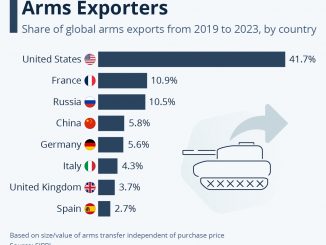
Any increase in weapons manufacturing on European soil will be negligible compared to the European NATO countries’ dependence on U.S. weapons manufacturers. 

Arms imports have more than doubled in the last five years, with 60% from the U.S. This includes almost 500 combat aircraft and other weapons still on order.  

Italy and Britain also bought U.S.- made F-35 fighter jets and Patriot anti-air defense systems. Below is a graph that highlights the U.S.’s position on weapons exports. 

Armsexports

The banks and bond market will be the biggest winners, outside of war manufacturers. The German and European working classes will be the losers. 

Workers must fight back

Every bit of this “rearmament” will cost the working class dearly in the form of greater poverty, cuts in services, higher prices, and slashed wages. Workers’ lives will be at risk if the ruling elite succeeds in the reintroduction of compulsory military service and sending troops to Ukraine.  

The next chapter must be aimed at stopping imperialist war, turning it around to fight the global billionaire class.

Strugglelalucha256


AI for the people? How China’s AI development challenges U.S. big tech

The following text is based on a talk given by Gary Wilson at the “Deep Seek and the Challenge to U.S. Technological Hegemony” webinar on Feb. 16, hosted by the Friends of Socialist China and the International Manifesto Group. The full webinar is available on YouTube at

Let’s start with the U.S. tech war against China. Some call it a New Cold War. A problem with that term is there’s no guarantee it will stay “cold.” There is a major U.S. military buildup around China, with a U.S. Army drone warfare Green Beret unit now stationed in Taiwan, and aircraft carriers from the U.S., France and Japan conducting “war games” in the South China Sea.

Nancy Pelosi’s visit to Taiwan in 2022, the first high-level U.S. official visit since the 1990s, was a provocation challenging China’s sovereignty, that was backed with an unprecedented escalation in U.S. military activity in the region that came dangerously close to sparking a “hot war.” 

Anyway, whatever we call it, a New Cold War, an economic war, trade war or tech war — the U.S. has made China’s science and technology a target. The U.S. has imposed strict limits on technology transfers, restricted access to semiconductors, sanctioned Chinese tech companies, blocked academic and research collaboration, and halted many scientific exchanges.

This tech war didn’t just start. It really began in 2011 with Barack Obama’s Pivot to Asia, a Cold War-style containment policy. The Pivot to Asia was primarily a military operation but also introduced export controls on advanced technologies. 

As a military operation, it involved moving 60% of U.S. naval forces into the Asia-Pacific region, militarily surrounding China, and expanding military exercises like RIMPAC, the world’s largest naval war games.

The tech war escalated significantly during Donald Trump’s first presidency with trade restrictions and sanctions on Chinese firms, including Huawei and ZTE. 

Then, with Joe Biden, even more severe restrictions were imposed. The U.S. also expanded military and technology alliances against China, like AUKUS – some call it the Asian NATO — and the U.S.-Japan-South Korea trilateral pact.

In the first few days of his second term, Trump implemented more aggressive export controls. The media is calling it a “tough on China” policy. Just two days ago, Trump’s State Department removed the statement “We do not support Taiwan independence” from its U.S. relations with Taiwan web page. The Financial Times reported this week that Trump has threatened China with 60% tariffs and he may ban Nvidia semiconductors.

Why are semiconductors such a big deal?

Semiconductors are the foundation of modern technology — enabling the functionality of virtually every device and system we use every day. For example, since the 1970s, every automobile has required semiconductors in order to operate. 

Biden’s Commerce Secretary said – and I quote – “the goal is to limit China’s ‘access to advanced semiconductors that could fuel breakthroughs in artificial intelligence and sophisticated computers.’”

Despite the restrictions, China has been making significant strides in semiconductor technology. Huawei is developing advanced high-powered chips, and the performance of its new Ascend 910C compares to Nvidia’s H20, the GPU used to build DeepSeek R1. While DeepSeek was trained on the Nvidia H20, it used the Ascend 910C for inference, the process where a trained AI model draws conclusions.

This brings us to DeepSeek AI, a large language model or LLM built in China that equals the best in the U.S. 

It was developed using less data and computing power and at a fraction of the cost of U.S. models.

With its release it profoundly became clear that the U.S. is not winning its tech war against China. Instead of falling behind, China showed its strength.

It’s not just DeepSeek — China has built entire high-tech industries that now dominate globally:

  • Huawei is the world’s leading 5G telecommunications company.
  • BYD is the world’s top electric vehicle maker.
  • CATL leads in advanced battery technology.
  • Tongwei is tops in solar power.
  • DJI is the world’s largest commercial drone maker.

U.S. restrictions haven’t stopped China

When the Pivot to Asia began in 2011, the U.S. led in 60 of 64 key technologies globally. 

By 2022, China had surpassed the U.S. in 52 of those technologies.

For years, AI was dominated by U.S. companies like Google and Microsoft’s OpenAI, but today, China is leading in AI development and applications, not just with DeepSeek. Why?

Unlike the U.S., which focuses on AI for corporate profits, China sees AI as a driver of economic transformation — a way to modernize its economy.

Lenin famously said that communism is Soviet power plus electrification. Today, he might say, high tech.

In 2017, China released its “Next Generation Artificial Intelligence Development Plan.” That plan is based on building open-source platforms to coordinate hardware, software and cloud-based systems. 

This approach is similar to how technologies like the Internet’s World Wide Web or Linux (the operating system for servers, cloud computing, mobile devices, and supercomputers) became dominant: They were built on open source standards that allowed for worldwide collaboration and innovation.

Accessible open-source AI can overtake the for-profit proprietary tech monopolies. 

One of DeepSeek AI’s most groundbreaking features is its ability to run on low-cost hardware, including laptops, even smartphones — making AI more accessible than ever before. This decentralized approach contrasts with how AI is used in the U.S., where companies like Amazon and Walmart deploy closed AI systems for worker monitoring, automation and robotics while using it to cut wages and suppress union organizing.

The potential benefits of treating AI as a public utility are immense. Rather than displacing workers or driving inequality, open-access AI can be used for equitable planning of production and distribution.

China is already leveraging AI for public services

China has embraced smart cities, using AI to optimize urban management, traffic control, waste management, and energy efficiency. There are over 500 smart city pilot projects in China right now. AI is also being used in health care, education, and disaster response:

  • Health care: AI is being used to predict disease outbreaks, optimize hospital resource allocation, and provide personalized health care.
  • Education: AI is being used to enhance personalized learning and helps bridge urban-rural education gap.
  • Disaster Preparedness: AI assists in flood prediction, earthquake monitoring, and emergency response coordination.

Despite U.S. restrictions, China continues to advance in AI, semiconductors, and other high-tech industries. China is shaping the future of global technology, and AI could play a key role in the economic planning of production and services to meet people’s needs. 

Gary Wilson is a long-time socialist agitator currently working as co-editor of Struggle-La Lucha. A retired computer network engineer, Gary is the author of a couple of guides to the Linux operating system and, more recently, “War & Lenin in the 21st Century.”

Strugglelalucha256


From Xizang to Appalachia and Altadena: A tale of opposite disaster responses

Trump’s recent visits to climate disaster sites underscore capitalism’s failures, while China’s response to the Xizang earthquake shows the way  

President Donald Trump recently visited two U.S. climate disaster sites — Asheville, North Carolina, and Los Angeles. In addition to racist rants against immigrants and DEI (diversity, equity, and inclusion) hires, he also targeted the Federal Emergency Management Agency (FEMA). 

Trump said his goal was to shut down the already underfunded agency and pass the problem of disaster relief to the states and local politicians to avoid federal responsibility.

Western North Carolina, particularly Buncombe County, suffered the worst damage and loss of life from Hurricane Helene. Entire villages in Appalachia were wiped out, and 105 of the 230 Helene victims lived in North Carolina. Some residents went weeks without water or power.

People in Appalachia remain cold and homeless

More than four months after Hurricane Helene struck, many residents in western North Carolina remain essentially homeless. They are temporarily housed in hotels and face eviction during a freezing winter. More than 1,600 families lost access to Transitional Sheltering Assistance because FEMA was unable to contact them digitally.

California disaster continues

The Palisades and Eaton Fires in California were contained after nearly a month, but the danger of mudslides remains. To date, 29 people have been reported dead, and victims are still being identified. At least 17,000 homes and structures were destroyed, leaving families homeless and left to fend for themselves. 

Meanwhile, predatory landlords have hiked rents, often violating Governor Newsom’s rather weak emergency decree limiting rent increases to 10% this month.

Health consequences in the region have not yet been fully measured, especially for young children, infants, and older people, whose lungs are more at risk of disease from inhaling poisonous air. The Los Angeles–based Harriet Tubman Center for Social Justice has called on the government to convert military production from bombs and guns to manufacturing air purifiers and personal protective equipment (PPE).

While Trump demagogically attacked Los Angeles’s Black Mayor, Karen Bass, he did not condemn price-gouging landlords, multi-million–dollar insurance companies, or profit-hungry utility companies such as Southern California Edison. Residents in Altadena, where 75% of African Americans living there own their homes, have charged the company with negligence and greed.

Trillions to the war machine

Nevertheless, the U.S. government continues to funnel trillions into the war machine, which includes genocide in Palestine. Imperialist war remains the priority for U.S. government spending.

China’s disaster response to the Xizang earthquake

While the Eaton Fire broke out on Jan. 7 in the United States, people in China’s Xizang Autonomous Region (referred to as Tibet in the Western press) suffered a devastating 6.8-magnitude earthquake. What followed in China contrasts sharply with what transpired in the U.S.

China’s President Xi Jinping ordered all-out rescue efforts to save lives. He called for top priority being given to treating the injured, meeting the basic needs of those affected, and speeding post-disaster recovery.

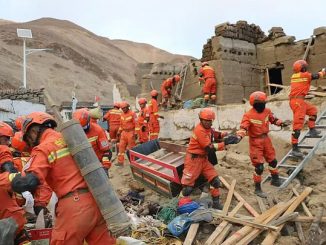
The earthquake struck at 9 a.m. Village representatives from the local government and the Communist Party of China immediately alerted the central government and went door to door to begin rescue efforts — even before specialized teams arrived. Military aircraft from the Western Theater Command took off early that day to set up a command station in Dingri County. Disaster teams, medical personnel, and supplies — including members of the People’s Liberation Army — were already on their way.

A report and video titled “Heroic Rescues After the Xizang Earthquake” from The Point in Beijing, released just 24 hours after the quake, explain the process in depth. What’s remarkable is that these efforts took place at high altitudes, in freezing temperatures, and with limited daylight. Pictures show Chinese rescue teams using drones to light up the area and working around the clock.

More than 14,000 people participated in the rescue efforts, and 46,000 have been relocated and housed. By Jan. 8, the largest highway had been cleared, and hot meals were available. 

The Chinese People’s Armed Police Force’s Xizang Contingent organized a voluntary blood donation drive in response to a critical shortage at the Xizang Autonomous Region blood center caused by the earthquake. 

A new recruit told the Global Times, “As soldiers, it’s our duty to help the people in the disaster area.” About 200 soldiers took part in the drive.

Here are a few videos and pictures depicting the Chinese government’s efforts on the ground:

“A total of 407 people have been rescued and over 30,000 relocated after a magnitude-6.8 #earthquake jolted southwest China’s #Xizang Autonomous Region. Governments at all levels deployed rescuers, funds and relief supplies to the quake-struck area.  Pictures 

Prefabricated housing was assembled in approximately 2-3 minutes by the China Railway Group Limited (CREC).

Workers solidarity is universal

In Gurong Village, Dingri County, 31-year-old village leader Sang Jie sprang into action as soon as the first tremors struck. After alerting the central government, he organized local teams to rescue people by digging them out with their bare hands until professional crews could arrive. A Facebook video from CGTN features an interview with him.

In Los Angeles, Marcia Garcia, an undocumented immigrant from Guatemala, sprang out of bed after hearing about the fires in Altadena. With her sons, she grabbed buckets and hoses and drove to the historic Black community in Altadena to help. In an NPR interview, she said, “Our values and our principles come first. That’s what our parents taught us. They always used to say, ‘Help others without concern for who they are or why they need help.’”

In western North Carolina, similar stories of heroism and sacrifice emerged. A young boy hiked more than 11 miles through mountainous terrain to reach his mother. Eddie Hunnel, carrying only a life vest and rope, jumped into the New River to save a woman trapped in a house being washed away by the storm. He paid little attention to his own safety, though he later admitted he was shaken when the real danger sunk in. Hunnel was in the area for his son’s wedding.

From China to Los Angeles and Appalachia, ordinary people have shown an incredible capacity for sacrifice and altruism and the ability to work together. Such cooperation and solidarity are key to human survival.

What is missing in Los Angeles, North Carolina, and the United States as a whole is a system that matches our natural ability to cooperate, protect one another, and act heroically when needed — a system that puts people’s needs before profits.

China’s President Xi Jinping summed it up best: “Saving lives is the most important thing.” It should always come before capitalist profits and imperialist war.


Strugglelalucha256


China responds to Rubio’s remarks on South China Sea after his phone call with Philippine FM

In response to a U.S. State Department statement claiming new U.S. Secretary of State Marco Rubio discussing Beijing’s “dangerous and destabilizing actions in the South China Sea” with his Philippines counterpart Enrique Manalo over phone and underscoring the “ironclad” U.S. defense commitment to Manila, Chinese Foreign Ministry spokesperson Mao Ning said on Thursday that the U.S. is not a party to the South China Sea issue and has no right to interfere in the maritime issues between China and the Philippines.

Mao said “the military cooperation between the U.S. and the Philippines should not undermine China’s sovereignty and maritime rights and interests in the South China Sea, still less should such cooperation support or advance the Philippines’ illegal claims.” China will continue to take necessary steps to firmly safeguard its territorial sovereignty and maritime rights and interests and uphold peace and stability in the South China Sea, said Mao.

U.S. Secretary of State Marco Rubio spoke Wednesday local time with Philippine Secretary of Foreign Affairs Enrique Manalo about issues of mutual concern, including so-called China’s “dangerous and destabilizing actions in the South China Sea.”

Rubio underscored the U.S.’ “ironclad commitments” to the Philippines under the Mutual Defense Treaty. The two sides also exchanged views on ways to advance security cooperation, expand economic ties for shared prosperity, and deepen avenues for further regional cooperation, according to a readout released by the U.S. Department of State on Wednesday.

Li Haidong, a professor at the China Foreign Affairs University, said that the U.S. will continue the diplomatic rhetoric, but to what extent Rubio’s remarks will turn into concrete actions in the region is still a question.

“The Marcos Jr. administration of the Philippines also needs to learn that the U.S., especially under the leadership of the Trump administration, will not be hijacked by any other countries, including its allies, for any unnecessary dangers,” Li noted.

Lü Xiang, an expert on U.S. studies and research fellow at the Chinese Academy of Social Sciences, told the Global Times on Thursday that the Trump administration is likely to continue to launch groundless accusations against China’s legitimate acts in the region.

“However, the Trump administration will be less interested in getting involved too much on issues not directly related to U.S. core interests, as this is what ‘America First’ means. In addition, China now has much more strength [to safeguard its legitimate rights and interests] in the region, and the consequences of being ‘unnecessarily provocative’ would be unaffordable to both Washington and Manila,” Lü noted.

The Chinese military conducted joint sea-air combat readiness patrols in the South China Sea from January 17 to 19 to maintain peace and stability in the area, according to a statement by the Chinese People’s Liberation Army (PLA) Southern Theater Command. The statement was issued after the Philippine Navy held live fire drills and carried out joint maritime exercises with the U.S. in the South China Sea.

“Any military activity that stirs up trouble in the South China Sea is within our control,” the PLA statement read. The statement directly targets the provocative exercises conducted by the Philippine navy near Huangyan Dao, and its joint exercises with the U.S., Zhang Junshe, a Chinese military expert, told the Global Times.

Humprey Arnaldo Russel, director of the China Research Center in the Institute for Strategy and Global Studies at the University of Indonesia, told the Global Times in an exclusive interview published on Tuesday that “ASEAN is a family. When a family faces a problem, it is unwise for one member to turn to external parties for ‘help.’ ASEAN, as a unity, is bound by shared values such as harmony, non-interference and the commitment to finding peaceful solutions to problems.”

“These core values will not change because of any single member’s actions. Therefore, it would be far more beneficial for the Philippines to engage directly with China, as this is where the solution lies,” said the Indonesian expert.

Source: Global Times

Strugglelalucha256


Did Trump ‘fix’ TikTok? Users report censorship after outage

On Jan. 19, after a 12-hour outage, TikTok resumed service for its U.S. users, but many noticed what they believe to be a shift in their experience. Shortly after regaining access on Sunday, creators began posting videos expressing concerns that the platform’s recommendation algorithm felt different. 

Some users claimed they were no longer seeing the types of videos typically suggested to them, while others reported issues with their primary feed, search function, and comments, alleging potential censorship. Posts highlighting these changes have garnered millions of likes.

On X, @AlexNaivety declared: “TikTok is dead. ‘Free Palestine’ is now considered a symbol of hate speech.”

Some speculated that the shutdown involved a system jigger to make changes demanded by Donald Trump.

At Trump’s inauguration

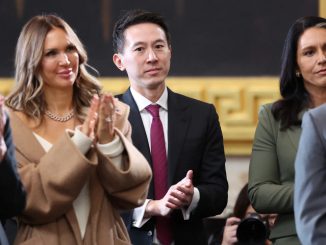
TikTok is owned by ByteDance, a Chinese company, but it operates independently, with its headquarters in Singapore. The Chinese government does not own TikTok. The Singapore-born and Harvard-trained CEO, Shou Zi Chew, attended Trump’s inauguration, sitting next to Tulsi Gabbard, Trump’s pick for national intelligence director.

When the platform came back online, U.S. users were greeted with a message crediting its return to Trump: “As a result of President Trump’s efforts, TikTok is back in the U.S.!” 

Shortly after taking office on Jan. 20, the president issued the order to delay the app’s ban for 75 days. Trump announced on Truth Social that the executive order “extends the period of time before the law’s prohibitions take effect, so that we can make a deal.” 

During a press briefing on Jan. 20, Trump said that he envisions either Tesla CEO Elon Musk or Oracle Chairman Larry Ellison as potential buyers of TikTok.

Tech imperialism

TikTok’s success and its ability to compete with U.S.-based social media giants like Facebook and Instagram made it a target. The TikTok ban is part of a broad effort to assert control over a highly successful global platform that operates outside U.S. corporate ownership.

Some call it “tech imperialism,” with the foreign-owned platform being forced to either turn over ownership or be banned. Compelling a foreign company to sell its U.S. operations has never been done before.

The action against TikTok comes amid what many describe as a “New Cold War” by the U.S. against China. TikTok, with its massive user base and cultural influence, became an especially prominent target.

Washington is actively targeting Chinese tech companies that are gaining global prominence and influencing technology standards. This is evident in actions taken against Huawei’s 5G infrastructure, TikTok’s social media platform, and efforts to restrict China’s access to advanced semiconductor technology. Tech imperialism indeed.

Strugglelalucha256


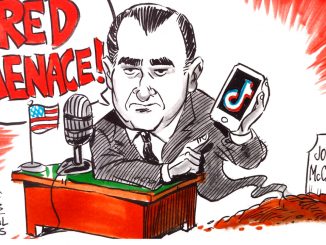
TikTok ban paves way for suppressing speech in anti-China crusade

On Jan. 17, the Supreme Court launched a sweeping, unanimous assault on the First Amendment. By ruling in favor of a federal ban on TikTok — the fourth most popular social media platform in the United States — the Court effectively elevated “national security” above constitutional free speech rights. 

This move aligns with an increasingly anti-China agenda within the U.S. government, which routinely uses the specter of “foreign adversaries” to justify censorship and attacks on democratic rights.

The ban took effect on Jan. 19. Hours after shutting down, TikTok announced that service would be restored after President-elect Donald Trump said he would sign an executive order on his first day in office to delay enforcing the U.S. ban of the social media platform.

Congress did order that TikTok ownership should be turned over to the U.S. tech-industrial complex by the Jan. 19 deadline, and Trump says his executive order is only to allow time for a U.S. takeover of a controlling interest (50%) of TikTok.

Regardless of what happens next, the Supreme Court’s ruling has far-reaching implications. 

Anti-China justifications

Notably, the justices anchored their decision in Congress’s claim that TikTok’s relationship with China — now labeled the primary “foreign adversary” — poses a grave risk. 

The justices seem to claim that the ban is not aimed at suppressing particular viewpoints, yet they put “national security” over free speech:

“There is no doubt that, for more than 170 million Americans, TikTok offers a distinctive and expansive outlet for expression … But Congress has determined that divestiture is necessary to address its well-supported national security concerns regarding TikTok’s data collection practices and relationship with a foreign adversary.”

In other words, the Court effectively concedes TikTok is a powerful platform for speech — only to elevate the U.S. government’s anti-China stand above the First Amendment.

The enemies list

This logic opens the door to systematic assaults on domestic opposition to war or any policy the government designates as aiding “foreign adversaries.” Once a country (in this case, China) is designated an enemy, any expression or platform seen as potentially advantageous to that so-called adversary can be curbed.

TikTok’s ban was initiated under Trump’s first administration, spurred by Republican “China hawk” Michael Gallagher and other anti-China crusaders. The justices also cited the Biden administration’s 2021 Executive Order on “Protecting Americans’ Sensitive Data from Foreign Adversaries,” which defines “foreign adversary” so broadly as to encompass any government or organization considered “significantly adverse” to Wall Street and U.S. corporate interests. 

Under such an expansive definition, practically any government from Beijing to Panama City could be labeled a hostile actor if it dared challenge U.S. policies. Indeed, Trump recently called the Panama Canal a “national security” asset. If Panama were to resist U.S. control of the Panama Canal, it, too, could be construed as posing a “threat.” In this context, banning an app because of its Chinese ownership signals how aggressively U.S. policymakers are prepared to stoke anti-China paranoia under the banner of defending “national security.”

Criminalizing social media

Particularly insidious is the Court’s reference to “Holder v. Humanitarian Law Project (2010),” which criminalized providing “material support” to designated “foreign terrorist organizations” — even if that support was simply legal advice. By drawing an analogy to China’s tech companies, the ruling essentially endorses the notion that working with or using technology from a “foreign adversary” is tantamount to collusion or aiding hostile interests.

The hypocrisy is striking. U.S. government agencies and corporations, with a documented history of unlawful surveillance (brought to light by Edward Snowden’s 2013 revelations), are now positioning themselves as defenders of privacy and security, justifying the ban of Chinese platforms on these grounds.

The NSA and other U.S. agencies have systematically gathered personal communications on a massive scale, aiming at “total information awareness.” However, none of this has produced bans on U.S. companies or apps. Instead, only the “adversary” label is invoked to quash a highly successful Chinese-owned platform that is not accused of gathering any more data than all other social media companies. In fact, the Washington Post found that TikTok gathers less data than Facebook. The Chinese government would never need TikTok to get access to personal info, which is widely available through multiple sources.

The Supreme Court falsely claims that TikTok’s ban doesn’t target specific viewpoints, but the legislative record shows otherwise. Leading Congressional voices have consistently accused TikTok of pushing “Chinese propaganda” and undermining pro-U.S. narratives, citing the platform’s lack of “fact checking,” allowing everything from the use of pro-Palestinian hashtags to criticisms of Washington’s foreign policy. Senator Mike Gallagher — one of the ban’s main orchestrators — branded TikTok “digital fentanyl” and openly called for crushing the platform to counter “the CCP’s worldview,” that is, to impose a capitalist ideology and an imperialist agenda.

The ban on TikTok represents more than just a regulatory action against a social media platform; it signifies a strategic maneuver in the escalating U.S. campaign against China. As the U.S. government broadens its anti-China initiatives, fundamental democratic rights, such as freedom of speech and the right to speak out, are among the casualties. 

Strugglelalucha256


U.S. War Drive Against China book launch

Nov. 23, Los Angeles — The Harriet Tubman Center for Social Justice launched the book “The U.S. War Drive against China.”

The book features articles from Struggle-La Lucha. The writers and a labor leader from Nigeria attended the meeting.

Writing contributors Sharon Black, Scott Scheffer, Apryle Everly, and John Parker discussed the implications of the U.S. war drive against China for the lives of working people around the world.

Scott Scheffer talked about the numerous contributions of China in fighting climate change.

Sharon Black exposed how the austerity and wars of the U.S. directly target the livelihoods of working people in the U.S. and abroad.

Writer and youth organizer Apryle Everly from Baltimore touched on the opportunities China provided in addition to the study abroad programs.

Featured guest Owei Lakemfa, a labor union national leader and coordinator of the International Decolonization conference in Nigeria spoke about the implications of the IMF and World Bank directly affecting the youth who were targeted for simply protesting against the IMF’s austerity measures in Nigeria.

John Parker welcomed the well-attended meeting participants to the Harriet Tubman Center for Social Justice. Parker focused on the opportunities provided by China’s Belt and Road projects, especially in Africa, which went contrary to the IMF and World Bank’s negative effects on developing infrastructure on the continent.

Black, Everly, Scheffer, and Parker are all members of the Socialist Unity Party and contributors to the Struggle-La Lucha magazine.

Strugglelalucha256


People over profit: How China tackled climate change

It’s so fitting that just after the 75th anniversary of China’s revolution on Oct. 1, a milestone in China’s efforts to deal with greenhouse gas emissions (GHGs) has emerged in the narrative surrounding global warming. What they have accomplished shows how people’s ownership of the world’s productive forces, instead of a tiny clique of billionaires owning everything, will solve this planetary crisis.

Climatologists and scientists widely recognize that China will likely reach its peak greenhouse gas emissions in 2024, although further research will be needed to confirm this with complete accuracy. If the data ultimately shows that the peak does not occur in 2024, it is almost certain to happen in 2025. Even in that case, China would still achieve peak emissions five years earlier than its official target, which President Xi Jinping announced at the 2020 UN General Assembly. This target aimed to reach peak emissions by 2030.

Other countries have reached peak emissions as well, but because China is so huge, UN figures and climatologists are buzzing with excitement over this development. It has great implications for the entire world, particularly for the Global South. 

U.S. corporate media often portray China’s crowning achievement as a problem rather than progress.

Mass production of renewables

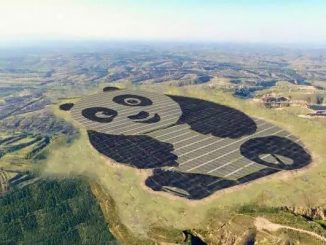
Chinese mass production of renewable energy components — wind and solar — has driven down the prices globally. It isn’t just the solar panels on rooftops that millions are aware of; China has developed renewables on an industrial scale — wind and solar farms built at much lower costs and capable of supplying energy for cities and industry. 

What this means to the Global South cannot be overstated. For instance, a struggling country in Africa, Latin America, or Asia relying on coal for energy can now replace a decrepit coal-fired power plant with a solar or wind farm more cheaply than repairing or replacing that coal plant. 

The flaw of wind and solar power’s intermittent availability is still there. China is still running coal plants in its territory as a backup for those times when the sun goes down, or the wind stops. 

On average, Chinese coal plants run half the time or less. This simple first step provided what seems to be an outsized result, and it can be replicated where it is needed in the Global South until the intermittency problem with renewables is resolved via other methods. 

Control over the means of production

The Communist Party of China faces a real challenge — trying to balance raising and safeguarding the living standards of 1.4 billion people while still developing its scientific and productive capacities and combating climate change at the same time. 

China’s capacity to overcome significant challenges stems from the people’s control over the means of production.

When the world’s manufacturing shifted to China in 1979, private interests began to invest in mines and other power generation sources. But that didn’t last long because the CPC and the government recognized that energy has to belong to the people, and they began nationalizing the mines. That process began in the 1980s, and now the number of mines in private hands is insignificant, and they are the smallest, least productive mines.

Inexpensive EVs

Chinese mass production of inexpensive electric vehicles has also been a factor in moving forward in the campaign to lower GHG (greenhouse gas) emissions. Millions of workers in China can now afford the price of a car, not only because 850 million people have been lifted out of extreme poverty but also because China has wonderful, inexpensive electric cars. 

Over the past decade, the Chinese state has spent $230 billion on research and development of EVs and batteries. China’s spectacular success in producing electric vehicles has prevented a surge in emissions from the increased use of cars.

Some of China’s EVs sell for as little as 10,000 U.S. dollars. They are getting rave reviews and are being sold in Southeast Asia, Latin America, Africa, and Europe. 

The Biden/Trump tariffs make buying one in the U.S. difficult, but the no-emissions cars are now helping to cut emissions throughout the rest of the world. The sales and use of EVs in China’s territory alone are a significant factor in reducing the world’s GHG emissions. 

Beyond cars, the shift to electric power for trucks and trains, both passenger and freight, has been crucial in curbing emissions and achieving peak emissions goals.

Environmental protection in the constitution

The Communist Party of China has taken the significant step of incorporating environmental protection into both its party constitution and the constitution of the People’s Republic of China.

The leadership of the CPC and the Chinese state do not face opposition from super-rich monopoly corporations. Still, this achievement of reaching peak emissions doesn’t mean that reaching “net zero” by the year 2060 will proceed in a straight line. 

Like many developing countries, China is still struggling to overcome what it calls the “century of humiliation,” when imperialist Western countries robbed China of its resources and used their military advantage to enforce the theft. The 1949 revolution was only the first step, and it still faces challenges. 

In the short term, China needs to develop AI, which will require a lot of electrical energy. Their goal is to power AI with renewables. 

They are also investing in research and development of many projects, ranging from areas that seem nearly ready to use, like green hydrogen as fuel whose only by-product is water, to their “artificial sun,” China’s fusion energy project. All of this is being implemented and studied while also trying to help develop the resources for global south countries to mitigate global warming and help them adapt to climate change.

2024 will prove to be the hottest year on record globally. Alongside the horrors of the genocide in Gaza and the U.S. proxy war against Russia, capitalism has dished out the most punishment of the planet in recent memory. Only socialism can end imperialist war and save the planet.

Strugglelalucha256


U.S. to be ready for war on China by 2027: Navy Chief

On Tuesday, Oct. 15, a large-scale military exercise named Kamandang commenced in the Philippines. The exercise, scheduled to run until Oct. 25, involves over 2,300 military personnel from the United States, the Philippines, Japan, South Korea, Australia, and Britain.

Kamandang coincides with a separate naval exercise taking place in northern Luzon Island, Philippines. 

The exercise will include live fire drills, amphibious landings, and training for possible chemical and biological warfare. It will take place in Burgos, Ilocos Norte, and Basco and Itbayat in Batanes, areas facing the Taiwan Strait.

The United States has been increasing its military operations in the Asia-Pacific region, including:

– Deploying more aircraft carriers, bombers, and submarines

– Introducing the Typhon mid-range missile launcher system

– Expanding military bases in the Philippines from five to nine under a new defense agreement

The U.S. has also been conducting joint exercises with South Korea and Japan. 

The trilateral military alliance of AUKUS — Australia, Britain, and the U.S. — is bringing Japan in for military drills as well as increasing NATO involvement in its regional military strategies. North Korea and China have observed these developments and accused the U.S. of trying to create an Asian version of NATO. The newly elected Japanese Prime Minister Shigeru Ishiba has recently proposed that such a formation of a “collective self-defense system,” referring to NATO, is “essential.”

The United States is gearing up for a potential war on China.

Adm. Lisa Franchetti, the Chief of Naval Operations and the highest-ranking officer in the U.S. Navy, revealed a strategic plan on Sept. 18 to achieve preparedness for a conflict with China by 2027. This initiative reflects the U.S. military’s belligerent intent to incite war with Beijing.

Strugglelalucha256


New book: The U.S. war drive against China, what it means for workers


On the 75th anniversary of the founding of the People’s Republic of China, Struggle-La Lucha published a new book: “The U.S. war drive against China, what it means for workers.” 

Celebrating 75 years of liberation

Oct. 1, 2024, marks the 75th anniversary of China’s transformative revolution, which liberated the nation from feudal oppression and imperialist control.

Under the leadership of Mao Zedong, widely known as Chairman Mao, the Communist Party of China achieved what many deemed impossible — inspiring not just China but working and oppressed peoples worldwide.

The revolution ended China’s “Century of Humiliation,”  which began with British imperialism’s First Opium War in 1839.

Over the past 75 years, there has been significant progress for the masses and China’s working class.

Today, China is a global scientific powerhouse, boasting achievements in high-speed trains, affordable electric vehicles, pollution reduction, carbon emission control, and space exploration. The People’s Republic has also made significant strides in health care, education, and sports.

At no point has U.S. monopoly capitalism adopted a hands-off approach toward the development of socialism in China or elsewhere. It has consistently intervened against socialism worldwide.

The maneuvers by U.S. imperialism have been increasingly more dangerous and now point in the direction of war.

The global working class, including U.S. workers, must stand united in solidarity with the working class of China.

This book, “The U.S. War Drive Against China: What it Means for Workers,” aims to illuminate the growing dangers posed by a potential U.S. war against China and reveal the working class’s real enemies.

Get “The U.S. war drive against China, what it means for workers,” available online at tinyurl.com/USWarChina.

Strugglelalucha256
https://www.struggle-la-lucha.org/china/page/2/