Hegseth demands Indo-Pacific allies escalate military spending, prepare for war on China

193737 160
U.S. military bases surrounding China, from John Pilger’s The Coming War With China. Graphic: Consortium News

At the annual Shangri-La Dialogue in Singapore on May 31, U.S. Defense Secretary Pete Hegseth delivered an ultimatum to Washington’s Indo-Pacific allies: Escalate your military spending and prepare for imminent war with China.

Framing China as the aggressor, Hegseth accused Beijing of seeking “hegemony in Asia” and warned that a Chinese move on Taiwan would bring “devastating consequences for the Indo-Pacific and the world.” “There’s no reason to sugarcoat it,” he declared. “The threat China poses is real. And it could be imminent.”

Please note that Taiwan is internationally recognized as part of the People’s Republic of China. Under the One China policy, the United States officially acknowledges this. Since the 1970s, the U.S. has agreed not to recognize Taiwan as a separate state. 

So when U.S. Defense Secretary Pete Hegseth speaks of preparing for war over Taiwan, what he’s really advocating is: a U.S. military intervention to take away a province of China.

This is akin to China threatening war if the U.S. deployed troops to Long Island, N.Y. or Isle Royale in Lake Superior on Canada’s border. 

Hegseth and the Trump administration are attempting to recast China’s efforts to maintain national sovereignty as “aggression,” while portraying U.S. military escalation in China’s immediate periphery as defensive. It’s a textbook example of how imperialism inverts reality.

Furthermore, the U.S. has systematically undermined the One China framework by increasing arms sales to Taiwan, sending high-level officials to visit the island’s capital, Taipei, stationing U.S. troops and conducting joint military training there, and encouraging Taiwanese political figures who flirt with formal declarations of independence.

In addition to arms sales and military visits, the U.S. has steadily undermined the One China policy through a range of provocative actions. These include expanding intelligence sharing and joint military planning with Taiwan, increasing naval and air patrols near the island, and passing legislation to deepen official ties. The U.S. has also promoted Taiwan’s participation in international organizations, supported the development of its domestic arms industry, and formalized trade agreements that treat Taiwan as a separate entity. Collectively, these moves aim to transform Taiwan into a U.S. military and economic outpost, escalating tensions with China and pushing the region closer to open conflict.

All of this raises the stakes deliberately. The U.S. is trying to provoke a response from China, just as it did with Russia over NATO’s expansion to Ukraine. In essence, what Hegseth is demanding is a U.S. military takeover of China’s Taiwan — disguised as “defending democracy.”

A global war strategy

Hegseth made clear that Trump’s “MAGA” doctrine now means aggressive militarization across the globe. The war in Europe and the U.S.-backed and armed genocide in Gaza are not isolated crises. 

“As our allies share the burden [in Europe], we can increase our focus on the Indo-Pacific,” Hegseth told leaders in Singapore. He demanded that regional governments “do their part on defense,” warning that any reluctance would provoke “tough conversations.”

Washington’s pressure campaign mirrors its bullying of NATO allies to dramatically raise military spending. Now the same expectations are being placed on Indo-Pacific partners: massive arms buildups, greater interoperability with the U.S. military, and unconditional alignment against China.

Engineering confrontation with China

The Trump administration’s confrontation with China did not appear overnight. It was Obama’s “pivot to Asia” that began the military and economic encirclement of China, with plans to shift 60% of U.S. air and naval power into the region — now a reality.

Trump and Biden alike escalated this trajectory, launching trade wars, restricting Chinese tech, and ramping up military provocations near China’s coast. 

U.S. militarization of the Indo-Pacific

Hegseth outlined an extensive list of deployments and war plans already underway. These include the deployment of NMESIS anti-ship missile systems and joint military exercises in the strategically sensitive Batanes Islands near Taiwan. 

The U.S. is also planning live-fire tests in Australia of its Mid-Range Capability missiles, which have a range of up to 2,500 kilometers. 

Additionally, this year’s Talisman Sabre war games in Australia will involve 30,000 troops from 19 countries, marking the largest of these exercises to date. 

The U.S. is further expanding the Quad’s military logistics network to integrate the forces of Japan, Australia, and India into a more unified warfighting structure. 

Meanwhile, Washington is establishing a new “integrated defense industrial base” through the Partnership for Indo-Pacific Industrial Resilience (PIPIR), which aims to reorient regional industry toward large-scale war production in support of U.S. plans for conflict with China.

But Hegseth insists this is only the beginning. He is demanding that Asian governments stop hedging between the U.S. and China economically, and instead commit fully to Washington’s war effort — even though China is the region’s largest trading partner. Echoing Trump’s tariff threats, the U.S. is now using economic pressure to enforce military compliance.

Capitalism’s drive to world war

To view the descent toward war as simply a product of Trump’s fascist ideology misses the deeper cause: the global crisis of capitalism. The U.S. ruling class once welcomed China into the world market as a low-wage manufacturing base. But China’s transformation into a major economic and technological rival — threatening U.S. dominance in electronics, green energy, and AI — is no longer tolerable.

The Trump administration is determined to strangle China’s rise — by war if necessary. This is not a defensive strategy. It is a conscious plan to preserve U.S. global supremacy, even if it risks nuclear war.

Strugglelalucha256


Ballots and bias: How the press framed Venezuela’s regional and legislative elections

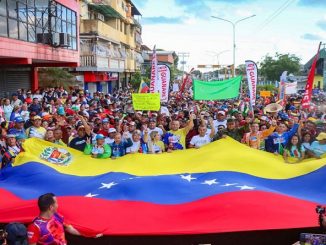
The pro-government alliance achieved a sweeping victory in Venezuela’s May 25 elections, while a fractured opposition suffered losses. Western media distorted the results – spinning low turnout claims, ignoring the role of illegal US sanctions, and offering selective sympathy to elite opposition figures.

 Opposition fractures, pro-government consolidates

At stake for the 54 contesting Venezuelan political parties were seats for 285 National Assembly deputies, 24 state governors, and 260 regional legislators.

The pro-government coalition won all but one of the governorships, taking three of the four states previously held by the opposition. The win in the state of Barinas was particularly symbolic for this was the birthplace of former President Hugo Chávez; and especially so, because the winner was Adán Chávez, the late president’s older brother.

Likewise, the Chavista alliance swept the National Assembly, securing 253 out of 285 seats. Notable exceptions were the election of opposition leaders Henrique Capriles and Henri Falcón, both of whom are former presidential candidates.

The New York Times reported the same outcomes but spun it as the “results [rather than the vote]…stripped the opposition of some of the last few positions it held,” inferring fraud.

However, this election outcome was not unexpected because the opposition was not only divided but a significant portion opted to boycott the vote. The pro-government forces enjoyed a unified effort, an efficient electoral machine, and grassroots support, especially from the communal movement.

“After 32 elections, amidst blockades, criminal sanctions, fascism and violence,” Venezuelan President Nicolás Maduro affirmed, “today we showed that the Bolivarian Revolution is stronger than ever.”

Opposition self-implodes

The headline from Le Monde spun the voting thus: “Venezuela holds divisive new elections.” Contrary to what the headline suggests, the divisiveness was not the government’s doing, but due to the opposition’s perennial internecine warfare.

While the pro-government Great Patriotic Pole alliance around the ruling Socialist Party (PSUV) “works in unison,” according to opposition leader Henrique Capriles, the electoral opposition divided into three warring camps. They in turn were surrounded by a circular firing squad of the far-right abstentionists, calling for a vote boycott.

The abstentionists were assembled around Maria Corina Machado. She had been pardoned for her involvement in the short-lived 2002 US-backed coup but was subsequently disqualified from running for office for constitutional offenses. Following Washington’s lead – which has not recognized a Venezuelan presidential election as legitimate since 2012 – the far-right opposition rejected electoral means for achieving regime change and has even pleaded in effect for US military intervention.

Machado’s faction, which claimed that Edmund González Urrutia won the 2024 presidential election, does not recognize their country’s constitutional authority. Consequently, when summoned by the Venezuela supreme court, they refused to present evidence that they won, removing any legal way for their claimed victory to be accepted. Machado maintained that voting only “legitimizes” the government, bitterly calling those participating in the democratic process “scorpions.”

Machado spent the election in self-imposed hiding. She further dug herself into a hole, after urging even harsher punishing US sanctions on her own people, by appearing to support Trump’s sending of Venezuelan migrants to the CECOT torture prison in El Salvador.

El Pais sympathized with her as “driven by the strength of the pain of being a mother who has been separated from her three children.” The WaPo described the middled-aged divorcé from one of the wealthiest families in Venezuela as a “courageous leader” whose “three children are exiled abroad.” In fact, her adult children live comfortably in the US and Colombia.

To this manufactured sympathy for the privileged, Venezuelan-Canadian sociologist Maria Paez Victor asks “where are the defenders of the human rights of Venezuelans?” She excoriates the collective West for their selective concern for human rights, emphasizing the neglect of Venezuelans’ rights amid external pressures and US sanctions.

 The disputed Essequibo

The headline for The New York Times’s report spun the elections with: “Venezuela is holding an election for another country’s land.” This refers to elections for governor and legislators in the Essequibo (Guayana Esequiba in Spanish), which is in fact a disputed land.

For nearly two centuries, Venezuelans have considered that region part of their country, when they wrested it from the Spanish colonialists in 1835. In the questionable Paris Arbitral Award, with the US representing Venezuela, the Essequibo was handed over to the UK in 1899 (then colonial British Guiana and now independent Guyana). Ever since, it has been contested territory.

In 1962, Venezuela formally revived its claim at the UN, asserting that the 1899 award was null and void. Not surprisingly, the Times sides with Guyana or more precisely with what they report as “Exxon Mobil’s multibillion-dollar investments” plus “military ties with the US.”

This first-time vote for political representation in the Essequibo is seen by Venezuelans across their political spectrum as an important step to assert their claim. It follows a referendum in 2023, which affirmed popular support for the Essequibo as part of their national territory. The actual voting was held in the neighboring Bolivar state.

On cue, the western-aligned press criticized the vote on the Essequibo as a “cynical ploy” by the Maduro administration to divert attention from other pressing problems. Meanwhile, they obscure the increasing US military penetration in neighboring Guyana and in the wider region.

Yet even the NYT had to admit: “Claims to the Essequibo region are deeply ingrained among many Venezuelans… [and even] María Corina Machado, the most prominent opposition leader, visited the area by canoe in 2013 to advance Venezuela’s claim.” Venezuelan journalist Jésus Rodríguez Espinoza (pers. comm.) described the vote as “an exercise in national sovereignty.”

Illegal sanctions – the elephant in the room

 WaPo opinion piece claims, “that the actual root cause of poverty has been a lack of democracy and freedom,” as if the US and its allies have not imposed sanctions deliberately designed to cripple the Venezuelan economy. These “unilateral coercive measures,” condemned by the UN, are illegal under international law because they constitute collective punishment.

But the fact that Venezuelans had to vote while being subjected to illegal coercion is completely ignored by the corporate press. That is, the existence of sanctions are recognized but instead of exposing their illegal and coercive essence, the press normalizes them. The story untold by the press is the courage of the Venezuelan people who continue to support their government under such adverse conditions.

Disparaging the election

 Washington and its aligned press cannot question the popular sweep for the Socialist Party’s alliance in Venezuela, because it is so obvious. Nonetheless, they disparage the mandate. The chorus of criticism alleges the fraudulent nature of previous elections, although it is a geopolitical reality that Washington considers any popular vote against its designated candidates illegitimate.

For this particular election, these State Department stenographers focused on the supposedly low turnout. In fact, the turnout was typical for a non-presidential election contest and in the same turnout percentage ballpark as US midterm elections.

Moreover, the pro-government slate actually garnered more votes than it had in the previous regional elections. The Chavista core of older, working class women remains solid.

When Elvis Amoroso, president of Venezuela’s authority (CNE) qualified the turnout percentages to apply to “active voters,” he meant those in-country. Due to the large amount of recent out migration, a significant number are registered but cannot vote because they are abroad.

What was notably low was voting for the highly divided opposition, major factions of which called for a boycott. Further, the opposition had been discredited by revelations that some had received and misused hundreds of millions of dollars from USAID. More than ever, the inept opposition has negatively exposed itself to the broad electorate.

 The overwhelming sentiment on the street in Venezuela is for an end to partisan conflict and for continuing the slow economic recovery. Challenges ahead include inflationary winds, a rising unofficial dollar exchange rate, and above all the animus of the Trump administration that is currently in internal debate over whether to try to deal the Bolivarian Revolution a quick or a slow death. Either way, destabilization efforts continue.

To which Socialist Party leader and Interior Minister Diosdado Cabello said: “No one can stop our people. Not sanctions, nor blockades, nor persecution – because when a people decide to be free, no one can stop them.”

Roger D. Harris is with the human rights organization Task Force on the Americas, the US Peace Council, and the Venezuela Solidarity Network.

Source: Resumen Latinoamericano – English

Strugglelalucha256


A Pakistani perspective on root cause of India-Pakistan conflict

The brief but intense conflict between India and Pakistan has been widely described not only as a military confrontation but a war of narratives. Occurring in the aftermath of the deadly Pahalgam attack in Kashmir on April 22, 2025, International observers noticed the stark contrast in responses: India’s aggressive stance and Pakistan’s call for de-escalation. This scrutiny was prompted by the Indian state and media’s use of dehumanizing propaganda and their repeated, unsubstantiated accusations labeling Pakistan as a “terrorist” state, raising concerns about India’s domestic policies concerning its 200 million Muslim population.

The two nuclear-armed countries share over a 3,000-kilometer (2,000-mile) border. The ceasefire declared on May 10, 2025, marked the end of a dangerous escalation. However, the deeper battle — driven by vilifying narratives and Islamophobia, exacerbated by India’s ambition for regional dominance — continues to reverberate across the region and the world.

From Pahalgam to ceasefire: A timeline of escalation

On April 22, a brutal terrorist attack in Pahalgam, Jammu and Kashmir, killed 26 civilians, mostly tourists. A little-known group, The Resistance Front, claimed responsibility for the attack. India swiftly blamed Pakistan for backing the attackers, a claim that Islamabad vehemently denied. From the political leadership to celebrity figures across the board, Pakistan condemned the Pahalgam attack. 

The sympathy, which may have come from Pakistanis knowing all too well the pain of losing innocent lives — nearly 70,000 from 2000 to 2019 in terrorist attacks — was seen on the other side of the border as hollow words reeking of complicity. While Pakistan called for an independent investigation into India’s claim of Pakistan’s involvement, what followed was a rapid military escalation. India launched “Operation Sindoor” and began attacks in Pakistani cities and Azad Jammu Kashmir on May 7. India claimed that its strike killed 100+ “terrorists” and Pakistan reported the Indian missiles hit residential areas, killing 40 civilians, including children, apart from 11 military personnel.

Three days of cross-border artillery exchanges, drone warfare, and missile strikes brought the two nuclear-armed neighbors to the brink of full-scale war. By May 10, after international diplomatic pressure (U.S. President Donald Trump included), a ceasefire was brokered.

Background of the Kashmir Valley: silenced, occupied, and sanitized

The Pahalgam attack happened in Indian-occupied Kashmir, which is one of the most heavily militarized zones in the world, with estimates of over 600,000 Indian troops stationed in the region. Following the controversial accession of the princely state of Jammu and Kashmir to India in 1947, the region has remained a flashpoint between India and Pakistan. While initially granted special autonomy under Article 370 of the Indian Constitution, this status was revoked unilaterally by the Indian government in August 2019, effectively dissolving the region’s limited self-governance and converting it into a territory ruled directly from New Delhi.

Kashmir may be portrayed as a picturesque valley in India’s media, but the state’s pervasive military strategy impacts every corner of civilian life:

  • Checkpoints, surveillance towers, and armed patrols are a daily reality
  • Mass arrests, including minors, and curfews are frequently imposed
  • Journalists, academics, and human rights defenders face harassment, imprisonment, and censorship

The Indian government has also employed advanced surveillance technologies, including facial recognition and drone monitoring, often with support from foreign allies like “Israel.”

Post-Pahalgam: Retaliation instead of reflection?

What ensued after the Pahalgam attack, however, was not a reckoning of the Kashmir occupation. The Indian mainstream media, largely aligned with the ruling government, blamed Pakistan for meddling in India’s internal affairs — implying Kashmir was a strictly Indian affair — and raised calls for retribution. On platforms like X (formerly Twitter), hashtags calling for the complete destruction of Pakistan trended for days. Users drew comparisons between Pakistan and Gaza, invoking imagery of total annihilation and dehumanization.

Normalization of media propaganda

Indian actress-turned-politician Kangana Ranaut took to Instagram to say that Pakistan “is full of bloody cockroaches. A horrible, disgusting country full of terrorists that needs to be wiped off the world map.” Concurrently, mainstream Indian media falsely reported and celebrated the complete destruction of major Pakistani cities by Indian attacks.

This rhetoric in India reflected a deeper, more troubling trend: the growing acceptance of Islamophobia in its public discourse, where rejoicing in a neighboring country’s destruction is justified by consistently dehumanizing its population. Over the years, Pakistanis have increasingly been portrayed as monolithic extremists, a narrative that found fertile ground in a media ecosystem that is dominated by nationalist voices.

This certainly has not happened overnight. India’s profound ideological transformation met its height when Narendra Modi assumed office in 2014. The fuel of this shift is Hindutva, a form of Hindu nationalism that envisions India as a Hindu-only nation, marginalizing its religious minorities, particularly Muslims and Christians.

Modi’s Bharatiya Janata Party (BJP) is closely aligned with the Rashtriya Swayamsevak Sangh (RSS), a right-wing paramilitary organization that has long advocated for a Hindu-first identity. Under Modi’s rule, the RSS has gained unprecedented influence over state institutions, education, and media.

As a result, Muslims, who make up over 200 million of India’s population, have faced increasing discrimination. From lynchings over beef consumption to discriminatory citizenship laws like the Citizenship Amendment Act (CAA), the state has institutionalized exclusion.

The global power illusion and internal contradictions

While fuelling a deep-seated Islamophobic exclusion, India paradoxically promotes its diversity — enabled by its billionaires, technology sector, iconic film industry, and religious tourism — as it pursues global aspirations. This projection contrasts with its domestic realities: suppressing indigenous communities, marginalizing religious and ethnic minorities, and weaponizing nationalism to consolidate power.

This internal contradiction was laid bare during the May 2025 India-Pakistan escalation. The calls for Pakistan’s destruction by Indian politicians and media were not isolated outbursts: They were the culmination of years of state-sanctioned Islamophobia, nurtured by a political ideology that sees diversity as a threat rather than a strength.

A turning point for global Islamophobia?

Pakistan’s measured response, juxtaposed with India’s aggressive media campaign, has prompted some international voices to reconsider long-held biases within South Asia’s geopolitical landscape.

As the dust settles over what the world witnessed in real time — the dangers of unchecked hate, misinformation, and digital radicalization — one question looms large: Could this moment mark a much-needed and perhaps awaited turning point in the global conversation around Islamophobia?

Whether the unmasking of India’s terrorism accusation leads to meaningful change remains to be seen. But one thing is clear: The war may have ended on May 10, but the battle for truth — and justice for Kashmir — is far from over.

Strugglelalucha256


U.S. quietly moves bombers as Israel prepares to hit Iran

Staging for a strike?

As threats of an Israeli strike on Iran grow louder, the United States is making quiet but unmistakable moves of its own. Over the past month, Washington has quietly repositioned strategic bombers and fighter squadrons to Diego Garcia, a remote U.S. military outpost in the Indian Ocean, squarely within striking distance of Tehran.

The official rationale is force protection. But the scale and nature of the deployments have sparked speculation that Washington is laying the groundwork for potential military involvement in an Israeli-led operation, or, at the very least, sending a message to Tehran that it won’t stand in the way.

Roughly a month ago, the U.S. Air Force deployed six B-2 Spirit bombers to Diego Garcia, a third of its active fleet of nuclear-capable stealth aircraft. These bombers, capable of flying directly from the U.S. to targets across the globe, don’t require forward deployment to be effective. Which is why their presence on a remote island in the Indian Ocean is raising eyebrows.

The B-2s have reportedly been used in prior strikes against Ansar Allah targets in Yemen, though with limited strategic effect. Following the declared conclusion of U.S. operations in Yemen, at least some of the B-2s were replaced by four B-52 strategic bombers, another long-range platform associated with show-of-force missions.

But then, additional firepower arrived. An entire squadron of F-15E Strike Eagle fighter jets was flown to the base. While these jets have strike capabilities, open-source intelligence analysts suggest they were likely deployed for base defense. That assessment, if correct, underscores that the Pentagon sees Diego Garcia not just as a staging ground, but as a potential target in a broader escalation.

Meanwhile, intelligence signals point to real movement on the Israeli side. A CNN report this Tuesday cited intercepted communications and activity on the ground indicating that Israel is preparing to strike Iranian nuclear facilities. U.S. officials reportedly believe the plans are active and serious.

In April, Donald Trump remarked that Israel would “lead” any such operation. That comment was interpreted by many as a nod of support, if not a green light, from Washington. Israeli Prime Minister Benjamin Netanyahu, for his part, has repeatedly warned that his government will not allow Iran to become a nuclear weapons state.

Yet even as diplomatic channels remained open, the introduction of new U.S. “red lines” appears to have derailed progress. U.S. Middle East envoy Steve Witkoff recently declared that Iran must halt all uranium enrichment, a demand not included in the original 2015 nuclear agreement, the Joint Comprehensive Plan of Action (JCPOA).

Iranian officials rejected the move outright. Foreign Minister Abbas Araghchi reiterated that enrichment is a sovereign right and a non-negotiable issue. Ayatollah Seyyed Ali Khamenei dismissed the new U.S. conditions as “nonsense.”

And on May 22, Araghchi issued a sharper warning: Iran, he said, would take “special measures to defend its nuclear facilities” if Israeli threats continued. The statement was deliberately vague, but left little doubt that Tehran is preparing for contingencies.

In Washington, meanwhile, influential think tanks are ratcheting up pressure for a hardline approach. The Washington Institute for Near East Policy (WINEP) has called for the complete dismantling of Iran’s enrichment infrastructure. The Foundation for Defense of Democracies (FDD) has urged more sanctions. The Atlantic Council argues the U.S. must avoid “reviving Obama’s Iran deal.”

Simultaneously, Dana Stroul, a former Biden official now at WINEP, has argued that Iran’s current weakness presents an opportunity for military action. Her view echoes a growing consensus across Washington’s think tank circuit: that Tehran is vulnerable, and now is the moment to strike.

These are the same voices that helped shape past U.S. interventions in the region. Their resurgence now, alongside tactical military deployments and rhetorical escalations, suggests a familiar pattern.

What’s missing from the conversation is any real public debate about the consequences. Not just for Iran, but for U.S. interests, regional stability, and the American public. A confrontation with Iran would carry significant consequences, yet few in Washington have publicly questioned whether such a conflict serves America’s national interest, save for outliers like Rep. Thomas Massie, who has drawn fire from powerful lobbies simply for asking whether this is our fight to begin with.

The buildup at Diego Garcia may be interpreted as precaution. But it’s also a reminder of how quickly precaution becomes policy, and policy becomes war, especially when shaped by proxies, pressure groups, and allies with very different interests.

Wars don’t always begin with votes. In fact, they often begin with quiet deployments far from view, and even farther from the American people they will ultimately affect.

Robert Inlakesh is a political analyst, journalist and documentary filmmaker currently based in London. He has reported from and lived in the occupied Palestinian territories and hosts the show ‘Palestine Files’. Director of ‘Steal of the Century: Trump’s Palestine-Israel Catastrophe’. Follow him on Twitter @falasteen47

Source: Mint Press News

Strugglelalucha256


U.S. banana giant Chiquita fires thousands of striking workers in Panama

The Chiquita workers’ strike is part of a nationwide protest movement against pension reforms approved by Panama’s right-wing government.

The U.S.-headquartered banana giant Chiquita said Thursday that it moved to fire thousands of Panamanian workers who walked off the job last month as part of nationwide protests against the right-wing government’s unpopular reforms to the nation’s pension system.

Citing an unnamed source close to Chiquita, Reuters reported that the mass firings are expected to impact around 5,000 of the company’s 6,500 Panamanian workers. José Raúl Mulino, Panama’s right-wing president, defended the banana giant formerly known as United Fruit, accusing striking workers of unlawful “intransigence.”

The company estimates that the strike, which began in late April, has cost it at least $75 million.

The pension reforms, known as Law 462, sparked outrage across Panama, with unions and other groups warning the changes would result in cuts to retirement benefits, particularly in the future for younger workers. The law transitions the country’s pension system to an individual account structure that opponents say will be far less reliable than its predecessor.

“With the previous legislation, we could retire on 60% to 70% of our salary. Now, with the new formula, that amount drops to just 30% to 35%,” said Diógenes Sánchez of Panama’s main teachers’ union. “It’s a starvation pension.”

The Associated Press noted Thursday that in recent weeks, “marches and occasional roadblocks have stretched from one end of the country to the other as teachers, construction workers, and other unions expressed their rejection of changes the government said were necessary to keep the social security system solvent.”

Source: Common Dreams

Strugglelalucha256


Listen to South Africans? Trump’s ‘white genocide’ tirade borrows directly from fascist script

In a stark display of racist arrogance, President Donald Trump derailed a recent meeting with South African President Cyril Ramaphosa when he launched into a rant alleging that the government of South Africa is engaged in “white genocide.” 

As President Ramaphosa was encouraging the U.S. President to “listen to the voices of South Africans,” Trump interrupted claiming there were thousands of stories demonstrating widespread violence against white South Africans.

In no uncertain terms, this rhetoric has to be condemned as the vicious racist lie it is. Many have analyzed Trump’s language towards oppressed people generally as being “code” for racism. There isn’t any code. There is just Donald Trump and Elon Musk’s racism laid out plainly. 

The idea that an oppressed group of people are intent on engaging in genocide against white people is not particularly new. Trump and Musk have simply adopted the age old rhetoric of Adolf Hitler, David Duke, and the entire South African apartheid regime. Simply put, this fascist ideology asserts that any social or political gains by oppressed people represent a threat to the existence of white people. 

This pernicious ideology is meant to spread fear and pit the working class against itself. This cannot be allowed. Trump and Musk’s assertions of an anti-white genocide in South Africa are based in complete fascist mythology and not in any sort of fact, just like the assertions of the fascist demagogues who came before them. 

Trump’s disgusting display towards President Ramaphosa is more proof that the Trump / Musk administration isn’t merely engaging in rhetorical racism. This rhetoric is indicative of an effort to erase the history of and any progress made by Black and African people.

Strugglelalucha256


Maduro: We will Rescue all Venezuelans Kidnapped in El Salvador

Caracas, May 16 (RHC)– Venezuelan President Nicolás Maduro, during the march celebrating Family Day and the return of Maikelys Espinoza, a girl kidnapped by the United States (US), assured that the 252 Venezuelans kidnapped in El Salvador will return sooner rather than later.

“I say to the mothers of the kidnapped children, to the fathers, to the siblings of those captured in El Salvador, they will be rescued safe and sound and returned to their loved ones sooner rather than later.”  He also emphasized that “our migrants (the Venezuelans) are hardworking, honest people. Migrating is not a crime.  Persecuting, torturing, and disappearing migrants is a crime.” “Sanctioning a country is also a crime,” he added.

Meanwhile, he noted that in this criminal wave, his government has managed to return more than 5,000 migrants who were in U.S. prisons.  The Venezuelan president also explained that one of those returned migrants was Maikelys’s mother, “a noble young woman who is here, who has never lost her ability to smile in the face of adversity,” he said.

However, a year after her migration to the U.S., where she turned herself in to immigration authorities, where her daughter was kidnapped and she was separated from her husband, Venezuela managed to rescue the minor.

In this regard, Maduro recounted that “one day they told her you were leaving.  She didn’t know where she was going, and suddenly she found herself on a plane, and finally she arrived at Simón Bolívar International Airport.  There were the hugs and arms of her homeland welcoming her, and that’s when we learned about the girl’s plight.”

In keeping with the celebration, Maduro emphasized that “the happiness we have in our souls is beyond our control,” adding that the girl is “rescued, free and happy among us.” “Our determination and unity has once again resulted in this great joy.”

Following this line of thought, he also recounted that the day, when he saw Maikelys, he was once again filled “with great emotion,” an event he celebrates in conjunction with the International Day of Families.

“I have seen the immense mobilization on a day that should be celebrated with music and hugs…as a family. This national effort that you called for to raise your flags and continue to reaffirm from Venezuela that together hope is in the streets,” he added.

He also thanked Jorge Rodríguez, president of the National Assembly of Venezuela, for his efforts in the girl’s return, as well as the first combatant, Cilia Flores.

Source: Radio Havana Cuba, translation Ed Newman

Strugglelalucha256


From Sankara to Traoré: continuing the legacy of anti-imperialist revolution in Burkina Faso

Right now, Burkina Faso sits again on the frontlines against U.S./Western imperialism. 

Prior to 2022, Burkina Faso was completely under the control of French neocolonial rule and oppression. The Burkinabe government — previously under the rule of Paul-Henri Damiba, a high-ranking officer of the Burkinabe military — allowed France to plunder the country for natural resources, including gold and uranium. 

Under France’s “supervision” the military was not allowed to procure weapons to defend the country from attacks. Burkina Faso had to borrow weapons and ammunition from neighboring countries in order to respond to attacks by groups like the Nusra Front and Islamic State. 

As a result, response times exceeded 72 hours before a counterattack could be mounted to defend the villages and people of Burkina Faso. France would also dictate if and when the Burkinabe military could respond and defend its territory. 

This humiliating pattern of neocolonial domination was broken in September 2022 when Field Artillery Captain Ibrahim Traoré led a military coup ousting Damiba and many other French-backed officers and politicians. After the ousting of these puppet figures, Ibrahim Traoré and the new revolutionary government of Burkina Faso set out to erase all remnants of French rule. 

They nationalized the country’s gold mines and set up its own gold refineries. Ibrahim Traoré personally ensured that education and health care for all people of Burkina Faso were accessible. The government also modernized the country’s infrastructure. 

From modernizing the Thomas Sankara International Airport in Ouagadougou to paving fresh roads and purchasing state-of-the-art agricultural and medical machinery and equipment, the revolutionary government has invested the country’s newfound wealth back into the people. 

These great strides were met with an outpouring of love from not only the people of Burkina Faso, but the greater community of the Black diaspora. 

However, the West has not sat idly. U.S. General Michael Langley, the head of AFRICOM, declared Ibrahim Traoré a threat to the people of Burkina Faso. Langley lied, saying Traoré was using the country’s wealth for himself. The lie is meant to justify the schemes meant to create instability in Burkina Faso. 

There have been multiple coups and assassination attempts against Ibrahim Traoré. Most recently, the intelligence services uncovered and foiled a coup attempt that was meant to take place on April 16. The coup was organized by current and former members of the Burkinabe military and government alongside the Islamic extremists whom the West backs. 

After the coup was foiled, the government accelerated the necessary steps to reach a long-lasting, self-sustaining national defense industry. They have built factories to produce all forms of military hardware. These improvements in national defense have shortened response times to attacks to 18 hours at most. 

Also, following the failed coup, the people of Burkina Faso took to the streets on April 30 to show massive support for Ibrahim Traoré and the revolutionary government. 

Burkina Faso has also gone about creating stronger alliances with its Sahel neighbors, namely creating the Alliance of Sahel States with Mali and Niger. Ibrahim Traoré has made it his mission to, in his own words, “finish what Thomas Sankara started.” 

The Russian government has taken steps to aid in the defense of Burkina Faso and its new government, with the countries entering into mutual aid pacts and Russian military assets deployed to help defend government officials and buildings. 

Ibrahim Traoré is a guiding light to all revolutionaries and a true leader for the Global South and Black people everywhere. 

Power to Ibrahim Traoré and the Revolutionary government!
Rest in Power Thomas Sankara!
Long live the people of Burkina Faso!
Long live International Solidarity!

Strugglelalucha256


Fifty years after reunification, Vietnam’s struggle still inspires

On April 30, 1975, the People’s Army of Vietnam broke down the gate of the U.S. Embassy in what is now Ho Chi Minh City. Formerly Saigon, this city was the last stronghold of the U.S.-backed puppet government in the South. 

April 30 marks not only the official defeat of U.S. imperialism in the country. It marks the defeat of all Western imperialism that occupied and terrorized the Vietnamese people for generations.

A long history of resistance

The liberation struggle in Vietnam dates back to the 1800s when French colonists sought to claim the country for themselves. The people of Vietnam wasted no time in organizing resistance to this foreign invader who not only disrespected and destroyed the land of the native population, but actively enslaved or erased the natives themselves. 

This struggle was not won by weapons, or technology, or by having individual great leaders; it was won through a unified commitment by every man, woman, and child, and an unyielding dedication to see liberation through by any means necessary, for however long it took. Imperial Japan occupied Vietnam from 1940 to 1945. Immediately afterwards, the French attempted to regain control of their former colony, and this kicked off the First Indochina War, which ended after the glorious Vietnamese victory at Dien Bien Phu and subsequent French withdrawal. 

Following this withdrawal, the Vietnamese people were betrayed by the Western imperialist powers yet again. This time it was the U.S. who split the country in half and occupied the southern portion below the 17th parallel, installing a puppet government and immediately began attacking and burning the North. However, this brutality was nothing new to the people of Vietnam, who have survived decades upon decades of bombing and massacres. 

As Washington attempted to bomb the North off of the map, these very same bombs were then turned around and used as booby traps and ordinance that would claim the lives and limbs of plenty of U.S. ground forces. As more and more U.S. weapons and ammo were sent into the country to squash the resistance, the U.S. and ARVN (Army of the Republic of Vietnam) forces found themselves on the receiving end of the hot lead and weapons, which found their way into the hands of the Vietnamese guerrilla fighters.

‘We won’t fight another rich man’s war’

That was a popular slogan of the anti-war movement because it was mostly the children of the working class who were thrown into the meat grinder to protect imperialist profits in Vietnam. Young men with rich parents, like Donald Trump, could often dodge the draft. 

The working-class soldiers resisted, however, joining up with the Black power and other movements of the day. The war in Vietnam reflected race oppression back home. Some 300,000 Black people served in the war. In 1965, they comprised 31% of ground forces but only 12% of the U.S. population. Eighty thousand Latinx people served, along with 42,000 Native Peoples. None of these groups had full rights in the U.S., and yet Washington lied and said that they were being sent to fight for the rights of the Vietnamese people.

Inspired by the labor struggle, troops also organized on the basis of class, for example with the American Servicemen’s Union (ASU), which brought together rank-and-file soldiers to resist their officers. In addition, countless soldiers deserted or went AWOL. And from 1969-1972, there were 900 documented incidents of U.S. troops killing their officers or sergeants, sometimes by throwing grenades into their tents. This was called “fragging.” All this resistance shook Washington, and the capitalists profiting from the destruction to their cores.

The Vietnamese people overcame every obstacle

Washington not only sought to destroy the will of resistance but also the land that the people were fighting so hard to protect. But Agent Orange, Napalm, and Rolling Thunder bombing runs all failed to subdue the people or destroy their subterranean tunnels and defenses. Every claim of nearing victory against communism was shattered. The Tet Offensive, Easter Offensive, and Ho Chi Minh Offensives all washed away the idea of a weak or faltering North Vietnam.

The victory over the U.S. occupation was inevitable because the Vietnamese people kicked out everyone before them. And whether the imperialists like it or not, there is no such thing as “American exceptionalism,” especially when the will to fight is involved. The Vietnamese people overcame every obstacle blocking them from achieving reunification and self-determination. They dismantled the dividing line of the 17th Parallel and kicked out the exploiters. 

After reunification, they had to overcome massive destruction just like their counterparts in Cambodia and Laos. Just like what the U.S. and Zionist forces are doing to Gaza today, towns and villages were flattened. Homes and infrastructure were destroyed. Agricultural lands were poisoned. Over 20 years, the U.S. had carried out more than a million bombing raids, dropping about 5 million tons of bombs. Tens of thousands of unexploded bombs are still found each year, with some exploding to maim and kill.

Socialism raises 40 million out of poverty 

The U.S. put a crushing embargo on the country in an attempt to make the revolutionary government collapse. These sanctions were not lifted until 1994. Isolated and struggling economically, the revolutionary government nevertheless persevered in building socialism, but had to make accommodations to the capitalist world market, especially after counterrevolution swept through the USSR and Eastern Europe, depriving Vietnam of trade and socialist aid. In the early 1990s, the majority of Vietnamese people lived in extreme poverty.

Despite implementing market reforms, the Communist Party of Vietnam has held on, maintaining state ownership of heavy industry and resources like oil, while continuing to expand the cooperative agricultural economy. Even with an increase in especially small and medium-sized private enterprises, Vietnam’s socialist-oriented development continues. A 2018 IMF report estimates that Vietnam lifted 40 million people out of poverty, and of course attributed this success wholly to capitalist reforms. But this remarkable poverty reduction is not a capitalist goal; it is a socialist one. Because of that orientation, they continue to advance equity for women and ethnic minorities, while expanding access to housing, health care, and education. Vietnam’s achievements are the result of its revolution.

Vietnamese struggle an inspiration to oppressed everywhere 

Here in Baltimore, the oppressed population is not divided North/South, but instead East/West. This division of communities has allowed for the ruling class in the city to attack each side differently. Over East, Johns Hopkins buys up and gentrifies city blocks with the aim of clearing out longstanding Black communities to make way for an exploiting class to move in and reinforce the racist exploitation. Over West, communities left without aid or investment are terrorized by police occupation, corralling the people into smaller neighborhoods, all while limiting the movement and growth of the communities in the area. 

Finally, the dividing line in Baltimore is not a DMZ lined with barbed wire between these two areas, but instead it is the center of the city where a majority of the wealth and capital reside.  Just like the Vietnamese who committed to struggle for generations, the oppressed people of Baltimore have committed to remain in this city against the wishes of the ruling capitalist class that would rather see them gone. 

The story of the Vietnamese struggle for true freedom culminating in Reunification Day is a lesson to all oppressed people here in the U.S. and abroad that no matter how daunting things may seem or how long it takes, the unshakable drive of a people to achieve their goals can never be beaten.

Happy Reunification Day to our blood brothers in Vietnam and around the world, and long live international solidarity!

Colby Byrd is an organizer with the Baltimore People’s Power Assembly and Struggle for Socialism Party.

Strugglelalucha256


U.S. fuels organized crime in Latin America with illegal weapons

The Trump administration’s designation of drug cartels as “terrorists” has opened the door to direct military intervention in Latin America. However, behind this security narrative lies an uncomfortable reality: most of the weapons that fuel organized crime violence come from the United States.

The US government, led by Secretary of State Marco Rubio and Donald Trump, issued an Executive Order designating Mexican and regional drug cartels as “terrorists”. With this, the White House and the Pentagon build the framework of justification for self-enabling drone and missile warfare attacks on the sovereign territories of Latin America.

In parallel to this decision, and according to a recent investigation by analysts Paula Giménez and Matías Caciabue published in Nodal News, the illegal arms trade supplies the cartels, strengthening their firepower, which has become a scourge for the region. This reality has become a serious affront to Latin American states and a danger to their citizens.

But where do drug trafficking weapons come from, what are the interests of the political and economic actors involved, and how does this dynamic impact regional security and forced migration?

Gimenez and Caciabue say the weapons come mainly from Arizona, Texas and Florida, where weak legislation and controls allow arms to flow easily to organized crime. In these states, the arms business and the world’s largest drug market converge in a symbiotic relationship: while weapons cross the southern border to strengthen criminal groups, drugs make the reverse journey to feed U.S. demand.

“The money from the lucrative narco-economy continues to feed the illegal circuit of buying and selling weapons. Violence that, obviously, ends up promoting the immigration that has awakened so much xenophobia in U.S. voters, that is encouraged by Trumpism,” the experts affirmed.

U.S.-made weapons fuel violence in several regions. “In the case of Latin America, it is known that a significant number of guns recovered at crime scenes were either manufactured in the United States, or first imported into the United States and then illegally trafficked,” they stated. For example, 98% of illegal guns in Haiti and the Bahamas come from the United States. In Mexico this figure reached 70% in the last decade. In the 7 Central American countries, 50% of illegal weapons come from the US.

Similarly, according to a recent report by the U.S. Government Accountability Office, 73% of the weapons recovered between 2018 and 2023 in the Caribbean region originated in the United States, and in some countries these weapons are responsible for up to 90% of homicides.

The geopolitical response to this crisis is contradictory. Washington criminalizes gangs south of its border, but weapons flow freely from the north, a policy that only benefits the war and private security industries. Without a dramatic change gun violence will continue to increase, organized crime will grow stronger, and Latin American societies will continue to be trapped in a spiral of death.

Source: Resumen Latinoamericano – English

Strugglelalucha256
https://www.struggle-la-lucha.org/around-the-world/page/6/