Trump and China in Brazil

Brazil protesttrumpbolsonaro
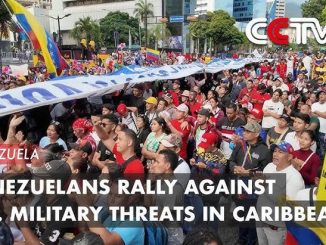
Protesters in Brazil burned an effigy of Donald Trump as they gathered to condemn 50% U.S. tariffs announced for Brazilian goods, which Trump has linked to the coup trial of his political ally, former Brazilian President Jair Bolsonaro.

U.S. President Donald Trump is threatening to impose a new 50% tariff on all Brazilian products starting on Aug. 1. According to a July 17 New York Times Op Ed,  Trump sent a bellicose letter to Brazilian President Luiz Inácio Lula da Silva declaring that the tariff is retaliation for the criminal prosecution of ultra right-wing former president Jair Bolsonaro, who attempted to hold onto power after losing the 2022 election.

New York Times Opinion Editor Lydia Polgreen writes that a much more consequential document had been signed just days earlier. Brazilian and Chinese companies have signed an agreement to begin building a roughly 2,800-mile railroad line that would connect Brazil’s Atlantic coast to a Chinese-built deepwater port on Peru’s Pacific coast. 

Such phenomenal infrastructure could transform much of South America’s economy. It would facilitate the distribution of goods and enable greater mobility of people between Latin America and Asia.

‘America First’ and Panama Canal

Shipping problems caused by the U.S. domination of the Panama Canal would be significantly eased. As part of Trump’s bullying “America First” program, BlackRock (the largest U.S. shadow bank)  purchased two key Panama Canal ports, Balboa and Cristóbal, located at both ends of the canal. Another issue is the logistics of the waterway passage, which opened in 1914. It was designed before the era of mega-container ships and supertankers.

Polgreen says about the difference between the threat of U.S. tariffs and China’s agreement: “It was a neat illustration of the contrasting approaches China and the United States have taken to their growing rivalry. China offers countries help building a new rail line; Trump bullies them and meddles in their politics.”

Brazil, a huge country, bigger than the contiguous U.S., has a growing population, the seventh largest population in the world, and it has enormous resources. It looks forward to a role in building a world economy free from U.S. economic and military domination. To that end, Brazil, along with China, was a founding member of the BRICS, an intergovernmental organization that is currently comprised of ten countries, including Russia and Iran. In July, Brazil hosted the BRICS summit meeting. 

Brazil’s collaboration with China has been flourishing. President Lula traveled to Beijing in May for his third bilateral meeting with China’s president, Xi Jinping, since returning to the presidency in 2023, declaring that “our relationship with China will be indestructible.”


Strugglelalucha256


Trump’s war in Ukraine

Trump ukraine

July 16 — A day of reactions, broad-brush analyses, and self-serving positions on the message of each of the parties directly or indirectly participating in the war in Ukraine. Tuesday passed between the uncertainty of the signal sent on Monday by Donald Trump, the exaggerated hope of those who already see themselves as victors, and the fear of those who doubt whether the president of the United States will actually follow through on his threats. 

“Fifty days,” lamented Anne Applebaum, one of the usual propagandists of this war, suggesting that Trump’s announcement will be nothing more than a bluff. “Trump can’t back down and not help Ukraine,” headlined yesterday’s editorial in The Washington Post, using the acronym “TACO” (Trump Always Chickens Out), used by Chuck Schumer and other Democrats to claim that the president of the United States is a chicken who first threatens and then backs down. 

“Ukraine needs more weapons. But Putin needs more pressure to end the war,” the outlet writes, insisting that “so far, Putin has calculated that time is his ally; he could wait for the West’s patience to run out with a grueling and costly war of attrition. Trump is trying to change Putin’s assumptions, forcing substantive negotiations within a tight deadline by wielding an economic weapon — secondary sanctions — that the United States has been hesitant to use” because, as the outlet admits, they are also a threat to the global economy.

Demanding compliance and praising the measure has also been the official position of the European Union, although there have been two sides to the issue. Like a good cop always trying to please Trump, the president of Finland wrote that he welcomes “the decision of the president of the United States to provide Ukraine with more weapons in its fight against Russia’s illegal war of aggression. The 50-day ceasefire, coupled with the threat of sanctions, including those included in the Lindsey Graham and Richard Blumenthal package, constitutes an important step forward in forcing Russia to the negotiating table. Collaboration with allies toward a just and lasting peace continues.” 

Like Iran when it was attacked, Russia was already at the negotiating table, although not in a position of weakness or faced with the need to unconditionally accept the terms offered by the West. Alexander Stubb’s counterpoint was, predictably, Kaja Kallas, who believes the 50-day grace period Trump has granted Vladimir Putin to reach an impossible agreement, given that Ukraine has never sent a delegation mandated to negotiate political issues, is “very long.” No measure can fully satisfy the continent’s most belligerent hawks.

Meanwhile, the work of Trump’s envoy to Ukraine continues, remaining in the country for a week that, in terms of logistics and planning, is significant. “I met with General Keith Kellogg: a clear voice of strength and strategy. We discussed weapons, sanctions, and the principle of peace through strength. We thank the U.S. president for his firm decisions. That’s what it takes to stop Putin: strength. Ukraine remembers those who lead with courage,” wrote Andriy Ermak, intoxicated with success since he managed to place his successor, Yulia Svyrydenko, as a candidate for prime minister and obtained from the United States exactly what Kiev was looking for: a large arms package that will not come with any restrictions. 

This was reported yesterday by media outlets such as Axios and The Washington Post, each citing their own sources in the Pentagon or the White House, who announced that Ukraine will have no restrictions on the use of the weapons it currently possesses.

“A source involved in the decision has told me that this likely includes permission to use the 18 long-range ATACMS missiles now in Ukraine at their maximum range of 300 kilometers (about 190 miles). That wouldn’t reach Moscow or St. Petersburg, but it would allow attacks on military bases, airfields, and supply depots deep inside Russia that are now out of reach. The package could also include more ATACMS,” David Ignatius wrote yesterday in The Washington Post.

Moscow and St. Petersburg were also part of the speculation that circulated throughout the day due to allegations by Ignatius and Financial Times reporters Max Seddon, Christopher Miller, and Henry Foy. “‘Volodymyr, can you attack Moscow? Can you attack St. Petersburg, too?’ Trump asked on the call, according to the sources. Zelensky responded: ‘Absolutely. We can if you give us the weapons,’” they wrote yesterday in an allegation that the White House later sought to deny. “Let them feel the pain,” Donald Trump reportedly added, referring to the population of the two Russian capitals. According to The Washington Post, he is even considering sending Ukraine Tomahawk missiles capable of reaching both cities.

If the weapons currently on the ground will have no restrictions on their use, it is to be expected that the weapons sent to Kiev from now on will not have any restrictions either, from which the United States will derive significant economic benefits, which is why Donald Trump’s team is currently congratulating itself in the press. 

“The days of the United States sending unlimited amounts of taxpayer money to defend Ukraine are over. The president of the United States has made a very intelligent decision and reached an agreement with NATO, which stipulates that Europe and Canada will pay for the weapons; the United States will manufacture them,” boasted the U.S. ambassador to NATO in an interview with Fox News.

European partners, proud that the United States is progressively moving closer to their position on the use of force and the need to escalate the war one step closer to direct confrontation with a nuclear power, have responded by expressing their pride at being chosen to pay for the weapons with which Donald Trump will finally and completely join the common proxy war against the Russian Federation. 

“President Trump took an important initiative today: the United States will provide Ukraine with large-scale weapons if its European partners finance it,” wrote Chancellor Friedrich Merz on social media, adding that he had assured Trump that “Germany will play a decisive role,” Merz concluded. So decisive that Defense Minister Boris Pistorius of the SPD has insisted that German soldiers will be prepared to kill Russian soldiers in the event of an attack — a completely gratuitous warning that, in the current context, in which Germany emerges as the continental leader in the discourse of massive shipments of weapons for war, sounds like a threat. 

“This,” Merz added, referring to the supply of Western weapons, “will help Ukraine defend itself against terrorism through Russian bombings. Only in this way will pressure increase on Moscow to finally negotiate peace. In short, we are showing that we are working together as partners in security policy,” Merz concluded, describing a partnership in which one side bears the costs and the other reaps the economic benefits.

“The threat of imposing 100% secondary sanctions if Russia fails to reach an agreement within 50 days is unlikely to succeed,” wrote Ukrainian-Canadian academic Ivan Katchanovski, adding that “this has been demonstrated by the failure of numerous previous sanctions against Russia and the imposition of even higher tariffs against China, which had to be reversed due to the reciprocal tariffs imposed by China against the United States and their economic consequences for the United States.” 

Focusing on the purely military issue, analyst Patricia Marins added that “if Putin is confident of forcing a breakthrough in 60 days and achieving his goals, Trump has given him 50 days,” she summarized, for example. “That is being pragmatic,” she added, “whether [Putin] will achieve those goals or not is his own problem. What cannot be done is to indefinitely delay the end of the war through politics.” 

That last sentence perfectly sums up Donald Trump’s thinking. Despite the fact that there hasn’t been any kind of peace process, only isolated negotiations with Ukraine and its European allies and initial talks with the Russian Federation, he is convinced not only that the peace process existed, but that it was on the verge of resolving the conflict. 

“I’m not done with it, but I’m disappointed,” Donald Trump stated, adding, incredibly, that he thought “we had reached an agreement four times, and then you come home and see he just attacked a nursing home or something. … I said, ‘What the hell was that all about?’” Donald Trump hasn’t noticed that Ukraine derailed a passenger train, causing civilian casualties, but he has been informed of a nonexistent bombing of a nursing home.

The U.S. president is simply projecting frustration at his failure to initiate a peace process that was supposed to involve direct dialogue between the parties and which, due to the complexity of the causes and the contradictory red lines of both countries, was always going to be long, hard, and difficult — a very different kind of negotiation from the one Trump enjoys. 

Unable to reach an agreement and without the possibility of applying against Russia the measures he applied against Iran, the moment he realized Tehran would not accept the unacceptable agreement he offered as his only option, with no possibility of negotiating, the U.S. president moves into the phase of threats.

Explaining the sharp increase in arms deliveries expected to occur over the coming days, weeks, and months as the equivalent of the military attack on Iran, analysts like David Ignatius referred to the intention to “escalate to de-escalate,” a concept widely used by Israel to describe its bombing campaigns to force its numerous regional enemies to accept, by force, the conditions imposed by Tel Aviv. 

However, threatening and even attacking a smaller country, subjected to sanctions for decades and under an arms embargo that has only been lifted in recent years, is not the same as attacking a nuclear power whose population is increasingly aligning with the official narrative that they are not confronting Ukraine but the West as a collective.

“We have already been through all this. … We are overcoming it and we will overcome it,” Russian Foreign Minister Sergey Lavrov said in a statement that contrasts with that of Kremlin spokesman Dmitry Peskov, who did not downplay Trump’s threats, which he described as “very serious.” In this context, the press yesterday not only tried to decipher what Trump will do in the medium term, but also what Vladimir Putin’s response will be in the short term. 

“Putin intends to continue fighting in Ukraine until the West accepts his peace terms, and his territorial demands could expand as Russian forces advance,” three sources close to the Kremlin told Reuters. The Russian president believes Russia’s economy and military are strong enough to withstand additional Western measures, the sources said. 

One of the sources stated that Moscow could halt its offensive after conquering Ukraine’s four eastern regions if it encounters strong resistance. “But if he falls, there will be an even greater advance on Dnipropetrovsk, Sumi, and Kharkov,” the Reuters news agency wrote yesterday. 

Without the possibility of negotiations — which Russia has not refused to accept, but as Sergey Lavrov recalled yesterday, Ukraine has not responded to the proposal for a new meeting — Russia’s only option is active defense, an attempt to consolidate its positions on the front, weaken the Ukrainian ground contingent as much as possible in key locations such as Krasnoarmeisk-Pokrovsk, Konstantinovka, Kupyansk, and Sumi, and prepare its air defenses for the massive use of Ukrainian drones accompanied by Western-made missiles.

If there’s no agreement in 50 days, “bad things will happen,” “sanctions and more,” Donald Trump declared yesterday afternoon. The threats continue and will increase as time passes and the deadline approaches. 

“If Putin and others are wondering what will happen on the 51st, I would suggest they call the Ayatollah,” said Senator Lindsey Graham, emboldened by his recent successes. 

His fanaticism is nothing new, nor is the attempt to take the war to Russia, a rhetoric that is increasingly becoming the official one.

Translated by Melinda Butterfield

Source: Slavyangrad.es

Strugglelalucha256


Reading Fanon in the age of ICE raids and Gaza genocide

“Colonialism is not satisfied merely with holding a people in its grip and emptying the native’s brain of all form and content. By a kind of perverted logic, it turns to the past of the oppressed people, and distorts, disfigures and destroys it.” – Frantz Fanon, “The Wretched of the Earth”

The attacks on the past, as Fanon puts it, are also attacks on the history, culture, and very way of life of oppressed people. 

Algeria had been occupied by the French since 1830. In the country, the French tried to secure their domination over the people through dismantling the cultural norms of Algerian society and maintaining an air of absolute violence on anyone who attempted to resist. 

In colonial Algeria, infrastructure was named after famous settlers, colonists or military figures of the occupation. 

In its colonial crusade to erase Islam from Algeria, France relied on deceit, intimidation, and brute force to replace Algerian Islamic culture with French, European, and Christian norms. Mosques were closed or converted into Catholic churches. Quranic schools were shut down or replaced with French-language Catholic schools.

Regarding news and media, French or colonial-friendly newspapers and radio stations were the main source of information and music that could be found in colonial Algeria. 

Finally, the separation of the Algerian villages and towns from the cities and metropolises of the French colonists and settlers was maintained by military checkpoints and a deep culture of racism. 

Committed to decolonization

In Fanon’s writings during the period, he details how the Algerian people, committed to liberation, were able to fight the French. The Algerian people were committed to decolonization, both physically with the removal of French troops and settlers and also culturally through destroying the idea of supremacy of Western values and destroying the divisions between people living in Algeria. 

Women played a crucial role in Algeria’s War of Independence (1954–1962). Their contributions were vital to the success of the National Liberation Front (FLN) and the broader revolutionary movement.

Algerian women who joined the struggle used the French arrogance and chauvinism against them. Western-dressed women were able to move more freely across checkpoints, taking with them all sorts of material and equipment that could aid the revolution. Veiled women hid weapons, equipment or money under their wardrobes. 

Women and men fought together. In cities, women were lookouts, guides and partners to their male counterparts, doing whatever was needed to beat back French occupation. Out in the mountains and countryside, women were armed to the teeth, carrying weaponry and heavy equipment to engage the French military. 

Women and men not only fought side by side to achieve liberation, but the addition of women in the struggle on all fronts saved the very revolution itself.

Rejected French-friendly media

French domination was also challenged in the information space. The Algerian population rejected Radio Algiers and other French-friendly stations. These stations did nothing but affirm the colonial rule of the French in the region and normalize their genocidal strategy of occupation and suppression. 

It was the “Voice of Fighting Algeria” that brought the news to the masses. This station was a direct lifeline to tap into the struggle for liberation. It was broadcast in many different languages, to include the entirety of Algeria’s diverse population. 

Also, newspapers began to spring up that directly challenged the written word of the colonial administration, with the written testimonies of revolutionaries and survivors of French atrocities. The masses were able to tune into these new channels of information, gaining insight and guidance on the struggle and the path the new nation was now on. Also, through these new media outlets, organizing to disrupt the colonial war machine became easier.

Against kidnappings and torture in L.A. (and Gaza)

In the spirit of the revolutionary women of Algeria, indigenous and immigrant women in the United States are leading the struggle out West against the kidnappings and torture of their friends, family and coworkers. This is especially evident in Los Angeles, where women fill the ranks and largely lead organizations like the Community Self Defense Coalition. They do everything from creating literature, scouting for ICE, training new members, to actively alerting areas about ongoing ICE operations. They do everything they possibly can to disrupt this repressive machinery. 

It is Black mothers and sisters who lead in the calls for justice against police brutality and terror, organizing their neighborhoods and communities to take action. 

In today’s information sphere, corporate and state media are constantly challenged by independent reporting and smaller, more community-driven outlets. 

In occupied Palestine, the Zionist entity is unable to destroy the ability of the Palestinian resistance to communicate to the outside world. Outlets like the Resistance News Network are able to get the word out about Palestinian victories over the Zionist enemy while also revealing the truth about Israeli massacres of civilian populations all around the Gaza Strip. 

People in Palestine and Los Angeles (and worldwide) are recording police as they attack peaceful demonstrations and also recording atrocities against civilians to share with the world, destroying narratives that normalize genocide and occupation.

Fanon’s teachings are applicable on any scale of struggle, from labor struggles to wars of national liberation. His teachings on anti-imperialist and anti-colonial resistance provide strategies for survival and resistance against the capitalist system. 

It is capitalism that tears communities apart to make room for profits, capitalism that pits communities against each other, capitalism that strangles human rights for the sake of the dollar, capitalism that enables the oppression of women and other oppressed people, capitalism that normalizes genocide for the creation of markets, and finally capitalism that nurtures the rise of fascism.

Strugglelalucha256


The Wretched of the Earth: Fanon’s anti-colonial manifesto lives on in Yemen, Palestine, Sahel states

In the spring and summer of 1961, as Algeria bled through its seventh year of war against French colonial rule, a dying Frantz Fanon poured his revolutionary vision into words. Too weak to write, he dictated “The Wretched of the Earth” — a book that would ignite liberation movements across the globe — to Josie Fanon, his life companion and fellow anti-colonial fighter. Around them, the struggle for independence raged; inside their exile in Tunisia, a manifesto for the oppressed was being forged.

The Algerian people waged a guerrilla war against French colonial and allied right-wing forces. The war took a tremendous toll on Algerian fighters, workers, and peasants.

Fanon was battling leukemia, a disease that would claim his life on Dec. 6 of that year. Just months after his death, 1962 witnessed the triumphant conclusion of the Algerian War, as the liberation forces achieved victory and secured the complete withdrawal of French colonial rule. This hard-won independence became a beacon of hope for liberation movements worldwide — a legacy that continues to inspire oppressed resistance across the globe.

Beginning at the outbreak of the war in 1954 and until he was exiled for his nationalist politics, Fanon served diligently as a physician and psychologist at a French Hospital in Algeria. For years, he treated not only Algerian people tortured by French authorities but also French soldiers traumatized from carrying out acts of torture and murder against the Algerian people. 

This gave Fanon a critical perspective into the brutality and inhumanity at the center of any colonial regime. The same brutality Fanon observed in French colonial rule in Algeria can be seen today in the Zionist apartheid state and the U.S. military assault on Yemen. 

In “The Wretched of the Earth,” Fanon analyzes the crippling long-term impacts of colonial repression on colonized people. Due to Fanon’s political beliefs, he did not stop at psychology. Fanon actively encouraged the oppressed masses of African people to rise up and take back their culture, their society, and their lives by any means necessary – and particularly through armed struggle. 

Fanon’s legacy of anti-colonial resistance resonates powerfully today in Africa and the West Asia region. In the Sahel states, Mali, Burkina Faso, and Niger have expelled French-backed regimes, seeking to reclaim their nations’ resources and wealth for their own people rather than enriching billionaires in Paris. 

Similar defiant resistance against imperialist domination can be witnessed across West Asia, particularly in Yemen and Palestine, where populations have courageously confronted vastly superior military powers. Despite the immense sacrifices these struggles have demanded, the resolve of these peoples remains unbroken, embodying the same revolutionary spirit that Fanon championed decades ago.

This year will be the 100th anniversary of Fanon’s birth on July 20. The best way to honor Fanon’s commitment to decolonization is to support the continued struggles of colonized and oppressed people across the planet, from Yemen to Palestine to the Sahel. 


Strugglelalucha256


Artists speak up against genocide in Gaza at Europe’s music festivals

As Europe’s summer music festival season rolls out, mainstream media and governments are struggling to keep Palestine solidarity off the stage. In its coverage of Glastonbury Festival, the BBC focused on censoring the Irish rap group Kneecap over their staunch pro-Palestinian stance – only to be met by a wave of artists who used their platform to call for a free Palestine and to demand broadcasters share real news about the Israeli genocide in Gaza.

Among them was the British duo Bob Vylan, who led the crowd in chanting “Free, free Palestine” and “Death, death to the IDF,” denouncing war crimes committed by the Israeli army, including the starvation of children and the killing of civilians in humanitarian aid lines. The BBC has since announced it would edit their performance on streaming platforms, festival organizers distanced themselves from the chant, and Prime Minister Keir Starmer labeled it hate speech. But the reaction among festivalgoers and artists has been starkly different.

Governments refuse to admit status quo has changed

Many artists insisted that the real issue is not on-stage speech but European governments’ complicity in genocide, echoing reactions to earlier attacks on Kneecap, who faced cancellations following their Coachella performance and outspoken solidarity with Palestine.

Australian band Amyl and the Sniffers condemned the backlash against Bob Vylan and Kneecap, saying authorities are attempting to frame these as isolated cases – “a couple of ‘bad bands’” – rather than acknowledging the growing anti-genocide anger among the public. “Trying to make it look like Bob [Vylan] and Kneecap are one-offs, instead of admitting that the status quo has shifted majorly and people are desperate for our governments to listen,” the band posted on social media. Throughout the weekend, they pointed out, musicians raised their voices for Gaza, cheered on by audiences that waved Palestinian flags.

While Kneecap and Bob Vylan both face legal action over their expressions of solidarity, their determination to challenge the status quo is unshaken. Watching what the music industry tried to do to Kneecap after Coachella, DJ Toddla T added, “has been like watching a lightweight boxer against a heavyweight, but holding it. Exhausted, but refusing to fall.”

“Kneecap represents community, which is why they can’t be taken down despite many attempts,” he added.

Taking the stage at Glastonbury, Kneecap voiced support for Palestine Action, a direct action group currently under threat of being banned under the UK’s anti-terror legislation. “Palestine Action is not arming the genocide and Israel – that’s Keir Starmer and the British government, who should be proscribed,” the group said.

“Kneecap, along with many artists and celebrities and Parliamentarians of different stripes, have joined thousands of people across the country saying ‘We are all Palestine Action,’ showing how unworkable the government’s threat to ban Palestine Action is,” Palestine Action spokespeople added.

“We just want to stop people from being murdered,” Kneecap members told The Guardian before the festival. “There’s people starving to death, people being bombed every day. That’s the stuff we need to talk about, not fucking artists.”

Liberating Europe from imperialism is part of the struggle

The genocide in Gaza was also front and center at other European festivals. At Zagreb’s InMusic Festival, bands like Fontaines D.C. and Massive Attack displayed Palestinian flags and screened footage from Gaza – images that were omitted from mainstream media coverage of the event. Other artists also emphasized the importance of linking global and local struggles in confronting Western imperialism.

During his performance, Nigerian musician Seun Kuti offered guidance to Europe’s youth. “I know you want to free Palestine, free Congo, free Sudan, free Iran. It’s a new one every week,” he said. “Free Europe. Free Europe from right-wing extremism, from fascism, from racism. Free Europe from imperialism. When you do this job – as soon as you do this job – Gaza will be free. Congo will be free. Sudan will be free.”

Source: Peoples Dispatch

Strugglelalucha256


U.S. bombs, China builds

China will eliminate tariffs on African countries

As global attention focused on the U.S. and Israeli conspiracy to bring about regime change in Iran (alongside the Pentagon’s bombing that risked a regional war crisis), China and African countries were actively building alliances.

Just days before the attacks on Iran began, China announced that it would eliminate tariffs on imports from 53 African countries (except Eswatini, which does not currently maintain relations with Beijing), a move set to significantly strengthen China-Africa trade relations and create new opportunities for African exporters.

The announcement was made during the Ministerial Meeting of Coordinators on the Implementation of the Follow-up Actions of the Forum on China-Africa Cooperation (FOCAC), held from June 10 to 12, 2025, in Changsha, Hunan Province. 

The forum brought together representatives from China, 53 African nations, and the African Union Commission to assess progress on commitments made at the 2024 Beijing Summit and to plan future cooperation.

Previously, zero-tariff treatment was available to only 33 African countries. This new announcement expands on the zero-tariff treatment for least developed countries (LDCs) that began on Dec. 1, 2024, which has already boosted exports from several African nations to China. This move opens up China’s extensive market to African products.

China’s broader strategy

China’s declaration of near-zero tariffs is part of a broader strategy that includes support for green industries, e-commerce, artificial intelligence, and infrastructure development. This also includes advancing modernization and supporting the African Union’s Agenda 2063. 

The removal of tariffs on African goods will help to diversify Africa’s export markets and reduce dependency on Western capitalist partners. It also signals a growing realignment in international trade partnerships, with Africa increasingly central to Beijing’s global partnerships and solidarity.

China has been Africa’s top trading partner for the last 15 years. In 2024, trade hit a record $295.6 billion. Q1 2025 saw bilateral trade at $72.6 billion, a 2.7% increase year-over-year. Africa’s 2023 exports to China were valued at approximately $170 billion (£125 billion), highlighting its growing role in China’s global trade.

Contrasts with the United States

Instead of lifting tariffs, the Trump administration has tightened the noose and imposed new tariffs, particularly on some of the poorest countries. Countries facing some of the highest tariffs include Lesotho (50%), Madagascar (47%), Mauritius (40%), Botswana (37%), Angola (32%), Libya (31%), and Algeria and South Africa (both 30%). These moves shred the “African Growth and Opportunity Act” (AGOA).

These actions threaten to disrupt supply chains and hinder economic growth. The impact is joblessness, hunger and general poverty for people living in these countries. And if the people in these regions rebel against economic strangulation, U.S. imperialism’s answer is the stick: Africa Command (AFRICOM), a network of military bases on the continent of Africa. 

Strugglelalucha256


U.S. bases in the Arab world: A colonial occupation in disguise

Usmiddleeastbases

The recent US aggression against the Islamic Republic of Iran has laid bare, long-ignored truth: US military bases are among the most serious threats to the peoples of our region. Today, much of the Arab world remains under occupation through foreign domination enforced by military presence, political control, and economic subjugation. Where direct US or Western military domination ends, internal occupation begins, through World Bank dictates, systems of dependency, normalization, and a suffocating helplessness.

From the Atlantic ocean to the shores of the Gulf, US military bases stretch across the Arab world like the fangs of a “modern” colonial beast. Under false slogans like “cooperation,” “stability,” and “protection”, these outposts have long masked their true purpose. These bases are nothing less than military occupations, brazen, shameless, and no different in essence from traditional colonialism. No free people would ever tolerate a foreign military presence imposed on their land, against their will and dignity.

Over 40,000 US troops are now stationed across at least 19 military bases and outposts in the Arab homeland, a number that has doubled in recent years. From al-Udeid base in Qatar, now a command hub for regional wars, to the Fifth Fleet in Bahrain, invasion platform in Kuwait, air installations in the UAE and Saudi Arabia, and covert sites in Jordan, Iraq, and Syria, the Arab land has become a launchpad for attacks on our peoples. These bases operate as spy centers, weapons depots defending the Zionist entity, and tools of domination to control our economies and politics. They are supported by mobile warships in our waters, and anchored by the largest outpost of them all: the Israeli entity itself.

The US, British, and French bases are not mere concrete structures or weapons stockpiles. They are the spearhead of the US-Zionist domination project. From those very bases, strikes are launched on Iran and Yemen. From them, security coordination is managed to weaken resistance in Palestine and Lebanon. Inside their walls, spy networks are built, normalization deals are signed, and the maps of devastation are drawn, just as they were when our region was carved up in the past, only now with even more destruction.

The regimes that welcomed these bases under the banners of dependency, normalization, and surrender, have sold their nations for the survival of a paid elite. They have handed over every port, airport, and airspace to foreign militaries, trading sovereignty for power. But as the pace of confrontation accelerates, the voice of the people grows louder: “Isn’t it time to expel every last US base from Arab soil?”

The ongoing genocide in Gaza, the recent assault on Iran, and the daily assassinations of resistance leaders expose these bases as more sinister than even traditional colonialism. Their existence ensures a continuous cycle of violence and control. No Arab state will know safety while they remain. No nation will enjoy stability under their shadow. No people will taste sovereignty as long as US warplanes fly overhead.

Palestine will never be liberated while a single US base remains in the region. Neither Iraq, Yemen, Lebanon, Syria, Egypt, nor Tunisia, Algeria, and Morocco will be free under the weight of US military occupation. The battle is one. Our fate is shared. The enemy is known.

Let the banners of Arab resistance rise once again, this time against US imperialism, as they once rose against the Zionist project. Let us ignite popular campaigns, national uprisings, and revolutionary movements across the region with a single cry: “US bases out of our land, immediately!”

Launching an armed and popular campaign against these bases will not only strike at the heart of imperial control, it will expose the alliance between US imperialism, Zionism, and Arab reactionary regimes. It will disrupt the balance of the enemy camp and open the door to a new phase in the Arab liberation struggle.

Expelling these bases is not an option. It is a national and revolutionary obligation, a critical chapter in our collective resistance. We will never reclaim a free future, Arab unity, or human dignity until we dismantle this foreign occupation, sever the chains of submission, and return sovereignty to where it belongs: in the hands of the Arab people, not the generals of the Pentagon.

This is an edited translation of an article originally published in Arabic.

Source: Al-Akhbar

Strugglelalucha256


The U.S. war machine must be smashed — before it smashes us

2025 06 21t230223z 1924070524 rc2b7fa4yx9n rtrmadp 3 usa migration protest los angeles

U.S. bombing of Iran sets the stage for wider war

June 22 — On Saturday, June 21, the U.S. military carried out a direct act of war on the people of Iran. According to Trump’s Truth Social, “A full payload of BOMBS was dropped on the primary site, #Fordow.”  Missile strikes were also launched on Natanz and Esfahan.

It’s reported that the U.S. military dropped 14 of its new GBU-57 “bunker buster bombs,” each weighing 30,000 lbs. This is the first time this bomb has been used, and it is the successor to the “Mother of All Bombs,” the GBU-43, which was used in Afghanistan in 2017.

The deployment of massive “bunker buster” bombs, Tomahawk cruise missiles, and the mobilization of U.S. naval fleets, air squadrons, and ground forces in the region is not just a war buildup — it’s a deliberate act of imperialist intimidation. Washington’s message is clear: Any people in West Asia who dare to take control of their own resources or chart an independent path will face the full wrath of the U.S. war machine. This is the iron fist of the military-industrial complex, reminding the oppressed that empire — not self-determination — rules.

Representatives of the Iranian government and its military have correctly pointed out that the U.S. has acted illegally and that the Iranian people have a right to defend themselves against both U.S. and Israeli acts of war.  

As we said in earlier articles, this war has nothing to do with so-called nuclear weapons. Like the pretext for war on Iraq, there are no “weapons of mass destruction.” It is about regime change in Iran as part of a strategy of imperialist world domination aimed at thwarting the development of the Global South and containing Russia and China.

We can expect the Pentagon to continue down this road until it is stopped. It has already targeted military and political leaders, along with scientists inside Iran, and it has trumpeted the real possibility of attempts to murder Iran’s religious leader of the Islamic Revolution, Ayatollah Seyyed Ali Khamenei.    

Trump & Netanyahu: Genocidal War Criminals

That this war has been launched in the midst of an active genocide of the Palestinian people cannot be ignored. Gaza health authorities report at least 202 Palestinians killed and 1,037 injured in Gaza in the last 48 hours due to ongoing Israeli actions. Since October 2023, they confirm 55,908 Palestinian fatalities and 131,138 injuries, primarily women and children.  Not included in this account is the destruction of Syria, Lebanon or the catastrophic war on the people of Yemen.

Generals over the White House

The decaying, malignant racist, anti-worker, anti-poor, anti-woman, transphobic and at times buffoonish cabal at the helm of the White House is in essence a product and reflection of the U.S. capitalist system which cannot provide quality of life for its own workers.

Instead of investment into health care, education, housing and all of the other things that the population desperately needs, including addressing the climate crisis, the vast wealth built on exploitation of the working class is being funneled into the war machine.  

President Trump, standing at the podium with Vice President Vance, Secretary of Defense Pete Hegseth, and Secretary of State Marco Rubio at his side at last night’s announcement of the bombing of Iran, was meant to project a quasi form of legality to actions that were clearly in violation of the War Powers Act. 

Trump was presenting himself as commander in chief (with full Pentagon backing), pushing aside Constitutional legalities, not even consulting with Congress — the only authority empowered to launch a war. Some have called Trump’s move a coup, putting the military in charge of war policy.

The actual power resides with the Pentagon generals, executing the will of U.S. finance capital to shape war policy. Though appearances may shift, their core strategy has stayed unchanged, regardless of who sits in the White House.

Widening war and increased repression at home

Just before launching a war in West Asia, Trump deployed approximately 700 Marines alongside thousands of National Guard troops to Los Angeles in response to protests against ICE raids and kidnappings, putting the country’s second-largest city under military occupation. 

The assault extends beyond protesters to prominent labor leaders. David Huerta, President of the Service Employees International Union-United Service Workers West, was assaulted and violently detained by ICE.  He was exercising his right to observe a raid at the Roybal Federal Building in Los Angeles. Huerta was charged with felony conspiracy to impede an officer, which carries a maximum sentence of six years in federal prison, and was hospitalized for injuries sustained during his arrest.

The Trump administration has arrested members of Congress and other public officials, including Newark Mayor Ras J. Baraka and Milwaukee County Circuit Judge Hannah Dugan. The escalation of violence against elected officials reached a new level when U.S. Senator Alex Padilla (D-California) was physically shoved, forced to the ground, and handcuffed by FBI agents during a Department of Homeland Security news conference with Secretary Kristi Noem at the Wilshire Federal Building in Los Angeles.

Workers and the world’s oppressed masses must stop the war

We do not assert that military supremacy, either its technology or its destructive powers, is of no consequence or importance. But perhaps the U.S. and Western capitalists have forgotten the power that the masses are capable of wielding.  

It should worry them that their immediate plans through proxy Israel on June 13, 2025, when they assassinated military leaders, scientists and civilians, did not result in regime change, but instead united the Iranian people. It appears that the U.S. military and its establishment have forgotten the lessons of the Vietnam War (and the many U.S. wars since then).

It was Huey P. Newton, Defense Minister of the Black Panther Party, who coined the slogan, “The spirit of the people is greater than the man’s technology.”

Just over a week ago, six million people took to the streets all across the country for the “No Kings” marches. Now, it’s time for the working class in the U.S. to mobilize and remain in the streets until the Pentagon is stopped.

Marx revealed the truth: Workers are the engine of history. As capitalism morphed into imperialism, Lenin expanded this vision, rallying the world’s workers and oppressed peoples to unite.

Strugglelalucha256


War on Iran made in the U.S., Israel is a U.S. proxy

Real goal is regime change to maintain U.S. global domination

Israel’s missile strikes and internal sabotage against Iran, launched on June 13, were carried out with the full agreement of their U.S. masters in the Pentagon. The Israelis executed the attacks with direct help from U.S. intelligence technology. And following Iran’s defensive counterattack, the U.S. has also helped Israel intercept missiles. 

The Pentagon maintains troops in Iraq and the region. It’s been reported that these troops are virtual sitting ducks, in harm’s way with inadequate defenses, similar to how Israel’s military targets are embedded in populated areas. Both of these things could provide a pretext for full-scale U.S. involvement. 

What Washington’s saying

Trump, Pete Hagseth and other U.S. officials have made contradictory statements. “Israel did this on their own,” “No they didn’t,” “Yes they did.” What’s undeniable is that U.S. imperialism has put the world on a perilous road. This could develop not only into a regional war, but one with worldwide consequences.

Yesterday, Trump refused to sign onto a very weak statement calling for de-escalation between Israel and Iran, prepared by the G7 at the summit in Alberta, Canada. Instead, he abruptly left the summit early.

When questioned by reporters on his Air Force One flight back, Trump stated, “I don’t care what she said, I think they were very close to having it.” (He was referring to National Intelligence Director Tulsi Gabbard, who stated Iran is not building a nuclear weapon). He continued, “Iran cannot have a nuclear weapon, it’s very simple,” and “I’m not too much in the mood to negotiate.”

Trump has ratcheted up his rhetoric on social media, proclaiming, “Everyone should immediately evacuate Tehran!” Tehran is home to almost 10 million people.

Simultaneously, the Pentagon has repositioned warships and military aircraft in the region in preparation for possible U.S. escalation.

While Israel’s sneak night attack caused damage to Iran, Iran was able to launch a counterattack, demonstrating that it could not be picked off so easily. (See: Iran was supposed to fold — instead, it’s exposing U.S. & Israeli military limits.)  

This brings us to the next, more dangerous stage. Will war now widen?  

Capitalist West using Iran’s nuclear program as a ruse 

There are no credible claims, even by Western capitalist sources, that Iran has actually built a bomb or is in the active process of doing so. As referenced earlier, Tulsi Gabbard, in March, stated that spy agencies assessed that “Iran is not building a nuclear weapon.” 

What has been reported in the mass media are sensationalized accounts from Israel, continuously repeated over and over. It echoes the fake accounts of “weapons of mass destruction” used by the U.S. to launch the destructive war on Iraq.

More importantly, what right do the U.S. imperialists have to make demands on the Iranian people, or their government, around Iran’s right to possess nuclear defenses, let alone to develop nuclear energy? 

The U.S. military is the only country to have actually used nuclear weapons on Hiroshima and Nagasaki. The Japanese were already planning to surrender when Truman ordered the U.S. military to drop the bombs that killed between 150,000 and 246,000 people, most of whom were civilians.  This criminal act of unbelievable destruction was unleashed as a warning to the then Soviet Union.

The press is silent on Israel’s nuclear weapons. This, despite declassified documents showing that, in 1975, Israeli Defense Minister Shimon Peres offered to sell them to South African Defense Minister P.W. Botha, during the white-supremacist apartheid regime’s conflict with the ANC.

Real aim is regime change 

Israel’s cowardly act was meant to cause internal chaos, aimed at provoking division and regime change. It failed, and is not a new strategy.

In 1953, the U.S. government and the CIA, in collaboration with Britain, orchestrated a bloody coup to depose Iran’s progressive and charismatic Prime Minister, Mohammad Mosaddegh. This action was taken to reinforce the rule of Shah Mohammad Reza Pahlavi. Under the Shah’s regime, the infamous SAVAK (Bureau for Intelligence and Security of the State) became notorious for its torture and murder of students, workers, and opposition figures.

Mossadegh’s real crime was the nationalization of the Abadan oil fields. The U.S State Department had wider fears that the actions of the Iranian people to take possession of their own resources would encourage the masses of the entire region.  

U.S. bankers, oil barons and imperialist bosses had cause for concern. On July 26, 1956, Egyptian President Gamal Abdel Nasser nationalized the Suez Canal, asserting Egyptian sovereignty, which touched off war involving Israel, France and Britain. 

Finally, in 1979, the Iranian Revolution brought the Shah’s bloody rule to an end. Following the Shah’s overthrow and the formation of the Iranian Republic, the imperialists have continually tried to destabilize the Iranian government, whether through color revolutions or with disabling sanctions aimed at creating internal divisions.

Root cause: U.S. imperialist decay and its world position

In a Nov. 14, 1979, article entitled “The Iranian crisis: the core of the problem,” Marxist thinker Sam Marcy outlined the extent of the capitalist crisis during that period. He asserted that Abolhassan Bani-Sadr, the appointed Deputy Minister of Finance of Iran’s new revolutionary government, went to the core of the problem.

Marcy wrote: 

“In his letter to the United Nations Security Council requesting a meeting of that body, the new foreign affairs director of Iran, Abolhassan Bani-Sadr, made a scathing indictment of U.S. policy toward Iran and pointedly attacked the U.S. government for attempting to create a war psychosis against Iran and pushing the world to the brink of war.

“The imperialists tried to picture the complaint against U.S. war preparations as a mere diversionary tactic from domestic problems in Iran. While few if any of the capitalist press published the entire text of this important letter, which details all the criminal activities not only of the Shah but of the U.S. itself in relation to the Iranian people, none referred to what is truly the core of the broad problem facing American finance capital, which Bani-Sadr pointedly made reference to.”

Marcy quotes Bani-Sadr:

“Mr. Secretary General,” said Mr. Bani-Sadr, “I am well equipped because of my scientific knowledge to know that the weakness of the American economy (at the present) and the weak position of the dollar has forced on America a grave economic and political crisis.

“Is America trying to reestablish the position of its money by putting world peace in peril?”

While today’s stakes are higher, the question remains the same.

Strugglelalucha256


NATO-backed Ukraine escalates war on labor: Union leaders arrested, halls seized

Just over 11 years ago, fascist mobs cheered in central Kiev as the Federation of Trade Unions of Ukraine (FPU) roared with flame. The FPU’s headquarters, known as the Trade Union House, was a target of the right-wing crowds throughout the “EuroMaidan” protests in 2014. 

It should be noted, this was not the only trade union hall that Maidan mobs burned. Just three months after the attack on the Kiev Trade Union House, Ukrainian neo-Nazis burned the Odessa House of Trade Unions, murdering nearly 50 labor organizers and progressive activists. If only Ukraine’s fascist war on labor unions ended there. 

Fast forward to the present day. As of April of this year, the Ukrainian government placed FPU president Grigoriy Osovyi under house arrest and illegally seized the Trade Union house and all affiliated assets. Control of the 14,000-square-meter property, worth 850 million Ukrainian hryvnia, or approximately $20 million, was handed over to the Kamparitet business consortium. The consortium manages all assets seized by fascist Ukraine. 

The Ukrainian government also moved against trade union organizations in Lviv. The Lviv Regional Council seized the local Trade Union House from the Association of Trade Unions of the Lviv Region. The Ukrainian regime took similar actions against unions in Poltava and Zakarpattia, confiscating various trade union property. The largest trade union coalitions in Europe, the ITUC and the EPSU, have both condemned these policies. 

Ukraine’s recent repressive actions against its labor movement represent a broader fascist assault against the country’s working class. Before the Ukrainian parliament is a draft law that would represent an existential threat to labor unionism in Ukraine. This abomination is formally known as Draft Law No. 6420 “On the legal regime of property of trade union public associations (organisations) of the former USSR.” This law is part of Ukraine’s ongoing disgraceful “decommunization” campaign. Ukraine’s “decommunization” policy is set on destroying socialist and working-class history and replacing it with fascist mythology. 

Draft Law No. 6420 would completely legalize the fascist government’s seizures of union property. Further, the law would allow employers to unilaterally suspend union contracts and cease salary payments to employees who are mobilized into the country’s military. Currently, Ukrainian private employers are required to pay a base salary to all workers sent to the front lines. 

These policies are aimed at one thing: completely dismantling what remains of organized labor in Ukraine. Zelensky’s fascist assault on labor union property and leaders reflects a broader agenda in the region. In its current form, the Ukrainian government is entirely propped up by U.S. and European military and financial aid. As such, there is tremendous pressure on Ukraine from the West to ramp up the profit margin on its investments. What better way to do this than through martial law, austerity, and the stripping of all workers’ rights and organizations? 

Ukraine has given us another example of its transparent role as a Western running dog in the U.S. imperialist war against the global working class. Ukraine’s internal fascist repression against the labor movement reflects a country being molded to further serve the interests of NATO and U.S war profiteers.

Strugglelalucha256
https://www.struggle-la-lucha.org/around-the-world/page/5/