China, Japan, South Korea restart economic talks amid Trump’s tariff war

Trade ministers
Trade ministers (from left to right): Japanese Industry Minister Yoji Muto; South Korean Industry Minister Ahk Duk-geun; Chinese Commerce Minister Wang Wentao.

On March 30, 2025, delegates from China, Japan, and South Korea held their first economic dialogue in five years. This appears to be a reaction to Trump’s tariff war against the world. Only time will tell what these talks mean for the U.S.-dominated political and economic order, but they may indicate increasing independence from the U.S. However, China, Japan, and South Korea each have different relationships to U.S. imperialism, the nature of which is obscured in the capitalist media. 

Japan and South Korea dominated by U.S. in different ways 

South Korea, though typically referred to as an “ally” of the U.S., is a semi-colony or a satellite state. The U.S. dominates it politically, economically, and militarily, even if Washington doesn’t control the government directly. South Korea is occupied by the U.S. military, with some 30,000 troops, the third largest U.S. military occupation after Germany and Japan.

This is no conspiracy. It’s how U.S. imperialism operates. This kind of arrangement gives the U.S. all the same control and profits without the overhead costs of an outright colony like “Israel.” This has been the case with South Korea since the end of World War II in 1945.

Japan is different because it is an imperialist power itself. Japan brutally occupied Korea between 1910 and 1945. Today, Japan is generally aligned with and subordinate to the U.S. After World War II, the U.S. deliberately rehabilitated and modernized Japanese industry — to strengthen the Japanese ruling class against both their own working class and the socialist wave sweeping Asia, particularly China, as well as the socialist countries led by the USSR.

After World War II, both Germany and Japan were subordinated militarily by the U.S., with each occupied by the largest U.S. military deployments in the world (that is, there are more U.S. military personnel and equipment, headquarters, etc., in Germany and Japan than in anywhere else in the world outside the U.S.). They are U.S.-occupied imperialist satellites.

The U.S.-imposed constitution on Japan, particularly Article 9, initially limited Japan’s military capacity, and the U.S.-Japan Security Treaty ensured that Japan served U.S. strategic interests in Asia against the Soviet Union and China.

Japan’s post-war economic resurgence (“economic miracle”), aided initially by U.S. policy, eventually led to economic contradictions and inter-imperialist rivalry with the U.S. and Europe. Trade disputes and competition in industries like automobiles and electronics emerged. In recent years, Japan’s government has essentially overridden Article 9 with a serious buildup of military forces. On Dec. 26, 2024, the Associated Press reported:  

“The Japanese Cabinet on Friday approved a record 8.7 trillion yen ($55 billion) defense budget for 2025 as Japan accelerates building up its strike-back capability with long-range cruise missiles and starts deploying Tomahawks to fortify itself against growing threats from China, North Korea and Russia.” 

This comes amid a rise of economic and political nationalism accompanied by anti-immigrant movements and growing racism in Japan, as in other imperialist countries like the U.S., Germany, Britain, and France. 

China’s socialist revolution made a difference

China, however, had a socialist revolution in 1949. It put the majority of people — the workers and peasants — in charge. China had endured its own “century of humiliation” as a semi-colony of Great Britain, which began in 1839. Before the 1949 socialist victory, Japan had occupied parts of China, namely with the colonial puppet state of Manchuria. A U.S. Library of Congress source says that 20 million Chinese people were killed in the Second Sino-Japanese War between 1937 and 1945, making it one of the deadliest conflicts of WWII. 

After so much death and destruction, the people of China would not fall into the same trap again. China’s revolution secured its sovereignty. Western powers, led by the U.S., have never forgiven China for its revolution. The U.S. has spent much of its military budget for decades trying to economically and militarily encircle China. But even with intensified aggression, starting under Obama and intensifying into Trump’s second term, China is not backing down, and is not bending to kiss Trump’s ring. 

Significance of current trade talks

As a response to U.S. tariffs, China, Japan, and South Korea agreed to expand their economic cooperation by continuing to stabilize supply chains and maintain continuous dialogue on export controls. 

Japan and South Korea are interested in importing raw materials for semiconductors, and China is interested in finished chip products in return.

To avoid drawing attention from the imperialists in Washington, both Japan and South Korea have downplayed the discussions. 

But the joint statement speaks for itself: 

“We noted with satisfaction the advancements made in trilateral cooperation between our three countries and held fruitful discussions on the future trajectory of our cooperation. We especially recognized the need for ongoing trilateral economic and trade cooperation to effectively address emerging challenges and achieve tangible outcomes in key areas.”

Though this is not a new trade agreement, an agreement to continue talks independently of the U.S. could be significant. It could signal that Washington’s ability to control the situation may be waning. Trade relations in themselves (even in defiance of U.S. efforts to isolate China) will likely not be enough to counteract Japan’s remilitarization and increasingly racist posture. 

But in this current period, it may be a political accomplishment in itself for two nations aligned with U.S. imperialism to be in the same room as one that has proven to be its counterweight, discussing economic cooperation. Ultimately, though, it is people’s struggles, particularly in Japan and South Korea, that can fundamentally change the dynamics.

People’s Victory in South Korea

Days later, on April 4, 2025, President of South Korea Yoon Suk Yeol was ousted by the country’s Constitutional Court. 

This was a result of a four-month-long struggle that followed President Yoon’s attempted declaration of martial law. Working-class forces, including the Korean Confederation of Trade Unions (KCTU), took to the streets demanding his removal. 

Nodutdol for Korean Community Development, an organization of Koreans in the diaspora for reunification and national liberation, put it succinctly:

“The movement in the streets that brought down Yoon has always demanded far more than his removal. Yoon is simply one representative of South Korea’s ruling capitalist class, and this class itself is dependent on U.S. imperialism to remain in power.” 

A special election for the presidency takes place in June. What this may mean for continued economic cooperation with China and Japan remains to be seen. But the South Korean people have shown that they have the power to topple U.S.-backed stooges. This is likely not comforting to the imperialist leaders in Washington and their Wall Street constituents. 

Strugglelalucha256


Ecuador: Leftist Luisa Gonzalez rejects election results and claims fraud

Today Ecuadorians were called to the polls for the runoff elections, which pitted leftist candidate Luisa Gonzalez against incumbent President and Trump supported Daniel Noboa. The election day was marked by a series of setbacks, including complaints of irregularities, violations of democracy and the activation of a new state of emergency which allowed the most extreme militarization the country has ever experienced. In addition, the arrival of international observers was prohibited, which generated even more doubts about the transparency of the process.

Despite this complicated context, at the end of the day, the National Electoral Council (CNE) announced the victory of right-wing billionaire Daniel Noboa, which has raised questions about the veracity of the results. According to the CNE, with more than 90% of the ballots counted, Noboa would have obtained 55.94% of the votes, while Revolucion Ciudadana movement, candidate Luisa Gonzalez had received 44.06%.

Just on the surface those numbers are hard to believe considering the backing Gonzalez received after the first election in February from a number of other parties including the left leaning indigenous Pachakutik Plurinational Unity Movement; and yet her numbers went down in this round of voting.

Shortly after this announcement, Luisa Gonzalez, presidential candidate for the political movement Revolucion Ciudadana, expressed her rejection of the results. In a strong statement, she affirmed that she does not recognize the electoral result and denounced a fraud in the registration of votes, designed to benefit President Noboa.

“Ecuador is living a dictatorship. I refuse to recognize these results. I refuse to believe that a country chooses violence over change. How can these results they are showing be credible, in the midst of so many irregularities?” questioned Gonzalez. “Ecuador cannot continue to be governed by a president who only thinks about the enrichment of his family, and not about the path towards the definitive peace of the country. We must be united now more than ever”.

Gonzalez also made a call to the population, stating: “I refuse to believe that people prefer lies instead of the truth. We are going to ask for a recount of the votes and for the polls to be opened”.

Yesterday Noboa issued a presidential decree to close the borders making it impossible for international observers to attend. As if that was not enough Noboa ordered 45,000 of soldiers to be posted in the streets and in the polling stations themselves as a way of intimidation to voters who already live in a climate of violence. A delegation from the U.S. based Black Alliance for Peace (BAP) delegation that had arrived earlier confirmed this overwhelming presence of the military during voting in Guayaquil, Ecuador’s largest city,especially in poor and AfroEcuadorian communities.

The situation in Ecuador remains tense, and the response of the international community and citizens will be crucial in the coming days. The demand for transparency and justice in the electoral process has become a clamor throughout the country, while Ecuadorians await a resolution that guarantees the integrity of their democracy.

How Ecuador reached this runoff election

Last time Ecuador held elections, in 2023, the country’s national assembly had been dissolved and then-President Guillermo Lasso had faced potential impeachment for a corruption scandal involving embezzlement of public oil transport funds.

This led to a political crisis that saw snap presidential elections usher in Daniel Noboa, a multi-millionaire with a direct lineage to Ecuador’s encrusted oligarchy, mainly through his father, Alvaro Noboa, a billionaire, the richest man in Ecuador who controls the Noboa Group of Companies, and also Noboa Corporation, which has more than 128 companies in Ecuador and around the world. Up to that point, his political experience amounted to one term in the National Assembly.

Rooted violence

Ecuador faces the 2025 elections in a context of violence and insecurity that has escalated alarmingly in recent years. The country closed 2024 with a rate of 38.76 homicides per 100,000 inhabitants, which places it among the most violent in the world. In total, 6,964 violent deaths were recorded, an average of one every hour and 15 minutes.

Although this figure represents a slight decrease compared to 2023, the most violent year in the country’s history, it still reflects a security crisis resulting from the growth of organized crime, prison massacres and institutional fragility.

Since 2020, starting with Lenin Moreno’s administration, at least 16 prison massacres have left hundreds of victims, many of them dismembered or burned, exposing the state’s inability to contain violence.

A country under constant “states of exceptions”

The government of Daniel Noboa, like his predecessors Lenín Moreno and Guillermo Lasso, has resorted to states of exception as a response to insecurity. In 2024, Ecuador lived more than 250 days under this measure, including the declaration of an “internal armed conflict” to confront gangs such as Los Choneros and Los Lobos, linked to international drug trafficking.

This decree allowed the Armed Forces to take control of prisons and public security, but also generated complaints of human rights abuses and violations. Cases such as that of four minors, Steven, Josué, Ismael and Saúl, detained, beaten and murdered in the custody of the Armed Forces, whose bodies were later found burned in the surroundings of the Taura Air Base, where they were taken after being arbitrarily detained, without evidence, after leaving a soccer game a short distance from their homes, according to what their parents later declared; have exacerbated criticism of the use of military forces in civilian functions.

Energy crisis and its origins

Ecuador is facing one of the worst energy crises in its recent history, a situation that has not only transformed the daily lives of its citizens, but has also marked the political, economic and social situation of the country on the threshold of the 2025 general elections. With power outages of up to 14 hours a day, economic losses in the millions and a government struggling to regain control, uncertainty dominates the national scene.

The current crisis has multiple causes, among them, the lack of maintenance and investment in the country’s hydroelectric power plants, a problem that has been dragging on since the government of Lenín Moreno.

Added to this is a severe drought which, according to the government, is the worst in 60 years, and which has significantly reduced the generation capacity of hydroelectric power plants, the main energy suppliers in the country.

However, experts point out that the drought is not the only determining factor. While other countries in the region have faced similar scenarios, Ecuador is the only one that has experienced such prolonged daily blackouts. This, according to analysts, is due to poor government management, insufficient planning and the lack of implementation of alternative energy projects.

Economic and social impact

The effects of the blackouts, which commonly last for 14 hours a day, have been devastating. According to data from the Quito Chamber of Commerce, in just two months of outages, the industrial sector lost U.S.D 4 billion, while the commercial sector reported a decrease of U.S.D 3.5 billion. In total, economic losses amount to more than U.S.D 9.5 billion since the rationing began in 2023.

The social impact has been no less alarming. Uncertainty about the timing of power cuts, unfulfilled government promises and the lack of clear information have generated an atmosphere of distrust. In addition, the energy crisis has led to massive layoffs, affecting key sectors such as manufacturing, agriculture and commerce. According to the Ministry of Labor, in September 2024, 3,647 termination notices were registered, 40% of them due to untimely dismissals.

The political management of the crisis

The government of President Daniel Noboa has been at the center of the debate. After assuming power in a context of energy instability, his administration promised to solve the crisis by January 2025. However, experts assure that there are no technical figures to back up this claim. The president’s credibility has also been affected by the resignations of high-ranking officials, such as the Minister of Production and the Minister of Energy, who left their posts in the midst of the crisis. The lack of effective communication and the improvisation in the planning of the cuts have increased the perception of citizen discontent.

Migration, unemployment and insecurity: the other faces of the crisis

The lack of employment and deteriorating economic conditions have driven an unprecedented wave of migration. Between January and July 2024, there was a migration deficit of almost 100,000 people who left the country and did not return, reflecting widespread discontent. This trend comes on top of a climate of insecurity exacerbated by drug trafficking, which has impacted both communities and the productive sector. According to the latest estimates by the Ministry of Foreign Affairs and Human Mobility, there are already more than 2.4 million Ecuadorians living outside the country, which represents about 10% of the population.

In an ominous sign of the increasing U.S. backed militarization of Ecuador CNN has reported that  mercenary military contractor and Blackwater founder Erik Prince joined in law enforcement operations on Saturday that included raids on homes in Guayaquil.

Source: Resumen Latinoamericano – English

Strugglelalucha256


The camouflaged U.S. invasion of Panama

Panama’s opposition parties accused the U.S. of launching a “camouflaged invasion” amid escalating tensions over the U.S. military presence in the country. Following U.S. Defense Secretary Pete Hegseth’s recent visit, President Donald Trump confirmed troop deployments, stating, “We’ve moved a lot of troops to Panama.”

Hegseth cited the need to “secure” the Panama Canal from Chinese influence, announcing increased U.S. military activities at four former bases vacated in 1999 under the Torrijos-Carter treaties, which stipulated the canal’s neutrality and prohibited foreign (i.e., U.S.) military installations.  

‘Without firing a shot’

Opposition leader Ricardo Lombana condemned the U.S. actions as an invasion “without firing a shot.”  

On April 4, the National Front for the Defense of Economic and Social Rights (FRENADESO) denounced the large-scale operation in Panama that the U.S. is orchestrating.  

The week before Hegseth’s arrival, military forces from Panama and the United States began conducting the joint exercise Panamax 2025, with “protection” drills for the interoceanic canal “against possible threats.”

Memories of 1989 U.S. invasion

The military exercise involves the arrival of members of the U.S. Armed Forces, who participate in joint tactical and operational training activities. This U.S. military operation evokes painful memories of the 1989 U.S. invasion, Operation Just Cause, causing widespread concern among Panamanians. A separate agreement granting preferential canal fee reimbursements to U.S. Navy vessels has raised further controversy, seemingly violating neutrality provisions.  

Demonstrations across the country against both U.S. policies and Mulino’s administration are expected on April 12, highlighting widespread discontent and the deepening crisis surrounding Panama’s sovereignty.  

The U.S. operation is meant to reassert control over the Panama Canal with a military occupation at four bases in strategic locations: Colón’s Coco Solo and Rodman, Balboa, Howard, and the Darién Gap — a critical migration route.  

FRENADESO condemns concessions

FRENADESO says Mulino’s administration has capitulated to U.S. demands, citing concessions such as migrant detention policies, the sale of Balboa and Cristóbal ports to U.S.-based firm BlackRock, cybersecurity collaboration with U.S. Southern Command, and the withdrawal from China-linked agreements like the Belt and Road Initiative. The group also warns of a classified U.S.-drafted defense pact, written exclusively in English, bypassing Panama’s constitutional requirement for legislative approval.  

“This government has subordinated itself to U.S. interests, from immigration to infrastructure,” FRENADESO stated, condemning the incremental arrival of U.S. troops and equipment, including advanced weaponry and aircraft.  

Protests against austerity

Hegseth’s visit followed a 48-hour teachers’ strike and construction worker protests against austerity measures, with unions now vowing to rally against the “sell-out” to “U.S. imperialism.”

The United People’s Alliance of Panama stated: “The country is being handed over with the four military bases that have been talked about. We cannot accept that. In this country, several generations of Panamanians fought for the sovereignty of the country, and today the dictator [Mulino] wants to hand over the sovereignty of this country and that cannot go unnoticed.”  

“We request international solidarity from peoples around the world and progressive, democratic, and revolutionary governments. We call for struggle and popular mobilization in defense of our national sovereignty. We reject Pete Hegseth’s presence in Panama.”  

Strugglelalucha256


Tariffs and spectacle

Tariffwhiteboard

April 4 — “Cambodia, oh, look at Cambodia! 97%. We’re going to take it down to 49% and make a fortune for the United States of America,” Donald Trump boasted in true telemarketing style. 

“South Africa. Oh, 60%, 30%. There are some very bad things going on in South Africa. We pay them trillions of dollars a week in financing, but we’re cutting them off because there are so many bad things going on in South Africa,” he continued after announcing 10% tariffs on British goods. 

Faced with worldwide astonishment at the attempt to make a spectacle of what could be the beginning of a trade war, the U.S. president continued with the list of usual grievances stemming from economic nationalism and xenophobia, such as hatred of the current South African government, which is largely influenced by the racist vision of defending the white population against a false “white genocide.” 

In the end, without fireworks but with a whiteboard where the White House presented data on the tariffs it believes other countries impose on its products and another column where the United States reciprocally adds its own, Donald Trump called April 2nd “America’s Liberation Day.”

In its magnanimity, there is no such thing as U.S. reciprocity. Instead, Washington creates the tariffs it imposes on the rest of the world using a deceptive formula that doesn’t calculate a country’s tariff level but simply the trade deficit, which Trumpism equates to tariffs. Thus, poor countries like Cambodia that barely import products from the United States — virtually any product Cambodia might need will be purchased more cheaply from China, which, in addition to being closer, hasn’t bombed the country to the point of littering its land with unexploded ordnance — are outstripped by their exports to the United States, products manufactured in the country due to the relocation of U.S. industry. 

Although imperceptible in absolute terms, calculated using the Trump administration’s formula (trade deficit with a country divided by that country’s imports), the result is the 97% Trump mentioned, a figure that has nothing to do with the tariffs Cambodia imposes on products from the United States, which are not taken into account in the calculation.

American protectionism responds to the deficit in the U.S. trade balance, which, by introducing yet another trick, takes into account trade in goods but not in services, and not necessarily the rates imposed by individual countries. Israel, for example, unsuccessfully attempted to preempt Trump’s announcement on Wednesday by zeroing tariffs on U.S. products. At the end of the night, Tel Aviv received a figure of 17% tariffs on its products based on the trade balance. 

The figures, and above all, the strange distribution, with which not only China but also former enemies such as Cambodia, Laos, and Vietnam were disproportionately punished, while others, such as what Washington perceives as its Latin American backyard, with low levels of exports to the northern country, received lesser penalties, sparked all kinds of speculation throughout yesterday morning. Before economic experts deciphered the formula, it was also noted that U.S. allies such as the European Union were faring worse than some opponents.

“Russia, Cuba, and North Korea escape the worst of Trump’s tariff wrath,” Reuters headlined yesterday in an article that included two other sworn enemies of the United States that also apparently emerged unscathed from the American “liberation”: Belarus and Iran. “Trump said he would impose a 10% base tariff on all imports to the United States and higher tariffs on dozens of other countries. Russia, Cuba, and North Korea do not appear on the list of countries facing higher ‘reciprocal’ tariffs released by the White House,” writes Reuters, adding that “in their annual threat assessment, U.S. intelligence agencies said China, Russia, Iran, and North Korea were the biggest potential nation-state threats to the United States, and Trump had threatened Moscow with new trade measures.” 

Only after falsely portraying favoritism toward these enemies does the article explain that the level of sanctions those countries are under makes any additional levies unfeasible. “Asked why Russia was not on the list, U.S. Treasury Secretary Scott Bessent told Fox News that the United States did not trade with Russia and Belarus and that they were subject to sanctions. Trade in goods between Russia and the United States was $3.5 billion last year, according to U.S. figures. In 2021, the year before Russia invaded Ukraine, it was $36 billion,” the article explained. 

The figures — $3 billion in Russian exports to the United States and $526 billion in imports —  would, according to the formula applied, result in tariffs of more than 40% on Russian imports. But compared to Ukraine, an ally and proxy that has received 10% tariffs, which it has received with the resignation of someone who lacks the tools to defend itself and knows it cannot raise its voice against those who supply it with weapons and intelligence, Russia has not received additional sanctions. 

On the contrary, this week it was announced that the United States has temporarily lifted coercive measures against senior Russian advisor Kiril Dmitrev, who traveled to Washington to meet with the Trump administration as part of the negotiations between the two countries. “A real understanding of Russia’s position opens up new possibilities for constructive cooperation, including in the economic and investment sphere,” Dmitrev commented on his Telegram channel.

The economic content of the visit, the first time a Russian representative will meet with White House officials on U.S. soil since 2022, is particularly striking given the timing, not least because it is tariff week. Hours before Donald Trump tossed around tariffs in a televised auction, two well-known senators, both friends of Ukraine, Republican Lindsey Graham and Democrat Richard Blumenthal, introduced a proposal in the Senate to impose draconian primary and secondary sanctions if Russia does not negotiate in good faith or reach a peace agreement with Ukraine. The senators, who obtained the signatures of 24 other representatives from both parties, propose 500% tariffs on imports from countries that purchase Russian products if peace efforts fail. 

“Sanctions against Russia require tariffs on countries that buy Russian oil, gas, uranium, and other products. They are tough for a reason,” the senators assert. Lindsey Graham, who has made no secret of the need to continue fighting “to the last Ukrainian,” and his usual ally have not lost hope of using the war not only to seize Ukraine’s mineral resources but also to severely sanction opponents like China, Russia’s main economic ally. Even if this requires a measure that is difficult to implement and has more than uncertain consequences for world trade.

Uncertainty was also one of the words repeated throughout yesterday when trying to predict the short- and medium-term effects of the announced measures. Donald Trump assumed that the White House would begin receiving calls pleading for the withdrawal of tariffs or wanting to negotiate, while Treasury Secretary Bessent warned countries not to respond reciprocally, which would be considered an escalation, and recommended sitting back and waiting. 

The main lesson from the way the United States has calculated the level of tariffs and the rhetoric accompanying the measures is the double definition of the word. In the United States, “tariff” is the most beautiful word, a way to reduce taxes for the population and to recover what other countries have stolen from the American people. Abroad, “tariff” does not equate to the tax applied to imported products, but to a trade deficit. Thus, when Donald Trump demands that different countries withdraw their tariffs if they want American tariffs to be reduced, the U.S. president is not seeking to reduce those duties, but rather to eliminate the trade deficit. In other words, Trumpism demands that the rest of the world purchase more American products. 

“The High Representative of the European Union for Foreign Affairs, Kaja Kallas, asserts that there are no ‘winners’ in trade wars. She acknowledges that the EU currently buys a lot of defense equipment from the United States,” EFE wrote yesterday. It is there, in this second idea, the acquisition of more U.S. military equipment, that European countries can achieve a reduction in the 20% tariffs imposed on EU imports. In this way, Trump would also guarantee that the European rearmament he has been demanding for years will not occur by acquiring strategic autonomy from Washington.

Translated by Melinda Butterfield

Source: http://Slavyangrad.es

Strugglelalucha256


Profit over peace: European capitalists push for war

In the wake of his election, incoming German Chancellor Frederick Merz proclaimed on Jan. 22 that Europe’s defense would be his highest priority. Merz moved quickly, securing a deal in the German legislature on March 5 to spend hundreds of billions on “defense” and loosen the limit on German borrowing for military spending. Merz’s Christian Democratic Union and the opposition Social Democratic Party of Germany joined forces to ensure the war budget spike.

Merz followed this with another deal on March 14. This time, Merz allied with the Green Party to ensure that Merz’s government could change the German constitution to allow the government to take endless loans to increase military expenditure. The message is clear: Germany is back on its war horse. Upon this supposed triumph, Merz proclaimed, “Germany is back!” This proclamation has eerie echoes of the last time Germany rearmed in 1935, upon the order of Chancellor Adolf Hitler. 

This momentous political shift in Germany was quickly followed by action from another prominent German politician: European Commission President Ursula Von Der Leyen, a fellow Christian Democrat and Ukraine hawk, along with Merz. Von Der Leyen proposed a broader “ReArm Europe Plan” on March 3. The plan aims to “help member states quickly and significantly increase expenditures in defence capabilities.” On March 21, top EU officials announced a deal to secure the funding for Von Der Leyen’s rearmament plan. Again, the message is clear: European capitalism is in a full drive towards war. 

So, why this spike in German and European military spending? Merz and Von Der Leyen would have the public believe that this shift towards war is a response to Trump’s move away from Ukraine. 

The European leaders have maintained this line even as the Trump administration has restored full military funding and assistance to fascist Ukraine. Trump has even begun to threaten more sanctions against Russia based on allegations of sabotaging peace talks. Yet, Europe continues to push for war. 

The answer can at least be partially found in the absurd profits that the German arms industry has reaped since the beginning of NATO’s proxy war in Ukraine against Russia. Since the beginning of Russia’s special military operation in Ukraine, German arms manufacturers have experienced a boon unseen since World War II. The largest German benefactor of NATO’s proxy war against Russia so far has been Rheinmetall AG, an automobile and arms manufacturer. 

Rheinmetall has experienced a 1000% increase in stock price since the beginning of the war in Ukraine in February of 2022. While Europe had not taken steps towards complete rearmament until now, Germany and many other European countries had already increased military spending to support Ukraine’s fascist military. 

This increase in military expenditure alone created a massive boon for Rheinmetall, driving the company to 9.8 billion euros in profit in 2024. These numbers represent billions upon billions of dollars and euros being pocketed by German and American war financiers. And to think, all this profit was before Merz’s election and the move towards complete rearmament in Europe. 

Rheinmetall is not the only German defense magnate that has profited handsomely from the war in Ukraine or who would profit further from a complete European rearmament. The KNDS Group, a defense conglomerate of German and French arms manufacturers, has recorded 11.2 billion euros in profit selling tanks, artillery, and armored vehicles to various European governments, who have then sent the equipment to Ukraine as military aid. That is billions upon billions made off the suffering of the Russian and Ukrainian people. 

If capitalism has taught the world anything, it’s that its wealthiest individuals will never stop in their dogged pursuit of profit. Given their record profits from the war in Ukraine, it makes sense these German and European defense magnates would want to escalate the war climate to increase profits. Enter the rearmament of Germany and Europe more broadly. 

In fact, the rearmament of Europe, led by Germany, has little to do with Trump “abandoning” Europe and everything to do with European war capitalists expanding their profit base. And when Europe makes money, wealthy U.S. investors almost always make money. 

Germany’s rearmament has not come without a heap of fascist symbolism. It began with cat-named (Leopard) tanks rolling into Eastern Europe to fight the Russian military. Now, Rheinmetall seeks to acquire a closing Volkswagen plant to convert it for arms production. This almost feels cosmic, as Volkswagen itself would not have existed without German fascism. As if icing on the cake, Donald Trump’s connection with electric car magnate Elon Musk conjures images of a similar alliance between Adolf Hitler and Henry Ford. 

Europe’s move towards military investment signals a dangerous escalation towards Russia and should be broadly condemned. The money of the working class does not need to be plundered to fuel the profits of blood sucking arms manufacturers like Rheinmettall and the NDS Group. All workers need jobs, health care, and self-determination – not capitalist war. 

Strugglelalucha256


U.S. attack on Iran imminent?

Tehran has already warned that its missile forces are ready to retaliate in case of escalation. All this sets the stage for yet another U.S.-orchestrated destabilization of not just the Middle East, but the world as a whole.

A attack

A U.S. attack on Iran has been on the agenda for nearly half a century at this point. After the 1979 Iranian revolution, the two countries have had an uneasy relationship, to say the least. Despite brief moments of covert and overt cooperation, Washington DC and Tehran have nearly unequivocally been geopolitical adversaries, supporting different sides in the Middle East and beyond.

Traditionally, Republican governments tend to be more aggressive toward Iran and the new Trump administration is no different in that regard. Since his first term, Donald Trump has been quite critical of Iran and its policies. This continued during his second term, with the U.S. escalating tensions by directly attacking and bombing Iranian allies such as the Houthis (officially known as the Ansar Allah).

Even the former Biden administration worked to pave the way for more American interventionism in the Middle East, particularly by targeting Syria, which fell to Western-backed terrorists in early December. In the meantime, the mainstream propaganda machine kept galvanizing the U.S. public for war with Iran (even before Trump took office).

Worse yet, in the last several months, there have been a number of concrete moves to facilitate such an attack, particularly in terms of deploying strategic assets. U.S. President Donald Trump himself has warned that his country could “launch a bombing attack the likes of which they have never seen before” if Tehran refuses to engage in negotiations and make the “necessary” concessions on its nuclear program.

“If they don’t make a deal, there will be bombing,” he said, adding that “U.S. and Iranian officials are talking” and that “there’s a chance that if they don’t make a deal, that I will do secondary tariffs on them like I did four years ago.”

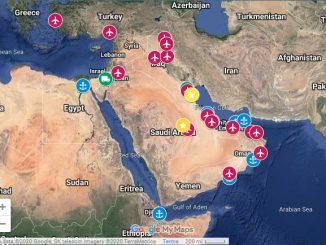
Trump made the statement in an interview on March 29, following the deployment of at least seven B-2 “Spirit” strategic stealth bombers to the Diego Garcia Naval Support Facility (officially belongs to the British military, but leased to the U.S. Navy and also often used by the USAF). The Pentagon operates only 19 B-2s, meaning that over a third of all operational bombers have been deployed to Diego Garcia.

Such a high concentration of these aircraft is certainly not reassuring if one is to maintain peace. Worse yet, military sources report there are also eight B-52 regular strategic bombers/missile carriers, seven C-17 “Globemaster III” heavy transports, ten KC-135 “Stratotanker” aerial refueling tankers and at least one P-8 “Poseidon” ISR (intelligence, surveillance, reconnaissance) platform.

The remote position of the island in the middle of the Indian Ocean gives strategic bombers the ability to launch more sorties while operating outside of the range of most land-based missiles. USAF can (and almost certainly does) use Diego Garcia to strike targets all across the Middle East. Although it can be argued that aircraft such as the B-2 are pretty much obsolete against countries like Russia or China, the U.S. seems to be confident that they can overpower Iran’s advanced air defense network. They can carry both nuclear and conventional weapons, including the GBU-57A/B MOP (Massive Ordnance Penetrator) “bunker buster” bombs. Each B-2 can carry a pair of these monstrosities that are very well suited to destroy fortified bases and underground facilities such as those used by the Iranian military.

The bomber’s long range also significantly increases its operational radius while reducing the risk for host and support bases. Officially, Iran still doesn’t operate missiles that could reach Diego Garcia, which is a major reason why the base is so important for the U.S. and its power projection capabilities in the region.

On the other hand, Washington, D.C., still has many other bases within the range of Iranian missiles and Tehran has already demonstrated that attacks on its homeland will not go unpunished. Thus, America’s ability to wage war against Iran with impunity is highly questionable. In fact, Tehran has already warned that its missile forces are ready to retaliate in case of escalation. All this sets the stage for yet another U.S.-orchestrated destabilization of not just the Middle East, but the world as a whole.

What’s more, such a move would certainly have detrimental consequences on Trump’s plans to reduce fuel prices in the troubled U.S. economy. Not to mention the fact that Iran is far more heavily armed than was the case only a decade ago. In addition to SAM (surface-to-air missile) and EW (electronic warfare) systems, Tehran has also upgraded its fighter jet fleet, including top-of-the-line Russian-made Su-35 air superiority fighters.

Thanks to its advanced avionics and sensors, particularly the OLS-35, this Russian-made jet has enhanced anti-stealth capabilities that would certainly come in handy in countering aircraft such as the B-2. In addition, its already battle-proven ability to network with other weapon systems, particularly air defense assets, makes it perfectly suited for defending against such attacks.

Drago Bosnic is an independent geopolitical and military analyst.

Source: infobrics.org

Strugglelalucha256


Trump wants a super bigot to be ambassador to South Africa

 102930116 976.jpg

Stop the war on Black people!

Donald Trump has nominated L. Brent Bozell III — who defended the white supremacist apartheid system — to be U.S. envoy to South Africa, whose people overthrew apartheid in 1994. Meanwhile, the apartheid nepo baby Elon Musk  —  whose daddy owned an emerald mine in Northern Rhodesia (now independent Zambia) —  posted on X, “The legacy media never mentions white genocide in South Africa.”

There is no genocide of any kind in South Africa right now. White landowners, who comprise 7% of South Africa’s population, still own 70% of the land.

South Africa has introduced provisions allowing for the expropriation of land without compensation. The Expropriation Act of 2025 was signed into law by President Cyril Ramaphosa on Jan. 23. To Elon Musk, South Africa’s land reforms are what he means by “white genocide.”

Trump is offering refuge to white farmland owners, mostly descendants of the Afrikaner settlers who stole the land and exploited African workers for generations, while here in the U.S., Trump is jailing immigrant farm workers and activists like Mahmoud Khalil.

These “persecuted” white landowners include Matthew Benson, who shot Tebogo Ndlovu in 2017 for allegedly stealing oranges and then threw him to crocodiles. 

Bozell’s nomination came a week after South Africa’s ambassador to the United States, Ebrahim Rasool, was kicked out of the U.S. The December 12th Movement held a demonstration at the U.S mission to the United Nations on March 21 — the 65th anniversary of the 1960 Sharpeville Massacre — to protest Rasool’s expulsion.

Secretary of State Marco Rubio called Ambassador Ebrahim Rasool a “race-baiting politician who hates America.” 

Brent Bozell is no diplomat, but he’s certainly a race-baiter. He told Fox News in 2011 that President Barack Obama “looked like a skinny, ghetto crackhead.” 

Rasool, the representative of 60 million Africans, was declared “persona non grata” and given 72 hours to “get out of Dodge.” That’s the treatment given to a diplomat whose country has had war declared upon it.

Trump’s racist war

Donald Trump has waged war against Black people for decades. Trump and his daddy, Fred Trump — who was arrested while participating in a 1927 Ku Klux Klan riot in Queens, New York — refused to rent to Black families. 

Trump took out full-page newspaper ads in 1989 demanding the return of the death penalty in New York. This was after five Black and Latinx youth were arrested and framed for committing a near-deadly assault in Central Park. 

The Exonerated Five were later given $41 million in compensation for years of being unjustly incarcerated. One of the Five, Yusef Salaam, has been elected to the New York City Council. Yet Trump refuses to apologize.

During last year’s election, Trump and his sidekick J.D. Vance claimed Haitian immigrants in Springfield, Ohio, were eating their neighbors’ cats and dogs; so bogus that even the Republican governor of Ohio denounced this claim. 

Trump is now trying to take over the National Museum of African American History and Culture and censor its exhibits. 

Trump has cut off medicines to combat HIV in Africa, threatening the lives of people throughout Africa.

Down with apartheid!

Trump kicked Ambassador Ebrahim Rasool out of the United States, but it wasn’t the first time Ambassador Ebrahim Rasool was expelled. When he was nine years old, Rasool and his family were evicted from their Cape Town home by the apartheid authorities.

The future ambassador joined the African National Congress, which, together with the South African unions and the South African Communist Party, overthrew the apartheid regime. People around the world demanded freedom for ANC leader Nelson Mandela, who was jailed for 27 years. He was arrested and imprisoned in 1962 in an apartheid secret police operation assisted by the CIA

A massive anti-apartheid movement swept the United States and the world in the 1980s. The same campuses where people are today demanding an end to the U.S. / Zionist genocide in Gaza were the sites of protests against the apartheid fascist regime.

Brent Bozell III wasn’t one of these anti-apartheid protesters. As president of the National Conservative Political Action Committee, he declared his organization was “proud to become a member of the Coalition Against ANC Terrorism.” 

This coalition of bigots tried unsuccessfully to prevent a 1987 meeting between Secretary of State George Shultz and ANC president Oliver Tambo. Bozell never said anything about the real terrorism of the apartheid army and police, who murdered 700 African youth in the 1976 Soweto massacre.

Racism runs in Bozell’s family. His father, L. Brent Bozell, Jr., was a co-founder of the reactionary National Review magazine along with William F. Buckley, Jr. In a 1985 newspaper column, Buckley wrote that Nelson Mandela should remain in jail.

Bozell’s son, L. Brent Bozell IV, was one of the fascists arrested for storming the U.S. Capitol on Jan. 6, 2021, in an effort to overturn the 2024 election.

South Africa is also a target of Trump because the country courageously brought charges of genocide against Benjamin Netanyahu and other Zionist leaders before the International Criminal Court.

Trump and his fellow billionaires want to turn back the clock in Africa and around the world. Trump’s nomination of the bigot Bozell is an insult to working and oppressed people everywhere. 

U.S. hands off Africa!

Strugglelalucha256


European Court rules Ukraine guilty in Odessa massacre

On March 13, the European Court of Human Rights delivered a scathing ruling, holding Ukraine responsible in the massacre of scores of anti-Maidan activists in Odessa on May 2, 2014. 

This ruling has received limited coverage in Western media outlets, as it confirms the Ukrainian regime’s support of the neo-Nazis through its inaction and refusal to take any measures against the killers.

On that day, nearly 50 anti-fascists were massacred. Activists were attacked by a racist neo-Nazi mob and driven into the House of Trade Unions, which was then set afire. Some anti-fascists were burned alive; others were shot or beaten to death as they tried to escape the blaze. The youngest victim was just 17.

(For more on the Odessa massacre, see the interview with massacre survivor Alexey Albu conducted by Struggle-La Lucha co-editor Melinda Butterfield in Simferopol, Crimea, in September 2014.)

The Court ruled that there had been “violations of the right to life/investigation on account of the authorities’ failure to … prevent the violence in Odessa and to ensure timely rescue measures for people trapped in the fire.”

The Court decision makes clear that firefighters were instructed not to respond to emergency calls from people trapped in the city’s House of Trade Unions when it was set ablaze. The Maidan coup regime actively wanted these people to die.

The 2014 Maidan coup

In February 2014, a U.S.-backed coup overthrew the elected government of Ukraine and installed a far-right regime representing Western imperialist interests, local oligarchs and neo-Nazis. It’s known as the Maidan coup, which refers to the central square in Kiev, Maidan Nezalezhnosti, where pro-NATO rallies were staged.  

Many Ukrainians resisted the Maidan coup, particularly in the working class. In the Maidan civil war, fascist gangs emerged as a force for the coup. Resistance to the coup was strongest in the eastern section of the country. In Odessa, a neo-Nazi pro-Maidan gang targeted the Odessa House of Trade Unions, near the center of the resistance. The building was firebombed and at least 46 anti-fascists and labor activists were burned alive.

The resistance to the Maidan coup has continued from 2014 to today. The independent Donetsk People’s Republic and Lugansk People’s Republic were created when the people there voted overwhelmingly (89% and 96%) to secede from the Maidan regime. They have been subjected to continuous attack since then, particularly by the Ukrainian National Guard’s Azov regiment, a neo-Nazi stormtrooper-like operation. More than 14,000 were killed in Ukraine’s war on Donetsk and Lugansk before Russia’s special military operation to stop the neo-Nazi war on these independent republics.

The U.S. had orchestrated the 2014 Maidan coup, seeking to seize control of Ukraine’s resources and to dominate the region, particularly targeting Russia. After years of bloodshed, their plan failed.

Rare earth minerals

Now, Trump wants to stop the massive military campaign against Russia (estimated cost so far is $183 billion since 2022) to focus on a bigger target: China. Don’t mistake Trump’s tactics as a pursuit of peace. Trump is demanding a massive price for ending the proxy war against Russia: Ukraine’s mineral wealth — said to be worth $13 trillion total. 

As John Helmer reported, “Because the U.S. auto, aerospace, and artificial intelligence industries are heavily dependent for their supplies of lithium, titanium, and other rare earth minerals (REM) on two enemy states, China and Russia, they should be replaced as quickly as possible by a friendly source. …

“The cheapest solution is to take over the Ukrainian sources of these minerals and metals at zero cost of acquisition — zero cost because Ukraine can be pressed to hand over its sources as payback for the U.S. financing of the war against Russia.”

Who proposed this solution to Trump? “It was Elon Musk,” Helmer reports.

“His Tesla company is the largest consumer of lithium and producer of lithium batteries for electric vehicles in the U.S., with his annual tonnage exceeding the four next largest producers combined. Musk also is a large consumer of titanium, both for Tesla cars and for his SpaceX company’s rockets.   

“Also, in Musk’s plans for cornering the artificial intelligence (AI) market with his xAI company, rare earth metals (REM) are essential. In fact, these metals are not rare – it’s just that they exist in low concentrations, which are difficult and expensive to extract. They are crucial components of the semiconductors that provide the computing power that drives AI. They possess uniquely powerful magnetic qualities and are excellent at conducting electricity and resisting heat.”

Trump has won Zelensky’s agreement to turn over Ukraine’s rare earth minerals. But that’s not enough. The fact is (and this isn’t being reported in any U.S. media) about 53% of the titanium, lithium, and rare earth minerals that the Ukraine regime claims are located in the four regions annexed by Russia in September 2022 (Luhansk, Donetsk, Zaporizhzhia, and Kherson) This is where Russia began its special military operation against the neo-Nazi incursion by the Kiev regime headed by Volodymyr Zelensky.

Strugglelalucha256


How a union’s 1984 anti-apartheid strike shaped today’s clash between Trump and South Africa

The Trump administration’s expulsion of South Africa’s ambassador from his post in Washington, D.C., is another outrage. 

On March 17, U.S. Secretary of State Marco Rubio expelled Ebrahim Rasool, South Africa’s ambassador to the United States, in extremely undiplomatic language, calling him a “race-baiting politician.” In a webinar at the South African Mapungubwe Institute, Ambassador Rasool characterized Trump as pursuing policies that were “a white supremacist response to growing demographic diversity in the United States.”

The expulsion was deeply felt in San Francisco, where the predominantly Black members of the International Longshore and Warehouse Union, Local 10, have special bonds with Rasool. That friendship is based on South Africa’s recognition of the union’s role in fighting apartheid and freeing Nelson Mandela.

Clarence Thomas, a Local 10 retiree and former executive treasurer, said,  “I think that Rasool’s removal by the Trump administration is a political act that had, in some degree, nothing to do with the ambassador at all. They used recent statements that he made to a think tank on the supremacist character of Trump’s MAGA regime as the rationale.”

Trump’s reasons for breaking relations with South Africa 

The expulsion occurred after Trump had already cut off all U.S. aid bound for the country and offered refugee status and a “rapid pathway to citizenship” for white farmers. He cited “unjust racial discrimination” against white Afrikaners, a reaction to a recent Expropriation Act that the South African government passed to address the issue of wealth inequality and eliminate some remnants of apartheid, in which 75% of the country’s private land is still owned by the tiny 7% of white Afrikaners. It’s a reform law that prioritizes land restitution to empower farm workers and the use of land for the public good.

Trump’s DOGE chief, Elon Musk, has accused his former country of discriminating against white farmers in the land ownership laws. Musk, a white supremacist, who waved a Nazi salute at Trump’s inauguration, calls the land appropriation act the “genocide of white people in South Africa.” 

More immediately, Trump’s anger was aroused by South Africa’s action in taking the Israeli government to the International Criminal Court, specifically with the charge of genocide in Gaza. South Africa has been getting support for this intervention all around the world. The United States government, in support of the Zionist entity, has made threats against the personnel of the International Criminal Court, including sanctions.

South Africa’s international relations are also at odds with the Trump administration’s imperial prerogatives. The country has trade ties with China and is a partner in the Belt and Road Initiative and the BRICS group of nations.

South Africa has also had a long-term friendship with socialist Cuba, a country that Trump, and especially Rubio, with his family’s Cuban exile background, are trying to strangle with sanctions.

Ambassador Rasool’s special friendship with ILWU Local 10

When Nelson Mandela gave his great speech at the Oakland Coliseum in 1990, he specifically acknowledged ILWU Local 10 for the 1984 action that it had taken in defying Taft-Hartley — defying its contract for 11 days and refusing to unload South African cargo. He placed Local 10 on the front lines of the struggle against apartheid. 

In March 2013, there was a memorial for the rank-and-file leader Leo Robinson, one of the earliest organizers of the Anti-apartheid Movement in the U.S. Robinson first introduced a union resolution protesting apartheid to the membership of ILWU in 1976 after witnessing the massacre of Soweto students who were protesting the forced instruction in the Afrikaner language.   

South African Consul General Cyril Ndaba and Ambassador Ebrahim Rasool came to Robinson’s memorial in 2013 to honor his role in mobilizing workers to resist apartheid. They spoke on behalf of the people of South Africa to express gratitude by saying that without the ILWU under the leadership of Robinson, the end of apartheid may not have come so quickly, and Nelson Mandela would not have been freed as early.

Thomas stressed, “The anti-apartheid campaign was not initiated by the international union president. It was not done by the mayor of San Francisco or the governor of California; it was done by rank-and-filers. It really goes to show the power of the working class. Rasool was at Robinson’s memorial to pay homage and respect not only to ILWU Local 10, but to the entire Bay Area who had become involved in the struggle. 

Thomas explained: “There was an eight or nine-year period before the 11-day boycott of the South African ship, the Nedlloyd Kimberley, in 1984, when there was an educational campaign preparing for that historic action. When ships carrying South African cargo arrived, there were discussions with the longshore workers and the dispatchers regarding public demonstrations. The longshore workers who took those jobs knew that they would not receive a whole day’s pay. 

“It was during this period when Leo Robinson, Larry Wright, and others organized the Southern African Liberation Support Committee. They would invite members of the African National (ANC) to come to speak at Local 10. They showed videos explaining the horrors of apartheid in South Africa.

“I remember a worker by the name of Delmont Blakeney; he’s passed on. He  was a very bright guy, let’s just say he was very street oriented. He said, to Leo Robinson, is this shit really gonna work – not working those ships? He lived to see that it did.”

Strugglelalucha256


Venezuelans demand the release of migrants deported to El Salvador

On Sunday, the Venezuelan government and people strongly rejected the deportation of 238 Venezuelans from the United States to El Salvador, where the migrants are subjected to mistreatment and imprisoned under inadequate conditions.

In this regard, the outlet La Iguana TV recalled that the current stigmatization of migrants in the United States would not exist if it were not for the actions of the Venezuelan far-right opposition, which has dedicated itself to creating narratives falsely linking migrants to the Aragua Train, a criminal organization that was dismantled by Venezuelan authorities some time ago.

“The so-called ‘USAID Train,’ led by extremists Maria Corina Machado, Juan Guaido, and Leopoldo Lopez, is responsible for the abuse suffered by Venezuelan migrants who were sent by the U.S. to El Salvador to be interned in the Terrorist Confinement Center (CECOT),” the Venezuelan outlet stressed.

On Sunday, videos posted on social media showed Venezuelan migrants being deported to El Salvador under degrading conditions—shackled and subjected to mistreatment as if they were criminals.

Relatives of the Venezuelan migrants demanded that Salvadoran President Nayib Bukele investigate each case, as many of the deported individuals do not belong to any criminal gang. The families explained that the group of Venezuelans had voluntarily turned themselves in to U.S. authorities to return to Venezuela because they were experiencing hardships in the United States.

Local humanitarian organizations recalled that the Inter-American Commission on Human Rights (IACHR) has questioned the conditions of the Salvadoran prison system, as inmates are kept away from their families and lack adequate and timely guarantees for their defense.

Once placed in Salvadoran prisons, the deported migrants have no means to understand what crimes they are being charged with, when they will be processed, or what right to legal defense they are granted.

On Sunday, the government of President Nicolas Maduro categorically rejected the decision by U.S. President Donald Trump to apply a 1798 law known as the Alien Enemies Act, which links Venezuelan migrants to the Aragua Train to facilitate their mass expulsion.

The Trump administration sent the Venezuelans to El Salvador despite U.S. District Judge James E. Boasberg ordering the immediate suspension of deportations based on the Alien Enemies Act.

Recently, the Venezuelan president denounced that the false narrative about the presence of Aragua Train members in the U.S. was promoted by the far right to stigmatize Venezuelan migration. Interior Minister Diosdado Cabello also accused the far-right opposition of running a human trafficking network along the Mexico–U.S. border, turning migration into a source of profit.

Source: Telesur

Strugglelalucha256
https://www.struggle-la-lucha.org/around-the-world/page/7/