Author: Gloria Verdieu and John Parker

  • Malcolm X had global view of struggle

    Malcolm X had global view of struggle

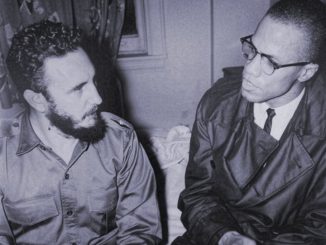
    Malcolm X and Fidel Castro met in 1960 at the Hotel Theresa in Harlem.

    Feb. 21, 2025, marks the 60th anniversary of the assassination of Malcolm X (El-Hajj Malik El Shabazz). Malcolm was killed just two months before his 40th birthday while speaking at an Organization of African American Unity indoor rally at the Audubon Ballroom in Manhattan. His pregnant wife and four children witnessed his murder.

    The mosque where Malcolm spoke, Temple #7, was firebombed after Malcolm’s murder. Malcolm’s supporters had a difficult time finding a venue for his memorial service due to the threat of violence. The Faith Temple Church of God in Christ agreed to conduct the funeral service. Between 20,000 to 30,000 people waited in line to pay their respects to Malcolm X as his body lay in state at the Unity Funeral Home in Harlem. 

    Ossie Davis’ eulogy

    Betty Shabazz chose Ossie Davis to give the eulogy. Despite the damage that it may cause his mainstream acting career, Davis agreed. His eulogy delivered on Saturday morning, Feb. 27, 1965, would be among the most memorable words he ever wrote.

    A quote from Davis’ eulogy states “There are those who will consider it their duty, as friends of the Negro people to tell us to revile him, to flee, even from the presence of his memory, to save ourselves by writing him out of the history.”

    Honoring Malcolm X by commemorating his death serves as a reminder of his lasting impact on social justice, racial equality, and human rights movements.

    On Jan. 24, 1965, Malcolm gave his first lecture on Afro-American history, which was planned to be the first of three public meetings designed to lay the political groundwork for the new program, the Organization for African American Unity (OAAU), leaders were preparing. The second meeting addressing the current condition of Afo-Americans was on Jan. 3. The third meeting set for Feb. 7 was postponed to Feb. 15 because Malcolm accepted invitations to speak in London and Paris. On Feb. 14, Malcolm’s house was firebombed while he and his family slept. At the Feb. 15 meeting, Malcolm spoke on the attack and the issues it raised. The third public OAAU meeting was postponed to Feb. 21, where Malcolm was cut down by assassins’ bullets as he started to speak.  

    FBI and COINTELPRO

    The assassination had signs of involvement by the FBI, which targeted for assassination members of the Black Panther Party, like Fred Hampton in Chicago. Cointelpro began the special attention of harassment and threats against Black liberation leaders in the U.S. in 1956. Those threats included other collaborations that were directly or indirectly responsible for the death of other Civil Rights leaders like Martin Luther King Jr.

    The text of the OAAU Basic Unity program, read and approved by Malcolm X, is printed in the appendix of Malcolm X: The Final Speeches.

    In the preface to the book Malcolm Talks to Young People, Steven Clark states that “Malcolm seized every occasion to talk to young people. All over the world, it is young people [quoting Malcolm X] ‘who are actually involving themselves in the struggle to eliminate oppression and exploitation.’” 

    Malcolm said, “One of the first things I think young people … should learn how to do; see for yourself, listen for yourself, and think for yourself. Then you come to an intelligent decision for yourself.”

    We are seeing today another genocidal threat from the Department of Justice targeting Black and Brown and Palestinian people in the U.S., with Trump increasing the already heinous violations of human rights by the Democratic Party.

    However, young Latine people are now in the streets almost daily, not backing away from Trump’s threat of massive raids.

    LA Times reported on Feb. 10 about a leaked memo by the State Department of a “large scale” immigration raid that is expected to happen in Los Angeles by the end of February. 

    ICE raids and resistance

    ICE agents began targeting major sanctuary cities immediately after Trump’s inauguration – the same day, including LA, Chicago, and Atlanta. The following day, Trump lifted well-established guidelines that restricted ICE from operating at “sensitive locations” such as schools, churches or hospitals.

    Sixty organizations in LA united in response: The press conference held in LA on Feb. 12 – launching now one of the largest Immigrant and Migrant solidarity organizations – had the greatest participation of leading youth who were making their own way, while respecting history’s lessons and older activists and leaders who led the historic 2006 demonstrations on May 1. Indeed, the youth heeded Malcolm’s words.

    In Malcolm’s 1964 speech, “Ballot OR The Bullet” he explained the difference between civil rights and human rights. Civil rights mean you’re asking Uncle Sam to treat you right. Human rights are something you were born with. Human rights are your God-given rights. Human rights are the rights that are recognized by all nations of this earth. Any time anyone violates their human rights, you can take them to the World Court. Malcolm spoke of the need to expand the civil rights struggle to a higher level – to the level of human rights.

    Malcolm would have today seen the immigrant struggle as part of the broader struggle for human rights.

    International solidarity

    Malcolm saw that solidarity with the international victims of U.S. and Western imperialism empowers those struggling here, especially in terms of Black and Brown unity and solidarity with the Global South.

    On Sept. 19, 1960, 35-year-old Nation of Islam member Malcolm and 34-year-old Cuban Head of State Fidel Castro had a historic meeting of the minds on the ninth floor of the Black-owned Hotel Theresa in Harlem. The midnight meeting lasted about 15 minutes, in which the two revolutionaries exchanged ideas and experiences. Malcolm said, “I just wanted to Welcome Fidel.” Fidel delivered a powerful speech at the 15th U.N. General Assembly summarizing the policy of the revolutionary government of Cuba.

    Malcolm once said that you can’t understand what is going on in Mississippi if you don’t know what is going on in the Congo.

    Malcolm X condemned the assassination of Patrice Lumumba, the first Prime Minister of the Democratic Republic of the Congo in January of 1961. He believed the U.S. government arranged Lumumba’s murder to protect investments and profits in the Congo.

    He understood the importance of international solidarity, especially with Africa and Latin America and Asia. And after his trip in April 1964 to Mecca, Saudi Arabia, performing the Hajj – he declared that unity of the oppressed nationalities was essential. After seeing the people he shared that trip to Mecca with, he began to think that “race” and ethnicity were not the determinants of friends, allies or comrades in the struggle against oppression and imperialism.

    From Malcolm’s letter on his trip to Mecca:

    “There were tens of thousands of pilgrims, from all over the world. They were of all colors, from blue-eyed blonds to black skin Africans. But we were all participating in the same rituals, displaying a spirit of unity and brotherhood that my experiences in America had led me to believe never could exist between the white and non-white. America needs to understand Islam, because this is the one religion that erases from its society the race problem. …”

    “On this pilgrimage, what I have seen, and experienced, has forced me to re-arrange much of my thought-patterns previously held, and to toss aside some of my previous conclusions … I have always kept an open mind, which is necessary to the flexibility that must go hand in hand with every form of intelligent search for truth.” – the “Autobiography of Malcolm X”

    He understood that the unity and the struggle of African people was an intrinsic part of the victory of the entire international working class.

    Malcolm’s international global view and his experiences as a Black person in the U.S. provided the fuel building the wisdom and courage to see and feel much of the pain of the Palestinian people. In September of 1964, he visited a Palestinian refugee camp in Gaza and witnessed firsthand the displacement and suffering caused by the 1948 Nakba. This visit was significant because it reflected Malcolm X’s growing international perspective and his commitment to linking the fight against racial oppression in the U.S. with anti-colonial and liberation movements worldwide. He spoke out against Israeli occupation of Palestinian territories, calling it unjust and unsustainable. He condemned the annexation of Jerusalem and other Palestinian lands, emphasizing the importance of human rights for all, including Palestinians.

    Malcolm X was no friend of capitalism and his hatred of the system grew into an understanding that, as long as it existed, oppression and division would thrive.

    “You can’t have capitalism without racism. And if you find a person without racism, usually they’re socialists or their political philosophy is socialism.”

    Ossie Davis eloquently portrayed Malcolm X in his eulogy. In Honoring him, we honor the best in ourselves. Read Malcolm X, “our own Black shining Prince! – who didn’t hesitate to die, because he loved us so.”

    Malcolm’s speeches are available on YouTube, and in books. 

    Suggested Malcolm X Books: 

    • “By Any Means Necessary“
    • “Malcolm X Talks to Young People”
    • “Malcolm X on Afro-American History”
    • “Fidel & Malcolm: Memories of a Meeting”
    • “Malcolm X’s Letter from Mecca”
    • “The Final Speeches”
    • “The Last Speeches”
  • Fund the movement for racial justice and equality, not the police!

    Fund the movement for racial justice and equality, not the police!

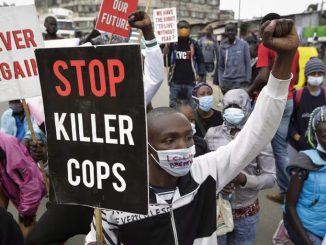
    March 2, the day after President Joe Biden delivered the State of the Union speech, 12-year-old Thomas Siderio was shot and killed by Philadelphia police officers.

    Investigators say that a bullet was fired into an unmarked police vehicle with four undercover police officers inside. Two officers got out of the car and fired at Siderio. One chased him, then shot him in the back while he was running away. 

    The Philadelphia police commissioner said the officer who killed Siderio will be fired at the end of his 30-day suspension due to violations of the “use of force policy” directive that prohibits shooting someone who is fleeing and not pointing a gun at the officer. The police say it is unknown who fired at the police car. News reports say the police suspect it was one of two young men they were following, not Siderio.

    The Family and Friends of Siderio mourned the loss days after he was shot and killed by police. They are confused and looking for answers. Siderio’s former foster mom said, “I feel that I failed him, I admit it; we tried. I love him to death; and I will always miss him.”  His biological mom hired a high-powered law firm to take his case.

    President Biden in his speech, recounted his recent visit to the New York City Police Department days after the funerals of two police officers. 

    He went on to claim that the Justice Department is assuring police accountability, requiring body cameras, banning the choke hold, and restricting no-knock warrants. That’s what they say. But most significantly, Biden nearly led a chant of “Fund the police, fund them, fund them.” 

    Biden added that the $350 billion tax provided under his “American Rescue Plan” is to be used for cities, states, and counties “to hire more police.”

    This statement drew much applause and a standing ovation from the privileged audience present listening to Biden’s speech in Washington, D.C.  Vice President Kamala Harris and Speaker of the House Nancy Pelosi stood in full view behind Biden.

    Workers want change

    How do the workers in the U.S., who pay more than their fair share of taxes, react to Biden’s statement? Workers want to change policing by minimizing the presence and contact with armed, militarized police in our states, cities, counties and communities. Workers — employed and unemployed — in Black, Brown, and poor communities are calling for community control of policing. They want tax dollars to fund livable wages, childcare, schools, college education, housing, physical and mental health care, and action on climate change. They want a real response to the economic juggernaut resulting from the pandemic and the U.S. fueling war against Russia.

    How did the workers respond when Biden said, “Let’s not abandon our streets and choose between safety and equal justice? Let’s come together.”

    Coming together is what workers are doing. Employed and unemployed workers are fighting, protesting in the streets against violence and for equal justice, peacefully in solidarity. Yet, they are being met with armed police, tear gas, pellet bullets, dogs, horses, and armored police vans.

    The movement for justice and against racist police violence has never been about causing harm or committing violent acts against police and the capitalists. Republicans and Democrats know this. It is about safety on both sides. It is not a competition to see who is killing more people — police or civilians.

    How many youths age 17 and under were killed by the police from 2015 to present? According to the Washington Post database “Killed by the Police,” some 122 youths age 17 and under were shot by the police between 2015 and 2022; of that, 31 were unarmed or in possession of a toy gun. That’s an average of 17 youths per year.

    The police must be placed at a higher standard because people expect the police to be there to protect and serve. The police, like an army, are trained professionals who should know the difference between a taser and a gun, who should have knowledge of the laws and abide by them, and should not be threatening if they must pull you over for a violation.

    Many people at home or in public call 911 when they sense danger; some feel a bit safer when there is a police station or noticeable police officers patrolling the streets of their community. However, for many in Black and Brown communities the opposite is felt. Some seek police to handle stressful domestic disputes or ask the police for guidance when lost. Many in Black and Brown communities seek the police only when things have reached the point of extreme desperation, as they are unsure of the police response. And when the police fail them, they all realize that the police reflect the racist, oppressive, and violent system we live in.

    Many people believe that individual police officers are good, but there are a few that poison the whole criminal justice system. Police brutality and the disrespectful, dehumanizing treatment of oppressed communities is a daily occurrence that’s not restricted to just a few. Even if it were only a few, the brutality and abuse is so prevalent that all police are aware of its occurrence but refuse to act to stop it or even report it. The few who have spoken out found themselves fired from the force. So the remaining police are complicit, whether they participate directly in the behavior or not.

    George Zimmerman, the vigilante who killed 17-year-old Trayvon Martin, believed he was providing a needed service to his neighborhood. So did the two vigilantes, Gregory McMichael and Travis McMichael, who killed 25-year-old Ahmaud Albery while William Bryan recorded the fatal shooting. The McMichaels reported the murder; Bryan turned in the video footage and was sent home, no arrests made. Two months later a local attorney published Bryan’s video and it went viral. The McMichaels were arrested and Bryan was arrested shortly after. If this is the way it works for non-police, imagine what the racist police officers get away with daily. The frequency of police murders and the intense racist, corrupt criminal justice system makes it evident that the whole criminal justice system needs to go.

    The greatest purveyor of violence

    The words of Dr. Martin Luther King Jr. are as true today as they were when he said them 55 years ago: “The greatest purveyor of violence in the world today, my own government.”

    The primary role of the police is to serve the rich and protect their private property. The hundreds of thousands participating in protests nationwide are working hard to change this. What the protesters must realize is that only a revolution will change this criminal justice system … a socialist revolution.

    The solution to crime prevention is not to “fund, fund, fund” the police, but to abolish the police and let working people — especially those in the oppressed communities most targeted by police — be empowered to create their own methods of safety in their communities, that reject racism and respect the right to life and human dignity. A better solution would be to fund movements for racial justice, equality, and a world where human needs are valued more than the private property of the rich.

    Every day younger activists are reading and studying socialism. This is a good thing.

  • AFRICOM: An extension of U.S.-European colonialism and genocide

    AFRICOM: An extension of U.S.-European colonialism and genocide

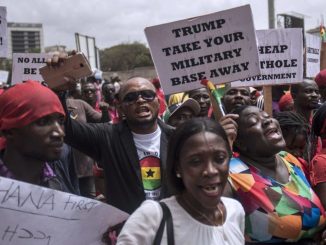
    Protesters in Accra, Ghana, demonstrated against AFRICOM expansion in 2018.

    In 2007, the George W. Bush administration inaugurated the United States Africa Command (AFRICOM) to further the influence of the U.S. and extend its military reach directly into Africa. AFRICOM, however, wasn’t officially established in Africa, with its expanded troop presence and unprecedented use of drones on the continent, until Barack Obama was elected president in 2008.

    This Oct. 1, the Black Alliance for Peace (BAP) hosted a webinar titled “AFRICOM at 13: Building the Popular Movement for Demilitarization and Anti-Imperialism in Africa.” The event featured voices rarely heard in the U.S., from countries most affected by AFRICOM, including internationally-known activists for liberation and those representing the growing movement on the continent against AFRICOM.

    The program started with a film by BAP exposing the imperialist aims of AFRICOM and its yearly price tag of $2 billion in Africa alone.

    Guest speakers exposed the other resources required for AFRICOM’s maintenance: the cost of peoples’ sovereignty and right to self-government, in addition to the cost of inflaming humanitarian crises.

    This webinar was part of a month-long effort by the Black Alliance for Peace to educate and advocate for these demands: the complete withdrawal of U.S. forces from Africa; the demilitarization of the African continent; the closure of U.S. bases throughout the world; and that the Congressional Black Caucus (CBC) oppose AFRICOM and support hearings on AFRICOM’s impact on the African continent.

    ‘To dominate and exploit us’

    Imani Na Umoja is a member of the Central Committee of the African Party of Independence of Guinea and Cape Verde, the largest political party in Guinea-Bissau, which participated in its armed struggle for independence from Portugal. Umoja spoke about AFRICOM’s major role in the recent coups on the continent to ensure resources for U.S. imperialism and deny its peoples’ right to self-determination.

    U.S. claims of promoting democracy are the exact opposite in its deeds.

    “The agreements are so horrendous it makes me sick, and should make anyone sick,” said Kwesi Pratt Jr., a journalist and general secretary of the Socialist Movement of Ghana. He was referring to the establishment of U.S. bases in Ghana and agreements signed by the government that allow U.S. forces more immunity, freedom of movement and secrecy than its own citizens, diplomats or even the president of the country, “simply by showing their U.S. ID cards.”

    Pratt said that the agreements do not allow anyone to question what the U.S. forces bring into or take out of the country. “The U.S. Army can use our resources for free … the agreement was signed to dominate and exploit us.”

    Irene Asuwa of the Revolutionary Socialist League of Kenya spoke further on AFRICOM’s domestic cost to her people. “The war on terror is an excuse to kidnap people,” she said, explaining the heightened profiling of Somali peoples in Kenya. “In less than 12 hours they are taken into court and sentenced as terrorists with no lawyer, then taken away.”

    Asuwa also spoke about the refugee crisis that was exacerbated by AFRICOM’s insistence that refugee camps be closed. This reality belies the false claim that AFRICOM is involved in solving humanitarian crises on the continent, rather than being one of the major causes of those crises — in spite of the well-polished public relations efforts touted on the organization’s official website.

    The speakers helped bring to life what award-winning journalist Nick Turse, who exposed the unreported buildup of AFRICOM in 2008, wrote for the Intercept in February 2020: “Since 9/11, the U.S. military has built a sprawling network of outposts in more than a dozen African countries. … During testimony before the Senate Armed Services Committee late last month, Stephen Townsend, the commander of AFRICOM, echoed a line favored by his predecessors that AFRICOM maintains a ‘light and relatively low-cost footprint’ on the continent. 

    “This ‘light’ footprint consists of a constellation of more than two dozen outposts that stretch from one side of Africa to the other. The 2019 planning documents provide locations for 29 bases located in 15 different countries or territories, with the highest concentrations in the Sahelian states on the west side of the continent, as well as the Horn of Africa in the east.”

    That so-called “light footprint” has had the effect of increasing, not decreasing terrorist activity. 

    U.S. presence promotes terrorism

    The result: Turse goes on to explain that the number of extremist groups went up 400 percent, according to the Defense Department’s Africa Center for Strategic Studies. In 2019, there were 3,471 reported violent events linked to these groups, a 1,105% increase since 2009.

    Said Turse: ¨The situation has become so grim that U.S. military aims in West Africa have recently been scaled back from a strategy of degrading the strength and reach of terror groups to nothing more than ‘containment.’”

    This also echoes a 2017 United Nations report called “Journey to Extremism in Africa,” which states that government actions of repression, including increased drone killings, killings of family members, jailings and repression are the main motivation for recruitment into extremist organizations.

    Many studies have also correlated the lack of food and basic necessities of life as the greatest cause of internal conflict. The U.N. report makes that point with a quote from Secretary-General António Guterres: “I am convinced that the creation of open, equitable, inclusive and pluralist societies, based on the full respect of human rights and with economic opportunities for all, represents the most tangible and meaningful alternative to violent extremism.”

    In 2018 the U.N. also reported that it would take just $175 billion per year for 20 years to eradicate poverty, not only on the entire continent of Africa, but the entire world. That’s just 17% of the U.S. yearly military spending of nearly $1 trillion (the total expense is more than the defense budget).

    So the money supposedly spent on fighting terrorism — which actually acts as a recruitment agent for folks joining extremist organizations — could be spent to actually end the conditions that create these extremist organizations. And it would have the added benefit of removing the greatest source of terrorism on the continent, the U.S. military.

    So why isn’t that happening?

    Profits before people

    The fact is that AFRICOM’s “war on terror,” in addition to being a vital tool for U.S. imperialism, is also a self-perpetuating money machine for the ruling class – a huge bonanza for the military-industrial complex and the politicians and corporations who directly or indirectly benefit from it.

    As Turse stated in his article on AFRICOM expansion, “The U.S. has been building up its network of bases, providing billions of dollars in security assistance to local partners.”

    As many of the webinar speakers pointed out, the primary goal of AFRICOM is to ensure the continued theft of resources by the U.S. and its allies and to maintain U.S. military dominance on the continent.

    “In 2007 to 2009, a discovery of oil on the Congo and Uganda border of 1.7 billion barrels brought heavy militarization and oil conglomerates and then, in 2012, Obama announces troops [being dispatched] to capture Joseph Kony (leader of a small rebel grouping), although he hadn’t been in Uganda for almost six years,” said Salome Ayuak, a member of BAP and Horn of Africa Pan-Africans for Liberation and Solidarity.

    Ayuak also explained that one-third of permanent and semi-permanent AFRICOM bases reside in the Horn of Africa, reflecting the strategic importance of its waterways for trade and oil exploration. “We must look at AFRICOM through a materialist lens to see the long history of its policing in African states,” she stated.

    “AFRICOM is linked with the history of exploitation and slavery and is part of NATO. It must [also] be seen as part of British, French and other imperialist countries’ armed forces,” stated Kwesi Pratt Jr. 

    He mentioned that this history and the military backing of imperialism created the situation where Ghana’s currency drops despite the country’s position as fifth in the world in gold production. The country receives only 3% of the interest and 2% of the revenue produced from gold mining.

    Militarism or mutual assistance?

    Kambale Musavuli, a native of the Democratic Republic of Congo and national spokesperson for Friends of the Congo, stated: “The U.S. has been engaged in the DRC since 1885. It was the first country to recognize the Congo as the personal property of King Leopold [Belgian monarch who committed the most horrendous atrocities against the native population, killing more than 10 million, in the exploitation of their labor for rubber production and export]. The U.S. used the relationship built with Leopold to get the uranium from the DRC used to bomb Hiroshima in 1945.”

    And in a further example of war crimes and genocide, Musavuli explained the role of the U.S. and its AFRICOM partners in the 1996 and 1998 invasions of the Congo by Rwanda and Uganda — causing the deaths of over 6 million Congolese. 

    This was followed by a huge extraction of mineral wealth essential for phones and computers. “Most of us have devices that use those minerals,” he noted.

    Musavuli also contrasted the approach of U.S. militarism to China’s mutual assistance in the race for cobalt and coltan, minerals primarily found in the Congo. “While the Chinese sent foreign ministers in the middle of the pandemic to forgive loans and discuss needed development programs, two weeks later [U.S.] soldiers showed up to meet local officials and sign military agreements. 

    “Then, this past summer, we see a group of American special forces in the Congo after leaving Afghanistan, supposedly going after ISIS … The U.S. today says the DRC has ISIS, when every local person knows we don’t.”

    What is to be done? Maybe Kwesi Pratt Jr. of Ghana should answer that:

    “All of these atrocities would not be possible if the power was in the hands of working people in Africa. So our task first and foremost is to make sure power resides in the hands of working people, to make sure that the revolutionary forces control power, that neocolonial regimes are defeated, and we move away from neocolonialist capitalism … 

    “Only under the banner of socialism can we stop all these enemy forces – we are in danger otherwise.”

    Which means we in the U.S. have to work towards exposing and dismantling AFRICOM, the Pentagon and capitalism here in the belly of the beast – which requires principled unity, solidarity and struggle – just as our comrades in Africa are determined to keep pushing forward.

    You can reach the Black Alliance for Peace at blackallianceforpeace.com.

    https://www.facebook.com/1120955981347159/videos/387810739637129