
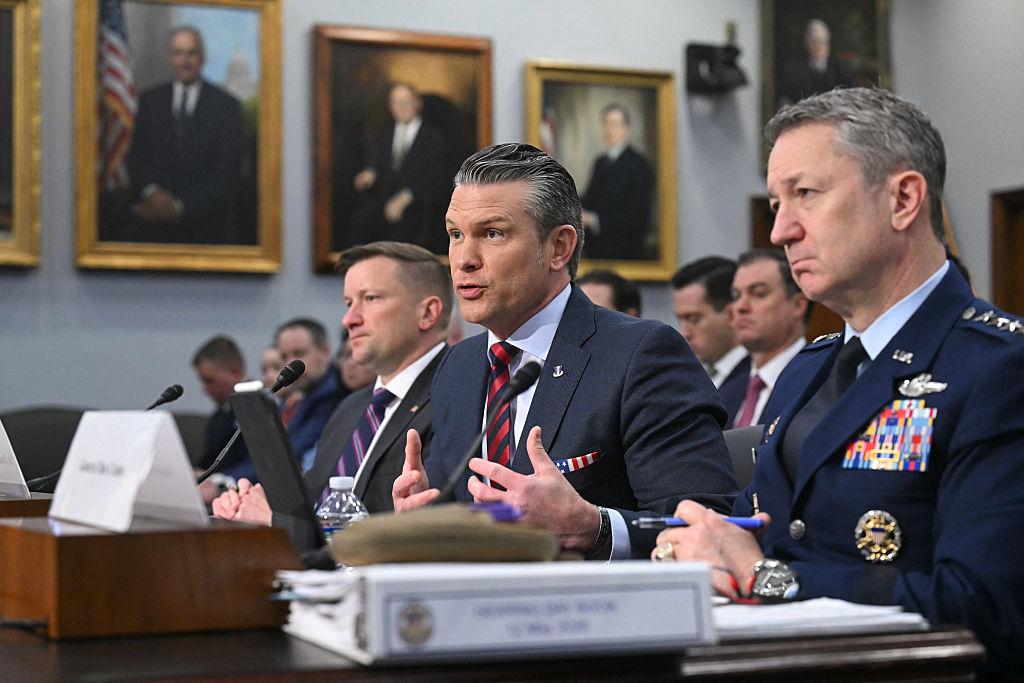
The Pentagon and the Trump administration are making war without a vote of Congress.
Trump, War Secretary Pete Hegseth and Secretary of State Marco Rubio are carrying out that policy in the open — in Venezuela, Iran and Cuba.
U.S. forces kidnapped Venezuela’s President Nicolás Maduro and Cilia Flores on Jan. 3, 2026. Washington now holds Maduro in New York while using Treasury licenses, frozen accounts, oil permits and military threats to control decisive parts of Venezuela’s government and economy. That is occupation in modern imperialist form.
On Feb. 28, the U.S. opened its war on Iran. By June 17, Washington had been forced into a 60-day pause after the war began choking oil, shipping and the dollar system.
The U.S. blockade and Iran’s response in the Strait of Hormuz bottled up oil inside the Gulf. Oil that cannot move cannot be sold. It cannot become profit. The crisis spread from tankers to freight rates, insurance, futures markets and stock prices. The war began to interrupt the circulation of capital itself.
It also weakened the dollar system. Washington was holding billions of dollars that belonged to Iran, locked away under sanctions. But every frozen account and blocked payment warns every country and central bank that money held in U.S.-controlled channels can be seized.
The war was priced out, not abandoned.
At the same time, the Pentagon has spent months placing warships, aircraft, drones and Marines around Cuba, putting the building blocks in place for an invasion if Trump gives the order.
Congress voted for none of it.
The war drive is not hidden. The USS Nimitz carrier strike group entered the Caribbean in May. Guided-missile destroyers and cruisers are in position. U.S. drones and surveillance aircraft have circled Cuba for months. Amphibious ships carrying Marines have been kept in the region or readied to replace ships coming home. Rubio has already called Cuba a “threat to the national security of the United States.”
This is how imperialist war is made. The president orders it. The War Department prepares it. The State Department sells it. Congress trails behind, funds it, excuses it or looks away.
When Sen. Tim Kaine forced a vote in January to require congressional approval for further military action against Venezuela, Republican leaders killed the resolution with a procedural maneuver. Vice President J.D. Vance broke the tie.
Then the Justice Department issued a 22-page memo claiming Trump could use military force in Venezuela without asking Congress at all.
On paper, Congress declares war and controls the purse. In practice, the military machine now reaches into the offices where those powers are supposed to be exercised. In congressional offices, Democratic and Republican alike, active-duty military officers — soldiers still in uniform, still drawing military pay — sit at the desks where bills and budgets are made.
They draft legislation. They write the questions members ask at hearings. They prepare the memos that decide which choices Congress will even consider.
Then they return to the Pentagon, to the same commands whose money and weapons programs they just helped set the rules for.
None of this is informal. These officers are fellows in the armed services’ Legislative Fellows programs — the Army calls its version the Army Congressional Fellowship Program — administered through each service’s Office of Legislative Affairs under a standing Defense Department instruction. The work is no secret either. The Navy spells out the duties for its applicants: a year-long, full-time assignment in the office of a House or Senate member who sits on a defense committee, where the fellow serves as a member of the staff and the listed tasks include drafting legislation, preparing the member for hearings, and advising on defense and national-security policy.
That is not civilian control of the military. It is the military moving inside the civilian offices that are supposed to control it.
Congress has two main levers over the armed forces. It votes the money. It writes the rules. Both run through legislation. And that legislation is what these officers write.
So Congress is pushed aside twice over: first when wars are launched without its vote, and again when the Pentagon drafts the defense bills Congress is supposed to use to check it.
Sam Marcy called his 1980 book “Generals Over the White House.” This is generals over Congress.
A program built over decades
The arrangement did not appear overnight.
Assigning officers to Congress is a decades-old practice. The Pentagon turned it into a regular pipeline in the late 1990s. What once was a short tour has become a 44-month track: graduate study, a year on Capitol Hill, and then a return tour in the Army’s own congressional liaison office.
The same machinery reaches well beyond Congress. The Defense Department sends officers into the think tanks, corporations and universities that help shape war policy. It uses the universities too, but on its own terms. In February 2026, War Secretary Pete Hegseth first moved against Harvard, cutting Defense Department fellowships and training programs there, then widened the review to other Ivy League and civilian university programs he accused of anti-military bias.
The officers rotate through the Congress that buys the weapons, the universities that study them and the corporations that build them. The military, corporations, universities and lawmakers are stitched together by the people who move among them.
Gen. Dwight D. Eisenhower drew the blueprint for the postwar military-industrial state. As Army chief of staff in 1946, he drafted a memorandum to fuse the military with industry, science and the universities. In his farewell address as president in January 1961, he warned the country against the complex he had helped build.
This is how the military-industrial complex organizes itself. It does not need a general to shout orders in Congress. It only needs officers at the desks where the bills are written.
What Marcy saw
Writing in 1980, Marcy traced how the military kept pushing aside the civilian side of the government — the elected officials who are supposed to run it.
He looked first at the top. He told the story of President Lincoln firing General George McClellan during the Civil War. At that stage, U.S. capitalism was still young and rising. The elected government, not the generals, stayed in command.
Marcy set that against President Truman firing General Douglas MacArthur during the Korean War. Textbooks present that as a simple case of civilian control. Marcy showed what they leave out. Truman fired MacArthur only after he went to the other military chiefs and got their approval first.
A president who must ask the generals’ permission before acting is no longer in command the way Lincoln was. That, Marcy wrote, showed the military taking over inside the government.
The fellows program carries that same process down to the level of daily lawmaking. There is no MacArthur this time. There is no public showdown. There is no headline ultimatum from the brass.
There is only the quiet handoff. The writing of the law passes from Congress, which is supposed to make the laws, to the military, which Congress is supposed to control.
Marcy described how the military often moves quietly at first, while the officials who are supposed to keep it in check either miss the move or look the other way. A soldier writing the fine print of a bill at 9 at night is exactly that kind of move.
Marcy was blunt about where this leads. The more the military takes over, the more power passes to the part of the state furthest from any vote and least answerable to the people. It rules by command. Wherever it reaches, it spreads repression and hollows out what little democracy capitalism still allows.
Already in military hands
Marcy quoted a witness from inside the ruling class itself: Senator Allen Ellender of Louisiana.
Ellender was an old-line segregationist Democrat. He was no leftist and no dove. Yet in 1967, he said Congress and the country were, in many ways, already in the hands of the military. The generals and admirals, backed by the State Department, got just about whatever they wanted, even when it ran against the country’s real needs.
The fellows program turns that warning into daily routine. In 1967, the military got what it wanted by pressing Congress for funds, weapons and authority. In 2026, it has moved deeper into the process. It helps write the bills that feed the war machine.
When Congress votes, the military’s demands are already built in.
Rules cannot solve it
Some critics answer with rules: disclose the placements, restrict what officers can draft, hire more civilian staff, make them wait before returning to Pentagon offices.
Those measures may expose part of the arrangement. They do not touch its source.
Marcy’s answer was that militarism does not come from one bad official, one missing rule or one abuse of procedure. It comes from the drive of finance capital — the banks, monopolies and war corporations that dominate the economy and require a war machine.
The same officers serve in Democratic and Republican offices because both parties administer the same war state. That is why the staff shortage in Congress is itself political. Congress can always find money for the Pentagon. It cannot find money for the aides who might question Pentagon spending.
It votes a trillion dollars for war and then claims it needs uniformed officers to help write the bills.
A few more civilian staffers would not change the power behind the process. The issue is not only who holds the pen. It is who the pen serves.
The war economy
Every one of these wars and war buildups runs through budgets Congress is supposed to weigh and approve. The occupation of Venezuela, the war on Iran, the military buildup surrounding Cuba, the buildup against Russia in Europe, the bases, fleets and missiles aimed at China across the Pacific, and the war economy itself — all of it passes through legislation Congress writes.
When the officers who carry out the programs also draft the bills that fund them, the military’s demands are built into the law before Congress votes.
Marcy warned that war spending works like a drug. For a while, it can stimulate capitalist production. Kept up year after year, it turns into its opposite. It drains the economy and feeds inflation. It builds up the banks, the weapons corporations and the contractors whose profits depend on the war budget.
This is how monopoly capitalism works in its imperialist stage. The capitalist state carries the risk. The corporations take the profit. Government research, military orders and guaranteed contracts build whole industries, from rockets and satellites to drones, ships, missiles and artificial intelligence. Then Wall Street turns those future contracts into paper wealth — stock prices, loans and market power today.
The war economy does not stand apart from capitalism. It is one of the main ways U.S. capitalism now organizes production, finance and the state.
The fellows program is one small gear in that machine. The same officers who help write the defense bills write the fine print inside them — the billions in guaranteed contracts handed to the weapons and tech monopolies, the firms whose drones, satellites and artificial intelligence the war budget pays for. The money becomes law before the public hears a word of debate. The whole arrangement comes dressed as sober, expert, bipartisan policy.
The real check
The answer is not to make Congress look more independent while the same class remains in command.
The civilian officials and the military are two arms of one ruling class. Workers have no stake in which arm holds the pen. What the fellows program shows is the whole government being pulled deeper under military control — the civilian offices as much as the uniformed ones — all in the service of capital.
No list of placements will reverse that. No waiting period will. No ethics rule will stop a war machine built into monopoly capitalism.
The only force that has ever pushed the military back is the one Marcy pointed to: workers and oppressed people in motion, refusing to bleed and pay for wars made over their heads.
The officer writing the fine print is a symptom. The disease is a system that needs endless war and writes its own permission slips to wage it.
Join the Struggle-La Lucha Telegram channel