
The USS Nimitz carrier strike group entered the Caribbean Sea on May 20, placing one of the U.S. Navy’s largest instruments of air power near Cuba.
Its arrival came as Washington escalated its campaign against the island: sanctions, fuel strangulation, surveillance flights, political ultimatums and a new federal indictment against 94-year-old Raúl Castro, one of the historic leaders of the Cuban Revolution.
U.S. Southern Command calls the deployment “maritime cooperation.” But an aircraft carrier is a floating military base. From the Caribbean, the Nimitz puts a full U.S. carrier air wing — fighter jets, spy planes, radar-jamming planes, helicopters and support aircraft — within striking distance of Cuba.
The USS Gerald Ford directly supported the Jan. 3 operation that killed more than a hundred Venezuelans and 32 Cuban soldiers, and ended with the kidnapping of Venezuelan President Nicolás Maduro and Cilia Flores.
The U.S. government is now trying to spin Cuba’s self-defense into a federal murder case.
Raúl Castro was Cuba’s defense minister in February 1996. A historic leader of the Revolution and Fidel Castro’s brother, he succeeded Fidel as president and served from 2008 to 2018. Washington is targeting him not simply for an office he held 30 years ago, but as one of the leaders of the Cuban Revolution.
The indictment stems from Cuba’s February 1996 shootdown of two aircraft operated by Brothers to the Rescue. Alongside Raúl Castro, the indictment names five Cuban military pilots who defended Cuban airspace after repeated violations by the group. Four Brothers to the Rescue members were killed.
Brothers to the Rescue was not a humanitarian outfit. It was founded in Miami in 1991 by José Basulto, a CIA operative and Bay of Pigs veteran, as part of a CIA-created anti-Cuba terrorist network built to destroy the Cuban Revolution. It called its first flights rescue missions for Cuban rafters, but it rescued no one. Its flights were directed against Cuba, including repeated incursions into Cuban airspace.
That network carried out bombings against Cuban tourism targets, assassination plots and paramilitary operations. Alpha 66, Omega 7, Comandos F4 and the Cuban American National Foundation operated within that U.S.-protected machinery. Basulto himself later acknowledged a CIA-sponsored commando mission into Cuba. In 1962, he fired a 20mm cannon at a Cuban hotel.
Cuba documented more than 25 violations of its airspace by Brothers to the Rescue between 1994 and 1996 and filed formal complaints with U.S. and international aviation authorities. In that context, the flights raised the danger of another Cubana de Aviación-type attack — like the 1976 bombing organized by CIA agent Luis Posada Carriles that killed 73 people.
After the Soviet Union collapsed in 1991, Cuba entered the Special Period, a severe economic crisis. The Soviet Union had been Cuba’s main trading partner and a major source of oil, machinery, food and industrial supplies. U.S. officials predicted the Revolution would fall. Cuba survived because its people fought to defend their freedom and their socialist Revolution. Raúl Castro helped hold the country’s revolutionary institutions together, including the armed forces, through one of the island’s most difficult times. Trump is now trying to break Cuba through fuel strangulation, sanctions, indictments, spy flights and military pressure.
By May 14, Washington’s fuel blockade had exhausted Cuba’s reserves. Since February, hostile U.S. surveillance flights near Cuba’s coast have increased sharply — the kind of flights that can map targets, guide attacks and intimidate a country under siege. CIA Director John Ratcliffe had visited Havana carrying Washington’s demand for political surrender. Then came the Nimitz — a floating air base backed by the world’s largest military machine.
Cuba’s Revolutionary Government rejected the charges against Raúl Castro on May 20 and upheld Cuba’s right to defend itself against violations of its airspace.
“Cuba’s response to the violation of its airspace constituted an act of self-defense,” the statement said, citing the United Nations Charter, the 1944 Chicago Convention on International Civil Aviation and the principles of air sovereignty.
The statement also pointed to Washington’s own record in the region: “It is highly cynical that this accusation is made by the very same government that has murdered nearly 200 people and destroyed 57 vessels in international waters of the Caribbean and the Pacific, far from U.S. territory, through the disproportionate use of military force.”
The contrast is plain. The figures who ran violent operations against Cuba from U.S. soil — bombing hotels, plotting assassinations, running paramilitary camps — lived freely in the United States. Posada Carriles, the CIA agent behind the Cubana de Aviación bombing, died a free man in Miami in 2018.
But Raúl Castro — a historic leader of the Cuban Revolution who helped defend Cuba through invasion, blockade and economic crisis — now faces federal murder charges for Cuba’s defense of its own airspace.
May 20 was not a neutral date. It marks the day in 1902 when Cuba was formally constituted as a republic — under U.S. military occupation, with the Platt Amendment embedded in the Cuban constitution. That amendment gave Washington the claimed right to intervene at will.
Trump used the anniversary to say Cuba was “free for the first time” on that date. Secretary of State Marco Rubio made the same claim earlier in the week.
Cuba in 1902 had no genuine sovereignty. Washington retained military bases on the island, controlled its foreign policy and intervened repeatedly over the following decades. By the 1950s, U.S.-backed rulers had turned the impoverished island of 7 million people into a casino and playground for the wealthy, with gangsters, corporations and landlords feeding off Cuban labor and land. The 1959 Revolution was a direct rejection of that neocolonial arrangement.
The Nimitz deployment belongs to that same history. Today, that old claim is backed by sanctions, indictments, spy flights and military threats.
Cuba is not on trial because of 1996. It is under attack because of 1959.
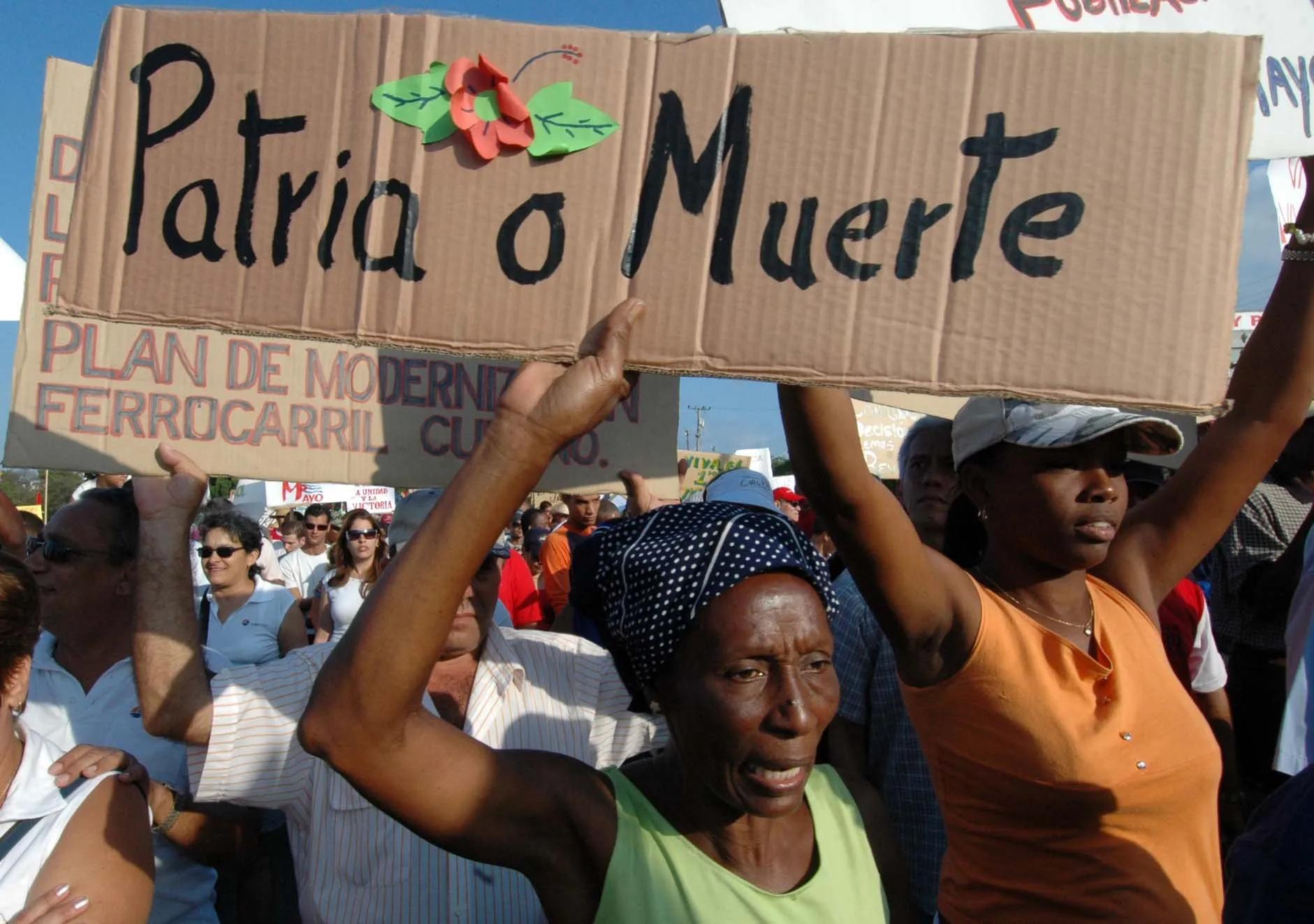
The Cuban statement closed with a declaration of support for Raúl Castro and for the socialist Revolution. It reaffirmed the Cuban people’s resolve “to defend the Homeland and their Socialist Revolution.”
That is what the U.S. ruling class cannot tolerate: a Cuba that defends its sovereignty and refuses to surrender.
Join the Struggle-La Lucha Telegram channel