Cuba marks Its National Day of Rebellion with the determination of Fidel

The Moncada. Photos: Bill Hackwell

Havana, July 25 — Tomorrow, the eyes of Cuba are on Santiago. The leaders of the island, Santiago inhabitants, and Cubans from all over the country are in the city where it all began 70 years ago. For others in other parts of the island, we will be closely following the calendar of activities that will be held to honor our National Day of Rebellion. Such a history to think that it has been seven decades since Fidel and the other revolutionaries attacked, against all odds, the Moncada Barracks with weapons that he characterized as being more appropriate for bird hunting.

I was thinking how appropriate it was that July 26 this year will be celebrated in Santiago de Cuba as it is intertwined with every facet of Fidel’s life, from his early schooling to the Moncada to his final resting place.

The Moncada today.

The little house in Santiago de Cuba from where Fidel saw the sea for the first time is still standing. He was six years old when his parents, Lina and Ángel, sent him to the Tivoli neighborhood, where the family of his teacher from Birán, his birthplace in Holguín, lived.

The wooden house at number 6 in the Loma del Intendente retains its austere character. In the small living room, where there was barely room for a piano, today the board walls are embellished with photos of the boy and phrases taken from the book Cien horas con Fidel by the journalist Ignacio Ramonet that recalls the conditions of our leader’s childhood in this place, where he lived for approximately two years and eight months.

The Sierra Maestras.

In that memorable interview, he confessed to Ignacio Ramonet that it was “a damp, small house (…), without electricity (…) with walls made of boards and roofs of discolored tiles, facing a small dirt square, with no trees”. However, he was captivated by the balcony of this place “that leaked when it rained” and where “I lived through some very busy days” and which “had a beautiful view of the mountains of the Sierra Maestra, and also of a part of the Bay of Santiago, very close by.”

It is not hard to imagine him walking around La Loma, visiting the “little grocery store where they sold coconut nougat made with sugar, one penny each,” or climbing the stairs of Padre Pico Street, which years later saw the young people of the July 26th Movement (M26J) pass by, whom we remember today 70 years after the Revolutionary actions of that July 26th, 1953.

The Secondary School, which later became a barracks for the Batista dictatorship -today the Clandestine Fight Museum-, formed part of the surroundings.

The school, located in front of the house, was used by soldiers during the dictatorship of Gerardo Machado, and Fidel never forgot the scene he saw from the doorway: “The soldiers were kicking a civilian who might have said something to them as he passed by. The atmosphere was tense.”

Twenty-one years later, on November 30th, 1956, members of the M26J attacked the Institute – by then a barracks of the Batista dictatorship – led by Frank País.

Today, the house marked with the number 6 is the most discreet and yet endearing place in the Loma del Intendente.

This is where the leader of the Revolution’s relationship with Santiago began. The windows are always open, and the breeze running between the sea and the Sierra Maestra crosses the little house from side to side. Four flamboyant trees escort the plot of land where Fidel played and where other children remember him now.

Fidel’s Mausoleum and the Martyrs of July 26. Photo: Bill Hackwell

The local government zealously guards these places that bear witness to Fidel’s life in a city still moved by the physical loss of the man who, as a child, saw the sea here for the first time.

In the early hours of Wednesday morning, the leaves of the red cloak, leaves that guard the Mausoleum where Fidel’s remains lie in Santa Ifigenia Cemetary, Santiago de Cuba, are damp. Two white roses adorn the smooth granite stone from a site near the Gran Piedra, on which all eyes in the cemetery at the foot of the Sierra Maestra coincide.

Mariana Grajales

He is not alone. To his left, a sculpture by Mariana Grajales, the Mother of the Cuban Homeland, accompanies him next to the mausoleums of Carlos Manuel de Céspedes, the Father of the Homeland, and the Apostle José Martí. And to his right are the martyrs who fell in the actions of July 26, 1953. Frank and Josué País, young men killed by Batista henchmen on the streets of Santiago, lie a few meters away. They are also remembered on this National Day of Rebellion.

A life cycle that began in the little red-tiled house and ends in Santa Ifigenia, but the trail of Fidel and the young people of the July 26 Movement is not a circle that closes in time. The leader of a revolution “greater than ourselves,” as he once warned, is the horizon of a city, of a country, of an era that started 70 years ago but one that is just beginning.

Source: Resumen Latinoamericano –  English

Strugglelalucha256


The U.S. ‘Act of War’ against China

The July 12 New York Times Magazine headlined: “‘An Act of War’: Inside America’s Silicon Blockade Against China.”

The report is about the October 2022 “export controls” against China:

“Last October, the United States Bureau of Industry and Security issued a document that — underneath its 139 pages of dense bureaucratic jargon and minute technical detail — amounted to a declaration of economic war on China. …

“The Oct. 7 controls essentially seek to eradicate, root and branch, China’s entire ecosystem of advanced technology. ‘The new policy embodied in Oct. 7 is: Not only are we not going to allow China to progress any further technologically, we are going to actively reverse their current state of the art,’ [Gregory] Allen [of the Center for Strategic and International Studies in Washington]  says. C.J. Muse, a senior semiconductor analyst at Evercore ISI, put it this way: ‘If you’d told me about these rules five years ago, I would’ve told you that’s an act of war — we’d have to be at war.’”

The U.S. export controls (the act of war) on computer chips aim to undermine China’s ability to produce or purchase high-end chips, which are crucial for the development of advanced technologies such as supercomputers and artificial intelligence (AI). Some call this a Silicon Curtain in the New Cold War against China.  

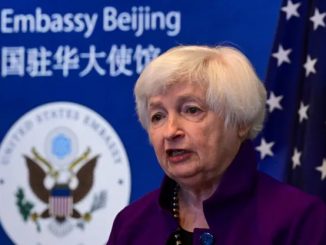
The U.S. controls (again, an act of war) are not narrowly targeted at curbing Chinese military development, as claimed by the Biden administration. On her recent visit to China, Treasury Secretary Janet Yellen seemed openly insincere when she tried to say the controls were not aimed at the broader economy. China’s Premier Li Qiang, who met Yellen, told her that she was “overstretching.”

The export controls are broad. As the New York Times reports, they seek to undermine China’s entire ecosystem of advanced technology, including its AI industry. The semiconductor industry is seen as a means to achieve this goal.

The semiconductor industry is a global industry that the U.S. has dominated and controlled, as U.S. Big Oil has dominated the global energy industry. 

The Pentagon’s semiconductor project

The semiconductor industry began as a project of the Pentagon’s Semiconductor Technology Advanced Research Network (STARnet), part of the Defense Advanced Research Projects Agency (DARPA). The industry in the U.S. was and is, to this day, heavily financed by the Pentagon and the U.S. government

The CHIPS Act, passed by Congress and signed by President Biden in August 2022, pumped an additional $280 billion in new funding for the research and manufacture of semiconductors in the U.S. That was followed by a DARPA announcement in January 2023 that it was putting almost half a billion dollars into a project to help advance the semiconductor industry in the U.S. 

None of this, by the way, was created or developed by any capitalist entrepreneur. Capitalism does not create anything on its own; it just finds a way to exploit new technology to make a profit. And many of the biggest, highest profit-making capitalist industries were created and funded by the government in various ways, including most of the technology industry, the internet, the pharmaceutical industry, the automobile industry, and even Big Oil.

The semiconductor industry is a knowledge-intensive industry. It is built on shared knowledge and resources. Initially, semiconductor companies were built on open innovation. Because of its complexity, development, and production required the collaboration of research centers, universities, scientists, engineers, and many others to develop the techniques and methodologies required.

The pace of innovation in the semiconductor industry has been incredibly rapid. New chip designs are constantly being developed, and the capabilities of chips are constantly increasing. This is due to a number of factors, including:

  • The increasing complexity of chips. Chips are becoming increasingly complex, with billions of transistors packed into a tiny space. This complexity requires the use of advanced manufacturing techniques and the development of new materials.
  • New materials and manufacturing techniques. The semiconductor industry is constantly developing new materials and manufacturing techniques to improve the performance and efficiency of chips. For example, new materials, such as gallium arsenide, silicon carbide, and graphene, have allowed for the development of faster and more powerful chips.
  • The increasing availability of computing power. The increasing availability of computing power has allowed chip designers to develop more complex and sophisticated chip designs.

Global means global

Global means that chips are designed and manufactured in many countries around the world, not just the U.S. This means:

  • A global workforce of scientists, engineers, technicians, and other skilled workers. The semiconductor industry requires a large pool of skilled labor. This labor is not evenly distributed around the world. Most of the semiconductor industry is now concentrated in China, Taiwan, and South Korea.
  • As a global industry, production depends on a complicated matrix of manufacturing, warehousing, shipping, and transportation. This global supply chain is highly interconnected and spans across many countries. Every chip has been produced from parts developed and produced in a dozen or more countries. This necessitates collaboration and sharing to ensure smooth operations and product quality.

The U.S. export restrictions (an act of war) are designed not only to prevent further advances in China’s technology sector but also to actively reverse its technological development. The controls are intended to eradicate China’s advanced technology ecosystem and hinder its progress in economic growth and development.

U.S. export controls, introduced by the Trump administration and now expanded by the Biden administration, have already had devastating consequences for Chinese companies like Huawei, which was heavily impacted by the chip bans imposed by the Trump administration in 2019. Huawei, once the largest smartphone seller in the world, saw its revenues plunge and its market share drastically decline as a result of these measures.

Biden expands what Trump started

The Biden administration has continued the Trump administration’s campaign against Chinese technology companies, but it has taken a more expanded approach. The Trump administration imposed broad sanctions on Chinese companies, including Huawei, ZTE, and Hikvision. The Biden administration has focused on whole industries, such as telecommunications and semiconductors.

In the words of Gregory Allen at CSIS, “The Trump administration went after companies. The Biden administration is going after industries.”

The Biden administration’s actions against China’s technology sector are an attempt to slow down the entire Chinese economy. China is heavily reliant on semiconductors, and the Biden administration’s actions are making it more difficult for China to acquire the technology and components it needs to produce its own chips.

The fact that China spent more on computer chip imports than it did on oil in April is a clear indication of how important semiconductors are to the Chinese economy. Chips are used in a wide range of products, from smartphones to cars to industrial machinery. 

But the New Cold War and its Silicon Curtain cannot reproduce the old Cold War.

In the Cold War, the United States and the European imperialist powers in NATO were the biggest manufacturers in the world. This gave them dominance in terms of economic power and military strength. 

Now, socialist China has emerged as a major manufacturing power. Today, China is the world’s largest manufacturer, including the semiconductor industry. China is the largest trade partner for 70% of the countries in the world. 

This has led to a decline in the United States’ relative power. The United States is no longer the dominant producer in the world.

In addition, the U.S. used to have a significant advantage in the global energy market, due to its control of West Asia’s hydrocarbon resources. However, in recent years, China has become a major player in the global energy market, and OPEC has become less reliant on the United States. The U.S. has greatly reduced oil imports because of domestic shale oil (fracking) and gas production. This means that OPEC is no longer as dependent on the United States as it once was. This has led to a loss of control for the United States in the global energy market.

Strugglelalucha256


JoAnn Watson, beloved Detroit leader, dies

Cuba lost a good friend on July 10 when the Rev. Dr. JoAnn Watson joined the ancestors. Watson originated the call “Doctors for Detroit” with the late Rev. Lucius Walker, founder of the Interreligious Foundation for Community Organization.

The goal of her Dec. 9, 2006, Saturday forum featuring Walker was to utilize her office as a Detroit Councilmember to explore “opportunities for Free Medical Training in Cuba” at the Latin American School of Medicine, known for its Spanish acronym ELAM.

Cuba’s historic leader Fidel Castro offered the scholarships during a Congressional delegation in 2000 when Mississippi Representative Bennie Thompson asked for Cuban doctors to help the people of his state. Every report on U.S. health outcomes ranks Mississippi at 49th or 50th. Black infant and maternal death are still genocidal even beyond Mississippi. In response to Thompson, Fidel doubted the U.S. would allow them to come, but Cuba would commit to training youth from the U.S. to be doctors at no cost and send them back home. 

These scholarships are still available because IFCO Executive Director Lucius Walker forged a way to make it a reality in 2001. The application deadline is August 15 — email elamscholarship@ifconews.org for more information. 

Today more than 220 Cuban-trained, debt-free doctors have returned to enter U.S. residency programs and serve the people throughout the U.S. Currently, three women are in Detroit hospital residency programs, and another is already providing first-rate, culturally competent, bilingual medical care in this city, plus more are in school now.

Detroit said goodbye to this beloved leader, unapologetically Black and Pan-African, on July 22 at a packed Fellowship Chapel. She was a teacher, mentor, radio host, grandmother, friend. The lifelong neighborhood friendships and ties that impacted her life included Rev. Dr. Wendell Anthony, NAACP National Board Member and pastor at Fellowship Chapel, who concluded the tribute to her life; the late Representative John Conyers, who authored the original reparations congressional resolution in 1989 — HR 40 to examine the merits of reparations to African Americans for U.S. slavery putting the issue and systemic racism represented by it, squarely on the national table, and the late Honorable Claudia House Morcom, who traveled indefatigably supporting freedom for the Cuban 5. 

Watson authored a Water Affordability Plan and testified in defense of demonstrators arrested for blocking the contractors from shutting off water at the order of the appointed emergency manager. After the imposed bankruptcy, she retired from the City Council, continuing the fight in other arenas.

Ebony JJ Curry, Senior Reporter for the Michigan Chronicle, wrote: “The memorial service for Watson was not merely a farewell. It was a shining beacon, a reflective mirror of the monumental influence this extraordinary woman wielded not only over the city of Detroit but within the pulsating heart of the Black movement in its entirety. Her spirit, her drive, and her unyielding commitment to justice were encapsulated in this gathering, in every tear shed, every fist raised, and every drumbeat that called us back to our roots. For in her passing, we did not lose a leader; we gained an ancestor whose memory will continue to inspire and guide us in the struggle for equality and freedom.”

At the time of her death, Watson co-chaired the Detroit Reparations Task Force initiated by the approval of 80% of Detroit voters for a 2021 ballot measure that called for the creation of a City Council Task force to study and address the issue of reparations for African Americans.

Watson had been scheduled to meet the Cuban ambassador last February during the Embassy’s Detroit visit but was prevented from doing so due to a scheduling change at Wayne County Community College, where Watson taught classes. 

We will forever hear her clarion call: Wake up, Detroit! 


Strugglelalucha256


A racist scab

Jason Aldean — whose music video “Try That in a Small Town” is an incitement to racist violence — was born in Macon, Georgia. Macon isn’t a small town, but it has a terrible racist history. The Black man Paul Jones was burned alive there by a white mob on Nov. 2, 1919.

The Bibb Mills was the largest textile plant in the city. One of the Civil Rights Movement’s greatest triumphs was getting Black workers hired in Southern textile mills.

When Ezell Blair, Jr., Franklin McCain, Joseph McNeill, and David Richmond began their sit-in at a Woolworth’s lunch counter in Greensboro, North Carolina, on Feb. 1, 1960, just 3.3% of textile workers were Black. Eighteen years later, in 1978, African Americans “held a quarter of all production jobs in the Southern textile industry.” (“Hiring the Black Worker, The Racial Integration of the Southern Textile Industry, 1960-1980,” by Timothy J. Minchin)

Excluding African Americans from these factories became as necessary as lynching to the white supremacist terrorist regimes that followed Reconstruction’s bloody overthrow. It was the key to manipulating and brainwashing white workers who were so desperately poor themselves.

Rebel yells and cross-burnings weren’t enough to do this. White sharecroppers and small farmers living in poverty could unite with African Americans in similar conditions.

They did so sometimes during the populist movement that shook the South in the 1880s and 1890s. This was noted by Howard University history professor Rayford W. Logan in his book “The Betrayal of the Negro, from Rutherford B. Hayes to Woodrow Wilson.”

In 1895 North Carolina’s state legislature adjourned for a day upon hearing that Fredrick Douglass died. “Fusionists” — Populists and largely Black Republican voters — kept re-electing George H. White, the last Black member in the U.S. Congress.

But in 1898, Black people were driven out of Wilmington, North Carolina, in a bloody massacre. In 1901 George H. White gave his farewell speech in the House of Representatives, declaring that African Americans would “rise-up some day” like a “Phoenix.” 

The Bibb Mills in Macon also refused to hire Black workers. The management there was just admitting class truth when they blurted out that “Negroes are more prone to join unions.” (Minchin)

Bibb used the Klan to crush a union organizing drive at their plants during the CIO’s “Operation Dixie” campaign in 1945 and 1946.

Twenty years later, in 1966, Bibb Mills helped put “Machine Gun” Ronnie Thompson in Macon’s city hall. This mayor got his nickname by handing out submachine guns to local cops.

He used the outline of a Thompson submachine gun in campaign literature and handed out lapel pins in the shape of this weapon. (After all, it was his namesake.)

Police were given “shoot to kill” orders by this racist mayor. In 1968, Thompson even moved a National Guard tank to a playground in a Black community.

The Bibb Mills are now closed. White and Black workers lost their jobs. Macon was devastated by the hundreds of jobs destroyed.

Jason Aldean’s racism doesn’t help any poor and working people. People in small and big towns will support UPS workers if they strike. Workers at Amazon and everywhere else need union wages, benefits, and protection.

Jason Aldean is just a scab.


Strugglelalucha256


Filipinos say NO! to dictatorship and economic misery

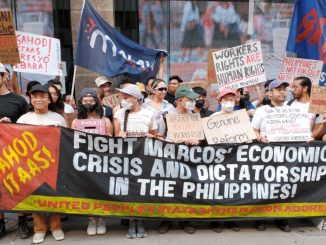
More than a hundred Filipinos and their allies rallied outside the Philippines consulate in New York City on July 23. They were protesting Philippines President Ferdinand Bongbong Marcos Jr.

The rally was one of many protesting President Bongbong Marcos’s State of the Nation address. Tens of thousands protested in Manila and other towns and cities across the Philippines.

Bongbong Marcos is the son of the late Filipino dictator Ferdinand Marcos who declared martial law in 1972. Thousands of people were tortured, imprisoned, and killed.

Meanwhile, the corrupt Marcos family stole tens of millions. People suspect that today’s Maharlika Investment Fund is also being looted. Food prices are rising while President Bongbong Marcos flies around the world and stays at five-star hotels. 

Bongbong Marcos was elected president last year in a voting process that many considered crooked. His running mate — Vice President Sara Duterte-Carpio — is the daughter of the previous president, Rodrigo Duterte.

What a bloody team! Rodrigo Duterte’s 2016-2022 presidency was dominated by his so-called war on drugs, in which 30,000 people were killed by police and the army.

Many of the victims were peasants and workers. Activists were “red tagged” — that is, labeled “communist terrorists” — and assassinated.

Bongbong Marcos is following the same path, which he tried to justify in his “State of the Nation” address. People gathered at Filipino consulates around the world — including the one on Manhattan’s swanky Fifth Avenue — as well as throughout the Philippines to protest Marcos’ lies.

Filipino activists from Bayan, the Malaya Movement, and the women’s organization Gabriella presented a “people’s state of the nation address.” Speakers described how poor and working people are suffering. The late revolutionary leader Jose Maria Sison, who died last year, was quoted about the need to struggle. 

The current minimum wage in the Philippines is half of what a family needs to survive. 

President Marcos is bragging that he’s increased the minimum wage by 40 pesos per day in the Manilla metropolitan area, but that amounts to just 72 U.S. cents.

Just as Florida Gov. Ron DeSantis is trying to ban Black history from the Sunshine State’s school books, President Marcos wants to wipe out any references to his daddy as a ruthless, corrupt dictator.

But the truth will come out. Among the speakers at the Manhattan rally was a survivor of the concentration camps that the elder Marcos erected as part of his martial law regime.

U.S. out of the Philippines!

A worker at Jollibee — a Filipino-owned fast food chain — described how when he suffered second-degree burns as a cook, he had to keep working to avoid being fired. Workers at the Jollibee restaurant in Journal Square, Jersey City, have been fired for organizing against low-paid, dangerous working conditions.

It’s these sweatshop owners and big landlords that are the biggest supporters of the Marcos-Duterte regime.

As a speaker from the New York Committee for Human Rights in the Philippines pointed out, it’s the Pentagon that’s the real power in the country. The U.S. is now at nine military bases in the supposedly sovereign Philippines.

Instead of addressing people’s needs, like developing food self-sufficiency, the government has bought a billion dollars of U.S. arms. Wall Street wants to drag the Philippines into its war plans against the People’s Republic of China. President Joe Biden welcomed President Bongbong Marcos to the White House.

Manila is just 700 miles from Hong Kong. The Philippines’ proximity to China is the reason that the U.S. started its war with Spain in 1898 in Manila, not the Caribbean.

A million Filipinos were killed by U.S. troops during its dirty war to establish its colony in the Philippines. Mark Twain denounced the tortures, which included waterboarding, committed by U.S. forces.

Almost a tenth of Filipino people have been forced to live abroad. World shipping would come to a halt without 400,000 Filipino sailors.

New York City hospitals would be forced to close without Filipino and Haitian health care workers. It was Filipino farmworkers in California that started the grape boycott in the 1960s.

The 117 million Filipino people are fighting back. Just as his father was swept from power, so will President Bongbong Marcos.

Strugglelalucha256


Solidarity in New York with the people of Peru

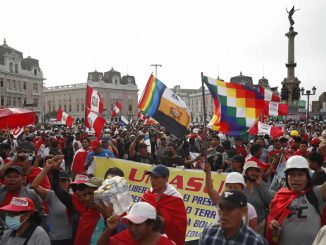
Twenty thousand people marched into Lima, the capital of Peru on July 19. They are demanding an end to the illegal regime that has crushed democracy and killed over 80 protesters. Thousands more have been arrested or wounded.

On Dec. 7, 2022, Peru’s elected President, Pedro Castillo Terrones, was removed from office and jailed. He’s still imprisoned.

The former vice president, Dina Boularte, is the figurehead for a military dictatorship whose real master is in the U.S. embassy. One thousand five hundred U.S. troops were sent to Peru, supposedly for “exercises” but really to bolster the dictatorship.

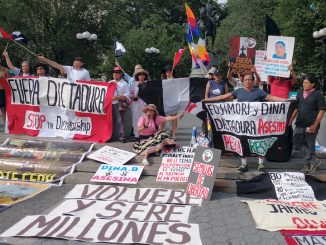
On July 22, members of New York City’s Peruvian community and other supporters gathered in Manhattan’s Union Square in solidarity with the struggle in Peru. Speeches described the police terror against peasants, workers, and students.

They demanded the freeing of President Castillo from jail and his restoration to office. Castillo was a teacher and is from the people.

Pictures were displayed in Union Square of those who police and the army had killed. People walking back stopped to listen.

The people of Peru are determined to overthrow the dictatorship of Dina Boularte, the military, and the U.S. embassy. Working and poor people here need to demand: U.S. out of Peru!

Strugglelalucha256


Peru: Social movements demand resignation of unelected president

The National Unitary Coordination Platform of Struggle (CNUL), composed of several Peruvian social movements, called for a new march on Saturday to demand the resignation of de facto President Dina Boluarte.

The platform of social movements announced that Saturday, July 22, will be a day of peaceful struggle, with marches in working class neighborhoods of the northern, southern and eastern parts of Lima, and in other regions of the country.

On Wednesday, July 19, marchers from all over the country took over the capital and 59 other provinces, and the CNUL plans to continue the same during July 24-29.

A meeting of trade unions, agrarian organizations, university student federations, and regional movements is scheduled for this weekend.

The CNUL congratulated the people for their mobilizations inside and outside Peru, and for demonstrating their support for the popular demands in this historic moment for Peru.

Mass protests have been going on in Peru demanding the resignation of de facto President Boluarte, the closure of the unpopular parliament, and the convocation of a constituent assembly to draft a new constitution.

At numerous places, there were clashes between the marchers and the police, who try to deny the legitimacy and legality of the protests.

The CNUL also demanded freedom for political prisoners detained since December 7, 2022, when President Pedro Castillo was imprisoned and removed from office and replaced by the de facto authorities.

Another demand of the platform is retribution for those who were directly or indirectly responsible for the death of nearly 70 Peruvians during the protests, and moral and material reparations for the families of the victims.

A new demand that was raised during the third takeover of Lima was the defense of national sovereignty, and the withdrawal of the US troops that arrived in Peru to back up the Boluarte regime.

Source: Orinoco Tribune

Strugglelalucha256


The next aggression that the U.S. is preparing against Venezuela

This year, the legislative arm in Washington has introduced three bills in the U.S. Congress against Venezuela: the Prohibition of Transactions and Leases with Venezuela’s Illegitimate Authoritarian Regime Act, the Venezuelan Human Rights “AFFECT” Act, and the Venezuelan Democracy Act. The bills have a common denominator: to further increase the pressure of the blockade and impose on it a framework of “humanitarian assistance”.

The focus of this article is the Venezuelan Democracy Act which was introduced in the newly installed U.S. Senate last March. The bill was put together by five Republicans: Jim Risch, Marco Rubio, Bill Hagerty, Rick Scott, and John Barrasso, who orbit around the lobby of energy companies and corporations that mobilize large sums of money to rebuild and assist “needy” countries.

The law is an aspirational mega project of administrative-interventionist management towards Venezuela that begins with the outline of the road map that they would like to apply in a next scenario of coercion and that, through its articles, seeks to establish the guidelines for the entire U.S. state structure to engage in the not so innovative operative against Venezuela, namely:

  • “Peaceful” transition.
  • Resumption of economic growth in Venezuela.
  • Imposition of “sanctions” on the Venezuelan government and any successor they deem “undemocratic”.
  • Assistance and financing.

This “strategy” does not appear out of nowhere; it is a known and imposed modus operandi in other countries such as Haiti or Syria and has also been described in reports such as the one published in December 2022 by the Woodrow Wilson International Center for Scholars, “Venezuela in 2023 and Beyond: charting a different course”, which shows, in essence, what is developed in this law.

“Transition and assistance”

On peaceful transition, two sections address that route. One on the “requirements to determine whether a transitional government is in power in Venezuela” and another on the policy towards “a transitional government and a democratically elected government,” which, in general lines and beyond the obvious intrusion, peek in the background of the new steps to change the government of Venezuela: highlight initiatives that seem to emerge from any group representing the so-called “civil society” and in which “the self-determination of the people” can be recognized, to encourage them to “empower themselves with a government”.

Even in the terms of that longed-for passage from a transitional government to a government per se, these congressmen dare to add that the democratic government to be elected -democratic according to their criteria and interests- will result from “an expression of the self-determination of the people”. The pressure strategy will have the same objective of changing the government, but by more “spontaneous” means.

In the same section, they point out that, in the face of a “difficult” transition, the U.S. administration as a whole must be prepared to provide “humanitarian assistance”, the place where they really do business and project their political interests.

In fact, it is further described that the Export-Import Bank of the United States will be part of all the agencies that will be involved in this assistance. It should be noted that the Export-Import Bank finances exports of U.S. products and services to international markets.

Matthew Rooney, a former State Department official, and advisor to the George W. Bush Institute think tank, explained in a 2019 article that the U.S. Congress budgets annual dollar amounts to influence and pressure foreign governments to support and prioritize U.S. interests in the U.S. and in the given region.

The law also refers to the distribution of resources under that “assistance,” explaining that, in order for them to “reach the people”, U.S. agencies and non-governmental organizations (NGOs) must be used, a matter on which there is already a precedent: the pot of corruption that was uncovered by the diversion of “humanitarian aid” funds in 2019, courtesy of the Guaidó gang.

These irregularities in that modality of resource distribution is well known in U.S. power groups. Economist and Stockholm University professor Jakob Svensson described in his book Foreign Aid and Rent-Seeking that “the inflow of aid negatively affects a developing economy because these resources are diverted from productive activities to rent-seeking activities by individuals from elite social groups in the economy.”

In the end, embezzlement goes hand in hand with these not-at-all-altruistic initiatives: it is a macabre symbiosis of big business management.

On the other hand, around this scheme of “assistance to the people of Venezuela,” these congressmen added a segment dedicated to providing assistance in the preparation of the Venezuelan military forces once a new government is established.

This subsection is different from other legislation because it goes beyond the commercial and political sphere and enters the field of defense and sovereignty. This U.S. approach is not surprising since they have been promoting for some time the recipe book of interference in different countries, whose crucial objective in the international agenda of the White House is to achieve control over the armed forces of a country in order to guarantee its interests.

More blockade, more “sanctions

In order to prevent any type of financing to the Venezuelan government, in this law, the section on the imposition of “sanctions” states that the Secretary of the Treasury of the United States will have the power to withhold any payment or loan approved by an international financial institution such as the International Monetary Fund, the Inter-American Development Bank, the Multilateral Investment Guarantee Agency, among others.

In addition, to expand the range of action of this hanging initiative, it is included that the U.S. government shall encourage other governments to restrict any commercial and credit relationship with Venezuela. In addition, the law stipulates that coercive measures will be imposed on any foreign government that offers aid or assistance to the Venezuelan government.

It is ostensible that a paragraph would be made to prevent any funding to PDVSA since the license to Chevron is an action that has disturbed these senators; as Republican Risch said last year: “We are deeply concerned about the Biden administration’s plans to once again ease sanctions”.

A review of this bill shows that its wording is intended to stand as a Constitution for Venezuela, courtesy of the United States.

If enacted, this bill could potentially nullify any avenue to normalize bilateral relations with the United States.

Source: Resumen

Strugglelalucha256


Storm clouds gathering over Black Sea

The NATO Summit in Vilnius (July 11-12) signaled that there is absolutely no possibility of talks to settle the Ukraine war in the foreseeable future. The war will only intensify as the U.S. and its allies still hope to inflict a military defeat on Russia, although that is clearly beyond their capability.

On July 14, Gen. Mark Milley, chairman of U.S. joint chiefs of staff, said that Ukraine’s counteroffensive is “far from a failure,” but the fight ahead will be “long” and “bloody.” Milley has a reputation for speaking what the White House wants to hear, no matter his professional judgment.

Indeed, on July 19, the Biden administration announced additional security assistance of about $1.3 billion for Ukraine. The Pentagon said in a statement that the announcement “represents the beginning of a contracting process to provide additional priority capabilities to Ukraine.” That is to say, the U.S. will be using funds in its Ukraine Security Assistance Initiative program, which allows the administration to buy weapons from industry rather than pull from U.S. weapons stocks.

According to the Pentagon, the latest package includes four National Advanced Surface-to-Air Missile Systems (NASAMS) and munitions; 152 mm artillery rounds; mine-clearing equipment; and drones.

Meanwhile, in an ominous development, no sooner than Russia let the UN-brokered grain deal expire on July 17, Ukrainian President Vladimir Zelensky disclosed that he had sent official letters to UN Secretary-General Antonio Guterres and Turkish President Tayyip Erdogan suggesting the continuation of the grain deal without Russia’s participation.

On the very next day, Kiev followed up with an official letter to the UN’s International Maritime Organization spelling out a new maritime corridor passing through Romania’s territorial waters and exclusive maritime economic zone in the north-western part of the Black Sea.

Evidently, Kiev acted in concert with Romania (a NATO member country where the 101st Airborne Division of the U.S. Army is deployed). Presumably, the U.S. and NATO are in the loop while the UN’s imprimatur is being arranged.  It goes without saying that NATO has been working on a new maritime route in the Black Sea for some time already.

This is a serious development, as it seems a precursor to involving NATO in some way to challenge Russia’s domain dominance in the Black Sea. Indeed, NATO’s Vilnius Summit Communique (July 11) had forecast that the alliance is gearing up for a vastly enhanced presence in the Black Sea region, which has been historically a Russian preserve, where it has important military bases.

The relevant paragraph in the NATO Communique said: “The Black Sea region is of strategic importance for the Alliance. This is further highlighted by Russia’s war of aggression against Ukraine. We underline our continued support to Allied regional efforts aimed at upholding security, safety, stability and freedom of navigation in the Black Sea region including, as appropriate, through the 1936 Montreux Convention. We will further monitor and assess developments in the region and enhance our situational awareness, with a particular focus on the threats to our security and potential opportunities for closer cooperation with our partners in the region, as appropriate.” [Emphasis added.]

Four things need to be noted:

  • one, the Ukraine conflict has been singled out as the context; the focus is on Crimea;
  • two, “freedom of navigation” means an assertive U.S. naval presence; reference to the 1936 Montreux Convention hinted at the role of Turkey, both as a NATO member country and the custodian of the Dardanelles and Bosporus straits;
  • three, NATO flags its intention to enhance its “situational awareness,” which as a military term involves four stages: observation, orientation, decision, and action. Situational awareness has two main elements, namely, one’s own knowledge of the situation and, secondly, one’s knowledge of what others are doing and might do if the situation were to change in certain ways. Simply put, the NATO surveillance of Russian activities in the Black Sea will intensify; and,
  • four, NATO seeks closer cooperation with “our partners in the region” (read Ukraine).

Most certainly, a new maritime route in northwestern and western regions of the Black Sea along Romania, Bulgaria, and Turkey (all of whom are NATO member countries) will cut off the Russian garrison in Transnistria (Moldova) and would boost Kiev’s capability to strike at Crimea. The NATO involvement would complicate any future Russian operations to liberate Odessa as well, which is historically a Russian city.

Apart from the huge legacy of culture and history, Odessa is a port head for the industrial products of Russia and Ukraine. The Togliatti-Odessa ammonia pipeline (which the Ukrainian saboteurs blew up recently) is one of the best examples. The 2,471 km pipeline, the longest ammonia pipeline in the world, connected the world’s largest ammonia producer, TogliattiAzot, in Russia’s Samara region with Odessa Port.

In strategic terms, without control over Odessa, NATO cannot force project in the Black Sea region or hope to resurrect Ukraine as an anti-Russia outpost. Nor can NATO advance toward the Transcaucasus and the Caspian (bordering Iran) and Central Asia without dominating the Black Sea region.

And for the same reasons, Russia cannot afford to cede the Black Sea region to NATO, either. Odessa is a vital link in any land bridge along the Black Sea coast connecting the Russian hinterland with its garrison in Transnistria, Moldova (which the U.S. is eyeing as a potential NATO member.) In fact, Crimea’s security will be endangered if hostile forces establish themselves in Odessa. (The attack on the Kerch Bridge in October 2022 was staged from Odessa.)

Clearly, the entire U.S. project on the new maritime route is intended to preempt Russia from gaining control of Odessa. It factors in the strong likelihood that with the Ukrainian offensive floundering, Russia may soon launch its counter-offensive in the direction of Odessa.

From the Russian perspective, this becomes an existential moment. NATO has virtually encircled the Russian Navy in the North Sea and the Baltic Sea (with the induction of Sweden and Finland as members). The freedom of navigation of the Baltic Fleet and the dominance in the Black Sea, therefore, becomes all the more crucial for Russia to freely access the world market round the year.

Moscow has reacted strongly. On July 19, the Russian ministry of defense notified that “all vessels sailing in the waters of the Black Sea to Ukrainian ports will be regarded as potential carriers of military cargo. Accordingly, the countries of such vessels will be considered to be involved in the Ukrainian conflict on the side of the Kiev regime.”

Russia has further notified that “the north-western and south-eastern parts of the international waters of the Black Sea have been declared temporarily dangerous for navigation.” The latest reports suggest that the Black Sea Fleet of warships are rehearsing the procedure for boarding foreign ships sailing to Ukrainian waters. In effect, Russia is imposing a sea blockade of Ukraine.

In an interview with Izvestia, Russian military expert Vasily Dandykin said he would now expect Russia to stop and inspect all ships sailing to Ukrainian ports. “This practice is normal: There is a war zone there, and in the past two days it has been the scene of missile strikes. We’ll see how this will work in practice and whether there will be anyone willing to send vessels to these waters, because this is very serious.”

The White House has accused Russia of laying mines to block Ukrainian ports. Of course, Washington hopes that NATO moving in as the guarantor of the grain corridor, replacing Russia, would have resonance in the Global South. The Western propaganda caricatures Russia as creating food scarcity globally. Whereas the fact of the matter is that the West didn’t keep its part of the bargain reciprocally to allow the export of Russian wheat and fertilizer, as has been acknowledged by the UN and Turkey.

What remains to be seen is whether, beyond the raging information war, any NATO country would dare to challenge Russia’s sea blockade. The chances are slim, the daunting deployment of the 101st Airborne Division in next-door Romania notwithstanding.

Source: Peoples Dispatch

Strugglelalucha256


Solidarity statement for Philippines People’s State of the Nation Address

The people of this country are familiar with a presidential address. And like the people of the Philippines, we know it to be an opportunity for presidents to lie through their teeth. 

And like the Philippines, this country has a president that has a little more stage savvy than the last. This is the kind of thing that can lull some parts of the masses into security. But we know better.

The Socialist Unity Party stands with you. We stand with you in this, the People’s State of the Nation Address–in standing up to power and telling the truth to the masses. 

We stand with the People’s Democratic Revolution and the mass movement that carries it out, inspiring working-class organizations all over the world.

Working class and activist organizations here in this country do not raise the issue of the Philippines nearly enough. Despite the imperialist relationship between the U.S. and the Philippines, too many could not point to the Philippines on a map.

This is our call to the Left in the U.S.: we must build the anti-imperialist movement in this country. Further, the anti-imperialist movement and the workers’ movement must become one in the same. 

This is necessary not only because of the shared knowledge that imperialism must be defeated. It is necessary because we believe in the victory of the People’s Democratic Revolution. And when the national democratic movement wins, we can count on U.S. imperialism to attack.

We should be ready to beat back the imperialists. The working class should be ready to shut down any attempt by the imperialists to intervene. 

This we commit to you–we will continue to do everything we can to build a movement with that power. 

Onward to a liberated Philippines! Victory to the People’s Democratic Revolution! 

From Palestine to the Philippines, stop the U.S. war machine!

Strugglelalucha256
https://www.struggle-la-lucha.org/2023/page/33/