En peligro juventud boricua

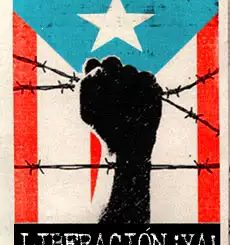
PR es un país donde la inestabilidad económica y política hace migrar a su población, sobre todo a la más joven. Un país-colonia donde la administración local es meramente el servidor del verdadero gobierno, que es la Junta de Control Fiscal impuesta por el Congreso estadounidense. Y ambos, Junta y gobierno local, han obliterado la esperanza de un futuro a nuestros jóvenes al dar prioridad al capital, sobre todo el extranjero, a costa de las necesidades del pueblo boricua. Por eso se han cerrado escuelas, se han privatizado servicios esenciales como la salud y en gran medida la educación. Se ha dificultado el tener una vivienda y un trabajo digno, mientras se le abren las puertas a los inversionistas millonarios extranjeros que compran miles de edificios para convertirlos en alquileres de corto plazo para turistas.

Y para añadir, esta semana la Organización Kilómetro Cero ha develado en un artículo una realidad que se ha ocultado por más de 15 años: y es que en PUERTO RICO se protege más a las armas que a los menores. Aquí, las armas de fuego son la primera causa de muerte en menores de edad. 

Casi a diario nos enteramos de muertes violentas donde menores de edad están involucrados. Porque además, por la falta de recursos y de interés del gobierno por el bienestar de nuestra juventud, estos jóvenes, niños y niñas de hasta de 12 años o menos, son reclutados por el Narco. Y no se puede dudar que PR es ahora un Narcoestado.

Si hay una poderosa razón para descolonizar ahora mismo a Puerto Rico, para obtener nuestra independencia y nuestra soberanía, es precisamente esa: ¡nuestra juventud!

Desde Puerto Rico, para Radio Clarín de Colombia, les habló Berta Joubert-Ceci

Strugglelalucha256


Thousands rally in support of Niger’s coup leaders as Western-backed ECOWAS threatens military intervention

The military junta which took power in Niger last week warned on Monday, July 31 that France might militarily intervene with authorization from the ousted government’s foreign minister to restore Mohamed Bazoum to the presidency.

Thousands have mobilized to the streets to welcome the military takeover, sloganeering against their former colonizer — “Down with France,” “Foreign bases out.” Protesters reportedly tore out the plaque on the French embassy in capital Niamey and torched its door on Sunday, July 30.

With drones and airplanes reportedly backing up to 1,500 of its troops in Niger, France, along with the US which has another 1,100 troops in two military bases, has extended support to the West African regional bloc which on Sunday threatened a military intervention.

Imposing a no-fly zone and freezing Niger’s assets in its central and commercial banks, the 15-member Economic Community of West African States (ECOWAS) said on Sunday that it will “take all measures necessary,” including  “the use of force,” to restore Bazoum to presidency.

Bazoum was taken captive and removed from office on July 26 in a coup led by the head of the presidential guard, Gen. Abdourahmane Tchiani. Speaking on behalf of the military junta which has called itself the National Council for the Safeguard of the Homeland (CNSP), Col Maj Amadou Abdramane announced in a televised statement, “the defense and security forces.. have decided to put an end to the regime… This follows the continuing deterioration of the security situation, and poor economic and social governance.”

“ECOWAS condemns in the strongest possible terms the attempt to seize power by force and calls on the coup plotters to free the democratically elected President of the Republic immediately and without any condition,” said its current chair, Nigerian President Bola Tinubu, immediately after the coup.

“[T]he EU also associated itself with ECOWAS’ first response to the matter,” said the European Union’s High Representative for Foreign Affairs, Josep Borrell, adding that the “EU condemns all attempts to destabilize the democracy.” US National Security Advisor Jake Sullivan also condemned “any effort to…subvert the functioning of Niger’s democratically elected government.”

The first-ever ‘democratic transition’?

After taking office in April 2021 following what is described as the “first-ever democratic transition” in the country, Bazoum instituted an internet shutdown for ten days while the security forces cracked down on protests and arrested hundreds amid accusations of irregularities.

In November that year, militant mass demonstrations tried to stop the movement of a French army convoy through the country en route from Ivory Coast to Mali. French soldiers and the Nigerien gendarmes escorting their convoy fired shots and tear gas, killing two Nigeriens and wounding 18.

Angry protesters also confronted the convoy all along its route through Burkina Faso before entering Niger. Two months later, in January 2022, Burkina Faso’s president was ousted in a popular coup. After consolidating power with another coup in September 2022, the junta demanded that the French troops leave Burkina Faso in January 2023. Mass demonstrations welcomed their military government’s decision.

In Mali, French troops had withdrawn by August 2022, six months after the military government, which had similarly consolidated power with two popular coups, demanded they leave. Tens of thousands took to the streets of the capital Bamako in celebration.

Announcing the withdrawal of 2,400 troops from Mali, French president Emmanuel Macron had said at the time that the “heart” of France’s military operation in Sahel “will no longer be in Mali but in Niger.”

Impervious to the popular sentiment against France in Niger and other former colonies in West Africa, the democratically elected Bazoum, touted by the BBC as “a key Western ally,” welcomed into Niger the French troops ordered out of Mali.

“It is unacceptable and intolerable to accept this redeployment on our territory,” Maïkol Zodi, a leader of the protest movement calling for the withdrawal of French troops, had said at the time, warning that “we will treat them as an occupying force.”

Later in August that year, 15 civil society organizations came together to form “M62: Sacred Union for the Safeguard of the Sovereignty and Dignity of the People” to launch a joint struggle against the French military’s presence in Niger. The M62 Movement’s coordinator, Abdoulaye Seydou, said at the time that the French troops, deployed as a part of Operation Barkhane, have “killed more civilians than terrorists,” DW reported.

Donning a T-shirt with Thomas Sankara’s image at the protest the M62 led in September 2022, he told the AFP, “there are anti-French slogans because we demand the immediate departure of the Barkhane force in Niger, which is alienating our sovereignty and destabilizing the Sahel.”

Operation Barkhane ended in failure, but French troops remain

Starting from 2014, Operation Barkhane was a Sahel-wide expansion of Operation Serval launched in Mali in 2013. Barkhane’s aim was to defeat the Islamist insurgencies, which were a fallout of the NATO’s war destroying Libya, in which France itself was a major participant. At its peak strength, the Barkhane force consisted of 5,500 French soldiers deployed in Mali, Niger, Chad, Burkina Faso, and Mauritania.

From the start of Operation Barkhane to mid-2022, violence involving Islamist Militants nearly tripled in the Sahel, according to the Africa Center for Strategic Studies. With this track record of failure, Macron ended the operation in November 2022, announcing however that about 3,000 troops will remain in Niger, Chad, and Burkina Faso.

But two months later, on January 23, 2023, Burkina Faso’s government also asked France to leave. That very day, police in Niger arrested M62 Movement’s coordinator Seydou in what Frontline Defenders deemed to be an “arbitrary detention…directly linked to his peaceful and legitimate work in defense of human rights.”

Later in April, he was sentenced to nine months imprisonment for “disseminating data likely to disturb public order.” Rallying behind the recent coup, M62 has called on Niger’s military government to release anti-French activists like Seydou who were incarcerated by the government of Bazoum.

Breaking away from the mass demonstration in front of the parliament on July 27 to support the military takeover, a group of angry Nigeriens chased away politicians from Bazoum’s party headquarters and torched the building.

While a protest in defense of Bazoum’s government quickly fizzled out, the pro-coup demonstrations continue to gain in strength as protesters count on the military junta to follow Mali and Burkina Faso in demanding the withdrawal of French and other western troops.

Alongside Niger’s flags, anti-French protesters also waved Russian flags, reflecting the popular demand to end the country’s dependence on its former colonizer for security and explore an alternative security partnership with Russia instead. 

An imminent military intervention

Deeming the coup as “completely illegitimate,” the French president said on July 28, “We also support the regional organizations, the Economic Community of West African States (ECOWAS) in particular, in their further decisions…”

With the US Secretary of State Antony Blinken also conveying American support for ECOWAS chair Tinubu’s “continued efforts to restore constitutional order,” the regional bloc threatened an armed action after the summit in Nigeria on July 30.

In its statement after the summit, ECOWAS warned that it will “take all measures necessary to restore constitutional order in the Republic of Niger. Such measures may include the use of force. For this effect, the chiefs of defense staff of ECOWAS are to meet immediately.”

The junta’s spokesperson Abdramane said ahead of this summit that its “objective” was “to approve a plan of aggression against Niger through an imminent military intervention.. in collaboration with other African countries that are non-members of ECOWAS, and certain western countries.” He added, “We want to once more remind ECOWAS or any other adventurer, of our firm determination to defend our homeland.”

Former CIA analyst Cameron Hudson tweeted about a “speculation” that Chad’s president, Mahamat Idriss Déby, “is being asked to lend his forces to help plan/lead a possible intervention force in Niger, as the most capable force in closest proximity.”

Incidentally, Gen. Deby also took power in a coup after his father and former president Idriss Deby died on the front while commanding his armed forces against a rebel group in northern Chad in April 2021.

However, unlike in the case of Mali, Burkina Faso, or Niger, where the coups have been welcomed by mass demonstrations, Chad’s coup leader has been facing pro-democracy protests, including a major one on October 20, 2022, which was met with a violent crackdown.

FP described it as “one of the worst repression in the country’s history.” Hundreds were imprisoned. Deby’s government admitted that 50 people, including 10 security personnel, were killed, but pro-democracy organizations and political parties claimed that as many as 200 people were killed.

Nevertheless, not having called for the withdrawal of French troops, Deby remains in the good books of ECOWAS and its Western backers. Arriving in Niger on Sunday, he held a meeting with Gen. Tchiani and will be reporting back to ECOWAS chair Tinubu, who assumed Nigeria’s presidency earlier this year after winning an election marred by allegations of voter suppression.

Strugglelalucha256


African states support Niger sovereignty in the face of imperialist attack and collusion of stooge African governments

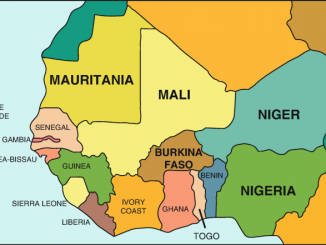
Reaction to the coup in Niger is a litmus test which determines who is truly supportive of self-determination for African nations. The Economic Community of West African States (ECOWAS) is urging Nigeria to invade neighboring Niger, which is just what the U.S. and France would like to see happen. But the leaders of Burkina Faso, Guinea, and Mali are standing firm and demanding that the people of Niger, who appear to be supportive of the military involvement in their country, resolve their own conflict without the intervention of imperialist western nations. The leaders of Mali and Burkina Faso announced a joint statement, and were joined by the president of Guinea in upholding sovereignty and Pan-African unity.

Joint Communique #001 of Burkina Faso and the Republic of Mali

The transition governments of Burkina Faso and Mali have learned through the press of the conclusion of the extraordinary summits of the Economic Community of West African States (ECOWAS) and of the West African Economic and Monetary Union held on July 30, 2023 in Abuja over the political situation in Niger.

The Transition Governments of Burkina Faso and Mali:

1.     Express their fraternal solidarity and the solidarity in brotherhood of the Burkinabe and Malian people with the people of Niger who has decided, responsibly, to take its destiny into its own hand and to be accountable in the face of history for complete sovereignty;

2.     Denounce the persistence of these regional organizations to impose sanctions that increase the populations’ suffering and imperil the spirit of Panafricanism.

3.     Refuse to apply those illegal, illegitimate, and inhumane sanctions against the Nigerien people and authorities.

4.     Warn that any military intervention against Niger would mean a declaration of war against Burkina Faso and Mali.

5.     Inform that any military intervention against Niger will lead to a withdrawal of Burkina Faso and Mali from ECOWAS as well as to the implementation of legitimate self-defense in support of the armed forces and people of Niger.

6.     Warn against the disastrous consequences of a military intervention in Niger that might destabilize the whole region like that of the unilateral intervention of NATO in Libya, which has been the cause of the spread of terrorism in the Sahel region and in West Africa.

The Transition Governments of Burkina Faso and Mali are deeply outraged and surprised by the unevenness observed between, on the one hand the speed and adventurous attitude of certain political representatives of West Africa wishing to use the armed forces to restore a constitutional order in a sovereign country and on the other, the inaction, the indifference and passive complicity of these political representatives to help states and people victims of terrorism for decades and left to their own fate.

In any case, the Transition Governments of Burkina Faso and Mali invites all living forces to be ready and to be mobilized, in anticipation of supporting the Nigerien people in those dark hours of Panafricanism.

May God Bless Africa and protect Africans!

Written in Ouagadougou and Bamako, July 31st, 2023.

Signed by Rimtalba Jean Emmanuel Ouedraogo and Colonel Abdoulaye Maiga
Statement from Guinea

Following the events in Niger, the National Committee of the Rally for Development (CNRD) firmly expressed its support for the people of this friendly country, emphasizing the importance of the values ​​of Pan-Africanism dear to the Head of State, Colonel Mamadi DOUMBOUYA. Consequently, the authorities of the Republic of GUINEA dissociate themselves from the sanctions imposed by ECOWAS.

Communique No 002/CNRD/2023

Since July 26, 2023, the people of Guinea, led by the National Committee for the Rally for Development (CNRD) have followed with great interest the evolution of the socio-political situation in the sister Republic of Niger, which led to the taking of responsibility by the National Council for the Safeguarding of the Country (CNSP).

The Guinean authorities pay tribute to the brave people of Niger for their exemplary patriotism and salute the republican spirit and the maturity of their defense and security forces that have prioritized the best interests of their nation by choosing to come together to find solutions to Nigerien problems.

The CNRD remains convinced that the new authorities will make every effort to guarantee the stability and harmony in Niger and in the sub-region.

The sanctions measures recommended by ECOWAS, including military intervention, are options that cannot be a solution to the current problem but would lead to a human disaster whose consequences could go beyond the borders of Niger.

Consequently, the CNRD refrains from applying these illegitimate and inhuman against the brotherly people and authorities of Niger and urges ECOWAS to return to better thinking.

The Republic of Guinea reaffirms with this press release its pan-Africanist vision by bringing its solidarity with the people of Niger and by the new authorities of the CNSP to preserve the national unity and cohesion.

The CNRD emphasizes that any military intervention against Niger would de facto lead to the dislocation of ECOWAS. Similarly, the brotherly peoples of Mali, Burkina Faso, Niger and Guinea yearns for more recognition and respect for our sovereignty.

Furthermore, the CNRD would like to point out that the sanctions imposed and the threats made at the summit of July 30, 2023 do not in any way make a commitment upon the Republic of Guinea.

At a time when the young populations of the ECOWAS region are experiencing a human drama in Tunisia and in the Mediterranean, the concern of the leaders of the sub-region should be rather oriented towards the strategic social and economic issues for the realization of their aspirations, rather than focus on the fate of deposed Presidents.

Conakry
July 31, 2023
For the National Rally for Development
Brigadier General
Ibrahim Bangoura

Source: Black Agenda Report

Strugglelalucha256


Oppenheimer, war criminal

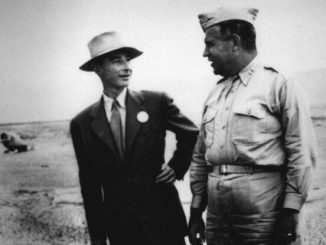
“I don’t think that your father ever met Oppenheimer,” my mother told me the other day. I can’t ask my father, since he died last year, at 90 years of age. My father was a subatomic particle physicist. He devoted most of his career to Fermilab, where he helped design the magnets that accelerated protons in one direction and antiprotons in the other direction around a 6.28 km ring called the Tevatron.

In its heyday, Fermilab hosted physicists from around the world. During the 1970s, even physicists from the Soviet Union and the People’s Republic of China worked there. Apparently, there are no military applications (yet) for this sort of high-energy particle physics.

My father had been thirteen years old when the U.S. dropped the atom bomb on Hiroshima. His immediate family, who lived by the train station, happened to be scattered far enough from Ground Zero that they survived. Of course, branches of his extended family (and my mother’s extended family) were pruned that day.

As a young physicist coming of age in the 1950s and 60s, he had met many of the scientists who had worked on the Manhattan Project. My father greatly admired his boss, Robert Rathbun Wilson, the first director of the National Accelerator Laboratory (later renamed Fermilab), who had led the Cyclotron Program at Los Alamos. Wilson was a Quaker and had opposed the use of the atom bomb on civilians in Japan.

For much of my life, I wondered why my father had chosen a career in physics, when the field seemed tainted by so many of its leading lights having devoted their energies to creating the world’s first weapon of mass destruction. When I finally asked him about it, he replied rather succinctly, “I like gadgets.” (What he actually told me was that he liked kikai, machines or gadgets in Japanese.)

I was reminded that when I was a child, my father would buy me plastic model sets of WWII Japanese warships or warplanes. He would extol the utility of the air-cooled engines of the Japanese Zero fighter plane. I suppose that, in the end, he was not terribly bothered by the depredations of early 20th century Imperial Japan. Perhaps for him, the atom bomb was largely a matter of superior U.S. science and technology.

My father wanted me to become a physicist, too, and I gave it the old college try. I found it too difficult, however, especially the math. However, I also had a nagging feeling that from the time of the Manhattan Project onward, that advances in the field were being put to nefarious uses.

Perhaps I am being overly harsh about 20th century nuclear physics in particular. We could also point to how the harnessing of fossil fuel since the industrial age has led to the present climate catastrophe. We could point to the dangers of gain-of-function synthetic biology research or artificial intelligence.

Perhaps the problem is, as pointed out by Jacques Ellul, the role of technique in the atrocities of our age. He defines technique as “the totality of methods, rationally arrived at and having absolute efficiency (for a given stage of development) in every field of human activity”1 (Ellul 1964, p. xxv, italics in original).

Neither “science” nor technique are moral actors. Individuals are. At this juncture, our eyes are upon one particular historical figure. Christopher Nolan’s Oppenheimer hews closely to the biography American Prometheus by Kai Bird and Martin Sherwin and paints a sympathetic portrait. One might even say that it is a heroic portrait, for was Prometheus not a god?

Nolan’s assertion that Oppenheimer “was the most important person who ever lived” challenges us to think through whether we agree with him or not. Certainly, he was a polymath. Nolan depicts him delivering a lecture in Dutch and reading the Bhagavad Gita in Sanskrit. While he was born into wealth, he sympathized with causes such as desegregation and that of the anti-fascists in the Spanish Civil War. Because it was the Communist Party of the U.S.A. that championed such causes in Berkeley in the 1930s, Oppenheimer became entwined with party members during that period.

However, once he was chosen to head the Manhattan Project, Oppenheimer was intent on embodying loyalty to the U.S. government, at one point donning a U.S. Army uniform. Focused on the success of the project, he squelched opposition on the part of some of the scientists to the use of the atom bomb on civilian targets.

He was a member of the Scientific Panel that advised the Interim Committee, the committee of government, academic, and capitalist officials that, in turn, advised Truman about the use of the atom bombs. The Scientific Panel consisted of Enrico Fermi, Arthur H. Compton, Ernest O. Lawrence, and Oppenheimer. Their final recommendations read as follows:

Recommendations on the Immediate Use of Nuclear Weapons
(by the Scientific Panel of the Interim Committee, June 16, 1945)

You have asked us to comment on the initial use of the new weapon. This use, in our opinion, should be such as to promote a satisfactory adjustment of our international relations. At the same time, we recognize our obligation to our nation to use the weapons to help save American lives in the Japanese war.

(1) To accomplish these ends we recommend that before the weapons are used not only Britain, but also Russia, France, and China be advised that we have made considerable progress in our work on atomic weapons, and that we would welcome suggestions as to how we can cooperate in making this development contribute to improved international relations.

(2) The opinions of our scientific colleagues on the initial use of these weapons are not unanimous: they range from the proposal of a purely technical demonstration to that of the military application best designed to induce surrender. Those who advocate a purely technical demonstration would wish to outlaw the use of atomic weapons, and have feared that if we use the weapons now our position in future negotiations will be prejudiced. Others emphasize the opportunity of saving American lives by immediate military use, and believe that such use will improve the international prospects, in that they are more concerned with the prevention of war than with the elimination of this specific weapon. We find ourselves closer to these latter views; we can propose no technical demonstration likely to bring an end to the war; we see no acceptable alternative to direct military use.

(3) With regard to these general aspects of the use of atomic energy, it is clear that we, as scientific men, have no proprietary rights. It is true that we are among the few citizens have had occasion to give thoughtful consideration to these problems during the past few years. We have, however, no claim to special competence in solving the political, social, and military problems which are presented by the advent of atomic power. 2

The reference to “those who advocate a purely technical demonstration would wish to outlaw the use of atomic weapons” is presumably to the scientists who signed Hungarian physicist  Leó Szilárd’s petition, which argued “that such attacks on Japan could not be justified, at least not until the terms which will be imposed after the war on Japan were made public in detail and Japan were given an opportunity to surrender.” 3 Szilárd circulated the petition during the summer of 1945 mostly among scientists at the Metallurgical Laboratory in Chicago. He asked Edwin Teller to circulate it in Los Alamos, but Teller turned it over to Oppenheimer, who in turn turned it over to Leslie Groves. Groves stamped it “classified” and put it in a safe. It therefore never reached Truman.

Thus, four eminent physicists (Fermi, Compton, Lawrence, and Oppenheimer), all except Oppenheimer Nobel Prize laureates, told the U.S. government that they saw “no acceptable alternative to direct military use.”

On August 6, 1945 Truman announced, “Sixteen hours ago an American airplane dropped one bomb on Hiroshima, an important Japanese Army base,” but this was a lie. All the planners knew that Hiroshima was occupied mostly by civilians.

Throughout the course of history, there was a gradual development of the idea that the killing of non-combatants was immoral. Starting in the late 19th century, such ideals were codified in international treaties. Thus, the Hague Convention of 1899, twenty-six nations (including Germany, Japan, Russia, the U.K., and the U.S.) signed the Convention with respect to the Laws and Customs of War on Land, Article 25 of which states

The attack or bombardment of towns, villages, habitations or buildings which are not defended, is prohibited.4

Of course, by 1945, most of the warring states involved in WWII had violated this convention. Japan began bombing Chongqing in 1938. Air assault was a facet of Nazi Germany’s blitzkrieg. The British and the U.S. bombed German cities. The U.S. Army Air Forces had reduced most Japanese cities to rubble by August 1945.

In the aftermath of WWI, particularly odious weapons of war had been outlawed by the 1925 Protocol for the Prohibition of the Use in War of Asphyxiating, Poisonous or other Gases, and of Bacteriological Methods of Warfare (the Geneva Protocol).

Violations of the laws of war are considered to be war crimes. In the aftermath of WWII, Nazi government officials were tried for war crimes at the Nuremberg trials. Officials of the Imperial Japanese government were tried at the International Military Tribunal for the Far East. War crimes committed by the victorious states were, of course, never considered to be war crimes at all. As Walter Benjamin noted,

Whoever has emerged victorious participates to this day in the triumphal procession in which the present rulers step over those who are lying prostrate. According to traditional practice, the spoils are carried along in the procession. They are called cultural treasures, and a historical materialist views them with cautious detachment. For without exception the cultural treasures he surveys have an origin which he cannot contemplate without horror. They owe their existence not only to the efforts of the great minds and talents who have created them, but also to the anonymous toil of their contemporaries. There is no document of civilization which is not at the same time a document of barbarism.5

Was Oppenheimer a war criminal? In a moment of contrition, Oppenheimer bemoaned the blood on his hands to Truman. For his part, Truman later noted, he hasn’t half as much blood on his hands as I have. Of course, Truman was the true war criminal. Were the members of the Scientific Panel mere yes-men? The “just following orders” defense did not work so well for the Nuremburg defendants. While Oppenheimer, as “the father of the atom bomb,” might have provided the U.S. military with the means of mass destruction – consider how Wernher von Braun, the physicist who led Nazi Germany’s rocketry program was treated after Germany’s defeat. Von Braun was whisked out of Europe and would eventually lead the U.S. Army rocketry program. Eventually, nuclear bombs were placed on rockets, becoming intercontinental ballistic missiles. The point is that von Braun was not treated as a war criminal. If Nazi scientists had been successful in constructing an atom bomb, they probably would not have been treated as war criminals either.

As the promoter of the new physics of the quantum on the Berkely campus, as the Bohemian who treated his guests to strong martinis and nasi goreng, as an opponent of segregation and fascism in Spain – Oppenheimer cut something of a countercultural figure. He funded the extrication of Jewish people from Nazi-occupied Europe. His commitment to the socialist cause turned out to be superficial, however.

From 2020 to 2022 the BBC aired a podcast about early atomic history. Season 1 focused on Leó Szilárd, the Hungarian Jew émigré physicist who opposed the dropping of the bomb on civilians. Season 2 focused on Klaus Fuchs, the committed Communist German émigré physicist who passed nuclear secrets to the Soviet Union. As a young man, he fought in the streets with Nazis, was thrown into a fjord, and left for dead. We are introduced to the idea that Soviet possession of nuclear weapons prevented the U.S. from continuing to freely utilize its own nuclear weapons in warfare. (Utilizing nuclear weapons on experiments on Marshallese being another story.)  In another BBC In Our Time podcast on the Manhattan Project that aired in 2021, British physicist Frank Close suggests specifically that the Soviet possession of the bomb might have specifically prevented U.S. hawks from deploying nuclear weapons in the Korean War. No, proliferation is not good, but the U.S. being in sole possession of the bomb didn’t work out so well for the people of Hiroshima or Nagasaki.

Perhaps in the U.S. we are excessively wont to only look for our heroes among U.S. Americans.

Notes.

1. Ellul, Jacques (1964) The Technological Society. New York: Alfred A. Knopf.

2Scientific Panel of the Interim Committee. Recommendations on the Immediate Use of Nuclear Weapons. June 16, 1945. http://www.nuclearfiles.org/menu/key-issues/nuclear-weapons/history/pre-cold-war/interim-committee/interim-committee-recommendations_1945-06-16.htm

3Szilárd, Leó. A Petition to the President of the United States. July 17, 1945. https://ahf.nuclearmuseum.org/ahf/key-documents/szilard-petition/

4Laws of War : Laws and Customs of War on Land (Hague II); July 29, 1899. https://avalon.law.yale.edu/19th_century/hague02.asp

5Benjamin, Walter. On the Concept of History. https://www.sfu.ca/~andrewf/CONCEPT2.html

Seiji Yamada, a native of Hiroshima, is a family physician practicing and teaching in Hawaii.

Source: Counterpunch

Strugglelalucha256


Hi Barbie

I am not going to say anything new that others have not said before, and I have referred to read people who have left an immense legacy in the thought of history. Therefore, in this opinion column, most of the ideas raised and exposed — with my contribution — are not new, but there are many who have been talking about them for decades.

In the last few days, we have witnessed the “Barbie phenomenon”. Hundreds and thousands of movie theaters around the world have premiered the latest Hollywood super production that may have already exceeded 1,000 million euros at the box office worldwide. We warn of all kinds of criticism of the film, from the most stale of the right to the most liberal of the left. The former say it is an attack on men, while the latter say it is an empowerment of women. The most reactionary conservatives in the United States have labeled it as Chinese communist garbage; the modern left accuses with their hand on their chest that there is a right-wing hate train against the film.

But, leaving aside the surface and delving into what this market product truly represents: what does Barbie really mean?

I was surprised when I went into Google to read the movie reviews to find an entire page was tinged with pink. It seemed that instead of looking for movie reviews, I was looking to buy the latest release of the moment. Marketing in the truest sense of the word. Then I went on social networks to observe the reactions that the phenomenon had awakened and still awakens in the masses: they all want to look like Barbie. They go to the movies in what I consider ridiculous outfits and are part of an alienation that I could say is worrisome.

This film is permeated by the dominant ideology. It presents the protagonist as a strong woman who empowers herself, but if we look closely, in the end, all that is being intended is to perpetuate the class system.

We are more than tired of the myth of success.  That one that says, thanks to effort and sacrifice in the capitalist system you will succeed.  This is a lie. It is an aberration that denies the class struggle. No woman who is born in the deepest poverty will become president of a company, no matter how much she sacrifices in the Western world, if her father or mother does not have an account with several figures.

Is Barbie nothing but a tool of ideological reproduction of the prevailing system?

It is sad this simplification of women’s struggle to something so reductionist. Feminism is not pink. It has a wide range of shades, as much as skin color. This brushstroke product of capitalism certainly does not reflect the real world we inhabit. But rather, it is a hodgepodge of bourgeois ideas poorly stitched together to make us feel empowered, unaware that we are victims of an alarming alienation.

I wrote something on Twitter about it, and a user answered me with great accuracy about the movie that I dare to quote:

“Hollywood canons, standard bearers of colonization and cultural identity must be dismantled from the identity and reality. Culture cannot be the patrimony of the elites who seek to impose it, but the sword and shield of nations”.

Brilliant.

From my point of view, feminism with a bourgeois tinge is nothing more than a tool of capitalism to continue promoting inequality among human beings. What would a struggling woman from New York who has to feed three children or a woman from the Cañada Real in Madrid who has been without lights for three years think about going to see Barbie dressed in pink? These women only want to be told about social and human rights, about labor improvements, about respect.

That is what all women want, not just a few. That’s why they try to colonize minds. So that we forget what the problem really is.

Pier Paolo Pasolini (1922-1975) warned about this a long time ago. He told us that identities are lost. He spoke of the subtle metamorphoses of fascism that never tires of highlighting the homogenization of consumer society as a subtle, repressive, and totalitarian action.

What is Barbie, if not, as Pasolini would say, an ideology of consumerist hedonism? Which, in his words, gives rise to selfishness, pseudo-culture, conformism, and false tolerance.

And there is nothing more comfortable and pleasing to the capitalist regime than the intolerant or false tolerant.

I think that’s enough.

Source: Cubadebate, translation Resumen Latinoamericano – English

Strugglelalucha256


Biden sends $345 million in weapons to Taiwan: Activists protest U.S.-Australia anti-China war games

The Biden administration announced a $345 million weapons package for Taiwan on July 28. The package includes a variety of weapons systems, including Reaper drones, Harpoon anti-ship missiles, Stinger anti-aircraft missiles, and TOW anti-tank missiles.

This is the first part of a $1 billion weapons transfer directly from Pentagon stockpiles to Taiwan this year. 

The transfer of weapons from the U.S. to Taiwan is a violation of Chinese sovereignty under international law, which recognizes Taiwan as an island province of China.

The United States does not officially recognize Taiwan as an independent country.

The MQ-9A Reaper is a long-endurance, medium-altitude, unmanned aerial vehicle (UAV) that is used for surveillance and strike missions. It is equipped with a variety of sensors, including a radar, a camera, and a laser designator. The Reaper can also carry a variety of weapons, including Hellfire missiles and laser-guided bombs.

The drones will be used to gather intelligence and could be used to strike population centers in mainland China, as Ukraine is doing with drone strikes on civilian apartment buildings in Moscow.

The transfer of the MQ-9A Reapers to Taiwan is a significant development, as it is the first time that the U.S. has sent this type of drone to a country in the Asia-Pacific region. It is clearly a significant increase in the U.S. military threat against China.

Politico reported: “The package marks the first time the U.S. has used new authority from Congress to transfer military equipment directly from Pentagon inventory to Taiwan. The transfer is done under the Presidential Drawdown Authority, the same mechanism Washington uses to send weapons to Ukraine.”

On July 21, the U.S. and Australia began two weeks of “Talisman Sabre war games” involving more than 30,000 troops and participants from 11 other countries, in a show of force against China, Reuters reported.

“This year will see Germany participate for the first time, with 210 paratroopers and marines taking part as the European nation bolsters its presence in the Indo-Pacific,” Reuters adds.

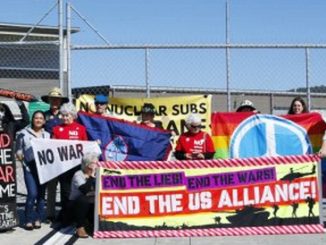
Activists from around Australia joined guests from the Pacific to speak out against the Talisman Sabre war training on July 30 outside the Enoggera Army Base, Green Left reported. The protest heard from guests who addressed the “Calling for Peace in the Pacific” conference, including Indigenous women Naek Flores from Guahan (Guam) and Shinako Oyakama from Ryukyu (Okinawa).


Strugglelalucha256


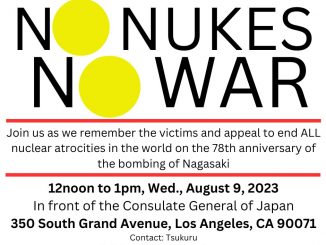
Los Angeles: No Nukes, No War! Aug. 9

August 9 – 12 noon to 1 p.m.
In front of the Consulate General of Japan
350 South Grand Avenue, Los Angeles, CA 90071

Join us as we remember the victims and appeal to end ALL nuclear atrocities in the world on the 78th anniversary of the bombing of Nagasaki.
No More Hiroshimas
No More Nagasakis
No More Fukushimas
No More Nuclear Atrocities, No More Sacrifices, Never Again.

Strugglelalucha256


NYC meeting salutes the 70th anniversary of the Cuban Revolution’s beginning

Hundreds of people packed the Malcolm X and Dr. Betty Shabazz Memorial and Educational Center in New York City on July 29 to commemorate the 70th anniversary of the attack on the Moncada barracks in Santiago de Cuba. They came to denounce the cruel U.S. blockade of Cuba and salute socialist Cuba’s achievements.

Called National Rebellion Day in Cuba, the courageous action on July 26, 1953, against the dictatorship of Fulgencio Batista was the beginning of the Cuban Revolution. It inspired the July 26th Movement led by Fidel Castro that overthrew the U.S.-backed Batista on New Year’s Day, 1959.

The meeting opened with the singing of Cuba’s national anthem.

Ike Nahem of the New York / New Jersey Cuba Sí Coalition welcomed the large delegation from Cuba’s mission to the United Nations.

Nahem and other speakers pointed out that the meeting was held on hallowed ground, where Malcolm X had been assassinated on Feb. 21, 1965. Malcolm X defended the Cuban Revolution and met with Fidel Castro in Harlem at the old Hotel Theresa in 1960.

Rosemari Mealy, J.D., Ph.D., a leading member of the Cuba Sí Coalition, has written a vivid account of this historic meeting in “Fidel & Malcolm X: Memories of a Meeting.”

Nahem paid tribute to four remarkable defenders of Cuba who had passed: Frank Velgara, long-time Puerto Rican activist and a founder of the ProLibertad Freedom Campaign; Pat Fry, a member of the Communist Party, the Committees of Correspondence for Democracy and Socialism, and a union activist in 1199SEIU; Chris Che Matlhako, staunch internationalist and central committee member of the South African Communist Party; and the activist Jane Franklin, author of the classic “Cuba and the United States: A Chronological History.”

Co-chairs of the meeting were Andreia Vizeu, educator and Brazilian democracy activist, and Nancy Cabrero of Casa de las Américas.

Vizeu compared the attack on the Moncada barracks to the people power that freed “Lula” (Luiz Inácio Lula da Silva) from jail and brought him back as president of Brazil. Cabrero paid tribute to Fidel Castro’s determination and compared his leadership to the spirit of José Martí, the apostle of Cuban independence.

Steve Clark, editorial director of Pathfinder Press, which has published 40 books on Cuba and a member of the Socialist Workers Party national committee, described the sacrifices of those who stormed the Moncada. While five revolutionaries were killed in the military assault, 56 were murdered after being captured.

Fortunately, Fidel Castro survived. Clark told how Fidel’s great speech, “History Will Absolve Me,” was smuggled out of prison. Twenty thousand copies were distributed throughout Cuba.

Cuba’s UN ambassador speaks

The meeting’s highlight was the talk given by his excellency Gerardo Peñalver Portal, Cuba’s ambassador and permanent representative to the United Nations. Peñalver is also Cuba’s Deputy Foreign Minister.

“Dear friends, today, more than ever, the solidarity received from you takes on special significance because Cuba is under heavy siege … tied to the blockade, [that] continues to be the central element that defines the policy of the United States to Cuba, ” said the ambassador.

Referring to the lying designation by the U.S. government of Cuba as a State Sponsor of Terrorism, Ambassador Peñalver said, “The consequences of such a designation are extremely harmful for a small nation like ours.

“It gravely damages international financial and commercial transactions … in short, it is a measure that … reinforces the blockade against Cuba. It should not be forgotten that the U.S. government used the COVID-19 pandemic … in its efforts to increase the siege of Cuba. This included actions aimed at preventing our access to basic medical supplies … just at a time when the world needed solidarity more than ever.

“We are pleased that Cuba was able to successfully develop three … COVID-19 vaccines … we were able to vaccinate more than 90% of Cubans in spite of the blockade,” said Ambassador Peñalver.

He continued, “Dear friends … the government of Cuba has expressed its willingness … to foster civilized … relations [with the U.S.] based on mutual respect. … We will continue to promote and facilitate the closest possible ties with numbers of sectors of this country that want to build bridges with Cuba. … Cuba will never renounce its socialist system of social justice. …

“We have the support of many good people in the world like you … who have been tireless defenders of the lifting of the blockade and the right of our people to live in peace and to decide their own destiny.”

The representative of revolutionary Cuba concluded by declaring, “Cuba will not give up and we will continue to resist and overcome. Long live the Cuban solidarity movement in the U.S.!”

New York says NO! to the blockade

Andreia Vizeu led the audience in chanting “Cuba sí, bloqueo no!” She introduced Baba Zayid Muhammad of the Malcolm X Commemoration Committee.

Muhammad pointed out the significance of the meeting being held at the Shabazz Center. “This stage was built on Malcolm’s blood,” he said, referring to the spot of the Black leader’s assassination, adding that Malcolm was killed in front of his wife and four daughters.

Baba Zayid Muhammad recited a fiery “praise poem” about Malcolm X and quoted Assata Shakur, a Black revolutionary given asylum by Cuba. The FBI has placed a $2 million ransom on Shakur’s head but the Cuban people protect her.

A stunning demonstration of drumming was given by members of the Mapuche nation, who described their struggle in Chile and hailed the Cuban Revolution. Alegna Cruz from the Puerto Rican Nationalist Party demanded an end to the U.S. blockade of Cuba.

Nancy Cabrero announced a raffle of artwork with portraits of the Puerto Rican Nationalist Party leader Pedro Albizu Campos, who was tortured in a U.S. federal prison by radiation experiments.

Speakers commented on the New York City Council, representing over 8 million people, passing a resolution calling for lifting the U.S. blockade of Cuba. Many organizations, including the Communist Party and the Democratic Socialists of America, worked to achieve this.

Ninety city councils and labor unions representing millions of people across the U.S. have passed similar resolutions demanding peaceful relations with Cuba. The National Network on Cuba has helped coordinate much of this work.

Vinson Verdree of the December 12th Movement emphasized the hard work it took to pass the New York City resolution. It was important, he said, that it demands Cuba be taken off the bogus State Sponsors of Terrorism list.

Council member Charles Barron played a key role in pushing the resolution through the council. Barron rightfully wants the United States on a list of terrorist countries.

Verdree paid tribute to Cuba’s aid to African liberation. Over 2,000 Cubans died alongside their African comrades in defeating the fascist armies of apartheid South Africa.

Several people, including Gail Walker, Executive Director of the Interreligious Foundation for Community Organization, were recently arrested for merely asking to speak to U.S. Senator Robert Menendez about Cuba. Menendez is chair of the Senate’s Foreign Relations Committee and a hardline supporter of the cruel blockade of Cuba.

One of those arrested was Calla Walsh, a co-chair of the National Network on Cuba, who spoke at the rally. Walsh said that when she and the others were released from jail on June 22, one of the first things she heard was that the NewYork City Council resolution condemning the blockade of Cuba had passed.

Across the United States, the struggle is heating up. Hands off Cuba!

Strugglelalucha256


Notes on creeping fear

“In a Facebook post, the owner of Studio 8 Hair Lab said that anyone who identifies as anything other than a man, or a woman needs to get serviced at a local pet groomer.”

The recent SCOTUS decision (303 Creative LLC v. Elenis) concerning Colorado graphic designer Lorie Smith’s theoretical free speech rights, which now extends to all creative businesses, is a disaster, a nightmare, a present and, now, perpetual, danger. Worse, it appears that the suit is a possible fraud constructed solely to establish this dangerous precedent, the result of which establishes (vaguely) creative business can refuse a client or customer on free speech grounds.

Meanwhile, in Waco, Texas, Dianne Hensley, a judge, has clamed that the 303 Creative case allows her to refuse to perform same-sex marriages. I believe it’s safe to say that a judge should understand the limits of creative speech, including that being a judge is not a creative act. But I think it’s also clear to most of us by now that the folks advancing anti-LGBTQ+ laws in the United States don’t really care what the actual law is. Power is power.

The hair salon in question is located in Michigan. The court case based on a lie emerged from Colorado. The activist judge is in Texas. SCOTUS is in Washington D.C. But the precedent – the danger – is everywhere.

The tiniest hole in the right place can sink the biggest ship.

Because no one knows what the specific precedent set by the 303 creative case is, or what constitutes a creative business, and no one who wants to use it like a lever cares about the actual reasoning and precedent of the decision, it means whatever any individual wants it to mean. “I know the law” as “I did my own research.”

A few weeks back, I was traveling by van through California, Arizona, New Mexico, Utah, and Nevada, mostly in rural areas.

I want to talk about fear, and how it’s held in the body.

When I travel, I stop to do regular stuff, like get gas, buy drinks or snacks, and use the restroom. Sometimes I sleep in hotels. I eat in restaurants. Things you do. I do the same things you do. I have the same needs as you do.

A few months ago, the Texas legislature put forth an anti-trans bounty law, ostensibly to police drag performances, but up to wild interpretation, one thought has consumed me, not just that these laws would legally restrict my travel or my day-to-day life, or be turned against me or cost me my career, health, and home, but that random persons – persons whose interpretations of what these laws and court cases mean is wildly different from what they mean – will act independently on their idiosyncratic interpretation of these laws.

The danger is both inside the law and outside the law.

When I’m traveling, every single time I step out of my vehicle and onto the hot tarmac of a gas station, regardless of what I know or believe my rights to actually be, mentally and physically prepare for worst-case scenarios and could-be-worse scenarios. These range from being screamed at (could-be-worse, I suppose) to being threatened with violence (worse than just general screaming) to actually being assaulted (worst case).

I’m not even sure what my rights are. I’ve never had to track differing levels of personal rights are, on a state-by-state or county-by-county basis. I suppose there’s an app for this. I no longer really know, out of a combination of “too much to follow” and “I am exhausted by looking.” Who can pee in Utah?

Back to scenarios. I’ve been assaulted – it happens faster than you think – faster than you can think. People without experience with violence have a lot of fantasies about violence. People with experience with violence have realities. Are you experienced (in violence)?

Of course, it’s the restroom where fear inhabits the body most. Much has been written about our animal fixation on the toilet as a place of refuge and fear. 1

A restroom is a hard-walled cul-de-sac with a single exit. One enters a second chamber with only one exit, alone, and cannot see what is happening outside. One leans over the hard porcelain sink with its various sharp metal protrusions, back turned to the room. One is distracted by the needs of one’s own body. It’s a place where the mirrors are useful, where you can wash your hands and watch your back at the same time.

You don’t watch behind you while you look in the mirror? Why do you think you don’t?

When I first came out at work, I wasn’t sure what to do about the bathroom. I’m a college professor. I work with students, including a lot of international students who are socialized along gender lines in diverse ways. Part of me thought that I might just keep using the men’s room at my work, since everyone there knows me, and the all gender bathrooms are few, often occupied, and often broken and disgusting. I just didn’t want to make waves. Like anyone else in a bathroom, I mostly just want to be left alone.

I immediately realized that using a men’s room made me feel terribly unsafe – I’ve experienced a lot of violence in my life, but almost all of it has originated with men, and I am a very small person compared to most men. I’m used to males assuming that I am an easy victim.

Using the men’s room also felt confusing – to my self AND others – and I’m already a confusing-enough presence in my workplace. People really only know how to deal with transfemmes when we conform to some very narrow standards of beauty and performance of gender 2, but that’s a whole other story. I’ve always gotten a lot of stares in the men’s room, anyways. I’ve been stared at my whole life.

I haven’t used a men’s room in a long time.

In these little trips to the ladies room, it’s like the whole world goes into slo-mo. I just want to get in and get out, but every action feels urgent. As I wash my hands, I don’t look at them. I look in the mirror, watching the women behind me watching me or not watching me. Someone I know had his head slammed into a sink by his partner, from behind. I think about porcelain and bone while I wash my hands….

In road trip gas stations, I’m not alone in these thoughts.

In Kanab, Utah, it took a while for me to wander around and buy a drink after using the restroom at a gas station, and my traveling companion came back inside to find me – she’s thinking the same things as I am. She was excited and immediately started talking about the bathroom, and we had a whole conversation about it. She’s thinking the same thing – that something bad might happen to me in the bathroom, and it might happen fast.

She’s wondering if she has to do anything to stop it, or if it’s too late.

Of course, I’m presuming if something happens, even if I am battered and bloody, it might be me that ends up in handcuffs – or worse. And, again, I don’t think of the all-too-imaginable worst happening because of the law, but because a rouge actor – maybe one in uniform – doesn’t care about the law or sees the law only as a tool to be used in service to power and base impulses.

America has been dancing with fascism for a long time, now, but the dance is real close, body-to-body, these days.

Fascism is all about power – power and the fear of losing it. Fascists have long rendered certain persons subhuman, and now an American hair salon owner compares transgender people to animals…. How does one oppose fascism? Can one rob it of its power? Or must one overpower it? The latter seems less poetic, but more likely – and more dangerous.

The danger is exhausting. The exhaustion is the fear and the fear is in the body. The exhaustion, like the cruelty, is the point.

* * * * *

About two weeks ago, I was watching the livecast of the Glendale Unified School District board meeting. For those not in the know, Glendale has become ground zero for alt-right and anti-LGBTQ+ and anti-trans activists in California. The community is very conservative and there is a very clear effort going on to mobilize candidates and votes to flip the school board to become an activist board for a variety of ultra-right or neo-fascist agendas.

During the meeting, nearly all public comment came from activists, as real violence and threats of violence have been experienced by those who have protested attempts by Proud Boys, Moms for Liberty, and various anti-LGBTQ+ groups and individual activists to force an agenda on the Glendale Unified School District – emphasis here on the word force. The heat is so high, and the potential for real violence has risen to a level that counter-protestation is not safe.

What struck me most during the meeting was how the various speakers seemed to wildly interpret board rules, the law, language, etc…. One speaker talked about the board as if it were a corporation and made a variety of small business analogies that were useless. One speaker used multiple commenting opportunities to campaign for a seat on the board. Multiple speakers invoked religion or used wildly incorrect language to discuss mental health topics, and not in the context of anti-trans bigotry. One proposed a scenario in which he would murder someone for speaking to his child. There were, of course, lots of ad hominem attacks made on individual board members.

It was a hard watch, because the board is not allowed to react or comment, so the speakers are basically given several minutes to rant without any challenges. It presents the notion that these statements might be sensible or that they go unchallenged. The board is considering new rules that would reign in this situation, but they are not in effect, and, of course, those rules will not be perfect, and the same actors will likely find ways to game them to some degree.

Since this meeting, which disturbed me so, at another meeting in Chino, where Proud Boys guarded anti-LGBTQ+ activists, after voting to force teachers and administrators to out trans students to their families, the Chino School Board had the police throw out the California State Superintendent of Public Instruction. And, since that meeting, Moms for Liberty, a hate group born out of Florida’s anti-mask and anti-vax movement, that feels very much like the women’s auxiliary of the Proud Boys, the “Pinkshirts” to “America’s Brownshirts,” held a training camp for to prepare activists for local office campaigns at the Glendale Hilton.

It feels as if Los Angeles is becoming encircled by hate – Temecula, Fullerton, Huntington Beach, Chino, Glendale, etc… ringing the city where I live. These meetings in smaller cities are anything but small – the Glendale school district budget is $300 million dollars, and it’s all too easy to seize control of the board that oversees it.

The meetings sound like rolling thunder in the distance. Each week the thunder grows closer. Every passing day, the 2024 election gets closer.

I spend a lot of time in Glendale. I no longer feel safe in that city, even just parking my car and walking to the front door of someone’s home, I feel very much like I did at that gas station in Kanab, Utah. I am starting to look at my neighbors differently, and I wonder if they’re looking at me differently, too.

Anything can happen. Anything IS happening. And it’s happening, here.

Source: Badly Licked Bear’s Wordpile

Strugglelalucha256


NYC Book Signing: Cleophas Williams, My Life Story in ILWU Local 10, Aug. 5

“Cleophas Williams, My Life Story in the Int’l Longshore Union Local 10”

Saturday, August 5

From 2 pm to 5 pm

St Mary’s Episcopal Church – Harlem
521 West 126th Street, NYC 10027

Cleophas Williams’ story as told by himself, will be introduced by Clarence Thomas, a leading African American radical labor and community activist.

“The history of African Americans in the Int’l Longshore & Warehouse Union (ILWU) in San Francisco is indeed worthy of docu­­­men­tation. Such an individual is Cleophas Williams, whose distinguished career as a member of the Local 10 spanned 38 years.

“Cleophas Williams’ election as president of ILWU Local 10 in 1967, made him the highest elected African American to serve as an officer in the entire ILWU.

“Born in rural Camden, Arkansas, and part of the great migration to the Bay Area, he arrived in Oakland, California, in 1942 – seeking to escape the horrors and multifaceted structures

of systemic racism and white supremacy. He was amongst the leaders who placed Local 10 into the vanguard of the labor movement by engaging in civil-rights unionism and other social movements in the 1960s and 1970s.

“Here is Cleophas Williams’ historic journey – his rise in Local 10 within the greater context of the Black liberation movement.

– Clarence Thomas


Review by Sadie William

“My eyes were filled with tears of joy when I saw the cover of this book! Cleophas wrote every day about something from current events, trips, people, history of his church, life, and his beloved union. Many have said they found the book hard to put down, so did I. I have read it twice, and learned something new each time. Hopefully this will be your experience as well.

– Sadie Williams is the 99 year old spouse of Cleophas Williams


Review by Gloria Verdieu

When I received this beautiful book from Delores Lemon-Thomas and Clarence Thomas, I could not wait to begin reading it.

I had the honor of meeting and talking with Sadie Williams, wife of Cleophas ­Williams, on two occasions. Once in Oakland at her home at the Cleophas Williams Rose Garden dedication shortly after the book “Mobilizing in Our Own Name: Million Worker March” was published and again about a year later at the ILWU Pacific Coast Pensioners Association convention in Long Beach, Calif.

Each time she was surrounded by ILWU Local 10 members engaging and embracing her presence with love and respect. I was surprised when I went to introduce myself in Long Beach, and she said, “I remember you,” and opened her arms for a hug.

In Long Beach, Delores let me glimpse some of the scanned pages of Cleophas Williams’ handwritten journal. I held it in my hand and immediately began to read it. Delores left the journal with me for a little while.

As I examined it, I was impressed with his handwriting or, more formally, his penmanship. There are a few samples of his handwriting in the book, one on page 52 at the beginning of Chapter 2, “A Longshore Worker’s Life Story.”

Delores told me about Clarence’s intention of editing and publishing Cleophas Williams’ story. The pages would have to be scanned, which required them to keep the original transcript for a while. It was hard for Mrs. Sadie ­Williams to part with it, even for a short time, but she could rest assured that it was in good hands. This journal is a treasure that will be valued for generations to come.

I read through the book quickly the first time and reread it, reflecting on my own life and making connections. I was also brought up in the South, and one of the many things that resonated with me was when Williams wrote about the Booker T. Washington High School that he and his sister attended. The school was “built by the Julius Rosenwald Fund, which builds schools for Black ­Students throughout the South where there were no Black schools.”

The segregated school my eight siblings and I attended, ­Carver School, named after George Washing­ton Carver, was built in 1915 using the same fund. It was renamed Carver-­Hill School in 1955 after Reverend Edward Hill, who fought for well-­funded schools for Black students.

There is much to be learned from this biography; the history of how Cleophas Williams was elected by popular vote the first African American president of ILWU Local 10, the most militant, progressive union in the United States, if not the world.

In the book, Cleophas explains that he was discharged from the army due to a knee injury after serving three months and 19 days. He heard a fellow “telling a barber that he was a Longshoreman; pay was good, and it had peacetime possibilities.” So he applied, followed the steps needed, and was hired with no idea that, in his words, “I was about to embark on a journey that not only brought me employment, but a place in the sun that I would have never dreamed of.”

Williams knew nothing about the ILWU when he was hired, but he was a fast learner and followed all the rules. After the 6-month probationary period, he was promoted to full union membership. Williams worked as a rank-and-file worker for 15 years, working out of the hall, attending union meetings, enrolling in the California Labor School, and just continuing to learn before deciding to run for president of ILWU.

Williams acknowledged the shoulders of those ancestors who paved the way and those that gave him much-needed support; apologized to people he hurt along the way. He took responsibility for his mistakes, not blaming his parents or the tragic experiences of growing up in the “Jim Crow” South.

Williams was a courageous working-class organizer, a fighter for social justice and the rights of workers nationally and internationally. He believed the struggle for social justice, equality, and dignity was a workers’ struggle.

I highly recommend employed, unemployed, organized, and unorganized workers read Cleophas Williams’ “My Life Story in the International Longshore & Warehouse Union Local 10.”

Gloria Verdieu is a journalist for Struggle-La Lucha Newspaper; editor of “Black August 1619-2019” (2029) and a co-editor of “Mobilizing in Our own Name, ­Million Worker March” (2021) Verdieu is a San Diego activist; member of Committee Against Police Brutality and the Free Mumia Abu-Jamal Coalition.

Review by Harvey Schwartz

Cleophas Williams, My Life Story in the International Longshore and Warehouse Union, Local 10, is a welcome addition to the rich literature about the famously progressive ILWU. ­Williams (1923-2016) was a four-time Local 10 president, the first African American to hold that office, and an iconic figure in the union’s history. Former Local 10 Secretary-Teasurer Clarence Thomas describes him in the volume’s introduction as the Jackie Robinson of the ILWU.

The book is a collection of Williams’ writings, including a previously unpublished 92-page manuscript, brief occasional pieces, and other offerings. It was compiled by Thomas and edited by his wife, Delores Lemon-Thomas, with the support of Cleophas’s widow Sadie Williams and Sade’s daughter Jackie Chauhan. The great strength of the book is its accessibility. It presents Williams’s recollections in rich narrative form in his own powerful voice.

Cleophas Williams is divided into two distinct and informative sections. The first focuses on Williams’s personal life from his youth in the Deep South during the Great Depression of the 1930s through his early career as a longshore worker and Local 10 activist in Northern California between 1943 and 1967. Williams relied on his strong family background, his religious faith, and his belief in education to survive and persevere despite the challenges of poverty and southern Jim Crow racism. In ­California, he became a civil rights advocate and an elected job dispatcher in his local. He won the first of his four terms as Local 10 president in 1967.

In the second section of the book, Williams explores the intersection of union politics and race in Local 10, which has had an African American majority since 1959. In running for office, Williams had to contend with a conservative, white-led faction in the local. Going beyond this problem to review other issues, Williams analyses race and politics in the local in complex and sometimes troubling terms. At one point he perceptively observes, “Racism made monsters out of us all…. We seek a utopia but we are not there yet.”

This second section of the book begins with the period immediately after World War II. Williams vividly describes pre-container break-bulk-cargo handling and has insightful observations about the 1946, 1948, and 1971 ­longshore strikes. He recalls how ILWU founder and long-time International president Harry Bridges defended African American longshore workers from job losses during a post-war decline in cargo tonnage, and he recounts Black-led Local 10 efforts to protect the Australian-born Bridges from deportation. Williams also traces Local 10’s sustained push to integrate many of the best jobs on the Bay Area waterfront. He retired from the job — but not from the struggle, as members of the ILWU Pacific Coast Pensioners Association put it — in 1981.

Cleophas Williams can be read profitably by all members of the ILWU, regardless of their local or their background. Everyone who is interested in work and unionism will benefit from reading it. The book contains a useful glossary, a helpful index, and numerous attractive illustrations.

Harvey Schwartz is curator of the International Longshore & Warehouse Union (ILWU) Oral History Collection at the union’s library in San ­Francisco. His writings include “Solidarity Stories: An Oral History of the ILWU”(2009); “Building the Golden Gate Bridge: A Workers’ Oral History” (2015) and “Labor under Siege, Big Bob McEllrath and the ILWU’s Fight for Organized Labor in an Anti-Union Era”, co-authored with Ronald E. Magden (2022), books published by the University of Washington Press. He holds a Ph.D. in history from UC Davis and specializes in West Coast maritime history.


“Cleophas Williams,
My Life Story in the Int’l Longshore Union Local 10”

DeClare Publishing, 2023
Order in hardcover, ebook and paperback from

millionworkermarch.com/cleophas-williams-book

Strugglelalucha256
https://www.struggle-la-lucha.org/2023/page/31/