Rudy Giuliani was always a no-good racist scoundrel

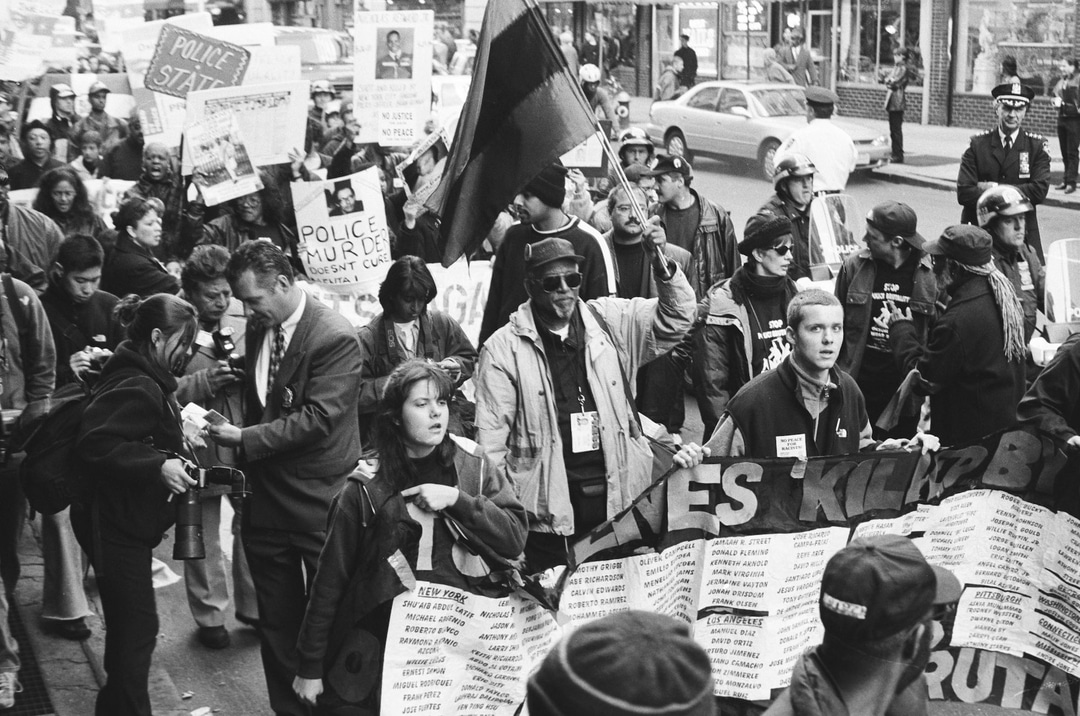
New Yorkers protesting Mayor Giuliani back in 1998. Photo: Dan Martensen

The corporate media has been obsessed about the downfall of their former hero, Rudolph Giuliani. The ex-mayor of New York City was seen leaving 2nd Chance Bail Bonds in Atlanta after surrendering to authorities as one of Trump’s co-conspirators.

Long gone were the days in 2001 when Time magazine made him — of all the billions of human beings — its “person of the year.” Comedian David Letterman gushed over Giuliani on The Late Show while Queen Elizabeth made him a Knight Commander of the Most Excellent Order of the British Empire.

These accolades were bestowed because of Giuliani’s supposed heroics on Sept. 11, 2001. So what did Giuliani mean when he said to ABC’s Peter Jennings that “we were told the World Trade Center was going to collapse”?

Who knew the South Tower (WTC 2) would crash at free-fall speed? And why weren’t the firefighters inside told, 343 of whom were killed?

Giuliani should have been jailed a long time ago. As President Reagan’s Associate Attorney General in the early 1980s, Giuliani was torturer-in-chief of Haitian immigrants.

Over 2,000 Haitian immigrants were kept in squalid conditions at Miami’s Krome Avenue concentration camp and other detention centers. They were denied access to lawyers, while dozens had attempted suicide.

Reagan kept dictator “Baby Doc” Jean-Claude Duvalier — the son of “Papa Doc” François Duvalier — and his Tonton Macoute thugs in power. In what was not meant to be an April Fool’s joke, Giuliani claimed on April 1, 1982, that repression in Haiti “simply does not exist now.” 

Eighteen years later, on March 16, 2000, one of Mayor Guiliani’s undercover cops profiled and tried to entice the Haitian security guard Patrick Dorismond into a drug deal. When the father of two indignantly rejected the proposition, he was killed.

Giuliani demonized the dead victim, and his police attacked mourners attending Dorismond’s funeral, arresting 27.

The New York 8+ attempted frame-up

Giuliani and Trump were indicted on charges under Georgia’s Racketeer Influenced and Corrupt Organizations (RICO) Act. Rudy loved using the federal RICO statute when he was the U.S. Attorney for the Southern District of New York.

Prosecutors adore conspiracy charges, of which RICO laws are an example. It allows them to use hearsay testimony more easily.

Organizing labor unions was once considered to be an illegal conspiracy. Clarence Darrow brought a halt to this frame-up method as a union lawyer during an 1898 strike in Oshkosh, Wisconsin.

Giuliani used RICO charges against the “five families” that supposedly controlled organized crime in New York. New Jersey initially denied a gambling license for Donald Trump to open a casino because he worked with organized crime.

The world’s biggest crime families don’t have vowels at the end of their names. These dynasties have names like Rockefeller, DuPont, and Mellon.

While the media considers it ironic that Giuliani is now facing RICO charges, it’s silent about Giuliani’s using the RICO act to jail liberation fighters in New York City.

In the fall of 1984, 500 cops and federal agents staged terror raids in New York City’s Black communities to round up defendants for a show trial. Irin Carmon described in New York magazine the raid on the home of Dorothy Roberts, the noted lawyer and author of “Killing the Black Body,” whose husband Coltrane Chimurenga was one of those targeted:

“One evening in October 1984, Roberts was at home with her 2-year-old and her 3-month-old when the phone rang. The FBI and the NYPD’s joint counterterrorism task force, she was told, was waiting at her door. Placing the toddler in the crib and hoisting the baby on her hip, she opened the door to what felt like dozens of armed officers, who began to interrogate her and ransack the apartment.”

Coltrane Chimurenga, Viola Plummer, Ruth Carter, Omowale Clay, Yvette Kelley, Jose Rios, Robert Taylor, and Roger Wareham faced fantastic charges of conspiring to rob banks and Brinks’ trucks and to stage jailbreaks. Even their political activity was claimed by the government to violate the RICO Act!

Giuliani was the inquisition’s ringmaster. He impaneled eight grand juries to get around the rules that spouses can’t be forced to testify against each other.

The tactic blew up in Giuliani’s face. People went to jail instead of lying. It’s to recognize these courageous grand jury resisters that this case is called the New York 8 “plus.”

No bail for Cop City defendants

Trump and Giuliani had their mug shots taken but didn’t have to spend time in Fulton County jail. Seven inmates have died so far this year in the overcrowded, cockroach-infested facility.

Among them was Lashawn Thompson, whose body was covered in lice and bedbugs.

While Trump and his co-conspirators are being accorded their rights, that’s not the case for those protesting Atlanta’s Cop City. The proposed police training facility, costing $90 million, will be the largest in the country.

It will include a replica of a city block where cops can practice urban warfare. People want its planned 300 acres to be turned into a city park and urban forest.

The unarmed protester Manuel Esteban Paez Terán, known as Tortuguita, was killed at the site on Jan. 18 by local police, Georgia Bureau of Investigation agents, and State Patrol officers.

Dozens of protesters have been arrested on domestic terrorism charges. Many were refused their Eighth Amendment right to bail.

Three activists associated with the Atlanta Solidarity Fund were arrested on May 31. They were charged with money laundering for helping to raise bail money for the defendants. That’s what fascism looks like.

Giuliani is the real domestic terrorist. His cops fired 41 shots at the unarmed Amadou Diallo on Feb. 4, 1999, killing the African immigrant. His kicking 640,000 poor people off welfare was also terrorism.

The people’s movement needs to defend the Cop City protesters. Trump and Giuliani can rot in jail.

Strugglelalucha256


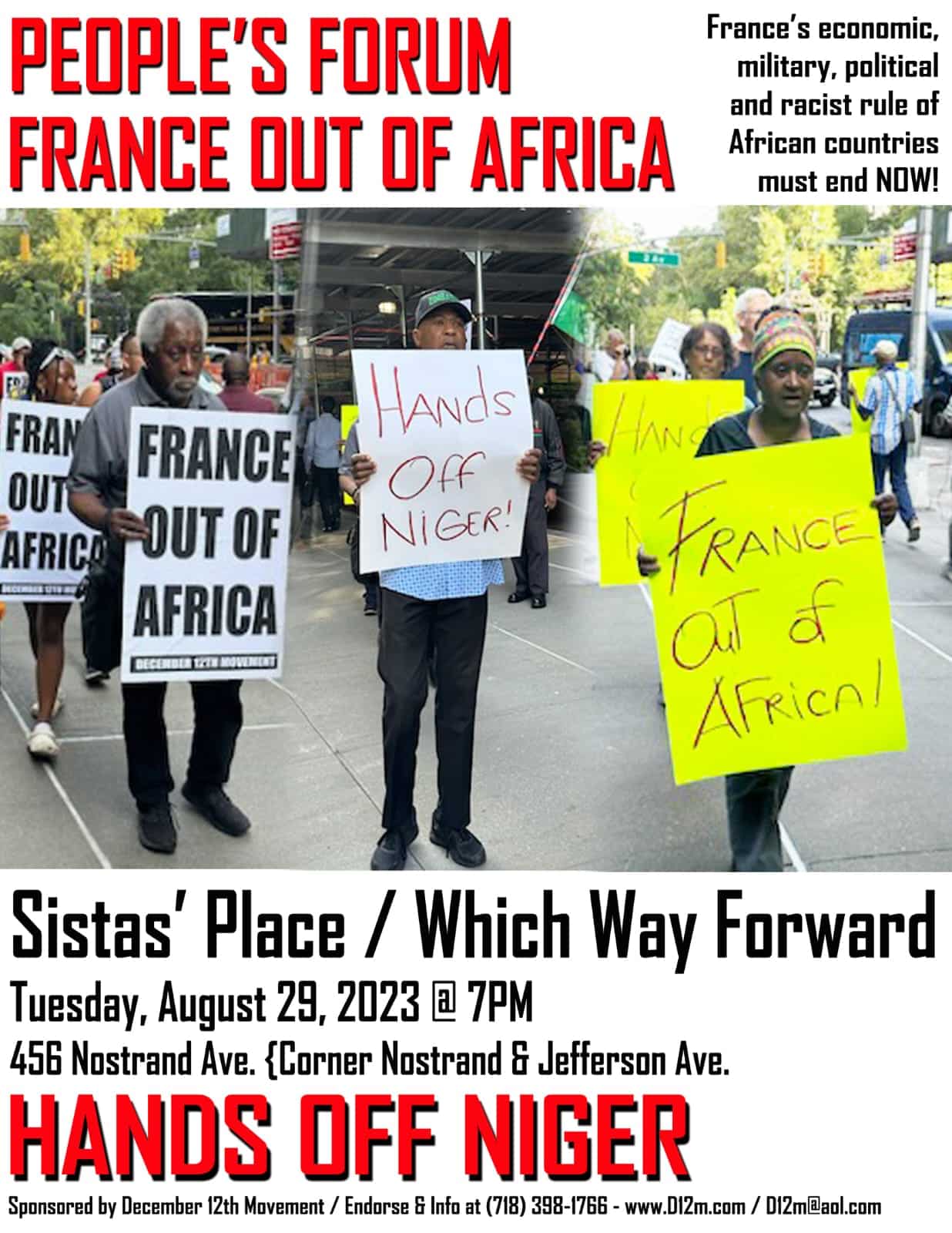
Brooklyn Forum: France Out of Africa – Hands Off Niger, Aug. 29

Tuesday, August 29 – 7 p.m.
Sistas’ Place / Which Way Forward
456 Nostrand Ave. (corner of Nostrand & Jefferson Aves.), Brooklyn, NYC

France’s economic, military, political and racist rule of African countries must end NOW!

Sponsored by December 12th Movement
Endorse & info at (718) 398-1766
D12m.com
D12m@aol.com

Strugglelalucha256


China’s Xi vows to support Cuba in defending Cuba’s sovereignty

China’s President Xi Jinping has pledged to support Cuba’s defense of its national sovereignty, opposing foreign interference and a U.S. economic blockade, and will expand strategic coordination with Havana.

Xi made the remarks in a meeting with Cuba’s President Miguel Diaz-Canel on the sidelines of the BRICS Summit in Johannesburg on Wednesday, according to a statement from the Chinese foreign ministry on Thursday.

“China highly appreciates Cuba’s consistent firm support for China on issues involving China’s core interests, and will continue to firmly support Cuba in defending its national sovereignty, opposing foreign interference and blockade, and doing its best to provide support for Cuba’s economic and social development,” Xi said at the meeting, according to the release.

During talks, Diaz-Canel labeled Cuban-Chinese relations at an “all-time high.”

“The Cuban people greatly admire President Xi Jinping and sincerely thank China for its understanding and valuable support for Cuba’s just cause,” Diaz-Canel said at the meeting, which was also attended by Chinese Foreign Minister Wang Yi.

The meeting between the two leaders comes months after a media report surfaced that China had reached a secret deal with Cuba to establish an electronic eavesdropping facility on the island. But the U.S. and Cuban governments cast strong doubt on the report.

China quickly denounced the U.S. government and media for releasing what it called inconsistent information, calling the allegations false.

Miguel Díaz-Canel Bermúdez met with Xi Jinping in the framework of the XV BRICS Summit.

From his Twitter account, the Cuban president announced the meeting and expressed the decision of both presidents to comply with the collaboration agreements between the nations. It said:  “In the context of the XV Summit of the #BRICS, I met with the President of the People’s Republic of China, Xi Jinping. We ratified the will to implement the important consensuses adopted during our visit to Beijing in 2022 for the benefit of both peoples.”

Díaz- Canel Bermúdez pointed out that “we noted a willingness to deepen inter-party ties and the close ties of friendship and cooperation.”

“I appreciated China’s solidarity and support for the just demand for the end of the blockade and the exclusion of Cuba from the list of state sponsors of terrorism,” said Miguel Díaz-Canel Bermúdez.

The Cuban president also held a meeting with leaders of the tripartite alliance of the South African Government, made up of the African National Congress, the South African Communist Party, and the Congress of South African Trade Unions.

“We expressed the willingness of our Communist Party of Cuba (PCC) to continue strengthening party ties. I appreciated the support and solidarity with Cuba,” said the head of state.

Source: Countercurrents

Strugglelalucha256


Ecuador: National referendum ending oil exploitation in the Amazon is victorious

While most of the focus was on the general elections in Ecuador, a national referendum was held on oil exploitation in the Amazon. In addition, in a regional referendum, the inhabitants of Quito voted on mining. In both cases, the vote to stop exploitation triumphed.

The long struggle to save Yasuní Biosphere Reserve reached a milestone this Sunday when the majority of the Ecuadorian population voted in favor of keeping the existing oil in Block 43 in the ground. This also includes the Ishpingo, Tambococha, and Tiputini fields. The yes vote was 59%, while the no vote to continue exploitation was 41%. The referendum was held in the context of the presidential and legislative elections where the correaist got 33%  and the  Guayaquil businessman Daniel Noboa 24% advancing them both to the second round to be held on October 15.

The oil block 43 is partially located within the Yasuní National Park (Ecuadorian Amazon), one of the areas with the greatest biodiversity on the planet and which, together with the neighboring Huaorani Ancestral Territory, was declared a biosphere reserve by UNESCO in 1989. It is also home to the Tagaeri and Taromenane, the last peoples in voluntary isolation in Ecuador.

After the failure in 2013 of the Yasuní Initiative presented by the government of then President Rafael Correa, it was announced that the block would be exploited. It was then that the environmental group Yasunidos was formed, which immediately submitted a question to the Constitutional Court to call for a referendum and for the Ecuadorian people to decide on this issue: “Do you agree that the Ecuadorian government should keep the crude oil, known as Block 43, indefinitely in the subsoil?”.

Bogged down in a process that would later be recognized as fraudulent, neither the question nor the consultation were approved at that time, so Yasunidos began a tortuous legal battle that would take 10 years and cross three governments. Along the way, that is, starting in 2016, the Block 43 began to be exploited after the declaration of national interest that former President Correa had requested to the National Assembly in 2013 came into force. After the official proclamation of the results this Sunday, the operations must now stop and, according to the law, the state-owned Petroecuador will have one year to dismantle its facilities and leave that area of Yasuní. However, Petroecuador officials have indicated that the withdrawal would take at least five years since there are around 230 wells in operation there.

“This is something historic. Ecuador has taken the first concrete step to fight climate change and has set a global example,” says Antonella Calle, spokesperson for Yasunidos. “That is very important because it forces countries around the world to make real decisions in this regard. On the other hand, this shows us once again that the Ecuadorian people are in favor of defending life, nature, the rights of people and animals.”

Opposing figures and campaigns

The Government of Guillermo Lasso has sustained the argument of the supposed economic loss that the State would incur by ceasing to exploit block 43: 1200 million dollars per year, considering that, according to his figures, that was the income achieved in 2022. Petroecuador’s manager, Ramón Correa, has also pointed out that in 20 years, the loss would total US$ 16.47 billion, which includes US$ 13.8 billion for oil revenues not received; US$ 467 million for the cost of abandoning the block; US$ 1.952 billion for the infrastructure and facilities that will have to be removed, and US$ 251 million for social compensations.

Carlos Larrea, economist, and member of Yasunidos has pointed out that this calculation is inaccurate since it is the result of multiplying 55,000 barrels of oil that Block 43 supposedly produces per day (about 12% of the country’s total production), 60 dollars per barrel and 365 days of the year. In this way, 1.2 billion is achieved, but in exports, not in income for the State. Larrea argues that the price of $60 per barrel is unrealistic since 2016 when exploitation of that block began, the price has been $51. Moreover, the calculation does not consider the cost of extraction, which is $35 per barrel, and the fact that it is a crude that contains too much water (11 barrels of water for each barrel of oil), which reduces its quality and makes it difficult to extract. The Minister of Energy himself, Fernando Santos, had said about this oil that “it was a disappointment,” that it is a “very heavy tar,” and that the enormous amount of water it contains “finds a way out to the surface and drowns the well”.

Countering the eventual losses pointed out by the Lasso government, Yasunidos has mentioned some alternatives, among them to eliminate the tax exemptions granted by the State to the richest groups in the country. According to information from the Internal Revenue Service (SRI), in 2021, Ecuador stopped receiving 6,338 million dollars for this reason, which in only one year is 30% more than what it would receive for exploiting the ITT block for 33 years.

While the Government’s strategy was to replicate the figures of the alleged losses through various spokespeople and with the main information media at its disposal, the campaign for a “yes” vote concentrated on the defense of natural resources, biodiversity, the territory of plants, animals and Amazonian peoples, with emphasis on the fact that this is not only Ecuador’s heritage but that of the world.

Rich in audiovisual products and very active in social networks, the Yes campaign stood out for its vitality and multiple voices. Although it radiated a mostly youthful energy, it was also careful to generate messages targeted to specific sectors, including academia, coastal populations, and indigenous peoples and nationalities.

“The beauty of this campaign is that it was megadiverse; like Yasuní,” says Antonella Calle. “Many wills from different parts of Ecuador and the world have joined in; various sectors of society, not only environmentalists. It has been a struggle from the heart, activism and the hope of defending life”.

Among the foreign personalities who backed the yes vote were activist Greta Thunberg and actors Leonardo DiCaprio, Mark Ruffalo, Jason Momoa, and Gael García Bernal. “Ecuador could become an example of democratizing climate policy, offering people the opportunity to vote for the forest, indigenous rights, the climate and the well-being of the planet,” DiCaprio wrote on his social networks.

With the outcome of the referendum now comes the phasing out of the ITT oil facilities. “We are going to make sure that the oil tankers leave our sacred forest as soon as possible,” says Nemonte Nenquimo, an indigenous leader, member of the Huaorani nationality, and winner of the Goldman 2020 environmental award. “And we are going to share this model of direct action on climate change with all peoples and countries, because at this time of climate crisis the world needs models of struggle that put power in the hands of the people.”

Another yes to stop mining

Parallel to the Yasuní consultation, the inhabitants of the Metropolitan District of Quito voted in a referendum on mining in six of its rural parishes in the northwest, which make up the Chocó Andino commonwealth, a territory of 287,000 hectares also declared a biosphere reserve by UNESCO. This is another area with very rich biodiversity, where 270 species of mammals, 210 reptiles, 130 amphibians, and 227 varieties of orchids have been recorded.

In this case, the will to stop the advance of mining obtained 68% of the votes. “This triumph has the weight of what the people want and need, because we citizens must be the ones to build democracy,” says Inti Arcos, spokesperson for the Quito Without Mining collective, which promoted the consultation. “It is the expression that we want a different world and that it is possible for economic alternatives to emerge that respect human rights and the rights of nature. As a society we have entered a fatal circle of violence, and mining was going to bring us more violence, because violence means entering the territories and destroying nature and the lives of the people.”

In the Andean Chocó, there are already twelve copper, gold, and silver mining concessions of artisanal, small, medium, and large scale in early stages of exploration. The yes vote in this consultation will prohibit mining at these four scales and the granting of new concessions, but existing projects will remain active.

Source: Resumen Latinoamericano – Buenos Aires

Strugglelalucha256


The people do not want war: mass protests continue in Niger against ECOWAS threats

The political situation in Niger and West Africa as a whole continues to be in flux. While people and their movements across the region are mobilizing against war and neo-colonial intervention, regional bodies have taken a stand in favor of the status quo.

In a communique released on August 22, the Peace and Security Council (PSC) of the African Union (AU) announced its decision to suspend Niger from all the bloc’s activities in response to the July 26 military takeover. The declaration released by the PSC on Tuesday had been adopted at a meeting held on August 14.

While it had been indicated that the AU would not back an intervention in Niger by the Economic Community of West African States (ECOWAS), the PSC stated that it had taken note of the regional bloc’s decision to activate a “standby force,” welcoming the communique in which this decision was taken by ECOWAS on August 10. The PSC has called upon the AU Commission to “undertake an assessment of the economic, social, and security implications” of such a deployment.

It has also urged all member states to “refrain from any action likely to grant legitimacy to the illegal regime in Niger” and has also endorsed the severe sanctions that ECOWAS has imposed on Niamey, calling on members to “fully implement” these measures.

It further rejected any interference by any actor or country outside Africa in the continent’s peace and security affairs, “including engagements by private military companies.”

These statements have emerged as Niger continues to witness mass protests in favor of the military leadership and in rejection of the threat of a West-backed invasion by ECOWAS.

Thousands of people took to the streets in Niger’s capital of Niamey on August 20. With slogans of “No to sanctions,” “Down with France,” and “Stop the military intervention,” the protest was held a day after the regional bloc dispatched another mission to Niger to hold talks with the military leaders, the National Council for the Safeguard of the Homeland (CNSP). Meanwhile, thousands of women also gathered in the Dosso region on Saturday, denouncing France and ECOWAS while expressing their support for the CNSP.

After previous failed attempts, the ECOWAS officials, led by former Nigerian president Abdulsalami Abubakar, finally met with the head of the CNSP, General Abdourahamane Tchiani, on Saturday afternoon. The mission then met with ousted president Mohamed Bazoum, who has been in custody since July 26.

“Neither the CNSP nor the people of Niger want war, and remain open to dialogue,” Tchiani stated after the meeting.

Importantly, while much of the focus of the public anger has been on France as the colonial and neo-colonial power, hundreds of people gathered in Agadez on Saturday to demand the closure of the U.S. drone base located in the city, as well as the removal of the 1,100 U.S. troops present on Nigerien soil. Known as Air Base 201, the site is considered to be the “largest base-building effort ever undertaken by troops in the history of the U.S. Air Force.”

The U.S. suspended its military cooperation with Niger shortly after the coup. It is now reportedly preparing precautionary plans to vacate its bases in Niger and redeploy its forces to other countries in the Sahel and Saharan regions. While France has been more open in its backing of ECOWAS’ “all measures necessary” approach and repeatedly called for the reinstatement of Bazoum, the U.S. seems to be more keen on negotiations.

On August 21, the state-owned Radio Algerie reported that Algeria had denied a request by France to fly over its airspace for a possible attack on Niger. The allegation was denied by the Chief of Staff of the French army. Algeria has firmly rejected any military intervention in Niger as a “direct threat” to itself, warning that such actions could inflame the entire Sahel.

According to the French newspaper Le Monde, in the hours following the coup, France had received a request from the Nigerien army to intervene. However, according to the source cited in the report, the “loyalists changed sides and joined the putschists.” On July 31, Niger’s military leadership also accused France of holding a meeting at the headquarters of the National Guard to seek the necessary political and military authorizations.

Meanwhile, following a visit by the Acting U.S. Deputy Secretary of State, Victoria Nuland, to Niamey, the U.S. has now sent Ambassador Kathleen FitzGibbon: “Her diplomatic focus will be to advocate for a diplomatic solution that preserves constitutional order in Niger and for the immediate release of President Bazoum, his family, and all those unlawfully detained.”

Intervention threatens ECOWAS split 

The ECOWAS delegation’s arrival followed a meeting between the bloc’s chiefs of defense staff in Ghana between August 17 and 18, following which it was announced that the “D-Day” had been decided for an intervention.

ECOWAS has repeatedly invoked the threat of military action despite opposition by countries both within and outside the bloc, who have warned that any such action could further destabilize the Sahel region as a whole. Moreover, people and political parties in countries including Senegal and Nigeria have also rejected their leaders’ decision to commit troops for the same.

Meanwhile, Mali and Burkina Faso—who were sanctioned and suspended from ECOWAS following popularly-supported, anti-French coups— have maintained that any action against Niger will be interpreted as a declaration of war against them. Speaking to Sud FM, Mali’s Prime Minister Choguel Maïga stated, “If ECOWAS goes to war in Niger, there is no longer ECOWAS. But that is the objective of some countries from the start, to break ECOWAS. They do not want African countries to unite.”

Burkina Faso’s defense minister, Colonel Kassoum Coulibaly, told Sputnik that not only would the country support Niger, it was also ready to withdraw from ECOWAS— “We have no right to fight each other. We are part of a single economic union. The very idea that some states of the association want to wage an internecine war is shocking. It is also shocking that some heads of state want to wage war against other countries under the guise of democracy.”

On August 18, in a “translation into concrete actions of their commitments,” Mali and Burkina Faso deployed combat aircraft to Niger, reported RTN. The news agency added that 311 trucks carrying various goods from Burkina Faso had arrived in Niger over the weekend.

Shortly after the coup, ECOWAS suspended Niger and proceeded, along with the West African Economic and Monetary Union, to impose extreme, sweeping sanctions on the land-locked country, including closing down borders, a ban on commercial flights, the suspension of commercial transactions and financial assistance, and the freezing of national state assets in both the regional central bank (the BCEAO) and commercial banks.

The border closures have also wreaked havoc on the livelihoods of communities living in the surrounding areas.

Aid agencies have warned of the drastic toll these measures will have on the already precarious humanitarian conditions in Niger, including putting two million children at risk of severe malnutrition. Niger’s dependency on aid, with foreign financing accounting for 40% of the national budget, is very much a function of the decades of neo-colonial extraction that have created a situation where despite being among the world’s biggest producers of uranium, over 40% of Niger’s population is impoverished.

This manufacturing of aid dependency, which is then used as a tool of coercion, has had disastrous consequences for other countries around the world who have been subject to similar imperialist and neo-colonial interventions.

CNSP to hold “inclusive national dialogue” to outline transition period

In a televised address on the evening of August 19, Tchiani reaffirmed that an ECOWAS intervention would be treated as an occupation and that Niger would respond to any aggression while also warning that an intervention would affect all countries in the region. He also stated that the CNSP was ready to engage in any dialogue accepted by the people.

Meanwhile, huge crowds of people gathered outside a stadium in Niamey on Saturday to sign up for “The Mobilization of Young People for the Homeland” as volunteers for defense roles in the event of an intervention.

Tchiani stated further that Niger would not surrender to ECOWAS sanctions, calling them illegal and inhumane and aimed at dividing and subjugating the country and its people, noting that the measures had led to the loss of medical materials at the border.

Notably, Tchiani proposed a three-year transition period for the country — “We do not seek power, but we will not accept the [subjugation] of the will of the people” — and announced the convening of a 30-day “Inclusive National Dialogue” between the CNSP and the people, to define the fundamental principles that should govern the transition, its duration, and the national priorities during this period.

Meanwhile, people’s movements in the region have continued to express their vehement rejection of the ECOWAS’s planned intervention as well as the “illegal and barbaric” sanctions imposed on Niger. Warning that the danger of an “imperialist war being unleashed against the peoples of Niger, and a subsequent general conflagration in the sub-region” had continued to grow, the West Africa Peoples Organisation (WAPO) expressed its solidarity with the “besieged people of Niger” in a statement on August 16.

It has called upon all its member as well as non-member organizations to protest at French embassies in their respective countries, to demand the dismantling of every foreign military base from the sub-region, and has called for the urgent lifting of all sanctions against Niger. It has also called for the establishment of Solidarity Committees in every country to express their rejection of “the current imperialist aggression against the peoples of the Sahel and Niger.”

This work has already started in parts of the region, WAPO Secretary General, Kafui Kan-Senaya, told Peoples Dispatch, including with the launch of the Benin-Niger Solidarity Campaign, which has denounced the “illegal, criminal and inhuman sanctions of ECOWAS” and called for the “immediate cessation of war preparations” and saying no to the deployment of the Benin Armed Forces for the intervention.

Moreover, he added that civil society organizations and even retired military personnel who had participated in ECOWAS’ intervention in Liberia have “joined the fray to protest and demand a stop to the senseless war preparations.”

Source: Peoples Dispatch

Strugglelalucha256


1.2% of adults have 47.8% of the world’s wealth while 53.2% have just 1.1%

Every year, I bring to the attention of readers of my blog the results of the latest Credit Suisse Wealth Report.  It is produced by economists Anthony Shorrocks (with whom I graduated at university), James Davies, and Rodrigo Lluberas.  It is the most comprehensive study of global personal wealth and inequality between adults around the world.

Personal wealth is defined as ownership of real estate and financial assets (stocks, bonds, and cash) less debt for all the adults in the world. According to the 2022 report, by the end of 2021, global wealth reached $463.6 trillion, which is an increase of 9.8% versus 2020 and far above the average annual +6.6% recorded since the beginning of the century. Setting aside exchange rate movements, aggregate global wealth grew by 12.7%, making it the fastest annual rate ever recorded. Average wealth per adult rose to $87,489 at the end of 2021.  On a country-by-country basis, the United States added the most household wealth in 2021, followed by China, Canada, India, and Australia.

This increase in wealth (real estate and financial assets) was not shared equally.  On the contrary, the wealth share of the global top 1% rose for a second year running to reach 45.6% in 2021, up from 43.9% in 2019.  This is represented in the report by a pyramid.

The wealth pyramid shows that 62 million people out of a total of 4.4 billion adults in the world, or just 1.2%, had 47.8% of the world’s wealth, while 2.8 billion adults (or 53.2%) had just 1.1% – a staggering level of inequality.  While the top 1.2% had average wealth after debt of well over $1 million each, the bottom 53% had well below $10,000 each, at least 100 times less.

And within the wealthiest group, the inequality is equally stark – with yet another pyramid.  There are 264,200 ultra-high-networth (UHNW) individuals with net worth above $50 million at the end of 2021. This is 46,000 more than the 218,200 recorded at the end of 2020, which in turn was 43,400 higher than in 2019. These increases are more than double the increases recorded in any other year this century. Taken together, it means that the number of adults with wealth above $50 million expanded by more than 50% in the two years 2020 and 2021. This recent rise in inequality is due to the surge in the value of financial assets during and after the COVID-19 pandemic – and it’s the rich that own most of the financial assets.

The overall increase in global wealth mainly reflects the rise in wealth in China and in the expansion of the ‘middle class’ in the so-called developing world.  Even so, this group’s average wealth is $33,724, or only about 40% of the level of average wealth worldwide.  The majority of rich and very rich people still live in the so-called ‘Global North’.  But note that 7% of the very poorest people in the world live in North America.

Global inequality rises or falls in response to changes in wealth inequality within countries: the so-called “within-country” component. But it is also affected by changes in the average wealth levels in countries relative to the global average: the “between-country” component. This century, the rise of household wealth in emerging markets, most notably in China and India, has narrowed wealth differences between countries, so that the between-country component has declined quite rapidly. This has been the dominant factor governing the overall downward inequality trend.

In the 21st century, median wealth per person has risen from $1613 in 2000 to $8296 in 2021, an annual rise of 8.1%.  But this is the result of the sharp rise in median wealth in China from $3133 per person to $26752 in 2021 (12% a year), or from 7% of North America’s median wealth in 2000 to 28% in 2021.  China’s median wealth per person in 2000 was about twice the world average; now it is more than three times.

India too saw a rise in median wealth per adult from $1005 in 2000 to $3295 in 2021, 7% a year, but in 2000, India’s wealth per adult was just 2% of that in North America; now it is just 3%; and India’s adults remain well below the world average.  Indeed, that ratio fell from 62% in 2000 to 40% now.  India is going backwards relatively, while China is going forwards relatively.

And here is a key point worth considering.  If you own a property to live in and, after taking out any mortgage debt, you still have over $100,000 in equity and any savings, you are among the wealthiest 10% of all adults in the world.  You may find that difficult to believe, but it’s true because most adults in the world have no wealth to speak of at all.

As for inequality between men and women, the report finds that of the 26 countries that make up 59% of the global adult population, 15 countries (including China, Germany and India, for example) show a decline in the wealth of women over the last two years.

As for the super rich worldwide, there were 62.5 million millionaires at the end of 2021, up 5.2 million from a year earlier. The United States added 2.5 million new millionaires, almost half of the global total. This is the largest increase in millionaire numbers recorded for any country in any year this century and reinforces the rapid rise in millionaire numbers seen in the United States since 2016. The US now has 39% of all millionaires in a population of 350m, while China has 10% with a population of 1.4bn.

As for wealth inequality within countries, at year-end 2021, the Gini coefficient (the usual measure of inequality) for wealth was a huge 85.0 in the United States (remember 100 would mean one adult owning all the wealth). Indeed, in the United States, all measures of inequality have trended upward since the early 2000s. For instance, the wealth share of the top 1% of adults rose from 32.9% in 2000 to 35.1% in 2021 in the United States.

What about China?  Well, the wealth Gini coefficient rose from 59.5 in 2000 to peak at 71.7 in 2016.  Then it eased back to 70.1 by 2021, close to where it was in 2010 and some 20% lower than in the US.  Wealth inequality in India was much higher in 2000 and has risen since. The Gini coefficient rose from 74.6 in 2000 to 82.3 at the end of 2021. The wealth share of the top 1% went up from 33.2% in 2000 to 40.6% in 2021.  Like the US, India is for the very rich.

In some advanced capitalist economies, wealth inequality fell in the first decade of the 21st century but then rose after the global financial crisis and the pandemic slump. By 2021, the wealth Gini had risen slightly above its 2000 level, standing at 70.2 in France and 70.6 in Britain – about the same as China.

The report provides an overall perspective on the disparity of wealth across countries and regions in its world wealth map. That shows that nations with high wealth per adult (above USD 100,000) are concentrated in North America and Western Europe, and among the richer parts of East Asia, the Pacific and the Middle East, with a sprinkling of outposts in the Caribbean.

China and Russia are core members of the “intermediate wealth” group of countries with mean wealth in the range of USD 25,000–100,000. This group also includes more recent members of the European Union and important emerging-market economies in Latin America and the Middle East.

One step below, the “frontier wealth” range of USD 5,000–25,000 per adult is a heterogeneous group that covers heavily populated countries such as India, Indonesia and the Philippines, plus most of South America and leading sub-Saharan nations such as South Africa. Fast-developing Asian countries like Cambodia, Laos and Vietnam also fall within this category.

Countries with average wealth below USD 5,000 comprise the final group, which is dominated by countries in central Africa.

The imperialist bloc is North America, Europe and Japan with add-ons from Australia.  Just as the imperialist bloc rules over trade, GDP, finance and technology, it has nearly all the personal wealth.

Source: Michael Roberts blog

Strugglelalucha256


NATO, the imperialist war machine

War and Lenin in the 21st century, part 3

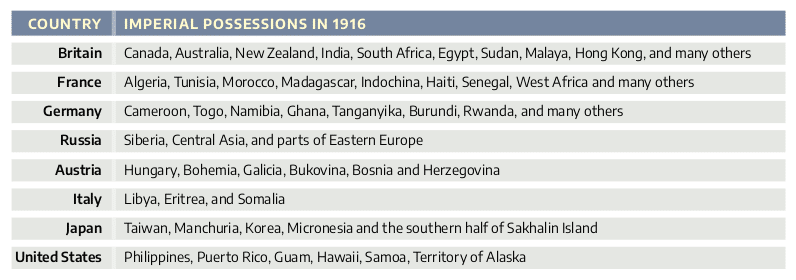
When Lenin wrote his pamphlet “Imperialism, the Highest Stage of Capitalism” in 1916, the world had a handful of imperialist countries, including the United States, Britain, France, Germany, and Japan. Britain was the leading imperialist power, the empire on which the sun never set.


Since 1945, world capitalism has been politically and militarily dominated by the U.S. empire. 

Historian Daniel Immerwahr says in “How the U.S. has hidden its empire”: “The years since the second world war have brought the U.S. military to country after country. The big wars are well-known: Korea, Vietnam, Iraq, Afghanistan. But there has also been a constant stream of smaller engagements. Since 1945, U.S. armed forces have been deployed abroad for conflicts or potential conflicts 211 times in 67 countries. Call it peacekeeping if you want, or call it imperialism. … 

“One of the truly distinctive features of the U.S. empire is how persistently ignored it has been. This is, it is worth emphasizing, unique. The British weren’t confused as to whether there was a British empire. They had a holiday, Empire Day, to celebrate it. France didn’t forget that Algeria was French. It is only the U.S. that has suffered from chronic confusion about its own borders.”

The relationship between the imperialist powers has changed since 1914, but the list of imperialist capitalist powers hasn’t changed much. The United States is the dominant imperialist power with Britain, Germany, France, and Japan as satellite imperialists.  They made up the Group of Five, and now the G7, which includes Canada and Italy. 

The change in imperialist relations can be summed up with one word: NATO.

Unlike in 1914, there is one military machine that dominates the imperialist world. The U.S.-commanded military alliance called the North Atlantic Treaty Organization – NATO – includes the armed forces of the U.S. and all other countries in the alliance, including Britain, Germany, and France. 

NATO also includes the armed forces of the “lesser” imperialist countries such as Canada and Italy (the G7 countries) and some smaller countries in Western Europe and now Eastern Europe.

Japan is a partner in NATO through the Individually Tailored Partnership Programme (ITPP) agreement. Japan participates in NATO exercises and training programs, and provides financial support to most NATO operations.

The United States had a double purpose when it created NATO in 1949. The first was to threaten the Soviet Union and its new Eastern European allies and, if necessary, put down any revolutionary movement in Western Europe. The communist parties in France, Italy, Spain, Greece, and Portugal were widely popular.

The second purpose was to ensure that neither Germany nor any other European power would challenge U.S. domination. For propaganda during the Cold War, the U.S. claimed its military forces in Europe were necessary to defend these countries against a possible Soviet attack. The last thing the Soviet Union, which had lost more than 27 million people in World War II, would have considered was a military offensive into Western Europe.

NATO’s purpose

The purpose of NATO became apparent after the Soviet Union was destroyed under the Gorbachev regime between 1985 and 1991. While the Warsaw Pact — the defensive alliance formed by the Soviet Union in 1955 — was abolished, NATO was not. Instead, the U.S. swallowed the Soviet Union’s former Eastern European allies and some of the former Soviet Republics into NATO. 

The only former Soviet or Soviet-allied countries in Europe that are not now part of NATO are Moldova, Belarus, and Ukraine.

Even though Russia is now capitalist and thus represents no socialist threat to any existing capitalist nation, the U.S. has been tightening its encirclement of Russia through NATO. The goal is to transform Russia, with its vast natural wealth, into a semi-colony of the U.S.

The U.S./NATO proxy war in Ukraine is about the drive of U.S. imperialism to bring Russia’s and Ukraine’s colossal wealth in natural resources under its control. Both countries are rich in farmland and raw materials such as ores. Already, much of Ukraine’s have been taken over by U.S. finance capital. Russian capitalists are fighting to maintain control of their own natural resources.

U.S. domination of Germany, Japan

The U.S. now has the most expensive military in history. No country even comes close to the U.S. global dominance. The Pentagon’s budget for “defense” in 2023 exceeds that of the next 10 countries (mostly NATO allies) combined.

So why does the U.S. have its largest military occupations in Germany and Japan? There is only one real reason — to ensure the defeated Axis powers remain U.S. satellites.

However, unlike after World War I, the U.S. did not throttle the capitalists of Germany and Japan. The World War I Treaty of Versailles attempted to squeeze the costs of the war out of Germany, which essentially destroyed the German economy. 

NATO war on Yugoslavia

NATO has undertaken eight military actions, all since 1990. The alliance did not undertake any military operations during the Cold War. Since 1990, NATO has engaged in two actions related to the first Gulf War, two in the former Yugoslavia, and military operations in Afghanistan, Iraq, Somalia, and Libya.

The NATO war on Yugoslavia in 1999 asserted NATO’s domination of the Balkans. The war was NATO showing other countries of Eastern Europe and the former Soviet republics that it is the dominant power. 

The 78-day-long aerial bombing campaign, using more than a thousand aircraft, dropped more than 3,000 cruise missiles and about 80,000 tons of bombs. More than 3,000 people were killed, and up to 20,000 were seriously injured.

NATO did not seek the approval of the United Nations Security Council for the bombing campaign or any other international legal cover; it was openly a war crime, not unlike the Nazi aerial bombing of Guernica during the Spanish Civil War.

NATO war on Libya

In 2011, NATO bombed Libya and overthrew its government. NATO’s war in Libya was its first major military operation in Africa. NATO bombed Libya 9,600 times over seven months. 

The war against Libya was part of an effort by the U.S. and its satellite imperialist allies, especially Britain and France, to crush the Arab Spring uprising.

The anti-government protests, uprisings, and armed rebellions began in Tunisia and then spread to five other countries: Libya, Egypt, Yemen, Syria, and Bahrain.

NATO and the U.S. military-industrial complex

As Forbes magazine gleefully reported in May, the expansion of NATO has opened up a big new market for U.S. military-industrial complex defense contractors. It’s “a big win for Raytheon, Lockheed Martin, and Northrop Grumman.

“NATO membership means a significant increase in each country’s military spending.  Finland joined NATO on April 4, 2023, and ordered 64 new F-35 warplanes, the elite joint strike fighter developed by Lockheed Martin, Northrop Grumman and BAE Systems (BAESY). Each one will cost between $110 million and $135.8 million.

Forbes adds: “More importantly, aligning with NATO is a commitment to interoperability with the American defense ecosystem. This directly benefits the big U.S. contractors. The market for their goods is expanding and they will face no competition for the foreseeable future. …

“The F-35-ification of European armies might be a bigger deal, though. In addition to the cost of the units, corresponding ground support, spare parts and maintenance, there is a lock-in factor. Europe is now committed to America-made gear for decades to come.”

War and Lenin in the 21st century

Strugglelalucha256


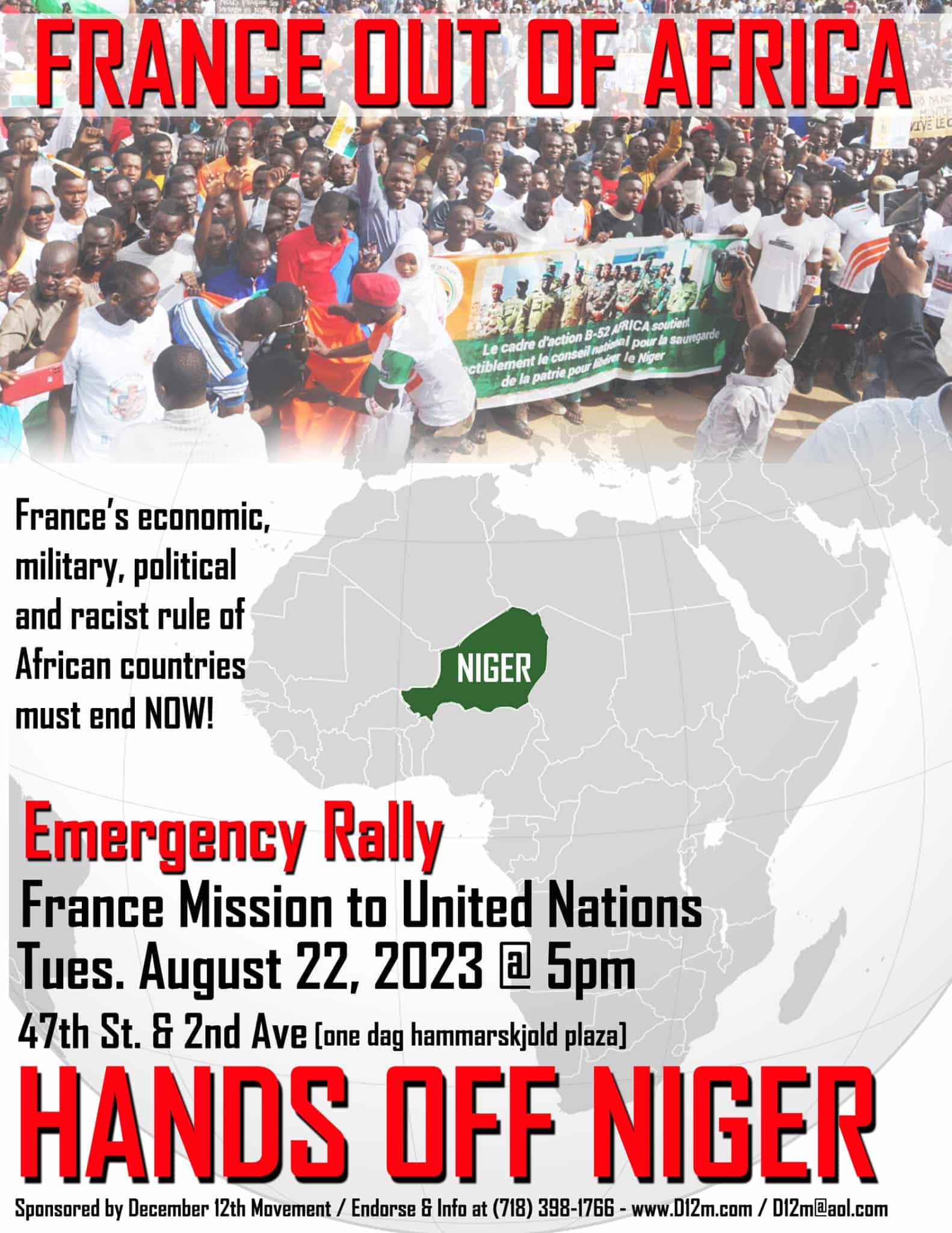
New York City: France out of Africa! Hands off Niger! – Aug. 22

Emergency Rally: Hands Off Niger

Tuesday, August 22 – 5:00 p.m.

French Mission to United Nations
47th St & 2nd Ave, Dag Hammarskjold Plaza, Manhattan
France’s economic, military, political and racist rule of African countries must end NOW!
Sponsored by December 12th Movement
Endorse & Info at (718) 398-1766
www.D12m.com
D12m@aol.com


Strugglelalucha256


Ecuador and Guatemala go to the polls under a shadow of violence and political uncertainty

August 20 — Today 2 important elections took place in Latin America, with the general elections in Ecuador and the presidential runoff in Guatemala. Two countries with no common border but shared problems and inhabitants longing for solutions. Today they are defining their political future after a whirlwind of corruption, accusations, and an entrenched violence.

The importance of these elections is because they reflect the contemporary period of struggle between the old neo-liberal order of oligarchs and imperialism and the countries moving in the direction of regional integration and self-determination

This Sunday, Ecuador ended a tense election day to designate president and lawmakers amid military deployment due to the recent murder of presidential candidate Fernando Villavicencio 10 days ago and the violence of drug gangs.

At press time, candidate Luisa Gonzalez, backed by the party of former progressive President Rafael Correa (2007-2017), remained the top vote-getter, with 32.22 percent of the ballots in her favor.

However, a runoff election is expected next October between Gonzalez and right-wing candidate Daniel Noboa from National Democratic Action, who has obtained 24.74 percent of the votes so far.

Gonzalez would of needed 40% of the vote to avoid the runoff, but that scenario seems unlikely at this point in the vote count

The electoral authority have until this Wednesday to give the final results. But the results are expected to remain unchanged. The candidate elected in the October runoff will govern for the next 18 months, only until the end of the term of outgoing president Guillermo Lasso, who called these early elections after being immersed in corruption scandals and facing an impeachment proceeding.

These elections in Ecuador were atypical. Although authorities insist that the electoral process took place without setbacks, the country experienced an unprecedented security scheme for candidates, who voted with bulletproof vests and helmets amid a state of emergency. The substitute for the late Fernando Villavicencio, Christian Zurita, arrived at the ballot box surrounded by military personnel and shields as if he were reaching a war front, wearing a helmet and bulletproof vest. “For Ecuadorians, normality is long gone,” the Ecuadorian newspaper El Universo reported.

The messages that arrived through networks and television warned the 13.4 million citizens summoned to vote to not take backpacks or bags to the voting center. They also advised going to vote alone, according to El Universo. This is a reflection of the instability that exists at this time in Ecuador

For the winning candidate, a year and a half is too short for the challenges that lie ahead for Ecuador and that have become evident in this campaign. Insecurity is already the main concern of all citizens. Containing it will not be an easy task.

Guatemala and the opportunity for a better change

This Sunday, Guatemala held the second round of its presidential elections, in which anti-corruption activist Bernardo Arévalo De Leon defeated former first lady Sandra Torres Casanova, aligned with the conservative political establishment. Preliminary results give the unexpected center-left frontrunner, who leads a crusade against corruption as the new leader of Central America’s most populous nation, a strong lead in a post he will hold for the next five years.

The vote comes after a tumultuous first round in June, in which judicial authorities suspended several progressive and indigenous candidates perceived as threats to the country’s ruling elites.

The former first lady lost the 2015 and 2019 ballots and, according to experts, her past linked to corruption cases generating a strong anti-vote in urban areas of the country; even though in the first round, on June 25, she clinched first place with almost 900,000 votes, which represented 15% of the electorate.

On the other hand, Arévalo De Leon, 64 years old, driven by an anti-corruption proposal and the image of his father, former president Juan José Arévalo Bermejo (1945-1951), surprised on June 25 by obtaining second place with more than 600,000 votes, even though polls had placed him in eighth place.

The winner of the election will replace the administration headed by Alejandro Giammattei, a conservative politician linked to dozens of bribery and corruption cases during his administration and who is in the pocket of the US. Today, Guatemala’s fragile democracy, constantly riddled with scandal-plagued governments, has gone from implementing innovative anti-corruption strategies to shutting down such efforts and forcing honest judges and prosecutors to flee the country for their lives, according to experts.

“Arevalo is perceived in Guatemala’s conservative political environment as the most progressive candidate to make it this far since democracy was restored in 1985, after more than three decades of military rule. And that is not saying much because of his links with the US who he would remain beholden to. He has drawn much of his support from the cities, and his party is largely composed of urban professionals, such as university professors and engineers. He has made the fight against corruption and impunity the central focus of his campaign,” Guatemala’s national daily Prensa Libre described.

Among his campaign promises, Arevalo has positioned himself as a populist claiming he would alleviate poverty in Guatemala, one of the most unequal countries in Latin America, through a massive job creation program to improve roads and other infrastructures. He also promised to increase agricultural production by providing low-interest loans to farmers. While he offers some hope after decades of presidents linked to the tiny oligarchy, it remains to be seen what he will be able to do to live up to his ambitious campaign promises.

Source: Resumen Latinoamericano – English

Strugglelalucha256


‘Long live the spirit of Jonathan Jackson!’

Two 17-year-olds at the door of history

Jonathan Jackson was just 17 years old when he gave his life for oppressed people on Aug. 7, 1970. He went to the San Rafael, California, courthouse to free his older brother George Jackson, Fleeta Drumgo, and John Clutchette — known as the “Soledad Brothers.”

These three revolutionary inmates were charged with killing Soledad prison guard John Mills. Just before Mills was thrown over a third-floor railing, a grand jury exonerated fellow officer O.G. Miller for shooting to death Black inmates Cleveland Edwards, Alvin Miller, and W.L. Nolan on Jan. 13, 1970. Black witnesses weren’t even allowed to testify at the whitewash.

No evidence linked the Soledad Brothers to the killing of Mills. California Governor and future U.S. President Ronald Reagan wanted to murder them in the state’s gas chamber because they were revolutionaries.

George Jackson was internationally known for “Soledad Brother,” a collection of his letters from prison. “I met Marx, Lenin, Trotsky, Engels and Mao when I entered prison and they redeemed me,” he wrote.

George Jackson, a field marshal of the Black Panther Party, had already spent a decade behind bars for a $70 robbery. As an 18-year-old, he was given a one-year-to-life sentence for being a passenger in a car whose driver allegedly stuck up a gas station.

Jonathan Jackson went to Judge Harold Haley’s courtroom armed with guns. San Quentin prisoner James McClain was defending himself against frame-up charges of assaulting a guard following the beating to death of Black inmate Fred Billingsley by prison officials. Fellow inmates Ruchell Cinque Magee and William Christmas were witnesses for McClain.

Like the enslaved Africans who joined John Brown’s band at Harper’s Ferry, these three San Quentin prisoners immediately joined Jonathan Jackson’s fight for freedom. Judge Haley, assistant prosecutor Gary Thomas, and three jurors were made their prisoners.

“We are revolutionaries,” they proclaimed. “We want the Soledad Brothers free by 12:30.”

Capitalist state sacrifices a judge

According to Black Panther Party veteran Kiilu Nyasha, “The plan was to use the hostages to take over a radio station and broadcast the racist, murderous prison conditions and demand the immediate release of the Soledad Brothers.” (San Francisco Bay View, August 3, 2009)

But the capitalist class would rather kill one of their judges than let Black people go free. As Jonathan Jackson drove away in a van, San Quentin guards and court cops started firing.

Jonathan Jackson, James McClain, and William Christmas were killed, along with Judge Haley. Ruchell Cinque Magee and assistant D.A. Thomas were wounded.

The courageous action of these four Black heroes at San Rafael shook the capitalist state from Nixon in the White House to the local police precinct. “Psychologically the slave masters have been terrified by the boldness and innovative tactical conception,” wrote Fred Goldstein. “No court is safe anymore.” (Workers World, Aug. 20, 1970)

Scapegoats had to be found. Survivor Ruchell Cinque Magee and Angela Davis, who had chaired the Soledad Brothers defense committee, were put on trial.

Jonathan Jackson was a bodyguard for Angela Davis, and three of the guns used at the San Rafael jailbreak were registered under her name. That was enough for Reagan to try to send Davis to the gas chamber as a “conspirator” who was responsible for Haley’s death. 

In 1969 Reagan got trustees at the University of California Los Angeles to fire the philosophy professor for being a member of the Communist Party.

For two months, Angela Davis eluded the FBI, which put the Black communist on its “ten most wanted” list. FBI Director J. Edgar Hoover listed her as “armed and dangerous” — an excuse to shoot her on sight. President “Watergate” Nixon congratulated Hoover for the capture of Davis and labeled the Black woman a “terrorist.”

From her prison cell, Angela Davis declared, “Long live the spirit of Jonathan Jackson!”

Free Angela! Free Ruchell!

The Black Community mobilized coast-to-coast to defend their sister. Over 200 “Free Angela Davis” defense committees were formed. People rallied in Cuba, the Soviet Union, and the German Democratic Republic (East Germany) as well. A jury acquitted Angela Davis of all charges on June 4, 1972.

Ruchell Cinque Magee was tried separately from Angela Davis. Magee adopted the name “Cinque” after the African leader of the 1839 slave revolt on the ship Amistad. 

The original Cinque was freed by a Connecticut court. Ruchell Cinque Magee, who was also part of a slave revolt, was convicted of kidnapping after murder charges were dismissed.

Judge Morton Colvin refused to adjourn the trial for a single day after Magee’s mother died. Yet Colvin recessed the hearing for two days following former President and Ku Klux Klan member Harry Truman’s death. At one point, the bigot-in-robes kicked all 40 Black spectators out of the courtroom. (Jet, March 1, 1973) An appeals court forced Colvin to allow former Attorney General Ramsey Clark to help defend Cinque. Jury foreman Bernard J. Suares stated in a 2001 affidavit that the jury actually voted to acquit Cinque of kidnapping for the purpose of extortion.

Ruchell Cinque Magee would remain in jail for another 50 years until he was finally released on July 21 at the age of 83. He was the longest-held political prisoner in the United States and possibly the world.

It shows how barbaric U.S. capitalism is that Comrade Magee spent over six decades in prison. (He had earlier been framed and served time in Louisiana.) An accomplished jailhouse lawyer, Cinque had helped free dozens of inmates.


One year after his younger brother sacrificed his life, George Jackson was assassinated by prison guards on Aug. 21, 1971. George Jackson’s murder sparked the Attica prison rebellion less than three weeks later. Billionaire New York Gov. Nelson Rockefeller had 29 prisoners slaughtered. 

On March 27, 1972, the two remaining Soledad Brothers — Fleeta Drumgo and John Clutchette — were acquitted by a San Francisco jury.

John Cluchette would finally be released from prison 36 years later, on June 6, 2018. Fleeta Drumgo would be killed in 1979 in a suspicious Oakland street shooting.

Another 17-year-old makes history

“Courage in one hand, the machine gun in the other,” was how George Jackson described his 17-year-old brother Jonathan. Vladimir Ulyanov was also 17 years old when his older brother Alexander was hanged in 1887 for trying to kill a tyrant called the Russian Czar.

Thirty years later, Vladimir Ulyanov — now known as Lenin — led the Bolshevik Revolution in 1917. Back in 1887, it seemed that the Russian Empire — like the United States today, a big prison house — was far from having a revolution.

The execution of Alexander Ulyanov affected Lenin so much that he could barely write about it. There are only two references to his brother in Lenin’s collected works. Yet thinking of Alexander’s execution must have helped Lenin develop his nerves of steel.

Lenin came from a better-off family than that of George and Jonathan Jackson. His father was a school superintendent who wanted peasants to be educated.

Despite the bloody overthrow of Reconstruction and thousands of lynchings, Black people built thousands of schools. Their literacy rate in 1917 was higher than that of Russian peasants, while the literacy rates of other peoples in the Czarist empire were often much lower.

Yet by 1957 — 40 years after the Bolshevik Revolution — the peoples of the Soviet Union sent the world’s first satellite called “sputnik” into outer space because of socialism.

Above all, Lenin had time to learn and organize — time that was denied to both Jonathan and George Jackson.

Today over two million people are locked-up throughout the United States. Four million have just been kicked off Medicaid. The minimum wage can buy about half what it could in 1968.

We need a revolution just as much as the workers and peasants ground down by the Czar did.

One of the first steps is to free political prisoners like Leonard Peltier, Mumia Abu-Jamal, and Ed Poindexter. Free them all!

Strugglelalucha256
https://www.struggle-la-lucha.org/2023/page/28/