- U.S. escalates war against Russia
- World stands with Cuba again!
- Kroger-Albertsons merger means layoffs, higher food prices
- National Day of Mourning, Nov. 24
- Demand buried evidence in Mumia’s case be heard
- Elections: The empire strikes back
- Dockworkers fight for a decent contract
- How to not build unity
- North Korea responds to massive, ‘reckless’ U.S.-led war games
- Military intervention is not the answer to Haiti’s crisis
- ‘Let’s get out of NATO’: Protests across Europe
- Alexis Castillo (Alfonso), internationalist fighter in Donbass
- Remembering Fatima Bernawi
- Situaciones indignantes por ser colonia
Struggle ★ La Lucha PDF – November 7, 2022
How to not build unity
The U.S. has ramped up its push towards World War III with further provocations against China and Russia. Not only has Washington admitted to and committed to adding more troops outside of Kiev – to engage more closely with the Russian troops in Ukraine – but this year’s National Defense Strategy document basically declares war on China in particular. The reasoning is simply that China is a “competitor” of the U.S. economically and in terms of military readiness, even though currently China has not declared war on anyone or participated in any proxy war against anyone – China belongs to no military alliance threatening anyone.
Because of Washington’s escalations, it is absolutely critical that the anti-war, union, social justice, and liberation movements build even greater unity. We must organize to stop not only the U.S.-NATO trajectory of world war but the added danger of the rebuilding of fascist movements here and in Europe. Neo-Nazi groupings are being funded with billions of U.S. dollars in weapons and training in Ukraine.
Vladimir Lenin led the 1917 Bolshevik revolution in Russia, which led to the formation of the Soviet Union. In facilitating the formation and cohesion of the Soviet Union, he was forced to grapple with the reality of disunity, stemming from a lack of trust among the non-Russian populations in much of the Soviet Union. He realized that the privileges given to and the racism used by the white Russian population caused a lack of trust among the non-Russian communities and territories. Indeed, Czarist Russia had been called the prison house of nations.
Lenin understood that to build unity, trust had to be built first. The formerly oppressed nations would not necessarily believe in the benefits of socialism or of becoming part of a country building socialism. Lenin could have lectured these nations about the benefits of socialism and demanded that their areas be incorporated into the Soviet Union. Instead, he advocated that people living in these areas be given the choice to become part of the Soviet Union, or enter as autonomous regions of the Soviet Union, where they would be encouraged to continue their own culture and language. They were to be provided with schools and medical facilities and all the benefits of the state, in hopes that this would first build trust and unity and thereby facilitate further incorporation into the Soviet Union.
The Congress of Nationalities
The Soviets even established a Congress of Nationalities as a part of parliament. It was set up to ensure that the oppressed nations had a voice, equal in power to that of the Russian population.
The successful unity that was built in most of the life of the Soviet Union has been a model for building solidarity in working-class movements around the globe.
As we endeavor to rebuild the unity of our class here in this country, we must remember
that trust built with the most oppressed communities of color in the U.S. is absolutely essential – and mandatory – if any progress toward real unity is to be made.
However, there has been another current in the anti-war movement negating these truths. This current mistakes the necessary unity amongst working people and their allies with a unity that includes even the most racist sectors of the ruling class.
It’s very interesting that those in the anti-war movement who see promise in the right-wing forces like Trump and Tucker Carlson of Fox News and the Republicans, Libertarians, and LaRouchites do not seem to be from the oppressed communities of color.
No collaboration with white supremacists
There’s an obvious reason for this. Black and Brown people (in general) have no interest in any collaboration with people who want to commit genocide against them.
They don’t want to associate with the Ku Klux Klan and any of the many manifestations of white supremacist groups like that, whether it be the Rise Above Movement responsible for the Unite the Right rally in Charlottesville, North Carolina, that killed anti-racist activist Heather Heyer, or the Proud Boys with their collaborator Kyle Rittenhouse who terrorized and killed anti-racist activists attending a march for Black lives in Wisconsin; or anyone who supports the genocide against Black and Brown people by former president Donald Trump.
Before, during and after his presidency, Trump encouraged the genocidal murders against Black and Brown people by the police and Border Patrol. This is the person who called the countries of our ethnic origin s**thole countries and made immigration policies that corresponded with his racism while encouraging dangerous white supremacists who had killed or assaulted people in Charlottesville, North Carolina, as “some good people.” There’s more to say about Trump and his followers, but that is enough to get the point across – and that is this:
If the anti-war movement wants to build the necessary unity to combat this trajectory of World War III by the Biden administration or whoever gets in office next – don’t ask Black and Brown people to “just get over it,” or “move on” or any number of ways to negate the type of solidarity Lenin understood in unifying that prison house of nations. Speaking of another prison house of nations with the largest prison population in the world, the other thing Trump encouraged was putting more Black people in jail, from his calling for the death of the Central Park Five, framed for an attack they did not commit, to encouraging the prison-industrial-complex and its disproportionate makeup of Black and Brown people, following the lead of Joe Biden who helped write some of the bills making that possible.
Instead of building unity, that negation of solidarity will destroy it.
Dockworkers fight for a decent contract
Early in the morning on Nov. 2, dockworkers, members of the International Longshore and Warehouse Union Locals 10, 34, and 91, walked off the job in a one-day work stoppage, closing down the Port of Oakland. It was reported on KTVU Fox News that it will take a week to recover from the one-day work stoppage.
Keith Shanklin, past president of ILWU Local 34, said, “We’ve been trying since July 1 to negotiate a contract with the PMA. We’ve been faithfully working, even through the pandemic, without any stoppage.” The workers are angry that the Pacific Maritime Association, representing the port’s cargo ship carriers and terminal operators, is prolonging ill-faith contract negotiations with ILWU.
The militant “point of production” action occurred at the Port of Oakland. Dockworkers say that if all the ILWU locals on the West Coast were to call a strike, they would have the powerful leverage they need to settle contract negotiations with PMA.
PMA is under additional seasonal pressure to unload the holiday merchandise currently in the port and still at sea. At the same time, a possible nationwide rail strike that was thought to have been settled looms again after two major unions rejected that contract proposal.
KTVU Fox News reported that a “West Coast port closure and a national rail strike would quickly return the entire U.S. to the bad old days of the supply chain crisis, perhaps even worse.”
Keith Shanklin served as president of Local 34 during the pandemic. He and past president Trent Willis of Local 10 demonstrated strong leadership during the pandemic. Keith Shanklin, ‘Shank,’ also served as the secretary-treasurer of the Million Worker March.
Elections: The empire strikes back
Whatever happens in the midterm elections, a mudslide of racist and bigoted filth is pouring down from the heights of capitalist society. Teaching Black history is under attack by labeling it Critical Race Theory.
Using an increase in street crime — the result of a massive increase in poverty and homelessness — politicians are encouraging more police brutality and killings.
A special target has been transgender people, particularly transgender youth. The measures in Florida forbidding transgender youth from receiving gender-affirming care guarantee more deaths.
This wholesale hate campaign is the reaction of banksters and billionaires to the Black Lives Matter movement, the largest series of protests in U.S. history.
The 26 million people who took to the streets in 2020 forced the ruling class to discuss the deadly racist violence of the police. The conviction of the Minneapolis cops who killed George Floyd was one of the few actual concessions made to oppressed people.
It was only because of an uprising in Minneapolis that any justice was administered to these killers in uniform. It took a mobilization in Georgia to send the murderers of Ahmaud Arbery to jail.
Now, as reflected in the Wall Street Journal, most capitalists want to take back the primarily verbal concessions that were made concerning police violence.
They don’t want their politicians to kneel in imitation of the courageous Colin Kaepernick. Billionaires want their elected flunkies to kneel before them. None of the football clubs’ super-rich owners are willing to hire Colin Kaepernick.
Capitalists form public opinion
The tiny percentage of society that consists of the big capitalist families is dragging millions of others behind them, including many workers. There’s nothing new in this.
Almost 180 years ago, Karl Marx wrote that “the ideas of the ruling class are in every epoch,” meaning the time period, “the ruling ideas.” The not-so-dead hand of slavery continues to brainwash millions of white people.
It takes an upsurge of millions for people to break with the lies of the master class. That’s a reason why Black Lives Matter is so hated by the wealthy and powerful. It reached into small, largely white towns that had never seen a protest before.
That movement, like any upsurge, has receded for the time being. Voters are subjected to billions of dollars of TV ads. More selective are Facebook and other social media posts that attempt to target individual voters.
The effect of this media barrage can be seen in Wisconsin. The Trump campaign in 2020 flooded the state with racist ads attacking the demonstrations in Kenosha following the police shooting of Jacob Blake. Trump lost Wisconsin by only 20,000 votes.
Two years later, the Republican candidates for governor and U.S. senate are again flooding the state with racist ads attacking the Kenosha anti-racist uprising.
A special target has been the liberalized bail laws instituted in New York state and some other places. The eighth amendment to the U.S. Constitution declares that “excessive bail shall not be required.”
Any bail that’s unaffordable to poor people is excessive and amounts to ransom. In Arizona, 80% of jail inmates haven’t been convicted of anything. Their real crime is being poor.
The Black youth Kalief Browder spent three years in New York City’s Rikers Island prison because his family couldn’t afford to bail him out.
He spent 700 days in solitary confinement before his charges were dropped. Then, on June 6, 2015, Kalief Browder hanged himself in his family home.
This tragedy doesn’t prevent Lee Zeldin, the New York Republican candidate, from demanding the new bail laws be repealed.
We must struggle
The capitalist offensive can also be seen in the union representation elections conducted by the National Labor Relations Board. The tremendous victory by the Amazon Labor Union at a Staten Island, New York, warehouse in April took the establishment by surprise.
Jeff Bezos, Amazon’s executive chairman whose fortune exceeds $120 billion, counterattacked. Amazon is spending untold millions for union busting. The union victory in Staten Island has not yet been repeated.
Despite workers at over 200 Starbucks locations voting for union representation, Starbucks CEO Howard Schultz refuses to discuss a union contract.
Frederick Engels — the co-worker of Karl Marx — described capitalist elections as a barometer of the consciousness of the working class.
For millions of people, the 2020 elections represented a break with more than 40 years of reaction and increased racism. But President Biden has given little in the way of help to poor and working people.
The White House and Congress can find $70 billion for the war against Russia, yet it can’t house the homeless. Inflation is cutting families’ income while corporations declare record profits. People line up at food banks.
Reactionary and bigoted politicians feed off this increased misery. The only way forward is more struggle in the streets and workplaces.
Capitalists want to cut Social Security, Medicare and Medicaid while jacking up the retirement age to 70. We won’t let them!
The future can be seen in thousands of railroad workers who’ve had enough and may go on strike. As dangerous as the election of Trump-supporting candidates are, the future is more struggle.
Kroger-Albertsons merger means layoffs, higher food prices
A proposed deal between two of the biggest grocery chains in the U.S. — Kroger and Albertsons — has many thousands of workers worried about losing their jobs. It also raises the possibility of more food deserts and worsening food prices.
Grocery prices have already risen by nearly 12% in the latest capitalist inflation crisis. If the deal goes through, the new corporation will control 20% of the U.S. grocery market with 5,000 stores in the 48 contiguous states.
Corporate mergers are always followed by a period of consolidation of assets. That means closures of some stores and layoffs. Both Kroger and Albertsons have a history of disregarding workers’ rights and turning their backs on the communities that have brought them billions of dollars.
Under the agreement, Kroger would buy Albertsons for nearly $25 billion. It isn’t by any stretch the largest dollar amount among corporate mergers. Others, among banks, telecommunications companies, and energy giants like Exxon Mobil, have been worth over 10 times that much.
It is the latest in a trend of retail mergers over the last 30 years. The emergence of big high-tech, warehouse-based corporations, Amazon, Walmart, and Costco, has set the wave of consolidations. By shrinking the workforce, they’ve taken over most grocery sales in the U.S.
In addition to combining with Albertsons, Kroger is looking to mimic the Amazon model by building giant high-tech warehouses at a dozen or more locations. This technology-based war among the retail giants is what underlies the proposed merger. At the same time, it has led to a heightened workers’ struggle, including an energetic unionization campaign by tens of thousands of Amazon warehouse workers.
A consolidation deal in 2014 between Albertsons and Safeway illustrates how mergers wipe out jobs and how ineffective regulations have become. The Federal Trade Commission approved the deal with the condition that Albertsons sell 168 of their stores to a much smaller grocery chain, Haggen. Haggen only owned 18 stores at the time, and buying 168 more was a highly leveraged deal.
The obligation to sell to Haggen was supposed to ensure competition, but under-capitalized Haggen’s failure was a foregone conclusion. Albertsons launched a competitive war against Haggen, forcing it into bankruptcy in just over a year. No federal regulator had the power to do anything about it.
Food Chain Workers Alliance
As corporations grow and control more of their market, capitalist regulations become proportionately weaker. Suzanne Adely, Co-Director of the Food Chain Workers Alliance, spoke with SLL about the merger and what capitalist consolidation can mean for workers, using the example of the meat and poultry industry.
“The industry is controlled by only a few big corporations. During COVID, the leverage they have meant that there was no transparency over health and safety. This led to a terrible number of Covid infections. It also means they have more control over the supply chain. For example, if they are a supplier for a government contract, maybe for school lunches, they can be chosen for their cheapest bid without regard for their health and safety record. Their sheer size diminishes transparency and lets them avoid any accountability.”
Corporate mergers must be approved by one of the capitalist government’s federal regulators. But the anti-trust system in the U.S. is weak by design. As a result, only rarely have similar mergers been blocked.
Capitalist competition leads to mergers. As a result, fewer and fewer corporations control larger market shares as time goes by under capitalism. This trend is part of the DNA of the capitalist economy and is explained by classical Marxism.
In the 19th century, most economists thought that the competitive era of capitalism was permanent. But Karl Marx recognized the inevitability of the concentration of capital and market share into the hands of fewer and larger corporations. In “Capital” he wrote, “The battle of competition is fought by the cheapening of commodities. The cheapness of commodities depends … on the productiveness of labor, and this again on the scale of production. Therefore, the larger capitals beat the smaller.”
Some Democratic politicians have spoken out against the merger, including Senators Bernie Sanders, Amy Klobuchar and Elizabeth Warren. Their position against it may help to secure their base as the Democratic Party worries about the midterm elections. But corporate power rolls over liberal politicians all the time.
The only real challenge to corporate power is that of workers and the community. In 2019 Kroger closed five supermarkets in Los Angeles. The United Food and Commercial Workers union was joined by the LA chapter of the Southern Christian Leadership Conference, the Harriet Tubman Center for Social Justice, and a number of community organizations based in South LA in a fierce struggle to save workers’ jobs and prevent another food desert in the Black community. This union and community alliance, along with the amazing union drive being conducted by Amazon workers, are examples of how to challenge capitalist corporations’ attempts to maximize their profits and beat down the working class.
When we fight, we win!
Analysis of the Brazil elections and Bolsonaro’s reaction
The elections in Brazil were without a doubt among the most important and anticipated events of the year in Latin America. The largest economy in the regional economy’s political definition is a core element in the current political context ever since the scope of the new Latin America progressive wave depends to a large extent on its political and economic trajectory. Domestically, it was vital, as Brazil had over 6 years of right-wing governments combined with the pandemic, which plunged millions of Brazilians into poverty.
Fortunately, the winning candidate was the Workers’ Party (PT) representative Luiz Inacio Lula da Silva, who won by a narrow margin of 2 million votes, or 0.8% of the vote. Despite the narrowness, the victory is still resounding.
The ultra-right-wing politician, Jair Bolsonaro, had the government machinery on his side. On top of it, he counted on the oligarchy and the Brazilian upper middle class’ support, meaning an economic and influential power able to define any electoral process.
The main component of Lula’s victory was his collective leadership strategy and alliances with the most diverse political forces, ranging from the center-right to the most progressive and left-wing organizations in the country. However, once the elections are won, this type of coalition turns into a challenge. Given the fact that Bolsonaro will be out of power in two months, differences could emerge, putting Lula’s government strategy at risk and leaving him exposed in front of right-wing forces, whose main objective is to destroy him politically. Therefore, a lot of work and conscientious strategy will be needed to avoid such a scenario.
The elections result
An interesting fact about the election result is that young adults voted for Lula. This is peculiar since ultra-right politicians are often popular in this sector. However, in Brazil, it seems to be different. Today’s young adults were born before Lula’s first term and saw how the country improved after 13 years of PT governments. These same people have witnessed the disastrous management of Bolsonaro and are willing to recover what they consider normal living standards. At the same time, Bolsonaro’s neoliberal approach to social and economic issues is not preferable to Lula’s fair and modern treatment of key topics like LGTBQ+, women, Black people’s rights, and environmental policies.
The elections showed a country divided economically and politically. It is no coincidence that Bolsonaro won in the states with the highest Human Development Index (HDI), the lowest illiteracy rate, and the richest Amazonian states. His agreement to cut down millions of hectares of forests, ignoring the environmental consequences, earned him the logging and cattle sector’s support. Many of these businessmen not only funded Bolsonaro but campaigned by threatening their workers with consequences, claiming Lula’s government will shut down their businesses.
Bolsonaro clearly won in the two states with the largest urban population, while Lula won in those with the largest rural population. This distribution of the vote shows the abysmal chasm that exists between the countryside and the city in Brazil, one of the problems that both Lula and his PT successor Dilma Rousseff tried to alleviate through the implementation of social policies.
According to the vote by states, Lula won in 13 of the 23 states. Those with less population, low incomes, and hit hardest by COVID-19 due to their health systems’ weakness and governmental neglect.
However, the power distribution in state-level elections was different, although balanced. The PT won only 4 out of the 23 governorships, featured with another 3 from the Brazilian Democratic Movement (MDB), whose presidential candidate was Simone Tebet, one from the Solidaridade Party, and 3 from the Brazilian Socialist Party (PSB). The rest of the governorships are in Bolsonaro’s and his fellows’ hands. In the Senate and the House of Representatives, the correlation between forces is equally unfavorable for Brazilian progressivism, which makes government management even more complex.
The overseas vote also reveals the transnationalization of the right-wing agenda in the region. Although Lula won the overseas vote in general, in the United States, for example, Bolsonaro won overwhelmingly. Something similar happened in Latin America, except for Colombia, Uruguay, Argentina, and Cuba. Lula won all across Europe, where Brazilians are less exposed to the media might of Latin America’s right-wing and the frenetic smear campaigns organized against Lula.
Lula is aware of the current political and social situation, which explains his conciliatory stance. During the victory speech, he said he will work for all Brazilians regardless if they voted for him or not. Then, uniting the country is one of his priorities and, at the same time, his biggest challenge, given the right-wing parties’ political strength and capacity to mobilize their supporters.
Regarding domestic policy, Lula had a strong environmental and social justice agenda. These remain two neuralgic topics, ever since they were totally neglected by the previous administration. However, moving forward with concrete proposals may be complicated due to the opposition of agribusiness and economic elites who are reluctant to improve the country’s wealth distribution.
On the other hand, Congress’ composition will be Damocles’ Sword on Lula’s neck. The lawfare impeachment of Dilma is still fresh in many lawmen’s minds. Moreover, the polarization, the division of political forces, and the constant alliances changes in Brazil are all elements that weaken democracy and pave the way for the lawfare to act.
The response of the international community
Lula’s victory was a cause for joy not only for Brazil, where millions celebrated in the streets but for the region in general. Dozens of presidents and Prime Ministers immediately congratulated Lula, most of them regional leaders such as Colombia’s Gustavo Petro, Venezuela’s Nicolas Maduro, Cuba’s Miguel Díaz-Canel, and Argentina’s Alberto Fernandez. After this victory, integration mechanisms such as the Southern Common Market (Mercosur) and the Community of Latin America and Caribbean States (CELAC) will get momentum. Brazil played a leading role in both projects, and the arrival of right-wing presidents like Bolsonaro marked the stagnation of both. Today, the obstacles are fewer, and the opportunities to work together and move forward now that many countries in the region are more inclined to challenge neo-liberalism.
The President of the United States did not miss a chance to make public his relief with Lula’s victory. His congratulations were among the first. This reaction was influenced by Biden’s deep differences with Bolsonaro, who is a faithful follower of former President Donald Trump. This reality led to a rift between the two nations, something Biden is eager to change due to Brazil’s geopolitical and diplomatic importance in multilateral forums and organizations.
Bolsonaro’s response
While the whole world was celebrating, Bolsonaro went to sleep and took over 24 hours to make a statement. In his first words after the elections, he did not acknowledge the results or congratulate Lula, as is the tradition. He rather questioned the results, which was interpreted by his supporters as a call to maintain federal highways blocked. However, hours later, when chaos had taken over the highways, Bolsonaro made a call to withdraw the blockades, but to maintain the protests.
He intends to keep Brazilian democracy in check, as Trump did in the United States. Once again, the right wing’s modus operandi remains the same: not recognizing the election results and betting on social disorder and instability to hinder the new government’s work, many calling for the military to step in to fulfill their fantasies.
In this context, the presidential transition will be very complicated due to Bolsonaro’s uncooperative attitude and the perennial threat of a coup d’état lingering around.
Source: Resumen Latinoamericano – US
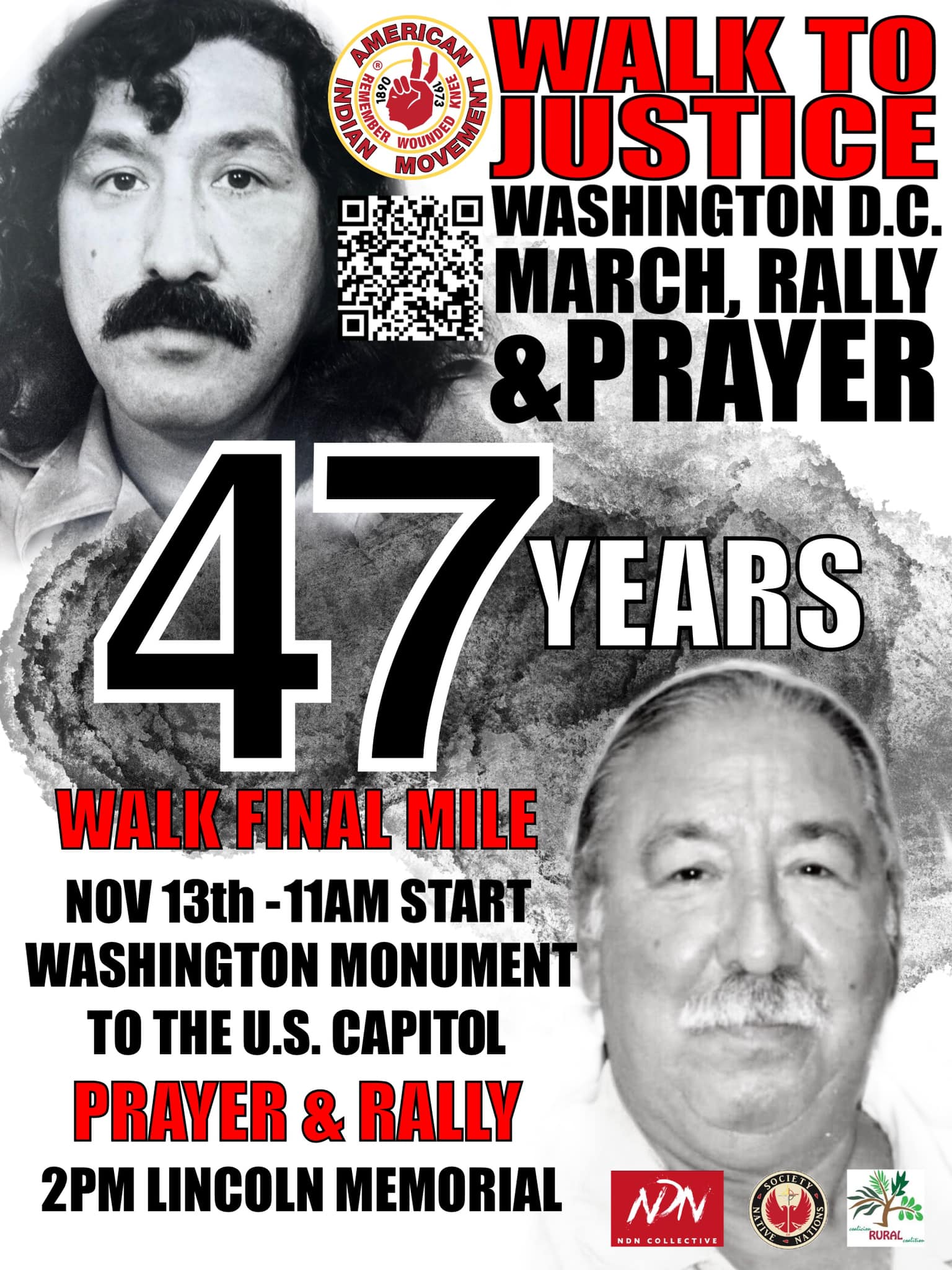
Leonard Peltier’s Walk To Justice – Washington, D.C., Nov. 13
The world stands with Cuba once again!
Once again, the United States has been left alone in its efforts to stifle Cuba. The General Assembly of the United Nations once again pronounced itself overwhelmingly against the economic blockade that Washington insists on maintaining against the island.
The UN member countries voted this Thursday on the Cuban resolution “Necessity of putting an end to the economic, commercial and financial blockade imposed by the United States of America against Cuba.” On this occasion, the document had 185 votes in favor, two against (the United States and its unconditional ally Israel), and two abstentions (Jair Bolsonaro’s Brazil and Ukraine).
Today, the world is with Cuba, and it is no surprise. That U.S. policy is an outdated and ineffective measure that hasn’t achieved and will not achieve its objective and has ended up discrediting and isolating the United States itself.
It has already been 30 years of continuous defeats. Since 1992, the Caribbean island, besieged and on the verge of economic asphyxiation, has presented this resolution before the UN in New York. Today, not even U.S. citizens themselves support this policy of hatred. Proof of this is that two nights ago, in the mythical Chrysler skyscraper in the Big Apple, a luminous sign caught the attention of the city dwellers and the world: “Down with the Blockade,” next to an image of the Cuban flag.
At the top of the building, the messages “Sanctions are a violation of human rights,” “Biden, vote for peace and justice” were also read; images that have been on the front page of major international media in the last hours, prior to the vote. New York, the American people, and the world want peace, but the White House doesn’t want to listen to these demands. It is stuck in the past, and without an ounce of courage, Biden has followed in the footsteps of previous administrations, Republican and Democrat alike, who adhere to the single notion of crushing Cuba and the example it projects to the world.
During its first opportunity to pronounce itself, in 2021, the administration of Joseph Biden voted against the resolution, and today it rejected once again the document, which shows, among other painful facts, that during the first 14 months of the Biden administration, the damage to the Cuban economy is estimated at $6.35 billion, equivalent to more than $15 million per day.
Cuban authorities have repeatedly denounced the blockade that has not only been in place for more than six decades but that it has intensified in recent years. Besides, the unilateral and fraudulent designation of Cuba as a state sponsor of terrorism reinforces the impact of that policy of economic asphyxiation.
Fidel’s words expressed 13 years ago came to life to me today: “The cynicism of U.S. policy hurts. It speaks of democracy while it includes Cuba on the list of terrorist countries, applies the murderous Cuban Adjustment Act exclusively to our nation, and blocks it economically.”
According to Cuban journalist Elson Concepción, being blockaded continues to be the price paid by those of us who declare ourselves free and sovereign, a condition conquered during years of struggle against Spanish colonialism, first, and U.S. neocolonialism, later.
“The blockade causes Cuban children to suffer the lack of some medicine, the implant of an organ, or the use of a reagent, for the ridiculous reason of having only 10% of U.S. components,” he added.
During his election campaign, Biden promised to change the U.S. policy path toward Cuba, but this has not happened. Meanwhile, Cuban families suffer when their children decide to emigrate in an unsafe way; they suffer from the lack of indispensable goods, such as food and medicine. They also suffer because they want their country to grow economically. After all, there’s no better place to live than where you were born and raised.
For the thirtieth time, the world said “No” to the blockade and is anxiously waiting for this to be the year of definitive changes. The U.S. would be a better place for it, a fairer one.
Source: Resumen Latinoamericano – US

U.S. escalates war against Russia
The Pentagon has confirmed reports by the Associated Press and the Washington Post that the U.S. has boots on the ground in Ukraine.
These troops are deployed to inspect and monitor U.S.-provided weapons in Ukraine, confirmed Pentagon press secretary Brig. Gen. Pat Ryder in an official briefing on Nov. 1. The troops will be operating far from the U.S. Embassy in Kiev and are in no way involved with embassy security.
Travis Tritten of military.com asked Ryder, “I’m wondering what the rules of engagement for those personnel are if they are fired on by the Russians or they are targeted by the Russians.”
In a long-winded reply, Ryder never answered Tritten’s question about what the U.S. would do if the Russians fired on any active-duty U.S. troops.
Tritten then said, “This [is] different because they would be working outside the embassy. I would just ask if people should read this as an escalation.”
The AP reported that a Pentagon official would not say where the military advisers are operating or how close to the battlefronts the U.S. troops are getting. The official said U.S. personnel are engaged in “inspections” where security conditions allow, not on the front lines.
On Feb. 24, when President Joe Biden announced sanctions on Russia, adding that the people of the U.S. must make a sacrifice and gas prices would rise, he said, “Our forces are not and will not be engaged in the conflict.”
Since that statement by Biden, the U.S. has intervened militarily in Ukraine with U.S. mercenaries (called contractors in media reports) engaged in the fighting. In addition, U.S. military advisers have been deployed to the Ukrainian military command, supplying military intelligence in real-time and engaging in planning and executing operations against Russian forces. Also, the U.S. has sent some $70 billion in aid to Ukraine, including tens of billions of dollars worth of weapons and ammunition.
While the White House says there are no “combat” troops, this is how U.S. military escalations are launched. The U.S. military invasion of Vietnam began in May 1961 when President John Kennedy sent 500 military “advisers,” not combat troops, to Saigon (now Ho Chi Minh City).
With U.S. troops inspecting Ukrainian arms and ammunition at Ukrainian military bases, this puts U.S. troops directly into a war zone, with the possibility of direct engagement with Russia. That makes it possible that the U.S. would engage in a direct shooting war with Russia.
This is definitely an escalation. The U.S./NATO “proxy war” against Russia may be shifting into direct conflict.
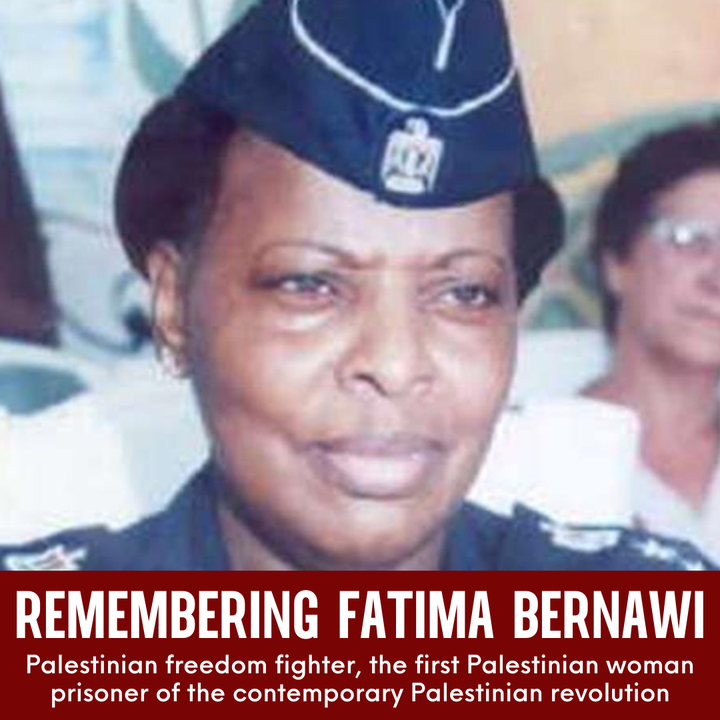
Remembering Fatima Bernawi: Historic Palestinian fighter and liberated prisoner (1939-2022)

On Thursday, 3 November, Palestinian struggler and liberated prisoner, Fatima Bernawi, the first Palestinian woman prisoner of the modern Palestinian revolutionary era and a prominent Afro-Palestinian figure, passed away in the Palestine Hospital in Cairo, Egypt at the age of 83. Bernawi was renowned as a symbol of Palestinian women’s participation and the participation of Palestinians of African descent in the armed struggle and the Palestinian prisoners’ movement.
Bernawi was born in Jerusalem in 1939 to her Nigerian father and Palestinian mother. In 1948, she was forced to a refugee camp near Amman with her mother before returning to Jerusalem, where her father had remained, in 1960; they lived in the African quarter of Jerusalem. At the age of 9, Bernawi had earlier smuggled herself into Jerusalem to reunite with her father. Bernawi’s father had been an active participant in the 1936-39 revolution in Palestine and in the defense of Palestine during al-Nakba, and she became an early member of the newly formed Fateh movement.
Bernawi worked as a UNRWA nurse in Qalqilya during the 1967 occupation and saw firsthand the impacts of the Zionist onslaught on the West Bank of Palestine. She would later declare that she undertook armed struggle “because you destroyed Qalqilya,” in a statement to the interrogators who held her.
She was one of the first women to plan an armed operation in Palestine, the attempted bombing of a cinema screening a film celebrating the occupation of 1967 in Jerusalem; she and a fellow woman freedom fighter left behind a handbag containing an explosive. Although it was found before being detonated, she was seized by occupation forces on 19 October 1967 and became the first Palestinian woman political prisoner of the contemporary Palestinian revolution.
She was sentenced to 30 years in prison and was released on 11 November 1977 in a prisoner release agreement. She was exiled to Jordan and then Lebanon under the exchange terms, where she returned to the Palestinian revolution as a member of social organizations. She later returned to Gaza in 1994 and lived with her husband, fellow liberated prisoner Fawzi al-Nimr, who died last year. She and al-Nimr have lived in Cairo for the past several years. Al-Nimr, who had been a fighter with the Akkawi group that targeted specific Zionist military installations, served over 15 years in occupation prisons with his comrades, and he was freed in an exchange with the Palestinian resistance in May 1985.
Her sister, Enaam Bernawi, was jailed for one year alongside her sister. During Fatima Bernawi’s time in the occupation prisons, she was jailed with fellow Palestinian woman freedom fighter Zakia Shammout, who was pregnant and gave birth in her prison cell accompanied by her fellow women prisoners. As a trained nurse, Bernawi cut the umbilical cord and ensured the life and health of Shammout and her daughter, Nadia.
While Bernawi was the first Palestinian woman prisoner of the contemporary (post-1967) Palestinian revolution, she was always certain to cite fellow Palestinian women who had been jailed in the two decades of occupation prior, including many women detained, held in forced labor camps and subjected to harsh violence by occupation soldiers during the Nakba, as well as notable Palestinians like Ikhlas Ali, jailed for teaching children revolutionary songs in Palestine ’48, and Nayfeh Akilah, a member of Al-Ard group — one of the first Palestinian revolutionary organizations formed following the Nakba — accused of sharing military information about Zionist forces with the Syrian army in 1956.
One journalist who interviewed Bernawi recalled that she discussed a memorable interaction with Omar al-Qasim, the imprisoned leader of the Democratic Front for the Liberation of Palestine who is renowned for his role in sparking Palestinian armed resistance inside the occupied West Bank of Palestine as well as for his later leading role in the prisoners’ movement. Both she and al-Qasim were brought by occupation soldiers where several Palestinian resistance fighters were holding Zionist military trainees hostage, while prison guards demanded they use a megaphone to call on the fighters to let the soldiers go. Bernawi refused to speak through the megaphone at all, while al-Qasim took up the megaphone and instead called on the fighters to carry through with the orders of their leadership. Al-Qasim was beaten and dragged away by occupation forces; later, in 1989, he died in Israeli occupation prisons after lengthy medical neglect and following weeks of appeals by his family for his freedom.
Along with Dalal al-Mughrabi, Shadia Abu Ghazaleh, and Leila Khaled, Bernawi remained a symbol of Palestinian women’s steadfastness and commitment by all means to liberate their homeland from the river to the sea. In fact, Bernawi met Dalal al-Mughrabi before she led her commando operation to occupied Palestine, although she was not aware of the operation planned; al-Mughrabi told Bernawi, “I am going to the place you came from.” Bernawi understood the full meaning of al-Mughrabi’s words when she received news of the commando operation and her martyrdom.
Fellow freed prisoner Aisha Odeh saluted Bernawi in a Facebook post: “Goodbye Fatima Bernawi, daughter of Jerusalem and great fighter, the first to seek freedom and dignity and refuse defeat…she became a beacon for us, guiding us to the path of struggle,” Odeh wrote.

Source: Samidoun
1