


81 years later, the Jewish community, and all those who would resist fascism, remember
The U.S. and European political mainstream love to use the Holocaust. They use it to justify Zionist apartheid. They use it to make millions of dollars off tragedy porn passed as drama films. They use it to draw false comparisons between Vladimir Putin and Adolf Hitler.
What they rarely do, liberal or conservative, is tell the truth about the Holocaust. This deception includes the massacre at Babyn Yar.
A standard narrative among the fascist movement and, unfortunately, government officials in Ukraine and its Baltic allies is that Babyn Yar was a despicable Soviet plot designed to cover up their mass slaughter of innocent Jewish children and deflect attention to Nazi Germany.
NATO and its media allies love to place responsibility for horrendous crimes against humanity on Russia and China. Funny enough, history tells us a different story. History tells us that fascism commits the worst crimes against humanity. Babyn Yar is no different.
The fact is, there is an incredible amount of disinformation and propaganda regarding Babyn Yar when the truth is fairly simple. The SS Galicia division, aided by Banderite collaborators, murdered over 33,000 Jews over the span of two days. The vast majority perished on the first day. Only 29 Jews subjected to this horror survived to tell the tale. That’s the truth not seen on CNN, BBC, or other big business media.
What’s important to understand is that Babyn Yar was not an isolated incident but a culminating event after a summer of horrific anti-Semitic and anti-Roma pogroms. Behind the terror in the summer of 1941 were the Stepan Bandera-led Organization of Ukrainian Nationalists (OUN), the SS, and other Nazi collaborators.
This article aims to recognize the anniversary of the Babyn Yar tragedy through a truthful analysis of contemporary conditions and an examination of history.
Babyn Yar borne from Ukrainian collaboration
The depth of Nazi terror and the Holocaust in Ukraine would not have been possible without a substantial, organized population of collaborators. Ukraine had exactly that.
Contemporary Ukrainian nationalist propaganda often touts the great resistance in Ukraine against the Nazi and Soviet invaders. As if making the two equivalent isn’t bad enough, the analysis is a historical fantasy.
Some 100,000 Ukrainians joined Nazi police forces during World War 2. That number does not include the ranks of the OUN nor the SS Galicia Division. Frankly, the level of Ukrainian collaboration with Nazi Germany was likely the most severe on the European continent, except for maybe Poland.
On January 1, 1941, almost 2 million Jews lived in Ukraine. By the time Bandera and Hitler were done, nearly 1.6 million of those people were dead. This did not happen without a significant Ukrainian fascist movement willing to collaborate with Nazi occupiers.
This depth of collaboration is exactly what allowed SS forces to perpetrate massacres like Babyn Yar. It’s crucial to understand that Babyn Yar was simply a culmination of a Nazi terror campaign against all those they viewed as sub-human. This included Jews, Roma people, Communists, Russians, Poles, LGBTQ2S people, and even Ukrainians.
A fallacy has long existed that Nazi collaborationism and fascism will save an occupied country from Nazi violence. This fallacy has repeatedly led countries like Ukraine to its destruction. This was the case during World War 2, and it is certainly the case now.
The actualization of this fallacy is no better demonstrated than by how quickly the Ukrainian community threw itself into anti-Semitic organizing once the Nazi invasion began in 1941. As soon as Hitler began his invasion of the USSR, the OUN and similar organizations sprang into action against all those who opposed fascism. The OUN had been working with the Nazis for years before the bloody summer that began with the 1941 Lviv pogroms and was bookended by Babyn Yar.
On June 30, 1941, not long after the Nazi invasion, Bandera and the OUN issued a proclamation “restoring the Ukrainian state.” In this proclamation, the OUN declared its affinity and future collaboration with Nazi Germany. In the OUN’s view, Nazi Germany was aiding the Ukrainian people in freeing themselves from “Muscovite occupation.”
In furtherance of this proclamation, the OUN launched a pogrom of unprecedented proportions the next day, centered in Lviv. The slaughter was immediate and brutal. In less than 12 hours, OUN militants murdered nearly 10,000 Ukrainian Jews. This began a summer of OUN terror against Ukrainian Jews, including a late July massacre known as the “Petliura Days.”
Symon Petliura was a famed Ukrainian nationalist leader and rabid anti-Semite. Petliura was infamous for his particularly brutal pogroms against Ukrainian Jews in the early 20th century. Approximately 2,000 more Jews would be murdered in his name over the span of less than 24 hours in late July 1941.
This is all to say Babyn Yar came as the summer’s Nazi terror reached a fever pitch. Ukrainian collaborationist organizations were fully mobilized and formed. This allowed the Nazi army and the SS to gain a substantial foothold in Ukraine.
The result? Babyn Yar — arguably the most notorious anti-Semitic massacre of the Holocaust. German SS paramilitary forces and the recently formed Ukrainian Auxiliary Police carried out this massacre.
Babyn Yar sticks in the collective memory of all those who would oppose Ukrainian Nazism and NATO imperialism as a firm reminder of fascism’s capabilities.
Bandera’s ideological descendants
Since the fall of the Soviet Union, Stepan Bandera has again grown into a popular symbol not only for the Ukrainian Nazi movement but for the Ukrainian government itself. It is not uncommon to see UAF or fascist battalion troops wearing Bandera patches or waving flags laden with Bandera’s face.
In the years leading up to Russia’s 2022 denazification campaign, mass Nazi demonstrations were held in western Ukrainian cities, including Kiev and Lviv. Crowds between 40,000 and 70,000 Nazis brandished swastikas, the Right Sector trident, and flags donning Stepan Bandera’s face. These are the people who really run Ukraine. Whether civilian organizers, elected politicians, or the NATO-equipped military, the veil of “Ukrainian democracy” only thinly covers the fascist reality.
These forces want to create a new Holocaust, a new Babyn Yar, directed at all those NATO deems undesirable: Russians, Jews, Roma people, all Slavic people, anti-imperialists, communists, socialists, etc. NATO uses the people of Ukraine as meat shields to further its goal of white supremacy and genocide.
One of the few images captured of Babyn Yar depicts a Jewish mother, stripped naked, trying to protect herself and her child from an SS trooper poised to execute her baby in front of her eyes. She was one of my people. Her child was one of my people. The Ukrop Nazis and their SS handlers murdered her and tens of thousands of others just like her and her child. Stepan Bandera adored this picture. He carried it with him until his death as a reminder of what he was fighting for, the purging of all “mongrel races” from Ukraine.
That is the Ukraine that NATO wants. That is the Ukraine that the UAF and the Azovites want. That is the Ukraine the U.S. wants. That Ukraine cannot be allowed to re-emerge. In reality, the myth of Ukrainian nationalism is inherently linked to fascism.
This is what all anti-imperialists, wherever we are, must resist. We must fight against all forms of imperialism, from racist police terror in the U.S. Black community to Ukrop nazi terror in the Donbass. The global working class defeated Bandera once. We must defeat his descendants now, or we will be subject to a million Babyn Yars.
Lev Koufax is an anti-zionist Jew with ancestral roots in Russia and Ukraine.
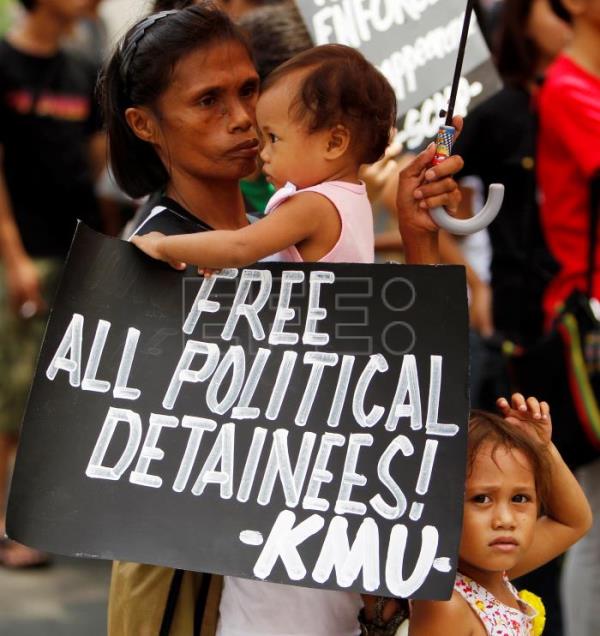
Earlier this month, newly elected Philippines president and neo-fascist demagogue Ferdinand “Bongbong” Marcos Jr. visited Singapore, a fellow country-member of the Association of Southeast Asian Nations (ASEAN). It is important to note that ASEAN was founded to suppress Communist movements that spread throughout the continent, including China, Vietnam, and Korea.
At this recent meeting, Marcos and the president of Singapore explicitly denounced the government of Myanmar and demanded that Myanmar release all political prisoners. Marcos’ office released a statement after the meeting in Singapore, “The leaders expressed support for ASEAN’s active role in assisting in Myanmar to overcome the crisis and to return to the path of democratization.”
The military junta in Myanmar has been charged with human rights violations against its political opponents. However, this description fits another government – that of President “BongBong” Marcos.
Since 2016, the Philippines has suffered neo-fascist rule. First at the hands of U.S.-backed dictator Rodrigo Duterte and now by his successor, Bongbong Marcos, who took office in June. The individual office holder has changed, but the political reality remains the same.
The political prisoner crisis in the Philippines has exploded in the past six years. There is a severe and disturbing irony in BongBong Marcos lecturing any country about their treatment of political prisoners when his fascist government is one of the most notorious for using prison and torture to subdue progressive and revolutionary political forces.
The Duterte regime took hundreds of political prisoners while it was in power. The recorded number is likely far less than the actual. Further, this number does not include the thousands that Duterte’s troops murdered in furtherance of the misnamed “war on terror.”
Bongbong Marcos has some nerve chastising anyone about political prisoners, especially considering his vice president is Sarah Duterte, the daughter of Rodrigo Duterte. This Marcos regime will simply continue the work of Duterte and Ferdinand Marcos before that.
Down with fascism in the Philippines! Release all political prisoners now!

Since 2014, the U.S.-led political West has invested billions into propping up the Neo-Nazi junta in Kiev. This paid off exponentially, as major corporations now had a 100% free hand to tap into and plunder Ukraine’s resources. The country’s territory was always considered a breadbasket of Europe and beyond and its grain has been a target of every foreign power invading the area. This is precisely what happened this time as well, with Western corporations controlling approximately 30% of Ukraine’s arable land. The country’s massive Soviet-era industrial sector was also carved up and bought for pennies, both by foreign corporations and local oligarchs.
The brutal exploitation of Ukraine was further exacerbated after 2014 and continues unabated. However, since February 24, the political West found itself in a situation where it had to keep the unsustainable Neo-Nazi junta in Kiev afloat, at all costs. Nearly a decade of mismanagement and lack of meritocracy left the regime in a state of near complete incompetence to tackle the issues of tens of millions of Ukrainians. The political West was well aware of the uselessness of the puppets it installed, just like in any other country it hijacked or invaded, so it decided to do what it always does in such situations – throw money at the problem until it’s fixed or until it all crumbles into oblivion, as it did in Afghanistan in 2021.
According to the Kiev regime’s current frontman, Vladimir Zelensky himself, this is precisely what is happening in Ukraine. In a CBS “Face the Nation” interview which aired on Sept. 25, Zelensky stated that the U.S. is providing the Neo-Nazi junta with a mindboggling $1.5 billion per month. He claimed the regime would be completely unable to function without these funds. “The United States gives us $1.5 billion every month to support our budget to fight against Russia,” the Kiev regime’s official leader explained. And yet, he pointed out that “there still remains a deficit of $5 billion in our budget.” He kept parroting the same trope that this is far from enough for the Neo-Nazi junta.
After revealing the whopping $1.5 billion provided to the Neo-Nazi junta monthly, Zelensky said: “But believe me, it’s not even nearly enough to cover the civilian infrastructure, schools, hospitals, universities, homes of Ukrainians. Why do we need this? We need the security in order to attract our Ukrainians to come back home.”
“If it’s safe, they will come, settle, work here, and will pay taxes, and then we won’t have a deficit of $5 billion in our budget. So it will be a positive for everybody,” he continued. “Because as of today the United States gives us $1.5 billion every month to support our budget to fight – fight this war. However, if our people will come back – and they do want to come back very much, they have a lot of motivation – they will work here.”
“And then the United States will not have to continue, give us this support,” Zelensky concluded. And yet, it seems the Kiev regime will never be in a position where the U.S.-led political West “will not have to continue” providing such a massive and constant cash flow. And indeed, it seems it’s never enough for the Neo-Nazi junta and the corrupt oligarchs, who keep demanding more. Only a day after Zelensky complained that “it’s not even nearly enough” U.S. Congress kept pushing with another $12 billion arrangement, according to AP.
“Negotiators to a stop-gap spending bill in the U.S. Congress have agreed to include about $12 billion in new aid to Ukraine in response to a request from the Biden administration, a source familiar with the talks said on Monday,” AP claims.
It should be noted that this arrangement isn’t that one-sided. The political West has also appropriated most of Ukraine’s gold and foreign exchange reserves. The political elites in Washington, D.C., and Brussels have certainly not gone empty-handed as a result of this premeditated conflict. And neither have the oligarchs running the Kiev regime. It should be noted that it was only in July that the Associated Press and NPR called attention to a hugely inconvenient fact that there was no way the enormous funds being provided to the Neo-Nazi junta could be held up to scrutiny. The report states:
“As it presses ahead with providing tens of billions of dollars in military, economic, and direct financial support aid to Ukraine and encourages its allies to do the same, the Biden administration is now once again grappling with longstanding worries about Ukraine’s suitability as a recipient of massive infusions of American aid.
“But Zelensky’s weekend firings of his top prosecutor, intelligence chief, and other senior officials have resurfaced those concerns and may have inadvertently given fresh attention to allegations of high-level corruption in Kyiv made by one outspoken U.S. lawmaker.”
What’s clear from this is that both the political elites of the collective West and the corrupt oligarchs of the Kiev regime are profiting from the “financial aid” back and forth, while regular people are suffering the consequences. All the while, the state and corporate-run propaganda machine of the political West continues trying to sell the “moral high ground” narrative that this is precisely what’s necessary to “protect the people of Ukraine,” the same people who have been pushed into a conflict with a nuclear-armed military superpower, one which they cannot hope to win in any conceivable way.
Stanley Kubrick’s classic 1964 film Dr. Strangelove featured an unhinged Air Force General named Jack D. Ripper, who orders a nuclear strike on the Soviet Union after he becomes convinced that the Soviets were polluting the U.S. water supply.
The scenario presented in the film, unfortunately, is not inconceivable today given the Dr. Strangelove-type characters who are prevalent in the upper ranks of the U.S. military and political establishment.
On September 16, President Joe Biden’s nominee to head the U.S. Strategic Command (STRATCOM), which oversees the U.S. nuclear weapons arsenal, Anthony J. Cotton was asked at his Senate confirmation hearing by Senator Tom Cotton (R-Ark.) whether he thought nuclear war was unthinkable.
He responded that if confirmed as STRATCOM commander, his role would be to “ensure that the 150,000 men and women supporting strategic command are prepared to do what some folks think may be unthinkable”—that is to deploy weapons from the U.S. nuclear arsenal.
Later in the hearing, Senator Joni Ernst (R-IO) asked Cotton whether in light of the 2018 National Defense Strategy’s conclusion that the U.S. would struggle to win a war with China over Taiwan, “the president should have flexible nuclear options to prevent conventional defeat at the hands of our adversaries in this particular scenario.”
Cotton replied: “Yes I do.”
Criminally insane?
Cotton’s predecessor, Carl J. Richard, would have likely responded in the same way. Last year, he wrote in the U.S. Naval Institute’s monthly magazine that the U.S. military had to “shift its principal assumption from ‘nuclear employment is not possible’ to ‘nuclear employment is a very real possibility,’” in the face of threats from Russia and China.
Former Pentagon whistleblower Daniel Ellsberg stated that Richard sounded like he was “criminally insane.”
Pitch for an even bigger nuclear weapons budget
The son of an Air Force Master Sergeant who served in the Korean War, Anthony Cotton grew up in Dudley, North Carolina, and was commissioned in the Air Force through ROTC at North Carolina State University in 1986.
He went on to rise through the Air Force, becoming deputy director of the National Reconnaissance Office, a senior military assistant to the Under Secretary of Defense for Intelligence, commander of the 45th space wing, and commander of the Air Force global strike command.
Besides specifying his intent on preparing U.S. forces to wage nuclear war, Cotton used his confirmation hearing to make a pitch for an even bigger budget for the U.S. nuclear arsenal — when the U.S. government is already slated to spend $634 billion over the 2021-2030 period, for an average of $60 billion per year, according to the Congressional Budget Office.
According to Cotton, “for the first time since 1945, the first time for us as a nation, we have two near-peer nuclear adversaries [China and Russia] [and will have to] roll up our sleeves to ensure that we are doing everything we can strategy-wise to [deal with] two.”
Cotton said that the U.S. nuclear arsenal was helping “constrain” Russia’s actions in Ukraine and could serve as a bulwark against a Chinese takeover of Taiwan. “I absolutely believe that our nuclear deterrent force held,” he said. “We did not see Russia do anything with our NATO partners. We may have heard the rhetoric, but I think at the end of the day, Russia and China both understand that we have a strong, resilient nuclear force that is offering deterrence to ourselves and extended deterrence to our allies.”
Such logic obscures the fact that it was the U.S. that provoked conflicts with Russia in China in the first place — and has provoked the new nuclear arms race which could end with the obliteration of much of planet earth with people like Cotton in positions of authority.
Source: CovertAction Magazine

In the following article, first carried in the Morning Star, Kenny Coyle details the “major reversal in U.S.-China relations”, most recently highlighted by Biden’s unequivocal declaration that the U.S. would commit its forces in the event of a military conflict between China and its renegade island province of Taiwan. This, Kenny explains, is “viewed with alarm in Beijing”, as it “increases the possibilities of a U.S.-China war.”
The article outlines the key points of the three Sino-U.S. joint communiques, noting how the second was swiftly undermined by the ‘Taiwan Relations Act,’ and drawing attention to the ‘Taiwan Policy Act’, currently making its way through the U.S. legislature. This would allow for an “enduring rotational U.S. military presence” on Taiwan, something that the U.S. has not maintained since 1979 when it established diplomatic relations with the People’s Republic. As Kenny rightly concludes, this “suggests dark days lie ahead.”
On Sunday 18 September, U.S. President Joe Biden told the U.S. news program 60 Minutes that the U.S. military would go to war in Taiwan should Chinese forces land on the island chain to enforce its sovereignty.
While China has never ruled out the last-resort use of military force, it has always insisted on its preference for peaceful reunification. Biden’s most recent comments repeat previous statements, including one made in Japan, Taiwan’s former colonial occupying power, in May. They are, however, the first since U.S. House Speaker Nancy Pelosi’s journey to Taipei in August which resulted in China holding major military exercises after her visit.
Pelosi’s meeting with the political leadership of Taiwan certainly enraged China and inflamed tension in the area. This was no diplomatic faux pas; it was the whole point of her trip.
An official visit by the third most senior politician in the U.S. on a U.S. Air Force special air mission Boeing C40 military jet emblazoned with U.S. livery to a territory in which Washington does not have an embassy or a consulate was a deliberate provocation.
China got the message. Once Pelosi’s jet departed Taiwan’s self-declared air space, rejoined by her U.S. Air Force escort, China announced a series of live-fire military drills around the main island of Taiwan and reaffirmed its declaration of sovereignty over the territories administered by the Taipei authorities.
Despite claims by the White House that Biden’s remarks do not challenge the One China policy, they essentially confirm the abandonment of “strategic ambiguity” over U.S. military intentions and the adoption of a policy of “strategic clarity” instead.
The move is viewed with alarm in Beijing, not simply because it is seen as breaking these longstanding commitments but because it increases the possibilities of a U.S.-China war. It is feared that such a shift will encourage separatist forces to escalate moves toward establishing a nominally independent Taiwan, thereby triggering the very conflict the U.S. claims it seeks to avoid.
The Biden administration’s moves represent a major reversal in U.S.-China relations that started with president Richard Nixon’s visit to China 50 years ago. In 1971, one year before Nixon’s trip, representatives of the People’s Republic of China (PRC) took up China’s seat at the United Nations, one formerly held by the Republic of China (ROC). The ROC’s leadership under Chiang Kai-shek had retreated to the island province of Taiwan and some neighbouring island groups after their civil war defeat on the Chinese mainland in 1949.
On the final day of Nixon’s 1972 visit, the U.S. and China issued a joint statement, known as the Shanghai Communique, that began the gradual process of diplomatic normalization between the two countries.
The communique stated in part: “The U.S. acknowledges that all Chinese on either side of the Taiwan Strait maintain there is but one China and that Taiwan is a part of China. The U.S. government does not challenge that position. It reaffirms its interest in a peaceful settlement of the Taiwan question by the Chinese themselves.
“With this prospect in mind, it affirms the ultimate objective of the withdrawal of all U.S. forces and military installations from Taiwan. In the meantime, it will progressively reduce its forces and military installations on Taiwan as the tension in the area diminishes.”
Although the text used “acknowledges” rather than the unambiguous “accepts” or “agrees,” the U.S. side did make it clear that it did not challenge the One China interpretation, which was in any case the position of the ROC authorities, with which the U.S. maintained diplomatic relations at the time.
Crucially it recognized the possibility of peaceful reunification by the Chinese themselves, both those on the mainland and Taiwan, and committed the U.S. to de-militarisation.
Full U.S.-PRC relations were formalized on January 1 1979 and a second joint declaration was issued. This stated: “The U.S. recognises the government of the People’s Republic of China as the sole legal government of China. Within this context, the people of the U.S. will maintain cultural, commercial, and other unofficial relations with the people of Taiwan.”
Naturally, this was interpreted by the Chinese as excluding official diplomatic and military relations between the U.S. and the authorities in Taipei. However, just a few months later, Congress passed the Taiwan Relations Act. This drastically altered the terms that had just been agreed.
The Act stated that the U.S. was “to provide Taiwan with arms of a defensive character; and to maintain the capacity of the U.S. to resist any resort to force or other forms of coercion that would jeopardise the security, or the social or economic system, of the people on Taiwan.”
The U.S. had unilaterally appointed itself the guardian of Taiwan and its social and economic system. This was hardly non-interference.
The third communique, by contrast, adopted during the Reagan presidency, August 17, 1982, set out much clearer parameters. These included:
“Respect for each other’s sovereignty and territorial integrity and non-interference in each other’s internal affairs constitute the fundamental principles guiding China-U.S. relations.
“The U.S. government attaches great importance to its relations with China, and reiterates that it has no intention of infringing on Chinese sovereignty and territorial integrity, or interfering in China’s internal affairs, or pursuing a policy of ‘two Chinas’ or ‘one China, one Taiwan.’
“The U.S. government states that it does not seek to carry out a long-term policy of arms sales to Taiwan, that its arms sales to Taiwan will not exceed, either in qualitative or in quantitative terms, the level of those supplied in recent years since the establishment of diplomatic relations between China and the U.S., and that it intends gradually to reduce its sale of arms to Taiwan, leading, over a period of time, to a final resolution.”
Anxious to enlist China in an anti-Soviet alliance, the U.S. clearly made serious concessions to Chinese positions that went beyond the first two declarations. However, these principles have never been implemented by the U.S. side in practice.
Challenges to China’s sovereignty and territorial integrity are openly canvassed by Washington, while U.S. arms sales to Taiwan have ballooned. According to defensenews.com Taiwan has a $14 billion backlog of U.S. arms, delayed due to the pandemic and the diversion of U.S. supplies to the proxy war in Ukraine.
In Washington today, the anti-China hawks are in full flight. A new piece of legislation, the Taiwan Policy Act, is currently being drafted by the Senate’s foreign relations committee.
This goes beyond previous policy in that it would commit the U.S. to a wider range of programs, an extended definition of “Chinese aggression,” including cyber attacks, social media disinformation, and economic coercion.
It provides for $6.5bn in military supplies and training programs over the next few years to pay for “war games, full-scale military exercises, and an enduring rotational U.S. military presence that assists Taiwan in maintaining force readiness and utilising U.S. defence articles and services transferred from the U.S. to Taiwan.”
The U.S. has not had an “enduring” military force in Taiwan since 1979, just after it recognized the PRC. That such a proposal is even being discussed in the corridors of power in Washington suggests dark days lie ahead.

A cycle of protests began in Haiti in July 2018, and—despite the pandemic—has carried on since then. The core reason for the protest in 2018 was that in March of that year the government of Venezuela—due to the illegal sanctions imposed by the United States—could no longer ship discounted oil to Haiti through the PetroCaribe scheme. Fuel prices soared by up to 50 percent. On August 14, 2018, filmmaker Gilbert Mirambeau Jr. tweeted a photograph of himself blindfolded and holding a sign that read, “Kot Kòb Petwo Karibe a???” (Where did the PetroCaribe money go?). He reflected the popular sentiment in the country that the money from the scheme had been looted by the Haitian elite, whose grip on the country had been secured by two coups d’état against the democratically elected President Jean-Bertrand Aristide (once in 1991 and again in 2004). Rising oil prices made life unlivable for the vast majority of the people, whose protests created a crisis of political legitimacy for the Haitian elite.
In recent weeks, the streets of Haiti have once again been occupied by large marches and roadblocks, with the mood on edge. Banks and nongovernmental organizations (NGOs) — including Catholic charities — faced the wrath of the protesters, who painted “Down with [the] USA” on buildings that they ransacked and burned. The Creole word dechoukaj or uprooting—that was first used in the democracy movements in 1986 — has come to define these protests. The government has blamed the violence on gangs such as G9 led by the former Haitian police officer Jimmy “Babekyou” (Barbecue) Chérizier. These gangs are indeed part of the protest movement, but they do not define it.
The government of Haiti—led by acting President Ariel Henry—decided to raise fuel prices during this crisis, which provoked a protest from the transport unions. Jacques Anderson Desroches, president of the Fós Sendikal pou Sove Ayiti, told the Haitian Times, “If the state does not resolve to put an end to the liberalization of the oil market in favor of the oil companies and take control of it,” nothing good will come of it. “[O]therwise,” he said, “all the measures taken by Ariel Henry will be cosmetic measures.” On September 26, trade union associations called for a strike, which paralyzed the country, including the capital of Haiti, Port-au-Prince.
The United Nations (UN) evacuated its nonessential staff from the country. UN Special Representative Helen La Lime told the UN Security Council that Haiti was paralyzed by “[a]n economic crisis, a gang crisis, and a political crisis” that have “converged into a humanitarian catastrophe.” Legitimacy for the United Nations in Haiti is limited, given the sexual abuse scandals that have wracked the UN peacekeeping missions in Haiti, and the political mandate of the United Nations that Haitian people see as oriented to protecting the corrupt elite that does the bidding of the West.
The current President Ariel Henry was installed to his post by the “Core Group” (made up of six countries, this group is led by the United States, the European Union, the UN, and the Organization of American States). Henry became the president after the still-unsolved murder of the unpopular President Jovenel Moïse (thus far, the only clarity is that Moïse was killed by Colombian mercenaries and Haitian Americans). The UN’s La Lime told the Security Council in February that the “national investigation into his [Moïse’s] murder has stalled, a situation that fuels rumors and exacerbates both suspicion and mistrust within the country.”
Haiti’s crises
An understanding of the current cycle of protests is not possible without looking clearly at four developments in Haiti’s recent past. First, the destabilization of the country after the second coup against Aristide in 2004, which took place right after the catastrophic earthquake of 2010, led to the dismantling of the Haitian state. The Core Group of countries took advantage of these serious problems in Haiti to import onto the island a wide range of Western NGOs, which seemed to substitute for the Haitian state. The NGOs soon provided 80 percent of the public services. They “frittered” considerable amounts of the relief and aid money that had come into the country after the earthquake. Weakened state institutions have meant that the government has few tools to deal with this unresolved crisis.
Second, the illegal U.S. sanctions imposed on Venezuela crushed the PetroCaribe scheme, which had provided Haiti with concessionary oil sales and $2 billion in profits between 2008 and 2016 that was meant for the Haitian state but vanished into the bank accounts of the elite.
Third, in 2009, the Haitian parliament tried to increase minimum wages on the island to $5 per day, but the U.S. government intervened on behalf of major textile and apparel companies to block the bill. David Lindwall, former U.S. deputy chief of mission in Port-au-Prince, said that the Haitian attempt to raise the minimum wage “did not take economic reality into account” but was merely an attempt to appease “the unemployed and underpaid masses.” The bill was defeated due to U.S. government pressure. These “unemployed and underpaid masses” are now on the streets being characterized as “gangs” by the Core Group.
Fourth, the acting President Ariel Henry likes to say that he is a neurosurgeon and not a career politician. However, in the summer of 2000, Henry was part of the group that created the Convergence Démocratique (CD), set up to call for the overthrow of the democratically elected government of Aristide. The CD was set up in Haiti by the International Republican Institute, a political arm of the U.S. Republican Party, and by the U.S. government’s National Endowment for Democracy. Henry’s call for calm on September 19, 2022, resulted in the setting up of more barricades and in the intensification of the protest movement. His ear is bent more to Washington than to Petit-Goâve, a town on the northern coast that is the epicenter of the rebellion.
Waves of invasions
At the UN, Haiti’s Foreign Minister Jean Victor Geneus said, “[T]his dilemma can only be solved with the effective support of our partners.” To many close observers of the situation unfolding in Haiti, the phrase “effective support” sounds like another military intervention by the Western powers. Indeed, the Washington Post editorial called for “muscular action by outside actors.” Ever since the Haitian Revolution, which ended in 1804, Haiti has faced waves of invasions (including a long U.S. occupation from 1915 to 1930 and a U.S.-backed dictatorship from 1957 to 1986). These invasions have prevented the island nation from securing its sovereignty and have prevented its people from building dignified lives. Another invasion, whether by U.S. troops or the United Nations peacekeeping forces, will only deepen the crisis.
At the United Nations General Assembly session on September 21, U.S. President Joe Biden said that his government continues “to stand with our neighbor in Haiti.” What this means is best understood in a new Amnesty International report that documents the racist abuse faced by Haitian asylum seekers in the United States. The United States and the Core Group might stand with people like Ariel Henry, but they do not seem to stand with the Haitian people, including those who have fled to the United States.
Options for the Haitian people will come from the entry of trade unions into the protest wave. Whether the unions and the community organizations—including student groups that have reemerged as key actors in the country — will be able to drive a dynamic change out of the anger being witnessed on the streets remains to be seen.
This article was produced by Globetrotter. Vijay Prashad is an Indian historian, editor, and journalist. He is a writing fellow and chief correspondent at Globetrotter. He is an editor of LeftWord Books and the director of Tricontinental: Institute for Social Research. He is a senior non-resident fellow at Chongyang Institute for Financial Studies, Renmin University of China. He has written more than 20 books, including The Darker Nations and The Poorer Nations. His latest books are Struggle Makes Us Human: Learning from Movements for Socialism and (with Noam Chomsky) The Withdrawal: Iraq, Libya, Afghanistan, and the Fragility of U.S. Power.
Sept. 25 — A rally in Corona Plaza, Queens, New York, today protested the inhuman U.S. economic blockade of Cuba. As the No. 7 elevated train rumbled overhead, speakers pointed out how the U.S. blockade also hurts poor and working people in the U.S.
Jason Corley chaired the Sunday afternoon rally called by the New York-New Jersey Cuba Sí Coalition. The coalition is gearing up for the annual United Nations vote against U.S. sanctions on Cuba, which will be taking place in October.
Last year’s vote was 184 countries against the blockade compared to just two votes in favor.
Speakers mentioned the referendum on Cuba’s new family code, which was taking place the same day. These laws will help protect LGBTQ2S people, as well as all women and youth.
There was also a short march through Corona, a poor working-class neighborhood with many immigrants. Estela Vazquez, Executive Vice President at 1199 SEIU, a health care workers union, said the community was hard hit by COVID-19.
One out of every 168 people died of the coronavirus in Corona, Queens. Despite the U.S. blockade, socialist Cuba has been able to contain the pandemic with its own vaccines.
Other speakers at the rally included Bill Sacks from the Venceremos Brigade; Camilo from the Puerto Rican Nationalist Party; and Samar from the Palestine Youth Movement.
U.S. hands off Cuba!
SATURDAY AT 1 PM
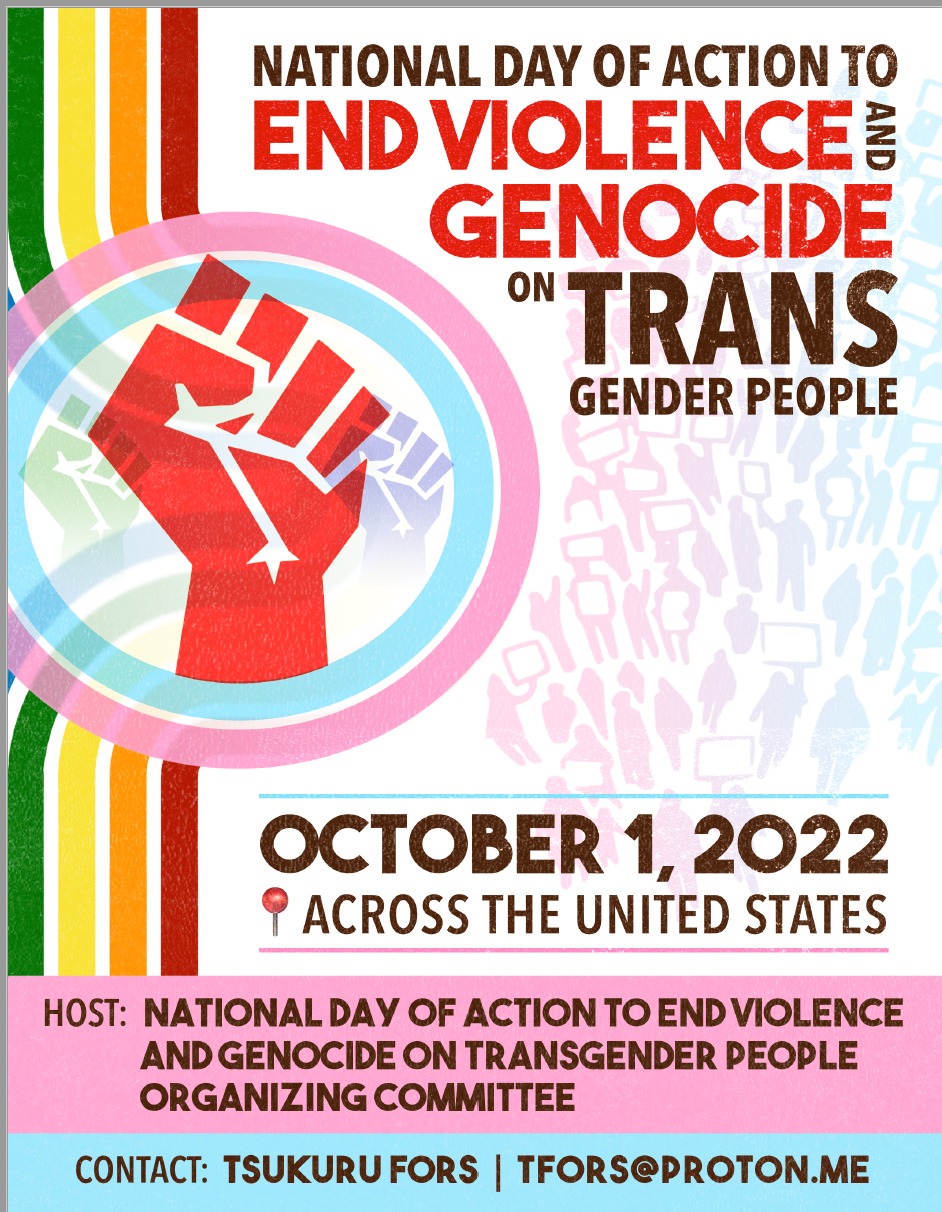
NYC National Day of Action to End Violence & Genocide on Transgender People
Union Square, 14th St. & Broadway, New York City
On October 1st, 2022, join your transgender/gender non-conforming siblings and allies nationwide, as we take to the streets of our hometowns to demand our basic human rights to live a safe, prosperous, and dignified life as our authentic selves!
It’s time to show up, stand out, and be heard. Join us!
Initiated by Trans Radical Activist Network
https://www.transradicalactivistnetwork.org/
Why do we protest?
On August 19, 2022, Rep. Marjorie Taylor Greene (GA-14) introduced H.R. 8731, Protect Children’s Innocence Act, to the US House of Representatives. If passed, the bill would:
We see this bill not only as an assault to transgender rights but also as potentially undermining individual freedom and rights to bodily autonomy for all in the U.S.
Therefore, on October 1, 2022, we call upon transgender/gender non-conforming people and their allies to take to the streets in multiple cities across the nation to demand federal protection for the rights of transgender/gender non-conforming people, as well as healthcare justice, housing justice, workplace justice, and reproductive justice for all.
We, transgender and gender non-conforming people of the United States demand our basic human right to life, liberty, and personal security. We demand the right for all of us, trans and cis people alike, to have education, health care, employment, and housing in a safe and dignified environment.
Trans liberation is liberation for all!
1