Big investors gobble up trailer parks, profit from housing crisis

On May 8, residents of Plaza Del Rey mobile home park in Sunnyvale, Calif., protested price hikes imposed by the investment company that owns the park.

In September 2020, a company called “CPI Superstition Sunrise RV Resort, LLC” purchased a mobile home park (MHP) in Mesa, Ariz., for $88 million — a record price for Arizona. The new owner concealed its identity with this shell company. It was actually The Carlyle Group, one of the world’s biggest global investment companies. 

Around the same time as Carlyle’s deal, the Blackstone Group was in negotiations to buy a portfolio of MHPs — mostly in Florida — for $550 million. Earlier in the year, Blackstone had purchased seven other parks in Florida and Arizona for $200 million. 

Stockbridge Capital, Apollo Global Management, Brookfield Asset Management — all worth billions in assets — are in the competition, along with dozens of others, to buy what we used to call “trailer parks.” 

The Carlyle Group manages $260 billion in assets. Blackstone Group is even bigger at $619 billion. The COVID-19 pandemic has these giant capitalist investors seeking alternatives to commercial real estate and luxury apartments. Those markets were already glutted and becoming less profitable when the pandemic hit, and were then battered in the economic tailspin as the pandemic shutdowns happened.  

Capital from these investment behemoths has been quietly creeping into the mobile home park market for years, but the pace quickened, fueled by the disastrous failure of U.S. capitalism to cope with the deadly COVID outbreak.

In almost all cases, the investor groups continue operating the MHPs as they are instead of razing them to make way for shopping malls or apartment buildings, as one might expect. The investment strategy itself is being marketed in seminars that sell advice on how and where real-estate giants can find the greatest potential profit. They advise their customers to avoid areas where tenant laws are stronger.

Lack of affordable housing

Affordable housing is more and more scarce as the capitalist crisis persists. It’s well known that rent for even tiny living spaces in cities like San Francisco, New York City and Los Angeles has reached absurd levels. But the problem is much more widespread than that. 

The National Low Income Housing Coalition reports that there isn’t a single state in the U.S. where a person working full-time at minimum wage can afford a one-bedroom apartment. The corporate ruling class is fighting tooth and nail to block any significant increase in wages at all. 

Landlord greed and illegal anti-worker tactics like those employed by Amazon during the Bessemer, Ala., union drive are enabled and bolstered by courts and bought-and-paid-for politicians across the political spectrum. All of this has driven people into one form of homelessness or another — more than 550,000 according to a 2017 point-in-time count. 

Mobile home parks have been one of the last resorts for working-class and poor people to keep a roof over their heads.

The Carlyle Group has been among the most aggressive investment giants — buying up MHPs in areas of the country where the tech industry has driven the cost of living sky high, like parts of Florida and California. 

These corporate giants have only snapped up a tiny fraction of all MHPs, but the buyouts are happening fast. According to a March 8 article in The New Yorker, 20 million people live in mobile homes in the U.S. They are most often retirees, low-income workers or disabled people. 

In the relationship between the landlord and mobile home owners, every advantage is the landlord’s. In most states, the skimpy, inadequate tenant protection laws that apply to apartments and single-family homes apply to MHPs in a more limited way. To the extent they do apply, enforcement is almost non-existent.

The tenant’s ownership of the mobile homes is real only in a convoluted technical sense. In reality, the relationship is remarkably similar to a feudal one, in which the serfs were technically free – but not really. 

The homeowners rent the land from the owner of the MHP. They’re required to cut the tow hitches from their homes when they’re moved onto the lot. That, combined with plumbing, gas and electricity being hooked up, make these “mobile homes” impractical to move. 

Few protections

There are so few laws to protect mobile home owners in the parks taken over by big corporations that they are often subject to big rent increases for their lots. Usually, park owners aren’t required to give prior notice of rent increases or even evictions.

Typically, it’s legal for the landlord to block a homeowner from selling their mobile home by requiring any new owner to move it off the lot. The cost to take your mobile home with you if you decide to move even a short distance may be as much as $10,000. Now, more people are forced to abandon the homes that they have struggled to get.

Owning a traditional home is often a first (and only) opportunity for working-class people to own something that they are able to pass on to their children. Of course, that opportunity was battered by the tsunami of home foreclosures during and since the 2008-2009 capitalist meltdown. For Black and Brown communities in the U.S. as a whole, those foreclosures amounted to the largest take-back of personal wealth in history. 

But the “generational wealth” that millions of working-class families labored and saved for barely exists in MHP living. Mobile homes quickly depreciate in value instead of gaining value, no matter how much money or time the tenants/owners invest in their upkeep. 

Since the homes are technically owned by the tenants, the multibillionaires that are buying up the mobile home parks never face costs or responsibility for maintenance. Land, however, appreciates in value, making the purchase of mobile home parks even more lucrative for giant investors than condos, luxury apartments or commercial real estate. 

To top all this off, The Carlyle Group, Blackstone and the other billionaire parasites are often eligible for subsidized loans from government entities Fannie Mae and Freddie Mac.

It may have surprised some to find out in the 1990s that pawn shops, payday lenders, easy credit/high interest finance companies, storage companies and other businesses that prey on the poor were being bought out by the likes of American Express, General Motors Acceptance Corporation and other Fortune 500 outfits. But that is an inherent feature of capitalist economy. 

Karl Marx pointed out that capital always seeks the highest rate of profit. The more widespread poverty becomes, the greater the potential profit – at least, that’s what happens until rebellion against the crushing poverty changes everything.  

Organizations of mobile home owners are cropping up and pushing for laws to protect themselves. As the anti-capitalist movement grows and develops, homelessness, housing and the links to poverty wages are crucial issues that need to be taken on, by unions and by all working-class activists.    

Strugglelalucha256


Community organizers force veto of attack on renters’ rights

Renters and tenant rights groups in Baltimore successfully forced the mayor to veto a bill that they would introduce rental security-deposit insurance — so-called surety bonds, a predatory practice by landlords that essentially makes the tenant pay the rental deposit twice.

The veto is a major victory against the landlords, especially taking into account the bill had the backing of the city council president and that all except two of the 14 council members voted for the bill. 

Over 40 community organizations joined efforts to counter the passage of Council Bill 21-0022, the Security Deposit Alternatives Bill. During press conferences and rallies around the city, housing activists explained that landlord interests had hijacked what was at first an attempt to put a policy in place that would make it easier for city renters to shoulder the burden of paying security deposits.

Fair housing advocates sought to get an alternative bill that would allow renters to pay the security deposits in installments, if desired, thereby making it easier to manage. The final bill passed was anything but a choice. It was instead a trap that was misnamed “renters’ choice.” 

Predatory lenders

In reality, renters would be signing up for a surety bond with predatory lenders who would then have the ability to keep the entire security deposit amount as well as tack on additional charges for unsubstantiated damages. 

The bill doesn’t specifically name Rhino, a real-estate startup that launched in 2017, but it’s widely understood that “security insurance” refers to a financial product that Rhino promotes.

The “security insurance” process would prevent renters from filing disputes in rent court. Rhino would have access to initiate debt collections against renters. If rents are in escrow over disputes, Rhino can still file a claim against renters for damages.

During the campaign to demand a veto, activists distributed literature which described Rhino as “a company run by a wealthy, longtime landlord and backed by a venture capital fund called Kairos.” This bill in reality is a landlord choice as it in no way gives renters any choice at all.

Rhino has been promoting the so-called “renters’ choice” legislation around the country — most recently in Columbus, Ohio, and Atlanta. In New York, Rhino is aligned with landlords, and is pursuing its scheme with help from an executive order issued by Gov. Andrew Cuomo. 

‘Enough housing exploitation’

At a recent rally against the bill, the two council members who voted against it addressed the crowd. 

Ryan Dorsey remarked, “This bill allows exploitation of people who are already in desperate situations.” Zeke Cohen observed: “This is subprime policies by a different name that allows predatory lending. Baltimore was the first city in the country to do redlining. Enough is enough for housing exploitation.”

Mayor Brandon Scott finally vetoed the bill at the eleventh hour on May 17. Community pressure gave rise to the power of the people to organize and defeat this giveaway to the landlords. 

The fact that the well-meaning intent of the original concept was able to be twisted and turned around at this level exposes that legislative bodies are in the hands of lobbyists for landlords and big business. It took a united effort of people’s power to rightly defeat this insult to renters’ intelligence. This provides a great lesson of the organizing power of the working class to win victories on our own behalf.

Strugglelalucha256


Unemployment benefits owed to every worker

The New York Times has called the Biden presidency “an echo of Franklin Roosevelt.” Today, support for labor unions is broader and more widespread than at any time in the last five decades, including support from Trump Republicans.

So some may have been surprised when, after the April jobs report showed unemployment is rising, Biden responded that he’s going to cut down on unemployment benefits, repeating the claims of the U.S. Chamber of Commerce that joblessness is increasing because of unemployment benefits.

“Anyone collecting unemployment who is offered a suitable job must take the job,” Biden said. That’s what happens with prisoners — forced to take any job offered — but shouldn’t happen in a free labor market.

Unemployment benefits are owed to every worker. The benefits come out of unpaid wages. The unemployment insurance program is financed through a tax that is taken indirectly from workers’ wages. Every cent that the unemployed collect is owed to the workers.

Unemployment is rising because of capitalist economic instability, not because any worker might pass on taking the low-wage, no-benefits jobs being offered.

Strugglelalucha256


What happened to U.S. passenger trains?

People around the world celebrate May Day as the international workers’ holiday. This past May 1st was also the 50th anniversary of Amtrak, the U.S. government’s passenger train system.

Until the coronavirus pandemic, Amtrak’s 20,000 employees carried almost 32 million passengers annually. The railroad’s Northeast Corridor between Boston and Washington, D.C., and a few other lines offer frequent service.

But for most people in the United States passenger trains are just a memory. There’s no Amtrak service to Columbus, Ohio, or Nashville, Tenn. Both these state capitals have metropolitan area populations of around 2 million.

Amtrak also doesn’t serve Las Vegas, Nev., and Louisville, Ky. Neither South Dakota or Wyoming have any passenger trains. There’s no service between Chicago, Atlanta and Florida.

That’s a shame and a special burden for elderly and disabled people. Although airline and other transportation workers try to be as helpful as possible, passenger trains have more room than either planes or buses. They’re wheelchair accessible.

Of all the big capitalist countries, only Canada has a similar lack of passenger trains. The European and Japanese rail systems are renowned for frequent and fast trains. India’s railroads carry 12 million passengers daily.

Then there’s the socialist People’s Republic of China, which has more miles of high-speed train lines than the rest of the world combined.

Bailing out railroad companies

President Richard Nixon signed the bill that established the National Passenger Railroad Corporation on May 1, 1971. Nixon’s father was a motorman on the old Pacific Electric transit system in Southern California. But the Watergate war criminal who was murdering Black Panther Party leaders like Fred Hampton wasn’t known to be a train buff.

Amtrak was set up to bail out the Penn Central railroad system. Its 20,000 miles of track dominated rail service in the Northeastern and Midwestern states. Auto, steel and other industries depended on it.

The Pennsylvania and New York Central railroads combined to form Penn Central on Feb. 1, 1968. It was the biggest corporate merger up to that time. Penn Central was the sixth biggest U.S. corporation and largest transportation company. 

And when Penn Central declared insolvency on June 21, 1970, it was the largest bankruptcy in history until the crooked Enron utility empire went under in 2001. Penn Central’s bankruptcy threatened to tank Goldman Sachs and many other banks. 

Amtrak was started to save Penn Central from losing millions by operating 35 percent of the country’s passenger trains. This included big commuter train operations serving Boston, New York City and Philadelphia.

The only way Congress could be persuaded to set up Amtrak was if there were some trains to serve the rest of the country, too. Passenger train service had already shrunk enormously since the mid-1950s.

Revenues from carrying the mail subsidized many trains. President Lyndon Johnson’s action in sending first class mail via the airlines was fatal. The Santa Fe ― now part of the BNSF railway ― immediately filed to abandon its trains linking California and Texas with Chicago.

Cut backs are a train wreck

Starting Amtrak resulted in cutting half of the remaining passenger trains. Thousands of railroad workers lost their jobs. 

Just in Wisconsin, service was dropped to Appleton, Green Bay, Kenosha, Manitowoc, Racine and Sheboygan. More cuts were made in 1979 when six Amtrak routes serving 5,000 miles were eliminated.  

Amtrak has only one train between New York City and Chicago. Back in 1953, the New York Central ran seven daily trains between the two cities while the Pennsylvania had six. More trains to the Windy City left from the Erie, Jersey Central and Lackawanna terminals across the Hudson River.

It wasn’t just jet planes and the interstate highway system that killed passenger trains. The ruling class didn’t need them anymore.

Workers couldn’t afford the fare on famous all-Pullman sleeping car trains like the New York Central’s “20th Century Limited” or the Pennsylvania’s “Broadway Limited.” It was the prosperous few who rode these palaces on wheels with delicious meals prepared in the dining cars by Black chefs.

Capitalists dumped these trains. What did they need Pullmans for when they could jet around the world and stay in hotel suites? The super-rich also went from owning private railroad cars to having their own jets.

Ending passenger service went hand-in-hand with cutting railroad employment from 1.4 million workers in 1947 to around 200,000 today. At least 50,000 miles of track have been abandoned.

For decades the Association of American Railroads attacked safety rules, claiming workers were being coddled. The AAR bosses called these absolutely necessary regulations “feather bedding.”

Crew sizes were cut in both the U.S. and Canada. An inevitable result was 47 people killed in the 2013 train wreck in Lac-Mégantic, Quebec. A lone engineer was the only crew member on a long train of oil tank cars.

All transportation workers have been under attack. Deregulation and bankruptcy laws have been used to attack airline workers and the Teamsters union.

President Joe Biden has now proposed to invest billions in new passenger trains. That’s a popular proposal. 

Even some of the wealthy see the need to have more passenger service. They view it as part of renewing the capitalist infrastructure.

It’s also an attempt to catch up with socialist China. We need what China has: train service for all.

The writer is a retired Amtrak worker.

Strugglelalucha256


The boom isn’t happening: Jobs report shows unemployment worsening


No matter how you look at it, the Labor Department’s April jobs report is miserable — unless you’re on Wall Street. The stock market hit record highs after the report was released. Business Insider reported, “Why the horrid April jobs report was actually great news for stocks.” 

There were only 266,000 new jobs available in April across the whole United States, the government reported May 7, not the million or so that capitalist cheerleaders had forecast. The Labor Department’s official unemployment rate is now 6.1%. The Ludwig Institute for Shared Economic Prosperity says the true rate in March was 24.7%. 

Joblessness remains rampant. The Labor Department says that the number of people working is still down 8.2 million from what it was before the pandemic in February 2020. Right now more than 16 million workers are collecting jobless aid — a number that’s far higher than the roughly 2 million a year ago, before the pandemic.

Even if you accept the nervous claims that April was an aberration (see for example John Cassidy’s New Yorker article “Don’t Panic Over One Weaker-Than-Expected Jobs Report”), job growth has averaged only 524,000 a month for the last three months.

Women have taken the brunt

The jobs report shows that even more women have dropped out of the labor force, primarily because schools continue to be closed and there is no childcare available.

The report showed a bleak outlook for women, who have taken a disproportionate hit from the pandemic’s economic devastation. According to the National Women’s Law Center, 165,000 women who are at least 20 years old dropped out of the labor force from March to April.

“If you added all of the women who’ve dropped out of the labor force since February 2020, the unemployment rate for women would be 8.1%,” Jasmine Tucker, the director of research at the NWLC, said. 

Unemployment is much higher than pre-pandemic levels for Black and Latina women. The NWLC estimates that it’ll take women 28 months to reach their pre-pandemic employment levels. That’d be the summer of 2023.

What’s required is accessible and affordable childcare. Lack of childcare is hampering people’s ability to get back to work.

Many of the new jobs available pay the minimum wage, with no benefits. Often the jobs available are only part-time with no benefits.

Black workers’ wages decline

Wages for Black workers declined in the first quarter of 2021, growing the wage gap to its highest level since before the pandemic, according to a report by the Ludwig Institute for Shared Economic Prosperity. Black workers saw their real earnings decrease by 1.4% since the fourth quarter of 2020, and a decline of 3.5% since the beginning of the pandemic.

Black workers are now earning 70 percent as much as their white counterparts, the largest wage gap since the pandemic began and six percentage points higher than at the turn of the century, according to LISEP.

Soon after the Labor Department released its April jobs report, the U.S. Chamber of Congress blamed the weak employment growth on the existence of a $300 weekly supplemental jobless benefit and began urging lawmakers to eliminate the federally enhanced unemployment payments that were extended through early September.

If $300 a week is preventing employers from hiring low-wage workers, the answer is to raise wages and pay benefits, and make the jobs safe.

That seems obvious. And some economists say that the federal enhanced unemployment payments along with the other stimulus payments in the CARES Act are the reason for record wealth growth in the billionaire class. The richest 500 people on the planet added $1.8 trillion to their combined wealth in 2020, accumulating a total net worth of $7.6 trillion, according to the Bloomberg Billionaires Index. 

Walmart and Target reported record sales. Amazon tripled its profits.

Why not raise wages?  

So it might seem like the capitalist class would favor the stimulus and extended unemployment benefits. And they’ve gotten so much richer. So why not raise wages? 

From the standpoint of the capitalist, the mass unemployment created by the COVID-19 pandemic provided a unique opportunity for employers to lower wages and increase the rate of surplus value, which they call profit.

Workers are resisting the wage cuts — the low wage jobs now being offered. At the most basic level, workers are generally opposed to returning to work until they are fully vaccinated and their children can be safely back in school and daycare full time.

A Pew Research Center survey this year found that 66% of the unemployed had “seriously considered” changing their field of work, a far greater percentage than during the Great Recession. People who used to work in restaurants or hotels are finding better paying jobs in warehouses or as delivery drivers, for example. Or they want a job that is more stable and less likely to be exposed to the coronavirus. 

Consider that grocery stores laid off over 49,000 workers in April and nursing care facilities tossed out nearly 20,000. Kroger has been closing stores to avoid local laws mandating “hero pay” of $5-an-hour for workers in the essential grocery stores who face hazardous exposure while on the job. 

“The problem is we are not making enough money to make it worth it to go back to these jobs that are difficult and dirty and usually thankless. You’re getting yelled at and disrespected all day. It’s hell,” Sara Wojtala, who is 31, told the Washington Post. She added that with two young kids, finding child care has also been a huge issue lately. 

“Cooks, who are overwhelmingly Latino, made up the highest excess mortality rate of any profession last year — and people wonder why workers would think twice before returning to these jobs?” Assemblywoman Lorena Gonzalez told the San Diego Union-Tribune. 

It’s no mystery

There is really no mystery to this. Good wages, full benefits, safe workplaces and respect — all that would add up to ending the near-depression level unemployment crisis.

The capitalist politicians, Republicans and Democrats, talk of getting the economy moving again. Starting the economy moving should be fairly easy. Calling people back to their jobs is easy. Offer a living wage with full benefits, at minimum.

So why is there a problem? The problem is that the bosses are not interested in starting just any economy. They are interested only in starting the capitalist economy. And there is the block.

“The real barrier to capitalist production,” says Karl Marx, “is capital itself.” Capital means production for profit and not for use. Lowering wages and cutting benefits maximizes profit.

It would be easy to get the economy moving, to get everyone back to work, if the economy were transformed into a system of production for use. The existing framework is fully capable of starting up and engaging everyone in useful productive labor.

The block, however, is production for profit, not for use. That’s the ultimate problem.

Strugglelalucha256


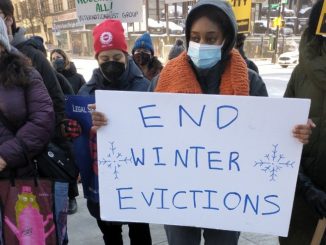
Don’t let them evict us!

Federal Judge Dabney Friedrich threw out the federal ban on evictions May 5. The Trump-appointed judge claims the Centers for Disease Control had no authority to impose the moratorium under the Public Health Service Act of 1944.

The coronavirus has already killed 3 million people worldwide, including 580,000 in the United States. What’s more important to public health than stopping millions of families from being thrown on the street during this pandemic?

For the capitalist class and its judges, profits always come before human lives. Children being kicked out of their homes mean nothing to the Alabama Association of Realtors and real estate agents in Georgia that filed the suit against the eviction ban.  

Behind these brokers and even the biggest landlords are the banksters who own the mortgages. The big banks can lend billions to build luxury housing while almost no affordable housing is being built.

It’s the real estate industry and financial institutions that enforced Jim Crow housing segregation. Real estate profiteers led bombing campaigns in Chicago to drive Black homeowners out of white neighborhoods.|

Between 1978 and 1983, 55 people were killed in fires in Hoboken, N.J., in order to drive out poor people. Half of the Latinx community was driven out of the city.

Now these criminals want to drive millions of people out of their homes with the blessing of a federal judge.

Evictions can be stopped

Tenants’ groups coast to coast, like the Crown Heights Tenant Union in Brooklyn, N.Y., have been organizing 24/7 to stop evictions. They need support from the labor movement and all progressive people.

During the Great Depression of the 1930s, the Unemployed Councils in cities like Chicago stopped evictions. People surrounded sheriffs conducting evictions. Furniture that was dumped on the street by cops was put back into people’s homes.

Because of struggle, laws were enacted that protected millions of renters, homeowners and small farmers. We can do it again!

One of the first acts of the Cuban Revolution was to limit both rent and utility bills to no more than 10 percent of a family’s income. While over 22,000 children are homeless in New York City, the capital of capitalism, not a single child is homeless in socialist Havana. 

We need what Cuba has. Housing is a right: fight, fight, fight! A fightback by millions can stop the wave of evictions that the slumlords and banksters are plotting to carry out. 

Strugglelalucha256


Ramsey Clark, enemy of imperialist war and racist oppression

On April 9, a dear friend and inspiration of mine died: former U.S. Attorney General Ramsey Clark. I traveled with him to many targets of U.S. imperialism and met heads of state. He had the clout to go anywhere and didn’t mind being vilified by the corporate media that slavishly toed the line of the U.S. State Department, impugning his integrity simply because he refused to go along with the lies of U.S. imperialism when they wanted to go to war, either overtly or covertly, against countries that insisted on their sovereignty and their orientation toward various aspects of socialism.

Clark was, and will be remembered throughout human history as, a person of principle. He turned his back on his privilege and connections to the ruling class. During the Lyndon Johnson administration, he refused to go along with the bombing of Cambodia and the Vietnam War. He turned his back on Johnson’s cabinet position and instead put his body in harm’s way to stop the U.S. war drive, whether in Sudan or Vietnam, Syria or Iraq, or anywhere he felt he could use his status to stop his country, which he often quoted Dr. Martin Luther King Jr. as saying, is the greatest purveyor of violence today. And he wanted to save children’s lives.

He assisted and led legal battles that were instrumental in helping to expose and hamper the FBI, CIA and State Department in their attacks against the democratic rights of workers and oppressed people here and abroad. And he still remained approachable, comforting and gentle to me and anyone he deemed as working for the good of the planet. On our trips, in spite of his notoriety, he refused to fly first class and carried with him only one outfit: a modest jacket and tie with pants to match.

I gave him a call four weeks ago — probably one of the best decisions I’ve made in life. I needed to ask about an endorsement for an anti-imperialist webinar, but mainly wanted to touch base and make sure he knew how important and loved he was to our movement even at 93 years old. He mainly wanted to talk about the right-wing riot at the Capitol, so I didn’t bring up the endorsement request, and just enjoyed hearing his reflections on it. When the call ended, I made damn sure he knew how important he was to all of us in the movement and to human history. 

Ramsey Clark, presente!


Strugglelalucha256


Where’s our $15 minimum wage?

On March 11, President Joe Biden signed a “historic” relief bill for the U.S. population. This bill’s goal was allegedly to soften the social and economic blow dealt to working people as a result of the COVID-19 pandemic. 

The Coronavirus Aid, Relief, and Economic Security (CARES) Act signed into law by Biden totaled $1.9 trillion. Included were much-needed payments of $1,400 to many working-class people, weekly payments of $300 (down from $600) added to unemployment benefits until September, and supplemental payments for dependent children.

While the stimulus checks were welcome, the CARES Act fell woefully short on many fronts. The most noticeable absence from the stimulus package was the mandatory federal $15-an-hour minimum wage that Biden promised on the campaign trail. 

Politicians often talk about the importance of “bipartisanship.” Here was a rare display of it, but not for the better: Eight Democratic senators joined 50 Republicans in voting down a $15 minimum wage amendment proposed by progressive Vermont Senator Bernie Sanders. 

The failure to pass a $15 federal minimum wage will disproportionately affect the Black community in the South, particularly Black women. Among minimum-wage workers, Black women are disproportionately represented. Many live in Southern states that are among the least likely to enact a state minimum wage raise. Ironically, it was Black women in the South whose support allowed Joe Biden to become president. 

Further diluting the positive effects of the relief, the legislation failed to provide protections against debt collectors seeking to seize stimulus checks. Any private debt collector that has a judgement against an individual can directly garnish their stimulus payment. 

There is something appalling about a group of millionaire politicians telling working people they claim to champion that they don’t deserve a pay raise or protections from legal loan sharks amidst a historic pandemic. 

Band aid on a broken system

President Biden promised a federal minimum wage raise, $2,000 stimulus payments and other relief for the working class during his campaign. So far he hasn’t followed through.

Biden caved on the minimum wage. Biden caved on $2,000 payments. Biden caved on protections against debt collectors. 

Biden’s actions make it clear he has no intention of following through his campaign promises to the communities, mostly Black and Brown people, that made his election a reality. 

There’s little doubt that Biden fancies himself the reincarnation of Franklin Delano Roosevelt, who implemented the New Deal programs during the Great Depression. In more ways than one, FDR was no friend of the worker or communities of color. It is important we are clear on that. 

However, when compared to the New Deal’s sweeping programs that lifted millions of workers and farmers from abject poverty in order to save the capitalist system, Biden’s pittance plans seem weak at best

The CARES Act did provide a small level of relief for millions in the U.S. However, more than anything, this relief package serves as an infinitesimally small band aid on a broken system. The last thing working and oppressed people in this country need are more half measures. 

When the people demanded a $15 minimum wage, they meant it. When the people demanded Medicare for all, they meant it. When the people demanded total forgiveness of crushing student debt, they meant it. 

The working-class struggle must continue to make these demands in the face of the Biden administration’s attempts to frame things as “back to normal.” If “normal” means racist police terror, low wages and a bloated military budget, then we want no part of it. 

Instead, we must continue to fight for worker power and a true people’s mandate. 

Strugglelalucha256


Maryland public-sector workers, forced back into line of fire, fight back

Though there’s no end to the pandemic in sight, including new mutations being confirmed at the University of Maryland College Park campus, Maryland Gov. Larry Hogan ordered public-sector workers back to work

Of course, most public-sector workers, essential or non-essential, did not have the luxury of working from home. Many public-sector workers in Maryland — teachers, custodians, sanitation workers, government employees, to name some — have been in the line of fire since the very first COVID-19 shutdowns. 

For much of that time, they’ve had to work in unsanitary conditions, hostile work environments, and without hazard pay or employer-provided PPE. 

When we fight, we win! A victory for Baltimore City teachers

Governor Hogan originally ordered the reopening of schools for the middle of February. In response, the Baltimore Teachers Union, an affiliate of the American Federation of Teachers-Maryland, held a massive online meeting of over 2,000 participants, followed by a 300-vehicle car caravan. 

On their widely-circulated petition, the union demanded that:

  • City schools staff be fully vaccinated before returning to their facilities (including both doses and waiting period to reach full efficacy);
  • Ventilation upgrade work be completed before any students or staff are brought back into their facilities;
  • Minimum public health metrics be met for at least a week (positivity rate and case rate) before expanding in-person programming;
  • A robust, reliable and proactive testing program for staff and students, both symptomatic and asymptomatic, before expanding in-person programming.

“It’s been a team effort as we continue to work for a safe reopening plan,” said Diana Desierto, a speech pathologist for Baltimore City Public Schools and chair for the BTU’s International Committee. 

“The recent victories led by student group SOMOS pressured Comcast to increase internet speed for certain packages, a 300-plus car rally led by BTU members and parents, as well as students organizing a strike, forced the school district to delay in-person learning by two weeks. 

“We are not finished yet, as we hope that more safety measures are put in place before we all return.”

The union forced the governor’s hand. But this only delayed the schools’ reopening by two weeks.

On March 19, the BTU tweeted a COVID-19 update, indicating a sudden jump in positive cases.

Uniting to fight for protections

Nearly every union in Maryland (including several locals each of the Service Employees International Union, American Federation of State, County and Municipal Employees, and American Federation of Teachers), an impressive number of community organizations, and even some Maryland state agencies formed a coalition called Protect Maryland Workers to push for the passage of the Maryland Essential Workers Act through the Maryland General Assembly. 

This bill would give workers in Maryland the right to refuse unsafe work conditions, a guarantee of employer-provided PPE, $3 per hour hazard pay for essential employees, and universal health and bereavement leave. 

On March 18, the coalition hosted a virtual Remembrance Ceremony with moving testimony from community leaders and public sector employees all over Maryland about the people they lost to COVID-19 and the conditions they faced on the front line. 

At the time of writing, the Maryland Essential Workers Act has been referred to committee in both the Maryland House and Senate. 

Baltimore County Library Employees fight for a union

Almost a year before the initial COVID-19 lockdowns, the Baltimore County Library Employees quietly began working with the International Association of Machinists and Aerospace Workers (IAMAW) to start fighting for a union and collective bargaining. A few members of the Peoples Power Assembly were involved from the beginning. 

“I worked for the Baltimore County Public Library for 10 years, and over that course of time I occupied positions on both the circulation and librarian side of things before I voluntarily left to pursue my education,” said Matt Ross, a BCPL worker at the time the union campaign started. “I think a union will be important for current employees, many of whom I am still very close with, because oftentimes there were changes made to positions by management, without the input of the employees.”

Ross explained: “The most recent change that was really aggravating was how they changed the way a portion of our paid time off accrued, which resulted in a net decrease in time off. It wasn’t necessarily a big portion of time that was lost, but it was the principle of the whole thing. 

“We, the employees, were losing out because of a decision made by the administration. It was part of a continuing trend of this kind of behavior and I think it really needs to change.”

As soon as the first COVID-19 lockdowns began, BCPL employees kicked it into high gear, understanding how important their libraries are to their communities. Now, in the 2020-21 Maryland legislative session, the bill for their right to collective bargaining is on the floor.

The BCPL Board of Directors, despite promising the workers they would do nothing to stand in the way of the collective bargaining bill, launched a union-busting campaign as soon as the bill hit the General Assembly. 

They hired anti-union lobbyists who spread a rumor among Baltimore County parents that “the union would prevent the library from opening.” These parents then took to highly-populated Facebook groups to spread this blatant lie so that others would contact their Maryland representatives and urge them to vote “no” on the collective bargaining bill. 

The Peoples Power Assembly rang the alarm on social media, urging Maryland constituents to contact their representatives to alert them to this union-busting campaign and pressure them to vote “yes” for the BCPL union. 

Ex-BCPL worker Ross added: “Seeing BCPL talk publicly about their employees’ right to collective bargaining, then finding out they had hired a lobbying firm from Washington, D.C., to challenge the bill, was not surprising. They have a pattern of saying one thing and doing another.

“They talk about supporting progress, being anti-racist, being for equality, and how librarians pride themselves on being institutions of democracy. Yet when the employees want a more democratic relationship with their employer, they hire a lobbying firm to fight them in the General Assembly.”

At this time, the collective bargaining bill has been passed by the Baltimore County delegations in both the House and Senate, crossed chambers, and is working through committees. The House and Senate versions must be reconciled and passed before going to the governor.

Organizer Bridget Fitzgerald added: “We’re looking forward to seeing this bill passed, successfully going through the election process, then helping BCPL employees negotiate a contract that protects the best things about their jobs and gives them a voice in improvements.”

Blatant COVID violations by the MTA

A Maryland Transit Administration superintendent forced a worker to come into work despite living with his wife, son and grandson, who all tested positive for COVID-19. When this worker provided a doctor’s note recommending that he stay quarantined for ten days, the superintendent said that he didn’t care — report to work or lose your job.

Another worker, who was in the hospital with COVID-19, struggling to breathe, kept receiving calls from the same superintendent, demanding to know when she would return to work. When she recovered and returned to work, this superintendent retaliated by changing her schedule to the most inconvenient shifts. 

Because some of these instances are in process of either being grieved or pursued in the State Labor Relations Board, specific details cannot be released.

Without revealing too much — in response, the MTA workers are getting organized.

A lesson for workers: Fight, fight, fight!

The recurring theme in these struggles is that the organized fightback is key. It’s also crucial to note that despite decades of union-busting, labor struggles are popping up everywhere. Workers everywhere are recognizing the absolute necessity to get organized and fight for their survival.

Strugglelalucha256


Open letter to Facebook denouncing the censorship of anti-imperialist activists

March 1, 2021

Facebook has recently waged a war on the accounts of progressive organizations and progressive individuals. Subsequently, a litany of progressive organizations has released statements and taken actions condemning Facebook’s censorship of anti-racist and working-class groups.

Zheila Ommani is an Iranian anti-imperialist activist and Ph.D. candidate in southern California. She hails from a long line of anti-imperialist activists, including her mother, Ellie. For over a decade, Zheila has used her Facebook account to promote her positions and establish a professional network. On January 27, 2021, Facebook permanently disabled her account.

Facebook’s attacks on Zheila are a product of her progressive views. Zheila consistently employed Facebook to not only criticize the Trump Administration’s war mongering but also President Biden’s positions towards Iran and other oppressed nations. Her concerns were vindicated when the Biden Administration bombed Iranian installations in Syria, as thousands of Texans froze and starved.

The deactivation of Zheila’s account comes amidst an abundance of similar actions against the Socialist Unity Party, the Peoples Power Assembly, other progressive organizations, and the publication Struggle for Socialism. Facebook appears to be determined to sustain these attacks even in the face of public outcry. Facebook’s actions violate free speech, free expression, and free assembly.

Furthermore, Facebook demonstrates a double standard regarding left-leaning organizers versus reactionary organizers.  While Facebook allows racists and fascists to spread hateful bile, it silences anti-war activists, such as Zheila.

Because Facebook’s actions are baseless, unethical, and illegal, the undersigned attorneys, activists, and organizations demand the immediate reinstatement of Zheila’s account and an end to its attacks on anti-racist and anti-war organizers.

If Facebook is unwilling to do this, legitimate reasons for the deactivation of Zheila’s account must be provided.

Signed,

Alec Summerfield, Community Attorney, Harriet Tubman Solidarity Center Baltimore
Baltimore Peoples Power Assembly

Strugglelalucha256
https://www.struggle-la-lucha.org/in-the-u-s/page/51/